ST. CUTHBERT’S, Moffat, Dumfriesshire.
Reading edition
On a hill on the opposite side of the River Annan from the town of Moffat stand the small remains of St. Cuthbert’s Church.
The building is believed to have been originally erected by the Knights Templars, who had considerable possessions in this locality. All that now remains of the structure is a portion of what appears to have been the west wall, containing parts of a pointed window (Fig. 1371), which has been divided into three lights by two mullions, one of which, and one arch and half of another, only remain. The three lights had sharply pointed openings, and the principal arch had two splays on its ingoing. The design might belong to almost any period of Gothic, but the form adopted was common in late work.
The east wall of the church appears to have been made available as part of a farmhouse, and its features are quite obliterated. Considerable foundations of other structures are observable in the grassy mounds scattered around.
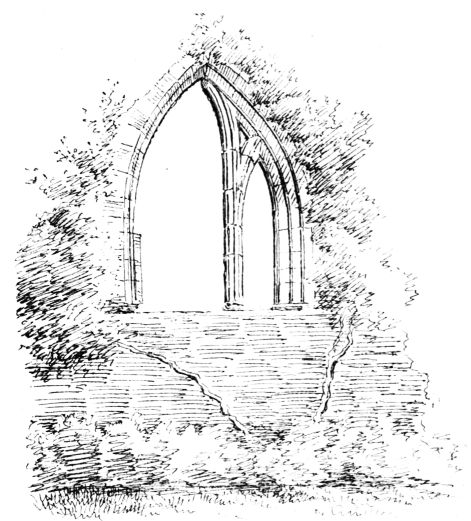
Fig. 1371.—St. Cuthbert’s, Moffat.