KINKELL CHURCH, Aberdeenshire.
Reading edition
A ruinous building, very prettily situated on the left bank of the Don, about three miles north from Kintore. Kinkell was once, as its name signifies, the head church of the district, and had under it six subordinate churches. In 1754 the Lords Commissioners for plantation of kirks annexed one third of the parish of Kinkell to that of Kintore, the remainder going to augment the parish of Keithhall. In 1771 the Church
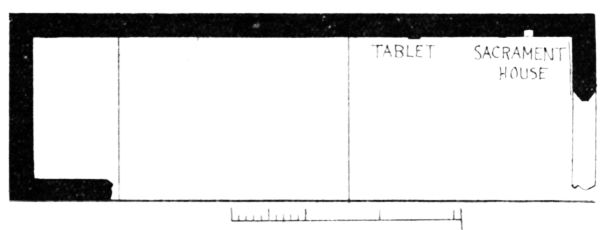
Fig. 1316.—Kinkell Church. Plan.
of Kinkell was unroofed in order to supply materials for use in the Church of Keithhall. The Church of Kinkell was remarkable for its fine design and workmanship, and contained several monuments and sculptures; but it is now sadly ruined, only the north wall and parts of the east and west walls remaining.
The edifice (Fig. 1316) was a simple oblong 73 feet in length by 18 feet 6 inches in width internally. There has been a large east window, only one jamb of which partially remains, and there are no other window or door openings preserved. The north wall seems to have been entirely without openings. A large modern burial vault has been erected in the centre of the church.
One or two features of the former fine ornamentation of the structure still remain in situ, but other portions have been removed, and are now to be found elsewhere, as will be pointed out.
In the north wall near the east end is a fine sacrament house (Fig. 1317). The design consists, as usual in these details, of a buttress on each side of the ambry, with crocketed finials, the carving of which is of a late style. Between the pinnacles is a panel which seems to have been
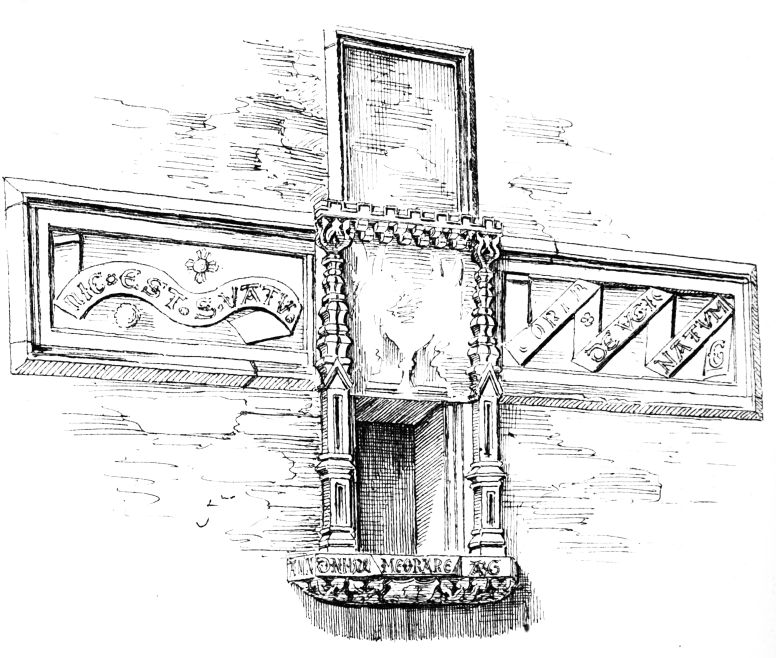
Fig. 1317.—Kinkell Church. Sacrament House.
ornamented with the usual monstrance supported by two angels, but the carving is nearly obliterated. Above this panel there runs a small crenelated parapet, supported by a double row of corbels. Immediately over the parapet is an oblong panel, which doubtless contained a Crucifixion or similar sculpture, but it is now empty.
To the right and left of the pinnacles are two panels, each containing a ribbon of different design. That on the left bears the inscription “Hic est Svatv,” and that on the right the words “Corps de Vigie Natum,” which may be read, “Hic est servatum corpus de Virgine Natum.”
On the base of the ambry are the letters Ano. Dni. 1528, in the centre Meorare, and on the right the initials A. and G. united by a cord. The letter G. also occurs at the end of the inscription in the right hand panel, and is probably a repetition of the last letter of the initials A. G.
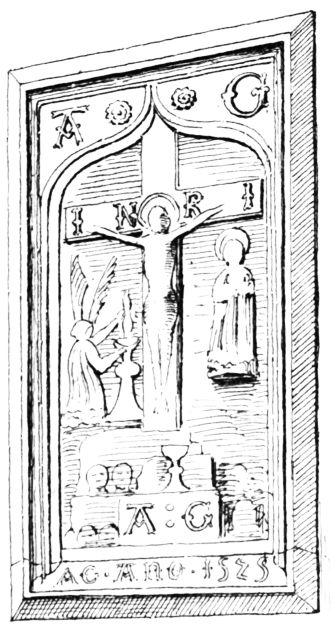
Fig. 1318.—Kinkell Church.
Panel in North Wall of Church.
The base is supported on a continuous corbel carved with foliage, and has in the centre a shield, bearing a lion rampant.
The initials A. G. twice repeated and the date, together with the late style of the work, point to the sacrament house having been designed by Alexander Galloway, who was rector of Kinkell in 1528, and who was also the architect of the first bridge of ten arches over the Dee at Aberdeen.
Another panel (Fig. 1318) is built into the north wall of the church a little to the west of the sacrament house. It contains a Crucifixion, with a figure of the Virgin Mary on one side and an angel on the other. The initials of Alexander Galloway occur three times on this sculpture, and the date 1525.
The font which was removed from the Church of Kinkell long stood in a garden, but is now restored and placed in St. John’s Episcopal Church, Aberdeen. Of the original font only the granite basin now exists. It is octagonal in form, and each face is illustrated with one or more sacred emblems, as shown in Fig. 1319, except one face, on which occur the initials of Alexander Galloway, parson of Kinkell. He was one of the best known ecclesiastics in Scotland before the Reformation, and gifted this font to the Church of Kinkell. Galloway appears to have been one of the most able public men of his time, of whom Boece says,[148] “He was so great a favourite
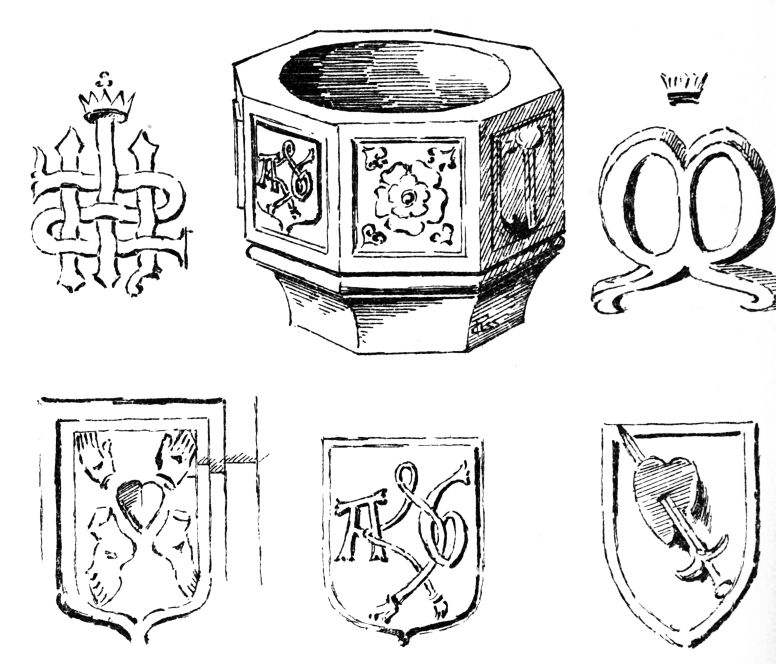
Fig. 1319.—Kinkell Church. Font.
with the Bishop (Elphinston) that none of his concerns of moment were transacted without him.”