SANQUHAR CHURCH, Dumfriesshire.
Reading edition
The old church of Sanquhar was demolished in 1827, and the present church was built partly on its site, as indicated by the dotted lines shown
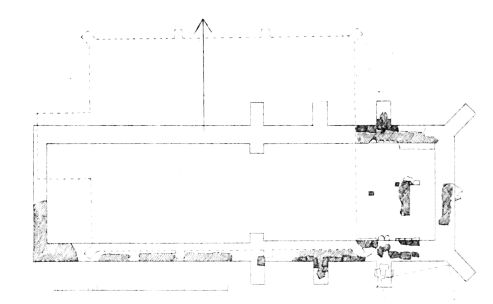
Fig. 1372.—Sanquhar Church. Plan.
on the Plan (Fig. 1372). In 1895 Lord Bute had excavations made, which partly revealed the Plan now submitted.[173]
The position of the east wall was thus determined, as likewise that of the east end of the north wall with one buttress, and considerable portions of the south wall throughout its whole length, with indications of three buttresses and the return of the west wall at the south-west
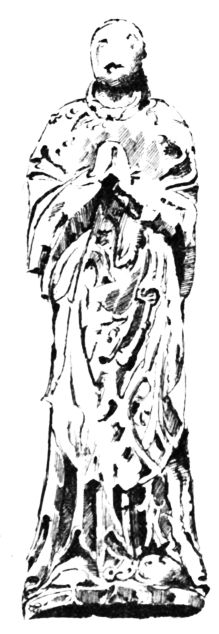
Fig. 1373.—Sanquhar Church.
Effigy.
corner. The dimensions of the building were ascertained to be about 96 feet from east to west by about 30 feet 6 inches from north to south over the walls. The angle buttresses shown at the east end are conjectural, and are based on a tradition that the corners of the existing church were copied from the form of the east end of the old church.
Mr. Schultz states that an old burial list, of which the date is uncertain, but which may be of the seventeenth or early eighteenth century, alludes to certain graves which can still be recognised as so many feet from the “queer pillar” (buttress), i.e., the buttress opposite which the chancel arch is represented. Mr. Schultz assumes from this that the choir or “queer” extended as far as this buttress; and the fact that a splayed base was found all along the choir wall as far as this point, and that no such splay existed farther west, gives a certain sanction to the above view, as does also the circumstance that the nave or western part of the building had no buttresses. It is frequently found that the eastern end was treated in a different manner from the west end. A foundation was found inside the building, at a distance of about 6 feet from the east wall, and it is conjectured that this may represent the seat of an altar. The windows, of which several stones were found, appear to have had single mullions with simple pointed arches.
Although only demolished in this century, there does not appear to be any view of the old church known. It is described by Symson, in his Large Description of Galloway, “as a considerable and large fabrick, consisting of a spacious church and stately quire, where are the tombs of the Lord Crichtons of Sanquhar, wrought in freestone, and before them some Lords of the name of Ross.”[174]
The effigy of an ecclesiastic (Fig. 1373) was taken from Sanquhar to Friars Carse when the old church was demolished, but it has recently been brought back by Lord Bute.