OLD DAILLY CHURCH, Ayrshire.
Reading edition
A ruin situated in the vale of the Girvan Water, about three miles east from Girvan. It stands in the centre of a spacious churchyard, planted with noble trees. Within its walls rest the remains of several of the Martyrs of the Covenant. The church was anciently called Dalmakervan, and was dedicated to St. Michael. It was granted by Duncan, first Earl of Carrick, to the monks of Paisley, and confirmed to them by Alexander II. in 1236. It was afterwards transferred to the monks of Crosraguel, and the name was changed to Dailly, possibly from the site of the church having been changed.
The structure (Fig. 1328) is very long and narrow, being 92 feet in length and 26 feet wide over the walls. There is a gable wall at each end, and each gable is crowned with a belfry (Fig. 1329). It is difficult to account for the presence of the two belfries. That on the east gable is the more
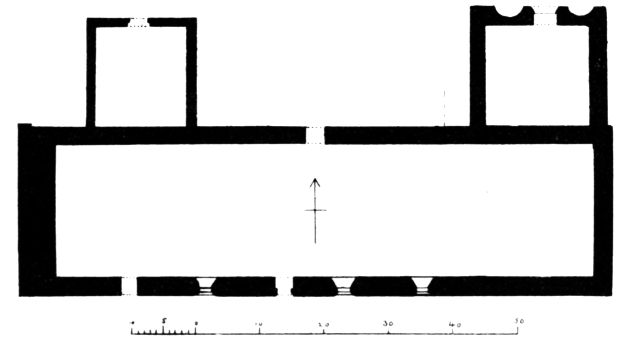
Fig. 1328.—Old Dailly Church. Plan.
ornamental of the two, but its ornament is obscured by ivy. The western belfry is plain and rather ruinous. The walls contain no doorways, and
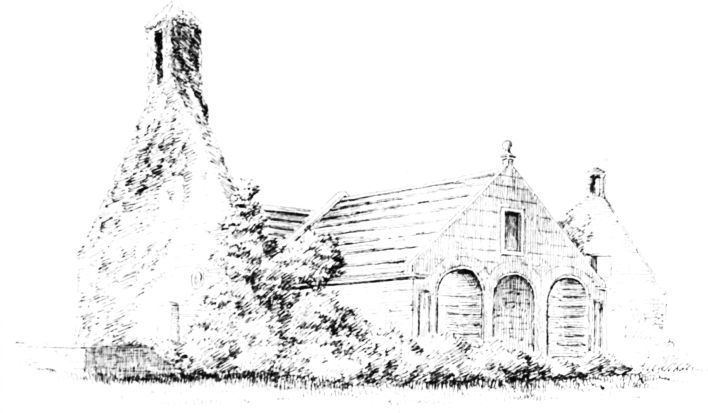
Fig. 1329.—Old Dailly Church. View from North-East.
only part of one window. From the details of the latter, the work seems to be of the seventeenth century, but the walls may be older. A new church was erected at New Dailly, and divine service transferred to it in 1696, since which period the old church has fallen into ruin.
A burial vault has been constructed within the east part of the building, in connection with the Bargeny Estate, which adjoins. Another similar vault for the use of the Killochan Estate, situated on the opposite side of the Girvan Water, has been erected at the north-east angle of the church (see Fig. 1329). It is evidently a seventeenth century structure. The north front is peculiar, having a deep niche on each side of the doorway. The latter is now built up.