LOUDOUN CHURCH, Galston, Ayrshire.[244]
Reading edition
LOUDOUN CHURCH, Galston, Ayrshire.[244]
This was originally a structure of the first pointed period, but it is now in a state of complete ruin, except the choir, which has been fitted up in the seventeenth century as a burial vault.
The west gable stands nearly entire, but the side walls are completely demolished, except at the choir (Fig. 1566). The building is externally
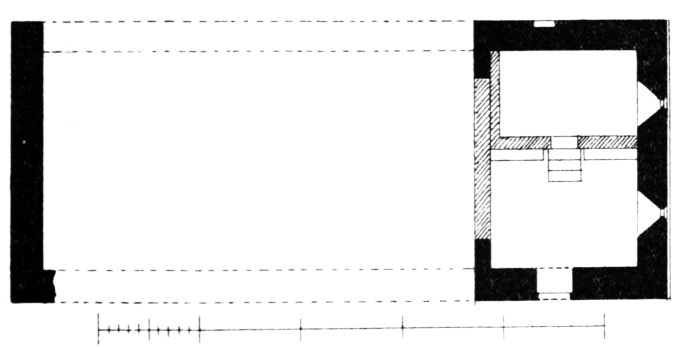
Fig. 1566.—Loudoun Church. Plan.
64 feet long by 27 feet wide. The choir is about 14 feet 9 inches long, and is separated from the nave by a plain round arch 15 feet 6 inches wide (Fig. 1567). In the east wall (Fig. 1568) there are two pointed windows about 10 inches wide, with slight splays on the outside, and widely splayed inside (Fig. 1569), where they are finished with round arches. There are two set-offs on the east wall, and the same occur on the west wall. The structure has been greatly modified in the seventeenth century. The south doorway into the choir and the window, with
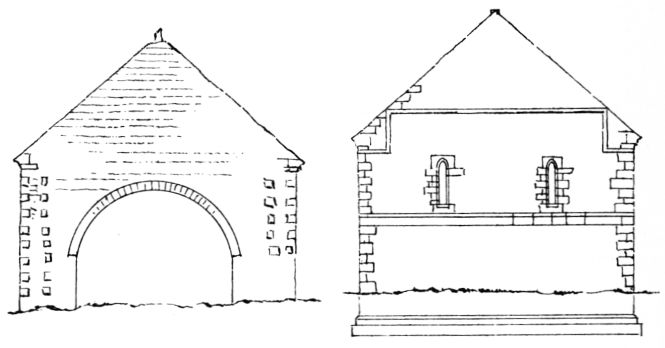
Fig. 1567.—Loudoun Church. Chancel Arch. Fig. 1568.—Loudoun Church. Elevation of East End.
panels and arms (Fig. 1570), are probably all insertions of that period, as also is the vault seen in the drawings. The ground has accumulated
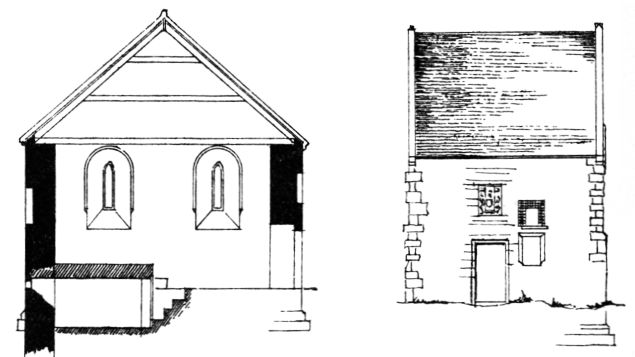
Fig. 1569.—Loudoun Church. Section, looking East. Fig. 1570.—Loudoun Church. South Doorway, &c.
round the church so that the splayed base seen in Mr. Schultz’s drawings is now buried to the extent of about 2 feet.
The masonry of the ruin is of fine ashlar, in regular courses.