EASSIE AND NEVAY, Forfarshire.
Reading edition
Two ruined parish churches, each in its churchyard, situated within two miles of each other and about nine miles south-west of Forfar. They are small buildings, measuring respectively 56 feet 6 inches by 15 feet 6 inches, and 53 feet 6 inches by 18 feet 6 inches within the walls (Fig. 1535). Neither church has any openings in the north wall. At Eassie (Fig. 1536) all the doors and windows are square-headed, and at Nevay they are the same, except that the west doorway is round-headed, but not arched, being cut out of one stone. At Eassie the westmost doorway on the south side is of eighteenth century work, but the eastmost one is original. An ivy-mantled belfry crowns the west end of each edifice.
On the lintel of the south door at Nevay there is the date 1695, with the initials D. N. between the first two and last two figures. These are
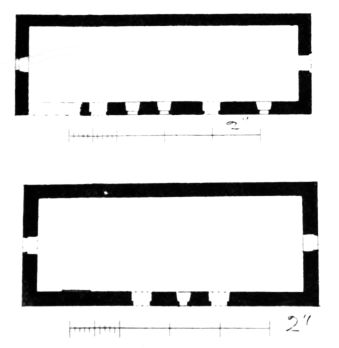
Fig. 1535.—Eassie and Nevay Churches. Plans.
doubtless the initials of David of Nevay, whose father, a Senator of the College of Justice, died shortly before this date. The church, however,
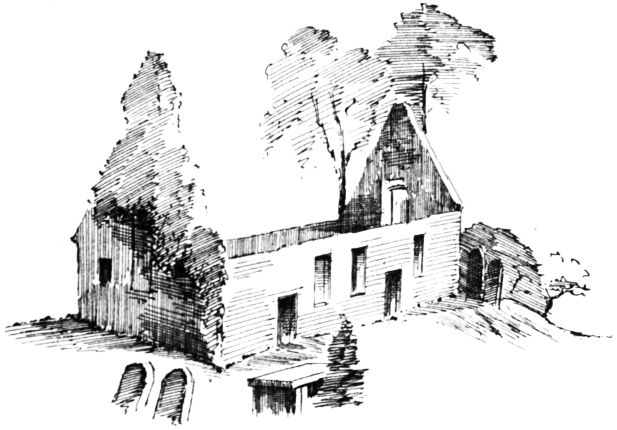
Fig. 1536.—Eassie Church.
appears to be of earlier date, as a tombstone of 1597 is built into its walls.
These churches were in the diocese of St. Andrews, and in 1309 “Robert I. gave the advocation and donation of the Kirk of Eassie to the Monks of Newbottle.[231]”
St. Neveth, martyr, to whom the church was dedicated, and from whom it received its name, was a bishop “in the north,” who was slain by the Saxons and the Picts, and Bishop Forbes[232] suggests that the martyr was buried at Nevay.
Eassie was dedicated to St. Brandon.
At Eassie Church there is one of the finest of the Scottish sculptured stones.