EAST CALDER CHURCH, Mid-Lothian.
Reading edition
This edifice was the parish church of East Calder till 1750, when a new church was erected at Kirknewton, and East Calder was united with that parish. These two parishes lie about ten miles west from Edinburgh.
The Church of East Calder was dedicated to St. Cuthbert. At the accession of William the Lion the church was granted to the monks of Kelso. This parish was formerly called Calder-Clere, to distinguish it from
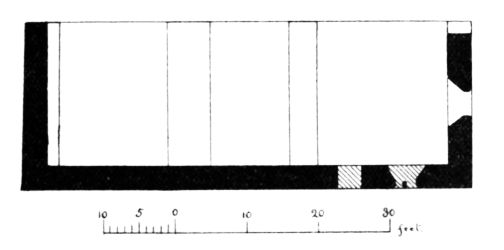
Fig. 1533.—East Calder Church. Plan.
Mid-Calder, which lies about one mile west of it, on the opposite side of the river Almond. The church, which is now a ruin, stands in its old churchyard. It is a simple oblong (Fig. 1533), internally 56 feet in length by 17 feet in width. The north wall has been removed, and the interior divided into burial-places, separated by walls and railings. The doorways and windows have been built up, and few of the wall openings can now be seen. One window is still partly preserved in the east end (Fig. 1534). It has evidently been divided into two lights by a mullion, which is removed, and each light has had a round-arched head. Another window in the south wall, near the east end, is of similar form. The mullion and round heads of the opening have been preserved by being built up. A doorway, also built up, adjoins the window in the south wall on the west.
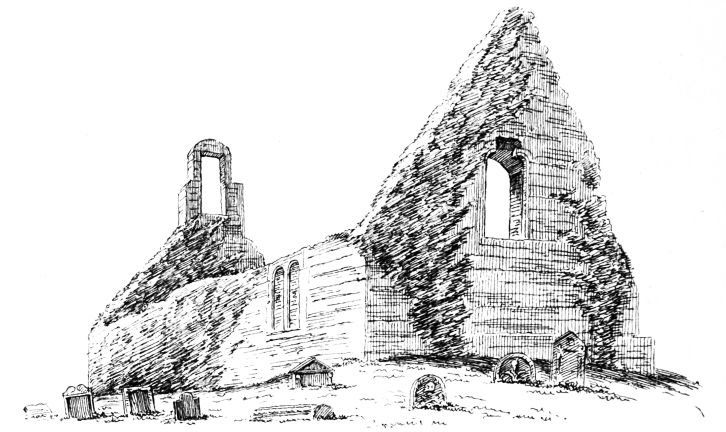
Fig. 1534.—East Calder Church. View from South-East.
There may be other built up openings, but the wall is so thickly covered with ivy that they cannot be identified. The belfry on the west gable is plain, and evidently late in date. The few details which survive indicate a post-Reformation style, probably of about 1600.