AUCHTERARDER CHURCH, Perthshire.
Reading edition
This old church is situated a little to the north of the town, and is surrounded by an old churchyard. It is densely ivy clad and generally
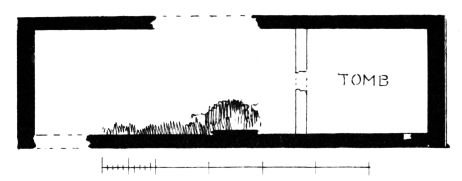
Fig. 1441.—Auchterarder Church. Plan.
concealed by vegetation, and thoroughly neglected. The church (Fig. 1441) measures about 81 feet long by about 24 feet 6 inches wide externally. There is almost no architectural feature now
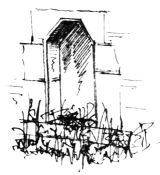
Fig. 1442.
Auchterarder Church.
Piscina.
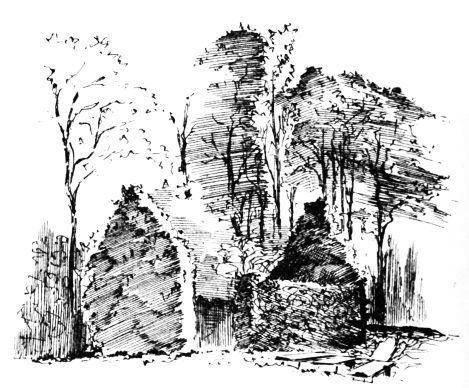
Fig. 1443.—Auchterarder Church. View from South-West.
visible except a piscina (Fig. 1442) in the usual place in the south wall near the east end, which part of the building is walled off as a tomb house. The piscina is triangular headed, somewhat like the one in the choir of Paisley Abbey. It is only visible through a chink in the door of the tomb. There has been some kind of projection in the south wall near the centre, but owing to vegetation and rubbish (Fig. 1443) it cannot be properly examined, nor for the same reason can anything be made out regarding any openings in the south wall. Both of the side walls are considerably ruined. There is a slightly projecting splayed base at the east wall, with the usual set-off just below the gable.
The edifice was dedicated to St. Mechessock, and in 1198 the church of Auchterarder was given by Gilbert, third Earl of Strathearn, to the Abbey of Inchaffray, but the existing ruin belongs to a much later age.
A well at a short distance south from the church still bears “St. M‘Kessog’s” name, and on his day (10th March) the principal fair of the town is held.[198] The church was served by a parochial curate appointed by the Abbot of Inchaffray.