ORMISTON CHURCH, Haddingtonshire.
Reading edition
Only a small portion of the old church of Ormiston, in which Wishart and Knox more than once officiated, has been preserved. It stands close to the mansion house of Ormiston Hall, about one mile south from the village of Ormiston. A new church having been erected about a quarter of a mile distant, the old church has been allowed to go to decay. The surviving fragment of the latter appears to have been the east end. There are several stones built into the walls which must have belonged to a Norman church, being carved with the chevron ornament.
The Church of Ormiston was dedicated to St. Giles. It was granted to the Hospital of Soltre, founded by Malcolm IV., which was confirmed by the Bishop of St. Andrews in the thirteenth century.
This church was subsequently made a prebend of the Church of the Holy Trinity at Edinburgh, founded by Mary of Gueldres.
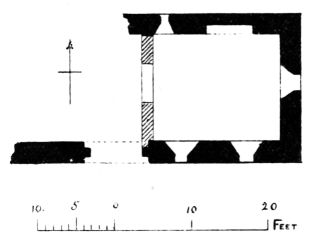
Fig. 1579.—Ormiston Church. Plan.
The building (Fig. 1579) has been enclosed at the west end with a modern wall, and measures, within the enclosure, 16 feet 6 inches in length by 13 feet 6 inches in width. It contains in the south wall the outlines of two windows, now built up, and of one window in the north wall. These have apparently been altered at some time and made square-headed. An archway of considerable height (Fig. 1580) stands in the continuation of the south wall westwards. It is in two orders, the outer order square and the inner order splayed. This doorway has apparently entered into the church, which, judging from the height of the archway, must have had side walls of considerable height. They are now reduced as shown, and a roof was put upon the east portion during this century, which renders the interior very dark.
In the north wall of the chancel there is a monument of some importance (Fig. 1581), as it contains one of the few brasses which exist in Scotland. The brass consists of an engraved plate containing an inscription to the memory of Alexander Cockburn, one of the members of the family to whom the adjoining mansion house belonged. He died, as the inscription tells, at an early age. The upper part of the inscription is metrical, and was composed by the learned George Buchanan, and
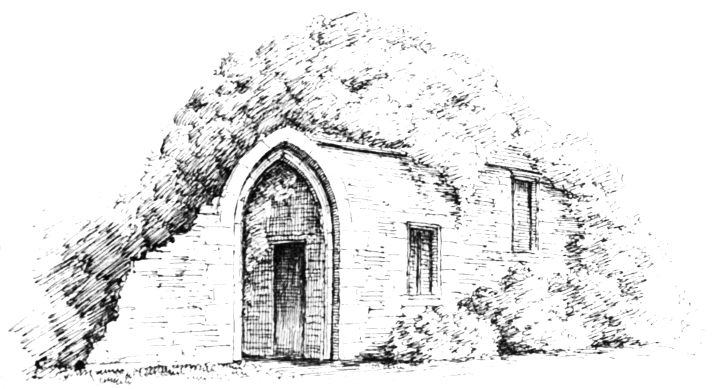
Fig. 1580.—Ormiston Church. South Side.
appears in his published works. Alexander Cockburn was a pupil of John Knox, and in 1547 sought refuge in the Castle of St. Andrews. On the dexter base of the brass are engraved the Cockburn arms, and on the sinister base the arms of Sandilands, for the mother of a Cockburn, who was of the family of Sandilands of Calder. These arms are quartered with the arms of Douglas, and show the ancient relationship between that family and the Sandilands.[249]
The barony of Ormiston was the property of the Cockburns from the middle of the fourteenth century, when they acquired it by marriage.
The monument was no doubt erected not long after the death of the person commemorated, or towards the end of the sixteenth century. It corresponds in style with that of the Regent Murray, in St. Giles’ Cathedral,
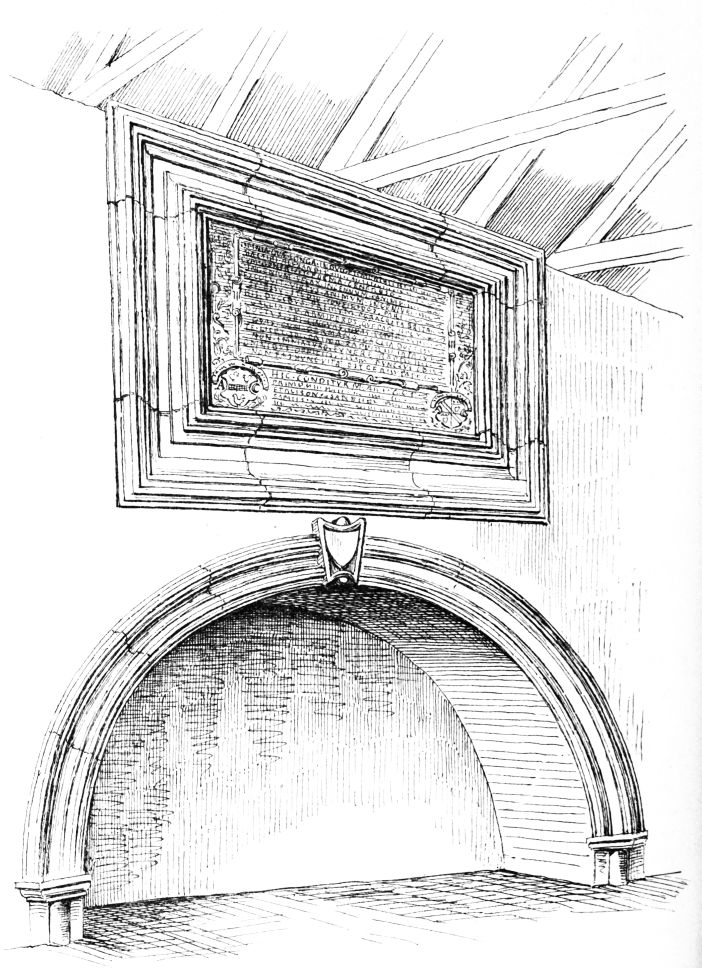
Fig. 1581.—Ormiston Church. Monument to Alexander Cockburn.
Edinburgh[250] (1570), the inscription on which was also composed by George Buchanan. That at Ormiston is as follows:—
Omnia quæ longa indulget mortalibus ætas Haec tibi Alexander prima juventa dedit Cum genere et forma generoso sanguine digna Ingenium velox, ingenuumque animum Excolint virtus animum ingeniumque Camenae Successu studio consilioque pari His ducibus primum Peragrata Britannia deinde Gallia ad armiferos qua patet Helvetios Doctus ibi linguas quas Roma Sionet Athenae Quas cum Germano Gallia docta sonat Te licet in prima rapuerunt fata juventa Nonimmaturo funera raptus obis Omnibus officiis vitae qui functus obivit Non fas nunc vitae est de brevitate queri Hic conditur Mr. Alexander Cokburn primogenitua Joannis domini Ormiston et Alisonae Sandilands ex preclara familia Calder, qui natus 13 Januarii 1535 post insignem linguarum professionem Obiit anno ætatis suae 28 Calen. Septe.[251]