W.
Reading edition
WACKE, is a massive mineral, intermediate between claystone and basalt. It is of a greenish-gray colour; vesicular in structure; dull, opaque; streak shining; soft, easily frangible; spec. grav. 2·55 to 2·9; it fuses like basalt.
WADD, is the provincial name of plumbago in Cumberland; and also of an ore of manganese in Derbyshire, which consists of the peroxide of that metal, associated with nearly its own weight of oxide of iron.
WADDING (Ouate, Fr.; Watte, Germ.); is the spongy web which serves to line ladies’ pelisses, &c. Ouate, or Wat, was the name originally given to the glossy downy tufts found in the pods of the plant commonly called Apocyn, and by botanists Asclepias syriaca, which was imported from Egypt and Asia Minor for the purpose of stuffing cushions, &c. Wadding is now made with a lap or fleece of cotton prepared by the carding-engine (see Carding, Cotton Manufacture), which is applied to tissue paper by a coat of size, made by boiling the cuttings of hare-skins, and adding a little alum to the gelatinous solution. When two laps are glued with their faces together, they form the most downy kind of wadding.
WAFERS. There are two manners of manufacturing wafers: 1, with wheat flour and water, for the ordinary kind; and 2, with gelatine. 1. A certain quantity of fine flour is to be diffused through pure water, and so mixed as to leave no clotty particles. This thin pap is then coloured with one or other of the matters to be particularly described under the second head; and which are, vermillion, sulphate of indigo, and gamboge. The pap is not allowed to ferment, but must be employed immediately after it is mixed. For this purpose a tool is employed, consisting of two plates of iron, which come together like pincers or a pair of tongs, leaving a certain small definite space betwixt them. These plates are first slightly heated, greased with butter, filled with the pap, closed, and then exposed for a short time to the heat of a charcoal fire. The iron plates being allowed to cool, on opening them, the thin cake appears dry, solid, brittle, and about as thick as a playing-card. By means of annular punches of different sizes, with sharp edges, the cake is cut into wafers. 2. The transparent wafers are made as follows:—
Dissolve fine glue, or isinglass, in such a quantity of water, that the solution, when cold, may be consistent. Let it be poured hot upon a plate of mirror glass, (previously warmed with steam, and slightly greased,) which is fitted in a metallic frame, with edges just as high as the wafers should be thick. A second plate of glass, heated and greased, is laid on the surface, so as to touch every point of the gelatine, resting on the edges of the frame. By this pressure, the thin cake of gelatine is made perfectly uniform. When the two plates of glass get cold, the gelatine becomes solid, and may easily be removed. It is then cut with proper punches into discs of different sizes.
The colouring-matters ought not to be of an insalubrious kind.
For red wafers, carmine is well adapted, when they are not to be transparent; but this colour is dear, and can be used only for the finer kinds. Instead of it, a decoction of brazil wood, brightened with a little alum, may be employed.
For yellow, an infusion of saffron or turmeric has been prescribed; but a decoction of weld, fustic, or Persian berries, might be used.
Sulphate of indigo, partially saturated with potash, is used for the blue wafers; and this mixed with yellow, for the greens. Some recommend the sulphate to be nearly neutralized with chalk, and to treat the liquor with alcohol, in order to obtain the best blue dye for wafers.
Common wafers are, however, coloured with the substances mentioned at the beginning of the article; and for the cheaper kinds, red lead is used instead of vermillion, and turmeric instead of gamboge.
WALNUT HUSKS, or PEELS (Brout des noix, Fr.); are much employed by the French dyers for rooting or giving dun colours.
WARP (Chaine, Fr.; Kette, Auschweif, Zettel, Germ.); is the name of the longitudinal threads or yarns, whether of cotton, linen, silk, or wool, which being decussated at right angles by the woof or weft threads, form a piece of cloth. The warp yarns are parallel, and continuous from end to end of the web. See Weaving, for a description of the warping-mill.
WASH, is the fermented wort of the distiller.
WASHING. See Bleaching, and Scouring.
WATERING OF STUFFS (Moirage, Fr.); is a process to which silk and other textile fabrics are subjected, for causing them to exhibit a variety of undulated reflections, and plays of light. It is produced by sprinkling water upon the goods, and then passing them through a calender, either with cold or hot rollers, plain or variously indented.
WATER-PROOF CLOTH. See Caoutchouc, and Gelatine.
A patent was obtained, in August, 1830, by Mr. Thomas Hancock, for rendering textile fabrics impervious to water and air, by spreading the liquid juice of the caoutchouc tree upon the surfaces of the goods, and then exposing them to the air to dry. It does not appear that this project has been realized in our manufactures.
Mr. William Simpson Potter proposes, in his patent, of April, 1835, to render fabrics water-proof by imbuing them with a solution of isinglass, alum, and soap, by means of a brush applied to the wrong side of the cloth, distended upon a table. After it is dry, it must be brushed on the wrong side, against the grain. Then the brush is to be dipped in clean water, and passed lightly over the cloth. The gloss caused by the above application can be taken off by brushing the goods when they are dry. Cloth so prepared is said to be impervious to water, but not to air.
I have examined woollen cloth now on sale in a shop in the Strand, which may be breathed through with the greatest facility, but which retains water upon its surface, as is evinced by a body of water standing upon a concave piece of it tied over a show-glass in the window.
Mr. Sievier’s plan of rendering cloth water-proof, for which he obtained a patent in December, 1835, consists in spreading over it, with a brush, a solution of India rubber in spirits of turpentine, at one or more applications, and then applying a similar solution mixed with acetate of lead, litharge, sulphate of zinc, gum mastic, or other drying material. He next takes wool, or other textile material, cut into proper lengths, and spreads it upon the surface of the fabric varnished in this manner, for the purpose of forming the nap or pile. He then presses the cloth by means of rollers, or brushes, so as to fix the nap firmly to its surface.
WAX (Cire, Fr.; Wachs, Germ.); is the substance which forms the cells of bees. It was long supposed to be derived from the pollen of plants, swallowed by these insects, and merely voided under this new form; but it has been proved by the experiments, first of Mr. Hunter, and more especially of M. Huber, to be the peculiar secretion of a certain organ, which forms a part of the small sacs, situated on the sides of the median line of the abdomen of the bee. On raising the lower segments of the abdomen, these sacs may be observed, as also scales or spangles of wax, arranged in pairs upon each segment. There are none, however, under the rings of the males and the queen. Each individual has only eight wax sacs, or pouches; for the first and the last ring are not provided with them. M. Huber satisfied himself by precise experiments that bees, though fed with honey, or sugar alone, produced nevertheless a very considerable quantity of wax; thus proving that they were not mere collectors of this substance from the vegetable kingdom. The pollen of plants serves for the nourishment of the larvæ.
But wax exists also as a vegetable product, and may, in this point of view, be regarded as a concrete fixed oil. It forms a part of the green fecula of many plants, particularly of the cabbage; it may be extracted from the pollen of most flowers; as also from the skins of plums, and many stone fruits. It constitutes a varnish upon the upper surface of the leaves of many trees, and it has been observed in the juice of the cow-tree. The berries of the Myrica angustifolia, latifolia, as well as the cerifera, afford abundance of wax.
Bees’ wax, as obtained by washing and melting the comb, is yellow. It has a peculiar smell, resembling honey, and derived from it, for the cells in which no honey has been deposited, yield a scentless white wax. Wax is freed from its impurities, and bleached, by melting it with hot water or steam, in a tinned copper or wooden vessel, letting it settle, running off the clear supernatant oily-looking liquid into an oblong trough with a line of holes in its bottom, so as to distribute it upon horizontal wooden cylinders, made to revolve half immersed in cold water, and then exposing the thin ribbons or films thus obtained to the blanching action of air, light, and moisture. For this purpose, the ribbons are laid upon long webs of canvas stretched horizontally between standards, two feet above the surface of a sheltered field, having a free exposure to the sunbeams. Here they are frequently turned over, then covered by nets to prevent their being blown away by winds, and watered from time to time, like linen upon the grass field in the old method of bleaching. Whenever the colour of the wax seems stationary, it is collected, remelted, and thrown again into ribbons upon the wet cylinder, in order to expose new surfaces to the blanching operation. By several repetitions of these processes, if the weather proves favourable, the wax eventually loses its yellow tint entirely, and becomes fit for forming white candles. If it be finished under rain, it will become gray on keeping, and also lose in weight.
In France, where the purification of wax is a considerable object of manufacture, about four ounces of cream of tartar, or alum, are added to the water in the first melting-copper, and the solution is incorporated with the wax by diligent manipulation. The whole is left at rest for some time, and then the supernatant wax is run off into a settling cistern, whence it is discharged by a stopcock or tap, over the wooden cylinder revolving at the surface of a large water-cistern, kept cool by passing a stream continually through it.
The bleached wax is finally melted, strained through silk sieves, and then run into circular cavities in a moistened table, to be cast or moulded into thin disc pieces, weighing from two to three ounces each, and three or four inches in diameter.
Neither chlorine, nor even the chlorides of lime and alkalis, can be employed with any advantage to bleach wax, because they render it brittle, and impair its burning quality.
Wax purified, as above, is white and translucent in thin segments; it has neither taste nor smell; it has a specific gravity of from 0·960 to 0·966; it does not liquefy till it be heated to 1541⁄2° F.; but it softens at 86°, becoming so plastic, that it may be moulded by the hand into any form. At 32° it is hard and brittle.
It is not a simple substance, but consists of two species of wax, which may be easily separated by boiling alcohol. The resulting solution deposits, on cooling, the waxy body called cerine. The undissolved wax, being once and again treated with boiling alcohol, finally affords from 70 to 90 per cent. of its weight of cerine. The insoluble residuum is the myricine of Dr. John, so called because it exists in a much larger proportion in the wax of the Myrica cerifera. It is greatly denser than wax, being of the same specific gravity as water; and may be distilled without decomposition, which cerine undergoes. See these two articles.
Wax is adulterated sometimes with starch; a fraud easily detected by oil of turpentine, which dissolves the former, and leaves the latter substance; and more frequently with mutton suet. This fraud may be discovered by dry distillation; for wax does not thereby afford, like tallow, sebacic acid (benzoic), which is known by its occasioning a precipitate in a solution of acetate of lead. It is said that two per cent. of a tallow sophistication may be discovered in this way.
Bees’ wax imported for home consumption:—in 1835, unbleached, 4,449 cwts.; bleached, 243 cwts.;—in 1836, unbleached, 4,673 cwts.; bleached, 121 cwts. Duty, when from British possessions, 10s.; from foreign, 30s.
WAX, MINERAL, or Ozocerite, is a solid, of a brown colour, of various shades, translucent, and fusible like bees’ wax; slightly bituminous to the smell, of a foliated texture, a conchoidal fracture, but wanting tenacity, so that it can be pulverized in a mortar. Its specific gravity varies from 0·900 to 0·953. Candles have been made of it in Moldavia, which give a tolerable light. It occurs at the foot of the Carpathians near Slanik, beneath a bed of bituminous slate-clay, in masses of from 80 to 100 pounds weight. Layers of brown amber are found in the neighbourhood. It is associated with variegated sandstone, rock salt, and beds of coal (lignite?). It is analogous to hatchetine. Something similar has been discovered in a trouble at Urpeth colliery, near Newcastle, 60 fathoms beneath the surface. Ozocerite consists of different hydro-carburetted compounds associated together; the whole being composed, ultimately, of—hydrogen 14, carbon 86, very nearly.
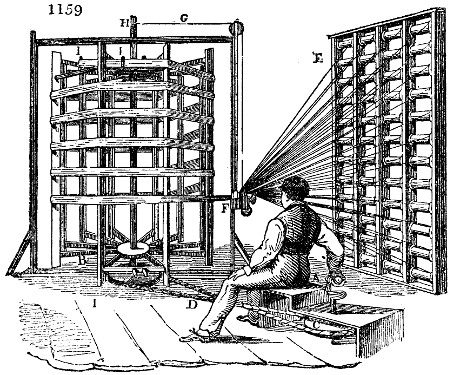
WEAVING (Tissage, Fr.; Weberei, Germ.); is performed by the implement called loom in English, métier à tisser in French, and weberstuhl in German. The process of warping must always precede weaving. Its object is to arrange all the longitudinal threads, which are to form the chain of the web, alongside of each other in one parallel plane. Such a number of bobbins, filled with yarn, must therefore be taken as will furnish the quantity required for the length of the intended piece of cloth. One-sixth of that number of bobbins is usually mounted at once in the warp mill, being set loosely in a horizontal direction upon wire skewers, or spindles, in a square frame, so that they may revolve, and give off the yarn freely. The warper sits at A, fig. 1159., and causes the reel B to revolve, by turning round with his hand the wheel C, with the endless rope or band D. The bobbins filled with yarn are placed in the frame E. There is a sliding piece at F, called the heck box, which rises and falls by the coiling and uncoiling of the cord G, round the central shaft of the reef H. By this simple contrivance, the band of warp-yarns is wound spirally, from top to bottom, upon the reel. I, I, I, are wooden pins which separate the different bands. Most warping mills are of a prismatic form; having twelve, eighteen, or more sides. The reel is commonly about six feet in diameter, and seven feet in height, so as to serve for measuring exactly upon its periphery the total length of the warp. All the threads from the frame E, pass through the heck F, which consists of a series of finely-polished hard-tempered steel pins, with a small hole at the upper part of each, to receive and guide one thread. The heck is divided into two parts, either of which may be lifted by a small handle below, while their eyes are placed alternately. Hence, when one of them is raised a little, a vacuity is formed between the two bands of the warp; but when the other is raised, the vacuity is reversed. In this way, the lease is produced at each end of the warp, and it is preserved by appropriate wooden pegs. The lease being carefully tied up, affords a guide to the weaver for inserting his lease-rods. The warping mill is turned alternately from right to left, and from left to right, till a sufficient number of yarns are coiled round it to form the breadth that is wanted; the warper’s principal care being to tie immediately every thread as it breaks, otherwise deficiencies would be occasioned in the chain, injurious to the appearance of the web, or productive of much annoyance to the weaver.
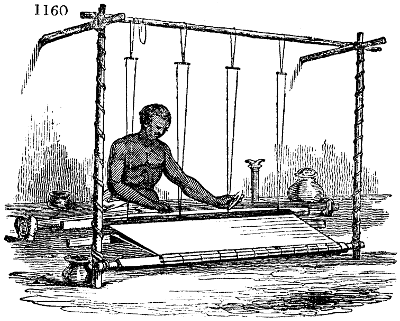
The simplest and probably the most antient of looms, now to be seen in action, is that of the Hindu tanty, shown in fig. 1160. It consists of two bamboo rollers; one for the warp, and another for the woven cloth; with a pair of heddles, for parting the warp, to permit the weft to be drawn across between its upper and under threads. The shuttle is a slender rod, like a large netting needle, rather longer than the web is broad, and is made use of as a batten or lay, to strike home or condense each successive thread of weft, against the closed fabric. The Hindu carries this simple implement, with his water pitcher, rice pot, and hooka, to the foot of any tree which can afford him a comfortable shade; he there digs a large hole, to receive his legs, along with the treddles or lower part of the harness; he next extends his warp, by fastening his two bamboo rollers, at a proper distance from each other, with pins, into the sward; he attaches the heddles to a convenient branch of the tree overhead; inserts his great toes into two loops under the geer, to serve him for treddles; lastly, he sheds the warp, draws through the weft, and beats it close up to the web with his rod-shuttle or batten.
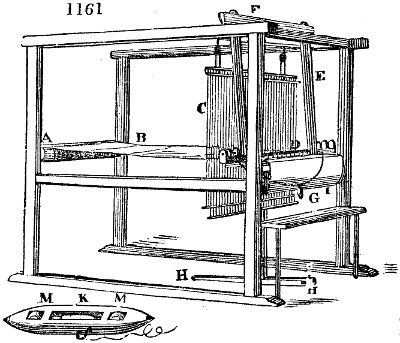
The European loom is represented in its plainest state, as it has existed for several centuries, in fig. 1161. A is the warp-beam, round which the chain, has been wound; B represents the flat rods, usually three in number, which pass across between its threads, to preserve the lease, or the plane of decussation for the weft; C shows the heddles or healds, consisting of twines looped in the middle, through which loops, the warp yarns are drawn, one half through the front heddle, and the other through the back one; by moving which, the decussation is readily effected. The yarns then pass through the dents of the REED under D, which is set in a movable swing-frame E, called the lathe, lay, and also batten, because it beats home the weft to the web. The lay is freely suspended to a cross-bar F, attached by rulers, called the swords, to the top of the lateral standards of the loom, so as to oscillate upon it. The weaver, sitting on the bench G, presses down one of the treddles at H, with one of his feet, whereby he raises the corresponding heddle, but sinks the alternate one; thus sheds the warp, by lifting and depressing each alternate thread, through a little space, and opens a pathway or race-course for the shuttle to traverse the middle of the warp, upon its two friction rollers M, M. For this purpose, he lays hold of the picking-peg in his right hand, and, with a smart jerk of his wrist, drives the fly-shuttle swiftly from one side of the loom to the other, between the shed warp yarns. The shoot of weft being thereby left behind from the shuttle pirn or cop, the weaver brings home, by pulling, the lay with its reed towards him by his left hand, with such force as the closeness of the texture requires. The web, as thus woven, is wound up by turning round the cloth beam I, furnished with a ratchet-wheel, which takes into a holding tooth. The plan of throwing the shuttle by the picking-peg and cord, is a great improvement upon the old way of throwing it by hand. It was contrived exactly a century ago, by John Kay, of Bury in Lancashire, but then resident in Colchester, and was called the fly-shuttle, from its speed, as it enabled the weaver to make double the quantity of narrow cloth, and much more broad cloth, in the same time.
The cloth is kept distended, during the operation of weaving, by means of two pieces of hard wood, called a templet, furnished with sharp iron points in their ends, which take hold of the opposite selvages or lists of the web. The warp and web are kept longitudinally stretched by a weighted cord, which passes round the warp-beam, and which tends continually to draw back the cloth from its beam, where it is held fast by the ratchet tooth. See Fustian, Jacquard Loom, Reed, and Textile Fabrics.
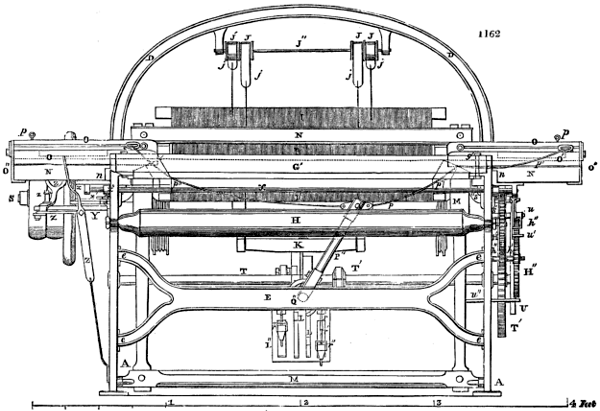
Fig. 1162 enlarged (195 kB)
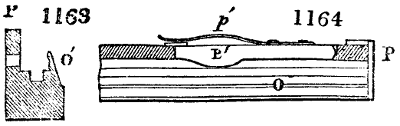
The greater part of plain weaving, and much even of the figured, is now performed by the power loom, called métier mécanique à tisser, in French. Fig. 1162. represents the cast-iron power loom of Sharp and Roberts. A, A′, are the two side uprights, or standards, on the front of the loom. D, is the great arch of cast iron, which binds the two sides together. E, is the front cross-beam, terminating in the forks e, e; whose ends are bolted to the opposite standards A, A′, so as to bind the framework most firmly together. G′, is the breast beam, of wood, nearly square; its upper surface is sloped a little towards the front, and its edge rounded off, for the web to slide smoothly over it, in its progress to the cloth beam. The beam is supported at its end upon brackets, and is secured by the bolts g′, g′. H, is the cloth beam, a wooden cylinder, mounted with iron gudgeons at its ends, that on the right hand being prolonged to carry the toothed winding wheel H′. k′ is a pinion in geer with H′. H′′, is a ratchet wheel, mounted upon the same shaft h′′′, as the pinion h′. h′, is the click of the ratchet wheel H′′. k′′′, is a long bolt fixed to the frame, serving as a shaft to the ratchet wheel H′′, and the pinion h′. I, is the front heddle-leaf, and I′, the back one. J, J, J′, J′, jacks or pulleys and straps, for raising and depressing the leaves of the heddles. J′′, is the iron shaft which carries the jacks or system of pulleys J, J, J′, J′. K, a strong wooden ruler, connecting the front heddle with its treddle. L, L′, the front and rear marches or treddle-pieces, for depressing the heddle leaves alternately, by the intervention of the rods k, (and k′, hid behind k). M, M, are the two swords (swing bars) of the lay or batten. N, is the upper cross-bar of the lay, made of wood, and supported upon the squares of the levers n, n′, to which it is firmly bolted. N′, is the lay-cap, which is placed higher or lower, according to the breadth of the reed; it is the part of the lay which the hand-loom weaver seizes with his hand, in order to swing it towards him. n′, is the reed contained between the bar N, and the lay-cap N′. O, O, are two rods of iron, perfectly round and straight, mounted near the ends of the batten-bar N, which serve as guides to the drivers or peckers o, o, which impel the shuttle. These are made of buffalo hide, and should slide freely on their guide-rods. O′, O′, are the fronts of the shuttle-boxes; they have a slight inclination backwards. P, is the back of them. See figs. 1163. and 1164. O′′, O′′ are iron plates, forming the bottoms of the shuttle-boxes. p, small pegs or pins, planted in the posterior faces P (fig. 1164.) of the boxes, round which the levers P′ turn. These levers are sunk in the substance of the faces P, turn round pegs p, being pressed from without inwards, by the springs p′. P′′, fig. 1162. (to the right of K,) is the whip or lever, (and Q′′, its centre of motion, corresponding to the right arm and elbow of the weaver,) which serves to throw the shuttle, by means of the pecking-cord p′′, attached at its other end to the drivers o, o.
On the axis of Q′′, a kind of eccentric or heart wheel is mounted, to whose concave part, the middle of the double band or strap r, being attached, receives impulsion; its two ends are attached to the heads of the bolts r′, which carry the stirrups r′′, that may be adjusted at any suitable height, by set screws.
S (see the left-hand side of fig. 1162.), is the moving shaft, of wrought iron, resting on the two ends of the frame, S′ (see the right-hand side), is a toothed wheel, mounted exteriorly to the frame, upon the end of the shaft S. S′′ (near S′), are two equal elbows, in the same direction, and in the same plane, as the shaft S, opposite to the swords M, M, of the lay.
Z, is the loose, and Z′, the fast pulley, or riggers, which receive motion from the steam-shaft of the factory, Z′′, a small fly-wheel, to regulate the movements of the main shaft of the loom.
T, is the shaft of the eccentric tappets, cams, or wipers, which press the treddle levers alternately up and down; on its right end is mounted T′, a toothed wheel in geer with the wheel S′, of one half its diameter. T′′, is a cleft clamping collar, which serves to support the shaft T.
U, is a lever, which turns round the bolt u, as well as the click h′′. U′, is the click of traction, for turning round the cloth beam, jointed to the upper extremity of the lever U; its tooth u′, catches in the teeth of the ratchet wheel H′′. u′′, is a long slender rod, fixed to one of the swords of the lay M, serving to push the lower end of the lever U, when the lay retires towards the heddle leaves.
X, is a wrought-iron shaft, extending from the one shuttle-box to the other, supported at its ends by the bearings x, x.
Y, is a bearing, affixed exteriorly to the frame, against which the spring bar Z, rests, near its top, but is fixed to the frame at its bottom. The spring falls into a notch in the bar Y, and is thereby held at a distance from the upright A, as long as the band is upon the loose pulley z′; but when the spring bar is disengaged, it falls towards A, and carries the band upon the fast pulley z, so as to put the loom in geer with the steam-shaft of the factory.
Weaving, by this powerful machine, consists of four operations: 1. to shed the warp by means of the heddle leaves, actuated by the tappet wheels upon the axis Q′, the rods k, k′, the cross-bar E, and the eyes of the heddle leaves I, I′; 2. to throw the shuttle (see fig. 1161.), by means of the whip lever P′′, the driver cord p, and the pecker o; 3. to drive home the weft by the batten N, N′; 4. to unwind the chain from the warp beam, and to draw it progressively forwards, and wind the finished web upon the cloth beam H, by the click and toothed wheel mechanism at the right-hand side of the frame. For more minute details, the reader may consult The Cotton Manufacture of Great Britain, vol. ii. p. 291.
WEFT (Trame, Fr.; Eintrag, Germ.); is the name of the yarns or threads which run from selvage to selvage in a web.
WELD (Vouëde, Fr.; Wau, Gelbkraut, Germ.); is an annual herbaceous plant, which grows all over Europe, called by botanists Reseda luteola. The stems and the leaves dye yellow; and among the dyes of organic nature, they rank next to the Persian berry for the beauty and fastness of colour. The whole plant is cropped when in seed, at which period its dyeing power is greatest; and after being simply dried, is brought into the market.
Chevreul has discovered a yellow colouring principle in weld, which he has called luteoline. It may be sublimed, and thus obtained in long needle-form, transparent yellow crystals. Luteoline is but sparingly soluble in water; but it nevertheless dyes alumed silk and wool of a fine jonquil colour. It is soluble in alcohol and ether; it combines with acids, and especially with bases.
When weld is to be employed in the dye-bath, it should be boiled for three quarters of an hour; after which the exhausted plant is taken out, because it occupies too much room. The decoction is rapidly decomposed in the air, and ought therefore to be made only when it is wanted. It produces with,
Solution of isinglass a slight turbidity.
Litmus paper a faint reddening.
Potash lye a golden yellow tint.
Solution of alum a faint yellow.
Protoxide salts of tin a rich yellow - precipitation.
Acetate of lead ditto
Salts of copper a dirty yellow-brown
Sulphate of red oxide of iron a brown, passing into olive.
A lack is made from decoction of weld with alum, precipitated by carbonate of soda or potassa. See Yellow Dye.
WELDING (Souder, Fr.; Schweissen, Germ.); is the property which pieces of wrought iron possess, when heated to whiteness, of uniting intimately and permanently under the hammer, into one body, without any appearance of junction. The welding temperature is usually estimated at from 60° to 90° of Wedgewood. When a skilful blacksmith is about to perform the welding operation, he watches minutely the effect of the heat in his forge-fire upon the two iron bars; and if he perceives them beginning to burn, he pulls them out, rolls them in sand, which forms a glassy silicate of iron upon the surface, so as to prevent further oxidizement; and then laying the one properly upon the other, he incorporates them by his right-hand hammer, being assisted by another workman, who strikes the metal at the same time with a heavy forge-hammer.
Platinum is not susceptible of being welded, as many chemical authors have erroneously asserted.
Mr. T. H. Russell, of Handsworth, near Birmingham, obtained a patent, in May, 1836, for manufacturing welded iron tubes, by drawing or passing the skelp, or fillet of sheet iron, five feet long, between dies or holes, formed by a pair of grooved rollers, placed with their sides contiguous; for which process, he does not previously turn up the skelp from end to end, but he does this so as to bring the edges together at the time when the welding is performed. He draws the skelp through two or more pairs of the above pincers or dies, each of less dimension than the preceding. In making tubes of an inch of internal diameter, a skelp four inches and a half broad is employed. The twin rollers revolve on vertical axes, which may be made to approach each other to give pressure; and they are kept cool by a stream of water, while the skelp, ignited to the welding heat, is passed between them. They are affixed at about a foot in front of the mouth of the furnace, on a draw-bench; there being a suitable stop within a few inches of the rollers, against which the workman may place a pair of pincers, having a bell-mouthed hole or die, for welding and shaping the tube. In the first passage between the rollers, a circular revolving plate of iron is let down vertically between them, to prevent the edges of the skelp from overlapping, or even meeting. The welding is performed at the last passage.
WELLS, ARTESIAN. See also Artesian Wells. The following account of a successful operation of this kind, lately performed at Mortlake, in Surrey, deserves to be recorded. The spot at which this undertaking was begun, is within 100 feet of the Thames. In the first instance, an auger, seven inches in diameter, was used in penetrating 20 feet of superficial detritus, and 200 feet of London clay. An iron tube, 8 inches in diameter, was then driven into the opening, to dam out the land-springs and the percolation from the river. A 4-inch auger was next introduced through the iron tube, and the boring was continued until, the London clay having been perforated to the depth of 240 feet, the sands of the plastic clay were reached, and water of the softest and purest nature was obtained; but the supply was not sufficient, and it did not reach the surface. The work was proceeded with accordingly; and after 55 feet of alternating beds of sand and clay had been penetrated, the chalk was touched upon. A second tube, 41⁄2 inches in diameter, was then driven into the chalk, to stop out the water of the plastic sands; and through this tube an auger, 31⁄2 inches in diameter, was introduced, and worked down through 35 feet of hard chalk, abounding with flints. To this succeeded a bed of soft chalk, into which the instrument suddenly penetrated to the depth of 15 feet. On the auger being withdrawn, water gradually rose to the surface, and overflowed. The expense of the work did not exceed 300l. The general summary of the strata penetrated is as follows:—Gravel, 20 feet; London clay, 250; plastic sands and clays, 55; hard chalk with flints, 35; soft chalk, 15; = 375 feet.
WHALEBONE (Baleine, Fr.; Fischbeine, Germ.); is the name of the horny laminæ, consisting of fibres laid lengthwise, found in the mouth of the whale, which, by the fringes upon their edges, enable the animal to allow the water to flow out, as through rows of teeth (which it wants), from between its capacious jaws, but to catch and detain the minute creatures upon which it feeds. The fibres of whalebone have little lateral cohesion, as they are not transversely decussated, and may, therefore, be readily detached in the form of long filaments or bristles. The blades, or scythe-shaped plates, are externally compact, smooth, and susceptible of a good polish. They are connected, in a parallel series, by what is called the gum of the animal, and are arranged along each side of its mouth, to the number of about 300. The length of the longest blade, which is usually found near the middle of the series, is the gauge adopted by the fishermen to designate the size of the fish. The greatest length hitherto known has been 15 feet, but it rarely exceeds 12 or 13. The breadth, at the root end, is from 10 to 12 inches; and the average thickness, from four to five tenths of an inch. The series, viewed altogether in the mouth of the whale, resemble, in general form, the roof of a house. They are cleansed and softened before cutting, by boiling for two hours in a long copper.
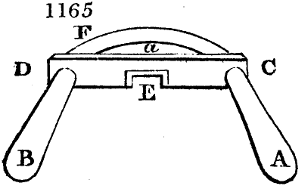
Whalebone, as brought from Greenland, is commonly divided into portable junks or pieces, comprising ten or twelve blades in each; but it is occasionally subdivided into separate blades, the gum and the hairy fringes having been removed by the sailors during the voyage. The price of whalebone fluctuates from 50l. to 150l. per ton. The blade is cut into parallel prismatic slips, as follows:—It is clamped horizontally, with its edge up and down, in the large wooden vice of a carpenter’s bench, and is then planed by the following tool: fig. 1165. A, B, are its two handles; C, D, is an iron plate, with a guide-notch E; F, is a semicircular knife, screwed firmly at each end to the ends of the iron plate C, D, having its cutting edge adjusted in a plane, so much lower than the bottom of the notch E, as the thickness of the whalebone slip is intended to be; for different thicknesses, the knife may be set by the screws at different levels, but always in a plane parallel to the lower guide surface of the plate C, D. The workman, taking hold of the handles A, B, applies the notch of the tool at the end of the whalebone blade furthest from him, and with his two hands pulls it steadily along, so as to shave off a slice in the direction of the fibres; being careful to cut none of them across. These prismatic slips are then dried, and planed level upon their other two surfaces. The fibrous matter detached in this operation, is used, instead of hair, for stuffing mattresses.
From its flexibility, strength, elasticity, and lightness, whalebone is employed for many purposes: for ribs to umbrellas or parasols; for stiffening stays; for the framework of hats, &c. When heated by steam, or a sand-bath, it softens, and may be bent or moulded, like horn, into various shapes, which it retains, if cooled under compression. In this way, snuff-boxes, and knobs of walking-sticks, may be made from the thicker parts of the blade. The surface is polished at first with ground pumice-stone, felt, and water; and finished with dry quicklime, spontaneously slaked, and sifted.
WHEAT. (Triticum vulgare, Linn.; Froment, Fr.; Waizen, Germ.) See Bread, Gluten, and Starch.
WHEEL CARRIAGES. Though this manufacture belongs most properly to a treatise upon mechanical engineering, I shall endeavour to describe the parts of a carriage, so as to enable gentlemen to judge of its make and relative merits. The external form may vary with every freak of fashion; but the general structure of a vehicle, as to lightness, elegance, and strength, may be judged of from the following figure and description.
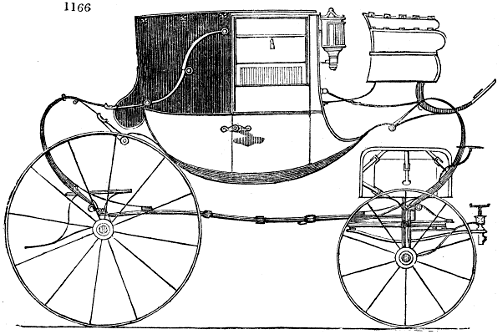
Fig. 1166. shows the body of a chariot, hung upon an iron carriage, with iron wheels, axletrees, and boxes; the latter, by a simple contrivance, is close at the out-head, by which means the oil cannot escape; and the fastening of the wheel being at the in-head, as will be explained afterwards, gives great security, and prevents the possibility of the wheel being taken off by any other carriage running against it.
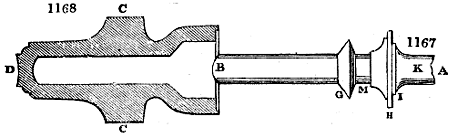
Fig. 1167. shows the arm of an axletree, turned perfectly true, with two collars in the solid, as seen at G and H. The parts from G to B are made cylindrical. At K is a screw nail, the purpose of which will be explained in fig. 1171.
Fig. 1168. is the longitudinal section of a metal nave, which also forms the bush, for the better fitting of which to the axletree, it is bored out of the solid, and made quite air-tight upon the pin; and for retaining the oil, it is left close at the out-head D.
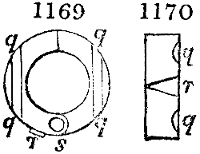
Fig. 1169. represents a collet, made of metal, turned perfectly true, the least diameter of which is made the same with that part of the axletree M, fig. 1167., and its greatest diameter the same with that of the solid collar G, fig. 1167. This collet is made with a joint at S, and opens at p. Two grooves are represented at qq, qq, which are seen at the same letters in fig. 1170., as also the dovetail r, in both figures.
Fig. 1170. is an edge view of the collet, fig. 1169.
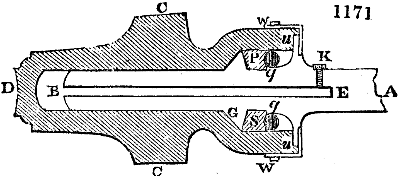
Fig. 1171. is a longitudinal section of an axletree arm, nave or bush, and fastening. A, B, is the arm of the axletree, bored up the centre from B to E. C, C, D, the nave, which answers also for the bush. P, S, the collet (see figs. 1169. and 1170.), put into its place. q, q, two steel pins, passing through the in-head of the bush, and filling up the grooves in the collet. W, W, a caped hoop, sufficiently broad to cover the ends of said pins, and made fast to the bush by screws. This hoop, when so fastened to the bush, prevents the possibility of the pins q, q, from getting out of their places. u, u, is a leather washer, interposed betwixt the in-head of the bush and the larger solid collar of the axletree, to prevent the escape of oil at the in-head. K, is a screw, the head of which is near the letter K, in fig. 1167. This screw being undone, and oil poured into the hole, it flows down the bore in the centre of the axletree arm, and fills the space B, left by the arm being about one inch shorter than the bore of the bush, and the screw, being afterwards replaced, keeps all tight. In putting on the wheel, a little oil ought to be put into the space betwixt the collet P, S, and the larger collar. The collar P, S, being movable round the axletree arm, and being made fast to the bush by means of the two pins q, q, revolves along with the bush, acting against the solid collar G, of the arm, and keeps the wheel fast to the axletree, until by removing the caped hoop W, W, and driving out the pins q, q, the collet becomes disengaged from the bush.
The dovetail, seen upon the collet at r, fig. 1170., has a corresponding groove cut in the bush, to receive it, in consequence of which the wheel must of necessity be put on so that the collet and pins fit exactly. These wheels very rarely require to be taken off, and they will run a thousand miles without requiring fresh oiling.
The spokes of the wheel, made of malleable iron, are screwed into the bush or nave at C, C, figs. 1168. 1171., all round. The felloes, composed merely of two bars of iron, bent into a circle edgeways, are put on, the one on the front, the other on the back, of the spokes, which have shoulders on both sides to support the felloes, and all three are attached together by rivets through them. The space between the two iron rings forming the felloes, should be filled up with light wood, the tire then put on, and fastened to the felloes by bolts and glands clasping both felloes.
This is a carriage without a mortise or tenon, or wooden joint of any kind. It is, at an average, one-seventh lighter than any of those built on the ordinary construction.
The design of Mr. W. Mason’s patent invention, of 1827, is to give any required pressure to the ends of what are called mail axletrees, in order to prevent their shaking in the boxes of the wheels. This object is effected by the introduction of leather collars in certain parts of the box, and by a contrivance, in which the outer cap is screwed up, so as to bear against the end of the axletree with any degree of tightness, and is held in that situation, without the possibility of turning round, or allowing the axletree to become loose.
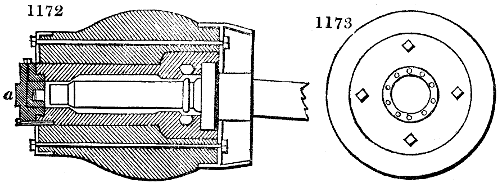
Fig. 1172. shows the section of the box of a wheel, with the end of the axletree secured in it. The general form of the box, and of the axle, is the same as other mail axles, there being recesses in the box for the reception of oil. At the end of the axle, a cap a, is inserted, with a leather collar enclosed in it, bearing against the end of the axle; which cap, when screwed up sufficiently tight, is held in that situation by a pin or screw passed through the cap a, into the end of the iron box; a representation of this end of the iron box being shown at fig. 1173.
In the cap a, there is also a groove for conducting the oil to the interior of the box, with a screw at the opening, to prevent it running out as the wheel goes round.
The particular claims of improvement are, the leather collar against the end of the axle; the pin going through one of the holes in the end of the box, to fix it; and the channel for conducting the oil.
Mr. Mason’s patent, of August, 1830, applies also to the boxes and axles of that construction of carriage wheels which are fitted with the so called mail-boxes; but part of the invention applies to other axles.
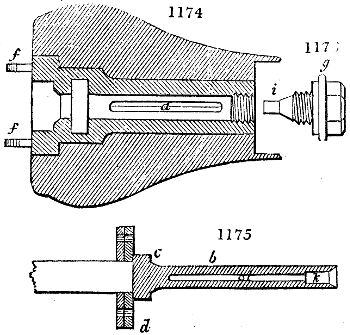
Fig. 1174. represents the nave of a wheel, with the box for the axle within it, both shown in section longitudinally; fig. 1175. is a section of the axle, taken in the same direction; and fig. 1176. represents the screw cap and oil-box, which attaches to the outer extremity of the axle-box. Supposing the parts were put together, that is, the axle inserted into the box, then the intention of the different parts will be perceived.
The cylindrical recess a, in the box of the nave, is designed to fit the cylindrical part of the axle b; and the conical part c, of the axle, to shoulder up against a corresponding conical cavity in the box, with a washer of leather to prevent its shaking. A collar d, formed by a metallic ring, fits loosely upon a cylindrical part of the axle, and is kept there by a flange or rim, fixed behind the cone c. Several strong pins f, f, are cast into the back part of the box; which pins, when the wheel is attached, pass through corresponding holes in the collar d; and nuts being screwed on to the ends of the pins f, behind the collar, keep the wheel securely attached to the axle. The screw-cap g, is then inserted into the recess h, at the outer part of the box, its conical end and small tube i, passing into the recess k, in the end of the axle.
The parts being thus connected, the oil contained within the cap g, will flow through the small tube i, in its end, into the recess or cylindrical channel l, within the axle, and will thence pass through a small hole in the side of the axle, into the cylindrical recess a, of the box; and then lodging in the groove and other cavities within the box, will lubricate the axle as the wheel goes round. There is also a small groove cut on the outside of the axle, for conducting the oil, in order that it may be more equally distributed over the surface and the bearings. This construction of the box and axle, as far as the lubrication goes, may be applied to the axles of wheels in general; but that part of the invention which is designed to give greater security in the attachment of the wheel to the carriage, applies particularly to mail axles.
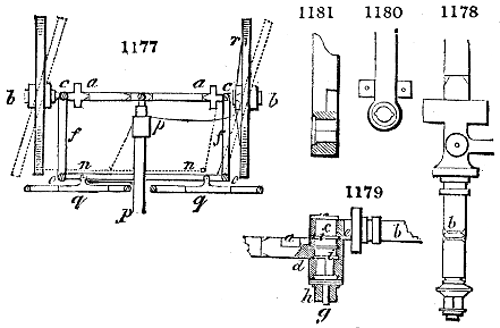
Mr. William Mason’s patent invention for wheel carriages, of August, 1831, will be understood by reference to the annexed figures. Fig. 1177. is a plan showing the fore-axletree bed a, a, of a four-wheeled carriage, to which the axletrees b, b, are jointed at each end; fig. 1178. is an enlarged plan; and fig. 1179. an elevation, or side view of one end of the said fore-axletree bed, having a Collinge’s axletree jointed to the axletree bed, by means of the cylindrical pin or bolt c, which passes through and turns in a cylindrical hole d, formed at the end of the axletree bed, shown also in the plan view, fig. 1180., and section, fig. 1181.
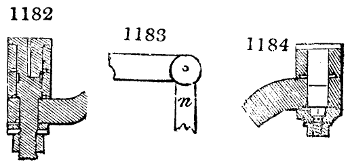
The axletree b, is firmly united with the upper end e, of the pin or bolt c; and to the lower end of it, which is squared, the guide piece f, is also fitted, and secured by the screw g, and cap or nut h, seen in fig. 1179., and in section in fig. 1182. There are leather washers i, i, let into recesses made to receive them in the parts a, b, and f, the intent of which is to prevent the oil from escaping that is introduced through the central perpendicular hole seen in fig. 1182., which hole is closed by means of a screw inserted into it. The oil is diffused, or spread over the surface of the cylinder c, by means of a side branch leading from the bottom of the hole into a groove formed around the cylinder, and also by means of two longitudinal gaps or cavities made within the hole, as shown in figs. 1180. and 1181. The guide piece f, is affixed at right angles with the axletree b, as shown in fig. 1178., and turns freely and steadily in the cylindrical hole d, made to receive one end of the iron fore-axletree bed a. In like manner, the opposite fore axletree b, fig. 1177., is jointed to the other end of the iron fore-axletree bed. The outer ends of the guide pieces f, f, are jointed to the splinter-bar n, fig. 1181, as follows:—Fig. 1183. is a plan, and fig. 1184. a section of the joint o, in fig. 1177., shown on an enlarged scale; a cylindrical pin or bolt c, is firmly secured in the splinter-bar, and round the lower part of the said pin or bolt the guide piece f, turns, and is made fast in its place by the screw g, and screwed nut h.
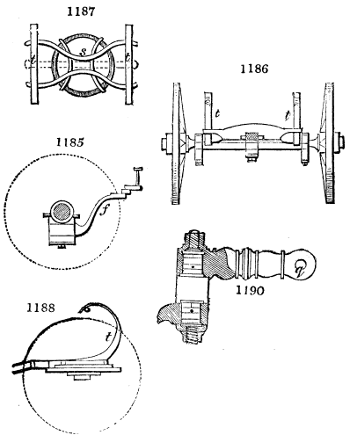
Oil is conveyed to the lower part of the cylindrical pin c, in a similar manner to that already described, and two leather washers are likewise furnished, to prevent its escape. The connecting joint at the opposite end of the splinter-bar n, is constructed in a similar manner. The futchel or socket p, p, for the pole of the carriage, must also be jointed to the middle of the fore-axletree bed and splinter-bar, in a similar manner. The swingletrees q, q, fig. 1177., are likewise jointed in the same way to the splinter-bar. Fig. 1185. is a side view of these parts. The fore wheels of the carriage, fig. 1177., are furnished with cast-iron boxes, as usual. The dotted lines show the action of the pole p, p, upon the splinter-bar n, and as communicated through the latter to the guide pieces f, f, connected with the axletrees b, b, so as to lock the wheels r, r, as shown in that figure.
The axletree may be incased in the woodwork of the fore-bed of the carriage, as usual, and as shown by dotted lines in the back end view thereof, fig. 1186.; and the framing s, fig. 1187., may be affixed firmly upon the said woodwork, in any fit and proper manner, as well as the fore-springs t, t, shown in figs. 1186. and 1187., and likewise in the side view, fig. 1188. In certain cases it may be desirable to fix the cylindrical pin or bolt c, firmly in the splinter-bar n, in the manner shown in figs. 1189. and 1190.; the swingletrees q, q, and guide pieces f, f, turning freely above and below upon the said pin or bolt, and secured in their places thereon by screws and screwed nuts, oil being also supplied through holes formed in both ends of the said pin or bolt, and leather washers provided, as in the above-described instances.
Mr. Gibbs, engineer, and Mr. Chaplin, coach-maker, obtained a patent, in 1832, for the construction of a four-wheeled carriage which shall be enabled to turn within a small compass, by throwing the axles of all the four wheels simultaneously into different positions. They effect this object by mounting each wheel upon a separate jointed axle, and by connecting the free ends of the four axles by jointed rods or chains, with the pole and splinter-bar in front of the carriage.
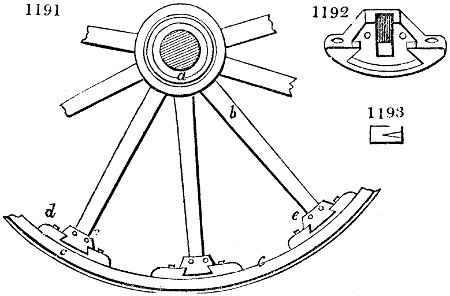
To fix the ends of the spokes of wheels to the felloe or rim, with greater security than had been effected by previous methods, is the object of a contrivance for which William Howard obtained a patent, in February, 1830. Fig. 1191. shows a portion of a wheel constructed on this new method; a, is the nave, of wood; b, b, b, wooden spokes, inserted into the nave in the usual way; c, c, is the rim or felloe, intended to be formed by one entire circle of wrought iron; d, and e, e, are the shoes or blocks, of cast iron, for receiving the ends of the spokes, which are secured by bolts to the rim on the inner circumference. The cap of the block d, is removed, for the purpose of showing the internal form of the block; e, e, have their caps fixed on, as they would appear when the spokes are fitted in. One of the caps or shoes is shown detached, upon a larger scale, at fig. 1192., by which it will be perceived that the end of the spoke is introduced into the shoe on the side. It is proposed that the end of the spoke shall not reach quite to the end of the recess formed in the block, and that it shall be made tight by a wedge driven in. The wedge piece is to be of wood, as fig. 1193., with a small slip of iron within it; and a hole is perforated in the back of the block or shoe, for the wedge to be driven through. When this is done, the ends of the spokes become confined and tight; and the projecting extremities of the wedges being cut off, the caps are then attached on the face of the block, as at e, e, by pins riveted at their ends, which secures the spokes, and renders it impossible for them to be loosened by the vibrations as the wheel passes over the ground. One important use of the wedges, is to correct the eccentric figure of the wheel, which may be readily forced out in any part that may be out of the true form, by driving the wedge up further; and this, it is considered, will be a very important advantage, as the nearer a wheel can be brought to a true circle, the easier it will run upon the road. The periphery of the wheel is to be protected by a tire, which may be put on in pieces, and bolted through the felloe; or it may be made in one ring, and attached, while hot, in the usual way.
Mr. Reedhead’s patent improvements in the construction of carriages, are represented in the following figures. They were specified in July, 1833.
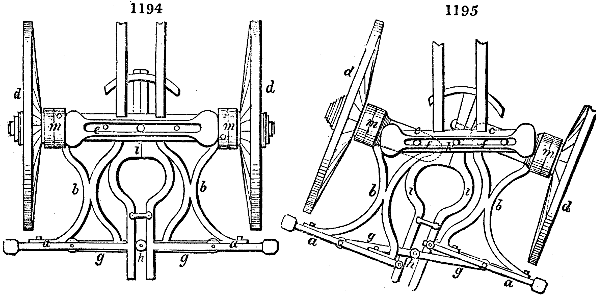
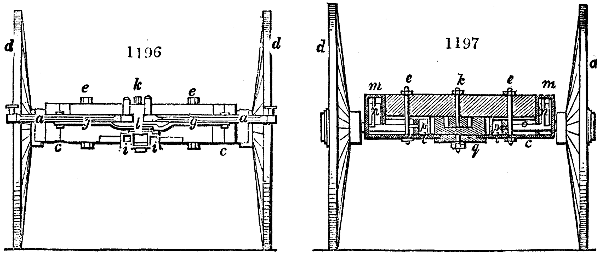
Fig. 1194. is a plan or horizontal view of the fore part of a carriage, intended to be drawn by horses, showing the fore wheels in their position when running in a straight course; fig. 1195. is a similar view, showing the wheels as locked, when in the act of turning; fig. 1196. is a front end elevation of the same; fig. 1197. is a section taken through the centre of the fore axletree; and fig. 1198. is a side elevation of the general appearance of a stage-coach, with the improvements appended: a, a, are two splinter-bars, with their roller-bolts, for connecting the traces of the harness; these splinter-bars are attached, by the bent irons b, b, to two short axletrees or axle-boxes c, c, which carry the axles of the fore wheels d, d, and turn upon vertical pins or bolts e, e, passed through the fore axletree f, the splinter-bars and axle-boxes being mounted so as to move parallel to each other, the latter partaking of any motion given to the splinter-bars by the horses in drawing the carriage forward, and thereby producing the locking of the wheels, as shown fig. 1195.; and in order that the two wheels, and their axles and axle-boxes, together with the splinter-bars a, a, may move simultaneously, the latter are connected by pivots to the end of the links or levers g, g, which are attached to the arms i, i, which receive the pole of the coach by a hinge-joint or pin h; the arms i, i, turning on a vertical fulcrum-pin k, passed through the main axletree, f, as the pole is moved from one side to the other.
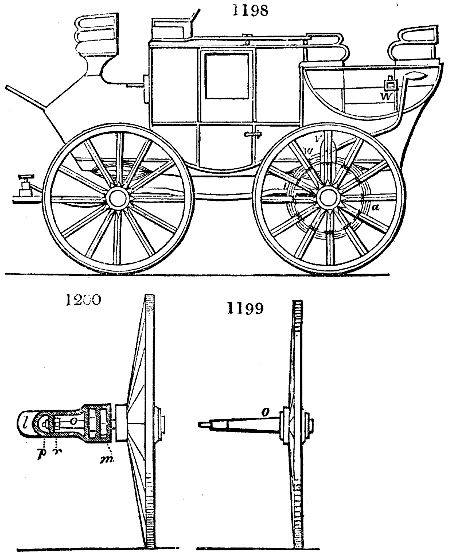
The axles o, o, are firmly fixed into the naves of the wheels, as represented in the side view of a wheel detached, at fig. 1200., the axles being mounted so as to revolve within their boxes in the following manner:—The axle-boxes, which answer the purpose of short axletrees, are formed of iron, and consist of one main or bottom plate l, seen best in figs. 1200. and 1199.; upon this bottom plate is formed the chamber m, m, carrying the two anti-friction rollers n, n, which turn on short axles passed through the sides and partition at the upper part of the chambers. These anti-friction rollers bear upon the cylindrical parts of the axle o, of each wheel, and support the weight of the coach; p, is a bearing firmly secured in the axle-box to the plate l, for the end of the axle o, to run in, the axle being confined in its proper situation by a collar and screw-nut on its end; e, is the vertical pin or bolt before mentioned, upon which the axle-bar turns when the wheels are locking, which bolt is enlarged within the box, and has an eye for the axle to pass through, being firmly secured to the plate l, and also to the sides of the box. Fig. 1200. is a plan or horizontal view of an axle and its box, belonging to one of the fore wheels; a piece q, is fixed to the under side of the main axletree, which supports the ends of the plates l, and thereby relieves the pins e, e, of the strain they would otherwise have to withstand. The axles of the hind wheels are mounted upon similar plates l, l, with bearings and chambers with anti-friction rollers; but as these are not required to lock, the plates l, l, are fixed on to the under side of the hind axletree by screw-nuts; there are small openings or doors, which can be removed for the purpose of unscrewing the nuts and collars of the bearings p, when the wheel is required to be taken off the carriage, when the axle can be withdrawn from the boxes. If it should be thought necessary, other chambers with friction rollers, may be placed on the under side of the plate l, to bear up the end of the axles, and relieve the bearing p. In order to stop or impede the progress of a carriage in passing down hills, there is a grooved friction or brake wheel t, fixed, by clamps or otherwise, on to the spokes of one of the hind wheels; u, is a brake-band or spring, of metal, encircling the friction wheel, one end of which band is fixed into the standard v, upon the hind axletree, and the other end connected by a joint to the shorter end of the lever w, which has its fulcrum in the standard v; this lever extends up to the hind seat of the coach, as shown in fig. 1198., and is intended to be under the command of the guard or passengers of the coach, and when descending a hill, or on occasion of the horses running away, the longer end of the lever is to be depressed, which will raise the shorter end, and, consequently, bring the band or spring u, in contact with the surface of the friction wheel, and thereby retard its revolution, and prevent the coach travelling too fast; or, instead of attaching the friction brake to the hind wheel, as represented in fig. 1198., it may be adapted to the fore wheels, and the end of the lever brought up to the side of the foot-board, or under it, and within command of the coachman, the standard which carries the fulcrum being made to move upon a pivot, to accommodate the locking of the wheels. It will be observed, that by these improved constructions of the carriage, and mode of locking the patentee is enabled to use much larger fore wheels than in common, and that the splinter-bars will always be in the position of right angles with the track or way of the horses in drawing the carriage, by which they are much relieved, and always pull in a direct and equal manner.
A manifest defect in all four-wheeled carriages, involving vast superfluous friction, is the small size of the front wheels; a defect which has existed ever since Walter Rippon made “the first hollow turning coach with pillars and arches for her majesty Queen Mary, being then her servant,” until the railroad era, when our engineers remedied the defect by equalizing the wheels, at the expense of another defect—sacrificing the power of turning, and thus producing great lateral friction; whence a train of evil consequences result:—necessarily increased strength, and consequently increased weight of the carriages; increased power and weight of the engine to draw them, and overcome the friction; and, of course, increased strength of rails, and greater solidity of railway.
These defects are at last remedied by an invention patented by Mr. William Adams, author of a work entitled “English Pleasure Carriages.” Instead of placing the perch-bolt, or turning centre, as is commonly done, over the front axle, he places it at a convenient distance between the front and hind axles; so that when turning the carriage the front wheels, instead of turning beneath the body, as is common, turn outside of it, and the driver’s seat turns with them; thus giving him a perfect command over his horses in all positions, instead of the usual dangerous plan, which renders a driver liable to be pulled off his box by a restive horse, when in the act of turning. A carriage constructed on Mr. Adams’ plan may also be driven round a corner at full speed, without any risk of overturning, as the weight is equally poised on the axles in all positions. It is well known that the oversetting of stage coaches usually takes place when turning a corner, the momentum urging the vehicle in a right line, while the horses are pulling at an angle. By the new arrangement the front wheels may be made equal to the hind ones, or of any desirable height, and at the same time the body may be kept as low as may be thought convenient, even almost close to the ground, if desired. Thus two important objects, hitherto deemed incompatible, are combined—high wheels and a low centre of gravity. These carriages are therefore essentially safety carriages, while the friction is reduced to a minimum. The principle, in its various modifications, is applicable to every variety of carriage, both those of the simply useful kind, and those where beauty of form and colour are prime requisites.
Another most important part of Mr. Adams’ invention, is his new mode of spring suspension; applying the principle of the bow and string, for the first time, to obviate the effects of concussion in wheel carriages. All the springs hitherto in use for wheel carriages, have been friction springs, composed of long sliding surfaces, uncertain in their action, and liable to quick destruction by rust. But Mr. Adams’ springs are essentially elastic, being formed of single plates abutting endways, so that all friction is removed, and they can be hermetically sealed within paint to prevent their corrosion. He has various modes of applying the bow, either single or double, above or below the axle; but one most important feature is, that the axle being attached to the flexible cords or braces, the concussion which affects the wheels, either laterally, vertically, or in the line of progress, is perfectly intercepted, without the unpleasant oscillation experienced in carriages where the same purpose is accomplished by the use of the curved or C spring. Mr. Adams’ brace being, at the same time, a non-conductor of sound, the rattling of the wheels does not annoy the rider as in ordinary carriages. His springs are equally applicable to vehicles with two and four wheels.
The advantages of these carriages may be thus summed up:—A great diminution of the total weight; a diminution of resistance in draught equal to about one third; increase of safety to the riders; increased durability of the vehicle; absence of noise and vibration; absence of oscillation.
To these qualities, so desirable to all, and especially those of delicate nervous temperament, may be added—greater economy, both in the first cost and maintenance.
The whirling public so blindly follows fashionable caprice in the choice of a carriage, as to have hitherto paid too little attention to this fundamental improvement; but many intelligent individuals have fully verified its practical reality. Having inspected various forms of two-wheeled and four-wheeled carriages, in the patentee’s premises in Drury Lane, I feel justified in recommending them as being constructed on the soundest mechanical principles; and have no doubt, that if reason be allowed to decide upon their merits, they will ere long be universally preferred by all who seek for easy-moving, safe, and comfortable vehicles.
WHETSLATE, is a massive mineral of a greenish-gray colour; feebly glimmering; fracture, slaty or splintery; fragments tabular; translucent on the edges; feels rather greasy; and has a spec. grav. of 2·722. It occurs in beds, in primitive and transition slates. Very fine varieties of whetslate are brought from Turkey, called honestones, which are in much esteem for sharpening steel instruments.
WHEY (Petit lait, Fr.; Molken, Germ.); is the greenish-gray liquor which exudes from the curd of milk. Scheele states, that when a pound of milk is mixed with a spoonful of proof spirit, and allowed to become sour, the whey filtered off, at the end of a month or a little more, is a good vinegar, devoid of lactic acid.
WHISKEY; is dilute alcohol, distilled from the fermented worts of malt or grains.
WHITE LEAD, Carbonate of lead, or Ceruse. (Blanc de plomb, Fr.; Bleiweiss, Germ.) This preparation is the only one in general use for painting wood and the plaster walls of apartments white. It mixes well with oil, without having its bright colour impaired, spreads easily under the brush, and gives a uniform coat to wood, stone, metal, &c. It is employed either alone, or with other pigments, to serve as their basis, and to give them body. This article has been long manufactured with much success at Klagenfurth in Carinthia, and its mode of preparation has been lately described with precision by Marcel de Serres. The great white-lead establishments at Krems, whence, though incorrectly, the terms white of Kremnitz became current on the continent, have been abandoned.
1. The lead comes from Bleyberg; it is very pure, and particularly free from contamination with iron, a point essential to the beauty of its factitious carbonate. It is melted in ordinary pots of cast iron, and cast into sheets of varying thickness, according to the pleasure of the manufacturer. These sheets are made by pouring the melted lead upon an iron plate placed over the boiler; and whenever the surface of the metal begins to consolidate, the plate is slightly sloped to one side, so as to run off the still liquid metal, and leave a lead sheet of the desired thinness. It is then lifted off like a sheet of paper; and as the iron plate is cooled in water, several hundred weight of lead can be readily cast in a day. In certain white-lead works these sheets are one twenty-fourth of an inch thick; in others, half that quantity; in some, one of these sheets takes up the whole width of the conversion-box; in others, four sheets are employed. It is of consequence not to smooth down the faces of the leaden sheets; because a rough surface presents more points of contact, and is more readily attacked by acid vapours, than a polished one.
2. These plates are now placed so as to expose an extensive surface to the acid fumes, by folding each other over a square slip of wood. Being suspended by their middle, like a sheet of paper, they are arranged in wooden boxes, from 41⁄2 to 5 feet long, 12 to 14 inches broad, and from 9 to 11 inches deep. The boxes are very substantially constructed; their joints being mortised; and whatever nails are used, being carefully covered. Their bottom is made tight with a coat of pitch about an inch thick. The mouths of the boxes are luted over with paper, in the works where fermenting horsedung is employed as the means of procuring heat, to prevent the sulphuretted and phosphuretted hydrogen from injuring the purity of the white lead. In Carinthia it was formerly the practice, as also in Holland, to form the lead sheets into spiral rolls, and to place them so coiled up in the chests; but this plan is not to be recommended, because these rolls present obviously less surface to the action of the vapours, are apt to fall down into the liquid at the bottom, and thus to impair the whiteness of the lead. The lower edges of the sheets are suspended about two inches and a half from the bottom of the box; and they must not touch either one another or its sides, for fear of obstructing the vapours in the first case, or of injuring the colour in the second. Before introducing the lead, a peculiar acid liquor is put into the box, which differs in different works. In some, the proportions are four quarts of vinegar, with four quarts of wine-lees; and in others, a mixture is made of 20 pounds of wine-lees, with 81⁄2 pounds of vinegar, and a pound of carbonate of potash. It is evident that in the manufactories where no carbonate of potash is employed in the mixture, and no dung for heating the boxes, it is not necessary to lute them.
3. The mixture being poured into the boxes, and the sheets of lead suspended within them, they are carried into a stove-room, to receive the requisite heat for raising round the lead the corrosive vapours, and thus converting it into carbonate. This apartment is heated generally by stoves, is about 9 feet high, 30 feet long, and 24 feet wide, or of such a size as to receive about 90 boxes. It has only one door.
The heat should never be raised above 86° Fahr.; and it is usually kept up for 15 days, in which time the operation is, for the most part, completed. If the heat be too high, and the vapours too copious, the carbonic acid escapes in a great measure, and the metallic lead, less acted upon, affords a much smaller product.
When the process is well managed, as much carbonate of lead is obtained, as there was employed of metal; or, for 300 pounds of lead, 300 of ceruse are procured, besides a certain quantity of metal after the crusts are removed, which is returned to the melting-pot. The mixture introduced into the boxes serves only once; and if carbonate of potash has been used, the residuary matter is sold to the hatters.
4. When the preceding operation is supposed to be complete, the sheets, being removed from the boxes, are found to have grown a quarter of an inch thick, though previously not above a twelfth of that thickness. A few pretty large crystals of acetate of lead are sometimes observed on their edges. The plates are now shaken smartly, to cause the crust of carbonate of lead formed on their surfaces to fall off. This carbonate is put into large cisterns, and washed very clean. The cistern is of wood, most commonly of a square shape, and divided into from seven to nine compartments. These are of equal capacity, but unequal height, so that the liquid may be made to overflow from one to the other. Thereby, if the first chest is too full, it decants its excess into the second, and so on in succession. See Rinsing Machine.
The water poured into the first chest, passes successively into the others, a slight agitation being meanwhile kept up, and there deposits the white lead diffused in it proportionally, so that the deposit of the last compartment is the finest and lightest. After this washing, the white lead receives another, in large vats, where it is always kept under water. It is lastly lifted out in the state of a liquid paste, with wooden spoons, and laid on drying-tables to prepare it for the market.
The white lead of the last compartment is of the first quality, and is called on the continent silver white. It is employed in fine painting.
When white lead is mixed in equal quantities with ground sulphate of barytes, it is known in France and Germany by the name of Venice white. Another quality, adulterated with double its weight of sulphate of barytes, is styled Hamburgh white; and a fourth, having three parts of sulphate to one of white lead, gets the name of Dutch white. When the sulphate of barytes is very white, like that of the Tyrol, these mixtures are reckoned preferable for certain kinds of painting, as the barytes communicates opacity to the colour, and protects the lead from being speedily darkened by sulphureous smoke or vapours.
The high reputation of the white lead of Krems was by no means due to the barytes, for the first and whitest quality was mere carbonate of lead. The freedom from silver of the lead of Villach, a very rare circumstance, is one cause of the superiority of its carbonate; as well as the skilful and laborious manner in which it is washed, and separated from any adhering particle of metal or sulphuret.
In England, lead is converted into carbonate in the following way.—The metal is cast into the form of a network grating, in moulds about 15 inches long, and 4 or 5 broad. Several rows of these are placed over cylindrical glazed earthen pots, about 4 or 5 inches in diameter, containing some treacle-vinegar, which are then covered with straw; above these pots another range is piled, and so in succession, to a convenient height. The whole are imbedded in spent bark from the tan-pit, brought into a fermenting state by being mixed with some bark used in a previous process. The pots are left undisturbed under the influence of a fermenting temperature for eight or nine weeks. In the course of this time the lead gratings become, generally speaking, converted throughout into a solid carbonate, which when removed is levigated in a proper mill, and elutriated with abundance of pure water. The plan of inserting coils of sheet lead into earthenware pipkins containing vinegar, and imbedding the pile of pipkins in fermenting horsedung and litter, is now little used; because the coil is not uniformly acted on by the acid vapours, and the sulphuretted hydrogen evolved from the dung is apt to darken the white lead.
In the above processes, the conversion of lead into carbonate, seems to be effected by keeping the metal immersed in a warm, humid atmosphere, loaded with carbonic and acetic acids; and hence a pure vinegar does not answer well; but one which is susceptible, by its spontaneous decomposition in these circumstances, of yielding carbonic acid. Such are tartar, wine-lees, molasses, &c.
Another process has lately been practised to a considerable extent in France, though it does not afford a white lead equal in body and opacity to the products of the preceding operations. M. Thenard first established the principle, and MM. Brechoz and Leseur contrived the arrangements of this new method, which was subsequently executed on a great scale by MM. Roard and Brechoz.
A subacetate of lead is formed by digesting a cold solution of uncrystallized acetate, over litharge, with frequent agitation. It is said that 65 pounds of purified pyrolignous acid, of specific gravity 1·056, require, for making a neutral acetate, 58 pounds of litharge; and hence, to form the subacetate, three times that quantity of base, or 174 pounds, must be used. The compound is diluted with water, as soon as it is formed, and being decanted off quite limpid, is exposed to a current of carbonic acid gas, which, uniting with the two extra proportions of oxide of lead in the subacetate, precipitates them in the form of a white carbonate, while the liquid becomes a faintly acidulous acetate. The carbonic acid may be extricated from chalk, or other compounds, or generated by combustion of charcoal, as at Clichy; but in the latter case, it must be transmitted through a solution of acetate of lead before being admitted into the subacetate, to deprive it of any particles of sulphuretted hydrogen. When the precipitation of the carbonate of lead is completed, and well settled down, the supernatant acetate is decanted off, and made to act on another dose of litharge. The deposit being first rinsed with a little water, this washing is added to the acetate; after which the white lead is thoroughly elutriated. This repetition of the process may be indefinitely made; but there is always a small loss of acetate, which must be repaired, either directly or by adding some vinegar.
In order to obtain the finest white lead by the process with earthen pots containing vinegar buried in fermenting tan, and covered by a grating of lead, the metal should be so thin as to be entirely convertible into carbonate; for whenever any of it remains, it is apt to give a gray tint to the product: if the temperature of the fermenting mass is less than 90° Fahr., some particles of the metal will resist the action of the vinegar, and degrade the colour; and if it exceeds 122°, the white verges into yellow, in consequence of some carbonaceous compound being developed from the principles of the acetic acid. The dung and tan have been generally supposed to act in this process by supplying carbonic acid, the result of their fermentation; but it is now said that this explanation is inexact, because the best white lead can be obtained by the entire exclusion of air from the pots in which the carbonation of the metal is carried on. We are thence led to conclude that the lead is oxidized at the expense of the oxygen of the vinegar, and carbonated by the agency of its oxygen and carbon; the hydrogen of the acid being left to associate itself with the remaining oxygen and carbon, so as to constitute an ethereous compound: thus, supposing the three atoms of oxygen to form, with one of lead and one of carbon, an atom of carbonate, then the remaining three atoms of carbon and three of hydrogen would compose olefiant gas.
It is customary on the continent to mould the white lead into conical loaves, before sending them into the market. This is done by stuffing well-drained white lead into unglazed earthen pots, of the requisite size and shape, and drying it to a solid mass, by exposing these pots in stove-rooms. The moulds being now inverted on tables, discharge their contents, which then receive a final desiccation; and are afterwards put up in pale-blue paper, to set off the white colour by contrast. Nothing in all the white-lead process is so injurious as this pot operation; a useless step, fortunately unknown in Great Britain. Neither greasing the skin, nor wearing thick gloves, can protect the operators from the diseases induced by the poisonous action of the white lead; and hence they must be soon sent off to some other department of the work.
It has been supposed that the differences observed between the ceruse of Clichy and the common kinds, depend on the greater compactness of the particles of the latter, produced by their slower aggregation; as also, according to M. Robiquet, on the former containing considerably less carbonic acid. See infrà.
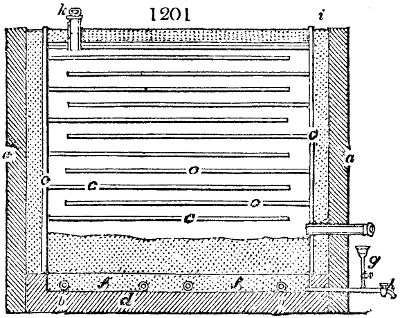
Mr. Ham proposed, in a patent dated June, 1826, to produce white lead with the aid of the following apparatus, a, a, (fig. 1201.) are the side-walls of a stove-room, constructed of bricks; b, is the floor of bricks laid in Roman cement; c, c, are the side-plates, between which and the walls, a quantity of refuse tanner’s bark, or other suitable vegetable matter, is to be introduced. The same material is to be put also into the lower part at d (upon a false bottom of grating?) The tan should rise to a considerable height, and have a series of strips of sheet lead e, e, e, placed upon it, which are kept apart by blocks or some other convenient means, with a space open at one end of the plates, for the passage of the vapours; but above the upper plates, boards are placed, and covered with tan, to confine them there. In the lower part of the chamber, coils of steam-pipe f, f, are laid in different directions to distribute heat; g, is a funnel-pipe, to conduct vinegar into the lower part of the vessel; and h, is a cock to draw it off, when the operation is suspended. The acid vapours raised by the heat, pass up through the spent bark, and on coming into contact with the sheets of lead, corrode them. The quantity of acid liquor should not be in excess; a point to be ascertained by means of the small tube i, at top, which is intended for testing it by the tongue. k, is a tube for inserting a thermometer, to watch the temperature, which should not exceed 170° Fahr. I am not aware of what success has attended this patented arrangement. The heat prescribed is far too great.
A magnificent factory has been recently erected at West Bromwich, near Birmingham, to work a patent lately granted to Messrs. Gossage and Benson, for making white lead by mixing a small quantity of acetate of lead in solution with slightly damped litharge, contained in a long stone trough, and passing over the surface of the trough currents of hot carbonic acid, while its contents are powerfully stirred up by a travelling-wheel mechanism. The product is afterwards ground and elutriated, as usual. The carbonic acid gas is produced from the combustion of coke. I am told that 40 tons of excellent white lead are made weekly by these chemico-mechanical operations.
Messrs. Button and Dyer obtained a patent about a year and a half ago, for making white lead by transmitting a current of purified carbonic acid gas, from the combustion of coke, through a mixture of litharge and nitrate of lead, diffused and dissolved in water, which is kept in constant agitation and ebullition by steam introduced through a perforated coil of pipes at the bottom of the tub. The carbonate of lead is formed here upon the principle of Thenard’s old process with the subacetate; for the nitrate of lead forms with the litharge a subnitrate, which is forthwith transformed into carbonate and neutral nitrate, by the agency of the carbonic acid gas. I have discovered that all sorts of white lead produced by precipitation from a liquid, are in a semi-crystalline condition; appear, therefore, semi-transparent, when viewed in the microscope; and do not cover so well as white lead made by the process of vinegar and tan, in which the lead has remained always solid during its transition from the blue to the white state; and hence consists of opaque particles.
A patent was obtained, in December, 1833, by John Baptiste Constantine Torassa, and others, for making white lead by agitating the granulated metal, or shot, in trays or barrels, along with water, and exposing the mixture of lead-dust and water to the air, to be oxidized and carbonated. It is said that upwards of 100,000l. have been expended at Chelsea, by a joint stock company, in a factory constructed for executing the preceding most operose and defective process; which has been, many years ago, tried without success in Germany. I am convinced that the whole of these recent projects for preparing white lead, are inferior in economy, and quality of produce, to the old Dutch process, which may be so arranged as to convert sheets of blue lead thoroughly into the best white lead, within the space of 12 days, at less expense of labour than by any other plan.
White lead, as obtained by precipitation from the acetate, subacetate, and subnitrate, is a true carbonate of the metal, consisting of one prime equivalent of lead 104, one of oxygen 8, and one of carbonic acid 22; whose sum is 134, the atomic weight of the compound; or, of lead, 77·6; oxygen, 6; carbonic acid, 16·4; in 100 parts. It has been supposed, by some authors, that the denser and better-covering white lead of Krems and Holland is a kind of subcarbonate, containing only 9 per cent. of carbonic acid; but this view of the subject does not accord with my researches.
WICK (Mèche, Fr.; Docht, Germ.); is the spongy cord, usually made of soft spun cotton threads, which by capillary action, draws up the oil in lamps, or the melted tallow or wax in candles, in small successive portions, to be burned. In common wax and tallow candles, the wick is formed of parallel threads; in the stearine candles, the wick is plaited upon the braiding machine, moistened with a very dilute sulphuric acid, and dried, whereby as it burns, it falls to one side and consumes without requiring to be snuffed; in the patent candles of Mr. Palmer, one-tenth of the wick is first imbued with subnitrate of bismuth ground up with oil, the whole is then bound round in the manner called gimping; and of this wick, twice the length of the intended candle is twisted double round a rod, like the caduceus of Mercury. This rod with its coil being inserted in the axis of the candle mould, is to be enclosed by pouring in the melted tallow; and when the tallow is set, the rod is to be drawn out at top, leaving the wick in the candle. As this candle is burned, the ends of the double wick stand out sideways beyond the flame; and the bismuth attached to the cotton being acted on by the oxygen of the atmosphere, causes the wick to be completely consumed, and, therefore, saves the trouble of snuffing it.
WINCING-MACHINE, is the English name of the dyer’s reel, which he suspends horizontally, by the ends of its iron axis in bearings, over the edge of his vat, so that the line of the axis, being placed over the middle partition in the copper, will permit the piece of cloth which is wound upon the reel, to descend alternately into either compartment of the bath, according as it is turned by hand to the right or the left. For an excellent self-acting or mechanical wince, see Dyeing.
WINE, is the fermented juice of the grape. In the more southern states of Europe, the grapes, being more saccharine, afford a more abundant production of alcohol, and stronger wines, as exemplified in the best port, sherry, and madeira. The influence of solar heat upon the vines may, however, be mitigated by growing them to moderate heights on level ground, and by training them in festoons under the shelter of trees. In the more temperate climates, such as the district of Burgundy, the finer flavoured wines are produced; and there the vines are usually grown upon hilly slopes fronting the south, with more or less of an easterly or westerly direction, as on the Côte d’Or, at a distance from marshes, forests, and rivers, whose vapours might deteriorate the air. The plains of this district, even when possessing a similar or analogous soil, do not produce wines of so agreeable a flavour. The influence of temperature becomes very manifest in countries further north, where, in consequence of a few degrees of thermometric depression, the production of generous agreeable wine becomes impossible.
The land most favourable to the vine is light, easily permeable to water, but somewhat retentive by its composition; with a sandy subsoil, to allow the excess of moisture to drain readily off. Calcareous soils produce the highly esteemed wines of the Côte d’Or; a granitic debris forms the foundation of the lands where the Hermitage wines are grown; siliceous soil interspersed with flints furnishes the celebrated wines of Château-Neuf, Ferté, and La Gaude; schistose districts afford also good wine, as that called la Malgue. Thus we see that lands differing in chemical composition, but possessed of the proper physical qualities, may produce most agreeable wines; and so also may lands of like chemical and physical constitution produce various kinds of wine, according to their varied exposure. As a striking example of these effects, we may adduce the slopes of the hills which grow the wines of Montrachet. The insulated part towards the top furnishes the wine called Chevalier Montrachet, which is less esteemed, and sells at a much lower price, than the delicious wine grown on the middle height, called true Montrachet. Beneath this district, and in the surrounding plains, the vines afford a far inferior article, called bastard Montrachet. The opposite side of the hills produces very indifferent wine. Similar differences, in a greater or less degree, are observable relatively to the districts which grow the Pomard, Volnay, Beaune, Nuits, Vougeot, Chambertin, Romanée, &c. Every where it is found, that the reverse side of the hill, the summit, and the plain, although generally consisting of like soil, afford inferior wine to the middle southern slopes.
Amelioration of the soil.—When the vine lands are too light or too dense, they may be modified, within certain limits, by introducing into them either argillaceous or siliceous matter. Marl is excellent for almost all grounds which are not previously too calcareous, being alike useful to open dense soils, and to render porous ones more retentive.
Manure.—For the vine, as well as all cultivated plants, a manure supplying azotized or animal nutriment may be used with great advantage, provided care be taken to ripen it by previous fermentation, so that it may not, by absorption in too crude a state, impart any disagreeable odour to the grape; as sometimes happens to the vines grown in the vicinity of great towns, like Paris, and near Argenteuil. There is a compost used in France, called animalized black, of which from 1⁄3 to 1⁄2 of a litre (old English quart) serves sufficiently to fertilize the root of one vine, when applied every year, or two years. An excess of manure, in rainy seasons especially, has the effect of rendering the grapes large and insipid.
The ground is tilled at the same time as the manure is applied, towards the month of March; the plants are then dressed, and the props are inserted. The weakness of the plants renders this practice useful; but in some southern districts, the stem of the vine, when supported at a proper height, acquires after a while sufficient size and strength to stand alone. The ends of the props or poles are either dipped in tar, or charred, to prevent their rotting. The bottom of the stem must be covered over with soil, after the spring rains have washed it down. The principal husbandry of the vineyard consists in digging or ploughing to destroy the weeds, and to expose the soil to the influence of the air, during the months of May, June, and occasionally in August.
The vintage, in the temperate provinces, generally takes place about the end of September; and it is always deteriorated whenever the fruit is not ripe enough before the 15th or 20th of October; for, in this case, not only is the must more acid, and less saccharine, but the atmospherical temperature is apt to fall so low during the nights, as to obstruct more or less its fermentation into wine. The grapes should be plucked in dry weather, at the interval of a few days after they are ripe; being usually gathered in baskets, and transported to the vats in dorsels, sufficiently tight to prevent the juice from running out. Whenever a layer about 14 or 15 inches thick has been spread on the bottom of the vat, the treading operation begins, which is usually repeated after macerating the grapes for some time, when an incipient fermentation has softened the texture of the skin and the interior cells. When the whole bruised grapes are collected in the vat, the juice, by means of a slight fermentation, reacts, through the acidity thus generated, upon the colouring-matter of the husks, and also upon the tannin contained in the stones and the fruit-stalks. The process of fermentation is suffered to proceed without any other precaution, except forcing down from time to time the pellicles and pedicles floated up by the carbonic acid to the top; but it would be less apt to become acetous, were the mouths of the vats covered. With this view, M. Sebille Auger introduced with success his elastic bung in the manufacture of wine in the department of the Maine-et-Loire.
With whatever kind of apparatus the fermentation may have been regulated, as soon as it ceases to be tumultuous, and the wine is not sensibly saccharine or muddy, it must be racked off from the lees, by means of a spigot, and run into the ripening tuns. The marc being then gently squeezed in a press, affords a tolerably clear wine, which is distributed among the tuns in equal proportions; but the liquor obtained by stronger pressure, is reserved for the casks of inferior wine.
In the south of France the fermentation sometimes proceeds too slowly, on account of the must being too saccharine; an accident which is best counteracted by maintaining a temperature of about 65° or 68° F., in the tun-room. When the must, on the other hand, is too thin, and deficient in sugar, it must be partially concentrated by rapid boiling, before the whole can be made to ferment into a good wine. By boiling up a part of the must for this purpose, the excess of ferment is at the same time destroyed. Should this concentration be inconvenient, a certain proportion of sugar must be introduced, immediately after racking it off.
The specific gravity of must varies with the richness and ripeness of the grapes which afford it; being in some cases so low as 1·0627, and in others so high as 1·1283. This happens particularly in the south of France. In the district of the Necker in Germany, the specific gravity varies from 1·050 to 1·090; in Heidelberg, from 1·039, to 1·091; but it varies much in different years.
After the fermentation is complete, the vinous part consists of water, alcohol, a colouring-matter, a peculiar aromatic principle, a little undecomposed sugar, bitartrate and malate of potash, tartrate of lime, muriate of soda, and tannin; the latter substances being in small proportion.
It is known that a few green grapes are capable of spoiling a whole cask of wine, and therefore they are always allowed to become completely ripe, and even sometimes to undergo a species of slight fermentation, before being plucked, which completes the development of the saccharine principle. At other times the grapes are gathered whenever they are ripe, but are left for a few days on wicker-floors, to sweeten, before being pressed.