E.
Reading edition
EARTHS. (Terres, Fr.; Erden, Germ.) Modern science has demonstrated that the substances called primitive earths, and which prior to the great electro-chemical career of Sir H. Davy, were deemed to be elementary matter, are all compounds of certain metallic bases and oxygen, with the exception of silica, whose base, silicon, being analogous to boron, has led that compound to be regarded as an acid; a title characteristic of the part it extensively performs in neutralizing alkaline bodies, in mineral nature, and in the processes of art. Four of the earths, when pure, possess decided alkaline properties, being more or less soluble in water, having (at least 3 of them) an acrid alkaline taste, changing the purple infusion of red cabbage to green, most readily saturating the acids, and affording thereby neutro-saline crystals. These four are baryta, strontia, lime (calcia), and magnesia. The earths proper are five in number; alumina, glucina, yttria, zirconia, and thorina. These do not change the colour of infusion of cabbage or tincture of litmus, do not readily neutralize acidity, and are quite insoluble in water. The alkalies are soluble in water, even when carbonated; a property which distinguishes them from the alkaline earths. Lithia must for this reason be considered to be an alkali. See the above substances in their alphabetical places.
EAU DE COLOGNE. This preparation has long possessed great celebrity, in consequence chiefly of the numerous virtues ascribed to it by its venders; and is resorted to by many votaries of fashion as a panacea against ailments of every kind. It is however nothing more than aromatized alcohol, and as such, an agreeable companion of the toilet. Numerous fictitious recipes have been offered for preparing eau de Cologne; the following may be reckoned authentic, having been imparted by Farina himself to a friend.
Take 60 gallons of silent brandy; sage, and thyme, each 6 drachms; balm-mint and spearmint, each 12 ounces; calamus aromaticus, 4 drachms; root of angelica, 2 drachms; camphor, 1 drachm; petals of roses and violets, each 4 ounces; flowers of lavender, 2 ounces; flowers of orange, 4 drachms; wormwood, 1 ounce; nutmegs, cloves, cassia lignea, mace, each 4 drachms. Two oranges and two lemons, cut in pieces. Allow the whole to macerate in the spirit during 24 hours, then distil off 40 gallons by the heat of a water bath. Add to the product:
Essence of lemons, of cedrat, of balm-mint, of lavender, each 1 ounce 4 drachms; neroli and essence of the seed of anthos, each 4 drachms; essence of jasmin, 1 ounce; of bergamot, 12 ounces. Filter and preserve for use.
Cadet Gassincourt has proposed to prepare eau de Cologne by the following recipe: Take alcohol at 32° B., 2 quarts; neroli, essence of cedrat, of orange, of lemon, of bergamot, of rosemary, each 24 drops; add 2 drachms of the seeds of lesser cardamoms, distil by the heat of a water bath a pint and a half. When prepared as thus by simple mixture of essences without distillation, it is never so good.
EAU DE LUCE, is a compound formed of the distilled oil of amber and water of ammonia.
ELEMI, is a resin which exudes from incisions made during dry weather through the bark of the amyris elemifera, a tree which grows in South America and Brazil. It comes to us in yellow, tender, transparent lumps, which readily soften by the heat of the hand. They have a strong aromatic odour, a hot spicy taste, and contain 121⁄2 per cent. of ethereous oil. The crystalline resin of elemi has been called Elémine. It is used in making lacquer, to give toughness to the varnish.
EBULLITION. (Eng. and Fr.; Kochen, Germ.) When the bottom of an open vessel containing water is exposed to heat, the lowest stratum of fluid immediately expands, becomes therefore specifically lighter, and is forced upwards by the superior gravity of the superincumbent colder and heavier particles. The heat is in this way diffused through the whole liquid mass, not by simple communication of that power from particle to particle as in solids, called the conduction of caloric, but by a translation of the several particles from the bottom to the top, and the top to the bottom, in alternate succession. This is denominated the carrying power of fluids, being common to both liquid and gaseous bodies. These internal movements may be rendered very conspicuous and instructive, by mingling a little powdered amber with water, contained in a tall glass cylinder, standing upon a sand-bath. A column of the heated and lighter particles will be seen ascending near the axis of the cylinder, surrounded by a hollow column of the cooler ones descending near the sides. That this molecular translation or loco-motion is almost the sole mode in which fluids get heated, may be demonstrated by placing the middle of a pretty long glass tube, nearly filled with water, obliquely over an argand flame. The upper half of the liquid will soon boil, but the portion under the middle will continue cool, so that a lump of ice may remain for a considerable time at the bottom. When the heat is rapidly applied, the liquid is thrown into agitation, in consequence of elastic vapour being suddenly generated at the bottom of the vessel, and being as suddenly condensed at a little distance above it by the surrounding cold columns. These alternate expansions and contractions of volume become more manifest as the liquid becomes hotter, and constitute the simmering vibratory sound which is the prelude of ebullition. The whole mass being now heated to a pitch compatible with its permanent elasticity, becomes turbulent and explosive under the continued influence of fire, and emitting more or less copious volumes of vapour is said to boil. The further elevation of temperature, by the influence of caloric, becomes impossible in these circumstances with almost all liquids, because the vapour carries off from them as much heat in a latent state as they are capable of receiving from the fire.
The temperature at which liquids boil in the open air varies with the degree of atmospheric pressure, being higher as that is increased, and lower as it is diminished. Hence boiling water is colder by some degrees in bad weather, or in an elevated situation, with a depressed barometer, than in fine weather, or at the bottom of a coal-pit, when the barometer is elevated. A high column of liquid also by resisting the discharge of the steam raises the boiling point. In vacuo, all liquids boil at a temperature about 124° F. lower than under the average atmospheric pressure. For a table of elasticities, see Vapour. Gay Lussac has shown that liquids are converted into vapours more readily or with less turbulence, when they are in contact with angular or irregular, than with smooth surfaces; that they therefore boil at a heat 2° F. lower in metallic than in glass vessels, probably owing to the greater polish of the latter. For example, if into water about to boil in a glass matras, iron filings, ground glass, or any other insoluble powder be thrown, such a brisk ebullition will be instantly determined, as will sometimes throw the water out of the vessel; the temperature at the same time sinking two degrees F. It would thence appear that the power of caloric, like that of electricity, becomes concentrated by points.
The following table exhibits the boiling heats, by Fahrenheit’s scale, of the most important liquids:—
Ether, specific gravity 0·7365 at 48° 100 °
Carburet of sulphur, 113
Alcohol, sp. grav. 0·813 Ure, 173 ·5
Nitric acid, . grav.1·500 Dalton, 210
Water, 212
Saturated solution of Glauber salt, Biot, 213 1⁄3
Satdo.ted soludo.n ofAcetate of lead do. 215 2⁄3
Satdo.ted soludo.n ofSea salt do. 224 1⁄3
Satdo.ted soludo.n ofMuriate of lime, Ure, 285
Satdo.ted soludo.n of Muriado.of lime, 3 1 + water 2, do. 230
Satdo.ted soludo.n of Muriado.of lime35·5 + wdo.r 64·5, do. 235
Satdo.ted soludo.n of Muriado.of lime40·5 + wdo.r 59·5, do. 240
Muriatic acid, sp. grav. 1·094 Dalton, 232
Muriado.c acid, sdo.av.1·127 do. 222
Nitric acid,id, sp.do.av.1·420 do. 248
Nitrdo. acid, sp. do.av.1·30 do. 236
Rectified petroleum Ure, 306
Oil of turpentine do. 316
Sulphuric acid, sp. grav. 1·848 Dalton, 600
Sulphdo.c acid, spdo.av.1·810 do. 473
Sulphdo.c acid, spdo.av.1·780 do. 435
Sulphdo.c acid, spdo.av.1·700 do. 374
Sulphdo.c acid, spdo.av.1·650 do. 350
Sulphdo.c acid, spdo.av.1·520 do. 290
Sulphdo.c acid, spdo.av.1·408 do. 260
Sulphdo.c acid, spdo.av.1·300+ do. 240
Phosphorus do. 554
Sulphur do. 570
Linseed oil do. 640
Mercury Dulong, 662
do. Crighton, 656
Saturated solution of acetate of soda, containing 60 per cent. Griffiths, 256
Saturatedo. Nitrate of soda, 60 do. 246
Saturatedo. Rochelle salt, 90 do. 240
Saturatedo. Nitre, 74 do. 238
Saturatedo. Muriate of ammonia, 50 do. 236
Saturatedo. Tartrate of potash, 68 do. 234
Saturatedo. Muriate of soda, 30 do. 224
Saturatedo. Sulphate of magnesia, 57 ·5 do. 222
Saturatedo. Borax, 52 ·5 do. 222
Saturatedo. Phosphate of soda, ? do. 222
Saturatedo. Carbonate of soda, ? do. 220
Saturatedo. Alum, 52 do. 220
Saturatedo. Chlorate of potash, 40 do. 218
Saturatedo. Sulphate of copper, 45 do. 216
EDULCORATE, (Edulcorer, Fr.; Aussüssen, Germ.) is a word introduced by the alchemists to signify the sweetening, or rather rendering insipid, of acrimonious pulverulent substances, by copious ablutions with water. It means, in modern language, the washing away of all particles soluble in water, by agitation or trituration with this fluid, and subsequent decantation or filtration.
EFFERVESCENCE. (Eng. and Fr.; Aufbrausen, Germ.) When gaseous matter is suddenly extricated with a hissing sound during a chemical mixture, or by the application of a chemical solvent to a solid, the phenomenon, from its resemblance to that of simmering or boiling water, is called effervescence. The most familiar example is afforded in the solution of sodaic powders; in which the carbonic acid gas of sesquicarbonate of soda, is extricated by the action of citric, or tartaric acid.
EFFLORESCENCE, (Eng. and Fr.; Verwittern, Germ.) is the spontaneous conversion of a solid, usually crystalline, into a powder, in consequence either of the abstraction of the combined water by the air, as happens to the crystals of sulphate and carbonate of soda; or by the absorption of oxygen and the formation of a saline compound, as in the case of alum schist, and iron pyrites. Saltpetre appears as an efflorescence upon the ground and walls in many situations.
EDGE-TOOLS. See Cutlery and Steel.
EGGS, HATCHING. See Incubation, Artificial.
EIDER-DOWN, is a kind of precious down, so called because it is obtained from the Eider-duck. These birds build their nests among precipitous rocks, and the female lines them with fine feathers plucked from her breast, among which she lays her five eggs. The natives of the districts frequented by the eider-ducks let themselves down by cords among the dangerous cliffs, to collect the down from the nests. It is used to fill coverlets, pillows, cushions, &c.
ELAINE is the name given by Chevreul to the thin oil, which may be expelled from tallow, and other fats, solid or fluid, by pressure either in their natural state, or after being saponified, so as to harden the stearine. It may be extracted also by digesting the fat in 7 or 8 times its weight of boiling alcohol, spec. grav. 0·798, till it dissolves the whole. Upon cooling the solution, the stearine falls to the bottom, while the elaine collects in a layer like olive oil, upon the surface of the supernatant solution, reduced by evaporation to one eighth of its bulk. If this elaine be now exposed to a cold temperature, it will deposit its remaining stearine, and become pure. See Fat, Oils, and Stearine.
ELASTIC BANDS. (Tissus Elastiques, Fr.; Federharz-zeige, Germ.) The manufacture of braces and garters, with threads of caoutchouc, either naked or covered, seems to have originated, some time ago, in Vienna, whence it was a few years since imported into Paris, and thence into this country. At first the pear-shaped bottle of Indian rubber was cut into long narrow strips by the scissors; a single operative turning off only about 100 yards in a day, by cutting the pear in a spiral direction. He succeeded next in separating with a pair of pincers the several layers of which the bottle was composed. Another mode of obtaining fine threads was to cut them out of a bottle which had been rendered thin by inflation with a forcing pump. All these operations are facilitated by previously steeping the caoutchouc in boiling water, in its moderately inflated state. More recently, machines have been successfully employed for cutting out these filaments, but for this purpose the bottle of caoutchouc is transformed into a disc of equal thickness in all its parts, and perfectly circular. This preliminary operation is executed as follows: 1. the bottle, softened in hot water, is squeezed between the two plates of a press, the neck having been removed beforehand, as useless in this point of view; 2. the bottle is then cut into two equal parts, and is allowed to consolidate by cooling before subjecting it to the cutting instrument. When the bottle is strong enough, and of variable thickness in its different points, each half is submitted to powerful pressure in a very strong cylindrical mould of metal, into which a metallic plunger descends, which forces the caoutchouc to take the form of a flat cylinder with a circular base. The mould is plunged into hot water during the compression. A stem or rod of iron, which goes across the hollow mould and piston, retains the latter in its place, notwithstanding the resilience of the caoutchouc, when the mould is taken from the press. The mould being then cooled in water, the caoutchouc is withdrawn.
The transformation of the disc of caoutchouc into fine threads is performed by two machines; the first of which cuts it into a riband of equal thickness in its whole extent, running in a spiral direction from the circumference to the centre; the second subdivides this riband lengthwise into several parallel filaments much narrower but equally thick.
The following figs. 366, 367, 368. represent the machine for cutting the spiral riband. The disc D, placed horizontally, turns round its vertical axis, so as to present its periphery to the edge of a knife C, formed like a circular blade, whose plane is perpendicular to that of the bases of the disc. This knife turns round its centre, which is fixed. The rotatory motion of the disc forces the knife to penetrate further and further into its mass, and the motion of the knife itself makes it cut the riband more easily. It is obvious, that if the disc alone revolved, the motionless knife could act only by pressure, and would meet with an enormous resistance. A third movement becomes necessary. In proportion as the disc is diminished by the removal of the spiral band, the centre of this disc must advance upon the knife, in order that the riband may have always the same breadth. The inspection of fig. 368. will make the accordance of the three motions intelligible.
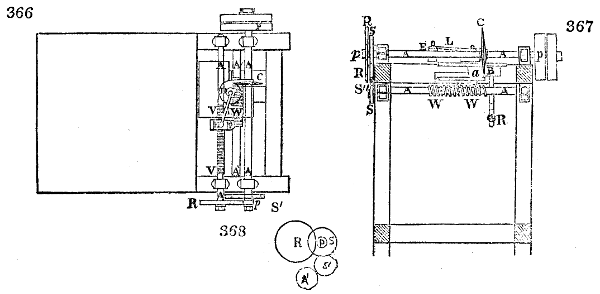
The knife C is placed upon a shaft or axis A, which carries a pulley, round which a belt or cord runs which drives the whole machine. This knife is six inches in diameter. In order that by being kept cool it may cut the caoutchouc better, it is plunged at its lower part into a trough B, full of water; a stopcock R, serves to empty this trough.
The shaft A bears a pinion p, which takes into a wheel R, placed upon the shaft A′; upon which there is cut a worm or endless screw, V, V. This worm bears a nut E, which advances as the screw turns, and carries with it a tie L, which in its turn pushes the disc D, carried upon a shoulder constantly towards the knife. This shoulder is guided by two ears which slide in two grooves cut in the thickness of the table. The diameter of the pinion p is about one fifth of that of the wheel R; so that the arbour A turns five times less quickly than the arbour A; and the fineness of the screw V contributes further to slacken the movement of translation of the disc.
When the disc is all cut down, the shoulder, the tie, and the nut, are brought back to their original position by lifting the nut, which is hinged on. The disc is fixed upon the shoulder by means of sharp points, and an upper washer. The shoulder and the washer have a very small diameter, in order that the knife may, in cutting down the disc, advance as near as possible to the centre.
The rotatory movement of the disc and its shoulder, is given by an endless screw W, W, which governs a pinion p′, provided with 10 teeth, and carried by the shaft A, upon which the shoulder is mounted. The arbour A′ of this endless screw receives its motion from the first shaft A, by means of the wheels S and S′ mounted upon these shafts, and of an intermediate wheel S′′. This wheel, of a diameter equal to that of the shaft A′′, is intended merely to allow this shaft to recede from the shaft A. The diameter of the wheel of this last shaft is to that of the two others in the ratio of 10 to 8.
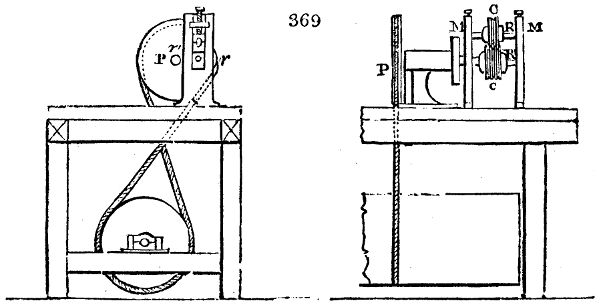
Second machine for sub-dividing the ribands. Fig. 369.—The riband is engaged between the circular knives, C, C, which are mounted upon the rollers R, R; thin brass washers keep these knives apart at a distance which may be varied, and two extreme washers mounted with screws on each roller maintain the whole system. The axes of these rollers traverse two uprights M, M, furnished with brasses, and with adjusting screws to approximate them at pleasure. The axis of the lower roller carries a wheel r, which takes into another smaller wheel r′, placed upon the same shaft as the pulley P, which is driven by a cord. The diameter of the wheel r is three times greater than the wheel r′. The pulley P is twice the size of the wheel r′; and its cord passes round a drum B, which drives the rest of the machine.
The threads when brought to this state of slenderness, are put successively into tubs filled with cold water; they are next softened in hot water, and elongated as much as possible in the following manner:—They are wound upon a reel turned quickly, while the operative stretches the caoutchouc thread with his hand. In this way it is rendered 8 or 10 times longer. The reels when thus filled are placed during some days in a cold apartment, where the threads become firm, and seem to change their nature.
This state of stiffness is essential for the success of the subsequent operations. The threads are commonly covered with a sheath of silk, cotton, or linen, by a braiding machine, and are then placed as warp in a loom, in order to form a narrow web for braces, garters, &c. If the gum were to exercise its elasticity during this operation, the different threads would be lengthened and shortened in an irregular manner, so as to form a puckered tissue. It is requisite therefore to weave the threads in their rigid and inextensible, or at least incontractile condition, and after the fabric is woven to restore to the threads of caoutchouc their appropriate elasticity. This restoration is easily effected by passing a hot smoothing iron over the tissue laid smoothly upon a table covered with blanket stuff. See Braiding Machine.
ELECTIVE AFFINITY, (Wahlverwandtschaft, Germ.) denotes the order of preference, so to speak, in which the several chemical substances choose to combine; or really, the gradation of attractive force infused by Almighty Wisdom among the different objects of nature, which determines perfect uniformity and identity in their compounds amidst indefinite variety of combination. The discussion of this interesting subject belongs to pure chemistry. See Decomposition.
ELEMENTS (Eng. and Fr.; Grundstoffe, Germ.) The ancients considered fire, air, water, and earth, as simple substances, essential to the constitution of all terrestrial beings. This hypothesis, evidently incompatible with modern chemical discovery, may be supposed to correspond, however, to the four states in which matter seems to exist; namely, 1. the unconfinable powers or fluids,—caloric, light, electricity; 2. ponderable gases, or elastic fluids; 3. liquids; 4. solids. The three elements of the alchemists, salt, earth, mercury, were, in their sense of the word, mere phantasms.
In modern science, the term Element signifies merely a substance which has not yet been resolved by analysis into any simpler form of matter; and it is therefore synonymous with undecompounded. This class comprehends 54 different bodies, of which no less than 41 are metallic. Five may be styled Archæal, from the intensity and universality of their affinities for the other bodies, which they penetrate, corrode, and apparently consume, with the phenomena of light and heat. These 5 are chlorine, oxygen, iodine, bromine, fluorine. Eight elements are eminently inflammable when acted upon by any of the preceding five, and are thereby converted into incombustible compounds. The simple non-metallic inflammables are hydrogen, azote, sulphur, phosphorus, selenium, carbon, boron, silicon.
The following table exhibits all the undecompounded bodies in alphabetical order, with their prime equivalent numbers, atomic weights, or reciprocal combining and saturating proportions, as given by Berzelius, in reference to oxygen, reckoned 100,000.:—
Table of undecompounded Bodies, or modern Chemical Elements.
A signifies Archæal; I, Inflammable; M, Metal.
Aluminium M. 171,167
Antimony — 806,542
Arsenic — 470,042
Azote I. 88,518
Barium M. 856,880
Bismuth — 886,000
Boron I. 135,983
Bromine A. 489,150
Cadmium M. 696,970
Calcium — 256,019
Carbon I. 76,437
Cerium M. 574,718
Chlorine A. 221,325
Chromium M. 351,819
Cobalt — 369,991
Copper — 395,695
Fluorine I. 116,900
Gold M. 1243,013
Hydrogen I. 62,398
Iodine A. 789,145
Iridium M. 1233,260
Iron — 339,213
Lead — 1294,489
Lithium — 81,320
Magnesium — 158,353
Manganesium — 345,900
Mercury M. 1265,822
Molybdenum — 598,525
Nickel — 369,675
Osmium — 1244,210
Oxygen A. 100,000
Palladium M. 665,840
Phosphorus I. 196,155
Platinum M. 1233,260
Rhodium — 651,400
Selenium I. 494,582
Silicon — 277,478
Silver M. 675,804
Strontium — 547,285
Sulphur I. 201,165
Tantalum M. 1153,715
Tellurium — 801,760
Thorinum — 744,900
Tin — 735,294
Titanium — 303,686
Tungsten — 1183,000
Uranium — 2711,360
Vanadium — 855,840
Yttrium — 401,840
Zinc — 403,226
Zirconium — 420,238
ELUTRIATE. (Soutirer, Fr.; Schlemmen, Germ.) When an insoluble pulverulent matter, like whitening or ground flints, is diffused through a large body of water, and the mixture is allowed to settle for a little, the larger particles will subside. If the supernatant liquid be now carefully decanted, or run off, with a syphon, it will contain an impalpable powder, which on repose will collect at the bottom, and may be taken out to dry. This process is called elutriation.
EMBALMING. (Embaument, Fr.; Einbalsamen, Germ.) Is an operation in which balsams (baumes, Fr.) were employed to preserve human corpses from putrefaction; whence the name.
The ancient Egyptians had recourse to this process for preserving the bodies of numerous families, and even of the animals which they loved or worshipped. An excellent account of their methods is given in Mr. Pettigrew’s work upon Mummies. Modern chemistry has made us acquainted with many means of counteracting putrefaction more simple and efficacious than the Egyptian system of salting, smoking, spicing, and bituminizing. See Putrefaction.
EMBOSSING WOOD. (Bossage, Fr.; Erhabenes Arbeit, Germ.) Raised figures upon wood, such as are employed in picture frames and other articles of ornamental cabinet work, are usually produced by means of carving, or by casting the pattern in plaster of Paris, or other composition, and cementing, or otherwise fixing it on the surface of the wood. The former mode is expensive; the latter is inapplicable on many occasions. The invention of Mr. Streaker may be used either by itself, or in aid of carving; and depends on the fact, that if a depression be made by a blunt instrument on the surface of the wood, such depressed part will again rise to its original level by subsequent immersion in the water.
The wood to be ornamented having been first worked out to its proposed shape, is in a state to receive the drawing of the pattern; this being put on, a blunt steel tool, or burnisher, or die, is to be applied successively to all those parts of the pattern intended to be in relief, and, at the same time, is to be driven very cautiously, without breaking the grain of the wood, till the depth of the depression is equal to the intended prominence of the figures. The ground is then to be reduced by planing or filing to the level of the depressed part; after which, the piece of wood being placed in water, either hot or cold, the part previously depressed will rise to its former height, and will then form an embossed pattern, which may be finished by the usual operations of carving.
For this invention the Society of Arts voted to Mr. Streaker their silver Isis medal, and ten guineas.
EMBOSSING CLOTH. Mr. Thomas Greig, of Rose Bank, near Bury, patented an invention, in November 1835, which consists in an ingenious construction of machinery for both embossing and printing silk, cotton, woollen cloth, paper, and other fabrics, in one or more colours, at one operation.
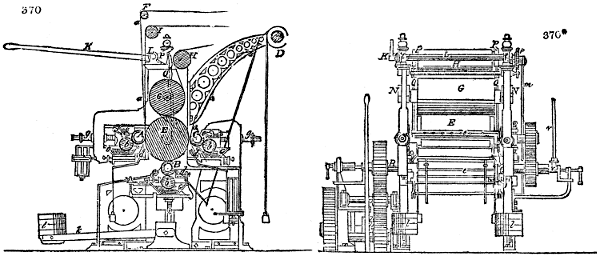
Fig. 370 and 370* enlarged (216 kB)
Figs. 370, 370* represent three distinct printing cylinders of copper, or other suitable material, A, B, C, with their necessary appendages for printing three different colours upon the fabric as it passes through the machine: either of these cylinders A, B, or C, may be employed as an embossing cylinder, without performing the printing process, or may be made to effect both operations at the same time.
The fabric or goods to be operated upon being first wound tightly upon a roller, that roller is to be mounted upon an axle or pivot, bearing in arms or brackets at the back of the machine, as shown at D. From this roller the fabric a a a a is conducted between tension rails, and passed under the bed cylinder or paper bowl E, and from thence proceeds over a carrier roller F, and over steam boxes not shown in the drawing, or it may be conducted into a hot room, for the purpose of drying the colours.
The cylinders A, B, and C, having either engraved or raised surfaces, are connected to feeding rollers b b b, revolving in the ink or coloured troughs c c c; or endless felts, called sieves, may be employed, as in ordinary printing machines, for supplying the colour, when the device on the surface of the cylinders is raised: these cylinders may be furnished with doctors or scrapers when required, or the same may be applied to the endless felts.
The blocks have adjustable screws g g, for the purpose of bringing the cylinders up against the paper bowl, with any required degree of pressure: the cylinder B is supported by its gudgeons running in blocks, which blocks slide in the lower parts of the side frames, and are connected to perpendicular rods i, having adjustable screw nuts.
The lower parts of these rods bear upon weighted levers k k, extending in front of the machine; and by increasing the weights l l, any degree of upward pressure may be given to the cylinder B.
The colour boxes or troughs c c c, carrying the feeding rollers b b b, are fixed on boards which slide in grooves in the side frames, and the rollers are adjusted and brought into contact with the surface of the printing cylinders by screws.
If a back cloth should be required to be introduced between the cylindrical bed or paper bowl E, and the fabric a a a, as the ordinary felt or blanket, it may, for printing and embossing cotton, silk, or paper, be of linen or cotton; but if woollen goods are to be operated upon, a cap of felt, or some such material, must be bound round the paper bowl, and the felt or blanket must be used for the back cloth, which is to be conducted over the rollers H and I.
For the purpose of embossing the fabric, either of the rollers A, B, or C, may be employed, observing that the surface of the roller must be cut, so as to leave the pattern or device elevated for embossing velvets, plain cloths, and papers; but for woollens the device must be excavated, that is, cut in recess.
The pattern of the embossing cylinder will, by the operation, be partially marked through the fabric on to the surface of the paper bowl E; to obliterate which marks from the surface of the bowl, as it revolves, the iron cylinder roller G is employed; but as in the embossing of the same patterns on paper, a counter roller is required to produce the pattern perfectly, the iron roller is in that case dispensed with, the impression given to the paper bowl being required to be retained on its surface until the operation is finished.
In this case the relative circumferences of the embossing cylinder, and of the paper bowl, must be exactly proportioned to each other; that is, the circumference of the bowl must be equal, exactly, to a given number of circumferences of the embossing cylinder, very accurately measured, in order to preserve a perfect register or coincidence, as they continue revolving between the pattern on the surface of the embossing cylinder, and that indented into the surface of the paper bowl.
The axle of the paper bowl E, turns in brasses fitted into slots in the side frames, and it may be raised by hand from its bearings when required, by a lever k, extending in front. This lever is affixed to the end of a horizontal shaft L, L, crossing the machine seen in the figures, at the back of which shaft there are two segment levers P, P, to which bent rods Q, Q, are attached, having hooks at their lower ends, passed under the axle of the bowl. At the reverse end of the shaft L, a ratchet-wheel r, is affixed, and a pall or click mounted on the side of the frame takes into the teeth of the wheel r, and thereby holds up the paper bowl when required.
When the iron roller G, is to be brought into operation, the vertical screws t, t, mounted in the upper parts of the side frames, are turned, in order to bring down the brasses N, which carry the axle of that roller and slide in slots in the side frames.
The cylinders A, B, and C, are represented hollow, and may be kept at any desired temperature during the operation of printing, by introducing steam into them; and under the colour boxes c, c, c, hollow chambers are also made for the same purpose. The degree of temperature required to be given to these must depend upon the nature of the colouring material, and of the goods operated upon. For the purpose of conducting steam to these hollow cylinders and colour boxes, pipes, as shown at v, v, v, are attached, which lead from a steam boiler. But when either of these cylinders is employed for embossing alone, or for embossing and printing at the same time, and particularly for some kinds of goods where a higher temperature may be required, a red-hot heater is then introduced into the hollow cylinder in place of steam.
If the cylinder B, is employed as the embossing cylinder, and it is not intended to print the fabric by that cylinder simultaneously with the operation of embossing, the feeding rolling b, must be removed, and also the colour box c, belonging to that cylinder; and the cylinders A, and C, are to be employed for printing the fabric, the one applying the colour before the embossing is effected, the other after it. It is however to be remarked, that if A, and C, are to print colours on the fabric, and B, to emboss it, in that case it is preferred, where the pattern would allow it. A and C, are wooden rollers having the pattern upon their surfaces, and not metal, as the embossing cylinders must of necessity be.
It will be perceived that this machine will print one, two, or three colours at the same time, and that the operation of embossing may be performed simultaneously with the printing, by either of the cylinders A, B, or C, or the operation may be performed consecutively by the cylinders, either preceding or succeeding each other.
The situations of the doctors, when required to be used for removing any superfluous colour from the surface of the printing cylinder, are shown at d, d, d; those for removing any lint which may attach itself, at e, e, e. They are kept in their bearings by weighted levers and screws, and receive a slight lateral movement to and fro, by means of the vertical rod m, which is connected at top to an eccentric, on the end of the axle of the roller H, and at its lower end to a horizontal rod mounted at the side of the frame; to this horizontal rod, arms are attached, which are connected to the respective doctors; and thus by the rotation of the eccentric, the doctors are made to slide laterally.
When the cylinders A, B, or C, are employed for embossing only, those doctors will not be required. The driving power is communicated to the machine from any first mover through the agency of the toothed geer, which gives rotatory motion to the cylinder B, and from thence to the other cylinders A, and C, by toothed geer shown in fig. 370.
EMBROIDERING MACHINE. (Machine à broder, Fr.; Steckmaschine, Germ.) This art has been till of late merely a handicraft employment, cultivated on account of its elegance by ladies of rank. But a few years ago M. Heilmann of Mulhausen invented a machine of a most ingenious kind, which enables a female to embroider any design with 80 or 140 needles as accurately and expeditiously as she formerly could do with one. A brief account of this remarkable invention will therefore be acceptable to many readers. It was displayed at the national exposition of the products of industry in Paris for 1834, and was unquestionably the object which stood highest in public esteem; for whether at rest or in motion, it was always surrounded with a crowd of curious visiters, admiring the figures which it had formed, or inspecting its movements and investigating its mechanism. 130 needles were occupied in copying the same pattern with perfect regularity, all set in motion by one person.
Several of these machines are now mounted in France, Germany, and Switzerland. I have seen one factory in Manchester, where a great many of them are doing beautiful work.
The price of a machine having 130 needles, and of consequence 260 pincers or fingers and thumbs to lay hold of them, is 5000 francs, or 200l. sterling; and it is estimated to do daily the work of 15 expert hand embroiderers, employed upon the ordinary frame. It requires merely the labour of one grown-up person, and two assistant children. The operative must be well taught to use the machine, for he has many things to attend to: with the one hand he traces out, or rather follows the design with the point of the pantograph; with the other he turns a handle to plant and pull all the needles, which are seized by pincers and moved along by carriages, approaching to and receding from the web, rolling all the time along an iron railway; lastly, by means of two pedals, upon which he presses alternately with the one foot and the other, he opens the 130 pincers of the first carriage, which ought to give up the needles after planting them in the stuff, and he shuts with the same pressure the 130 pincers of the second carriage, which is to receive the needles, to draw them from the other side, and to bring them back again. The children have nothing else to do than to change the needles when all their threads are used, and to see that no needle misses its pincers.
This machine deserves particular attention, because it is no less remarkable for the happy arrangement of its parts, than for the effects which it produces. It may be described under four heads: 1. the structure of the frame; 2. the disposition of the web; 3. the arrangement of the carriages; and 4. the construction of the pincers.
1. The structure of the frame. It is composed of cast-iron, and is very massive. Fig. 371. exhibits a front elevation of it. The length of the machine depends upon the number of pincers to be worked. The model at the exposition had 260 pincers, and was 2 metres and a half (about 100 inches or 8 feet 4 inches English) long. The figure here given has been shortened considerably, but the other proportions are not disturbed. The breadth of the frame ought to be the same for every machine, whether it be long or short, for it is the breadth which determines the length of the thread to be put into the needles, and there is an advantage in giving it the full breadth of the model machine, fully 100 inches, so that the needles may carry a thread at least 40 inches long.
Disposition of the piece to be embroidered.—We have already stated that the pincers which hold the needles always present themselves opposite to the same point, and that in consequence they would continually pass backwards and forwards through the same hole, but the piece is displaced with sufficient precision to bring opposite the tips progressively of the needles, every point upon which they are to work a design, such as a flower.
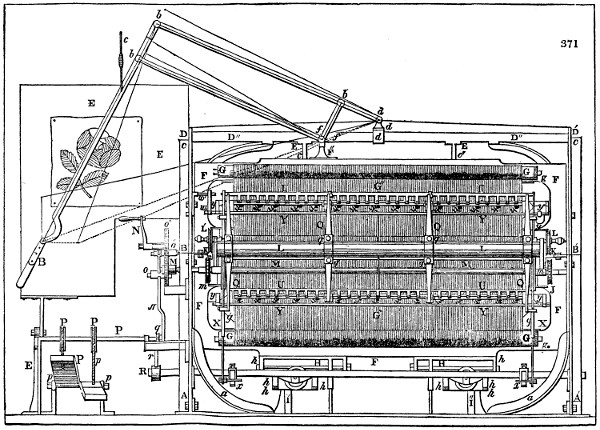
Fig. 371 enlarged (465 kB)
Explanation of Figure
The piece is strained perpendicularly upon a large rectangular frame, whose four sides are visible in fig. 371.; namely the two vertical sides at F F, and the two horizontal sides, the upper and lower at F′ F′′. We see also in the figure two long wooden rollers G and G, whose ends, mounted with iron studs, are supported upon the sides F of the frame, so as to turn freely. These form a system of beams upon which the piece destined to receive the embroidery, is wound and kept vertically stretched to a proper degree, for each of these beams bears upon its end a small ratchet wheel g, g; the teeth of one of them being inclined in the opposite direction to those of the other. Besides this system of lower beams, there is another of two upper beams, which is however but imperfectly seen in the figure, on account of the interference of other parts in this view of the machine. One of these systems presents the web to the inferior needles, and the other to the upper needles. As the two beams are not in the same vertical plane, the plane of the web would be presented obliquely to the needles were it not for a straight bar of iron, round whose edge the cloth passes, and which renders it vertical. The piece is kept in tension crosswise by small brass templets, to which the strings g′′ are attached, and by which it is pulled towards the sides of the frame F. It remains to shew by what ingenious means this frame may be shifted in every possible direction. M. Heilmann has employed for this purpose the pantograph which draughtsmen use for reducing or enlarging their plans in determinate proportions.
b b′ f b′′ (fig. 371.) represents a parallelogram of which the four angles b, b′, f, b′′, are jointed in such a way that they may become very acute or very obtuse at pleasure, while the sides of course continue of the same length; the sides b, b′ and b, b′′ are prolonged, the one to the point d, and the other to the point c, and these points c and d, are chosen under the condition that in one of the positions of the parallelogram, the line c d which joins them passes through the point f; this condition may be fulfilled in an infinite number of manners, since the position of the parallelogram remaining the same, we see that if we wished to shift the point d further from the point b′, it would be sufficient to bring the point c near enough to b′′, or vice versa; but when we have once fixed upon the distance b′ d, it is evident that the distance b′′ c is its necessary consequence. Now the principle upon which the construction of the pantograph rests is this; it is sufficient that the three points d, f, and c be in a straight line, in one only of the positions of the parallelogram, in order that they shall remain always in a straight line in every position which can possibly be given to it.
We see in the figure that the side b c, has a handle B′′ with which the workman puts the machine in action. To obtain more precision and solidity in work, the sides of the pantograph are joined, so that the middle of their thickness lies exactly in the vertical plane of the piece of goods, and that the axes of the joints are truly perpendicular to this plane, in which consequently all the displacements are effected. We arrive at this result by making fast to the superior great cross bar D′′ an elbow piece d2, having a suitable projection, and to which is adapted in its turn the piece d′, which receives in a socket the extremity of the side b, d; this piece d′ is made fast to d′′ by a bolt, but it carries an oblong hole, and before screwing up the nut, we make the piece advance or recede, till the fulcrum point comes exactly into the plane of the web. This condition being fulfilled, we have merely to attach the frame to the angle f of the parallelogram, which is done by means of the piece F′′.
It is now obvious that if the embroiderer takes the handle B′′ in his hand and makes the pantograph move in any direction whatever, the point f will describe a figure similar to the figure described by the point c, and six times smaller, but the point f cannot move without the frame, and whatever is upon it moving also. Thus, in the movement of the pantograph, every point of the web describes a figure equal to that described by the point f, and consequently similar to that described by the point c, but six times smaller; the embroidered object being produced upon the cloth in the position of that of the pattern. It is sufficient therefore to give the embroidering operative who holds the handle B′′, a design six times greater than that to be executed by the machine, and to afford him at the same time a sure and easy means of tracing over with the point c, all the outlines of the pattern. For this purpose he adapts to c, perpendicularly to the plane of the parallelogram, a small style terminated by a point C′, and he fixes the pattern upon a vertical tablet E, parallel to the plane of the stuff and the parallelogram, and distant from it only by the length of the style c C′′; this tablet is carried by the iron rod c′, which is secured to a cast iron foot E′, serving also for other purposes, as we shall presently see. The frame loaded with its beams and its cloth forms a pretty heavy mass, and as it must not swerve from its plane, it needs to be lightened in order that the operative may cause the point of the pantograph to pass along the tablet without straining or uncertainty in its movements. M. Heilmann has accomplished these objects in the following way. A cord e attached to the side b c of the pantograph passes over a return pulley, and carries at its extremity, a weight which may be graduated at pleasure; this weight equipoises the pantograph, and tends slightly to raise the frame. The lower side of the frame carries two rods H and H, each attached by two arms h h, a little bent to the left; both of these are engaged in the grooves of a pulley. Through this mechanism a pressure can be exercised upon the frame from below upwards, which may be regulated at pleasure, and without preventing the frame from moving in all directions, it hinders it from deviating from the primitive plane to which the pantograph was adjusted. The length of the rods H ought to be equal to the amount of the lateral movement of the frame. Two guides i i carried by two legs of cast iron, present vertical slits in which the lower part of the frame F′ is engaged.
Disposition of the carriages.—The two carriages, which are similar, are placed the one to the right, and the other to the left of the frame. The carriage itself is composed merely of a long hollow cylinder of cast iron L, carrying at either end a system of two grooved castors or pulleys L′, which roll upon the horizontal rails K; the pulleys are mounted upon a forked piece l′, with two ends to receive the axes of the pulleys, and the piece l′ is itself bolted to a projecting ear l cast upon the cylinder.
This assemblage constitutes properly speaking the carriage, resting in a perfectly stable equilibrium upon the rails K, upon which it may be most easily moved backwards and forwards, carrying its train of needles to be passed or drawn through the cloth.
M. Heilmann has contrived a mechanism by which the operative without budging from his place may conduct the carriages, and regulate as he pleases the extent of their course, as well as the rapidity of their movements. By turning the axes M′′ in the one direction or the other, the carriage may be made to approach to, or recede from the web.
When one of the carriages has advanced to prick the needles into the stuff, the other is there to receive them; it lays hold of them with its pincers, pulls them through, performs its course by withdrawing to stretch the thread, and close the stitch, then it goes back with the needles to make its pricks in return. During these movements the first carriage remains at its post waiting the return of the second. Thus the two chariots make in succession an advance and a return, but they never move together.
To effect these movements M. Heilmann has attached to the piece O′ made fast to the two uprights A C and A D of the frame, a bent lever n o n′ n′′ movable round the point o; the bend n′ carries a toothed wheel O′, and the extremity n′′ a toothed wheel O′′; the four wheels M M′ O′ and O′′ have the same number of teeth and the same diameter; the two wheels O′ and O′′ are fixed in reference to each other, so that it is sufficient to turn the handle N to make the wheel O′′ revolve, and consequently the wheel O′; when the lever n o is vertical, the wheel O′ touches neither the wheel M nor the wheel M′; but if it be inclined to the one side or the other, it brings the wheel O′ alternately into geer with the wheel M or the wheel M′. As the operative has his two hands occupied, the one with the pantograph and the other with the handle of impulsion, he has merely his feet for acting upon the lever n o, and as he has many other things to do, M. Heilmann has adapted before him a system of two pedals, by which he executes with his feet a series of operations no less delicate than those which he executes with his hands.
The pedals P are moveable round the axis p, and carry cords p′ wound in an opposite direction upon the pulleys P′; these pulleys are fixed upon a moveable shaft P′′, supported upon one side by the prop E′, and on the other in a piece K′ attached to the two great uprights of the frame. In depressing the pedal P (now raised in the figure), the upper part of the shaft P′′ will turn from the left to the right, and the lever n o will become inclined so as to carry the wheel O′ upon the wheel M′, but at the same time the pedal which is now depressed will be raised, because its cord will be forced to wind itself upon its pulley, as much as the other cord has unwound itself; and thus the apparatus will be ready to act in the opposite direction, when wanted.
Disposition of the pincers.—The shaft L′ carries, at regular intervals of a semi-diameter, the appendages q q cast upon it, upon which are fixed, by two bolts, the curved branches Q destined to bear the whole mechanism of the pincers. When the pincers are opened by their appropriate leverage, and the half of the needle, which is pointed at each end, with the eye in the middle, enters the opening of its plate, it gets lodged in an angular groove, which is less deep than the needle is thick, so that when the pincers are closed, the upper jaw presses it into the groove. In this way the needle is firmly held, although touched in only three points of its circumference.
Suppose, now, that all the pincers are mounted and adjusted at their proper distances upon their prismatic bar, forming the upper range of the right carriage. For opening all the pincers there is a long plate of iron, U, capable of turning upon its axis, and which extends from the one end of the carriage to the other. This axis is carried by a kind of forks which are bolted to the extremity of the branches Q. By turning that axis the workman can open the pincers at pleasure, and they are again closed by springs. This movement is performed by his feet acting upon the pedals.
The threads get stretched in proportion as the carriage is run out, but as this tension has no elastic play, inconveniences might ensue which are prevented by adapting to the carriage a mechanism by means of which all the threads are pressed at the same time by a weight susceptible of graduation. A little beneath the prismatic bar, which carries the pincers, we see in the figure, a shaft Y, going from one end of the carriage to the other, and even a little beyond it; this shaft is carried by pieces y which are fixed to the arms Q, and in which it can turn. At its left end it carries two small bars y′ and w′, and at its right a single bar y′, and a counterweight (not visible in this view); the ends of the two bars y′ are joined by an iron wire somewhat stout and perfectly straight. When the carriage approaches the web, and before the iron wire can touch it, the little bar w presses against a pin w′, which rests upon it, and tends to raise it more and more. In what has preceded we have kept in view only the upper range of pincers and needles, but there is an inferior range quite similar, as the figure shows, at the lower ends of the arms Q. In conclusion, it should be stated, that the operative does not follow slidingly with the pantograph the trace of the design which is upon the tablet or the picture, but he must stop the point of the style upon the point of the pattern into which the needle should enter, then remove it, and put it down again upon the point by which the needle ought to re-enter in coming from the other side of the piece, and so on in succession. To facilitate this kind of reading off, the pattern upon the tablet is composed of right lines terminated by the points for the entrance and return of the needle, so that the operative (usually a child) has continually under her eyes the series of broken lines which must be followed by the pantograph; if she happens to quit this path an instant, without having left a mark of the point at which she had arrived, she is under the necessity of looking at the piece to see what has been already embroidered, and to find by this comparison the point at which she must resume her work, so as not to leave a blank, or to repeat the same stitch.
Explanation of figure:
A, lower cross bars, which unite the legs of the two ends of the frame.
a, the six feet of the front end of the frame.
a′, the six feet of the posterior end of the frame.
a′′, curved pieces which unite the cross bars A′′ to the uprights.
B′′, handle of the pantograph.
b b′ b′′, three of the angles of the pantograph.
c, point of the side b b′′ on which the point is fixed.
C′′, point of the pantograph.
D′′, cross bar in form of a gutter, which unites the upper parts of the frame.
d, fixed point, round which the pantograph turns.
E, tablet upon which the pattern to be embroidered is put.
E′, support of that tablet.
e, cord attached at one end to the side b c of the pantograph passing over a guide pulley, and carrying a weight at the other end.
e′, iron rod by which the tablet E is joined to its support E′.
F F, uprights of the cloth-carrying frame.
F′ F′, horizontal sides of the same frame.
G, four roll beams.
G′′, the piece of cloth.
g′′, the strings, which serve to stretch the cloth laterally.
EMERALD. (Emeraude, Fr.; Smaragd, Germ.) Is a precious stone of a beautiful green colour; valued next to diamond, and in the same rank as oriental ruby and sapphire. It occurs in prisms with a regular hexagonal base; sp. grav. 2·7; scratches quartz with difficulty; is scratched by topaz; fusible at the blowpipe into a frothy bead; the precipitate afforded by ammonia, from its solution, is soluble, in a great measure, in carbonate of ammonia. Its analysis is given very variously by different chemists. It contains about 14 per cent. of glucina, which is its characteristic constituent; along with 68 of silica, 16 of alumina, a very little lime and iron. The beautiful emerald of Peru is found in a clay schist mixed with some calcareous matter. A stone of 4 grains weight is said to be worth from 4l. to 5l.; one of 8 grains, 10l.; one of 15 grains, being fine, is worth 60l.; one of 24 grains fetched, at the sale of M. de Drée’s cabinet, 2400 francs, or nearly 100l.
The beryl is analogous in composition to the emerald, and is employed (when of the common opaque kind, found near Limoges,) by chemists, for procuring the earth glucina.
EMERY. This mineral was long regarded as an ore of iron; and was called by Haüy fer oxidé quartzifère. It is very abundant in the island of Naxos, at cape Emeri, whence it is imported in large quantities. It occurs also in the islands of Jersey and Guernsey, at Almaden, in Poland, Saxony, Sweden, Persia, &c. Its colour varies from red brown to dark brown; its specific gravity is about 4·000; it is so hard as to scratch quartz and many precious stones. By Mr. Tennant’s analysis, it consists of alumina, 80; silica, 3; iron, 4. Another inferior kind yielded 32 of iron, and only 50 of alumina.
The alumina of emery is believed to be aggregated to the same degree of hardness as in corundum or adamantine spar; which is one of the hardest minerals known. Emery is extensively employed for grinding metals, glass, &c.; for which purpose it is reduced to powders of different degrees of fineness by grinding and elutriation. When so treated, it is sold under the name of flour of emery, or washed emery.
EMPYREUMA, means the offensive smell produced by fire applied to organic matters, chiefly vegetable, in close vessels. Thus, empyreumatic vinegar is obtained by distilling wood at a red heat, and empyreumatic oil from many animal substances in the same way.
ENAMELS, (Emaux, Fr.; Schmelzglas, Germ.) are varieties of glass, generally opaque and coloured, always formed by the combination of different metallic oxides, to which certain fixed fusible salts are added, such as the borates, fluates, and phosphates.
The simplest enamel, and the one which serves as a basis to most of the others, is obtained by calcining first of all a mixture of lead and tin, in proportions varying from 15 to 50 parts of tin for 100 of lead. The middle term appears to be the most suitable for the greater number of enamels; and this alloy has such an affinity for oxygen, that it may be calcined with the greatest ease in a flat cast-iron pot, and at a temperature not above a cherry red, provided the dose of tin is not too great. The oxide is drawn off to the sides of the melted metal according as it is generated, new pieces of the alloy being thrown in from time to time, till enough of the powder be obtained. Great care ought to be taken that no metallic particles be left in the oxide, and that the calcining heat be as low as is barely sufficient; for a strong fire frits the powder, and obstructs its subsequent comminution. The powder when cold is ground in a proper mill, levigated with water, and elutriated, as will be described under Red lead. In this state of fineness and purity, it is called calcine, or flux, and it is mixed with siliceous sand and some alkaline matter or sea-salt. The most ordinary proportions are, 4 of sand, 1 of sea-salt, and 4 of calcine. Chaptal states, that he has obtained a very fine product from 100 parts of calcine, made by calcining equal parts of lead and tin, 100 parts of ground flint, and 200 parts of pure subcarbonate of potash. In either case, the mixture is put into a crucible, or laid simply on a stratum of sand, quicklime spontaneously slacked, or wood-ashes, placed under a pottery or porcelain kiln. This mass undergoes a semi-vitrification; or even a complete fusion on its surface. It is this kind of frit which serves as a radical to almost every enamel; and by varying the proportions of the ingredient, more fusible, more opaque, or whiter enamels are obtained. The first of these qualities depends on the quantity of sand or flux, and the other two on that of the tin.
The sea-salt employed as a flux may be replaced either by salt of tartar, by pure potash, or by soda; but each of these fluxes gives peculiar qualities to the enamel.
Most authors who have written on the preparation of enamels, insist a great deal on the necessity of selecting carefully the particular sand that should enter into the composition of the frit, and they even affirm that the purest is not the most suitable. Clouet states, in the 34th volume of the Annales de Chimie, that the sand ought to contain at least 1 part of talc for 3 of siliceous matter, otherwise the enamel obtained is never very glassy, and that some wrinkled spots from imperfect fusion are seen on its surface; and yet we find prescribed in some old treatises, to make use of ground flints, fritted by means of salt of tartar or some other flux. It would thence appear that the presence of talc is of no use towards the fusibility of the silica, and that its absence may be supplied by increasing the dose of the flux. In all cases, however, we ought to beware of metallic oxides in the sand, particularly those of iron and manganese, which most frequently occur, and always injure the whiteness of the frit.
The ancients carried the art of enamelling to a very high perfection, and we occasionally find beautiful specimens of their work, of which we know neither the composition, nor the manner of applying it. Then, as at present, each artist made a mystery of the means that succeeded best with him, and thus a multitude of curious processes have been buried with their authors. Another cause contributes powerfully to this sort of declension in the arts. Among the vast number of recipes which have been published for the formation of enamels, there are several in which substances are mentioned that can no longer be procured, whether owing to a change of denomination, or because the substances cannot now be found in commerce, or because they are not of the same nature as of old. Hence, in many cases, we find it impossible to obtain satisfactory results. What we have now said renders it desirable that the operations should be resumed anew, or upon new bases, and availing ourselves of all the known chemical facts, we should employ in the production of enamels, raw materials of the purest kind.
The Venetians are still in possession of the best enamel processes, and they supply the French and other nations with the best kinds of enamel, of every coloured shade.
Enamels are distinguished into transparent and opaque; in the former all the elements have experienced an equal degree of liquefaction, and are thus run into crystal glass, whilst in the others, some of their elements have resisted the action of heat more, so that their particles retain sufficient aggregation to prevent the transmission of light. This effect is produced, particularly by the oxide of tin, as we shall perceive in treating of white enamel.
The frits for enamels that are to be applied to metallic surfaces require greater fusibility, and should therefore contain more flux; and the sand used for these should be calcined beforehand with one-fourth its weight of sea-salt; sometimes, indeed, metallic fluxes are added, as minium or litharge. For some metallic colours, the oxides of lead are very injurious, and in this case recourse must be had to other fluxes. Clouet states that he has derived advantage from the following mixtures, as bases for purples, blues, and some other delicate colours:—
Three parts of siliceous sand, one of chalk, and three of calcined borax; or, three of glass (of broken crystal goblets), one of calcined borax, one-fourth of a part of nitre, and one part of well washed diaphoretic antimony. These compositions afford a very white enamel, which accords perfectly well with blue.
It is obvious that the composition of this primary matter may be greatly varied; but we should never lose sight of the essential quality of a good enamel; which is, to acquire, at a moderate heat, sufficient fluidity, to take a shining surface, without running too thin. It is not complete fusion which is wanted; but a pasty state, of such a degree as may give it, after cooling, the aspect of having suffered complete liquefaction.
Dead-white Enamel.—This requires greater nicety in the choice of its materials than any other enamel, as it must be free from every species of tint, and be perfectly white; hence the frit employed in this case should be itself composed of perfectly pure ingredients. But a frit should not be rejected hastily because it may be somewhat discoloured, since this may depend on two causes; either on some metallic oxides, or on fuliginous particles proceeding from vegetable or animal substances. Now the latter impurities may be easily removed by means of a small quantity of peroxide of manganese, which has the property of readily parting with a portion of its oxygen, and of thus facilitating the combustion, that is to say, the destruction of the colouring carbonaceous matter. Manganese indeed possesses a colouring power itself on glass, but only in its highest state of oxidizement, and when reduced to the lower state, as is done by incombustible matters, it no longer communicates colour to the enamel combinations. Hence the proportion of manganese should never exceed what is just; for the surplus would cause colour. Sometimes, indeed, it becomes necessary to give a little manganese-colour, in order to obtain a more agreeable shade of white; as a little azure blue is added to linens, to brighten or counteract the dulness of their yellow tint.
A white enamel may be conveniently prepared also with a calcine composed of two parts of tin and one of lead calcined together; of this combined oxide, one part is melted with two parts of fine crystal and a very little manganese, all previously ground together. When the fusion is complete, the vitreous matter is to be poured into clear water, and the frit is then dried, and melted anew. The pouring into water and fusion are sometimes repeated 4 times, in order to secure a very uniform combination. The crucible must be carefully screened from smoke and flame. The smallest portions of oxide of iron or copper admitted into this enamel will destroy its value.
Some practitioners recommend the use of washed diaphoretic antimony (antimoniate of potash, from metallic antimony and nitre deflagrated together) for white enamel; but this product cannot be added to any preparation of lead or other metallic oxides; for it would tend rather to tarnish the colour than to clear it up; and it can be used therefore only with ordinary glass, or with saline fluxes. For three parts of white glass (without lead) one part of washed diaphoretic antimony is to be taken; the substances are well ground together, and fused in the common way.
Blue Enamel.—This fine colour is almost always obtained from the oxide of cobalt or some of its combinations, and it produces it with such intensity that only a very little can be used, lest the shade should pass into black. The cobalt blue is so rich and lively that it predominates in some measure over every other colour, and masks many so that they can hardly be perceived; it is also most easily obtained. To bring it out, however, in all its beauty, the other colours must be removed as much as possible, and the cobalt itself should be tolerably pure. This metal is associated in the best known ores with a considerable number of foreign substances, as iron, arsenic, copper, nickel, and sulphur, and it is difficult to separate them completely; but for enamel blues, the oxide of cobalt does not require to be perfectly free from all foreign metals; the iron, nickel, and copper being most prejudicial, should be carefully eliminated. This object may be most easily attained by dissolving the ore in nitric acid, evaporating the solution to a syrupy consistence, to expel the excess of acid, and separate a portion of arsenic. It is now diluted with water, and solution of carbonate of soda is dropped slowly into it with brisk agitation, till the precipitate, which is at first of a whitish gray, begins to turn of a rose-red. Whenever this colour appears, the whole must be thrown on a filter, and the liquid which passes through must be treated with more of the carbonate of soda, in order to obtain the arseniate of cobalt, which is nearly pure. Since arsenic acid and its derivatives are not capable of communicating colour themselves, and as they moreover are volatile, they cannot impair the beauty of the blue, and hence this preparation affords it in great perfection.
Metallic fluxes are not the most suitable for this colour; because they always communicate a tint of greater or less force, which never fails to injure the purity of the blue. Nitre is a useful addition, as it keeps the oxide at the maximum of oxidation, in which state it produces the richest colour.
Yellow Enamel.—There are many processes for making this colour in enamel; but it is somewhat difficult to fix, and it is rarely obtained of an uniform and fine tint. It may be produced directly with some preparations of silver, as the phosphate or sulphate; but this method does not always succeed, for too strong a heat or powerful fluxes readily destroy it, and nitre is particularly prejudicial. This uncertainty of success with the salts of silver causes them to be seldom employed; and oxides of lead and antimony are therefore preferred, which afford a fine yellow when combined with some oxides that are refractory enough to prevent their complete vitrification. One part of white oxide of antimony may be taken with from one to three parts of white lead, one of alum, and one of sal-ammoniac. Each of these substances is to be pulverized, and then all are to be exactly mixed, and exposed to a heat adequate to decompose the sal-ammoniac. This operation is judged to be finished when the yellow colour is well brought out. There is produced here a combination quite analogous to that known under the name of Naples yellow.
Other shades of yellow may be procured either with the oxide of lead alone, or by adding to it a little red oxide of iron; the tints varying with the proportion of the latter.
Clouet says, in his memoir on enamels, that a fine yellow is obtained with pure oxide of silver, and that it is merely necessary to spread a thin coat of it on the spot to be coloured. The piece is then exposed to a moderate heat, and withdrawn as soon as this has reached the proper point. The thin film of metallic silver revived on the surface being removed, the place under it will be found tinged of a fine yellow, of hardly any thickness. As the pellicle of silver has to be removed which covers the colour, it is requisite to avoid fixing this film with fluxes; and it ought therefore to be applied after the fusion of the rest. The yellows require in general little flux, and they answer better with one of a metallic nature.
Green Enamel.—It is known that a green colour may be produced by a mixture of yellow and blue; but recourse is seldom had to this practice for enamels, as they can be obtained almost always directly with the oxide of copper; or still better with the oxide of chrome, which has the advantage of resisting a strong heat.
Chemists describe two oxides of copper, the protoxide, of an orange red colour, which communicates its colour to enamels, but it is difficult to fix; the deutoxide is blue in the state of hydrate, but blackish-brown when dry, and it colours green all the vitreous combinations into which it enters. This oxide requires, at most, one or two proportions of flux, either saline or metallic, to enter into complete fusion; but a much smaller dose is commonly taken, and a little oxide of iron is introduced. To four pounds of frit, for instance, two ounces of oxide of copper and 48 grains of red oxide of iron are used; and the ordinary measures are pursued for making very homogeneous enamel.
The green produced by the oxide of chrome is much more solid; it is not affected by a powerful fire, but it is not always of a fine shade. It generally inclines too much to the dead-leaf yellow, which depends on the degree of oxygenation of the chrome.
Red Enamel.—We have just stated, that protoxide of copper afforded a fine colour when it could be fixed, a result difficult to obtain on account of the fugitive nature of this oxide; slight variations of temperature enabling it to absorb more oxygen. The proper point of fusion must be seized, for taking it from the fire whenever the desired colour is brought out. Indeed, when a high temperature has produced peroxidizement, this may be corrected by adding some combustible matter, as charcoal, tallow, tartar, &c. The copper then returns to its minimum of oxidizement, and the red colour which had vanished, reappears. It is possible, in this way, and by pushing the heat a little, to accomplish the complete reduction of a part of the oxide; and the particles of metallic copper thereby disseminated in a reddish ground, give this enamel the aspect of the stone called avanturine. The surest and easiest method of procuring protoxide of copper is to boil a solution of equal parts of sugar, and sulphate or rather acetate of copper, in four parts of water. The sugar takes possession of a portion of the oxygen of the cupreous oxide, and reduces it to the protoxide; when it may be precipitated in the form of a granular powder of a brilliant red. After about two hours of moderate ebullition, the liquid is set aside to settle, decanted off the precipitate, which is washed and dried.
This pure oxide, properly employed by itself, furnishes a red which vies with the finest carmine, and by its means every tint may be obtained from red to orange, by adding a greater or smaller quantity of peroxide of iron.
The preparations of gold, and particularly the oxide and purple of Cassius, are likewise employed, with advantage, to colour enamel red, and this composition resists a powerful fire tolerably well. For some time back, solutions of gold, silver, and platinum have been used with success instead of their oxides; and, in this way, a more intimate mixture may be procured, and, consequently, more homogeneous tints.
Black Enamel.—Black enamels are made with peroxide of manganese or protoxide of iron; to which more depth of colour is given with a little cobalt. Clay alone, melted with about a third of its weight of protoxide of iron, gives, according to Clouet, a fine black enamel.
Violet Enamel.—The peroxide of manganese in small quantity by itself furnishes, with saline or alkaline fluxes, an enamel of a very fine violet hue; and variations of shade are easily had by modifying the proportions of the elements of the coloured frit. The great point is to maintain the manganese in a state of peroxidation, and consequently to beware of placing the enamel in contact with any substance attractive of oxygen.
Such are the principal coloured enamels hitherto obtained by means of metallic oxides; but since the number of these oxides is increasing every day, it is to be wished that new trials be made with such as have not yet been employed. From such researches some interesting results would unquestionably be derived.
Of painting on Enamel.—Enamelling is only done on gold and copper; for silver swells up, and causes blisters and holes in the coat of enamel. All enamel paintings are, in fact, done on copper or gold.
The goldsmith prepares the plate that is to be painted upon. The gold should be 22 carats fine: if purer, it would not be sufficiently stiff; if coarser, it would be subject to melt; and its alloy should be half white and half red, that is, half silver and half copper; whereby the enamel with which it is covered will be less disposed to turn green, than if the alloy were entirely copper.
The workman must reserve for the edge of the plate a small fillet, which he calls the border. This ledge serves to retain the enamel, and hinders it from falling off when applied and pressed on with a spatula. When the plate is not to be counter-enamelled, it should be charged with less enamel, as, when exposed to heat, the enamel draws up the gold to itself, and makes the piece convex. When the enamel is not to cover the whole plate, it becomes necessary to prepare a lodgement for it. With this view, all the outlines of the figure are traced on the plate with a black-lead pencil, after which recourse is had to the graver.
The whole space enclosed by the outlines must be hollowed out in bas-relief, of a depth equal to the height of the fillet, had the plate been entirely enamelled. This sinking of the surface must be done with a flat graver as equally as possible; for if there be an eminence, the enamel would be weaker at that point, and the green would appear. Some artists hatch the bottom of the hollow with close lines, which cross each other in all directions; and others make lines or scratches with the end of a file broken off square. The hatchings or scratches lay hold of the enamel, which might otherwise separate from the plate. After this operation, the plate is cleansed by boiling it in an alkaline ley, and it is washed first with a little weak vinegar, and then with clear water.
The plate thus prepared is to be covered with a coat of white enamel, which is done by bruising a piece of enamel in an agate or porcelain mortar to a coarse powder like sand, washing it well with water, and applying it in the hollow part in its moist state. The plate may meanwhile be held in an ordinary forceps. The enamel powder is spread with a spatula. For condensing the enamel powder, the edges of the plate are struck upon with this spatula.
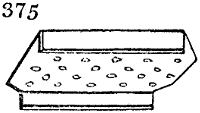
Whenever the piece is dry, it is placed on a slip of sheet iron perforated with several small holes, see fig. 375., which is laid on hot cinders; and it is left there until it ceases to steam. It must be kept hot till it goes to the fire; for were it allowed to cool it would become necessary to heat it again very gradually at the mouth of the furnace of fusion, to prevent the enamel from decrepitating and flying off.
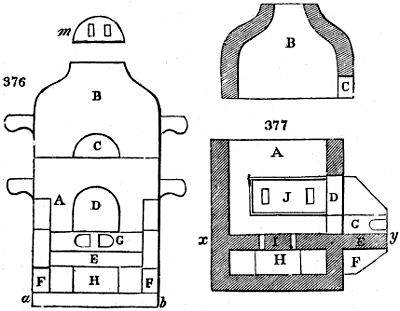
Before describing the manner of exposing the piece to the fire, we must explain the construction of the furnace. It is square, and is shewn in front elevation in fig. 376. It consists of two pieces, the lower part A, or the body of the furnace, and the upper part B, or the capital, which is laid on the lower part as is shewn in fig. 377., where these two parts are separately represented. The furnace is made of good fire-clay, moderately baked, and resembles very closely the assay or cupellation furnace. Its inside dimensions are 9 inches in width; 13 inches in height in the body, and 9 in the capital. Its general thickness is 2 inches.
The capital has an aperture or door C, fig. 376., which is closed by a fire-brick stopper m, when the fire is to be made active. By this door fuel is supplied.
The body of the furnace has likewise a door D, which reaches down to the projecting shelf E, called the bib (mentonnière), whose prominence is seen at E, fig. 376. This shelf is supported and secured by the two brackets F, F; the whole being earthenware. The height of the door D, is abridged by a peculiar fire-brick G, which not only covers the whole projection of the shelf E, but enters within the opening of the door D, filling its breadth, and advancing into the same plane with the inner surface of the furnace. This plate is called the hearth; its purpose will appear presently; it may be taken out and replaced at pleasure, by laying hold of the handle in its front.
Below the shelf E, a square hole, H, is seen, which serves for admitting air, and for extracting the ashes. Similar holes are left upon each side of the furnace, as is shown in the ground plan of the base, fig. 377., at H H H.
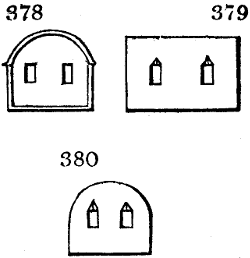
On a level with the shelf, in the interior of the furnace, a thin fire-tile I rests, perforated with numerous small holes. This is the grate represented in a ground view in fig. 375. Fig. 378, 379, 380. represent, under different aspects, the muffle. Fig. 377. shows the elevation of its further end; fig. 379. its sides; and fig. 380. its front part. At J, fig. 377. the muffle is seen in its place in the furnace, resting on two bars of iron, or, still better, on ledges of fire-clay, supported on brackets attached to the lateral sides of the furnace. The muffle is made of earthenware, and as thin as possible. The fuel consists of dry beech-wood, or oaken branches, about an inch in diameter, cut to the length of 9 inches, in order to be laid in horizontal strata within the furnace, one row only being placed above the muffle. When the muffle has attained to a white-red heat, the sheet iron tray, bearing its enamel plate, is to be introduced with a pair of pincers into the front of the muffle, and gradually advanced towards its further end. The mouth of the muffle is to be then closed with two pieces of charcoal only, between which the artist may see the progress of the operation. Whenever the enamel begins to flow, the tray must be turned round on its base to ensure equality of temperature; and as soon as the whole surface is melted, the tray must be withdrawn with its plate, but slowly, lest the vitreous matter be cracked by sudden refrigeration.
The enamel plate, when cold, is to be washed in very dilute nitric acid, and afterwards in cold water, and a second coat of granular enamel paste is to be applied, with the requisite precautions. This, being passed through the fire, is to be treated in the same way a third time, when the process will be found complete. Should any chinks happen to the enamel coat, they must be widened with a graver, and the space being filled with ground enamel, is to be repaired in the muffle. The plate, covered with a pure white enamel, requires always to be polished and smoothed with sandstone and water, particularly if the article have a plane surface; and it is then finally glazed at the fire.
The painting operation now follows. The artist prepares his enamel colours by pounding them in an agate mortar, with a pestle of agate, and grinding them on an agate slab, with oil of lavender, rendered viscid by exposure to the sun in a shallow vessel, loosely covered with gauze or glass. The grinding of two drachms of enamel pigment into an impalpable powder, will occupy a labourer a whole day. The painter should have alongside of him a stove in which a moderate fire is kept up, for drying his work whenever the figures are finished. It is then passed through the muffle.
Enamelling at the Lamp.—The art of the lamp enameller is one of the most agreeable and amusing that we know. There is hardly a subject in enamel which may not be executed by the lamp-flame in very little time, and more or less perfectly, according to the dexterity of the artist, and his acquaintance with the principles of modelling.
In working at the lamp, tubes and rods of glass and enamel must be provided, of all sizes and colours.
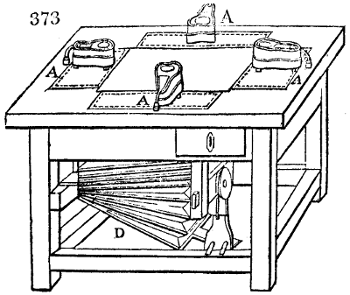
The enamelling table is represented in fig. 373., round which several workmen, with their lamps, may be placed, while the large double bellows D below is set a-blowing by a treadle moved with the foot. The flame of the lamp, when thus impelled by a powerful jet of air, acquires surprising intensity. The bent nozzles or tubes A A A A, are made of glass, and are drawn to points modified to the purpose of the enameller.
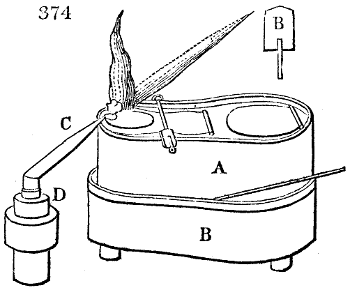
Fig. 374. shows, in perspective, the lamp A of the enameller standing in its cistern B; the blowpipe C is seen projecting its flame obliquely upwards. The blowpipe is adjustable in an elastic cork D, which fills up exactly the hole of the table into which it enters. When only one person is to work at a table provided with several lamps, he sits down at the same side with the pedal of the bellows; he takes out the other blowpipes, and plugs the holes in the table with solid corks.
The lamp is made of copper or tin-plate, the wick of cotton threads, and either tallow or oil may be used. Between the lamp and the workman a small board or sheet of white iron B, called the screen, is interposed to protect his eyes from the glare of light. The screen is fastened to the table by a wooden stem, and it throws its shadow on his face.
The enamelling workshop ought to admit little or no daylight, otherwise the artist, not perceiving his flame distinctly, would be apt to commit mistakes.
It is impossible to describe all the manipulations of this ingenious art, over which taste and dexterity so entirely preside. But we may give an example. Suppose the enameller wishes to make a swan. He takes a tube of white enamel, seals one of its ends hermetically at his lamp, and while the matter is sufficiently hot, he blows on it a minikin flask, resembling the body of the bird; he draws out, and gracefully bends the neck; he shapes the head, the beak, and the tail; then, with slender enamel rods of a proper colour, he makes the eyes; he next opens up the beak with pointed scissors; he forms the wings and the legs; finally attaching the toes, the bird stands complete.
The enameller also makes artificial eyes for human beings, imitating so perfectly the colours of the sound eye of any individual, as to render it difficult to discover that he has a blind and a seeing one.
It is difficult to make large articles at the blowpipe; those which surpass 5 or 6 inches become nearly unmanageable by the most expert workmen.
EPSOM SALTS. Sulphate of Magnesia.
EQUIVALENTS, CHEMICAL. (Stöchiometrie, Germ.) This expression was first employed by Dr. Wollaston, to denote the primary proportions in which the various chemical bodies reciprocally combine; the numbers representing these proportions being referred to one standard substance of general interest, such as oxygen or hydrogen reckoned unity, or 1,000. Dr. Dalton, who is the true author of the grand discovery of definite, and multiple chemical ratios, calls these equivalent numbers atomic weights, when reduced to their lowest terms, either hydrogen or oxygen being the radix of the scale. Though it belongs to a chemical work, to discuss the principles and develope the applications of the Atomic Theory, I shall be careful, upon all proper occasions, to point out the vast advantages which the chemical manufacturer may derive from it, and to show how much he may economize and improve his actual processes by its means. See Element.
ESSENCES, are either ethereous oils, in which all the fragrance of vegetable products reside; or the same combined and diluted with alcohol. See Oils, Ethereous.
ESSENCE D’ORIENT, the name of a pearly looking matter procured from the blay or bleak, a fish of the genus cyprinus. This substance, which is found principally at the base of the scales, is used in the manufacture of artificial pearls. A large quantity of the scales being scraped into water in a tub, are there rubbed between the hands to separate the shining stuff, which subsides on repose. The first water being decanted, more is added with agitation till the essence is thoroughly washed from all impurities; when the whole is thrown upon a sieve; the substance passes through, but the scales are retained. The water being decanted off, the essence is procured in a viscid state, of a bluish white colour, and a pearly aspect. The intestines of the same fish are also covered with this beautiful glistening matter. Several other fish yield it, but in smaller proportion. When well prepared, it presents exactly the appearance and reflections of the real pearls, or the finest mother of pearl; properties which are probably owing to the interposition of some portions of this same substance, between the laminæ of these shelly concretions. Its chemical nature has not been investigated; it putrefies readily when kept moist, an accident which may however be counteracted by water of ammonia. See Pearls.
ETCHING Varnish. (Aetzgrund-Deckfirniss, Germ.) Though the practice of this elegant art does not come within the scope of our Dictionary, the preparation of the varnishes, and of the biting menstrua which it employs, legitimately does.
The varnish of Mr. Lawrence, an English artist resident in Paris, is made as follows: Take of virgin wax and asphaltum, each two ounces, of black pitch and burgundy-pitch each half an ounce. Melt the wax and pitch in a new earthenware glazed pot, and add to them, by degrees, the asphaltum, finely powdered. Let the whole boil till such time as that, taking a drop upon a plate, it will break when it is cold, on bending it double two or three times betwixt the fingers. The varnish, being then enough boiled, must be taken off the fire, and after it cools a little, must be poured into warm water that it may work the more easily with the hands, so as to be formed into balls, which must be kneaded, and put into a piece of taffety for use.
Care must be taken, first, that the fire be not too violent, for fear of burning the ingredients, a slight simmering being sufficient; secondly, that whilst the asphaltum is putting in, and even after it is mixed with the ingredients, they should be stirred continually with the spatula; and, thirdly, that the water into which this composition is thrown should be nearly of the same degree of warmth with it, in order to prevent a kind of cracking that happens when the water is too cold.
The varnish ought always to be made harder in summer than in winter, and it will become so if it be suffered to boil longer, or if a greater proportion of the asphaltum or brown rosin be used. The experiment above mentioned, of the drop suffered to cool, will determine the degree of hardness or softness that may be suitable to the season when it is used.
Preparation of the hard varnish used by Callot, commonly called the Florence Varnish:—Take four ounces of fat oil very clear, and made of good linseed oil, like that used by painters; heat it in a clean pot of glazed earthenware, and afterwards put to it four ounces of mastick well powdered, and stir the mixture briskly till the whole be well melted, then pass the mass through a piece of fine linen into a glass bottle with a long neck, that can be stopped very securely; and keep it for the use that will be explained below.
Method of applying the soft varnish to the plate, and of blackening it.—The plate being well polished and burnished, as also cleansed from all greasiness by chalk or Spanish white, fix a hand-vice on the edge of the plate where no work is intended to be, to serve as a handle for managing it when warm; then put it upon a chafing dish, in which there is a moderate fire, and cover the whole plate equally with a thin coat of the varnish; and whilst the plate is warm, and the varnish upon it in a fluid state, beat every part of the varnish gently with a small ball or dauber made of cotton tied up in taffety, which operation smooths and distributes the varnish equally over the plate.
When the plate is thus uniformly and thinly covered with the varnish, it must be blackened by a piece of flambeau, or of a large candle which affords a copious smoke; sometimes two or even four such candles are used together for the sake of dispatch, that the varnish may not grow cold, which if it does during the operation, the plate must be heated again, that it may be in a melted state when that operation is performed; but great care must be taken not to burn it, which when it happens may be easily perceived by the varnish appearing burnt and losing its gloss.
The menstruum used and recommended by Turrell, an eminent London artist, for etching upon steel, was prepared as follows:—
Take Pyrolignous acid 4 parts by measure,
Alcohol 1 part, mix, and add
Nitric acid 1 part.
This mixed liquor is to be applied from 11⁄2 to 15 minutes, according to the depth desired. The nitric acid was employed of the strength of 1·28—the double aquafortis of the shops.
The eau forte or menstruum for copper, used by Callot, as also by Piranesi, with a slight modification, is prepared, with
8 parts of strong French vinegar,
4 parts of verdigris,
4 ditto sea salt,
4 ditto sal ammoniac,
1 ditto alum,
16 ditto water.
The solid substances are to be well ground, dissolved in the vinegar, and diluted with the water; the mixture is now to be boiled for a moment, and then set aside to cool. This menstruum is applied to the washed, dried, and varnished plate, after it has suffered the ordinary action of aquafortis, in order to deepen and finish the delicate touches. It is at present called the eau forte à passer.
ETHER, is the name of a class of very light, volatile, inflammable, and fragrant spirituous liquids, obtained by distilling in a glass retort, a mixture of alcohol with almost any strong acid. Every acid modifies the result, in a certain degree, whence several varieties of ether are produced. The only one of commercial importance is sulphuric ether, which was first made known under the name of sweet oil of vitriol, in 1540, by the receipt of Walterus Cordus. Froberus, 190 years after that date, directed the attention of chemists afresh to this substance, under the new denomination of ether.
There are two methods of preparing it; by the first, the whole quantity of acid and alcohol are mixed at once, and directly subjected to distillation; by the second, the alcohol is admitted, in a slender streamlet, into a body of acid previously mixed with a little alcohol, and heated to 220° Fahr.
1. Mix equal weights of alcohol at spec. grav. 0·830, and sulphuric acid at 1·842, by introducing the former into a large tubulated retort, giving it a whirling motion, so that the alcohol may revolve round a central conical cavity. Into this species of whirlpool the acid is to be slowly poured. The mixture, which becomes warm, is to be forthwith distilled by attaching a spacious receiver to the retort, and applying the heat of a sand-bath. The formation of ether takes place only at a certain temperature. If the contents of the retort be allowed to cool, and be then slowly heated in a water bath, alcohol alone will come over for some time without ether, till the mixture acquires the proper degree of heat. The first receiver should be a globe, with a tube proceeding from its bottom, into a second receiver, of a cylindric shape, surrounded with ice-cold water. The joints must be well secured by lutes, after the expanded air has been allowed to escape. The liquid in the retort should be kept in a steady state of bullition. The ether, as long as it is produced, condenses in the balloon and neck of the receiver in striæ; when these disappear the process is completed. The retort must now be removed from the sand; otherwise it would become filled with white fumes containing sulphurous acid, and denser striæ would flow over, which would contaminate the light product with a liquid called sweet oil of wine.