S. (continued 2)
Reading edition
SEPTARIA, called antiently ludus Helmontii, (the quoits of Van Helmont, from their form,) are lenticular concretions of clay ironstone, intersected by veins of calc-spar, which, when calcined, and ground to powder, form an excellent hydraulic cement. See Mortar, Hydraulic.
SERPENTINE, is a mineral of the magnesian family, of a green colour; it is scratched by calcareous spar, is sectile, tough, and therefore easily cut into ornamental forms. It occurs in Unst and Fetlar, in Shetland; at Portsoy, in Banffshire; in Cornwall; and the Isle of Holyhead. The floors of bakers’ ovens are advantageously laid with slabs of serpentine.
SHAFT, in mining, signifies a perpendicular or slightly inclined pit.
SHAGREEN. (Chagrin, Fr. and Germ.) The true oriental shagreen is essentially different from all modifications of leather and parchment. It approaches the latter somewhat, indeed, in its nature, since it consists of a dried skin, not combined with any tanning or foreign matter whatever. Its distinguishing characteristic is having the grain or hair side covered over with small rough round specks or granulations.
It is prepared from the skins of horses, wild asses, and camels; of strips cut along the chine, from the neck towards the tail, apparently because this stronger and thicker portion of the skin is best adapted to the operations about to be described. These fillets are to be steeped in water till the epidermis becomes loose, and the hairs easily come away by the roots; after which they are to be stretched upon a board, and dressed with the currier’s fleshing-knife. They must be kept continually moist, and extended by cords attached to their edges, with the flesh side uppermost upon the board. Each strip now resembles a wet bladder, and is to be stretched in an open square wooden frame by means of strings tied to its edges, till it be as smooth and tense as a drum-head. For this purpose it must be moistened and extended from time to time in the frame.
The grain or hair side of the moist strip of skin must next be sprinkled over with a kind of seeds called Allabuta, which are to be forced into its surface either by tramping with the feet, or with a simple press, a piece of felt or other thick stuff being laid upon the seeds. These seeds belong probably to the Chenapodium album. They are lenticular, hard, of a shining black colour, farinaceous within, about the size of poppy seed, and are sometimes used to represent the eyes in wax figures.
The skin is exposed to dry in the shade, with the seeds indented into its surface; after which it is freed from them by shaking it, and beating upon its other side with a stick. The outside will be then horny, and pitted with small hollows corresponding to the shape and number of the seeds.
In order to make the next process intelligible, we must advert to another analogous and well-known operation. When we make impressions in fine-grained dry wood with steel punches or letters of any kind, then plane away the wood till we come to the level of the bottom of these impressions, afterwards steep the wood in water, the condensed or punched points will swell above the surface, and place the letters in relief. Snuff-boxes have been sometimes marked with prominent figures in this way. Now shagreen is treated in a similar manner.
The strip of skin is stretched in an inclined plane, with its upper edge attached to hooks, and its under one loaded with weights, in which position it is thinned off with a proper semi-lunar knife, but not so much as to touch the bottom of the seed-pits or depressions. By maceration in water, the skin is then made to swell, and the pits become prominent over the surface which had been shaved. The swelling is completed by steeping the strips in a warm solution of soda, after which they are cleansed by the action of salt brine, and then dyed.
In the East the following processes are pursued. Entirely white shagreen is obtained by imbuing the skin with a solution of alum, covering it with the dough made with Turkey wheat, and after a time washing this away with a solution of alum. The strips are now rubbed with grease or suet, to diminish their rigidity, then worked carefully in hot water, curried with a blunt knife, and afterwards dried. They are dyed red with decoction of cochineal or kermes, and green with fine copper filings and sal ammoniac, the solution of this salt being first applied, then the filings being strewed upon the skin, which must be rolled up and loaded with weights for some time; blue is given with indigo, quicklime, soda, and honey; and black, with galls and copperas.
SHALE, or SLATE-CLAY, is an important stratiform member of the coal-measures. See Pitcoal.
SHAMOY LEATHER. See Leather.
SHEATHING OF SHIPS. For this purpose many different metals and metallic alloys have been lately proposed. From a train of researches which I made for an eminent copper company, a few years ago, upon various specimens of sheathing which had been exposed upon ships during many voyages, it appeared that copper containing a minute but definite proportion of tin, was by far the most durable.
SHELLAC. See Lac, and Sealing-wax.
SIENITE, is a granular aggregated compound rock, consisting of felspar and hornblende, sometimes mixed with a little quartz and mica. The hornblende is the characteristic ingredient, and serves to distinguish sienite from granite, with which it has been sometimes confounded; though the felspar, which is generally red, is the more abundant constituent. The Egyptian sienite, containing but little hornblende, with a good deal of quartz and mica, approaches most nearly to granite. It is equally metalliferous with porphyry; in the island of Cyprus, it is rich in copper; and in Hungary, it contains many valuable gold and silver mines.
Sienite forms a considerable part of the Criffle, a hill in Galloway. It takes its name from the city of Syene, in the Thebaid, near the cataracts of the Nile, where this rock abounds. It is an excellent building-stone, and was imported in large quantities from Egypt by the Romans, for the architectural and statuary decorations of their capital.
SILICA and SILICON. (Silice, silicium, Fr.; Kieselerde, kiesel, Germ.) Silica was till lately ranked among the earths proper; but since the researches of Davy and Berzelius, it has been transferred to the chemical class of acids. It constitutes the principal portion of most of the hard stones and minerals which compose the crust of the globe; occurring nearly pure in rock crystal, quartz, agate, calcedony, flint, &c. Silica or silicic acid may be obtained perfectly pure, and also in the finest state of comminution, by taking the precipitate formed by passing silicated fluoric gas through water, filtering, washing, and igniting it, to expel the last traces of the fluoride of silicon. The powder thus obtained is so light as to be blown away with the least breath of air. Silica may be more conveniently procured, however, by fusing ground flint with four times its weight of a mixture, in equal parts, of dry carbonate of potassa and carbonate of soda, in a platinum or silver crucible. The alkaline carbonates should be first fused, and the flint powder sprinkled into the liquid, as long as it dissolves with effervescence. The mass is to be then allowed to cool, dissolved in dilute muriatic acid; the solution is to be filtered, and evaporated to dryness; the dry crust is to be pulverized, digested for two hours with a little muriatic acid, to remove any iron and alumina that may be present, next washed with hot water, drained, dried, and ignited.
The above silicate of potassa and soda is the compound called soluble glass, which applied in solution to the surface of wood, calico, paper, &c., renders them unsusceptible of taking fire on the contact of an ignited body.
Silica, as thus prepared, is a white powder, rough to the touch, gritty between the teeth, absolutely insoluble in water, acids, and most liquids. Its specific gravity is 2·66. It cannot be fused by the most intense heat of our furnaces, but at the flame of the oxy-hydrogen blowpipe it melts into a limpid colourless glass. By peculiar chemical methods, an aqueous solution of it may be made artificially, similar to what nature presents us with in many thermal springs, as in those of Reikum and of Geyser in Iceland, and of most mineral waters, in minute quantity. There is no acid except the fluoric which can directly dissolve dry or calcined silica. Silica is composed of 48·04 silicon, and 51·96 oxygen.
SILICATES, are compounds of silicic acid (silica), with the bases alumina, lime, magnesia, potassa, soda, &c. They constitute the greater number by far of the hard minerals which encrust the terrestrial globe. Thus cyanite is a subsilicate of alumina; felspar and leucite, are silicates of alumina and potassa; albite and analcime, are silicates of alumina and soda; stilbite, prehnite, mesolite, labradorite, tourmaline, mica, &c., are silicates of alumina and lime; chrysolite, steatite, serpentine, and meerschaum, are silicates of magnesia; augite and hornblende, are silicates of lime and magnesia, &c.
SILICON, called also silicium, may be obtained by burning potassium in silicated fluoric gas. The product of the combustion is a brown cinder, which, on being thrown into water, disengages hydrogen with violence, and lets fall a dark liver-brown powder, upon which water exercises no action. This matter is silicon mixed with a salt of difficult solution, which is composed of fluorine, potassium, and silicon. This salt may, however, be removed by a great deal of washing. The further details of this curious subject will be given in my forthcoming system of chemistry.
SILK MANUFACTURE. (Fabrique de soie, Fr.; Seidenfabrik, Germ.) This may be divided into two branches: 1. the production of raw silk; 2. its filature and preparation in the mill, for the purposes of the weaver and other textile artisans. The threads, as spun by the silkworm, and wound up in its cocoon, are all twins, in consequence of the twin orifice in the nose of the insect through which they are projected. These two threads are laid parallel to each other, and are glued more or less evenly together by a kind of glossy varnish, which also envelopes them, constituting nearly 25 per cent. of their weight. Each ultimate filament measures about 1⁄2000 of an inch in average fine silk, and the pair measures of course fully 1⁄1000 of an inch. In the raw silk, as imported from Italy, France, China, &c., several of these twin filaments are slightly twisted and agglutinated to form one thread, called a single.
The specific gravity of silk is 1·300, water being 1·000. It is by far the most tenacious or the strongest of all textile fibres, a thread of it of a certain diameter being nearly three times stronger than a thread of flax, and twice stronger than hemp. Some varieties of silk are perfectly white, but the general colour in the native state is a golden yellow.
The production of silk was unknown in Europe till the sixth century, when two monks, who brought some eggs of the silkworm from China or India to Constantinople, were encouraged to breed the insect, and cultivate its cocoons, by the Emperor Justinian. Several silk manufactures were in consequence established in Athens, Thebes, and Corinth, not only for rearing the worm upon mulberry-leaves, but for unwinding its cocoons, for twisting their filaments into stronger threads, and weaving these into robes. The Venetians having then and long afterwards intimate commercial relations with the Greek empire, supplied the whole of western Europe with silk goods, and derived great riches from the trade.
About 1130, Roger II., king of Sicily, set up a silk manufacture at Palermo, and another in Calabria, conducted by artisans whom he had seized and carried off as prisoners of war in his expedition to the Holy Land. From these countries, the silk industry soon spread throughout Italy. It seems to have been introduced into Spain at a very early period, by the Moors, particularly in Murcia, Cordova, and Granada. The last town, indeed, possessed a flourishing silk trade when it was taken by Ferdinand in the 15th century. The French having been supplied with workmen from Milan, commenced, in 1521, the silk manufacture; but it was not till 1564 that they began successfully to produce the silk itself, when Traucat, a working gardener at Nismes, formed the first nursery of white mulberry-trees, and with such success, that in a few years he was enabled to propagate them over many of the southern provinces of France. Prior to this time, some French noblemen, on their return from the conquest of Naples, had introduced a few silkworms with the mulberry into Dauphiny; but the business had not prospered in their hands. The mulberry plantations were greatly encouraged by Henry IV.; and since then they have been the source of most beneficial employment to the French people. James I. was most solicitous to introduce the breeding of silkworms into England, and in a speech from the throne he earnestly recommended his subjects to plant mulberry-trees; but he totally failed in the project. This country does not seem to be well adapted for this species of husbandry, on account of the great prevalence of blighting east winds during the months of April and May, when the worms require a plentiful supply of mulberry-leaves. The manufacture of silk goods, however, made great progress during that king’s peaceful and pompous reign. In 1629 it had become so considerable in London, that the silk-throwsters of the city and suburbs were formed into a public corporation. So early as 1661 they employed 40,000 persons. The revocation of the edict of Nantes, in 1685, contributed in a remarkable manner to the increase of the English silk trade, by the influx of a large colony of skilful French weavers, who settled in Spitalfields. The great silk-throwing mill mounted at Derby, in 1719, also served to promote the extension of this branch of manufacture; for soon afterwards, in the year 1730, the English silk goods bore a higher price in Italy than those made by the Italians, according to the testimony of Keysler.
Till the year 1826, however, our silk manufactures in general laboured under very grievous fiscal burdens. Foreign organzine, or twisted raw silk, paid an import duty of 14s. 71⁄2d. per pound; raw Bengal silk, 4s.; and that from other places, 5s. 71⁄2d. Mr. Huskisson introduced a bill at that time, reducing the duty on organzine to 5s., and the duty on other raw silk to 3d. per pound. The total prohibition of the import of French manufactured silks, which gave rise to so much contraband trade, was also converted into a duty of 30 per cent. ad valorem. During the reign of the prohibitory system, when our silk weavers had no variety of patterns to imitate, and no adequate stimulus to excel, on account of the monopoly which they possessed in the home market, the inferiority of their productions was a subject of constant pride and congratulation among the Lyonnais; and accordingly the English could not stand their competition any where. At that time, the disadvantage on English silk goods, compared to French, was estimated in foreign markets at 40 per cent.; of late years it certainly does not exceed 20, notwithstanding the many peculiar facilities which France enjoys for this her favourite staple.
The silkworm, called by entomologists Phalæna bombyx mori, is, like its kindred species, subject to four metamorphoses. The egg, fostered by the genial warmth of spring, sends forth a caterpillar, which, in its progressive enlargement, casts its skin either three or four times, according to the variety of the insect. Having acquired its full size in the course of 25 or 30 days, and ceasing to eat during the remainder of its life, it begins to discharge a viscid secretion, in the form of pulpy twin filaments, from its nose, which harden in the air. These threads are instinctively coiled into an ovoid nest round itself, called a cocoon, which serves as a defence against living enemies and changes of temperature. Here it soon changes into the chrysalis or nymph state, in which it lies swaddled, as it were, for about 15 or 20 days. Then it bursts its cearments, and comes forth furnished with appropriate wings, antennæ, and feet, for living in its new element, the atmosphere. The male and the female moths couple together at this time, and terminate their union by a speedy death, their whole existence being limited to two months. The cocoons are completely formed in the course of three or four days; the finest being reserved as seed worms. From these cocoons, after an interval of 18 or 20 days, the moth makes its appearance, perforating its tomb by knocking with its head against one end of the cocoon, after softening it with saliva, and thus rendering the filaments more easily torn asunder by its claws. Such moths or aurelias are collected and placed upon a piece of soft cloth, where they couple and lay their eggs.
The eggs, or grains as they are usually termed, are enveloped in a liquid which causes them to adhere to the piece of cloth or paper on which the female lays them. From this glue they are readily freed, by dipping them in cold water, and wiping them dry. They are best preserved in the ovum state at a temperature of about 55° F. If the heat of spring advances rapidly in April, it must not be suffered to act on the eggs, otherwise it might hatch the caterpillars long before the mulberry has sent forth its leaves to nourish them. Another reason for keeping back their incubation is, that they may be hatched together in large broods, and not by small numbers in succession. The eggs are made up into small packets, of an ounce, or somewhat more, which in the south of France are generally attached to the girdles of the women during the day, and placed under their pillows at night. They are, of course, carefully examined from time to time. In large establishments, they are placed in an appropriate stove-room, where they are exposed to a temperature gradually increased till it reaches the 86th degree of Fahrenheit’s scale, which term it must not exceed. Aided by this heat, nature completes her mysterious work of incubation in eight or ten days. The teeming eggs are now covered with a sheet of paper pierced with numerous holes, about one-twelfth of an inch in diameter. Through these apertures the new-hatched worms creep upwards instinctively, to get at the tender mulberry leaves strewed over the paper.
The nursery where the worms are reared, is called by the French a magnanière; it ought to be a well-aired chamber, free from damp, excess of cold or heat, rats and other vermin. It should be ventilated occasionally, to purify the atmosphere from the noisome emanations produced by the excrements of the caterpillars and the decayed leaves. The scaffolding of the wicker-work shelves should be substantial; and they should be from 15 to 18 inches apart. A separate small apartment should be allotted to the sickly worms. Immediately before each moulting, the appetite of the worms begins to flag; it ceases altogether at that period of cutaneous metamorphosis, but revives speedily after the skin is fairly cast, because the internal parts of the animal are thereby allowed freely to develop themselves. At the end of the second age, the worms are half an inch long; and should then be transferred from the small room in which they were first hatched, into the proper apartment where they are to be brought to maturity and set to spin their balls. On occasion of changing their abode, they must be well cleansed from the litter, laid upon beds of fresh leaves, and supplied with an abundance of food every six hours in succession. In shifting their bed, a piece of network being laid over the wicker plates, and covered with leaves, the worms will creep up over them; when they may be transferred in a body upon the net. The litter, as well as the sickly worms, may thus be readily removed, without handling a single healthy one. After the third age, they may be fed with entire leaves; because they are now exceedingly voracious, and must not be subsequently stinted in their diet. The exposure of chloride of lime, spread thin upon plates, to the air of the magnanière, has been found useful in counteracting the tendency which sometimes appears of an epidemic disease among the silkworms, from the fetid exhalations of the dead and dying.
When they have ceased to eat, either in the fourth or fifth age, agreeably to the variety of the bombyx, and when they display the spinning instinct by crawling up among the twigs of heath, &c., they are not long of beginning to construct their cocoons, by throwing the thread in different directions, so as to form the floss, filoselle, or outer open network, which constitutes the bourre or silk for carding and spinning.
The cocoons destined for filature, must not be allowed to remain for many days with the worms alive within them; for should the chrysalis have leisure to grow mature or come out, the filaments at one end would be cut through, and thus lose almost all their value. It is therefore necessary to extinguish the life of the animal by heat, which is done either by exposing the cocoons for a few days to sunshine, by placing them in a hot oven, or in the steam of boiling water. A heat of 202° F. is sufficient for effecting this purpose, and it may be best administered by plunging tin cases filled with the cocoons into water heated to that pitch.
80 pounds French (88 Eng.) of cocoons, are the average produce from one ounce of eggs, or 100 from one ounce and a quarter; but M. Folzer of Alsace obtained no less than 165 pounds. The silk obtained from a cocoon is from 750 to 1150 feet long. The varnish by which the coils are glued slightly together, is soluble in warm water.
The silk husbandry, as it may be called, is completed in France within six weeks from the end of April, and thus affords the most rapid of agricultural returns, requiring merely the advance of a little capital for the purchase of the leaf. In buying up cocoons, and in the filature, indeed, capital may be often laid out to great advantage. The most hazardous period in the process of breeding the worms, is at the third and fourth moulting; for upon the 6th day of the third age, and the seventh day of the fourth, they in general eat nothing at all. On the first day of the fourth age, the worms proceeding from one ounce of eggs will, according to Bonafons, consume upon an average twenty-three pounds and a quarter of mulberry leaves; on the first of the fifth age, they will consume forty-two pounds; and on the sixth day of the same age, they acquire their maximum voracity, devouring no less than 223 pounds. From this date their appetite continually decreases, till on the tenth day of this age they consume only fifty-six pounds. The space which they occupy upon the wicker tables, being at their birth only nine feet square, becomes eventually 239 feet. In general the more food they consume, the more silk will they produce.
A mulberry-tree is valued, in Provence, at from 6d. to 10d.; it is planted out of the nursery at four years of age; it is begun to be stripped in the fifth year, and affords an increasing crop of leaves till the twentieth. It yields from 1 cwt. to 30 cwt. of leaves, according to its magnitude and mode of cultivation. One ounce of silkworm eggs is worth in France about 21⁄2 francs; it requires for its due development into cocoons about 15 cwt. of mulberry leaves, which cost upon an average 3 francs per cwt. in a favourable season. One ounce of eggs is calculated, as I have said, to produce from 80 to 100 pounds of cocoons, of the value of 1 fr. 52 centimes per pound, or 125 francs in whole. About 8 pounds of reeled raw silk, worth 18 francs a pound, are obtained from these 100 pounds of cocoons.
There are three denominations of raw silk; viz., organzine, trame (shute or tram), and floss. Organzine serves for the warp of the best silk stuffs, and is considerably twisted; tram is made usually from inferior silk, and is very slightly twisted, in order that it may spread more, and cover better in the weft; floss, or bourre, consists of the shorter broken silk, which is carded and spun like cotton. Organzine and trame may contain from 3 to 30 twin filaments of the worm; the former possesses a double twist, the component filaments being first twisted in one direction, and the compound thread in the opposite; the latter receives merely a slender single twist. Each twin filament gradually diminishes in thickness and strength, from the surface of the cocoon, where the animal begins its work in a state of vigour, to the centre, where it finishes it, in a state of debility and exhaustion; because it can receive no food from the moment of its beginning to spin by spouting forth its silky substance. The winder is attentive to this progressive attenuation, and introduces the commencement of some cocoons to compensate for the termination of others. The quality of raw silk depends, therefore, very much upon the skill and care bestowed upon its filature. The softest and purest water should be used in the cocoon kettle.
The quality of the raw silk is determined by first winding off 400 ells of it, equal to 475 metres, round a drum one ell in circumference, and then weighing that length. The weight is expressed in grains, 24 of which constitute one denier; 24 deniers constitute one ounce; and 16 ounces make one pound, poids de marc. This is the Lyons rule for valuing silk. The weight of a thread of raw silk 400 ells long, is two grains and a half, when five twin filaments have been reeled and associated together.
Raw silk is so absorbent of moisture, that it may be increased ten per cent. in weight by this means. This property has led to falsifications; which are detected by enclosing weighed portions of the suspected silk in a wire-cloth cage, and exposing it to a stove-heat of about 78° F. for 24 hours, with a current of air. The loss of weight which it thereby undergoes, demonstrates the amount of the fraud. There is an office in Lyons called the Condition, where this assay is made, and by the report of which the silk is bought and sold. The law in France requires, that all the silk tried by the Condition must be worked up into fabrics in that country.
In the Journal of the Asiatic Society of Bengal, for January, 1837, there are two very valuable papers upon silkworms; the first, upon those of Assam, by Mr. Thomas Hugon, stationed at Nowgong; the second by Dr. Heifer, upon those which are indigenous to India. Besides the Bombyx mori, the Doctor enumerates the following seven species, formerly unknown:—1. The wild silkworm of the central provinces, a moth not larger than the Bombyx mori. 2. The Joree silkworm of Assam, Bombyx religiosæ, which spins a cocoon of a fine filament, with much lustre. It lives upon the pipul tree (Ficus religiosa), which abounds in India, and ought therefore to be turned to account in breeding this valuable moth. 3. Saturnia silhetica, which inhabits the cassia mountains in Silhet and Dacca, where its large cocoons are spun into silk. 4. A still larger Saturnia, one of the greatest moths in existence, measuring ten inches from the one end of the wing to the other; observed by Mr. Grant, in Chirra Punjee. 5. Saturnia paphia, or the Tusseh silkworm, is the most common of the native species, and furnishes the cloth usually worn by Europeans in India. It has not hitherto been domesticated, but millions of its cocoons are annually collected in the jungles, and brought to the silk factories near Calcutta and Bhagelpur. It feeds most commonly on the hair-tree (Zizyphus jujuba), but it prefers the Terminalia alata, or Assam tree, and the Bombax heptaphyllum. It is called Koutkuri mooga, in Assam. 6. Another Saturnia, from the neighbourhood of Comercolly. 7. Saturnia assamensis, with a cocoon of a yellow-brown colour, different from all others, called mooga, in Assam; which, although it can be reared in houses, thrives best in the open air upon trees, of which seven different kinds afford it food. The Mazankoory mooga, which feeds on the Adakoory tree, produces a fine silk, which is nearly white, and fetches 50 per cent. more than the fawn-coloured. The trees of the first year’s growth produce by far the most valuable cocoons. The mooga which inhabits the soom-tree, is found principally in the forests of the plains, and in the villages. The tree grows to a large size, and yields three crops of leaves in the year. The silk is of a light fawn colour, and ranks next in value to the Mazankoory. There are generally five breeds of mooga worms in the year; 1. in January and February; 2. in May and June; 3. in June and July; 4. in August and September; 5. in October and November; the first and last being the most valuable.
The Assamese select for breeding, such cocoons only as have been begun to be formed in the largest number on the same day, usually the second or third after the commencement; those which contain males being distinguishable by a more pointed end. They are put in a closed basket suspended from the roof; the moths, as they come forth, having room to move about, after a day, the females (known only by their large body) are taken out, and tied to small wisps of thatching-straw, selected always from over the hearth, its darkened colour being thought more acceptable to the insect. If out of a batch, there should be but few males, the wisps with the females tied to them are exposed outside at night; and the males thrown away in the neighbourhood find their way to them. These wisps are hung upon a string tied across the roof, to keep them from vermin. The eggs laid after the first three days are said to produce weak worms. The wisps are taken out morning and evening, and exposed to the sunshine, and in ten days after being laid, a few of them are hatched. The wisps being then hung up to the tree, the young worms find their way to the leaves. The ants, whose bite is fatal to the worm in its early stages, are destroyed by rubbing the trunk of the tree with molasses, and tying dead fish and toads to it, to attract these rapacious insects in large numbers, when they are destroyed with fire; a process which needs to be repeated several times. The ground under the trees is also well cleared, to render it easy to pick up and replace the worms which fall down. They are prevented from coming to the ground by tying fresh plantain-leaves round the trunk, over whose slippery surface they cannot crawl; and they are transferred from exhausted trees to fresh ones, on bamboo platters tied to long poles. The worms require to be constantly watched and protected from the depredations of both day and night birds, as well as rats and other vermin. During their moultings, they remain on the branches; but when about beginning to spin, they come down the trunk, and being stopped by the plantain-leaves, are there collected in baskets, which are afterwards put under bunches of dry leaves, suspended from the roof, into which the worms crawl, and form their cocoons—several being clustered together: this accident, due to the practice of crowding the worms together, which is most injudicious, rendering it impossible to wind off their silk in continuous threads, as in the filatures of Italy, France, and even Bengal. The silk is, therefore, spun like flax, instead of being unwound in single filaments. After four days the proper cocoons are selected for the next breed, and the rest are uncoiled. The total duration of a breed varies from 60 to 70 days; divided into the following periods:—
Four moultings, with one day’s illness attending each 20
From fourth moulting to beginning of cocoon 10
In the cocoon 20, as a moth 6, hatching of eggs 10 36
66
On being tapped with the finger, the body renders a hollow sound; the quality of which shows whether they have come down for want of leaves on the tree, or from their having ceased feeding.
As the chrysalis is not soon killed by exposure to the sun, the cocoons are put on stages, covered up with leaves, and exposed to the hot air from grass burned under them; they are next boiled for about an hour in a solution of the potash, made from incinerated rice-stalks; then taken out, and laid on cloth folded over them to keep them warm. The floss being removed by hand, they are then thrown into a basin of hot water to be unwound; which is done in a very rude and wasteful way.
The plantations for the mooga silkworm in Lower Assam, amount to 5000 acres, besides what the forests contain; and yield 1500 maunds of 84 lbs. each per annum. Upper Assam is more productive.
The cocoon of the Koutkuri mooga is of the size of a fowl’s egg. It is a wild species, and affords filaments much valued for fishing-lines. See Silkworm Gut.
8. The Arrindy, or Eria worm, and moth, is reared over a great part of Hindustan, but entirely within doors. It is fed principally on the Hera, or Palma christi leaves, and gives sometimes 12 broods of spun silk in the course of a year. It affords a fibre which looks rough at first; but when woven, becomes soft and silky, after repeated washings. The poorest people are clothed with stuff made of it, which is so durable as to descend from mother to daughter. The cocoons are put in a closed basket, and hung up in the house, out of reach of rats and insects. When the moths come forth, they are allowed to move about in the basket for twenty-four hours; after which the females are tied to long reeds or canes, twenty or twenty-five to each, and these are hung up in the house. The eggs that are laid the first three days, amounting to about 200, alone are kept; they are tied up in a cloth, and suspended to the roof till a few begin to hatch. These eggs are white, and of the size of turnip-seed. When a few of the worms are hatched, the cloths are put on small bamboo platters hung up in the house, in which they are fed with tender leaves. After the second moulting, they are removed to bunches of leaves suspended above the ground, beneath which a mat is laid to receive them when they fall. When they cease to feed, they are thrown into baskets full of dry leaves, among which they form their cocoons, two or three being often found joined together. Upon this injudicious practice I have already animadverted.
9. The Saturnia trifenestrata, has a yellow cocoon of a remarkably silky lustre. It lives on the soom-tree in Assam, but seems not to be much used.
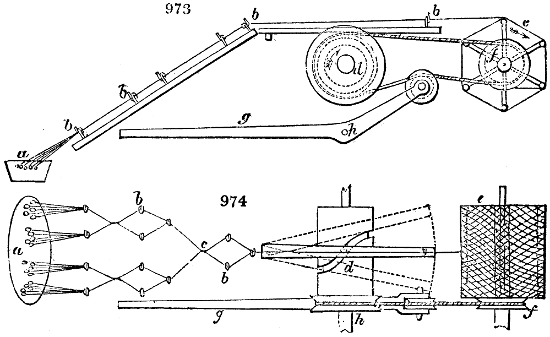
The mechanism of the silk filature, as lately improved in France, is very ingenious. Figs. 973. and 974. exhibit it in plan and longitudinal view. a is an oblong copper basin containing water heated by a stove or by steam. It is usually divided by transverse partitions into several compartments, containing 20 cocoons, of which there are 5 in one group, as shown in the figure. b, b, are wires with hooks or eyelets at their ends, through which the filaments run, apart, and are kept from ravelling. c, c, the points where the filaments cross and rub each other, on purpose to clean their surfaces. d, is a spiral groove, working upon a pin point, to give the traverse motion alternately to right and left, whereby the thread is spread evenly over the surface of the reel e. f, f, are the pulleys, which by means of cords transmit the rotatory movement of the cylinder d, to the reel e. g, is a friction lever or tumbler, for lightening or slackening the endless cord, in the act of starting or stopping the winding operation. Every apartment of a large filature contains usually a series of such reels as the above, all driven by one prime mover; each of which, however, may by means of the tumbling lever be stopped at pleasure. The reeler is careful to remove any slight adhesions, by the application of a brush in the progress of her work.
The expense of reeling the excellent Cevennes silk is only 3 francs and 50 centimes per Alais pound; from 4 to 5 cocoons going to one thread. That pound is 92 hundredths of our avoirdupois pound. In Italy, the cost of reeling silk is much higher, being 7 Italian livres per pound, when 3 to 4 cocoons go to the formation of one thread; and 6 livres when there are from 4 to 5 cocoons. The first of these raw silks will have a titre of 20 to 24 deniers; the last, of 24 to 28. If 5 to 6 cocoons go to one thread, the titre will be from 26 to 32 deniers, according to the quality of the cocoons. The Italian livre is worth 71⁄2d. English. The woman employed at the kettle receives one livre and five sous per day; and the girl who turns the reel, gets thirteen sous a day; both receiving board and lodging in addition. In June, July, and August, they work 16 hours a day, and then they wind a rubo or ten pounds weight of cocoons, which yield from 1-5th to 1-6th of silk, when the quality is good. The whole expenses amount to from 6 to 7 livres upon every ten pounds of cocoons; which is about 2s. 8d. per English pound of raw silk.
The raw silk, as imported into this country in hanks from the filatures, requires to be regularly wound upon bobbins, doubled, twisted, and reeled in our silk-mills. These processes are called throwing silk, and their proprietors are called silk throwsters; terms probably derived from the appearance of swinging or tossing which the silk threads exhibit during their rapid movements among the machinery of the mills.
A representation of a French mill for throwing silk, is given in the Dictionnaire Technologique, under the article Moulinage de Soie. But it is a most awkward, operose, and defective piece of machinery, quite unworthy of being presented to my readers. It was in Manchester that throwing-mills received the grand improvement upon the antient Italian plan, which had been originally introduced into this country by Sir Thomas Lombe, and erected at Derby. That improvement is chiefly due to the eminent factory engineers, Messrs. Fairbairn and Lillie, who transferred to silk the elegant mechanism of the throstle, so well known in the cotton trade. Still, throughout the silk districts of France the throwing mills are generally small, not many of them turning off more than 1000 pounds of organzine per annum, and not involving 5000l. of capital. The average price of throwing organzine in that country, where the throwster is not answerable for loss, is 7 francs; of throwing trame, from 4 fr. to 5 fr. (per kilogramme?) Where the throwster is accountable for loss, the price is from 10 fr. to 11 fr. for organzine, and from 6 to 7 for trame. In Italy, throwing adds 3s. 9d. to the price of raw silk, upon an average. I should imagine, from the perfection and speed of the silk-throwing machinery in this country, as about to be described, that the cost of converting a pound of raw silk either into organzine or trame must be considerably under any of the above sums.
SILK-THROWING MILL.
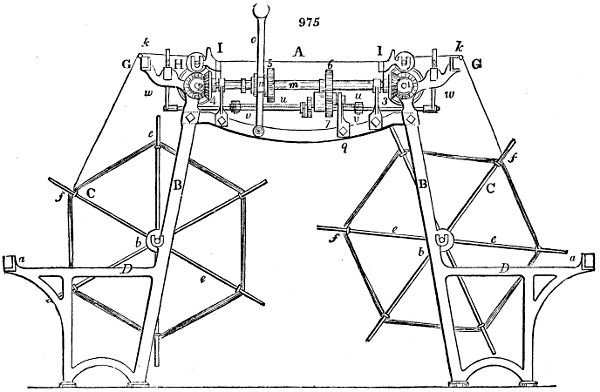
The first process to which the silk is subjected, is winding the skeins, as imported, off upon bobbins. The mechanism which effects this winding off and on, is technically called the engine, or swift. The bobbins to which the silk is transferred, are wooden cylinders, of such thickness as may not injure the silk by sudden flexure, and which may also receive a great length of thread without having their diameter materially increased, or their surface velocity changed. Fig. 975. is an end view of the silk-throwing machine, or engine, in which the two large hexagonal reels, called swifts, are seen in section, as well as the table between them, to which the bobbins and impelling mechanism are attached. The skeins are put upon these reels, from which the silk is gradually unwound by the traction of the revolving bobbins. One principal object of attention, is to distribute the thread over the length of the bobbin-cylinder in a spiral or oblique direction, so that the end of the slender semi-transparent thread may be readily found when it breaks. As the bobbins revolve with uniform velocity, they would soon wind on too fast, were their diameters so small at first as to become greatly thicker when they are filled. They are therefore made large, are not covered thick, but are frequently changed. The motion is communicated to that end of the engine shown in the figure.
The wooden table A, shown here in cross section, is sometimes of great length, extending 20 feet, or more, according to the size of the apartment. Upon this the skeins are laid out. It is supported by the two strong slanting legs B, B, to which the bearings of the light reel C are made fast. These reels are called swifts, apparently by the same etymological casuistry as lucus à non lucendo; for they turn with reluctant and irregular slowness; yet they do their work much quicker than any of the old apparatus, and in this respect may deserve their name. At every eighth or tenth leg there is a projecting horizontal piece D, which carries at its end another horizontal bar a, called the knee rail, at right angles to the former. This protects the slender reels or swifts from the knees of the operatives.
These swifts have a strong wooden shaft b, with an iron axis passing longitudinally through it, round which they revolve, in brass bearings fixed near to the middle of the legs B. Upon the middle of the shaft b, a loose ring is hung, shown under c, in fig. 976., to which a light weight d, is suspended, for imparting friction to the reel, and thus preventing it from turning round, unless it be drawn with a gentle force, such as the traction of the thread in the act of winding upon the bobbin.
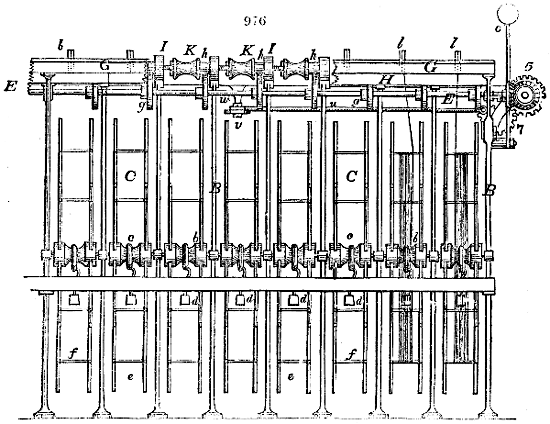
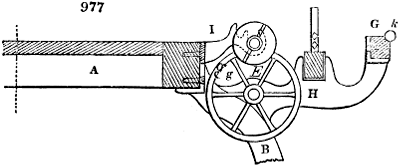
Fig. 976. is a front view of the engine. B, B, are the legs, placed at their appropriate distances (scale 11⁄2 inch to the foot); C, C, are the swifts. By comparing figs. 975. and 976., the structure of the swifts will be fully understood. From the wooden shaft b, six slender wooden (or iron) spokes e, e, proceed, at equal angles to each other; which are bound together by a cord f, near their free ends, upon the transverse line f of which cord, the silk thread is wound, in a hexagonal form; due tension being given to the circumferential cords, by sliding them out from the centre. Slender wooden rods are set between each pair of spokes, to stay them, and to keep the cord tight. E is one of the two horizontal shafts, placed upon each side of the engine, to which are affixed a number of light iron pulleys g, g (shown on a double scale in fig. 977.) These serve, by friction, to drive the bobbins which rest upon their peripheries.
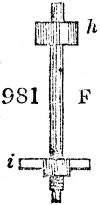
To the table A, fig. 975., are screwed the light cast-iron slot-bearings I, I, wherein the horizontal spindles or skewers rest, upon which the bobbins revolve. The spindles (see F, fig. 981.) carry upon one end a little wooden pulley h, whereby they press and revolve upon the larger driving pulleys g, of the shaft E. These pulleys are called stars by our workmen. The other ends of the spindles, or skewers, are cut into screws, for attaching the swivel nuts i (fig. 981.), by which the bobbins K, K, are made fast to their respective spindles. Besides the slots, above described, in which the spindles rest when their friction pulleys h, are in contact with the moving stars g, there is another set of slots in the bearings, into which the ends of the spindles may be occasionally laid, so as to be above the line of contact of the rubbing periphery of the star g, in case the thread of any bobbin breaks. Whenever the girl has mended the thread, she replaces the bobbin-spindle in its deeper slot-bearings, thereby bringing its pulley once more into contact with the star, and causing it to revolve.
G is a long ruler or bar of wood, which is supported upon every eighth or twelfth leg B, B. (The figure being, for convenience of the page, contracted in length, shows it at every sixth leg.) To the edge of that bar the smooth glass rods k, are made fast, over which the threads glide from the swifts, in their way to the bobbins. H is the guide bar, which has a slow traverse or seesaw motion, sliding in slots at the top of the legs B, where they support the bars G. Upon the guide bar H, the guide pieces l, l, are made fast. These consist of two narrow, thin, upright plates of iron, placed endwise together, their contiguous edges being smooth, parallel, and capable of approximation to any degree by a screw, so as to increase or diminish at pleasure the ordinary width of the vertical slit that separates them. Through this slit the silk thread must pass, and, if rough or knotty, will be either cleaned or broken; in the latter case, it is neatly mended by the attendant girl.
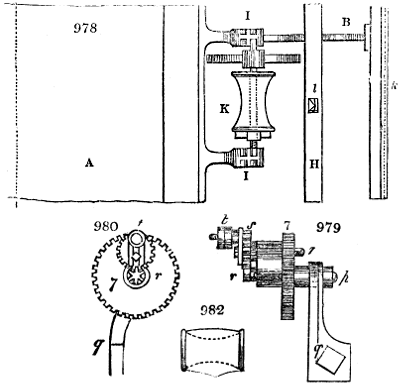
The motions of the various parts of the engine are given as follows. Upon the end of the machine, represented in fig. 975., there are attached to the shafts E (fig. 976.), the bevel wheels 1 and 2, which are set in motion by the bevel wheels 3 and 4, respectively. These latter wheels are fixed upon the shaft m, fig. 975. m is moved by the main steam shaft which runs parallel to it, and at the same height, through the length of the engine apartment, so as to drive the whole range of the machines. 5 is a loose wheel or pulley upon the shaft m, working in geer with a wheel upon the steam shaft, and which may be connected by the clutch n, through the hand lever or geering rod o (figs. 975. and 976.), when the engine is to be set at work. 6 is a spur wheel upon the shaft m, by which the stud wheel 7, is driven, in order to give the traverse motion to the guide bar H. This wheel is represented, with its appendages, in double size, figs. 979. and 980., with its boss upon a stud p, secured to the bracket q. In an eccentric hole of the same boss, another stud r, revolves, upon which the little wheel s, is fixed. This wheel s, is in geer with a pinion cut upon the end of the fixed stud p; and upon it is screwed the little crank t, whose collar is connected by two rods u (figs. 975. and 976.), to a cross-piece v, which unites the two arms w, that are fixed upon the guide bar H, on both sides of the machine. By the revolution of wheel 7, the wheel s will cause the pinion of the fixed stud p to turn round. If that wheel bear to the pinion the proportion of 4 to 1, then the wheel s will make, at each revolution of the wheel 7, one-fourth of a revolution; whereby the crank t will also rotate through one-fourth of a turn, so as to be brought nearer to the centre of the stud, and to draw the guide bar so much less to one side of its mean position. At the next revolution of wheel 7, the crank t will move through another quadrant, and come still nearer to the central position, drawing the guide bars still less aside, and therefore causing the bobbins to wind on more thread in their middle than towards their ends. The contrary effect would ensue, were the guide bars moved by a single or simple crank. After four revolutions of the wheel 7, the crank t will stand once more as shown in fig. 980., having moved the bar H through the whole extent of its traverse. The bobbins, when filled, have the appearance represented in fig. 982.; the thread having been laid on the mall the time in diagonal lines, so as never to coincide with each other.
Doubling is the next operation of the silk throwster. In this process, the threads of two or three of the bobbins, filled as above, are wound together in contact upon a single bobbin. An ingenious device is here employed to stop the winding-on the moment that one of these parallel threads happens to break. Instead of the swifts or reels, a creel is here mounted for receiving the bobbins from the former machine, two or three being placed in one line over each other, according as the threads are to be doubled or trebled. Though this machine is in many respects like the engine, it has some additional parts, whereby the bobbins are set at rest, as above mentioned, when one of the doubling threads gets broken.
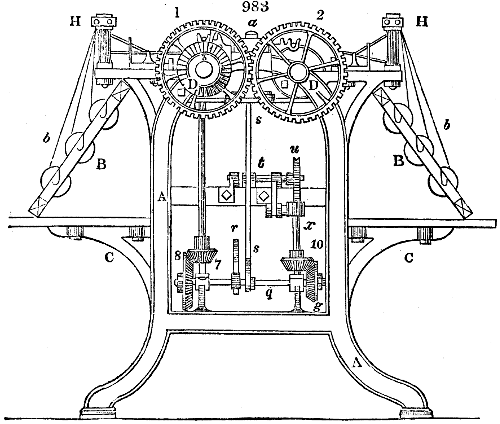
Fig. 983. is an end view, from which it will be perceived that the machine is, like the preceding, a double one, with two working sides.
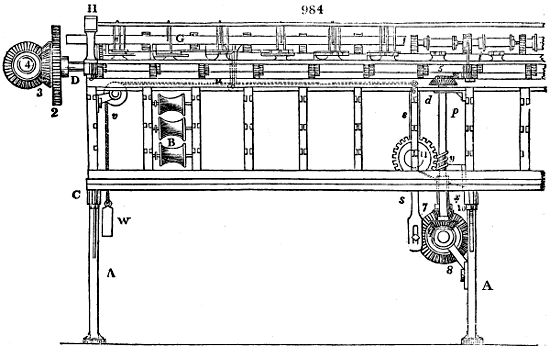
Fig. 984. is a front view of a considerable portion of the machine.
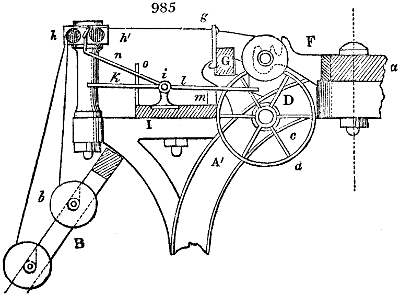
Fig. 985. shows part of a cross section, to explain minutely the mode of winding upon a single bobbin.
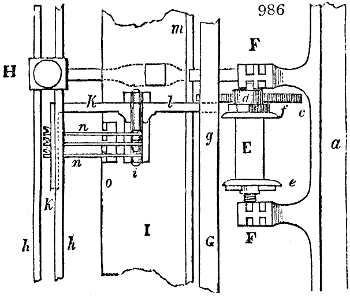
Fig. 986. is the plan of the parts shown in fig. 985.; these two figures being drawn to double the scale of figs. 983. and 984.
A, A, figs. 983. and 984. are the end frames, connected at their tops by a wooden stretcher, or bar-beam, a, which extends through the whole length of the machine; this bar is shown also in figs. 985. and 986.
B, B, are the creels upon each side of the machine, or bobbin bearers, resting upon wooden beams or boards, made fast to the arms or brackets C, about the middle of the frames A.

D, D, are two horizontal iron shafts, which pervade the whole machine, and carry a series of light movable pulleys, called stars, c, c, (figs. 985, 986.) which serve to drive the bobbins E, E, whose fixed pulleys rest upon their peripheries, and are therefore turned simply by friction. These bobbins are screwed by swivel nuts e, e, upon spindles, as in the silk engine. Besides the small friction pulley or boss, d, seen best in fig. 986., by which they rest upon the star pulleys c, c, a little ratchet wheel f, is attached to the other end of each bobbin. This is also shown by itself at f, in fig. 987.
The spindles with their bobbins revolve in two slot-bearings F, F, fig. 986., screwed to the bar-beam a, which is supported by two or three intermediate upright frames, such as A′. The slot-bearings F, have also a second slot, in which the spindle with the bobbin is laid at rest, out of contact of the star wheel, while its broken thread is being mended. G is the guide bar (to which the cleaner slit pieces g, g, are attached), for making the thread traverse to the right and the left, for its proper distribution over the surface of the bobbin. The guide bar of the doubling machine is moved with a slower traverse than in the engine; otherwise, in consequence of the different obliquities of the paths, the single threads would be readily broken, h, h, is a pair of smooth rods of iron or brass, placed parallel to each of the two sides of the machine, and made fast to the standards H, H, which are screwed to brackets projecting from the frames A, A′. Over these rods the silk threads glide, in their passage to the guide wires g, g, and the bobbins E, E.
I, I, is the lever board upon each side of the machine, upon which the slight brass bearings or fulcrums i, i, one for each bobbin in the creel, are made fast. This board bears the balance-lever k, l, with the fullers n, n, n, which act as dexterous fingers, and stop the bobbin from winding-on the instant a thread may chance to break. The levers k, l, swing upon a fine wire axis, which passes through their props i, i, their arms being shaped rectangularly, as shown at k, k′, fig. 986. The arm l, being heavier than the arm k, naturally rests upon the ridge bar m, of the lever board I. n, n, n, are three wires, resting at one of their ends upon the axis of the fulcrum i, i, and having each of their other hooked ends suspended by one of the silk threads, as it passes over the front steel rod h, and under h′. These faller wires, or stop fingers, are guided truly in their up-and-down motions with the thread, by a cleaner-plate o, having a vertical slit in its middle. Hence, whenever any thread happens to break, in its way to a winding-on bobbin E, the wire n, which hung by its eyelet end to that thread, as it passed through between the steel rods in the line of h, h′, falls upon the lighter arm of the balance lever k, l, weighs down that arm k, consequently jerks up the arm l, which pitches its tip or end into one of the three notches of the ratchet or catch wheel f (figs. 986. and 987.), fixed to the end of the bobbin. Thus its motion is instantaneously arrested, till the girl has had leisure to mend the thread, when she again hangs up the faller wire n, and restores the lever k, l, to its horizontal position. If, meanwhile, she took occasion to remove the winding bobbin out of the sunk slot-bearing, where pulley d touches the star wheel c, into the right-hand upper slot of repose, she must now shift it into its slot of rotation.
The motions are given to the doubling machine in a very simple way. Upon the end of the framing, represented in fig. 983., the shafts D, D, bear two spur wheels 1 and 2, which work into each other. To the wheel 1, is attached the bevel wheel 3, driven by another bevel wheel 4 (fig. 984.), fixed to a shaft that extends the whole length of the apartment, and serves, therefore, to drive a whole range of machines. The wheel 4 may be put in geer with the shaft, by a clutch and geer-handle, as in the silk engine, and thereby it drives two shafts, by the one transmitting its movement to the other.
The traverse motion of the guide bar G, is effected as follows:—Upon one of the shafts D, there is a bevel wheel 5, driving the bevel wheel 6, upon the top of the upright shaft p (fig. 984., to the right of the middle); whence the motion is transmitted to the horizontal shaft q, below, by means of the bevel wheels 7 and 8. Upon this shaft q, there is a heart-wheel r, working against a roller which is fixed to the end of the lever s, whose fulcrum is at t, fig. 983. The other end of the lever s, is connected by two rods (shown by dotted lines in fig. 984.) to a brass piece which joins the arms u (fig. 984.), of the guide bars G. To the same cross piece a cord is attached, which goes over a roller v, and suspends a weight w, by means of which the lever s, is pressed into contact with the heart-wheel r. The fulcrum t, of the lever s, is a shaft which is turned somewhat eccentric, and has a very slow rotatory motion. Thus the guide bar, after each traverse, necessarily winds the silk in variable lines, to the side of the preceding threads.
The motion is given to this shaft in the following way. Upon the horizontal shaft q, there is a bevel wheel g (figs. 983. and 984.), which drives the wheel 10 upon the shaft x; on whose upper end, the worm y works in the wheel 11, made fast to the said eccentric shaft t; round which the lever s, swings or oscillates, causing the guide bars to traverse.
The spinning silk-mill.—The machine which twists the silk threads, either in their single or doubled state, is called the spinning mill. When the raw singles are first twisted in one direction, next doubled, and then twisted together in the opposite direction, an exceedingly wiry, compact thread, is produced, called organzine. In the spinning mill, either the singles or the doubled silk, while being unwound from one set of bobbins, and wound upon another set, is subjected to a regular twisting operation; in which process the thread is conducted as usual through guides, and coiled diagonally upon the bobbins by a proper mechanism.
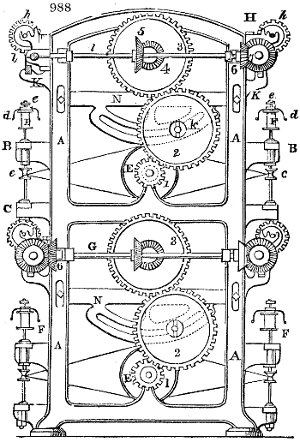
Fig. 988. exhibits an end view of the spinning mill; in which four working lines are shown; two tiers upon each side, one above the other. Some spinning mills have three working tiers upon each side; but as the highest tier must be reached by a ladder or platform, this construction is considered by many to be injudicious.
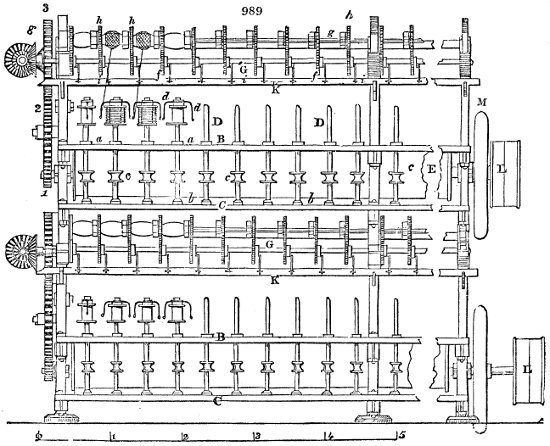
Fig. 989. is a front view, where, as in the former figure, the two working lines are shown.
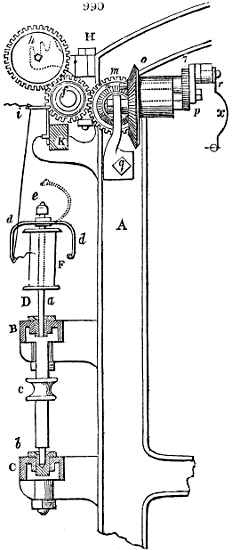
Fig. 990. is a cross section of a part of the machine, to illustrate the construction and play of the working parts; figs. 996, 997. are other views of fig. 990.
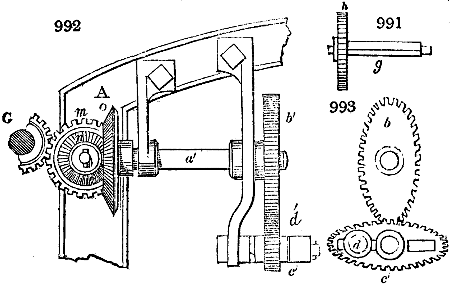
Fig. 991. shows a single part of the machine, by which the bobbins are made to revolve.
Figs. 992. and 993. show a different mode of giving the traverse to the guide bars, than that represented in fig. 990.
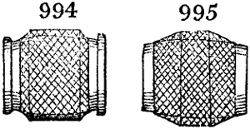
Figs. 994. and 995. show the shape of the full bobbins, produced by the action of these two different traverse motions.
The upper part of the machine being exactly the same as the under part, it will be sufficient to explain the construction and operation of one of them.
A, A, are the end upright frames or standards, between which are two or three intermediate standards, according to the length of the machine. They are all connected at their sides by beams B and C, which extend the whole length of the machines. D, D, are the spindles, whose top bearings a, a, are made fast to the beams B, and their bottoms turn in hard brass steps, fixed to the bar C. These two bars together are called, by the workmen, the spindle box. The standards A, A, are bound with cross bars N, N.
c, c, are the wharves or whorls, turned by a band from the horizontal tin cylinder in the lines of E, E, fig. 988., lying in the middle line between the two parallel rows of spindles D, D. F, F, are the bobbins containing the untwisted doubled silk, which are simply pressed down upon the taper end of the spindles. d, d, are little flyers, or forked wings of wire, attached to washers of wood, which revolve loose upon the tops of the said bobbins F, and round the spindles. One of the wings is sometimes bent upwards, to serve as a guide to the silk, as shown by dotted lines in fig. 990. e, e, are pieces of wood pressed upon the tops of the spindles, to prevent the flyers from starting off by the centrifugal force. G, are horizontal shafts bearing a number of little spur wheels f, f. H, are slot-bearings, similar to those of the doubling-machine, which are fixed to the end and middle frames. In these slots, the light square cast-iron shafts or spindles g, fig. 989., are laid, on whose end the spur wheel h is cast; and when the shaft g lies in the front slot of its bearing, it is in geer with the wheel f, upon the shaft G; but when it is laid in the back slot, it is out of geer, and at rest. See F, F, fig. 986.
Upon these little cast-iron shafts or spindles g, fig. 991., the bobbins or blocks I, are thrust, for receiving, by winding-on, the twisted or spun silk. These blocks are made of a large diameter, in order that the silk fibres may not be too much bent; and they are but slightly filled, at each successive charge, lest, by increasing their diameter too much, they should produce too rapid an increase in the rate of winding, with proportional diminution in the twist, and risk of stretching or tearing the silk. They are therefore the more frequently changed. K, K, are the guide bars, with the guides i, i, through which the silk passes, being drawn by the revolving bobbins I, and delivered or laid on by the flyers d, d, from the rotatory twisting-bobbins F. The operation of the machine is therefore simple, and the motions are given to the parts in a manner equally so.
Upon the shaft of the tin cylinder or drum, exterior to the frame, the usual fast and loose pulleys, or riggers, L, L′, are mounted, for driving the whole machine. These riggers are often called steam-pulleys by the workmen, from their being connected by bands with the steam-driven shaft of the factory. In order to allow the riggers upon the shafts of the upper and the under drums to be driven from the same pulley upon the main shaft, the axis of the under drum is prolonged at L, L, and supported at its end, directly from the floor, by an upright bearing. Upon the shafts of the tin cylinders there is also a fly-wheel M, to equalize the motion. Upon the other ends of these shafts, namely at the end of the spinning-mill, represented in fig. 988., the pinions 1 are fixed, which drive the wheels 3, by means of the intermediate or carrier wheel 2; called also the plate wheel, from its being hollowed somewhat like a trencher. 1, is called the change-pinion, because it is changed for another, of a different size and different number of teeth, when a change in the velocity of wheels 2 and 3 is to be made. To allow a greater or smaller pinion to be applied at 1, the wheel 2 is mounted upon a stud k, which is movable in a slot concentric with the axis of the wheel 3. This slot is a branch from the cross bar N. The smaller the change-pinion is, the nearer will the stud k approach to the vertical line joining the centres of wheels 1 and 3; and the more slowly will the plate wheel 2 be driven. To the spur wheel 3, a bevel wheel 4, is fixed, with which the other also revolves loose upon a stud. The bevel wheel 5, upon the shaft l, is driven by the bevel wheel 4; and it communicates motion, by the bevel wheels 6 and 7, to each of the horizontal shafts G, G, extending along the upper and under tiers of the machine. At the left-hand side of the top part of fig. 988. the two wheels 6 and 7 are omitted, on purpose to show the bearings of the shaft G, as also the slot-bearings for carrying the shafts or skewers of the bobbins.
If it be desired to communicate twist in the opposite direction to that which would be given by the actual arrangement of the wheels, it is necessary merely to transpose the carrier wheel 2, from its present position on the right hand of pinion 1, to the left of it, and to drive the tin cylinder by a crossed or close strap, instead of a straight or open one.
The traverse motion of the guide is given here in a similar way to that of the engine, (fig. 975.) Near one of the middle or cross-frames of the machine (see fig. 990.) the wheel f, in geer with a spur wheel h, upon one of the block-shafts, drives also a spur wheel m, that revolves upon a stud, to which wheel is fixed a bevel wheel n, in geer with the bevel wheel o. To wheel o, the same mechanism is attached as was described under figs. 979. and 980., and which is here marked with the same letters.
To the crank-knob r, fig. 990., a rod x, is attached, which moves or traverses the guide bar belonging to that part of the machine; to each machine one such apparatus is fitted. In figs. 992. and 993. another mode of traversing the guide bar is shown, which is generally used for the coarser qualities of silk. Near to one of the middle frames, one of the wheels f, in geer with the spur wheel m, and the bevel wheel n, both revolving on one stud, gives motion also to the wheel o, fixed upon a shaft a′, at whose other end the elliptical wheel b′ is fixed, which drives a second elliptical wheel c′, in such a way that the larger diameter of the one plays in geer with the smaller diameter of the other; the teeth being so cut as to take into each other in all positions. The crank-piece d′ is screwed upon the face of the wheel c′, at such a distance from its centre as may be necessary to give the desired length of traverse motion to the guide bar for laying the silk spirally upon the blocks. The purpose of the elliptical wheel is to modify the simple crank motion, which would wind on more silk at the ends of the bobbins than in their middle, and to effect an equality of winding-on over the whole surface of the blocks. In fig. 993. the elliptical wheels are shown in front, to illustrate their mode of operating upon each other. Fig. 994. is a block filled by the motion of the eccentric, fig. 900.; and fig. 995. is a block filled by the elliptical mechanism. As the length of the motions of the bar in the latter construction remains the same during the whole operation, the silk, as it is wound on the blocks, will slide over the edges, and thereby produce the flat ends of the barrel in fig. 995. The conical ends of the block (fig. 994.) are produced by the continually shortened motions of the guide bar, as the stud approaches, in its sun-and-planet rotation, nearer to the general centre.
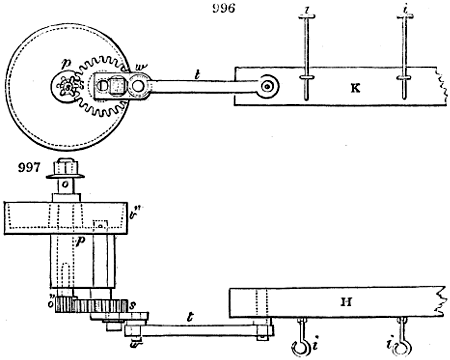
Figs. 996, 997. are two different views of the differential mechanism described under fig. 990.
The bent wire x, fig. 990., is called the guider iron. It is attached at one end to the pivot of the sun-and-planet wheel-work t, s, o, and at the other to the guide bar f, f, fig. 989. The silk threads pass through the guides, as already explained. By the motion communicated to the guide bar (guider), the diamond pattern is produced, as shown in fig. 994.
THE SILK AUTOMATIC REEL.
In this machine, the silk is unwound from the blocks of the throwing-mill, and formed into hanks for the market. The blocks being of a large size, would be productive of much friction, if made to revolve upon skewers thrust through them, and would cause frequent breakage of the silk. They are, therefore, set with their axes upright upon a board, and the silk is drawn from their surface, just as the weft is from a cop in the shuttle. On this account the previous winding-on must be executed in a very regular manner; and preferably as represented in fig. 994.
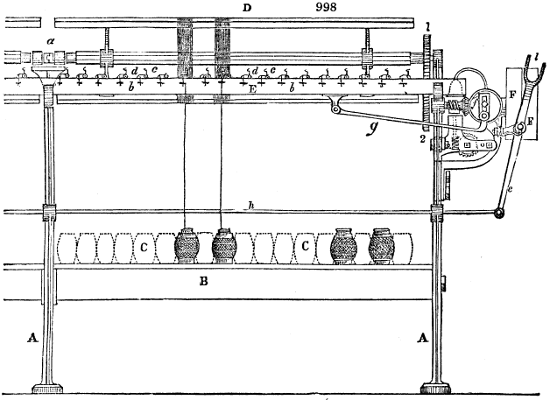
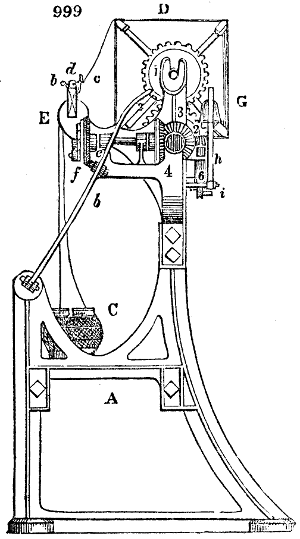
Fig. 998. is a front view of the reel; little more than one-half of it being shown. Fig. 999. is an end view. Here the steam-pulleys are omitted, for fear of obstructing the view of the more essential parts. A, A, are the two end framings, connected by mahogany stretchers, which form the table B, for receiving the bobbins C, C, which are sometimes weighted at top with a lump of lead, to prevent their tumbling. D is the reel, consisting of four long laths of wood, which are fixed upon iron frames, attached to an octagonal wooden shaft. The arm which sustains one of these laths is capable of being bent inwards, by loosening a tightening hook, so as to permit the hanks, when finished, to be taken off, as in every common reel.
The machine consists of two equal parts, coupled together at a, to facilitate the removal of the silk from either half of the reel; the attendant first lifting the one part, and then the other. E is the guide bar, which by a traverse motion causes the silk to be wound on in a cross direction. b and c are the wire guides, and d are little levers lying upon the cloth-covered guide bar E. The silk in its way from the block to the reel, passes under these levers, by which it is cleaned from loose fibres.
On the other end of the shaft of the reel, the spur wheel 1 is fixed, which derives motion from wheel 2, attached to the shaft of the steam-pulley F. Upon the same shaft there is a bevel wheel 3, which impels the wheel 4 upon the shaft e; to whose end a plate is attached, to which the crank f is screwed, in such a way as to give the proper length of traverse motion to the guide bar E, connected to that crank or eccentric stud by the jointed rod g. Upon the shaft of the steam-pulleys F, there is a worm or endless screw, to the left of f, fig. 999., which works in a wheel 5; attached to the short upright shaft h (fig. 998.). At the end of h, there is another worm, which works in a wheel 6; at whose circumference there is a stud i, which strikes once at every revolution against an arm attached to a bell, seen to the left of G; thus announcing to the reel-tenter that a measured length of silk has been wound upon her reel. e is a rod or handle, by which the fork l, with the strap, may be moved upon the fast or loose pulley, so as to set on or arrest the motion at pleasure.
Throwsters submit their silk to scouring and steaming processes. They soak the hanks, as imported, in lukewarm soap-water in a tub; but the bobbins of the twisted single silk from the spinning mill are enclosed within a wooden chest, and exposed to the opening action of steam for about ten minutes. They are then immersed in a cistern of warm water, from which they are transferred to the doubling frame.
The wages of the workpeople in the silk-throwing mills of Italy are about one half of their wages in Manchester; but this difference is much more than counterbalanced by the protecting duty of 2s. 10d. a pound upon thrown silk, and the superior machinery of our mills. In 1832, there was a power equal to 342 horses engaged in the silk-throwing mills of Manchester; and of about 100 in the mills of Derby. The power employed in the other silk mills of England and Scotland has not been recorded.
There is a peculiar kind of silk called marabout, containing generally three threads, made from the white Novi raw silk. From its whiteness, it takes the most lively and delicate colours without the discharge of its gum. After being made into tram by the single twist upon the spinning mill, it is reeled into hanks, and sent to the dyer without further preparation. After being dyed, the throwster re-winds and re-twists it upon the spinning mill, in order to give it the whipcord hardness which constitutes the peculiar feature of marabout. The cost of the raw Novi silk is 19s. 6d. a pound; of throwing it into tram, 2s. 6d.; of dyeing, 2s.; of re-winding and re-twisting, after it has been dyed, about 5s.; of waste, 2s., or 10 per cent.; the total of which sum is 31s.; being the price of one pound of marabout in 1832.
An Estimate of the Annual Quantities of Silk produced or exported from the several Countries in the World, exhibiting also the Countries to which exported.
Countries whence exported. Quantities. Countries to which exported. Quanti- ties.
Italy exports 34,000 bales of 225 small lbs. Bales.
France produces 10,500 - 73 1⁄8 kils., or - England 28,000
India and Bengal export 9,500 128 1⁄2 Vienna lbs. France 22,000
Persia 7,500 162 lbs. English Prussia 7,600
China 4,000 Russia 6,400
Asia Minor 3,500 Austria and Germany 5,000
Levant, Turkey, and Archipelago export 3,500 Switzerland 5,000
Spain 1,500
Total 74,000 bales. Total 74,000
Note.—These estimates exclude the silk manufactured in Italy.
The declared value of the silk manufactures exported from the United Kingdom in 1836, was 917,822l.; and in 1837, only 494,569. The deficit in the last year was owing to the commercial crisis in the United States; which country took, the preceding year, our silk goods to the value of 524,301l.
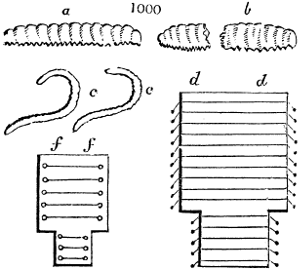
SILKWORM GUT, for angling, is made as follows:—Select a number of the best and largest silkworms, just when they are beginning to spin; which is known by their refusing to eat, and having a fine silk thread hanging from their mouths. Immerse them in strong vinegar, and cover them closely for twelve hours, if the weather be warm, but two or three hours longer, if it be cool. When taken out, and pulled asunder, two transparent guts will be observed, of a yellow green colour, as thick as a small straw, bent double. The rest of the entrails resembles boiled spinage, and therefore can occasion no mistake as to the silk-gut. If this be soft, or break upon stretching it, it is a proof that the worm has not been long enough under the influence of the vinegar. When the gut is fit to draw out, the one end of it is to be dipped into the vinegar, and the other end is to be stretched gently to the proper length. When thus drawn out, it must be kept extended on a thin piece of board, by putting its extremities into slits in the end of the wood, or fastening them to pins, and then exposed in the sun to dry. Thus genuine silk-gut is made in Spain. From the manner in which it is dried, the ends are always more or less compressed or attenuated.[53] Fig. 1000. a, is the silkworm; b, the worm torn asunder; c, c, the guts; d, d, a board slit at the ends, with the gut to dry; f, f, a board with wooden pegs, for the same purpose.
SILVER (Argent, Fr.; Silber, Germ.;) was formerly called a perfect metal, because heat alone revived its oxide, and because it could pass unchanged through fiery trials, which apparently destroyed most other metals. The distinctions, perfect, imperfect, and noble, are now justly rejected. The bodies of this class are all equal in metallic nature, each being endowed merely with different relations to other forms of matter, which serve to characterize it, and to give it a peculiar value.
When pure and planished, silver is the brightest of the metals. Its specific gravity in the ingot is 10·47; but, when condensed under the hammer or in the coining press, it becomes 10·6. It melts at a bright red heat, a temperature estimated by some as equal to 1280° Fahr., and by others to 22° Wedgewood. It is exceedingly malleable and ductile; affording leaves not more than 1⁄100000 of an inch thick, and wire far finer than a human hair.
By Sickingen’s experiments, its tenacity is, to that of gold and platinum, as the numbers 19, 15, and 261⁄4; so that it has an intermediate strength between these two metals. Pure atmospheric air does not affect silver, but that of houses impregnated with sulphuretted hydrogen, soon tarnishes it with a film of brown sulphuret. It is distinguished chemically from gold and platinum by its ready solubility in nitric acid, and from almost all other metals, by its saline solutions affording a curdy precipitate with a most minute quantity of sea salt, or any soluble chloride.
Silver occurs under many forms in nature:—
1. Native silver, possesses the greater part of the above properties; yet, on account of its being more or less alloyed with other metals, it differs a little in malleability, lustre, density, &c. It sometimes occurs crystallized in wedge-form octahedrons, in cubes, and cubo-octahedrons. At other times it is found in dendritic shapes, or arborescences, resulting from minute crystals implanted upon each other. But more usually it presents itself in small grains without determinable form, or in amorphous masses of various magnitude.
The gangues (mineral matrices) of native silver are so numerous, that it may be said to occur in all kinds of rocks. At one time it appears as if filtered into their fissures, at another as having vegetated on their surface, and at a third, as if impasted in their substance. Such varieties are met with principally in the mines of Peru.
The native metal is found in almost all the silver mines now worked; but especially in that of Kongsberg in Norway, in carbonate and fluate of lime, &c.; at Schlangenberg in Siberia, in a sulphate of barytes; at Allémont, in a ferruginous clay, &c. In the article Mines, I have mentioned several large masses of native silver that have been discovered in various localities.
The metals most usually associated with silver in the native alloy, are gold, copper, arsenic, and iron. At Andreasberg and Guadalcanal it is alloyed with about 5 per cent. of arsenic. The auriferous native silver is the rarest; it has a brass-yellow colour.
2. Antimonial silver.—This rare ore is yellowish-blue; destitute of malleability; even very brittle; spec. grav. 9·5. It melts before the blowpipe, and affords white fumes of oxide of antimony; being readily distinguished from arsenical iron, and arsenical cobalt, by its lamellar fracture. It consists of from 76 to 84 of silver, and from 24 to 16 of antimony.
3. Mixed antimonial silver.—At the blowpipe it emits a strong garlic smell. Its constituents are, silver 16, iron 44, arsenic 35, antimony 4. It occurs at Andreasberg.
4. Sulphuret of silver.—This is an opaque substance, of a dark-gray or leaden hue; slightly malleable, and easily cut with a knife, when it betrays a metallic lustre. The silver is easily separated by the blowpipe. It consist of, 13 of sulphur to 89 of silver, by experiment; 13 to 87 are the theoretic proportions. Its spec. grav. is 6·9. It occurs crystallized in most silver mines, but especially in those of Freyberg, Joachimsthal in Bohemia, Schemnitz in Hungary, and Mexico.
5. Red sulphuret of silver; silver glance.—Its spec. grav. is 5·7. It contains from 84 to 86 of silver.
6. Sulphuretted silver, with bismuth.—Its constituents are, lead 35, bismuth 27, silver 15, sulphur 16, with a little iron and copper. It is rare.
7. Antimoniated sulphuret of silver, the red silver of many mineralogists, is an ore remarkable for its lustre, colour, and the variety of its forms. It is friable, easily scraped by the knife, and affords a powder of a lively crimson red. Its colour in mass, is brilliant red, dark red, or even metallic reddish-black. It crystallizes in a variety of forms. Its constituents are,—silver from 56 to 62; antimony from 16 to 20; sulphur from 11 to 14; and oxygen from 8 to 10. The antimony being in the state of a purple oxide in this ore, is reckoned to be its colouring principle. It is found in almost all silver mines; but principally in those of Freyberg, Sainte-Marie-aux-Mines, and Guadalcanal.
8. Black sulphuret of silver; is blackish, brittle, cellular, affording globules of silver at the blowpipe. It is found only in certain mines, at Allémont, Freyberg; more abundantly in the silver mines of Peru and Mexico. The Spaniards call it negrillo.
9. Chloride of silver, or horn silver.—In consequence of its semi-transparent aspect, its yellowish or greenish colour, and such softness that it may be cut with the nail, this ore has been compared to horn, and may be easily recognised. It melts at the flame of a candle, and may be reduced when heated along with iron or black flux, which are distinctive characters. It is seldom crystallized; but occurs chiefly in irregular forms, sometimes covering the native silver as with a thick crust, as in Peru and Mexico. Its density is only 4·74.
Chloride of silver sometimes contains 60 or 70 per cent. of clay; and is then called butter-milk ore, by the German miners. The blowpipe causes globules of silver to sweat out of it. This ore is rather rare. It occurs in the mines of Potosi, of Annaberg, Freyberg, Allémont, Schlangenberg, in Siberia, &c.
10. Carbonate of silver, a species little known, has been found hitherto only in the mine of S. Wenceslas, near Wolfache.
Table of the Quantities of Silver brought into the Market every year, on an average, from 1790 to 1802.
Old Continent. Lbs. Avoird. New Continent. Lbs. Avoird.
ASIA.
Siberia 38,500 Central America 1,320,000
EUROPE. South America 605,000
Hungary 44,000
Austrian States 11,000
Hartz and Hessia 11,000
Saxony 22,000
Norway 22,000
Sweden - 11,000
France
Spain
Total of the Old Continent 159,500 Total of the New Continent 1,925,000
Thus the New Continent furnished twelve times more silver than the Old. For more detailed statistics of silver, see the end of the article.
The following is Mr. Ward’s description of the treatment of silver ores in Mexico:—
“After returning from San Augustin,” says he, “I passed the whole of the afternoon at the hacienda (metallurgic works) of Salgado, in which the ores of the Valenciana mine are reduced. The hacienda, of which a representation is given below, fig. 1001. contains forty-two crushing-mills, called arrastres, and thirty-six stampers. The ore, on being extracted from the mine, is placed in the hands of the pepenadores, men and women, who break all the larger pieces with hammers, and after rejecting those in which no metallic particles are contained, divide the rest into three classes” (inferior, middling, and rich). “These are submitted to the action of the morteros (stamps), one of which, of eight stampers, is capable of reducing to powder ten cargas of ore (each of 350 lbs.) in twenty-four hours. This powder not being thought sufficiently fine for the quicksilver to act upon with proper effect, it is transferred from the morteros to the arrastres (crushing-mills, see wood-cut), in which water is used. Each of these reduces to a fine impalpable metalliferous mud, six quintals (600 lbs.) of powder in 24 hours. At Guanajuato, where water-power cannot be obtained, the arrastres are worked by mules (see fig. 1001.), which are kept constantly in motion at a slow pace, and are changed every 6 hours. The grinding-stones, as well as the sides and bottom of the mill itself, are composed of granite; four blocks of which revolve in each crushing-mill, attached to cross-bars of wood. This part of the operation is thought of great importance, for it is upon the perfection of the grinding that the saving of the quicksilver is supposed in a great measure to depend, in the subsequent amalgamation. The grinding is performed usually in a covered shed or gallery which in a large hacienda, like Salgado, from the number of arrastres at work at the same time, is necessarily of considerable extent.”
1001 The Gallera of the Hacienda of Salgado
Fig. 1002. represents the rude grinding apparatus used at the lavaderos, or gold washings, in Chile. The streamlet of water conveyed to the hut of the gold washer, is received upon a large rude stone, whose flat surface has been hollowed out into a shallow basin, and in the same manner into 3 or 4 others in succession; the auriferous particles are thus allowed to deposit themselves in these receptacles, while the lighter earthy atoms, still suspended, are carried off by the running water. The gold thus collected is mixed with a quantity of ferruginous black sand and stony matter, which requires the process of trituration, effected by the very rude and simple trapiche shown in the figure; consisting of two stones, the under one being about three feet in diameter, and slightly concave. The upper stone is a large spherical boulder of syenitic granite, about two feet in diameter, having on its upper part two iron plugs fixed oppositely, to which is secured, by lashings of hide, a transverse horizontal pole of canela (cinnamon) wood, about 10 feet long; two men seated on the extremities of this lever, work it up and down alternately, so as to give to the stone a rolling motion, which is sufficient to crush and grind the materials placed beneath it. The washings thus ground, are subjected to the action of running water, upon inclined planes formed of skins, by which process the siliceous particles are carried off, while a portion of the ferruginous matter, mixed with the heavier grains of gold, is extracted by a loadstone; it is again washed, till nothing but pure gold-dust remain. The whole process is managed with much dexterity; and if there were much gold to be separated, it would afford very profitable employment; but generally the small quantity collected is sufficient only to afford subsistence to a few miserable families.
The trapiche, ingenio, or mill, for grinding the ores of silver, is a very simple piece of mechanism. A place is chosen where a small current of water, whose section will present a surface of six inches diameter, can be brought to a spot where it can fall perpendicularly ten or twelve feet; at this place a well is built of this depth, about 6 feet in diameter; in its centre is fixed an upright shaft, upon a central brass pin; it is confined above by a wooden collar. A little above its foot, the shaft has a small wheel affixed to it, round which are fixed a number of radiating spokes, shaped at the end somewhat like cups, and forming altogether a horizontal wheel, four feet in diameter. Upon the slanting edges of the cups, the water is made to strike with the force it has acquired in falling down a nearly perpendicular trough, scooped out of the solid trunk of a tree. This impression makes the wheel turn with a quick rotatory motion. The upright axis rises about 6 feet above the top of the well, at about half which height is inserted a small horizontal arm, four feet long, which serves as an axle to a ponderous mill-stone of granite, of from four to six feet diameter, which is made to roll on its edge in a circular trough, sometimes made of the same material, and sometimes of hard wood.
The weight of this quickly rolling stone effects the pulverization of the ore. In some cases, it is taken out in the dry state, and sifted; but more generally the separation of the finely ground particles is accomplished by the action of running water. For this purpose a small stream is made to trickle into the circular trough, by which the pounded ore is worked up into a muddy consistence, and the finer particles flow off with the excess of water, through a notch cut in the margin of the trough. This fine matter is received in little pools, where the pounded ore is left to settle; and the clear water being run off, the powder is removed from the bottom, and carried to the place of amalgamation.
The ingenios, or stamping-mills, are driven by a small breast water-wheel, of five feet diameter, and one foot broad. Fig. 1003. will give a sufficient idea of their construction. The long horizontal shaft, fixed on the axis of the wheel, is furnished with 5 or 6 cams placed at different situations round the shaft, so as to act in succession on the projecting teeth of the upright rods or pestles. Each of these weighs 200 pounds, and works in a corresponding oblong mortar of stone or wood.
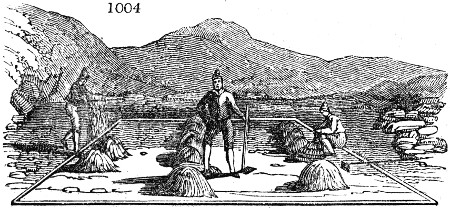
The patio, or amalgamation floor, fig. 1004., is a large flat space, open to the sky, 312 feet in length, by 236 in breadth, and securely surrounded by strong walls. It is paved with large unhewn blocks of porphyry, and is capable of containing 24 tortas, or flat circular collections of lama, of about 50 feet diameter, and 7 inches deep, when the patio is not filled, (but of somewhat smaller dimensions when nearly so,) ranged in 4 rows, and numbered from the left-hand corner. At one end a small space is generally set apart for the assays, which are made each on one monton.
The following description of Mexican amalgamation is given by Captain Lyon.
A torta of Zacatecas contains 60 montons of 20 quintals each, and is thus formed:—In the first instance, a square space, of the requisite size for a torta, is marked out, and enclosed by a number of rough planks, which are propped in their places on the patio floor by large stones, and dried horse-dung and dust are piled round their edges to prevent the escape of the lama. A heap of saltierra (salt mixed with earthy impurities) is then piled in the centre, in the proportion of 2 fanegas (each = 1·6 English bushels) and a half to the monton, = 150 for the torta. After this, the lama, or ore ground into a fine paste, is poured in. When the last or 60th monton is delivered, the saltierra is shovelled down and well mixed with the lama, by treading it with horses, and turning it with shovels; after which the preparation is left at rest for the remainder of the day. On the following day comes the el incorporo. After about one hour’s treading by horses, the magistral or roasted and pulverized copper ore is mixed with the lama, (the repaso or treading-mill still continuing,) in summer in the proportion of 15 cargas of 12 arrobas (25 lbs. each) to the torta, if the ore be of 6 marcs to the monton, and in winter in only half the quantity. For it is a singular fact, that in summer the mixture cools, and requires more warmth; while in winter it acquires of itself additional heat. With poorer ores, as for instance those of 4 marcs to the monton, 12 cargas are applied in summer, and 6 in winter. From November to February, lime is also occasionally used to cool the lama, in the proportion of about a peck per monton.
The repaso, or treading out, is continued by six horses, which are guided by one man, who stands in the lama, and directs them all by holding all their long halters. This operation is much more effectual in a morning than an evening, and occupies about five or six hours. When the magistral is well mixed, the quicksilver is applied, by being sprinkled through pieces of coarse cloth doubled up like a bag, so that it spurts out in very minute particles. The second treading of the horses then follows; after which the whole mixture is turned over by six men with wooden shovels, who perform the operation in an hour. The torta is then smoothed and left at rest for one entire day, to allow the incorporation to take place. It undergoes the turning by shovels and treading by horses every other day, until the amalgamator ascertains that the first admixture of quicksilver is found to be all taken up by the silver; and this he does by vanning or washing a small quantity of the torta in a little bowl. A new supply is then added, and when this has done its duty, another is applied to catch any stray particles of silver. On the same day, after a good repaso, the torta is removed on hand-barrows by the labourers, to the lavaderos, in order that it may receive its final cleansing. The general method of proportioning the quicksilver to the tortas, is by allowing that every marco of silver which is promised by trial of the ores as the probable produce of a monton, will require in the whole process 4 lbs.
In metals of five to six marcs and a half per monton (of the average richness of Zacatecas), 16 lbs. of quicksilver were incorporated for every monton, = 900 lbs. for the torta. On the day of the second addition, the proportion is 5 lbs. the monton; and when the torta is ready to receive the last dose of quicksilver, it is applied at the rate of 7 lbs. the monton, = 420 lbs.; making a total of 1620 lbs. of quicksilver. With poorer ores, less quicksilver and less magistral are required.
The usual time for the completion of the process of amalgamation, is from 12 to 15 days in the summer, and 20 to 25 in the winter. This is less than a third of the time taken at some other mines in Mexico. This rapidity is owing to the tortas being spread very flat, and receiving thereby the stronger influence of the sun. In the Mexican mines, only one monton is commonly mixed at a time; and the lama is then piled in a small conical heap or monton.
Lavadero, or washing vat.—Here the prepared tortas are washed, in order to carry off the earthy matters, and favour the deposition of the amalgam at the bottom. Each vat is about 8 feet deep, and 9 in diameter; and solidly built in masonry.
A large horizontal wheel, worked by mules, drives a vertical one, which turns a horizontal wheel fitted round a perpendicular wooden shaft, revolving upon an iron pivot at the bottom of the vat. To the lower end of this shaft, four cross-beams are fitted, from which long wooden teeth rise to the height of 5 feet. Their motion through the water being rapid, keeps all the lighter particles afloat, while the heavier sink to the bottom. The large wheel is worked by four mules, two at each extremity of the cross-beam. Water is supplied from an elevated tank. It requires 12 hours’ work of one tub to wash a torta. Eight porters are employed in carrying the prepared lama of the torta in hand-barrows to the vats. The earthy matter receives a second washing.