L. (continued 3)
Reading edition
Fresh skins must be worked immediately after being washed, and then dried, otherwise they ferment, and contract either indelible spots, or get tender in certain points, so as to open up and tear under the tools. When received in the dry state they should be steeped in water for two days, and then treated as fresh skins. They are next strongly rubbed on the convex horse-beam with a round-edged knife, in order to make them pliant. The rough parts are removed by the fleshing knife. One workman can in this way prepare 200 skins in a day.
The flesh side of each being rubbed with a cold cream of lime, the skins are piled together with the woolly side of each pair outermost, and the flesh sides in contact. They are left in this state for a few days, till it is found that the wool may be easily removed by plucking.
They are next washed in running water, to separate the greater part of the lime, stripped of the wool by small spring tweezers, and then fleeced smooth by means of the rolling-pin, or sometimes by rubbing with a whetstone. Unless they be fleeced soon after the treatment with lime, they do not well admit of this operation subsequently, as they are apt to get hard.
They are now steeped in the milk of lime-pit, in order to swell, soften, and cleanse them; afterwards in a weak pit of old lime-water, from which they are taken out and drained. This steeping and draining upon inclined tables, are repeated frequently during the space of 3 weeks. Only the skins of young animals, or those of inferior value are tawed. Sometimes the wool is left on, as for housings, &c.
The skins, after having been well softened in the steeps, are rubbed on the outside with a whetstone set in a wooden case with two handles, in order to smooth them completely by removing any remaining filaments of wool. Lamb skins are rubbed with the pin in the direction of their breadth, to give them suppleness; but sheep skins are fulled with water alone. They are now ready for the branning, which is done by mixing 40 lbs. of bran with 20 gallons of water, and keeping them in this fermentable mixture for three weeks—with the addition, if possible, of some old bran water. Here they must be frequently turned over, and carefully watched, as it is a delicate operation. In the course of two days in summer, and eight in winter, the skins are said to be raised, when they sink in the water. On coming out of the bran, they are ready for the white stuff; which is a bath composed of alum and sea-salt. Twelve, fourteen, and sometimes eighteen pounds of alum for 100 skins, form the basis of the bath; to which two and a half pounds of salt are added in winter, and three in summer. These ingredients are introduced into a copper with twelve gallons of water. The salt aids in the whitening action. When the solution is about to boil, three gallons of it are passed through the cullender into a basin; in this 26 skins are worked one after another, and after draining, they are put together into the bath, and left in it for ten minutes to imbibe the salts. They are now ready to receive the paste. For 100 skins, from 13 to 15 pounds of wheat flour are used along with the yolks of 50 eggs. After having warmed the alum bath through which the skins have been passed, the flower is dusted into it, with careful stirring. The paste is well kneaded by the gradual addition of the solution, and passed through the cullender, whereby it becomes as clear as honey. To this the yolks being added, the whole is incorporated with much manual labour. The skins are worked one after another in this paste; and afterwards the whole together are left immersed in it for a day. They are now stretched and dried upon poles, in a proper apartment, during from 8 to 15 days, according to the season.
The effects of the paste are to whiten the skins, to soften them, and to protect them from the hardening influence of the atmosphere, which would naturally render them brittle. They would not bear working upon the softening iron, but for the emulsion which has been introduced into their substance. With this view they are dipped in a tub of clear water during five or six minutes, and then spread and worked upon the board. They are increased by this means in length, in the proportion of 5 to 3. No hard points must be left in them. The whiteness is also better brought out by this operation, which is performed upon the flesh side. The softening tool is an iron plate, about one foot broad, rounded over above, mounted upon an upright beam, 30 inches high, which is fixed to the end of a strong horizontal plank, 31⁄2 feet long, and 1 broad. This plank is heavily loaded, to make it immovable upon the floor. Sometimes the skins are next spread over an undressed clean skin upon the horse, and worked well with the two-handled knife, for the purpose of removing the first and second epidermis, called the fleur and arrière-fleur by the French megissiers. They are then dried while stretched by hooks and strings. When dry they are worked on the stretching iron, or they are occasionally polished with pumice stone. A delicate yellow tint is given by a composition made of two parts of whitening, and one of ochre, applied in a moistened state, and well worked in upon the grain side. After being polished with pumice, they are smoothed with a hot iron, as the laundresses do linen, whereby they acquire a degree of lustre, and are ready to be delivered to the glover.
For housings, the best sheepskins are selected, and such as are covered with the longest and most beautiful fleece. They are steeped in water, in order to be cleaned and softened; after which they are thinned inside by the fleshing knife. They are now steeped in an old bran pit for 3 or 4 days, when they are taken out and washed. They are next subjected to the white or alum bath, the wool being carefully folded within; about 18 pounds of alum being used for 100 skins. The paste is made as for the fleeced skins, but it is merely spread upon their flesh side, and left upon them for 18 hours, so as to stiffen. They are then hung up to dry. They are next moistened by sprinkling cold water upon them, folded up, piled in a heap, and covered with boards weighted with heavy stones; in which state they remain for two days. They are next opened with a round iron upon the horse, and subjected to the stretching iron, being worked broadwise. They are dried with the fleece outermost, in the sun if possible; and are finished upon the stretcher.
Calf and lamb skins with their hair and wool are worked nearly in the same manner; only the thicker the skin, the stronger the alum bath ought to be. One pound of alum and one of salt are required for a single calf skin. It is left four days in this bath, after which it is worked upon the stretcher, then fulled. When half dry the skins are opened upon the horse. In eight days of ordinary weather, they may be completely dressed. Lamb skins are sometimes steeped during eight days in a bath prepared with unbolted rye flour and cold water, in which they are daily moved about two or three times. They are then dried, stretched upon the iron, and switched upon the fleecy side.
Chamois or Shamoy leather.—The skins are first washed, limed, fleeced, and branned as above described. They are next efflowered, that is, deprived of their epidermis by a concave knife, blunt in its middle part, upon the convex horse-beam. The cutting part serves to remove all excrescences, and to equalize the thickness, while the blunt part softens and smooths. The skins of goats, does, and chamois are always treated in this way. They are next subjected to the fermenting bran steep for one or two days, in ordinary weather; but in hot weather for a much shorter time, sometimes only moving them in the sour bran liquor for a few minutes. They are lastly wrung at the peg, and subjected to the fulling mill.
When the skins have been sufficiently swelled and suppled by the branning, they may receive the first oil as follows: a dozen skins being stretched upon the table, the fingers are dipped in the oil, and shaken over the skins in different places, so as to impart enough of it to imbue the whole surface slightly, by friction with the palms of the hands. It is to the outside or grain that the oil is applied. The skins are folded four together, so as to form balls of the size of a hog’s bladder, and thrown into the trough of the fulling mill, to the number of twelve dozen at once. Here they remain exposed to the beater for two, three, or four hours, according to their nature and the state of the weather. They are taken out, aired, oiled, and again fulled. The airing and fulling are repeated several times, with more or less frequent oilings. Any cheap animal oil is employed.
After these operations, the skins require to be subjected to a fermenting process, to dilate their pores, and to facilitate their combination with the oil. This is performed in a chamber only 6 feet high, and 10 or 12 feet square. Poles are suspended horizontally a few inches from the ceiling, with hooks fixed in them to which the skins are attached. A somewhat elevated temperature is maintained, and by a stove if need be. This operation requires great skill and experience.
The remainder of the epidermis is next removed by a blunt concave knife and the horse; whereby the surface is not cut, but rather forcibly scraped.
The skins are now scoured to carry off the redundant oil; which is effected by a potash lye, at two degrees Baumé, heated no hotter than the hand can bear. In this they are stirred briskly, steeped for an hour, and lastly wrung at the peg. The soapy liquor thus expelled is used for inferior purposes. The clean skins after being dried, are finished first on the stretcher-iron, and then on the herse or stretching frame.
Leather of Hungary.—This is manufactured by impregnating strong hides with alum, common salt, and suet; by a rapid process which is usually completed in the space of two months. The workshop is divided into two parts; 1. a shed on the side of a stream, furnished with wooden horses, fleshing knives, and other small tools. In one corner is a furnace with a boiler for dissolving the alum, a vat for immersing the hides in the solution, and several subsidiary tubs. 2. A chamber, 6 feet high, by 15 feet square, capable of being made very tight, for preserving the heat. In one corner is a copper boiler, of sufficient size to contain 170 pounds of tallow. In the middle of the stove is a square stone slab, upon which an iron grate is placed about a yard square. This is covered with charcoal. At each side of the stove are large tables, which occupy its whole length, and on which the leather is spread to receive the grease. The upper part below the ceiling is filled with poles for hanging the leather upon to be heated. The door is made to shut perfectly close.
The first operations are analogous to those of tanning and tawing; the skins being washed, cut in halves, shaved, and steeped for 24 hours in the river. They are then cleaned with 5 or 6 pounds of alum, and 31⁄2 pounds of salt, for a piece of hide which weighs from 70 to 80 pounds. The common salt softens the effect of the alum, attracts the moisture of the air, and preserves the suppleness of the skin. When the alum and salt are dissolved, hot water is poured upon the hides placed in a vat, and they are tramped upon by a workman walking repeatedly from one end of the vat to the other. They are then transferred into a similar vat containing some hot water, and similarly tramped upon. They are next steeped for eight days in alum water. The same round of operations is repeated a second time.
The skins are now dried either in the air, or a stove room; but before being quite dry, they are doubled together, well stretched to take out the wrinkles, and piled up. When dry, they are again tramped to open the pores as well as to render the skin pliant, after which they are whitened by exposure to the sun.
Tallow of inferior quality is employed for greasing the leather. With this view the hides are hung upon the poles in the close stove room, then laid upon the table, and besmeared with the tallow melted till it begins to crackle. This piece is laid on another table, is there covered with a second, similarly greased, and so forth. Three pounds of fat are commonly employed for one piece of leather.
When the thirty strips, or fifteen hides passed through the grease in one operation are completed, two workmen take the first piece in their hands, and stretch it over the burning charcoal on the grate for a minute, with the flesh side to the fire. The rest are passed over the flame in like manner. After flaming, the pieces are successively laid on an inclined table exposed to the fire, where they are covered with a cloth. They are finally hung upon poles in the air to dry; and if the weather be warm, they are suspended only during the night, so as to favour the hardening of the grease. Instead of the alum bath, M. Curaudau has employed with advantage a steep of dilute sulphuric acid.
Morocco leather.—The true morocco leather is goat skin tanned and then dyed on the side of the grain. Sheep skins are treated in the same way. The skins are steeped first in a fermenting mixture of bran water for a few days, they are then worked upon the horse, steeped in fresh water for 12 hours, and rinsed in the same. They are next drained, steeped in weak lime pits for a proper time, till the hairs can be readily detached. They are now subjected to the action of a blunt knife upon the horse-beam, in order to strip off their hair, after which they are cleansed in running water. Any excrescences must be carefully removed with the fleshing knife, and their edges neatly pared. The next process is rubbing them strongly with a piece of hard schist, set in a wooden frame, in order to expel by the pressure any lime which may still adhere, and to soften the grain. They are now worked upon the horse-beam with the blunt knife, and subjected to a species of fulling, by being agitated by pegs in a revolving cask along with water. Many manufacturers prefer a weak alkaline lye, or putrified urine, to the lime bath.
The skins are immersed for a night and a day, in a bran bath, in a certain state of fermentation, then worked on the horse, and salted, to preserve them till they are to be dyed.
Preparatory to being dyed, each skin is sewed together edgewise, with the grain on the outside, and it is then mordanted either with a solution of tin, or with alum water. The colour is given by cochineal, of which from 10 to 12 ounces are required for a dozen of skins. The cochineal being boiled in water along with a little tartar or alum for a few minutes, forms a red liquor, which is filtered through a linen cloth, and put into a clean cask. The skins are immersed in this bath, and agitated in it for about half an hour; they are taken out and beaten, and then subjected to a second immersion in the cochineal bath. After being thus dyed, they are rinsed and tanned with Sicilian sumach, at the rate of two pounds for a skin of moderate size. This process is performed in a large tub made of white wood, in the liquor of which the skins are floated like so many bladders, and moved about by manual labour during four hours. They are then taken out, drained, and again subjected to the tanning liquor; the whole process requiring a space of twenty-four hours. The skins are now unstitched, rinsed, fulled with beetles, drained, rubbed hard with a copper blade, and lastly hung up to dry.
Some manufacturers brighten the colour by applying to the surface of the skins, in a damp state, a solution of carmine in ammonia with a sponge; others apply a decoction of saffron to enliven the scarlet tint. At Paris the morocco leather is tanned by agitation with a decoction of sumach in large casks made to revolve upon a horizontal axis, like a barrel churn. White galls are sometimes substituted for sumach; a pound being used for a skin. The skins must be finally cleaned with the utmost care.
The black dye is given by applying with the brush a solution of red acetate of iron to the grain side. Blue is communicated by the common cold indigo vat; violets, with a light blue followed by cochineal red; green, by Saxon blue followed by a yellow dye, usually made with the chopped roots of the barberry. This plant serves also for yellows. To dye olive, the skins are first passed through a weak solution of green vitriol, and then through the decoction of barberry root, containing a little Saxon blue. Puce colour is communicated by logwood with a little alum; which may be modified by the addition of a little Brazil wood. In all these cases, whenever the skins are dyed, they should be rinsed, wrung or rather drained, stretched upon a table, then besmeared on the grain side with a film of linseed oil applied by means of a sponge, in order to promote their glossiness when curried, and to prevent them becoming horny by too rapid drying.
The last process in preparing morocco leather is the currying, which brings out the lustre, and restores the original suppleness. This operation is practised in different manners, according to the purpose the skins are to serve. For pocket-books, portfolios, and case-making in general, they must be thinned as much as possible upon the flesh side, moistened slightly, then stretched upon the table, to smooth them; dried again, moistened, and lastly passed two or three times through the cylinder press in different directions, to produce the crossing of the grain. The skins intended for the shoemaker, the saddler, the bookbinder, &c., require more pliancy, and must be differently curried. After being thinned, they are glazed with a polisher while still moist, and a grain is formed upon the flesh side with the roughened lead plate or grainer of the curriers, called in French pommelle; they are glazed anew to remove the roughness produced by the pommel, and finally grained on the flesh side with a surface of cork applied under a pommel of white wood.
Russia leather.—The Russians have long been possessed of a method of making a peculiar leather, called by them jucten, dyed red with the aromatic saunders wood. This article has been much sought after, on account of not being subject to mould in damp situations, being proof against insects, and even repelling them from the vicinity of its odour. The skins are freed from the hair or fleece, by steeping in an ash-lye too weak to act upon the animal fibres. They are then rinsed, fulled for a longer or shorter time according to their nature, and fermented in a proper steep, after having been washed in hot water. They are taken out at the end of a week, but they may be steeped a second time if deemed necessary, to open their pores. They are now cleaned by working them at the horse on both the flesh and grain sides.
A paste is next composed, for 200 skins, of 38 pounds of rye flour, which is set to ferment with leaven. This dough is worked up with a sufficient quantity of water to form a bath for the skins, in which they are soaked for 48 hours; they are then transferred into small tubs, where they remain during fifteen days, after which they are washed at the river. These operations serve to prepare the skins for absorbing the astringent juices with uniformity. A decoction of willow bark (salix cinerea, and salix caprea) being made, the skins are immersed in the boiler whenever the temperature of the liquor is sufficiently lowered not to injure the animal fibres, and handled and pressed for half an hour. This manipulation is repeated twice daily during the period of a week. The tanning infusion is then renewed, and applied to the same skins for another week; after which being exposed to the air to dry, they are ready for being dyed, and then curried with the empyreumatic oil of the bark of the birch tree. To this substance the Russia leather owes its peculiarities. Many modes have been prescribed for preparing it; but the following is the one practised in Russia.
The whitish membranous epidermis of the birch, stripped of all woody parts, is introduced into an iron boiler, which, when stuffed full, is covered tight with a vaulted iron lid, having a pipe rising from its centre. A second boiler into which this pipe passes without reaching its bottom, is set over the first, and is luted to it at the edges, after the two are bolted together. They are then inverted, so that the upper one contains the birch bark. The under half of this apparatus is sunk in the earth, the surface of the upper boiler is coated over with a clay lute, then surrounded with a fire of wood, and exposed to a red heat, till the distillation be completed. This operation, though rude in appearance, and wasteful of wood, answers its purpose perfectly well. The iron cylinder apparatus used in Britain for distilling wood vinegar, would, however, be much more convenient and productive. When the above boilers are unluted, there is found in the upper one a very light powder of charcoal, and in the under one which served as a receiver, there is an oily, brown, empyreumatic fluid, of a very strong smell, which is mixed with the tar, and which floats over a small quantity of crude vinegar. The former matter is the oil employed to impregnate the skins, by working it into the flesh side with the curriers’ tools. It is difficult to make this oil penetrate with uniformity; and the Russians do not always succeed in this process, for they turn out many skins in a spotted state. This oil is at present obtained in France by distilling the birch bark in copper stills, and condensing the products by means of a pipe plunged in cold water. About 60 per cent. of the weight of the bark is extracted.
The skins imbibe this oil most equally before they are fully dry. Care must be taken not to apply too much of it, for fear of its passing through and staining the grain-side of the leather. Chevreul has investigated the chemical nature of this odoriferous substance, and finding it to be a peculiar compound, has called it betuline.
LEDUM PALUSTRE. This plant is employed in Russia to tan the skins of goats, calves, and sheep, into a reddish leather of an agreeable smell; as also in the preparation of the oil of birch, for making what is commonly called Russia leather.
LEGUMINE, is the name of a vegeto-alkali supposed to exist in leguminous plants.
LEMONS. See Citric Acid, and Oils, Essential.
LEVIGATION, is the mechanical process whereby hard substances are reduced to a very fine powder.
LEUCITE, is a hard Vesuvian mineral, consisting of silica, 54; alumina, 23; potash, 23.
LEUCINE, is a white crystalline substance produced by acting upon flesh with sulphuric acid.
LEWIS, is the name of one kind of shears used in cropping woollen cloth.
LIAS, is a fine-grained argillaceous limestone, whose geological position is under the oolite; it is the proper lithographic stone.
LIBAVIUS, Liquor of, is the bichloride of tin, prepared by dissolving that metal with the aid of heat, in aqua regia, or by passing chlorine gas through a solution of muriate of tin till no more gas be absorbed, evaporating the solution, and setting it aside to crystallize. The anhydrous bichloride is best prepared by mixing four parts of corrosive sublimate with one part of tin, previously amalgamated with just so much mercury as to render it pulverizable; and by distilling this mixture with a gentle heat. A colourless fluid, the dry bichloride of tin, or the proper fuming liquor of Libavius, comes over. When it is mixed with one-third of its weight of water it becomes solid. The first bichloride of tin is used in calico-printing.
LICHEN. See Archil.
LIGNEOUS MATTER, is vegetable fibre. See Fibrous Matter.
LIGNITE, is one of the most recent geological formations, being the carbonaceous remains of forest trees. From this substance, as found in the neighbourhood of Cologne, the brown colours, called umber and earth of Cologne, are prepared.
LILAC DYE. See Calico-printing and Dyeing.
LIMESTONE (Calcaire, Fr.; Kalkstein, Germ.); may be classed under the following heads:—
1. Calcareous spar occurs in colourless crystals or crystalline masses; dissolves with effervescence in muriatic acid; is scratched by soft iron, but not by the nail; specific gravity 2·7; loses 46 per cent. by the expulsion of carbonic acid, and calcines into quicklime.
2. Calcsinter, or stalactitic carbonate of lime, called also concretionary limestone, because formed of zones more or less undulated, and nearly parallel. These zones have a fibrous structure, arising from the successive deposits of the crystalline limestone from its solvent water. The long conical pieces called stalactites, show fibres converging to the axis. The tubercular consists of irregular lumps often sprinkled over with small crystals, and associated so as to exhibit the appearance of cauliflower. The stratiform, commonly called stalagmite, or alabaster limestone, represents zones not concentric, but spread out, waving, and parallel; its texture is sometimes lamellar, and sometimes fibrous. These waving strata are distinguishable from one another by their different densities, and by their degrees of translucency. This stalagmitic mass bears the name of oriental alabaster, when it is reddish-yellow with distinct zones, and is susceptible of a fine polish. Stalactites are formed in the large excavations of calcareous rocks. The water percolating down through them, and dropping from the roofs of the caverns, is usually charged with carbonate of lime held in suspension by an excess of carbonic acid. The exposure to air, the motion, and the consequent diminution of pressure, cause the precipitation of the carbonate of lime in the solid state. Each drop of water, on falling through the vault, abandons a small film of limestone, which enlarges by degrees, and forms either a cylinder or solid mass. This alabaster differs from marble in its parallel and waving layers, and its faint degree of transparency.
This alabaster serves for the decoration of public buildings, and is occasionally introduced into certain pieces of furniture. The fine Egyptian alabaster was anciently brought from the mountains of the Thebaid, between the Nile and the Red Sea, near a town called Alabastron, whence probably the name. Very fine red alabaster, of great hardness, was found at one time in the quarries of Montmartre, but the stock was soon exhausted.
The incrusting concretionary limestone differs little from the preceding except in the rapidity of its formation, and in being moulded upon some body whose shape it assumes. These deposits from calcareous springs, form equally on vegetable bodies, on stones, metals, within pipes of cast iron, wood, or lead. The incrustations on vegetable and animal substances are vulgarly called petrifactions, as the organic fibres are replaced by stone. One of the most curious springs of this nature is at the baths of Saint Philip, in Tuscany, where the water flows in almost a boiling state, over an enormous mass of alabaster which it has produced. The carbonate of lime seems to be held in solution here by sulphuretted hydrogen, which flies off when the water issues to the day. Dr. Vegny has taken advantage of this property of the spring, to obtain basso-relievo figures of great whiteness and solidity. He makes use of sulphur moulds.
Calcareous tuf consists of similar incrustations made by petrifying rivulets running over mud, sand, vegetable remains, &c. It is porous, even cellular, somewhat soft, impure, and of a dirty gray colour. Its surface is wavy, rough, and irregular. These incrustations or deposits are, however, sometimes so abundant, and the resulting stony matters so hard that buildings may be constructed with them. The stone with which the town of Pasti, in Italy, is built has been called pipe-stone by the Italians; and it has apparently derived its origin from incrustations upon large reeds.
The travertino, which served to construct all the monuments of Rome, appears to have been formed by the deposits of the Anio and the solfatara of Tivoli. The temples of Pæstum, which are of extreme antiquity, have been built with a travertino formed by the sediment of the waters which still flow in this territory. All these stones acquire great hardness in the air, and M. de Breislak thinks that it is to the happy union of travertino and pouzzolana in the same spot, that the monuments of Rome owe their great solidity.
Spongy limestone, usually called Agaric mineral, stone marrow, &c., belongs to this kind of formation. It has a very white colour, a very fine grain, is soft to the touch, very tender, and light enough to float for an instant on water. It occurs in rather thin layers, in the crevices of calcareous rocks, and is so common in Switzerland as to be employed for whitening houses.
3. Compact limestone, is of a grain more or less fine, does not polish, nor afford large blocks free from fissures, has a conchoidal, or uneven scaly fracture. Colours very various. Its varieties are; a, The sub-lamellar, compact, with some appearance of a foliated texture. b, Compact fine-grained limestone, the zechstein of the Germans, to which M. Brongniart refers the lithographic stone in his classification of rocks (Dictionnaire des Sciences Naturelles,) but the English geologists place the locality of the famous lithographic quarry of Solenhofen much higher in the plane of secondary superposition. Its fracture is conchoidal; colour from gray to whitish; c, Compact common limestone. Grain of middle size; earthy aspect; uneven fracture; perfectly opaque; colour, whitish to pale gray, yellow, or reddish. The limestones of the Jura formation are referred to this head, as well as most of those interspersed among the coal strata. d, The coarse compact, or Cornbrash; texture somewhat open, earthy aspect, rough to the touch, ragged fracture, colour yellow, gray, or dirty red. e, Compact cellular, the Rauchekalk and Holekalk of the Germans, on account of the numerous holes or caverns distributed through it.
4. Oolite or roe-stone.—It consists of spherical grains of various size, from a millet seed, to a pea, or even an egg; texture compact; fracture even; colours, whitish, yellow, gray, reddish, brownish. The larger balls have almost always a foreign body for their centre or nucleus.
5. Chalk; texture earthy; grains fine, tender, friable; colours white, grayish, or pale yellowish.
6. Coarse-grained limestone; an earthy texture, in large particles, often loose; fracture foliated, uneven; colour pale and dirty yellow. Coarse lias has has been referred to this head.
7. Marly limestone; lake and fresh-water limestone formation; texture fine-grained, more or less dense; apt to crumble down in the air; colour white or pale yellow; fracture rough-grained, sometimes conchoidal; somewhat tenacious. Texture occasionally cavernous; with cylindrical winding cavities. This true limestone must not be confounded with the lime-marl, composed of calcareous matter and clay.
8. Siliceous limestone; of a compact texture; scratching steel, and scratched by it; leaves a siliceous residuum after the action of muriatic acid.
9. Calp; texture compact; fine-grained; schistose structure; hard, as the preceding; not burning into quicklime, affording to dilute muriatic acid a copious residuum of clay and silica; colour blackish; found in beds in the transition district near Dublin.
10. Lucullite or stinkstone; texture compact or sub-lamellar, colour grayish; emits the smell of sulphuretted hydrogen by friction or a blow. It occurs at Assynt, in Sutherlandshire; in Derbyshire; counties of Kilkenny, Cork, and Galway.
11. Bituminous limestone; black or blackish colour; diffusing by the action of fire a bituminous odour, and becoming white.
Of all common limestones the purity may most readily be determined by the quantity of carbonic acid which is evolved during their solution in dilute nitric or muriatic acid. Perfect carbonate of lime loses in this way 46 per cent.; and if any particular limestone loses only 23 per cent., we may infer that it contains only one half its weight of calcareous carbonate. This method is equally applicable to marls, which are mixtures in various proportions of carbonate of lime, clay, and sand, and may all be recognized by their effervescing with acids.
The chief use of calcareous stones is for procuring quicklime by calcination in proper furnaces; and they are all adapted to this purpose provided they are not mixed with too large a proportion of sand and ferruginous clay, whereby they acquire a vitrescent texture in a high heat, and will not burn into lime. Limestone used to be calcined in a very rude kiln, formed by enclosing a circular space of 10 or 15 feet diameter, by rude stone walls 4 or 5 feet high, and filling the cylindrical cavity with alternate layers of turf or coal and limestone broken into moderate pieces. A bed of brushwood was usually placed at the bottom, to facilitate the kindling of the kiln. Whenever the combustion was fairly commenced, the top, piled into a conical form, was covered in with sods, to render the calcination slow and regular. This method being found relatively inconvenient and ineffectual, was succeeded by a permanent kiln built of stones or brickwork, in the shape of a truncated cone with the narrow end undermost, and closed at bottom by an iron grate. Into this kiln, the fuel and limestone were introduced at the top in alternate layers, beginning of course with the former; and the charge was either allowed to burn out, when the lime was altogether removed at a door near the bottom, or the kiln was successively fed with fresh materials, in alternate beds, as the former supply sunk down by the calcination, while the thoroughly burnt lime at the bottom was successively raked out by a side door immediately above the grate. The interior of the lime kiln has been changed of late years from the conical to the elliptical form; and probably the best is that of an egg placed with its narrow end undermost, and truncated both above and below; the ground plot or bottom of the kiln being compressed so as to give an elliptical section, with an eye or draft-hole towards each end of that ellipse. A kiln thus arched in above gives a reverberatory heat to the upper materials, and also favours their falling freely down in proportion as the finished lime is raked out below; advantages which the conical form does not afford. The size of the draft-notes for extracting the quicklime, should be proportionate to the size of the kiln, in order to admit a sufficient current of air to ascend with the smoke and flame, which is found to facilitate the extrication of the carbonic acid. The kilns are called perpetual, because the operation is carried on continuously as long as the building lasts; and draw-kilns, from the mode of discharging them by raking out the lime into carts placed against the draft-holes. Three bushels of calcined limestone, or lime-shells, are produced on an average for every bushel of coals consumed. Such kilns should be built up against the face of a cliff, so that easy access may be gained to the mouth for charging, by making a sloping cart road to the top of the bank.
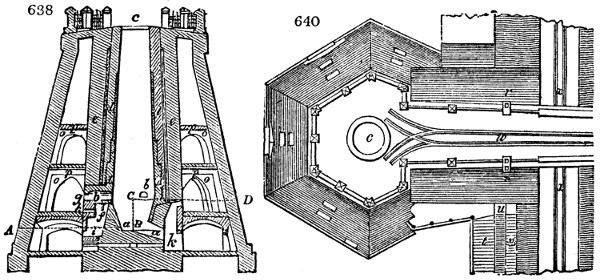
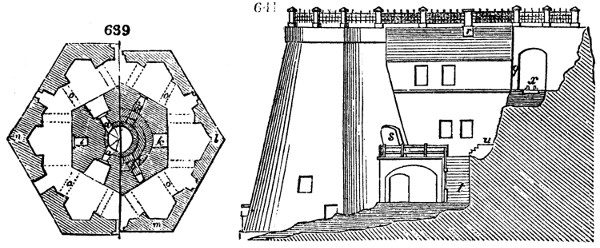
Fig. 638, 640 enlarged (311 kB)
Fig. 639, 641 enlarged (259 kB)
Figs. 638, 639, 640, 641. represent the lime-kiln of Rüdersdorf near Berlin, upon the continuous plan, excellently constructed for economizing fuel. It is triple, and yields a threefold product. Fig. 640. is a view of it as seen from above; fig. 641., the elevation and general appearance of one side; fig. 638, a vertical section, and fig. 639. the ground plan in the line A B C D of fig. 638. The inner shaft fig. 638. has the form of two truncated cones, with their larger circular ends applied to each other; it has the greatest width at the level of the fire-door b, where it is 8 feet in diameter; it is narrower below at the discharge door, and at the top orifice, where it is about 6 feet in diameter. The interior wall d, of the upper shaft is built with hewn stones, to the height of 38 feet, and below that for 25 feet, with fire-bricks d′ d′, laid stepwise. This inner wall is surrounded with a mantle e, of limestones, but between the two there is a small vacant space of a few inches filled with ashes, in order to allow of the expansion of the interior with heat taking place without shattering the mass of the building.
The fire-grate b, consists of fire-tiles, which at the middle, where the single pieces press together, lie upon an arched support f. The fire-door is also arched, and is secured by fire-tiles. g is the iron door in front of that orifice. The tiles which form the grate have 3 or 4 slits of an inch wide for admitting the air, which enters through the canal h. The under part of the shaft from the fire to the hearth, is 7 feet, and the outer enclosing wall is constructed of limestone, the lining being of fire-bricks. Here are the ash-pit i, the discharge outlet a, and the canal k, in front of the outlet. Each ash-pit is shut with an iron door, which is opened only when the space i becomes filled with ashes. These indeed are allowed to remain till they get cool enough to be removed without inconvenience.
The discharge outlets are also furnished with iron doors, which are opened only for taking out the lime, and are carefully luted with loam during the burning. The outer walls l m n of the kiln, are not essentially necessary, but convenient, because they afford room for the lime to lie in the lower floor, and the fuel in the second. The several stories are formed of groined arches o, and platforms p, covered over with limestone slabs. In the third and fourth stories the workmen lodge at night. See fig. 641. Some enter their apartments by the upper door q; others by the lower door s. r is one of the chimneys for the several fire-places of the workmen. t u v are stairs.
As the limestone is introduced at top, the mouth of the kiln is surrounded with a strong iron balustrade to prevent the danger of the people tumbling in. The platform is laid with rails w, for the waggons of limestone, drawn by horses, to run upon. x is another rail-way, leading to another kiln. Such kilns are named after the number of their fire-doors, single, twofold, threefold, fourfold, &c.; from three to five being the most usual. The outer form of the kiln also is determined by the number of the furnaces; being a truncated pyramid of equal sides; and in the middle of each alternate side there is a fire-place, and a discharge outlet. A cubic foot of limestone requires for burning, one and five-twelfths of a cubic foot of wood, and one and a half of turf.
When the kiln is to be set in action, it is filled with rough limestones, to the height C D, or to the level of the firing; a wood fire is kindled in a, and kept up till the lime is calcined. Upon this mass of quicklime, a fresh quantity of limestones is introduced, not thrown in at the mouth, but let down in buckets, till the kiln be quite full; while over the top a cone of limestones is piled up, about 4 feet high. A turf-fire is now kindled in the furnaces b. Whenever the upper stones are well calcined, the lime under the fire-level is taken out, the superior column falls in, a new cone is piled up, and the process goes on thus without interruption, and without the necessity of once putting a fire into a; for in the space C B, the lime must be always well calcined. The discharge of lime takes place every 12 hours, and it amounts at each time in a threefold kiln, to from 20 to 24 Prussian tonnes of 6 imperial bushels each; or to 130 bushels imperial upon the average. It is found by experience, that fresh-broken limestone which contains a little moisture, calcines more readily than what has been dried by exposure for some time to the air; in consequence of the vapour of water promoting the escape of the carbonic acid gas; a fact well exemplified in distilling essential oils, as oil of turpentine and naphtha, which come over with the steam of water, at upwards of 100 degrees F. below their natural term of ebullition. Six bushels of Rüdersdorf quicklime weigh from 280 to 306 pounds.
When coals are used for fuel in a well-constructed perpetual, or draw kiln, about 1 measure of them should suffice for 4 or 5 of limestone.
The most extensive employment of quicklime is in agriculture, on which subject instructive details are given in Loudon’s Encyclopædias of Agriculture and Gardening.
Quicklime is employed in a multitude of preparations subservient to the arts; for clarifying the juice of the sugar-cane and the beet-root; for purifying coal gas; for rendering the potash and soda of commerce caustic in the soap manufacture, and in the bleaching of linen and cotton; for purifying animal matters before dissolving out their gelatine; for clearing hides of their hair in tanneries; for extracting the pure volatile alkali from muriate or sulphate of ammonia; for rendering confined portions of air very dry; for stopping the leakage of stone reservoirs, when mixed with clay and thrown into the water; for making a powerful lute with white of egg or serum of blood; for preparing a depilatory pommade with sulphuret of arsenic, &c. Lime water is used in medicine, and quicklime is of general use in chemical researches. Next to agriculture the most extensive application of quicklime is to Mortar-Cements, which see.
LINEN. See Flax, and Textile Fabrics.
LINSEED (Graine de lin, Fr.; Leinsame, Germ.); contains in its dry state, 11·265 of oil; 0·146 of wax; 2·488 of a soft resin; 0·550 of a colouring resinous matter; 0·926 of a yellowish substance analogous to tannin; 6·154 of gum; 15·12 of vegetable mucilage; 1·48 of starch; 2·932 of gluten; 2·782 of albumine; 10·884 of saccharine extractive; 44·382 of envelopes, including some vegetable mucilage. It contains also free acetic acid; some acetate, sulphate, and muriate of potash, phosphate and sulphate of lime; phosphate of magnesia; and silica. See Oils, Unctuous.
LIQUATION (Eng. and Fr.; Saigerung, Germ.); is the process of sweating out, by a regulated heat, from an alloy, an easily fusible metal from the interstices of a metal difficult of fusion. Lead and antimony are the metals most commonly subjected to liquation; the former for the purpose of carrying off by a superior affinity the silver present in any complex alloy, a subject discussed under Silver; the latter will be considered here, as referred to from the article Antimony.
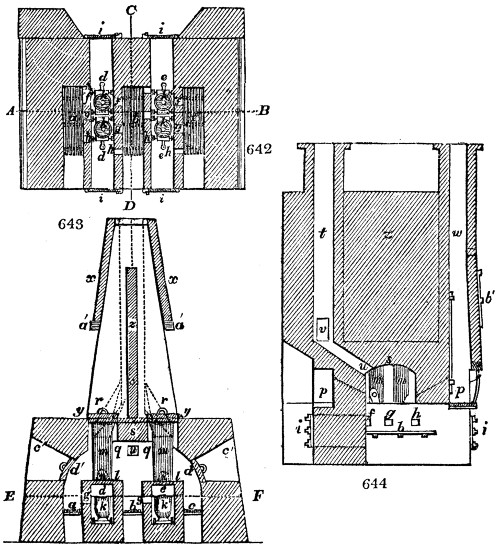
Fig. 642 enlarged (193 kB)
Figs. 642, 643, 644. represent the celebrated antimonial liquation furnaces of Malbosc, in the department of Ardèche, in France. Fig. 642. is a ground plan taken at the level of the draught holes g g, fig. 643., and of the dotted line E F; fig. 643. is a vertical section through the dotted line A B, of fig. 642.; and fig. 644. is a vertical section through the dotted line C D of fig. 642. In the three figures, the same letters denote like objects, a b c are three grates upon the same level above the floor of the works, 41⁄2 feet long, by 101⁄2 inches broad; between which are two rectangular galleries, d e, which pass transversely through the whole furnace, and lie at a level of 12 inches above the ground. They are separated by two walls from the three fire places. The walls have three openings, f g h, alternately placed for the flames to play through. The ends of these galleries are shut in with iron doors i i, containing peep holes. In each gallery are two conical cast-iron crucibles k k, into which the eliquating sulphuret of antimony drops. Their height is from 12 to 14 inches, the width of the mouth is 10 inches, that of the bottom is 6, and the thickness four-tenths of an inch. They are coated over with fire clay, to prevent the sulphuret from acting upon them; and they stand upon cast-iron pedestals with projecting ears, to facilitate their removal from the gallery or platform. Both of these galleries are lined with tiles of fire-clay l l, which also serve as supports to the vertical liquation tubes m m, made of the same clay. The tiles are somewhat curved towards the middle, for the purpose of receiving the lower ends of these tubes, and have a small hole at n, through which the liquid sulphuret flows down into the crucible.
The liquation tubes are conical, the internal diameter at top being 10 inches, at bottom 8; the length fully 40 inches, and the thickness six-tenths of an inch. They have at their lower ends notches or slits o, fig. 644., from 3 to 5 inches long, which look outwards, to make them accessible from the front and back part of the furnaces through small conical openings p p, in the walls. These are closed during the operation with clay stoppers, and are opened only when the gangue, rubbish, and cinders are to be raked out. The liquation tubes pass across the arch of the furnace q q, the space of the arch being wider than the tubes; they are shut in at top with fire-covers r r. s s, the middle part of the arch, immediately under the middle grate, is barrel-shaped, so that both arches are abutted together. The flames, after playing round about the sides of the liquation tubes, pass off through three openings and flues into the chimney t, about 13 feet high; u being the one opening, and v the two others, which are provided with register plates. In front of the furnace is a smoke flue w, to carry off the sulphureous vapours exhaled during the clearing out of the rubbish and slag; another x, begins over y y, at the top of the tubes; a wall z, separates the smoke flue into halves, so that the workmen upon the one side may not be incommoded by the fumes of the other. This wall connects at the same time the front flue w with the chimney t. a′ a′ and b′ b′ are iron and wooden bearer beams and rods for strengthening the smoke-flue, c′ c′ are arches upon both sides of the furnace, which become narrower from without inwards, and are closed with well-fitted plates d′ d′. They serve, in particular circumstances, to allow the interior to be inspected, and to see if either of the liquation furnaces be out of order.
Each tube being charged with about 500 lbs. of the antimonial ore, previously warmed upon the roof of the furnace, in a short time the sulphuret of a blue colour begins to flow out. Whenever the liquation ceases, the cinders are raked out by the side openings, and the tubes are charged afresh. The luted iron crucibles are suffered to become three-fourths full, are then drawn out from the galleries, left to cool, and emptied. The ingots weigh about 85 pounds. The charging is renewed every three hours, and, when the process is in good train, 100 lbs. of sulphuret of antimony are obtained every hour. The average duration of the tubes is 3 weeks, though in some cases it may be 40 days. The product from the ore is from 40 to 50 per cent. The above plan of operation is remarkable for the small consumption of fuel, the economy of labour, and the complete exhaustion of the ore.
LIQUEURS, LIQUORISTE; names given by the French to liquors compounded of alcohol, water, sugar, and different aromatic substances; and to the person who compounds them. I shall insert here a few of their most approved recipes.
Infusion of the peels of fruits.—The outer skin pared off with a sharp knife, is to be dropped into a hard glazed jar, containing alcohol of 34° B., diluted with half its bulk of water, and the whole is to be transferred into well-corked carboys. After an infusion of six weeks, with occasional agitation, the aromatized spirit is to be distilled off. In this way are prepared the liquors of cedrat, lemons, oranges, limettes (a sort of sweet lemon), poncires (the large citron), bergamots, &c.
Infusion of aromatic seeds.—These must be pounded, put into a carboy, along with alcohol diluted as above, infused with agitation for six weeks, and then distilled.
Infusions of aromatic woods are made in the same way.
The liquorist should not bring his infusions and tinctures into the market till six months after their distillation.
Liqueurs have different titles, according to their mode of fabrication.
Thus waters are liquors apparently devoid of viscidity; creams and oils possess it in a high degree.
Water of cedrat, is made by dissolving six pounds of sugar in seven quarts of water; adding two quarts of spirit of cedrat, and one of spirit of citron. Boil the whole for a minute, and filter hot through a proper bag. Set it for a considerable time aside in a corked carboy, before it be bottled.
Oil or cream of cedrat.—Take eight quarts of river water, two of spirit of cedrat, one of spirit of citron, and as much rich syrup as is necessary to give the mixture an oily consistence. Stir it well and set it aside in carboys. Should it be at all clouded, it must be filtered till it be perfectly pellucid.
Balm of Molucca, is made by infusing for ten days, in a carboy capable of holding fully four gallons, 10 pounds of spirits of 18° B., 4 pounds of white sugar, 4 pounds of river water, 4 drachms of pounded cloves, and 48 grains of pounded mace. The mixture is to be shaken 3 or 4 times daily, coloured with caramel (burnt sugar), filtered at the end of ten days, and set aside in bottles.
Tears of the widow of Malabar, are compounded with the preceding quantity of spirits, sugar, and water, adding 4 drachms of ground cinnamon, 48 grains of cloves, and a like quantity of mace, both in powder. It may be slightly coloured with caramel.
The delight of the Mandarins.—Take spirit, sugar, and water, as above, adding 4 drachms of anisum Chinæ, (Gingi), as much ambrette (seeds of the hibiscus abelmoschus, Lin.) all in powder; 2 drachms of safflower.
The sighs of love.—Take spirits, water, and sugar, as above. Perfume with essence (otto) of roses; give a very pale pink hue with tincture of cochineal, filter and bottle up.
Crème de macarons.—Add to the spirit, sugar, and water as above, half a pound of bitter almonds, blanched and pounded; cloves, cinnamon, and mace in powder, of each 48 grains. A violet tint is given by the tinctures of turnsole and cochineal.
Curaçoa.—Put into a large bottle nearly full of alcohol of trente-six (34° Baumé), the peels of six smooth Portugal oranges, (Seville?) and let them infuse for 15 days; then put into a carboy 10 pounds of spirits of 18° B., 4 pounds of white sugar, and 4 pounds of river water. When the sugar is dissolved, add a sufficient quantity of the orange zestes to give flavour, then spice the whole with 48 grains of cinnamon, and as much mace, both in powder. Lastly introduce an ounce of ground Brazil wood, and infuse during 10 days, agitating 3 or 4 times daily. A pretty deep hue ought to be given with caramel.
Swiss extract of wormwood, is compounded as follows:—
Tops of the absinthium majus 4 pounds;
Ditto, absinthium minus 2 pounds;
Roots of angelica, - of each a few grains at pleasure;
Calamus aromaticus,
Seeds of anisum Chinæ,
Leaves of the dittany of Crete,
Alcohol of 20° B., four gallons Imp.
Macerate these substances during eight days, then distil by a gentle fire; draw off two gallons of spirits, and add to it 2 drachms of essential oil of anise-seed. The two gallons left in the still serve for preparing the vulnerary spirituous water.
Of colouring the liqueurs.
Yellow is given with the yellow colouring matter of safflower (carthamus,) which is readily extracted by water.
Fawn is given by caramel, made by heating ground white sugar in an iron spoon over a charcoal fire, till it assumes the desired tint, and then pouring it into a little cold water.
Red is given by cochineal alone, or with a little alum.
Violet is given by good litmus (turnsole).
Blue and green.—Sulphate of indigo gives the first. After saturating it nearly with chalk, alcohol being digested upon it, becomes blue. This tincture mixed with that of carthamus forms a good green.
LIQUID AMBER, is obtained from the liquidambar styraciflua, a tree which grows in Mexico, Louisiana, and Virginia. Some specimens are thin, like oil, and others are thickish, like turpentine. It is transparent, amber coloured, has an agreeable and powerful smell, and an aromatic taste, which feels pungent in the throat. Boiling alcohol dissolves it almost entirely. It contains a good deal of benzoic acid, some of which effloresces whenever the liquid amber hardens with keeping.
LITHARGE (Eng. and Fr.; Glätte, Germ.); is the fused yellow protoxide of lead, which on cooling passes into a mass consisting of small six-sided plates, of a reddish yellow colour, and semitransparent. It generally contains more or less red lead, whence the variations of its colour; and carbonic acid, especially when it has been exposed to the air for some. time. See Lead, and Silver, for its mode of preparation.
LITHIA, is a simple earthy or alkaline substance, discovered not many years ago, in the minerals called petalite and triphane. It is white, very caustic, reddens litmus, and red cabbage, and saturates acids with great facility. When exposed to the air it attracts humidity and carbonic acid. It is more soluble in water than baryta; and has such a strong affinity for it, as to be obtained only in the state of a hydrate. It forms neutral salts with all the acids. It is most remarkable for its power of acting upon, or corroding platinum.
LITHIUM, is the metallic basis of Lithia; the latter substance consists of 100 of metal, and 123 of oxygen.
LITHOGRAPHY. Though this subject belongs rather to the arts of taste and design than to productive manufactures, its chemical principles fall within the province of this Dictionary.
The term lithography is derived from λιθος, a stone, and γραφη, writing, and designates the art of throwing off impressions upon paper, of figures and writing previously traced upon stone. The processes of this art are founded:—
1. Upon the adhesion to a smoothly-polished limestone, of an encaustic fat which forms the lines or traces.
2. Upon the power acquired by the parts penetrated by this encaustic, of attracting to themselves, and becoming covered with a printer’s ink, having linseed oil for its basis.
3. Upon the interposition of a film of water, which prevents the adhesion of the ink in all the parts of the surface of the stone not impregnated with the encaustic.
4. Lastly, upon a pressure applied by the stone, such as to transfer to paper the greater part of the ink which covers the greasy tracings of the encaustic.
The lithographic stones of the best quality are still procured from the quarry of Solenhofen, a village at no great distance from Munich, where this mode of printing had its birth. They resemble in their aspect the yellowish white lias of Bath, but their geological place is much higher than the lias. Abundant quarries of these fine-grained limestones occur in the county of Pappenheim, along the banks of the Danube, presenting slabs of every required degree of thickness, parted by regular seams, and ready for removal with very little violence. The good quality of a lithographic stone is generally denoted by the following characters; its hue is of a yellowish gray, and uniform throughout; it is free from veins, fibres, and spots; a steel point makes an impression on it with difficulty; and the splinters broken off from it by the hammer, display a conchoidal fracture.
The Munich stones are retailed on the spot in slabs or layers of equal thickness; they are quarried with the aid of a saw, so as to sacrifice as little as possible of the irregular edges of the rectangular tables or plates. One of the broad faces is then dressed, and coarsely smoothed. The thickness of these stones is nearly proportional to their other dimensions; and varies from an inch and two-thirds to 3 inches.
In each lithographic establishment, the stones receive their finishing, dressing, and polishing; which are performed like the grinding and polishing of mirror plate. The work is done by hand, by rubbing circularly a movable slab over another cemented in a horizontal position, with fine sifted sand and water interposed between the two. The style of work that the stone is intended to produce, determines the kind of polish that it should get. For crayon drawing the stone should be merely grained more or less fine according to the fancy of the draughtsman. The higher the finish of the surface, the softer are the drawings; but the printing process becomes sooner pasty, and a smaller number of impressions can be taken. Works in ink require the stone to be more softened down, and finally polished with pumice and a little water. The stones thus prepared are packed for use with white paper interposed between their faces.
Lithographic crayons.—Fine lithographic prints cannot be obtained unless the crayons possess every requisite quality. The ingredients composing them ought to be of such a nature as to adhere strongly to the stone, both after the drawing has undergone the preparation of the acid, and during the press-work. They should be hard enough to admit of a fine point, and trace delicate lines without risk of breaking. The following composition has been successfully employed for crayons by MM. Bernard and Delarue, at Paris:—
Pure wax, (first quality) 4
Dry white tallow soap 2
White tallow 2
Gum lac 2
Lamp black, enough to give a dark tint 1
Occasionally copal varnish 1
The wax is to be melted over a gentle fire, and the lac broken to bits is then to be added by degrees, stirring all the while with a spatula; the soap is next introduced in fine shavings; and when the mixture of these substances is very intimately accomplished, the copal-varnish, incorporated with the lamp black, is poured in. The heat and agitation are continued till the paste has acquired a suitable consistence; which may be recognised by taking out a little of it, letting it cool on a plate, and trying its quality with a penknife. This composition, on being cut, should afford brittle slices. The boiling may be quickened by setting the rising vapours on fire, which increases the temperature, and renders the exhalations less offensive. When ready, it is to be poured into a brass mould, made of two semi-cylinders joined together by clasps or rings, forming between them a cylindric tube of the crayon size. The mould should be previously smeared with a greasy cloth.
M. Lasteyrie prescribes a more simple composition, said to be equally fit for the lithographer’s use:—
Dried white tallow soap 6 parts.
White wax 6 —
Lamp black 1 —
The soap and tallow are to be put into a small goblet and covered up. When the whole is thoroughly fused by heat, and no clots remain, the black is gradually sprinkled in with careful stirring.
Lithographic ink is prepared nearly on the same principles:—
Wax 16 parts.
Tallow 6 —
Hard tallow soap 6 —
Shell-lac 12 —
Mastic in tears 8 —
Venice turpentine 1 —
Lamp black 4 —
The mastic and lac, previously ground together, are to be heated with care in the turpentine; the wax and tallow are to be added after they are taken off the fire, and when their solution is effected, the soap shavings are to be thrown in. Lastly, the lamp black is to be well intermixed. Whenever the union is accomplished by heat, the operation is finished; the liquor is left to cool a little, then poured out on tables, and, when cold, cut into square rods.
Lithographic ink of good quality ought to be susceptible of forming an emulsion so attenuated, that it may appear to be dissolved when rubbed upon a hard body in distilled or river water. It should be flowing in the pen, not spreading on the stone; capable of forming delicate traces, and very black to show its delineations. The most essential quality of the ink is to sink well into the stone, so as to re-produce the most delicate outlines of the drawing, and to afford a great many impressions. It must therefore be able to resist the acid with which the stone is moistened in the preparation, without letting any of its greasy matter escape.
M. de Lasteyrie states that after having tried a great many combinations, he gives the preference to the following:—
Tallow soap, dried 30 parts.
Mastic, in tears 30 —
White soda of commerce 30 —
Shell-lac 150 —
Lamp black 12 —
The soap is first put into the goblet and melted over the fire, to which the lac being added fuses immediately; the soda is then introduced, and next the mastic, stirring all the while with a spatula. A brisk fire is applied till all these materials be melted completely, when the whole is poured out into the mould.
The inks now prescribed may be employed equally with the pen and the hair pencil, for writings, black-lead drawings, aqua tinta, mixed drawings, those which represent engravings on wood (wood cuts), &c. When the ink is to be used it is to be rubbed down with water, in the manner of China ink, till the shade be of the requisite depth. The temperature of the place ought to be from 84° to 90° Fahr., or the saucer in which the ink-stick is rubbed should be set in a heated plate. No more ink should be dissolved than is to be used at the time, for it rarely keeps in the liquid state for 24 hours; and it should be covered or corked up.
Autographic paper.—Autography, or the operation by which a writing or a drawing is transferred from paper to stone, presents not merely a means of abridging labour, but also that of reverting the writings or drawings into the direction in which they were traced, whilst, if executed directly upon the stone, the impression given by it is inverted. Hence, a writing upon stone must be inverted from right to left to obtain direct impressions. But the art of writing thus is tedious and difficult to acquire, while, by means of the autographic paper and the transfer, proofs are obtained in the same direction with the writing and drawing.
Autographic ink.—It must be fatter and softer than that applied directly to the stone, so that though dry upon the paper, it may still preserve sufficient viscidity to stick to the stone by mere pressure.
To compose this ink, we take—
White soap 100 parts.
White wax of the best quality 100 —
Mutton suet 30 —
Shell-lac 50 —
Mastic 50 —
Lamp black 30 or 35 —
These materials are to be melted as above described for the lithographic ink.
Lithographic ink and paper.—The following recipes have been much commended:
Virgin or white wax 8 parts
White soap 2 —
Shell-lac 2 —
Lamp black 3 table-spoonsful.
Preparation.—The wax and soap are to be melted together, and before they become so hot as to take fire, the lamp black is to be well stirred in with a spatula, and then the mixture is to be allowed to burn for 30 seconds; the flame being extinguished, the lac is to be added by degrees, carefully stirring all the time; the vessel is to be put upon the fire once more in order to complete the combination, and till the materials are either kindled or nearly so. After the flame is extinguished, the ink must be suffered to cool a little, and then put into the moulds.
With the ink crayons thus made, lines may be drawn as fine as with the point of the graver, and as full as can be desired, without risk of its spreading in the carriage. Its traces will remain unchanged on paper for years before being transferred.
Some may think it strange that there is no suet in the above composition, but it has been found that ink containing it is only good when used soon after it is made, and when immediately transferred to the stone, while traces drawn on paper with the suet ink become defective after 4 or 5 days.
Lithographic paper.—Lay on the paper, 3 successive coats of sheep-feet jelly, Lithographic paper.—Lay on the paper, 1 layer of white starch, Lithographic paper.—Lay on the paper, 1 layer of gamboge.
The first layer is applied with a sponge dipped in the solution of the hot jelly, very equally over the whole surface, but thin; and if the leaf be stretched upon a cord, the gelatine will be more uniform. The next two coats are to be laid on, until each is dry. The layer of starch is then to be applied with a sponge, and it will also be very thin and equal. The coat of gamboge is lastly to be applied in the same way. When the paper is dry, it must be smoothed by passing it through the lithographic press; and the more polished it is, the better does it take on the ink in fine lines.
Transfer.—When the paper is moistened, the transfer of the ink from the gamboge is perfect and infallible. The starch separates from the gelatine, and if, after taking the paper off the stone, we place it on a white slab of stone, and pour hot water over it, it will resume its primitive state.
The coat of gamboge ought to be laid on the same day it is dissolved, as by keeping, it becomes of an oily nature; in this state it does not obstruct the transfer, but it gives a gloss to the paper which renders the drawing or tracing more difficult, especially to persons little habituated to lithography.
The starch paste can be employed only when cold, the day after it is made, and after having the skin removed from its surface.
A leaf of such lithographic paper may be made in two minutes.
In transferring a writing, an ink drawing, or a lithographic crayon, even the impression of a copper-plate, to the stone, it is necessary, 1. that the impressions be made upon a thin and slender body like common paper; 2. that they may be detached and fixed totally on the stone by means of pressure; but as the ink of a drawing sinks to a certain depth in paper, and adheres pretty strongly, it would be difficult to detach all its parts, were there not previously put between the paper and the traces, a body capable of being separated from the paper, and of losing its adhesion to it by means of the water with which it is damped. In order to produce this effect, the paper gets a certain preparation, which consists in coating it over with a kind of paste ready to receive every delineation without suffering it to penetrate into the paper. There are different modes of communicating this property to paper. Besides the above, the following may be tried. Take an unsized paper, rather strong, and cover it with a varnish composed of:—
Starch 120 parts
Gum arabic 40 —
Alum 20 —
A paste of moderate consistence must be made with the starch and some water, with the aid of heat, into which the gum and alum are to be thrown, each previously dissolved in separate vessels. When the whole is well mixed, it is to be applied, still hot, on the leaves of paper, with a flat smooth brush. A tint of yellow colour may be given to the varnish, with a decoction of the berries of Avignon, commonly called French berries by our dyers. The paper is to be dried, and smoothed by passing under the scraper of the lithographic press.
Steel pens are employed for writing and drawing with ink on the lithographic stones.
LITMUS (Tournesol, Fr.; Lackmus, Germ.); is prepared in Holland from the species of lichen called Lecanora tartarea, Roccella tartarea, by a process which has been kept secret, but which is undoubtedly analogous to that for making archil and cudbear. The ground lichens are first treated with urine containing a little potash, and allowed to ferment, whereby they produce a purple-red; the coloured liquor, treated with quicklime and some more urine, is set again to ferment during two or three weeks, then it is mixed with chalk or gypsum into a paste, which is formed into small cubical pieces, and dried in the shade. Litmus has a violet-blue colour, is easy to pulverize, is partially soluble in water and dilute alcohol, leaving a residuum consisting of carbonate of lime, of clay, silica, gypsum, and oxide of iron combined with the dye. The colour of litmus is not altered by alkalis, but is reddened by acids; and is therefore used in chemistry as a delicate test of acidity, either in the state of solution or of unsized paper stained with it. It is employed to dye marble blue.
LIXIVIATION (Lessivage, Fr.; Auslagen, Germ.); signifies the abstraction by water of the soluble alkaline or saline matters present in any earthy admixture; as from that of quicklime and potashes to make potash lye, from that of effloresced alum schist to make aluminous liquors, &c.
LOADSTONE, MAGNETIC IRON-STONE (Fer oxydulé, Fr.; Magneteisenstein, Germ.); an iron ore consisting of the protoxide and peroxide of iron in a state of combination.
LOAM (Terre-limoneuse, Fr.; Lehm, Germ.); a native clay mixed with quartz sand and iron ochre, and occasionally with some carbonate of lime.
LODE, is the name given by the Cornish miners to a vein, whether it be filled with metallic or earthy matter.
LOGWOOD (Bois de Campèche, Bois bleu, Fr.; Blauholz, Germ.); is the wood of the Hæmatoxylon Campechianum, a native tree of central America, grown in Jamaica since 1715. It was first introduced into England in the reign of Elizabeth, but as it afforded to the unskilful dyers of her time a fugitive colour, it was not only prohibited from being used, under severe penalties, but was ordered to be burned wherever found, by a law passed in the 23d year of her reign. The same prejudice existed, and the same law was enacted against indigo. At length, after a century of absurd prohibition, these two most valuable tinctorial matters, by which all our hats, and the greater part of our woollen cloths, are dyed, were allowed to be used.
Old wood, with black bark and with little of the white alburnum, is preferred. Logwood is denser than water, very hard, of a fine compact grain, and almost indestructible by the atmospheric elements; it has a sweet and astringent taste, and a peculiar not inoffensive smell.
For its chemical composition, see Hematin.
When chipped logwood is for some time exposed to the air, it loses a portion of its dyeing power. Its decoction absorbs the oxygen of the atmosphere, and then acquires the property of precipitating with gelatine, which it had not before. The dry extract of logwood, made from an old decoction, affords only a fugitive colour.
For its applications in dyeing, see Black Dye; Brown Dye; Calico Printing; Dyeing; Hat Dyeing, &c.
The imports of logwood for home use, were, in 1836, 12,880 tons, 13 cwts.; in 1837, 14,677 tons, 13 cwts. And the amount of duty received was, in 1836, 2,480l.; in 1837, 2,552l.
LOOM (Metier a tisser, Fr.; Weberstuhl, Germ.); is the ancient and well-known machine for weaving cloth by the decussation of a series of parallel threads, which run lengthwise, called the warp or chain, with other threads thrown transversely with the shuttle, called the woof or weft. See Jacquard Loom and Weaving.
LUBRICATION. The following simple and efficacious plan of lubricating the joints and bearings of machinery by capillary attraction, has been kindly communicated to me, by its ingenious inventor, Edward Woolsey, Esq.:—
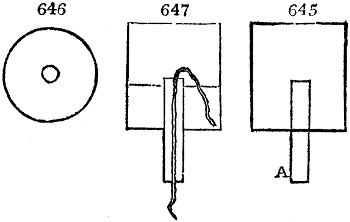
Fig. 645. represents a tin cup, which has a small tin tube A, which passes through the bottom, as shown by the dotted lines. It may have a tin cover to keep out the dust.
Fig. 646. is a plan of the same.
Fig. 647. is a section of the same. Oil is poured into the cup, and one end of a worsted or cotton thread is dipped into the oil, and the other end passed through the tube. The capillary attraction causes the oil to ascend and pass over the orifice of the tube, whence it gradually descends, and drops slower or quicker, according to the length of the thread, or its thickness, until every particle of oil is drawn over by this capillary syphon. The tube is intended to be put into the bearings of shafts, &c., and is made of any size that may be wished. If oil, or other liquids, is desired to be dropped upon a grindstone or other surface, this cup can have a handle to it, or be hung from the ceiling.
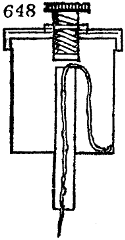
Fig. 648. It is frequently required to stop the capillary action when the machinery is not going; and this has been effected by means of a tightening screw, which passes through a screw boss in the cover of the cup, and presses against the internal orifice of the tube, preventing the oil from passing.
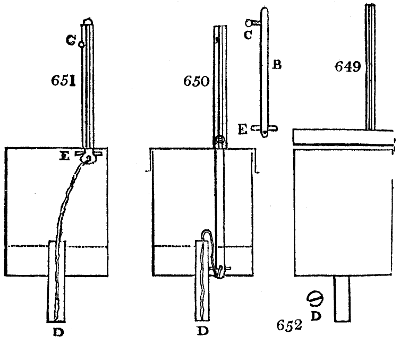
Fig. 649. As I find when these screw cups (fig. 648.) are used upon beams of engines and moving bearings, that the screw is apt to be tightened by the motion; and also, as I think the action of the screw is uncertain, from the workman neglecting to screw it down sufficiently, it answers best to take out the capillary thread when the lubrication is not required; and to effect this easily, I have a tin top to the cup, with a round pipe soldered to it: this pipe has a slit in it, like a pencil case, and allows a bolt B to slide easily in it. In fig. 650. the bolt is down; in fig. 651., the bolt, which is a piece of brass wire, is drawn up, and there is no capillary action between the thread and the oil. In fig. 651. it will be observed, that the bolt is kept in its place by its head C, resting in a lateral slit in the pipe, and it cannot be drawn out on account of the pin E. One end of the thread is fastened to the eye-hole at the bottom of the bolt, and the other end is tied to a small wire which crosses the lower orifice of the tube at D and which is shown in plan fig. 652.
By this simple contrivance the capillary action can be stopped or renewed in a second, without removing the top of the lubricator.
The saving by this plan, instead of pouring oil into the bearings, is 2 gallons out of 3, while the bearings are better oiled.
“I send you the drawings of the lubricators, with a detailed explanation. I have omitted to state, that the saving in labour is considerable where there are many joints to keep oiled three or four times a day; and that the workman does not, with this apparatus, run the risk of being caught by the machinery. Perhaps your friends may be at a loss how to tie on the cotton or worsted thread. I pass a long thread through the eye-hole E of the bolt, and then draw the two ends through the tube by a fine wire with a hook to it, one end on one side of the cross wire D, and the other end on the other side. I then put the cover on, and the bolt in the position shown in fig. 651.; when by drawing the two ends of the thread, and tying them across the wire D, you have the exact length required. When you wish to see the quantity of oil remaining in the lubricator, the bolt must be dropped as in fig. 650., and you can then lift the cover a little way off, without breaking the thread, and replenish with oil. The cost of fig. 650. in tin plate is 9d. The figures in the wood cuts are one third of the full size.
“Believe me to be yours sincerely,
“E. J. Woolsey.”
LUPININE, is a substance of a gummy appearance, so named by M. Cussola, because it was obtained from Lupines.
LUPULINE, from Humulus Lupulus; is the peculiar bitter aromatic principle of the hop. See Beer.
LUTE (from lutum, clay; Lut, Fr.; Kitte, Beschläge, Germ.); is a pasty or loamy matter employed to close the joints of chemical apparatus, or to coat their surfaces, and protect them from the direct action of flame. Lutes differ according to the nature of the vapours which they are destined to confine, and the degree of heat which they are to be exposed to.
1. Lute of linseed meal, made into a soft plastic dough with water, and immediately applied pretty thick to junctions of glass, or stone-ware, makes them perfectly tight, hardens speedily, resists acid and ammoniacal vapours, as also a moderate degree of heat. It becomes stronger when the meal is kneaded with milk, lime-water, or solution of glue.
2. Lute of thick gum-water, kneaded with clay, and iron filings, serves well for permanent junctions, as it becomes extremely solid.
3. By softening in water a piece of thick brown paper, kneading it first with rye-flour paste, and then with some potter’s clay, till it acquire the proper consistence, a lute is formed which does not readily crack or scale off.
4. Lute, consisting of a strong solution of glue kneaded into a dough with new slaked lime, is a powerful cement, and with the addition of white of egg, forms the lut d’ane;—a composition adapted to mend broken vessels of porcelain and stone-ware.
5. Skim-milk cheese, boiled for some time in water, and then triturated into paste with fresh-slaked lime, forms also a good lute.
6. Calcined gypsum, diffused through milk, solution of glue or starch, is a valuable lute, in many cases.
7. A lute made with linseed, melted caoutchouc, and pipe-clay, incorporated into a smooth dough, may be kept long soft when covered in a cellar, and serves admirably to confine acid vapours. As it does not harden, it may therefore be applied and taken off as often as we please.
8. Caoutchouc itself, after being melted in a spoon, may be advantageously used for securing joints against chlorine and acid vapours, in emergencies when nothing else would be effectual. It bears the heat at which sulphuric acid boils.
9. The best lute for joining crucibles inverted into each other, is a dough made with a mixture of fresh fire-clay, and ground fire-bricks, worked with water. That cement if made with solution of borax answers still better, upon some occasions, as it becomes a compact vitreous mass in the fire. See Cements.
LUTEOLINE, is a yellow colouring matter discovered by Chevreul in weld. When sublimed, it crystallizes in needles.
LYCOPODIUM CLAVATUM. The seeds of the lycopodium ripen in September. They are employed, on account of their great combustibility, in theatres, to imitate the sudden flash of lightning, by throwing a quantity of them from a powder puff, or bellows, across the flame of a candle.
LYDIAN STONE, is flint-slate.