B.
Reading edition
BABLAH. The rind or shell which surrounds the fruit of the mimosa cineraria; it comes from the East Indies, as also from Senegal, under the name of Neb-neb. It contains gallic acid, tannin, a red colouring matter, and an azotized substance; but the proportion of tannin is smaller than in sumach, galls, and knoppern (gall-nuts of the common oak) in reference to that of gallic acid, which is considerable in the bablah. It has been used, in dyeing cotton, for producing various shades of drab; as a substitute for the more expensive astringent die-stuffs.
BAGASSE. The sugar-cane, in its dry, crushed state, as delivered from the sugar-mill. It is much employed for fuel in the colonial sugar-houses.
BAKING. (Cuire, Fr. Backen, Germ.) The exposure of any body to such a heat as will dry and consolidate its parts without wasting them. Thus wood, pottery, and porcelain, are baked, as well as bread.
BALANCE. To conduct arts, manufactures, and mines, with judgment and success, recourse must be had, at almost every step, to a balance. Experience proves that all material bodies, existing upon the surface of the earth, are constantly solicited by a force which tends to bring them to its centre, and that they actually fall towards it when they are free to move. This force is called gravity. Though the bodies be not free, the effort of gravity is still sensible, and the resultant of all the actions which it exercises upon their material points, constitutes what is popularly called their weight. These weights are, therefore, forces which may be compared together, and by means of machines may be made to correspond or be counterpoised.
To discover whether two weights be equal, we must oppose them to each other in a machine where they act in a similar manner, and then see if they maintain an equilibrium; for example, we fulfil this condition if we suspend them at the two extremities of a lever, supported at its centre, and whose arms are equal. Such is the general idea of a balance. The beam of a good balance ought to be a bar of well-tempered steel, of such form as to secure perfect inflexibility under any load which may be fitly applied to its extremities. Its arms should be quite equal in weight and length upon each side of its point of suspension; and this point should be placed in a vertical line over the centre of gravity; and the less distant it is from it, the more delicate will be the balance. Were it placed exactly in that centre, the beam would not spontaneously recover the horizontal position when it was once removed from it. To render its indications more readily commensurable, a slender rod or needle is fixed to it, at right angles, in the line passing through its centres of gravity and suspension. The point, or rather edge, of suspension, is made of perfectly hard steel, and turns upon a bed of the same. For common uses the arms of a balance can be made sufficiently equal to give satisfactory results; but, for the more refined purposes of science, that equality should never be presumed nor trusted to; and, fortunately, exact weighing is quite independent of that equality. To weigh a body is to determine how many times the weight of that body contains another species of known weight, as of grains or pounds, for example. In order to find it out, let us place the substance, suppose a piece of gold, in the left hand scale of the balance; counterpoise it with sand or shot in the other, till the index needle be truly vertical, or stand in the middle of its scale, proving the beam to be horizontal. Now remove gently the piece of gold, and substitute in its place standard multiple weights of any graduation, English or French, till the needle again resumes the vertical position, or till its oscillations upon either side of the zero point are equal. These weights will represent precisely the weight of the gold, since they are placed in the same circumstances precisely with it, and make the same equilibrium with the weight laid in the other scale.
This method of weighing is obviously independent of the unequal length as well as the unequal weight of the arms of the beam. For its perfection two requisites only are indispensable. The first is that the points of suspension should be rigorously the same in the two operations; for the power of a given weight to turn the beam being unequal, according as we place it at different distances from the centre of suspension, did that point vary in the two consecutive weighings, we would require to employ, in the second, a different weight from that of the piece of gold, in order to form an equilibrium with the sand or shot originally put in the opposite scale; and as there is nothing to indicate such inequality in the states of the beam, great errors would result from it. The best mode of securing against such inequality is to suspend the cords of the scales from sharp-edged rings, upon knife edges, at the ends of the beam, both made of steel so hard tempered as to be incapable of indentation. The second condition is, that the balance should be very sensible, that is, when in equilibrium and loaded, it may be disturbed, and its needle may oscillate, by the smallest weight put into either of the scales. This sensibility depends solely upon the centre or nail of suspension; and it will be the more perfect the less friction there is between that knife-edge surface and the plane which supports it. Both should therefore be as hard and highly polished as possible; and should not be suffered to press against each other, except at the time of weighing. Every delicate balance of moderate size, moreover, should be suspended within a glass case, to protect it from the agitations of the air, and the corroding influence of the weather. In some balances a ball is placed upon the index or needle, (whether that index stand above or below the beam,) which may be made to approach or recede from the beam by a fine-threaded screw, with the effect of varying the centre of gravity relatively to the point of suspension, and thereby increasing, at will, either the sensibility, or the stability of the balance. The greater the length of the arms, the less distant the centre of gravity is beneath the centre of suspension, the better polished its central knife-edge of 30°, the lighter the whole balance, and the less it is loaded; the greater will be its sensibility. In all cases the arms must be quite inflexible. A balance made by Ramsden for the Royal Society, is capable of weighing ten pounds, and turns with one hundredth of a grain, which is the seven-millionth part of the weight. In pointing out this balance to me one evening, Dr. Wollaston told me it was so delicate, that Mr. Pond, then astronomer royal, when making some observations with it, found its indications affected by his relative position before it, although it was inclosed in a glass case. When he stood opposite the right arm, that end of the beam preponderated, in consequence of its becoming expanded by the radiation of heat from his body; and when he stood opposite the left arm, he made this preponderate in its turn. It is probable that Mr. Pond had previously adjusted the centres of gravity and suspension so near to each other as to give the balance its maximum sensibility, consistent with stability. Were these centres made to coincide, the beam, when the weights are equal, would rest in any position, and the addition of the smallest weight would overset the balance, and place the beam in a vertical position, from which it would have no tendency to return. The sensibility in this case would be the greatest possible; but the other two requisites of level and stability would be entirely lost. The case would be even worse if the centre of gravity were higher than the centre of suspension, as the balance when deranged, if free, would make a revolution of no less than a semi-circle. A balance may be made by a fraudulent dealer to weigh falsely though its arms be equal, provided the suspension be as low as the centre of gravity, for he has only to toss his tea, for instance, forcibly into one scale to cause 15 ounces of it, or thereby, to counterpoise a pound weight in the other. Inspectors of weights, &c. are not au fait to this fruitful source of fraud among hucksters.
BALSAMS. (Baumes, Fr. Balsame, Germ.) Are native compounds of ethereal or essential oils, with resin, and frequently benzoic acid. Most of them have the consistence of honey; but a few are solid, or become so by keeping. They flow either spontaneously, or by incisions made from trees and shrubs in tropical climates. They possess peculiar powerful smells, aromatic hot tastes, but lose their odoriferous properties by long exposure to the air. They are insoluble in water; soluble, to a considerable degree, in ether; and completely in alcohol. When distilled with water, ethereal oil comes over, and resin remains in the retort.
1. Balsams with benzoic acid:—
Balsam of Peru is extracted from the myroxylon peruiferum, a tree which grows in Peru, Mexico, &c.; sometimes by incision, and sometimes by evaporating the decoction of the bark and branches of the tree. The former kind is very rare, and is imported in the husk of the cocoa nut, whence it is called balsam en coque. It is brown, transparent only in thin layers, of the consistence of thick turpentine; an agreeable smell, an acrid and bitter taste; formed of two matters, the one liquid, the other granular, and somewhat crystalline. In 100 parts, it contains 12 of benzoic acid, 88 of resin, with traces of a volatile oil.
The second sort, the black balsam of Peru, is much more common than the preceding, translucent, of the consistence of well-boiled syrup, very deep red-brown colour, an almost intolerably acrid and bitter taste, and a stronger smell than the other balsam. Stoltze regards it as formed of 69 parts of a peculiar oil, 20·7 of a resin, little soluble in alcohol, of 6·4 of benzoic acid, of 0·6 of extractive matter, and 0·9 of water.
From its high price, balsam of Peru is often adulterated with copaiba, oil of turpentine, and olive oil. One thousand parts of good balsam, should, by its benzoic acid, saturate 75 parts of crystallised carbonate of soda. It is employed as a perfume for pomatums, tinctures, lozenges, sealing-wax, and for chocolate and liqueurs, instead of vanilla, when this happens to be very dear.
Liquid amber, Storax or Styrax, flows from the leaves and trunk of the liquid amber styraciflua, a tree which grows in Virginia, Louisiana, and Mexico. It is brownish ash-grey, of the consistence of turpentine, dries up readily, smells agreeably, like benzoin, has a bitterish, sharp, burning taste; is soluble in 4 parts of alcohol, and contains only 1·4 per cent. of benzoic acid.
Balsam of Tolu flows from the trunk of the myroxylon toluiferum, a tree which grows in South America; it is, when fresh, of the consistence of turpentine, is brownish-red, dries into a yellowish or reddish brittle resinous mass, of a smell like benzoin; is soluble in alcohol and ether; affords, with water, benzoic acid.
Chinese varnish flows from the bark of the Augia sinensis; it is a greenish yellow turpentine-like substance, smells aromatic, tastes strong and rather astringent, in thin layers dries soon into a smooth shining lac, and consists of resin, ethereous oil, and benzoic acid. It is soluble in alcohol and ether; and has been employed, immemorially, in China, for lacquering and varnishing surfaces, either alone or coloured.
2. Balsams without benzoic acid:—
Copaiva balsam, balsam of copahu or capivi, is obtained from incisions made in the trunk of the Copaifera officinalis, a tree which grows in Brazil and Cayenne. It is pale yellow, middling liquid, clear transparent, has a bitter, sharp, hot taste; a penetrating disagreeable smell; a specific gravity of from 0·950 to 0·996. It dissolves in absolute alcohol, partially in spirit of wine, forms with alkalis, crystalline compounds. It consists of 45·59 ethereous oil, 52·75 of a yellow brittle resin, and 1·66 of a brown viscid resin. The oil contains no oxygen, has a composition like oil of turpentine, dissolves caoutchouc (according to Durand), but becomes oxidised in the air, into a peculiar species of resin. This balsam is used for making paper transparent, for certain lacquers, and in medicine.
Mecca balsam, or opobalsam, is obtained both by incisions of, and by boiling, the branches and leaves of the Balsamodendron Gileadense, a shrub which grows in Arabia Felix, Lesser Asia and Egypt. When fresh it is turbid, whitish, becomes, by degrees, transparent; yellow, thickish, and eventually solid. It smells peculiar, but agreeable; tastes bitter and spicy; does not dissolve completely in hot spirit of wine, and contains 10 per cent. of ethereous oil, of the spec. grav. 0·876.
Japan lac varnish flows from incisions in the trunk of the Rhus Vernix (Melanorrhea usitata) which is cultivated in Japan, and grows wild in North America. The juice becomes black in the air; when purified, dissolves in very little oil; and, mixed with colouring matter, it constitutes the celebrated varnish of the Japanese.
For Benzoin and Turpentine, see these articles in their alphabetical places.
BANDANNA. A style of calico printing, in which white or brightly coloured spots are produced upon a red or dark ground. It seems to have been practised from time immemorial in India, by binding up firmly with thread, those points of the cloth which were to remain white or yellow, while the rest of the surface was freely subjected to the dyeing operations.
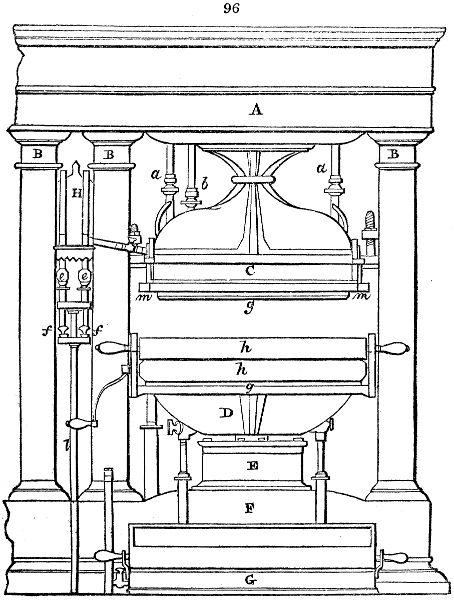
The European imitations have now far surpassed, in the beauty and precision of the design, the oriental patterns; having called into action the refined resources of mechanical and chemical science. The general principles of producing bright figures upon dark grounds, are explained in the article Calico-printing; but the peculiarities of the Bandanna printing may be conveniently introduced here. In Brande’s Journal for July 1823, I described the Bandanna gallery of Messrs. Monteith at Glasgow, which, when in full action some years ago, might be reckoned the most magnificent and profitable printing apartment in the world. The white spots were produced by a solution of chlorine, made to percolate down through the Turkey red cotton cloth, in certain points, defined and circumscribed by the pressure of hollow lead types in plates, in a hydraulic press. Fig. 96., is an elevation of one press; A, the top or entablature; B B, the cheeks or pillars; C, the upper block for fastening the upper lead perforated pattern to; D, the lower block to which the fellow pattern is affixed, and which moves up and down with the piston of the press; E, the piston or ram; F, the sole or base; G, the water-trough, for the discharged or spotted calico to fall into; H, the small cistern, for the aqueous chlorine or liquor-meter, with glass tubes for indicating the height of liquor inside of the cistern; e e, glass stopcocks, for admitting the liquor into that cistern from the general reservoir; f f, stopcocks for admitting water to wash out the chlorine; g g, the pattern lead-plates, with screws for setting the patterns parallel to each other; m m, projecting angular pieces at each corner, perforated with a half-inch hole to receive the four guide-pins rising from the lower plate, which serve to secure accuracy of adjustment between the two faces of the lead pattern plates; h h, two rollers which seize and pull through the discharged pieces, and deliver them into the water-trough. To the left of D there is a stopcock for filling the trough with water; l, is the waste tube for chlorine liquor and water of washing. The contrivance for blowing a stream of air across the cloth, through the pattern tubes, is not represented in the figure.
Sixteen engines, similar to the above, each possessing the power of pressing with several hundred tons, are arranged in one line, in subdivisions of four; the spaces between each subdivision serving as passages to allow the workmen to go readily from the front to the back of the presses. Each occupies twenty-five feet, so that the total length of the apartment is 100 feet.
To each press is attached a pair of patterns in lead, (or plates as they are called,) the manner of forming which will be described in the sequel. One of these plates is fixed to the upper block of the press. This block is so contrived, that it rests upon a kind of universal joint, which enables this plate to apply more exactly to the under fellow-plate. The latter sits on the moveable part of the press, commonly called the sill. When this is forced up, the two patterns close on each other very nicely, by means of the guide-pins at the corners, which are fitted with the utmost care.
The power which impels this great hydrostatic range is placed in a separate apartment, called the machinery room. This machinery consists of two press cylinders of a peculiar construction, having solid rams accurately fitted to them. To each of these cylinders, three little force-pumps, worked by a steam-engine, are connected.
The piston of the large cylinder is eight inches in diameter, and is loaded with a top-weight of five tons. This piston can be made to rise about two feet through a leather-stuffing or collar. The other cylinder has a piston of only one inch in diameter, which is also loaded with a top-weight of five tons. It is capable, like the other, of being raised two feet through its collar.
Supposing the pistons to be at their lowest point, four of the six small force-pumps are put in action by the steam-engine, two of them to raise the large piston, and two the little one. In a short time, so much water is injected into the cylinders, that the loaded pistons have arrived at their highest points. They are now ready for working the hydrostatic discharge-presses, the water pressure being conveyed from the one apartment to the other, under ground, through strong copper tubes, of small calibre.
Two valves are attached to each press, one opening a communication between the large driving-cylinder and the cylinder of the press, the other between the small driving-cylinder and the press. The function of the first is simply to lift the under-block of the press into contact with the upper-block; that of the second, is to give the requisite compression to the cloth. A third valve is attached to the press, for the purpose of discharging the water from its cylinder, when the press is to be relaxed, in order to remove or draw through the cloth.
From twelve to fourteen pieces of cloth, previously dyed Turkey-red, are stretched over each other, as parallel as possible, by a particular machine. These parallel layers are then rolled round a wooden cylinder, called by the workmen, a drum. This cylinder is now placed in its proper situation at the back of the press. A portion of the fourteen layers of cloth, equal to the area of the plates, is next drawn through between them, by hooks attached to the two corners of the webs. On opening the valve connected with the eight-inch driving-cylinder, the water enters the cylinder of the press, and instantly lifts its lower block, so as to apply the under plate with its cloth, close to the upper one. This valve is then shut, and the other is opened. The pressure of five tons in the one inch prime-cylinder, is now brought to bear on the piston of the press, which is eight inches in diameter. The effective force here will, therefore, be 5 tons × 82 = 320 tons; the areas of cylinders being to each other, as the squares of their respective diameters. The cloth is thus condensed between the leaden pattern-plates, with a pressure of 320 tons, in a couple of seconds;—a splendid example of automatic art.
The next step, is to admit the blanching or discharging liquor, (aqueous chlorine, obtained by adding sulphuric acid to solution of chloride of lime,) to the cloth. This liquor is contained in a large cistern, in an adjoining house, from which it is run at pleasure into small lead cisterns H attached to the presses; which cisterns have graduated index tubes, for regulating the quantity of liquor according to the pattern of discharge. The stopcocks on the pipes and cisterns containing this liquor, are all made of glass.
From the measure-cistern H, the liquor is allowed to flow into the hollows in the upper lead-plate, whence it descends on the cloth, and percolates through it, extracting in its passage the Turkey-red dye. The liquor is finally conveyed into the waste pipe, from a groove in the under block. As soon as the chlorine liquor has passed through, water is admitted in a similar manner, to wash away the chlorine; otherwise, upon relaxing the pressure, the outline of the figure discharged would become ragged. The passage of the discharge liquor, as well as of the water through the cloth, is occasionally aided by a pneumatic apparatus, or blowing machine; consisting of a large gasometer, from which air subjected to a moderate pressure, may be allowed to issue, and act in the direction of the liquid, upon the folds of the cloth. By an occasional twist of the air stopcock, the workman also can ensure the equal distribution of the discharging liquor, over the whole excavations in the upper plate. When the demand for goods is very brisk, the air apparatus is much employed, as it enables the workman to double his product.
The time requisite for completing the discharging process in the first press is sufficient to enable the other three workmen to put the remaining fifteen presses in play. The discharger proceeds now from press to press, admits the liquor, the air, and the water; and is followed at a proper interval by the assistants, who relax the press, move forwards another square of the cloth, and then restore the pressure. Whenever the sixteenth press has been liquored, &c., it is time to open the first press. In this routine, about ten minutes are employed; that is 224 handkerchiefs (16 × 14) are discharged every ten minutes. The whole cloth is drawn successively forward, to be successively treated in the above method.
When the cloth escapes from the press, it is passed between the two rollers in front; from which it falls into a trough of water placed below. It is finally carried off to the washing and bleaching department, where the lustre of both the white and the red is considerably brightened.
By the above arrangement of presses, 1600 pieces, consisting of 12 yards each = 19,200 yards, are converted into Bandannas in the space of ten hours, by the labour of four workmen.
The patterns, or plates, which are put into the presses to determine the white figures on the cloth, are made of lead in the following way. A trellis frame of cast-iron, one inch thick, with turned-up edges, forming a trough rather larger than the intended lead pattern, is used as the solid ground-work. Into this trough, a lead plate about one half inch thick, is firmly fixed by screw nails passing up from below. To the edges of this lead plate, the borders of the piece of sheet-lead are soldered, which covers the whole outer surface of the iron frame. Thus a strong trough is formed, one inch deep. The upright border gives at once great strength to the plate, and serves to confine the liquor. A thin sheet of lead is now laid on the thick lead-plate, in the manner of a veneer on toilette-tables, and is soldered to it round the edges. Both sheets must be made very smooth beforehand, by hammering them on a smooth stone table, and then finishing with a plane: the surface of the thin sheet (now attached), is to be covered with drawing paper, pasted on, and upon this the pattern is drawn. It is now ready for the cutter. The first thing which he does, is to fix down with brass pins all the parts of the pattern which are to be left solid. He now proceeds with the little tools generally used by block-cutters, which are fitted to the different curvatures of the pattern, and he cuts perpendicularly quite through the thin sheet. The pieces thus detached are easily lifted out; and thus the channels are formed which design the white figures on the red cloth. At the bottom of the channels, a sufficient number of small perforations are made through the thicker sheet of lead, so that the discharging liquor may have free ingress and egress. Thus, one plate is finished; from which, an impression is to be taken by means of printers’ ink, on the paper pasted upon another plate. The impression is taken in the hydrostatic press. Each pair of plates constitutes a set, which may be put into the presses, and removed at pleasure.
BARBERRY. The root of this plant contains a yellow colouring matter, which is soluble in water and alcohol, and is rendered brown by alkalis. The solution is employed in the manufacture of Morocco leather.
BARILLA. A crude soda, procured by the incineration of the salsola soda, a plant cultivated for this purpose in Spain, Sicily, Sardinia, &c. Good barilla usually contains, according to my analysis, 20 per cent. of real alkali, associated with muriates and sulphates, chiefly of soda, some lime, and alumina, with very little sulphur. Caustic lyes made from it, are used in the finishing process of the hard soap manufacture. 125,068 cwts. were imported in 1835, of which only 5,807 were exported. The duty is 2s. per cwt. Of the above quantity, 64,174 came from Spain and the Balearic islands, 39,943 from the Canaries, and 20,432 from Italy and the Italian islands.
BARIUM, the metallic basis of Baryta.
BARK OF OAK, for tanning. Unfortunately, the Tables of Revenue published by the Board of Trade, mix up this bark and the dyeing barks together, and give the sum of the whole for 1835, at 826,566 cwts., of which only 2,264 were re-exported. The duty is 1d. per cwt. from British possessions, and 8d. from other parts.
BARLEY (Orge, Fr. Gerste, Germ.) English barley is that with two-rowed ears, or the hordeum vulgare distichon of the botanists; the Scotch beer or bigg, is the hordeum vulgare hexastichon. The latter has two rows of ears, but 3 corns come from the same point, so that it seems to be six-eared. The grains of bigg are smaller than those of barley, and the husks thinner. The specific gravity of English barley varies from 1·25 to 1·33; of bigg from 1·227 to 1·265; the weight of the husk of barley is 1⁄6, that of bigg 2⁄9. 1000 parts of barley flour contain, according to Einhof, 720 of starch, 56 sugar, 50 mucilage, 36·6 gluten, 12·3 vegetable albumen, 100 water, 2·5 phosphate of lime, 68 fibrous or ligneous matter. Sp. gravity of barley, is 1·235 by my trials.
BARM. The yeasty top of fermenting beer. See Beer, Distillation, Fermentation.
BARYTA or BARYTES, one of the simple earths. It may be obtained most easily by dissolving the native carbonate of barytes (Witherite) in nitric acid, evaporating the neutral nitrate till crystals be formed, draining and then calcining these in a covered platina crucible, at a bright red heat. A less pure baryta may be obtained by igniting strongly a mixture of the carbonate and charcoal, both in fine powder and moistened. It is a grayish white earthy looking substance, fusible only at the jet of the oxy-hydrogen blowpipe, has a sharp caustic taste, corrodes the tongue and all animal matter, is poisonous even in small quantities, has a very powerful alkaline reaction; a specific gravity of 4·0; becomes hot, and slakes violently when sprinkled with water, falling into a fine white powder, called the hydrate of baryta, which contains 101⁄2 per cent. of water, and dissolves in 10 parts of boiling water. This solution lets fall abundant columnar crystals of hydrate of baryta as it cools; but it still retains one twentieth its weight of baryta, and is called baryta water. The above crystals contain 61 per cent. of water, of which, by drying, they lose 50 parts. This hydrate may be fused at a red heat without losing any more water. Of all the bases, baryta has the strongest affinity for sulphuric acid, and is hence employed either in the state of the above water, or in that of one of its neutral salts, as the nitrate or muriate, to detect the presence, and determine the quantity of that acid present in any soluble compound. Its prime equivalent, according to Berzelius, is 956,880, oxygen being 100; or 76,676, hydrogen being 1,000. Native sulphate of baryta, or heavy spar, is fraudulently used to adulterate white lead by the English dealers to a shameful extent.
BASSORINE. A constituent part of a species of gum which comes from Bassora, as also of gum tragacanth, and of some gum resins. It is semi-transparent, difficult to pulverise, swells considerably in cold or boiling water, and forms a thick mucilage without dissolving. Treated with ten times its weight of nitric acid, it affords nearly 23 per cent. of its weight of mucic acid, being much more than is obtainable from gum arabic or cherry-tree gum. Bassorine is very soluble in water slightly acidulated with nitric or muriatic acid. This principle is procured by soaking gum Bassora in a great quantity of cold water, and in removing, by a filter, all the soluble parts.
BATHS. (Bains, Fr. Baden, Germ.) Warm baths have lately come into very general use, and they are justly considered as indispensably necessary in all modern houses of any magnitude, as also in club-houses, hotels, and hospitals. But the mode of constructing these baths, and of obtaining the necessary supplies of hot and cold water, does not appear to have undergone an improvement equal to the extension of their employment.
The several points in regard to warm baths, are,
The materials of which they are constructed.
Their situation.
The supply of cold water.
The supply of hot water.
Minor comforts and conveniences.
1. As to the materials of which they are constructed.—Of these the best are slabs of polished marble, properly bedded with good water-tight cement, in a seasoned wooden case, and neatly and carefully united at their respective edges. These, when originally well constructed, form a durable, pleasant, and agreeable-looking bath; but the expense is often objectionable, and, in upper chambers, the weight may prove inconvenient. If of white or veined marble, they are also apt to get yellow or discoloured by frequent use, and cannot easily be cleansed; so that large Dutch tiles, as they are called, or square pieces of white earthenware, are sometimes substituted; which, however, are difficultly kept water-tight; so that, upon the whole, marble is preferable.
Where there are reasons for excluding marble, copper or tinned iron plate is the usual material resorted to. The former is most expensive in the outfit, but far more durable than the latter, which is, moreover, liable to leakage at the joints, unless most carefully made. Either the one or the other should be well covered outside and inside, with several coats of paint, which may then be marbled, or otherwise ornamented.
Wooden tubs, square or oblong, and oval, are sometimes used for warm baths; and are cheap and convenient, but neither elegant nor cleanly. The wood always contracts a mouldy smell; and the difficulty and nuisance of keeping them water-tight, and preventing shrinkage, are such as to exclude them from all except extemporaneous application.
2. As to the situation of the bath, or the part of the house in which it is to be placed.—In hotels, and club-houses, this is a question easily determined: several baths are usually here required, and each should have annexed to it, a properly warmed dressing-room. Whether they are up stairs or down stairs, is a question of convenience, but the basement story, in which they are sometimes placed, should always be avoided; there is a coldness and dampness belonging to it, in almost all weathers, which is neither agreeable nor salubrious.
In hospitals, there should be at least two or three baths on each side of the house, (the men’s and women’s), and the supply of hot water should be ready at a moment’s notice. The rooms in which the baths are placed should be light and comparatively large and airy; and such conveniences for getting into and out of the bath should be adopted, as the sick are well known to require. The dimensions of these baths should also be larger than usual.
In private houses, the fittest places for warm baths are dressing-rooms annexed to the principal bed-rooms; or, where such convenience cannot be obtained, a separate bath-room, connected with the dressing-room, and always upon the bed-room floor. All newly-built houses should be properly arranged for this purpose, and due attention should be paid to the warming of the bath-room, which ought also to be properly ventilated. A temperature of 70° may be easily kept up in it, and sufficient ventilation is absolutely requisite, to prevent the deposition of moisture upon the walls and furniture.
The objection which formerly prevailed, in respect to the difficulty of obtaining adequate supplies of water, in the upper rooms, has been entirely obviated, by having cisterns at or near the top of the house; and we would just hint that these should be so contrived, as to be placed out of the reach of frost; a provision of the utmost importance in every point of view, and very easily effected in a newly-built house, though it unfortunately happens, that architects usually regard these matters as trifles, and treat them with neglect, as indeed they do the warming and ventilation of buildings generally.
3. The supply of water of proper quality and quantity, is a very important point, as connected with the present subject. The water should be soft, clean, and pure; and as free as possible from all substances mechanically suspended in it. In many cases, it answers to dig a well for the exclusive supply of a large house with water. In most parts of London this may effectually be accomplished, at a comparatively moderate expense; and, if the well be deep enough, the water will be abundant, soft, and pellucid. The labour of forcing it by a pump to the top of the house, is the only drawback; this, however, is very easily done by a horse-engine, or there are people enough about town, glad to undertake it at a shilling a day. I am led to these remarks by observing the filthy state of the water usually supplied, at very extravagant rates, by the water companies. It often partakes more of the appearance of pea-soup than of the pure element; fills our cisterns and pipes with mud and dirt, and, even when cleared by subsidence, is extremely unpalatable. It deposits its nastiness in the pipes connected with warm baths, and throws down a slippery deposit upon the bottom of the vessel itself to such an extent, as often to preclude its being used, at least as a luxury, which a clear and clean bath really is. This inconvenience may, in some measure, be avoided, by suffering the water to throw down its extraneous matters upon the bottom of the cistern, and drawing our supplies from pipes a little above it; there will, however, always be more or less deposit in the pipes themselves; and every time the water runs into the cistern, the grouts are stirred up, and diffused through its mass: this, from some cause or other, has lately become an intolerable nuisance; and he who reflects upon the miscellaneous contents of Thames water, will not have his appetite sharpened by a draught of the Grand Junction beverage, nor feel reanimated and refreshed by bathing in a compound so heterogeneous and unsavoury.
4. and 5. In public bathing establishments, where numerous and constant baths are required, the simplest and most effective means of obtaining hot water for their supply consists in drawing it directly into the baths from a large boiler, placed somewhere above their level. This boiler should be supplied with proper feeding-pipes and gauges; and, above all things, its dimensions should be ample; it should be of wrought iron or copper, except where sea water is used, in which case the latter metal is sometimes objectionable. The hot water should enter the bath by a pipe at least an inch and a half in diameter; and the cold water by one of the same dimension, or somewhat larger, so that the bath may not be long in filling. The relative proportions of the hot and cold water are, of course, to be adjusted by a thermometer, and every bath should have a two-inch waste-pipe, opening about two inches from the top of the bath, and suffering the excess of water freely to run off; so that when a person is immersed in the bath, or when the supplies of water are accidentally left open, there may be no danger of an overflow.
Where there is a laundry in the upper story of the house, or other convenient place for erecting a copper and its appurtenances, a plan similar to the above may often be conveniently adopted in private houses, for the supply of a bath upon the principal bed-room floor. An attempt is sometimes made to place boilers behind the fires of dressing-rooms, or otherwise to erect them in the room itself, for the purpose of supplying warm water; but this plan is always objectionable, from the complexity of the means by which the supply of water is furnished to the boiler, and often dangerous from the flues becoming choaked with soot, and taking fire. Steam is also apt, in such cases, to escape in quantities into the room; so that it becomes necessary to search for other methods of heating the bath; one or two of the least objectionable of which I shall describe.
1. A contrivance of some ingenuity consists in suffering the water for the supply of the bath to flow from a cistern above it, through a leaden pipe of about one inch diameter, which is conducted into the kitchen or other convenient place where a large boiler for the supply of hot water is required. The bath-pipe is immersed in this boiler, in which it makes many convolutions, and, again emerging, ascends to the bath. The operation is simply this:—the cold water passing through the convolutions of that part of the pipe which is immersed in the boiling water, receives there sufficient heat for the purpose required, and is delivered in that state by the ascending pipe into the bath, which is also supplied with cold water and waste-pipes as usual. The pipe may be of lead, as far as the descending and ascending parts are concerned, but the portion forming the worm, or convolutions immersed in the boiler should be copper, in order that the water within it may receive heat without impediment.
This plan is economical only where a large boiler is constantly kept at work in the lower part of the house; otherwise, the trouble and expense of heating such a boiler, for the mere purpose of the bath, render it unavailable. The worm-pipe is also apt to become furred, upon the outside, by the deposition of the earthy impurities of the water in which it is immersed; it then becomes a bad conductor of heat, is cleansed with difficulty, and the plan is rendered ineffective. This system, however, has been adopted, in some particular cases, with satisfaction.
2. A much more simple, economical, and independent mode of heating a warm bath, by a fire placed at a distance from it, is the following, which is found to answer perfectly in private houses, as well as upon a more extended scale in large establishments. It is certainly open to some objections, but these are overbalanced by its advantages. A waggon-shaped boiler, holding about six gallons of water, is properly placed over a small furnace, in any convenient and safe part of the house, as the kitchen, scullery, servants’ hall, or wash-house. The bath itself, of the usual dimensions and construction, is placed where it is wanted, with a due supply of cold water from above. Two pipes issue from within an inch of the bottom of the bath at its opposite extremities; one at the head of the bath, about one inch, and the other at the foot, an inch and one eighth in diameter. These tubes descend to the boiler, the smaller one entering it at the bottom, and the larger one issuing from its top.
Under these circumstances, supposing the pipes and boiler every where perfectly tight, when the bath is filled, the water will descend into and expel the air from the boiler, and completely fill it. Now, upon making a gentle fire under the boiler, an ascending current of warm water will necessarily pass upwards through the larger pipe which issues from its top, and cold water will descend by the pipe which enters at the bottom; and thus, by the establishment of currents, the whole mass of water in the bath will become heated to the desired point; or, if above it, the temperature may easily be lowered by the admixture of cold water.
The advantages of this form of bath are numerous. The shorter the pipes of communication the better, but they may extend forty or fifty feet without any inconvenience beyond that of expense; so that there is no obstacle to the bath being near the bed-room while the boiler is on the basement story. There is but little time required for heating the bath; the water in which may, if requisite, be raised to about 100° in about half an hour from the time of lighting the fire. The consumption of fuel is also trifling.
The following are the chief disadvantages attendant upon this plan, and the means of obviating them:—
It is necessary, when the water has acquired its proper temperature, to withdraw the fire from the boiler, or not to use the bath immediately, as it may go on acquiring some heat from the boiler, so that we may become inconveniently hot in the bath. When, therefore, this bath is used, we may proceed as follows:—heat the water in it an hour before it is wanted, to about 100°, and then extinguish the fire. The water will retain its temperature, or nearly so, for three or four hours, especially if the bath be shut up with a cover; so that when about to use it, cold water may be admitted till the temperature is lowered to the required point, and thus all the above inconveniences are avoided.
Another disadvantage of this bath arises from too fierce a fire being made under the boiler, so as to occasion the water to boil within it, a circumstance which ought always to be carefully avoided. In that case, the steam rising in the upper part of the boiler, and into the top pipe, condenses there, and occasions violent concussions, the noise of which often alarms the whole house, and leads to apprehensions of explosion, which, however, is very unlikely to occur; but the concussions thus produced injure the pipes, and may render them leaky: so that in regard to these, and all other baths, &c., we may remark, that the pipes should pass up and down in such parts of the house as will not be injured if some leakage takes place; and under the bath itself should be a sufficiently large leaden tray with a waste-pipe, to receive and carry off any accidental drippings, which might injure the ceilings of the rooms below. In all newly-built houses, two or three flues should be left in proper places for the passage of ascending and descending water-pipes; and these flues should in some way receive at their lower part a little warm air in winter, to prevent the pipes freezing: the same attention should also be paid to the situation of the cisterns of water in houses, which should be kept within the house, and always supplied with a very ample waste-pipe, to prevent the danger of overflow. Cisterns thus properly placed, and carefully constructed, should be supplied from the water-mains by pipes kept under ground, till they enter the house, and not carried across the area, or immediately under the pavement, where they are liable to freeze.
3. Baths are sometimes heated by steam, which has several advantages: it may either be condensed directly into the water of the bath, or, if the bath be of copper or tinned iron, it may be conducted into a casing upon its outside, usually called a jacket; in the latter case there must be a proper vent for the condensed water, and for the escape of air and waste steam. Steam is also sometimes passed through a serpentine pipe, placed at the bottom of the bath. But none of these methods are to be recommended for adoption in private houses, and are only advisable in hospitals, or establishments where steam boilers are worked for other purposes than the mere heating of baths.
Many copper and tin baths have been lately constructed in London, with a little furnace attached to one end, and surrounded with a case or jacket, into which the water flows and circulates backwards and forwards till the whole mass in the bath gets heated to the due degree. One of the best of these is that constructed by Mr. Benham, of Wigmore Street. The bath must be placed near the fire-grate, and the smoke-pipe of the attached furnace be conducted up the chimney a certain way to secure a sufficient draught to maintain combustion. The above bath, well managed, heats the water from 50° to 98° in about 20 or 25 minutes, as I have experimentally proved. When the proper temperature is attained, the fire must of course be extinguished.
BDELLIUM. A gum resin, produced by an unknown plant which grows in Persia and Arabia. It comes to us in yellowish or reddish pieces, smells faintly, like myrrh, and consists of 59 resin, 9·2 gum, 30·6 bassorine, and 1·2 ethereous oil.
BEER. (Bière, Fr. Bier, Germ.) The fermented infusion of malted barley, flavoured with hops, constitutes the best species of beer; but there are many beverages of inferior quality to which this name is given, such as spruce beer, ginger beer, molasses beer, &c.; all of which consist of a saccharine liquor, partially advanced into the vinous fermentation, and flavoured with peculiar substances.
The ancients were acquainted with beer, and the Romans gave it the appropriate name of Cerevisia (quasi Ceresia), as being the product of corn, the gift of Ceres. The most celebrated liquor of this kind in the old time, was the Pelusian potation, so called from the town where it was prepared at the mouth of the Nile. Aristotle speaks of the intoxication caused by beer; and Theophrastus very justly denominated it the wine of barley. We may, indeed, infer from the notices found in historians, that drinks analogous to our beer were in use among the ancient Gauls, Germans, and in fact almost every people of our temperate zone; and they are still the universal beverage in every land where the vine is not an object of rustic husbandry.
The manufacture of beer, or the art of brewing, may be conveniently considered under five heads:—
1. An examination of the natural productions which enter into its composition; or of barley and hops.
2. The changes which barley must undergo to fit it for making beer; or the processes of malting and mashing.
3. The formation of a proper wort from the mashed malt and hops.
4. The fermentation of that wort; and
5. The fining, ripening, and preservation of the beer.
I. Of the materials.
1. Barley, wheat, maize, and several other kinds of corn are capable of undergoing those fermentative changes, by which beer may be made; but the first substance is by far the fittest. There are two species of barley, the hordeum vulgare or common barley, having two seeds arranged in a row on its spikes; and the hordeum hexastichon, in which three seeds spring from one point, so that its double row has apparently six seeds. The former is the proper barley, and is much the larger sized grain; the latter is little known in England, but is much cultivated in Scotland under the name of bear or big; being a hardy plant adapted to a colder country. The finer the climate in which barley grows the denser and larger its seed, and the thinner its husk; thus the Norfolk and Suffolk barley is distinguished in these respects from that of Aberdeenshire. Big is a less compact grain than barley; the weight of a Winchester bushel (2150·42 cubic inches) of the former is only about 47 libs, while that of a bushel of the latter is nearly 51 libs. Their constituents, however, bear much the same proportion to each other.
The quality of barley is proved not only by its density when dry, but by the increase of volume which it acquires when steeped in water. Thus,
100 measures of average English barley thereby swell into 124.
100 — of — Scotch ditto, 121.
100 — of — — bigg or bear, 118.
Nay, 100 of very fine Suffolk barley have swollen into 183.
While 100 of an inferior Scotch bigg became no more than 109.
This circumstance indicates so nearly the probable yield of malt, that it is carefully attended to by the officers of excise, who gauge the steep cistern, and levy their duty in conformity with the largest volume, 100 pounds of good barley become almost one half heavier by the absorption of moisture; and weigh upon an average 147 pounds; the best of course taking up most water.
By chemical analysis barley flour seems to consist of 67·18 parts of hordeine, or starch and gluten intimately combined, 7·29 of vegetable fibre, 1·15 of coagulated albumen, 3·52 parts of gluten, 5·21 of sugar, 4·62 of gum, 0·24 of phosphate of lime, and 9·37 of water. The loss amounted to 1·42. To these principles should be added a peculiar volatile oil of a concrete nature, which is obtained during the process of distilling fermented malt wash. (See Whiskey.) It may also be extracted from barley flour, by the solvent action of alcohol; and never amounts to more than a few parts in the thousand. The husk also contains some of that fetid oil. Proust thought that he had discovered in barley a peculiar principle, to which he gave the name of hordeine, and which he separated from starch by the action of both cold and boiling water. He found that by treating barley meal successively with water, he obtained from 89 to 90 parts of a farinaceous substance, composed of from 32 to 33 of starch, and from 57 to 58 of hordeine. Einhof obtained from barley seeds, 70·05 of flour, 18·75 of husks or bran, and 11·20 of water.
According to Proust hordeine is a yellowish powder, not unlike fine saw-dust. It contains no azote, for it affords no ammonia by distillation, and is therefore very dissimilar to gluten. In the germination of barley, which constitutes the process of malting, the proportion of hordeine is greatly diminished by its conversion into sugar and starch. Other chemists suppose that the hordeine of Proust is merely a mixture of the bran of the barley with starch and gluten. It is obvious that the subject stands in need of new chemical researches. In barley the husk constitutes from one fourth to one fifth of the whole weight; in oats it constitutes one third; and in wheat, one tenth. From the analysis of barley flour recently made, it appears to consist in 1000 parts: of water, 100; albumine, 22·3; sugar, 56; gum or mucilage, 50; gluten, 37·6; starch, 720; phosphate of lime, 2·5.
2. The hop, humulus lupulus, the female flowers of the plant. Ives first directed attention to a yellow pulverulent substance which invests the scales of the catkins, amounting to about one eighth of their weight; and referred to it the valuable properties which hops impart to beer. We may obtain this substance by drying the hops at a temperature of 86° F., introducing them into a coarse canvass bag, and shaking it so that the yellow powder shall pass through the pores of the canvass. This powder bears some resemblance to lycopodium. Of the 13 parts in 100 of this powder, 4 parts are foreign matters, derived from the scales of the cones; leaving 9 parts of a peculiar granular substance. When distilled with water, this substance affords two per cent. of its weight (2⁄10 for 100 times the weight of hops) of a volatile colourless oil, to which the plant owes its peculiar aroma. This oil dissolves in water in considerable quantity. It appears to contain sulphur (for it blackens solutions of silver), and also acetate of ammonia. No less than 65 per cent. of the yellow dust is soluble in alcohol. This solution, treated with water and distilled, leaves a resin, which amounts to 52·5 per cent. It has no bitter taste, and is soluble in alcohol and ether. The watery solution from which the resin was separated contains the bitter substance which has been called lupuline by Payen and Chevallier, mixed with a little tannin and malic acid. To obtain this in a state of purity, the free acid must be saturated with lime, the solution evaporated to dryness, and the residuum must be treated with ether, which removes a little resin; after which the lupuline is dissolved out by alcohol, which leaves the malate of lime. On evaporating away the alcohol, the lupuline remains, weighing from 8·3 to 12·5 per cent. It is sometimes white, or slightly yellowish, and opaque, sometimes orange yellow, and transparent. At ordinary temperatures it is inodorous, but when heated strongly it emits the smell of hops. It possesses the characteristic taste and bitterness of the hop. Water dissolves it only in the proportion of 5 per cent., but it thereby acquires a pale yellow colour. Lupuline is neither acid nor alkaline; it is acted upon neither by the dilute acids nor alkalies, nor by the solutions of the metallic salts: it is quite soluble in alcohol, but hardly in ether. It contains apparently no azote, for it affords no ammonia by destructive distillation; but only an empyreumatic oil.
The yellow dust of hops contains, moreover, traces of a fatty matter, gum, a small quantity of an azotised substance, and several saline combinations in minute quantity. Boiling water dissolves from 19 to 31 per cent., of the contents of the dust, of which a large proportion is resin. Ives thought that the scales of the catkins of hops, when freed from the yellow powder, contained no principles analogous to it; but Payen and Chevallier have proved the contrary. The cones of hop give up to boiling alcohol 36 per cent. of soluble matter; while the same cones, stripped of their yellow powder, yield only 26 per cent.; and further, these chemists found the same principles in the different parts of the hop, but in different proportions.
The packing of the hop catkins or cones is one of the most important operations towards the preservation of this plant; and is probably the cause of the enormous difference in value between the English and French hops after a few years’ keeping. The former, at the end of six years, possess still great value, and may be sold as an article only two or three years old; while the latter have lost the greater part of their value in three years, and are no more saleable at the end of four. In France, it is packed merely by tramping it with the feet in sacks. Under this slight pressure, large interstitial spaces are left amid the mass of the hops, through which the air freely circulates, carrying off the essential oil, and oxygenating some of the other proximate principles, so as to render them inert. By the English method, on the contrary, the hops, after being well rammed into strong sacks hung in frames, are next subjected to the action of a hydraulic press. The valuable yellow powder thus inclosed on every side by innumerable compact scales, is completely screened from the contact of the atmosphere, and from all its vicissitudes of humidity. Its essential oil, in particular the basis of its flavour, is preserved without decay.
According to the experiments of Chevallier and Payen upon the hops of England, Flanders, the Netherlands, and the department of the Vosges, those of the county of Kent afforded the largest cones, and were most productive in useful secreted and soluble matters. Next to them were the hops of Alost.
The best hops have a golden yellow colour, large cones, an agreeable aroma; when rubbed between the hands, they leave yellow traces, powerfully odoriferous, without any broken portions of the plant, such as leaves, stems, and scaly fragments. When alcohol is digested on good hops, from 9 to 12 per cent. of soluble yellow matter may be obtained by evaporating it to dryness. This is a good test of their quality.
The best-flavoured and palest hops are packed in sacks of fine canvass, which are called pockets, and weigh about 11⁄2 cwt. each. These are bought by the ale brewer. The stronger-flavoured and darker-coloured hops are packed in bags of a very coarse texture like door-mats, called hop bags: these contain generally about 3 cwt., and are sold to the porter and beer brewers. After the end of a year or two, hops are reckoned to have lost much of their marketable value, and are then sold to the second-rate porter brewers, under the name of old hops. The finest hops are grown in the neighbourhood of Canterbury; but those of Worcester have an agreeable mildness of flavour, greatly admired by many ale drinkers. When the bitter and aromatic principles disappear, the hops are no better than so much chaff; therefore, an accurate chemical criterion of their principles would be a great benefit to the brewer.
II. Malting.—This process consists of three successive operations; the steeping; the couching, sweating, and flooring; and the kiln-drying.
The steeping is performed in large cisterns made of wood or stone, which being filled with clear water up to a certain height, a quantity of barley is shot into them, and well stirred about with rakes. The good grain is heavy, and subsides; the lighter grains, which float on the surface, are damaged, and should be skimmed off; for they would injure the quality of the malt, and the flavour of the beer made with it. They seldom amount to more than two per cent. More barley is successively emptied into the steep cistern, till the water stands only a few inches, about five, above its surface; when this is levelled very carefully, and every light seed is removed. The steep lasts from forty to sixty hours, according to circumstances; new barley requiring a longer period than old, and bigg requiring much less time than barley.
During this steep, some carbonic acid is evolved from the grains, and combines with the water, which, at the same time, acquires a yellowish tinge, and a strawy smell, from dissolving some of the extractive matter of the barley husks. The grain imbibes about one half its weight of water, and increases in size by about one-fifth. By losing this extract, the husk becomes about one seventieth lighter in weight, and paler in colour.
The duration of the steep depends, in some measure, upon the temperature of the air, and is shorter in summer than in winter. In general from 40 to 48 hours will be found sufficient for sound dry grain. Steeping has for its object to expand the farina of the barley with humidity, and thus prepare the seed for germination, in the same way as the moisture of the earth prepares for the growth of the radicle and plumula in seed sown in it. Too long continuance in the steep is injurious; because it prevents the germination at the proper time, and thereby exhausts a portion of the vegetative power: it causes also an abstraction of saccharine matter by the water. The maceration is known to be complete when the grain may be easily transfixed with a needle, and is swollen to its full size. The following is reckoned a good test:—If a barley-corn, when pressed between the thumb and fingers, continues entire in its husk, it is not sufficiently steeped; but if it sheds its flour upon the fingers, it is ready. When the substance exudes in the form of a milky juice, the steep has been too long continued, and the barley is spoiled for germination.
In warm weather it sometimes happens that the water becomes acescent before the grain is thoroughly swelled. This accident, which is manifest to the taste and smell, must be immediately obviated by drawing off the foul water through the tap at the bottom of the cistern, and replacing it with fresh cold water. It does no harm to renew it two or three times at one steep.
The couch.—The water being drawn off, and occasionally a fresh quantity passed through, to wash away any slimy matter which may have been generated in warm weather, the barley is now laid upon the couch floor of stone flags, in square heaps from 12 to 16 inches high, and left in that position for 24 hours. At this period, the bulk of the grain being the greatest, it may be gauged by the revenue officers if they think fit. The moisture now leaves the surface of the barley so completely, that it imparts no dampness to the hand. By degrees, however, it becomes warm; the temperature rising 10° above the atmosphere, while an agreeable fruity smell is evolved. At this time, if the hand be thrust into the heap, it not only feels warm, but it gets bedewed with moisture. At this sweating stage, the germination begins; the fibrils of the radicle first sprout forth from the tip of every grain, and a white elevation appears, that soon separates into three or more radicles, which grow rapidly larger. About a day after this appearance, the plumula peeps forth at the same point, proceeding thence beneath the husk to the other end of the seed, in the form of a green leaflet.
The greatest heat of the couch is usually about 96 hours after the barley has been taken out of the steep. In consequence, the radicles tend to increase in length with very great rapidity, and must be checked by artificial means, which constitute the chief art of the maltster. He now begins to spread the barley thinner on the floor, and turns it over several times in the course of a day, bringing the portions of the interior into the exterior surface. The depth, which was originally 15 or 16 inches, is lowered a little at every turning over, till it be brought eventually down to three or four inches. Two turnings a day are generally required. At this period of spreading or flooring, the temperature in England is about 62°, and in Scotland 5 or 6 degrees lower.
About a day after the radicles appear, the rudiments of the stem, or of the plumula, sprout forth, called by the English maltsters the acrospire. It issues from the same end of the seed as the radicle, but turns round, and proceeds within the husk towards the other end, and would there come forth as a green leaf, were its progress not arrested. The malting, however, is complete before the acrospire becomes a leaf.
The barley couch absorbs oxygen and emits carbonic acid, just as animals do in breathing, but to a very limited extent; for the grain loses only three per cent. of its weight upon the malt floor, and a part of this loss is due to waste particles. As the acrospire creeps along the surface of the seed, the farina within undergoes a remarkable alteration. The gluten and mucilage disappear, in a great measure, the colour becomes whiter, and the substance becomes so friable that it crumbles into meal between the fingers. This is the great purpose of malting, and it is known to be accomplished when the plumula or acrospire has approached the end of the seed. Now the further growth must be completely stopped. Fourteen days may be reckoned the usual duration of the germinating stage of the malting operations in England; but in Scotland, where the temperature of the couch is lower, eighteen days or even twenty-one, are sometimes required. The shorter the period within the above limits, the more advantageous is the process to the maltster, as he can turn over his capital the sooner, and his malt is also somewhat the better. Bigg is more rapid in its germination than barley, and requires to be still more carefully watched. In dry weather it is sometimes necessary to water the barley upon the couch.
Occasionally the odour disengaged from the couch is offensive, resembling that of rotten apples. This is a bad prognostic, indicating either that the barley was of bad quality, or that the workmen, through careless shovelling, have crushed a number of the grains in turning them over. Hence when the weather causes too quick germination, it is better to check it by spreading the heap out thinner than by turning it too frequently over. On comparing different samples of barley, we shall find that the best develope the germ or acrospire quicker than the radicles, and thus occasion a greater production of the saccharine principle; this conversion advances along with the acrospire, and keeps pace with it, so that the portion of the seed to which it has not reached, is still in its unaltered starchy state. It is never complete for any single barleycorn till the acrospire has come to the end opposite to that from which it sprung; hence one part of the corn may be sugary, while the other is still insipid. If the grain were allowed to vegetate beyond this term, the radicles being fully one third of an inch long, the future stem would become visibly green in the exterior; it would shoot forth rapidly, the interior of the grain would become milky, with a complete exhaustion of all its useful constituents, and nothing but the husk would remain.
In France, the brewers, who generally malt their barley themselves, seldom leave it on the couch more than 8 or 10 days, which, even taking into account the warmer climate of their country, is certainly too short a period, and hence they make inferior wort to the English brewer, from the same quantity of malt.
At the end of the germination, the radicles have become 11⁄2 longer than the barley, and are contorted so that the corns hook into one another, but the acrospire is just beginning to push through. A moderate temperature of the air is best adapted to malting; therefore it cannot be carried on well during the heat of summer or the colds of winter. Malt-floors should be placed in substantial thick-walled buildings, without access of the sun, so that a uniform temperature of 59° or 60° may prevail inside. Some recommend them to be sunk a little under the surface of the ground, if the situation be dry.
During germination a remarkable change has taken place in the substance of the grain. The glutinous constituent has almost entirely disappeared, and is supposed to have passed into the matter of the radicles, while a portion of the starch is converted into sugar and mucilage. The change is similar to what starch undergoes when dissolved in water, and digested in a heat of about 160°F. along with a little gluten. The thick paste becomes gradually liquid, transparent, and sweet tasted, and the solution contains now, sugar and gum, mixed with some unaltered starch. The gluten suffers a change at the same time, and becomes acescent, so that only a certain quantity of starch can be thus converted by a quantity of gluten. By the artificial growth upon the malt-floor, all the gluten and albumen present in barley are not decomposed, and only about one half of the starch is converted into sugar; the other half, by a continuance of the germination, would only go to the growth of the roots and stems of the plant; but it receives its nearly complete conversion into sugar without any notable waste of substance in the brewer’s operation of mashing.
The kiln-drying.—When the malt has become perceptibly dry to the hand upon the floor, it is taken to the kiln, and dried hard with artificial heat, to stop all further growth, and enable it to be kept, without change, for future use, at any time. The malt-kiln, which is particularly described in the next page, is a round or a square chamber, covered with perforated plates of cast iron, whose area is heated by a stove or furnace, so that not merely the plates on which the malt is laid are warmed, but the air which passes up through the stratum of malt itself, with the effect of carrying off very rapidly the moisture from the grains. The layer of malt should be about 3 or 4 inches thick, and evenly spread, and its heat should be steadily kept at from the 90th to the 100th degree of Fahrenheit’s scale, till the moisture be mostly exhaled from it. During this time the malt must be turned over at first frequently, and latterly every three or four hours. When it is nearly dry, its temperature should be raised to from 145° to 165°F., and it must be kept at this heat till it has assumed the desired shade of colour, which is commonly a brownish-yellow or a yellowish-brown. The fire is now allowed to die out, and the malt is left on the plates till it has become completely cool; a result promoted by the stream of cool air, which now rises up through the bars of the grate; or the thoroughly dry browned malt may, by damping the fire, be taken hot from the plates, and cooled upon the floor of an adjoining apartment. The prepared malt must be kept in a dry loft, where it can be occasionally turned over till it is used. The period of kiln-drying should not be hurried. Many persons employ two days in this operation.
According to the colour and the degree of drying, malt is distributed into three sorts; pale, yellow, and brown. The first is produced when the highest heat to which it has been subjected is from 90° to 100° F.; the amber yellow, when it has suffered a heat of 122°; and the brown when it has been treated as above described. The black malt used by the porter brewer to colour his beer, has suffered a much higher heat, and is partially charred. The temperature of the kiln should, in all cases, be most gradually raised, and most equably maintained. If the heat be too great at the beginning, the husk gets hard dried, and hinders the evaporation of the water from the interior substance; and should the interior be dried by a stronger heat, the husk will probably split, and the farina become of a horny texture, very refractory in the mash-tun. In general, it is preferable to brown malt, rather by a long-continued moderate heat, than by a more violent heat of shorter duration, which is apt to carbonise a portion of the mucilaginous sugar, and to damage the article. In this way, the sweet is sometimes converted into a bitter principle.
During the kiln-drying, the roots and acrospire of the barley become brittle, and fall off; and are separated by a wire sieve whose meshes are too small to allow the malt itself to pass through.
A quantity of good barley, which weighs 100 pounds, being judiciously malted, will weigh, after drying and sifting, 80 pounds. Since the raw grain, dried by itself at the same temperature as the malt, would lose 12 per cent. of its weight in water, the malt process dissipates out of these remaining 88 pounds, only 8 pounds, or 8 per cent. of the raw barley. This loss consists of—
1 1⁄2 per cent. dissolved out in the steep water,
3 — dissipated in the kiln,
3 — by the falling of the fibrils,
1⁄2 — of waste.
The bulk of good malt exceeds that of the barley from which it was made, by about 8 or 9 per cent.
The operation of kiln-drying is not confined to the mere expulsion of the moisture from the germinated seeds; but it serves to convert into sugar a portion of the starch which remained unchanged, and that in a twofold way; first, by the action of the gluten upon the fecula at an elevated temperature, as also by the species of roasting which the starch undergoes, and which renders it of a gummy nature. (See Starch.) We shall have a proof of this explanation, if we dry one portion of the malt in a naturally dry atmosphere, and another in a moderately warm kiln; the former will yield less saccharine extract than the latter. Moreover, the kiln-dried malt has a peculiar, agreeable, and faintly burned taste, probably from a small portion of empyreumatic oil formed in the husk, and which not only imparts its flavour to the beer, but also contributes to its preservation. It is therefore obvious, that the skilful preparation of the malt must have the greatest influence both on the quantity and quality of the worts to be made from it. If the germination be pushed too far, a part of the extractible matter is wasted; if it has not advanced far enough, the malt will be too raw, and too much of its substance will remain as an insoluble starch; if it is too highly kiln-dried, a portion of its sugar will be caramelised, and become bitter; and if the sweating was imperfect or irregular, much of the barley may be rendered lumpy and useless. Good malt is distinguishable by the following characters:—
The grain is round and full, breaks freely between the teeth, and has a sweetish taste, an agreeable smell, and is full of a soft flour from end to end. It affords no unpleasant flavour on being chewed; it is not hard, so that when drawn along an oaken table across the fibres, it leaves a white streak, like chalk. It swims upon water, while unmalted barley sinks in it. Since the quality of the malt depends much on that of the barley, the same sort only should be used for one malting. New barley germinates quicker than old, which is more dried up; a couch of a mixture of the two would be irregular, and difficult to regulate.
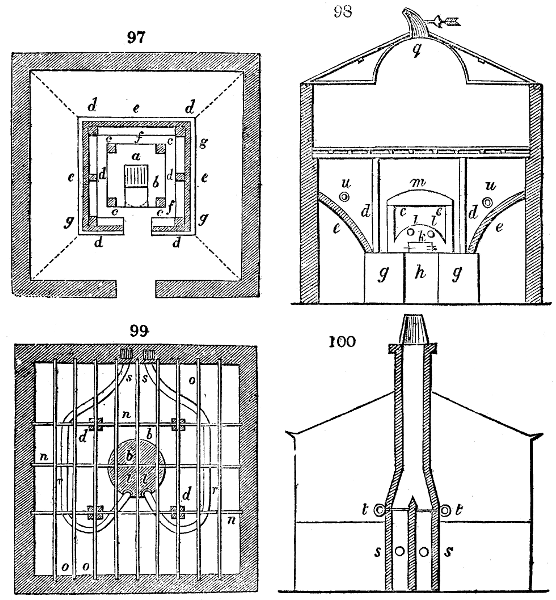
Description of the malt kiln.—Figs. 97, 98, 99, 100. exhibit the construction of a well-contrived malt kiln. Fig. 97. is the ground plan; fig. 98. is the vertical section; and figs. 99. and 100., a horizontal and vertical section in the line of the malt-plates. The same letters denote the same parts in each of the figures. A cast-iron cupola-shaped oven is supported in the middle, upon a wall of brickwork four feet high; and beneath it, are the grate and its ash-pit. The smoke passes off through two equi-distant pipes into the chimney. The oven is surrounded with four pillars, on whose top a stone lintel is laid: a is the grate, 9 inches below the sole of the oven b; c c c c are the four nine-inch strong pillars of brickwork which bear the lintel m; d d d d d d are strong nine-inch pillars, which support the girder and joists upon which perforated plates repose; e denotes a vaulted arch on each of the four sides of the oven; f is the space between the kiln and the side arch, into which a workman may enter, to inspect and clean the kiln; g g, the walls on either side of the kiln, upon which the arches rest, h, the space for the ashes to fall; k, the fire-door of the kiln; l l, junction-pieces to connect the pipes r r with the kiln; the mode of attaching them is shown in fig. 99. These smoke-pipes lie about three feet under the iron plates, and at the same distance from the side walls; they are supported upon iron props, which are made fast to the arches. In fig. 98., u shows their section; at s s, fig. 99., they enter the chimney, which is provided with two register or damper plates, to regulate the draught through the pipes. These registers are represented by t t, fig. 100., which shows a perpendicular section of the chimney. m, fig. 98., is the lintel which causes the heated air to spread laterally instead of ascending in one mass in the middle, and prevents any combustible particles from falling upon the iron cupola. n n are the main girders of iron for the iron beams o o, upon which the perforated plates p lie; q, fig. 98., is the vapour pipe in the middle of the roof, which allows the steam of the drying malt to escape. The kiln may be heated either with coal or wood.
The size of this kiln is about 20 feet square; but it may be made proportionally either smaller or greater. The perforated floor should be large enough to receive the contents of one steep or couch.
The perforated plate might be conveniently heated by steam pipes, laid zig-zag, or in parallel lines under it; or a wire-gauze web might be stretched upon such pipes. The wooden joists of a common floor would answer perfectly to support this steam-range, and the heat of the pipes would cause an abundant circulation of air. For drying the pale malt of the ale brewer, this plan is particularly well adapted.
The kiln-dried malt is sometimes ground between stones in a common corn mill, like oatmeal; but it is more generally crushed between iron rollers, at least for the purposes of the London brewers.
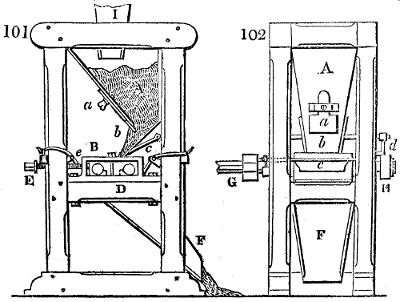
The crushing mill.—The cylinder malt-mill is constructed as shown in fig. 101, 102. I is the sloping-trough, by which the malt is let down from its bin or floor to the hopper A of the mill, whence it is progressively shaken in between the rollers B D. The rollers are of iron, truly cylindrical, and their ends rest in bearers of hard brass, fitted into the side frames of iron. A screw E goes through the upright, and serves to force the bearer of the one roller towards that of the other, so as to bring them closer together when the crushing effect is to be increased. G is the square end of the axis, by which one of the rollers may be turned either by the hand or by power; the other derives its rotatory motion from a pair of equal-toothed wheels H, which are fitted to the other end of the axes of the rollers. d is a catch which works into the teeth of a ratchet-wheel on the end of one of the rollers (not shown in this view). The lever c strikes the trough b at the bottom of the hopper, and gives it the shaking motion for discharging the malt between the rollers, from the slide sluice a. e e, fig. 101., are scraper-plates of sheet iron, the edges of which press by a weight against the surfaces of the rollers, and keep them clean.
Instead of the cylinders, some employ a crushing mill of a conical-grooved form like a coffee mill, upon a large scale. (See the general plan, infrà.)
The mashing and boiling.—Mashing is the operation by which the wort is extracted, or eliminated from the malt, and whereby a saccharo-mucilaginous extract is made from it. The malt should not in general be ground into a fine meal, for in that case it would be apt to form a cohesive paste with hot water, or to set, as it is called, and to be difficult to drain. In crushed malt, the husk remains nearly entire, and thus helps to keep the farinaceous particles open and porous to the action of the water. The bulk of the crushed malt is about one-fifth greater than that of the whole, or one bushel of malt gives a bushel and a quarter of crushed malt. This is frequently allowed to lie a few days in a cool place, in order that it may attract moisture from the air, which it does very readily by its hygrometric power. Thus, the farinaceous substance which had been indurated in the kiln, becomes soft, spongy, and fit for the ensuing process of watery extraction.
Mashing has not for its object merely to dissolve the sugar and gum already present in the malt, but also to convert into a sweet mucilage the starch which had remained unchanged during the germination. We have already stated that starch, mixed with gluten, and digested for some time with hot water, becomes a species of sugar. This conversion takes place in the mash-tun. The malted barley contains not only a portion of gluten, but diastase more than sufficient to convert the starch contained in it, by this means, into sugar.
The researches of Payen and Persoz show, that the mucilage formed by the reaction of malt upon starch, may either be converted into sugar, or be made into permanent gum, according to the temperature of the water in which the materials are digested. We take of pale barley malt, ground fine, from 6 to 10 parts, and 100 parts of starch; we heat, by means of a water-bath, 400 parts of water in a copper, to about 80°F.; we then stir in the malt, and increase the heat to 140°F., when we add the starch, and stir well together. We next raise the temperature to 158°, and endeavour to maintain it constantly at that point, or at least to keep it within the limits of 167° on the one side, and 158° on the other. At the end of 20 or 30 minutes, the original milky and pasty solution becomes thinner, and soon after as fluid nearly as water. This is the moment in which the starch is converted into gum, or into that substance which the French chemists call dextrine, from its power of polarising light to the right hand, whereas common gum does it to the left. If this merely mucilaginous solution, which seems to be a mixture of gum with a little liquid starch and sugar, be suitably evaporated, it may serve for various purposes in the arts to which gum is applied, but with this view, it must be quickly raised to the boiling point, to prevent the farther operation of the malt upon it. If we wish, on the contrary, however, to promote the saccharine fermentation, for the formation of beer, we must maintain the temperature at between 158° and 167° for three or four hours, when the greatest part of the gum will have passed into sugar, and by evaporation of the liquid at the same temperature, a starch syrup may be obtained like that procured by the action of sulphuric acid upon starch. The substance, which operates in the formation of sugar, or is the peculiar ferment of the sugar fermentation, may be considered as a residuum of the gluten or vegetable albumen in the germinating grain: it is reckoned by Payen and Persoz, a new proximate principle called diastase, which is formed during malting, in the grains of barley, oats, and wheat, and may be separated in a pure state, if we moisten the malt flour for a few minutes in cold water, press it out strongly, filter the solution, and heat the clear liquid in a water bath, to the temperature of 158°. The greater part of that albuminous azotised substance is thus coagulated, and is to be separated by a fresh filtration; after which, the clear liquid is to be treated with alcohol, when a flocky precipitate appears, which is diastase. To purify it still further, especially from the azotised matter, we should dissolve it in water, and precipitate again with alcohol. When dried at a low temperature, it appears as a solid white substance, which contains no azote; is insoluble in alcohol, but dissolves in water and proof spirit. Its solution is neutral and tasteless; when left to itself, it changes with greater or less rapidity according to the temperature, and becomes sour at a temperature of from 149° to 167°. It has the property of converting starch into gum (dextrine) and sugar, and indeed, when sufficiently pure, with such energy that one part of it disposes 2000 parts of dry starch to that change, but it operates the quicker the greater its quantity. Whenever the solution of diastase with starch or with dextrine is heated to the boiling point, it loses the sugar-fermenting property. One hundred parts of well-malted starch appear to contain about one part of this substance.
We can now understand the theory of malting, and the limits between which the temperature of the liquor, ought to be maintained in this operation; namely, the range between 157° and 160°F. It has been ascertained as a principle in mashing, that the best and soundest extract of the malt, is to be obtained, first of all, by beginning to work with water at the lowest of these heats, and to conclude the mash with water at the highest. Secondly, not to operate the extraction at once with the whole of the water that is to be employed; but with separate portions and by degrees. The first portion is added with the view of penetrating equally the crushed malt, and of extracting the already formed sugar; the next for effecting the sugar fermentation by the action of the diastase. By this means also, the starch is not allowed to run into a cohesive paste, and the extract is more easily drained from the poorer mass, and comes off in the form of a nearly limpid wort. The thicker moreover, or the less diluted the mash is, so much the easier is the wort fined in the boiler or copper by the coagulation of the albuminous matter: these principles illustrate, in every condition, the true mode of conducting the mashing process; but different kinds of malt require a different treatment. Pale and slightly kilned malt requires a somewhat lower heat than malt highly kilned, because the former has more undecomposed starch, and is more ready to become pasty. The former also, for the same reason, needs a more leisurely infusion than the latter, for its conversion into mucilaginous sugar. The more sugar the malt contains, the more is its saccharine fermentation accelerated by the action of the diastase. What has been here said of pale malt, is still more applicable to the case of a mixture of raw grain with malt, for it requires still gentler heats, and more cautious treatment.
III. The mash-tun is a large circular tub with a double bottom; the uppermost of which is called a false bottom, and is pierced with many holes. There is a space of about 2 or 3 inches between the two, into which the stopcocks enter, for letting in the water and drawing off the wort. The holes of the false bottom should be burned, and not bored, to prevent the chance of their filling up by the swelling of the wood, which would obstruct the drainage: the holes should be conical, and largest below, being about 3⁄8 of an inch there, and 1⁄8 at the upper surface. The perforated bottom must be fitted truly at the sides of the mash-tun, so that no grains may pass through. The mashed liquor is let off into a large back, from which it is pumped into the wort coppers. The mash-tun is provided with a peculiar rotatory apparatus for agitating the crushed grains and water together, which we shall presently describe. The size of the wort copper is proportional to the amount of the brewing, and it must, in general, be at least so large as to operate upon the whole quantity of wort made from one mashing; that is, for every quarter of malt mashed, the copper should contain 140 gallons. The mash-tun ought to be at least a third larger, and of a conical form, somewhat wider below than above. The quantity of water to be employed for mashing, or the extraction of the wort, depends upon the greater or less strength to be given to the beer. The seeds of the crushed malt, after the wort is drawn off, retain still about 32 gallons of water for every quarter of malt. In the boiling, and evaporation from the coolers, 40 gallons of water are dissipated from one quarter of malt; constituting 72 gallons in all. If 13 quarters of barley be taken to make 1500 gallons of beer, 2400 gallons of water must therefore be required for the mashing. This example will give an idea of the proportions for an ordinary quality of beer.
When the mash is to begin, the copper must be filled with water, and heated. As soon as the water has attained the heat of 145° in summer, or 167° in winter, 600 gallons of it are to be run off into the mash-tun, and the 13 quarters of crushed malt are to be gradually thrown in and well intermixed by proper agitation, so that it may be uniformly moistened, and no lumps may remain. After continuing the agitation in this way for one half or three-quarters of an hour, the water in the copper will have approached to its boiling point, when 450 gallons at the temperature of about 200° are to be run into the mash-tun, and the agitation is to be renewed till the whole assumes an equally fluid state: the tun is now to be well covered for the preservation of its heat, and to be allowed to remain at rest for an hour, or an hour and a half. The mean temperature of this mash may be reckoned at about 145°. The time which is necessary for the transmuting heat of the remaining starch into sugar depends on the quality of the malt. Brown malt requires less time than pale malt, and still less than a mixture with raw grain, as already explained. After the mash has rested the proper time, the tap of the tun is opened, and the clear wort is to be drawn out into the under back. If the wort that first flows is turbid, it must be returned into the tun, till it runs clear. The amount of this first wort may be about 675 gallons. Seven hundred and fifty gallons of water at the temperature of 200° are now to be introduced up through the drained malt, into the tun, and the mixture is to be agitated till it becomes uniform, as before. The mash-tun is then to be covered, and allowed to remain at rest for an hour. The temperature of this mash is from 167° to 174°. While the second mash is making, the worts of the first are to be pumped into the wort copper, and set a-boiling as speedily as possible. The wort of the second mash is to be drawn off at the proper time, and added to the copper as fast as it will receive it, without causing the ebullition to stop.
A third quantity of water amounting to 600 gallons, at 200°, is to be introduced into the mash-tun, and after half an hour, is to be drawn off, and either pumped into the wort copper, or reserved for mashing fresh malt, as the brewer may think fit.
The quantity of extract, per barrel weight, which a quarter of malt yields to wort, amounts to about 84 lbs. The wort of the first extract is the strongest; the second contains, commonly, one-half the extract of the first; and the third, one-half of the second; according to circumstances.
To measure the degrees of concentration of the worts drawn off from the tun, a particular form of hydrometer, called a saccharometer, is employed, which indicates the number of pounds weight of liquid contained in a barrel of 36 gallons imperial measure. Now, as the barrel of water weighs 360 lbs., the indication of the instrument when placed in any wort, shows by how many pounds a barrel of that wort is heavier than a barrel of water; thus, if the instrument sinks with its poise till the mark 10 is upon a line with the surface of the liquid, it indicates that a barrel of that wort weighs ten pounds more than a barrel of water. See Saccharometer.
Or, supposing the barrel of wort weighs 396 lbs., to convert that number into specific gravity, we have the following simple rule:—
360 : 396 ∷ 100 : 1·100;
at which density, by my experiments, the wort contains 25 per cent., of solid extract.
Having been employed to make experiments on the density of worts, and the fermentative changes which they undergo, for the information of a committee of the House of Commons, which sat in July and August, 1830, I shall here introduce a short abstract of that part of my evidence which bears upon the present subject.
My first object was to clear up the difficulties which, to common apprehension, hung over the matter, from the difference in the scales of the saccharometers in use among the brewers and distillers of England and Scotland. I found that one quarter of good malt would yield to the porter brewer a barrel Imperial measure of wort, at the concentrated specific gravity of 1·234. Now, if the decimal part of this number be multiplied by 360, being the number of pounds weight of water in the barrel, the product will denote the excess in pounds, of the weight of a barrel of such concentrated wort, over that of a barrel of water, and that product is, in the present case, 84·24 pounds.
Mr. Martineau, jun., of the house of Messrs. Whitbread and Company, and a gentleman connected with another great London brewery, had the kindness to inform me that their average product from a quarter of malt was a barrel of 84 lbs. gravity. It is obvious, therefore, that by taking the mean operation of two such great establishments, I must have arrived very nearly at the truth.
It ought to be remarked that such a high density of wort as 1·234 is not the result of any direct experiment in the brewery, for infusion of malt is never drawn off so strong; that density is deduced by computation from the quantity and quality of several successive infusions; thus, supposing a first infusion of the quarter of malt to yield a barrel of specific gravity 1·112, a second to yield a barrel at 1·091, and a third a barrel at 1·031, we shall have three barrels at the mean of these three numbers, or one barrel at their sum, equal to 1·234.