L. (continued 2)
Reading edition
14. Of all the countries in the world, Great Britain is that which annually produces the greatest quantity of lead. According to M. Villefosse, in his Richesse Minerale, published in 1810, we had furnished every year 12,500 tons of lead, whilst all the rest of Europe taken together, did not produce so much; but from more recent documents, that estimate seems to have been too low. Mr. Taylor has rated the total product of the United Kingdom per annum at 31,900 tons, a quantity fully 21⁄2 times greater than the estimate of Villefosse (see Conybeare and Phillips’ Geology, p. 354). Mr. Taylor distributes this product among the different districts as follows:—
Tons.
Wales, (Flintshire and Denbighshire) 7,500
Scotland, (in transition graywacke) 2,800
Durham, Cumberland, and Yorkshire, (in carboniferous lime) 19,000
Derbyshire, (probably in carboniferous lime) 1,000
Shropshire 800
Devon and Cornwall, (transition and primitive rocks) 800
Total 31,900
We thus see that Cumberland, and the adjacent parts of the counties of Durham and York, furnish of themselves nearly three-fifths of the total product. Derbyshire was formerly much more productive. In Cornwall and Devonshire, the lead ore is found in veins in killas, a clay-slate passing into greywacke. In North Wales and the adjacent counties, as well as in Cumberland and Derbyshire, the lead occurs in the carboniferous limestone.
The English lead-miners distinguish three different kinds of deposits of lead ore; rake-veins, pipe-veins, and flat-veins. The English word vein corresponds to the French term filon; but miners make use of it indifferently in England and France, to indicate all the deposits of this ore, adding an epithet to distinguish the different forms; thus, rake veins are true veins in the geological acceptation of the word vein; pipe-veins are masses usually very narrow, and of oblong shape, most frequently parallel to the plane of the rocky strata; and flat-veins are small beds of ores interposed in the middle of these strata.
Rake-veins are the most common form in which lead ore occurs in Cumberland. They are in general narrower in the sandstone which covers the limestone, than in the calcareous beds. A thickness of less than a foot in the former, becomes suddenly 3 or 4 feet in the latter; in the rich vein of Hudgillburn, the thickness is 17 feet in the Great limestone, while it does not exceed 3 feet in the overlying Watersill or sandstone. This influence exercised on the veins by the nature of the enclosing rock, is instructive; it determines at the same time almost uniformly their richness in lead ore, an observation similar to what has been made in other countries, especially in the veins of Kongsberg in Norway. The Cumberland veins are constantly richer, the more powerful they are, in the portions which traverse the calcareous rocks, than in the beds of sandstone, and more particularly the schistose rocks. It is rare in the rock called plate (a solid slaty clay) for the vein to include any ore; it is commonly filled with a species of potter’s earth. The upper calcareous beds are also in general more productive than the lower ones. In most of these mines, the veins were not worked till lately below the fifth calcareous bed (the four-fathom limestone), which is 307 yards beneath the millstone-grit; and as the first limestone stratum is 108 yards beneath it, it follows that the thickness of the part of the ground where the veins are rich in lead does not in general exceed 200 yards. It appears however that veins have been mined in the neighbourhood of Alston Moor, downwards to the eleventh calcareous stratum, or Tyne bottom limestone, which is 418 yards under the millstone-grit of the coal formation, immediately above the whin-sill; and that they have been followed above the first limestone stratum, as high as the grindstone sill, which is only 83 yards below the same stratum of millstone-grit; so that in the total thickness of the plumbiferous formation there is more than 336 yards. It has been asserted that lead veins have been traced even further down, into the Memerby scar limestone; but they have not been mined.
The greatest enrichment of a vein takes place commonly in the points where its two sides, being not far asunder, belong to the same rock; and its impoverishment occurs when one side is calcareous and the other a schistose clay. The minerals which most frequently accompany the galena, are carbonate of lime, fluate of lime, sulphate of baryta, quartz, and pyrites.
The pipe-veins (amas in French), are seldom of great length; but some have a considerable width; their composition being somewhat similar to that of the rake-veins. They meet commonly in the neighbourhood of the two systems, sometimes being in evident communication together; they are occasionally barren; but when a wide pipe-vein is metalliferous, it is said to be very productive.
The flat veins, or strata veins, seem to be nothing else than expansions of the matter of the vein between the planes of the strata; and contain the same ores as the veins in their vicinity. When they are metalliferous, they are worked along with the adjacent rake vein; and are productive to only a certain distance from that vein, unless they get enriched by crossing a rake vein. Some examples have been adduced of advantageous workings in flat veins in the great limestone of Cumberland, particularly in the mines of Coalcleugh and Nenthead. The rake veins, however, furnish the greater part of the lead which Cumberland and the adjacent counties send every year into the market. Mr. Forster gives a list of 165 lead mines, which have been formerly, or are now, worked in that district of the kingdom.
The metalliferous limestone occupies, in Derbyshire, a length of about 25 miles from north-west to south-east, under a very variable breadth, which towards the south, amounts to 25 miles. Castleton to the north, Buxton to the north-west, and Matlock to the south-east, lie nearly upon its limits. It is surrounded on almost all sides by the millstone grit which covers it, and which is, in its turn, covered by the coal strata. The nature of the rocks beneath the limestone is not known. In Cumberland the metalliferous limestone includes a bed of trap, designated under the name of whinsill. In Derbyshire the trap is much more abundant, and it is thrice interposed between the limestone. These two rocks constitute of themselves the whole mineral mass, through a thickness of about 550 yards, measuring from the millstone grit; only in the upper portion, that is near the millstone grit, there is a pretty considerable thickness of argillo-calcareous schists.
Four great bodies or beds of limestone are distinguishable, which alternate with three masses of trap, called toadstone. The lead veins exist in the calcareous strata, but disappear at the limits of the toadstone. It has now been ascertained however that they recur in the limestone underneath.
Treatment of the Ores of Lead.
The mechanical operations performed upon the lead ores in Great Britain, to bring them to the degree of purity necessary for their metallurgic treatment, may be divided into three classes, whose objects are,—
1. The sorting and cleansing of the ores;
2. The grinding;
3. The washing, properly so called.
The apparatus subservient to the first objects are sieves, running buddles, and gratings. The large sieves employed in Derbyshire for sorting the ore at the mouth of the mine, into coarse and fine pieces, is a wire gauze of iron; its meshes are square, and an inch long in each side. There is a lighter sieve of wire gauze, similar to the preceding, for washing the mud from the ore, by agitating the fragments in a tub filled with water. But in Derbyshire, instead of using this sieve, the pieces of ore are sometimes merely stirred about with a shovel, in a trough filled with water. This is called a standing buddle; a most defective plan.
The running buddle serves at once to sort and cleanse the ore. It consists of a plane surface made of slabs or planks, very slightly inclined forwards, and provided behind and on the sides with upright ledges, the back one having a notch to admit a stream of water. The ore is merely stirred about with a shovel, and exposed on the slope to the stream. For this apparatus, formerly the only one used at the mines of Alston Moor, the following has been substituted, called the grate. It is a grid, composed of square bars of iron, an inch thick, by from 24 to 32 inches long, placed horizontally, and parallelly to each other, an inch apart. There is a wooden canal above the grate, which conducts a stream of water over its middle; and an inclined plane is set beneath it, which leads to a hemispherical basin, about 24 inches inches in diameter, for collecting the metallic powder washed out of the ore.
The apparatus subservient to grinding the ore are,—
1. The bucker, or beater, formed of a cast-iron plate, 3 inches square, with a socket in its upper surface, for receiving a wooden handle. In the neighbourhood of Alston Moor, crushing cylinders have been substituted for the beating bucker; but even now, in Derbyshire, buckers are generally employed for breaking the pieces of mixed ore, called knock-stone-stuff.
At the mines of this county, the knocker’s workshop, or striking floor, is provided either with a strong stool, or a wall 3 feet high, beyond which there is a flat area 4 feet broad, and a little raised behind. On this area, bounded, except in front, by small walls, the ore to be bruised is placed. On the stool, or wall, a very hard stone slab, or cast-iron plate is laid, 7 feet long, 7 inches broad, and 11⁄2 inches thick, called a knock-stone. The workmen seated before it, break the pieces of mixed ore, called bowse in Derbyshire, with the bucker.
Crushing machines are in general use at Alston Moor, to break the mingled ores, which they perform with great economy of time and labour. They have been employed there for nearly forty years.
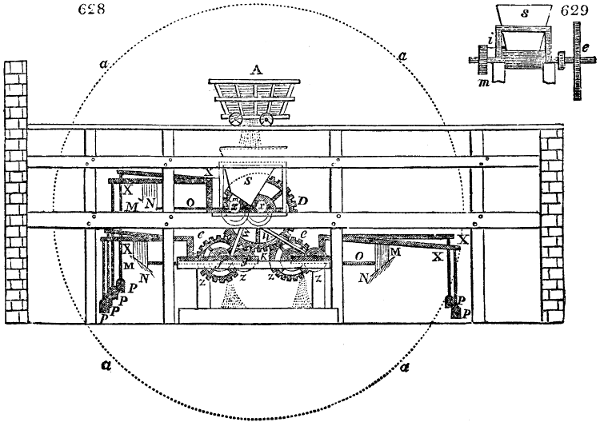
Figs. 628, 629 enlarged (149 kB)
This machine is composed of one pair of fluted cylinders, x x, fig. 628., and of two pairs of smooth cylinders z z, z z, which serve altogether for crushing the ore. The two cylinders of each of the three pairs turn simultaneously in an inverse direction, by means of two toothed wheels, as at m, fig. 629., upon the shaft of every cylinder, which work by pairs in one another. The motion is given by a single water wheel, of which the circle a a a represents the outer circumference. One of the fluted cylinders is placed in the prolongation of the shaft of this wheel, which carries besides a cast-iron toothed wheel, geered with the toothed wheels e e, fixed upon the ends of two of the smooth cylinders. Above the fluted cylinders, there is a hopper, which discharges down between them, by means of a particular mechanism, the ore brought forward by the waggons A. These waggons advance upon a railway, stop above the hopper, and empty their contents into it through a trap-hole, which opens outwardly in the middle of their bottom. Below the hopper there is a small bucket called a shoe, into which the ore is shaken down, and which throws it without ceasing upon the cylinders, in consequence of the constant jolts given it by a crank-rod i (fig. 629.) attached to it, and moved by the teeth of the wheel m. The shoe is so regulated, that too much ore can never fall upon the cylinders, and obstruct their movement. A small stream of water is likewise led into the shoe, which spreads over the cylinders, and prevents them from growing hot. The ore, after passing between the fluted rollers, falls upon the inclined planes N, N, which turn it over to one or other of the pairs of smooth rolls.
These are the essential parts of this machine; they are made of iron, and the smooth ones are case-hardened, or chilled, by being cast in iron moulds. The gudgeons of both kinds move in brass bushes fixed upon iron supports k, made fast by bolts to the strong wood-work basis of the whole machine. Each of the horizontal bars has an oblong slot, at one of whose ends is solidly fixed one of the plummer-blocks or bearers of one of the cylinders f, and in the rest of the slot the plummer-block of the other cylinder g slides; a construction which permits the two cylinders to come into contact, or to recede to such a distance from each other, as circumstances may require. The movable cylinder is approximated to the fixed one by means of the iron levers X X, which carry at their ends the weights P, and rest upon wedges M, which may be slidden upon the inclined plane N. These wedges then press the iron bar O, and make it approach the movable cylinder by advancing the plummer-block which supports its axis. When matters are so arranged, should a very large or hard piece present itself to one of the pairs of cylinders, one of the rollers would move away, and let the piece pass without doing injury to the mechanism.
Besides the three pairs of cylinders which constitute essentially each crushing machine, there is sometimes a fourth, which serves to crush the ore when not in large fragments, for example, the chats and cuttings (the moderately rich and poorer pieces), produced by the first sifting with the brake sieve, to be presently described. The cylinders composing that accessory piece, which, on account of their ordinary use, are called chats-rollers, are smooth, and similar to the rollers z z, and z z. The one of them is usually placed upon the prolongation of the shaft of the water-wheel, of the side opposite to the principal machine; and the other, which is placed alongside, receives its motion from the first, by means of toothed wheel-work.
The stamp mill is employed in concurrence with the crushing cylinders. It serves particularly to pulverize those ores whose gangue is too hard to yield readily to the rollers, and also those which being already pulverized to a certain degree, require to be ground still more finely. The stamps employed in the neighbourhood of Alston Moor are moved by water wheels. They are similar to those described under Tin.
Proper sifting or jigging apparatus.—The hand sieve made of iron wire meshes, of various sizes, is shaken with the two hands in a tub of water, the ore vat, being held sometimes horizontally, and at others in an inclined position. This sieve is now in general use only for the cuttings that have passed through the grating, and which though not poor enough to require finer grinding, are too poor for the brake sieve. When the workman has collected a sufficient quantity of these smaller pieces, he puts them in his round hand sieve, shakes it in the ore vat with much rapidity and a dexterous toss, till he has separated the very poor portions called cuttings, from the mingled parts called chats, as well as from the pure ore. He then removes the first two qualities, with a sheet-iron scraper called a limp, and he finds beneath them, a certain portion of ore which he reckons to be pure.
The brake sieve is rectangular, as well as the cistern in which it is agitated. The meshes are made of strong iron wire, three-eighths of an inch square. This sieve is suspended at the extremity of a forked lever, or brake, turning upon an axis by means of two upright arms about 5 feet long, which are pierced with holes for connecting them with bolts or pins, both to the sieve-frame and to the ends of the two branches of the lever. These two arms are made of wrought iron, but the lever is made of wood; as it receives the jolt. A child placed near its end, by the action of leaping, jerks it smartly up and down, so as to shake effectually the sieve suspended at the other extremity. Each jolt not only makes the fine parts pass through the meshes, but changes the relative position of those which remain on the wires, bringing the purer and heavier pieces eventually to the bottom. The mingled fragments of galena, and the stony substances called chats lie above them; while the poor and light pieces called cuttings, are at top. These are first scraped off by the limp, next the mixed lumps, or chats, and lastly the pure ore, which is carried to the bing heap. The cuttings are handed to a particular class of workmen, who by a new sifting, divide them into mere stones, or second cuttings, and into mixed ore analogous to chats.
The poor ore, called chats, is carried to a crushing machine, where it is bruised between two cylinders appropriated to this purpose under the name of chats rollers; after which it is sifted afresh. During the sifting many parcels of small ore and stony substances pass through the sieve, and accumulate at the bottom of the cistern. When it is two-thirds filled, water is run slowly over it, and the sediment called smitham is taken out, and piled up in heaps. More being put into the tub, a child lifts up the smitham, and lays it on the sieve, which retains still on its meshes the layer of fine ore. The sifter now agitates in the water nearly as at first, from time to time removing with the limp the lighter matters as they come to the surface; which being fit for washing only in boxes, are called buddler’s offal, and and are thrown into the buddle hole.
Mr. Petherick, the manager of Lanescot and the Fowey Consol mines, has contrived an ingenious jigging machine, in which a series of 8 sieves are fixed in a stationary circular frame, connected with a plunger or piston working in a hollow cylinder, whereby a body of water is alternately forced up through the crushed ore in the sieves, and then left to descend. In this way of operating, the indiscriminate or premature passage of the finer pulverulent matter through the meshes is avoided, because a regulated stream of water is made to traverse the particles up and down. This mode has proved profitable in washing the copper ores of the above mentioned copper mines.
Proper washing apparatus.—For washing the ore after sifting it, the running buddle already described is employed, along with several chests or buddles of other kinds.
1. The trunk buddle is a species of German chest (see Metallurgy and Tin) composed of two parts; of a cistern or box into which a stream of water flows, and of a large tank with a smooth level bottom. The ore to be trunked being placed in the box, the workman furnished with a shovel bent up at its sides, agitates it, and removes from time to time the coarser portions; while the smaller are swept off by the water and deposited upon the level area.
2. The stirring buddle, or chest for freeing the schlamms or slimy stuff from clay, is analogous to the German chests, and consists of two parts; namely, 1. a trough which receives a stream of water through a plug hole, which is tempered at pleasure, to admit a greater or less current; 2. a settling tank with a horizontal bottom. The metallic slime being first floated in the water of the trough, then flows out and is deposited in the tank; the purest parts falling first near the beginning of the run.
3. The nicking buddle is analogous to the tables called dormantes or jumelles by the French miners. See Metallurgy. They have at their upper end a cross canal or spout, equal in length to the breadth of the table, with a plug hole in its middle for admitting the water. Alongside of this channel there is a slightly inclined plank, called nicking board, corresponding to the head of the twin table, and there is a nearly level plane below. The operation consists in spreading a thin layer of the slime upon the nicking board, and in running over its surface a slender sheet of water, which in its progress is subdivided into rills, which gradually carry off the muddy matters, and strew them over the lower flat surface of the tank, in the order of their density.
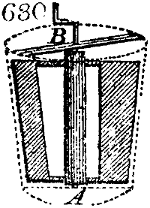
4. The dolly tub or rinsing bucket, fig. 630., has an upright shaft, which bears the vane or dolly A B, turned by the winch handle. This apparatus serves to bring into a state of suspension in water, the fine ore, already nearly pure; the separation of the metallic particles from the earthy ones by repose, being promoted by the sides of the tub being struck frequently during the subsidence.
5. Slime pits.—In the several operations of cleansing ores from mud, in grinding, and washing, where a stream of water is used, it is impossible to prevent some of the finely attenuated portions of the galena called sludge, floating in the water, from being carried off with it. Slime pits or labyrinths, called buddle holes in Derbyshire, are employed to collect that matter, by receiving the water to settle, at a little distance from the place of agitation.
These basins or reservoirs are about 20 feet in diameter, and from 24 to 40 inches deep. Here the suspended ore is deposited, and nothing but clear water is allowed to escape.
The workmen employed in the mechanical preparation of the ores, are paid, in Cumberland, by the piece, and not by day’s wages. A certain quantity of crude ore is delivered to them, and their work is valued by the bing, a measure containing 14 cwt. of ore ready for smelting. The price varies according to the richness of the ore. Certain qualities are washed at the rate of two and sixpence, or three shillings the bing; while others are worth at least ten shillings. The richness of the ore varies from 2 to 20 bings of galena per shift of ore; the shift corresponding to 8 waggons load.
1. The cleansing and sorting of the ores are well performed in Cumberland. These operations seem however to be inferior to the cleansing on the grid steps, grilles à gradin, of Saxony (see Metallurgy), an apparatus which in cleaning the ores, has the advantage of grouping them in lots of different qualities and dimensions.
2. The breaking or bruising by means of the crushing machine, is much more expeditious than the Derbyshire process by buckers; for the machine introduces not only great economy into the breaking operation, but it likewise diminishes considerably the loss of galena; for stamped ores may be often subjected to the action of the cylinders without waste, while a portion of them would have been lost with the water that runs from the stamp mill. The use of these rollers may therefore be considered as one of the happiest innovations hitherto made in the mechanical preparation of ores.
3. The brake sieves appear to be preferable to the hand ones.
4. The system of washing used in Cumberland differs essentially from that of Brittany. The slime pits are constructed with much less care than in France and Germany. They never present, as in these countries, those long windings backwards and forwards, whence they have been called labyrinths; probably because the last deposits, which are washed with profit in France and Germany, could not be so in Cumberland. There is reason to believe, however, that the introduction of brake tables, (tables à secousses, see Metallurgy) would enable deposits to be saved, which at present run to waste in England.
5. From what we have now said about the system of washing, and the basins of deposit or settling cisterns, it may be inferred that the operation followed in Cumberland is more expeditious than that used in Brittany, but it furnishes less pure ores, and occasions more considerable waste; a fact sufficiently obvious, since the refuse stuff at Poullaouen is often resumed, and profitably subjected to a new preparation. We cannot however venture to blame this method, because in England, fuel being cheap, and labour dear, there may possibly be more advantage in smelting an ore somewhat impure, and in losing a little galena, than in multiplying the number of washing processes.
6. Lastly, the dolly tub ought to be adopted in all the establishments where the galena is mixed with much blende (sulphuret of zinc); for schlich (metallic slime) which appears very clean to the eye, gives off a considerable quantity of blende by means of the dolly tub. While the vane is rapidly whirled, the sludge is gradually let down into the revolving water, till the quantity is sufficiently great. Whenever the ore is thoroughly disseminated in the liquid, the dolly is withdrawn. The workmen then strike on the sides of the tub for a considerable time, with mallets or wooden billets, to make the slime fall fast to the bottom. The lighter portions, consisting almost entirely of refuse matter, fall only after the knocking has ceased; the water is now run away; then the very poor slime upon the top of the deposit is skimmed off; while the pure ore found at the bottom of the tub is lifted out, and laid on the bingstead. In this way the blende, which always accompanies galena in a greater or smaller quantity, is well separated.
Smelting of lead ores.—The lead ores of Derbyshire and the north of England were antiently smelted in very rude furnaces, or boles, urged by the natural force of the wind, and were therefore placed on the summits or western slopes of the highest hills. More recently these furnaces were replaced by blast hearths, resembling smith’s forges, but larger; and were blown by strong bellows, moved by men or water-wheels. The principal operation of smelting is at present always executed in Derbyshire in reverberatory furnaces, and at Alston Moor in furnaces similar to those known in France by the name of Scotch furnaces. Before entering into the detail of the founding processes, we shall give a description of the furnaces essential for both the smelting and accessory Operations.
1. The reverberatory furnace called cupola, now exclusively used in Derbyshire for the smelting of lead ores, was imported thither from Wales, about the year 1747, by a company of Quakers. The first establishment in this county was built at Kalstedge, in the district of Ashover.
In the works where the construction of these furnaces is most improved, they are interiorly 8 feet long by 6 wide in the middle, and two feet high at the centre. The fire, placed at one of the extremities, is separated from the body of the furnace by a body of masonry, called the fire-bridge, which is two feet thick, leaving only from 14 to 18 inches between its upper surface and the vault. From this, the highest point, the vault gradually sinks towards the further end, where it stands only 6 inches above the sole. At this extremity of the furnace, there are two openings separated by a triangular prism of fire-stone, which lead to a flue, a foot and a half wide, and 10 feet long, which is recurved towards the top, and runs into an upright chimney 55 feet high. The above flue is covered with stone slabs, carefully jointed with fire-clay, which may be removed when the deposit formed under them (which is apt to melt), requires to be cleaned out. One of the sides of the furnace is called the labourers’ side. It has a door for throwing coal upon the fire-grate, besides three small apertures each about 6 inches square. These are closed with movable plates of cast iron, which are taken off when the working requires a freer circulation of air, or for the stirring up of the materials upon the hearth. On the opposite side, called the working side, there are five apertures; namely, three equal and opposite to those just described, shutting in like manner with cast iron plates, and beneath them two other openings, one of which is for running out the lead, and another for the scoriæ. The ash pit is also on this side, covered with a little water, and so disposed as that the grate-bars may be easily cleared from the cinder slag.
The hearth of the furnace is composed of the reverberatory furnace slags, to which a proper shape has been given by beating them with a strong iron rake, before their entire solidification. On the labourers’ side, this hearth rises nearly to the surface of the three openings, and falls towards the working side, so as to be 18 inches below the middle aperture. In this point, the lowest of the furnace, there is a tap-hole, through which the lead is run off into a large iron boiler (lea-pan), placed in a recess left outside in the masonry. From that lowest point, the sole gradually rises in all directions, forming thus an inside basin, into which the lead runs down as it is smelted. At the usual level of the metal bath, there is on the working side, at the end furthest from the fire, an aperture for letting off the slag.
In the middle of the arched roof there is a small aperture, called the crown-hole, which is covered up during the working with a thick cast iron plate. Above this aperture a large wooden or iron hopper stands, leading beneath into an iron cylinder, through which the contents of the hopper may fall into the furnace when a trap or valve is opened.
2. The roasting furnace.—This was introduced about 30 years ago, in the neighbourhood of Alston Moor, for roasting the ore intended to pass through the Scotch furnace, a process which greatly facilitates that operation. Since its first establishment it has successively received considerable improvements.
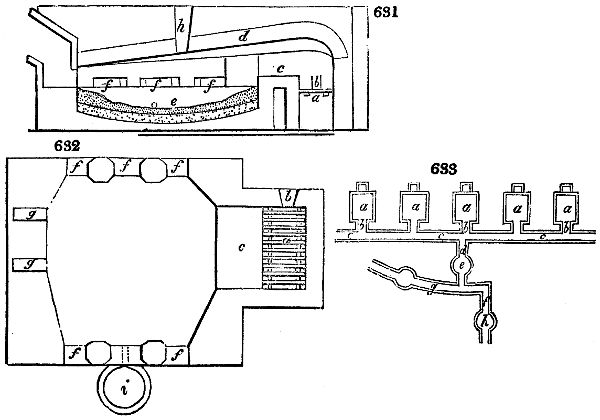
Figs. 631, 632, 633., represent the cupola furnace at the Marquess of Westminster’s lead smelting works, two miles from Holywell. The hearth is hollowed out below the middle door of the furnace; it slopes from the back and ends towards this basin. The distance from the lowest point of this concavity up to the sill of the door, is usually 24 inches, but it is sometimes a little less, according to the quality of the ores to be smelted. This furnace has no hole for running off the slag, above the level of the top hole for the lead i, like the smelting furnace of Lea, near Matlock. A single chimney stalk serves for all the establishments; and receives all the flues of the various roasting and reducing furnaces. Fig. 633. gives an idea of the distribution of these flues. a a a, &c. are the furnaces; b, the flues, 18 inches square; these lead from each furnace to the principal conduit c, which is 5 feet deep by 21⁄2 wide; d is 6 feet deep by 3 wide; e is a round chamber 15 feet in diameter; f is a conduit 7 feet high by 5 wide; g another, 6 feet high by 3 wide. The chimney at h has a diameter at bottom of 30 feet, at top of 12 feet, including the thickness of its sides, forming a truncated cone 100 feet high; whose base stands upon a hill a little way from the furnaces, and 62 feet above their level.
a, figs. 631, 632., is the grate; b, the door of the fire-place; c, the fire-bridge; d, the arched roof; e, the hearth; f f f, &c., the working doors; g g, flues running into one conduit, which leads to the subterranean condensing chamber, e, and thence to the general chimney; h, a hopper-shaped opening in the top of the furnace, for supplying it with materials.
This magnificent structure is not destined solely for the reduction of the ores, but for dissipating all the vapours which might prove noxious to the health of the work-people and to vegetation.
The ores smelted at Holywell are very refractory galenas, mixed with blende, calamine, pyrites, carbonate of lime, &c., but without any fluate of lime. They serve mutually as fluxes to one another. The coal is of inferior quality. The sole of each furnace is formed of slags obtained in the smelting, and they are all of one kind. In constructing it, 7 or 8 tons of these slags are first of all thrown upon the brick area of the hearth; are made to melt by a brisk fire, and in their stiffening state, as they cool, they permit the bottom to be sloped and hollowed into the desired shape. Four workmen, two at each side of the furnace, perform this task.
The ordinary charge of ore for one smelting operation is 20 cwt., and it is introduced through the hopper; see Copper, fig. 304. An assistant placed at the back doors spreads it equally over the whole hearth with a rake; the furnace being meanwhile heated only with the declining fire of a preceding operation. No regular fire is made during the first two hours, but a gentle heat merely is kept up by throwing one or two shovelfuls of small coal upon the grate from time to time. All the doors are closed, and the register-plate of the chimney is lowered.
The outer basin in front of the furnace is at this time filled with the lead derived from a former process, the metal being covered with slags. A rectangular slit above the tap hole is left open, and remains so during the whole time of the operation, unless the lead should rise in the interior basin above the level of that orifice; in which case a little mound must be raised before it.
The two doors in front furthest from the fire being soon opened, the head-smelter throws in through them, upon the sole of the furnace, the slags swimming upon the bath of lead, and a little while afterwards he opens the tap-hole, and runs off the metallic lead reduced from these slags. At the same time his assistant turns over the ore with his paddle, through the back doors. These being again closed, while the above two front doors are open, the smelter throws a shovelful of small coal or coak cinder upon the lead bath, and works the whole together, turning over the ore with the paddle or iron oar. About three quarters of an hour after the commencement of the operation, he throws back upon the sole of the hearth the fresh slags which then float upon the bath of the outer basin, and which are mixed with coaly matter. He next turns over these slags, as well as the ore with the paddle, and shuts all the doors. At this time the smelter runs off the lead into the pig-moulds.
The assistant now turns over the ore once more through the back doors. A little more than an hour after the operation began, a quantity of lead proceeding from the slag last remelted, is run off by the tap; being usually in such quantity as to fill one half of the outer basin. Both the workmen then turn over the ore with the paddles, at the several doors of the furnace. Its interior is at this time of a dull red heat; the roasting being carried on rather by the combustion of the sulphurous ingredients, than by the action of the small quantity of coal in the grate. The smelter, after shutting the front doors, with the exception of that next the fire-bridge, lifts off the fresh slags lying upon the surface of the outside bath, drains them, and throws them back into the furnace.
An hour and a half after the commencement, the lead begins to ooze out in small quantities from the ore; but little should be suffered to flow before two hours have expired. About this time the two workmen open all the doors, and turn over the ore, each at his own side of the furnace. An hour and three quarters after the beginning, there are few vapours in the furnace, its temperature being very moderate. No more lead is then seen to flow upon the sloping hearth. A little coal being thrown into the grate to raise the heat slightly, the workmen turn over the ore, and then close all the doors.
At the end of two hours, the first fire or roasting being completed, and the doors shut, the register is to be lifted a little, and coal thrown upon the grate to give the second fire, which lasts during 25 minutes. When the doors are now opened, the inside of the furnace is of a pretty vivid red, and the lead flows down from every side towards the inner basin. The smelter with his rake or paddle pushes the slags upon that basin back towards the upper part of the sole, and his assistant spreads them uniformly over the surface through the back doors. The smelter next throws in by his middle door, a few shovelfuls of quicklime upon the lead bath. The assistant meanwhile, for a quarter of an hour, works the ore and the slags together through the three back doors, and then spreads them out, while the smelter pushes the slags from the surface of the inner basin back to the upper parts of the sole. The doors being now left open for a little, while the interior remains in repose, the metallic lead, which had been pushed back with the slags, flows down into the basin. This occasional cooling of the furnace is thought to be necessary for the better separation of the products, especially of the slags from the lead bath.
In a short time the workmen resume their rakes, and turn over the slags along with the ore. Three hours after the commencement, a little more fuel is put into the grate, merely to keep up a moderate heat of the furnace during the paddling. After three hours and ten minutes, the grate being charged with fuel for the third fire, the register is completely opened, the doors are all shut, and the furnace is left in this state for three quarters of an hour. In nearly four hours from the commencement, all the doors being opened, the assistant levels the surfaces with his rake, in order to favour the descent of any drops of lead; and then spreads the slags, which are pushed back towards him by the smelter. The latter now throws in a fresh quantity of lime, with the view not merely of covering the lead bath and preventing its oxidizement, but of rendering the slags less fluid.
Ten minutes after the third fire is completed, the smelter puts a new charge of fuel in the grate, and shuts the doors of the furnace to give it the fourth fire. In four hours and forty minutes from the commencement, this fire being finished, the doors are opened, the smelter pierces the tap-hole to discharge the lead into the outer basin, and throws some quicklime upon the slags in the inner basin. He then pushes the slags thus dried up towards the upper part of the hearth, and his assistant rakes them out by the back doors.
The whole operation of a smelting shift takes about four hours and a half, or at most five hours, in which four periods may be distinguished.
1. The first fire for roasting the ores, requires very moderate firing, and lasts two hours.
2. The second fire, or the smelting, requires a higher heat, with shut doors; at the end the slags are dried up with lime, and the furnace is also allowed to cool a little.
3, 4. The last two periods, or the third and fourth fires, are likewise two smeltings or foundings, and differ from the first only in requiring a higher temperature. The heat is greatest in the last. The form and dimensions of the furnace are calculated to cause a uniform distribution of heat over the whole surface of the hearth. Sometimes billets of green wood are plunged into the metallic lead of the outer basin, causing an ebullition which favours the separation of the slags, and consequently the production of a purer lead; but no more metallic metal is obtained.
Ten cwts. of coal are consumed at Holywell in smelting one ton of the lead-ore schlich or sludge; but at Grassington, near Skipton in Yorkshire, with a similar furnace worked with a slower heat, the operation taking from seven hours to seven hours and a half, instead of five, only 71⁄2 cwts. of coal are consumed. But here the ores are less refractory, have the benefit of fluor spar as a flux, and are more exhausted of their metal, being smelted upon a less sloping hearth.
Theory of the above operations.—At Holywell, Grassington, and in Cornwall, the result of the first graduated roasting heat, is a mixture of undecomposed sulphuret of lead, with sulphate and oxide of lead, in proportions which vary with the degree of care bestowed upon the process. After the roasting, the heat is raised to convert the sludge into a pasty mass; in which the oxide and sulphate re-act upon the sulphuret, so as to produce a sub-sulphuret, which parts with the metal by liquation. The cooling of the furnace facilitates the liquation every time that the sub-sulphuret is formed, and the ore has passed by increase of temperature from the pasty into the liquid state. Cooling brings back the sludge to the pasty condition, and is therefore necessary for the due separation of the different bodies. The drying up of the thin slags by lime is intended to liberate the oxide of lead, and allow it to re-act upon any sulphuret which may have resisted roasting or decomposition. It is also useful as a thickener, in a mechanical point of view. The iron of the tools, which wear away very fast, is also serviceable in reducing the sulphuret of lead. The small coal added along with the lime at Grassington, and also sometimes at Holywell, aids in reducing the oxide of lead, and in transforming the sulphate into sulphuret.
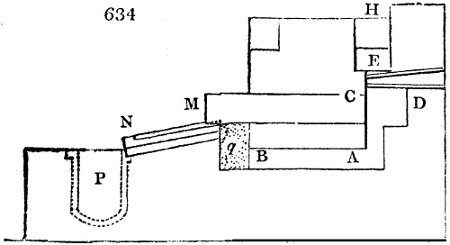
3. The smelting furnace or ore hearth.—This furnace, called by the French écossais, is from 22 to 24 inches in height and 1 foot by 11⁄2 in area inside; but its horizontal section, always rectangular, varies much in its dimensions at different levels, as shown in fig. 634.
The hearth and the sides are of cast iron; the sole-plate A B is also of cast iron, 21⁄2 inches thick, having on its back and two sides an upright ledge, A C, 21⁄2 inches thick, and 41⁄4 high. In front of the hearth there is another cast iron plate M N, called the work-stone, surrounded on every side excepting towards the sole of the furnace, by a ledge one inch in thickness and height. The plate slopes from behind forwards, and its posterior ledge, which is about 41⁄2 inches above the surface of the hearth, is separated from it by a void space q, which is filled with a mixture of bone ash and galena, both in fine powder, moistened and pressed down together. The melted lead cannot penetrate into this body, but after filling the basin at the bottom of the furnace, flows naturally out by the gutter (nearly an inch deep) through a groove in the work-stone; and then passes into a cauldron of reception P, styled the melting-pot, placed below the front edge of the work-stone.
The posterior ledge of the sole is surmounted by a piece of cast iron C D, called the back-stone, 28 inches long, and 61⁄2 high; on which the tuyère or blast-pipe is placed. It supports another piece of cast iron E, called pipe-stone, scooped out at its under part, in the middle of its length, for the passage of the tuyère. This piece advances 2 inches into the interior of the furnace, the back wall of which is finally crowned by another piece of cast iron E H, called also back-stone.
On the ledges of the two sides of the sole, are placed two pieces of cast iron, called bearers, each of which is 5 inches in breadth and height, and 26 inches long. They advance an inch or two above the posterior and highest edge of the work-stone, and contribute effectually to fix it solidly in its place. These bearers support, through the intervention of several ranges of fire-bricks, a piece of cast iron called a fore-stone, which has the same dimensions as the piece called the back-stone, on which the base of the blowing-machine rests. This piece is in contact, at each of its extremities, with another mass of cast iron, 6 inches cube, called the key-stone, supported on the masonry. Lastly, the void spaces left between the two key-stones and the back part of the furnace are filled up with two masses of cast iron exactly like the key-stones.
The front of the furnace is open for about 12 inches from the lower part of the front cross-piece called fore-stone, up to the superior part of the work-stone. It is through this opening that the smelter operates.
The gaseous products of the combustion, on escaping from this ore-hearth, are frequently made to pass through a long flue, sloped very slightly upwards, in which they deposit all the particles of ore that they may have swept along; these flues, whose length is sometimes more than 100 yards, are usually 5 feet high and 3 feet wide in the inside, and always terminate in a chimney stalk. The matters deposited near the commencement of the flue require to be washed; but not the other dusty deposits. The whole may then be carried back to the roasting furnace, to be calcined and re-agglutinated, or introduced without any preparation into the slag-hearth.
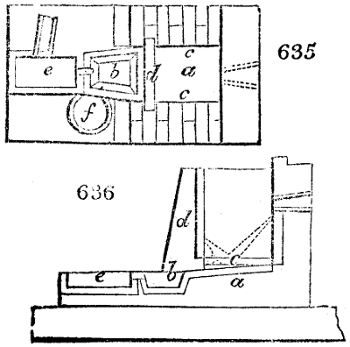
4. Figs. 635, 636. represent a slag-hearth, the fourneau à manche (elbow furnace) of the French, and the krummofen (crooked furnace) of the Germans; such as is used at Alston Moor, in Cumberland, for the reduction of the lead-slag. It resembles the Scotch furnace. The shaft is a parallelopiped, whose base is 26 inches by 22 in area inside, and whose height is 3 feet; the sole-plate a, of cast iron, slopes slightly down to the basin of reception, or the fore-hearth b. Upon both of the long sides of the sole-plate there are cast iron beams, called bearers C C, of great strength, which support the side walls built of a coarse grained sand-stone, as well as the cast-iron plate d (fore-stone), which forms the front of the shaft. This stands 7 inches off from the sole-plate, leaving an empty space between them. The back side is made of cast iron, from the sole-plate to the horizontal tuyère in its middle; but above this point it is made of sand-stone. The tuyère is from 11⁄5 to 2 inches in diameter. In front of the fore-hearth b, a cistern e, is placed, through which water continually flows, so that the slags which spontaneously overflow the fore-hearth may become inflated and shattered, whereby the lead disseminated through them may be readily separated by washing. The lead itself flows from the fore-hearth b, through an orifice, into an iron pot f, which is kept hot over a fire. The metal obtained from this slag-hearth is much less pure than that extracted directly from the ore.
The whole bottom of the furnace is filled to a height of 17 inches, that is, to within 2 or 3 inches of the tuyère, with the rubbish of coke reduced to coarse powder and beat strongly down. At each smelting shift, this bed must be made anew, and the interior of the furnace above the tuyère repaired, with the exception of the front, consisting of cast iron. In advance of the furnace there is a basin of reception, which is also filled with coke rubbish. Farther off is a pit, full of water, replenished by a cold stream, which incessantly runs in through a pipe. The scoriæ, in flowing out of the furnace, pass over the coke bed in the basin of reception, and then fall into the water, whose coolness makes them fly into small pieces, after which they are easily washed, so as to separate the lead that may be entangled among them.
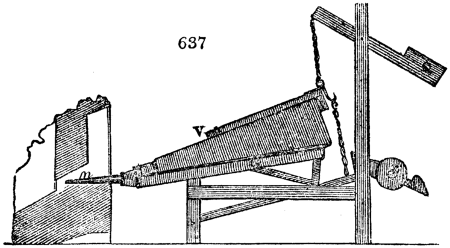
These furnaces are urged, in general, by wooden bellows; fig. 637. But at the smelting works of Lea, near Matlock, the blowing-machine consists of two casks, which move upon horizontal axes. Each of these casks is divided into two equal parts by a fixed plane that passes through its axis, and is filled with water to a certain height. The water of one side communicates with that of the other by an opening in the lower part of the division. Each cask possesses a movement of oscillation, produced by a rod attached to a crank of a bucket-wheel. At each demi-oscillation, one of the compartments, being in communication with the external air, is filled; whilst the other, on the contrary, communicates with the nozzle, and supplies wind to the furnace.
5. Refining or cupellation furnace. See Silver.
6. Smelting by the reverberatory furnace, is adopted exclusively in Derbyshire, and in some works at Alston-moor. The charge in the hopper consists commonly of 16 cwt., each weighing 120 lbs. avoirdupois, composed of an intimate mixture of 5, 6, 7 or even 8 kinds of ore, derived from different mines, and prepared in different ways. The proportions of the mixture are determined by experience, and are of great consequence to the success of the work.
The ore is rather in the form of grains than of a fine schlich; it is sometimes very pure, and affords 75 per cent.; but usually it is mixed up with a large proportion of carbonate and fluate of lime; and its product varies from 65 to 23 per cent.
After scraping the slaggy matters out of the furnace, a fresh smelting shift is introduced at an interval of a few minutes; and thus, by means of two alternate workmen, who relieve each other every seven or eight hours, the weekly operations continue without interruption. The average product in lead of the reverberatory furnaces in Derbyshire, during several years, has been 66 per cent. of the ore. Very fine ore has, however, afforded 76.
7. Smelting of the drawn slag, on the slag-mill hearth.—The black slag of the reverberatory furnace is broken by hammers into small pieces, and mixed in proper proportions with the coal cinders that fall through the grate of the reverberatory fire. The leaden matts that float on the surface of the bath, and the dust deposited in the chimney, are added, along with some poor ore containing a gangue of fluor spar and limestone, which had been put aside during the mechanical preparation. With such a mixture, the slag-hearth, already described, figs. 635, 636., is charged. By the action of heat and coal, the lead is revived, the earthy matters flow into very liquid scoriæ, and the whole is made to pass across the body of fire into a basin of reception placed beneath. The scoriæ are thickened by throwing quicklime upon them, and they are then raked away. At the end of the operation the lead is cast into pigs or ingots of a peculiar form. This is called slag-lead. It is harder, more sonorous than the lead obtained from the reverberatory furnace, and is preferred for the manufacture of minium, lead shot, and some other purposes.
8. Treatment of lead ores by the Scotch furnace, or ore-hearth.—This furnace is generally employed in the counties of Northumberland, Cumberland, and Durham, for the smelting of lead ores, which were formerly carried to them without any preparation, but now they are exposed to a preliminary calcination. The roasted ore yields in the Scotch furnace a more considerable product than the crude ore, because it forms in the furnace a more porous mass, and at the same time it works drier, to use the founders’ expression; that is, it allows the stream of air impelled by the bellows to diffuse itself more completely across the matters contained in the furnace.
The charge of the roasting furnace, figs. 631, 632, 633., is from 9 to 11 cwt. of ore, put into the furnace without any addition. Three such shifts are usually passed through in eight hours. The fire should be urged in such a manner as to produce constantly a dense smoke, without letting any part of the ore melt and form a slag; an accident which would obstruct the principal end of the process, which is to burn off the sulphur and antimony, and to expel the carbonic acid of the carbonate of lead. The ore must be frequently turned over, by moving it from the bridge to the other end and back again. To prevent the ore from running into masses as it cools, it is made to fall out of the furnace into a pit full of water, placed below one of the lateral doors.
Smelting of the lead ores in the Scotch furnace.—When a smelting shift has been finished in the Scotch furnace, a portion of the ore, called browse, remains in a semi-reduced state, mixed with coke and cinders. It is found of more advantage to preserve the browse for beginning the following operation, than to take raw or even roasted ore. To set the furnace in action, the interior of it is filled with peats, cut into the form of bricks. The peats towards the posterior part are heaped up without order, but those near the front are piled up with care in the form of a wall. A kindled peat is now placed before the nozzle of the bellows, which are made to blow, and the blast spreads the combustion rapidly through the whole mass. To increase the heat, and to render the fire more steady and durable, a few shovelfuls of coals are thrown over the turf. A certain quantity of the browse is to be next introduced; and then (or sometimes before all the browse is put in) the greater part of the matters contained in the furnace is drawn over on the work-stone, by means of a large rake called a gowelock; the refuse of the ore called gray slag, which a skilful smelter knows by its shining more than the browse, is taken off with a shovel, and thrown to the right hand into a corner outside of the furnace. The browse left on the work-stone is to be now thrown back into the furnace, with the addition of a little coal, if necessary. If the browse be not well cleaned from the slag, which is perceived by the whole mass being in a soft state, and shewing a tendency to fuse, quicklime must be added, which by its affinity for the argillaceous, siliceous, and ferruginous substances, dries up the materials, as the smelters say, and gives to the earthy parts the property of concreting into lumps or balls; but if, on the other hand, the siliceous, argillaceous, or ferruginous parts contained in the ore be too refractory, lime is also to be added, but in smaller quantity, which, by rendering them more fusible, communicates the property of concreting into balls. These lumps, called gray slag, contain from one-tenth to one-fifteenth of the lead which was present in the ore. They must be smelted afterwards at a higher temperature in the slag hearth, to extract their lead. After the browse has been thrown back into the furnace, as has been said, a few shovelfuls of ore are to be strewed over it; but before doing this, and after removing the scoriæ, there must be always placed before the tuyère half a peat, a substance which, being extremely porous and combustible, not only hinders any thing from entering the nozzle of the bellows, but spreads the blast through all the vacant parts of the furnace. After an interval of from 10 to 15 minutes, according to circumstances, the materials in the furnace are drawn afresh upon the work-stone, and the gray slag is removed by the rake. Another peat being placed before the tuyère, and coal and quicklime being introduced in suitable proportions, the browse is thrown back into the furnace, a fresh portion of ore is charged above it, and left in the furnace for the above mentioned time.
This mode of working, continued for 14 or 15 hours, forms what is called a smelting shift; in which time from 20 to 40 cwt. of lead, and even more, are produced.
By this process the purest part of the lead, as well as the silver, are sweated out, as it were, from the materials, with which they are mixed, without any thing entering into fusion except these two metals in the state of alloy. It is probable that the moderate temperature employed in the Scotch furnace is the main cause of the purity of the lead which it yields.
9. Smelting of the scoriæ of the Scotch furnace on the slag hearth.—Before putting fire to the slag hearth already described, figs. 635, 636., its empty space is to be filled with peats, and a lighted one being placed before the tuyère, the bellows are made to play. A layer of coke is to be now thrown upon the burning peats, and as soon as the heat is sufficiently high, a layer of the gray slag is to be introduced, or of any other scoriæ that are to be reduced. From time to time, as the fit moment arrives, alternate strata of coke and slag are to be added. In this operation, though the slag and the lead are brought to a state of perfect fluidity; the metal gets separated by filtering down through the bed of peat cinders, which the slag cannot do on account of its viscidity. Whenever that coke bed becomes covered with fluid slag, the workman makes a hole in it, of about an inch diameter, by means of a kneed poker; and runs it off by this orifice, as it cannot sink down into the hard rammed cinders, which fill the basin of reception. The slag flows over it in a glowing stream into the pit filled with water, where it gets granulated and ready for washing.
When lead is obtained from galena without the addition of combustible matter, we have an example on the great scale, of the mutual decomposition of the oxides and sulphates formed during the roasting heat, by the still undecomposed galena, especially when this action is facilitated by working up and skilfully mingling the various matters, as happens in the reverberatory and Scotch furnaces. It is therefore the sulphuret of lead itself which serves as the agent of reduction in regard to the oxide and sulphate, when little or no charcoal has been added. Sometimes, however, towards the end of the operation in the reverberatory hearth, it becomes necessary to throw in some wood or charcoal, because the oxidizement having become too complete, there does not remain a sufficient body of sulphuret of lead to effect the decompositions and reductions just mentioned, and therefore it is requisite to regenerate some galena by means of carbonaceous matter, which immediately converts the sulphate of lead into the sulphuret. The sulphur and oxygen are eventually all separated in the form of sulphurous acid. Roasted galena contains sometimes no less than 77 per cent. of sulphate of lead.
At Viconago in the Valais, the process of smelting lead ore in the reverberatory furnace with the addition of iron, as practised at Vienne on the Isère, was introduced; but the difficulty of procuring a sufficient supply of old iron has led to an interesting modification.
On the hearth of the reverberatory furnace, 10 quintals of moderately rich ore are spread; these are heated temperately for some time, and stirred about to promote the sublimation of the sulphur. After three or four hours, when the ore seems to be sufficiently de-sulphuretted, the heat is raised so as to melt the whole materials, and whenever they flux into a metallic glass, a few shovelfuls of bruised charcoal or cinders are thrown in, which soon thicken the liquid, and cause metallic lead to appear. By this means three-fourths of the lead contained in the ore are usually extracted; but at length the substance becoming less and less fluid, yields no more metal. Stamped and washed carbonate of iron (sparry iron ore) is now added, in the proportion of about 10 per cent. of the lead ore primarily introduced.
On stirring and working together this mixture, it assumes the consistence of a stiff paste, which is raked out of the furnace. When this has become cold, it is broken into pieces, and thereafter smelted in a slag-hearth, without the addition of flux. By this operation, almost the whole lead present is obtained. 100 quintals of schlich yield 45 of argentiferous lead; and in the production of 100 quintals (cwts.) of marketable lead, 140 cubic feet of beech-wood, and 3571⁄2 quintals of charcoal are consumed.
This process is remarkable for the use of iron-ore in smelting galena.
10. Reduction in the reverberatory furnace, of the litharge obtained in the refining of lead.—The litharge of Alston Moor is seldom sold as such, but is usually converted into lead, in a reverberatory furnace.
In commencing this reduction, a bed of coal about 2 inches thick is first of all laid on the hearth; which is soon kindled by the flame of the fire-place, and in a little while is reduced to red hot cinders. Upon these a certain quantity of a mixture of litharge and small coal is uniformly spread; the heat of the fire-place being meanwhile so managed as to maintain in the furnace a suitable temperature for enabling the combustible to deprive the litharge of its oxygen, and to convert it into lead. The metal is run out by the tap-hole into an iron pot; and being cast into pigs of half a hundred weight, is sold under the name of refined lead at a superior price.
The quantity of small coal mixed with the litharge, should be somewhat less than what may be necessary to effect the reduction, because if in the course of the process, a deficiency of it is perceived in any part of the furnace, more can always be added; whereas a redundancy of coal necessarily increases the quantity of slag, which, at the end of the shift, must be removed from the furnace before a new operation is begun, whereby lead is lost. In the reverberatory furnace, six fodders of lead may be revived in nine or ten hours; during the first six of which the mixture of litharge and coal is added at short intervals. A fodder is from 21 to 24 cwts.
It deserves to be remarked that the work does not go on so well nor so quick when the coal and litharge are in a pulverulent form; because the reduction in this case takes place only at the surface, the air not being able to penetrate into the body, and to keep up its combustion, and the mutual action of the litharge and carbon in the interior. But on the other hand, when the litharge is in porous pieces as large as a hen’s egg, the action pervades the whole body, and the sooty fumes of the coal effect the reduction even in the centre of the fragments of the litharge, penetrating into every fissure and carrying off the oxygen. The heat ought never to be urged so far as to melt the litharge.
The grounds of the cupel, and the slag of the reduction furnace, being a mixture of small coke, coal ash, and oxide of iron, more or less impregnated with lead, are smelted upon the slag hearth, along with coke, and by way of flux, with a certain quantity of the black scoriæ obtained from the same furnace, prepared for this purpose, by running it out in thin plates, and breaking it into small pieces. The lead thus obtained is usually very white, very hard, and not susceptible of refinement.
MM. Dufrénoy and Beaumont consider the smelting of lead ore by the reverberatory furnace as practised in Derbyshire, as probably preferable to that with the slag hearth as carried on in Brittany; a process which seldom gives uniform products, while it occasions a more considerable waste of lead, and consumption of fuel.
The mixed process employed in Cumberland of roasting the ore, and afterwards smelting it in a small furnace resembling that called the Scotch, apparently yields a little less lead than if both operations were executed in the reverberatory furnace; but according to Mr. Forster, (see his Treatise on a Section of the Strata from Newcastle upon Tyne, &c.) this slight loss is more than compensated by the smaller consumption of fuel, the increased rapidity of the operation, and especially by the much greater purity of the lead obtained from the Scotch furnace. When it comes to be refined, the loss is only about one-twelfth or one-thirteenth, whereas the lead revived in the reverberatory furnace, loses frequently a ninth. Moreover, the lead furnished by the first method admits of being refined with profit, when it yields only 5 ounces of silver per fodder of 20 quintals, poids de marc, while that produced by the reverberatory furnace cannot be cupelled unless it gives 10 ounces per fodder; and as in the English cupellation, lead is constantly added anew without skimming, the litharge obtained in the second case can never be brought into the market, whereas the litharge of the leads from the Scotch furnace is of good quality. See the new method of enriching lead for cupellation, under Silver.
As the smelting of galena, the principal ore of lead, is not a little complex, the following tabular view of the different processes may prove acceptable to the metallurgist:—
Treatment of Process of
I. Class. Treated in reverberatory furnaces. - A De-sulphuration by roasting. - 1. Pure ores - Pesey, Spain, &c.
2. Ores mixed with saline gangues. - England, in general.
3. Ores mixed with earthy gangues. - Viconago in Italy, and Redruth in Cornwall.
4. Ores mixed with several sulphurets. - Combined with the above.
5. Ores with earthy saline, and sulphurous gangues.
B De-sulphuration by iron. - 6. Ores with mattes, as at Vienne, in Dauphiny. - Vienne, Poullaouen, and Tarnowitz.
II. Class. Treated in the mill-slag-hearth, the fourneau à manche, or Scotch furnace. - A Founding after roasting in a heap, or in a reverberatory. - 7. Ores producing slags of various silicates. - Mattes, with raw lead. - Many places.
Workable lead, without mattes. - Villefort.
8. Ores producing compound silicate slags. - Mattes and workable lead. - Several places.
Workable lead. - Pont Gibaud and Scotch furnace.
B Founding with direct desulphuration by metallic iron. - 9. Ores producing slags composed of silicates and subsilicates. - Mattes and workable lead. - Baad-Ems, Hartz, Tarnowitz.
- Poor mattes and workable lead. - Tarnowitz.
The annual production of lead in Europe may be estimated at about 80,000 tons; of which four-sevenths are produced in England, two-sevenths in Spain, the remainder in Germany and Russia. France does not produce more than one five-hundredth part of the whole; and only one-fiftieth of its consumption.
See Litharge, Minium, or Red Lead, Solder, Sugar or Acetate of Lead, Type Metal, and White Lead.
LEAD-SHOT; (Plomb de chasse, Fr.; Schrot, Flintenschrot, Germ.) The origin of most of the imperfections in the manufacture of lead-shot is the too rapid cooling of the spherules by their being dropped too hot into the water, whereby their surfaces form a solid crust, while their interior remains fluid, and in its subsequent concretion, shrinks, so as to produce the irregularities of the shot.
The patent shot towers originally constructed in England obviate this evil by exposing the fused spherules after they pass through the cullender, to a large body of air during their descent into the water tub placed on the ground. The greatest erection of this kind is probably at Villach in Carinthia, being 240 Vienna, or 249 English feet high.
The quantity of arsenic added to the mass of melted lead, varies according to the quality of this metal; the harder and less ductile the lead is, the more arsenic must be added. About 3 pounds of either white arsenic or orpiment is enough for one thousand parts of soft lead, and about 8 for the coarser kinds. The latter are employed preferably for shot, as they are cheaper and answer sufficiently well. The arsenical alloy is made either by introducing some of this substance at each melting; or by making a quantity of the compound considerably stronger at once, and adding a certain portion of this to each charge of lead. If the particles of the shot appear lens-shaped, it is a proof that the proportion of arsenic has been too great; but if they are flattened upon one side, if they are hollowed in their middle, called cupping by the workman, or drag with a tail behind them, the proportion of arsenic is too small.
The following is the process prescribed by the patentees, Ackerman and Martin. Melt a ton of soft lead, and sprinkle round its sides in the iron pot, about two shovelfuls of wood ashes, taking care to leave the centre clear; then put into the middle about 40 pounds of arsenic to form a rich alloy with the lead. Cover the pot with an iron lid, and lute the joints quickly with loam or mortar to confine the arsenical vapours, keeping up a moderate fire to maintain the mixture fluid for three or four hours; after which skim carefully, and run the alloy into moulds to form ingots or pigs. The composition thus made is to be put in the proportion of one pig or ingot into 1000 pounds of melted ordinary lead. When the whole is well combined, take a perforated skimmer and let a few drops of it fall from some height into a tub of water. If they do not appear globular, some more arsenical alloy must be added.
Lead which contains a good deal of pewter or tin must be rejected, because it tends to produce elongated drops or tails.
From two to three tons are usually melted at once in the large establishments. The surface of the lead gets covered with a crust of oxide of a white spongy nature, sometimes called cream by the workmen, which is of use to coat over the bottom of the cullender, because without such a bed the heavy melted lead would run too rapidly through the holes for the granulating process, and would form oblong spheroids. The mounting of this filter, or lining of the cullender, is reckoned to be a nice operation by the workmen, and is regarded usually as a valuable secret.
The cullenders are hollow hemispheres of sheet iron about 10 inches in diameter, perforated with holes, which should be perfectly round and free from burs. These must be of an uniform size in each cullender; but of course a series of different cullenders with sorted holes for every different size of lead shot, must be prepared. The holes have nearly the following diameters for the annexed numbers of shot.
No. 0. 1⁄50 of an inch.
1. 1⁄58 —
2. 1⁄66 —
3. 1⁄72 —
4. 1⁄80 —
From No. 5. to No. 9. the diameter decreases by regular gradations, the latter being only 1⁄360 of an inch.
The operation is always carried on with three cullenders at a time; which are supported upon projecting grates of a kind of chafing dish made of sheet iron somewhat like a triangle. This chafing dish should be placed immediately above the fall; while at its bottom there must be a tub half filled with water for receiving the granulated lead. The cullenders are not in contact, but must be parted by burning charcoal in order to keep the lead constantly at the proper temperature, and to prevent its solidifying in the filter. The temperature of the lead bath should vary with the size of the shot; for the largest, it should be such that a bit of straw plunged into it will be scarcely browned, but for all it should be nicely regulated. The height from which the particles should be let fall varies likewise with the size of the shot; as the congelation is the more rapid, the smaller they are. With a fall of 33 yards or 100 feet, from No. 4. to No. 9. may be made; but for larger sizes, 150 feet of height will be required.
Every thing being arranged as above described, the workman puts the filter-stuff into the cullender, pressing it well against the sides. He next pours lead into it with an iron ladle, but not in too great quantity at a time, lest it should run through too fast. The shot thereby formed and found in the tub are not all equal.
The centre of the cullender being less hot affords larger shot than the sides, which are constantly surrounded with burning charcoal. Occasionally, also, the three cullenders employed together may have holes of different sizes, in which case the tub may contain shot of very various magnitudes. These are separated from each other by square sieves of different fineness, 10 inches broad and 16 inches long, their bottoms being of sheet iron pierced with holes of the same diameters as those of the cullenders. These sieves are suspended by means of two bands above boxes for receiving the shot; one sieve being usually set above another in consecutive numbers, for instance 1 and 2. The shot being put into the upper sieve, No. O. will remain in it, No. 1. will remain in the lower sieve, and No. 2. will, with all the others, pass through it into the chest below. It is obvious that by substituting sieves of successive fineness, shot of any dimension may be sorted.
In the preceding process the shot has been sorted to size; it must next be sorted to form, so as to separate all the spheroids which are not truly round, or are defective in any respect. For this purpose a board is made use of about 27 inches long and 16 broad, furnished partially with upright ledges; upon this tray a handful or two of the shot to be sorted being laid, it is inclined very slightly, and gently shaken in the horizontal direction, when the globular particles run down by one edge, into a chest set to receive them, while those of irregular forms remain on the sides of the tray, and are reserved to be re-melted.
After being sorted in this way, the shot requires still to be smoothed and polished bright. This object is effected by putting it into a small octagonal cask, through a door in its side, turning upon a horizontal iron axis, which rests in plummer boxes at its ends, and is made to revolve by any mechanical power. A certain quantity of plumbago or black lead is put in along with the shot.
LAZULITE (Eng. and Fr.; Lazulith, Germ.); is a blue vitreous mineral, crystallizing in rhomboidal dodecahedrons; spec. grav. 2·76 to 2·94; scratches glass; affords a little water by calcination; fusible into a white glass; dissolves in acids with loss of colour; solution leaves an alkaline residuum, after being treated with carbonate of ammonia, filtered, evaporated, and calcined. It consists of silica, 35·8; alumina, 34·8; soda, 23·2; sulphur, 3·1; carbonate of lime, 3·1. This beautiful stone affords the native ultramarine pigment, which was very costly till a mode of making it artificially was lately discovered. See Ultramarine.
LEATHER, (Cuir, Fr.; Germ., Leder); is the skin of animals, so modified by chemical means as to have become unalterable by the external agents which tend to decompose it in its natural state. The preparation in a rude manner of this valuable substance, has been known from the most antient times, but it was not till the end of the last, and the beginning of the present century, that it began to be manufactured upon right principles, in consequence of the researches of Macbride, Deyeux, Seguin, and Davy. There are several varieties of leather; such as sole leather, boot or upper leather, shamoy leather, kid or glove leather, &c. Skins may be converted into leather either with or without their hairy coat.
We shall treat first of sole and upper leathers, being the most important, and most costly and difficult to prepare in a proper manner. These kinds consist of organized fibrous gelatine or skin, combined with the proximate vegetable principle, tannin, and probably also some vegetable extractive. Under the articles Galls and Tannin, will be found an account of the properties of this substance, and the means of obtaining it in a state of purity. Calf leather quickly tanned by an infusion of galls, consists of 61 parts of skin, and 39 of vegetable matter in 100 by weight; by solution of catechu, it consists of 80 of skin, and 20 of vegetable matter; by infusion of Leicester willow, of 74·5 skin, and 25·5 vegetable matter; and by infusion of oak bark, of 73·2 skin, and 26·8 vegetable matter. By the slow process of tanning, continued for three months, the increase of weight upon the skin in its conversion into leather, is greatly less; the vegetable constituents being from Leicester willow only 13 per cent. of the leather, and from oak bark 15 per cent. Sole leather, however, generally contains no less than 40 per cent. of vegetable matter. In every astringent bark, the inner white part next to the alburnum, contains the largest quantity of tannin, and the middle coloured part contains most extractive matter. The outer surface or epidermis seldom furnishes either tannin or extractive matter. Young trees abound most in the white cortical layers, and are hence more productive of tannin under equal weights, than the barks of old trees. In no case is there any reason to believe that the gallic acid of astringent vegetables is absorbed in the process of making leather; hence Seguin’s theory of the agency of that substance in disoxygenating skin, falls to the ground. The different qualities of leather made with the same kind of skin, seem to depend very much upon the different quantities of extractive matter it may have absorbed. The leather made with infusion of galls, is generally harder and more liable to crack than the leather obtained from infusions of barks; and it always contains a much larger proportion of tannin, and a smaller proportion of extractive matter.
When calf skin is slowly tanned in weak solutions of the bark, or of catechu, it combines with a good deal of extractive matter, and though the increase of the weight of the skin be comparatively small, yet it has become perfectly insoluble in water, forming a soft, but at the same time a strong leather. The saturated infusions of astringent barks contain much less extractive matter in proportion to their tannin, than the weak infusions; and when skin is quickly tanned in the former, it produces a worse and less durable leather than when slowly tanned in the latter. In quick tanning, a considerable quantity of vegetable extractive matter is thus lost to the manufacturer, which might have been made to enter as a useful constituent into the leather. These observations show that there is sufficient foundation for the opinion of the common workmen, concerning what is technically called feeding of leather, in the slow method of tanning; and though the processes of this art have been unnecessarily protracted by defective methods of steeping, and want of progressive infiltration of the astringent liquor through the skins, yet in general they appear to have arrived, in consequence of old experience, at a degree of perfection in the quality of the leather, which cannot be far exceeded by means of any theoretical suggestions which have been advanced.
On the first view it may appear surprising, that in those cases of quick tanning, where extractive matter forms a certain portion of the leather, the increase of weight is less than when the skin is combined with the pure tannin; but the fact is easily accounted for, when we consider that the attraction of skin for tannin must be probably weakened by its union with extractive matter; and whether we suppose that the tannin and extractive matter enter together into combination with the matter of skin, or unite with separate portions of it, still, in either case, the primary attraction of skin for tan must be to a certain extent diminished.
In examining astringent vegetables in relation to their power of making leather, it is necessary to take into account not only the quantity they may contain of the substance precipitable by gelatine, but likewise the quantity and the nature of the extractive matter; and in cases of comparison, it is essential to employ infusions of the same degree of concentration.
Of all astringent substances hitherto examined, catechu is that which contains the largest proportion of tannin; and in supposing, according to the usual estimation, that from four to five pounds of common oak bark are required to produce one pound of leather, it appears, from the various synthetical experiments, that about half a pound of catechu would answer the same purpose. Mr. Purkis found, by the results of different accurate experiments, that 1 pound of catechu was equivalent to 7 or 8 of oak bark. For the common purposes of the tanner, 1 pound of it would be equivalent also to 21⁄4 pounds of galls, to 71⁄2 of the Leicester willow, to 11 of the bark of the Spanish chesnut, to 18 of the bark of the common elm, to 21 of the bark of the common willow, and to 3 pounds of sumach.
Various menstrua have been proposed for the purpose of expediting and improving the process of tanning, among others, lime water, and solution of pearl-ash; but as these two substances form compounds with tannin which are not decomposable by gelatine, it follows that their effects must be prejudicial. There is very little reason to suppose that any bodies will be found which, at the same time that they increase the solubility of tannin in water, will not likewise diminish its attraction for skin.
In this country all tanned leather is distinguished into two kinds, called hides and skins; the former term being appropriated to that made from the larger animals, as bulls, buffaloes, oxen, and cows, into thick strong sole leather; and the latter to that made from calves, seals, &c., into thinner and more flexible upper leather. Sometimes the hides are brought into the market merely dried, as from Buenos-Ayres; or dried and salted, as from Bahia and Pernambuco; but the greater part are fresh from recently slaughtered animals. The heaviest ox hides are preferred for forming butts or backs, which are manufactured as follows:—
The washing process must be more or less elaborate, according to the state of the skins. Those that are salted and dry require to be steeped, beaten, and rubbed several times alternately, to bring them to the fresh condition.
After removing the horns, the softened or recent hides are laid in a heap for two or three days, after which they are suspended on poles in a close room called a smoke-house, heated somewhat above the common temperature by a smouldering fire. In these circumstances, a slight putrefaction supervenes, which loosens the epidermis, and renders the hair easily detachable by the fleshing knife; a large two-handled implement, with a blunt edge, and bent to suit the curvature of the rounded beam of the wooden horse upon which the hide is scraped. See Currying.
The next step is immersion in a pit containing water impregnated with about a 1000th part of sulphuric acid. This process is called raising, because it distends the pores, and makes the fibres swell, so as to render the skins more susceptible of the action of the tanning infusions. Forty-eight hours in general suffice for this operation, but more time may be safely taken.
When the hides are found to be sufficiently raised, they are transferred to a pit, in which they are stratified with oak bark, ground by a proper mill into a coarse powder. The pit is then filled up with an infusion of oak bark called ooze, and the hides are allowed to remain in it for about a month or six weeks. By this time the tannin and extractive matter of the bark having combined intimately with the animal fibre, the pit is exhausted of its virtue, and must be renewed, by taking out the spent bark, and subjecting the skins to a fresh dose of oak bark and ooze. The hides which were placed near the top of the first pit, must be placed near the bottom of the next. In this mixture they remain, upon the old practice, about three months. The last process being repeated twice or thrice, perfectly tanned leather is the result. The hides are now removed from the pit, and hung up in a shed. In the progress of drying, which should be slow, they are compressed with a steel tool, and beaten smooth, to render them more firm and dense.
Some manufacturers place on the bottom of the pit 5 or 6 inches of spent bark, over it 2 inches of fresh bark, then a skin; and so, alternately, a layer of new bark and a skin, till the pit is nearly full, reserving a small space at top for a thicker layer of bark, over which weighted boards are laid, to condense the whole down into the tanning infusion.
The operation of tanning sole leather in the above way, lasts a year or a year and a half, according to the quality wanted, and the nature of the hides.
A perfect leather is recognized by its section, which should have a glistening marbled appearance, without any white streaks in the middle.
Crop hides are manufactured by immersion, during three or four days, in pits containing milk of lime; in which they are occasionally moved up and down in order to expose them equally to the action of this menstruum. They are then removed, and cleared from hair and impurities, by using the fleshing knife upon the horse; after which they must be completely freed from the lime by a thorough washing. They are next plunged in pits containing a weak ooze or infusion of oak bark, from which they are successively transferred into other pits with stronger ooze; all the while being daily handled, that is, moved up and down in the infusion. This practice is continued for about a month or six weeks. They are now ready to be subjected to a mixture of ground oak bark and stronger ooze in other pits, to a series of which they are progressively subjected during two or three months.
The hides are next put into large vats, called layers, in which they are smoothly stratified with more oak bark, and a stronger infusion of it. After six weeks they are taken out of these vats, and subjected to a new charge of the same materials for two months. This simple process is repeated twice or thrice, at the option of the manufacturer, till the hides are thoroughly tanned. They are then slowly dried, and condensed in the manner above described. These crop hides form the principal part of the sole leather used for home consumption in England.
The process of tanning skins (as of calves, seals, &c.) is in some respects peculiar. They are left in the lime pits for about twelve days, when they are stripped of their hair, washed in water, then immersed in a lixivium of pigeons’ dung, called a grainer, of an alkaline nature. Here they remain from eight to ten days, according to the state of the atmosphere, during which time they are frequently handled, and scraped on both sides upon a convex wooden beam. This scraping or working, as it is termed, joined to the action of the grainer, serves to separate the lime, oil, and glutinous matter, and to render the skin pliant, soft, and ready to imbibe the tanning principle. They are with this view transferred into pits containing a weak solution of bark, in which they undergo nearly the same treatment as described above for crop hides; but they are not commonly stratified in the layers. The time occupied in tanning them is usually limited to three months. They are then dried, and disposed of to the currier, who dresses and blackens them for the upper leathers of boots and shoes, for harness, and other purposes. The light and thin sorts of cow and horse hides are often treated like calf skins.
In all the above processes, as the animal fibres on the surface of the skin absorb most readily the tanning principles, and thereby obstruct, in a certain degree, their passage into the interior fibres, especially of thick hides, it becomes an object of importance to contrive some method of overcoming that obstacle, and promoting the penetration of the tan. The first manufacturer who appears to have employed efficacious mechanical means of favouring the chemical action was Francis G. Spilsbury, who in April, 1823, obtained a patent for the following operation:—After the hides are freed from the hairs, &c. in the usual way, they are minutely inspected as to their soundness, and if any holes be found, they are carefully sewed up, so as to be water tight. Three frames of wood are provided of equal dimensions, fitted to each other, with the edges of the frames held together by screw bolts. A skin about to be tanned is now laid upon the frame, and stretched over its edges, then the second frame is to be placed upon it, so that the edges of the two frames may pinch the skin all round and hold it securely; another such skin is then stretched over the upper surface of the second frame, in like manner, and a third frame being set upon this, confines the second skin. The three frames are then pinched tightly together by a series of screw bolts, passing through ears set round their outer edges, which fix the skin in a proper manner for being operated upon by the tanning liquor.
A space has been thus formed between the two skins, into which, when the frames are set upright, the infusion is introduced by means of a pipe from the cistern above, while the air is permitted to escape by a stopcock below. This cock must of course be shut whenever the bag is filled, but the one above is left open to maintain a communication with the liquor cistern, and to allow the hydrostatic pressure to force the liquor through the cutaneous pores by a slow infiltration, and thus to bring the tannin into contact with all the fibres indiscriminately. The action of this pressure is evinced by a constant perspiration on the outer surfaces of the skins.
When the tanning is completed, the upper stopcock is closed, and the under is opened to run off the liquor. The frames are now removed, the bolts are unscrewed, and the pinched edges of the skins pared off; after which they are to be dried and finished in the usual manner.
A modification of this ingenious and effectual process was made the subject of a patent, by William Drake, of Bedminster, tanner, in October, 1831. The hides, after the usual preparatory processes, are immersed in a weak tan liquor, and by frequent handling or turning over, receive an incipient tanning before being submitted to the infiltration plan. Two hides, as nearly of the same size and shape as possible, are placed grain to grain, when their corresponding edges are sewed firmly together all round by shoemaker’s waxed thread, so as to form a bag sufficiently tight to hold tan liquor. This bag must then be suspended by means of loops sewed to its shoulder end, upon pegs, in such a manner that it may hang within a wooden-barred rack, and be confined laterally into a book form. About an inch of the bag is left unsewed at the upper end, for the purpose of introducing a funnel through which the cold tan liquor is poured into the bag till it be full. After a certain interval which varies with the quality of the hides, the outer surface becomes moist, and drops begin to form at the bottom of the bag. These are received in a proper vessel, and when they accumulate sufficiently may be poured back into the funnel; the bag being thus, as well as by a fresh supply from above, kept constantly distended.
When the hides are observed to feel hard and firm, while every part of them feels equally damp, the air of the tanning apartment having been always well ventilated, is now to be heated by proper means to a temperature gradually increasing from 70° to 150° of Fahrenheit’s scale. This heat is to be maintained till the hides become firmer and harder in all parts. When they begin to assume a black appearance in some parts, and when the tan liquor undergoes little diminution, the hides may be considered to be tanned, and the bag may be emptied by cutting a few stitches at its bottom. The outer edges being pared off, the hides are to be finished in the usual way. During their suspension within the racks, the hides should be shifted a little sideways, to prevent the formation of furrows by the bars, and to facilitate the equable action of the liquor.
By this process the patentee says, that a hide may be tanned as completely in ten days as it could be in ten months by the usual method. I have seen a piece of sole leather thus rapidly tanned, and it seemed to be perfect. How it may wear, compared with that made in the old way, I cannot pretend to determine.
Messrs. Knowlys and Duesbury obtained a patent in August, 1826, for accelerating the impregnation of skins with tannin, by suspending them in a close vessel, from which the air is to be extracted by an air pump, and then the tanning infusion is to be admitted. In this way, it is supposed to penetrate the hide so effectually as to tan it uniformly in a short time.
About 32 years ago, a similar vacuum scheme was employed to impregnate with weaver’s paste or starch, the cops of cotton weft, for the dandy looms of Messrs. Radcliff and Ross, of Stockport.
Danish leather is made by tanning lamb and kid skins with willow bark, whence it derives an agreeable smell. It is chiefly worked up into gloves.
Of the tawing or dressing of skins for gloves, and white sheep leather.
The operations of this art are: 1. washing the skins; 2. properly treating them with lime; 3. taking off the fleece; 4. treatment in the leather steep.
A shed erected upon the side of a stream, with a cistern of water for washing the skins; wooden horses for cleaning them with the back of the fleshing knife; pincers for removing the fibres of damaged wool; a plunger for depressing the skins in the pits; a lime pit; a pole with a bag tied to the end of it; a two-handed fleshing knife; a rolling pin, from 15 to 18 inches long, thickened in the middle; such are some of the utensils of a tawing establishment. There must be provided also a table for applying the oil to the skins; a fulling mill, worked by a water-wheel or other power; a dressing peg; a press for squeezing out the fatty filth; a stove; planks mounted upon legs, for stretching the skins, &c.