P. (continued 4)
Reading edition
In British practice, there are four different systems of working coal-mines:—
1. Working with pillars and rooms, styled post and stall, where the pillars left, bear such proportion to the coal excavated, as is just adequate to the support of the incumbent strata.
2. Working with post and stall, where the pillars are left of an extra size, and stronger than may be requisite for bearing the superior strata, with the intention of removing a considerable portion of each massive pillar, whenever the regular working of post and stall has been finished in the colliery.
3. Working with post and stall, or with comparatively narrow rooms or boards, whereby an uncommonly large proportion of coal is left, with the view of working back towards the pits, whenever the colliery is worked in this manner to the extent of the coal-field, and then taking away every pillar completely, if possible, and allowing the whole superincumbent strata to crush down, and follow the miners in their retreat.
4. Working the long way, being the Shropshire method; which leaves no pillars, but takes out all the coal progressively as the workings advance. On this plan, the incumbent strata crush down, creeping very close to the heads of the miners.
The post and stall system is practised with coals of every thickness. The Shropshire method is adopted generally with thin coals; for when the thickness exceeds 6 or 7 feet, this mode has been found impracticable.
The following considerations must be had in view in establishing a coal-mine:—
1. The lowest coal of the winning should be worked in such a manner as not to injure the working or the value of the upper coals of the field; but if this cannot be done, the upper coals should be worked in the first place.
2. The coals must be examined as to texture, hardness, softness, the number and openness of the backs and cutters.
3. The nature of the pavement of the coal seam, particularly as to hardness and softness; and if soft, to what depth it may be so.
4. The nature of the roof of the coal-seam, whether compact, firm, and strong; or weak and liable to fail; as also the nature of the superincumbent strata.
5. The nature of the alluvial cover of the ground, as to water, quicksands, &c.
6. The situation of rivers, lakes, or marshes, particularly if any be near the outcrop of the coal strata.
7. The situation of towns, villages, and mansion-houses, upon a coal-field; as to the chance of their being injured by any particular mode of mining the coal.
Mr. Bald gives the following general rules for determining the best mode of working coal:—
“1. If the coal, pavement, and roof are of ordinary hardness, the pillars and rooms may be proportioned to each other, corresponding to the depth of the superincumbent strata, providing all the coal proposed to be wrought is taken away by the first working, as in the first system; but if the pillars are to be winged afterwards, they must be left of an extra strength, as in the second system.
“2. If the pavement is soft, and the coal and roof strong, pillars of an extra size must be left, to prevent the pillars sinking into the pavement, and producing a creep.
“3. If the coal is very soft, or has numerous open backs and cutters, the pillars must be left of an extra size, otherwise the pressure of the superincumbent strata will make the pillars fly or break off at the backs and cutters, the result of which would be a total destruction of the pillars, termed a crush or sit, in which the roof sinks to the pavement, and closes up the work.
“4. If the roof is very bad, and of a soft texture, pillars of an extra size are required, and the rooms or boards comparatively very narrow.
“In short, keeping in view all the circumstances, it may be stated generally, that when the coal, pavement, and roof are good, any of the systems before mentioned may be pursued in the working; but if they are soft, the plan is to work with rooms of a moderate width, and with pillars of great extra strength, by which the greater part of the coal may be got out at the last of the work, when the miners retreat to the pit bottom, and there finish the workings of a pit.”
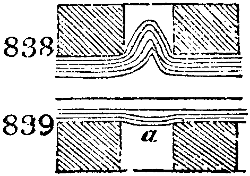
Fig. 838. represents the effects of pillars sinking into the pavement, and producing a creep; and fig. 839. exhibits large pillars and a room, with the roof stratum bending down before it falls at a. Thus the roads will be shut up, the air-courses destroyed, and the whole economy of the mining operations deranged.
The proportion of coal worked out, to that left in the pillars, when all the coal intended to be removed is taken out at the first working, varies from four-fifths to two-thirds; but as the loss of even one-third of the whole area of coal is far too much, the better mode of working suggested in the third system ought to be adopted.
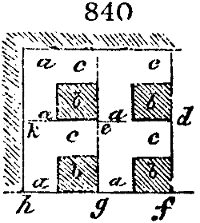
The proportion of a winning to be worked maybe thus calculated. Let fig. 840. be a small portion of the pillars, rooms, and thirlings formed in a coal-field; a, a, are two rooms; b, the pillars; c, the thirlings (or area worked out). Suppose the rooms to be 12 feet wide, the thirlings to be the same, and the pillars 12 feet on each side; adding the face of the pillar to the width of the room, the sum is 24; and also the end of the pillar to the width of the thirling, the sum is likewise 24: then 24 × 24 = 576; and the area of the pillar is 12 × 12 = 144; and as 576 divided by 144, gives 4 for a quotient, the result is, that one fourth of the coal is left in pillars, and three fourths extracted. Let d, e, f, g, be one winning, and g, e, k, h, another. By inspecting the figure, we perceive the workings of a coal-field are resolved into quadrangular areas, having a pillar situated in one of the angles.
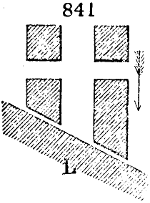
In forming the pillars and carrying forwards the boards with regularity, especially where the backs and cutters are very distinct and numerous, it is of importance to work the rooms at right angles to the backs, and the thirlings in the direction of the cutters, however oblique these may be to the backs, as the rooms are by this means conducted with the greatest regularity with regard to each other, kept equidistant, and the pillars are strongest under a given area. At the same time, however, it seldom happens that a back or cutter occurs exactly at the place where a pillar is formed; but this is of no consequence, as the shearing or cutting made by the miner ought to be in a line parallel to the backs and cutters. It frequently happens that the dip-head level intersects the cutters in its progress at a very oblique angle. In this case, when rooms and pillars are set off, the face of the pillar and width of the room must be measured off an extra breadth in proportion to the obliquity, as in fig. 841. By neglect of this rule, much confusion and irregular work is often produced. It is, moreover, proper to make the first set of pillars next the dip-head level much stronger, even where there is no obliquity, in order to protect that level from being injured by any accidental crush of the strata.
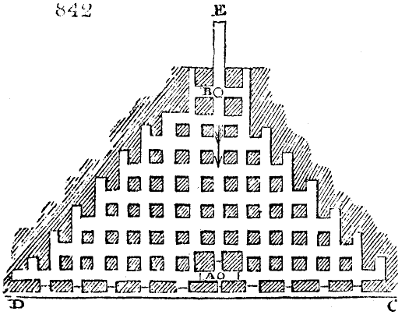
We shall now explain the different systems of working; one of the simplest of which is shown in fig. 842; where A represents the engine-pit, B the bye-pit, C D the dip-head levels, always carried in advance of the rooms, and E the rise or crop gallery, also carried in advance. These galleries not only open out the work for the miners in the coal-bed, but, being in advance, afford sufficient time for any requisite operation, should the mines be obstructed by dikes or hitches. In the example before us, the rooms or boards are worked from the dip to the crop; the leading rooms, or those most in advance, are on each side of the crop gallery E; all the other rooms follow in succession, as shown, in the figure; consequently, as the rooms advance to the crop, additional rooms are begun at the dip-head level, towards C and D. Should the coal work better in a level-course direction, then the level rooms are next the dip-head level, and the other rooms follow in succession. Hence the rooms are carried a cropping in the one case, till the coal is cropped out, or is no longer workable; and in the other, they are extended as far as the extremity of the dip-head level, which is finally cut off, either by a dike or slip, or by the boundary of the coal-field.
When the winnings are so very deep as from 100 to 200 fathoms, the first workings are carried forward with rooms, pillars, and thirlings, but under a different arrangement, on account of the great depth of the superincumbent strata, the enormous expense incident to sinking a pit, and the order and severity of discipline indispensable to the due ventilation of the mines, the preservation of the workmen, and the prosperity of the whole establishment. To the celebrated Mr. Buddle the British nation is under the greatest obligations for devising a new system of working coal-mines, whereby nearly one-third of the coals has been rescued from waste and permanent destruction. This system is named panel work; because, instead of carrying on the coal-field winning in one extended area of rooms and pillars, it is divided into quadrangular panels, each panel containing an area of from 8 to 12 acres; and round each panel is left at first a solid wall of coal from 40 to 50 yards thick. Through the panel walls roads and air-courses are driven, in order to work the coal contained within these walls. Thus all the panels are connected together with the shaft, as to roads and ventilation. Each district or panel has a particular name; so that any circumstance relative to the details of the colliery, casualties as to falls and crushes, ventilation, and the safety of the workmen, can be referred to a specific place.
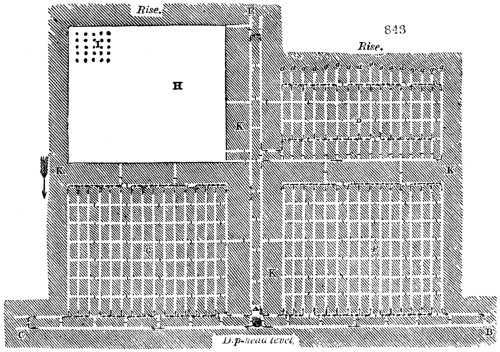
Fig. 843 enlarged (200 kB)
Fig. 843. represents a part of a colliery laid out in four panels, according to the improved method. To render it as distinct as possible, the line of the boards is at right angles with the dip-head level, or level course of the coal. A is the engine-shaft, divided into three compartments, an engine-pit and two coal-pits, like fig. 825. One of the coal-pits is the down-cast, by which the atmospheric air is drawn down to ventilate the works; the other coal-pit is the up-cast shaft, at whose bottom the furnace for rarefying the air is placed. B C, is the dip-head level; A E, the rise or crop gallery; K, K, the panel walls; F, G, are two panels completed as to the first work; D, is a panel, with the rooms a, a, a, in regular progress to the rise; H, is a panel fully worked out, whence nearly all the coal has been extracted; the loss amounting in general to no more than a tenth, instead of a third, or even a half, by the old method. By this plan of Mr. Buddle’s, also, the pillars of a panel may be worked out at any time most suitable for the economy of the mining operation; whereas formerly, though the size of the pillars and general arrangement of the mine were made with the view of taking out ultimately a great proportion of the pillars, yet it frequently happened that, before the workings were pushed to the proposed extent, some part of the mine gave way, and produced a crush; but the most common misfortune was the pillars sinking into the pavement, and deranging the whole economy of the field. Indeed the crush or creep often overran the whole of the pillars, and was resisted only by the entire body of coal at the wall faces; so that the ventilation was entirely destroyed, the roads leading from the wall faces to the pit-bottom shut up and rendered useless, and the recovery of the colliery by means of new air-courses, new roads, and by opening up the wall faces or rooms, was attended with prodigious expense and danger. Even when the pillars stood well, the old method was attended with other very great inconveniences. If water broke out in any particular spot of the colliery, it was quite impossible to arrest its progress to the engine-pit; and if the ventilation was thereby obstructed, no idea could be formed where the cause might be found, there being instances of no less than 30 miles of air-courses in one colliery. And if from obstructed ventilation an explosion of the fire-damp occurred while many workmen were occupied along the extended wall faces, it was not possible to determine where the disaster had taken place; nor could the viewers and managers know where to bring relief to the forlorn and mutilated survivors.
In Mr. Buddle’s system all these evils are guarded against, as far as human science and foresight can go. He makes the pillars very large, and the rooms or boards narrow; the pillars being in general 12 yards broad, and 24 yards long; the boards 4 yards wide, and the walls or thirlings cut through the pillars from one board to another, only 5 feet wide, for the purpose of ventilation. In the figure, the rooms are represented as proceeding from the dip to the crop, and the panel walls act as barriers thrown round the area of the panel, to prevent the weight of the superincumbent strata from overrunning the adjoining panels. Again, when the pillars of a panel are to be worked, one range of pillars, as at I (in H), is first attacked; and as the workmen cut away the furthest pillars, columns of prop-wood are erected betwixt the pavement and the roof, within a few feet of each other (as shown by the dots), till an area of above 100 square yards is cleared of pillars, presenting a body of-strata perhaps 130 fathoms thick, suspended clear and without support, except at the line of the surrounding pillars. This operation is termed working the goaff. The only use of the prop-wood is to prevent the seam, which forms the ceiling over the workmen’s heads, from falling down and killing them by its splintery fragments. Experience has proved, that before proceeding to take away another set of pillars, it is necessary to allow the last-made goaff to fall. The workmen then begin to draw out the props, which is a most hazardous employment. They begin at the more remote props, and knock them down one after another, retreating quickly under the protection of the remaining props. Meanwhile the roof-stratum begins to break by the sides of the pillars, and falls down in immense pieces; while the workmen still persevere, boldly drawing and retreating till every prop is removed. Nay, should any props be so firmly fixed by the top pressure, that they will not give way to the blows of heavy mauls, they are cut through with axes; the workmen making a point of honour to leave not a single prop in the goaff. The miners next proceed to cut away the pillars nearest to the sides of the goaff, setting prop-wood, then drawing it, and retiring as before, until every panel is removed, excepting small portions of pillars which require to be left under dangerous stones to protect the retreat of the workmen. While this operation is going forward, and the goaff extending, the superincumbent strata being exposed without support over a large area, break progressively higher up; and when strong beds of sandstone are thus giving way, the noise of the rending rocks is very peculiar and terrific; at one time loud and sharp, at another hollow and deep.
As the pillars of the panels are taken away, the panel walls are also worked progressively backwards to the pit bottom; so that only a very small proportion of coal is eventually lost. This method is undoubtedly the best for working such coals as those of Newcastle, considering their great depth beneath the surface, their comparative softness, and the profusion of inflammable air. It is evident that the larger the pillars and panel walls are, in the first working, the greater will be the security of the miners, and the greater the certainty of taking out, in the second stage, the largest proportion of coal. This system may be applied to many of the British collieries; and it will produce a vast quantity of coals beyond the post and stall methods, so generally persisted in.
In thus tearing to pieces the massive rocks over his head, the miner displays a determined and cool intrepidity; but his ingenuity is no less to be admired in contriving modes of carrying currents of pure atmospheric air through every turning of his gloomy labyrinth, so as to sweep away the explosive spirit of the mine.
The fourth system of working coal, is called the long way, the long-wall, and the Shropshire method. The plan must at first have been extremely hazardous; though now it is so improved as to be reckoned as safe, if not safer, to the workmen, than the other methods, with rooms and pillars.
The object of the Shropshire system, is to begin at the pit-bottom pillars, and to cut away at once every inch of coal progressively forward, and to allow the whole superincumbent strata to crush down behind and over the heads of the workmen. This plan is pursued chiefly with coals that are thin, and is very seldom adopted when the seam is 7 feet thick; from 4 to 5 feet being reckoned the most favourable thickness for proceeding with comfort, amidst ordinary circumstances, as to roof, pavement, &c. When a pit is opened on a coal to be treated by this method, the position of the coals above the lowest seam sunk to, must first be considered; if the coal beds be contiguous, it will be proper to work the upper one first, and the rest in succession downwards; but if they are 8 fathoms or more apart, with strata of strong texture betwixt them, the working of the lower coals in the first place will do no injury to that of the upper coals, except breaking them, perhaps, a little. In many instances, indeed, by this operation on a lower coal, upper coals are rendered more easily worked.
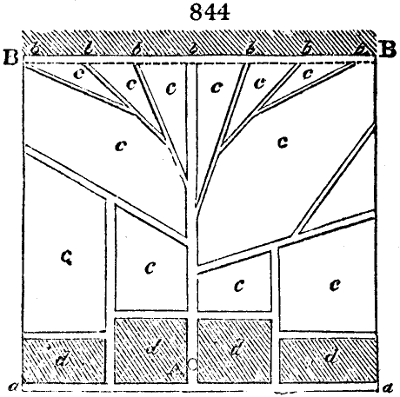
When the operation is commenced by working on the Shropshire plan, the dip-head levels are driven in the usual manner, and very large bottom pillars are formed, as represented in fig. 844. Along the rise side of the dip-head level, chains of wall, or long pillars, are also made, from 8 to 10 yards in breadth, and only mined through occasionally, for the sake of ventilation, or of forming new roads. In other cases no pillars are left upon the rise side of the level; but, instead of them, buildings of stone are reared, 4 feet broad at the base, and 9 or 10 feet from the dip side of the level. Though the roads are made 9 feet wide at first, they are reduced to half that width after the full pressure of the strata is upon them. Whenever these points are secured, the operation of cutting away the whole body of the coal begins. The place where the coal is removed, is named the gobb or waste; and gobbin, or gobb-stuff, is stones or rubbish taken away from the coal, pavement, or roof, to fill up that excavation as much as possible, in order to prevent the crush of superincumbent strata from causing heavy falls, or following the workmen too fast in their descent. Coals mined in this manner work most easily according to the way in which the widest backs and cutters are; and therefore, in the Shropshire mode, the walls stand sometimes in one direction, and sometimes in another; the mine always turning out the best coals when the open backs and cutters face the workmen. As roads must be maintained through the crushed strata, the miners in the first place cut away about 15 feet of coal round the pit-bottom pillars, and along the upper sides of the dip-head chain walls; and then, at the distance of 9 or 10 feet, carry regular buildings of stone 3 feet broad, with props set flush with the faces of these, if necessary. As the miners advance, they erect small pillars of roof or pavement stone in regular lines with the wall face, and sometimes with props intermediate.
There are two principal modifications of the Shropshire plan. The first, or the original system, was to open out the wall round the pit-bottom; and, as the wall face extended, to set off main roads and branches, very like the branches of a tree. These roads were so distributed, that between the ends of any two branches there should be a distance of 30 or 40 yards, as might be most convenient. (see fig. 844.) Each space of coal betwixt the roads is called a wall; and one half of the coals produced from each wall is carried to the one road, and the other half to the other road. This is a great convenience when the roof is bad; and hence a distance of only 20 yards betwixt the roads is in many instances preferred. In fig. 844. A represents the shaft; B B, the wall-face; a, the dip-head level; b, the roads, from 20 to 40 yards asunder; c, the gobb or waste, with buildings along the sides of the roads; and d, the pillars.
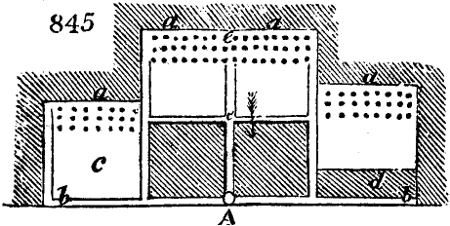
The other Shropshire system is represented in fig. 845., where A shows the pit, with the bottom pillars; b, the dip-head levels; c, the off-break from the level, where no pillars are left; d, the off-break, where pillars remain to secure the level. All roads are protected in the sides by stone buildings, if they can be had, laid off 9 feet wide. After the crush settles, the roads generally remain permanently good, and can, in many cases, be travelled through as easily 50 years after they have been made, as at the first. Should stones not be forthcoming, coals must be substituted, which are built about 20 inches in the base. In this method, the roads are likewise from 20 to 40 yards apart; but instead of ramifying, they are arranged parallel to each other. The miners secure the waste by gobbing; and three rows of props are carried forwards next the wall faces a, with pillars of stone or of coal reared betwixt them. This mode has a more regular appearance than the other; though it is not so generally practised.
In the post and stall system, each man has his own room, and performs all the labour of it; but in that of Shropshire, there is a division of labour among the workmen, who are generally divided into three companies. The first set curves or pools the coal along the whole line of walls, laying in or pooling at least 3 feet, and frequently 45 inches, or 5 quarters, as it is called. These men are named holers. As the crush is constantly following them, and impending over their heads, causing frequent falls of coal, they plant props of wood for their protection at regular distances in an oblique direction between the pavement and wall face. Indeed, as a further precaution, staples of coal, about 10 inches square, are left at every 6 or 8 yards, till the line of holing or curving is completed. The walls are then marked off into spaces of from 6 to 8 yards in length; and at each space a shearing or vertical cut is made, as deep as the holing; and when this is done, the holer’s work is finished. The set who succeed the holers, are called getters. These commence their operations at the centre of the wall divisions, and drive out the gibbs and staples. They next set wedges along the roof, and bring down progressively each division of coal; or, if the roof be hard-bound, the coal is blown down with gunpowder. When the roof has a good parting, the coals frequently fall down the moment the gibbs are struck; which makes the work very easy. The getters are relieved in their turn by the third set, named butty-men, who break down the coals into pieces of a proper size for sending up the shaft, and take charge of turning out the coal from the wall face to the ends of the roads. This being done, they build up the stone pillars, fill up the gobb, set the trees, clear the wall faces of all obstructions, set the gibbs, and make every thing clear and open for the holers to resume their work. If the roads are to be heightened by taking down the roof, or removing the pavement, these butty-men do this work also, building forwards the sides of the roads, and securing them with the requisite props. When a coal has a following or roof stone, which regularly separates with the coal, this facilitates the labour, and saves much of the coal; and should a soft bed of fire-clay occur a foot or two beneath the coal-seam, the holing is made in it, instead of into the coal, and the stone betwixt the holing and the coal benched down, which serves for pillars and gobbing. In this way all the vendible coal becomes available.
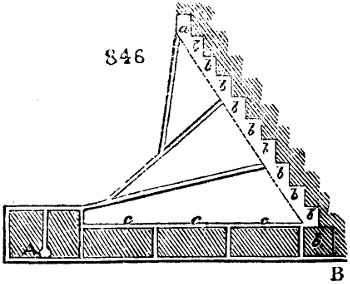
Another form of the Shropshire system is, for each miner to have from 6 to 12 feet of coal before him, with a leading-hand man; and for the several workmen to follow in succession, like the steps of a stair. When the coal has open backs and cutters, this work goes on very regularly, as represented in fig. 846., where the leading miner is at a, next to the outcrop, and b b, &c. are the wall faces of each workman; A being the shaft, and B the dip-head level. In this case the roads are carried either progressively through the gobb, or the gobb is entirely shut up; and the whole of the coals are brought down the wall-faces, either to the dip-head level or the road c, c. This method may be varied by making the walls broad enough to hold two, three, or four men when each set of miners performs the whole work of holing, getting, breaking down, and carrying off the coals.
It is estimated that from one-eighth to one-twelfth part only of the coals remains underground by the Shropshire plan; nay, in favourable circumstances, almost every inch of coal may be taken out, as its principle is to leave no solid pillars nor any coal below, except what may be indispensable for securing the gobb. Indeed this system might be applied to coal seams of almost any ordinary thickness, providing stuff to fill up the gobb could be conveniently procured.
In Great Britain, seams of coal are mined when they are only 18 inches thick; but if thinner, the working of fire-clay or ironstone immediately adjoining must be included. A few instances may be adduced, indeed, where caking coals of a fine quality for blacksmiths have been worked, though only in 12-inch seams.
Eighteen-inch seams are best worked by young lads and boys. The coal itself may be mined without lifting the pavement, or taking down the roof in the rooms; but roads must be cut either in the pavement or the roof, for removing the coals to the pit-bottom. All coals less than 2 feet 3 inches thick, are worked with the view of taking out all the coal, either on the Shropshire system, or with pillar-walls and rooms; with this peculiarity, that, on account of the thinness of the seam, the rooms are worked as wide as the roof will bear up; or if a following of the roof-stone, or fall of it, can be brought on, it proves advantageous, by not only giving head-room, but by filling up the waste, and rendering the roads easily kept for the working of the pillars. Where no following takes place, small temporary pillars, about 8 feet square, are left along the chain-wall side. The walls may vary in thickness from 4 to 16 yards, according to circumstances, and they are holed through only for ventilation.
Coals from 5 to 8 feet thick are the best suited in every point of view for the effective work of the miner, and for the general economy of underground operations. When they exceed that thickness, they require very excellent roofs and pavements, to render the working either safe or comfortable; or to enable those who superintend the field to get out a fair proportion of coal from a given area. In such powerful beds the Shropshire method is impracticable, from want of gobbin; and long props, unless of prodigious girth, would present an inadequate resistance to the pressure of the massive ceiling.
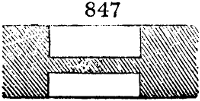
When coals do not exceed 20 feet in thickness, and have good roofs, they are sometimes worked as one bed of coal; but if the coal be tender or free, it is worked as two beds. One-half of such thick coal, however, is in general lost in pillars; and it is very seldom that less than one-third can be left. When the coal is free and ready to crumble by the incumbent pressure, as well as by the action of the air, the upper portion of the coal is first worked, then a scaffolding of coal is left, 2 or 3 feet thick, according to the compactness of the coal; and the lower part of the coal is now worked, as shown in fig. 847. As soon as the workings are completed to the proposed extent, the coal scaffoldings are worked away, and as much of the pillars as can be removed with safety. As propwood is of no use in coal seams of such a height, and as falls from the roof would prove frequently fatal to the miners, it is customary with tender roofs to leave a ceiling of coal from 2 to 3 feet thick. This makes an excellent roof; and should it break, gives warning beforehand, by a peculiar crackling noise, very different from that of roof-stones crushing down.
One of the thickest coals in Great Britain, worked as one bed from roof to pavement, is the very remarkable seam near the town of Dudley, known by the name of the ten-yard coal, about 7 miles long, and 4 broad. No similar coal has been found in the island; and the mode of working it is quite peculiar, being a species of panel work totally different from the modern Newcastle system. A compartment, or pannel, formed in working the coal, is called a side of work; and as the whole operation is exhibited in one of these compartments, it will be proper to describe the mode of taking the coal from one of them, before describing the whole extent of the workings of a mine.
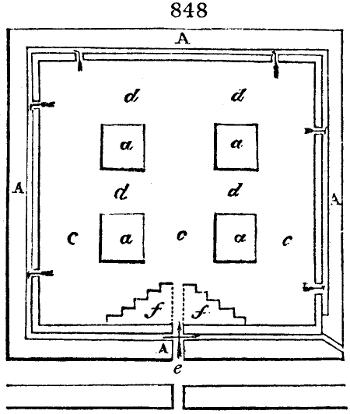
Let fig. 848. represent a side of work; A, the ribs or walls of coal left standing round, constituting the side of work; a, the pillars, 8 yards square; c, the stalls, 11 yards wide; d, the cross openings, or through puts, also 11 yards wide; e, the bolt-hole, cut through the rib from the main road, by which bolt-hole the side of work is opened up, and all the coals removed. Two, three, or even four bolt-holes open into a side of work, according to its extent; they are about 8 feet wide, and 9 feet high. The working is in a great measure regulated by the natural fissures and joints of the coal-seam; and though it is 30 feet thick, the lower band, of 2 feet 3 inches, is worked first; the miners choosing to confine themselves within this narrow opening, in order to gain the greater advantage afterwards, in working the superjacent coal. Whenever the bolt hole is cut through, the work is opened up by driving a gallery forward, 4 feet wide, as shown by the dotted lines. At the sides of this gallery next the bolt-hole, each miner breaks off in succession a breast of coal, two yards broad, as at f, f, by means of which the sides of the rib-walls A, are formed, and the area of the pillars. In this way each collier follows another, as in one of the systems of the Shropshire plan. When the side of work is laid open along the rib-walls, and the faces and sides of the pillars have been formed, the upper coals are then begun to be worked, next the rib-wall. This is done by shearing up to a bed next the bolt-hole, and on each side, whereby the head coals are brought regularly down in large cubical masses, of such thickness as suits with the free partings or subordinate divisions of the coals and bands. Props of wood, or even stone pillars, are placed at convenient distances for the security of the miners.
In working the ten-yard coal, a very large proportion of it is left underground, not merely in pillars and rib-walls, but in the state of small coal produced in breaking out the coal. Hence, from four-tenths to a half of the total amount is lost for ever.
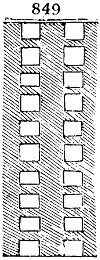
Another method of working coal of uncommon thickness, is by scaffoldings or stages of coals, as practised in the great coal bed at Johnstone, near Paisley, of which a section has already been given. In one part of the field the coal is from 50 to 60 feet thick, and in another it amounts to 90 feet. The seams of stone interspersed through the coal are generally inconsiderable, and amount in only two cases to 27 inches in thickness. The roof of the coal is so unsound, and the height so prodigious, that it could not possibly be worked in one seam, like that of Staffordshire. About 3 feet of the upper coal is therefore left as a roof, under which a band of coal, from 6 to 7 feet thick, is worked on the post and stall plan, with square pillars of extra strength, which are thereafter penetrated. A platform about 3 feet high is left at the sole; under which the rooms and pillars are set off and worked in another portion of the coal, from 5 to 7 feet thick, great care being had to place pillar under pillar, and partition under partition, to prevent a crush. Where the coal is thickest, no less than 10 bands of it are worked in this way, as is shown in fig. 849. When any band of the coal is foul from sulphur or other causes, it is left for the next platform, so that a large proportion of it is lost, as in the Staffordshire mines. Much attention must here be paid to the vertical distribution of the pillars and apartments; the miner’s compass must be continually consulted, and bore-holes must be put down through the coal scaffoldings, to regulate correctly the position of the pillars under one another.
Edge coals, which are nearly perpendicular, are worked in a peculiar manner; for the collier stands upon the coal, having the roof on the one hand, and the floor on the other, like two vertical walls. The engine-pit is sunk in the most powerful stratum. In some instances the same stratum is so vertical as to be sunk through for the whole depth of the shaft.
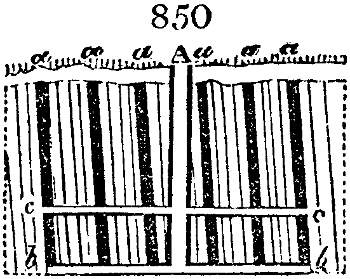
Whenever the shaft has descended to the required depth, galleries are driven across the strata from its bottom, till the coals are intersected, as is shown in fig. 850., where we see the edge coals at a, a; A, the engine-pit; b, b, the transverse galleries from the bottom of the shaft; and c, c, upper transverse galleries, for the greater conveniency of working the coal. The principal edge coal works in Great Britain lie in the neighbourhood of Edinburgh, and the coals are carried on the backs of women from the wall-face to the bottom of the engine-pit.
The modes of carrying coals from the point where they are excavated to the pit bottom, are nearly as diversified as the systems of working.
One method employs hutches, or baskets, having slips or cradle feet shod with iron, containing from 2 to 3 hundred weight of coals. These baskets are dragged along the floor by ropes or leather harness attached to the shoulders of the workmen, who are either the colliers or persons hired on purpose. This method is used in several small collieries; but it is extremely injudicious, exercising the muscular action of a man in the most unprofitable manner. Instead of men, horses are sometimes yoked to these basket-hurdles, which are then made to contain from 4 to 6 hundred weight of coals; but from the magnitude of the friction, this plan cannot be commended.
An improvement on this system, where men draw the coals, is to place the basket or corve on a small four-wheeled carriage, called a tram, or to attach wheels to the corve itself. Thus much more work is performed, provided the floor be hard; but not on a soft pavement, unless some kind of wooden railway be laid.
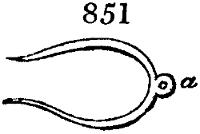
The transport of coals from the wall-face to the bottom of the shaft, was greatly facilitated by the introduction of cast-iron railways, in place of wooden roads, first brought into practice by Mr. John Curr of Sheffield. The rails are called tram-rails, or plate-rails, consisting of a plate from 3 to 4 inches broad, with an edge at right angles to it about two inches and a half high. Each rail is from 3 to 4 feet long, and is fixed either to cross bearers of iron, called sleepers, or more usually to wooden bearers. In some collieries, the miners, after working out the coals, drag them along these railways to the pit bottom; but in others, two persons called trammers are employed to transport the coals; the one of whom, in front of the corve, draws with harness; and the other, called the patter, pushes behind. The instant each corve arrives, from the wall-face, at a central spot in the system of the railways, it is lifted from the tram by a crane placed there, and placed on a carriage called a rolley, which generally holds two corves. Whenever three or four rolleys are loaded, they are hooked together, and the rolley driver, with his horse, takes them to the bottom of the engine-shaft. The rolley horses have a peculiar kind of shafts, commonly made of iron, named limbers, the purpose of which is to prevent the carriage from overrunning them. One of these shafts is represented in fig. 851. The hole shown at a, passes over an iron peg or stud in front of the rolley, so that the horse may be quickly attached or disengaged. By these arrangements the work is carried on with surprising regularity and despatch.
The power of the engine for drawing the coals up the shaft, is made proportional to the depth of the pit and the quantity to be raised, the corves ascending at an average velocity of about 12 feet per second. So admirable is the modern arrangement of this operation, that the corves are transported from the wall-faces to the pit bottom, and moved up the shaft, as fast as the onsetters at the bottom, and the banksmen at the top, can hook the loaded and empty corves on and off the engine ropes. Thus 100 corves of coals have been raised every hour up a shaft 100 fathoms deep, constituting a lift of 27 tons per hour, or 324 tons in a day, or shift of 12 hours. Coals mined in large cubical masses cannot, however, be so rapidly raised as the smaller coal of the Newcastle district.
When coals have so great a rise from the pit bottom to the crop that horses cannot be used on the rolley ways, the corves descend along the tram-roads, by means of inclined-plane machines, which are moved either by vertical rope-barrels, or horizontal rope-sheaves. These inclined planes are frequently divided into successive stages, 200 or 300 yards long, at the end of each of which is an inclined-plane machine, whereby the coals are lowered from one level to another.
The wheels of the trams and rolleys vary in diameter from 8 to 16 inches, according to the thickness of the coal. In some, the axles not only revolve on their journals, but the wheels also revolve on their axles.
Various forms of machines have been employed for raising the coals out of the pits. The steam engine with fly-wheel and rope-barrels, is, however, now preferred in all considerable establishments. When of small power, they are usually constructed with a fly wheel, and short fly-wheel shaft, on which there is a small pinion working into the teeth of a large wheel, fixed upon the rope barrel. Thus the engine may move with great rapidity, while it imparts an equable slow motion to the corves ascending in the shaft. When the engines are of great power, however, they are directly connected with the rope-barrel; some of these being of such dimensions, that each revolution of the rope-barrel produces an elevation of 12 yards in the corve. A powerful brake is usually connected with the circumference of the fly-wheel or rope-barrel, whereby the brakeman, by applying his foot to the governing lever of the brake, and by shutting at the same time the steam valves with his hands, can arrest the corve, or pitch its arrival within a few inches of the required height of every delivery. An endless chain, suspended from the bottom to the top of the shaft, has, in a few pits of moderate depth, been worked by a steam engine, for raising corves in constant succession; but the practice has not been found hitherto applicable on the greater scale.
There is a kind of water engines for raising coals, strictly admissible only in level free pits, where the ascent of the loaded corve is produced by the descent of a cassoon filled with water. When the ascent and descent are through equal spaces, the rope barrels for the cassoon and the corves are of equal diameter; but when the point from which the coals have to be lifted is deeper than the point of discharge for the water into the dry level, the cassoon must be larger, and the rope barrel smaller; so that by the time the cassoon reaches to the half-depth, for example, the corve may have mounted through double the space. The cassoon is filled with water at the pit mouth, and is emptied by a self-acting valve whenever it gets to the bottom. The loaded corve is replaced by an empty one at the pit mouth, and its weight, with that of the descending rope, pull up the empty cassoon; the motions of the whole mechanism being regulated by a powerful brake.
Various plans have been devised to prevent collision between the ascending and descending corves, which sometimes pass each other with a joint velocity of 20 or 30 feet per second. One method is by dividing the pit from top to bottom, so that each corve moves in a separate compartment. Another mode was invented by Mr. Curr of Sheffield, in which wooden guides were attached from top to bottom of the pit; being spars of deal about 4 inches square, attached perpendicularly to the sides of the shaft, and to buntons in the middle of the pit. Betwixt these guides, friction-roller sliders are placed, attached to the gin-ropes, to which sliders the corves are suspended. In this way, the corves can be raised with great rapidity; but there is a considerable loss of time in banking the corve at the pit mouth, where shutters or sliding boards must be used. This plan is highly beneficial where the coals are in large lumps.
Both ropes and chains are used for lifting coals. The round ropes are shroud-laid; but the preferable rope is the flat band, made of four ropes placed horizontally together, the ropes being laid alternately right and left. In this way, the ropes counteract one another in the twist, hanging like a ribbon down the shaft; and are stitched strongly together by a small cord. Such rope bands are not only very pliable for their strength, which protects the heart of the rope from breaking, but as they lap upon themselves, a simple sheave serves as a rope-barrel. They possess the additional advantage, that by so lapping, they enlarge the diameter of the axle in which they coil, and thus make a compensation mechanically against the increasing length of rope descending with its corve. Thus the counterpoise chains, used in deep pits to regulate the descent, have been superseded. See Rope-spinning.
When chains are preferred to ropes, as in very deep pits, the short pudding-link chains are mostly used. See Cable.
The corves after being landed or banked at the pit mouth, are drawn to the bin or coal-hill, either upon slips by horses, or by trammers on a tram-road. But with small coals, like the Newcastle, the pit head is raised 8 or 9 feet above the common level of the ground, and the coal-heap slopes downwards from that height. As the bins increase, tram-roads are laid outwards upon them.
I shall now describe the ventilation of coal mines. Into their furthest recesses, an adequate supply of fresh air must be carried forwards, for the purposes of respiration, and the combustion of candles; as also for clearing off the carbonic acid and carburetted hydrogen gases, so destructive to the miners, who call these noxious airs, from their most obvious qualities, choke-damp and fire-damp.
Before the steam engine was applied to the drainage of the mines, and the extraction of the coal, the excavations were of such limited extent, that when inflammable air accumulated in the foreheads, it was usual in many collieries to fire it every morning. This was done by fixing a lighted candle to the end of a long pole, which being extended towards the roof by a person lying flat on the floor, the gas was fired, and the blast passed safely over him. If the gas was abundant, the explosive miner put on a wet jacket, to prevent the fire from scorching him. In other situations, where the fire-damp was still more copious, the candle was drawn forwards into it, by a cord passing over a catch at the end of the gallery, while the operator stood at a distance. This very rude and dangerous mode of exploding the inflammable gas, is still practised in a few mines, under the name of the firing line.
The carbonic acid or choke-damp having a greater specific gravity than atmospheric air, in the proportion of about 3 to 2, occupies the lower part of the workings, and gives comparatively little annoyance. Its presence may moreover be always safely ascertained by the lighted candle. This cannot, however, be said of the fire-damp, which being lighter and more movable, diffuses readily through the atmospheric air, so as to form a most dangerous explosive mixture, even at a considerable distance from the blowers or sources of its extrication from the coal strata. Pure subcarburetted hydrogen has a specific gravity = 0·555, air being 1; and consists of a volume of vapour of carbon, and two volumes of hydrogen, condensed by mutual affinity into one volume. The choke-damp is a mixture of the above, with a little carbonic acid gas, and variable proportions of atmospheric air. As the pure subcarburetted hydrogen requires twice its bulk of oxygen to consume it completely, it will take for the same effect about 10 times its bulk of atmospheric air, since this volume of air contains about two volumes of oxygen. Ten volumes of air, therefore, mixed with one volume of subcarburetted hydrogen, form the most powerfully explosive mixture. If either less or more air be intermixed, the explosive force will be impaired; till 3 volumes of air below or above that ratio, constitute non-explosive mixtures; that is, 1 of the pure fire-damp mixed with either 7 or 13 of air, or any quantity below the first, or above the second number, will afford an unexplosive mixture. With the first proportion, a candle will not burn; with the second, it burns with a very elongated blue flame. The fire-damp should therefore be still further diluted with common air, considerably beyond the above proportion of 1 to 13, to render the working of the mine perfectly safe.
These noxious gases are disengaged from the cutters, fissures, and minute pores of the coal; and if the quantity be considerable, relative to the orifice, a hissing noise is heard.
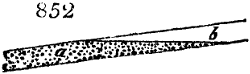
Though the choke-damp, or carbonic acid gas, be invisible, yet its line of division from the common air is distinctly observable on approaching a lighted candle to the lower level, where it accumulates, which becomes extinguished the instant it comes within its sphere, as if it were plunged in water. The stratum of carbonic acid sometimes lies 1 or 2 feet thick on the floor, while the superincumbent air is perfectly good. When the coal has a considerable dip and rise, the choke-damp will be found occupying the lower parts of the mine, in a wedge form, as represented in fig. 852., where a shows the place of the carbonic acid gas, and b that of the common air.
When a gallery is driven in advance of the other workings, and a discharge of this gas takes place, it soon fills the whole mine, if its direction be in the line of level, and the mine is rendered unworkable until a supply of fresh air is introduced to dislodge it. As the flame of a candle indicates correctly the existence of the choke-damp, the miners may have sufficient warning of its presence, so as to avoid the place which it occupies, till adequate means be taken to drive it away.
The fire-damp is not an inmate of every mine, and is seldom found, indeed, where the carbonic acid prevails. It occurs in the greatest quantities in the coal mines of the counties of Northumberland, Durham, Cumberland, Staffordshire, and Shropshire. It is more abundant in coals of the caking kind, with a bright steel-grained fracture, than in cubic coals of an open-burning quality. Splint coals are still less liable to disengage this gas. In some extensive coal-fields it exists copiously on one range of the line of bearing, while on the other range, none of it is observed, but abundance of carbonic acid gas.
In the numerous collieries in the Lothians, south from the city of Edinburgh, the fire-damp is unknown; while in the coal-fields round the city of Glasgow, and along the coast of Ayrshire, it frequently appears.
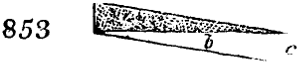
The violent discharge of the gas from a crevice or cutter of the coal, is called a blower; and if this be ignited, it burns like an immense blowpipe, inflaming the coal at the opposite side of the gallery. The gas evidently exists in a highly compressed and elastic state; whence it seems to loosen the texture of the coals replete with it, and renders them more easily worked. The gas is often peculiarly abundant near a great dislocation or slip of the strata; so that the fissure of the dislocation will sometimes emit a copious stream of gas for many years. It has also happened, that from certain coals, newly worked, and let fall from a height into the hold of a vessel, so much inflammable gas has been extricated that, after the hatches were secured, and the ship ready to proceed to sea, the gas has ignited with the flame of a candle, so as to scorch the seamen, to blow up the decks, and otherwise damage the vessel. In like manner, when the pillars in a mine are crushed by sudden pressure, a great discharge of gas ensues. This gas being lighter than common air, always ascends to the roof or to the rise of the galleries; and, where the dip is considerable, occupies the forehead of the mine, in a wedge form, as shown in fig. 853., where a represents the fire-damp, and b the common air. In this case, a candle will burn without danger near the point c, close to the floor; but if it be advanced a few feet further towards the roof, an explosion will immediately ensue; since at the line where the two elastic fluids are in contact, they mix, and form an explosive body.
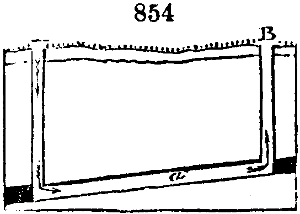
When this gas is largely diluted with air, the workmen do not seem to feel any inconvenience from breathing the mixture for a period of many years; but on inhaling pure carburetted hydrogen, the miner instantly drops down insensible, and, if not speedily removed into fresh air, he dies. The production of these noxious gases renders ventilation a primary object in the system of mining. The most easily managed is the carbonic acid. If an air-pipe has been carried down the engine pit for the purpose of ventilation in the sinking, other pipes are connected with it, and laid along the pavement, or are attached to an angle of the mine next the roof. These pipes are prolonged with the galleries, by which means the air at the forehead is drawn up the pipes and replaced by atmospheric air, which descends by the shaft in an equable current, regulated by the draught of the furnace at the pit mouth. This circulation is continued till the miners cut through upon the second shaft, when the air-pipes become superfluous; for it is well known that the instant such communication is made, as is represented in fig. 854., the air spontaneously descends in the engine pit A, and, passing along the gallery a, ascends in a steady current in the second pit B. The air, in sinking through A, has at first the atmospheric temperature, which in winter may be at or under the freezing point of water; but its temperature increases in passing down through the relatively warmer earth, and ascends in the shaft B, warmer than the atmosphere. When shafts are of unequal depths, as represented in the figure, the current of air flows pretty uniformly in one direction. If the second shaft has the same depth with the first, and the bottom and mouth of both be in the same horizontal plane, the air would sometimes remain at rest, as water would do in an inverted syphon, and at other times would circulate down one pit and up another, not always in the same direction, but sometimes up the one, and sometimes up the other, according to the variations of temperature at the surface, and the barometrical pressures, as modified by winds. There is in mines a proper heat, proportional to their depth, increasing about one degree of Fahrenheit’s scale for every 60 feet of descent.
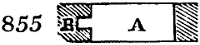
There is a simple mode of conducting air from the pit bottom to the forehead of the mine, by cutting a ragglin, or trumpeting, as it is termed, in the side of the gallery, as represented in fig. 855., where A exhibits the gallery in the coal, and B the ragglin, which is from 15 to 18 inches square. The coal itself forms three sides of the air-pipe, and the fourth is composed of thin deals applied air-tight, and nailed to small props of wood fixed between the top and bottom of the lips of the ragglin. This mode is very generally adopted in running galleries of communication, and dip-head level galleries, where carbonic acid abounds, or when from the stagnation of the air the miners’ lights burn dimly.
When the ragglin or air-pipes are not made spontaneously active, the air is sometimes impelled through them by means of ventilating fanners, having their tube placed at the pit bottom, while the vanes are driven with great velocity by a wheel and pinion worked with the hand. In other cases, large bellows like those of the blacksmith, furnished with a wide nozzle, are made to act in a similar way with the fanners. But these are merely temporary expedients for small mines. A very slight circulation of air can be effected by propulsion, in comparison of what may be done by exhaustion; and hence it is better to attach the air-pipe to the valve of the bellows, than to their nozzle.
Ventilation of collieries has been likewise effected on a small scale, by attaching a horizontal funnel to the top of air-pipes elevated a considerable height above the pit mouth. The funnel revolves on a pivot, and by its tail-piece places its mouth so as to receive the wind. At other times, a circulation of air is produced by placing coal-fires in iron grates, either at the bottom of an upcast pit, or suspended by a chain a few fathoms down.
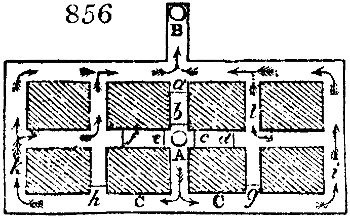
Such are some of the more common methods practised in collieries of moderate depth, where carbonic acid abounds, or where there is a total stagnation of air. But in all great coal mines the aërial circulation is regulated and directed by double doors, called main or bearing doors. These are true air-valves, which intercept a current of air moving in one direction from mixing with another moving in a different direction. Such valves are placed on the main roads and passages of the galleries, and are essential to a just ventilation. Their functions are represented in the annexed fig. 856., where A shows the downcast shaft, in which the aerial current is made to descend; B is the upcast shaft, sunk towards the rise of the coal; and C, the dip-head level. Were the mine here figured to be worked without any attention to the circulation, the air would flow down the pit A, and proceed in a direct line up the rise mine to the shaft B, in which it would ascend. The consequence would therefore be, that all the galleries and boards to the dip of the pit A, and those lying on each side of the pits, would have no circulation of air; or, in the language of the collier, would be laid dead. To obviate this result, double doors are placed in three of the galleries adjoining the pit; viz., at a and b, c and d, e and f; all of which open inwards to the shaft A. By this plan, as the air is not suffered to pass directly from the shaft A to the shaft B, through the doors a and b, it would have taken the next shortest direction by c d and e f; but the doors in these galleries prevent this course, and compel it to proceed downwards to the dip-head level C, where it will spread or divide, one portion pursuing a route to the right, another to the left. On arriving at the boards g and h, it would have naturally ascended by them; but this it cannot do, by reason of the building or stopping placed at g and h. By means of such stoppings placed in the boards next the dip-head level, the air can be transported to the right hand or to the left for many miles, if necessary, providing there be a train or circle of aerial communication from the pit A to the pit B. If the boards i and k are open, the air will ascend in them, as traced out by the arrows; and after being diffused through the workings, will again meet in a body at a, and mount the gallery to the pit B, sweeping away with it the deleterious air which it meets in its path. Without double doors on each main passage, the regular circulation of the air would be constantly liable to interruptions and derangements; thus, suppose the door c to be removed, and only d to remain in the left hand gallery, all the other doors being as represented, it is obvious, that whenever the door d is opened, the air, finding a more direct passage in that direction, would mount by the nearest channel l, to the shaft B, and lay dead all the other parts of the work, stopping all circulation. As the passages on which the doors are placed constitute the main roads by which the miners go to and from their work, and as the corves are also constantly wheeling along all the time, were a single door, such as d, so often opened, the ventilation would be rendered precarious or languid. But the double doors obviate this inconvenience; for both men and horses, with the corves, in going to or from the pit bottom A, no sooner enter the door d, than it shuts behind them, and encloses them in the still air contained between the doors d and c; c having prevented the air from changing its proper course while d was open. When d is again shut, the door c may be opened without inconvenience, to allow the men and horses to pass on to the pit bottom at A; the door d preventing any change in the aerial circulation while the door c is open. In returning from the pit, the same rule is observed, of shutting one of the double doors, before the other is opened.
If this mode of disjoining and insulating air-courses from each other be once fairly conceived, the continuance of the separation through a working of any extent, may be easily understood.
When carbonic acid gas abounds, or when the fire-damp is in very small quantity, the air may be conducted from the shaft to the dip-head level, and by placing stoppings of each room next the level, it may be carried to any distance along the dip-head levels; and the furthest room on each side being left open, the air is suffered to diffuse itself through the wastes, along the wall faces, and mount in the upcast pit, as is represented in fig. 842. But should the air become stagnant along the wall faces, stoppings are set up throughout the galleries, in such a way as to direct the main body of fresh air along the wall faces for the workmen, while a partial stream of air is allowed to pass through the stoppings, to prevent any accumulation of foul air in the wastes.
In very deep and extensive collieries more elaborate arrangements for ventilation are introduced. Here the circulation is made active by rarefying the air at the upcast shaft, by means of a very large furnace placed either at the bottom or top of the shaft. The former position is generally preferred. Fig. 834. exhibits a furnace placed at the top of the pit. When it surmounts a single pit, or a single division of the pit, the compartment intended for the upcast is made air-tight at top, by placing strong buntons or beams across it, at any suitable distance from the mouth. On these buntons a close scaffolding of plank is laid, which is well plastered or moated over with adhesive plastic clay. A little way below the scaffold, a passage is previously cut, either in a sloping direction, to connect the current of air with the furnace, or it is laid horizontally, and then communicates with the furnace by a vertical opening. If any obstacle prevent the scaffold from being erected within the pit, this can be made air-tight at top, and a brick flue carried thence along the surface to the furnace.
The furnace has a size proportional to the magnitude of the ventilation, and the chimneys are either round or square, being from 50 to 100 feet high, with an inside diameter of from 5 to 9 feet at bottom, tapering upwards to a diameter of from 21⁄2 feet to 5 feet. Such stalks are made 9 inches thick in the body of the building, and a little thicker at bottom, where they are lined with fire-bricks.
The plan of placing the furnace at the bottom of the pit is, however, more advantageous, because the shaft through which the air ascends to the furnace at the pit mouth, is always at the ordinary temperature; so that whenever the top furnace is neglected, the circulation of air throughout the mine becomes languid, and dangerous to the workmen; whereas, when the furnace is situated at the bottom of the shaft, its sides get heated, like those of a chimney, through its total length, so that though the heat of the furnace be accidentally allowed to decline or become extinct for a little, the circulation will still go on, the air of the upcast pit being rarefied by the heat remaining in the sides of the shaft.
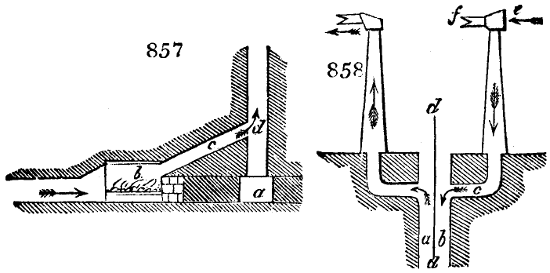
To prevent the annoyance to the onsetters at the bottom, from the hot smoke, the following plan has been adopted, as shown in the wood-cut, fig. 857., where a represents the lower part of the upcast shaft; b, the furnace, built of brick, arched at top, with its sides insulated from the solid mass of coal which surrounds it. Between the furnace wall and the coal-beds, a current of air constantly passes towards the shaft, in order to prevent the coal catching fire. From the end of the furnace a gallery is cut in a rising direction at c, which communicates with the shaft at d, about 7 or 8 fathoms from the bottom of the pit. Thus the furnace and furnace-keeper are completely disjoined from the shaft; and the pit bottom is not only free from all encumbrances, but remains comfortably cool. To obviate the inconveniences from the smoke to the banksmen in landing the coals at the pit mouth, the following plan has been contrived for the Newcastle collieries. Fig. 858. represents the mouth of the pit; a is the upcast shaft, provided with a furnace at bottom; b, the downcast shaft, by which the supply of atmospheric air descends; and d, the brattice carried above the pit mouth. A little way below the settle-boards, a gallery c, is pushed, in communication with the surface from the downcast shaft, over which a brick tube or chimney is built from 60 to 80 feet high, 7 or 8 feet diameter at bottom, and 4 or 5 feet diameter at top. On the top of this chimney a deal funnel is suspended horizontally on a pivot, like a turn-cap. The vane f, made also of deal, keeps the mouth of the funnel always in the same direction with the wind. The same mechanism is mounted at the upcast shaft a, only here the funnel is made to present its mouth in the wind’s eye. It is obvious from the figure, that a high wind will rather aid than check the ventilation by this plan.
The principle of ventilation being thus established, the next object in opening up a colliery, and in driving all galleries whatever, is the double mine or double headways course; on the simple but very ingenious distribution of which, the circulation of air depends at the commencement of the excavations.
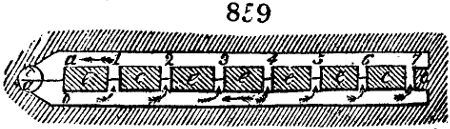
The double headways course is represented in fig. 859., where a is the one heading or gallery, and b the other; the former being immediately connected with the upcast side of the pit c, and the latter with the downcast side of the pit d. The pit itself is made completely air-tight by its division of deals from top to bottom, called the brattice wall; so that no air can pass through the brattice from d to c, and the intercourse betwixt the two currents of air is completely intercepted by a stopping betwixt the pit bottom and the end of the first pillar of coal; the pillars or walls of coal, marked e, are called stenting walls; and the openings betwixt them, walls or thirlings. The arrows show the direction of the air. The headings a and b are generally made about 9 feet wide, the stenting walls 6 or 8 yards thick, and are holed or thirled at such a distance as may be most suitable for the state of the air. The thirlings are 5 feet wide.
When the headings are set off from the pit bottom, an aperture is left in the brattice at the end of the pillar next the pit, through which the circulation betwixt the upcast and downcast pits is carried on; but whenever the workmen cut through the first thirling No. 1., the aperture in the brattice at the pit bottom is shut; in consequence of which the air is immediately drawn by the power of the upcast shaft through that thirling as represented by the dotted arrow. Thus a direct stream of fresh air is obviously brought close to the forehead where the mines are at work. The two headings a and b are then advanced, and as soon as the thirling No. 2. is cut through, a wall of brick and mortar, 41⁄2 inches thick, is built across the thirling No. 1. This wall is termed a stopping; and being air-tight, it forces the whole circulation through the thirling No. 2. In this manner the air is always led forward, and caused to circulate always by the last-made thirling next the forehead; care being had, that whenever a new thirling is made, the last thirling through which the air was circulated, be secured with an air-tight stopping. In the woodcut, the stoppings are placed in the thirlings numbered 1, 2, 3, 4, 5, 6, and of consequence the whole circulation passes through the thirling No. 7., which lies nearest the foreheads of the headings a, b. By inspecting the figure, we observe, that on this very simple plan, a stream of air may be circulated to any required distance, and in any direction, however tortuous. Thus, for example, if while the double headways course a, b, is pushed forward, other double headways courses are required to be carried on at the same time on both sides of the first headway, the same general principles have only to be attended to as shown in fig. 860., where a is the upcast, and b the downcast shaft. The air advances along the heading c, but cannot proceed further in that direction than the pillar d, being obstructed by the double doors at e. It therefore advances in the direction of the arrows to the foreheads at f, and passing through the last thirling made there, returns to the opposite side of the double doors, ascends now the heading g to the foreheads at h, passes through the last-made thirling at that point, and descends, in the heading i, till it is interrupted by the double doors at k. The aerial current now moves along the heading l, to the foreheads at m, returns by the last-made thirling there, along the heading n, and finally goes down the heading o, and mounts by the upcast shaft a, carrying with it all the noxious gases which it encountered during its circuitous journey. This wood-cut is a faithful representation of the system by which collieries of the greatest extent are worked and ventilated. In some of these, the air courses are from 30 to 40 miles long. Thus the air conducted by the medium of a shaft divided by a brattice wall only a few inches thick, after descending in the downcast in one compartment of the pit at 6 o’clock in the morning, must thence travel through a circuit of nearly 30 miles, and cannot arrive at its reascending compartment on the other side of the brattice, or pit partition, till 6 o’clock in the evening, supposing it to move all the time at the rate of 21⁄2 miles per hour. Hence we see that the primum mobile of this mighty circulation, the furnace, must be carefully looked after, since its irregularities may affect the comfort, or even the existence of hundreds of miners spread over these vast subterraneous labyrinths. On the principles just laid down, it appears, that if any number of boards be set off from any side of these galleries, either in a level, dip, or rise direction, the circulation of air may be advanced to each forehead, by an ingoing and returning current.
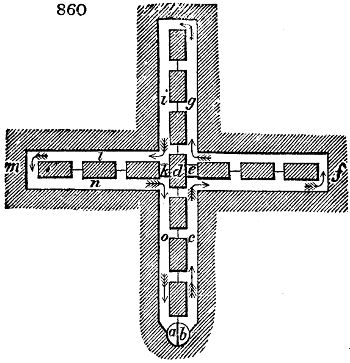
Yet while the circulation of fresh air is thus advanced to the last-made thirling next the foreheads f, h, and m, fig. 860., and moves through the thirling which is nearest to the face of every board and room, the emission of fire-damp is frequently so abundant from the coaly strata, that the miners dare not proceed forwards more than a few feet from that aerial circulation, without hazard of being burned by the combustion of the gas at their candles. To guard against this accident, temporary shifting brattices are employed. These are formed of deal, about 3⁄4 of an inch thick, 3 or 4 feet broad, and 10 feet long; and are furnished with cross-bars for binding the deals together, and a few finger loops cut through them, for lifting them more expeditiously, in order to place them in a proper position. Where inflammable air abounds, a store of such brattice deals should be kept ready for emergencies.
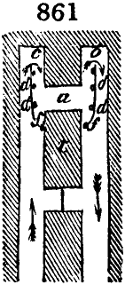
The mode of applying these temporary brattices, or deal partitions, is shown in the accompanying figure (fig. 861.), which shows how the air circulates freely through the thirling d, d before the brattices are placed. At b and c, we see two heading boards or rooms, which are so full of inflammable air as to be unworkable. Props are now erected near the upper end of the pillar e, betwixt the roof and pavement, about two feet clear of the sides of the next pillar, leaving room for the miner to pass along between the pillar side and the brattice. The brattices are then fastened with nails to the props, the lower edge of the under brattice resting on the pavement, while the upper edge of the upper is in contact with the roof. By this means any variation of the height in the bed of coal is compensated by the overlap of the brattice boards; and as these are advanced, shifting brattices are laid close to, and alongside of, the first set. The miner next sets up additional props in the same parallel line with the former, and slides the brattices forwards, to make the air circulate close to the forehead where he is working; and he regulates the distance betwixt the brattice and the forehead by the disengagement of fire-damp and the velocity of the aerial circulation. The props are shown at d d, and the brattices at f, f. By this arrangement the air is prevented from passing directly through the thirling a, and is forced along the right-hand side of the brattice, and, sweeping over the wall face or forehead, returns by the back of the brattice, and passes through the thirling a. It is prevented, however, from returning in its former direction by the brattice planted in the forehead c, whereby it mounts up and accomplishes its return close to that forehead. Thus headways and boards are ventilated till another thirling is made at the upper part of the pillar. The thirling a is then closed by a brick stopping, and the brattice boards removed forward for a similar operation.
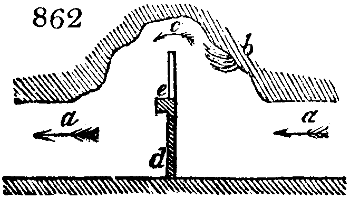
When blowers occur in the roof, and force the strata down, so as to produce a large vaulted excavation, the accumulated gas must be swept away; because, after filling that space, it would descend in an unmixed state under the common roof of the coal. The manner of removing it is represented in fig. 862., where a is the bed of coal, b the blower, c the excavation left by the downfall of the roof, d is a passing door, and e a brattice. By this arrangement the aerial current is carried close to the roof, and constantly sweeps off or dilutes the inflammable gas of the blower, as fast as it issues. The arrows show the direction of the current; but for which, the accumulating gas would be mixed in explosive proportions with the atmospheric air, and destroy the miners.
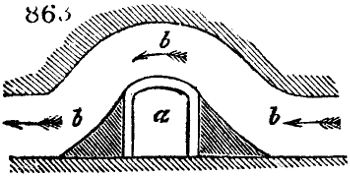
There is another modification of the ventilating system, where the air-courses are traversed across; that is, when one air-course is advanced at right angles to another, and must pass it in order to ventilate the workings on the further side. This is accomplished on the plan shown in fig. 863., where a is a main road with an air-course, over which the other air-course b, has to pass. The sides of this air channel are built of bricks arched over so as to be air-tight, and a gallery is driven in the roof strata as shown in the figure. If an air-course, as a, be laid over with planks made air-tight, crossing and recrossing may be effected with facility. The general velocity of the air in these ventilating channels is from 3 to 4 feet per second, or about 21⁄2 miles per hour, and their internal dimensions vary from 5 to 6 feet square, affording an area of from 25 to 36 square feet.
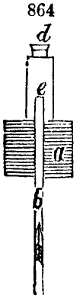
Mr. Taylor’s hydraulic air-pump, formerly described, p. 839., deserves to be noticed among the various ingenious contrivances for ventilating mines, particularly when they are of moderate extent. a is a large wooden tub, nearly filled with water, through whose bottom the ventilating pipe b passes down into the recesses of the mine. Upon the top of b, there is a valve e, opening upwards. Over b, the gasometer vessel is inverted in a, having a valve also opening outwards at d. When this vessel is depressed by any moving force, the air contained within it is expelled through d; and when it is raised, it diminishes the atmospherical pressure in the pipe b, and thus draws air out of the mine into the gasometer; which cannot return on account of the valve at e, but is thrown out into the atmosphere through d at the next descent.
The general plan of distributing the air, in all cases, is to send the first of the current that descends in the downcast shaft among the horses in the stables, next among the workmen in the foreheads, after which the air, loaded with whatever mixtures it may have received, is made to traverse the old wastes. It then passes through the furnace with all the inflammable gas it has collected, ascends the upcast shaft, and is dispersed into the atmosphere. This system, styled coursing the air, was invented by Mr. Spedding of Cumberland. According to the quantity of the fire-damp, the coursing is conducted either up one room, and returned by the next alternately, through the whole extent of the works, or it passes along 2 or 3 connected rooms, and returns by the same number.
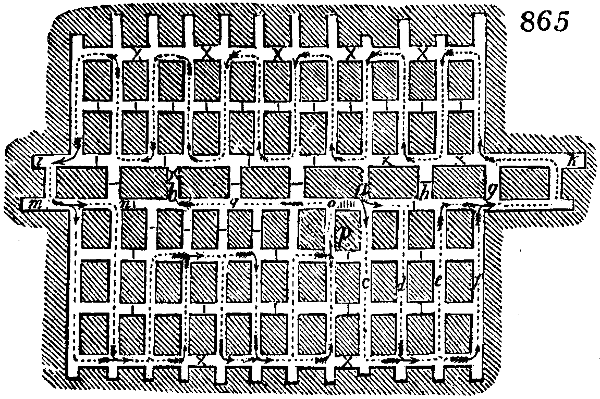
This admirable system has received the greatest improvements from the mining engineers of the Newcastle district, and especially from Mr. Buddle of Wallsend. His plan being a most complete scale of ventilation, where the aerial current is made to sweep every corner of the workings, is shown in fig. 865.; in which a represents the downcast, and b the upcast shaft. By pursuing the track of the arrows, we may observe that the air passes first along the two rooms c, d, having free access to each through the walls, but is hindered from entering into the adjoining rooms by the stoppings which form the air-courses. It sweeps along the wall faces of the rooms c, d, and makes a return down the rooms e, f, but is not allowed to proceed further in that direction by the stoppings g, h. It then proceeds to the foreheads i, k, and single courses all the rooms to the foreheads l, m; from this point it would go directly to the upcast pit b, were it not prevented by the stopping n, which throws it again into double coursing the rooms, till it arrives at o, whence it goes directly to the furnace, and ascends the shaft b. The lines across each other represent the passing doors; and these may be substituted in any place for a passage where there is a stopping. The stopping p, near the bottom of the downcast shaft, is termed a main stopping; because if it were removed, the whole circulation would instantly cease, and the air, instead of traversing in the direction of the arrows, would go directly from the downcast pit a, to the upcast pit b, along the gallery q. Hence every gallery and room of the workings would be laid dead, as it is termed, and be immediately filled with fire-damp, which might take fire either at the workmen’s candles, or at the furnace next the upcast shaft b. Thus also a partial stagnation in one district of the colliery, would be produced by any of the common stoppings being accidentally removed or destroyed, since the air would thereby always pursue the nearest route to the upcast pit. Main stoppings are made particularly secure, by strong additional stone buildings, and they are set up at different places, to maintain the main air courses entire in the event of an explosion; by which precautions great security is given to human life. This system of ventilation may be extended to almost any distance from the pit-bottom, provided the volume of fresh air introduced be adequate to dilute sufficiently the fire-damp, so that the mixture shall not reach the explosive point. The air, by this management, ventilates first one panel of work, and then other panels in succession, passing onwards through the barriers or panel walls, by means of galleries, as in fig. 843., by the principle either of single, double, or triple coursing, according to the quantity of gas in the mine.
In ventilating the very thick coal of Staffordshire, though there is much inflammable air, less care is needed than in the north of England collieries, as the workings are very roomy, and the air courses of comparatively small extent. The air is conducted down one shaft, carried along the main roads, and distributed into the sides of work, as shown in fig. 848. A narrow gallery, termed the air-head, is carried in the upper part of the coal, in the rib walls, along one or more of the sides. In the example here figured, it is carried all round, and the air enters at the bolt-hole e. Lateral openings, named spouts, are led from the air-head gallery into the side of work; and the circulating stream mixed with the gas in the workings, enters by these spouts, as represented by the arrows, and returns by the air-head at g, to the upcast pit.
When the fire-damp comes off suddenly in any case, rendering the air foul and explosive at the foreheads, if no other remedy be found effectual, the working of the coal must be suspended, and a current of air sent directly from the fresh in-going stream, in order to dilute the explosive mixture, before it reaches the furnace. This is termed skailing the air; for otherwise the gas would kindle at the furnace, and flame backwards, like a train of gunpowder, through all the windings of the work, carrying devastation and death in its track. By skailing the air, however, time is given for running forward with water, and drowning the furnace. A cascade of water from the steam engine pumps is then allowed to fall down the pit, the power of which through a fall of 500 or 600 feet, is so great in carrying down a body of air, that it impels a sufficient current through every part of the workings. The ventilation is afterwards put into its usual train at leisure.
In collieries which have been worked for a considerable time, and particularly in such as have goaves, creeps, or crushed wastes, the disengagement of the fire-damp from these recesses is much influenced by the state of atmospheric pressure. Should this be suddenly diminished, as shown by the fall of the barometer, the fire-damp suddenly expands and comes forth from its retirement, polluting the galleries of the mine with its noxious presence. But an increase of barometric pressure condenses the gases of the mine, and restrains them within their sequestered limits. It is therefore requisite that the coal-viewer should consult the barometer before inspecting the subterraneous workings of an old mine, on the Monday mornings, in order to know what precautions must be observed in his personal survey.
The catastrophe of an explosion in an extensive coal-mine is horrible in the extreme. Let us imagine a mine upwards of 100 fathoms deep, with the workings extended to a great distance under the surrounding country, with machinery complete in all its parts, the mining operations under regular discipline, and railways conducted through all its ramifications; the stoppings, passing doors, brattices, and the entire economy of the mine, so arranged that every thing moves like a well regulated machine. A mine of this magnitude at full work is a scene of cheering animation, and happy industry; the sound of the hammer resounds in every quarter, and the numerous carriages, loaded or empty, passing swiftly to and fro from the wall faces to the pit bottom, enliven the gloomiest recesses. At each door a little boy, called a trapper, is stationed, to open, and shut it. Every person is at his post, displaying an alacrity and happiness pleasingly contrasted with the surrounding gloom. While things are in this merry train, it has but too frequently happened that from some unforeseen cause, the ventilation has partially stagnated, allowing a quantity of the fire-damp to accumulate in one space to the explosive pitch; or a blower has suddenly sprung forth, and the unsuspecting miner entering this fatal region with his candle, sets the whole in a blaze of burning air, which immediately suffocates and scorches to death every living creature within its sphere, while multitudes beyond the reach of the flame are dashed to pieces by the force of the explosion, rolling like thunder along the winding galleries. Sometimes the explosive flame seems to linger in one district for a few moments; then gathering strength for a giant effort, it rushes forth from its cell with the violence of a hurricane, and the speed of lightning, destroying every obstacle in its way to the upcast shaft. Its power seems to be irresistible. The stoppings are burst through, the doors are shivered into a thousand pieces; while the unfortunate miners, men, women, and boys, are swept along with an inconceivable velocity, in one body, with the horses, carriages, corves, and coals. Should a massive pillar obstruct the direct course of the aerial torrent, all these objects are dashed against it, and there prostrated or heaped up in a mass of common ruin, mutilation, and death. Others are carried directly to the shaft, and are either buried there amid the wreck, or are blown up and ejected from the pit mouth. Even at this distance from the explosive den, the blast is often so powerful, that it frequently tears the brattice walls of the shaft to pieces, and blows the corves suspended in the shaft as high up into the open air as the ropes will permit. Not unfrequently, indeed, the ponderous pulley-wheels are blown from the pit-head frame, and carried to a considerable distance in the bosom of a thick cloud of coals and coal-dust brought up from the mine by the fire-damp, whose explosion shakes absolutely the superincumbent solid earth itself with a mimic earthquake. The dust of the ruins is sometimes thrown to such a height above the pit as to obscure the light of the sun. The silence which succeeds to this awful turmoil is no less formidable; for the atmospheric back-draught, rushing down the shaft, denotes the consumption of vital air in the mine, and the production of the deleterious choke-damp and azote.
Though many of the miners may have escaped by their distance in the workings from the destructive blast and the fire, yet their fate may perhaps be more deplorable. They hear the explosion, and are well aware of its certain consequences. Every one anxious to secure his personal safety, strains every faculty to reach the pit-bottom. As the lights are usually extinguished by the explosion, they have to grope their way in utter darkness. Some have made most marvellous escapes, after clambering over the rubbish of fallen roofs, under which their companions are entombed; but others wandering into uncertain alleys, tremble lest they should encounter the pestilential airs. At last they feel their power, and aware that their fate is sealed, they cease to struggle with their inevitable doom; they deliberately assume the posture of repose, and fall asleep in death. Such has been too often the fate of the hardy and intelligent miners who immure themselves deep beneath the ground, and venture their lives for the comfort of their fellow-men; and such frequently is the ruinous issue of the best ordered and most prosperous mining concerns.
In such circumstances the mining engineers or coal viewers have a dangerous and difficult duty to perform. The pit into which they must descend as soon as possible, is rendered unsafe by many causes; by the wrecks of loose timber torn away by the eruption, or by the unrespirable gases; by the ignition perhaps of a portion of the coal itself, or by the flame of a blower of fire-damp; either of which would produce violent and repeated explosions whenever the gas may again accumulate to the proper degree. Such a predicament is not uncommon, and it is one against which no human skill can guard. Yet even here, the sense of duty, and the hope of saving some workmen from a lingering death by wounds or suffocation, lead this intrepid class of men to descend amid the very demons of the mine.
As soon as the ventilation is restored by temporary brattices, the stoppings and doors are rebuilt in a substantial manner, and the workings are resumed with the wonted activity. From an inspection of fig. 864., p. 1029, it is obvious that the stability of the main stopping p, is an important point; for which reason it is counterforted by strong walls of stone, to resist the explosive force of fire-damp.
When it is known that fire exists in the wastes, either by the burning of the small coal-dust along the roads, or from the ignition of the solid coal by a blower of gas, the inspection of the mine is incomparably more hazardous, as safety cannot be insured for an instant; for if the extrication of gas be great, it rapidly accumulates, and whenever it reaches the place where the fire exists, a new explosion takes place. There have been examples of the most furious detonations occurring regularly after the interval of about an hour, and being thus repeated 36 times in less than two days, each eruption appearing at the pit mouth like the blast of a volcano. It would be madness for any one to attempt a descent in such circumstances. The only resource is to moat up the pit, and check the combustion by exclusion of atmospheric air, or to drown the workings by letting the water accumulate below ground.
When fire exists in the wastes, with less apparent risk of life, water is driven upon it by portable fire-extinguishing engines, or small cannon are discharged near the burning coal, and the concussion thus produced in the air sometimes helps to extinguish the flame.
Since the primary cause of these tremendous catastrophes is the accension of the explosive gases by the candle of the miner, it has been long a desideratum to procure light of such a nature as may not possess the power of kindling the fire-damp. The train of light producible from the friction of flint and steel, by a mechanism called a steel mill, has been long known, and afforded a tolerable gleam, with which the miners were obliged to content themselves in hazardous atmospheres.
It consists of a small frame of iron, mounted with a wheel and pinion, which give rapid rotation to a disk of hard steel placed upright, to whose edge a piece of flint is applied. The use of this machine entailed on the miner the expense of an attendant, called the miller, who gave him light. Nor was the light altogether safe, for occasionally the ignited shower of steel particles attained to a sufficient heat to set fire to the fire-damp.
At length the attention of the scientific world was powerfully attracted to the means of lighting the miner with safety, by an awful catastrophe which happened at Felling Colliery, near Newcastle, on the 25th May, 1812. This mine was working with great vigour, under a well-regulated system of ventilation, set in action by a furnace and air-tube, placed over a rise pit in elevated ground. The depth of winning was above 100 fathoms; 25 acres of coal had been excavated, and one pit was yielding at the rate of 1700 tons per week. At 11 o’clock in the forenoon the night shift of miners was relieved by the day shift; 121 persons were in the mine, at their several stations, when, at half-past 11, the gas fired, with a most awful explosion, which alarmed all the neighbouring villages. The subterraneous fire broke forth with two heavy discharges from the dip-pit, and these were instantly followed by one from the rise-pit. A slight trembling, as from an earthquake, was felt for about half a mile round the colliery, and the noise of the explosion, though dull, was heard at from 3 to 4 miles’ distance. Immense quantities of dust and small coal accompanied these blasts, and rose high into the air, in the form of an inverted cone. The heaviest part of the ejected matter, such as corves, wood, and small coal, fell near the pits; but the dust borne away by a strong west wind fell in a continuous shower a mile and a half from the pit. In the adjoining village of Heworth it caused a darkness like that of early twilight, covering the roads where it fell so thickly that the footsteps of passengers were imprinted in it. The heads of both shaft-frames were blown off, their sides set on fire, and their pulleys shattered to pieces. The coal-dust ejected from the rise-pit into the horizontal part of the ventilating tube, was about 3 inches thick, and speedily burnt to a cinder; pieces of burning coal, driven off the solid stratum of the mine, were also blown out of this shaft. Of the 121 persons in the mine at the time of the explosion, only 32 were drawn up the pit alive, 3 of whom died a few hours after the accident. Thus no less than 92 valuable lives were instantaneously destroyed by this pestilential fire-damp. The scene of distress among the relatives at the pit mouth was indescribably sorrowful.