F. (continued 5)
Reading edition
In the following September, I executed for the Board of Ordnance a set of experiments complementary to those of the memoir, with the view of ascertaining the best manner of protecting the fulminate when applied to the copper caps, from being detached by carriage, or altered by keeping. The following were my results and conclusions.
1. Fulminate of mercury moistened upon copper is speedily decomposed by the superior affinity of the copper over mercury, for oxygen and fulminic acid. Dryness is, therefore, essential to the preservation of the fulminate; and hence charcoal, which is apt to become moist, should not be introduced into percussion caps destined for distant service.
2. An alcoholic solution of sandarach, commonly called spirit varnish, acts powerfully on copper, with the production of a green efflorescence, which decomposes fulminate of mercury. Indeed, sandarach can decompose the salts of copper. It is therefore ill adapted for attaching the fulminate to copper caps.
3. An alcoholic solution of shell-lac acts on copper, though more feebly than the sandarach.
4. A solution of mastic in spirits of turpentine, whether alone or mixed with fulminate, has no action whatever on bright copper, but protects it from being tarnished. Such a varnish is very cheap, dries readily, adheres strongly, screens the fulminate from damp, and does not impair or counteract its detonating powers. This, therefore, is in my opinion the fittest medium for attaching the fulminate, and for softening the force of its impulsion in any degree proportional to the thickness of the varnish.”
Fulminate of mercury is obtained in white grains, or short needles, of a silky lustre, which become gray upon exposure to light, and detonate either by a blow or at a heat under 370° F.; with the disengagement of azote, carbonic acid, as also of aqueous and mercurial vapours; to the sudden formation of which gaseous products the report is due. It detonates even in a moist condition; and when dry it explodes readily when struck between two pieces of iron, less so between iron and bronze, with more difficulty between marble and glass, or between two surfaces of marble or glass. It is hardly possible to explode it by a blow with iron upon lead; and impossible by striking it with iron upon wood. It fulminates easily when rubbed between two wooden surfaces; less so between two of marble, two of iron, or one of iron against one of wood or marble. The larger its crystals, the more apt they are to explode. By damping it with 5 per cent. of water, it becomes less fulminating; the part of it struck still explodes with a proper blow, but will not kindle the adjoining portion. Though moistened with 30 per cent. of water, it will occasionally explode by trituration between a wooden muller and a marble slab, but only to a small extent, and never with any danger to the operator. When an ounce of it, laid upon the bottom of a cask, is kindled, it strikes a round hole down through it, as if it had been exposed to a four-pound shot, without splintering the wood. If a train of fulminate of mercury be spread upon a piece of paper, covered with some loose gunpowder, in exploding the former the latter will not be kindled, but merely scattered. When gunpowder, however, is packed in a cartridge, or otherwise, it may be certainly kindled by a percussion cap of the fulminate, and more completely than by a priming of gunpowder. 81⁄2 parts of gunpowder exploded by a percussion cap, have an equal projectile force as 10 exploded by a flint lock. If we add to this economy in the charge of the barrel, the saving of the powder for priming, the advantage in military service of the percussion system will become conspicuous.
The French calculate that 1 kilogramme of mercury will furnish 11⁄4 kil. (21⁄2 lbs. nearly) of fulminate, which will be sufficient to charge 40,000 percussion caps. For this purpose they grind the crystalline salt along with 30 per cent. of water upon a marble table with a wooden muller; mixing with every 10 parts of the fulminate 6 of gunpowder. A consistent dough is thus obtained, which, being dried in the air, is ready for introducing into the bottoms of the copper caps. One quarter of a grain of the fulminate is said to be fully sufficient for one priming.
Mr. Lovell, of the Royal Manufactory of Arms, has lately executed a series of experiments upon priming powders. His trials, which occupied nearly 18 months, were made for the purpose of ascertaining what is the advantage in point of force obtained by using percussion primes. He had anticipated some extra energy would be imparted to the charge of powder in the barrel, because he had repeatedly proved that a good strong cap, exploded by itself on the nipple of the musquet, (without any charge of gunpowder), will exert sufficient force upon the air within the barrel to blow a candle out at a distance of 12 feet from the muzzle. He concluded also that stopping the escape of fluid from the vent, as is done by the cap, would have some effect, but he attributed most to the quickness and energy with which the powder of the charge is ignited by the vivid stream of flame, generated by the percussion prime. The trials were made from one and the same barrel, having a percussion lock on one side and a flint lock on the other. The balls were fired against Austen’s recoiling target, a very delicate plegometer, beginning with a charge of 150 grains (the present musquet charge), and descending by 10 grains at a time (firing 30 rounds with each weight), down to 50 grains. The machine marked the decrease of force at each reduction in the charge very satisfactorily, and the result of the whole average was that 8·84 parts of gunpowder fired by percussion are equal to 10 parts fired by the flint.
To find out what sort of liberties might be taken with fulminate of mercury in handling it, he placed 3 grains on an anvil, putting the end of a steel punch gently on the top of it, and while so placed he covered the fulminate over with a drachm of dry gunpowder. He then ignited the fulminate by a blow on the punch with the hammer, but not a grain of the gunpowder was lighted, though it was blown about in all directions. He then placed a train of fulminate as thick as a quill, and about 3 feet long, on a table, and covered it over entirely with gunpowder except about an inch at one end; this he lighted with a hot iron, when the whole train went off without blazing a grain of the gunpowder, which he swept together and blew up afterwards with a match. He then took a tin box containing 500 copper caps, made a hole in the top of the box, and through this hole ignited one of the caps in the middle, by means of the punch and hammer on the outside; only two other caps besides the one struck exploded; no injury was sustained by the remainder, except being discoloured. This he tried repeatedly, and always with the same kind of result, never more than 3 or 4 caps exploding. He then made a steel rammer red hot, and passed it through the hole in the box right in amongst the caps, but it only ignited them where the hot iron came in actual contact with the priming composition; when, however, he placed a few grains of gunpowder loose among the caps, the hot iron lighted this, and produced a flame that blew off the whole of them.
The same thing has been tried at Woolwich, where large packages of percussion caps (some thousands) have been fired at with musquet balls, and only a few of the caps actually hit by the ball exploded; but when any cartridges were connected with the packages, the whole, caps and all were blown up. The flame of the fulminate is therefore hazardous, but being so very ethereal, it requires for making primes, an admixture of some combustible matter, as a little gunpowder, to condense or modify the flame.
FULMINIC ACID; (Acide fulminique, Fr.; Knallsäure, Germ.) is the explosive constituent of the fulminating mercury of Howard, and the fulminating silver of Brugnatelli, being generated by the reaction of alcohol and the acid nitrates of these metals. It is a remarkable chemical fact, that fulminic acid has exactly the same composition as cyanic acid; though the salts of the latter possess no detonating property, and afford, in their decomposition by an oxygen acid, ammonia with carbonic acid; while those of the former afford ammonia and prussic acid. All attempts to insulate fulminic acid have proved unsuccessful, as it explodes with the slightest decomposing force. It consists, by weight, of 2 primes of carbon, 1 of azote, and 1 of oxygen; or of two volumes of carbonic acid, and one of azote. When two different bodies, like the above, have the same composition, they are said to be isomeric.
FUMIGATION, is the employment of fumes or vapours to purify articles of apparel, and goods or apartments supposed to be imbued with some infectious or contagious poison or fumes. The vapours of vinegar, the fumes of burning sulphur, explosion of gunpowder, have been long prescribed and practised, but they have in all probability little or no efficacy. The diffusion of such powerful agents as chlorine gas, muriatic acid gas, or nitric acid vapour, should alone be trusted to for the destruction of morbific effluvia.
FUR; see Peltry.
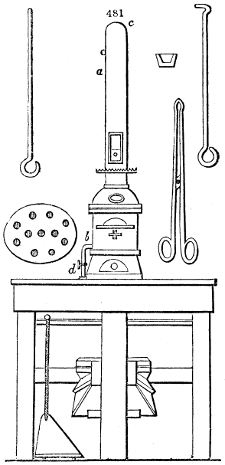
FURNACE OF ASSAY. Under Assay, I have referred to a furnace constructed by Messrs. Anfrye and d’Arcet, which gives some peculiar facilities and economy to the ancient process by fire. It had originally a small pair of bellows attached to it, for raising the heat rapidly to the proper vitrifying pitch. The furnace, 171⁄2 inches high, and 71⁄2 inches wide, made of pottery or fine clay, is represented fig. 481., supported upon a table, having a pair of bellows beneath it. The laboratory is at b, the blow-pipe of the bellows at d, with a stop-cock, and the dome is surmounted by a chimney a, c, in whose lower part there is an opening with a sliding door, for the introduction of the charcoal fuel. The furnace is formed in three pieces; a dome, a body, and an ash-pit. A pair of tongs, a stoking hook, and cupel, are seen to the right hand, and the plan of the stone-ware grate, pierced with conical holes, and a poker, are seen to the left. This grate suits the furnace represented under Assay. The following are comparative experiments made by means of this furnace:
Numbers. Silver employed. Lead employed. Time of Assay. Standards. Charcoal used.
1 1 Grain. 4 Grains. 12 minutes. 947 millièmes. 173 Grains.
2 — — 11 950 86
3 — — 13 949 93
4 — — 10 949 60
Each assay was therefore performed at an average in 111⁄2 minutes, and not much more than a quarter of a pound of charcoal was used. An experiment of verification in the ordinary assay furnace showed the standard to be 949 thousandths.
This furnace becomes a very convenient one for melting small quantities of metals in analyses, by removing the muffle, and closing the several apertures with their appropriate stoppers. A small pedestal may be then set in the middle of the grate, to support a crucible, which may be introduced through the opening h. Coak may also be used as fuel, either by itself or mixed with charcoal. For descriptions of various furnaces, see Assay; Beer; Copper; Evaporation; Iron; Metallurgy; Ores; Silver; Tin; &c.
FUSIBILITY. That property by which solids assume the fluid state.
Some chemists have asserted that fusion is simply a solution in caloric; but this opinion includes too many yet undecided questions, to be hastily adopted.
Fusibility of Metals, as given by M. Thenard.
Centigr.
1. Fusible below a red heat. Mercury -39 °
Potassium +58 ° - Gay Lussac and Thenard.
Sodium 90
Tin 210 - Newton.
Bismuth 256
Lead 260 Biot.
Tellurium A little less fusible than lead.—Klaproth.
Arsenic Undetermined.
Zinc 370 ° Brongniart.
Antimony A little below a red heat.
Cadmium Stromeyer.
Pyrometer of Wedgewood.
2. Infusible below a red heat. Silver 20 ° Kennedy.
Copper 27 - Wedgewood.
Gold 32
Cobalt A little less difficult to melt than iron.
Iron - 130 Wedgewood.
158 Sir G. M’Kenzie.
Manganese 160 Guyton.
Nickel As manganese.—Richter.
Palladium - Nearly infusible; and to be obtained at a forge heat only in small buttons.
Molybdenum
Uranium
Tungsten
Chromium
Titanium - Infusible at the forge furnace. Fusible at the oxyhydrogen blowpipe. See Blowpipe.
Cerium
Osmium
Iridium
Rhodium
Platinum
Columbium
FUSIBLE METAL. See Alloy.
FUSTET. (Fustec, Fr.) The wood of the rhus cotinus, a fugitive yellow dye.
FUSTIAN, is a species of coarse thick tweelled cotton, and is generally dyed of an olive, leaden, or other dark colour. Besides the common fustian, which is known by the name of pillow (probably pilaw), the cotton stuffs called corduroy, velverett, velveteen, thicksett, used for men’s wearing apparel, belong to the same fabric. The commonest kind is merely a tweel of four, or sometimes five leaves, of a very close stout texture, and very narrow, seldom exceeding 17 or 18 inches in breadth. It is cut from the loom in half pieces, or ends as they are usually termed, about 35 yards long, and after undergoing the subsequent operations of dyeing, dressing, and folding, is ready for the market.
The draught and cording of common fustian is very simple, being generally a regular or unbroken tweel of four or five leaves. Below are specimens of a few different kinds, selected from those most general in Lancashire.
The number of leaves of heddles are represented by the lines across the paper, and the cording by the cyphers in the little squares, those which raise every leaf being distinguished by these marks, and those which sink them left blank, as more particularly explained in the article Textile Fabric.
Of velvet, there are properly only two kinds, that with a plain, and that with a tweeled, or, as it is here called, a Genoa ground, or back. When the material is silk, it is called velvet, when cotton, velveteen; and this is the sole difference. In the same way a common tweeled cloth, when composed of silk is called satin; when of cotton, fustian or jean; of woollen, plaiding, serge, or kerseymere; and in the linen trade is distinguished by a variety of names according to the quality or fineness, or the place where the article is manufactured.
No. 1.—Pillow Fustian. No. 2.—Plain Velveret.
0 4 5 1 § 0 3 1
0 3 6 2 § 0 5
0 6 2 3 § 0 0 0 0 2
0 5 1 4 § 0 6 4
2 4 3 1 4 6 2 3 1
5
Of the above, each contains four leaves of heddles or healds; that represented by No. 1. is wrought by four treddles, and that which is distinguished by No. 2. by five; the succession of inserting the threads of warp into the heddles will be discovered by the figures between the lines, and the order in which the treddles are to be successively pressed down by the figures below.
No. 3.—Double Jean. No. 4.—Plain Thicksett.
0 0 1 § 0 8
0 0 2 § 0 0 0 6 4
0 0 3 § 0 5 2
0 0 4 § 0 0 0 7 3 1
4 2 3 1 4 6 2 3 1
5 7
These, like the former, are wrought with leaves. No. 3. requires four, and No. 4. five treddles. The succession of inserting the threads of warp, and of working the treddles, are marked by the respective numbers between and under the lines, as in the former example. Both are fabrics of cloth in very general use and estimation as low priced articles.
No. 5.—Best Thicksett. No. 6.—Velvet Tuft.
0 0 0 3 1 § 0 5 3 1
0 5 § 0 0 4 2
0 2 § 0 0 0 4 2
0 0 6 4 § 0 5 3 1
6 4 2 3 1 6 4 2 3 1
5
These are further specimens of what may be, and is, executed with four leaves, and in both examples five treddles are used. With two other specimens we shall conclude our examples of this description of work, and shall then add a very few specimens of the more extensive kinds.
No. 7.—Cord and Velveret. No. 8.—Thicksett Cord.
0 3 1 3 1 § 0 0 0 5 3 1
0 0 5 7 5 § 0 4 2
0 0 0 6 8 2 § 9 7
0 4 2 6 4 § 0 0 10 8 6
4 2 3 1 5 4 3 2 1
6 5
In these the succession of drawing and working are marked like the former. The next are examples of patterns wrought with six leaves. No. 9. has eight, and No. 10. five heddles.
No. 9.—Double Corduroy. No. 10.—Genoa Thicksett.
0 0 0 1 § 0 0 1
0 0 2 § 0 0 2
0 0 0 0 0 3 § 0 0 0 3
0 0 4 § 0 0 0 4
0 0 5 § 0 0 0 5
0 0 6 § 0 0 6
2 4 6 8 10 12 3 1 4 2 5 3 1
7 5 8 6 11 9 7
11 9 1 2 10
In both these the warp is inserted into the heddles the same way. The difference is entirely in the application of the cords, and in the succession of pressing down the treddles. We now give four specimens of the flushed and cut work, known by the name of velveteen. They are also upon six leaves, and the difference is solely in the cording and in the treading.
No. 11.Queen’s Velveteens.No. 12.
0 0 0 1 § 0 0 1
0 0 2 § 0 0 0 2
0 0 3 § 0 0 3
0 0 0 4 § 0 0 0 4
0 0 5 § 0 0 5
0 0 0 6 § 0 0 0 6
1 2 12 8 4 2 2 4 3 1
5 7 6 6 8 7 5
9 11 10 10 12 11 9
No. 13.—Plain Velveteen. No. 14.—Genoa Velveteen.
0 1 § 0 0 0 1
0 0 2 § 0 0 2
0 3 § 0 0 0 3
0 0 4 § 0 0 4
0 5 § 0 0 0 5
0 0 6 § 0 0 6
1 3 2 4 8 2 4 8 12 3 1
5 7 6 6 7 5
10 11 9
The additional varieties of figure which might be given are almost endless, but the limits of this article will not admit a further detail. Those already given are the articles in most general use. The varieties of fancy may be indulged to great extent, but it is universally found, that the most simple patterns in every department of ornamental weaving, are those which attract attention and command purchasers. We shall therefore only add two examples of king’s cord or corduroy, two of Genoa and common velvet, and two more of jean. These will be found below.
No. 15.—King’s Cord. No. 16.—Dutch Cord.
0 0 1 § 0 4 1
0 0 2 § 0 0 5 2
0 0 7 3 § 0 0 6 3
0 0 8 4 § 0 0 7
0 0 0 5 § 0 0 0 8
0 0 6 § 0 0 0 0 9
1 3 8 6 4 2 6 4 2 3 1
5 7 5
No. 17.—Genoa Velvet. No. 18.—Plain Velvet.
0 0 1 § 1
0 0 0 2 § 2
0 0 3 § 3
0 0 4 § 4
0 0 5 § 5
0 0 6 § 6
2 4 8 12 3 1 1 3 4 2 8
6 7 5 7 5
10 11 9
After the fustian cloth is taken from the loom-beam, it is carried to the cutter, who rips up the surface-threads of weft, and produces thereby a hairy-looking stuff.
Preparatory to its being cut, the cloth is spread evenly upon a table about six feet long, upon each end of which a roller mounted with a ratchet-wheel is fixed; the one to give off, and the other to wind up the piece, in the above six-feet lengths.
The knife is a steel rod about two feet long, and three-eighths of an inch square, having a square handle at the one end; the other end is tapered away to a blade, as thin as paper. To prevent this point from turning downwards and injuring the cloth, its under side is covered by a guide which serves to stiffen it, as well as to prevent its lower edge from cutting the fustian.
The operative (male or female) grasps the handle in the right hand, and insinuating the projecting point of the guide under the weft, pushes the knife smartly forward through the whole length of six feet, with a certain dexterous movement of the shoulder and right side, balancing the body meanwhile, like a fencer, upon the left foot. This process is repeated upon every adhesive line of the weft.
The next process to which fustians are exposed is steeping in hot water, to take out the dressing paste. They are then dried, reeled, and brushed by a machine, &c. From twenty to thirty pieces, each eighty yards long, may be brushed in an hour. The breadth of the cloth is twenty inches. The maceration is performed by immersing the bundled pieces in tanks of water, heated by waste steam; and the washing by means of a reel or winch, kept revolving rapidly under the action of a stream of cold water, for an hour or longer.
After being thus ripped up, it is taken to the brushing or teazling machine, to make it shaggy.
This consists of a series of wooden rollers, turning freely upon iron axles, and covered with tin-plate, rough with the burs of punched holes; and blocks of wood, whose concave under surfaces are covered with card-cloth or card-brushes, and which are made to traverse backwards and forwards in the direction of the axes of the revolving rollers, during the passage of the cloth over them.
After they are brushed in the machine, the goods are singed by passing their cut surface over a cylinder of iron, laid in a horizontal direction, and kept red hot by a flue. See Singeing. They are now brushed again by the machine, and once more passed over the singeing surface. The brushing and singeing are repeated a third or even occasionally a fourth time, till the cord acquires a smooth polished appearance.
The goods are next steeped, washed, and bleached, by immersion in solution of chloride of lime. They are then dyed by appropriate chemical means. After which they are padded (imbued by the padding machine of the calico printers) with a solution of glue, and passed over steam cylinders to stiffen them.
Smooth fustians, when cropped or shorn before dyeing, are called moleskins; but when shorn after being dyed, are called beaverteen, they are both tweeled fabrics. Cantoon is a fustian with a fine cord visible upon the one side, and a satiny surface of yarns running at right angles to the cords upon the other side. The satiny side is sometimes smoothed by singeing. The stuff is strong, and has a very fine aspect. Its price is one shilling and sixpence a yard.
Common plain fustian, of a brown or drab colour, with satin top, is sold as low as sevenpence a yard.
A fustian, with a small cord running in an oblique direction, has a very agreeable appearance. It is called diagonal. Moleskin shorn, of a very strong texture, and a drab dyed tint, is sold at 20d. per yard.
The weight of 90 yards of the narrow velveteen, in the green or undressed state, is about 24 pounds. The goods made for the German, Italian, and Russian markets are lighter, on account of the peculiarity in the mode of levying the import duty in these countries.
Velveteens as they come from the loom, are sold wholesale by weight, and average a price of 20d. per pound. They are usually woven with yarns of Upland and Brazil cotton wool, spun together for the warp; or, sometimes, New Orleans alone. The weft is usually Uplands, sometimes mixed with East India cotton wools.
Trowser velveteens are woven 19 inches wide, if they are to be cut up; if not, they are woven 30 inches, and called beaverteen.
Cutting or cropping fustians by hand is a very laborious and delicate operation. The invention of an improved apparatus for effecting the same end with automatic precision and despatch, was therefore an object of no little interest to this peculiar manufacture of Manchester. An ingenious machine, apparently well calculated for this purpose, was made the subject of a patent by Messrs. William Wells and George Scholefield, of Salford in November, 1834.
FUSTIC. (Bois jaune, Fr.; Gelbholz, Germ.) The old fustic of the English dyer, as the article fustet is their yellow fustic. It is the wood of the Morus tinctoria. It is light, not hard, and pale yellow with orange veins; it contains two colouring matters, one resinous, and another soluble in water. The latter resembles weld, but it has more of an orange cast, and is not so lively.
Its decoctions in water are brightened by the addition of a little glue, and more by curdled milk. This wood is rich in colour, and imparts permanent dyes to woollen stuffs, when aided by proper mordants. It unites well with the blue of the indigo vat, and Saxon blue, in producing green of various shades. Alum, tartar, and solution of tin, render its colour more vivid; sea salt and sulphate of iron deepen its hue. From 5 to 6 parts of old fustic are sufficient to give a lemon colour to 16 parts of cloth. The colour of weld is however purer and less inclining to orange; but that of fustic is less affected by acids than any other yellow dye. This wood is often employed with sulphate of iron in producing olive and brownish tints, which agree well with its dull yellow. For the same reason it is much used for dark greens.