H. (continued 2)
Reading edition
Working of the frame.—In order to work a frame, the whole apparatus being previously put into complete order, the hosier places himself on the seat B in front, and provides himself with a bobbin of yarn or stuff. This bobbin he places loosely on a vertical pin of wire, driven into one side of the frame contiguous to the needles, so that it may turn freely as the stuff is unwound from it. Taking the thread in his hand, he draws it loosely along the needles, behind the barbs, and under the throats of the sinkers. He then presses down one of the treadles to pass the slur along, and unlock the jacks from the back springs, that they may fall in succession. When this is done, the number of loops thus formed is doubled by bringing down the lead sinkers, and the new formed loops are lodged under the barbs of the needles by bringing forward the sinkers. The preceding course, and former fabric, being then again pushed back, the barbs are shut by depressing the middle treadle, and forcing down the presser upon the needles. The former work is now easily brought over the shut needles, after which, by raising the hands, both sets of sinkers are raised; the jacks are locked by the back springs, and the hosier goes on to another course.
From this it will be apparent, that the remark made in the outset is well founded, that there are in reality, no complicated or difficult movements in the stocking-frame. Almost the whole are merely those of levers moving upon their respective fulcra, excepting that of the carriage which gives the horizontal motion to the sinkers, and that is merely an alternate motion on four wheels. Yet the frame is a machine which requires considerable experience and care, both to work it to advantage, and also to keep it in good order. This circumstance arises greatly from the small compass in which a number of moving parts must be included. Owing to this, the needles, unless cautiously and delicately handled, are easily bent or injured. The same circumstance applies with equal or greater force to the sinkers, which must be so very thin as to be easily injured. But as these must work freely, both in a perpendicular and horizontal direction between the needles, in a very confined and limited space, the slightest variation in either, from being truly and squarely placed, unavoidably injures the others. When a hosier, either ignorant of the mechanical laws, of their relation to each other, or too impatient to wait for the assistance of another, attempts to rectify defects, he in most cases increases them tenfold, and renders the machine incapable of working at all, until repaired by some more experienced person. This circumstance has given rise to a set of men employed in this trade, and distinguished by the name of upsetters; and these people, beside setting new frames to work, have frequently more employment in repairing old ones injured by want of care or skill, than many country apothecaries, who live in unhealthy parishes, find in tampering with the disorders of mankind.
It seems unnecessary to go further into detail respecting a machine so well known, and which requires practical attention even more than most others. It may, therefore, be sufficient to describe shortly some of its varieties, the most simple and common of which is the rib stocking-frame.
Rib stocking-frame.—This frame, which, next to the common frame, is most extensively in use, is employed for working those striped or ribbed stockings, which are very common in all the different materials of which hosiery is formed. In principle it does not differ from the common frame, and not greatly in construction. The preceding general description will nearly apply to this machine with equal propriety as to the former: that part, however, by which the ribs or stripes are formed, is entirely an addition, and to the application of this additional machinery it may be proper to pay the chief attention, referring chiefly to fig. 558., which is a front elevation.
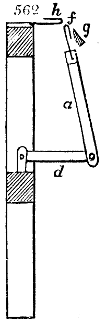
This figure has been already referred to for the illustration of those parts of the machinery which are common to both, and those parts therefore require no recapitulation. The principle of weaving ribbed hosiery possesses considerable affinity to that which subsists in the weaving of that kind of cloth which is distinguished by the name of tweeling, for the formation of stripes, with some variation arising merely from the different nature of the fabric. In cloth weaving, two different kinds of yarn intersecting each other at right angles, are employed; in hosiery only one is used. In the tweeling of cloth, striped as dimity, in the cotton or kerseymere, and in the woollen manufacture, the stripes are produced by reversing these yarns. In hosiery, where only one kind of yarn is used, a similar effect is produced by reversing the loops. To effect this reversing of the loops, a second set of needles is placed upon a vertical frame, so that the bends of the hooks may be nearly under those of the common needles. These needles are cast into tin moulds, pretty similar to the former, but more oblique or bevelled towards the point, so as to prevent obstructions in working them. They are also screwed to a bar of iron, generally lighter than the other, and secured by means of plates: this bar is not fixed, but has a pivot in each end, by means of which the bar may have a kind of oscillatory motion on these pivots. Two frames of iron support this bar; that in which it oscillates being nearly vertical, but inclined a little towards the other needles. Fig. 562., which is a profile elevation, will serve to illustrate the relative position of each bar to the other. The lower or horizontal frame, the ends only of which can be seen in fig. 558. under a a, appears in profile in fig. 562., where it is distinguished by d. The vertical frame at a is attached to this by two centre screws, which serve as joints for it to move in. On the top of this frame is the rib-needle bar at f, in figs. 552. and 562., and one needle is represented in fig. 562. at f. At g is a small presser, to shut the barbs of the rib-needles, in the same manner as the large one does those of the frame. At h is one of the frame needles, to show the relative position of the one set to the other. The whole of the rib-bar is not fitted with needles like the other; for here needles are only placed where ribs or stripes are to be formed, the intervals being filled up with blank leads, that is to say, with sockets of the same shape as the others, but without needles; being merely designed to fill the bar and preserve the intervals. Two small handles depend from the needle bar, by which the oscillatory motion upon the upper centres is given. The rising and sinking motion is communicated to this machine by chains which are attached to iron sliders below, and which are wrought by the hosier’s heel when necessary. The pressure takes place partly by the action of the small presser, and partly by the motion of the needles in descending, A small iron slider is placed behind the rib-needles, which rises as they descend, and serves to free the loops perfectly from each other.
In the weaving of ribbed hosiery, the plain and rib courses are wrought alternately. When the plain are finished, the rib-needles are raised between the others, but no additional stuff is supplied. The rib-needles intersecting the plain ones, merely lay hold of the last thread, and, by again bringing it through that which was on the rib-needle before, give it an additional looping, which reverses the line of chaining, and raises the rib above the plain intervals, which have only received a single knitting.
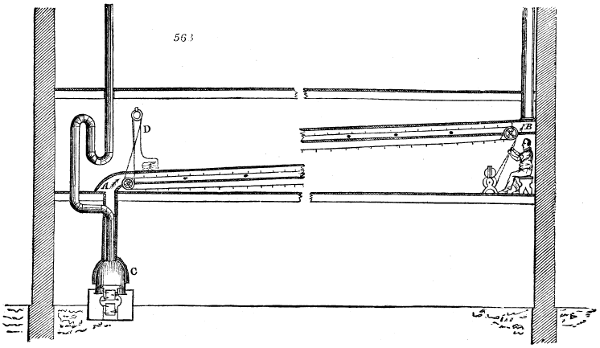
HOT-FLUE, is the name given in England to an apartment heated by stoves or steam pipes, in which padded and printed calicoes are dried hard. Fig. 563. represents the simplest form of such a flue, heated by the vertical round iron stove C, from whose top a wide square pipe proceeds upwards in a slightly inclined direction, which receives the current of air heated by the body and capital of the stove. In this wide channel there are pullies, with cords or bands which, suspend by hooks, and conduct the web of calico, from the entrance at B, where the operative sits, to near the point A, and back again. This circuit may be repeated once or oftener till the goods are perfectly dried. At D the driving pulley connected with the main shaft is shown. Near the feet of the operative is the candroy or reel upon which the moist goods are rolled in an endless web; so that their circulation in the hot-air channel can be continued without interruption, as long as may be necessary.
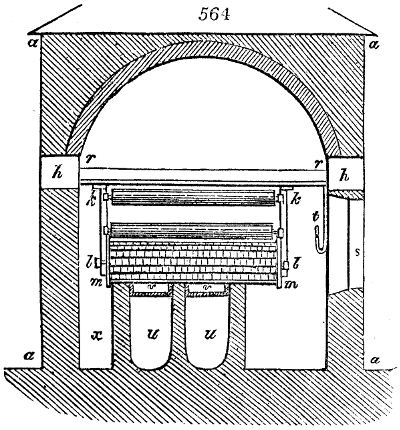
Fig. 564. is a cross section of the apparatus of the regular hot-flue, as it is mounted in the most scientific calico works of England, those of James Thomson, Esq., of Primrose, near Clitheroe, Lancashire. a a a a, is an arched apartment, nearly 30 yards long, by 13 feet high, and 10 feet wide. Through about one half of this gallery there is a horizontal floor supported on arches, above which is the driest space, through which the goods are finally passed before they escape from the hot-flue, after they have been previously exposed to the hot but somewhat moist air of the lower compartment. A large square flue covered with cast-iron plates runs along the whole bottom of the gallery. It is divided into two long parallel vaults, whose sections are seen at u, u, fig. 564., covered with the cast-iron plates v v, grooved at their ends into one another. The thickness of these plates is increased progressively as they come nearer to the fireplace or furnace. There are dampers which regulate the draught, and of course the heat of the stove. h h are the air-passages or vent-holes, left in the side walls, and which by means of a long iron rod, mounted with iron plates, may be opened or closed together to any degree. k k are the cast-iron supports of the tinned brass rollers which guide the goods along, and which are fixed to the cross pieces represented by r r, fig. 564. l l are iron bars for supporting the ventilators or fans (see the fan under Foundry). These fans are here enclosed within a wire grating. They make about 300 turns per minute, and expel the moist air with perfect effect. s indicates the position of the windows, which extend throughout the length of the building. t is a gas-light jet, placed at the side of each window to supply illumination for night work.
The piece is stretched along the whole extent of the gallery, and runs through it in the course of one minute and a half; being exposed during its passage to the heat of 212° Fahr.
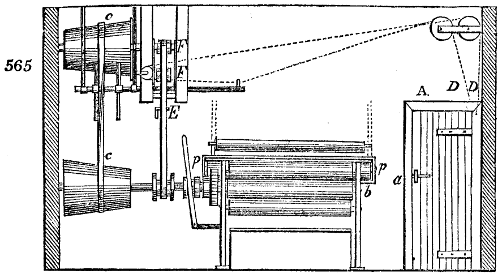
In fig. 565., A is the iron door of entrance to the hot-flue gallery; at b is the padding machine, where the goods are imbued with the general mordant. The speed of this machine may be varied by means of the two conical drums c c, which drive it; since when the band c c, is brought by its forks, and adjusting screws, nearer to the narrow end of the lower drum, the cylinder upon the same shaft with the latter is driven quicker; and vice versa. Over D D the cords are shown for drawing the drum mechanism into geer with the main shaft band F, F, E; or for throwing it out of geer. The pullies F F carry the bands which transmit the motion to the padding machine. A cylindrical drum exterior to the hot-flue, covered with flannel, serves to receive the end of the series of pieces, and to draw them through the apartment. This mode of drying the padded calicoes requires for each piece of 28 yards, 3 pounds of coals for the furnace when a fan is employed, and 4 pounds without it.
HYDRATES; are compounds of the oxides, salts, &c. with water in definite or equivalent proportions. Thus slaked lime consists of one atom of quick-lime = 28, + one atom of water = 9, of which the sum is 37 on the hydrogen scale.
HYDRAULIC PRESS. See Oil, Press, and Stearine.
HYDRIODIC ACID; (Acide Hydriodique, Fr.; Hydriodsäure, Germ.) is an acid formed by the combination of 99·21 parts of iodine, and 0·79 hydrogen. When pure, it occurs in the gaseous state, but it combines with water like the hydrochloric or muriatic acid gas into a liquid acid.
HYDROCHLORIC ACID; the new chemical name of muriatic acid, which see.
HYDROGEN; (Eng. and Fr.; Wasserstoff, Germ.) an undecompounded gaseous body; the lightest of all ponderable matter, whose examination belongs to chemistry.
HYDROMETER; an instrument for ascertaining the specific gravities of liquids. Baumé’s hydrometer, which is much used in France, and other countries of the continent of Europe, when plunged in pure water, at the temperature of 58° Fahr., marks 0 upon its scale; in a solution containing 15 per cent. of common salt, (chloride of sodium) and 85 of water by weight, it marks 15°; so that each degree is meant to indicate a density corresponding to one per cent. of that salt. See Areometer, for comparative tables of hydrometers.
HYDROSULPHURETS; chemical compounds of bases with sulphuretted hydrogen.
HYMENŒA COURBARIL; a tree growing in South America, from which the resin animé exudes.
HYOSCIAMUS NIGER. Henbane is a plant used in medicine, from which modern chemistry has extracted a new crystalline vegetable principle called hyosciamine, which is very poisonous, and when applied in solution to the eye, determines a remarkable dilatation of the pupil; as belladonna also does.
HYPOSULPHATES; Hyposulphites; saline compounds of the hyposulphuric or hyposulphurous acid with bases.
HYPEROXYMURIATES; the old and incorrect name of Chlorates.