T.
Reading edition
TABBYING, or WATERING, is the process of giving stuffs a wavy appearance with the calender.
TACAMAHAC, is a resin obtained from the Fagura octandra, a tree which grows in Mexico and the West Indies. It occurs in yellowish pieces, of a strong smell, and a bitterish aromatic taste. That from the island of Madagascar has a greenish tint.
TAFFETY, is a light silk fabric, with a considerable lustre or gloss.
TAFIA, is a variety of rum.
TALC, is a mineral genus, which is divided into two species, the common and the indurated. The first occurs massive, disseminated in plates, imitative, or crystallized in small six-sided tables. It is splendent, pearly, or semi-metallic, translucent, flexible, but not elastic. It yields to the nail; spec. gray. 2·77. Before the blowpipe, it first whitens, and then fuses into an enamel globule. It consists of—silica, 62; magnesia, 27; alumina, 1·5; oxide of iron, 3·5; water, 6. Klaproth found 21⁄2 per cent. of potash in it. It is found in beds of clay-slate and mica-slate, in Aberdeenshire, Banffshire, Perthshire, Salzburg, the Tyrol, and St. Gothard. It is an ingredient in rouge for the toilette, communicating softness to the skin. It gives the flesh polish to soft alabaster figures, and is also used in porcelain paste.
The second species, or talc-slate, has a greenish-gray colour; is massive, with tabular fragments, translucent on the edges, soft, with a white streak; easily cut or broken, but is not flexible; and has a greasy feel. It occurs in the same localities as the preceding. It is employed in the porcelain and crayon manufactures; as also as a crayon itself, by carpenters, tailors, and glaziers.
TALLOW (Suif, Fr.; Talg, Germ.); is the concrete fat of quadrupeds and man. That of the ox consists of 76 parts of stearine, and 24 of oleine; that of the sheep contains somewhat more stearine. See Fat and Stearine.
Tallow imported into the United Kingdom, in 1836, 1,186,364 cwts. 1 qr. 4 lbs.; in 1837, 1,308,734 cwts. 1 qr. 4 lbs. Retained for home consumption, in 1836, 1,318,678 cwts. 1 qr. 25 lbs.; in 1837, 1,294,009 cwts. 2 qrs. 21 lbs. Duty received, in 1836, £208,284; in 1837, £204,377.
TALLOW, PINEY. See Piney Tallow.
TAMPING, is a term used by miners to express the filling up of the hole which they have bored in a rock, for the purpose of blasting it with gunpowder. See Mines.
TAN, or TANNIC ACID. (Tannin, Fr.; Gerbstoff, Germ.) See its preparation and properties described under Galls.
The barks replete with this principle should be stripped with hatchets and bills, from the trunk and branches of trees, not less than 30 years of age, in spring, when their sap flows most freely. Trees are also sometimes barked in autumn, and left standing, whereby they cease to vegetate, and perish ere long; but afford, it is thought, a more compact timber. This operation is, however, too troublesome to be generally practised, and therefore the bark is commonly obtained from felled trees; and it is richer in tannin the older they are. The bark mill is described in Gregory’s Mechanics, and other similar works.
The following Table shows the quantity of extractive matter and tan in 100 parts of the several substances:—
Substances. In 480, by Davy. In about 8 oz., by Biggins. In 100 parts, by Cadet de Gassincourt.
White inner bark of old 72 21
Do. young oak 77
Do. Spanish chestnut 63 30
Do. Leicester willow 79
Coloured or middle bark of oak 19
Do. Spanish chestnut 14
Do. Leicester willow 16
Entire bark of oak 29
Do. Spanish chestnut 21
Do. Leicester willow 33 109
Do. Elm 13 28
Do. Common willow 11 boughs, 31
Sicilian sumach 78 158
Malaga sumach 79
Souchong tea 48
Green tea 41
Bombay catechu 261
Bengal catechu 231
Nut-galls 127 46
Bark of oak, cut in winter — 30
Do. beech — 31
Do. Elder — 41
Do. Plum-tree — 58
Bark of the trunk of Willow — 52
Do. Sycamore — 53 16
Bark of Birch — 54
Bark of Cherry-tree — 59 24
Do. Sallow — 59
Do. Poplar — 76
Do. Hazel — 79
Do. Ash — 82
Do. trunk of Span. chestnut — 98
Do. Smooth oak — 104
Do. Oak, cut in spring — 108
Root of Tormentil — 46
Cornus sanguinea of Canada — 44
Bark of Alder — 36
Do. Apricot — 32
Do. Pomegranate — 32
Do. Cornish cherry-tree — 19
Do. Weeping willow — 16
Do. Bohemian olive — 14
Do. Tan shrub with myrtle leaves — 13
Do. Virginian sumach — 10
Do. Green oak — 10
Do. Service-tree — 8
Do. Rose chestnut of Amer. — 8
Do. Rose chestnut — 6
Do. Rose chestnut of Carolina — 6
Do. Sumach of Carolina — 5
TANNING (Tanner, Fr.; Gärberei, Germ.); is the art of converting skin into Leather, which see. It has been ascertained, beyond a doubt, that “the saturated infusions of astringent barks contain much less extractive matter, in proportion to their tannin, than the weak infusions; and when skin is quickly tanned (in the former), common experience shows that it produces leather less durable than leather slowly formed.”[66] The older tanners, who prided themselves on producing a substantial article, were so much impressed with the advantages of slowly impregnating skin with astringent matter, that they employed no concentrated infusion (ooze) in their pits, but stratified the skins with abundance of ground bark, and covered them with soft water, knowing that its active principles are very soluble, and that, by being gradually extracted, they would penetrate uniformly the whole of the animal fibres, instead of acting chiefly upon the surface, and making brittle leather, as the strong infusions never fail to do. In fact, 100 pounds of skin, quickly tanned in a strong infusion of bark, produce 137 of leather; while 100 pounds, slowly tanned in a weak infusion, produce only 1171⁄2. The additional 191⁄2 pounds weight in the former case serve merely to swell the tanner’s bill, while they deteriorate his leather, and cause it to contain much less of the textile animal solid. Leather thus highly charged with tannin, is, moreover, so spongy as to allow moisture to pass readily through its pores, to the great discomfort and danger of persons who wear shoes made of it. That the saving of time, and the increase of product, are temptations strong enough to induce many modern tanners to steep their skins in a succession of strong infusions of bark, is sufficiently intelligible; but that any shoemaker should be so ignorant or so foolish as to proclaim that his leather is made by a process so injurious to its quality, is unaccountably stupid.
TANTALUM, is the rare metal; also called Columbium.
TAPESTRY, is an ornamental figured textile fabric of worsted or silk, for lining the walls of apartments; of which the most famous is that of the Gobelins Royal Manufactory, near Paris.
TAPIOCA, is a modification of starch, partially converted into gum, by heating and stirring cassava upon iron plates. See Cassava and Starch.
TAR (Goudron, Fr.; Ther, Germ.); is the viscid, brown-black, resino-oleaginous compound, obtained by distilling wood in close vessels, or in ovens of a peculiar construction. See Charcoal, Pitcoal, coking of, and Pyrolignous Acid. According to Reichenbach, tar contains the peculiar proximate principles, paraffine, eupion, creosote, picamar, pittacal, besides pyrogenous resin, or pyretine, pyrogenous oil, or pyroleine, and vinegar. The resin, oil, and vinegar are called empyreumatic, in common language.
Tar imported into the United Kingdom, in 1836, 9,797 lsts. 8 brls.; in 1837, 11,480 lsts. 1 brl. Retained for home consumption, in 1836, 9,639 lsts. 8 brls.; in 1837, 11,686 lsts. 8 brls. Duty received, in 1836, £7,231; in 1837, £8,775.
TARRAS; see Cement, and Mortar, hydraulic.
TARTAR (Tartre, Fr.; Weinstein, Germ.); called also argal or argol; is the crude bitartrate of potassa, which exists in the juice of the grape, and is deposited from wines in their fermenting casks, being precipitated in proportion as the alcohol is formed, in consequence of its insolubility in that liquid. There are two sorts of argal known in commerce, the white, and the red; the former, which is of a pale-pinkish colour, is the crust let fall by white wines; the latter is a dark-red, from red wines.
The crude tartar is purified, or converted into cream of tartar, at Montpellier, by the following process:—
The argal having been ground under vertical mill-stones, and sifted, one part of it is boiled with 15 of water, in conical copper kettles, tinned on the inside. As soon as it is dissolved, 31⁄2 parts of ground pipe-clay are introduced. The solution being well stirred, and then settled, is drawn off into crystallizing vessels, to cool; the crystals found concreted on the sides and bottom are picked out, washed with water, and dried. The mother-water is employed upon a fresh portion of argal. The crystals of the first crop are re-dissolved, re-crystallized, and exposed upon stretched canvas to the sun and air, to be bleached. The clay serves to abstract the colouring-matter. The crystals formed upon the surface are the whitest, whence the name cream of tartar is derived.
Purified tartar, the bitartrate of potassa, is thus obtained in hard clusters of small colourless crystals, which, examined by a lens, are seen to be transparent 4-sided prisms. It has no smell, but a feebly acid taste; is unchangeable in the air, has a specific gravity of 1·953, dissolves in 16 parts of boiling water, and in 200 parts at 60° F. It is insoluble in alcohol. It consists of 24·956 potassa, 70·276 tartaric acid, and 4·768 water. It affords, by dry distillation, pyrotartaric acid, and an empyreumatic oil; while carbonate of potassa remains associated with much charcoal in the retort, constituting black flux. Tartar is used in dyeing, medicine, and for extracting—
TARTARIC ACID. (Acide tartarique, Fr.; Weinsteinsäure, Germ.) This is prepared by adding gradually to a boiling-hot solution of 100 parts of tartar, in a large copper boiler, 26 of chalk, made into a smooth pap with water. A brisk effervescence ensues, by the disengagement of the carbonic acid of the chalk, while its base combines with the acid excess in the tartar, and forms an insoluble precipitate of tartrate of lime. The supernatant liquor, which is a solution of neutral tartrate of potassa, must be drawn off by a syphon, and decomposed by a solution of chloride of calcium (muriate of lime). 281⁄2 parts of the dry chloride are sufficient for 100 of tartar. The tartrate of lime, from both processes, is to be washed with water, drained, and then subjected, in a leaden cistern, to the action of 49 parts of sulphuric acid, previously diluted with 8 times its weight of water: 100 of dry tartrate take 75 of oil of vitriol. This mixture, after digestion for a few days, is converted into sulphate of lime and tartaric acid. The latter is to be separated from the former by decantation, filtration through canvas, and edulcoration of the sulphate of lime upon the filter.
The clear acid is to be concentrated in leaden pans, by a moderate heat, till it acquires the density of 40° B. (spec. grav. 1·38), and then it is run off, clear from any sediment, into leaden or stoneware vessels, which are set in a dry stove-room for it to crystallize. The crystals, being re-dissolved and re-crystallized, become colourless 6-sided prisms. In decomposing the tartrate of lime, a very slight excess of sulphuric acid must be employed; because pure tartaric acid would dissolve any tartrate of lime that may escape decomposition. Bone black, previously freed from its carbonate and phosphate of lime, by muriatic acid, is sometimes employed to blanch the coloured solutions of the first crystals. Tartaric acid contains nearly 9 per cent. of combined water. It is soluble in two parts of water at 60°, and in its own weight of boiling water. In its dry state, as it exists in the tartrate of lime or lead, it consists of 36·8 of carbon, 3 of hydrogen, and 60·2 of oxygen. It is much employed in calico-printing, and for making sodaic powders.
TARTRATES, are salts composed of tartaric acid, and oxidized bases, in equivalent proportions.
TAWING, is the process of preparing the white skins of the sheep doe, &c. See Leather.
TEA, green, contains 34·6 parts of tannin, 5·9 of gum, 5·7 of vegetable albumine, 51·3 of ligneous fibre, with 2·5 of loss; and black tea contains 40·6 of tannin, 6·3 of gum, 6·4 of vegetable albumine, 44·8 of ligneous fibre, with 2 of loss. The ashes contain silica, carbonate of lime, magnesia, and chloride of potassium.—Frank. Davy obtained 32·5 of extract from Souchong tea; of which 10 were precipitated by gelatine. He found 8·5 only of tannin in green tea. The latter chemist is most to be depended upon. Chemical analysis has not yet discovered that principle in tea, to which its exciting property is due.
The Chinese method of making Black Tea in Upper Assam.[67]—In the first place, the youngest and most tender leaves are gathered; but when there are many hands and a great quantity of leaves to be collected, the people employed nip off with the forefinger and thumb the fine end of the branch with about four leaves on, and sometimes even more, if they look tender. These are all brought to the place where they are to be converted into tea; they are then put into a large, circular, open-worked bamboo basket, having a rim all round, two fingers broad. The leaves are thinly scattered in these baskets, and then placed in a framework of bamboo, in all appearance like the side of an Indian hut without grass, resting on posts, 2 feet from the ground, with an angle of about 25°. The baskets with leaves are put in this frame to dry in the sun, and are pushed up and brought down by a long bamboo with a circular piece of wood at the end. The leaves are permitted to dry about two hours, being occasionally turned; but the time required for this process depends on the heat of the sun. When they begin to have a slightly withered appearance, they are taken down and brought into the house, where they are placed on a frame to cool for half an hour. They are then put into smaller baskets of the same kind as the former, and placed on a stand. People are now employed to soften the leaves still more, by gently clapping them between their hands, with their fingers and thumb extended, and tossing them up and letting them fall, for about five or ten minutes. They are then again put on the frame during half an hour, and brought down and clapped with the hands as before. This is done three successive times, until the leaves become to the touch like soft leather; the beating and putting away being said to give the tea the black colour and bitter flavour. After this the tea is put into hot cast-iron pans, which are fixed in a circular mud fireplace, so that the flame cannot ascend round the pan to incommode the operator. This pan is well heated by a straw or bamboo fire to a certain degree. About two pounds of the leaves are then put into each hot pan, and spread in such a manner that all the leaves may get the same degree of heat. They are every now and then briskly turned with the naked hand, to prevent a leaf from being burnt. When the leaves become inconveniently hot to the hand, they are quickly taken out and delivered to another man with a close-worked bamboo basket ready to receive them. A few leaves that may have been left behind are smartly brushed out with a bamboo broom; all this time a brisk fire is kept up under the pan. After the pan has been used in this manner three or four times, a bucket of cold water is thrown in, and a soft brickbat and bamboo broom used, to give it a good scouring out; the water is thrown out of the pan by the brush on one side, the pan itself being never taken off. The leaves, all hot on the bamboo basket, are laid on a table that has a narrow rim on its back, to prevent these baskets from slipping off when pushed against it. The two pounds of hot leaves are now divided into two or three parcels, and distributed to as many men, who stand up to the table with the leaves right before them, and each placing his legs close together; the leaves are next collected into a ball, which he gently grasps in his left hand, with the thumb extended, the fingers close together, and the hand resting on the little finger. The right hand must be extended in the same manner as the left, but with the palm turned downwards, resting on the top of the ball of tea leaves. Both hands are now employed to roll and propel the ball along; the left hand pushing it on, and allowing it to revolve as it moves; the right hand also pushes it forward, resting on it with some force, and keeping it down to express the juice which the leaves contain. The art lies here in giving the ball a circular motion, and permitting it to turn under and in the hand two or three whole revolutions, before the arms are extended to their full length, and drawing the ball of leaves quickly back without leaving a leaf behind, being rolled for about five minutes in this way. The ball of tea leaves is from time to time gently and delicately opened with the fingers, lifted as high as the face, and then allowed to fall again. This is done two or three times, to separate the leaves; and afterwards the basket with the leaves is lifted up as often, and receives a circular shake to bring these towards the centre. The leaves are now taken back to the hot pans, and spread out in them as before, being again turned with the naked hand, and when hot taken out and rolled; after which they are put into the drying basket, and spread on a sieve which is in the centre of the basket, and the whole placed over a charcoal fire. The fire is very nicely regulated; there must not be the least smoke, and the charcoal should be well picked.
When the fire is lighted, it is fanned until it gets a fine red glare, and the smoke is all gone off; being every now and then stirred and the coals brought into the centre, so as to leave the outer edge low. When the leaves are put into the drying basket, they are gently separated by lifting them up with the fingers of both hands extended far apart, and allowing them to fall down again; they are placed 3 or 4 inches deep on the sieve, leaving a passage in the centre for the hot air to pass. Before it is put over the fire, the drying basket receives a smart slap with both hands in the act of lifting it up, which is done to shake down any leaves that might otherwise drop through the sieve, or to prevent them from falling into the fire and occasioning a smoke, which would affect and spoil the tea. This slap on the basket is invariably applied throughout the stages of the tea manufacture. There is always a large basket underneath to receive the small leaves that fall, which are afterwards collected, dried, and added to the other tea; in no case are the baskets or sieves permitted to touch or remain on the ground, but always laid on a receiver with three legs. After the leaves have been half dried in the drying basket, and while they are still soft, they are taken off the fire and put into large open-worked baskets, and then put on the shelf, in order that the tea may improve in colour.
Next day the leaves are all sorted into large, middling, and small; sometimes there are four sorts. All these, the Chinese informed me, become so many different kinds of teas; the smallest leaves they called Pha-ho, the second Pow-chong, the third Su-chong, and the fourth, or the largest leaves, Toy-chong. After this assortment they are again put on the sieve in the drying basket (taking great care not to mix the sorts), and on the fire, as on the preceding day; but now very little more than will cover the bottom of the sieve is put in at one time, the same care of the fire is taken as before, and the same precaution of tapping the drying basket every now and then. The tea is taken off the fire with the nicest care, for fear of any particle of the tea falling into it. Whenever the drying basket is taken off, it is put on the receiver, the sieve in the drying basket taken out, the tea turned over, the sieve replaced, the tap given, and the basket placed again over the fire. As the tea becomes crisp, it is taken out and thrown into a large receiving basket, until all the quantity on hand has become alike dried and crisp; from which basket it is again removed into the drying basket, but now in much larger quantities. It is then piled up eight and ten inches high on the sieve in the drying basket; in the centre a small passage is left for the hot air to ascend; the fire that was before bright and clear, has now ashes thrown on it to deaden its effect, and the shakings that have been collected are put on the top of all; the tap is given, and the basket with the greatest care is put over the fire. Another basket is placed over the whole, to throw back any heat that may ascend. Now and then it is taken off, and put on the receiver; the hands, with the fingers wide apart, are run down the sides of the basket to the sieve, and the tea gently turned over, the passage in the centre again made, &c., and the basket again placed on the fire. It is from time to time examined, and when the leaves have become so crisp that they break by the slightest pressure of the fingers, it is taken off, when the tea is ready. All the different kinds of leaves underwent the same operation. The tea is now little by little put into boxes, and first pressed down with the hands and then with the feet (clean stockings having been previously put on).
There is a small room inside of the tea-house, 7 cubits square and 5 high, having bamboos laid across on the top to support a net work of bamboo, and the sides of the room smeared with mud to exclude the air. When there is wet weather, and the leaves cannot be dried in the sun, they are laid out on the top of this room, on the network, on an iron pan, the same as is used to heat the leaves; some fire is put into it, either of grass or bamboo, so that the flame may ascend high; the pan is put on a square wooden frame, that has wooden rollers on its legs, and pushed round and round this little room by one man, while another feeds the fire, the leaves on the top being occasionally turned; when they are a little withered, the fire is taken away, and the leaves brought down and manufactured into tea, in the same manner as if it had been dried in the sun. But this is not a good plan, and never had recourse to, if it can possibly be avoided.
Tea imported into the United Kingdom, in 1836, 49,307,701 lbs.; in 1837, 36,765,735 lbs. Retained for home consumption, in 1836, 49,841,507 lbs.; in 1837, 31,872 lbs. Duty received, in 1836, £4,728,600; in 1837, £3,319,665.
TEASEL, the head of the thistle (Dipsacus), is employed to raise the nap of cloth. See Woollen Manufacture.
TEETH. See Bones.
TELLURIUM, is a metal, too rare and high-priced to be used in the arts.
TERRA-COTTA, literally baked clay, is the name given to statues, architectural decorations, figures, vases, &c., modelled or cast in a paste made of pipe or potter’s clay and a fine-grained colourless sand, from Ryegate, with pulverized potsherds, slowly dried in the air, and afterwards fired to a stony hardness in a proper kiln. See Stone, artificial.
TERRA DI SIENA, is a brown ferruginous ochre, employed in painting.
TESTS, are chemical reagents of any kind, which indicate, by special characters, the nature of any substance, simple or compound. See Assay, the several metals, acids, &c.
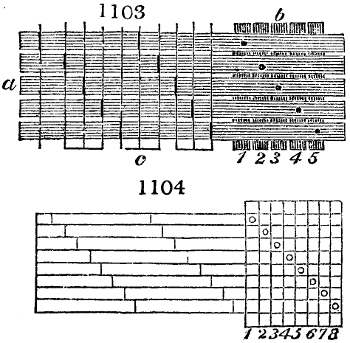
TEXTILE FABRICS. The first business of the weaver is to adapt those parts of his loom which move the warp, to the formation of the various kinds of ornamental figures which the cloth is intended to exhibit. This subject is called the draught, drawing or reading in, and the cording of looms. In every species of weaving, whether direct or cross, the whole difference of pattern or effect is produced, either by the succession in which the threads of warp are introduced into the heddles, or by the succession in which those heddles are moved in the working. The heddles being stretched between two shafts of wood, all the heddles connected by the same shafts are called a leaf; and as the operation of introducing the warp into any number of leaves is called drawing a warp, the plan of succession is called the draught. When this operation has been performed correctly, the next part of the weaver’s business is to connect the different leaves with the levers or treddles by which they are to be moved, so that one or more may be raised or sunk by every treddle successively, as may be required to produce the peculiar pattern. These connections being made by coupling the different parts of the apparatus by cords, this operation is called the cording. In order to direct the operator in this part of his business, especially if previously unacquainted with the particular pattern upon which he is employed, plans are drawn upon paper, specimens of which will be found in figs. 1103, 1104., &c. These plans are horizontal sections of a loom, the heddles being represented across the paper at a, and the treddles under them, and crossing them at right angles, at b. In figs. 1103. and 1104. they are represented as if they were distinct pieces of wood, those across being the under shaft of each leaf of heddles, and those at the left hand the treddles. See Weaving. In actual weaving, the treddles are placed at right angles to the heddles, the sinking cords descending perpendicularly as nearly as possible to the centre of the latter. Placing them at the left hand, therefore, is only for ready inspection, and for practical convenience. At c a few threads of warp are shown as they pass through the heddles, and the thick lines denote the leaf with which each thread is connected. Thus, in fig. 1103., the right-hand thread, next to a, passes through the eye of a heddle upon the back leaf, and is disconnected with all the other leaves; the next thread passes through a heddle on the second leaf; the third, through the third leaf; the fourth, through the fourth leaf; and the fifth, through the fifth or front leaf. One set of the draught being now completed, the weaver recommences with the back leaf, and proceeds in the same succession again to the front. Two sets of the draught are represented in this figure, and the same succession, it is understood by weavers (who seldom draw more than one set), must be repeated until all the warp is included. When they proceed to apply the cords, the right-hand part of the plan at b serves as a guide. In all the plans shown by these figures, excepting one which shall be noticed, a connexion must be formed, by cording, between every leaf of heddles and every treddle; for all the leaves must either rise or sink. The raising motion is effected by coupling the leaf to one end of its correspondent top lever; the other end of this lever is tied to the long march below, and this to the treddle. The sinking connexion is carried directly from under the leaf to the treddle. To direct a weaver which of these connexions is to be formed with each treddle, a black spot is placed when a leaf is to be raised, where the leaf and treddle intersect each other upon the plan, and the sinking connexions are left blank. For example, to cord, the treddle 1, to the back leaf, put a raising cord, and to each of the other four, sinking cords; for the treddle 2, raise the second leaf, and sink the remaining four, and so of the rest; the spot always denoting the leaf or leaves to be raised. The figs. 1103. and 1104. are drawn for the purpose of rendering the general principle of this kind of plans familiar to those who have not been previously acquainted with them; but those who have been accustomed to manufacture and weave ornamented cloths, never consume time by representing either heddles or treddles as solid or distinct bodies. They content themselves with ruling a number of lines across a piece of paper, sufficient to make the intervals between these lines represent the number of leaves required. Upon these intervals, they merely mark the succession of the draught, without producing every line to resemble a thread of warp. At the left hand, they draw as many lines across the former as will afford an interval for each treddle; and in the squares produced by the intersections of these lines, they place the dots, spots, or ciphers which denote the raising cords. It is also common to continue the cross lines which denote the treddle a considerable length beyond the intersections, and to mark by dots, placed diagonally in the intervals, the order or succession in which the treddles are to be pressed down in weaving. The former of these modes has been adopted in the remaining figs. to 1112.; but to save room, the latter has been avoided, and the succession marked by the order of the figures under the intervals which denote the treddles.
Some explanation of the various kinds of fanciful cloths represented by these plans, may serve further to illustrate this subject, which is, perhaps, the most important of any connected with the manufacture of cloth, and will also enable a person who thoroughly studies them, readily to acquire a competent knowledge of the other varieties in weaving, which are boundless. Figs. 1103. and 1104. represent the draught and cording of the two varieties of tweeled cloth wrought with five leaves of heddles. The first is the regular or run tweel, which, as every leaf rises in regular succession, while the rest are sunk, interweaves the warp and woof only at every fifth interval, and as the succession is uniform, the cloth when woven, presents the appearance of parallel diagonal lines, at an angle of about 45° over the whole surface. A tweel may have the regularity of its diagonal lines broken by applying the cording as in fig. 1104. It will be observed, that in both figures the draught of the warp is precisely the same, and that the whole difference of the two plans consists in the order of placing the spots denoting the raising cords, the first being regular and successive, and the second alternate.
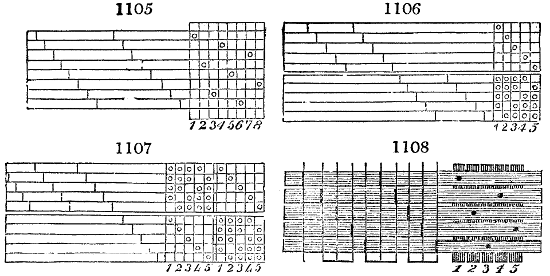
Figs. 1105. and 1106. are the regular and broken tweels which may be produced with eight leaves. This properly is the tweel denominated satin in the silk manufacture, although many webs of silk wrought with only five leaves receive that appellation. Some of the finest Florentine silks are tweeled with sixteen leaves. When the broken tweel of eight leaves is used, the effect is much superior to what could be produced by a smaller number; for in this, two leaves are passed in every interval, which gives a much nearer resemblance to plain cloth than the others. For this reason it is preferred in weaving the finest damasks. The draught of the eight-leaf tweel differs in nothing from the others, excepting in the number of leaves. The difference of the cording in the broken tweel, will appear by inspecting the cyphers which mark the raising cords, and comparing them with those of the broken tweel of five leaves. Fig. 1107. represents the draught and cording of striped dimity of a tweel of five leaves. This is the most simple species of fanciful tweeling. It consists of ten leaves, or double the number of the common tweel. These ten leaves are moved by only five treddles, in the same manner as a common tweel. The stripe is formed by one set, of the leaves flushing the warp, and the other set, the woof. The figure represents a stripe formed by ten threads, alternately drawn through each of the two sets of leaves. In this case, the stripe and the intervals will be equally broad, and what is the stripe upon one side of the cloth, will be the interval upon the other, and vice versâ. But great variety of patterns may be introduced by drawing the warp in greater or smaller portions through either set. The tweel is of the regular kind, but may be broken by placing the cording as in fig. 1104. It will be observed that the cording-marks of the lower or front leaves are exactly the converse of the other set; for where a raising mark is placed upon one, it is marked for sinking in the other; that is to say, the mark is omitted; and all leaves which sink in the one, are marked for raising in the other: thus, one thread rises in succession in the back set, and four sink; but in the front set, four rise, and only one sinks. The woof, of course, passing over the four sunk threads, and under the raised one, in the first instance, is flushed above; but where the reverse takes place, as in the second, it is flushed below; and thus the appearance of a stripe is formed. The analogy subsisting between striped dimity and dornock, is so great, that before noticing the plan for fancy dimity, it may be proper to allude to the dornock, the plan of which is represented by fig. 1108.
The draught of dornock is precisely the same in every respect with that of striped dimity. It also consists of two sets of tweeling-heddles, whether three, four, or five leaves are used for each set. The right-hand set of treddles is also corded exactly in the same way, as will appear by comparing them. But as the dimity is a continued stripe from the beginning to the end of the web, only five treddles are required to move ten leaves. The dornock being checker-work, the weaver must possess the power of reversing this at pleasure. He therefore adds five more treddles, the cording of which is exactly the reverse of the former; that is to say, the back leaves, in the former case, having one leaf raised, and four sunk, have, by working with these additional treddles, one leaf sunk and four leaves raised. The front leaves are in the same manner reversed, and the mounting is complete. So long as the weaver continues to work with either set, a stripe will be formed, as in the dimity; but when he changes his feet from one set to the other, the whole effect is reversed, and the checkers formed. The dornock pattern upon the design-paper, fig. 1108., may be thus explained: let every square of the design represent five threads upon either set of the heddles, which are said by weavers to be once over the draught, supposing the tweel to be one of five leaves; draw three parallel lines, as under, to form two intervals, each representing one of the sets; the draught will then be as follows:—
4 1 4 1 1 4 1
4 4 1 1 1 4 4
The above is exactly so much of the pattern as is there laid down, to show its appearance; but one whole range of the pattern is completed by the figure 1, nearest to the right hand upon the lower interval between the lines, and the remaining figures, nearer to the right, form the beginning of a second range or set. These are to be repeated in the same way across the whole warp. The lower interval represents the five front leaves; the upper interval, the five back ones. The first figure 4, denotes that five threads are to be successively drawn upon the back leaves, and this operation repeated four times. The first figure 4, in the lower interval, expresses that the same is to be done upon the front leaves; and each figure, by its diagonal position, shows how often, and in what succession, five threads are to be drawn upon the leaves which the interval in which it is placed represents.
Dornocks of more extensive patterns are sometimes woven with 3, 4, 5, and even 6 sets of leaves; but after the leaves exceed 15 in number, they both occupy an inconvenient space, and are very unwieldy to work. For these reasons the diaper harness is in almost every instance preferred.
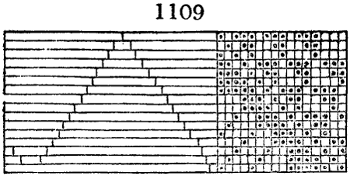
Fig. 1109. represents the draught and cording of a fanciful species of dimity, in which it will be observed that the warp is not drawn directly from the back to the front leaf, as in the former examples; but when it has arrived at either external leaf, the draught is reversed, and returns gradually to the other. The same draught is frequently used in tweeling, when it is wished that the diagonal lines should appear upon the cloth in a zigzag direction. This plan exhibits the draught and cording which will produce the pattern upon the design-paper in fig. 1103. a. Were all the squares produced by the intersection of the lines denoting the leaves and treddles, where the raised dots are placed, filled the same as on the design, they would produce the effect of exactly one-fourth of that pattern. This is caused by the reversing of the draught, which gives the other side reversed as on the design; and when all the treddles, from 1 to 16, have been successively used in the working, one-half of the pattern will become complete. The weaver then goes again over his treddles, in the reversed order of the numbers, from 17 to 30, when the other half of the pattern will be completed. From this similarity of the cording to the design, it is easy, when a design is given, to make out the draught and cording proper to work it; and when the cording is given, to see its effect upon the design.
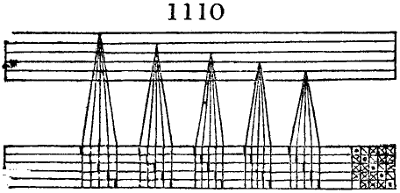
Fig. 1110. represents the draught of the diaper mounting, and the cording of the front leaves, which are moved by treddles. From the plan, it will appear that 5 threads are included in every mail of the harness, and that these are drawn in single threads through the front leaves. The cording forms an exception to the general rules, that when one or more leaves are raised, all the rest must be sunk; for in this instance, one leaf rises, one sinks, and three remain stationary. An additional mark, therefore, is used in this plan. The dots, as formerly, denote raising cords; the blanks, sinking cords; and where the cord is to be totally omitted, the cross marks × are placed.
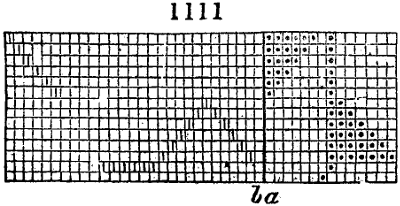
Fig. 1111. is the draught and cording of a spot whose two sides are similar, but reversed. That upon the plan forms a diamond, similar to the one drawn upon the design paper in the diagram, but smaller in size. The draught here is reversed, as in the dimity plan, and the treading is also to be reversed, after arriving at 6, to complete the diamond. Like it, too, the raising marks form one-fourth of the pattern. In weaving spots, they are commonly placed at intervals, with a portion of plain cloth between them, and in alternate rows, the spots of one row being between those of the other. But as intervals of plain cloth must take place, both by the warp and woof, 2 leaves are added for that purpose. The front, or ground leaf, includes every second thread of the whole warp; the second, or plain leaf, that part which forms the intervals by the warp. The remaining leaves form the spots; the first six being allotted to one row of spots, and the second six to the next row; where each spot is in the centre between the former. The reversed draught of the first is shown entire, and is succeeded by 12 threads of plain. One-half of the draught of the next row is then given, which is to be completed exactly like the first, and succeeded by 12 threads more of plain; when, one set of the pattern being finished, the same succession is to be repeated over the whole warp. As spots are formed by inserting woof of coarser dimensions than that which forms the fabric, every second thread only is allotted for the spotting. Those included in the front, or ground leaf, are represented by lines, and the spot threads between them, by marks in the intervals, as in the other plans.
The treddles necessary to work this spot are, in number, 14. Of these, the two in the centre, a, b, when pressed alternately, will produce plain cloth; for b raises the front leaf, which includes half of the warp, and sinks all the rest; while a exactly reverses the operation. The spot-treddles on the right hand work the row contained in the first six spot-leaves; and those upon the left hand, the row contained in the second six. In working spots, one thread, or shot of spotting-woof, and two of plain, are successively inserted, by means of two separate shuttles.
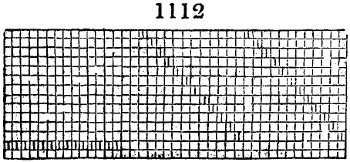
Dissimilar spots, are those whose sides are quite different from each other. The draught only of these is represented by fig. 1112. The cording depends entirely upon the figure.

Fig. 1113. represents any solid body composed of parts lashed together. If the darkened squares be supposed to be beams of wood, connected by cordage, they will give a precise idea of textile fabric. The beams cannot come into actual contact, because, if the lashing cords were as fine even as human hairs, they must still require space. The thickness is that of one beam and one cord; but if the cords touch each other, it may then be one beam and two cords; but it is not possible in practical weaving to bring every thread of weft into actual contact. It may therefore be assumed, that the thickness is equal to the diameter of one thread of the warp, added to that of one yarn of the weft; and when these are equal, the thickness of the cloth is double of that diameter. Denser cloth would not be sufficiently pliant or flexible.

Fig. 1114. is a representation of a section of cloth of an open fabric, where the round dots which represent the warp are placed at a considerable distance from each other.

Fig. 1115. may be supposed a plain fabric of that description which approaches the most nearly to any idea we can form of the most dense or close contact of which yarn can be made susceptible. Here the warp is supposed to be so tightly stretched in the loom as to retain entirely the parallel state, without any curvature, and the whole flexure is therefore given to the woof. This mode of weaving can never really exist; but if the warp be sufficiently strong to bear any tight stretching, and the woof be spun very soft and flexible, something very near it may be produced. This way of making cloth is well fitted for those goods which require to give considerable warmth; but they are sometimes the means of very gross fraud and imposition; for if the warp is made of very slender threads, and the woof of slackly twisted cotton or woollen yarn, where the fibrils of the stuff, being but slightly brought into contact, are rough and oozy, a great appearance of thickness and strength may be given to the eye, when the cloth is absolutely so flimsy, that it may be torn asunder as easily as a sheet of writing-paper. Many frauds of this kind are practised.
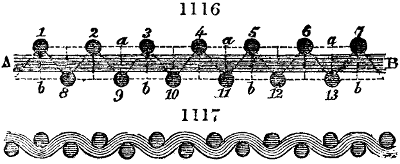
In fig. 1116. is given a representation of the position of a fabric of cloth in section, as it is in the loom before the warp has been closed upon the woof, which still appears as a straight line. This figure may usefully illustrate the direction and ratio of contraction which must unavoidably take place in every kind of cloth, according to the density of the texture, the dimensions of the threads, and the description of the cloth. Let A, B, represent one thread of woof completely stretched by the velocity of the shuttle in passing between the threads of warp which are represented by the round dots 1, 2, &c., and those distinguished by 8, 9, &c. When these threads are closed by the operation of the heddles to form the inner texture, the first tendency will be to move in the direction 1 b, 2 b, &c., for those above, and in that of 8 a, 9 a, &c., for those below; but the contraction for A, B, by its deviation from a straight to a curved line, in consequence of the compression of the warp threads 1 b, 2 b, &c., and 1 a, 2 a, &c., in closing, will produce, by the action of the two powers at right angles to each other, the oblique or diagonal direction denoted by the lines 1, 8-2, 9, to the left, for the threads above, and that expressed by the lines 2, 8-3, 9, &c., to the right, for the threads below. Now, as the whole deviation is produced by the flexure of the thread A, B, if A is supposed to be placed at the middle of the cloth, equidistant from the two extremities, or selvages as they are called by weavers, the thread at 1 may be supposed to move really in the direction 1 b, and all the others to approach to it in the directions represented, whilst those to the right would approach in the same ratio, but the line of approximation would be inverted. Fig. 1117. represents that common fabric used for lawns, muslins, and the middle kind of goods, the excellence of which neither consists in the greatest strength, nor in the greatest transparency. It is entirely a medium between fig. 1114. and fig. 1115.

In the efforts to give great strength and thickness to cloth, it will be obvious that the common mode of weaving, by constant intersection of warp and woof, although it may be perhaps the best which can be devised for the former, presents invincible obstructions to the latter, beyond a certain limit. To remedy this, two modes of weaving are in common use, which, while they add to the power of compressing a great quantity of materials in a small compass, possess the additional advantage of affording much facility for adding ornament to the superficies of the fabric. The first of these is double cloth, or two webs woven together, and joined by the operation. This is chiefly used for carpets; and its geometrical principles are entirely the same as those of plain cloth, supposing the webs to be sewed together. A section of the cloth will be found in fig. 1118. See Carpet.
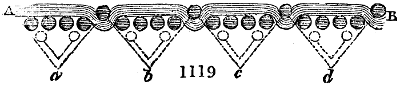
Of the simplest kind of tweeled fabrics, a section is given in fig. 1119.
The great and prominent advantage of the tweeled fabric, in point of texture, arises from the facility with which a very great quantity of materials may be put closely together. In the figure, the warp is represented by the dots in the same straight line as in the plain fabrics; but if we consider the direction and ratio of contraction, upon principles similar to those laid down in the explanation given of fig. 1116., we shall readily discover the very different way in which the tweeled fabric is affected.
When the dotted lines are drawn at a, b, c, d, their direction of contraction, instead of being upon every second or alternate thread, is only upon every fifth thread, and the natural tendency would consequently be, to bring the whole into the form represented by the lines and dotted circles at a, b, c, d. In point, then, of thickness, from the upper to the under superficies, it is evident that the whole fabric has increased in the ratio of nearly three to one. On the other hand, it will appear, that four threads or cylinders being thus put together in one solid mass, might be supposed only one thread, or like the strands of a rope before it is twisted; but, to remedy this, the thread being shifted every time, the whole forms a body in which much aggregate matter is compressed; but where, being less firmly united, the accession of strength acquired by the accumulation of materials is partially counteracted by the want of equal firmness of junction.

The second quality of the tweeled fabric, susceptibility of receiving ornament, arises from its capability of being inverted at pleasure, as in fig. 1120. In this figure we have, as before, four threads, and one alternately intersected; but here the four threads marked 1 and 2 are under the woof, while those marked 3 and 4 are above.

Fig. 1121. represents that kind of tweeled work which produces an ornamental effect, and adds even to the strength of a fabric, in so far as accumulation of matter can be considered in that light. The figure represents a piece of velvet cut in section, and of that kind which, being woven upon a tweeled ground, is known by the name of Genoa velvet. 1st. Because, by combining a great quantity of material in a small compass, they afford great warmth. 2nd. From the great resistance which they oppose to external friction, they are very durable. And, 3rd. Because, from the very nature of the texture, they afford the finest means of rich ornamental decoration.
The use of velvet cloths in cold weather is a sufficient proof of the truth of the first. The manufacture of plush, corduroy, and other stuffs for the dress of those exposed to the accidents of laborious employment, evinces the second; and the ornamented velvets and Wilton carpeting, are demonstrative of the third of these positions.
In the figure, the diagonal form which both the warp and woof of cloth assume, is very apparent from the smallness of the scale. Besides what this adds to the strength of the cloth, the flushed part, which appears interwoven at the darkly shaded intervals 1, 2, &c., forms, when finished, the whole covering or upper surface. The principle, in so far as regards texture, is entirely the same as any other tweeled fabric.

Fig. 1122., which represents corduroy, or king’s cord, is merely striped velvet. The principle is the same, and the figure shows that the one is a copy of the other. The remaining figures represent those kinds of work which are of the most flimsy and open description of texture; those in which neither strength, warmth, nor durability are much required, and of which openness and transparency are the chief recommendations.

Fig. 1123. represents common gauze, or linau, a substance very much used for various purposes. The essential difference between this description of cloth and all others, consists in the warp being turned or twisted like a rope during the operation of weaving, and hence it bears a considerable analogy to lace. The twining of gauze is not continued in the same direction, but is alternately from right to left, and vice versâ, between every intersection of the woof. The fabric of gauze is always open, flimsy, and transparent; but, from the turning of the warp, it possesses an uncommon degree of strength and tenacity in proportion to the quantity of material which it contains. This quality, together with the transparency of the fabric, renders it peculiarly adapted for ornamental purposes of various kinds, particularly for flowering or figuring, either in the loom; or by the needle. In the warp of gauze; there arises a much greater degree of contraction during the weaving, than in any other species of cloth; and this is produced by the turning. The twisting between every intersection of weft amounts precisely to one complete revolution of both threads; hence this difference exists between this and every other species of weaving, namely, that the one thread of warp is always above the woof, and the contiguous thread is always below.

Fig. 1124. represents a section of another species of twisted cloth, which is known by the name of catgut, and which differs from the gauze only, by being subjected to a greater degree of twine in weaving; for in place of one revolution between each intersection, a revolution and a half is always given; and thus the warp is alternately above and below, as in other kinds of weaving.
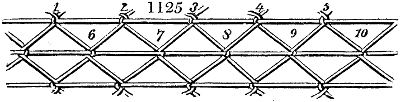
Fig. 1125. is a superficial representation of the most simple kind of ornamental network produced in the loom. It is called a whip-net by weavers, who use the term whip for any substance interwoven in cloth for ornamental purposes, when it is distinct from the ground of the fabric. In this, the difference is merely in the crossing of the warp; for it is very evident that the crossings at 1, 2, 3, 4, and 5, are of different threads from those at 6, 7, 8, and 9.
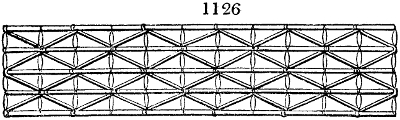
Fig. 1126. represents, superficially, what is called the mail-net, and is merely a combination of common gauze and the whip-net in the same fabric. The gauze here being in the same direction as the dotted line in the former figure, the whole fabric is evidently a continued succession of right-angled triangles, of which the woof forms the basis, the gauze part the perpendiculars, and the whip part the hypothenuses. The contraction here being very different, it is necessary that the gauze and whip parts should be stretched upon separate beams.
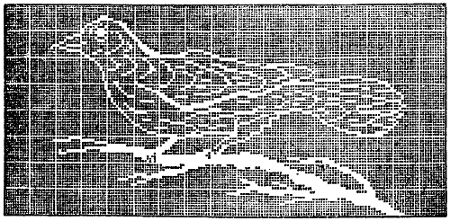
In order to design ornamental figures upon cloths, the lines which are drawn from the top to the bottom of the paper may be supposed to represent the warp; and those drawn across, the woof of the web; any number of threads being supposed to be included between every two lines. The paper thus forms a double scale, by which, in the first instance, the size and form of the pattern may be determined with great precision; and the whole subsequent operations of the weaver regulated, both in mounting and working his loom. To enable the projector of a new pattern to judge properly of its effects, when transferred from the paper to the cloth, it will be essentially necessary that he should bear constantly in his view the comparative scale of magnitude which the design will bear in each, regulating his ideas always by square or superficial measurement. Thus, in the large design, fig. 1127., representing a bird perched upon the branch of a tree, it will be proper, in the first place, to count the number of spaces from the point of the bill to the extremity of the tail; and to render this the more easy, it is to be observed that every tenth line is drawn considerably bolder than the others. This number in the design is 135 spaces. Counting again, from the stem of the branch to the upper part of the bird’s head, he will find 76 spaces. Between these spaces, therefore, the whole superficial measure of the pattern is contained. By the measure of the paper, this may be easily tried with a pair of compasses, and will be found to be nearly 65⁄10 inches in length, by 33⁄16 inches in breadth. Now, if this is to be woven in a reed containing 800 intervals in 37 inches, and if every interval contains five threads, supposed to be contained between every two parallel lines, the length will be 6·24 inches, and the breadth 3·52 inches nearly; so that the figure upon the cloth would be very nearly of the same dimensions as that upon the paper; but if a 1200 reed were used, instead of an 800, the dimensions would be proportionally contracted.
A correct idea being formed of the design, the weaver may proceed to mount his loom according to the pattern; and this is done by two persons, one of whom takes from the design the instructions necessary for the other to follow in tying his cords.
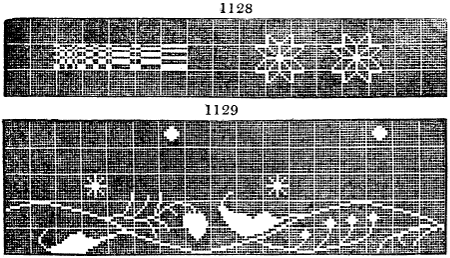
Fig. 1128. is a representation of the most simple species of table-linen, which is merely an imitation of checker-work of various sizes; and is known in Scotland, where the manufacture is chiefly practised, by the name of Dornock. When a pattern is formed upon tweeled cloth, by reversing the flushing, the two sides of the fabric being dissimilar, one may be supposed to be represented by the black marks, and the other by the part of the figure which is left uncoloured. For such a pattern as this, two sets of common tweel-heddles, moved in the ordinary way, by a double succession of heddles, are sufficient. The other part of fig. 1128. is a design of that intermediate kind of ornamental work which is called diaper, and which partakes partly of the nature of the dornock, and partly of that of the damask and tapestry. The principle upon which all these descriptions of goods are woven is entirely the same, and the only difference is in the extent of the design, and the means by which it is executed. Fig. 1129. is a design for a border of a handkerchief or napkin, which may be executed either in the manner of damask, or as the spotting is practised in the lighter fabrics.
THENARD’S BLUE, or COBALT BLUE, is prepared by digesting the oxide of cobalt used in the potteries, with nitric acid, evaporating the nitrate almost to dryness, diluting it with water, and filtering, to separate some arseniate of iron, which usually precipitates. The clear liquor is to be poured into a solution of phosphate of soda, whence an insoluble phosphate of cobalt falls. This being well washed, is to be intimately mixed in its soft state with eight times its weight of well-washed gelatinous alumina, which has been obtained by pouring a solution of alum into water of ammonia in excess. The uniformly coloured paste is to be spread upon plates, dried in a stove, then bruised dry in a mortar, enclosed in a crucible, and subjected to a cherry-red heat for half an hour. On taking out the crucible, and letting it cool, the fine blue pigment is to be removed into a bottle, which is to be stoppered till used.
The arseniate of cobalt may be substituted, in the above process, for the phosphate, but it must be mixed with sixteen times its weight of the washed gelatinous alumina. The arseniate is procured by pouring the dilute nitrate of cobalt into a solution of arseniate of potassa. If nitrate of cobalt be mixed with the alumina, and the mixture be treated as above described, a blue pigment will also be obtained, but paler than the preceding, showing that the colour consists essentially of alumina stained with oxide of cobalt.
THERMOMETER, signifies the measure of heat. Its description belongs to a treatise on chemical physics.
THERMOSTAT, is the name of an apparatus for regulating temperature, in vaporization, distillation, heating baths or hothouses, arid ventilating apartments, &c.; for which I obtained a patent in the year 1831. It operates upon the physical principle, that when two thin metallic bars of different expansibilities are riveted or soldered facewise together, any change of temperature in them will cause a sensible movement of flexure in the compound bar, to one side or other; which movement may be made to operate, by the intervention of levers, &c., in any desired degree, upon valves, stopcocks, stove-registers, air-ventilators, &c.; so as to regulate the temperature of the media in which the said compound bars are placed. Two long rulers, one of steel, and one of hard hammered brass, riveted together, answer very well; the object being not simply to indicate, but to control or modify temperature. The following diagrams will illustrate a few out of the numerous applications of this instrument:—
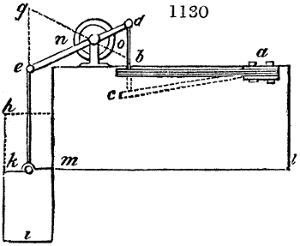
Fig. 1130. a, b, is a single thermostatic bar, consisting of two or more bars or rulers of differently expansible solids (of which, in certain cases, wood may be one): these bars or rulers are firmly riveted or soldered together, face to face. One end of the compound bar is fixed by bolts at a, to the interior of the containing cistern, boiler, or apartment, a, l, m, b, whereof the temperature has to be regulated, and the other end of the compound bar at b, is left free to move down towards c, by the flexure which will take place when its temperature is raised.
The end b, is connected by a link, b, d, with a lever d, e, which is moved by the flexure into the dotted position b, g, causing the turning-valve, air-ventilator, or register, o, n, to revolve with a corresponding angular motion, whereby the lever will raise the equipoised slide-damper k, i, which is suspended by a link from the end e, of the lever e, d, into the position k, h. Thus a hothouse or a water-bath may have its temperature regulated by the contemporaneous admission of warm, and discharge of cold air, or water.
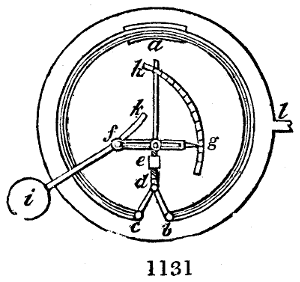
Fig. 1131. a, b, c, is a thermostatic hoop, immersed horizontally beneath the surface of the water-bath of a still. The hoop is fixed at a, and the two ends b, c, are connected by two links b d, c d, with a straight sliding rod d, h, to which the hoop will give an endwise motion, when its temperature is altered; e; is an adjusting screw-nut on the rod d, h, for setting the lever f, g, which is fixed on the axis of the turning-valve or cock f; at any desired position, so that the valve may be opened or shut at any desired temperature, corresponding to the widening of the points b, c, and the consentaneous retraction of the point d, towards the circumference a, b, c, of the hoop. g, h, is an arc graduated by a thermometer, after the screw-piece e has been adjusted. Through a hole at h, the guide-rod passes. i, is the cold-water cistern; i, f, k, the pipe to admit cold water; l, the overflow pipe, at which the excess of hot water runs off.
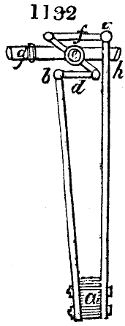
Fig. 1132. shows a pair of thermostatic bars, bolted fast together at the ends a. The free ends b, c, are of unequal length, so as to act by the cross links d, f, on the stopcock e. The links are jointed to the handle of the turning plug of the cock, on opposite sides of its centre; whereby that plug will be turned round in proportion to the widening of the points b, c. h, g, is the pipe communicating with the stopcock.
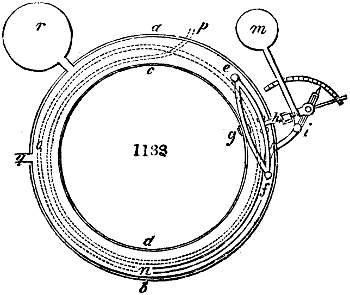
Suppose that for certain purposes in pharmacy, dyeing, or any other chemical art, a water-bath is required to be maintained steadily at a temperature of 150° F.: let the combined thermostatic bars, hinged together at e, f, fig. 1133., be placed in the bath, between the outer and inner vessels a, b, c, d, being bolted fast to the inner vessel at g; and have their sliding rod k, connected by a link with a lever fixed upon the turning plug of the stopcock i, which introduces cold water from a cistern m, through a pipe m, i, n, into the bottom part of the bath. The length of the link must be so adjusted that the flexure of the bars, when they are at a temperature of 150°, will open the said stopcock, and admit cold water to pass into the bottom of the bath through the pipe i, n, whereby hot water will be displaced at the top of the bath through an open overflow-pipe at q. An oil bath may be regulated on the same plan; the hot oil overflowing from q, into a refrigeratory worm, from which it may be restored to the cistern m. When a water bath is heated by the distribution of a tortuous steam pipe through it, as i, n, o, p, it will be necessary to connect the link of the thermostatic bars with the lever of the turning plug of the steam-cock, or of the throttle valve i, in order that the bars, by their flexure, may shut or open the steam passage more or less, according as the temperature of the water in the bath shall tend more or less to deviate from the pitch to which the apparatus has been adjusted. The water of the condensed steam will pass off from the sloping winding-pipe i, n, o, p, through the sloping orifice p. A saline, acid, or alkaline bath has a boiling temperature proportional to its degree of concentration, and may therefore have its heat regulated by immersing a thermostat in it, and connecting the working part of the instrument with a stopcock i, which will admit water to dilute the bath whenever by evaporation it has become concentrated, and has acquired a higher boiling point. The space for the bath, between the outer and inner pans, should communicate by one pipe with the water-cistern m; and by another pipe, with a safety cistern r, into which the bath may be allowed to overflow during any sudden excess of ebullition.
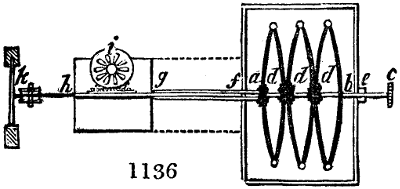
Fig. 1136. is a thermostatic apparatus, composed of three pairs of bars d, d, d, which are represented in a state of flexure by heat; but they become nearly straight and parallel when cold, a, b, c, is a guide rod, fixed at one end by an adjusting screw e, in the strong frame f, e, having deep guide grooves at the sides. f, g, is the working-rod, which moves endways when the bars d, d, d, operate by heat or cold. A square register-plate h, g, may be affixed to the rod f, g, so as to be moved backwards and forwards thereby, according to the variations of temperature; or the rod f, g, may cause the circular turning air-register i, to revolve by rack and wheel-work, or by a chain and pulley. The register-plate h, g, or turning register i, is situated at the ceiling or upper part of the chamber, and serves to let out hot air. k, is a pulley, over which a cord runs to raise or lower a hot-air register l, which may be situated near the floor of the apartment or hothouse, to admit hot air into the room. c, is a milled head, for adjusting the thermostat, by means of the screw at e, in order that it may regulate the temperature to any degree.
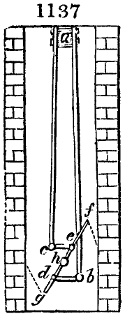
Fig. 1137. represents a chimney, furnished with a pyrostat a, b, c, acting by the links b, d, e, c, on a damper f, h, g. The more expansible metal is in the present example supposed to be on the outside. The plane of the damper-plate will, in this case, be turned more directly into the passage of the draught through the chimney by increase of temperature.
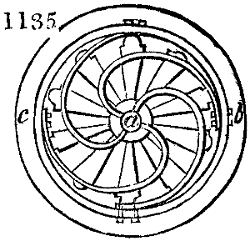
Fig. 1135. represents a circular turning register, such as is used for a stove, or stove-grate, or for ventilating apartments; it is furnished with a series of spiral thermostatic bars, each bar being fixed fast at the circumference of the circle b, c, of the fixed plate of the air-register; and all the bars act in concert at the centre a, of the twining part of the register, by their ends being inserted between the teeth of a small pinion, or by being jointed to the central part of the turning plate by small pins.
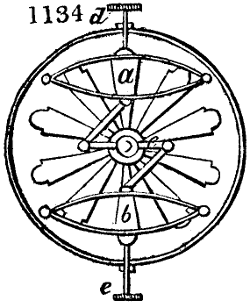
Fig. 1134. represents another arrangement of my thermostatic apparatus applied to a circular turning register, like the preceding, for ventilating apartments. Two pairs of compound bars are applied so as to act in concert, by means of the links a c, b c, on the opposite ends of a short lever, which is fixed on the central part of the turning plate of the air-register. The two pairs of compound bars a, b, are fastened to the circumference of the fixed plate of the turning register, by two sliding rods a d, b e, which are furnished with adjusting screws. Their motion or flexure is transmitted by the links a c, and b c, to the turning plate, about its centre, for the purpose of shutting or opening the ventilating sectorial apertures, more or less, according to the temperature of the air which surrounds the thermostatic turning register. By adjusting the screws a d, and b c, the turning register is made to close all its apertures at any desired degree of temperature; but whenever the air is above that temperature, the flexure of the compound bars will open the apertures.
THIMBLE (Dé à coudre, Fr.; Fingerhut (fingerhat), Germ.); is a small truncated metallic cone, deviating little from a cylinder, smooth within, and symmetrically pitted on the outside with numerous rows of indentations, which is put upon the tip of the middle finger of the right hand, to enable it to push the needle readily and safely through cloth or leather, in the act of sewing. This little instrument is fashioned in two ways; either with a pitted round end, or without one; the latter, called the open thimble, being employed by tailors, upholsterers, and, generally speaking, by needle-men. The following ingenious process for making this essential implement, the contrivance of M. M. Rouy and Berthier, of Paris, has been much celebrated, and very successful. Sheet-iron, one twenty-fourth of an inch thick, is cut into strips, of dimensions suited to the intended size of the thimbles. These strips are passed under a punch-press, whereby they are cut into discs of about 2 inches diameter, tagged together by a tail. Each strip contains one dozen of these blanks. A child is employed to make them red-hot, and to lay them on a mandril nicely fitted to their size. The workman now strikes the middle of each with a round-faced punch, about the thickness of his finger, and thus sinks it into the concavity of the first mandril. He then transfers it successively to another mandril, which has five hollows of successively increasing depth; and, by striking it into them, brings it to the proper shape.
A second workman takes this rude thimble, sticks it in the chuck of his lathe, in order to polish it within, then turns it outside, marks the circles for the gold ornament, and indents the pits most cleverly with a kind of milling tool. The thimbles are next annealed, brightened, and gilt inside, with a very thin cone of gold leaf, which is firmly united to the surface of the iron, simply by the strong pressure of a smooth steel mandril. A gold fillet is applied to the outside, in an annular space turned to receive it, being fixed, by pressure at the edges, into a minute groove formed on the lathe.
Thimbles are made in this country by means of moulds in the stamping-machine. See Stamping of Metals.
THORINA, is a primitive earth, with a metallic basis, discovered in 1828, by Berzelius. It was extracted from the mineral thorite, of which it constitutes 58 per cent., and where it is associated with the oxides of iron, lead, manganese, tin, and uranium, besides earths and alkalis, in all 12 substances. Pure thorina is a white powder, without taste, smell, or alkaline reaction on litmus. When dried and calcined, it is not affected by either the nitric or muriatic acid. It may be fused with borax into a transparent glass, but not with potash or soda. Fresh precipitated thorina is a hydrate, which dissolves readily in the above acids, as well as in solutions of the carbonates of potash, soda, and ammonia, but not in these alkalis in a pure state. This earth consists of 74·5 parts of the metal thorinum, combined with 100 of oxygen. Its hydrate contains one equivalent prime of water. It is hitherto merely a chemical curiosity, remarkable chiefly for a density of 9·402, far greater than that of all the earths, and even of copper.
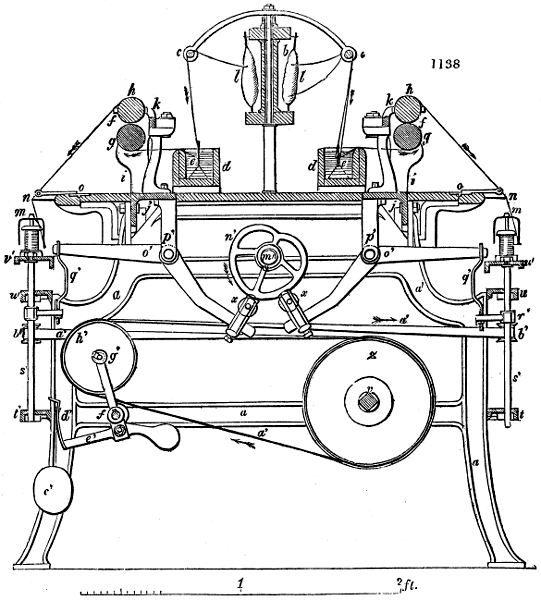
THREAD MANUFACTURE. The doubling and twisting of cotton or linen yarn into a compact thread, for weaving bobbin-net, or for sewing garments, is performed by a machine resembling the throstle of the cotton-spinner. Fig. 1138. shows the thread-frame in a transverse section, perpendicular to its length. a, is the strong framing of cast iron; b, is the creel, or shelf, in which the bobbins of yarn l, l, are set loosely upon their respective skewers, along the whole line of the machine, their lower ends turning in oiled steps, and their upper in wire eyes; c, is a glass rod, across which the yarn runs as it is unwound; d, d, are oblong narrow troughs, lined with lead, and filled with water, for moistening the thread during its torsion; the threads being made to pass through eyes at the bottom of the fork e, which has an upright stem for lifting it out, without wetting the fingers, when any thing goes amiss; f, f, are the pressing rollers, the under one g, being of smooth iron, and the upper one h, of box-wood; the former extends from end to end of the frame, in lengths comprehending 18 threads, which are joined by square pieces, as in the drawing-rollers of the mule-jenny. The necks of the under rollers are supported, at the ends and the middle, by the standards i, secured to square bases j, both made of cast iron. The upper cylinder has an iron axis, and is formed of as many rollers as there are threads; each roller being kept in its place upon the lower one by the guides k, whose vertical slots receive the ends of the axes.
The yarn delivered by the bobbin l, glides over the rod c, and descends into the trough d, e, where it gets wetted; on emerging, it goes along the bottom of the roller g, turns up, so as to pass between it and h, then turns round the top of h, and finally proceeds obliquely downwards, to be wound upon the bobbin m, after traversing the guide-eye n. These guides are fixed to the end of a plate, which may be turned up by a hinge-joint at o, to make room for the bobbins to be changed.
There are three distinct simultaneous movements to be considered in this machine: 1. that of the rollers, or rather of the under roller, for the upper one revolves merely by friction; 2. that of the spindles m, s′; 3. the up-and-down motion of the bobbins upon the spindles.
The first of these motions is produced by means of toothed wheels, upon the right hand of the under set of rollers. The second motion, that of the spindles, is effected by the drum z, which extends the whole length of the frame, turning upon the shaft v, and communicating its rotatory movement (derived from the steam pulley) to the whorl b′, of the spindles, by means of the endless band or cord a′. Each of these cords turns four spindles, two upon each side of the frame. They are kept in a proper state of tension by the weights c′, which act tangentially upon the circular arc d′, fixed to the extremity of the bell-crank lever e′ f′ g′, and draw in a horizontal direction the tension pulleys h, embraced by the cords. The third movement, or the vertical traverse of the bobbins, along the spindles m, takes place as follows:—
The end of one of the under rollers carries a pinion, which takes into a carrier wheel, that communicates motion to a pinion upon the extremity of the shaft m′, of the heart-shaped pulley n′. As this eccentric revolves, it gives a reciprocating motion to the levers o′, o′, which oscillate in a vertical plane round the points, p′, p′. The extremities of these levers, on either side, act by means of the links q′, upon the arms of the sliding sockets r′, and cause the vertical rod s′, to slide up and down in guide-holes at t′, u′, along with the cast-iron step v′, which bears the bottom washer of the bobbins. The periphery of the heart-wheel n′, is seen to bear upon friction wheels x, x′, set in frames adjusted by screws upon the lower end of the bent levers, at such a distance from the point p′, as that the traverse of the bobbins may be equal to the length of their barrel.
By adapting change pinions and their corresponding wheels to the rollers, the delivery of the yarn may be increased or diminished in any degree, so as to vary the degree of twist put into it by the uniform rotation of the drum and spindles. The heart motion being derived from that of the rollers, will necessarily vary with it.
Silk thread is commonly twisted in lengths of from 50 to 100 feet, with hand reels, somewhat similar to those employed for making ropes by hand.
TILES. See Bricks.
TILTING OF STEEL. See Steel. Rees’s Cyclopædia contains an excellent article on this subject.
TIN (Etain, Fr.; Zinn, Germ.); in its pure state, has nearly the colour and lustre of silver. In hardness it is intermediate between gold and lead; it is very malleable, and may be laminated into foil less than the thousandth of an inch in thickness; it has an unpleasant taste, and exhales on friction a peculiar odour; it is flexible in rods or straps of considerable strength, and emits in the act of bending a crackling sound, as if sandy particles were intermixed, called the creaking of tin. A small quantity of lead, or other metal, deprives it of this characteristic quality. Tin melts at 442° Fahr., and is very fixed in the fire at higher heats. Its specific gravity is 7·29. When heated to redness with free access of air, it absorbs oxygen with rapidity, and changes first into a pulverulent gray protoxide, and by longer ignition, into a yellow-white powder, called putty of tin. This is the peroxide, consisting of 100 of metal + 27·2 of oxygen.
Tin has been known from the most remote antiquity; being mentioned in the books of Moses. The Phœnicians carried on a lucrative trade in it with Spain and Cornwall.
There are only two ores of tin; the peroxide, or tin-stone, and tin pyrites; the former of which alone has been found in sufficient abundance for metallurgic purposes. The external aspect of tin-stone has nothing very remarkable. It occurs sometimes in twin crystals; its lustre is adamantine; its colours are very various, as white, gray, yellow, red, brown, black; specific gravity 6·9 at least; which is, perhaps, its most striking feature. It does not melt by itself before the blowpipe; but is reducible in the smoky flame or on charcoal. It is insoluble in acids. It has somewhat of a greasy aspect; and strikes fire with steel.
Tin-stone occurs disseminated in the antient rocks, particularly granite; also in beds and veins, in large irregular masses, called stockwerks; and in pebbles, an assemblage of which is called stream-works, where it occasionally takes a ligneous aspect, and is termed wood-tin.
This ore has been found in few countries in a workable quantity. Its principal localities are, Cornwall, Bohemia, Saxony, in Europe; and Malacca and Banca, in Asia. The tin-mines of the Malay peninsula lie between the 10th and 6th degree of south latitude; and are most productive in the island of Junck-Ceylon, where they yield sometimes 800 tons per annum, which are sold at the rate of 48l. each. The ores are found in large caves near the surface; and though actively mined for many centuries, still there is easy access to the unexhausted parts. The mines in the island of Banca, to the east of Sumatra, discovered in 1710, are said to have furnished, in some years, nearly 3500 tons of tin. Small quantities occur in Gallicia in Spain, in the department of Haute Vienne in France, and in the mountain chains of the Fichtel and Riesengebürge in Germany. The columnar pieces of pyramidal tin-ore from Mexico and Chile, are products of stream-works. Small groups of black twin crystals have been lately discovered in the albite rock of Chesterfield in Massachusetts.
The Cornish ores occur—1. in small strata or veins, or in masses; 2. in stockwerks, or congeries of small veins; 3. in large veins; 4. disseminated in alluvial deposits.
The stanniferous small veins, or thin flat masses, though of small extent, are sometimes very numerous, interposed between certain rocks, parallel to their beds, and are commonly called tin-floors. The same name is occasionally given to stockwerks. In the mine of Bottalack, a tin-floor has been found in the killas (primitive schistose rock), thirty-six fathoms below the level of the sea; it is about a foot and a half thick, and occupies the space between a principal vein and its ramification; but there seems to be no connexion between the floor and the great vein.
2. Stockwerks occur in granite and in the felspar porphyry, called in Cornwall, elvan. The most remarkable of these in the granite, is at the tin-mine of Carclase, near St. Austle. The works are carried on in the open air, in a friable granite, containing felspar disintegrated into kaolin, or china clay, which is traversed by a great many small veins, composed of tourmaline, quartz, and a little tin-stone, that form black delineations on the face of the light-gray granite. The thickness of these little veins rarely exceeds 6 inches, including the adhering solidified granite, and is occasionally much less. Some of them run nearly east and west, with an almost vertical dip; others, with the same direction, incline to the south at an angle with the horizon of 70 degrees.
Stanniferous stockwerks are much more frequent in the elvan (porphyry); of which the mine of Trewidden-ball is a remarkable example. It is worked among flattened masses of elvan, separated by strata of killas, which dip to the east-north-east at a considerable angle. The tin ore occurs in small veins, varying in thickness from half an inch to 8 or 9 inches, which are irregular, and so much interrupted, that it is difficult to determine either their direction or their inclination.
3. The large and proper metalliferous veins are not equally distributed over the surface of Cornwall and the adjoining part of Devonshire; but are grouped into three districts; namely, 1. In the south-west of Cornwall, beyond Truro; 2. In the neighbourhood of St. Austle; and 3. In the neighbourhood of Tavistock in Devonshire.
The first group is by far the richest, and the best explored. The formation most abundant in tin mines is principally granitic; whilst that of the copper mines is most frequently schistose or killas; though with numerous exceptions. The great tin veins are the most antient metalliferous veins in Cornwall; yet they are not all of one formation, but belong to two different systems. Their direction is, however, nearly the same, but some of them dip towards the north, and others towards the south. The first are older than the second; for in all the mines where these two sets of veins are associated, the one which dips to the north, cuts across and throws out the one which dips to the south. See Mines, p. 835.
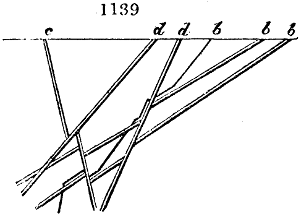
At Trevannance mines, the two systems of tin veins are both intersected by the oldest of the copper veins; indicating the prior existence of the tin veins. In fig. 1139. b, marks the first system of tin veins; c, the second; and d, the east and west copper veins. Some of these tin veins, as at Poldice, have been traced over an extent of two miles; and they vary in thickness from a small fraction of an inch to several feet, the average width being from 2 to 4 feet; though this does not continue uniform for any length, as these veins are subject to continual narrowings and expansions. The gangue is quartz, chlorite, tourmaline, and sometimes decomposed granite and fluor spar.
4. Alluvial tin ore, stream tin.—Peroxide of tin occurs disseminated both in the alluvium which covers the gentle slopes of the hills adjoining the rich tin-mines, and also in the alluvium which fills the valleys that wind round their base; but in these numerous deposits the tin-stone is rarely distributed in sufficient quantities to make it worth the working. The most important explorations of alluvial tin ore are grouped in the environs of St. Just and St. Austle; where they are called stream-works; because water is the principal agent employed to separate the metallic oxide from the sand and gravel.
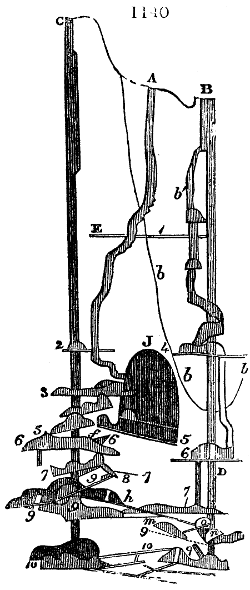
The tin mine of Altenberg, in Saxony (fig. 1140., which is a vertical projection in a plane passing from west to east,) is remarkable for a stockwerke, or interlaced mass of ramifying veins, which has been worked ever since the year 1458. The including rock is a primitive porphyry, superposed upon gneiss; becoming very quartzose as it approaches the lode. This is usually disseminated in minute particles, and accompanied with wolfram, copper and arsenical pyrites, fer oligiste, sulphuret of molybdenum, and bismuth, having gangues of lithomarge, fluor spar, mica, and felspar. The space which the ore occupies in the heart of the quartz, is a kind of dædalus, the former being often so dispersed among the latter as to seem to merge into it; whence it is called by the workmen zwitter, or ambiguous. In 1620, the mine was worked by 21 independent companies, in a most irregular manner, whereby it was damaged to a depth of 170 fathoms by a dreadful downfall of the roofs. This happened on a Sunday, providentially, when the pious miners were all at church. The depth of this abyss, marked by the curved line b, b, b, is 66 fathoms; but the devastation is manifest to a depth of 95 fathoms below that curve, and 35 fathoms below the actual workings, represented at the bottom of the shaft under B. The parts excavated are shaded black in the figure. There are two masses of ore, one under the shaft B, and another under the shaft C; which at the levels 5 and 10 are in communication, but not at 6, 7. There is a direct descent from 8 to 9. The deposits are by no means in one vertical plane, but at a considerable horizontal distance from each other. A is the descending shaft; B is the extraction shaft, near the mouth of which there is a water-wheel; C is another extraction shaft, worked also by means of a water-wheel. A and C are furnished with ladders, but for B the ladders are placed in an accessory shaft b′; under D, a shaft is sunk for pumping out the water, by means of an hydraulic wheel at D; E is the gallery or drift for admitting the water which drives the wheels. This falls 300 feet, and ought to be applied to a water-pressure engine, instead of the paddles of a wheel. At D, is the gallery of discharge for the waters, which serves also to ventilate the mine, being cut to the day, through 936 toises of syenitic porphyry and gneiss. J, is a great vaulted excavation. The mine has 13 stages of galleries, of which 11 serve for extracting the ore; 1 is the mill-course; the rest are marked with the numbers 2, 3, 4, &c.; each having besides a characteristic German name. The rare mineral called topaz pycnite is found in this mine, above 10, between the shafts C and D.
The only rule observed in taking ore from this mine, has been to work as much out of each of these levels as is possible, without endangering the superincumbent or collateral galleries; on which account many pillars are constructed to support the roofs. The mine yields annually 1600 quintals (Leipzick) of tin, being four-fifths of the whole furnished by the district of Altenberg; to produce which, 400,000 quintals of ore are raised. 1000 parts of the rock yield 8 of concentrated schlich, equivalent to only 4 of metal; being only 1 in 250 parts.
But the most extensive and productive stream-works, are those of Pentowan, near St. Austle.
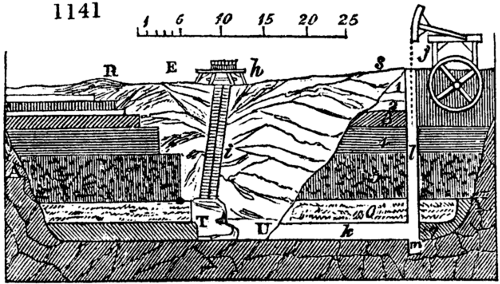
Fig. 1141. represents a vertical section of the Pentowan mine, taken from the stream-work, Happy Union. A vast excavation, R, T, U, S, has been hollowed out in the open air, in quest of the alluvial tin ore T, which occurs here at an unusual depth, below the level of the strata R, S. Before getting at this deposit, several successive layers had to be sunk through; namely, 1, 2, 3; the gravel, containing in its middle a band of ochreous earth 2, or ferruginous clay; 4, a black peat, perfectly combustible, of a coarse texture, composed of reeds and woody fibres, cemented into a mass by a fine loam; 5, coarse sea-sand, mingled with marine shells; 6, a blackish marine mud, filled with shells. Below these the deposit of tin-stone occurs, including fragments of various size, of clay slate, flinty slate, quartz, iron ore, jasper; in a word, of all the rocks and gangues to be met with in the surrounding territory, with the exception of granite. Among these fragments there occur, in rounded particles, a coarse quartzose sand, and the tin-stone, commonly in small grains and crystals. Beneath the bed T, the clay slate occurs, called killas (A, X, Y), which supports all the deposits of more recent formation.
The system of mining is very simple. The successive beds, whose thickness is shown in the figure, are visibly cut out into steps or platforms. By a level or gallery of efflux k, the waters flow into the bottom of the well l, m, which contains the drainage pumps; and these are put in action by a machine j, moved by a water-wheel. The extraction of the ore is effected by an inclined plane i, cut out of one of the sides of the excavation, at an angle of about 45 degrees. At the lower end of this sloping pathway there is a place of loading; and at its upper end h, a horse-gin, for alternately raising and lowering the two baskets of extraction on the pathway i.
Mine tin requires peculiar care in its mechanical preparation or dressing, on account of the presence of foreign metals, from which, as we have stated, the stream tin is free.
1. As the mine tin is for the most part extremely dispersed through the gangue, it must be all stamped and reduced to a very fine powder, to allow the metallic particles to be separated from the stony matters.
2. As the density of tin-stone is much greater than that of most other metallic ores, it is less apt to run off in the washing; and may, therefore, be dressed so as to be completely stripped of every matter not chemically combined.
3. As the peroxide of tin is not affected by a moderate heat, it may be exposed to calcination; whereby the specific gravity of the associated sulphurets and arseniurets is so diminished as to facilitate their separation.
We may therefore conclude, that tin ore should be first of all pounded very fine in the stamp-mill, then subjected to reiterated washings, and afterwards calcined. The order of proceeding in Cornwall is as follows:—
1. Cleaning the ore.—This is usually done at the mouth of the gallery of efflux, by agitating the ore in the stream of water as it runs out. Sometimes the ore is laid on a grating, under a fall of water.
2. Sorting.—The ore thus cleaned, is sorted on the grate, into four heaps: 1. stones rich in tin; 2. stones containing both tin and copper ore; 3. copper ore; 4. sterile pieces, composed in a great measure of stony gangue, with iron and arsenical pyrites. In those veins where there is no copper ore, the second and third heaps are obviously absent. When present, the compound ore is broken into smaller pieces with a mallet, and the fragments are sorted anew.
3. Stamping.—The stanniferous fragments (No. 1.) are stamped into a sand, of greater or less fineness, according to the dissemination of the tin-stone in the gangue. The determination of the size of the sand, is an object of great importance. It is regulated by a copper plate pierced with small holes, through which every thing from the stamping-mill must run off with the rapid stream introduced for this purpose. This plate forms the front of the stamp cistern.
Several years ago, all the stamp mills were driven by water-wheels, which limited the quantity of ore that could be worked to the hydraulic power of the stream or waterfall; but since the steam engine has been applied to this purpose, the annual product of tin has been greatly increased. On the mine of Huel Vor, there are three steam engines appropriated to the stamping-mills. Their force is 25 horses at least. One of these machines, called south stamps, drives 48 pestles; a second, called old stamps, drives 36; and a third, 24. The weight of these pestles varies from 370 to 387 pounds; and they generally rise through a space of 101⁄2 inches. The machine called south stamps, the strongest of the three, gives 171⁄2 blows in the minute, each pestle being lifted twice for every stroke of the piston. The steam engine of this mill has a power of 25 horses, and it consumes 1062 bushels of coals in the month. Three pestles constitute a battery, or stamp-box.
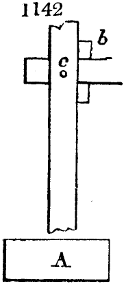
Washing and stamping of tin ores at Polgooth, near St. Austle.—The stamps or pestles are of wood, 6 inches by 51⁄2 in the square: they carry lifting bars b, secured with a wooden wedge and a bolt of iron, and they terminate below in a lump of cast iron A, called the head, which is fastened to them by a tail, and weighs about 21⁄2 cwts. The shank of the pestle is strengthened with iron hoops. A turning-shaft communicates motion to the stamps by cams stuck round its circumference, so arranged that the second falls while the first and third of each set are uplifted. There are 4 cams on one periphery, and the shaft makes 7 turns in the minute. Each stamp, therefore, gives 28 strokes per minute, and falls through a space of 71⁄2 inches. The stamp chest is open behind, so that the ore slips away under the pestles, by its weight, along the inclined plane with the stream of water. The bottom of the troughs consists of stamped ores. With 6 batteries of 6 pestles each, at Poldice, near Redruth, 120 bags of ore are stamped in 12 hours; each bag containing 18 gallons of 282 cubic inches; measuring altogether 352 cubic feet, and 864 cubic inches.