I. & J. (continued 4)
Reading edition
Phosphorus and chromium are determined in the following way. The iron must be dissolved in nitro-muriatic acid, to oxygenate those two bodies. The solution must be evaporated cautiously to dryness in porcelain capsules, and the saline residuum heated to redness. A little chloride of iron is volatilized, and the remainder resembles the red-brown oxide. This must be mixed with thrice its weight of carbonate of potash, and fused in a platinum crucible; the quantity of iron being from 40 to 50 grains at most.
The mixture after being acted upon by boiling water, is to be left to settle, to allow the oxide to be deposited, for it is so fine as to pass through a filter. If the iron contained manganese, this would be found at first in the alkaline solution; but manganese spontaneously separates by exposure to the air. The alkaline liquor must be supersaturated with muriatic acid, and evaporated to dryness. The liquor acidulated, and deprived of its silica by filtration, is to be supersaturated with ammonia; when the alumina will precipitate in the state of a subphosphate. When the liquor is now supersaturated with acetic acid, and then treated with acetate of lead, a precipitate of phosphate of lead almost always falls. There is hardly a bit of iron to be found which does not contain phosphorus. The slightest trace of chrome is detected by the yellow colour of the lead precipitate; if this be white there is none of the colouring metal present.
100 parts of the precipitated phosphate of lead contain, after calcination, 19·4 parts of phosphoric acid. The precipitate should be previously washed with acetic acid, and then with water. These 19·4 parts contain 8·525 parts of phosphorus.
Cast iron sometimes contains calcium and barium, which may be detected by their well-known reagents, oxalate of ammonia, and sulphuric acid. In malleable iron they are seldom or never present.
The charcoal found in the residuum of the nitro-muriatic solution is to be burned away under a muffle. The solution itself contains along with the oxide of iron, protoxide of manganese, and other oxides, as well as the earths, and the phosphoric and arsenic acids. Tartaric acid is to be added to it, till no precipitate be formed by supersaturation with caustic ammonia. The ammoniacal liquor must be treated with hydrosulphuret of ammonia as long as it is clouded, then thrown upon a filter. The precipitate is usually very voluminous, and must be well washed. The liquor which passes through is to be saturated with muriatic acid, to decompose all the sulphurets.
The solution still contains all the earths and the oxide of titanium, besides the phosphoric acid. It is to be evaporated to dryness, whereby the ammonia is expelled, and the carbonaceous residuum must be burned under a muffle. If the iron contains much phosphorus, the ashes are strongly agglutinated. They are to be fused as already described along with carbonate of potash, and the mass is to be treated with boiling water. The residuum may be examined for silica, lime, barytes, and oxide of titanium. Muriatic acid being digested on it, then evaporated to dryness, and the residuum treated with water; will leave the silica. Caustic ammonia, poured into the solution, will separate the alumina, if any be present, and the oxide of titanium; but the former almost never occurs.
Manganese is best sought for by a distinct operation. The iron must be dissolved at the heat of boiling water, in nitro-muriatic acid; and the solution, when very cold, is to be treated with small successive doses of solution of carbonate of ammonia. If the iron has been oxidized to a maximum, and if the liquor has been sufficiently acid, and diluted with water, it will retain the whole of the manganese. This process is as good as that by succinate of ammonia, which requires many precautions.
The liquor is often tinged yellow by carbon, after it has ceased to contain a single trace of iron oxide. As soon as litmus paper begins to be blued by carbonate of ammonia, we should stop adding it; immediately throw the whole upon a filter, and wash continuously with cold water. What passes through is to be neutralized with muriatic acid, and concentrated by evaporation. It may contain besides manganese, some lime, or barytes. It should therefore be precipitated with hydrosulphuret of ammonia, the hydrosulphuret of manganese should be collected, dissolved in strong muriatic acid, filtered, and treated, at a boiling heat, with carbonate of potash. The precipitate, well washed and calcined, contains, in 100 parts, 72·75 parts of metallic manganese.
The copper, arsenic, lead, tin, bismuth, antimony, or silver, are best separated by a stream of sulphuretted hydrogen gas passed through the solution in nitro-muriatic acid, after it is largely diluted with water. The precipitate must be cautiously roasted in a porcelain test, to burn away the large quantity of sulphur which is deposited in consequence of the conversion of the peroxide of iron into the protoxide. If nothing remains upon the test, none of these metals is present. If a residuum be obtained, it must be dissolved in nitro-muriatic acid, and subjected to examination. But, in fact, carbon, sulphur, phosphorus, silicon, and manganese, are the chief contaminators of iron.
Chloride of silver affords the means of determining the proportion of carbon contained in iron, and of ascertaining the state in which that substance exists in the metal. Fused chloride of a pale yellow colour must be employed. The operation is to be performed in close vessels, with the addition of a great deal of water, and a few drops of muriatic acid. The carbonaceous residuum is occasionally slightly acted upon. We may judge of this circumstance by the gases disengaged, as well as by the appearance of the charcoal.
Ductile iron and soft steel, as well as white cast-iron which has been rendered gray by roasting, when decomposed by chloride of silver, afford a blackish-brown unmagnetic charcoal, and a plumbaginous substance perfectly similar to what is extracted from the same kinds of iron, by solution in acids. A portion of this plumbago is also converted into charcoal of a blackish brown colour, by the action of the chloride. Hence this agent does not afford the means of obtaining what has been called the poly-carburet, till it has produced a previous decomposition. But we obtain it, in this manner, purer and in greater quantity than we could by dissolving the metal in the acids. The only subject of regret is, that we possess no good criterion for judging of the progress of this analytical operation.
Gray cast iron leaves, besides the polycarburet, a residuum of plumbago, and carbon which was not chemically combined with the iron; while tempered steel and white cast iron afford merely a blackish brown charcoal; but the operation is extremely slow with the latter two bodies, because a layer of charcoal forms upon the surface, which obstructs their oxidizement. For this reason the white cast iron ought to be previously changed into gray by fusion in a crucible lined with charcoal, before being subjected to the chloride of silver; if this process be employed for tempered steel, the combined carbon becomes merely a polycarburet. It would not be possible to operate upon more than 15 grains, which require from 60 to 80 times that quantity of the chloride, and a period of 15 days for the experiment.
The residuum, which is separable from the silver only by mechanical means, should be dried a long time at the heat of boiling water. It contains almost always iron and silica. After its weight is ascertained, it is to be burned in a crucible of platinum till the ashes no longer change their colour, and are not attractable by the magnet. The difference between the weights of the dried and calcined residuum is the weight of the charcoal. The oxide of iron is afterwards separated from the silica by muriatic acid.
In operating upon gray cast iron, we should ascertain separately the proportion of graphite or plumbago, and that of the combined charcoal. To determine the former, we dissolve a second quantity of the cast iron in nitric acid, with a little muriatic; the residuum, which is graphite, is separated from the silica and the combined carbon by the action of caustic potash. After being washed and dried, it must be weighed. The weight of the graphite obtained being deducted from the quantity of carbon resulting from the decomposition effected by the chloride of silver, the remainder is the amount of the chemically combined carbon.
By employing muriatic acid, we could dissipate at once the combined carbon; but this method would be inexact, because the hydrogen disengaged would carry off a portion of the graphite.
According to Karsten, Mushet’s table of the quantities of carbon contained in different steels and cast irons is altogether erroneous. It gives no explanation why, with equal proportions of charcoal, cast iron constitutes at one time a gray, soft, granular metal, and at another, a white, hard, brittle metal in lamellar facets. The incorrectness of Mushet’s statement becomes most manifest when we see the white lamellar cast iron melted in a crucible lined with charcoal, take no increase of weight, while the gray cast iron treated in the same way becomes considerably heavier.
Analysis has never detected a trace of carbon unaltered or of graphite in white cast iron, if it did not proceed from small quantities of the gray mixed with it; while perfect gray cast iron affords always a much smaller quantity of carbon altered by combination, and a much greater quantity of graphite. Neither kind of cast iron, however, betrays the presence of any oxygen. Steel affords merely altered carbon, without graphite; the same thing holds true of malleable iron; while the iron obtained by fusion with 25 per cent. of scales of iron contains no carbon at all.
The graphite of cast iron is obtained in scales of a metallic aspect, whereas the combined carbon is obtained in a fine powder. When the white cast iron has been roasted, and become gray, and is as malleable as the softest gray cast iron, it still affords no graphite as the latter does, though in appearance both are alike. Yet in their properties they are still essentially dissimilar.
With 41⁄4 per cent. of carbon, the white cast iron preserves its lamellar texture; but with less carbon, it becomes granular and of a gray colour, growing paler as the dose of carbon is diminished, while the metal after passing through an indefinite number of gradations, becomes steely cast iron, very hard steel, soft steel, and steely wrought iron.
The steels of the forge and the cast steels examined by Karsten, afforded him from 2·3 to 11⁄4 per cent. of carbon; in the steel of cementation, (blistered steel) he never found above 13⁄4 of carbon. Some wrought irons which ought to contain no charcoal, hold as much as 1⁄2 per cent. and they then approach to steel in nature. The softest and purest irons contain still 0·2 per cent. of carbon.
The quantity of graphite which gray cast iron contains, varies, according to Karsten’s experiments, from 2·57 to 3·75 per cent.; but it contains besides, some carbon in a state of alteration. The total contents in carbon varied from 3·15 to 4·65 per cent. When the congelation of melted iron is very slow, the carbon separates, probably in consequence of its crystallizing force, so as to form a gray cast iron replete with plumbago. If the gray do not contain more charcoal than the white from which it has been formed, and if it contain the charcoal in the state of mechanical mixture, then it can have little or none in a state of combination, even much less than what some steels contain. Hence we can account for some of its peculiarities in reference to white cast iron; such as its granular texture, its moderate hardness, the length of time it requires to receive annealing colours, the modifications it experiences by contact of air at elevated temperatures, the high degree of heat requisite to fuse it, its liquidity, and finally its tendency to rust by porosity, much faster than the white cast iron.
We thus see that carbon may combine with iron in several manners; that the gray cast iron is a mixture of steely iron and plumbago; that the white, rendered gray and soft by roasting, is a compound of steely iron and a carburet of iron, in which the carbon predominates; and that untempered steel is in the same predicament.
For the following analyses of cast irons, we are indebted to MM. Gay Lussac and Wilson.
Table.—In 100 parts.
Cast iron. Iron. Carbon. Silica. Phos- phorus. Man ganese. Remarks.
White cast from Siegen 94·338 2·690 0·230 0·162 2·590 By wood charcoal
Do. Coblentz 94·654 2·441 0·230 0·185 2·490 do.
Do. a. d. Champ 96·133 2·324 0·840 0·703 a trace do.
Do. Isère 94·687 2·636 0·260 0·280 2·137 do.
Gray Nivernais 95·673 2·254 1·030 1·043 a trace do.
Do. Berry 95·573 2·319 1·920 0·188 do Mix. of coke & do.
Do. a. d. Champ 95·971 2·100 1·060 0·869 do. Charcoal
Do. Creusot 93·385 2·021 3·490 0·604 do. Coke
Do. a. d. Franche Comté 95·689 2·800 1·160 0·351 do. do.
Do. Wales 94·842 1·666 3·000 0·492 do. do.
Do. Do. 95·310 2·550 1·200 0·440 do. do.
Do. Do. 95·150 2·450 1·620 0·780 do. do.
Karsten has given the following results as to carbon, in 100 parts of gray cast iron.
Gray cast iron. Combined carbon. Free carbon. Total carbon. Remarks.
Siegen, from brown iron-stone 0·89 3·71 4·60 By wood charcoal
Siegen (Widderstein), from brown and sparry iron 1·03 3·62 4·65 do.
Malapane, from spherosiderite 0·75 3·15 3·90 do.
Königshütte, from brown ore 0·58 2·57 3·15 coke
Do. at a lower smelting heat 0·95 2·70 3·65 do.
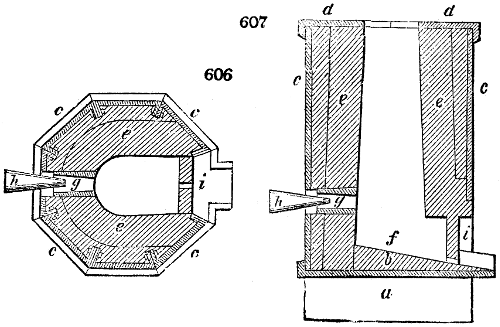
Fig. 607. represents in section, and fig. 606. in plan, the famous cupola furnace for casting iron employed at the Royal Foundry in Berlin. It rests upon a foundation a, from 18 to 24 inches high, which supports the basement plate of cast iron, furnished with ledges, for binding the lower ends of the upright side plates or cylinder, e. Near the mouth there is a top-plate d, made in several pieces, which serves to bind the sides at their upper end, as also to cover in the walls of the shaft. These plates are most readily secured in their places by screws and bolts. Within this iron case, at a little distance from it, the proper furnace-shaft e, is built with fire-bricks, and the space between this and the iron is filled up with ashes. The sole of the hearth f, over the basement-plate, is composed of a mixture of fire-clay and quartz-sand firmly beat down to the thickness of 6 or 8 inches, with a slight slope towards the discharge-hole for running off the metal. g is the form or the tuyère (there are sometimes one on each side); h the nose pipe; the discharge aperture i is 12 inches wide and 15 inches high; across which the sole of the hearth is rammed down. During the melting operation, this opening is filled up with fire-clay; when it is completed, a small hole merely is pierced through it at the lowest point, for running off the liquid metal. The hollow shaft should be somewhat wider at bottom than at top. Its dimensions vary with the magnitude of the foundry. When 5 feet high, its width at the level of the tuyère or blast-hole may be from 20 to 22 inches. From 250 to 300 cubic feet of air per minute are required for the working of such a cupola. For running down 100 pounds of iron, after the furnace has been brought to its heat, 48 pounds of ordinary coke are used; but with the hot blast much less will suffice. The furnace requires feeding with alternate charges of coke and iron every 8 or 10 minutes. The waste of iron, by oxidization and slag, amounts in most foundries to fully 5 per cent. For carrying off the burnt air, a chimney-hood is commonly erected over the cupola. See Foundry.
The double-arched air or wind-furnace used in the foundries of Staffordshire for melting cast iron, has been found advantageous in saving fuel, and preventing waste by slag. It requires fire-bricks of great size and the best composition.
The main central key-stone is constructed of large fire-bricks made on purpose; against that key-stone the two arches press, having their abutments at the sides against the walls. The highest point of the roof is only 8 inches above the melted metal. The sole of the hearth is composed of a layer of sand 8 inches thick, resting upon a bed of iron or of brickwork. The edge of the fire-bridge is only 3 inches above the fluid iron.
In from 2 to 4 hours from 1 to 3 tons of metal may be founded in such a furnace, according to its size; but it ought always to be heated to whiteness before the iron is introduced. 100 pounds of cast iron require from 1 to 11⁄2 cubic foot of coal to melt them. The waste varies from 5 to 9 per cent.
I shall conclude the subject of iron with a few miscellaneous observations and statistical tables. Previously to the discovery by Mr. Cort, in 1785, of the methods of puddling and rolling or shingling iron, this country imported 70,000 tons of this metal from Russia and Sweden; an enormous quantity for the time, if we consider that the cotton and other automatic manufactures, which now consume so vast a quantity of iron, were then in their infancy; and that two years ago, the whole of our importation from these countries did not exceed 40,000 tons. From the following table of the prices of bar iron in successive years, we may infer the successive rates of improvement and economy, with slight vicissitudes.
Years. Per Ton.
£ s. £ s.
1824 9 0 to 10 0
1825 10 0 — 14 0
1826 8 10 — 10 0
1827 8 0 — 9 0
1828 7 10 — 8 0
1829 5 10 — 7 0
1830 5 5 — 6 0
1831 5 5 — 5 10
1832 5 0 — 5 10
1833 5 10 — 6 0
1834 6 0 — 6 10
1835 5 10 — 7 0
I have been informed upon good authority that the total production of iron in Great Britain, in the year 1836, was almost exactly ONE MILLION OF TONS!
The export of iron that year, in bars, rods, pigs, castings, wire, anchors, hoops, nails, and old iron, amounted to 189,390 tons; in unwrought steel to 3,014, and in cutlery, to 21,072; in whole to 213,478: leaving apparently for internal consumption 776,522 tons, from which however one tenth probably should be deducted for waste, in the conversion of the bar iron. Hence 700,000 tons may be taken as the approximate quantity of iron made use of in the United Kingdom, in the year 1836.
The years 1835 and 1836 being those of the railway mania over the world, produced a considerable temporary rise in the price of bar iron; but as this increased demand caused the construction of a great many more smelting and refining furnaces, it has tended eventually to lower the prices; an effect also to be ascribed to the more general use of the hot blast.
The relative cost of making cast iron at Merthyr Tydvil in South Wales, and at Glasgow, was as follows, eight or nine years ago.
At Merthyr.
s. Tons. Cwts. Qrs. £ s. d.
Raw mine at 10 per ton, 3 7 0 1 13 6
Coal at 6 2 16 0 0 16 6
Limestone 1 5 2 0 1 4
Other charges 0 9 1
Total Cost 3 0 5
At Glasgow.
s. d. Tons. Cwts. £ s. d.
Raw mine at 4 6 3 10 0 16 3
Splint Coal at 2 5 5 15 0 14 0
Limestone at 0 3 0 14 0 3 6
Coals for the engine 1 10 0 3 0
Other charges 1 1 0
Total cost 2 17 9
The cost is still nearly the same at Merthyr, but it has been greatly decreased at Glasgow.
The saving of fuel by the hot-blast is said to be in fact so great, that blowing cylinders, which were adequate merely to work three furnaces at the first period, were competent to work four furnaces at the last period. The saving of materials has moreover been accompanied by an increase of one-fourth in the quantity of iron, in the same time; as a furnace which turned out only 60 tons a week with the cold blast, now turns out no less than 80 tons. That the iron so made is no worse, but probably better, when judiciously smelted, would appear from the following statement. A considerable order was not long since given to four iron-work companies in England, to supply pipes to one of the London water companies. Three of these supplied pipes made from the cold-blast iron; the fourth, it is said, supplied pipes made with the hot-blast iron. On subjecting these several sets of pipes to the requisite trials by hydraulic pressure, the last lot was found to stand the proof far better than any of the former three.—That iron was made with raw coal.
I have been since told by eminent iron-masters of Merthyr, that this statement stands in need of confirmation, or is probably altogether apocryphal, and that as they find the hot blast weakens the iron, they will not adopt it.
Between the cast irons made in different parts of Great Britain, there are characteristic differences. The Staffordshire metal runs remarkably fluid, and makes fine sharp castings. The Welsh is strong, less fluent, but produces bar iron of superior quality. The Derbyshire iron also forms excellent castings, and may be worked with care into very good bar iron. The Scotch iron is very valuable for casting into hollow wares, as it affords a beautiful smooth skin from the moulds, so remarkable in the castings of the Carron company, in Stirlingshire, and of the Phœnix foundry, at Glasgow. The Shropshire iron resembles the Staffordshire in its good qualities.
The average quantity of fine metal obtainable from the forge-pigs at Merthyr Tydvil, from the finery furnace, is one ton for 221⁄2 cwt. of cast iron, with a consumption of about 91⁄2 cwt. of coal per ton.
Estimate of the average cost of erecting three blast furnaces.
BUILDING EXPENSES.
Foundations £480
Masonry of hewn grit-stones 600
Common bricklayers’ work 1200
Lining of the furnace, hearth, &c., in fire-bricks 1140
Fire-clay for building 80
Lime and sand 800
CAST IRON.
Cast-iron pieces, such as dam-plates, tymp-plates, beams, tuyère-plates, &c., weighing about 24 tons for each furnace;—in whole 1140
WROUGHT IRON.
For the binding-hoops, keys, &c.; 5 tons for each 300
COST OF LABOUR.
Bricklayers, masons, and labourers in building 1080
VARIOUS EXPENSES.
Scaffolding 48
Tools 160
Shed in front of each furnace 480
Terracing, cost of ground, &c. 2400
Total cost of erecting the furnaces 9908
INCIDENTAL CHARGES.
Blowing machinery, and steam engine of 80-horse power 6400
Inclined railway for mounting the charges 120
Gallery for charging 160
Steam engine house 400
Chimneys, boilers, &c. 480
Roasting kilns 480
Coke kilns 800
Dwelling-houses for workmen 800
Total cost of 3 furnaces complete £19,548
Estimate from the Neath-Abbey Works in S. Wales, of the cost of machines requisite for a forge and shingling-mill, capable of turning out 120 tons of bar iron per week.
1. Steam-engine upon Bolton and Watt’s construction; of 40 inches diameter in the cylinder, and 8-feet stroke; with boilers, pipes, grate, bars, fire-doors, &c. &c., complete £1600
2. System of great-geering for transmitting the crank-motion of the engine to the mill-work, with fly-wheel, &c. 1090
3. A system of roughing rolls, with pinions, uprights, and every thing else necessary 525
4. Two pairs of finisher-rolls, with all their accessories 525
5. Two pairs of shear-machines, at 170l. apiece 340
6. One pair of rolls of 10 inches diameter, for making small bar iron, with all their accessories 230
7. Forge hammer, including the anvil, the cam-shafts, and all the other requisites 185
8. A complete turning lathe 200
£4695
9. To the above must be added, spare cylinders weighing about 60 tons 960
10. Duplicate articles for the steam-engine ?
11. 150 tons of cast-iron plates, to cover the floor of the mill 900
12. Eight tons of cast-iron pieces for a reverberatory furnace 52
13. Tools of malleable iron; rakes, oars, &c. 28
14. Castings for mounting a cupola furnace 50
15. Blowing-machine for the cupola 80
16. Pieces of iron for a small forge, with two fires, two bellows, two anvils, iron tools faced with steel, and common iron tools, &c. 100
17. Eight tons of cast-iron pieces, and wrought-iron pieces for 14 puddling furnaces 983
18. Seven tons of cast-iron pieces, and wrought iron for 4 re-heating furnaces 252
19. Tools for the puddlers and other workmen 15
20. Iron mountings for two cranes, partly made of wood 50
Total cost of machines, and pieces of iron £8165
To the above, the cost of the steam engine house is to be added, that of another forge hammer, and incidental expenses.
In Staffordshire the following estimate has been given:
A steam-engine of 60-horse power 2016
Rolls, with the iron work of the furnaces, &c., to make 120 tons of bar iron weekly 2572
£4588
The Neath-Abbey estimate is greater, but that company has a high character for making substantial well-finished machinery.
Bar iron made entirely from ore without admixture of cinder, or vitrified oxide, is always reckoned worth 10s. a ton more than the average iron in the market, which is frequently made by smelting 25 per cent. of cinder with 75 of ore or mine, as it is called.
Importation of iron in bars or unwrought, for home consumption; and amount of duty, in
1836. 1837. 1836. 1837.
18,978 tons 18 cwt. 13,470 tons 4 cwt. £28,450 £20,065
M. Virlet’s Statistical Table of the produce of Iron in Europe.
Quintals.
England (1827) 7,098,000
France (1834) 2,200,000
Russia (1834) 1,150,000
Austria (1829) 850,000
Sweden (1825) 850,000
Prussia 800,000
The Hartz Mountains 600,000
Holland and Belgium 600,000
Elba and Italy 280,000
Piedmont 200,000
Spain 180,000
Norway 150,000
Denmark 135,000
Bavaria 130,000
Saxony 80,000
Poland 75,000
Switzerland 30,000
Savoy 25,000
Total 13,433,000
(equal to about 672,000 tons.)
For additional statistics of iron, see Pitcoal, at the end.
Bronzing of polished iron.—The barrels of fowling-pieces and rifles are occasionally bronzed and varnished, to relieve the eye of the sportsman from the glare of a polished metal, and to protect the surface from rusting. The liquid used for browning the barrels is made by mixing nitric acid of specific gravity 1·2, with its own weight of spirit of nitric ether, of alcohol, and tincture of muriate of iron; and adding to that mixture, a quantity of sulphate of copper equal in weight to the nitric acid and ethereous spirit taken together. The sulphate must be dissolved in water before being added; and the whole being diluted with about 10 times its weight of water, is to be bottled up for use. This liquid must be applied by friction with a rag to the clear barrel, which must then be rubbed with a hard brush; processes to be alternated two or three times. The barrel should be afterwards dipped in boiling water, rendered feebly alkaline with carbonate of potash or soda, well dried, burnished, and heated slightly for receiving several coats of tin-smith’s lacquer, consisting of a solution of shellac in alcohol, coloured with dragon’s blood.
ISINGLASS, or Fish-glue, called in Latin ichthyocolla, is a whitish, dry, tough, semi-transparent substance, twisted into different shapes, often in the form of a lyre, and consisting of membranes rolled together. Good isinglass is unchangeable in the air, has a leathery aspect, and a mawkish taste nearly insipid; when steeped in cold water it swells, softens, and separates in membranous laminæ. At the boiling heat it dissolves in water, and the solution, on cooling, forms a white jelly, which is semi-transparent, soluble in weak acids, but is precipitated from them by alkalies. It is gelatine nearly pure; and if not brittle, like other glue, this depends on its fibrous and elastic texture. The whitest and finest is preferred in commerce. Isinglass is prepared from the air-bladders of sturgeons, and especially the great sturgeon, the accipenser huso; which is fished on the shores of the Caspian sea, and in the rivers flowing into it, for the sake chiefly of its swim bladder.
The preparation of isinglass in this part of Russia, and particularly at Astracan, consists in steeping these bladders in water, removing carefully their external coat, and the blood which often covers them, putting them in a hempen bag, squeezing them, softening them between the hands, and twisting them into small cylinders, which are afterwards bent into the shape of a lyre. They are ready for the market immediately after being dried in the sun, and whitened with the fumes of burning sulphur.
In some districts of Moldavia, another process is followed. The skin, the stomach, the intestines, and the swim bladder of the sturgeon are cut in small pieces, steeped in cold water, and then gently boiled. The jelly thus obtained is spread in thin layers to dry, when it assumes the appearance of parchment. This being softened in a little water, then rolled into cylinders, or extended into plates, constitutes an inferior article.
The swim bladder of the cod and many other fishes, also furnishes a species of isinglass, but it is much more membranous, and less soluble than that of the sturgeon.
The properties of isinglass are the same as those of gelatine or pure glue; and its uses are very numerous. It is employed in considerable quantities to clarify ale, wine, liqueurs, and coffee. As an article of food to the luxurious in the preparation of creams and jellies, it is in great request. Four parts of it convert 100 of water into a tremulous jelly, which is employed to enrich many soups and sauces. It is used along with gum as a dressing to give lustre to ribbons and other silk articles. The makers of artificial pearls employ it to fix the essence d’Orient on the glass globules which form these pearls, and the Turks set their precious stones or jewellery by means of isinglass dissolved in alcohol along with gum ammoniac; a combination which is also employed in this country to join broken pieces of china and glass, under the name of diamond cement. That setting preserves its transparency after it solidifies, if it be well made.
It is by covering taffety or thin silk with a coat of isinglass that court plaster is made. A solution of isinglass coloured with carmine forms an excellent injection liquor to the anatomist. M. Rochen has made another pretty application of isinglass. He plunges into a limpid solution of it, made by means of a water bath, sheets of wire gauze set in window or lamp frames, which, when cold, have the appearance of glass, and answer instead of it for shades and other purposes. If one dip be not sufficient to make a proper transparent plate of isinglass, several may be given in succession, allowing each film to harden in the interval between the dips. The outer surface should be varnished to protect it from damp air. These panes of gelatine are now generally used for lamps instead of horn, in the maritime arsenals of France.
Isinglass imported for home consumption; and duties paid in
1835. 1836. 1835. 1836.
1,814 cwts. 1,735 cwts. £4,290 £4,125
ISLAND MOSS (Lichen d’Islande, Fr.; Flechte Isl., Germ.); is a lichen, the Cetraria islandica, which contains a substance soluble in hot water, but forming a jelly when it cools, styled lichenine by M. Guerin. Lichenine has a yellowish tint in the dry state, is transparent in thin plates, insipid, inodorous, and difficult to pulverize. Cold water makes it swell, but does not dissolve it. It is precipitated in white flocks by alcohol and ether. Iodine tinges it of a brownish green. Sulphuric acid converts it into sugar; and the nitric into oxalic acid. Lichenine is prepared by extracting first of all from the plant a bitter colouring matter, by digesting 1 pound of it in 16 pounds of cold water containing 1 ounce of pearl-ash; then draining the lichen, edulcorating with cold water, and boiling it in 9 pounds of boiling water, till 3 pounds be evaporated. The jelly which forms, upon cooling the filtered solution, is dark coloured, but, being dried and redissolved in hot water, it becomes clear and colourless. Lichenine consists of 39·33 carbon, 7·24 hydrogen, and 55·43 oxygen. With potash, lime, oxide of lead, and tincture of galls, the habitudes of lichenine and starch are the same. The mucilage of island moss is preferred in Germany to common paste for dressing the warp of webs in the loom, because it remains soft, from its hygrometric quality. It is also mixed with the pulp for sizing paper in the vat.
IVORY (Ivoire, Fr.; Elfenbein, Germ.); is the osseous matter of the tusks teeth of the elephant, the hippopotamus, or morse, wild boar, several species of phocæ, as well as the horn or tooth of the narwhal. Ivory is a white, fine-grained, dense substance, of considerable elasticity, in thin plates, and more transparent than paper of equal thickness. The outside of the tusk is covered by the cortical part, which is softer and less compact than the interior substance, with the exception of the brown plate that sometimes lines the interior cavity. The hardest, toughest, whitest, and most translucent ivory, has the preference in the market; and the tusks of the sea-horse are considered to afford the best. In these, a rough glassy enamel covers the cortical part, of such hardness, as to strike sparks with steel. The horn of the narwhal is sometimes ten feet long, and consists of an ivory of the finest description, as hard as that of the elephant, and susceptible of a better polish; but it is not in general so much esteemed as the latter.
Ivory has the same constituents as the teeth of animals, three-fourths being phosphate, with a little carbonate of lime; one-fourth cartilage. See Bones.
It is extensively employed by miniature painters for their tablets; by turners, in making numberless useful and ornamental objects; by cutlers, for the handles of knives and forks; by comb-makers; as also by philosophical instrument makers, for constructing the scales of thermometers, &c. The ivory of the sea-horse is preferred by dentists for making artificial teeth; that of the East India elephant is better than of the African. When it shows cracks or fissures in its substance, and when a splinter broken off has a dull aspect, it is reckoned of inferior value. Ivory is distinguishable from bone by its peculiar semi-transparent rhombohedral net-work, which may be readily seen in slips of ivory cut transversely.
Ivory is very apt to take a yellow-brown tint by exposure to air. It may be whitened or bleached, by rubbing it first with pounded pumice-stone and water, then placing it moist under a glass shade luted to the sole at the bottom, and exposing it to sunshine. The sunbeams without the shade would be apt to occasion fissures in the ivory. The moist rubbing and exposure may be repeated several times.
For etching ivory, a ground made by the following recipe is to be applied to the polished surface:—Take of pure white wax, and transparent tears of mastick, each one ounce; asphalt, half an ounce. The mastick and asphalt having been separately reduced to fine powder, and the wax being melted in an earthenware vessel over the fire, the mastick is to be first slowly strewed in and dissolved by stirring; and then the asphalt in like manner. This compound is to be poured out into lukewarm water, well kneaded, as it cools, by the hand, into rolls or balls about one inch in diameter. These should be kept wrapped round with taffety. If white rosin be substituted for the mastick, a cheaper composition will be obtained, which answers nearly as well; 2 oz. asphalt, 1 oz. rosin, 1⁄2 oz. white wax; being good proportions. Callot’s etching ground for copper plates, is made by dissolving with heat 4 oz. of mastick in 4 oz. of very fine linseed oil; filtering the varnish through a rag, and bottling it for use.
Either of the two first grounds being applied to the ivory, the figured design is to be traced through it in the usual way, a ledge of wax is to be applied, and the surface is to be then covered with strong sulphuric acid. The effect comes better out with the aid of a little heat; and by replacing the acid, as it becomes dilute by absorption of moisture, with concentrated oil of vitriol. Simple wax may be employed instead of the copperplate engravers’ ground; and strong muriatic acid instead of sulphuric. If an acid solution of silver or gold be used for etching, the design will become purple or black, on exposure to sunshine. The wax may be washed away with oil of turpentine. Acid nitrate of silver affords the easiest means of tracing permanent black lines upon ivory.
Ivory may be dyed by using the following prescriptions:—
1. Black dye.—If the ivory be laid for several hours in a dilute solution of neutral nitrate of pure silver, with access of light, it will assume a black colour, having a slightly green cast. A still finer and deeper black may be obtained by boiling the ivory for some time in a strained decoction of logwood, and then steeping it in a solution of red sulphate or red acetate of iron.
2. Blue dye.—When ivory is kept immersed for a longer or shorter time in a dilute solution of sulphate of indigo (partly saturated with potash), it assumes a blue tint of greater or less intensity.
3. Green dye.—This is given by dipping blued ivory for a little while in solution of nitromuriate of tin, and then in a hot decoction of fustic.
4. Yellow dye—is given by impregnating the ivory first with the above tin mordant, and then digesting it with heat in a strained decoction of fustic. The colour passes into orange, if some brazil wood has been mixed with the fustic. A very fine unchangeable yellow may be communicated to ivory by steeping it 18 or 24 hours in a strong solution of the neutral chromate of potash, and then plunging it for some time in a boiling hot solution of acetate of lead.
5. Red dye—may be given by imbuing the ivory first with the tin mordant, then plunging it in a bath of brazil wood, cochineal, or a mixture of the two. Lac-dye may be used with still more advantage, to produce a scarlet tint. If the scarlet ivory be plunged for a little in a solution of potash, it will become cherry red.
6. Violet dye—is given in the logwood bath, to ivory previously mordanted for a short time with solution of tin. When the bath becomes exhausted, it imparts a lilac hue. Violet ivory is changed to purple-red by steeping it a little while in water containing a few drops of nitro-muriatic acid.
With regard to dyeing ivory, it may in general be observed, that the colours penetrate better before the surface is polished than afterwards. Should any dark spots appear, they may be cleared up by rubbing them with chalk; after which the ivory should be dyed once more to produce perfect uniformity of shade. On taking it out of the boiling hot dye bath, it ought to be immediately plunged into cold water, to prevent the chance of fissures being caused by the heat.
If the borings and chips of the ivory-turner, called ivory dust, be boiled in water, a kind of fine size is obtained.
The importation of elephants’ teeth for home consumption was, in 1834, 4,282 cwts.; in 1835, 3,698, and in 1836, 4,584 cwts.; duty, 1l. per cwt.
IVORY BLACK (Noir d’ivoire, Fr.; Kohle von Elfenbein, Germ.); is prepared from ivory dust, by calcination in the very same way as is described under Bone Black.
The calcined matter being ground and levigated on a porphyry slab, affords a beautiful velvety black, much used in copperplate printing. Ivory black may be prepared upon the small scale, by a well regulated ignition of the ivory dust in a covered crucible.