F.
Reading edition
FAHLERZ. Gray copper-ore, called also Panabase, from the many oxides it contains.
FAINTS, is the name of the impure spirit, which comes over first and last in the distillation of whiskey; the former being called the strong, and the latter, which is much more abundant, the weak faints. This crude spirit is much impregnated with fetid essential oil, is therefore very unwholesome, and must be purified by rectification.
FAN (Eventail, Fr.; Fächer, Germ.); is usually a semi-circular piece of silk or paper, pasted double, enclosing slender slips of wood, ivory, tortoise-shell, whale-bone, &c., arranged like the tail of a peacock in a radiating form, and susceptible of being folded together, and expanded at pleasure. This well-known hand ornament is used by ladies to cool their faces by agitating the air. Fans made of feathers, like the wing of a bird, have been employed from time immemorial by the natives of tropical countries.
Fan is also the name of the apparatus for winnowing corn. For an account of the powerful blowing and ventilating fan machine, see Foundry and Ventilator.
FARINA (Farine, Fr.; Mehl, Germ.); is the flour of any species of corn, or starchy root, such as potato, arrow root, &c. See Bread and Starch.
FATS, (Graisses, Fr.; Fette, Germ.) occur in a great number of the animal tissues, being abundant under the skin in what is called the cellular membrane, round the kidneys, in the folds of the omentum, at the base of the heart, in the mediastinum, the mesenteric web, as well as upon the surface of the intestines, and among many of the muscles. They vary in consistence, colour, and smell, according to the animals from which they are obtained; thus, they are generally fluid in the cetaceous tribes, soft and rank-flavoured in the carnivorous, solid and nearly scentless in the ruminants, usually white and copious in well-fed young animals; yellowish and more scanty in the old. Their consistence varies also according to the organ of their production; being firmer under the skin, and in the neighbourhood of the kidneys, than among the movable viscera. Fat forms about one twentieth of the weight of a healthy animal. But as taken out by the butcher it is not pure, for being of a vesicular structure it is always enclosed in membranes, mixed with blood, blood-vessels, lymphatics, &c. These foreign matters must first be separated in some measure mechanically, after the fat is minced small, and then more completely by melting it along with hot water, passing it through a sieve, and letting the whole cool very slowly. By this means a cake of cleansed fat will be obtained. Many plans of purifying fats have been proposed; one of the best is to mix two per cent. of strong sulphuric acid with a quantity of water, in which the tallow is heated for some time with much stirring; to allow the materials to cool, to take off the supernatant fat, and re-melt it with abundance of hot water. More tallow will thus be obtained, and that considerably whiter and harder than is usually procured by the melters.
I have found that chlorine, and chloride of lime do not improve, but rather deteriorate the appearance of oils and other fatty bodies. According to Appert, minced suet subjected to the action of high-pressure steam in a digester, at 250° or 260° F., becomes so hard as to be sonorous when struck, whiter, and capable when made into candles, of giving a superior light. A convenient mode of rendering minced tallow, or melting it, is to put it in a tub, and drive steam through it from numerous orifices in ramifying pipes placed near the bottom. Mr. Watt assures me that his plan of purifying fats, patented in March 1836, has been quite successful. He employs dilute sulphuric acid, to which he adds a little nitric acid, with a very small quantity of bichromate of potash, “to supply oxygen;” and some oxalic acid. These are mixed with the fat in the steaming tub. When the lumps of it are nearly dissolved, he takes for every ton of fat, one pound of strong nitric acid, diluted with one quart of water; to which he adds two ounces of alcohol, naphta, sulphuric ether, or spirits of turpentine; and after introducing this mixture, he continues the boiling for half an hour. The fat is finally washed.—As I do not comprehend the modus operandi of these ingredients, I shall abstain from any comment upon the recipe.
Others have proposed to use vegetable or animal charcoal first, especially for rancid oils, then to heat them with a solution of sulphate of copper and common salt, which is supposed to precipitate the fetid albuminous matter. Milk of lime has been also prescribed; but it is I believe always detrimental.
Davidson treats whale oil with infusion of tan, in order to separate the gelatine and albumine in flocks; next with water and chloride of lime, to destroy the smell; and lastly, with dilute sulphuric acid, to precipitate all the lime in the state of a sulphate. This is certainly one of the cheapest and most effective methods of purifying that substance.
Braconnot and Raspail have shown that solid animal fats are composed of very small, microscopic, partly polygonal, partly reniform particles, which are connected together by very thin membranes. These may be ruptured by mechanical means, then separated by triturating the fresh fats with cold water, and passing the unctuous matter through a sieve. The particles float in the water, but eventually collect in a white granular crystalline appearance, like starch. Each of them consists of a vesicular integument, of the nature of stearine, and an interior fluid like elaine, which afterwards exudes. The granules float in the water, but subside in spirits of wine. When digested in strong alcohol, the liquid part dissolves, but the solid remains. These particles differ in shape and size, as obtained from different animals; those of the calf, ox, sheep, are polygonal, from 1⁄50 to 1⁄350 of an inch in diameter; those of the sow are kidney-shaped, and from 1⁄50 to 1⁄100; those of man are polygonal, and from 1⁄50 to 1⁄600; those of insects are spherical, and at most 1⁄500 of an inch.
Fats all melt at a temperature much under 212° F. When strongly heated with contact of air, they diffuse white pungent fumes, then blacken, and take fire. When subjected to distillation, they afford a changed fluid oil, carburetted hydrogen, and the other products of oily bodies. Exposed for a certain time to the atmosphere, they become rancid, and generate the same fat acids as they do by saponification. In their fresh state they are all composed principally of stearine, margarine, and oleine, with a little colouring and odorous matter; and, in some species, hircine, from the goat; phocenine, from the dolphin; and butyrine, from butter. By subjecting them to a great degree of cold, and compressing them between folds of blotting paper, a residuum is obtained, consisting chiefly of stearine and margarine; the latter of which may be dissolved out by oil of turpentine.
Beef and Mutton Suet.—When fresh, this is an insipid, nearly inodorous fat, of a firm consistence, almost insoluble in alcohol, entirely so if taken from the kidneys and mesenteric web of the ox, the sheep, the goat, and the stag. It varies in its whiteness, consistence, and combustibility, with the species and health of the animals. That of the sheep is very white, and very solid. They may all be purified in the manner above described. Strong sulphuric acid develops readily the acid fats by stirring it through melted suet. Alkalis, by saponification, give rise at once to the three acids,—the stearic, margaric, and oleic. Beef suet consists of stearine, margarine, and oleine; mutton and goat suet contain a little hircine. The specific gravity of the tallow, of which common candles are made is, by my experiments, 0·936. The melting point of suet is from 98° to 104° F. The proportion of solid and fluid fat in it is somewhat variable, but the former is in much larger proportion. Mutton suet is soluble in 44 parts of boiling alcohol, of 0·820; beef suet in 44 parts. Marrow fat consists of 76 of stearine, and 24 of oleine; it melts at 115° F.
Hog’s-lard is soft, fusible at 81° F., convertible, by an alkaline solution, into a stearate, margarate, oleate, and glycerine. Its sp. grav. is 0·938, at 50° F; It consists of 62 of oleine, and 38 of stearine, in 100 parts.
Goose-fat, consists of 68 oleine and 32 stearine.
Butter, in summer, consists of 60 of oleine and 40 of stearine; in winter, of 35 of oleine, and 65 of stearine; the former substance being yellow and the latter white. It differs, however, as produced from the milk of different cows, and also according to their pasture.
The ultimate constituents of stearine, according to Chevreul are, 79 carbon; 11·7 hydrogen; and 9·3 oxygen, in 100 parts.
1,294,009 cwts. of the tallow imported in 1837, were retained for internal consumption. See Margarine, Oleine, Soap, Stearine.
FAULTS (Failles, Fr.); in mining, are disturbances of the strata which interrupt the miner’s operations, and put him at fault, to discover where the vein of ore or bed of coal has been thrown by the convulsions of nature. Many examples of faults are exhibited under Pitcoal.
FEATHERS (Plumes, Fr.; Federn, Germ.), constitute the subject of the manufacture of the Plumassier, a name given by the French (and also the English) to the artisan who prepares the feathers of certain birds for ornaments to the toilette of ladies and for military men, and to him also who combines the feathers in various forms. We shall content ourselves with describing the method of preparing ostrich feathers, as most others are prepared in the same way.
Several qualities are distinguished in the feathers of the ostrich; those of the male, in particular, are whiter and more beautiful. Those upon the back and above the wings are preferred; next, those of the wings, and lastly, of the tail. The down is merely the feathers of the other parts of the body, which vary in length from 4 to 14 inches. This down is black in the males, and gray in the females. The finest white feathers of the female have always their ends a little grayish, which lessens their lustre, and lowers their price. These feathers are imported from Algiers, Tunis, Alexandria, Madagascar, and Senegal; this being the order of their value.
The scouring process is thus performed:—4 ounces of white soap, cut small, are dissolved in 4 pounds of water, moderately hot, in a large basin; and the solution is made into a lather by beating with rods. Two bundles of the feathers, tied with packthread, are then introduced, and are rubbed well with the hands for five or six minutes. After this soaping they are washed in clear water, as hot as the hand can bear.
The whitening or bleaching is performed by three successive operations.
1. They are immersed in hot water mixed with Spanish white, and well agitated in it; after which they are washed in three waters in succession.
2. The feathers are azured in cold water containing a little indigo tied up in a fine cloth. They should be passed quickly through this bath.
3. They are sulphured in the same way as straw hats are (see Sulphuring); they are then dried by hanging upon cords, when they must be well shaken from time to time to open the fibres.
The ribs are scraped with a bit of glass cut circularly, in order to render them very pliant. By drawing the edge of a blunt knife over the filaments they assume the curly form so much admired. The hairs of a dingy colour are dyed black. For 20 pounds of feathers, a strong decoction is made of 25 pounds of logwood in a proper quantity of water. After boiling it for 6 hours, the wood is taken out, 3 pounds of copperas are thrown in; and, after continuing the ebullition for 15 or 20 minutes, the copper is taken from the fire. The feathers are then immersed by handfuls, thoroughly soaked, and worked about; and left in for two or three days. They are next cleansed in a very weak alkaline lye, and soaped three several times. When they feel very soft to the touch, they must be rinsed in cold water, and afterwards dried. White feathers are very difficult to dye a beautiful black. The acetate of iron is said to answer better than the sulphate, as a mordant.
For dyeing other colours, the feathers should be previously well bleached by the action of the sun and the dew; the end of the tube being cut sharp like a toothpick, and the feathers being planted singly in the grass. After fifteen days’ exposure, they are cleared with soap as above described.
Rose colour or pink, is given with safflower and lemon juice.
Deep red, by a boiling hot bath of Brazil wood, after aluming.
Crimson. The above deep red feathers are passed through a bath of cudbear.
Prune de Monsieur. The deep red is passed through an alkaline bath.
Blues of every shade, are dyed with the indigo vat.
Yellow; after aluming, with a bath of turmeric or weld.
Other tints may be obtained by a mixture of the above dyes.
Feathers have some more useful employments than the decoration of the heads of women and soldiers. In one case, they supply us with a soft elastic down on which we can repose our wearied frames, and enjoy sweet slumbers. Such are called bed feathers. Others are employed for writing, and these are called quills.
Goose feathers are most esteemed for beds, and they are best when plucked from the living bird, which is done thrice a year, in spring, midsummer, and the beginning of harvest. The qualities sought for in bed feathers, are softness, elasticity, lightness, and warmth. Their only preparation when cleanly gathered are a slight beating to clear away the loose matter, but for this purpose they must be first well dried either by the sun or a stove. Bleaching with lime water is a bad thing, as they can never be freed from white dust afterwards.
The feathers of the eider duck, anas mollissima, called eider down, possess in a superior degree all the good qualities of goose down. It is used only as a covering to beds, and never should be slept upon, as it thereby loses its elasticity.
Quills for writing. These consist usually of the feathers plucked out of the wings of geese. Dutch quills have been highly esteemed, as the Dutch were the first who hit upon the art of preparing them well, by clearing them both inside and outside from a fatty humour with which they are naturally impregnated, and which prevents the ink from flowing freely along the pens made with them. The Dutch for a long time employed hot cinders or ashes to attain this end; and their secret was preserved very carefully, but it at length transpired, and the process was then improved. A bath of very fine sand must be kept constantly at a suitable temperature, which is about 140° F.; into this, the quill end of the feather must be plunged, and left in it a few instants. On taking them out they must be strongly rubbed with a piece of flannel, after which they are found to be white and transparent. Both carbonate of potash in solution and dilute sulphuric acid have been tried to effect the same end, but without success. The yellow tint which gives quills the air of age, is produced by dipping them for a little in dilute muriatic acid, and then making them perfectly dry. But this process must be preceded by the sand-bath operation. The above is the French process.
Quills are dressed by the London dealers in two ways; by the one, they remain of their natural colour; by the other, they acquire a yellow tint. The former is called the Dutch method, and the principal workman is called a Dutcher. He sits before a small stove fire, into which he thrusts the barrel of the quill for about a second, then lays its root quickly below his blunt-edged knife called a hook, and, pressing this firmly with the left hand, draws the quill briskly through with his right. The bed on which the quill is laid to receive this pressure is called the plate. It is a rectangular smooth lump of iron, about 3 inches long, 11⁄2 broad, and 21⁄2 thick, which is heated on his stove to about the 350th degree Fahr. The hook is a ruler of about 15 inches in length, somewhat like the patten-makers’ knife, its fulcrum being formed at the one end by a hook and staple, and the power of pressure being applied by the hand at the other end. The quill, rendered soft and elastic by the heat, endures the strong scraping action of the tool, and thus gets stripped of its opaque outer membrane, without hazard of being split. A skilful workman can pass 2000 quills through his hands in a day of 10 hours.
They are next cleaned by being scrubbed by a woman with a piece of rough dog-fish skin, and finally tied up by a man in one quarter of hundred bundles.
In another mode of dressing quills, they are steeped a night in decoction of turmeric, to stain them yellow; taken out and dried in warm sand contained in a pot, then scraped by the Dutcher as above described. The first are reckoned to make the best pens, though the second may appear more beautiful.
Crow quills for draughtsmen, as well as swan quills, are prepared in the same way. The quills plucked from well-fed living birds have most elasticity, and are least subject to be moth-eaten. The best are those plucked, or which are spontaneously cast in the month of May or June, because they are then fully ripe. In the goose’s wing the five exterior feathers only are valuable for writing. The first is the hardest and roundest of all, but the shortest. The next two are the best of the five. They are sorted into those of the right and the left wing, which are differently bent. The heaviest quills are, generally speaking, the best. Lately, steaming for four hours has been proposed as a good preparation.
FECULA (Fecule, Fr.; Stärkemehl, Germ.); sometimes signifies corn flour, sometimes starch from whatever source obtained.
FELSPAR (Orthose, Fr.; Feldspath, Germ.) is a mineral crystallizing in oblique rhomboidal prisms, susceptible of two cleavages; lustre more pearly than vitreous; spec. grav. 2·39 to 2·58; scratches glass; yields no water when calcined; fusible at the blowpipe into a white enamel; not affected by acids. The liquid left from its analytical treatment with nitrate of baryta, nitric acid, and carbonate of ammonia, affords on evaporation an alkaline residuum which precipitates platina from its chloride, and appears from this, as well as other tests, to be potash. Felspar consists of—silica, 66·75; alumina, 17·50; potash, 12; lime, 1·25; oxide of iron, 0·75. Rose. This mineral is a leading constituent of granite; and in its decomposed state furnishes the petuntse or Cornish stone, so much used in the porcelain and best pottery manufactures.
FELTING; (Feutrage, Fr.; Filzen, Germ.) is the process by which loose flocks of wool, and hairs of various animals, as the beaver, rabbit, hare, &c., are mutually interlaced into a compact textile fabric. The first step towards making felt is to mix, in the proper proportions, the different kinds of fibres intended to form the stuff; and then, by the vibratory strokes of the bowstring, to toss them up in the air, and to cause them to fall as irregularly as possible, upon the table, opened, spread, and scattered. The workman covers this layer of loose flocks with a piece of thick blanket stuff slightly moistened; he presses it with his hands, moving the hairs backwards and forwards in all directions. Thus the different fibres get interlaced, by their ends pursuing ever tortuous paths; their vermicular motion being always, however, root foremost. As the matting gets denser, the hand pressure should be increased in order to overcome the increasing resistance to the decussation.
A first thin sheet of soft spongy felt being now formed, a second is condensed upon it in like manner, and then a third, till the requisite strength and thickness be obtained. These different pieces are successively brought together, disposed in a way suitable to the wished-for article, and united by continued dexterous pressure. The stuff must be next subjected to the fulling mill. See Hat Manufacture.
FERMENT (Eng. and Fr.; Hefe, Germ.) is the substance which, when added in a small quantity to vegetable or animal fluids, tends to excite those intestine motions and changes which accompany fermentation. It seems to be the result of an alteration which vegetable albumen and gluten undergo with contact of air amidst a fermenting mass. The precipitate or lees which fall down when fermentation is finished consist of a mixture of the fermenting principle with the insoluble matters contained in the fermented liquor, some of which, like hordeine, existed in the worts, and others are probably generated at the time.
To prepare a pure ferment, or at least a compound rich in that principle, the precipitate separated during the fermentation of a clear infusion of malt, commonly called yeast or barm, is made use of. This pasty matter must be washed in cold distilled water, drained and squeezed between the folds of blotting paper. By this treatment it becomes a pulverulent mass, composed of small transparent grains, yellowish gray when viewed in the compound microscope. It contains much water, and is therefore soft, like moist gluten and albumen. When dried, it becomes like these bodies, translucid, yellowish brown, horny, hard, and brittle. In the soft humid state it is insipid, inodorous, insoluble in water and alcohol. If, in this state, the ferment be left to itself at a temperature of from 60° to 70° F., but not in too dry a situation, it putrefies with the same phenomena as vegetable gluten and albumen, and leaves, like them, a residuum resembling old cheese.
At the beginning of this change, particularly if the ferment be enclosed in a limited portion of air, there is an absorption of oxygen gas with a fivefold disengagement of carbonic acid gas; while acetic acid makes its appearance in the substance. When distilled by itself it affords the same products as gluten. Dilute acids dissolve it very readily; and so does potash with the production of ammonia, a peculiar circumstance, for in dissolving gluten the alkali causes no such evolution.
The property possessed by yeast of determining the fermentation of a properly diluted solution of sugar is very fleeting, and is lost by very trifling alterations. It is destroyed by complete desiccation, and cannot be restored by moistening it again. The attempts made in London to squeeze out the liquid part of yeast in bags placed in a powerful press, and to obtain a solid cake, in order to transport ferment to India, have had but a very partial success; for its virtue is so impaired that it will rarely excite a perfect fermentation in the best prepared worts. The same method is adopted in Germany, to send yeast to only moderate distances; and therefore with more advantage.
If yeast be boiled for ten minutes, it loses the greater part of its fermenting power, and by longer boiling it becomes inert.
When alcohol is poured upon yeast, it immediately destroys its fermenting faculties, though, on filtering it off, it seems to carry no remarkable principle with it. One thousandth part of sulphuric acid equally deprives yeast of its peculiar property, and so does a little strong acetic acid. All the acids and the salts, especially those which part readily with their oxygen, produce the same effect. A very small quantity of sulphurous acid, or sulphites, mustard powder, particularly the volatile oil of mustard, and in general the volatile oils that contain sulphur, as well as the vegetables which yield them, such as horse-radish and garlick, all kill the fermenting agent. Lastly, fermentation is completely stopped by a moderate depression of temperature.
During fermentation the yeast undergoes a change; it loses the property of causing another wort to ferment. This change probably depends upon the chemical reaction between the ferment and the sugar that is decomposed; for a certain quantity of yeast can effect the fermentation of only a certain quantity of sugar, and all the sugar exceeding this quantity remains unaltered in the liquor. It has been concluded from some rather loose experiments, that one part and a half of yeast (supposed to be in the dry state), is adequate to the fermentation of a solution of 100 parts of pure sugar. When such a solution is fermented by the precise proportion of yeast, the fermenting principle is exhausted, for no new yeast is formed in it. There is a deposit indeed to about half the weight of the yeast employed, of a white matter insoluble in water, which affords no ammonia by dry distillation, and is incapable of acting as a ferment upon a fresh saccharine solution.
Of all the bodies convertible into yeast during fermentation, vegetable gluten and albumen possess the most rapid and energetic powers. But ordinary glue, isinglass, animal fibrine, curd or caseum, albumine, urine and other azotized substances, all enjoy the property of causing a solution of sugar to ferment; with this difference, that whilst yeast can establish a complete fermentation in less than an hour, at a temperature of about 68°, the above substances require several days, with a heat of from 77° to 87° F., for becoming ferments, and for occasioning fermentation. Substances devoid of nitrogen do not produce a ferment.
FERMENTATION. (Eng. and Fr.; Gährung, Germ.) When organic substances, under the influence of water, air, and warmth, are abandoned to the reciprocal operation of their proximate principles, (sugar, starch, gluten, &c.), they are entirely changed and decomposed, so that their ultimate principles (oxygen, hydrogen, carbon, and in some cases azote,) combine in new proportions, and thus give birth to various new compounds. To this process, the general name of fermentation has been given. These operations and their products differ according to the differences of the substances, and of the circumstances in which they are placed. The following may be enumerated as sufficiently distinct species of fermentation. 1. The saccharine fermentation, in which starch and gum are changed into sugar. 2. The vinous fermentation, in which sugar is converted into alcohol. 3. The mucilaginous fermentation, in which sugar is converted into slime, instead of alcohol. 4. The acetous fermentation, in which alcohol and other substances are converted into vinegar. 5. The putrid fermentation or putrefaction, which characterizes particularly the decomposition of azotized organic substances.
1. The saccharine fermentation. When a paste made by boiling one part of starch with twelve parts of water is left entirely to itself, water merely being stirred in as it evaporates, at the end of a month or two in summer weather it is changed into sugar, equal in weight to from one third to one half of the starch, and into gum, equal to from one fifth to one tenth, with a residuum of starch paste somewhat altered. This saccharifying process advances much quicker through the co-operation of vegetable albumine or gluten, acting as a ferment. If we boil two parts of potato starch into a paste with twenty parts of water, mix this paste with one part of the gluten of wheat flour, and set the mixture for 8 hours in a temperature of from 122° to 167° F., the mixture soon loses its pasty character, and becomes by degrees limpid, transparent and sweet, passing at the same time first into gum, and then into sugar. The remainder consists of the unchanged starch with the altered gluten, which has become sour, and has lost the faculty of acting upon fresh portions of starch. It is probable, however, that the sugar formation in the first case, when the starch undergoes a spontaneous change, may be due to the action of a small portion of gluten and albumine left in the starch, since a putrefactive smell is eventually evolved indicative of that azotized matter. The gum into which during this process the starch is first converted, and which becomes afterwards sugar, is of the same nature as British gum, formed by the roasting of starch.
This production of sugar takes place in the germination and kiln-drying of malt; and the mashing of the brewer as well as the sweetening of bread in baking, rests upon the same principles. In many cases the vinous fermentation precedes the saccharification, or accompanies it; the starchy parts of the fermenting mass changing into sugar, while the previously formed sugar becomes wine or beer. In the sweetening of fruits by keeping, a similar process occurs; the gummy and starchy fibres become sugar from the action of the glutinous ferment which they contain; as happens also to the juices of many fruits which sweeten for a little while after they have been expressed.
The nature of this sugar formation through the influence of gluten upon starch, is undoubtedly the same as the conversion of starch into sugar, by boiling it with sulphuric acid; though the whole theory of this change is not entirely developed.
The most energetic substance for the conversion of starch into sugar, is the malt of barley. According to the researches of Payen and Persoz, the gum which by this process is first formed, may be prevented from going into sugar, by merely exposing it to a boiling heat, and hence we have it in our power either to make sugar or gum at pleasure. Of finely ground malt from 10 to 25 parts must be taken for 100 parts of starch. Into a pan placed in a water bath, 400 parts of water being warmed to from 77° to 86° F., the ground malt must be stirred in, and the temperature must be raised to 140°. The 100 parts of starch must now be added, and well mixed. The heat is then to be increased to 158°F.; and be so regulated that it shall not fall below 149°, nor rise above 167°. In the course of 20 or 30 minutes the originally milky and pasty liquid will become gradually more attenuated, and eventually it will turn as fluid nearly as water. This is the point of time in which the starch has passed into gum, or into the substance lately denominated dextrine by the chemists. Should this mucilaginous matter, which appears to be a mixture of gum and a little starchy sugar, be wished for in that state, the temperature of the liquid must be suddenly raised to the boiling point, whereby the further action of the malt upon it is stopped. But on the other hand if sugar be desired, then the temperature must be steadily maintained at from 158° to 167° for three quarters of an hour, in which time the greater part of the starch will have become sugar, and from the evaporation of the fluid a starchy syrup will be obtained, entirely similar to that procurable by the action of very dilute sulphuric acid upon starch.
The substance which operates this saccharine change, or the appropriate yeast of the sugar fermentation, which had been previously imagined to be a residuum of gluten or vegetable albumen in the germinated grain, has been traced by Payen and Persoz to a peculiar proximate vegetable principle called by them diastase. This substance is generated during the germination of barley, oats, and wheat, and may be obtained separately by infusing the ground malt in a small quantity of cold water, straining off the liquor, then filtering it, and heating the clear solution in a water bath to the temperature of 158° F. The greater part of the vegetable albumen is thus coagulated, and must be separated by a fresh filtration; the liquid is afterwards treated with alcohol as long as the flocculent precipitate of diastase falls. In order to purify it still more completely from the azotized matter, it may be once more dissolved in water, and again precipitated by alcohol. When dried at a low temperature, it appears as a white solid, which contains no azote, is insoluble in strong alcohol, but dissolves in weak alcohol and water. Its solution is neutral and tasteless; and if left to itself, it changes spontaneously sooner or later according to the degree of warmth, and becomes sour. At the temperature of from 149° to 168°, it has the property of converting starch into gum or dextrine, and sugar; and, when sufficiently pure, it does this with such energy, that one part of it is capable of saccharifying 2000 parts of dry starch. It acts the more rapidly the larger its proportion. Whenever the solution of diastase with starch or dextrine, has been heated to the boiling point, it loses the property of transforming these substances. One hundred parts of well malted barley appear to contain about one part of this new body.
2. The Vinous Fermentation.—In this fermentation the sugar existing in watery solution is, by the operation of the ferment or yeast, converted into alcohol, with disengagement of carbonic acid gas. If we dissolve one part of pure sugar in ten parts of water, and leave the solution in a temperature of from 68° to 77° F., which is that most favourable to fermentation, it will remain unaltered. But if we stir into that solution some beer yeast, the phenomena of fermentation soon appear in the above circumstances; for carbonic acid gas is evolved, with intestine movements of the liquid, and an increase of its temperature. A body of yeast rises to the surface, and exhibits a continual formation and rupture of air bubbles. At length the sugar being in a great measure decomposed, the motions cease, the liquor becomes clear, and instead of being a syrup, it is now a dilute alcohol. The yeast has by this time fallen to the bottom in a somewhat compact form, and of a whitish colour, deprived of the property of exciting fermentation in fresh syrup, provided no undue excess of it was added at first, for that alone would remain effective. Experience shows that for the conversion of a determinate quantity of sugar by fermentation, a determinate quantity of yeast is necessary, which has been estimated at about 11⁄2 per cent. in the dry state. When the yeast has been decomposed by fermenting its definite proportion of sugar, it loses its fermentable property, and leaves the excess of sugar unaffected, forming a sweet vinous solution. The same thing happens if the yeast be separated from the wort by a filter in the progress of the fermentation, for then all intestine motion speedily stops, although much saccharine matter remains.
In the juices of sweet fruits, of grapes, for example, the ferment is intimately associated with the sugar. It is at first soluble and inactive, till it absorbs oxygen from the atmosphere, whereby it becomes an operative ferment, but, at the same time, insoluble, so as to precipitate at the end of the process. When the expressed juice of the grape, or must, is inclosed in a vessel out of contact of air, and there subjected to the heat of boiling water, the small portion of oxygen present is rendered inactive, and the liquor experiences no fermentative change. If the grapes be squeezed in an atmosphere deprived of oxygen, and confined in the same, the juice will also remain unaltered. Recently expressed grape juice is limpid, and manifests the commencement of fermentation by the separation of the yeasty substance, which can take place only with access of air. The solution becomes turbid after a certain time, gas begins to be evolved, and the separated ferment decomposes the sugar. At the end of the process the yeast collects at the bottom of the vessel, usually in larger quantity than was sufficient to complete the fermentation; and hence a considerable portion of it possesses still the fermentative faculty. The fermentation itself, when once begun, that is, whenever the yeasty particles are evolved, and float in the liquid, for which evolution a very minute quantity of oxygen is sufficient, is thenceforth independent of the contact of air, and goes on as well in close as in open vessels; so that the production of alcohol and carbonic acid depends solely upon the mutual reaction of the ferment and the sugar.
The yeast, which may be obtained tolerably pure from a fine infusion of malt in a state of fermentation, after being washed with cold water to separate the soluble, gummy, and saccharine matter, and after being pressed between folds of blotting paper, constitutes a pulverulent, grayish yellow, granular substance, destitute of both taste and smell, insoluble both in water and alcohol. Cold water dissolves, indeed, only 1⁄400, and boiling water very little more.
The essentially operative constituent of yeast is a peculiar azotized matter, which in the wine vat is mixed with some tartar and other salts, and in the beer tun with gum, starch, &c. This animalized substance may be obtained in a separate state, according to Braconnot, by acting upon the washed yeast powder with a weak lye of carbonate of potash, and by decomposing the solution with vinegar, whereby the matter is thrown down in a gelatinous form. The substance thus obtained is insoluble in cold water and alcohol, but dissolves readily in very dilute alkaline lyes, and even in lime water. When diffused through water, it assumes a homogeneous aspect, as if it were really dissolved; but when this mixture is heated, the animalized matter coagulates, and separates in thick flocks. In this state it has lost its former properties, being no longer soluble in alkaline lyes, even when concentrated. Acids exercise no solvent power over this peculiar matter; they precipitate it from its solutions, as do also the earthy and metallic salts, which, moreover, combine with it. This is also the case with tannin. The combination of the ferment stuff with acids increases the stability of its constitution, and counteracts its tendency to influence solutions of sugar. These properties of the operative principle of yeast explain many of the phenomena of fermentation, as we shall presently see.
The animalized matter of yeast resembles gluten, albumen, caseum, and other azotized substances; if any one of these be put into a saccharine solution ready for fermentation, it will begin to operate a change, when aided by warmth and time, if it be previously decomposed in some measure to facilitate its influence; or if these substances be brought into a slightly putrescent state beforehand, they will cause more speedy fermentation. Thus white of egg, when added to saccharine liquors, requires a period of three weeks, with a temperature of 96° F., before it will excite fermentation; afterwards the excess of the albumen forms a precipitate which may be used instead of yeast upon other sweet worts. The rapidity with which such azotized substances are capable of being converted into ferments of more or less purity and power is very variable; vegetable gluten and albumen being best fitted for this purpose. This conversion is accelerated when the sweet liquor in which the substance is diffused or dissolved has already begun to ferment; whence it appears that the presence of carbonic acid gas, combined with the liquor, is here of singular influence. Upon it, in fact, the formation and elimination of the yeast in fermenting liquors depend.
A solution of pure sugar, which has been made to ferment by the addition of yeast, furnishes no new yeast; but there remains after the process a portion of the yeast originally mixed, in an altered inoperative condition, should its quantity have been exactly adequate to the decomposition of the sugar, or in an operative state, should the quantity have been originally excessive.
But if the fermentable liquor contains vegetable albumen and gluten, as is commonly the case with the sweet juices of fruits and beer worts, these substances become changed into ferments in the course of the fermentation induced by the yeast, and, being superfluous, so to speak, for that particular process, they remain entire at the end, and may be collected for use in other operations.
Upon this principle is founded the increased production of yeast, and the manufacture of what has been called artificial barm, in which the fermentation is conducted chiefly with a view to the formation of yeast. To the fermenting mass, those kinds of meal are added which abound in albumen and gluten, as barley, beans, or wheat, for instance; and the process is similar to the production of a great lump of leaven, from the action of a small piece of it upon dough. The following prescription will illustrate this subject. Take three ounces of bean flour, add to it five quarts of boiling water, and boil the mixture for half an hour. Pour the decoction into a vessel, and stir into it, while hot, 56 ounces of wheaten flour. After the mixture cools to the temperature of 54° F., add to it about two quarts of beer barm, stirring the whole well together. About 24 hours after the commencement of the fermentation, incorporate with the mixture 112 ounces of barley or bean flour, till it becomes a uniform dough, which must be thoroughly kneaded, rolled out into cakes about an inch thick, and cut into pieces of the size of a dollar. These cakelets must be dried upon laths in the sun in favourable weather, and then put up in a dry situation. For use, one of these discs is to be broken into pieces, laid in warm water, and set in a warm place during 12 hours. The soft mass will then serve the purpose of beer yeast.
Or we may mix equal parts of barley malt, wheat malt, and crushed rye, pour water at the temperature of 122° F. over them into a tub till it stand a span above their surface; then stir well together, and allow the whole to remain at rest for a few hours, till it cools to about 65° F. We must now add for each pound of the mingled meals, a quarter of an ounce of beer barm. The tub must be then covered, and preserved at a temperature of 63° F. The husks, as they begin to rise to the surface, in consequence of the fermentation, must be taken off, and squeezed through a cloth over the vessel. When the meal comes afterwards to subside to the bottom, the whole must be strained through a canvas bag, and freed from the superfluous moisture by squeezing. The bag with its doughy mass must next be surrounded with dry ashes, to remove the remaining humidity, and to arrest any further fermentation. This consistent ferment may be used instead of beer yeast.
It is difficult to prepare an artificial yeast without barm. The best process for this purpose is the following. Take five parts of honey, one part of powdered tartar, and sixteen parts of wheat or barley malt, stir the whole in water of the temperature of 122° F., and place in a fermenting heat; when the yeast will, as usual, be eliminated.
The change which gluten or vegetable albumen undergoes in the different kinds of meal, when it becomes a ferment, consists apparently in an oxidation, since analysis shows that this ferment contains more oxygen than gluten does.
It has been already stated that yeast in its liquid condition readily putrefies, and becomes altogether useless for the process of fermentation. In order to preserve it for some time, it must be dried to such a degree as to resist spontaneous decomposition without losing its fermentative faculty; but completely dried yeast loses that property, and does not recover it by being again moistened. Beer barm may be dried after being washed several times with cold water, till the last quantity comes off clear; but the insoluble portion must be allowed to settle fully before the water is poured away from it. The residuum being freed as much as possible from water, by drainage and pressure between flannel cloths, is to be dried in the shade by a current of warm air as quickly as possible, with the aid of frequent turning over. It must be afterwards kept in dry earthen vessels. Yeast may also be preserved a short time in activity by being kneaded with as much barley or wheat flour as it can take up without losing the doughy consistence. Dried yeast has, however, always an impaired activity. The easiest and most certain method of preserving yeast in its primitive power, is by mixing it, after pressure in flannel, with as much pulverized sugar as will render it dry, and putting up the mixture in air-tight vessels. The fermentative power of yeast is destroyed by the following means: 1. as already stated, by making it completely dry either by the evaporation of the water, or its abstraction by alcohol; 2. by boiling, which if continued for ten minutes renders yeast quite inoperative; 3. by the action of such substances as dissolve out its essential constituents; by alkalis, for instance, since the particles of yeast seem to be operative only in their insoluble granular state; 4. by such substances as form combinations with it, and thereby either alter its nature, or at least increase the cohesion of its constituent parts, so that they can no longer operate upon sweet liquors by the decomposing affinity of its ultimate particles. Such bodies are the acids, especially the mineral ones, tannin and most salts, particularly the metallic, which unite with the yeast into new compounds. The volatile oils which contain sulphur exercise the same paralyzing influence upon yeast.
The circumstances which promote, and are necessary to, the vinous fermentation are, conformably to the above views, the following:—1. The presence of the proper quantity of active yeast, and its proper distribution through the worts. If in the course of a slack fermentation the yeast subsides to the bottom, the intestine motions cease entirely, but they may be excited anew by stirring up the ingredients, or rousing the tun, as the brewers say. 2. A certain degree of warmth, which should never be less than 51° F., nor more than 86°; the temperature of from 68° to 77° being the most propitious for the commencement and progress of fermentation. When other circumstances are the same, the rapidity of the fermentation is proportional to the temperature within certain limits, so that by lowering it, the action may be moderated at pleasure. 3. The fermentation proceeds the better and more equably the greater the mass of fermenting liquor, probably on account of the uniformly high temperature, as well as the uniform distribution of the active particles of the yeast by the greater energy of the intestine movements. 4. The saccharine solution must be sufficiently diluted with water; when too much concentrated it will not ferment. Hence very sweet musts furnish wines containing much undecomposed sugar. For a complete fermentative action, one part of sugar should be dissolved in ten parts of water.
Fermentation maybe tempered or stopped: 1. by those means which render the yeast inoperative, particularly by the oils that contain sulphur, as oil of mustard; as also by the sulphurous and sulphuric acids. The operation of the sulphurous acid in obstructing the fermentation of must consists partly, no doubt, in its absorbing oxygen, whereby the elimination of the yeasty particles is prevented. The sulphurous acid, moreover, acts more powerfully upon fermenting liquors that contain tartar, as grape juice, than sulphuric acid. This acid decomposes the tartaric salts, and, combining with their bases, sets the vegetable acid free, which does not interfere with the fermentation; but the sulphurous acid operates directly upon the yeast: 2. by the separation of the yeast, either with the filter or by subsidence: 3. by lowering the temperature to 45° F. If the fermenting mass become clear at this temperature, and be drawn off from the subsided yeast, it will not ferment again, though it should be heated to the proper pitch.
The products of vinous fermentation are carbonic acid gas, and alcohol; of which the former escapes during the process, except in the case of the sparkling wines, like champaign, that are partially fermented in close vessels. The alcohol remains in the fermented liquor. 100 parts of sugar afford by complete decomposition nearly 50 parts of alcohol. According to Thenard, 100 parts of sugar are converted into 46·8 parts of carbonic acid, and 49·38 of alcohol; besides 3·82 parts of carbon otherwise employed, which the sugar contained, above what is present in the former two products. This chemist found in the fermented liquor 4 per cent. of an extractive matter, soluble in water, and having an acidulous reaction, to whose formation, probably, that excess of carbon may be necessary. In what way the action of the yeasty particles upon the saccharine substance is carried on in the vinous fermentation, or what may be the interior working of this process, is not accurately understood. The quantitative relation of the carbonic acid and alcohol to the sugar is pretty well made out; but the determination of the ultimate principles of the ferment itself, before and after the vinous change, and of the residuum dissolved in the fermented liquor, has not been well ascertained. It is probable that the yeast undergoes in the process a similar decomposition to that of the putrefactive, and that its elementary constituents enter into new combinations, and abstract so much carbon and hydrogen from the sugar, that the remainder, amounting to 96 per cent. of the whole, may constitute one atom of alcohol and one of carbonic acid.
3. The slimy or glutinous fermentation.—This process takes place in weak solutions of sugar, at ordinary fermenting temperatures, where, from defect of good yeast, the vinous fermentation cannot proceed. In such circumstances from one part of sugar, one third part of gum is formed. According to Desfosses however, 100 parts of sugar afford 109·48 of gum or slime. This is formed when one part of sugar is dissolved in twenty parts of water, which had been previously boiled with washed barm or gluten, and then filtered. The process proceeds slowly and quietly, equally well in close vessels, as with contact of air, and continues at ordinary temperatures about 12 days; but it goes on more rapidly and completely at the heat of from 77° to 86° F. A small quantity of hydrogen and carbonic acid gas is disengaged, in the proportion of two to one by volume. The fermented liquor becomes turbid, and assumes a tough thready appearance, like a decoction of linseed. A small addition of sulphuric or sulphurous acid, of muriatic acid and alum, or of tannin, impedes this species of fermentation; because these substances combine, as in the vinous fermentation, with the ferment into an insoluble precipitate, unsusceptible of further change. In many wines, especially when bottled, this slimy fermentation occurs, and occasions their ropiness, which may be best remedied or prevented by the addition of as much tannin as will precipitate the dissolved mucous matter. This species of fermentation attacks very rapidly the rinsing waters of the sugar refiner, which always contain some fermentative gluten. A little alum is the best preventative in this case, because it precipitates the dissolved ferment.
4. The acetous or sour fermentation.—In this process, alcohol, more or less dilute, is resolved into water and vinegar, in consequence of the operation of the ferment; oxidizement of the alcohol being effected by the oxygen of the atmospherical air. The requisites of this process have been already detailed under the article Acetic Acid. They are the presence of atmospherical air; alcohol diluted to a certain degree with water ferment or yeast, and a temperature above 66° F. The most active ferments are such substances as have already passed into the acetous state; hence vinegar, especially when it contains some yeasty particles, or is combined with porous and spongy bodies, so as to multiply its points of contact with the vinous liquor, is particularly powerful. Common yeast may also be employed for vinegar ferments, if it be imbued with a little vinegar, with leaven, crusts of bread soaked in vinegar, the stalks and husks of grapes, sawdust and shavings of beech or oak impregnated with vinegar, or the slimy sediment of vinegar casks called mother; all of which operate as ferments chiefly in consequence of the vinegar which they contain. The inside shavings of the staves of vinegar tuns act on the same principle.
The acetous fermentation may, moreover, go on along with the vinous in the same liquor, when this contains sugar as well as alcohol. Whilst the acidification of the alcohol is effected by the absorption of oxygen from the atmosphere, the sugar becomes alcohol with disengagement of carbonic acid, and then passes into vinegar. Since most liquors intended for making vinegar, such as wine, juices of fruits, ales, &c., contain still a little sugar, they disengage always a little carbonic acid. Besides spirits, some other substances, such as gum, the mucilage of plants, and starch paste, directly ferment into vinegar. Sugar also seems to be convertible into vinegar without any vinous change. The albuminous matter of potato juice, precipitated by vinegar, serves as a proper ferment for that purpose, when added in its moist state to weak syrup. 5. See Putrefaction.
Mr. William Black, in his treatise on Brewing, has, with much ingenuity and apparent truth, endeavoured to show that the process of fermentation is strongly influenced by electricity, not only that of the atmosphere, as has been long known from the circumstance of beer and wine becoming speedily sour after thunderstorms, but the voltaic, produced by electric combinations of metals in the fermenting tuns. He therefore recommends these tuns to be made with as little metallic work as possible, and to be insulated from the floor of the brewhouse. For the propriety of this advice he adduces some striking examples. Wort which had become stationary in its fermentation, on being pumped out of square gyles imbedded in the floor, into casks placed upon wooden stillions, began immediately to work very well, and gained about 6 degrees of attenuation while throwing off its yeast. From the stagnation of the process in the gyles, he had in the morning predicted an approaching thunderstorm, which accordingly supervened in the course of the evening. In further support of his views he instances the fact, that, in dairies where the milk is put into porcelain vessels, and placed upon wooden shelves, it is seldom injured by lightning; but when contained in wooden or leaden vessels, and placed upon the ground, it almost invariably turns sour in thundery weather. His general conclusion is “that the preservation or destruction of beer depends upon electricity; and the most certain mode of preservation is to insulate as much as possible, both the squares and all other utensils or vessels connected with the brewing or storing of beer.”
Mr. Black further considers that unsoundness of worts is often the result of electricity excited between the mash tun and the copper.
Why is beer liable to get spoiled in thunder storms, though apparently well insulated in glass bottles?
I shall conclude this article with Mr. Black’s description of the phenomena of beer fermentation. In every regular process there are five distinct stages. In the first we see a substance like cream forming all round the edges of the gyle tun; which extends towards the centre until the whole is creamed over, constituting the first change. Next a fine curl appears like cauliflower, which also spreads over the square surface, and according to the strength and appearance of this curl, the quality of the fermentation may be predicated. This he calls the second stage. What is technically called the stomach or vinous vapour now begins to be smelt, and continues to gain strength till the process is concluded. From the vinous energy of this odour, and the progressive attenuation of the wort, the vigour of the fermentation may be inferred. The experienced brewer is much guided in his operations by the peculiarity of this effluvium. The third change is when the cauliflower or curling top rises to a fine rocky or light yeasty head; and when this falls down, the fourth stage has arrived. Finally the head should rise to what is called close yeasty, having the appearance of yeast all over. About this period the gas becomes so powerful as to puff up occasionally in little bells or bladders about the size of a walnut, which immediately break. The bells should appear bright and clear. If they be opaque or whey coloured, there is some unsoundness in the wort. The great point is to add just so much yeast as to carry the fermentation completely through these five changes at the regular periods.
FERROCYANATE, or, more correctly, FERROCYANIDE. (Ferrocyanure, Fr.; Eisencyanid, Germ.) Several compounds of cyanogen and metals possess the property of uniting together into double cyanides; of which there are none so remarkable in this respect, as the protocyanide of iron. This appears to be capable of combining with several simple cyanides, such as that of potassium, sodium, barium, strontium, calcium, and ammonium. The only one of these double cyanides of any importance in manufactures is the first, which is described under its commercial name, Prussiate of Potash.
FERROPRUSSIATES; another name for Ferrocyanides.
FIBRE, VEGETABLE, called also Lignine; (Ligneux, Fr.; Pflanzen-faserstoff, Germ.) is the most abundant and general ingredient of plants, existing in all their parts, the root, the leaves, the stem, the flowers, and the fruit; amounting in the compact wood to 97 or 98 per cent. It is obtained in a pure state by treating saw-dust successively with hot alcohol, water, dilute muriatic acid, and weak potash lye, which dissolve, first, the resinous; second, the extractive, and saline matters; third, the carbonate and phosphate of lime; and, lastly, any residuary substances. Ligneous fibres, such as saw-dust, powdered barks, straw, hemp, flax, linen, and cotton cloth, are convertible by the action of strong sulphuric acid into a gummy substance analogous to dextrine, and a sugar resembling that of the grape.
If we put into a glass mortar 24 parts, by weight, of dry old cordage, chopped small, and sprinkle over it 34 parts of sulphuric acid, by degrees, so as to avoid heating the mixture, while we constantly stir it; and if, in a quarter of an hour, we triturate the mass with a glass pestle, the fibres will disappear without the disengagement of gas. A tenacious mucilage will be produced, almost entirely soluble in water. The gum being thus formed, may be separated from the acid by dilution with water, and addition of the requisite quantity of chalk; then straining the saturated liquid through linen cloth, concentrating it by evaporation, throwing down any remaining lime by oxalic acid, filtering anew, and mixing the mucilage with alcohol in great excess, which will take up the free acid, and throw down the gum. From 24 parts of hemp fibres thus treated, fully 24 parts of a gummy mass may be obtained, containing, however, probably some water.
When, instead of saturating the diluted acid paste with chalk, we boil it for 10 hours, the gummy matter disappears, and is replaced by sugar, which may be purified without any difficulty, by saturation with chalk, filtration, and evaporation to the consistence of syrup. In 24 hours crystallization begins, and, in 2 or 3 days, a concrete mass of grape sugar is formed; which needs merely to be pressed strongly between old linen cloths doubled, and then crystallized a second time. If this syrup be treated with bone black, a brilliant white sugar will be procured. 20 parts of linen rags yield 23 of good sugar. Braconnot. Guerin got 871⁄2 of dry sugar from 100 parts of rags, treated with 250 of sulphuric acid. See Wood.
FIBRINE, (Eng. and Fr.; Thierischer Faserstoff, Germ.) constitutes the principal part of animal muscle; it exists in the chyle, the blood, and may be regarded as the most abundant constituent of animal bodies. It may be obtained in a pure state by agitating or beating new drawn blood with a bundle of twigs, when it will attach itself to them in long reddish filaments, which may be deprived of colour by working them with the hands under a streamlet of cold water, and afterwards freed from any adhering grease by digestion in alcohol or ether.
Fibrine, thus obtained, is solid, white, flexible, slightly elastic, insipid, inodorous, denser than water, but containing 4 fifths of its weight of it, and without action on litmus. When dried, it becomes semi-transparent, yellowish, stiff, and brittle: water restores its softness and flexibility. 100 parts of fibrine consist of 53·36 carbon, 19·68 oxygen, 7·02 hydrogen, and 19·31 azote. As the basis of flesh, it is a very nutritious substance, and is essential to the sustenance of carnivorous animals.
FILE (Lime, Fr.; Feile, Germ.), is a well known steel instrument, having teeth upon the surface for cutting and abrading metal, ivory, wood, &c.
When the teeth of these instruments are formed by a straight sharp-edged chisel, extending across the surface, they are properly called files; but when by a sharp-pointed tool, in the form of a triangular pyramid, they are termed rasps. The former are used for all the metals, as well as ivory, bone, horn, and wood; the latter for wood and horn.
Files are divided into two varieties, from the form of their teeth. When the teeth are a series of sharp edges, raised by the flat chisel, appearing like parallel furrows, either at right angles to the length of the file, or in an oblique direction, they are termed single cut. But when these teeth are crossed by a second series of similar teeth, they are said to be double cut. The first are fitted for brass and copper, and are found to answer better when the teeth run in an oblique direction. The latter are suited for the harder metals, such as cast and wrought iron and steel. Such teeth present sharp angles to the substance, which penetrate it, while single cut files would slip over the surface of these metals. The double cut file is less fit for filing brass and copper, because its teeth would be very liable to become clogged with the filings.
Files are also called by different names according to their various degrees of fineness. Those of extreme roughness are called rough; the next to this is the bastard cut; the third is the second cut; the fourth, the smooth; and the finest of all, the dead smooth. The very heavy square files used for heavy smith-work, are sometimes a little coarser than the rough; they are known by the name of rubbers.
Files are also distinguished from their shape, as flat, half-round, three-square, four-square, and round. The first are sometimes of uniform breadth and thickness throughout, and sometimes tapering. The cross section is a parallelogram. The half-round is generally tapering, one side being flat, and the other rounded. The cross section is a segment of a circle, varying a little for different purposes, but seldom equal to a semi-circle. The three-square generally consists of three equal sides, being equilateral prisms, mostly tapering; those which are not tapering are used for sharpening the teeth of saws. The four-square has four equal sides, the section being a square. These files are generally thickest in the middle, as is the case with the smith’s rubber. In the round file, the section is a circle, and the file generally conical.
The heavier and coarser kinds of files are made from the inferior marks of blistered steel. Those made from the Russian iron, known by the name of old sable, called from its mark CCND, are excellent. The steel made from the best Swedish iron, called hoop L or Dannemora, makes the finest Lancashire files, for watch and clock makers; a manufacture for which the house of Stubbs in Warrington is celebrated.
The steel intended for files is more highly converted than for other purposes, to give them proper hardness. It should however be recollected, that if the hardness be not accompanied with a certain degree of tenacity, the teeth of the file break, and do but little service.
Small files are mostly made of cast steel, which would be the best for all others, if it were not for its higher price. It is much harder than the blistered steel, and from having been in the fluid state, is entirely free from those seams and loose parts so common to blistered steel, which is no sounder than as it comes from the iron forge before conversion.
The smith’s rubbers are generally forged in the common smith’s forge, from the converted bars, which are, for convenience, made square in the iron before they come into this country. The files of lesser size are made from bars or rods, drawn down from the blistered bars, and the cast ingots, and known by the name of tilted steel.
The file-maker’s forge consists of large bellows, with coak as fuel. The anvil-block, particularly at Sheffield, is one large mass of mill-stone girt. The anvil is of considerable size, set into and wedged fast into the stone; and has a projection at one end, with a hole to contain a sharp-edged tool for cutting the files from the rods. It also contains a deep groove for containing dies or bosses, for giving particular forms to the files.
The flat and square files are formed entirely by the hammer. One man holds the hot bar, and strikes with a small hammer. Another stands before the anvil with a two-handed hammer. The latter is generally very heavy, with a broad face for the large files. They both strike with such truth as to make the surface smooth and flat, without what is called hand-hammering. This arises from their great experience in the same kind of work. The expedition arising from the same cause is not less remarkable.
The half-round files are made in a boss fastened into the groove above mentioned. The steel being drawn out, is laid upon the rounded recess, and hammered till it fills the die.
The three-sided files are formed similarly in a boss, the recess of which consists of two sides, with the angle downwards. The steel is first drawn out square, and then placed in a boss with an angle downwards, so that the hammer forms one side, and the boss two. The round files are formed by a swage similar to those used by common smiths, but a little conical.
The file-cutter requires an anvil of a size greater or less, proportioned to the size of his files, with a face as even and flat as possible. The hammers weigh from one to five or six pounds. The chisels are a little broader than the file, sharpened to an angle of about 20 degrees. The length is just sufficient for them to be held fast between the finger and thumb, and so strong as not to bend with the strokes of the hammer, the intensity of which may be best conceived by the depth of the impression. The anvil is placed in the face of a strong wooden post, to which a wooden seat is attached, at a small distance below the level of the anvil’s face. The file is first laid upon the bare anvil, one end projecting over the front, and the other over the back edge of the same. A leather strap now goes over each end of the file, and passes down upon each side of the block to the workman’s feet, which, being put into the strap on each side, like a stirrup, holds the file firmly upon the anvil as it is cut. While the point of the file is cutting, the strap passes over one part of the file only, the point resting upon the anvil, and the tang upon a prop on the other side of the strap. When one side of the file is single cut, a fine file is run slightly over the teeth, to take away the roughness; when they are to be double cut, another set of teeth is cut, crossing the former nearly at right angles. The file is now finished upon one side, and it is evident that the cut side cannot be laid upon the bare anvil to cut the other. A flat piece of an alloy of lead and tin is interposed between the toothed surface and the anvil, while the other side is cut, which completely preserves the side already formed. Similar pieces of lead and tin, with angular and rounded grooves, are used for cutting triangular and half-round files.
Rasps are cut precisely in the same way, by using a triangular punch instead of a flat chisel. The great art in cutting a rasp is to place every new tooth as much as possible opposite to a vacancy.
Many abortive attempts have been made to cut the teeth of files by machinery. The following plan, for which a patent was obtained by Mr. William Shilton, of Birmingham, in April 1833, is replete with ingenious mechanical resources, and deserves to succeed.
The blanks of steel for making the files and rasps, are held in a pair of clamps in connexion with a slide, and are moved forward at intervals under the head of the tilt hammer which carries the tool; the distance which the blank is to be advanced at every movement being dependent upon the required fineness or coarseness of the cut of the file, which movement is effected and regulated by a rack and pinion, actuated by a pall and ratchet wheel, or the movement may be produced by any other convenient means.
When the machine is employed for cutting or indenting the teeth of rasps, the cutting tool being pointed and only producing one tooth at a blow, the tilt hammer carrying the tool must be made to traverse at intervals across the width of the blank piece of steel from one edge to the other and back again; the blank being advanced in length only when the hammer has produced the last cut or tooth toward either edge of the rasp.
In order to render this invention better understood, two views of the apparatus for producing the cross-cut or teeth of the files, are given.
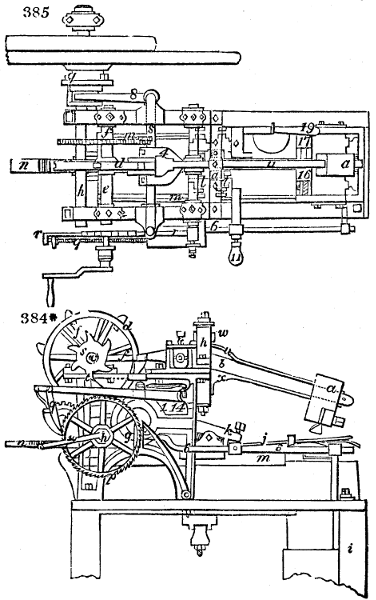
Fig. 384* and 385 enlarged (149 kB)
Fig. 384*. is an elevation of the upper part of the file-cutting machine, as seen on one side; fig. 385. is a plan or horizontal view, as the machine appears on the top.
a, is the head of the tilt hammer placed in the end of the lever b, which is mounted on an axle c, turning in proper bearings in the frame work of the machine; d, is the tilt wheel mounted on another axle s, also turning in bearings on the frame work of the machine, and having any required number of projections or tappets upon it for depressing the tail or shorter end of the hammer or tilt lever b.
The tilt wheel d, receives its rotatory motion from the toothed wheel f, mounted upon the same axle, and it takes into geer with a pinion g, upon the main shaft h, which is actuated by a band passed from any first mover to the rigger on its end, or in any other convenient manner. The bed upon which the blank piece of steel bears is marked i. This bed is firmly supported upon masonry placed upon proper sleepers: j, is one of the blank pieces of steel under operation, and is shown secured in the pair of jaws or holding clamps k, mounted on centre pins in the slide l, fig. 385.; which slide is held down by a spring and slide beneath, and is moved backwards and forwards in the machine upon the (v) edges m, m, of the frame, by means of the rack n, and its pinion; the latter being mounted upon the axle of the ratchet wheel p, and which ratchet wheel is made to turn at intervals by means of the pall q, upon the end of the lever r, fig. 385. This lever is depressed, after every cut has been effected upon the blank by means of the teeth or tappets of the wheel s, coming in contact with the inclined plane t, upon the lever r. The tappet wheel s, is mounted upon the end of the axle e, of the tilt wheel, and consequently revolves with it, and by depressing the lever r, every time that a tooth passes the inclined plane t, the click q, is made to drive the ratchet wheel p, and thereby the advancing movement of the blank is effected after each blow of the tilt hammer.
There is a strong spring u, attached to the upper side of the tilt hammer, its end being confined under an adjustable inclined plane v, mounted in the frame w, which inclined plane can be raised or lowered by its adjusting screws as required, to produce more or less tension of the spring.
A similar spring is placed on the under side of the tilt hammer, to raise and sustain the cutter or tool clear of the bed after every blow, and in conjunction with safety holders or catchers, to counteract any vibration or tendency the spring u, may have to cause the hammer to reiterate the blow.
The end of the lower spring acts on an inclined plane, mounted in the frame w, which has an adjusting screw similar to v, to regulate the tension of the spring.
In case the under spring should raise, that is, return the hammer, with sufficient force or velocity to cause the top spring u, to reiterate the blow, the ends of the safety holders or catchers are made to move under and catch the tail of the lever b, immediately on its being raised by the under springs, which is effected by the following means:—The holders are mounted upon a plate or carriage 1, fig. 384., which turns upon a small pin or axle mounted in the ears of a cross bar; the upper ends of the holders are kept inclined towards the tail of the tilt hammer by means of a spring fixed to the cross bar, and which acts upon one end of the plate or carriage 1.
In order that the holders may be removed out of the way of the tail of the hammer b, when the tilt wheel is about to effect a blow, the tooth of the tilt wheel which last acted upon the hammer comes in contact with an inclined plane fixed on the plate or carriage 1, and by depressing that end of the plate, causes the upper ends of the holders to be withdrawn from under the tail of the hammer b. The tilt wheel continuing to revolve, the next tooth advances, and depresses the tail of the hammer, but before it leaves the tail of the hammer, the tooth last in operation will have quitted the inclined plane and allowed the spring to return the holders into their former position. After the tooth has escaped from the tail of b, the hammer will immediately descend and effect the blow or cut on the blank, and as the tail of the hammer rises, it will come in contact with the inclined planes at the upper ends of the holders, and force them backwards; and as soon as the tail of the hammer has passed the top of the holders, the spring will immediately force the holders forward under the tail of the hammer, and prevent the hammer rising again until the next tooth of the tilt wheel is about to depress the end of the hammer, when the same movements of the parts will be repeated, and the machine will continue in operation until a sufficient length of the blank of steel (progressively advanced under the hammer) has been operated upon, when it will be thrown out of geer by the following means:—
Upon the sliding bar 6, there is placed an adjustable stop, against which the foremost end of the slide l l, fig. 385. comes in contact, as it is moved forward by the rack n, and its pinion. The sliding bar 6, is connected at its left end to the bent lever 8, the other end of this lever being formed into a forked arm, which embraces a clutch upon the main shaft, and as the slide l continues to advance, it will come in contact with a stop; and when it has brought a sufficient length of the blank pieces of steel under the operation of the cutting tool, the slide l, in its progress, will have moved that stop and the bar 6 forward, and that bar, by means of the bent lever 8, will withdraw the clutch on the main shaft, from locking into the boss of the fly-wheel, and consequently stop the further progress of the machine; the rigger and fly-wheel turning loosely upon the main shaft.
The cut file can now be removed from out of the clamps, and reversed to cut the other side, or another blank piece put in its place; and after throwing back the pall q of the ratchet wheel p, the slide l, and with it the fresh blank may be moved back into the machine by turning the winch handle, on the axle of the ratchet wheel p, the reverse way, which will turn the pinion backwards, and draw back the rack n, without affecting any other parts of the machine; and on moving back the bar 6, by the handle 11, placed on the stop, the clutches will be thrown into geer again, and the machine proceed to cut the next blank.
When the blanks have been thus cut on one side, and are reversed in the machine to form the teeth upon the other side, there should be a piece of lead placed between the blank and the bed to protect the fresh cut teeth.
It will be seen that the position of the stop upon the bar 6, will determine the length or extent of the blank piece of steel which shall be cut or operated upon; and in order that the progressive movement of the blanks under the cutting tool may be made to suit different degrees of fineness or coarseness of the teeth (that is the distance between the cuts), there is an adjusting screw upon the lever r, the head of which screw stops against the under side of an ear projecting from the frame-work, and thereby determines the extent of the motion of the lever r, when depressed by the tappets of the wheel s, acting upon the inclined plane t, consequently determining the number of teeth the ratchet wheel p shall be moved round by the pall q; and hence the extent of motion communicated by the rack and pinion to the slide l, and the blank j, which regulates the distance that the teeth of the file are apart, and the lever r is forced upwards by a spring pressing against its under side.
It will be perceived that the velocity of the descent of the hammer, and consequently the force of the blow, may be regulated by raising or lowering the inclined plane v of the spring u; and in order to accommodate the bed upon which the blanks rest to the different inclinations they may be placed at, that part of the bed is formed of a semi-globular piece of hardened steel, which fits loosely into a similar concavity in the bed r, and is therefore capable of adjusting itself, so that the blanks shall be properly presented to the cutting tool, and receive the blow or cut in an equal and even manner; or the piece of steel may be of a conical shape, and fit loosely in a similar shaped concavity.
There are guides 16, placed on the top of the bed i, for the purpose of keeping the blanks in their proper position towards the cutting tool, and these can be regulated to suit blanks of any width, by turning the right and left handed screw 17. There is also another adjustable stop on the jaws or clamps k which serves as a guide when placing the blanks within the jaws: and 19 is a handle or lever for raising the clamps when required, which has a weight suspended from it for the purpose of keeping down the blanks with sufficient pressure upon the bed.
The cutting tool in the face of the hammer, can be placed at any required angle or inclination with the blank, it being secured in the head of the hammer by clamps and screws. In cutting fine files a screw is employed in preference to the rack and pinion, for advancing the slide l, and the blank piece of steel in the machine.
Hardening of files.—This is the last and most important part of file making. Whatever may be the quality of the steel, or however excellent the workmanship, if it is not well hardened all the labour is lost.
Three things are strictly to be observed in hardening; first, to prepare the file on the surface, so as to prevent it from being oxidated by the atmosphere when the file is red hot, which effect would not only take off the sharpness of the tooth, but render the whole surface so rough that the file would, in a little time, become clogged with the substance it had to work. Secondly, the heat ought to be very uniformly red throughout, and the water in which it is quenched, fresh and cold, for the purpose of giving it the proper degree of hardness. Lastly, the manner of immersion is of great importance, to prevent the files from warping, which in long thin files is very difficult.
The first object is accomplished by laying a substance upon the file, which when it fuses, forms as it were, a varnish upon the surface, defending the metal from the action of the oxygen of the air. Formerly the process consisted in first coating the surface of the file with ale grounds, and then covering it over with pulverized common salt, (muriate of soda.) After this coating became dry, the files were heated red hot, and hardened; after this, the surface was lightly brushed over with the dust of cokes, when it appeared white and metallic, as if it had not been heated. This process has lately been improved, at least so far as relates to the economy of the salt, which from the quantity used, and the increased thickness, had become a serious object. Those who use the improved method are now consuming about one fourth the quantity of salt used in the old method. The process consists in dissolving the salt in water to saturation, which is about three pounds to the gallon, and stiffening it with ale grounds, or with the cheapest kind of flour, such as that of beans, to about the consistence of thick cream. The files require to be dipped only into this substance, and immediately heated and hardened. The grounds or the flour are of no other use, than to give the mass consistence, and by that means to allow a larger quantity of salt to be laid upon the surface. In this method, the salt forms immediately a firm coating. As soon as the water is evaporated, the whole of it becomes fused upon the file. In the old method the dry salt was so loosely attached to the file, that the greatest part of it was rubbed off into the fire, and was sublimed up the chimney, without producing any effect.
The carbonaceous matter of the ale grounds is supposed to have some effect in giving hardness to the file, by combining with the steel, and rendering it more highly carbonated. It will be found, however, upon experiment, that vegetable carbon does not combine with iron, with sufficient facility to produce any effect, in the short space of time a file is heating, for the purpose of hardening. Some file makers are in the habit of using the coal of burnt leather, which doubtless produces some effect; but the carbon is generally so ill prepared for the purpose, and the time of its operation so short, as to render the result inconsiderable. Animal carbon, when properly prepared and mixed, with the above hardening composition, is capable of giving hardness to the surface even of an iron file.
This carbonaceous matter may be readily obtained from any of the soft parts of animals, or from blood. For this purpose, however, the refuse of shoemakers and curriers is the most convenient. After the volatile parts have been distilled over, from an iron still, a bright shining coal is left behind, which, when reduced to powder, is fit to mix with the salt. Let about equal parts, by bulk, of this powder, and muriate of soda be ground together, and brought to the consistence of cream, by the addition of water. Or mix the powdered carbon with a saturated solution of the salt, till it become of the above consistence. Files which are intended to be very hard, should be covered with this composition, previous to hardening. All files intended to file iron or steel, particularly saw files, should be hardened with the aid of this mixture, in preference to that with the flour or grounds. Indeed, it is probable, that the carbonaceous powder might be used by itself, in point of economy, since the ammonia or hartshorn, obtained by distillation, would be of such value as to render the coal of no expense. By means of this method the files made of iron, which, in itself, is unsusceptible of hardening, acquire a superficial hardness sufficient for any file whatever. Such files may, at the same time, be bent into any form; and, in consequence, are particularly useful for sculptors and die-sinkers.
The next point to be considered is the best method of heating the file for hardening. For this purpose a fire, similar to the common smiths’ fire, is generally employed. The file is held in a pair of tongs by the tang, and introduced into the fire, consisting of very small cokes, pushing it more or less into the fire for the purpose of heating it regularly. It must frequently be withdrawn with the view of observing that it is not too hot in any part. When it is uniformly heated, from the tang to the point, of a cherry red colour, it is fit to quench in the water. At present an oven, formed of fire-bricks, is used for the larger files, into which the blast of the bellows is directed, being open at one end, for the purpose of introducing the files and the fuel. Near to the top of the oven are placed two cross bars, on which a few files are placed, to be partially heating. In the hardening of heavy files, this contrivance affords a considerable saving, in point of time, while it permits them also to be more uniformly and thoroughly heated.
After the file is properly heated for the purpose of hardening, in order to produce the greatest possible hardness, it should be cooled as soon as possible. The most common method of effecting this is by quenching it in the coldest water. Some file-makers have been in the habit of putting different substances in their water, with a view to increase its hardening property. The addition of sulphuric acid to the water was long held a great secret in the hardening of saw files. After all, however, it will be found, that clear spring water, free from animal and vegetable matter, and as cold as possible, is the best calculated for hardening files of every description.
In quenching the files in water, some caution must be observed. All files, except the half-round, should be immersed perpendicularly, as quickly as possible, so that the upper part shall not cool. This management prevents the file from warping. The half-round file must be quenched in the same steady manner; but, at the same time that it is kept perpendicular to the surface of the water, it must be moved a little horizontally, in the direction of the round side, otherwise it will become crooked backwards.
After the files are hardened, they are brushed over with water, and powdered cokes, when the surface becomes perfectly clean and metallic. They ought also to be washed well in two or three clean waters, for the purpose of carrying off all the salt, which, if allowed to remain, will be liable to rust the file. They should moreover be dipped into lime-water, and rapidly dried before the fire, after being oiled with olive oil, containing a little oil of turpentine, while still warm. They are then finished.
FILLIGREE (Filigrane, Fr.; Filigran, or Feine Drahtgeflecht, Germ.); is, as the last term justly expresses it, intertwisted fine wire, used for ornamenting gold and silver trinkets. The wire is seldom drawn round, but generally flat or angular; and soldered by gold or silver solder with borax and the blowpipe. The Italian word, filigrana, is compounded of filum and granum, or granular net-work; because the Italians, who first introduced this style of work, placed small beads upon it.
FILTRATION (Eng. and Fr.; Filtriren, Germ.), is a process purely mechanical, for separating a liquid from the undissolved particles floating in it, which liquid may be either the useful part, as in vegetable infusions, or of no use, as the washings of mineral precipitates. The filtering substance may consist of any porous matter in a solid, foliated, or pulverulent form; as porous earthen ware, unsized paper, cloth of many kinds, or sand. The white blotting paper sold by the stationers answers extremely well for filters in chemical experiments, provided it be previously washed with dilute muriatic acid, to remove some lime and iron that are generally present in it. Filter papers are first cut square, and then folded twice diagonally into the shape of a cornet, having the angular parts rounded off. Or the piece of paper being cut into a circle, may be folded fan-like from the centre, with the folds placed exteriorly, and turned out sharp by the pressure of the finger and thumb, to keep intervals between the paper and the funnel into which it is fitted, to favour the percolation. The diameter of the funnel should be about three-fourths of its height, measured from the neck to the edge. If it be more divergent, the slope will be too small for the ready efflux of the fluid. A filter covered with the sediment is most conveniently washed by spouting water upon it with a little syringe. A small camel’s-hair paint brush is much employed for collecting and turning over the contents in their soft state. Agitation or vibration is of singular efficacy in quickening percolation, as it displaces the particles of the moistened powders, and opens up the pores which had become closed. Instead of a funnel, a cylindrical vessel may be employed, having its perforated bottom covered with a disc of filtering powder folded up at the edges, and made tight there by a wire ring. Linen or calico is used for weak alkaline liquors; and flannels, twilled woollen cloth, or felt-stuff for weak acid ones. These filter bags are often made conical like a fool’s cap, and have their mouths supported by a wooden or metallic hoop. Cotton wool put loose into the neck of a funnel answers well for filtering oils upon the small scale. In the large way, oil is filtered in conical woollen bags, or in a cask with many conical tubes in its bottom, filled with tow or cotton wool. Stronger acid and alkaline liquors must be filtered through a layer of pounded glass, quartz, clean sand, or bruised charcoal. The alcarrhazas are a porous biscuit of stone ware made in Spain, which are convenient for filtering water, as also the porous filtering stone of Teneriffe, largely imported into England at one time, but now superseded in a great measure by the artificial filters patented under many forms, consisting essentially of strata of gravel, sand, and charcoal powder.
It is convenient to render the filter self-acting, by accommodating the supply of liquid to the rate of percolation, so that the pressure upon the porous surface may be always equally great. Upon the small scale, the lamp-fountain or bird’s-glass form so generally used for lamps, will be found to answer.
Fig. 386. represents a glass bottle A, partly filled with the fluid to be filtered, supported in the ring of a chemical stand, and having its mouth inverted into the same liquor in the filter funnel. It is obvious, that whenever this liquor by filtration falls below the lip of the bottle, air will enter into it, let down a fresh supply to feed the filter, and keep the funnel regularly charged. If larger quantities are to be operated upon, the following apparatus may be employed. Fig. 387. A B is a metallic vessel which may be made air-tight; C is the under pipe provided with a stopcock R, for letting down the liquor into the filter a b. The upper pipe t, through which the fluid is poured by means of the funnel E, has also a stopcock which opens or shuts, at the same time, the small side tube u t, through which, during the entrance of the fluid, the air is let off from the receiver. A glass tube g, shows the level of the liquor in the body of the apparatus. In using it, the cock R must be first closed, and the cock S must be opened to fill the receiver. Then the filter is set a going, by re-opening the cock R, so as to keep the fluid in the filter upon a level with the opening of the tube C. Both these pieces of apparatus are essentially the same.
In many manufactures, self-acting filters are fed by the plumber’s common contrivance of a ball-cock in which the sinking and rising of the ball, within certain limits, serves to open or shut off the supply of liquor, as it may be required or not. Dumont has adopted this expedient for his system of filtering syrup through a stratum of granularly ground animal charcoal or bone-black. Fig. 388. is a front view of this apparatus with 4 filters C; and fig. 389. is a cross section. The framework B supports the cistern A, in which the syrup is contained. From it the liquor flows through the stop-cock b, and the connection-tube a, into the common pipe c, which communicates, by the short branch tubes e, with each of the four filters. The end of the branch tube, which is inside of the filter tub, is provided with a stopcock d f, whose opening, and thereby the efflux of the liquor from the cistern through the tube a, is regulated by means of the float-ball g. Upon the brickwork D the filter tub stands, furnished at h with a false bottom of zinc or copper pierced with fine holes; besides which, higher up at i there is another such plate of metal furnished with a strong handle k, by which it may be removed, when the bone-black needs to be changed. In the intervening space l, the granular coal is placed. o is the cover of the filter tub, with a handle also for lifting it. One portion of it may be raised by a hinge, when it is desired to inspect the progress of the filtration within. m m is a slender vertical tube, forming a communication between the bottom part h, and the upper portion of the filter, to admit of the easy escape of the air from that space, and from among the bone-black as the syrup descends; otherwise the filtration could not go on. p is the stopcock through which the fluid collected in the space under h is let off from time to time into the common pipe q, fig. 388. r is a trickling channel or groove lying parallel to the tube q, and in which, by means of a tube s, inserted at pleasure, the syrup is drawn off in case of its flowing in a turbid state, when it must be returned over the surface of the charcoal.