S. (continued 6)
Reading edition
Towards the end of the process, after all the wash has entered the alembic, it may be sometimes desirable, for the sake of despatch, to modify the thermostat, by its adjusting-screw, so that the bath may take a higher temperature, and allow the residuary feints to run rapidly over, into a separate cistern. This weak fluid may be pumped back into the alembic, as the preliminary charge of a fresh operation.
The above plan of a water-bath regulated by the thermostat, may be used simply as a rectifying cistern, without transmitting the spirit or wash down through it. The series of shelves will cause the vapours from the still to impinge against a most extensive system of metallic surfaces, maintained at a steady temperature, whereby their watery and crude constituents will be condensed and thrown back, while their fine alcoholic particles will proceed forwards to the refrigeratory. Any ordinary still may be readily converted into this self-rectifying form, by merely interposing the cistern, fig. 1058., between the alembic and the worm-tub. The leading novelty of the present invention is the movable system of shelves or trays, enclosed in metallic cases, separated by water, combined with the thermostatic regulator. By this combination, any quality of spirits may be procured at one step from wash or wine, by an apparatus, simple, strong and easily kept in order.
The empyreumatic taint which spirits are apt to contract from the action of the naked fire on the bottom of the still, may be entirely prevented by the use of a bath of potash lye, p, p, fig. 1057.; for thus a safe and effectual range of temperature, of 300° F., may be conveniently obtained. The still may also be used without the bath vessel.
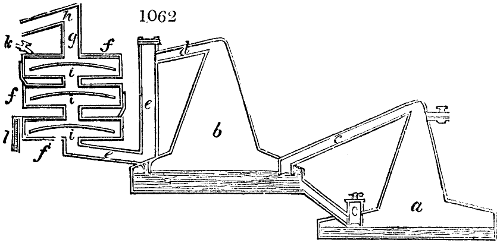
Mr. D. T. Shears, of Southwark, obtained a patent in March, 1830, for certain improvements and additions to stills, which are ingenious. They are founded upon a previous patent, granted to Joseph Corty, in 1818; a section of whose contrivance is shown in fig. 1062., consisting of a first still a, a second still b, a connecting tube c, from the one end to the other, and the tube d, which leads from the second still-head down through the bent tube e, e, to the lower part of the condensing apparatus.
The original improvements described under Corty’s patent, consisted further, in placing boxes f, f, f, of the condensing apparatus in horizontal positions, and at a distance from each other, in order that the vapour might ascend through them, for the purpose of discharging the spirit by the top tube g, and pipe h, into the worm, in a highly rectified or concentrated state. In each of the boxes f, there is a convex plate or inverted dish i, i, i, and the vapour in rising from the tube e, strikes against the concave or under part of the first dish, and then escapes round its edges, and over its convex surface, to the under part of the second dish, and so on to the top, the condensed part of the vapour flowing down again into the still, and the spirit passing off by the pipe h, at top; and as the process of condensation will be assisted by cooling the vapour as it rises, cold water is made to flow over the tops of the boxes f, from a cock k, and through small channels or tubes on the sides of the boxes, and is ultimately discharged by the pipe l, at bottom.
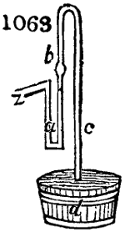
Fig. 1063. represents a peculiarly shaped tube a, through which the spirit is described as passing after leaving the end of the worm at b, which tube is open to the atmospheric air at z; c, is the passage through which the carbonic acid gas is described as escaping into the vessel of water d.
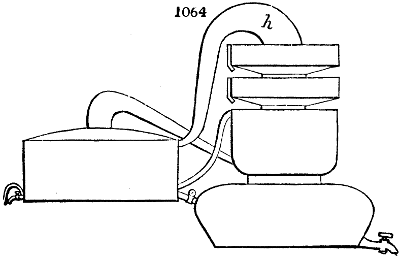
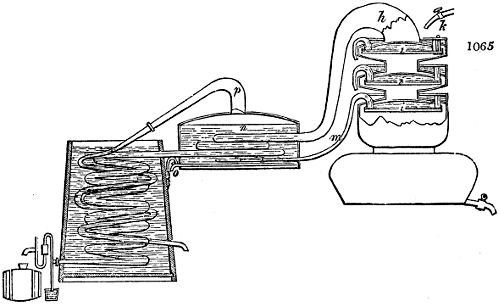
Now the improvements claimed under the present patent, are exhibited in figs. 1064, 1065, and 1066. Fig. 1064. represents the external appearance of a still, the head of which is made very capacious, to guard against over-boiling by any mismanagement of the fire; fig. 1065. is the same, partly in section. On the top of the still-head is formed the first-described rectifying apparatus, or series of condensing boxes. The vapour from the body of the still filling the head, meets with the first check from the dish or lower vessel i, and after passing under its edges, ascends and strikes against the lower part of the second dish or vessel i, and so on, till it ultimately leaves the still-head by the pipe at top.
This part of the apparatus is slightly altered from the former, by the substitution of hollow convex vessels, instead of the inverted dishes before described, which vessels have rims descending from their under surfaces, for the purpose of retaining the vapour. The cold water, which, as above described, flowed over the tops of the boxes f, for the purpose of cooling them, now flows also through the hollow convex vessels i, within the boxes, and by that means greatly assists the refrigerating process, by which the aqueous parts of the vapour are more readily condensed, and made to fall down and flow back again into the body of the still, while the spirituous parts pass off at top to the worm, in a very high state of rectification.
After the water employed for the refrigeration has passed over all the boxes, and through all the vessels, it is carried off by the pipe m, through the vessel n, called the wash-heater; that is, the vessel in which the wash is placed previous to introducing it into the still. The pipe m, is coiled round in the lower part of the vessel n, in order that the heated water may communicate its caloric to the wash, instead of losing the heat by allowing the water to flow away. After the heated water has made several turns round the wash heater, it passes out at the curved pipe o, which is bent up, in order to keep the coils of the pipe within always full of water.
Instead of the coiled pipe n, last described, the patentee proposes sometimes to pass the hot water into a chamber in a tub or wooden vessel, as at n, in fig. 1061., in which the wash to be heated occupies the upper part of the vessel, and is separated from the lower part by a thin metallic partition.
The swan-neck h, figs. 1064. and 1065., which leads from the head of the still, conducts the spirit from the still through the wash-heater, where it becomes partially cooled, and gives out its heat to the wash; and from thence the spirit passes to the worm tub, and being finally condensed, is passed through a safety tube, as (fig. 1058.) before described, and by the funnel is conducted into the cask below.
Should any spirit rise in the wash-heater during the above operation, it will be carried down to the worm by the neck p, and coiled pipe, and discharged at its lower end; or it may be passed into the still-head, as shown in fig. 1062.
A patent was obtained by Mr. Æneas Coffey, in August, 1830, for a still, which has been since mounted in several distilleries. It is economical in fuel, labour, and time, but is said not to produce a clean spirit, without peculiar attention.
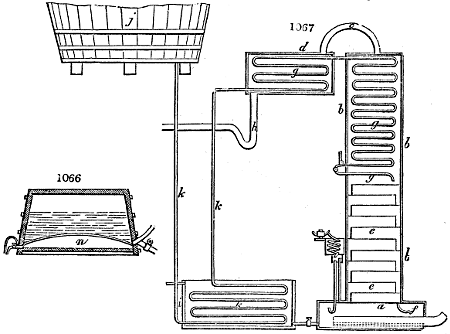
The apparatus is represented in fig. 1067. a, b, c, d, is a sectional view of that part of the still wherein the wash is deprived of its alcohol, and the vapours analyzed. It is described as consisting of a chamber or vessel a, with the vertical chamber b, c, placed above it; the lower half of this chamber is divided into compartments by horizontal plates e, e, e, of thin copper or other metal; each of these plates is turned down at one side, until it nearly touches the plate next underneath it, as shown in the figure; thus leaving a passage throughout the whole of them, by which any liquid falling on the top plate may descend into the next under it, and from that to the third, and so on, from plate to plate, at the alternate ends, until it arrives at the last plate, wherein it falls into the vessel a, by the pipe f; each of these plates is furnished with several light valves, opening upwards, through which any steam or vapour may ascend; it may also be perforated with holes, but they must not be so numerous or so large as to allow of all the steam passing through them without raising the valves; c, is a pipe by which the alcoholic vapour, after it has been analyzed, and has acquired the proper strength, is conducted into the vessel d, which is made perfectly close; the vapour will here be condensed on the surface of the pipe g, g, g; from this chamber it will descend in a liquid state into the pipe h, whence it may be conducted to a worm or refrigerator, to be cooled in the ordinary way; i, is a vessel through which the spent wash flows, after being operated upon in the distilling apparatus, and is discharged in a state of ebullition; j, is a vessel or chamber containing the wash to be distilled. A force pump may be substituted, to force the wash through the pipes k, and distilling apparatus, with the velocity required.
The patentee states that it is requisite the wash should be passed through the pipe k, with sufficient velocity and force, so as to prevent the deposition of sediment in the pipe; the wash in its passage through the pipe k, will gradually become increased in temperature as it passes through the spent wash in the chamber, and the close vessel d, until it is discharged nearly at the boiling point on the upper plate in the chamber, where it comes in contact with the vapours arising from the vessel a.
It is to be observed, that the wort does not reach the boiling point while in the pipe k, k; to ascertain which, a thermometer is placed on the pipe, and by increasing or diminishing the quantity of wash, its temperature may be regulated. The wash, after being discharged from the pipe k, descends from plate to plate as before mentioned, at which time a supply of steam from a boiler, or generator is admitted into the apparatus, through the pipe.
The lower part of this pipe in the vessel a, is pierced with a number of small holes, so as to spread the steam over the vessel; it then rises upwards, passing through the plate by the small holes and valves, and through the stratum or sheet of wash flowing over them; the wash, as it descends, gives out a portion of its alcohol to the steam, as it passes over every plate, until it is entirely deprived of its spirit, which it will generally do by the time it arrives at the 7th or 8th plate; but it is better to employ a greater number, to guard against accidents or neglect.
A small steam pipe rises from the chamber a, with its upper end opening into the box or chamber; into this chamber the end of a worm projects from the cistern of cold water; the steam rising up the pipe is nearly all condensed in the worm, and flows back into the chamber a, by the pipe. The small portion of the steam uncondensed, is allowed to escape at the upper end of the worm, and the flame of a small lamp or taper is to be constantly kept over the orifice; when, should the least quantity of alcohol descend with the wash into the chamber a, it will rise with the steam through the pipe and worm, and immediately take fire from the flame of the lamp or taper, thereby warning the attendant to increase the supply of steam or diminish the quantity of wash, as may seem necessary.
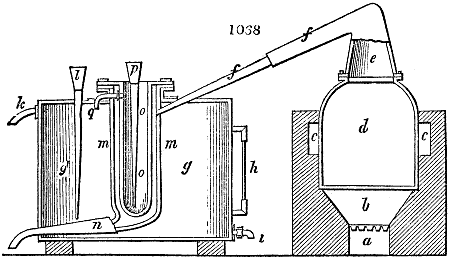
I shall conclude this article with a description of the cheap still which is commonly employed by the chemists in Berlin for rectifying alcohol. a, is the ash-pit; b, the fireplace; c, c, the flues, which go spirally round the sides of the cucurbit d; e, the capital, made of block tin, and furnished with a brass edge, which fits tight to a corresponding edge on the mouth of d; f, f, the slanting pipes of the capital; g, the oval refrigeratory, made of copper; h, the water-gauge glass tube; i, a stopcock for emptying the vessel; k, do., for drawing off the hot water from the surface; l, tube for the supply of cold water. A double cylinder of tin is placed in the refrigeratory, of which the outer one m, m, stands upon three feet, and is furnished with a discharge pipe n. The inner one o, o, which is open above, receives cold water through the pipe p, and lets the warm water flow off through the short tube q, into the refrigeratory. In the narrow space between the two cylinders, the vapours proceeding from the capital are condensed, and pass off in the liquid state through n. The refrigeratory is made oval, in order to receive two condensers alongside of each other in the line of the longer axis; though only one, and that in the middle, is represented in the figure.
STOCKING MANUFACTURE. See Hosiery.
STONE, is earthy matter, condensed into so hard a state as to yield only to the blows of a hammer, and therefore well adapted to the purposes of building. Such was the care of the antients to provide strong and durable materials for their public edifices, that but for the desolating hands of modern barbarians, in peace and in war, most of the temples and other public monuments of Greece and of Rome would have remained perfect at the present day, uninjured by the elements during 2000 years. The contrast, in this respect, of the works of modern architects, especially in Great Britain, is very humiliating to those who boast so loudly of social advancement; for there is scarcely a public building of recent date, which will be in existence one thousand years hence. Many of the most splendid works of modern architecture are hastening to decay, in what may be justly called the very infancy of their existence, if compared with the date of those erected in antient Italy, Greece, and Egypt. This is remarkably the case with the three bridges of London, Westminster, and Blackfriars; the foundations of which began to perish most visibly in the very lifetime of their constructors. Every stone intended for a durable edifice, ought to be tested as to its durability, by immersion in a saturated solution of sulphate of soda, and exposure during some days to the air. The crystallization which ensues in its interior, will cause the same disintegration of its substance which frost would occasion in a series of years.
Figs. 1069, 1070 enlarged (155 kB)
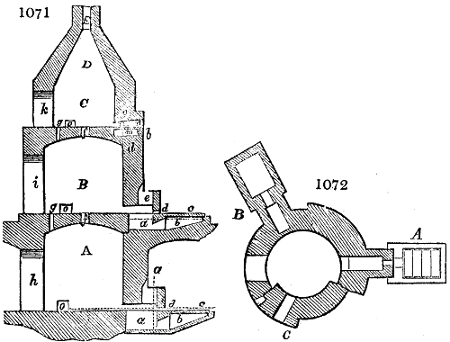
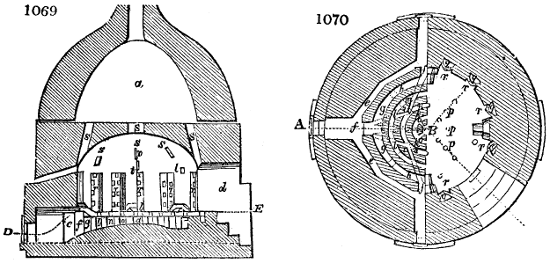
STONE, ARTIFICIAL, for statuary and other decorations of architecture, has been made for several years with singular success at Berlin, by Mr. Feilner. His materials are nearly the same with those of English pottery; and the plastic mass is fashioned either in moulds, or by hand. His kilns, which are peculiar in form, and economical in fuel, deserve to be generally known. Figs. 1069. and 1070. represent his round kiln; fig. 1069. being an oblique section in the line A, B, C, of fig. 1070., which is a ground plan in the line D, a, b, E, of fig. 1069. The inner circular space c, covered with the elliptical arch, is filled with the figures to be baked, set upon brick supports. The hearth is a few feet above the ground; and there are steps before the door d, for the workmen to mount by, in charging the kiln. The fire is applied on the four sides under the hearth. The flame of each passes along the straight flues f i, f i, and f k. In the second annular flue g, g, as also in the third l, l, the flame of each fire is kept apart, being separated from the adjoining, by the stones h and m. In the fourth flue n, the flames again come together, as also in o, and ascend by the middle opening. Besides this large orifice, there are several small holes, p, p, in the hearth over the above flues, to lead the flames from the other points into contact with the various articles. There are also channels q, q, in the sides, enclosed by thin walls r, to promote the equable distribution of the heat; and these are placed right over the first fire-flues e. The partitions r, are perforated with many holes, through which, as well as from their tops, the flame may be directed inwards and downwards; s are the vents for carrying off the flames into the upper space u, which is usually left empty. These vents can be closed by iron damper-plates, pushed in through the side-slits of the dome. t, t, are peep-holes, for observing the state of ignition in the furnace; but they are most commonly bricked up. Fig. 1071. is a vertical section, and fig. 1072. a plan, of an excellent kiln for baking clay to a stony consistence, for the above purpose, or for burning fire-bricks. A, is the lower; B, the middle; C, the upper kiln; and D, the hood, terminating in the chimney E. a, a, is the ash-pit; b, b, the vault for raking out the ashes; it is covered with an iron door c. d, is the peep-hole, filled with a clay stopper; e, is the fireplace; f, f, a vent in the middle of each arch; g, g, flues at the sides of the arches, situated between the two fireplaces; h, i, k, are apertures for introducing the articles to be baked; l, a grate for the fire in the uppermost kiln; m, the ash-pit; n, the fire-door; o, openings through which the flames of a second fire are thrown in. At first, only the ground kiln A, is fired, with cleft billets of pine-wood, introduced at the opening e; when this is finished, the second is fired; and then the third, in like manner. This kiln is very like the porcelain kiln of Sèvres, and is employed in many places for baking stoneware.
Mr. Keene obtained a patent, about a year ago, for making a factitious stone-paste in the following way:—He dissolves one pound of alum in a gallon of water, and in this solution he soaks 84 pounds of gypsum calcined in small lumps. He exposes these lumps in the open air for about eight days, till they become apparently dry, and then calcines them in an oven at a dull-red heat. The waste heat of a coke oven is well adapted for this purpose. (See Pitcoal, coking of.) These lumps, being ground and sifted, afford a fine powder, which, when made up into a paste with the proper quantity of water, forms the petrifying ground. The mass soon concretes, and after being brushed over with a thin layer of the petrifying paste, may be polished with pumice, &c., in the usual way. It then affords a body of great compactness and durability. If half a pound of copperas be added to the solution of the alum, the gypsum paste, treated as above, has a fine cream or yellow colour. This stone stands the weather well.
STONEWARE. (Fayence, Fr.; Steingut, Germ.) See Pottery.
STORAX, STYRAX, flows from the twigs and the trunk of the Liquidambar styraciflua, a tree which grows in Louisiana, Virginia, and Mexico. Liquidamber, as this resin is also called, is a brown or ash-gray substance, of the consistence of turpentine, which dries up rapidly, has an agreeable smell, like benzoin, and a bitterish, sharp, burning taste. It dissolves in four parts of alcohol, and affords 1·4 per cent. of benzoic acid.
STOVE (Poële, Calorifère, Fr.; Ofen, Germ.); is a fireplace, more or less close, for warming apartments. When it allows the burning coals to be seen, it is called a stove-grate. Hitherto stoves have rarely been had recourse to in this country for heating our sitting-rooms; the cheerful blaze and ventilation of an open fire being generally preferred. But last winter, by its inclemency, gave birth to a vast multitude of projects for increasing warmth and economizing fuel, many of them eminently insalubrious, by preventing due renewal of the air, and by the introduction of noxious fumes into it. When coke is burned very slowly in an iron box, the carbonic acid gas which is generated, being half as heavy again as the atmospherical air, cannot ascend in the chimney at the temperature of 300° F.; but regurgitates into the apartment through every pore of the stove, and poisons the atmosphere. The large stoneware stoves of France and Germany are free from this vice; because, being fed with fuel from the outside, they cannot produce a reflux of carbonic acid into the apartment, when their draught becomes feeble, as inevitably results from the obscurely burning stoves which have the doors of the fireplace and ash-pit immediately above the hearth-stone.
I have recently performed some careful experiments upon this subject, and find that when the fuel is burning so slowly in the stove as not to heat the iron surface above the 250th or 300th degree of Fahr., there is a constant deflux of carbonic acid gas from the ash-pit into the room. This noxious emanation is most easily evinced by applying the beak of a matrass, containing a little Goulard’s extract (solution of subacetate of lead), to a round hole in the door of the ash-pit of a stove in this languid state of combustion. In a few seconds the liquid will become milky, by the reception of carbonic acid gas. I shall be happy to afford ocular demonstration of this fact to any incredulous votary of the pseudo-economical, anti-ventilation, stoves now so much in vogue. There is no mode in which the health and life of a person can be placed in more insidious jeopardy, than by sitting in a room with its chimney closed up with such a choke-damp-vomiting stove.
That fuel may be consumed by an obscure species of combustion, with the emission of very little heat, was clearly shown in Sir H. Davy’s Researches on Flame. “The facts detailed on insensible combustion,” says he, “explain why so much more heat is obtained from fuel when it is burned quickly, than slowly; and they show that, in all cases, the temperature of the acting bodies should be kept as high as possible; not only because the general increment of heat is greater, but likewise because those combinations are prevented, which, at lower temperatures, take place without any considerable production of heat. These facts likewise indicate the source of the great error into which experimenters have fallen, in estimating the heat given out in the combustion of charcoal; and they indicate methods by which the temperature may be increased, and the limits to certain methods.” These conclusions are placed in a strong practical light by the following simple experiments:—I set upon the top orifice of a small cylindrical stove, a hemispherical copper pan, containing six pounds of water, at 60° F., and burned briskly under it 31⁄2 pounds of coke in an hour; at the end of which time, 41⁄2 pounds of water were boiled off. On burning the same weight of coke slowly in the same furnace, surmounted by the same pan, in the course of 12 hours, little more than one-half the quantity of water was exhaled. Yet, in the first case, the aerial products of combustion swept so rapidly over the bottom of the pan, as to communicate to it not more than one-fourth of the effective heat which might have been obtained by one of the plans described in the article Evaporation; while, in the second case, these products moved at least 12 times more slowly across the bottom of the pan, and ought therefore to have been so much the more effective in evaporation, had they possessed the same power or quantity of heat.
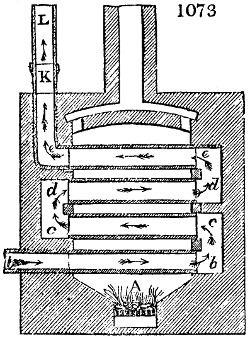
Stoves, when properly constructed, may be employed both safely and advantageously to heat entrance-halls upon the ground story of a house; but care should be taken not to vitiate the air by passing it over ignited surfaces, as is the case with most of the patent stoves now foisted upon the public. Fig. 1073. exhibits a vertical section of a stove which has been recommended for power and economy; but it is highly objectionable, as being apt to scorch the air. The flame of the fire A, circulates round the horizontal pipes of cast iron, b b, c c, d d, e e, which receive the external air at the orifice b, and conduct it up through the series, till it issues highly heated at K, L, and may be thence conducted wherever it is wanted. The smoke escapes through the chimney B. This stove has evidently two prominent faults; first, it heats the air-pipes very unequally, and the undermost far too much; secondly, the air, by the time it has ascended through the zigzag range to the pipe e e, will be nearly of the same temperature with it, and will therefore abstract none of its heat. Thus the upper pipes, if there be several in the range, will be quite inoperative, wasting their warmth upon the sooty air.
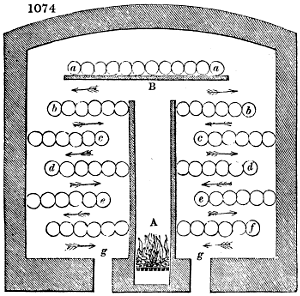
Fig. 1074. exhibits a transverse vertical section of a far more economical and powerful stove, in which the above evils are avoided. The products of combustion of the fire A, rise up between two brick walls, so as to play upon the bed of tiles B, where, after communicating a moderate heat to the series of slanting pipes whose areas are represented by the small circles a, a, they turn to the right and left, and circulate round the successive rows of pipes b b, c c, d d, e e, and finally escape at the bottom by the flues g, g, pursuing a somewhat similar path to that of the burned air among a bench of gas-light retorts. It is known, that two-thirds of the fuel have been saved in the gas-works by this distribution of the furnace. For the purpose of heating apartments, the great object is to supply a vast body of genial air; and, therefore, merely such a moderate fire should be kept up in A, as will suffice to warm all the pipes pretty equably to the temperature of 220° Fahr.; and, indeed, as they are laid with a slight slope, are open to the air at their under ends, and terminate at the upper in a common main pipe or tunnel, they can hardly be rendered very hot by any intemperance of firing. I can safely recommend this stove to my readers. If the tubes be made of stoneware, its construction will cost very little; and they may be made of any size, and multiplied so as to carry off the whole effective heat of the fuel, leaving merely so much of it in the burned air, as to waft it fairly up the chimney.
I shall conclude this article by a short extract of a paper which was read before the Royal Society, on the 16th of June, 1836, upon warming and ventilating apartments; a subject to which my mind had been particularly turned at that time, by the Directors of the Customs Fund of Life Assurance, on account of the very general state of indisposition and disease prevailing among those of their officers (nearly 100 in number) engaged on duty in the Long Room of the Custom House, London.
“The symptoms of disorder experienced by the several gentlemen (about twenty in number), whom I examined, out of a great many who were indisposed, were of a very uniform character. The following is the result of my researches:—
“A sense of tension or fulness of the head, with occasional flushings of the countenance, throbbing of the temples, and vertigo, followed, not unfrequently, with a confusion of ideas, very disagreeable to officers occupied with important and sometimes intricate calculations. A few are affected with unpleasant perspiration on their sides. The whole of them complain of a remarkable coldness and languor in their extremities, more especially the legs and feet, which has become habitual, denoting languid circulation in these parts, which requires to be counteracted by the application of warm flannels on going to bed. The pulse is, in many instances, more feeble, frequent, sharp, and irritable, than it ought to be, according to the natural constitution of the individuals. The sensations in the head occasionally rise to such a height, notwithstanding the most temperate regimen of life, as to require cupping, and at other times depletory remedies. Costiveness, though not a uniform, is yet a prevailing symptom.
“The sameness of the above ailments, in upwards of one hundred gentlemen, at very various periods of life, and of various temperaments, indicates clearly sameness in the cause.
“The temperature of the air in the Long Room ranged, in the three days of my experimental inquiry, from 62° to 64° of Fahrenheit’s scale; and in the Examiner’s Room it was about 60°, being kept somewhat lower by the occasional shutting of the hot-air valve, which is here placed under the control of the gentlemen; whereas that of the Long Room is designed to be regulated in the sunk story, by the fireman of the stove, who seems sufficiently careful to maintain an equable temperature amidst all the vicissitudes of our winter weather. Upon the 7th of January, the temperature of the open air was 50°; and on the 11th it was only 35°; yet upon both days the thermometer in the Long Room indicated the same heat, of from 62° to 64°.
“The hot air discharged from the two cylindrical stove-tunnels into the Long Room was at 90° upon the 7th, and at 110° upon the 11th. This air is diluted, however, and disguised, by admixture with a column of cold air, before it is allowed to escape. The air, on the contrary, which heats the Examiner’s Room, undergoes no such mollification, and comes forth at once in an ardent blast of fully 170°; not unlike the simoom of the desert, as described by travellers. Had a similar nuisance, on the greater scale, existed in the Long Room, it could not have been endured by the merchants and other visitors on business: but the disguise of an evil is a very different thing from its removal. The direct air of the stove, as it enters the Examiner’s Room, possesses, in an eminent degree, the disagreeable smell and flavour imparted to air by the action of red-hot iron; and, in spite of every attention on the part of the fireman to sweep the stove apparatus from time to time, it carries along with it abundance of burned dusty particles.
“The leading characteristic of the air in these two rooms, is its dryness and disagreeable smell. In the Long Room, upon the 11th, the air indicated, by Daniell’s hygrometer, 70 per cent. of dryness, while the external atmosphere was nearly saturated with moisture. The thermometer connected with the dark bulb of that instrument stood at 30° when dew began to be deposited upon it; while the thermometer in the air stood at 64°. In the court behind the Custom-house, the external air being at 35°, dew was deposited on the dark bulb of the hygrometer by a depression of only 3°; whereas in the Long Room, on the same day, a depression of 34° was required to produce that deposition. Air, in such a dry state, would evaporate 0·44 in. depth of water from a cistern in the course of twenty-four hours; and its influence on the cutaneous exhalents must be proportionably great.
“As cast iron always contains, beside the metal itself, more or less carbon, sulphur, phosphorus, or even arsenic, it is possible that the smell of air passed over it in an incandescent state, may be owing to some of these impregnations; for a quantity of noxious effluvia, inappreciably small, is capable of affecting not only the olfactory nerves, but the pulmonary organs. I endeavoured to test the air as it issued from the valve in the Examiner’s Room, by presenting to it pieces of white paper moistened with a solution of nitrate of silver, and perceived a slight darkening to take place, as if by sulphurous fumes. White paper, moistened with sulphuretted hydrogen water, was not in the least discoloured. The faint impression on the first test paper, may be, probably, ascribed to sulphurous fumes, proceeding from the ignition of the myriads of animal and vegetable matters which constantly float in the atmosphere, as may be seen in the sunbeam admitted into a dark chamber: to this cause, likewise, the offensive smell of air, transmitted over red-hot iron, may in some measure be attributed, as well as to the hydrogen resulting from the decomposition of aqueous vapour, always present in our atmosphere in abundance; especially close to the banks of the Thames, below London Bridge.
“When a column of air sweeps furiously across the burning deserts of Africa and Arabia, constituting the phenomenon called simoom by the natives, the air becomes not only very hot and dry, but highly electrical, as is evinced by lightning and thunder. Dry sands, devoid of vegetation, cannot be conceived to communicate any noxious gas or vapour to the atmosphere, like the malaria of marshes, called miasmata: it is, hence, highly probable that the blast of the simoom owes its deadly malignity, in reference to animal as well as vegetable life, simply to extreme heat, dryness, and electrical disturbance. Similar conditions, though on a smaller scale, exist in what is called the bell, or cockle, apparatus for heating the Long Room and the Examiner’s apartment in the Custom-house. It consists of a series of inverted, hollow, flattened pyramids of cast iron, with an oblong base, rather small in their dimensions, to do their work sufficiently in cold weather, when moderately heated. The inside of the pyramids is exposed to the flames of coke furnaces, which heat them frequently to incandescence, while currents of cold air are directed to their exterior surfaces by numerous sheet-iron channels. The incandescence of these pyramids, or bells, as they are vulgarly called, was proved by pieces of paper taking fire when I laid them on the summits. Again, since air becomes electrical when it is rapidly blown upon the surfaces of certain bodies, it occurred to me that the air which escapes into the Examiner’s Room might be in this predicament. It certainly excites the sensation of a cobweb playing round the head, which is well known to all who are familiar with electrical machines. To determine this point, I presented a condensing gold-leaf electrometer to the said current of hot air, and obtained faint divergence with negative electricity. The electricity must be impaired in its tension, however, in consequence of the air escaping through an iron grating, and striking against the flat iron valves, both of which tend to restore the electric equilibrium. The air blast, moreover, by being diffused round the glass of the condenser apparatus, would somewhat mask the appearances. Were it worth while, an apparatus might be readily constructed for determining this point, without any such sources of fallacy. The influence of an atmosphere charged with electricity in exciting headache and confusion of thought in many persons, is universally known.
“The fetid burned odour of the stove air, and its excessive avidity for moisture, are of themselves, however, sufficient causes of the general indisposition produced among the gentlemen who are permanently exposed to it in the discharge of their public duties.
“From there being nearly a vacuum, as to aqueous vapour, in the said air, while there is nearly a plenum in the external atmosphere round about the Custom-house, the vicissitudes of feeling in those who have occasion to go out and in frequently, must be highly detrimental to health. The permanent action of an artificial desiccated air on the animal economy may be stated as follows:—
“The living body is continually emitting a transpirable matter, the quantity of which, in a grown up man, will depend partly on the activity of the cutaneous exhalents, and partly on the relative dryness or moisture of the circumambient medium. Its average amount, in common circumstances, has been estimated at 20 ounces in twenty-four hours.
“When plunged in a very dry air, the insensible perspiration will be increased; and, as it is a true evaporation or gasefaction, it will generate cold proportionably to its amount. Those parts of the body which are most insulated in the air, and furthest from the heart, such as the extremities, will feel this refrigerating influence most powerfully. Hence the coldness of the hands and feet, so generally felt by the inmates of the apartment, though its temperature be at or above 60°. The brain, being screened by the skull from this evaporating influence, will remain relatively hot, and will get surcharged, besides, with the fluids which are repelled from the extremities by the condensation, or contraction, of the blood-vessels, caused by cold. Hence the affections of the head, such as tension, and its dangerous consequences. If sensible perspiration happen, from debility, to break forth from a system previously relaxed, and plunged into dry air, so attractive of vapour, it will be of the kind called a cold clammy sweat on the sides and back, as experienced by many inmates of the Long Room.
“Such, in my humble apprehension, is a rationale of the phenomena observed at the Custom-house. Similar effects have resulted from hot-air stoves of a similar kind in many other situations.
“After the most mature physical and medical investigation, I am of opinion that the circumstances above specified cannot act permanently upon human beings, without impairing their constitutions, and reducing the value of their lives. The Directors of the Customs Fund are therefore justified in their apprehensions, ‘that the mode of heating the Long Room is injurious to the health of persons employed therein, and that it must unduly shorten the duration of life.’
“It may be admitted, as a general principle, that the comfort of sedentary individuals, occupying large apartments during the winter months, cannot be adequately secured by the mere influx of hot air from separate stove-rooms: it requires the genial influence of radiating surfaces in the apartments themselves, such as of open fires, of pipes, or other vessels filled with hot water or steam. The clothing of our bodies, exposed to such radiation in a pure, fresh, somewhat cool and bracing air, absorbs a much more agreeable warmth than it could acquire by being merely immersed in an atmosphere heated even to 62° Fahr., like that of the Long Room. In the former predicament, the lungs are supplied with a relatively dense air, say at 52° Fahr.; while the external surface of the body or the clothing is maintained at, perhaps, 70° or 75°. This distinctive circumstance has not, I believe, been hitherto duly considered by the stove doctors, each intent on puffing his own pecuniary interest; but it is obviously one of great importance, and which the English people would do well to keep in view; because it is owing to our domestic apartments being heated by open fires, and our factories by steam pipes, that the health of our population, and the expectation of life among all orders in this country, are so much better than in France and Germany, where hot-air stoves, neither agreeable nor inoffensive, and in endless variety of form, are generally employed.
“In conclusion, I take leave to state to you my firm conviction that the only method of warming your Long Room and subsidiary apartments, combining salubrity, safety, and economy, with convenience in erection and durable comfort in use, is by a series of steam pipes laid along the floor, at the line of the desk partitions, in suitable lengths, with small arched junction-pipes rising over the several doorways, to keep the passages clear, and at the same time to allow a free expansion and contraction in the pipes, thereby providing for the permanent soundness of the joints.”
It would not be difficult to construct a stove or stove-grate which should combine economy and comfort of warming an apartment, with briskness of combustion and durability of the fire, without any noxious deflux of carbonic acid. See Chimney.
STRASS; see Pastes.
STRAW-HAT MANUFACTURE. The mode of preparing the Tuscany or Italian straw, is by pulling the bearded wheat while the ear is in a soft milky state, the corn having been sown very close, and of consequence produced in a thin, short, and dwindled condition. The straw, with its ears and roots, is spread out thinly upon the ground in fine hot weather, for three or four days or more, in order to dry the sap; it is then tied up in bundles and stacked, for the purpose of enabling the heat of the mow to drive off any remaining moisture. It is important to keep the ends of the straw air-tight, in order to retain the pith, and prevent its gummy particles from passing off by evaporation.
After the straw has been about a month in the mow, it is removed to a meadow and spread out, that the dew may act upon it, together with the sun and air, and promote the bleaching, it being necessary frequently to turn the straw while this process is going on. The first process of bleaching being complete, the lower joint and root is pulled from the straw, leaving the upper part fit for use, which is then sorted according to qualities; and after being submitted to the action of steam, for the purpose of extracting its colour, and then to a fumigation of sulphur, to complete the bleaching, the straws are in a condition to be platted or woven into hats and bonnets, and are in that state imported into England in bundles, the dried ears of the wheat being still on the straw.
Straw may be easily bleached by a solution of chloride of lime, and also by sulphuring. For the latter purpose, a cask open at both ends, with its seams papered, is to be set upright a few inches from the ground, having a hoop nailed to its inside, about six inches beneath the top, to support another hoop with a net stretched across it, upon which the straw is to be laid in successive handfuls loosely crossing each other. The cask having been covered with a tight overlapping lid, stuffed with lists of cloth, a brazier of burning charcoal is to be inserted within the bottom, and an iron dish containing pieces of brimstone is to be put upon the brazier. The brimstone soon takes fire, and fills the cask with sulphurous acid gas, whereby the straw gets bleached in the course of three or four hours. Care should be taken to prevent such a violent combustion of the sulphur as might cause black burned spots, for these cannot be afterwards removed. The straw, after being aired and softened by spreading it upon the grass for a night, is ready to be split, preparatory to dyeing. Blue is given by a boiling-hot solution of indigo in sulphuric acid, called Saxon blue, diluted to the desired shade; yellow, by decoction of turmeric; red, by boiling hanks of coarse scarlet wool in a bath of weak alum water, containing the straw; or directly, by cochineal, salt of tin, and tartar. Brazil wood and archil are also employed for dyeing straw. For the other colours, see their respective titles in this Dictionary.
STRETCHING MACHINE. Cotton goods and other textile fabrics, either white or printed, are prepared for the market by being stretched in a proper machine, which lays all their warp and woof yarns in truly parallel positions. A very ingenious and effective mechanism of this kind was made the subject of a patent by Mr. Samuel Morand, of Manchester, in April, 1834, which serves to extend the width of calico pieces, or of other cloths woven of cotton, wool, silk, or flax, after they have become shrunk in the processes of bleaching, dyeing, &c. I regret that the limits of this volume will not admit of its description. The specification of the patent is published in Newton’s Journal, for December, 1835.
STRONTIA, one of the alkaline earths, of which strontium is the metallic basis, occurs in a crystalline state, as a carbonate, in the lead mines of Strontian in Argyleshire, whence its name. The sulphate is found crystallized near Bristol, and in several other parts of the world; but strontitic minerals are rather rare. The pure earth is prepared exactly like baryta, from either the carbonate or the sulphate. It is a grayish-white powder, infusible in the furnace, of a specific gravity approaching that of baryta, having an acrid, burning taste, but not so corrosive as baryta, though sharper than lime. It becomes hot when moistened, and slakes into a pulverulent hydrate, dissolves in 150 parts of water at 60°, and in much less at the boiling point, forming an alkaline solution called strontia water, which deposits crystals in four-sided tables as it cools. These contain 68 per cent. of water, are soluble in 52 parts of water at 60°, and in about 2 parts of boiling water; when heated they part with 53 parts of water, but retain the other 15 parts, even at a red heat. The dry earth consists of 84·55 of base, and 15·45 of oxygen. It is readily distinguished from baryta, by its inferior solubility, and by its soluble salts giving a red tinge to flame, while those of baryta give a yellow tinge. Fluosilicic acid and iodate of soda precipitate the salts of the latter earth, but not those of the former. The compounds of strontia are not poisonous, like those of baryta. The only preparation of strontia used in the arts is the Nitrate, which see.
STRYCHNIA, is an alkaline base, extracted from the Strychnos nux vomica, Strychnos ignatia, and the Upas tiente; which has been employed in medicine by some of the poison doctors, but is of no use in any of the arts. When introduced into the stomach, strychnia acts with fearful energy, causing lock-jaw immediately, and the death of the animal in a very short time. Half a grain, blown into the throat of a rabbit, proves fatal in five minutes.
STUCCO. See Gypsum.
SUBERIC ACID, is prepared by digesting grated cork with nitric acid. It forms crystals, which sublime in white vapours when heated.
SUBLIMATE, is any solid matter resulting from condensed vapours, and,
SUBLIMATION, is the process by which the volatile particles are raised by heat, and condensed into a crystalline mass. See Calomel and Sal-ammoniac, for examples.
SUBSALT, is a salt in which the base is not saturated with acid; as subacetate of lead.
SUCCINIC ACID, Acid of amber, (Acide succinique, Fr.; Bernsteinsaüre, Germ.) is obtained by distilling coarsely pounded amber in a retort by itself, with a heat gradually raised; or mixed with one-twelfth of its weight of sulphuric acid, diluted with half its weight of water. The acid which sublimes is to be dissolved in hot water, to be saturated with potassa or soda, boiled with bone black, to remove the foul empyreumatic oily matter, filtered, and precipitated by nitrate of lead, to convert it into an insoluble succinate; which being washed, is to be decomposed by the equivalent quantity of sulphuric acid. Pure succinic acid forms transparent prisms. The succinate of ammonia is an excellent reagent for detecting and separating iron.
SUGAR (Sucre, Fr.; Zucker, Germ.); is the sweet constituent of vegetable and animal products. It may be distinguished into two principal species. The first, which occurs in the sugar-cane, the beet-root, and the maple, crystallizes in oblique four-sided prisms, terminated by two-sided summits; it has a sweetening power which may be represented by 100; and in circumpolarization it bends the luminous rays to the right. The second occurs ready formed in ripe grapes and other fruits; it is also produced by treating starch with diastase or sulphuric acid. This species forms cauliflower concretions, but not true crystals; it has a sweetening power which may be represented by 60, and in circumpolarization it bends the rays to the left. Besides these two principal kinds of sugar, some others are distinguished by chemists; as the sugar of milk, of manna, of certain mushrooms, of liquorice-root, and that obtained from sawdust and glue by the action of sulphuric acid; but they have no importance in a manufacturing point of view.
Sugar, extracted either from the cane, the beet, or the maple, is identical in its properties and composition, when refined to the same pitch of purity; only that of the beet seems to surpass the other two in cohesive force, since larger and firmer crystals of it are obtained from a clarified solution of equal density. It contains 5·3 per cent. of combined water, which can be separated only by uniting it with oxide of lead, into what has been called a saccharate; made by mixing syrup with finely ground litharge, and evaporating the mixture to dryness upon a steam-bath. When sugar is exposed to a heat of 400° F., it melts into a brown pasty mass, but still retains its water of composition. Sugar thus fused is no longer capable of crystallization, and is called caramel by the French. It is used for colouring liqueurs. Indeed sugar is so susceptible of change by heat, that if a colourless solution of it be exposed for some time to the temperature of boiling water, it becomes brown and partially uncrystallizable. Acids exercise such an injurious influence upon sugar, that after remaining in contact with it for a little while, though they be rendered thoroughly neutral, a great part of the sugar will refuse to crystallize. Thus, if 3 parts of oxalic or tartaric acid be added to sugar in solution, no crystals of sugar can be obtained by evaporation, even though the acids be neutralized by chalk or carbonate of lime. By boiling cane sugar with dilute sulphuric acid, it is changed into starch sugar. Manufacturers of sugar should be, therefore, particularly watchful against every acidulous taint or impregnation. Nitric acid converts sugar into oxalic and malic acids. Alkaline matter is likewise most detrimental to the grain of sugar; as is always evinced by the large quantity of molasses formed, when an excess of temper lime has been used in clarifying the juice of the cane or the beet. When one piece of lump sugar is rubbed against another in the dark, a phosphorescent light is emitted.
Sugar is soluble in all proportions in water; but it takes four parts of spirits of wine, of spec. grav. 0·830, and 80 of absolute alcohol, to dissolve it, both being at a boiling temperature. As the alcohol cools, it deposits the sugar in small crystals. Caramelized and uncrystallizable sugar dissolves readily in alcohol. Pure sugar is unchangeable in the air, even when dissolved in a good deal of water, if the solution be kept covered and in the dark; but with a very small addition of gluten, the solution soon begins to ferment, whereby the sugar is decomposed into alcohol and carbonic acid, and ultimately into acetic acid.
Sugar forms chemical compounds with the salifiable bases. It dissolves readily in caustic potash lye, whereby it loses its sweet taste, and affords on evaporation a mass which is insoluble in alcohol. When the lye is neutralized by sulphuric acid, the sugar recovers its sweet taste, and may be separated from the sulphate of potash by alcohol, but it will no longer crystallize.
That syrup possesses the property of dissolving the alkaline earths, lime, magnesia, strontites, barytes, was demonstrated long ago by Mr. Ramsay of Glasgow, by experiments published in Nicholson’s Journal, vol. xviii. page 9, for September 1807. He found that syrup is capable of dissolving half as much lime as it contains of sugar; and as much strontites as sugar. Magnesia dissolved in much smaller quantity, and barytes seemed to decompose the sugar entirely. These results have been since confirmed by Professor Daniell. Mr. Ramsay characterized sugar treated with lime as weak, from its sweetening power being impaired; from its solution he obtained, after some time, a deposit of calcareous carbonate. M. Pelouze has lately shown that the carbonic acid in this case is derived from the atmosphere, and is not formed at the expense of the elements of the sugar, as Mr. Daniell had asserted.
Sugar forms with oxide of lead two combinations; the one soluble, the other insoluble. Oxide of lead digested in syrup dissolves to a certain amount, forms a yellowish liquor, which possesses an alkaline reaction, and leaves after evaporation an uncrystallizable, viscid, deliquescent mass. If syrup be boiled with oxide of lead in excess, if the solution be filtered boiling hot, and if the phial be corked in which it is received, white bulky flocks will fall to its bottom in the course of 24 hours. This compound is best dried in vacuo. It is in both cases light, tasteless, and insoluble in cold and boiling water; it takes fire like German tinder (Amadou), when touched at one point with an ignited body, and burns away, leaving small globules of lead. It dissolves in acids, and also in neutral acetate of lead, which forms with the oxide a subsalt, and sets the sugar free. Carbonic acid gas passed through water, in which the above saccharate is diffused, decomposes it with precipitation of carbonate of lead. It consists of 58·26 parts of oxide of lead, and 41·74 sugar, in 100 parts. From the powerful action exercised upon sugar by acids and oxide of lead, we may see the fallacy and danger of using these chemical reagents in sugar-refining. Sugar possesses the remarkable property of dissolving the oxide, as well as the subacetate of copper (verdigris), and of counteracting their poisonous operation. Orfila found that a dose of verdigris, which would kill a dog in an hour or two, might be swallowed with impunity, provided it was mixed with a considerable quantity of sugar. When a solution of sugar is boiled with the acetate of copper, it causes an abundant precipitate of protoxide of copper; when boiled with the nitrates of mercury and silver, or the chloride of gold, it reduces the respective bases to the metallic state.
The following Table shows the quantities of Sugar contained in Syrups of the annexed specific gravities.[63] It was the result of experiments carefully made.
Experimental spec. grav. of solution at 60° F. Sugar in 100. by weight.
1 ·3260 66 ·666
1 ·2310 50 ·000
1 ·1777 40 ·000
1 ·440 33 ·333
1 ·1340 31 ·250
1 ·1250 29 ·412
1 ·1110 26 ·316
1 ·1045 25 ·000
1 ·0905 21 ·740
1 ·0820 20 ·000
1 ·0685 16 ·666
1 ·0500 12 ·500
1 ·0395 10 ·000
If the decimal part of the number denoting the specific gravity of syrup, be multiplied by 26, the product will denote very nearly the quantity of sugar per gallon in pounds weight, at the given specific gravity.[64]
Sugar has been analyzed by several chemists; the following Table exhibits some of their results:—
Gay Lussac and Thenard. Berze- lius. Prout. Ure.
Oxygen 56·63 49·856 53·35 50·33 in 100.
Carbon 42·47 43·265 39·99 43·38 —
Hydrogen 6·90 6·875 6·66 6·29 —
Of the sugar cane, and the extraction of sugar from it.—Humboldt, after the most elaborate historical and botanical researches in the New World, has arrived at the conclusion, that before America was discovered by the Spaniards, the inhabitants of that continent and the adjacent islands were entirely unacquainted with the sugar canes, with any of our corn plants, and with rice. The progressive diffusion of the cane has been thus traced out by the partisans of its oriental origin. From the interior of Asia it was transplanted first into Cyprus, and thence into Sicily, or possibly by the Saracens directly into the latter island, in which a large quantity of sugar was manufactured in the year 1148. Lafitau relates the donation made by William the Second, king of Sicily, to the convent of St. Benoit, of a mill for crushing sugar canes, along with all its privileges, workmen, and dependencies: which remarkable gift bears the date of 1166. According to this author, the sugar cane must have been imported into Europe at the period of the Crusades. The monk Albertus Aquensis, in the description which he has given of the processes employed at Acre and at Tripoli to extract sugar, says, that in the Holy Land, the Christian soldiers being short of provisions, had recourse to sugar canes, which they chewed for subsistence. Towards the year 1420, Dom Henry, regent of Portugal, caused the sugar cane to be imported into Madeira from Sicily. This plant succeeded perfectly in Madeira and the Canaries; and until the discovery of America these islands supplied Europe with the greater portion of the sugar which it consumed.
The cane is said by some to have passed from the Canaries into the Brazils; but by others, from the coast of Angola in Africa, where the Portuguese had a sugar colony. It was transported in 1506, from the Brazils and the Canaries, into Hispaniola or Hayti, where several crushing-mills were constructed in a short time. It would appear, moreover, from the statement of Peter Martyr, in the third book of his first Decade, written during the second expedition of Christopher Columbus, which happened between 1493 and 1495, that even at this date the cultivation of the sugar cane was widely spread in St. Domingo. It may therefore be supposed to have been introduced here by Columbus himself, at his first voyage, along with other productions of Spain and the Canaries, and that its cultivation had come into considerable activity at the period of his second expedition. Towards the middle of the 17th century, the sugar cane was imported into Barbadoes from Brazil, then into the other English West Indian possessions, into the Spanish Islands on the coast of America, into Mexico, Peru, Chile, and, last of all, into the French, Dutch, and Danish colonies.
The sugar cane, Arundo saccharifera, is a plant of the graminiferous family, which varies in height from 8 to 10, or even to 20 feet. Its diameter is about an inch and a half; its stem is dense, brittle, and of a green hue, which verges to yellow at the approach of maturity. It is divided by prominent annular joints of a whitish-yellow colour, the plane of which is perpendicular to the axis of the stem. These joints are placed about 3 inches apart; and send forth leaves, which fall off with the ripening of the plant. The leaves are 3 or 4 feet long, flat, straight, pointed, from 1 to 2 inches in breadth, of a sea-green tint, striated in their length, alternate, embracing the stem by their base. They are marked along their edges with almost imperceptible teeth. In the 11th or 12th month of their growth, the canes push forth at their top a sprout 7 or 8 feet in height, nearly half an inch in diameter, smooth, and without joints, to which the name arrow is given. This is terminated by an ample panicle, about 2 feet long, divided into several knotty ramifications, composed of very numerous flowers, of a white colour, apetalous, and furnished with 3 stamens, the anthers of which are a little oblong. The roots of the sugar cane are jointed and nearly cylindrical; in diameter they are about one twelfth of an inch; in their utmost length 1 foot, presenting over their surface a few short radicles.
The stem of the cane in its ripe state is heavy, very smooth, brittle, of a yellowish-violet, or whitish colour, according to the variety. It is filled with a fibrous, spongy, dirty-white pith, which contains very abundant sweet juice. This juice is elaborated separately in each internodary portion, the functions of which are in this respect independent of the portions above and below. The cane may be propagated by seeds or buds with equal facility; but it is usually done by cuttings or joints of proper lengths, from 15 to 20 inches, in proportion to the nearness of the joints, which are generally taken from the tops of the canes, just below the leaves.
There are several varieties of the sugar-cane plant. The first, and longest known, is the creole, or common sugar cane, which was originally introduced at Madeira. It grows freely in every region within the tropics, on a moist soil, even at an elevation of 3000 feet above the level of the sea. In Mexico, among the mountains of Caudina-Masca, it is cultivated to a height of more than 5000 feet. The quantity and quality of sugar which it yields, is proportional to the heat of the place where it grows, provided it be not too moist and marshy.
The second variety of this plant is the Otaheitan cane. It was introduced into the West Indies about the end of the 18th century. This variety, stronger, taller, with longer spaces between the joints, quicker in its growth, and much more productive in sugar, succeeds perfectly well in lands which seem too much impoverished to grow the ordinary cane. It sends forth shoots at temperatures which chill the growth and development of the creole plant. Its maturation does not take more than a year, and is accomplished sometimes in nine months. From the strength of its stem, and the woodiness of its fibres, it better resists the storms. It displays a better inflorescence, weighs a third more, affords a sixth more juice, and a fourth more sugar, than the common variety. Its main advantage, however, is to yield four crops in the same time that the creole cane yields only three. Its juice contains less feculency and mucilage, whence its sugar is more easily crystallized, and of a fairer colour.
Besides these two varieties, another kind is described by Humboldt and Bonpland, under the name of the violet sugar-cane, for its haum and leaves are of this colour. It was transported from Batavia in 1782. It flowers a month sooner than the rest, that is, in August, but it yields less solid sugar, and more liquid, both of which have a violet tint.
In saying that the cane may be propagated by seeds as well as buds, we must remark, that in all the colonies of the New World, the plant flowers, indeed, but it then sends forth a shoot (arrow), that is, its stem elongates, and the seed-vessel proves abortive. For this reason, the bud-joints must there be used for its propagation. It grows to seed, however, in India. This circumstance occurs with some other plants, which, when propagated by their roots, cease to yield fertile seeds; such as the banana, the bread-fruit, the lily, and the tulip.
In the proper season for planting, the ground is marked out by a line into rows three or four feet asunder, in which rows the canes are planted about two feet apart. The series of rows is divided into pieces of land 60 or 70 feet broad, leaving spaces of about 20 feet, for the convenience of passage, and for the admission of sun and air between the stems. Canes are usually planted in trenches, about 6 or 8 inches deep, made with the hand-hoe, the raised soil being heaped to one side, for covering-in the young cane; into the holes a negro drops the number of cuttings intended to be inserted, the digging being performed by other negroes. The earth is then drawn about the hillocks with the hoe. This labour has been, however, in many places better and more cheaply performed by the plough; a deep furrow being made, into which the cuttings are regularly planted, and the mould then properly turned in. If the ground is to be afterwards kept clear by the horse-hoe, the rows of canes should be 5 feet asunder, and the hillocks 21⁄2 feet distant, with only one cane left in one hillock. After some shoots appear, the sooner the horse-hoe is used, the more will the plants thrive, by keeping the weeds under, and stirring up the soil. Plant-canes of the first growth have been known to yield, on the brick-mould of Jamaica, in very fine seasons, 21⁄2 tons of sugar per acre. The proper season for planting the cane-slips, containing the buds, namely, the top part of the cane, stripped of its leaves, and the two or three upper joints, is in the interval between August and the beginning of November. Favoured by the autumnal weather, the young plants become luxuriant enough to shade the ground before the dry season sets in; thereby keeping the roots cool and moderately moist. By this arrangement the creole canes are ripe for the mill in the beginning of the second year, so as to enable the manager to finish his crop early in June. There is no greater error in the colonist than planting canes at an improper season of the year, whereby his whole system of operations becomes disturbed and, in a certain degree, abortive.
The withering and fall of a leaf afford a good criterion of the maturity of the cane-joint to which it belonged; so that the eight last leafless joints of two canes, which are cut the same day, have exactly the same age and the same ripeness, though one of the canes be 15 and the other only 10 months old. Those, however, cut towards the end of the dry season, before the rains begin to fall, produce better sugar than those cut in the rainy season, as they are then somewhat diluted with watery juice, and require more evaporation to form sugar. It may be reckoned a fair average product, when one pound of sugar is obtained from one gallon (English) of juice.
Rattoons (a word corrupted from rejettons) are the sprouts or suckers that spring from the roots or stoles of the canes that have been previously cut for sugar. They are commonly ripe in 12 months; but canes of the first growth are called plant-canes, being the direct produce of the original cuttings or germs placed in the ground, and require a longer period to bring them to maturity. The first yearly return from the roots that are cut over, are called first rattoons; the second year’s growth, second rattoons; and so on, according to their age. Instead of stocking up his rattoons, holing, and planting the land anew, the planter suffers the stoles to continue in the ground, and contents himself, as the cane-fields become thin and impoverished, with supplying the vacant places with fresh plants. By these means, and with the aid of manure, the produce of sugar per acre, if not apparently equal to that from plant-canes, gives perhaps in the long run as great returns to the owner, considering the relative proportion of the labour and expense attending the different systems. The common yielding on proper land, such as the red soil of Trelawney, in Jamaica, is 7 hogsheads, of 16 cwt. each, to 10 acres of rattoons cut annually; and such a plantation lasts from 6 to 10 years.
When the planted canes are ripe, they are cut close above the ground, by an oblique section, into lengths of 3 or 4 feet, and transported in bundles to the mill-house. If the roots be then cut off, a few inches below the surface of the soil, and covered up with fine mould, they will push forth more prolific offsets or rattoons, than when left projecting in the common way.
OF SUGAR MILLS.
The first machines employed to squeeze the canes, were mills similar to those which serve to crush apples in some cider districts, or somewhat like tan-mills. In the centre of a circular area, of about 7 or 8 feet in diameter, a vertical heavy wheel was made to revolve on its edge, by attaching a horse to a cross beam projecting horizontally from it, and making it move in a circular path. The cane pieces were strewed on the somewhat concave bed in the path of the wheel, and the juice expressed flowed away through a channel or gutter in the lowest part. This machine was tedious and unproductive. It was replaced by the vertical cylinder-mill of Gonzales de Velosa; which has continued till modern times, with little variation of external form, but is now generally superseded by the sugar-mill with horizontal cylinders.
SUGAR-CANE MILL.
Specification of, and Observations on, the Construction and Use of the best Horizontal Sugar-mill.
Fig. 1075. Front elevation of the entire mill. Fig. 1076. Horizontal plan. Fig. 1077. End elevation. Fig. 1078. Diagram, showing the dispositions of the feeding and delivering rollers, feeding board, returner, and delivering board.
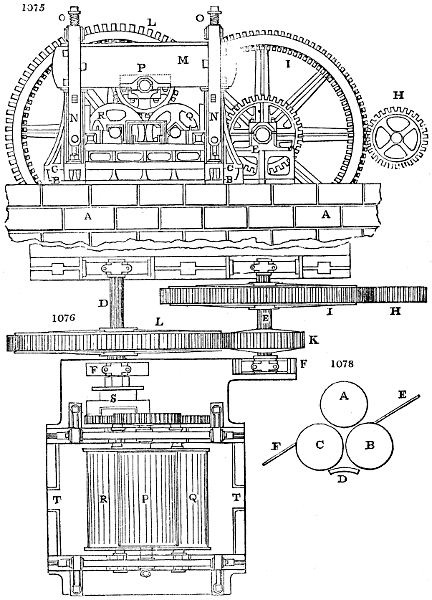
Fig. 1075. A, A, solid foundation of masonry; B, B, bed plate; C, C, headstocks or standards; D, main shaft (seen only in fig. 1076.); E, intermediate shaft; F, F, plummer-blocks of main shaft D, (seen only in fig. 1076.); H, driving pinion on the fly-wheel shaft of engine; I, first motion mortise wheel driven by the pinion; K, second motion pinion, on the same shaft; L, second motion mortise-wheel, on the main shaft; M, brays of wood, holding the plummer-blocks for shaft D; N, wrought-iron straps connecting the brays to the standards C, C; O, O, regulating screws for the brays; P, top roller and gudgeons; Q and R, the lower or feeding and delivering rollers; S, clutch for the connexion of the side of lower rollers Q and R, to the main shaft (seen only in fig. 1076.); T, T, the drain gutters of the mill-bed (seen only in fig. 1076.).
The same letters of reference are placed respectively on the same parts of the mill in each of figs. 1075, 1076, and 1077.
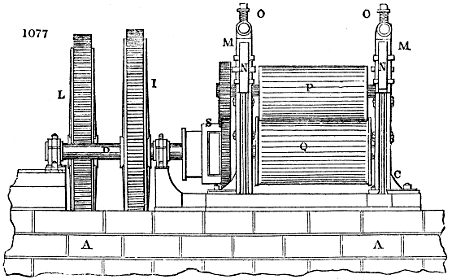
The relative disposition of the rollers is shown in the diagram, fig. 1078., in which A is the top roller; B, the feeding roller; C, the delivering roller; D, the returner; E, the feed board; F, the delivering board.
The rollers are made two inches and a quarter to two inches and a half thick, and ribbed in the centre. The feeding and delivering rollers have small flanges at their ends (as shown in fig. 1075.), between which the top roller is placed; these flanges prevent the pressed canes or begass from working into the mill-bed. The feeding and top rollers are generally fluted, and sometimes diagonally, enabling them the better to seize the canes from the feed-board. It is, however, on the whole, considered better to flute the feeding roller only, leaving the top and delivering rollers plane; when the top roller is fluted, it should be very slightly, for, after the work of a few weeks, its surface becomes sufficiently rough to bite the canes effectively. The practical disadvantage of fluting the delivering rollers, is in the grooves carrying round a portion of liquor, which is speedily absorbed by the spongy begass, as well as in breaking the begass itself, and thus causing great waste.
The feed board is now generally made of cast iron, and is placed at a considerable inclination, to allow the canes to slip the more easily down to the rollers. The returner is also of cast iron, serrated on the edge, to admit the free flowing of the liquor to the mill-bed. The concave returner, formerly used, was pierced with holes to drain off the liquor, but it had the serious disadvantage of the holes choking up with the splinters of the cane, and has therefore been discarded. The delivering board is of cast iron, fitted close to the roller, to detach any begass that may adhere to it, and otherwise mix with the liquor.
In Demerara, Surinam, Cayenne, and the alluvial district of Trinidad, it is usual to attach to the mill a liquor-pump, with two barrels and three adjustments of stroke. This is worked from the gudgeon of the top roller. In action, the liquor from the gutter of the mill-bed runs into the cistern of the pump, and is raised by the pump to the gutter which leads to the clarifier or coppers. Such pumps have brass barrels and copper discharging pipes, are worked with a very slow motion, and require to be carefully adjusted to the quantity of liquor to be raised, which, without such precaution, is either not drawn off sufficiently quick, or is agitated with air in the barrels, and delivered to the gutter in a state of fermentation.
In working this mill, the feeding roller is kept about half an inch distant from the upper roller, but the delivering roller is placed so close to it, as to allow the begass to pass through unbroken.
The practice with this mill is to cut the sugar canes into short lengths of about three feet, and bring them to the mill tied up in small bundles; there the feeder unties them, throws them on the feed board, and spreads them so that they may cross each other as little as possible. They are taken in by the feed rollers, which split and slightly press them; the liquor flows down, and, the returner guiding the canes between the top and delivering rollers, they receive the final pressure, and are turned out on the mill-floor, while the liquor runs back and falls into the mill-bed. The begass, then in the state of pith, adhering to the skin of the cane, is tied up in bundles, and after being exposed a short time to the sun, is finally stored in the begass-house for fuel. By an important improvement in this stage of the process, recently introduced, the begass is carried to the begass-house by a carrier chain, worked by the engine.
The relative merits of horizontal and vertical sugar-mills on this construction, may be thus stated:—The horizontal mill is cheaper in construction, and is more easily fixed; the process of feeding is performed at about one-half of the labour, and in a much superior manner; the returner guides the canes to receive the last pressure more perfectly; and the begass is not so much broken as in the vertical mill; but left tolerably entire, so as to be tied, dried, and stored, with less trouble and waste.
The vertical mill has a considerable advantage, in being more easily washed; and it can be readily and cheaply mounted in wooden framing; but the great labour of feeding the vertical mill, renders it nearly inapplicable to any higher power than that of about ten horses. In situations where the moving power is a windmill, or a cattle gin, the vertical mill may be preferred.
The scale of produce of such mills varies according to the climate and soil. In Demerara, a well constructed engine and mill will produce about 100 gallons of liquor per hour for each horse power.
The dimensions of the most approved horizontal mills are these:—
Horse- power of Engine. Length of Rollers. Diameter of Rollers.
ft. in. inches.
8 4 0 25
10 4 6 27
12 4 8 28
The surface speed of the rollers is 3·4 or 3·6 feet per minute; and to provide for the varying resistance arising from irregular feeding, or the accidental crossing of the canes, by which the engine is often brought up so suddenly as to break the fly-wheel shaft, it is necessary to make both the shaft and the fly-wheel of unusual strength and weight.
Sugar is manufactured in the East Indies by two distinct classes of persons; the ryots, who raise the sugar cane, extract its juice, and inspissate it to a syrupy consistence; and the goldars, who complete the conversion into sugar.
The ryots are the farmers, or actual cultivators of the soil; but, properly speaking, they are merely peasants, toiling under oppressive landlords, and miserably poor. After they cut the canes, they extract the juice by one or other of the rude mills or mortars presently to be described, and boil it down to an entire mass, which is generically called goor, without making any attempt to clarify it, or separate the granular sugar from the uncrystallizable molasses. This goor is of various qualities; one of which, in most common use for making sugar, is known amongst the English settlers under the name of jaggery. There is a caste in Ceylon, called jaggeraros, who make sugar from the produce of the Caryota urens, or Kitul tree; and the sugar is styled jaggery. Sugar is not usually made in Ceylon from the sugar cane; but either from the juice of the Kitul, from the Cocos nucifera, or the Borassus flabelliformis (the Palmyra tree).
Several sorts of cane are cultivated in India.
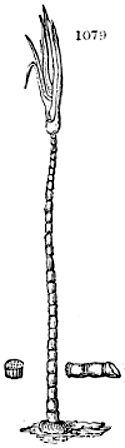
The Cadjoolee (fig. 1079.) is a purple-coloured cane; yields a sweeter and richer juice than the yellow or light coloured, but in less quantities, and is harder to press. It grows in dry lands. When eaten raw, it is somewhat dry and pithy in the mouth, but is esteemed very good for making sugar. It is not known to the West India planter. The leaves rise from a point 6 feet above the ground. An oblique and transverse section of the cane is represented by the parts near the bottom of the figure.
The Pooree is a light-coloured cane, yellow, inclining to white, deeper yellow when ripe and on rich ground. West India planters consider it the same sort as one of theirs. It is softer and more juicy than the preceding, but the juice is less rich, and produces a weaker sugar. It requires seven parts of pooree juice to make as much goor as is produced from six of the cadjoolee. Much of this cane is brought to the Calcutta market, and eaten raw.
The Cullorah thrives in swampy lands, is light-coloured, and grows to a great height. Its juice is more watery, and yields a weaker sugar also than the cadjoolee. However, since much of Bengal consists of low grounds, and since the upland canes are apt to suffer from drought, it deserves encouragement in certain localities.
It is only large farms that cut an acre of cane in a year; one mill, therefore, and one set of the implements used in inspissating the juice, although very rude and simple, serve for several farms, and generally belong to some wealthy man, who lets them out for hire to his poorer neighbours, the whole of whom unite to clear each other’s fields by turns; so that though many people and cattle are employed at one of these miserable sets of works, very few indeed are hired, and the greater part of the labour is performed by the common stock of the farms.
The inspissated juice, or extract of cane, called by the natives goor, is of two kinds; one of which may be termed cake extract, and the other pot extract; both being often denominated jaggery, as above stated, by the English residents.
One-third of an acre of good land in the southern districts, is reckoned by the farmers to produce 18,891 pounds of cane, and 1,159 pounds of pot extract. Its produce in cake extract is about 952 pounds.
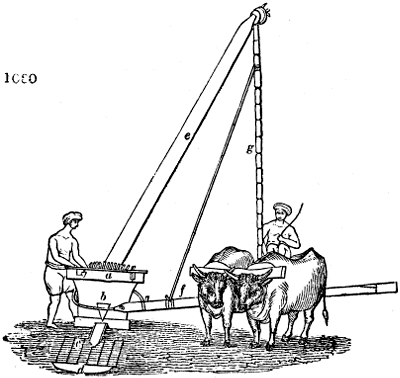
I shall now describe the primitive rude mill and boiler used in preparing the extract of sugar cane, and which are usually let to the ryots by the day. The mill in Dinajpur, fig. 1080. is on the principle of a pestle and mortar. The pestle, however, does not beat the canes, but is rubbed against them, as is done in many chemical triturations; and the moving force is two oxen. The mortar is generally a tamarind tree, one end of which is sunk deep in the ground, to give it firmness. The part projecting a, a, a, a, may be about two feet high, and a foot and a half in diameter; and in the upper end a hollow is cut, like the small segment of a sphere. In the centre of this, a channel descends a little way perpendicularly, and then obliquely to one side of the mortar, so that the juice, as squeezed from the cane, runs off, by means of a spout b, into a strainer c, through which it falls into an earthen pot, that stands in a hole d, under the spout. The pestle e, is a tree about 18 feet in length, and 1 foot in diameter, rounded at its bottom, which rubs against the mortar, and which is secured in its place by a button or knob, that goes into the channel of the mortar. The moving force is applied to a horizontal beam f, about 16 feet in length, which turns round about the mortar, and is fastened to it by a bent bamboo b. It is suspended from the upper end of the pestle by a bamboo g, which has been cut with part of the root, in which is formed a pivot that hangs on the upper point of the pestle. The cattle are yoked to the horizontal beam, at about ten feet from the mortar, move round it in a circle, and are driven by a man, who sits on the beam, to increase the weight of the triturating power. Scarcely any machine more miserable can be conceived; and it would be totally ineffectual, were not the cane cut into thin slices. This is a troublesome part of the operation. The grinder sits on the ground, having before him a bamboo stake, which is driven into the earth, with a deep notch formed in its upper end. He passes the canes gradually through this notch, and at the same time cuts off the slices with a kind of rude chopper.

The boiling apparatus is somewhat better contrived, and is placed under a shed, though the mill is without shelter. The fireplace is a considerable cavity dug in the ground, and covered with an iron boiler p, fig. 1081. At one side of this, is an opening q, for throwing in fuel; and opposite to this, is another opening, which communicates with the horizontal flue. This is formed by two parallel mud walls r, r, s, s, about 20 feet long, 2 feet high, and 18 inches distant from each other. A row of eleven earthen boilers t, is placed on these walls, and the interstices u, are filled with clay, which completes the furnace-flue, an opening v, being left at the end, for giving vent to the smoke.
The juice, as it comes from the mill, is first put into the earthen boiler that is most distant from the fire, and is gradually removed from one boiler to another, until it reaches the iron one, where the process is completed. The fireplace is manifestly on the same model as the boiler range in the West Indies, and may possibly have suggested it, since the Hindostan furnace is, no doubt, of immemorial usage. The execution of its parts is very rude and imperfect. The inspissated juice that can be prepared in 24 hours by such a mill, with 16 men and 20 oxen, amounts to no more than 476 lbs.; and it is only in the southern parts of the district, where the people work night and day, that the sugar-works are so productive. In the northern districts, the people work only during the day, and inspissate about one-half the quantity of juice. The average daily make of a West India sugar-house, is from 2 to 3 hogsheads, of 16 cwts each.
The Indian manufacturers of sugar purchase the above inspissated juice or goor from the farmers, and generally prefer that of a granular honey consistence, which is offered for sale in pots. As this, however, cannot conveniently be brought from a distance, some of the cake kind is also employed. The boilers are of two sizes; one adapted for making at each operation about ten cwt.; the other, about eight and a half. The latter is the segment of a sphere, nine feet diameter at the mouth; the former is larger. The boiler is sunk into a cylindrical cavity in the ground, which serves as a fireplace, so that its edge is just above the floor of the boiling-house. The fuel is thrown in by an aperture close to one side of the boiler, and the smoke escapes by a horizontal chimney that passes out on the opposite side of the hut, and has a small round aperture, about ten feet distant from the wall, in order to lessen the danger from fire. Some manufacturers have only one boiler; others as many as four; but each boiler has a separate hut, in one end of which is some spare fuel; and in the other, some bamboo stages, which support cloth strainers, that are used in the operation. This hut is about twenty-four cubits long, and ten broad; has mud walls, six cubits high; and is raised about one cubit above the ground.
For each boiler, two other houses are required: one in which the cane extract is separated by straining from the molasses, is about twenty cubits long by ten wide; another, about thirty cubits long, by eight wide, is that in which, after the extract has been strained, boiled and clarified, the treacle is separated from the sugar by an operation analogous to claying.
Each sugar manufacturer has a warehouse besides, of a size proportional to the number of his boilers.
About 960 pounds of pot extract being divided into four parts, each is put into a bag of coarse sackcloth, hung over an equal number of wide-mouthed earthen vessels, and is besprinkled with a little water. These drain from the bags about 240 lbs. of a substance analogous to West Indian molasses. The remainder in the bags is a kind of coarse muscovado sugar; but is far from being so well drained and freed from molasses as that of the Antilles. The 720 lbs. of this substance are then put into a boiler with 270 pounds of water, and the mixture is boiled briskly for 144 minutes, when 180 additional pounds of water are added, and the boiling is continued for 48 minutes more. An alkaline solution is prepared from the ashes of the plantain tree, strewed over straw placed in the bottom of an earthen pot perforated with holes. Ninety pounds of water are passed through; and 6 pounds of the clear lixivium are added to the boiling syrup, whereby a thick scum is raised, which is removed. After 24 minutes, four and a half pounds of alkaline solution, and about two-fifths of a pound of raw milk, are added; after which the boiling and skimming are continued 24 minutes. This must be repeated from five to seven times, until no more scum appears. 240 pounds of water being now added, the liquor is to be poured into a number of strainers. These are bags of coarse cotton cloth, in the form of inverted quadrangular pyramids, each of which is suspended from a frame of wood, about 2 feet square. The operation of straining occupies about 96 minutes. The strained liquor is divided into three parts: one of these is put into a boiler, with from half a pound to a pound and a half of alkaline solution, one-twelfth of a pound of milk, and 12 pounds of water. After having boiled for between 48 and 72 minutes, three quarters of a pound of milk are added, and the liquor is poured, in equal portions, into four refining pots. These are wide at the mouth, and pointed at the bottom; but are not conical, for the sides are curved. The bottom is perforated, and the stem of a plantain leaf forms a plug for closing the aperture. The two remaining portions of the strained liquor are managed in exactly the same manner; so that each refining pot has its share of each portion. When they have cooled a little, the refining pot is removed to the curing-house, and placed on the ground for 24 hours; next day they are placed on a frame, which supports them at some distance from the ground. A wide-mouthed vessel is placed under each, to receive the viscid liquor that drains from them. In order to draw off this more completely, moist leaves of the Valisneria spiralis are placed over the mouth of the pot, to the thickness of two inches; after 10 or 12 days, these are removed; when a crust of sugar, about half an inch in thickness is found on the surface of the boiled liquor. The crust being broken and removed, fresh leaves are repeatedly added, until the whole sugar has formed; which requires from 75 to 90 days. When cake extract is used, it does not require to be strained before it be put into the boiler.
On the above-described operose and preposterous process, it is needless to make any remarks. While it is adhered to with the tenacity of Hindu habit, the West Indies has no reason to fear the competition of the East, in the manufacture of sugar, provided the former avail themselves of the aids which chemical and mechanical science are ready to supply.
In every part of the Behar and Putna districts, several of the confectioners prepare the coarse article called shukkur, which is entirely similar in appearance to the inferior Jamaica sugars. They prepare it by putting some of the thin extract of sugar cane into coarse sackcloth bags, and by laying weights on them, they squeeze out the molasses; a process perfectly analogous to that contemplated in several English patents.
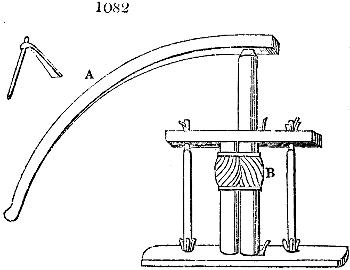
The sugar-mill at Chica Ballapura is worked by a single pair of buffaloes or oxen, fig. 1082., going round with the lever A, which is fixed on the top of the right-hand roller. The two rollers have endless screw heads B, which are formed of 4 spiral grooves and 4 spiral ridges, cut in opposite directions, which turn into one another, when the mill is working. These rollers and their heads are of one piece, made of the toughest and hardest wood that can be got, and such as will not impart any bad taste to the juice. They are supported in a thick strong wooden frame, and their distance from each other is regulated by means of wedges, which pass through mortises in the frame planks, and a groove made in a bit of some sort of hard wood, and press upon the axis of one of the rollers. The axis of the other presses against the left-hand side of the hole in the frame-boards. The cane juice runs down the rollers, and through a hole in the lower frame-board, into a wooden conductor, which carries it into an earthen pot. Two long-pointed stakes or piles are driven into the earth, to keep the mill steady, which is all the fixing it requires. The under part of the lowermost plank of the frame rests upon the surface of the ground, which is chosen level and very firm, that the piles may hold the faster. A hole is dug in the earth, immediately below the spout of the conductor, to receive the pot.
The mill used in Burdwan and near Calcutta, is simply two small wooden cylinders, grooved, placed horizontally, close to each other, and turned by two men, one at each end. This simple engine is said completely, but slowly, to express the juice. It is very cheap, the prime cost not being two rupees; and being easily moved from field to field, it saves much labour in the carriage of the cane. Notwithstanding this advantage, so rude a machine must leave a large proportion of the richest juice in the cane-trash.
It is curious to find in the antient arts of Hindostan exact prototypes of the sugar-rollers, horizontal and upright, of relatively modern invention in the New World.
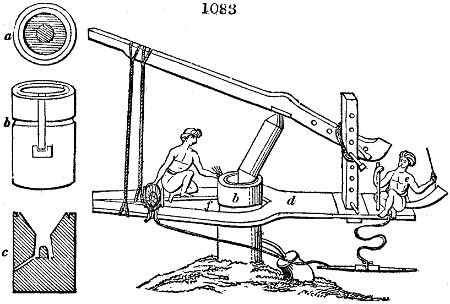
The sugar-mill of Chinapatam, fig. 1083., consists of a mortar, lever, pestle, and regulator. The mortar is a tree about 10 feet in length, and 14 inches in diameter: a is a plan of its upper end; b is an outside view; and c is a vertical section. It is sunk perpendicularly into the earth, leaving one end two feet above the surface. The hollow is conical, truncated downwards, and then becomes cylindrical, with a hemispherical projection in its bottom, to allow the juice to run freely to the small opening that conveys it to a spout, from which it falls into an earthen pot. Round the upper mouth of the cone is a circular cavity, which collects any of the juice that may run over from the upper ends of the pieces of cane; and thence a canal conveys this juice, down the outside of the mortar, to the spout. The beam d, is about sixteen feet in length, and six inches in thickness, being cut out from a large tree that is divided by a fork into two arms. In the fork an excavation is made for the mortar b, round which the beam turns horizontally. The surface of this excavation is secured by a semicircle of strong wood. The end towards the fork is quite open, for changing the beam without trouble. On the undivided end of the beam sits the bullock-driver e, whose cattle are yoked by a rope which comes from the end of the beam; and they are prevented from dragging out of the circle by another rope, which passes from the yoke to the forked end of the beam. On the arms f, a basket is placed, to hold the cuttings of cane; and between this and the mortar sits the man who feeds the mill. Just as the pestle comes round, he places the pieces of cane sloping down into the cavity of the mortar; and after the pestle has passed, he removes those that have been squeezed.
OF THE MANUFACTURE OF SUGAR IN THE WEST INDIES.
Cane-juice varies exceedingly in richness, with the nature of the soil, the culture, the season, and variety of the plant. It is an opaque fluid, of a dull gray, olive, or olive-green colour; in taste, balmy and saccharine; exhaling the balsamic odour of the cane; slightly viscid; and of a specific gravity varying from 1·033 to 1·106, according to circumstances. When fresh, it consists of two parts; the one liquid, the other solid; the latter of which being merely suspended in the former, and, therefore, separable in a great measure by filtration or repose. The solid matter consists of fragments of the cellular parenchyma of the cane, its fibres, and bark, mechanically protruded through the mill; mixed with a very abundant greenish substance, like that called chlorophyle by chemists.
When left to itself in the colonial climates, the juice runs rapidly into the acetous fermentation; twenty minutes being, in many cases, sufficient to bring on this destructive change. Hence arises the necessity of subjecting it immediately to clarifying processes, speedy in their action. When deprived of its green fecula and glutinous extractive, it is still subject to fermentation; but this is now of the vinous kind. The juice flows from the mill through a wooden gutter lined with lead, and being conducted into the sugar-house, is received in a set of large pans or caldrons, called clarifiers. On estates which make on an average, during crop time, from 15 to 20 hogsheads of sugar a week, three clarifiers, of from 300 to 400 gallons’ capacity each, are sufficient. With pans of this dimension, the liquor may be drawn off at once by a stopcock or syphon, without disturbing the feculencies after they subside. Each clarifier is hung over a separate fire, the flue being furnished with a damper for checking the combustion, or extinguishing it altogether. The clarifiers are sometimes placed at one end, and sometimes in the middle of the house, particularly if it possesses a double set of evaporating pans.