S. (continued 7)
Reading edition
Whenever the stream from the mill cistern has filled the clarifier with fresh juice, the fire is lighted, and the temper, or dose of slaked lime, diffused uniformly through a little juice, is added. If an albuminous emulsion be used to promote the clarifying, very little lime will be required; for recent cane-liquor contains no appreciable portion of acid to be saturated. In fact, the lime and alkalies in general, when used in small quantity, seem to coagulate the glutinous extractive matter of the juice, and thus tend to brighten it up. But if an excess of temper be used, the gluten is taken up again by the strong affinity which is known to exist between sugar and lime. Excess of lime may always be corrected by a little alum-water. Where canes grow on a calcareous marly soil, in a favourable season the saccharine matter gets so thoroughly elaborated, and the glutinous mucilage so completely condensed, that a clear juice and a fine sugar may be obtained without the use of lime.
As the liquor grows hot in the clarifier, a scum is thrown up, consisting of the coagulated feculencies of the cane-juice. The fire is now gradually urged till the temperature approaches the boiling point; to which, however, it must not be suffered to rise. It is known to be sufficiently heated, when the scum rises in blisters, which break into white froth; an appearance observable in about forty minutes after kindling the fire. The damper being shut down, the fire dies out; and after an hour’s repose, the clarified liquor is ready to be drawn off into the last and largest in the series of evaporating pans. In the British colonies, these are merely numbered 1, 2, 3, 4, 5, beginning at the smallest, which hangs right over the fire, and is called the teache; because in it the trial of the syrup, by touch, is made. The flame and smoke proceed in a straight line along a flue to the chimney-stalk at the other end of the furnace. The area of this flue proceeds, with a slight ascent from the fire, to the aperture at the bottom of the chimney; so that between the surface of the grate and the bottom of the teache, there is a distance of 28 inches; while between the bottom of the flue and that of the grand, No. 5., at the other end of the range, there are barely 18 inches.
In some sugar-houses there is planted, in the angular space between each boiler, a basin, one foot wide and a few inches deep, for the purpose of receiving the scum which thence flows off into the grand copper, along a gutter scooped out on the margin of the brickwork. The skimmings of the grand are thrown into a separate pan, placed at its side. A large cylindrical cooler, about 6 feet wide and 2 feet deep, has been placed in certain sugar-works near the teache, for receiving successive charges of its inspissated syrup. Each finished charge is called a skipping, because it is skipped or laded out. The term striking is also applied to the act of emptying the teache. When upon one skipping of syrup in a state of incipient granulation in the cooler, a second skipping is poured, this second congeries of saccharine particles agglomerates round the first as nuclei of crystallization, and produces a larger grain; a result improved by each successive skipping. This principle has been long known to the chemist, but does not seem to have been always properly considered or appreciated by the sugar-planter.
From the above described cooler, the syrup is transferred into wooden chests or boxes, open at top, and of a rectangular shape; also called coolers, but which are more properly crystallizers or granulators. These are commonly six in number; each being about one foot deep, seven feet long, and five or six feet wide. When filled, such a mass is collected, as to favour slow cooling, and consequent large-grained crystallization. If these boxes be too shallow, the grain is exceedingly injured, as may be easily shown by pouring some of the same syrup on a small tray; when, on cooling, the sugar will appear like a muddy soft sand.
The criterion by which the negro boilers judge of the due concentration of the syrup in the teache, is difficult to describe, and depends almost entirely on the sagacity and experience of the individual. Some of them judge by the appearance of the incipient grain on the back of the cooling ladle; but most decide by “the touch,” that is, the feel and appearance of a drop of the syrup pressed and then drawn into a thread between the thumb and fore-finger. The thread eventually breaks at a certain limit of extension, shrinking from the thumb to the suspended finger, in lengths somewhat proportional to the inspissation of the syrup. But the appearance of granulation in the thread must also be considered; for a viscid and damaged syrup may give a long enough thread, and yet yield almost no crystalline grains when cooled. Tenacity and granular aspect must therefore be both taken into the account, and will continue to constitute the practical guides to the negro boiler, till a less barbarous mode of concentrating cane-juice be substituted for the present naked teache, or sugar frying-pan.
That weak sugars are such as contain an inferior proportion of carbon in their composition, was first deduced by me from my experiments on the ultimate analysis of vegetable and animal bodies; an account of which was published in the Philosophical Transactions of the Royal Society for 1822. Since then Dr. Prout has arrived at results comfirmatory of my views. See Philosophical Transactions for 1827. Thus, he found pure sugar-candy, and the best refined sugar, to contain 42·85 parts of carbon per cent.; East India sugar-candy, 41·9 parts; East India raw sugar in a thoroughly dry state, but of a low quality, 40·88; manna sugar, well refined, 28·7; sugar from Narbonne honey, 36·36; sugar from starch, 36·2. Hence, by caramelizing the syrup in the teache, not only is the crystallizable sugar blackened, but its faculty of crystallizing impaired, and the granular portion rendered weaker.
A viscous syrup containing much gluten and sugar, altered by lime, requires a higher temperature to enable it to granulate, than a pure saccharine syrup; and therefore the thermometer, though a useful adjuvant, can by no means be regarded as a sure guide, in determining the proper instant for striking the teache.
The colonial curing-house is a capacious building, of which the earthen floor is excavated to form the molasses reservoir. This is lined with sheet lead, boards, tarras, or other retentive cement; its bottom slopes a little, and it is partially covered by an open massive frame of joist-work, on which the potting casks are set upright. These are merely empty sugar hogsheads, without headings, having 8 or 10 holes bored in their bottoms, through each of which the stalk of a plantain leaf is stuck, so as to protrude downwards 6 or 8 inches below the level of the joists, and to rise above the top of the cask. The act of transferring the crude concrete sugar from the crystallizers into these hogsheads, is called potting. The bottom holes, and the spongy stalks stuck in them, allow the molasses to drain slowly downwards into the sunk cistern. In the common mode of procedure, sugar of average quality is kept from 3 to 4 weeks in the curing-house; that which is soft-grained and glutinous, must remain 5 or 6 weeks. The curing-house should be close and warm, to favour the liquefaction and drainage of the viscid caramel.
Out of 120 millions of pounds of raw sugar, which used to be annually shipped by the St. Domingo planters, only 96 millions were landed in France, according to the authority of Dutrone, constituting a loss by drainage in the ships of 20 per cent. The average transport waste at present in the sugars of the British colonies cannot be estimated at less than 12 per cent., or altogether upwards of 27,000 tons! What a tremendous sacrifice of property!
Within these few years a very considerable quantity of sugar has been imported into Great Britain in the state of concentrated cane-juice, containing nearly half its weight of granular sugar, along with more or less molasses, according to the care taken in the boiling operations. I was at first apprehensive that the syrup might undergo some change on the voyage; but among more than a hundred samples which I have analyzed for the custom-house, I have not perceived any traces of fermentation. Since sugar softens in its grain at each successive solution, whatever portion of the crop may be destined for the refiner, should upon no account be granulated in the colonies; but should be transported in the state of a rich cane-syrup to Europe, transferred at once into the blowing-up cistern, subjected there to the reaction of bone black, and passed through bag-filters, or through layers of the coarsely ground black, previously to its final concentration in the vacuum pan. Were this means generally adopted, I am convinced that 30 per cent. would be added to the amount of home-made sugar loaves corresponding to a given quantity of average cane-juice; while 30 per cent., would be taken from the amount of molasses. The saccharine matter now lost by drainage from the hogsheads in the ships, amounting to from 10 to 15 per cent., would, also be saved. The produce of the cane would, on this plan, require less labour in the colonies, and might be exported 5 or 6 weeks earlier than at present, because the period of drainage in the curing-house would be spared.
It does not appear that our sugar colonists have availed themselves of the proper chemical method of counteracting that incipient fermentation of the cane-juice, which sometimes supervenes, and proves so injurious to their products. It is known that grape-must, feebly impregnated with sulphurous acid, by running it slowly into a cask in which a few sulphur matches have been burned, will keep without alteration for a year; and if must, so muted, is boiled into a syrup within a week or ten days, it retains no sulphureous odour. A very slight muting would suffice for the most fermentable cane-juice: and it could be easily given, by burning a sulphur match within the cistern immediately before charging it from the mill. The cane-juice should, in this case, be heated in the clarifier, so as to expel the sulphurous acid, before adding the temper lime; for otherwise a little calcareous sulphite might be introduced into the sugar. Thus the arescence so prejudicial to the saccharine granulation would be certainly prevented.
An Account of Sugar Imported into the United Kingdom during the years ending 5th January, 1837, and 5th January, 1838.
Quantities imported. Quantities entered for Home Consumption. Gross amount of Duty received.
1837. 1838. 1837. 1838. 1837. 1838.
Sugar, unrefined; viz.— Cwt. qr. lb. Cwt. qr. lb. Cwt. qr. lb. Cwt. qr. lb. £. £.
of the British possessions in America 3,600,516 3 2 3,304,092 2 2 3,296,641 1 19 3,562,703 1 24 3,956,879 4,275,207
Of Mauritius 497,303 0 8 537,054 1 21 518,228 0 5 522,348 3 11 621,596 626,131
East India British possessions 152,229 1 13 296,677 2 12 110,236 2 0 270,146 1 2 176,376 368,672
East India Foreign possessions 71,464 2 0 77,090 0 18 20 3 18 3 3 11 66 12
Other sorts 327,647 1 12 266,559 2 24 31 1 6 37 3 10 41 95
Total 4,649,161 0 7 4,481,474 1 21 3,925,140 0 20 4,355,240 1 2 4,754,958 5,270,117
Quantities imported.
1837. 1838.
Sugar, unrefined; viz.— Cwt. qr. lb. Cwt. qr. lb.
of the British possessions in America 3,600,516 3 2 3,304,092 2 2
Of Mauritius 497,303 0 8 537,054 1 21
East India British possessions 152,229 1 13 296,677 2 12
East India Foreign possessions 71,464 2 0 77,090 0 18
Other sorts 327,647 1 12 266,559 2 24
Total 4,649,161 0 7 4,481,474 1 21
Quantities entered for Home Consumption.
1837. 1838.
Sugar, unrefined; viz.— Cwt. qr. lb. Cwt. qr. lb.
of the British possessions in America 3,296,641 1 19 3,562,703 1 24
Of Mauritius 518,228 0 5 522,348 3 11
East India British possessions 110,236 2 0 270,146 1 2
East India Foreign possessions 20 3 18 3 3 11
Other sorts 31 1 6 37 3 10
Total 3,925,140 0 20 4,355,240 1 2
Gross amount of Duty received.
1837. 1838.
Sugar, unrefined; viz.— £. £.
of the British possessions in America 3,956,879 4,275,207
Of Mauritius 621,596 626,131
East India British possessions 176,376 368,672
East India Foreign possessions 66 12
Other sorts 41 95
Total 4,754,958 5,270,117
An Account of Sugar Exported in the year ended 5th January, 1838, compared with the Exports of the preceding Year.
1837. 1838.
Cwts. qrs. lbs. Cwts. qrs. lbs.
Sugar, of the British possessions in America 8,774 1 15 9,267 0 21
Mauritius 2,687 3 14 3,065 0 19
East India, of British possessions 22,290 3 16 13,283 0 22
East India, of Foreign possessions 52,384 0 4 68,252 2 18
Other sorts 191,961 0 20 354,513 1 23
Syrup intended for forming clayed sugar must be somewhat more concentrated in the teache, and run off into a copper cooler, capable of receiving three or four successive skippings. Here it is stirred to ensure uniformity of product, and is then transferred by ladles into conical moulds, or formes, made of coarse pottery, having a small orifice at the apex, which is stopped with a plug of wood wrapped in a leaf of maize. These pots are arranged with the base upwards. As their capacity, when largest, is greatly less than that of the smallest potting-casks, and as the process lasts several weeks, the claying-house requires to have very considerable dimensions. Whenever the syrup is properly granulated, which happens usually in about 18 or 20 hours, the plugs are removed from the apices of the cones, and each is set on an earthen pot to receive the drainings. At the end of 24 hours, the cones are transferred over empty pots, and the molasses contained in the former ones is either sent to the fermenting-house or sold. The claying now begins, which consists in applying to the smoothed surface of the sugar at the base of the cone, a plaster of argillaceous earth, or tolerably tenacious loam in a pasty state. The water diffused among the clay escapes from it by slow infiltration, and descending with like slowness through the body of the sugar, carries along with it the residuary viscid syrup which is more readily soluble than the granulated particles. Whenever the first magma of clay has become dry, it is replaced by a second; and this occasionally in its turn by a third, whereby the sugar cone gets tolerably white and clean. It is then dried in a stove, cut transversely into frusta, crushed into a coarse powder on wooden trays, and shipped off for Europe. Clayed sugars are sorted into different shades of colour according to the part of the cone from which they were cut; under the denomination in French commerce of premier, second, troisième, petit, commun, and tête; the last or the tip being an indifferent article. The clayed sugar of Cuba is called Havannah sugar, from the name of the shipping port.
Clayed sugar can be made only from the ripest cane-juice, for that which contains much gluten would be apt to get too much burned by the ordinary process of boiling, to bear the claying operation. The syrups that run off from the second, third, and fourth application of the clay-paste, are concentrated afresh in a small building apart, called the refinery, and yield tolerable sugars. Their drainings go to the molasses cistern. The cones remain for 20 days in the claying-house, before the sugar is taken out of them.
Claying is seldom had recourse to in the British plantations, on account of the increase of labour, and diminution of weight in the produce, for which the improvement in quality yields no adequate compensation. Such, however, was the esteem in which the French consumers held clayed sugar, that it was prepared in 400 plantations of St. Domingo alone.
SUGAR REFINING.
Raw, or muscovado sugar, as imported from the colonies, is contaminated more or less with gluten, lime, but particularly caramel, which give its grains a yellow brown tint, an empyreumatic odour, and a soft clammy feel in the hand. If such sugar be dissolved in water, and the syrup be evaporated by a gentle heat, it will afford a sugar of still inferior quality and appearance. This rapid deterioration is in some measure owing to the injurious operation of a prolonged heat upon the crystalline structure, but chiefly to the chemical reaction of the glutinous ferment and lime upon the sugar. The first care of the refiner should therefore be the immediate abstraction of these noxious alteratives, which he effects by the process called meltings; that is, mixing up the sugar in a pan with hot water or steam into a pap, and transferring this pap into large sugar-moulds. Whenever these become cool, their points are unplugged, and they are set to drain for a few days in a warm apartment. Sugar thus cleansed is well prepared for the next refining process; which consists in putting it into a large square copper cistern along with some lime-water, (a little bullock’s blood,) and from 5 to 20 per cent. of bone black, and blowing it up with steam; or, in other words, injecting steam through the mixture from numerous orifices in copper pipes laid along the bottom and sides of the vessel. Under the influence of the heat and agitation thus occasioned, the saccharine matter is perfectly dissolved and incorporated with the albumen of the blood and the bone black. Instead of the blood, many refiners employ a mixture of gelatinous alumina and gypsum, called finings, prepared by adding a solution of alum to a body of lime-water, collecting, washing, and draining the precipitate upon a filter. Other refiners use both the blood and finings, with advantage. Bone black is now very frequently employed by the sugar-refiner, not in a fine meal, but in a granular state, like corned gunpowder, for the purpose of decolouring his syrups; in which case, he places it in a box, in a stratum 8 or 10 inches thick, and makes the syrup percolate downwards through it, into a cistern placed beneath. By this means it is deprived of colour, and forms the claircé of the French refiner. When the blowing up cistern is charged with sugar, finely ground bone black, and blood, the mixture must be passed through a proper system of filters. That now most in use is the creased bag filter, represented in figs. 1084, 1085, 1086.
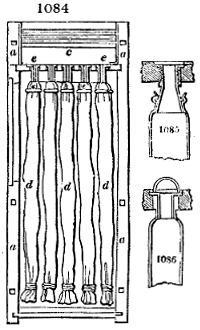
The apparatus consists of an upright square wooden case a, a, about 6 or 8 feet high, furnished with a door of admission to arrange the interior objects; beneath is a cistern with an educting-pipe for receiving and carrying off the filtered liquor; and above the case is another cistern e, which, like the rest, is lined with tinned sheet copper. Into the upper cistern, the syrup mixed with animal charcoal is introduced, and passes thence into the mouths e, e, of the several filters d, d. These consist, each of a bag of thick tweeled cotton cloth, about 12 or 15 inches in diameter, and 6 or 8 feet long, which is inserted into a narrow bottomless bag of canvas, about 5 inches in diameter, for the purpose of folding the filter-bag up into a small space, and thus enabling a great extent of filtering surfaces to be compressed into one box. The orifice of each compound bag is tied round a conical brass month-piece or nozzle e, which screws tight into a corresponding opening in the copper bottom of the upper cistern. From 40 to 60 bags are mounted in each filter case. The liquor which first passes is generally tinged a little with the bone black, and must be pumped back into the upper cistern, for refiltration. In cold weather the interior of the case may be kept warm by a proper distribution of steam-pipes. Fig. 1085. shows one mode of forming the funnel-shaped nozzles of the bags, in which they are fixed by a bayonet catch. Fig. 1086. shows the same made fast by means of a screwed cap, which is more secure.
The next process in sugar-refining is the evaporation of the clarified syrup to the granulating or crystallizing pitch. The more rapidly this is effected, and with the less scorching injury from fire, the better and greater is the product in sugar-loaves. No apparatus answers the refiner’s double purpose of safety and expedition so well as the vacuum-pan of Howard.
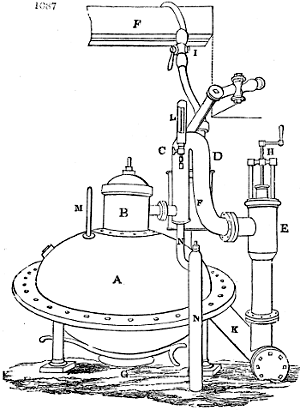
Fig. 1087. shows the structure of a single vacuum-pan. The horizontal diameter of the copper spheroid A, is not less than 5 feet; the depth of the under hemisphere is at least 18 inches from the level of the plane; and the height of the dome-cover is 2 feet. The two hemispheres (of which the inferior one is double, or has a steam-jacket,) are put together by bolts and screws, with packing between the flanges to preserve the joints tight against atmospheric pressure. The jacket of the lower hemisphere forms the case of the steam, which communicates heat to the syrup enclosed in the inner hemisphere. In general, the pans contain, when filled to the flange, 100 gallons of syrup, and yield about 11 cwt. of granulated sugar, at every charge.
A, represents the vacuum spheroid; B, the neck with the lid. From the side of B, a pipe passes into the lower extremity of the bent pipe C, D, which terminates in the vertical pipe E, connected with the vacuum main-pipe K, proceeding horizontally from the air-pump (not shown in the figure). At the top of E, a valve, movable by a screw H, is placed for establishing or cutting off the connexion with the air-pump at pleasure. Behind F, is the measure cistern, from which the successive charges are admitted into the pan. This measure is filled with the clear syrup, by opening the stopcock I, on the pipe under the ceiling, which communicates with the filter-cistern placed above. G is the valve or plug-hole, at the bottom of the pan, for discharging the granulating syrup. This plug is opened by means of a powerful lever attached to it; the connexion with the air-pump being previously intercepted. L, is the barometer, or manometer, for showing the state of the vacuum corresponding to the temperature. N, N, is a cistern-pipe for receiving any little syrup which may accidentally boil over the neck B. Its contents are let off by a stopcock at its bottom from time to time. M shows the place of the proof-stick, an ingenious brass rod for taking out a sample of syrup without admitting air. See infrà.
The charging-cistern contains about 20 gallons. This quantity of syrup being first admitted, and brought to a certain pitch of concentration, a second measure is introduced, the inspissation of which is supposed by some refiners to cause an agglomeration of saccharine matter round the first crystalline particles. The repetition of this process for two or three times is imagined to produce the large brilliant grain of vacuum-pan sugar. This hypothesis is more specious than sound, because the granulating syrup discharged from the pan is subjected to a heat of 180° or 190° in the subjacent steam-cased receiver, whereby the granulations are again reduced to a very small size. Into this receiver, two or three skippings or discharges of the pan are admitted in succession, and the whole are diligently mixed and agitated by a stirring oar. It is by this process that the granulating tendency is promoted and determined. From this receiver (absurdly enough called a cooler) the moulds are filled in the usual way, by means of copper basins or large ladles.
The case of the under hemisphere of the vacuum-pan is filled with steam, generated under a pressure of four or five pounds on the square inch; the heat of which causes the interior syrup to boil rapidly while the air-pump is kept in action. A small escape-pipe for waste steam must be placed at the opposite side of the case or jacket, to ensure its equal distribution; as also a stopcock below, to let off the water of condensation. The pans are mounted on iron feet, or short pillars, which insulate them from the floor, and allow their whole surface to be inspected, and any flaw to be repaired. The air-pump usually stands in a cold-water cistern, to favour the condensation of the aqueous vapour, which it draws out of the pans; and it is kept in constant action by the steam-engine, being attached to the working-beam of its piston.
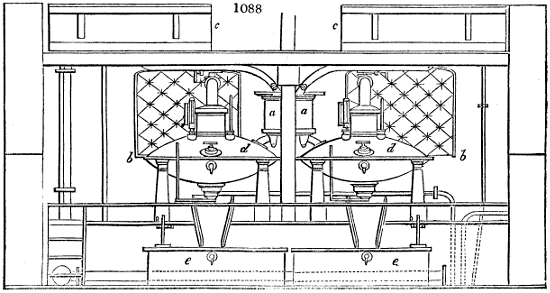
Fig. 1088. exhibits the general arrangement of the vacuum-pans, and their subsidiary apparatus. Here are shown, on the ground floor, the heaters e, e, (miscalled coolers), into which the concentrated syrup is let down. These heaters are made of copper, in one piece, surrounded with a cast-iron jacket, bolted at the flange or brim to it. Each pan contains, when full, about 350 gallons, equivalent to nearly 35 cwt. of crystallized sugar. They are furnished with steam-cocks and waste steam-pipes. Under the level of the spheroids d, d, the horizontal main-pipe is seen, for supplying the cases with steam. In the face of each pan, above the line b, b, the handle of the proof-stick appears, like that of a stop-cock. The distribution of the measure cisterns, and some other parts of the pans, is slightly varied in this representation from the former. From the bottom of the liquor cisterns C, C, pipes descend to the charging measures a, a, below. The cisterns C, C, are made of copper, and contain each about 400 gallons. Six tons of refined sugar can be turned out daily in a three-pan house.
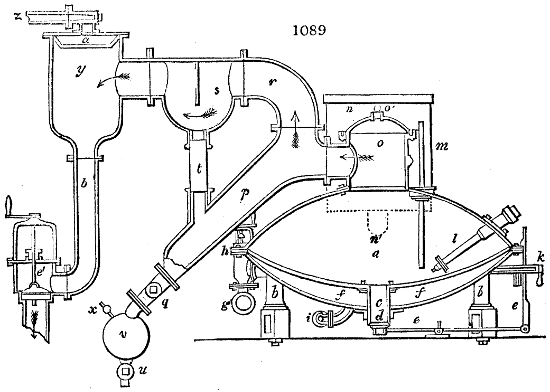
Fig. 1089. represents in section another form of the vacuum-pan, a is the spheroidal copper vessel, supported by four iron columns b, b. It may be discharged by means of the pipe c, which is secured with a conical valve d. This may be opened or shut, by acting on the lever e. The lower of the two hemispheres of which the pan is composed is double, and the interstitial space f, f, is filled with steam by the pipe g, as the heating and evaporating agent. h, is the steam valve; i, the pipe for the efflux of the condensed water. k, a tube for the escape of the air at the commencement of the operation. l, is an apparatus inserted air-tight into the cover of the vacuum-pan, and which dips down into the syrup; serving to take out a sample of it, without allowing air to enter, and hence called the proof-stick. The construction of this instrument is exhibited in figs. 1091, 1092, 1093, 1094, 1095., which will be presently explained. m, is the thermometer, which is also plunged into the sugar; behind it, is the barometer. n, is the charger or gauge-vessel, filled with the filtered syrup, which it discharges by the pipe n′. o, is the cover or capital of the vacuum-pan. o′, is a safety-valve, through which the air may be admitted, after the completion of the process. p, is a bent pipe, slanting downwards, with a stopcock q, at its end, to receive the superfluous syrup. The vapour, which is disengaged from the syrup during its concentration, is extracted from the top of the pan into the pipe r, passes from this into the vessel s, which is divided by a plate of copper into two compartments. The syrup forced over accidentally in the ebullition, goes into the vessel s, and passes by the glass tube t, into the pipe p. The glass tube serves to show the quantity of the syrup that has boiled over, so that it may be drawn off when necessary. For this purpose, the stopcock u, of the vessel v, must be closed, and q must be opened, in order to fill v, while the air contained in it escapes into the pan. The stopcock q, being then shut, and u, with the little air-cock x, opened, the syrup will flow into the large receiver placed beneath it, commonly but erroneously called a cooler; because it is a double copper basin, with steam in the interstitial space. The hot steam rushes from s, into the cast-iron vessel y, where it is condensed. z, is a pipe for introducing the water of condensation through the copper rose a′. The condensed water flows through the pipe b′, and the valve e′, to the air-pump, which receives motion from the shaft of the steam-engine.
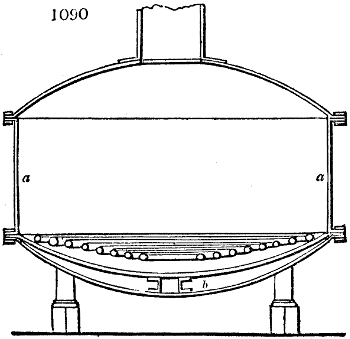
The vacuum-pan was originally heated solely by the admission of steam between the double bottom; but of late years the heat has been also applied to the syrup through several coils of pipe placed within the pan, filled with steam at a temperature many degrees above 212° F., sometimes so high as 250°. By this double application of heat, the evaporating power of a pan has been vastly increased. The latest made pans have a considerably flat bottom, fig. 1090.; a spiral pipe, laid close upon it; and between the under hemisphere and the upper one, there is a space a, a, 21⁄2 feet high, to give the syrup room for frothing up without boiling over. The space b, of the bottom receives steam of common pressure, and the spiral tubes, of high pressure. A pan like this is now making for a house in London, which is to work off 16 tons of sugar-loaves daily.
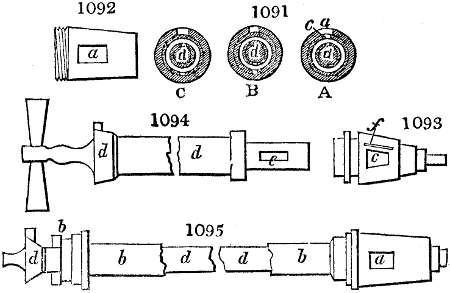
The proof-stick, fig. 1095., consists of a cylindrical rod, capable of being screwed air-tight into the pan in an oblique direction downwards. The upper or exterior end is open; the under, which dips into the syrup, is closed, and has on one side a slit a (figs. 1091, 1092.), or notch, about 1⁄2 inch wide. In this external tube, there is another shorter tube b, capable of moving round in it, through an arc of 180°. An opening upon the under end e, corresponds with the slit in the outer tube, so that both may be made to coincide, fig. 1091. A. A wooden plug d, is put in the interior tube, but so as not to shut it entirely. Upon the upper end there is a projection or pin, which catches in a slit of the inner tube, by which this may be turned round at pleasure. In the lower end of the plug there is a hole e, which can be placed in communication with the lateral openings in both tubes. Hence it is possible, when the plug and the inner tube are brought into the proper position, A, fig. 1091., to fill the cavity of the wooden rod with the syrup, and to take it out without allowing any air to enter. In order to facilitate the turning of the inner tube within the outer, there is a groove in the under part, into which a little grease may be introduced.
Whenever a proof has been taken, the wooden plug must be placed in reference to the inner tube, as shown in fig. 1091. c, and then be turned into the position A; when the cavity of the plug will again be filled with syrup. c must be now turned back to the former position, whereby all intercourse with the vacuum-pan is cut off; the plug being drawn out a little, and placed out of communication with the inner tube. The plug is then turned into the position B, drawn out, and the proof examined by the fingers.
Table showing the boiling point of syrup, at the corresponding atmospheric pressure within the vacuum-pan:—
Height of the mercury (inches) in one leg of the syphon, above that in the other—
0·74 0·86 1·01 1·17 1·36 1·57 1·80 2·05 2·36 2·72 3·10 3·52 4·00.
Boiling point, Fahr.—
115° 120° 125° 130° 135° 140° 145° 150° 155° 160° 165° 170° 175°.
The large double steam-basin, which receives several successive skippings of the concentrated granulating syrup, serves to heat it from the temperature of 160° or 170°, at which it leaves the vacuum-pan, up to 200° or thereby, before it is filled out into the moulds; for were it introduced in the cooler state, it would not concrete into sufficiently compact loaves.
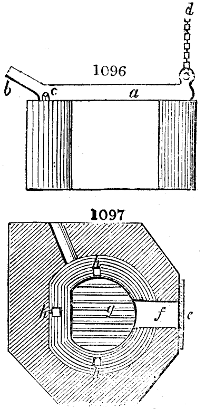
The following apparatus is used in many French sugar-houses, for concentrating syrups, called the swing pan, or chaudière à bascule. It is represented in fig. 1096. in elevation, and in fig. 1097. in ground plan. a, is the pan; b, its spout; c, the axis or pivot round which it swings, so as to empty itself, when raised behind by the chain d; e, is the furnace door; f, the passage to the fireplace and grate g; h, h, h, side flues for conducting the smoke into the chimney.
The duly clarified, concentrated, granulated, and reheated syrup, is transferred, by means of copper basins, from the coolers into conical moulds, made either of brown and somewhat porous earthenware, or of sheet iron, strongly painted. The sizes of the moulds vary, from a capacity of 10 pound loaves, to that of 56 pound bastards—a kind of soft brown sugar obtained by the concentration of the inferior syrups. These moulds have the orifices at their tips closed with bits of twisted paper, and are set up in rows close to each other, in an airy apartment adjoining the coolers. Here they are left several hours, commonly the whole night, after being filled, till their contents become solid, and they are lifted next morning into an upper floor, kept at a temperature of about 80° by means of steam pipes, and placed each over a pot to receive the syrup drainings—the paper plug being first removed, and a steel wire, called a piercer, being thrust up to clear away any concretion from the tip. Instead of setting the lower portion of the inverted cones in pots, some refiners arrange them in wooden racks, with their apices suspended over longitudinal gutters of lead or zinc, laid with a slight slope upon the floor, and terminating in a sunk cistern. The syrup which flows off spontaneously is called green syrup. It is kept separate. In the course of two or three days, when the drainage is nearly complete, some finely clarified syrup, made from loaf sugar, called liquor by the refiners, is poured to the depth of about an inch upon the base of each cone, the surface having been previously rendered level and solid by an iron tool, called a bottoming trowel. The liquor, in percolating downwards, being already a saturated syrup, can dissolve none of the crystalline sugar, but only the coloured molassy matter; whereby, at each successive liquoring, the loaf becomes whiter, from the base to the apex. A few moulds, taken promiscuously, are emptied from time to time, to inspect the progress of the blanching operation; and when the loaves appear to have acquired as much colour, according to the language of refiners, as is wanted for the particular market, they are removed from the moulds, turned on a lathe at the tips, if necessary, set for a short time upon their bases, to diffuse their moisture equally through them, and then transferred into a stove heated to 130° or 140° by steam pipes, where they are allowed to remain for two or three days, till they be baked thoroughly dry. They are then taken out of the stove, and put up in blue paper for sale.
In the above description of sugar-refining, I have said nothing of the process of claying the loaves, because it is now nearly obsolete, and abandoned in all well-appointed sugar-houses. Those of my readers who desire to become acquainted with sugar-refining upon the old plan, may consult my Report made upon the subject to the Honourable House of Commons in July 1833; where they will find every step detailed, and the numerical results stated with minute accuracy. The experiments subservient to that official report were instituted purposely to determine the average yield or product, in double and single refined loaves, lumps, bastards and treacle, which different kinds of sugar would afford per cwt., when refined by decolouring with not more than 5 per cent. of bone black, boiling in an open pan, and clearing the loaves with clay-pap.
BEET-ROOT SUGAR.
The physical characters which serve to show that a beet-root is of good quality, are its being firm, brittle, emitting a creaking noise when cut, and being perfectly sound within; the degree of sweetness is also a good indication. The 45th degree of latitude appears to be the southern limit of the successful growth of beet in reference to the extraction of sugar.
Extraction of Sugar from the Beet.—The first manipulations to which the beets are exposed, are intended to clear them from the adhering earth and stones, as well as the fibrous roots and portions of the neck. It is desirable to expose the roots, after this operation, to the action of a cylinder washing-machine.
The parenchyma of the beet is a spongy mass, whose cells are filled with juice. The cellular tissue itself, which forms usually only a twentieth or twenty-fifth of the whole weight, consists of ligneous fibre. Compression alone, however powerful, is inadequate to force out all the liquor which this tissue contains. To effect this object, the roots must be subjected to the action of an instrument which will tear and open up the greatest possible number of these cells. Experiments have, indeed, proved, that by the most considerable pressure, not more than 40 or 50 per cent. in juice from the beet can be obtained; whilst the pulp procured by the action of a grater produces from 75 to 80 per cent.
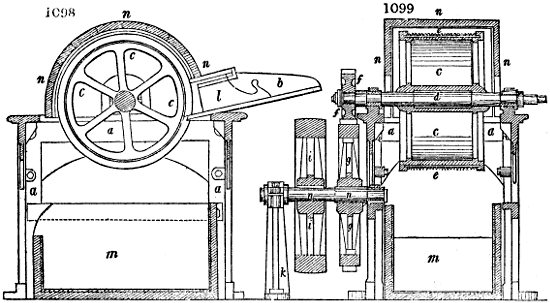
The beet-root rasp of Moulfarine is represented in figs. 1098, 1099. a, a, is the frame-work of the machine; b, the feed-plate made of cast iron, divided by a ridge into two parts; c, the hollow drum; d, its shaft, upon either side of whose periphery nuts are screwed for securing the saw blades e, e, which are packed tight against each other by means of laths of wood; f, is a pinion upon the shaft of the drum, into which the wheel g works, and which is keyed upon the shaft h; i, is the driving rigger; k, pillar of support; l, blocks of wood, with which the workman pushes the beet-roots against the revolving-rasp; m, the chest for receiving the beet-pap; n, the wooden cover of the drum, lined with sheet iron. The drum should make 500 or 600 turns in the minute.
A few years ago, M. Dombasle introduced a process of extracting the juice from the beet without either rasping or hydraulic pressure. The beets were cut into thin slices, by a proper rotatory blade-machine; these slices were put into a macerating cistern, with about their own bulk of water, at a temperature of 212° F. After half an hour’s maceration, the liquor was said to have a density of 2° B., when it was run off into a second similar cistern, upon other beet-roots; from the second, it was let into a third, and so on to a fifth; by which time, its density having risen to 51⁄2°, it was ready for the process of defecation. Juice procured in this way is transparent, and requires little lime for its purification; but it is apt to ferment, or to have its granulating power impaired by the watery dilution. The process has been accordingly abandoned in most establishments.
I have seen the following operations successfully executed in a beet-root factory near Lille, and have since verified their propriety in my own laboratory upon white beets, grown near Mitcham in Surrey. My product was nearly 5 per cent.; it was very fair, and large grained, like the vacuum-pan sugar of Demerara, but without its clamminess.
The roots were washed by a rotatory movement upon a grating made like an Archimedes’ screw, formed round the axis of a squirrel-cage cylinder, which was laid horizontally beneath the surface of water in an oblong trough. It was turned by hand rapidly, with the intervention of a toothed wheel and pinion. The roots, after being sufficiently agitated in the water, were tossed out by the rotation at the end of the cylinder furthest from the winch. They were next hoisted in a basket up through a trap hole into the floor above, by means of a cord and pulley moved by mechanical power; a six-horse steam engine, upon Woolfe’s expansive principle, being employed to do all the heavy work. They were here subjected to the mechanical grater (rape mécanique), see fig. 1098, 1099., which had, upon its sloping feed-table, two square holes for receiving at least two beets at a time, which were pushed forwards by a square block of wood held in the workman’s hand by means of a strap. The rasp was a drum, having rows of straight saws placed half an inch apart round its periphery, parallel to the axis, with teeth projecting about 1⁄8 of an inch. The space between each pair of saws was filled with a wedge of wood. The steel slips, or saw plates, were half an inch broad, twelve inches long, and serrated on both their longitudinal edges, so that when the one line of teeth was blunted, the other could be turned out. The drum made 750 turns per minute.
The pulp from the rasp fell into a flat trough placed beneath, whence it was shovelled into small bags. Each bag had its mouth folded over, was laid upon a wicker plate, and spread flat with a rolling-pin. The bags and hurdles were then piled in the hydraulic press. There were three presses, of which the two allotted to the first pressure were charged alternately, and the third was reserved for a final and more durable pressure of the marc. See Press, hydraulic, and Stearine Press.
The juice flowed over the edges of the wicker plates, and fell into the sill-plate of the press, which was furnished with upright borders, like a tray, through whose front side a pipe issued, that terminated in a leathern hose, for conducting the juice into an elevated cistern in the boiling-house. Here one pound of slaked lime was mixed with every four hectolitres (about 88 gallons imp.) of juice. The mixture was made to boil for a little while in a round pan alongside, whence it was decanted into oblong flat filters, of blanket stuff. The filtered liquor, which had in general a spec. gravity of 15° Baumé, (about double that of the fresh juice), was now briskly concentrated by boiling, in an oblong pan, till it acquired the density of 28° B. The fire being damped with raw coal, the syrup was run off rapidly by a stopcock into a large basin with a swing handle, and immediately replaced by fresh defecated liquor. The basin was carried by two men to the opposite side of the boiling-house, and emptied into a cistern set on a high platform, whose horizontal discharge-pipe was provided with a series (five) of stopcocks, placed respectively over five copper chests (inverted truncated pyramids), containing a thick bed of granular bone black, covered with a perforated copper plate. The hot syrup thus filtered had a pale straw-colour, and was subsequently evaporated in swing pans, figs. 1096, 1097., over a brisk fire, in quantities equivalent to half a cwt. of sugar, or four hectolitres of average juice.
MAPLE SUGAR.
The manufacture of sugar from the juice of a species of maple tree, which grow spontaneously in many of the uncultivated parts of North America, appears to have been first attempted about 1752, by some of the farmers of New England, as a branch of rural economy.
The sugar maple, the Acer saccharinum of Linnæus, thrives especially in the states of New York and Pennsylvania, and yields a larger proportion of sugar than that which grows upon the Ohio. It is found sometimes in thickets which cover five or six acres of land; but it is more usually interspersed among other trees. They are supposed to arrive at perfection in forty years.
The extraction of maple sugar is a great resource to the inhabitants of districts far removed from the sea; and the process is very simple. After selecting a spot among surrounding maple trees, a shed is erected, called the sugar-camp, to protect the boilers and the operators from the vicissitudes of the weather. One or more augers, three-fourths of an inch in diameter; small troughs for receiving the sap; tubes of elder or sumach, 8 or 10 inches long, laid open through two-thirds of their length, and corresponding in size to the auger-bits; pails for emptying the troughs, and carrying the sap to the camp; boilers capable of holding 15 or 16 gallons; moulds for receiving the syrup inspissated to the proper consistence for concreting into a loaf of sugar; and, lastly, hatchets to cut and cleave the fuel, are the principal utensils requisite for this manufacture. The whole of February and beginning of March are the sugar season.
The trees are bored obliquely from below upwards, at 18 or 20 inches above the ground, with two holes 4 or 5 inches asunder. Care must be taken that the auger penetrates no more than half an inch into the alburnum, or white bark; as experience has proved that a greater discharge of sap takes place at this depth than at any other. It is also advisable to perforate in the south face of the trunk.
The trough, which contains from two to three gallons, and is made commonly of white pine, is set on the ground at the foot of each tree, to receive the sap which flows through the two tubes inserted into the holes made with the auger; it is collected together daily, and carried to the camp, where it is poured into casks, out of which the boilers are supplied. In every case, it ought to be boiled within the course of two or three days from flowing out of the tree, as it is liable to run quickly into fermentation, if the weather become mild. The evaporation is urged by an active fire, with careful skimming during the boiling; and the pot is continually replenished with more sap, till a large body has at length assumed a syrupy consistence. It is then allowed to cool, and passed through a woollen cloth, to free it from impurities.
The syrup is transferred into a boiler to three-fourths of its capacity, and it is urged with a brisk fire, till it acquires the requisite consistence for being poured into the moulds or troughs prepared to receive it. This point is ascertained, as usual, by its exhibiting a granular aspect, when a few drops are drawn out into a thread between the finger and the thumb. If in the course of the last boiling, the liquor froth up considerably, a small bit of butter or fat is thrown into it. After the molasses have been drained from the concreted loaves, the sugar is not at all deliquescent, like equally brown sugar from the cane. Maple sugar is in taste equally agreeable with cane sugar, and it sweetens as well. When refined, it is equally fair with the loaf sugar of Europe.
The period during which the trees discharge their juices is limited to about six weeks. Towards the end of the flow, it is less abundant, less saccharine, and more difficult to be crystallized.
Quantity of Sugar brought into the Markets of the World, in the year 1838.
Tons.
British West Indies 160,000
Mauritius, 35,000; and British East Indies, 20,000 55,000
Java 36,000
Manilla and Siam 30,000
Dutch West Indies 25,000
St. Thomas and St. Croix 7,000
Martinique and Guadaloupe 80,000
Bourbon 20,000
Cuba 100,000
Brazils 95,000
From Beet-root, in France and Belgium 65,000
United States 65,000
738,000 [65]
SUGAR OF LEAD, properly Acetate of lead, (Acetate de plomb; Sel de Saturne, Fr.; Essigsaures Bleioxyd, Bleizucker, Germ.) is prepared by dissolving pure litharge, with heat, in strong vinegar, made of malt, wood, or wine, till the acid be saturated. A copper boiler, rendered negatively electrical by soldering a strap of lead within it, is the best adapted to this process on the great scale. 325 parts of finely ground and sifted oxide of lead, require 575 parts of strong acetic acid, of spec. grav. 7° Baumé, for neutralization, and afford 960 parts of crystallized sugar of lead. The oxide should be gradually sprinkled into the moderately hot vinegar, with constant stirring, to prevent adhesion to the bottom; and when the proper quantity is dissolved, the solution may be weakened with some of the washings of a preceding process, to dilute the acetate, after which the whole should be heated to the boiling point, and allowed to cool slowly, in order to settle. The limpid solution is to be drawn off by a syphon, concentrated by boiling to the density of 32° B., taking care that there be always a faint excess of acid, to prevent the possibility of any basic salt being formed, which would interfere with the formation of regular crystals. Should the concentrated liquor be coloured, it may be whitened by filtration through granular bone black.
Stoneware vessels, with salt glaze, answer best for crystallizers. Their edges should be smeared with candle-grease, to prevent the salt creeping over them by efflorescent vegetation. The crystals are to be drained, and dried in a stove-room very slightly heated. It deserves remark, that linen, mats, wood, and paper, imbued with sugar of lead, and strongly dried, readily take fire, and burn away like tinder. When the motherwaters cease to afford good crystals, they should be decomposed by carbonate of soda, or by lime skilfully applied, when a carbonate or an oxide will be obtained, fit for treating with fresh vinegar. The supernatant acetate of soda may be employed for the extraction of pure acetic acid.
A main point in the preparation of sugar of lead, is to use a strong acid; otherwise much time and acid are wasted in concentrating the solution. This salt crystallizes in colourless, transparent, four and six sided prisms, from a moderately concentrated solution; but from a stronger solution, in small needles, which have a yellow cast if the acid has been slightly impure. It has no smell, a sweetish astringent metallic taste, a specific gravity of 2·345; it is permanent in the air at ordinary temperatures, but effloresces when heated to 95°, with the loss of its water of crystallization and some acid, falling into a powder, which passes, in the air, slowly into carbonate of lead. The crystals dissolve in 11⁄2 times their weight of water at 60°, but in much less of boiling water, and in 8 parts of alcohol. The solution feebly reddens litmus paper, but has an alkaline reaction upon the colours of violets and turmeric. The constituents of the salt are, 58·71 oxide of lead, 27·08 acetic acid, and 14·21 water, in 100.
Acetate of lead is much used in calico-printing. It is poisonous, and ought to be prepared and handled with attention to this circumstance.
There are two subacetates of lead; the first of which, the ter-subacetate, has three atoms of base to one of acid, and is the substance long known by the name of Goulard’s extract. It may be obtained by digesting with heat a solution of the neutral acetate, upon pure litharge or massicot. The solution affords white crystalline scales, which do not taste so sweet as sugar of lead, dissolve in not less than 30 parts of water, are insoluble in alcohol, and have a decided alkaline reaction upon test paper. Carbonic acid, transmitted through the solution, precipitates the excess of the oxide of lead, in the state of a carbonate, a process long ago prescribed by Thenard for making white-lead. This subacetate consists of 88·66 of oxide, and 13·34 acid, in 100 parts. It is employed for making the orange sub-chromate of lead, as also sometimes in surgery.
A sex-subacetate, containing six atoms of base, may be obtained by adding ammonia in excess to a solution of the preceding salt, and washing the precipitate with dilute water of ammonia. A white powder is thus formed, that dissolves sparingly in cold water, but gives a solution in boiling water, from which white silky needles are deposited. It consists of 92·86 oxide, and 7·14 acid.
SULPHATES, are saline compounds of sulphuric acid with oxidized bases. The minutest quantity of them present in any solution, may be detected by the precipitate, insoluble in nitric or muriatic acid, which they afford with nitrate or muriate of baryta. They are mostly insoluble in alcohol.
SULPHATE OF ALUMINA AND POTASSA, is alum.
SULPHATE OF AMMONIA, is a salt sometimes formed by saturating the ammonia liquor of the gas-works with sulphuric acid; and it is employed for making carbonate of ammonia. See Ammonia and Sal Ammoniac.
SULPHATE OF BARYTA, is the mineral called heavy-spar, which frequently forms the gangue or vein-stone of lead and other metallic ores.
SULPHATE OF COPPER, Roman or Blue Vitriol (Vitriol de Chypre, Fr.; Kupfervitriol, Germ.); is a salt composed of sulphuric acid and oxide of copper, and may be formed by boiling the concentrated acid upon the metal, in an iron pot. It is, however, a natural product of many copper mines, from which it flows out in the form of a blue water, being the result of the infiltration of water over copper pyrites, which has become oxygenated by long exposure to the air in subterranean excavations. The liquid is concentrated by heat in copper vessels, then set aside to crystallize. The salt forms in oblique four-sided tables, of a fine blue colour; has a spec. gravity of 2·104; an acerb, disagreeable, metallic taste; and, when swallowed, it causes violent vomiting. It becomes of a pale dirty blue, and effloresces slightly, on long exposure to the air; when moderately heated, it loses 36 per cent. of water, and falls into a white powder. It dissolves in 4 parts of water, at 60°, and in 2 of boiling water, but not in alcohol; the solution has an acid reaction upon litmus paper. When strongly ignited, the acid flies off, and the black oxide of copper remains. The constituents of crystallized sulphate of copper are—oxide, 31·80; acid, 32·14; and water, 36·06. Its chief employment in this country is in dyeing, and for preparing certain green pigments. See Scheele’s and Schweinfurth Green. In France, the farmers sprinkle a weak solution of it upon their grains and seeds before sowing them, to prevent their being attacked by birds and insects.
SULPHATE OF IRON, Green vitriol, Copperas (Couperose verte, Fr.; Eisenvitriol, Schwefelsaures Eisenoxydul, Germ.); is a crystalline compound of sulphuric acid and protoxide of iron; hence called, by chemists, the protosulphate; consisting of, 26·10 of base, 29·90 of acid, and 44·00 of water, in 100 parts; or of 1 prime equivalent of protoxide, 36, + 1 of acid, 40, + 7 of water, 63, = 139. It may be prepared by dissolving iron to saturation in dilute sulphuric acid, evaporating the solution till a pellicle forms upon its surface, and setting it aside to crystallize. The copperas of commerce is made in a much cheaper way, by stratifying the pyrites found in the coal measures (Vitriolkies and Strahlkies of the Germans), upon a sloping puddled platform of stone, leaving the sulphuret exposed to the weather, till, by the absorption of oxygen, it effloresces, lixiviating with water the supersulphate of iron thus formed, saturating the excess of acid with plates of old iron, then evaporating and crystallizing. The other pyrites, which occurs often crystallized, called by the Germans Schwefelkies or Eisenkies, must be deprived of a part of its sulphur by calcination, before it acquires the property of absorbing oxygen from the atmosphere, and thereby passing from a bisulphuret into a bisulphate. Alum schist very commonly contains vitriolkies, and affords, after being roasted and weather-worn, a considerable quantity of copperas, which must be carefully separated by crystallization from the alum.
This liquor used formerly to be concentrated directly in leaden vessels; but the first stage of the operation is now carried on in stone canals of considerable length, vaulted over with bricks, into which the liquor is admitted, and subjected at the surface to the action of flame and heated air, from a furnace of the reverberatory kind, constructed at one end, and discharging its smoke by a high chimney raised at the other. See Soda Manufacture. Into this oblong trough, resting on dense clay, and rendered tight in the joints by water-cement, old iron is mixed with the liquor, to neutralize the excess of acid generated from the pyrites, as also to correct the tendency to superoxidizement in copperas, which would injure the fine green colour of the crystals. After due concentration and saturation in this surface evaporator, the solution is run off into leaden boilers, where it is brought to the proper density for affording regular crystals, which it does by slow cooling, in stone cisterns.
Copperas forms sea-green, transparent, rhomboidal prisms, which are without smell, but have an astringent, acerb, inky taste; they speedily become yellowish-brown in the air, by peroxidizement of the iron, and effloresce in a warm atmosphere: they dissolve in 1·43 parts of water at 60°, in 0·27 at 190°, and in their own water of crystallization at a higher heat. This salt is extensively used in dyeing black, especially hats, in making ink and prussian blue, for reducing indigo in the blue vat, in the China blue dye, for making the German oil of vitriol, and in many chemical and medicinal preparations.
There is a persulphate and subpersulphate of iron, but they belong to the domain of chemistry. The first may be formed, either by dissolving with heat one part of red oxide of iron (colcothar) in one-and-a-half of concentrated sulphuric acid, or by adding some nitric acid to a boiling-hot solution of copperas. It forms with galls and logwood a very black ink, which is apt to become brown-black. When evaporated to dryness, it appears as a dirty white pulverulent substance, which is soluble in alcohol. It consists, in 100 parts, of 39·42 of red oxide of iron, and 60·58 sulphuric acid.
Hydrated peroxide of iron, prepared by precipitation with alkali from solution of the persulphate, is an excellent antidote against poisoning by arsenic. A French peruquier, who had swallowed two drams of arsenious acid, was, after an interval of twenty minutes, treated with the oxide precipitated from 6 ounces of that salt by caustic potash. It was diffused in 20 quarts of weak syrup, and administered in successive doses. After repeated vomiting and purging, the patient felt no more pain, and was pronounced by the physician to be quite convalescent.
In the copperas and alum works, a very large quantity of ochrey sediment is obtained; which is a peroxide of iron, containing a little sulphuric acid and alumina. This deposit, calcined in reverberatory hearths, becomes of a bright-red colour; and when ground and elutriated, in the same way as is described under white lead, forms a cheap pigment, in very considerable demand, called English red, in the French market.
Colcothar of Vitriol, and Crocus of Mars, are old names for red oxide of iron. This brown-red powder is obtained in its purest state, by calcining dried sulphate of iron in a furnace till all its acid be expelled, and its base become peroxidized. It must be levigated, elutriated, and dried. This powder is employed extensively in the steel manufacture, for giving the finishing lustre to fine articles; it is used by silversmiths under the name of plate powder and rouge; and by the opticians for polishing the specula of reflecting telescopes. Much of the crocus in the market, is made, however, from the copperas and alum sediments, and is greatly inferior to the article prepared by the last process. The finest rouge is made by precipitating the oxide with soda, then washing and calcining the powder.
An excellent powder for applying to razor-strops, is made by igniting together in a crucible equal parts of well-dried copperas and sea salt. The heat must be slowly raised and well regulated, otherwise the materials will boil over in a pasty state, and the product will be in a great measure lost. When well made, out of contact of air, it has the brilliant aspect of plumbago. It has a satiny feel, and is a true fer olegiste, similar in composition to the Elba iron ore. It requires to be ground and elutriated; after which it affords, on drying, an impalpable powder, that may be either rubbed on a strop of smooth buff leather, or mixed up with hog’s-lard or tallow into a stiff cerate.
SULPHATE OF LIME. See Gypsum.
SULPHATE OF MAGNESIA, Epsom Salt (Sel amer, Fr.; Bittersalz, Germ.); exists in sea-water, as also in the waters of Saidschütz, Sedlitz, and Püllna; and in many saline springs, besides Epsom in Surrey, whence it has derived its trivial name, and from which it was first extracted, in the year 1695, and continued to be so, till modern chemistry pointed out cheaper and more abundant sources of this useful purgative salt. The sulphate of magnesia, occasionally found effloresced on the surface of minerals in crystalline filaments, was called haarsalz (hair salt) by the older writers. The bittern of the Scotch sea-salt works is muriate of magnesia, mixed, with a little sulphate of magnesia and chloride of sodium. If the proper decomposing quantity (found by trial) of sulphate of soda be added to it, and the mixed solution be evaporated at the temperature of 122° F., chloride of sodium will form by double affinity, and fall down in cubical crystals; while the solution of sulphate of magnesia which remains, being evaporated to the proper point, will afford regular crystals in four-sided prisms with four-sided acuminations. Or, if bittern be treated in a retort with the equivalent quantity of sulphuric acid, the muriatic acid may be distilled off into a series of Woulfe’s bottles, and the sulphate of magnesia, soda, and lime, will remain in the retort, from which mixture the sulphate of magnesia may be separated by filtration and crystallization.
Magnesian limestone being digested with as much muriatic acid as will dissolve out its lime only, will, after washing, afford, with the equivalent quantity of sulphuric acid, a pure sulphate of magnesia; and this is certainly the simplest and most profitable process for manufacturing this salt upon the great scale. Many prepare it directly, by digesting upon magnesian limestone the equivalent saturating quantity of dilute sulphuric acid. The sulphate of lime being separated by subsidence, the supernatant solution of sulphate of magnesia is evaporated and crystallized.
This salt is composed of, magnesia 16·72, sulphuric acid 32·39, and water 50·89. When free from muriate, it tends to effloresce in the air. It dissolves in 4 parts of water at 32°, in 3 parts at 60°, in 1·4 at 200°, and in its own water of crystallization at a higher heat.
SULPHATE OF MANGANESE, is prepared on the great scale for the calico-printers, by exposing the peroxide of the metal and pitcoal ground together, and made into a paste with sulphuric acid, to a heat of 400° F. On lixiviating the calcined mass, a solution of the salt is obtained, which is to be evaporated and crystallized. It forms pale amethyst-coloured prisms, which have an astringent bitter taste, dissolve in 21⁄2 parts of water, and consist of, protoxide of manganese 31·93, sulphuric acid 35·87, and water 32·20, in 100 parts.
SULPHATE OF MERCURY, is a white salt which is used in making corrosive sublimate. See Mercury. The subsulphate, called Turbith Mineral, is a pale yellow pigment, and may be prepared by washing the white sulphated peroxide with hot water, which resolves it into the soluble supersulphate, and the insoluble subsulphate, or Turbith. It is poisonous.
SULPHATE OF POTASSA, is obtained by first igniting and then crystallizing the residuum of the distillation of nitric acid from nitre.
SULPHATE OF SODA, is commonly called Glauber’s salt, from the name of the chemist who first prepared it. It is obtained by igniting and then crystallizing the residuum of the distillation of muriatic acid from common salt. It crystallizes in channelled 6-sided prisms. See Soda Manufacture.
SULPHATE OF ZINC, called also White Vitriol, is commonly prepared in the Harz, by washing the calcined and effloresced sulphuret of zinc or blende, on the same principle as green and blue vitriol are obtained from the sulphurets of iron and copper. Pure sulphate of zinc may be made most readily by dissolving the metal in dilute sulphuric acid, evaporating and crystallizing the solution. It forms prismatic crystals, which have an astringent, disagreeable, metallic taste; they effloresce in a dry air, dissolve in 2·3 parts of water at 60°, and consist of—oxide of zinc, 28·29; acid, 28·18; water, 43·53. Sulphate of zinc is used for preparing drying oils for varnishes, and in the reserve or resist pastes of the calico-printer.
SULPHITES, are a class of salts, consisting of sulphurous acid, combined in equivalent proportions with the oxidized bases.
SULPHOSELS, is the name given by Berzelius to a class of salts which may be prepared as follows:—1. Dissolve a salt consisting of an oxide and an acid (an oxisalt), in a very small quantity of water, and pass through the solution a stream of sulphuretted hydrogen, till the salt be entirely decomposed. In this operation, the oxisalt is transformed into a sulphosalt, by the sulphur of the compound gas; while its hydrogen forms water with the oxygen of the saline base. This process is applicable only to the metallic salts; and among these, not to the nitrates, carbonates, or phosphates. 2. Another method of preparing sulphosalts is, to add to a watery solution of sulphuret of potassium, an electro-negative metallic sulphuret, which will dissolve in the liquid till the sulphuret of potassium be saturated. This saline compound is to be employed to effect double decompositions with the oxisalts; that is, to convert the radical of another base, combined with an oxacid, into a sulphosalt. 3. If the electro-negative sulphuret be put in powder into a solution of the hydrosulphuret of potassa, it will dissolve and expel the sulphuretted hydrogen with effervescence; just as carbonic acid is displaced by a stronger acid. For his other three methods of preparing sulphosalts, see his Elements, vol. iii. p. 336, Fr. translation.
SULPHUR; Brimstone (Soufre, Fr.; Schwefel, Germ.); is a simple combustible, solid, non-metallic, of a peculiar yellow colour, very brittle, melting at the temperature of 226° Fahr., and possessing, after it has been fused, a specific gravity of 1·99. When held in a warm hand, a roll of sulphur emits a crackling sound, by the fracture of its interior parts; and when it is rubbed, it emits a peculiar well-known smell, and acquires at the same time negative electricity. When heated to the temperature of 560° F. it takes fire, burns away with a dull blue flame of a suffocating odour, and leaves no residuum. When more strongly heated, sulphur burns with a vivid white flame. It is not affected by air or water.
Sulphur is an abundant product of nature; existing sometimes pure or merely mixed, and at others in intimate chemical combination with oxygen, and various metals, forming sulphates and sulphurets. See Ores of Copper, Iron, Lead, &c., under these metals.
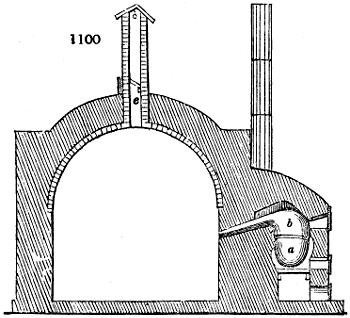
Fig. 1100. represents one of the cast-iron retorts used at Marseilles for refining sulphur, wherein it is melted and converted into vapours, which are led into a large chamber for condensation. The body a, of the retort is an iron pot, 3 feet in diameter outside, 22 inches deep, half an inch thick, which weighs 14 cwt., and receives a charge of 8 cwt. of crude sulphur. The grate is 8 inches under its bottom, whence the flame rises and plays round its sides. A cast-iron capital b, being luted to the pot, and covered with sand, the opening in front is shut with an iron plate. The chamber d, is 23 feet long, 11 feet wide, and 13 feet high, with walls 32 inches thick. In the roof, at each gable, valves or flap-doors, e, 10 inches square, are placed at the bottom of the chimney c. The cords for opening the valves are led down to the side of the furnace. The entrance to the chamber is shut with an iron door. In the wall opposite to the retorts, there are two apertures near the floor, for taking out the sulphur. Each of the two retorts belonging to a chamber is charged with 71⁄2 or 8 cwts. of sulphur; but one is fired first, and with a gentle heat, lest the brimstone froth should overflow; but when the fumes begin to rise copiously, with a stronger flame. The distillation commences within an hour of kindling the fire, and is completed in six hours. Three hours after putting fire to the first retort, the second is in like manner set in operation.
When the process of distillation is resumed, after having been some time suspended, explosions may be apprehended, from the presence of atmospherical air; to obviate the danger of which, the flap-doors must be opened every 10 minutes; but they should remain closed during the setting of the retorts, and the reflux of sulphurous fumes or acid should be carried off by a draught-hood over the retorts. The distillation is carried on without interruption during the week, the charges being repeated four times in the day. By the third day, the chamber acquires such a degree of heat as to preserve the sulphur in a liquid state; on the sixth, its temperature becoming nearly 300° F., gives the sulphur a dark hue, on which account the furnace is allowed to cool on the Sunday. The fittest distilling temperature is about 248°. The sulphur is drawn off through two iron pipes cast in the iron doors of the orifices on the side of the chamber opposite to the furnace. The iron stoppers being taken out of the mouths of the pipes, the sulphur is allowed to run along an iron spout placed over red-hot charcoal, into the appropriate wooden moulds.
Native sulphur in its pure state is solid, brittle, transparent, yellow, or yellow bordering on green, and of a glassy lustre when newly broken. It occurs frequently in crystalline masses, and sometimes in complete and regular crystals, which are all derivable from the rhomboidal octahedron. The fracture is usually conchoidal and shining. Its specific gravity is 2·072, exceeding somewhat the density of melted sulphur. It possesses a very considerable refractive power; and doubles the images of objects even across two parallel faces. Sulphur, crystallized by artificial means, presents a very remarkable phenomenon; for by varying the processes, crystals are obtained whose forms belong to two different systems of crystallization. The red tint, so common in the crystals of Sicily, and of volcanic districts, has been ascribed by some mineralogists to the presence of realgar, and by others to iron; but Stromeyer has found the sublimed orange-red sulphur of Vulcano, one of the Lipari islands, to result from a natural combination of sulphur and selenium.
It is extracted from the minerals containing it, at Solfatara, by the following process:—
Ten earthen pots, of about a yard in height, and 41⁄2 gallons imperial in capacity, bulging in the middle, are ranged in a furnace called a gallery; five being set on the one side, and five on the other. These are so distributed in the body of the walls of the gallery, that their belly projects partly without, and partly within, while their top rises out of the vault of the roof. The pots are filled with lumps of the sulphur ore of the size of the fist; their tops are closed with earthenware lids, and from their shoulder proceeds a pipe of about 2 inches diameter, which bends down, and enters into another covered pot, with a hole in its bottom, standing over a tub filled with water. On applying heat to the gallery, the sulphur melts, volatilizes, and runs down in a liquid state into the tubs, where it congeals. When one operation is finished, the pots are re-charged, and the process is repeated.
In Saxony and Bohemia, the sulphurets of iron and copper are introduced into large earthenware pipes, which traverse a furnace-gallery; and the sulphur exhaled flows into pipes filled with cold water, on the outside of the furnace. 900 parts of sulphuret afford from 100 to 150 of sulphur, and a residuum of metallic protosulphuret. See Metallurgy and Copper.
Volcanic sulphur is purer than that extracted from pyrites; and as the latter is commonly mixed with arsenic, and some other metallic impregnations, sulphuric acid made of it would not answer for many purposes of the arts; though a tolerably good sulphuric acid may be made directly from the combustion of pyrites, instead of sulphur, in the lead chambers. The present high price of the Sicilian sulphur is a great encouragement to its extraction from pyrites. It is said that the common English brimstone, such as was extracted from the copper pyrites of the Parys mine of Anglesey, contained fully a fifteenth of residuum, insoluble in boiling oil of turpentine, which was chiefly orpiment; while the fine Sicilian sulphur, now imported in vast quantities by the manufacturers of oil of vitriol, contains not more than 3 per cent. of foreign matter, chiefly earthy, but not at all arsenical.
Sulphur has been known from the most remote antiquity. From its kindling at a moderate temperature, it is employed for readily procuring fire, and lighting by its flame other bodies not so combustible. At Paris, the preparation of sulphur matches constitutes a considerable branch of industry. The sulphurous acid formed by the combustion of sulphur in the atmospheric air, is employed to bleach woollen and silken goods, as also cotton stockings; to disinfect vitiated air, though it is inferior in power to nitric acid vapour and chlorine; to kill mites, moths, and other destructive insects in collections of zoology; and to counteract too rapid fermentation in wine-vats, &c. As the same acid gas has the property of suddenly extinguishing flame, sulphur has been thrown into a chimney on fire, with the best effect; a handful of it being sometimes sufficient. Sulphur is also employed for cementing iron bars in stone; for taking impressions from seals and cameos, for which purpose it is kept previously melted for some time, to give the casts an appearance of bronze. Its principal uses, however, are for the manufactures of vermillion, or cinnabar, gunpowder, and sulphuric acid.
See Metallurgy, page 823, for the description of Gahn’s furnace for extracting sulphur from pyrites.
Pyrites as a bi-sulphuret, consisting of 45·5 parts of iron, and 54·5 of sulphur, may, by proper chemical means, be made to give off one half of its sulphur, or about 27 per cent.; but great care must be taken not to generate sulphurous acid, as is done very wastefully by the Fahlun and the Goslar processes. By the latter, indeed, not more than 1 or 2 parts of sulphur are obtained, by roasting 100 parts of the pyritous ores of the Rammelsberg mines. In these cases, the sulphur is burned, instead of being sublimed. The residuum of the operation, when it is well conducted, is black sulphuret of iron, which may be profitably employed for making copperas. The apparatus for extracting sulphur from pyrites should admit no more air than is barely necessary to promote the sublimation.—Sicily produced last year 70,000 tons of sulphur, and Tuscany 1200; of which Great Britain consumed 46,000; France, 18,000; other places, 6000. In 1820, Great Britain consumed only 5000 tons.
SULPHURATION, is the process by which woollen, silk, and cotton goods are exposed to the vapours of burning sulphur, or to sulphurous acid gas. In the article Straw-hat Manufacture, I have described a simple and cheap apparatus, well adapted to this operation.
Sulphuring-rooms are sometimes constructed upon a great scale, in which blankets, shawls, and woollen clothes may be suspended freely upon poles or cords. The floor should be flagged with a sloping pavement, to favour the drainage of the water that drops down from the moistened cloth. The iron or stoneware vessels, in which the sulphur is burned, are set in the corners of the apartment. They should be increased in number according to the dimensions of the place, and distributed uniformly over it. The windows and the entrance door must be made to shut hermetically close. In the lower part of the door, there should be a small opening, with a sliding shutter, which may be raised or lowered by the mechanism of a cord passing over a pulley.
The aperture by which the sulphurous acid and azotic gases are let off, in order to carry on the combustion, should be somewhat larger than the opening at the bottom. A lofty chimney carries the noxious gases above the building, and diffuses them over a wide space, their ascension being promoted by means of a draught-pipe of iron, connected with an ordinary stove, provided with a valve to close its orifice when not kindled.
When the chamber is to be used, the goods are hung up, and a small fire is made in the draught-stove. The proper quantity of sulphur being next put into the shallow pans, it is kindled, the entrance door is closed, as well as its shutter, while a vent-hole near the ground is opened by drawing its cord, which passes over a pulley. After a few minutes, when the sulphur is fully kindled, that vent-hole must be almost entirely shut, by relaxing the cord; when the whole apparatus is to be let alone for a sufficient time.
The object of the preceding precautions is to prevent the sulphurous acid gas escaping from the chamber by the seams of the principal doorway. This is secured by closing it imperfectly, so that it may admit of the passage of somewhat more air than can enter by the upper seams, and the smallest quantity of fresh air that can support the combustion. The velocity of the current of air may be increased at pleasure, by enlarging the under vent-hole a little, and quickening the fire of the draught-stove.
Before opening the entrance door of the apartment, for the discharge of the goods, a small fire must be lighted in the draught furnace, the vent-hole must be thrown entirely open, and the sliding shutter of the door must be slid up, gradually more and more every quarter of an hour, and finally left wide open for a proper time. By this means the air of the chamber will become soon respirable.
SULPHURETTED HYDROGEN, is a gas, composed of one part of hydrogen and sixteen parts of sulphur, by weight. Its specific gravity is 1·1912, compared to air = 1·0000. It is the active constituent of the sulphureous mineral waters. When breathed, it is very deleterious to animal life; and being nearly twice as dense as air, it may be poured from its generating bottle into cavities; a scheme successfully employed by M. Thenard to destroy rats in their holes.
SULPHURIC ACID, Vitriolic Acid, or Oil of Vitriol (Acid sulfurique, Fr.; Schwefelsaüre, Germ.). This important product, the agent of many chemical operations, was formerly procured by the distillation of dried sulphate of iron, called green vitriol, whence the corrosive liquid which came over, having an oily consistence, was denominated oil of vitriol. This method has been superseded in Great Britain, France, and most other countries, by the combustion of sulphur along with nitre, in large leaden chambers; but as the former process, which is still practised at Bleyl in Bohemia, and Nordhausen in Saxony, gives birth to some interesting results, I shall describe it briefly.
Into a long horizontal furnace, or gallery of brickwork, a series of earthenware retorts, of a pear shape, is arranged, with curved necks fitted into stoneware bottles or condensers. Each retort is charged with sulphate of iron, which has been previously heated to moderate redness. The first product of the distillation, a slightly acidulous phlegm, is allowed to escape; then the retort and receiver are securely luted together. The fire is now raised, and urged briskly for 36 hours, whereby the strong sulphuric acid is expelled, in the form of heavy white vapours, which condense in the cold receiver into an oily-looking liquid. The latter portions, when received in a separate refrigerator, frequently concrete into a crystalline mass, formerly called glacial oil of vitriol. About 64 pounds of strong acid may be obtained from 600 pounds of copperas. It is brown-coloured; and varies in specific-gravity from 1·842 to 1·896. Its boiling point is so low as 120° Fahr. When re-distilled in a glass retort, into a receiver surrounded with ice, a very moderate heat sends over white fumes, which condense into a soft solid, in silky filaments, like asbestos, tough, and difficult to cut. When this is exposed to the air, it emits copious fumes of sulphuric (not sulphurous) acid. It burns holes in paper as rapidly as a red-hot iron. Dropped in small quantities into water, it excites a hissing noise, like ignited metal; and in larger quantities, it occasions an explosion. By dropping a fragment of it into a poised phial containing water, and stoppering instantly, to prevent the ejection of liquid, by the ebullition which always ensues, I got a dilute acid, containing a known portion of the solid acid, from the specific gravity of which, as well as from its saturating power, I ascertained that the above solid sulphuric acid was truly anhydrous (void of water), consisting of 1 equivalent proportion of sulphur, and 3 of oxygen; or, by weight, of 16 of the former, and 24 of the latter. This acid makes a red solution of indigo.
The production of sulphuric acid from sulphur and nitre may be elegantly illustrated by means of a glass globe with a stoppered hole at its side, and four bent glass tubes inserted into a leaden cap in its upper orifice. The first tube is to be connected with a heated matrass, disengaging sulphurous acid from copper filings and sulphuric acid; the second with a retort, disengaging more slowly deutoxide of azote (nitric oxide) from copper filings and nitric acid; the third with a vessel for furnishing steam in a moderate current towards the end of the process, when no water has been previously admitted into the balloon; the fourth tube may be upright, and terminate in a small funnel. Through the opening in the side of the globe, atmospherical air is to be admitted from time to time, by removing the stopper; after which, the residuary lighter azote may be allowed to escape by the funnel orifice.
The nitric oxide first absorbs oxygen from the air, becomes, in consequence, nitrous acid vapour, which giving up one third of its oxygen to the sulphurous acid, converts this, with the aid of water, into sulphuric acid, while itself returning to the state of nitric oxide, is again qualified to take oxygen from the air, and to transfer it to the sulphurous acid gas; and thus in perpetual rotation. These oxygenating and disoxygenating processes continue until nearly the whole oxygen of the atmospheric air contained in the globe is consumed. Were there little aqueous vapour present, those gases would soon cease to operate upon each other; for though the nitric oxide became nitrous acid, this would oxygenate little of the sulphurous acid, because the three substances would condense into white crystals upon the sides of the balloon, like hoar frost upon a window-pane in winter. These indicate a deficiency of aqueous vapour, and an excess of nitrous acid. On the admission of steam, the crystals disappear, the sulphuric acid is liquefied, the nitrous acid is converted into nitric acid and nitric oxide; the former of which combines with the water, while the latter is converted by the atmospheric oxygen into nitrous acid vapour. A certain quantity of water is therefore requisite to prevent the formation of that crystalline compound, which condenses the nitrous acid, and renders it inoperative in transforming fresh portions of sulphurous acid into sulphuric. On these principles alone is it possible to oxygenate the sulphurous acid, by the nitrous acid resuming and surrendering a dose of oxygen, in perpetual alternation.
It was MM. Clement and Desormes who first had the sagacity to trace these complicated changes. They showed that nitrous acid gas and sulphurous acid gas mixed, react on each other through the intervention of moisture; that there resulted thence a combination of sulphuric acid, deutoxide of azote (nitrous gas), and water; that this crystalline compound was instantly destroyed by more water, with the separation of the sulphuric acid in a liquid state, and the disengagement of nitrous gas; that this gas re-constituted nitrous acid at the expense of the atmospheric oxygen of the leaden chamber, and thus brought matters to their primary condition. From this point, starting again, the particles of sulphur in the sulphurous acid, through the agency of water, became fully oxygenated by the nitrous acid, and fell down in heavy drops of sulphuric acid, while the nitrous gas derived from the nitrous acid, had again recourse to the air for its lost dose of oxygen. This beautiful interchange of the oxygenous principle was found to go on, in their experiments, till either the sulphurous acid, or oxygen in the air, was exhausted.
They verified this proposition, with regard to what occurs in sulphuric acid chambers, by mixing in a crystal globe the three substances, deutoxide of azote, sulphurous acid, and atmospheric air. The immediate production of red vapours indicated the transformation of the deutoxide into nitrous acid gas; and now the introduction of a very little water caused the proper reaction, for opaque vapours rose, which deposited white star-form crystals on the surface of the glass. The gases were once more transparent and colourless; but another addition of water melted these crystals with effervescence, when ruddy vapours appeared. In this manner the phenomena were made to alternate, till the oxygen of the included air was expended, or all the sulphurous acid was converted into sulphuric. The residuary gases were found to be nitrous acid gas, and azote, without sulphurous acid gas; while unctuous sulphuric acid bedewed the inner surface of the globe. Hence, they justly concluded their new theory of the manufacture of oil of vitriol to be demonstrated.
In consequence of their discovery, the manufacture of this acid has received such improvements, that a nearly double product of it may now be obtained from the same weight of materials. Indeed, the economy may be reckoned to be much greater; for one half of the more costly ingredient, the nitre, formerly employed with a given weight of sulphur, suffices at present.
In the manufacture of sulphuric acid upon the great scale, two different systems of working were long prevalent; the intermittent or periodical, and the continuous or uniform. Both were carried on in large leaden chambers. In the former, the chambers were closed during the period of combustion and gaseous combination, but were opened from time to time to introduce fresh atmospheric air. This method is, I believe, generally abandoned now, on account of the difficulties and delays attending it, though it afforded large products in skilful hands. In the latter, a continuous current of air is allowed to enter at the oven in front of the chamber for the combustion of the sulphur, and there is a constant escape of nitrogen gas, with a little sulphurous acid gas, at the remote end of the roof.
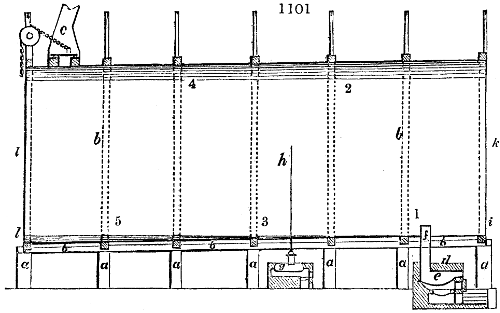
Fig. 1101. represents a sulphuric acid chamber, a, a, are the brick or stone pillars upon which it rests; b, b, are the sustaining wooden beams or joists; c, is the chimney for the discharge of the nitrogen; d, is the roof, and e, the sole of the hearth for the combustion of the sulphur; f, is the cylindrical tunnel, or pipe of lead or cast iron, for conducting the gasiform materials into the chamber; g, is the steam-boiler; and h, the steam-pipe. That plan is variously modified, by different oil-of-vitriol makers in this country and in France. Very frequently, the oven e, d, is not situated under the chamber, but is built at the end of it, as at i, and arched over with brick, the crown being 9 inches thick. The pipe f, 18 inches in diameter, is then placed outside of the chamber, being inserted into a brick chimney, and, turning rectangularly, enters it opposite k. The sole of the hearth e, is a thick plate of cast iron (not hollowed as shown in the figure), 5 or 6 feet long, and 3 or 4 broad, with a small fireplace constructed beneath it, whose smoke-flue runs outwards, under the floor, to the side wall of the building. The oven is in this case about 2 feet in height, from the sole to the roof; and it has an iron door, about 12 inches by 15, which slides up and down in a tightly-fitted iron frame. This door is frequently placed in the side of the oven, parallel to the long side of the leaden chamber. A stout collar of lead is bolted to the chamber, where the pipe enters it. At the middle of the side of the chamber, about 2 feet above the ground, a leaden trough is fixed, which serves as a syphon-funnel and water-trap for introducing water to the acid gases.
Several manufacturers divide the chamber into a series of rectangular compartments, by parallel leaden screens, 10 or 12 feet asunder, and allow these compartments to communicate by a narrow opening, or a hole 1 foot square, in the top and bottom of each screen alternately. Thus the fumes, which enter from the chimney-pipe over k, will be forced, by the screen at b, to descend to 1, and pass through the opening there, to get into the second compartment, whence they will escape near the top at 2, thus circulating up and down, so as to occasion a complete agitation and intermixture of their heterogeneous particles. Into the side of the chamber, opposite to the centre of each compartment, a lead pipe enters, and proceeds towards the middle of the area, terminating in a narrow orifice, for discharging a jet of high-pressure steam from a boiler loaded with 40 pounds upon the square inch. This boiler should be placed under a shed exterior to the building. It deserves to be noted, that the incessant tremors produced in this pipe by the escape of the steam, cause the orifice to contract, and eventually to close almost entirely, just as the point of a glass tube does when exposed directly to the flame of a blowpipe. Provision should therefore be made against this event, by the chemical engineer.
Equidistant between the middle point and each end of the chamber, two round holes are cut out in its side, about 16 inches in diameter, and 2 feet from the floor; the sheet lead being folded back over the face of the strong deals which strengthen the chamber in that place. The edges of the holes are bevelled outwards, so as to fit a large conical plug of wood faced with lead, called a man-hole door. One or other of these doors is opened from time to time, to allow the superintendent to inspect the process, or workmen to enter, after the chamber is well ventilated, for the purpose of making repairs. The joists or tie-beams, that bind the rafters of the roof of both the leaden chamber and the house, must be at least 7 inches deep, by 3 broad, and of such length as to have their ends supported upon the outer wall, or the columnar supports of the roof, in case a number of chambers are enclosed together in parallel ranges under a vast shed. These beams, which lie two feet apart, suspend the leaden roof, by means of leaden straps, soldered to its upper surface and edges. The sides of the chamber are sustained by means of similar leaden straps affixed to the wooden posts (uprights), 4 inches broad by 3 thick, placed two or three feet apart along the sides of the chamber; resting on the ground below, and mortised into the tie-beams above. Some chambers rest upon a sand-floor; but they are preferably placed upon wooden joists, supported by pillars stretching over an open area, as shown in the figure, into which the workmen may descend readily, to examine the bottom.
The outlet c, on the top of the chamber, is sometimes joined to a long pipe of lead laid nearly horizontally, with a slight inclination upwards, along the roof, for favouring the condensation and return of acid matter.
At the extremity l, of the chamber, which, having a downward slope of 1 inch in every 20 feet, should stand from 3 to 6 inches (according to its length) lower than i, one leg of an inverted syphon pipe is fixed by fusion, into which the liquid of the chamber passing, will show by its altitude the depth on the bottom within. From the cup-shaped orifice of that bent-up pipe, the acid of the chamber is drawn off by an ordinary leaden syphon into the concentration pans.
The sheet lead of which the sides and top are made, should weigh from 5 to 6 pounds per square foot; that of the bottom should be nearly of double thickness.
Having now detailed, with sufficient minuteness, the construction of the chamber, I shall next describe the mode of operating with it. There are at least two plans at present in use for burning the sulphur continuously in the oven. In the one, the sulphur is laid on the hearth e, (or rather on the flat hearth in the separate oven, above described,) and is kindled by a slight fire placed under it; which fire, however, is allowed to go out after the first day, because the oven becomes by that time sufficiently heated by the sulphur flames to carry on the subsequent combustion. Upon the hearth, an iron tripod is set, supporting, a few inches above it, a hemispherical cast-iron bowl (basin) charged with nitre and its decomposing proportion of strong sulphuric acid. In the other plan, 12 parts of bruised sulphur, and 1 of nitre, are mixed in a leaden trough on the floor with 1 of strong sulphuric acid, and the mixture is shovelled through the sliding iron door upon the hot hearth. The successive charges of sulphur are proportioned, of course, to the size of the chamber. In one of the largest, which is 120 feet long, 20 broad, and 16 high, 12 cwt. are burned in the course of 24 hours, divided into 6 charges, every fourth hour, of 2 cwt. each. In chambers of one-sixth greater capacity, containing 1400 metres cube, 1 ton of sulphur is burned in 24 hours. This immense production was first introduced at Chaunay and Dieuze, under the management of M. Clement-Desormes. The bottom of the chamber should be covered at first with a thin stratum of sulphuric acid, of spec. grav. 1·07, which decomposes nitrous acid into oxygen and nitrous gas; but not with mere water, which would absorb the nitrous acid vapours, and withdraw them from their aerial sphere of action. The vapour of nitric acid, disengaged from the nitre on the hearth of the oven, when brought into intimate contact with the sulphurous acid, either gives up oxygen to it, becomes itself nitrous gas, and converts it into sulphuric acid; or combines with the sulphurous acid into the crystalline compound above described, which, the moment it meets with moisture, is decomposed into sulphuric acid and nitrous gas. The atmospherical oxygen of the chamber immediately reconverts this gas into nitrous or nitric acid fumes, which are again ready, with the co-operation of sulphurous acid gas and aqueous vapour, to produce fresh quantities of hydrous sulphuric acid (oil of vitriol) and nitrous gas. At low temperatures, this curious play of chemical affinities has a great tendency to form the crystalline compound, and to deposit it in a crust of considerable thickness (from one-half to one inch) on the sides of the chamber, so as to render the process inoperative. A circumstance of this kind occurred, in a very striking manner, during winter, in a manufacture of oil of vitriol in Russia; and it has sometimes occurred, to a moderate extent, in Scotland. It is called, at Marseilles, the maladie des chambres. It may be certainly prevented, by maintaining the interior of the chamber, by a jet of steam, at a temperature of 100° F. When these crystals fall into the dilute acid at the bottom, they are decomposed with a violent effervescence, and a hissing gurgling noise, somewhat like that of a tun of beer in brisk fermentation.