I. & J.
Reading edition
JACK, called also jack in a box, and hand-jack, is a portable, mechanical instrument, consisting of a rack and pinion, or a pair of claws and ratchet bar, moved by a winch handle, for raising heavy weights a little way off the ground.
JACK and JACK-SINKERS, are parts of a stocking frame; see Hosiery.
JACK-BACK, is the largest jack of the brewer.
JACQUARD. A peculiar and most ingenious mechanism, invented by M. Jacquart of Lyons, to be adapted to a silk or muslin loom for superseding the employment of draw-boys, in weaving figured goods. Independently of the ordinary play of the warp threads for the formation of the ground of such a web, all those threads which should rise simultaneously to produce the figure, have their appropriate healds, which a child formerly raised by means of cords, that grouped them together into a system, in the order, and at the time desired by the weaver. This plan evidently occasioned no little complication in the machine, when the design was richly figured; but the apparatus of Jacquart, which subjects this manœuvre to a regular mechanical operation, and derives its motion from a simple pedal put in action by the weaver’s feet, was generally adopted soon after its invention in 1800. Every common loom is susceptible of receiving this beautiful appendage. It costs in France, 200 francs, or 8l. sterling; and a little more in this country.
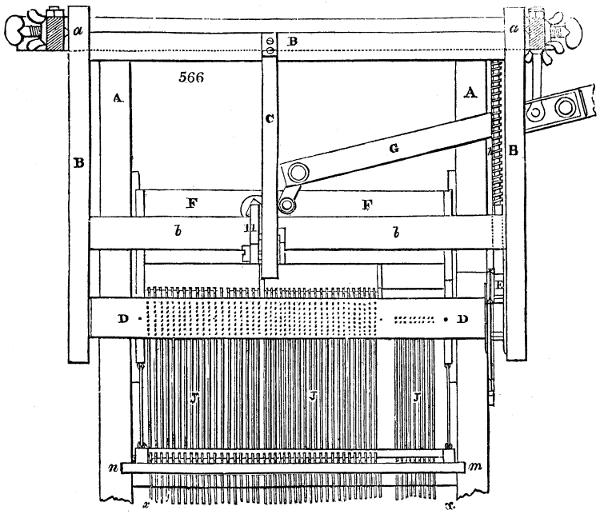
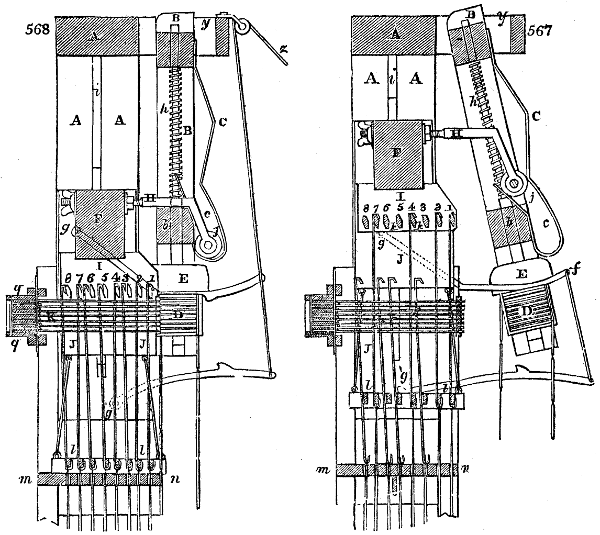
Fig. 566. is a front elevation of this mechanism, supposed to be let down. Fig. 567. is a cross section, shown in its highest position. Fig. 568. the same section as the preceding, but seen in its lower position.
A, is the fixed part of the frame, supposed to form a part of the ordinary loom; there are two uprights of wood, with two cross-bars uniting them at their upper ends, and leaving an interval x y, between them, to place and work the movable frame B, vibrating round two fixed points a a, placed laterally opposite each other, in the middle of the space x y, fig. 566.
C, is a piece of iron with a peculiar curvature, seen in front, fig. 566., and in profile, figs. 567. and 568. It is fixed on one side upon the upper cross-bar of the frame B, and on the other, to the intermediate cross-bar b of the same frame, where it shows an inclined curvilinear space c, terminated below by a semi-circle.
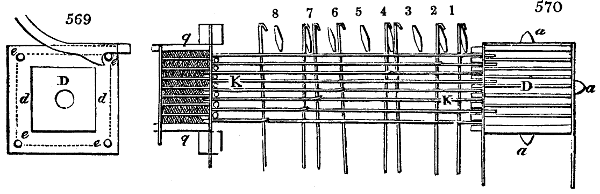
D, is a square wooden axis, movable upon itself round two iron pivots, fixed into its two ends; which axis occupies the bottom of the movable frame B. The four faces of this square axis are pierced with three round, equal, truly-bored holes, arranged in a quincunx. The teeth a, fig. 570., are stuck into each face, and correspond to holes a, fig. 573., made in the cards which constitute the endless chain for the healds; so that in the successive application of the cards to each face of the square axis, the holes pierced in one card may always fall opposite to those pierced in the other. The right-hand end of the square axis, of which a section is shown in double size, fig. 569., carries two square plates of sheet iron d, kept parallel to each other and a little apart, by four spindles e, passed opposite to the corners. This is a kind of lantern, in whose spindles, the hooks of the levers f f′, turning round fixed points g g′ beyond the right hand upright A, catch hold, either above or below at the pleasure of the weaver, according as he merely pulls or lets go the cord z, during the vibratory movement of the frame B.
E is a piece of wood shaped like a T, the stem of which prolonged upwards, passes freely through the cross-bar b, and through the upper cross-bar of the frame B, which serve as guides to it. The head of the T piece being applied successively against the two spindles e, placed above in a horizontal position, first by its weight, and then by the spiral spring h, acting from above downwards, keeps the square axis in its position, while it permits it to turn upon itself in the two directions. The name press is given to the assemblage of all the pieces which compose the movable frame B B.
F is a cross-bar made to move in a vertical direction by means of the lever G, in the notches or grooves i, formed within the fixed uprights A.
H, is a piece of bent iron, fixed by one of its ends with a nut and screw, upon the cross-bar F, out of the vertical plane of the piece C. Its other end carries a friction roller J, which working in the curvilinear space c of the piece C, forces this, and consequently the frame B to recede from the perpendicular, or to return to it, according as the cross-bar F is in the top or bottom of its course, as shown in figs. 567. and 568.
I, cheeks of sheet iron attached on either side to the cross-bar F, which serve as a safe to a kind of claw K, composed here of eight small metallic bars, seen in section fig. 567. and 568., and on a greater scale in fig. 570.
J, upright skewers of iron wire, whose tops bent down hook-wise, naturally place themselves over the little bars K. The bottom of these spindles likewise hooked in the same direction as the upper ones, embraces small wooden bars l, whose office is to keep them in their respective places, and to prevent them from twirling round, so that the uppermost hooks may be always directed towards the small metallic bars upon which they impend. To these hooks from below are attached strings, which after having crossed a fixed board m n, pierced with corresponding holes for this purpose, proceed next to be attached to the threads of the loops destined to lift the warp threads. K K, horizontal spindles or needles, arranged here in eight several rows, so that each spindle corresponds both horizontally and vertically to each of the holes pierced in the four faces of the square axis D. There are therefore as many of these spindles as there are holes in one of the faces of the square.

Fig. 571. represents one of these horizontal spindles. n is an eyelet through which the corresponding vertical skewer passes. o another elongated eyelet, through which a small fixed spindle passes to serve as a guide, but which does not hinder it from moving length-wise, within the limits of the length of the eyelet. p, small spiral springs placed in each hole of the case q q, fig. 570. They serve the purpose of bringing back to its primitive position, every corresponding needle, as soon as it ceases to press upon it.
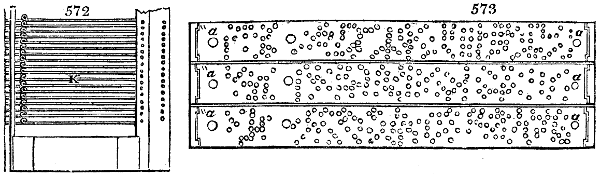
Fig. 572. represents the plan of the upper row of horizontal needles. Fig. 573. is a fragment of the endless chain, formed with perforated cards, which are made to circulate or travel by the rotation of the shaft D. In this movement, each of the perforated cards, whose position, form, and number, are determined by the operation of tying-up of the warp, comes to be applied in succession against the four faces of the square axis or drum, leaving open the corresponding holes, and covering those upon the face of the axis, which have no corresponding holes upon the card.
Now let us suppose that the press B is let down into the vertical position shown in fig. 568.; then the card applied against the left face of the axis, leaves at rest or untouched the whole of the horizontal spindles (skewers), whose ends correspond to these holes, but pushes back those which are opposite to the unpierced part of the card; thereby the corresponding upright skewers, 3. 5. 6. and 8. for example, pushed out of the perpendicular, unhook themselves from above the bars of the claw, and remain in their place, when this claw comes to be raised by means of the lever G; and the skewers 1. 2. 4. and 7., which have remained hooked on, are raised along with the warp threads attached to them. Then by the passage across of a shot of the colour, as well as a shot of the common weft, and a stroke of the lay after shedding the warp and lowering the press B, an element or point in the pattern is completed.
The following card, brought round by a quarter revolution of the axis, finds all the needles in their first position, and as it is necessarily perforated differently from the preceding card, it will lift another series of warp threads; and thus in succession for all the other cards, which compose a complete system of a figured pattern.
This machine, complicated in appearance, and which requires some pains to be understood, acts however in a very simple manner. Its whole play is dependent upon the movement of the lever G, which the weaver himself causes to rise and fall, by means of a peculiar pedal; so that without the aid of any person, after the piece is properly read in and mounted, he can execute the most complex patterns, as easily as he could weave plain goods; only attending to the order of his weft yarns, when these happen to be of different colours.
If some warp yarns should happen to break without the weaver observing them, or should he mistake his coloured shuttle yarns, which would so far disfigure the pattern, he must undo his work. For this purpose, he makes use of the lower hooked lever f′, whose purpose is to make the chain of the card go backwards, while working the loom as usual, withdrawing at each stroke the shot both of the ground and of the figure. The weaver is the more subject to make mistakes, as the figured side of the web is downwards, and it is only with the aid of a bit of looking-glass that he takes a peep of his work from time to time. The upper surface exhibits merely loose threads in different points, according as the pattern requires them to lie upon the one side or the other.
Thus it must be evident, that such a number of paste-boards are to be provided and mounted as equal the number of throws of the shuttle between the beginning and end of any figure or design which is to be woven; the piercing of each paste-board individually, will depend upon the arrangement of the lifting rods, and their connection with the warp, which is according to the design and option of the workman; great care must be taken that the holes come exactly opposite to the ends of the needles; for this purpose two large holes are made at the ends of the paste-boards, which fall upon conical points, by which means they are made to register correctly.
It will be hence seen, that, according to the length of the figure, so must be the number of paste-boards, which may be readily displaced so as to remount and produce the figure in a few minutes, or remove it, or replace it, or preserve the figure for future use. The machine, of course, will be understood to consist of many sets of the lifting rods and needles, shown in the diagram, as will be perceived by observing the disposition of the holes in the paste-board; those holes, in order that they may be accurately distributed, are to be pierced from a gauge, so that not the slightest variation shall take place.
To form these card-slips, an ingenious apparatus is employed, by which the proper steel punches required for the piercing of each distinct card, are placed in their relative situations preparatory to the operation of piercing, and also by its means a card may be punched with any number of holes at one operation. This disposition of the punches is effected by means of rods connected to cords disposed in a frame, in the nature of a false simple, on which the pattern of the work to be performed is first read in.
These improved pierced cards, slips, or paste-boards, apply to a weaving apparatus, which is so arranged that a figure to be wrought can be extended to any distance along the loom, and by that means the loom is rendered capable of producing broad figured works; having the long lever G placed in such a situation that it affords power to the foot of the weaver, and by this means enables him to draw the heaviest morintures and figured works, without the assistance of a draw-boy.
The machinery for arranging the punches, consists of a frame with four upright standards and cross-pieces, which contains a series of endless cords passing under a wooden roller at bottom, and over pulleys at the top. These pulleys are mounted on axles in two frames, placed obliquely over the top of the standard frame, which pulley-frames constitute the table commonly used by weavers.
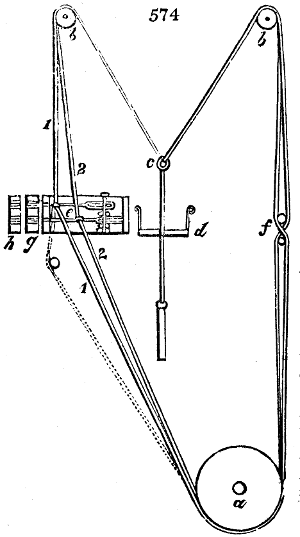
In order better to explain these endless cords, fig. 574. represents a single endless cord 1, 1, which is here shown in operation, and part of another endless cord 2, 2, shown stationary. There must be as many endless cords in this frame as needles in the weaving-loom. a is the wooden cylinder, revolving upon its axis at the lower part of the standards; b b, the two pulleys of the pulley-frames above, over which the individual endless cord passes; c is a small traverse ring. To each of these rings a weight is suspended by a single thread, for the purpose of giving tension to the endless cord. d is a board resembling a common comber-bar, which is supported by the cross-bars of the standard frame, and is pierced with holes, in situation and number, corresponding with the perpendicular threads that pass through them; which board keeps the threads distinct from each other.
At e, the endless cord passes through the eyes of wires resembling needles, which are contained in a wooden box placed in front of the machine, and shown in this figure in section only. These wires are called the punch-projectors; they are guided and supported by horizontal rods and vertical pins, the latter of which pass through loops formed at the hinder part of the respective wires. At f are two horizontal rods extending the whole width of the machine, for the purpose of producing the cross in the cords; g is a thick brass plate, extending along in front of the machine, and lying close to the box which holds the punch-projectors; this plate g, shown also in section, is called the punch-holder; it contains the same number of apertures as there are punch-projectors, and disposed so as to correspond with each other. In each of these apertures, there is a punch for the purpose of piercing the cards, slips, or pasteboards with holes; h is a thick steel plate of the same size as g, and shown likewise in section, corresponding also in its number of apertures, and their disposition, with the punch-projectors and the punch-holder. This plate h, is called the punch-receiver.
The object of this machine is to transfer such of the punches as may be required for piercing any individual card from the punch-holder g, into the punch-receiver h; when they will be properly situated, and ready for piercing the individual card or slip, with such holes as have been read in upon the machine, and are required for permitting the warp threads to be withdrawn in the loom, when this card is brought against the ends of the needles. The process of transferring the patterns to the punches will be effected in the following manner.
The pattern is to be read in, according to the ordinary mode, as in a false simple, upon the endless cords below the rods f, and passed under the revolving wooden cylinder a, to a sufficient height for a person in front of the machine to reach conveniently. He there takes the upper threads of the pattern, called the beard, and draws them forward so as to introduce a stick behind the cords thus advanced, as shown by dots, for the purpose of keeping them separate from the cords which are not intended to be operated upon. All the punch-projectors which are connected with the cords brought forward, will be thus made to pass through the corresponding apertures of the punch-holder g, and by this means will project the punches out of these apertures, into corresponding apertures of the punch-receiver h. The punches will now be properly arranged for piercing the required holes on a card or slip, which is to be effected in the following manner.
Remove the punch-receivers from the front of the machine; and having placed one of the slips of card or pasteboard between the two folding plates of metal, completely pierced with holes corresponding to the needles of the loom, lay the punch-receiver upon those perforated plates; to which it must be made to fit by mortises and blocks, the cutting parts of the punches being downwards. Upon the back of the punch-receiver is then to be placed a plate or block, studded with perpendicular pins corresponding to the above described holes, into which the pins will fall. The plates and the blocks thus laid together, are to be placed under a press, by which means the pins of the block will be made to pass through the apertures of the punch-receiver; and wherever the punch has been deposited in the receiver by the above process, the said punches will be forced through the slip of pasteboard, and pierced with such holes as are required for producing the figured design in the loom.
Each card being thus pierced, the punch-receiver is returned to its place in front of the machine, and all the punches forced back again into the apertures of the punch-holder as at first. The next set of cords is now drawn forward by the next beard, as above described, which sends out the punch-projectors as before, and disposes the punches in the punch-receiver, ready for the operation of piercing the next card. The process being thus repeated, the whole pattern is, by a number of operations, transferred to the punches, and afterwards to the cards or slips, as above described.
JADE; axe-stone; (Nephrite, Ceraunite, Fr.) is a mineral commonly of a greenish colour, compact, and of a fatty lustre. Spec. grav. 2·95; scratches glass, is very tough; fuses into a white enamel. Its constituents are, silica 50·5; alumina 10; magnesia 31; oxide of iron 5·50; oxide of chrome 0·05; water 2·75. It comes from China, is used among rude nations for making hatchets; and is susceptible of being cut into any form.
JAPANNING, is a kind of varnishing or lacquering, practised with excellence by the Japanese, whence the name. See Varnish.
JASPER; (Jaspe calcedoine, Fr.; Jaspis, Germ.) is a sub species of calcedony quartz, of which there are five varieties. 1. The Egyptian red and brown, with ring or tendril-shaped delineations. 2. Striped jasper. 3. Porcelain jasper. 4. Common jasper. 5. Agate jasper. The prettiest specimens are cut for seals, and for the inferior kinds of jewellery ornaments. See Lapidary.
ICEHOUSE; (Glacière, Fr.; Eishaus, Germ.) Under the article Freezing, I have enumerated the different artificial methods of producing cold. But for the uses of common life, in these climates, the most economical and convenient means of refrigeration in hot weather may be procured by laying up a store of ice in winter, in such circumstances as will preserve it solid during summer.
An icehouse should not be regarded as an object of mere luxury, for pleasing the palates of gourmands with iced creams and orgeats. In the southern countries of Europe it is considered among people in easy circumstances as an indispensable appendage to a country mansion. During the Dog-days, especially at those periods, and in those districts where the sirocco blows, a lassitude and torpor of mind and body supervene, with indigestion or total loss of appetite, and sometimes dysenteries, which are obviously occasioned by the excessive heat, and are to be prevented or counteracted chiefly by the use of cold beverages. By giving tone to the stomach, iced drinks immediately restore the functions of the nervous and muscular systems when they are languid; while they enable persons in health to endure without much inconvenience an atmosphere so close and sultry as would be intolerable without this remedy. Icehouses, moreover, afford to country gentlemen, a great advantage in enabling them to preserve their fish, butcher meat, dead poultry, and game, which would otherwise, in particular states of the weather, immediately spoil. Considering at how little expense and trouble an icehouse can be constructed, it is surprising that any respectable habitation in the country should not have one attached to it. The simplest and most scientific form is a double cone, that is, two cones joined base to base; the one being of stones or brickwork, sunk under ground with its apex at the bottom, into which the ice is rammed; the other being a conical roof of carpentry covered with thatch, and pointed at top. The entrance should be placed always on the north side; it should consist of a corridor or porch with double doors, and be screened from the sunbeams by a small shrubbery. Such are, in general, the principles upon which an icehouse should be formed; but they will be better understood by the following explanation and figure.
A dry sandy soil should be selected, and, if possible, a spot sheltered by a cliff or other natural barrier from the direct rays of the sun. Here a cavity is to be dug about 16 feet in diameter, terminating below like the point of a sugar loaf. Its ordinary depth, for a moderate family, may be about 24 feet; but the larger its dimensions are, the longer will it preserve the ice, provided it be filled. In digging, the workman should slope the ground progressively towards the axis of the cone, to prevent the earth falling in. This conical slope should be faced with brick or stone work about one foot thick, and jointed with Roman cement so as to be air and water tight. A well is to be excavated at the bottom two feet wide and four deep, covered at top with an iron grating for supporting the ice, and letting the water drain away.
The upper cone may likewise be built of brickwork, and covered with thatch; such a roof would prove the most durable. This is the construction shown in fig. 575. Whatever kind of roof be preferred, there must be left in it an oblong passage into the interior. This porch should face the north, and be at least 8 feet long by 21⁄2 feet wide; and perfectly closed by a well-fitted door at each end. All round the bottom of this conical cover, a gutter should be placed to carry off the rain to a distance from the icehouse, and prevent the circumjacent ground from getting soaked with moisture.
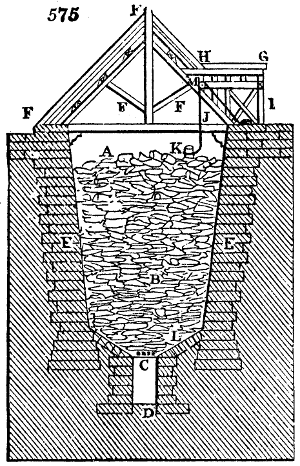
Fig. 575. shows the section of a well-constructed icehouse. Under the ice-chamber A the ice is rammed into the space B. C is the grate of the drain-sink D. The portion E E is built in brick or stone; the base L of the ice-chamber slopes inwards towards the centre at C. The upper part of the brickwork E E is a little way below the level of the ground. The wooden frame work F F F F forms the roof, and is covered with thick thatch. G H is the wooden work of the door I. At K the bucket is seen for lifting up a charge of ice, by means of the cord J passing over the pulley M, which enables the servant to raise it easily.
The icehouse should have no window to admit light; but be, so to speak, hermetically sealed in every point, except at its cess-pool, which may terminate in a water trap to prevent circulation of air.
A clear day should be selected for charging the icehouse; but before beginning to fill, a quantity of long dry straw should be laid on the bottom crosswise; and as the ice is progressively introduced, straw is to be spread against the conical sides, to prevent the ice from coming into contact with the brick or stone work. The more firmly compacted the ice is, the better does it keep; with which view it should be broken into pieces with mallets before being thrown in. No layers of straw should be stratified among the ice, for they would make its body porous. Some persons recommend to pour in a little water with the successive layers of ice, in order to fill up its small crevices, and convert the whole into one mass.
Over the top layer a thick bed of straw should be spread, which is to be covered with boards surmounted with heavy stones, to close up the interstices in the straw. The inner and outer doors should never be opened at once; but the one should always be shut before the other is opened.
Dry snow well rammed keeps equally well with hard ice, if care be taken to leave no cavities in the mass, and to secure its compactness by sprinkling a little water upon the successive charges.
To facilitate the extraction of the ice, a ladder is set up against its sloping wall at one side of the door, and left there during the season.
JELLY, VEGETABLE, of ripe currants and other berries, is a compound of mucilage and acid, which loses its power of gelatinizing by prolonged ebullition.
JELLY, ANIMAL; see Gelatine, Glue, and Isinglass.
JET; (Jaiet or jais, Fr.) a species of pitch-coal or glance-coal, which, being found abundantly in a beautiful compact form, in the valley of Hers, arrondissement of Pamiers, department of the Arriège, has been worked up extensively there from time immemorial, into a multitude of ornamental articles. With this black lignite, buttons, crosses, rosaries, necklaces, ear-drops, bracelets, waist-buckles, &c. are made, which were at one time much worn by ladies for mourning dresses. The greater number of these ornaments are fashioned upon grindstones which turn in a horizontal direction, and are kept continually wet; others are turned at the lathe, or shaped by files.
About 40 years ago this manufacture employed from 1000 to 1200 operatives; at present it gives bread to only 60. This falling off may be ascribed to the successful imitation of the jet articles by those of black glass, which are equally beautiful, and not nearly so apt to lose their polish by use.
IMPERMEABLE, is the epithet given to any kind of textile fabric, rendered water-proof by one or other of the following substances:—
1. Linseed oil to which a drying quality has been communicated by boiling with litharge or sugar of lead, &c.
2. The same oil holding in solution a little caoutchouc.
3. A varnish made by dissolving caoutchouc in rectified petroleum or naphtha, applied between two surfaces of cloth, as described under Macintosh’s patent. See Caoutchouc.
4. Vegetable or mineral pitch, applied hot with a brush, as in making tarpauling for covering goods in ships.
5. A solution of soap worked into cloth, and decomposed in it by the action of a solution of alum; whence results a mixture of acid fats and alumina, which insinuates itself among all the woolly filaments, fills their interstices, and prevents the passage of water.
6. A solution of glue or isinglass, introduced into a stuff, and then acted upon by a clear infusion of galls, whereby the fibres get impregnated with an insoluble, impermeable, pulverulent leather.
7. Plaster work is rendered impermeable by mixing artificial or natural asphaltum with it.
JEWELLERY, Art of. See Gem and Lapidary.
INCOMBUSTIBLE CLOTH; is a tissue of the fibrous mineral called amianthus or asbestos. This is too rare to form the object of any considerable manufacture. Cotton and linen cloth may be best rendered incapable of taking fire, or burning with flame, by being imbued with a solution of sal ammoniac.
INCUBATION, ARTIFICIAL. The Egyptians have from time immemorial been accustomed to hatch eggs by artificial warmth, without the aid of hens, in peculiar stoves, called Mammals. The inhabitants of the village Bermé, still travel through the most distant provinces of Egypt at certain seasons of the year, with a portable furnace, heated by a lamp, and either hatch chickens for sale, or undertake to hatch the eggs belonging to the natives at a certain rate per dozen. M. de Reaumur published in France about a century ago, some ingenious observations upon this subject; but M. Bonnemain was the first person who studied with due attention all the circumstances of artificial incubation, and mounted the process successfully upon the commercial scale. So far back as 1777 he communicated to the Academy of Sciences an interesting fact, which he had noticed, upon the mechanism employed by chicks to break their shells; and for some time prior to the French revolution he furnished the Parisian market with excellent poultry at a period of the year when the farmers had ceased to supply it. His establishment was ruined at that disastrous era, and no other has ever since been constructed or conducted with similar care. As there can be no doubt however of the practicability and profitableness of the scheme, when judiciously managed, I shall insert a brief account of his ingenious arrangements. I had the pleasure of making the acquaintance of this amiable old man at my first visit to Paris, many years ago, and believe all his statements to be worthy of credit. Some imitations of his plans have been made in this country, but how far they have succeeded in an economical point of view, it is difficult to determine. His apparatus derives peculiar interest from the fact, that it was founded upon the principle of the circulation of hot water, by the intestine motions of its particles, in a returning series of connected pipes; a subject afterwards illustrated in the experimental researches of Count Rumford. It has of late years been introduced as a novelty into this country, and applied to warm the apartments of many public and private buildings. The following details will prove that the theory and practice of hot-water circulation were as perfectly understood by M. Bonnemain fifty years ago, as they are by any of our stove-doctors at the present day. They were then publicly exhibited at his residence in Paris, and were afterwards communicated to the world at large in the interesting article of the Dictionnaire Technologique, intitled Incubation Artificielle.
The apparatus of M. Bonnemain consisted: 1. of a boiler and pipes for the circulation of water; 2. of a regulator calculated to maintain an equable temperature; 3. of a stove-apartment, heated constantly to the degree best fitted for incubation, which he called the hatching pitch. He attached to one side a poussinière or chick-room, for cherishing the chickens during a few days after incubation.
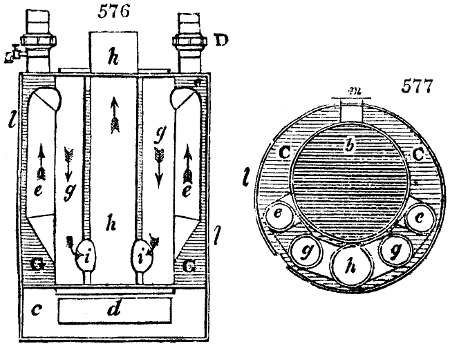
The boiler is represented in vertical section and ground plan, in figs. 576. and 577. It is composed of a double cylinder of copper or cast-iron l, l, having a grate b (see plan), an ashpit at d (section). The water occupies the shaded space C, C. h, g, g, e, e, are five vertical flues, for conducting the burnt air and smoke, which first rise in the two exterior flues e, e, then descend in the two adjoining flues g, g, and finally re-mount through the passages i, i, in the central flue h. During this upwards and downwards circulation, as shown by the arrows in the section, the products of combustion are made to impart nearly the whole of their heat to the water by which they are surrounded. At the commencement, some burning paper or wood shavings are inserted at the orifice m, to establish a draught in this circuitous chimney. The air is admitted into the ash-pit at the side, in regulated quantities, through a small square door, movable round a rod which runs horizontally along its middle line. This swing valve is acted upon by an expanding bar (see Heat-Regulator), which opens it more or less, according to the temperature of the stove apartment in which the eggs are placed.
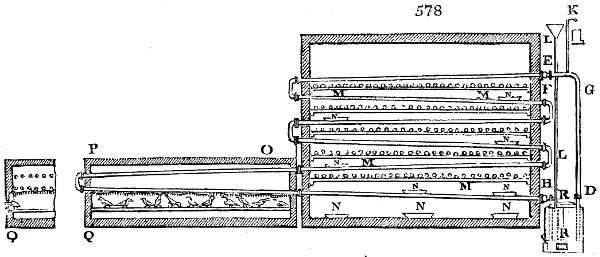
D is the upper orifice of the boiler, by which the hotter and consequently lighter particles of the water continually ascend, and are replaced by the cooled particles, which enter the boiler near its bottom, as shown in fig. 578. at R. Into further details relative to the boiler it is needless to enter; for though its form, as designed by M. Bonnemain, is excellent and most economical of heat for a charcoal fire, it would not suit one of pit-coal, on account of the obstruction to the pipes which would soon be occasioned by its soot.
In fig. 578. the boiler is shown at R, with the rod which regulates the air door of the ash-pit. D is a stopcock for modifying the opening by which the hotter particles of water ascend; G is the water-pipe of communication, having the heating pipe of distribution attached between E F, which thence passes backwards and forwards with a very slight slope from the horizontal direction, till it reaches the poussinière O P Q. It traverses this apartment, and returns by N N to the orifice of the boiler H, where it turns vertically downwards, and descends to nearly the bottom of the boiler, discharging at that point the cooled and therefore denser particles of water to replace those which continually issue upwards at D. L R is a tube surmounted with a funnel for keeping the range of pipes always full of water; and K is a syphon orifice for permitting the escape of the disengaged air, which would otherwise be apt to occupy partially the pipes and obstruct the aqueous circulation.
The faster the water gets cooled in the serpentine tubes, the quicker its circulation will be, because the difference of density between the water at the top and bottom of the boiler, which is the sole cause of its movement, will be greater. N represents small saucers filled with water, to supply the requisite moisture to the heated air, and to place the eggs, arranged along the trays M M, in an atmosphere analogous to that under the body of the hen.
When we wish to hatch eggs with this apparatus, the fire is to be kindled in the boiler, and as soon as the temperature has risen to about 100° F., the eggs are introduced; but only one-twentieth of the whole number intended, upon the first day; next day, a like number is laid upon the trays, and thus in succession for twenty days, so that upon the twenty-first day the eggs first placed may be hatched for the most part, and we may obtain daily afterwards an equal number of chicks. In this way, regularity of care is established in the rearing of them.
During the first days of incubation, natural as well as artificial, a small portion of the water contained in the egg evaporates by the heat, through the shell, and is replaced by a like quantity of air, which is afterwards useful for the respiration of the animal. If the warm atmosphere surrounding the eggs were very dry, such a portion of the aqueous part of the eggs would evaporate through the pores of the shells, as would endanger the future life of the chick in ovo. The transpiration from the body of the hen, as she sits upon her eggs, counteracts this desiccation in general; yet in very dry weather, many hatching eggs fail from that cause, unless they be placed in moist decomposing straw. The water saucers N N are therefore essential to success in artificial incubation.
After the chickens are hatched they are transferred into the nursery, O Q, on the front side of which there is a small grated trough filled with millet seed. Small divisions are made between the broods of successive days, to enable the superintendent to vary their feeding to their age.
In order to supply an establishment of the common kind, where 100 eggs are to be hatched daily, a dozen of hens would be needed, and 150 eggs must be placed under them, as only two-thirds in general succeed. At this rate, 4300 mothers would be required to sit. Now supposing we should collect ten times as many hens, or 43,000, we should not be able to command the above number of chickens, as there is seldom a tenth part of hens in a brooding state. Besides, there would be in this case no fewer than 720 hens every day coming out with a fresh brood of chickens, which would require a regiment of superintendents.
Artificial Incubation, by means of Hot Mineral Waters.—This curious process is described very briefly in a letter by M. D’Arcet. The following are extracts from this letter:—
“In June, 1825, I obtained chickens and pigeons at Vichy, by artificial incubation, effected through the means of the thermal waters of that place. In 1827 I went to the baths of Chaudes-Aigues, principally for the purpose of doing the same thing there. Finding the proprietor a zealous man, I succeeded in making a useful application of this source of heat to the production of poultry.
“The advantage of this process may be comprehended, when it is known that the invalids who arrive at Vichy, for instance in the month of May, find chickens only the size of quails; whereas, by this means, they may be readily supplied six months old.
“The good which may be done by establishing artificial incubation in places where hot springs exist, is incalculable; it may be introduced into these establishments without at all interfering with the medical treatment of patients, since the hatching would go on in winter, at a time when the baths for other purposes are out of use.
“There is no other trouble required in breeding chickens, by means of hot baths, than to break the eggs at the proper time; for, when the apartments are closed, the whole of the interior will readily acquire a sufficiently elevated and very constant temperature.”
In addition to these details by M. D’Arcet, a letter was received from M. Felgeris, the proprietor of the baths at Chaudes-Aigues (Cantal), in which he describes the success he had in following M. D’Arcet’s process. This consists in putting the eggs into a small basket, suspending it in one of the stove-rooms heated by the hot mineral water, and turning round the eggs every day. The very first trial was attended with success, and no failure was experienced in four repetitions of it.
INDIGO. This invaluable blue dye-stuff, for which no tolerable substitute has been found, was known to the ancients as a pigment under the name of indicum, whence its present denomination. In modern Europe, it first came into extensive use in Italy, but, about the middle of the 16th century, the Dutch began to import and employ it in considerable quantities. Its general introduction into the dye-houses of both England and France was kept back by absurd laws, founded upon an opinion that it was a fugitive substance, and even prejudicial to the fibre of wool. See Dyeing, p. 413.
The plants which afford this dye-drug grow in the East and West Indies, in the middle regions of America, in Africa, and Europe. They are all species of the genera Indigofera, Isatis, and Nerium.
The following are cultivated:—Indigofera tinctoria affords in Bengal, Malabar, Madagascar, the Isle of France, and St. Domingo, an article of middling quality, but in large quantity. The indigofera disperma, a plant cultivated in the East Indies and America, grows higher than the preceding, is woody, and furnishes a superior dye-stuff. The Guatimala indigo comes from this species. Indigofera Anil grows in the same countries, and also in the West Indies. The Indigofera Argentea, which grows also in Africa; it yields little indigo, but of an excellent quality. Indigofera Pseudotinctoria, which is cultivated in the East Indies, furnishes the best of all: the Indigofera Glauca is the Egyptian and Arabian species. There are also the cærulea, cinerea erecta, hirsuta, glabra, and several others. The Nerium tinctorium of the East Indies affords some indigo; as does the Isatis tinctoria, or Woad, in Europe; and the Polygonum tinctorium.
The districts of Kishenagar, Jessore, and Moorshedabad, in Bengal, ranging from 88° to 90° E.L. and 221⁄2° to 24° N.L., produce the finest indigo. That from the districts about Burdwan and Benares is of a coarser or harsher grain. Tyroot, in lat. 26°, yields a tolerably good article. The portion of Bengal most propitious to the cultivation of indigo lies between the river Hoogly and the main stream of the Ganges.
In the East Indies, after having ploughed the ground in October, November, and the beginning of December, they sow the seed of the indigo plant in the last half of March and the beginning of April, while the soil being neither too hot nor too dry, is most propitious to its germination. A light mould answers best; and sunshine, with occasional light showers, are most favourable to its growth. Twelve pounds of seeds are sufficient for sowing an acre of land. The plants grow rapidly, and will bear to be cut for the first time at the beginning of July, nay, in some districts, so early as the middle of June. The indications of maturity are the bursting forth of the flower buds, and the expansion of the blossoms; at which period the plant abounds most in the dyeing principle. Another indication is taken from the leaves; which, if they break across, when doubled flat, denote a state of maturity. But this character is somewhat fallacious, and depends upon the poverty or richness of the soil. When much rain falls, the plants grow too rapidly, and do not sufficiently elaborate the blue pigment. Bright sunshine is most advantageous to its production.
The first cropping of the plants is the best; after two months a second is made; after another interval, a third, and even a fourth; but each of these is of diminished value. There are only two croppings in America.
Two methods are pursued to extract the indigo from the plant; the first effects it by fermentation of the fresh leaves and stems; the second, by maceration of the dried leaves; the latter process being most advantageous.
1. From the recent leaves.—In the indigo factories of Bengal, there are two large stone-built cisterns, the bottom of the first being nearly upon a level with the top of the second, in order to allow the liquid contents to be run out of the one into the other. The uppermost is called the fermenting vat, or the steeper; its area is 20 feet square, and its depth 3 feet; the lowermost, called the beater or beating vat, is as broad as the other, but one third longer. The cuttings of the plant, as they come from the field, are stratified in the steeper, till this be filled within 5 or 6 inches of its brim. In order that the plant, during its fermentation, may not swell and rise out of the vat, beams of wood and twigs of bamboo are braced tight over the surface of the plants, after which water is pumped upon them till it stands within three or four inches of the edge of the vessel. An active fermentation speedily commences, which is completed within 14 or 15 hours; a little longer or shorter, according to the temperature of the air, the prevailing winds, the quality of the water, and the ripeness of the plants. Nine or ten hours after the immersion of the plant, the condition of the vat must be examined; frothy bubbles appear, which rise like little pyramids, are at first of a white colour, but soon become gray-blue; and then deep purple-red. The fermentation is at this time violent, the fluid is in constant commotion, apparently boiling, innumerable bubbles mount to the surface, and a copper-coloured dense scum covers the whole. As long as the liquor is agitated, the fermentation must not be disturbed; but when it becomes more tranquil, the liquor is to be drawn off into the lower cistern. It is of the utmost consequence not to push the fermentation too far, because the quality of the whole indigo is deteriorated; but rather to cut it short, in which case there is, indeed, a loss of weight, but the article is better. The liquor possesses now a glistening yellow colour, which, when the indigo precipitates, changes to green. The average temperature of the liquor is commonly 85° Fahr.; its specific gravity at the surface is 1·0015; and at the bottom 1·003.
As soon as the liquor has been run into the lower cistern, ten men are set to work to beat it with oars, or shovels 4 feet long, called busquets. Paddle wheels have also been employed for the same purpose. Meanwhile two other labourers clear away the compressing beams and bamboos from the surface of the upper vat, remove the exhausted plant, set it to dry for fuel, clean out the vessel, and stratify fresh plants in it. The fermented plant appears still green, but it has lost three fourths of its bulk in the process, or from 12 to 14 per cent. of its weight, chiefly water and extractive matter.
The liquor in the lower vat must be strongly beaten for an hour and a half, when the indigo begins to agglomerate in flocks, and to precipitate. This is the moment for judging whether there has been any error committed in the fermentation; which must be corrected by the operation of beating. If the fermentation has been defective, much froth rises in the beating, which must be allayed with a little oil, and then a reddish tinge appears. If large round granulations are formed, the beating is continued, in order to see if they will grow smaller. If they become as small as fine sand, and if the water clears up, the indigo is allowed quietly to subside. Should the vat have been over fermented, a thick fat-looking crust covers the liquor, which does not disappear by the introduction of a flask of oil. In such a case the beating must be moderated. Whenever the granulations become round, and begin to subside, and the liquor clears up, the beating must be discontinued. The froth or scum diffuses itself spontaneously into separate minute particles, that move about the surface of the liquor; which are marks of an excessive fermentation. On the other hand, a rightly fermented vat is easy to work; the froth, though abundant, vanishes whenever the granulations make their appearance. The colour of the liquor, when drawn out of the steeper into the beater, is bright green; but as soon as the agglomerations of the indigo commence, it assumes the colour of Madeira wine; and speedily afterwards, in the course of beating, a small round grain is formed, which, on separating, makes the water transparent, and falls down, when all the turbidity and froth vanish.
The object of the beating is threefold: first, it tends to disengage a great quantity of carbonic acid present in the fermented liquor; secondly, to give the newly developed indigo its requisite dose of oxygen by the most extensive exposure of its particles to the atmosphere; thirdly, to agglomerate the indigo in distinct flocks or granulations. In order to hasten the precipitation, lime-water is occasionally added to the fermented liquor in the progress of beating, but it is not indispensable, and has been supposed capable of deteriorating the indigo. In the front of the beater a beam is fixed upright, in which three or more holes are pierced a few inches in diameter. These are closed with plugs during the beating, but, two or three hours after it, as the indigo subsides, the upper plug is withdrawn to run off the supernatant liquor, and then the lower plugs in succession. The state of this liquor being examined, affords an indication of the success of both the processes. When the whole liquor is run off, a labourer enters the vat, sweeps all the precipitate into one corner, and empties the thinner part into a spout which leads into a cistern, alongside of a boiler, 20 feet long, 3 feet wide and 3 deep. When all this liquor is once collected, it is pumped through a bag for retaining the impurities, into the boiler, and heated to ebullition. The froth soon subsides, and shows an oily looking film upon the liquor. The indigo is by this process not only freed from the yellow extractive matter, but is enriched in the intensity of its colour, and increased in weight. From the boiler the mixture is run, after two or three hours, into a general receiver called the dripping vat, or table, which, for a factory of twelve pairs of preparation vats, is 20 feet long, 10 feet wide, and 3 feet deep; having a false bottom, 2 feet under the top edge. This cistern stands in a basin of masonry (made water tight with Chunam hydraulic cement), the bottom of which slopes to one end, in order to facilitate the drainage. A thick woollen web is stretched along the bottom of the inner vessel, to act as a filter. As long as the liquor passes through turbid, it is pumped back into the receiver. Whenever it runs clear, the receiver is covered with another piece of cloth to exclude the dust, and allowed to drain at its leisure. Next morning the drained magma is put into a strong bag, and squeezed in a press. The indigo is then carefully taken out of the bag, and cut with a brass wire into bits, about 3 inches cube, which are dried, in an airy house, upon shelves of wicker work. During the drying, a whitish efflorescence comes upon the pieces, which must be carefully removed with a brush. In some places, particularly on the coast of Coromandel, the dried indigo lumps are allowed to effloresce in a cask for some time, and when they become hard they are wiped and packed for exportation.
From some experiments it would appear that the gas disengaged during the middle period of the fermentation is composed in 100 parts of 27·5 carbonic acid, 5·8 oxygen, and 66·7 azote; and towards its end, of 40·5 carbonic acid, 4·5 oxygen, and 55·0 azote. The fermenting leaves apparently convert the oxygen of the atmosphere into carbonic acid gas, and leave its azote; besides the quantity of carbonic acid which they spontaneously evolve. Carburetted hydrogen does not seem to be disengaged. That the liquor in the beating vat absorbs oxygen from the air in proportion as the indigo becomes flocculent and granular, has been ascertained by experiment, as well as that sunshine accelerates the separation of the indigo blue. Out of 1000 parts of the fermented liquor of specific gravity 1·003, the blue precipitate may constitute 0·75 of a part. Such a proportion upon the great scale is however above the average, which is not more than 0·5. When lime water is added, an extractive matter is thrown down, which amounts to from 20 to 47 parts in 1000 of the liquor. It has a dark brown tint, a viscid appearance, an unpleasant smell, and a bitter taste. It becomes moist in damp air, and dissolves in water without decomposition. It is precipitated by lime, alkalis, infusion of galls, and acetate of lead. All indigo contains a little lime derived from the plant, even though none has been used in its preparation.
2. Indigo from dried leaves.—The ripe plant being cropped, is to be dried in sunshine from 9 o’clock in the morning till 4 in the afternoon, during two days, and threshed to separate the stems from the leaves, which are then stored up in magazines till a sufficient quantity be collected for manufacturing operations. The newly dried leaves must be free from spots, and friable between the fingers. When kept dry, the leaves undergo in the course of 4 weeks, a material change, their beautiful green tint turning into a pale blue-gray, previous to which the leaves afford no indigo by maceration in water, but subsequently a large quantity. Afterwards the product becomes less considerable.
The following process is pursued to extract indigo from the dried leaves. They are infused in the steeping vat with six times their bulk of water, and allowed to macerate for two hours with continual stirring till all the floating leaves sink. The fine green liquor is then drawn off into the beater vat, for if it stood longer in the steeper, some of the indigo would settle among the leaves and be lost. Hot water, as employed by some manufacturers, is not necessary. The process with dry leaves possesses this advantage, that a provision of the plant may be made at the most suitable times, independently of the vicissitudes of the weather, and the indigo may be uniformly made; and moreover, that the fermentation of the fresh leaves, often capricious in its course, is superseded by a much shorter period of simple maceration.
The process for obtaining indigo from the Nerium is altogether the same, but hot water has been generally applied to the dried leaves. For woad, hot water must be employed, and also lime water as a precipitant, on account of the small proportion of indigo in the plant. Dilute muriatic acid is digested upon the woad indigo to remove the lime, without which no dye could be precipitated. According to the warmth of the summer and the ripeness of the plant, from 2 to 5 ounces of indigo may be obtained from 100 pounds of the dried woad, or upon an average 4 ounces to the hundred weight.
The indigo found in European commerce is imported from Bengal, Coromandel, Madras, the Mauritius, Manilla, and Java in the Eastern hemisphere; from Senegal, Caraccas, Guatimala, Brazil, (South Carolina and Louisiana in small quantity), and formerly from the West India islands, especially St. Domingo. Its quality depends upon the species of the plant, its ripeness, the soil and climate of its growth, and mode of manufacture. The East Indian and Brazilian indigo comes packed in chests, the Guatimala in ox-hides, called surons.
The organ which affords the indigo is confined entirely to the pellicle of the leaves, and exists in largest quantity at the commencement of maturation while the plant is in flower. The indigofera is remarkable for giving a blue tinge to the urine of cows that feed upon its leaves.
According to some manufacturers, the plants should be cut down in dry weather, an hour or two before sunset, carried off the field in bundles, and immediately spread upon a dry floor. Next morning the reaping is resumed for an hour and a half, before the sun acts too powerfully upon vegetation; and the plants are treated in the same way. Both cuttings become sufficiently dry by three o’clock in the afternoon, so as to permit the leaves to be separated from the stems by threshing. They are now thoroughly dried in the sunshine, then coarsely bruised, or sometimes ground to powder in a mill, and packed up for the operations of manufacture.
In the spring of 1830 I subjected a variety of specimens of indigo to comparative analyses, by dissolving a few grains of each in strong sulphuric acid, diluting the solutions with an equal volume of water, and determining the resulting shade of colour in a hollow prism of plate glass, furnished with a graduated scale. The following are the results, compared to the shade produced by a like weight of absolute indigo.
I. East India Indigos; prices as at the last October sales.
No. Price. Real indigo in 100 parts. Characters by the Brokers.
s. d.
1 3 9 42 Broken, middling violet, and coppery violet spotted.
2 3 6 56 ·5 Ditto, a little being coppery violet and copper.
3 3 3 46 ·0 Ditto, middling red violet, dull violet and lean.
4 4 3 54 ·5 Large broken, and square, even middling red violet.
5 4 2 75 ·0 Much broken and very small, very crumbly and limy, soft, good violet.
6 4 9 60 ·0 Square and large broken, 1⁄2 middling violet, and 1⁄2 good coppery violet.
7 5 3 70 ·0 Large broken, very good; paste a little limy, good violet.
8 6 6 60 ·0 Square and large broken, soft, fine paste, fine violet.
9 6 0 66 2⁄3 Square, ditto, good red violet.
10 7 0 75 Square, ditto, fine purple and blue.
11 2 3 37 ·5 Middling ordinary Madras.
12 3 6 60 ·0 Good Madras.
13 4 3 58 ·0 Very fine ditto.
14 2 0 —— Low, pale Oude.
15 2 4 27 3⁄4 Middling, ordinary Oude.
16 3 3 54 Good Oude.
17 1 9 29 Lundy, very low quality.
II. American Indigos; wholesale prices at present. (March 1830.)
Indigo. No. Price. Parts in 100.
s. d.
Caraca flor. 1 6 6 54 1⁄2
Guatimala 2 5 5 33 1⁄2
—— 3 3 3 19
—— 4 4 4 32 1⁄2
—— 5 5 5 50
—— 6 5 5 50
—— 7 5 5 35
—— 8 4 4 46
—— 9 4 4 33 1⁄2
—— 10 5 5 50
Properties of Indigo.—It possesses a dark blue colour, passing into violet-purple, is void of taste and smell, dull, but by rubbing with a smooth hard body, it assumes the lustre and hue of copper. It occurs sometimes less and sometimes more dense apparently than water, which circumstance depends upon its freedom from foreign impurities, as well as upon the treatment of its paste in the boiling, pressing, and drying operations. It is insoluble in water, cold alcohol, ether, muriatic acid, dilute sulphuric acid, cold ethereous and fat oils; but boiling alcohol and oils dissolve a little of it, which they deposit on cooling. Creosote has the property of dissolving indigo.
Indigo is a mixture of several dye-stuffs, and other substances. Berzelius found in it a matter resembling vegetable gluten or gliadine, a brown, red, and blue pigment, besides oxide of iron, clay, lime, magnesia, and silica.
1. Indigo gluten or gliadine is dissolved along with the calcareous and magnesian salts by acids. If the powder be treated with dilute sulphuric acid, if the solution be saturated with carbonate of lime, evaporated to dryness, and its residuum treated with alcohol; the solution thus formed leaves, after being evaporated, a yellow transparent extract, easily soluble in water, more difficultly in acid liquids; showing that acids extract only a portion of the gliadine from the indigo. It yields, by dry distillation, much ammonia, a fetid oil, and comports itself in other respects like vegetable gluten.
2. Indigo-brown, occurs in combination with lime, as also with vegetable acid in considerable quantity, and more abundantly in the coarser sorts of indigo than in the finer. Indigo purified by acids is to be treated with hot strong caustic lye, which dissolves the indigo-brown; the liquid part of the mixture passes with difficulty through the filter, is black-brown, opaque, and holds some indigo-blue in solution, or diffused in fine powder. The alkali being neutralized with acetic acid, the liquor is to be evaporated, and alcohol poured on the residuum, whereby the alkaline acetate is dissolved out from the brown.
This pigment is a dark brown, almost black, but is not yet entirely deprived of the other constituents of indigo. It is nearly tasteless, is combustible, affords, by dry distillation, ammonia and fetid oil, forms with acids combinations hardly soluble in water, with alkalis soluble ones, but with earths hardly soluble. Lime possesses the property of precipitating the indigo-brown completely from its alkaline solution. Chlorine occasions a pale yellow brownish precipitate, which consists of indigo brown and muriatic acid, but causes no further change. By drying, it becomes again dark coloured. Indigo-brown seems to exist also in woad.
3. Indigo-red, or more properly red resin of indigo. This may be obtained by boiling alcohol of sp. grav. 0·830 upon some indigo which has been previously treated with acids and alkalis; for the red substance is hardly soluble in cold alcohol. The solution is dark red, opaque, and leaves, by distillation, the indigo-red in the form of a black-brown powder, or a glistening varnish, slightly soluble in alcohol and ether. Alkalis do not dissolve it, but concentrated sulphuric acid forms with it a dark yellow dye, from which water causes no precipitation; wool extracts the colour from the acid solution, and becomes of a dirty brown hue. Chlorine does not seem capable of destroying the colour for though it makes it yellow, it becomes as dark as ever on being dried. Indigo-red melts with heat, burns with a bright flame, affords, when heated in vacuo, first a white crystalline sublimate, and then unchanged indigo-red. That white matter is changed by nitric acid into indigo-red.
4. Indigo-blue, or pure indigo remains, after treating the indigo of commerce with dilute acid, alkalis, and alcohol; it retains, however, still traces of the matters thereby extracted, along with some earthy substances. In order to procure indigo-blue in its utmost purity, we must deoxidize the above blue residuum, thus form colourless indigo, which again acquires a blue colour from the air, and constitutes the pure pigment. For this purpose the above moist indigo is to be mixed with slaked lime, green sulphate of iron, and hot water in an air-tight matrass. The indigo when deoxidized by protoxide of iron being soluble in lime-water, the clear yellow solution is to be poured off, and exposed to the air. The indigo absorbs oxygen, and becomes again blue. By digestion with dilute muriatic acid the foreign matters are dissolved, and may then be washed away with distilled water, from the absolute indigo.
The indigo-blue obtained in this manner has a cast of purple red, displaying the characteristic copper lustre in a high degree, but in powder, it is blue. It is void of taste and smell, is by my experiments of specific gravity 1·50, affords at 554° Fahr. a purple vapour, and sublimes in shining purple scales, or slender needles in an apparatus open to the air, whereby, however, much of it is destroyed. Some carbon remains after the sublimation. A quick heat produces most sublimate. These needles contain a brown oily matter, which may be dissolved out by means of hot alcohol. Their specific gravity is 1·35, according to Mr. Crum. The sublimate from common indigo does not contain any oil, but some indigo-red and the above white crystalline matter. According to Mr. Crum, indigo-blue consists of carbon, 73·22; oxygen, 12·60; azote, 11·26; hydrogen, 2·92; while according to Dumas, crystallized indigo consists of carbon, 73·26; oxygen, 10·43; azote, 13·81; and hydrogen, 2·50: precipitated indigo consists of carbon, 74·81; oxygen, 7·88; azote, 13·98; and hydrogen, 3·33: sublimed indigo, of carbon, 71·71; oxygen, 12·18; azote, 13·45; hydrogen, 2·66. My own analysis afforded—carbon, 71·37; oxygen, 14·25; azote, 10·00; hydrogen, 4·33. In another analysis of Dumas, 3·93 parts of hydrogen were obtained. Hence we must infer that considerable differences exist in the composition of indigo in its purest state. Reagents act upon it much as upon common indigo. Chlorine, iodine, and bromine convert it into a reddish brown soluble substance. Concentrated sulphuric acid, especially the smoking or anhydrous of Nordhausen, dissolves indigo-blue with the disengagement of heat, but it makes it suffer some modification; for though it retains an intense dark blue colour, it has become soluble in water, and may be blanched by light, which does not happen with indigo itself. Nitric acid destroys indigo-blue, forms indigotic (carbazotic) acid, carbonic acid, artificial resin, and bitter principle.
Indigo-blue may be reduced by substances oxidized, with the co-operation of alkalis or alkaline earths; for example, by such substances as have a strong affinity for oxygen, and are imperfectly saturated with this principle, as the sulphurous and phosphorous acids and their salts, the protoxides of iron and manganese, the protoxide salts of tin, and the corresponding compounds of chlorine, as the proto-chlorides of tin and iron; and the solution of the former in potash. When in these circumstances, in the presence of alkali, a deoxidation or reduction of the indigo-blue takes place, the other bodies get oxidized by absorption of the oxygen of the indigo-blue; the protoxides become peroxides, and the acids in ous become acids in ic, &c. Several metallic sulphurets also reduce the indigo-blue in the same predicament, as the sulphurets of potassium, of calcium, of antimony, and of arsenic (orpiment). A similar influence is exercised by fermenting vegetable substances, such as woad, madder, bran, raw sugar (molasses), starch, syrup, in consequence of the formation of carbonic and acetic acids, by absorption of the oxygen of the indigo-blue, for acetic acid and acetic salts are found in the liquor of the warm blue vat, in which indigo has been reduced by means of woad, madder, and bran.
Formation of colourless reduced indigo-blue, or indigotine.—Purified indigo-blue is to be treated with copperas and slaked lime, as above described; or the clear wine-yellow supernatant liquor of the cold blue-vat mixture is to be taken, run by a syphon into a matrass, a few drops of concentrated acetic or sulphuric acid, deprived of air, are to be poured into it, and the vessel being made quite full, is to be well corked. The reduced indigo soon falls in white flocks, or crystalline scales. They must be edulcorated upon a filter with water deprived of its air by boiling, then pressed between folds of blotting-paper, and dried under the receiver in vacuo. Indigo-blue may likewise be reduced and dissolved by solution of hydro-sulphuret of ammonia; and the colourless indigotine may be precipitated by muriatic acid.
The reduced indigo is sometimes white at the instant of its elimination, sometimes grayish, of a silky lustre, but becomes very readily greenish, blue green, and blue, in the air; in which case it absorbs, according to Berzelius, 4·2 per cent. of oxygen; but according to Liebig, 11·5 per cent. It is void of taste and smell, is insoluble in water; well boiled water free from air is not affected by it, but is turned blue by common water. It dissolves in alcohol and ether into a yellow dye; not in dilute acids, but in concentrated sulphuric acid, whereby probably a portion of this is decomposed, and some hyposulphurous acid formed; the colour of this solution is blue. Solutions of the caustic and carbonated alkalis, even the alkaline earths, readily dissolve reduced indigo into a wine-yellow liquid; but in contact with air, oxygen is absorbed, and indigo-blue falls, while a purple-coloured froth, passing into copper-red, appears upon the surface, just as in the indigo vats of the dyer.
The reduced indigo may be combined, by means of complex affinity, with other bases, with the exception of the oxides of copper, zinc, and mercury, which oxidize it. These combinations are white, in part crystallizable, become speedily blue in the air, and afford by sublimation indigo-blue. Berzelius formed with lime a two-fold combination; one easily soluble in water, and another difficultly soluble, of a lemon colour, which contained an excess of lime; this is formed both in the hot and the cold blue vat; in the latter it is occasioned by an overdose of lime.
When pure indigo-blue is treated with concentrated sulphuric acid, and particularly with six times its weight of the smoking dry acid, it dissolves completely, and several different compounds are produced in the solution. There is first a blue sulphate of indigo; secondly, a similar compound with the resulting hyposulphurous acid; thirdly, a combination of sulphuric acid with the purple of indigo (called Phænicin by Crum), a peculiar substance, generated from indigo-blue. These three compounds are here dissolved in an excess of sulphuric acid. The more concentrated the sulphuric acid is, the more blue hyposulphite is formed. The solution in smoking acid, when diluted with water and filtered, affords a considerable precipitate of indigo purple, which that in oil of vitriol does not. The vapour of anhydrous sulphuric acid combines with indigo-blue into a purple fluid.
In order to obtain from the dark blue solution each of these blue acids in a pure state, we must dilute it with forty times its weight of water, and immerse in the filtered liquor, well washed wool or flannel, with which the blue acids combine, while most of the sulphuric acid and some other foreign substances remain free in the liquor. The wool must be then scoured with water containing about half a per cent. of carbonate of ammonia, or potash, which neutralizes both of the blue acids, and produces a blue compound. This being evaporated to dryness at the temperature of 140° F., alcohol of 0·833 is to be poured upon the residuum, which dissolves the blue hyposulphite, but leaves the blue sulphate undissolved. From either salt, by precipitating with acetate of lead, by acting upon the precipitate with sulphuretted hydrogen water, and evaporation, either of the two blue acids may be obtained. They may be both evaporated to dryness, especially the blue sulphate of indigo; they both become somewhat moist in the air, they are very soluble in water, and the blue sulphate also in alcohol; they have a not unpleasant smell, and an acid astringent taste.
From these habitudes, particularly in reference to the bases, it appears that indigo-blue does not comport itself like a saline base towards the acids, but rather like an acid, since it enters into the salts, just as the empyreumatic oil of vinegar and oil of turpentine do into resin soaps. The blue pigment of both acids is reduced by zinc or iron without the disengagement of hydrogen gas; as also by sulphuretted hydrogen, tepid protochloride of tin, while the liquor becomes yellow.
Indigo-blue sulphate of potash, or ceruleo-sulphate of potash, may be obtained by extracting the blue colour from the wool by water containing 1 per cent. of carbonate of potash, evaporating nearly to dryness, treating the extract with alcohol to remove the indigo-blue hyposulphite, then with acetic acid and alcohol to remove any excess of carbonate of potash. It is found in commerce under the name of precipitated indigo, indigo paste, blue carmine, and soluble indigo. To prepare it economically, indigo is to be dissolved in ten times its weight of concentrated sulphuric acid; the solution after twenty-four hours is to be diluted with ten times its weight of water, filtered, and imperfectly saturated with carbonate of potash; whereby a blue powder falls down; for the resulting sulphate of potash throws down the ceruleo-sulphate, while the hyposulphite of potash remains dissolved. It is a dark blue copper shining powder, soluble in 140 parts of cold water, and in much less of boiling water. It is made use of as a dye, and to give starch a blue tint. When mixed with starch into cakes, it is sold under the name of blue for washerwomen.
Ceruleo-sulphate of ammonia may be formed in the same way. It is much more soluble in water. Ceruleo-sulphate of lime is obtained by saturating the above dilute acid with chalk, filtering to separate the undyed gypsum, and washing with water till the purple colour be extracted. This liquor evaporated and decomposed by alcohol, affords a bluish flocky precipitate, which is more soluble in water than common gypsum, and dries up in a purple-blue film. Ceruleo-sulphate of alumina may be obtained by double affinity; it is dark blue while moist, but becomes black-blue by drying, and is soluble in water.
The blue present in all these salts of ceruline is destroyed by sunshine, becomes greenish-gray by caustic alkalis; and turns immediately yellow-brown by alkaline earths. But when the solution is very dilute, the colour becomes first green, then yellow. The carbonates of alkalis do not produce these changes. Nitric acid decomposes the colour quickly. Mr. Crum considers ceruline to be a combination of indigo-blue with water.
Phenicine, or indigo-purple combined with sulphuric acid, is obtained when the solution of indigo-blue in concentrated sulphuric acid, has been diluted for a few hours with water, and then filtered. It seems to be an intermediate body into which the indigo-blue passes, before it becomes soluble ceruline. Hence it occurs in greater quantity soon after digesting the indigo with the acid, than afterwards. It is dark blue, dissolves gradually in water, affords after evaporation a blue residuum, of the same appearance as the above blue acids. When a salt is added to it a purple precipitate ensues, which is a compound of indigo-purple, sulphuric acid, and the base of the salt. Indigo-purple is reduced by bodies having a strong attraction for oxygen, if a free alkali or alkaline earth be present, and its solution is yellow, but it becomes blue in the atmosphere. According to Mr. Crum, Phenicine contains half as much combined water as ceruline.
The table which I published in 1830 (as given above) shows very clearly how much the real quality and value of indigo differ from its reputed value and price, as estimated from external characters by the brokers. Various test or proof processes of this drug have been proposed. That with chlorine water is performed as follows. It is known that chlorine destroys the blue of indigo, but not the indigo-red or indigo-brown, which by the resulting muriatic acid is thrown down from the sulphuric solution in flocks, and the chlorine acts in the same way on the gliadine or gluten of the indigo. Pure indigo-blue is to be dissolved in 10 or 12 parts of concentrated sulphuric acid, and the solution is to be diluted with a given weight of water, as, for example, 1000 parts for 1 of indigo-blue. If we then put that volume of liquor into a graduated glass tube, and add to it chlorine water of a certain strength till its blue colour be destroyed by becoming first green and then red-brown, we can infer the quantity of colour from the quantity of chlorine water expended to produce the effect. The quantity of real indigo-blue cannot, however, be estimated with any accuracy in this way, because the other colouring matters in the drug act also upon the chlorine; and, indeed, the indigo itself soon changes, when dissolved in sulphuric acid, even out of access of light, while the chlorine water itself is very susceptible of alteration. Perhaps a better appreciation might be made by avoiding the sulphuric acid altogether, and adding the finely-powdered indigo to a definite volume of the chlorine water till its colour ceased to be destroyed, just as prussian-blue is decoloured by solution of potash in making the ferro-cyanide.
Another mode, and one susceptible of great precision, is to convert 10 or 100 grains of indigo finely powdered into its deoxidized state, as in the blue vat by the proper quantity of slaked lime and solution of green sulphate; then to precipitate the indigo, collect and weigh it. The indigo should be ground upon a muller along with the quicklime, the levigated mixture should be diluted with water, and added to the solution of the copperas. This exact analytical process requires much nicety in the operator, and can hardly be practised by the broker, merchant, or manufacturer.
Employment of indigo in dyeing.—As indigo is insoluble in water, and as it can penetrate the fibres of wool, cotton, silk, and flax, only when in a state of solution, the dyer must study to bring it into this condition in the most complete and economical manner. This is effected either by exposing it to the action of bodies which have an affinity for oxygen superior to its own, such as certain metals and metallic oxides, or by mixing it with fermenting matters, or, finally, by dissolving it in a strong acid, such as the sulphuric. The second of the above methods is called the warm blue, or pastel vat; and being the most intricate, we shall begin with it.
Before the substance indigo was known in Europe, woad having been used for dyeing blue, gave the name of woad vats to the apparatus. The vats are sometimes made of copper, at other times of iron or wood, the last alone being well adapted for the employment of steam. The dimensions are very variable; but the following may be considered as the average size: depth, 71⁄2 feet; width below, 4 feet, above, 5 feet. The vats are built in such a way that the fire does not affect their bottom, but merely their sides half way up; and they are sunk so much under the floor of the dyehouse, that their upper half only is above it, and is surrounded with a mass of masonry to prevent the dissipation of the heat. About 3 or 31⁄2 feet under the top edge an iron ring is fixed, called the champagne by the French, to which a net is attached in order to suspend the stuffs out of contact of the sediment near the bottom.
In mounting the vat the following articles are required: 1. woad prepared by fermentation, or woad merely dried, which is better, because it may be made to ferment in the vat, without the risk of becoming putrid, as the former is apt to do; 2. indigo, previously ground in a proper mill; 3. madder; 4. potash; 5. slaked quicklime; 6. bran. In France, weld is commonly used instead of potash.
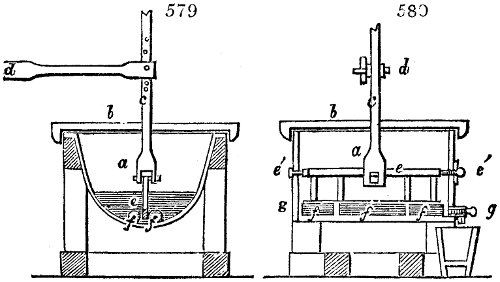
The indigo mill is represented in figs. 579. and 580. a is a four-sided iron cistern, cylindrical or rounded in the bottom, which rests upon gudgeons in a wooden frame; it has an iron lid b, consisting of two leaves, between which the rod c moves to and fro, receiving a vibratory motion from the crank d. By this construction, a frame e, which is made fast in the cistern by two points e′ e′, is caused to vibrate, and to impart its swing movement to six iron rollers f f f, three being on each side of the frame, which triturate the indigo mixed with water into a fine paste. Whenever the paste is uniformly ground, it is drawn off by the stopcock g, which had been previously filled up by a screwed plug, to prevent any of the indigo from lodging in the orifice of the cock, and thereby escaping the action of the rollers. The cistern is nearly three feet long.
The vat being filled with clear river water, the fire is to be kindled, the ingredients introduced, and if fermented woad be employed, less lime is needed than with the merely dried plant. Meanwhile the water is to be heated to the temperature of 160° Fahr., and maintained at this pitch till the deoxidizement and solution of the indigo begin to shew themselves, which, according to the state of the constituents, may happen in 12 hours, or not till after several days. The first characters of incipient solution are blue bubbles, called the flowers, which rise upon the surface, and remain like a head of soap-suds for a considerable time before they fall; then blue coppery shining veins appear with a like coloured froth. The hue of the liquor now passes from blue to green, and an ammoniacal odour begins to be exhaled. Whenever the indigo is completely dissolved, an acetic smelling acid may be recognized in the vat, which neutralizes all the alkali, and may occasion even an acid excess, which should be saturated with quicklime. The time for doing this cannot be in general very exactly defined. When quicklime has been added at the beginning in sufficient quantity, the liquor appears of a pale wine-yellow colour, but if not, it acquires this tint on the subsequent introduction of the lime. Experience has not hitherto decided in favour of the one practice or the other.
As soon as this yellow colour is formed in the liquor, and its surface becomes blue, the vat is ready for the dyer, and the more lime it takes up without being alkaline, the better is its condition. The dyeing power of the vat may be kept up during six months, or more, according to the fermentable property of the woad. From time to time, madder and bran must be added to it, to revive the fermentation of the sediment, along with some indigo and potash, to replace what may have been abstracted in the progress of dyeing. The quantity of indigo must be proportional, of course, to the depth or lightness of the tints required.
During the operation of this blue vat two accidents are apt to occur; the first, which is the more common one, is called the throwing back, in French the cuve rebuté, and in German, the Scharf or Schwartzwerden (the becoming sharp or black); the second is the putrefaction of the ingredients. Each is discoverable by its peculiar smell, which it is impossible to describe. The first is occasioned by the employment of too much quicklime, whereby the liquor becomes neutral or even alkaline. This fault may be recognized by the fading of the green, or by the dark green, or nearly black appearance of the liquor; and by a dull blue froth, owing to a film of lime. The remedy for a slight degree of this vicious condition, is to suspend in the liquor a quantity of bran tied up in a bag, and to leave it there till the healthy state be restored. Should the evil be more inveterate, a decoction of woad, madder, and bran must be introduced. Strong acids are rather detrimental. Sulphate of iron has been recommended, because its acid precipitates the lime, while its oxide reduces the indigo to the soluble state.
The decomposition or putrefaction of the blue vat is an accident the reverse of the preceding, arising from the transition of the acetous into the putrid fermentation, whereby the dyeing faculty is destroyed. Such a misfortune can happen only towards the commencement of working the vat, whilst the woad is still powerful, and very little indigo has been dissolved. Whenever the vat is well charged with indigo, that accident cannot easily supervene. In both of these distemperatures the elevation of the temperature of the vat aggravates the evil.
Dyeing in the blue vat is performed as follows:—
Wool is put into a net, and pressed down into the liquor with rods; but cloth is smoothly stretched and suspended by hooks upon frames, which are steadily dipped into the vat, with slight motions through the liquor; yarn-hanks must be dipped and turned about by hand. All unnecessary stirring of the liquor must however be avoided, lest the oxygen of the atmosphere be brought too extensively into contact with the reduced indigo, for which reason mechanical agitation with rollers in the vat is inadmissible. The stuffs to be dyed, take at the first dip only a feeble colour, though the vat be strong, but they must be deepened to the desired shade by successive immersions of fifteen minutes or more each time, with intervals of exposure to the air, for absorption of its oxygen.
After the lapse of a certain time, if the fermentative power be impaired, which is recognized by the dye stuffs losing more colour in a weak alkaline test lye than they ought, the vat should be used up as far as it will go, and then the liquor should be poured away, for the indigo present is not in a reduced state, but merely mixed mechanically, and therefore incapable of forming a chemical combination with textile fibres. If cotton goods previously treated with an alkaline lye are to be dyed blue, the vat should contain very little lime.
Theory of the Indigo vat.—The large quantity of extractive matter in woad and madder; as also the sugar, starch and gluten in the bran and woad, when dissolved in warm water, soon occasion a fermentation, with an absorption of oxygen, from the air, but especially from the indigo of the woad, and from that introduced in a finely ground state. When thus disoxygenated, it becomes soluble in alkaline menstrua; the red-brown of the indigo being dissolved at the same time. When lime is added, the indigo-blue dissolves, and still more readily if a little potash is conjoined with it; but whatever indigo-brown may have been dissolved by the potash, is thrown down by the lime. Lime in too large a quantity, however, forms an insoluble combination with the reduced indigo, and thus makes a portion of the dye ineffective; at the same time it combines with the extractive. In consequence of the fermentative action, carbonic acid, acetic acid, and ammonia are disengaged; the first two of which neutralize a portion of the lime, and require small quantities of this earth to be added in succession; hence also a considerable quantity of the carbonate of lime is found as a deposit on the sides and bottom of the vat. In the sound condition of the indigo vat, no free lime should be perceived, but on the contrary a free acid. Yet when the disengaged carbonic and acetic acids saturate the lime completely, no indigo can remain at solution; therefore a sufficient supply of lime must always be left to dissolve the dye, otherwise the indigo would fall down and mix with the extractive matter at the bottom. Goods dyed in the blue vat are occasionally brightened by a boil in a logwood bath, with a mordant of sulpho-muriate of tin, or in a bath of cudbear.
Another mode of mounting the indigo vat without woad and lime, is by means of madder, bran, and potash. The water of the vat is to be heated to the temperature of 122° F.; and for 120 cubic feet of it, 12 pounds of indigo, 8 pounds of madder, and as much bran are to be added, with 24 pounds of good potashes; at the end of 36 hours, 12 pounds more of potash are introduced, and a third 12 pounds in other 12 hours. In the course of 72 hours, all the characters of the reduction and solution of the indigo become apparent; at which time the fermentation must be checked by the addition of quick-lime. The liquor has a bright full colour, with a beautiful rich froth. In feeding the vat with indigo, an equal weight of madder, and a double weight of potash should be added. The odour of this vat in its mild but active state is necessarily different from that of the woad vat, as no ammonia is exhaled in the present case, and the sediment is much smaller. The reduced indigo is held in solution by the carbonated potash, while the small addition of quicklime merely serves to precipitate the indigo-brown.
A potash vat dyes in about half the time of the ordinary warm vat, and penetrates fine cloth much better; while the goods thus dyed lose less colour in alkaline and soap solutions. This vat may moreover be kept with ease in good condition for several months; is more readily mounted; and from the minute proportion of lime present, it cannot impair the softness of the woollen fibres. It is merely a little more expensive. It is said that cloth dyed in the potash indigo vat, requires one third less soap in the washing at the fulling mill, and does not soil the hands after being dressed. At Elbœuf and Louviers in France, such vats are much employed. Wool, silk, cotton, and linen may all be dyed in them.
Cold vats.—The copperas or common blue vat of this country is so named because the indigo is reduced by means of the protoxide of iron. This salt should therefore be as free as possible from the red oxide, and especially from any sulphate of copper, which would re-oxidize the indigo. The necessary ingredients are: copperas (green sulphate of iron), newly slaked quicklime, finely ground indigo, and water; to which sometimes a little potash or soda is added, with a proportional diminution of the lime. The operation is conducted in the following way: the indigo well triturated with water or an alkaline lye, must be mixed with hot water in the preparation vat, then the requisite quantity of lime is added, after which the solution of copperas must be poured in with stirring. Of this preparation vat, such a portion as may be wanted is laded into the dyeing vat. For one pound of indigo three pounds of copperas are taken, and four pounds of lime (or 1 of indigo, 21⁄2 of copperas, and 3 of lime). If the copperas be partially peroxidized, somewhat more of it must be used.
A vat containing a considerable excess of lime is called a sharp vat, and is not well adapted for dyeing. A soft vat, on the contrary, is that which contains too much copperas. In this case the precipitate is apt to rise, and to prevent uniformity of tint in the dyed goods. The sediment of the copperas vat consists of sulphate of lime, oxide of iron, lime with indigo brown, and lime with indigo blue, when too much quicklime has been employed. The clear, dark wine yellow fluid contains indigo blue in a reduced state, and indigo red, both combined with lime and with the gluten of indigo dissolved. After using it for some time the vat should be refreshed or fed with copperas and lime, upon which occasion, the sediment must first be stirred up, and then allowed time to settle again, and become clear. For obtaining a series of blue tints, a series of vats of different strengths is required.
Linen and cotton yarn, before being dyed should be boiled with a weak alkaline lye, then put upon frames or tied up in hanks, and after removing the froth from the vat, plunged into, and moved gently through it. For pale blues, an old, nearly exhausted vat, is used; but for deep ones, a fresh nearly saturated vat. Cloth is stretched upon a proper square dipping frame made of wood, or preferably of iron, furnished with sharp hooks or points of attachment. These frames are suspended by cords over a pulley, and thus immersed and lifted out alternately at proper intervals. In the course of 8 or 10 minutes, the cloth is sufficiently saturated with the solution of indigo, after which it is raised and suspended so as to drain into the vat. The number of dippings determines the depth of the shade; after the last the goods are allowed to dry, taken off the frame, plunged into a sour bath of very dilute sulphuric or muriatic acid, to remove the adhering lime, and then well rinsed in running water. Instead of the dipping frames some dyers use a peculiar roller apparatus, called gallopers, similar to what has been described under Calico Printing; particularly for pale blues. This cold vat is applicable to cotton, linen and silk goods.
When white spots are to appear upon a blue ground, resist pastes are to be used, as described under Calico Printing.
The urine vat is prepared by digestion of the ground indigo in warmed stale urine, which first disoxygenates the indigo, and then dissolves it by means of its ammonia. Madder and alum are likewise added, the latter being of use to moderate the fermentation. This vat was employed more commonly of old than at present, for the purpose of dyeing woollen and linen goods.
The mode of making the china blue dye has been described under Calico Printing; as well as the pencil blue, or blue of application.
A blue dye may likewise be given by a solution of indigo in sulphuric acid. This process was discovered by Barth, at Grossenhayn in Saxony, about the year 1740, and is hence called the Saxon blue dye. The chemical nature of this process has been already fully explained. If the smoking sulphuric acid be employed, from 4 to 5 parts are sufficient for 1 of indigo; but if oil of vitriol, from 7 to 8 parts. The acid is to be poured into an earthen-ware pan, which in summer must be placed in a tub of cold water, to prevent it getting hot, and the indigo in fine powder, is to be added with careful stirring, in small successive portions. If it become heated, a part of the indigo is decomposed, with the disengagement of sulphurous acid gas, and indigo green is produced. Whenever all the indigo has been dissolved, the vessel must be covered up, allowed to stand for 48 hours, and then diluted with twice its weight of clear river water.
The undiluted mass has a black blue colour, is opaque, thick, attracts water from the air, and is called indigo composition or chemic blue. It must be prepared beforehand, and kept in store. In this solution, besides the cerulin, there are also indigo-red, indigo-brown, and gluten, by which admixture the pure blue of the dye is rendered foul, assuming a brown or a green cast. To remove these contaminations, wool is had recourse to. This is plunged into the indigo previously diffused through a considerable body of water, brought to a boiling heat in a copper kettle, and then allowed to macerate as it cools for 24 hours. The wool takes a dark blue dye by absorbing the indigo-blue sulphate and hyposulphite, while at the same time the liquor becomes greenish blue; and if the wool be left longer immersed, it becomes of a dirty yellow. It must therefore be taken out, drained, washed in running water till this runs off colourless, and without an acid taste. It must next be put into a copper full of water, containing one or two per cent. of carbonate of potash, soda, or ammonia (to about one third the weight of the indigo), and subjected to a boiling heat for a quarter of an hour. The blue salts forsake the wool, leaving it of a dirty red brown, and dye the water blue. The wool is in fact dyed with the indigo red, which is hardly soluble in alkali. The blue liquor may now be employed as a fine dye, possessed of superior tone and lustre. It is called distilled blue and soluble blue. Sulphuric acid throws down from it the small quantity of indigo red, which had been held in solution by the alkali.
When wool is to be dyed with this sulphate of indigo blue, it must be first boiled in alum, then treated with the blue liquor, and thus several times alternately, in order to produce an uniform blue colour. Too long continuance of boiling is injurious to the beauty of the dye. In this operation the woollen fibres get impregnated with the indigo-blue sulphate of alumina.
With sulphate of indigo, not only blues of every shade are dyed, but also green, olive, gray, as also a fast ground to logwood blues; for the latter purpose the preparatory boil is given with alum, tartar, sulphates of copper and iron, and the blue solution; after which the goods are dyed up with a logwood bath containing a little potash.
Statistical Tables of Indigo; per favour of James Wilkinson, Esq., of Leadenhall-Street.
East India Indigo.