C. (continued 4)
Reading edition
The first thing to be done after having, as above, prepared the long sheets or fillets of leather, of suitable length, breadth, and thickness, for making the cards, is to stretch the leather, and hold it firmly; which is accomplished by winding the fillet of leather upon the roller or drum, like the warp roller of a loom, and then conducting it upwards between guide rollers, to a receiving or work roller at top of the machine, where the fillet is held fast by a cramp, by which means the leather is kept stretched.
Secondly, the holes are pierced in the leather to receive the wire staples or teeth of the card, by means of a sliding fork, the points of which are presented to the face of the leather; while the fork is made to advance and recede continually, by the agency of levers worked by rotatory cams upon a revolving main shaft.
The points of the fork being thus made to penetrate into the leather, the holes for receiving the staples are pierced, at regular distances, and in correct order, by shifting the leather fillet so as to bring different parts of its surface opposite to the points of the sliding fork. This is done by cams, or indented wheels and gear, which shift the guide rollers and confining drums laterally, as they revolve, and consequently move the fillet of leather at intervals a short distance, so as to present to the points of the fork or piercer at every movement, a different part of the surface of the leather.
Thirdly, the wire of which the teeth or points of the card are to be made, is supplied from a coil on the side of the machine, and is brought forward at intervals, by a pair of sliding pincers, which are slidden to and fro through the agency of levers actuated by rotatory cams upon the main shaft. The pincers having advanced a distance equal to the length of wire intended to form one staple, or two points, this length of wire is pressed upon exactly in the middle by a square piece of steel, and being there confined, a cutter is brought forward, which cuts it off from that part of the wire held in the pincers.
The length of wire thus separated and confined, is now, by a movement of the machine, bent up along the sides of the square steel holder, and shaped to three edges of the square, that is, formed as a staple; and in the same way, by the continued movements of the machine, a succession of pieces of wire are cut off, and bent into staples for making the teeth of the card as long as the mechanism is kept in action.
Fourthly, the wire staple thus formed is held with its points or ends outwards, closely contiguous to the forked piercer described above, and by another movement of the mechanism, the staple is protruded forward, its end entering into the two holes made previously in the leather by the sliding of the fork.
While the wire staple is being thus introduced into the leather, its legs or points are to be bent, that is, formed with a knee or angle, which is the fifth object to be effected. This is done by means of a small apparatus consisting of a bar or bed, which bears up against the under side of the wire staple when it has been passed half-way into the holes in the leather, and another bar above it, which being brought down behind the staple, bends it over the resisting bar to the angle required; that is, forms the knee in each leg. A pusher now acts behind the staple, and drives it home into the leather, which completes the operation.
The leather being thus conducted, and its position shifted before the piercer progressively, a succession of the above described operations of cutting the wire, forming the staple, passing it into the leather, and bending its legs to the angular form, produces a sheet of card of the kind usually employed for carding or combing wool, cotton, and other fibrous materials. It may be necessary to add, that as these wire staples are required to be set in the leathers sometimes in lines crossing the sheet, which is called ribbed, and at other times in oblique lines, called twilled, these variations are produced by the positions of the notches or steps upon the edge or periphery of the cam or indented wheel, which shifts the guide rollers that hold the fillet or sheet of leather as already described.
CARMINE, (Eng. and Fr.; Karminstoff, Ger.), is, according to Pelletier and Caventou, a triple compound of the colouring substance, and an animal matter contained in cochineal, combined with an acid added to effect the precipitation. The preparation of this article is still a mystery, because upon the one hand, its consumption being very limited, few persons are engaged in its manufacture, and upon the other, the raw material being costly, extensive experiments on it cannot be conveniently made. Success in this business is said to depend not a little upon dexterity of manipulation, and upon knowing the instant for arresting the further action of heat upon the materials.
There is sold at the shops different kinds of carmine, distinguished by numbers, and possessed of a corresponding value. This difference depends upon two causes, either upon the proportion of alumina added in the precipitation, or of a certain quantity of vermillion put in to dilute the colour. In the first case the shade is paler, in the second, it has not the same lustre. It is always easy to discover the proportion of the adulteration. By availing ourselves of the property of pure carmine to dissolve in water of ammonia, the whole foreign matter remains untouched, and we may estimate its amount by drying the residuum.
To make Ordinary Carmine.
Take 1 pound of cochineal in powder; Take 3 drachms and a half of carbonate of potash; Take 8 drachms of alum in powder; Take 3 drachms and a half of fish-glue.
The cochineal must be boiled along with the potash in a copper containing five pailfuls of water (60 pints); the ebullition being allayed with cold water. After boiling a few minutes the copper must be taken from the fire, and placed on a table at such an angle as that the liquor may be conveniently transvased. The pounded alum is then thrown in, and the decoction is stirred; it changes colour immediately, and inclines to a more brilliant tint. At the end of fifteen minutes the cochineal is deposited at the bottom, and the bath becomes as clear as if it had been filtered. It contains the colouring matter, and probably a little alum in suspension. We decant it then into a copper of equal capacity, and place it over the fire, adding the fish-glue dissolved in a great deal of water, and passed through a searce. At the moment of ebullition, the carmine is perceived to rise up to the surface of the bath, and a coagulum is formed, like what takes place in clarifications with white of egg. The copper must be immediately taken from the fire, and its contents be stirred with a spatula. In the course of fifteen or twenty minutes the carmine is deposited. The supernatant liquor is decanted, and the deposit must be drained upon a filter of fine canvas or linen. If the operation has been well conducted, the carmine when dry crushes readily under the fingers. What remains after the precipitation of the carmine is still much loaded with colour, and may be employed very advantageously for carminated lakes. See Lake.
By the old German process carmine is prepared by means of alum without any other addition. As soon as the water boils the powdered cochineal is thrown into it, stirred well, and then boiled for six minutes; a little ground alum is added, and the boiling is continued for three minutes more; the vessel is removed from the fire, the liquor is filtered and left for three days in porcelain vessels, in the course of which time a red matter falls down, which must be separated and dried in the shade. This is carmine, which is sometimes previously purified by washing. The liquor after three days more lets fall an inferior kind of carmine, but the residuary colouring matter may also be separated by the muriate of tin.
The proportions for the above process are 580 parts of clear river water, 16 parts of cochineal, and 1 part of alum; there is obtained from 11⁄2 to 2 parts of carmine.
Another carmine with tartar.—To the boiling water the cochineal is added, and after some time a little cream of tartar; in eight minutes more we add a little alum, and continue the boiling for a minute or two longer. Then take it from the fire and pour it into glass or porcelain vessels, filter and let it repose quietly till the carmine falls down. We then decant and dry in the shade. The proportions are 8 pounds of water, 8 oz. of cochineal, 1⁄2 oz. of cream of tartar, 3⁄4 oz. of alum, and the product is an ounce of carmine.
The process of Alxon or Langlois.—Boil two pails and a half of river water (30 pints), throw into it, a little afterwards, a pound of cochineal, add a filtered solution of six drachms of carbonate of soda and a pound of water, and let the mixture boil for half an hour; remove the copper from the fire, and let it cool, inclining it to one side. Add six drachms of pulverized alum, stir with a brush to quicken the solution of the salt, and let the whole rest 20 minutes. The liquor, which has a fine scarlet colour, is to be carefully decanted into another vessel, and there is to be put into it the whites of two eggs well beat up with half a pound of water. Stir again with a brush. The copper is replaced on the fire, the alumina becomes concrete, and carries down the colouring matter with it. The copper is to be taken from the fire, and left at rest for 25 or 30 minutes to allow the carmine to fall down. When the supernatant liquor is drawn off, the deposit is placed upon filter cloth stretched upon a frame to drain. When the carmine has the consistence of cream cheese, it is taken from the filter with a silver or ivory knife and set to dry upon plates covered with paper, to screen it from dust. A pound of cochineal gives in this way an ounce and a half of carmine.
Process of Madame Cenette of Amsterdam, with salt of sorrel.—Into six pails of river water boiling hot throw two pounds of the finest cochineal in powder, continue the ebullition for two hours and then add 3 oz. of refined saltpetre, and after a few minutes 4 oz. of salt of sorrel. In ten minutes more take the copper from the fire and let it settle for four hours; then draw off the liquor with a syphon into flat plates and leave it there for three weeks. Afterwards there is formed upon the surface a pretty thick mouldiness, which is to be removed dexterously in one pellicle by a slip of whalebone. Should the film tear and fragments of it fall down, they must be removed with the utmost care. Decant the supernatant water with a syphon, the end of which may touch the bottom of the vessel, because the layer of carmine is very firm. Whatever water remains must be sucked away by a pipette. The carmine is dried in the shade, and has an extraordinary lustre.
Carmine by the salt of tin, or the Carmine of China.—Boil the cochineal in river water, adding some Roman alum, then pass through a fine cloth to remove the cochineal, and set the liquor aside. It becomes brighter on keeping. After having heated this liquor, pour into it drop by drop solution of tin till the carmine be precipitated. The proportions are one pailful of water, 20 oz. of cochineal and 60 grains of alum, with a solution of tin containing 4 oz. of the metal.
To revive or brighten carmine.—We may brighten ordinary carmine, and obtain a very fine and clear pigment, by dissolving it in water of ammonia. For this purpose we leave ammonia upon carmine in the heat of the sun, till all its colour be extracted, and the liquor has got a fine red tinge. It must be then drawn off and precipitated, by acetic acid and alcohol, next washed with alcohol, and dried. Carmine dissolved in ammonia has been long employed by painters, under the name of liquid carmine.
Carmine is the finest red colour which the painter possesses. It is principally employed in miniature painting, water colours, and to tint artificial flowers, because it is more transparent than the other colours. For Carminium, see Cochineal.
CARPET. (Tapis, Fr.; Teppich, Germ.) A thick woollen fabric of variegated colours, for covering the floors of the better sort of apartments. This luxurious manufacture took its origin in Persia and Turkey, whence the most beautiful patterns were wont to come into Europe; but they have been for some time surpassed by the workmanship of France, Great Britain, and Belgium. To form a just conception of the elegant and ingenious processes by which carpets are made, we should visit the royal establishment of the Gobelins at Paris, where we would see the celebrated carpet manufactory of the Savonnerie, which has been transported thither. A detailed set of engravings of this art is given by Roland de la Platière in the first and second volumes of the Encyclopédie Méthodique, to which I must refer my readers, as a due exposition of its machines and operations would far exceed the scope of the present volume.
The warp, says M. Roland, being the foundation of the fabric, ought to be of fine wool, equally but firmly spun, and consist of three yarns twisted into one thread. The yarns that are to form the velvety surface of the carpet, ought also to be of the best quality, but soft and downy in their texture, so that the dye may penetrate every filament. Hemp, or linen yarns, are likewise employed in this manufacture, as a woof, to bind the warp firmly together after each shoot of the velvety threads. Thus we see that good carpeting consists essentially of two distinct webs woven at the same time, and firmly decussated together by the woof threads. Hence the form of the pattern is the same upon the two sides of the cloth, only the colours are reversed, so that what was green upon one side becomes red or black upon the other, and vice versâ. The smaller the figures the more frequent the decussations of the two planes, and the firmer and more durable the fabric.
The carpet manufacture, as now generally practised, may be distributed into two systems—that of double fabrics, and that cut in imitation of velvet. Of late years the Jacquard loom has been much used in weaving carpets, the nature of which will be found fully explained under that title.
For the sake of illustration, if we suppose the double carpets to be composed of only two colours, the principle of weaving will be easily understood; for it is only necessary to raise the warp of each web alternately for the passage of the shuttle, the upper web being entirely above when the under web is being woven, or decussated, and vice versâ. In a Brussels carpet the worsted yarn raised to form the pile, and make the figure, is not cut; in the Wilton the pile is cut to give it a velvety aspect and softness. In the imperial Brussels carpet the figure is raised above the ground, and its pile is cut, but the ground is uncut; and in the royal Wilton, the pile is both raised higher than in the common Wilton, and it is cut, whereby it has a rich cushion-like appearance. The cloth of all these superior carpets consists of woollen and linen, or hemp; the latter being put upon a beam, and brought, of course, through heddles and a reed; but as its only purpose is to bind together the worsted fabric, it should not be visible upon the upper face of the carpet. The worsted yarn is wound upon small bobbins or pirns, with a weight affixed to each, for giving proper tension to the threads. Their number varies, for one web, from 1300 to 1800, according as the carpet is to be 27 or 36 inches wide; and, they are placed, in frames, behind the loom, filled with differently coloured yarn, to correspond with the figure. This worsted warp is then drawn through the harness, heddles, and reed, to be associated with the linen yarn in the compound fabric.
In Kidderminster carpeting, both warp and weft appear upon the face of the cloth, whereas, in the Brussels style, only the warp is seen, its binding weft being fine hempen or linen threads. The three-ply imperial carpet, called the Scotch, is coming very much into vogue, and is reckoned by many to be little inferior in texture, look, and wear to the Brussels. Kilmarnock has acquired merited distinction by this ingenious industry. In this fabric, as well as in the two-ply Kidderminster, the weft predominates, and displays the design; but, in the French carpets, the worsted warp of the web shows the figure. Plain Venetian carpets, as used for stairs and passages, are woven in simple looms, provided merely with the common heddles and reed. The warp should be a substance of worsted yarn, so heavy as to cover in the weft completely from the view. Figured Venetian carpets are woven in the two-ply Kidderminster looms, and are provided with a mechanism to raise the pattern upon the worsted warp. The weft is an alternate shoot of worsted and linen yarn, and must be concealed.
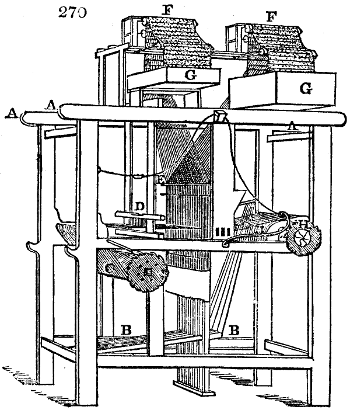
The following figure and description will explain the construction of the three-ply imperial Scotch and two-ply Kidderminster carpet loom, which is merely a modification of the Jacquard métier. The Brussels carpet-loom, on the contrary, is a draw-boy loom on the damask plan, and requires the weaver to have an assistant. Fig. 270. A A A, is the frame of the loom, consisting of four upright posts, with caps and cross rails to bind them together. The posts are about six feet high. C C, the cloth-beam, is a wooden cylinder, six inches or thereby in diameter, of sufficient length to traverse the loom, with iron gudgeons in the two ends, which work in bushes in the side frame. On one end of this beam is a ratchet wheel, with a tooth to keep it from turning round backwards by the tension of the web. D, the lay, with its reed, its under and upper shell, its two lateral rulers or swords, and rocking-tree above. There are grooves in the upper and under shell, into which the reed is fitted. E, the heddles, or harness, with a double neck attached to each of the tower or card mechanisms F F, of the Jacquard loom. The heddles are connected and work with the treddles B B, by means of cords, as shown in the figure. G G are wooden boxes for the cards. H, the yarn, or warp beam.
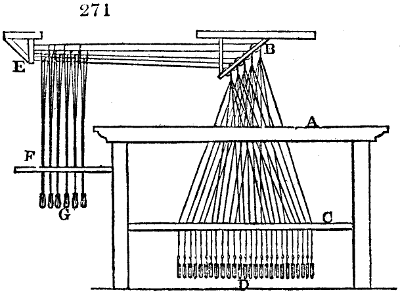
In draw-looms of every kind, there is no sinking of any portion of the warp, as in plain cloth-weaving; but the plane of the warp is placed low, and the threads under which the shuttle is to pass are raised, while all the rest remains stationary. The harness part of this carpet loom is moved by an assistant boy or girl, who thus allows the weft to be properly decussated, while the weaver attends to working the front mounting or heddles. Fig. 271., A represents the frame of a carpet draw-loom; B is a box or frame of pulleys, over which the cords of the harness pass, and are then made fast to a piece of wood, seen at E, which the weavers call a table. From the tail of the harness the simples descend, and to the end of each is attached a small handle G, called a bob. These handles being disposed in pairs, and their regularity preserved by means of a perforated board C, it is merely necessary to pull every handle in succession; the weaver, at the same time, working his treddles with his feet, as in any other loom. The treddles are four in number, the fabric being that of plain or alternate cloth, and two treddles allotted for each web. The harness part of the carpet draw-loom is furnished with mails, or metallic eyes, to save friction; two threads being drawn through each eye. The design or pattern of a carpet is drawn upon cross-rule paper, exactly in the same way as every other kind of fancy-loom work, and is transferred from the paper to the mounting by the rules for damask weaving. Suppose that a double web is so mounted that every alternate thread of the one may be raised, so as to form a sufficient shed-way for the shuttle, without depressing the other in the least. Then suppose another web placed above the former, at such a distance that it will exactly touch the convexity of those threads of the former, which are raised. Then, if the threads of the latter web are sunk while the others are raised, the two would be entirely incorporated. But if this be only partially done, that is, at particular places, only those parts immediately operated upon will be affected by the action of the apparatus. If the carpet is a two-coloured pattern, as black and red, and if upon the upper surface, as extended in the loom, red flowers are to be represented upon a black ground, then all those species of design paper which are coloured may be supposed to represent the red, and those which are vacant the black. Then counting the spaces upon the paper, omit those which are vacant, and cord those which are coloured, and the effect will be produced. But as the two webs are to be raised alternately, whatever is corded for the first handle must be passed by for the second, and vice versâ; so that the one will form the flower, and the other the ground.
The board by which the simples are regulated appears at F. D shows the weights.
CARTHAMUS, or safflower (carthamus tinctorius), (Carthame, Fr.; Färber distel, Germ.), the flower of which alone is used in dyeing, is an annual plant cultivated in Spain, Egypt, and the Levant. There are two varieties of it—one which has large leaves, and the other smaller ones. It is the last which is cultivated in Egypt, where it forms a considerable article of commerce.
Carthamus contains two colouring matters, one yellow and the other red. The first alone is soluble in water; its solution is always turbid: with re-agents it exhibits the characters usually remarked in yellow colouring matters. The acids render it lighter, the alkalies deepen it, giving it more of an orange hue: both produce a small dun precipitate, in consequence of which it becomes clearer. Alum forms a precipitate of a deep yellow, in small quantity. The solution of tin and the other metallic solutions cause precipitates which have nothing remarkable in them.
The yellow matter of carthamus is not employed; but in order to extract this portion, the carthamus is put into a bag, which is trodden under water, till no more colour can be pressed out. The flowers, which were yellow, become reddish, and lose in this operation nearly one half of their weight. In this state they are used.
For extracting the red part of carthamus, and thereafter applying it to stuff, the property which alkalies possess of dissolving it is had recourse to, and it is afterwards precipitated by an acid.
The process of dyeing consists, therefore, in extracting the colouring matter by means of an alkali, and precipitating it on the stuff by means of an acid. It is this fecula which serves for making the rouge employed by ladies.
As to this rouge, the solution of carthamus is prepared with crystallised carbonate of soda, and it is precipitated by lemon juice. It has been remarked that lemons, beginning to spoil, were fitter for this operation than those which were less ripe, whose juice retained much mucilage. After squeezing out the lemon juice, it is left to settle for some days. The precipitate of carthamus is dried at a gentle heat upon plates of stone-ware; from which it is detached and very carefully ground with talc, which has been reduced to a very subtile powder, by means of the leaves of shave-grass (presle), and successively passed through sieves of increasing fineness. It is the fineness of the talc, and the greater or less proportion which it bears to the carthamus precipitate, which constitute the difference between the high and low priced rouges.
Carthamus is used for dyeing silk, poppy, nacarat (a bright orange-red), cherry, rose colour, and flesh colour. The process differs according to the intensity of the colour, and the greater or less tendency to flame colour that is wanted. But the carthamus bath, whose application may be varied, is prepared as follows:
The carthamus, from which the yellow matter has been extracted, and whose lumps have been broken down, is put into a trough. It is repeatedly sprinkled with cendres gravelées (crude pearl ashes), or soda (barilla) well powdered and sifted at the rate of 6 pounds for 120 lbs. of carthamus; but soda is preferred, mixing carefully as the alkali is introduced. This operation is called amestrer. The amestred carthamus is put into a small trough with a grated bottom, first lining this trough with a closely woven cloth. When it is about half filled, it is placed over the large trough, and cold water is poured into the upper one, till the lower becomes full. The carthamus is then set over another trough, till the water comes from it almost colourless. A little more alkali is now mixed with it, and fresh water is passed through it. These operations are repeated till the carthamus be exhausted, when it turns yellow.
After distributing the silk in hanks upon the rods, lemon juice, brought in casks from Provence, is poured into the bath till it becomes of a fine cherry colour; this is called turning the bath (virer le bain). It is well stirred, and the silk is immersed and turned round the skein-sticks in the bath, as long as it is perceived to take up the colour. For ponceau (poppy colour), it is withdrawn, the liquor is run out of it upon the peg, and it is turned through a new bath, where it is treated as in the first. After this it is dried and passed through fresh baths, continuing to wash and dry it between each operation, till it has acquired the depth of colour that is desired. When it has reached the proper point, a brightening is given it by turning it round the sticks seven or eight times in a bath of hot water, to which about half a pint of lemon juice for each pailful of water has been added.
When silk is to be dyed ponceau or flame colour, it must be previously boiled as for white; it must then receive a slight foundation of annotto, as explained in treating of this substance. The silk should not be alumed.
The nacarats, and the deep cherry colours, are given precisely like the ponceaux, only they receive no annotto ground; and baths may be employed which have served for the ponceau, so as to complete their exhaustion. Fresh baths are not made for the latter colours, unless there be no occasion for the poppy.
With regard to the lighter cherry-reds, rose colour of all shades and flesh colours, they are made with the second and last runnings of the carthamus, which are weaker. The deepest shades are passed through first.
The lightest of all these shades, which is an extremely delicate flesh colour, requires a little soap to be put into the bath. This soap lightens the colour, and prevents it from taking too speedily, and becoming unevenly. The silk is then washed, and a little brightening is given it, in a bath which has served for the deeper colours.
All these baths are employed the moment they are made, or as speedily as possible, because they lose much of their colour upon keeping, by which they are even entirely destroyed at the end of a certain time. They are, moreover, used cold, to prevent the colour from being injured. It must have been remarked in the experiments just described, that the caustic alkalies attack the extremely delicate colour of carthamus, making it pass to yellow. This is the reason why crystals of soda are preferred to the other alkaline matters.
In order to diminish the expense of the carthamus, it is the practice in preparing the deeper shades to mingle with the first and the second bath about one fifth of the bath of archil.
Dobereiner regards the red colouring matter of carthamus as an acid, and the yellow as a base. His carthamic acid forms, with the alkalies, colourless salts, decomposed by the tartaric and acetic acids, which precipitate the acid of a bright rose-red. Heat has a remarkable influence upon carthamus, rendering its red colour yellow and dull. Hence, the colder the water is by which it is extracted, the finer is the colour. Light destroys the colour very rapidly, and hitherto no means have been found of counteracting this effect. For this reason this brilliant colour must be dried in the shade, its dye must be given in a shady place, and the silk stuffs dyed with it must be preserved as much as possible from the light. Age is nearly as injurious as light, especially upon the dye in a damp state. The colour is very dear, because a thousand parts of carthamus contain only five of it.
In preparing the finest rouge, the yellow colouring matter being separated by washing with water, the red is then dissolved by the aid of alkali, and is thrown down on linen or cotton rags by saturating the solution with vegetable acid. The colour is rinsed out of these rags, dissolved anew in alkalis, and once more precipitated by lemon juice. The best and freshest carthamus must be selected. It is put into linen bags, which are placed in a stream of water, and kneaded till the water runs off colourless. The bags are then put into water soured with a little vinegar, kneaded till the colour is all expelled, and finally rinsed in running water. By this treatment the carthamus loses nearly half its weight. 6633 cwts. of safflower were imported into the United Kingdom in 1835, of which 2930 cwts. were retained for internal consumption.
CASE-HARDENING, is the name of the process by which iron tools, keys, &c., have their surfaces converted into steel.
Steel when very hard is brittle, and iron alone is for many purposes, as for fine keys, far too soft. It is therefore an important desideratum to combine the hardness of a steely surface with the toughness of an iron body. These requisites are united by the process of case-hardening, which does not differ from the making of steel, except in the shorter duration of the process. Tools, utensils, or ornaments, intended to be polished, are first manufactured in iron and nearly finished, after which they are put into an iron box, together with vegetable or animal charcoal in powder, and cemented for a certain time. This treatment converts the external part into a coating of steel, which is usually very thin, because the time allowed for the cementation is much shorter than when the whole substance is intended to be converted. Immersion of the heated pieces into water hardens the surface, which is afterwards polished by the usual methods. Moxon in his Mechanic Exercises, p. 56., gives the following receipt for case-hardening:—“Cow’s horn or hoof is to be baked or thoroughly dried and pulverised. To this add an equal quantity of bay salt; mix them with stale chamber-lye or white wine vinegar: cover the iron with this mixture, and bed it with the same in loam, or enclose it in an iron box: lay it on the hearth of the forge to dry and harden: then put it into the fire, and blow till the lump have a blood-red heat, and no higher, lest the mixture be burnt too much. Take the iron out, and immerse it in water to harden.” I consider the vinegar to be quite superfluous.
I shall now describe the recent application of prussiate (ferrocyanate) of potash to this purpose. The piece of iron, after being polished, is to be made brightly red-hot, and then rubbed or sprinkled over with the above salt in fine powder, upon the part intended to be hardened. The prussiate being decomposed, and apparently dissipated, the iron is to be quenched in cold water. If the process has been well managed, the surface of the metal will have become so hard as to resist the file. Others propose to smear over the surface of the iron with loam made into a thin paste with a strong solution of the prussiate, to dry it slowly, then expose the whole to a nearly white heat, and finally plunge the iron into cold water, when the heat has fallen to dull redness. See Steel.
CASHMERE or CACHEMERE, a peculiar textile fabric first imported from the kingdom of Cashmere, and now well imitated in France and Great Britain. The material of the Cashmere shawls is the downy wool found about the roots of the hair of the Thibet goat. The year 1819 is remarkable in the history of French husbandry for the acquisition of this breed of goats, imported from the East under the auspices of their government, by the indefatigable courage and zeal of M. Jaubert, who encountered every fatigue and danger to enrich his country with these valuable animals, aided by the patriotism of M. Ternaux, who first planned this importation, and furnished funds for executing it at his own expence and responsibility. He placed a portion of the flock brought by M. Jaubert, at his villa of Saint Ouen, near Paris, where the climate seemed to be very favourable to them, since for several successive years after their introduction M. Ternaux was enabled to sell a great number of both male and female goats. The quantity of fine fleece or down afforded by each animal annually, is from a pound and a half to two pounds.
The wool imported into Europe comes by the way of Casan, the capital of a government of the Russian empire upon the eastern bank of the Wolga; it has naturally a grayish colour, but is easily bleached. Its price a few years back at Paris was 17 francs per kilogramme; that is, about 6 shillings the pound avoirdupois. The waste in picking, carding, and spinning, amounts to about one third of its weight.
The mills for spinning Cachemere wool have multiplied very much of late years in France, as appears from the premiums distributed at the exposition of 1834, and the prices of the yarn have fallen from 25 to 30 per cent. notwithstanding their improved fineness and quality. There is a fabric made with a mixture of Cachemere down and spun silk, which is becoming very general. One of the manufacturers, M. Hindenlang, exhibited samples of Cachemere cloth woven with yarn so fine as No. 130 for warp, and No. 228 for weft.
Messrs. Pollino, brothers, of Paris, produced an assortment of Cachemere pieces from 22 to 100 francs the yard, dyed of every fancy shade. Their establishment at Ferté-Bernard occupies 700 operatives, with an hydraulic wheel of 60 horse power.
The oriental Cashmere shawls are woven by processes extremely slow and consequently costly; whence their prices are very high. They are still sold in Paris at from 4,000 to 10,000 francs a piece; and from 100 to 400 pounds sterling in London. It became necessary therefore either to rest satisfied with work which should have merely a surface appearance, or contrive economical methods of weaving, to produce the real Cachemere style with much less labour. By the aid of the draw-loom and still better of the Jacquard loom, M. Ternaux first succeeded in weaving Cachemere shawls perfectly similar to the oriental in external aspect, which became fashionable under the name of French Cachemere. But to construct shawls altogether identical on both sides with the eastern, was a more difficult task, which was accomplished only at a later period by M. Bauson of Paris.
In both modes of manufacture, the piece is mounted by reading-in the warp for the different leaves of the heddles, as is commonly practised for warps in the Jacquard looms. The weaving of imitation shawls is executed, as usual, by as many shuttles as there are colours in the design, and which are thrown across the warp in the order established by the reader. The greater number of these weft yarns being introduced only at intervals into the web, when the composition of the pattern requires it, they remain floating loose at the back of the piece, and are cut afterwards, without affecting in the least the quality of the texture; but there is a considerable waste of stuff in the weaving, which is worked up into carpets.
The weaving of the imitation of real Cachemere shawls is different from the above. The yarns intended to form the weft are not only equal in number to that of the colours of the pattern to be imitated, but besides this, as many little shuttles or pirns (like those used by embroiderers) are filled with these yarns, as there are to be colours repeated in the breadth of the piece; which renders their number considerable when the pattern is somewhat complicated and loaded with colours. Each of these small bobbins or shuttles passes through only that portion of the flower in which the colour of its yarn is to appear, and stops at the one side and the other of the cloth exactly at its limit; it then returns upon itself after having crossed the thread of the adjoining shuttle. From this reciprocal intertexture of all the yarns of the shuttles, it results, that although the weft is composed of a great many different threads, they no less constitute a continuous line in the whole breadth of the web, upon which the lay or batten acts in the ordinary way We see therefore that the whole art of manufacturing this Cachemere cloth consists in avoiding the confusion of the shuttles, and in not striking up the lay till all have fulfilled their function. The labour does not exceed the strength of a woman, even though she has to direct the loom and work the treddles. Seated on her bench at the end opposite to the middle of the beam, she has for aids in weaving shawls from 45 to 52 inches wide, two girl apprentices, whom she directs and instructs in their tasks. About four hundred days of work are required for a Cachemere shawl of that breadth. For the construction of the loom, see Jacquard.
In the oriental process all the figures in relief are made simply with a slender pirn without the shuttle used in European weaving. By the Indians the flower and its ground are made with the pirn, by means of an intertwisting, which renders them in some measure independent of the warp. In the Lyons imitation of this style, the leaves of the heddles lift the yarns of the warp, the needles embroider as in lappett weaving, and the flower is united to the warp by the weft thrown across the piece. Thus a great deal of labour is saved, the eye is pleased with an illusion of the loom, and the shawls cost little more than those made by the common fly shuttle.
Considered in reference to their materials, the French shawls present three distinct classes, which characterise the three fabrics of Paris, Lyons, and Nimes.
Paris manufactures the French Cachemere, properly so called, of which both the warp and the weft are the yarn of pure Cachemere down. This web represents with fidelity the figures and the shades of colour of the Indian shawl, which it copies; the deception would be complete if the reverse of the piece did not show the cut ends. The Hindoo shawl, also woven at Paris, has its warp in spun silk, which reduces its price without impairing its beauty much.
Lyons however has made the greatest progress in the manufacture of shawls. It excels particularly in the texture of its Thibet shawls, the weft of which is yarn spun with a mixture of wool and spun silk.
Nimes is remarkable for the low price of its shawls, in which spun silk, Thibet down, and cotton, are all worked up together.
The value of shawls exported from France in the following years was:—
1831. 1832. 1833.
Francs. Francs. Francs.
Woollen 1,863,147 2,070,926 4,319,601
Cachemere down 433,410 655,200 609,900
Spun silk 401,856 351,152 408,824
It appears that M. J. Girard at Sèvres, near Paris, has succeeded best in producing Cachemere shawls equal in stuff and style of work to the oriental, and at a lower price. They have this advantage over the Indian shawls, that they are woven without seams, in a single piece, and exhibit all the variety and the raised effect of the eastern colours. Women and children alone are employed in his factory.
CASK, (Tonneau, Fr.; Fass, Germ.) manufacture of by mechanical power. Mr. Samuel Brown obtained a patent in Nov., 1825, for certain improvements in machinery for making casks, which seems to be ingenious and worthy of record. His mechanism consists in the first place of a circular saw attached to a bench, with a sliding rest, upon which rest each piece of wood intended to form a stave of a cask is fixed; and the rest being then slidden forward in a curved direction, by the assistance of an adjustable guide, brings the piece of wood against the edge of the rotatory saw, and causes it to be cut into the curved shape required for the edge of the stave. The second feature is an apparatus with cutters attached to a standard, and traversing round with their carrier upon a centre, by means of which the upper and lower edges of the cask are cut round and grooved, called chining, for the purpose of receiving the heads. Thirdly, an apparatus not very dissimilar to the last, by which the straight pieces of wood designed for the heads of the cask are held together, and cut to the circular figure required, and also the bevelled edges produced. And fourthly, a machine in which the cask is made to revolve upon an axis, and a cutting tool to traverse for the purpose of shaving the external part of the cask, and bringing it to a smooth surface.
The pieces of wood intended to form the staves of the cask, having been cut to their required length and breadth, are placed upon the slide-rest of the first mentioned machine, and confined by cramps; and the guide, which is a flexible bar, having been previously bent to the intended curve of the stave and fixed in that form, the rest is then slidden forward upon the bench by the hand of the workman, which as it advances (moving in a curved direction) brings the piece of wood against the edge of the revolving circular saw, by which it is cut to the curved shape desired.
The guide is a long bar held by a series of movable blocks fitted to the bench by screws, and is bent to any desired curve by shifting the screws: the edge of the slide-rests which holds the piece of wood about to be cut, runs against the long guide bar, and of consequence is conducted in a corresponding curved course. The circular saw receives a rapid rotatory motion by means of a band or rigger from any first mover; and the piece of wood may be shifted laterally by means of racks and pinions on the side-rest, by the workman turning a handle, which is occasionally necessary in order to bring the piece of wood up to, or away from, the saw.
The necessary number of staves being provided, they are then set round within a confining hoop at bottom, and brought into the form of a cask in the usual way, and braced by temporary hoops. The barrel part of the cask being thus prepared, in order to effect the chining, it is placed in a frame upon a platform, which is raised up by a treddle lever, that the end of the barrel may meet the cutters in a sort of lathe above: the cutters are then made to traverse round within the head of the barrel, and, as they proceed, occasionally to expand, by which means the bevels and grooves are cut on the upper edge of the barrel, which is called chining. The barrel being now reversed, the same apparatus is brought to act against the other end, which becomes chined in like manner.
The pieces of wood intended to form the heads of the cask are now to be cut straight by a circular saw in a machine, similar to the first described; but in the present instance the slide-rest is to move forward in a straight course. After their straight edges are thus produced, they are to be placed side by side, and confined, when a scribing cutter is made to traverse round, and cut the pieces collectively into the circular form desired for heading the cask.
The cask having now been made up, and headed by hand as usual, it is placed between centres, or upon an axle in a machine, and turned round by a rigger or band with a shaving cutter, sliding along a bar above it, which cutter being made to advance, and recede as it slides along, shaves the outer part of the cask to a smooth surface.
CASSAVA. Cassava bread, conaque, &c., are different names given to the starch of the root of the Manioc (Jatropha Manihot, Linn.), prepared in the following manner in the West Indies, the tropical regions of America, and upon the African coast. The tree belongs to the natural family of the euphorbiaceæ.
The roots are washed, and reduced to a pulp by means of a rasp or grater. The pulp is put into coarse strong canvas bags, and thus submitted to the action of a powerful press, by which it parts with most of its noxious juice (used by the Indians for poisoning the barbs of their arrows). As the active principle of this juice is volatile, it is easily dissipated by baking the squeezed cakes of pulp upon a plate of hot iron. Fifty pounds of the fresh juice, when distilled, afford, at first, three ounces of a poisonous water, possessing an intolerably offensive smell; of which, 35 drops being administered to a slave convicted of the crime of poisoning, caused his death in the course of six minutes, amid horrible convulsions.[16]
The pulp dried in the manner above described concretes into lumps, which become hard and friable as they cool. They are then broken into pieces, and laid out in the sun to dry. In this state they afford a wholesome nutriment, and are habitually used as such by the negroes, as also by many white people. These cakes constitute the only provisions laid in by the natives, in their voyages upon the Amazons. Boiled in water with a little beef or mutton they form a kind of soup similar to that of rice.
The Cassava cakes sent to Europe (which I have eaten with pleasure) are composed almost entirely of starch, along with a few fibres of the ligneous matter. It may be purified by diffusion through warm water, passing the milky mixture through a linen cloth, evaporating the strained liquid over the fire, with constant agitation. The starch dissolved by the heat, thickens as the water evaporates, but on being stirred, it becomes granulated, and must be finally dried in a proper stove. Its specific gravity is 1·530—that of the other species of starch.
The product obtained by this treatment is known in commerce under the name of tapioca; and being starch very nearly pure, is often prescribed by physicians as an aliment of easy digestion. A tolerably good imitation of it is made by heating, stirring, and drying potato starch in a similar way.
The expressed juice of the root of manioc contains in suspension a very fine fecula, which it deposits slowly upon the bottom of the vessels. When freed by decantation from the supernatant liquor, washed several times and dried, it forms a beautiful starch, which creaks on pressure with the fingers. It is called cipipa, in French Guyana; it is employed for many delicate articles of cookery, especially pastry, as also for hair powder, starching linen, &c.
Cassava flour, as imported, may be distinguished from arrow-root and other kinds of starch, by the appearance of its particles viewed in a microscope. They are spherical, all about 1-1000th of an inch in diameter, and associated in groups; those of potato starch are irregular ellipsoids, varying in size from 1-300th to 1-3000th of an inch; those of arrow-root have the same shape nearly, but vary in size from 1-500th to 1-800th of an inch; those of wheat are separate spheres 1-1000th of an inch.
CASSIS, the black currant (ribes nigra, Linn.), which was formerly celebrated for its medicinal properties with very little reason.
The only technical use to which it is now applied is in preparing the agreeable liqueur called ratafia, by the following French recipe:—Stone, and crush three pounds of black currants, adding to the magma one drachm of cloves, two of cinnamon, four quarts of spirit of wine, at 18° Baumé (see Aréomètre of Baumé), and 21⁄2 pounds of sugar. Put the mixture into a bottle which is to be well corked; let it digest for a fortnight, shaking the bottle once daily during the first eight days; then strain through a linen cloth, and finally pass through filtering paper.
CASTING OF METALS. (See Founding.) Casts from elastic moulds.—Being much engaged in taking casts from anatomical preparations, Mr. Douglas Fox, Surgeon, Derby, found great difficulty, principally with hard bodies, which, when undercut, or having considerable overlaps, did not admit of the removal of moulds of the ordinary kind, except with injury. These difficulties suggested to him the use of elastic moulds, which, giving way as they were withdrawn from complicated parts, would return to their proper shape; and he ultimately succeeded in making such moulds of glue, which not only relieved him from all his difficulties, but were attended with great advantages, in consequence of the small number of pieces into which it was necessary to divide the mould.
The body to be moulded, previously oiled, must be secured one inch above the surface of a board, and then surrounded by a wall of clay, about an inch distant from its sides. The clay must also extend rather higher than the contained body: into this, warm melted glue, as thick as possible so that it will run, is to be poured, so as to completely cover the body to be moulded; the glue is to remain till cold, when it will have set into an elastic mass, just such as is required.
Having removed the clay, the glue is to be cut into as many pieces as may be necessary for its removal, either by a sharp-pointed knife, or by having placed threads in the requisite situations of the body to be moulded, which may be drawn away when the glue is set, so as to cut it out in any direction.
The portions of the glue mould having been removed from the original, are to be placed together and bound round by tape.
In some instances it is well to run small wooden pegs through the portions of glue, so as to keep them exactly in their proper positions. If the mould be of considerable size, it is better to let it be bound with moderate tightness upon a board to prevent it bending whilst in use; having done as above described, the plaster of Paris, as in common casting, is to be poured into the mould, and left to set.
In many instances wax may also be cast in glue, if it is not poured in whilst too hot; as the wax cools so rapidly when applied to the cold glue, that the sharpness of the impression is not injured.
Glue has been described as succeeding well where an elastic mould is alone applicable; but many modifications are admissible. When the moulds are not used soon after being made, treacle should be previously mixed with the glue (as employed by printers) to prevent it becoming hard.
The description thus given is with reference to moulding those bodies which cannot be so done by any other than an elastic mould; but glue moulds will be found greatly to facilitate casting in many departments, as a mould may be frequently taken by this method in two or three pieces, which would, on any other principle, require many.
CASTOR. (Eng. and Fr.; Biber, Germ.) The castor is an amphibious quadruped, inhabiting North America; also found in small numbers in the islands of the Rhone. In the arts, the skin of this animal is employed either as a fur or as affording the silky hair called beaver, with which the best hats are covered. Beaver skins, which form a very considerable article of trade, are divided into 3 sorts: 1. The fresh beaver skins from castors, killed in winter before shedding their hair; these are most in request among the furriers, as being the most beautiful. 2. The dry or lean beavers are the skins of the animals killed during the moulting season; they are not much esteemed, as the skin is rather bare. 3. The fat castors: these are the skins of the first sort, which have been worn for some time upon the persons of the savages and have got imbued with their sweat. The last are principally used in the hat manufacture. In France, the marine otter has been for many years substituted in the place of the castor or beaver.
CASTOR or CASTOREUM. This name is given to a secretion of the castors, contained in pear-shaped cellular organic sacs, placed near the genital organs of both the male and female animals. It is a substance analogous to civet and musk, of a consistence similar to thick honey. It has a bitter acrid taste; a powerful, penetrating, fetid, and very volatile smell; but, when dried, it becomes inodorous. Several chemists, and in particular Bouillon Lagrange, Laugier, and Hildebrandt have examined castor; and found it to be composed of a resin, a fatty substance, a volatile oil, an extractive matter, benzoic acid, and some salts.
The mode of preparing it is very simple. The sacs are cut off from the castors when they are killed, and are dried to prevent the skin being affected by the weather. In this state, the interior substance is solid, of a dark colour, and a faint smell; it softens with heat, and becomes brittle by cold. Its fracture betrays fragments of membranes, indicating its organic structure. When chewed, it adheres to the teeth somewhat like wax; it has a bitter, slightly acrid, and nauseous taste.
The castor bags, as imported, are often joined in pairs by a kind of ligature. Sometimes the substance which constitutes their value is sophisticated; a portion of the castoreum being extracted, and replaced by lead, clay, gums, or some other foreign matters. This fraud may be easily detected, even when it exists in a small degree, by the absence of the membranous partitions in the interior of the bags, as well as by the altered smell and taste.
The use of castoreum in medicine is considerable, especially in nervous and spasmodic diseases, and it is often advantageously combined with opium.
CASTORINE. A chemical principle lately discovered to the amount of a few parts per cent. in Castoreum.
CASTOR OIL. The expressed oil of the seeds of the Palma Christi, or Ricinus communis, a native tree of the West Indies and South America; but which has been cultivated in France, Italy, and Spain. Bussy and Lecanu discovered in it 3 species of fatty matters, obtained partly by saponification, and partly by dry distillation—the margaritic, ricinic, and elaiodic acids. None of these has been separately applied to any use in the arts.
The quantity of castor oil imported in 1835 into the United Kingdom, was 1,109,307 libs.; retained for home consumption, 670,205 libs. See Oils.
CATECHU, absurdly called Terra Japonica, is an extract made from the wood of the tree mimosa catechu, which grows in Bombay, Bengal, and other parts of India. It is prepared by boiling the chips of the interior of the trunk in water, evaporating the solution to the consistence of syrup over the fire, and then exposing it in the sun to harden. It occurs in flat rough cakes, and under two forms. The first, or the Bombay, is of uniform texture, of a dark red colour, and of specific gravity 1·39. The second is more friable and less solid. It has a chocolate colour, and is marked inside with red streaks. Its specific gravity is 1·28.
According to Sir H. Davy, these two species are composed as follows:—
Bombay. Bengal.
Tannin 54 ·5 48 ·5
Extractive 34 ·0 36 ·5
Mucilage 6 ·5 8
Insoluble matters, sand and lime 5 7
100 ·0 100 ·0
Areka nuts are also found to yield catechu; for which purpose they are cut into pieces watered in an earthen pot with solution of nitre, and have a little of the bark of a species of mimosa added to them. The liquor is then boiled with the nuts, and affords an inspissated decoction.
Good catechu is a brittle, compact solid, of a dull fracture. It has no smell, but a very astringent taste. Water dissolves the whole of it, except the earthy matter, which is probably added during its preparation. Alcohol dissolves its tannin and extractive. The latter may be oxidized, and thus rendered insoluble in alcohol, by dissolving the catechu in water, exposing it for some time to a boiling heat, and evaporating to dryness.
The tannin of catechu differs from that of galls, in being soluble in alcohol, and more soluble in water. It precipitates iron of an olive colour, and gelatine in a mass which gradually becomes brown.
It has been long employed in India for tanning skins, where it is said to effect this object in five days. I have seen a piece of sole leather completely tanned by it in this country in ten days, the ox-hide having been made into a bag, with the hair outside, and kept filled with the solution of catechu. In India it has also been used to give a brown dye to cotton goods, and of late years it has been extensively introduced into the calico print-works of Europe. The salts of copper with sal ammoniac cause it to give a bronze colour, which is very fast; the proto-muriate of tin, a brownish yellow; the per-chloride of tin, with the addition of nitrate of copper, a deep bronze hue; acetate of alumina alone, a reddish brown, and, with nitrate of copper, a reddish olive gray; nitrate of iron, a dark brown gray. For dyeing a golden coffee brown, it has entirely superseded madder; one pound of it being equivalent to six pounds of this root.
A solution of one part of catechu in ten parts of water, which is reddish brown, exhibits the following results with—
Acids A brightened shade.
Alkalis A darkened shade.
Proto-sulphate of iron Olive brown precipitate.
Per-sulphate of iron Olive green do.
Sulphate of copper Yellowish brown.
Alum A brightening of the liquor.
Per-nitrate of iron Olive green precipitate.
Nitrate of copper Yellowish brown do.
Nitrate of lead Salmondo.
Proto-nitrate of mercury Milk-coffee do.
Muriate of alumina Brown yellow.
Muriate of tin Do. do.
Per-chloride of tin Do.darker.
Corrosive sublimate Light chocolate do.
Acetate of alumina Brightening of the liquor.
Acetate of copper Copious brown precipitate.
Acetate of lead Salmon coloureddo.
Bichromate of potash Copious browndo.
Pure tannin may be obtained from catechu, by treating it with sulphuric acid and carbonate of lead; but this process has no manufacturing application.
CATGUT, (Corde à boyau, Fr.; Darmsaite, Germ.) the name absurdly enough given to cords made of the twisted intestines of the sheep. The guts being taken while warm out of the body of the animal, are to be cleared of feculent matter, freed from any adhering fat, and washed in a tub of water. The small ends of all the intestines are next to be tied together, and laid on the edge of the tub, while the body of them is left to steep in some water, frequently changed, during two days, in order to loosen the peritoneal and mucous membranes. The bundle of intestines is then laid upon a sloping table which overhangs the tub, and their surface is scraped with the back of a knife, to try if the external membrane will come away freely in breadths of about half the circumference. This substance is called by the French manufacturers filandre, and the process filer. If we attempt to remove it by beginning at the large end of the intestine, we shall not succeed. This filandre is employed as thread to sew intestines, and to make the cords of rackets and battledores. The flayed guts are put again into fresh water, and after steeping a night, are taken out and scraped clean next day, on the wooden bench with the rounded back of a knife. This is called curing the gut. The large ends are now cut off, and sold to the pork-butchers. The intestines are again steeped for a night in fresh water, and the following day in an alkaline lixivium made by adding 4 ounces of potash, and as much pearlash, to a pail of water containing about 3 or 4 imperial gallons. This lye is poured in successive quantities upon the intestines, and poured off again, after 2 or 3 hours, till they be purified. They are now drawn several times through an open brass thimble, and pressed against it with the nail, in order to smooth and equalize their surface. They are lastly sorted, according to their sizes, to suit different purposes.
Whip-cord is made from the above intestines, which are sewed together endwise by the filandre, each junction being cut aslant, so as to make it strong and smooth. The cord is put into the frame, and each end is twisted separately; for whip-cord is seldom made out of two guts twisted together. When twisted it is to be sulphured (see Sulphuring) once or twice. It may also be dyed black with common ink, pink with red ink, which the sulphurous acid changes to pink, and green with a green dye which the colour dealers sell for the purpose. The guts take the dyes readily. After being well smoothed, the cord is to be dried, and coiled up for sale.
Hatter’s cords for bowstrings.—The longest and largest intestines of sheep, after being properly treated with the potash, are to be twisted 4, 6, 8, 10, or 12 together, according to the intended size of the cord, which is usually made from 15 to 25 feet long. This cord must be free from seams and knots. When half dry, it must be exposed twice to the fumes of burning sulphur; and, after each operation, it is to be well stretched and smoothed; it should be finally dried in a state of tension.
Clockmaker’s cord.—This cord should be extremely thin, and be therefore made from very small intestines, or from intestines slit up in their length by a knife fitted for the purpose; being a kind of lancet surmounted with a ball of lead or wood. The wet gut is strained over the ball which guides the knife, and the two sections fall down into a vessel placed beneath. Each hand pulls a section. Clockmakers also make use of stronger cords made of 2 or more guts twisted together.
Fiddle and harp strings.—These require the greatest care and dexterity on the part of the workmen. The treble strings are peculiarly difficult to make, and are best made at Naples, probably because their sheep, from their small size and leanness, afford the best raw material.
The first scraping of the guts intended for fiddle-strings must be very carefully performed; and the alkaline lyes being clarified with a little alum, are added, in a progressively stronger state from day to day, during 4 or 5 days, till the guts be well bleached and swollen. They must then be passed through the thimble, and again cleansed with the lixivium; after which they are washed, spun, or twisted and sulphured during two hours. They are finally polished by friction, and dried. Sometimes they are sulphured twice or thrice before being dried, and are polished between horse-hair cords.
It has been long a subject of complaint, as well as a serious inconvenience to musicians, that catgut strings cannot be made in England of the same goodness and strength as those imported from Italy. These are made of the peritoneal covering of the intestines of the sheep; and, in this country, they are manufactured at Whitechapel, and probably elsewhere in considerable quantity; the consumption of them for harps, as well as for the instruments of the violin family, being very great. Their chief fault is weakness; whence it is difficult to bring the smaller ones, required for the higher notes, to concert pitch; maintaining at the same time, in their form and construction, that tenuity or smallness of diameter, which is required to produce a brilliant and clear tone.
The inconvenience arising from their breaking when in use, and the expense in the case of harps, where so many are required, are such as to render it highly desirable to improve a manufacture which, to many individuals may, however, appear sufficiently contemptible.
It is well known to physiologists, that the membranes of lean animals are far more tough than of those animals which are fat or in high condition; and there is no reason to doubt that the superiority of the Italian strings arises from the state of the sheep in that country. In London, where no lean animals are slaughtered, and where, indeed, an extravagant and useless degree of fattening, at least for the purpose of food, is given to sheep in particular, it is easy to comprehend why their membranes can never afford a material of the requisite tenacity. It is less easy to suggest an adequate remedy; but a knowledge of the general principle, should this notice meet the eyes of those interested in the subject, may at least serve the purpose of diminishing the evil and improving the manufacture, by inducing them to choose in the market the offal of such carcases as appear least overburthened with fat. It is probable that such a manufacture might be advantageously established in those parts of the country where the fashion has not, as in London, led to the use of meat so much overfed; and it is equally likely, that in the choice of sheep for this purpose, advantage would arise from using the Welch, the Highland, or the Southdown breeds, in preference to those which, like the Lincoln, are prone to excessive accumulations of fat. It is equally probable, that sheep dying of some of the diseases accompanied by emaciation, would be peculiarly adapted to this purpose.
That these suggestions are not merely speculative is proved by comparing the strength of the membranes in question, or that of the other membranous parts, in the unfattened Highland sheep, with that of those found in the London markets.
CATHARTINE. The name proposed by MM. Feneulle and Lassaigne for a chemical principle, which they suppose to be the active constituent of senna.
CAUSTIC. Any chemical substance corrosive of the skin and flesh; as potash, called common caustic, and nitrate of silver, called lunar caustic, by surgeons.
CAVIAR. The salted roe of certain species of fish, especially the sturgeon. This product forms a considerable article of trade, being exported annually from the town of Astrachan alone, upon the shores of the Caspian sea, to the amount of several hundred tons. The Italians first introduced it into Eastern Europe from Constantinople, under the name of caviale. Russia has now monopolized this branch of commerce. It is prepared in the following manner:—
The female sturgeon is gutted; the roe is separated from the other parts, and cleaned by passing it through a very fine searce, by rubbing it into a pulp between the hands: this is afterwards thrown into tubs, with the addition of a considerable quantity of salt; the whole is then well stirred, and set aside in a warm apartment. There is another sort of caviar, the compressed, in which the roe, after having been cured in strong brine, is dried in the sun, then put into a cask, and subjected to strong pressure.
CAWK. The English miner’s name for sulphate of baryta, or heavy spar.
CEDRA, (Cedrat, Fr.) is the fruit of a species of orange, citron, or lemon, a tree which bears the same name. Its peel is very thick, and covered with an epidermis which encloses a very fragrant and highly prized essential oil. The preserves flavoured with it are very agreeable. The citrons are cut into quarters for the dry comfits, but are put whole into the liquid ones. The liquorist-perfumer makes with the peel of the cedra an excellent liqueur; for which purpose, he plucks them before they are quite ripe; grates down the peel into a little brandy, or cuts them into slices, and infuses these in the spirits. This infusion is distilled for making perfume; but the flavour is better when the infusion itself is used. See Essences, Liquorist, Perfumery.
CELESTINE. Native sulphate of strontia, found abundantly near Bristol, in the red marl formation. It is decomposed, by ignition with charcoal, into sulphuret of strontia, which is converted into nitrate by saturation with nitric acid, evaporation, and crystallization. This nitrate is employed for the production of the red light in theatrical fire-works.
CEMENTATION. A chemical process, which consists in imbedding a solid body, in a pulverulent matter, and exposing both to ignition in an earthen or metallic case. In this way, iron is cemented with charcoal to form steel, and bottle glass with gypsum powder, or sand, to form Reaumur’s porcelain.
CEMENTS. (Ciments, Fr.; Cämente, Kitte, Germ.) Substances capable of taking the liquid form, and of being in that state applied between the surfaces of two bodies, so as to unite them by solidifying. They may be divided into two classes, those which are applied through the agency of a liquid menstruum, such as water, alcohol, or oil, and those which are applied by fusion with heat.
The diamond cement for uniting broken pieces of china, glass, &c. which is sold as a secret at an absurdly dear price, is composed of isinglass soaked in water till it becomes soft, and then dissolved in proof spirit, to which a little gum resin, ammoniac, or galbanum, and resin mastic are added, each previously dissolved in a minimum of alcohol. When to be applied, it must be gently heated to liquefy it; and it should be kept for use in a well-corked phial. A glass stopper would be apt to fix so as not to be removable. This is the cement employed by the Armenian jewellers in Turkey for glueing the ornamental stones to trinkets of various kinds. When well made it resists moisture.
Shell-lac dissolved in alcohol, or in a solution of borax, forms a pretty good cement. White of egg alone, or mixed with finely sifted quick lime, will answer for uniting objects which are not exposed to moisture. The latter combination is very strong, and is much employed for joining pieces of spar and marble ornaments. A similar composition is used by copper-smiths to secure the edges and rivets of boilers; only bullock’s blood is the albuminous matter used instead of white of egg. Another cement in which an analogous substance, the curd or caseum of milk is employed, is made by boiling slices of skim-milk cheeses into a gluey consistence in a great quantity of water, and then incorporating it with quicklime on a slab with a muller, or in a marble mortar. When this compound is applied warm to broken edges of stoneware, it unites them very firmly after it is cold.
A cement which gradually indurates to a stony consistence may be made by mixing 20 parts of clean river sand, two of litharge, and one of quicklime, into a thin putty with linseed oil. The quicklime may be replaced with litharge. When this cement is applied to mend broken pieces of stone, as steps of stairs, it acquires after some time a stony hardness. A similar composition has been applied to coat over brick walls, under the name of mastic.
The iron-rust cement is made of from 50 to 100 parts of iron borings, pounded and sifted, mixed with one part of sal-ammoniac, and when it is to be applied moistened with as much water as will give it a pasty consistency. Formerly flowers of sulphur were used, and much more sal-ammoniac in making this cement, but with decided disadvantage, as the union is effected by the oxidizement, consequent expansion and solidification of the iron powder, and any heterogeneous matter obstructs the effect. The best proportion of sal-ammoniac is, I believe, one per cent. of the iron borings. Another composition of the same kind is made by mixing 4 parts of fine borings or filings of iron, 2 parts of potter’s clay, and 1 part of pounded potsherds, and making them into a paste with salt and water. When this cement is allowed to concrete slowly on iron joints, it becomes very hard.
For making architectural ornaments in relief, a moulding composition is formed of chalk, glue, and paper paste. Even statues have been made with it, the paper aiding the cohesion of the mass.
Mastics of a resinous or bituminous nature which must be softened or fused by heat are the following:—
Mr. S. Varley’s consists of sixteen parts of whiting sifted and thoroughly dried by a red heat, adding when cold a melted mixture of 16 parts of black rosin and 1 of bees’-wax, and stirring well during the cooling.
Mr. Singer’s electrical and chemical apparatus cement consists of 5 lbs. of rosin, 1 of bees’-wax, 1 of red ochre, and two table-spoonsful of Paris-plaster, all melted together. A cheaper one for cementing voltaic plates into wooden troughs is made with 6 pounds of rosin, 1 pound of red ochre, 1⁄2 of a pound of plaster of Paris, and 1⁄4 of a pound of linseed oil. The ochre and the plaster of Paris should be calcined beforehand, and added to the other ingredients in their melted state. The thinner the stratum of cement that is interposed, the stronger generally speaking is the junction.
Boiled linseed oil and red lead mixed together into a putty are often used by coppersmiths and engineers, to secure joints. The washers of leather or cloth are smeared with this mixture in a pasty state.
The resin mastic alone is sometimes used by jewellers to cement by heat cameos of white enamel or coloured glass to a real stone, as a ground to produce the appearance of an onyx. Mastic is likewise used to cement false backs or doublets to stones to alter their hue.
Melted brimstone either alone, or mixed with rosin and brick dust, forms a tolerably good and very cheap cement.
Plumber’s cement consists of black rosin one part, brick dust two parts, well incorporated by a melting heat.
The cement of dihl for coating the fronts of buildings consists of linseed oil, rendered dry by boiling with litharge, and mixed with porcelain clay in fine powder, to give it the consistence of stiff mortar. Pipe-clay would answer equally well if well dried, and any colour might be given with ground bricks, or pottery. A little oil of turpentine to thin this cement aids its cohesion upon stone, brick, or wood. It has been applied to sheets of wire cloth, and in this state laid upon terraces, in order to make them water tight; but it is little less expensive than lead.
The bituminous or black cement for bottle corks consists of pitch hardened by the addition of rosin and brick-dust.
In certain localities where a limestone impregnated with bitumen occurs, it is dried, ground, sifted, and then mixed with about its own weight of melted pitch, either mineral, vegetable, or that of coal tar. When this mixture is getting semifluid, it may be moulded into large slabs or tiles in wooden frames lined with sheet iron, previously smeared over with common lime mortar, in order to prevent adhesion to the moulds, which, being in movable pieces, are easily dismounted so as to turn out the cake of artificial bituminous stone. This cement is manufactured upon a great scale in many places, and used for making Italian terraces, covering the floors of balconies, flat roofs, water reservoirs, water conduits, &c. When laid down, the joints must be well run together with hot irons. The floor of the terrace should be previously covered with a layer of Paris plaster or common mortar, nearly an inch thick, with a regular slope of one inch to the yard. Such bituminous cement weighs 144 pounds the cubic foot; or a foot of square surface, one inch thick, weighs 12 pounds. Sometimes a second layer of these slabs or tiles is applied over the first, with the precaution of making the seams or joints of the upper correspond with the middle of the under ones. Occasionally a bottom bed, of coarse cloth or gray paper, is applied. The larger the slabs are made, as far as they can be conveniently transported and laid down, so much the better. For hydraulic cements, see Mortar.
CERASIN. The name given by Dr. John to those gums which swell, but do not dissolve in water; such as gum tragacanth. It is synonymous with Bassorine, which see.
CERATE from cera, wax. An unguent, of rather a stiff consistence, made of oil, or lard and wax, thickened occasionally with pulverulent matters.
CERINE. A substance which forms from 70 to 80 per cent. of bees’-wax. It may be obtained by digesting wax, for some time, in spirit of wine, at a boiling temperature. The myricine separates, while the cerine remains dissolved, and may be obtained from the decanted liquor by evaporation. Cerine is white, analogous to wax, fusible at 134° F., hardly acted upon by hot nitric acid, but is readily carbonized by hot sulphuric acid. When treated with caustic alkaline lye, it is converted into margaric acid and ceraïne.
CERIUM. A peculiar metal discovered in the rare mineral, called cerite, found only in the copper mine of Bastnaes, near Riddarhytta, in Sweden. Cerium, extracted from its chloride by potassium, appears as a dark red or chocolate powder, which assumes a metallic lustre by friction. It does not conduct electricity well, like other metals; it is infusible; its specific gravity is unknown. It has been applied to no use in the arts.
CERUSE. A name of white lead. See Lead.
CETINE. The name given by Chevreul to spermaceti.
CHAINWORK is a peculiar style of textile fabric, to which hosiery and tambouring belong. See Hosiery.
CHALK. (Craie, Fr.; Kreide, Germ.) A friable carbonate of lime, white, opaque, soft, dull, or without any appearance of polish in its fracture. Its specific gravity varies from 2·4 to 2·6. It usually contains a little silica, alumina, and oxide of iron. It may be purified by trituration, and elutriation. The siliceous and ferruginous matters subside first, and the finer chalky particles floating in the supernatant liquid, may be decanted with it, and obtained by subsidence. When thus purified, it is called whitening and Spanish white, in England; schlemmkreide, in Germany; blanc de Troyes, and blanc de Meudon, in France. Pure chalk should dissolve readily in dilute muriatic acid, and the solution should afford no precipitate with water of ammonia.
CHALK—Black. A mineral, called also drawing-slate.
CHALK—French. Steatite, or soap stone; a soft magnesian mineral.
CHALK—Red. A clay coloured with the peroxide of iron, of which it contains about 17 per cent.
CHARCOAL. The fixed residuum of vegetables exposed to ignition out of contact of air. In the article Carbon, I have described the general properties of charcoal and the simplest mode of making it. I shall here detail the best systems of manufacturing this product upon the continent of Europe.
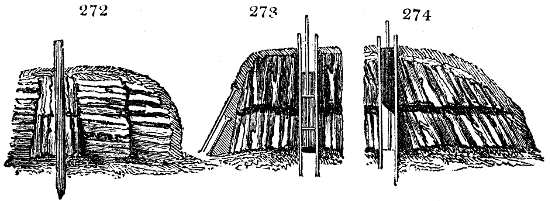
To carbonize wood under a movable covering, the plan of meiler, or heaps, is employed very much in Germany. The wood is arranged either in horizontal layers, or in nearly vertical ones, with a slight slope, so as to form conical rounded heaps of different sizes. The former are called lying meiler, fig. 272.; the latter standing meiler, figs. 273. and 274. Both are distributed in much the same way.
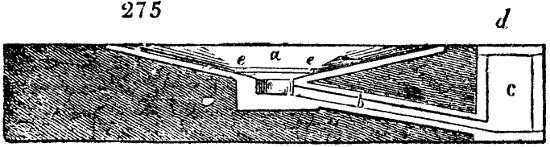
In districts where the wood can be transported into one place by means of rivers, or mountain slides, a dry flat space must be pitched upon, screened from storms and floods, which may be walled round, having a slight declivity made in the ground, towards the centre. See fig. 275. Into this space the tarry acid will partially fall, and may be conducted outwards, through a covered gutter beneath, into a covered tank. The mouth of the tank must be shut, during the coaking, with an iron or stone slab, luted with clay. A square iron plate is placed over the inner orifice of the gutter, to prevent it being choked with coal ashes. Fig. 275. represents a walled meiler station; a, the station; b, the gutter; c, the tank, which is covered with the slab d; e, a slab which serves to keep the gutter clear of coals. The cover of the heaps is formed of earth, sand, ashes, or such other matter as may be most readily found in the woods. They should be kindled in the centre. From 6 days to 4 weeks may be required for charring a heap, according to its size; hard wood requiring most time; and the slower the process, the better and greater is the product, generally speaking.
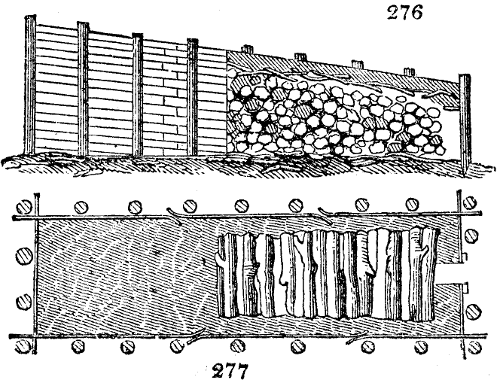
Charring of wood in mounds (Haufe or liegende werke) figs. 276. and 277. differs from that in the meiler, because the wood in the haufe is successively charred, and the charcoal is raked out by little and little. The product is said to be greater in this way, and also better. Uncleft billets, 6 or 8 feet long, being laid over each other, are covered with ashes, and then carbonized. The station is sometimes horizontal, and sometimes made to slope. The length may be 24 feet, the breadth 8 feet; and the wood is laid crosswise. Piles are set perpendicularly to support the roof, made of boughs and leaves, covered with ashes. Pipes are occasionally laid within the upper part of the mounds, which serve to catch and carry off some of the liquid products into proper tanks.
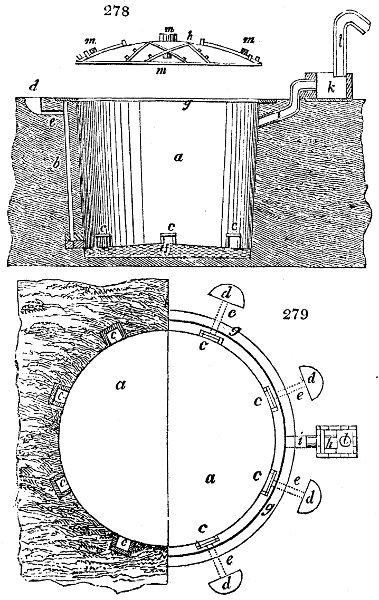
Fig. 278. is a vertical section, and fig. 279. a half bird’s-eye view, and half cross section, at the height of the pit-bottom, of Chabeaussière’s kiln for making wood charcoal. a is the oven; b, vertical air-pipes; c c, horizontal flues for admitting air to the kiln; d d, small pits which communicate by short horizontal pipes e e, with the vertical ones; f, the sole of the kiln, a circle of brickwork, upon which the cover or hood h reposes; i, a pipe which leads to the cistern k; l, the pipe destined for carrying off the gaseous matter; m m, holes in the iron cover or lid.
The distribution of the wood is like that in the horizontal meilers, or heaps; it is kindled in the central vertical canal with burning fuel, and the lid is covered with a few inches of earth. At the beginning of the operation all the draught flues are left open, but they are progressively closed, as occasion requires. In eight kilns of this kind, 500 decasters of oak wood are carbonized, from which 16,000 hectolitres of charcoal are obtained, equal to 64,000 pounds French, being about 25 per cent.; besides tar and 3000 velts of wood vinegar, of from 2° to 3°. Baumé.
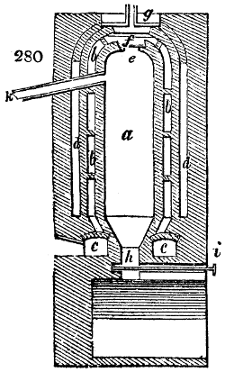
At Crouy upon the Ourcq, near Meaux, there is a well constructed kiln for making turf-charcoal. It resembles most nearly a tar-kiln. In fig. 280. a is the cylindrical coaking place, whose surrounding walls are heated by the flame which passes through the intermediate space b. The place itself is divided by partitions of fire tiles into three stages, through the apertures in which the flames of the fire c c, rise, and heat the exterior of the coaking apartment. In order to confine the heat, there is in the enclosing walls of the outer kiln a cylindrical hollow space d, where the air is kept stagnant. Through the apertures left in the upper end at e, the turf is introduced; they are then shut with an iron plate f, which is covered with ashes or sand. The fire-place opens above this aperture, and its outlet is provided with a moveable iron cover g, in which there is a small hole for the issue of the gases. The sole of the kiln consists of a cast iron slab h, which may be raised by means of a hook i upon it. This is drawn back after the carbonization is completed, whereby the charcoal falls from the coaking space into a subjacent vault. The volatile products are carried off by the pipe k, and led into the condensing cistern; the gases escaping to the fire-place where they are burned. The iron slab is protected from the corrosion of the acid vapours by a layer of coal ashes.
CHICA is a red colouring principle made use of in America by some Indian tribes to stain their skins. It is extracted from the bignonia chica by boiling its leaves in water, decanting the decoction, and allowing it to settle and cool, when a red matter falls down, which is formed into cakes and dried. This substance is not fusible, and, when burned, diffuses the same odour as animal bodies do. It is insoluble in cold water, very soluble in alcohol and ether, but, after the evaporation of these liquids, it is recovered unchanged. Fats and unctuous oils both dissolve it. It is soluble in carbonated and caustic alkaline lyes, from which it is precipitated by the acids without alteration. An excess of alkali, however, speedily decomposes it. Nitric acid transforms it into oxalic acid, and a bitter matter. Chlorine makes it white.
The savages mix this pigment with the fat of the cayman or alligator, and rub their skins with the mixture. It may probably be turned to account in the arts of civilized nations.
CHIMNEY. (Cheminée, Fr.; Schornstein, Germ.) Chimney is a modern invention for promoting the draught of fires and carrying off the smoke, introduced into England so late as the age of Elizabeth, though it seems to have been employed in Italy 100 years before. The Romans, with all their luxurious refinements, must have had their epicurean cookery placed in perpetual jeopardy from their kitchen fires, which, having no vent by a vertical tunnel in the walls, discharged their smoke and frequently their flames at the windows, to the no small alarm of their neighbours, and annoyance of even the street passengers.
Chimneys in dwelling houses serve also the valuable purpose of promoting salubrious circulation of air in the apartments, when not foolishly sealed with anti-ventilating stove-chests.
The first person who sought to investigate the general principles of chimney draughts, in subserviency to manufacturing establishments, was the celebrated Montgolfier. As the ascent of heated air in a conduit depends upon the diminution of its specific gravity, or, in other words, upon the increase of its volume by the heat, the ascensional force may be deduced from the difference between the density of the elastic fluid in the interior of the chimney, and of the external air; that is, between the different heights of the internal and external columns of elastic fluid supposed to be reduced to the same density. In the latter case, the velocity of the gaseous products of combustion in the interior of the chimney is equal to that of a heavy body let fall from a height equal to the difference in height of the two aerial columns.
To illustrate this position by an example, let us consider the simple case of a chimney of ventilation for carrying off foul air from a factory of any kind; and suppose that the tunnel of iron be incased throughout with steam at 212 degrees Fahr. Suppose this tunnel to be 100 yards high, then the weight of the column of air in it will be to that of a column of external air 100 yards high, assumed at 32° F. inversely as its expansion by 180°; that is, as 1000 is to 1·375; or as 72·727 is to 100. The column of external air at 32° being 100 yards, the internal column will be represented by 72·727; and the difference = 27·27, will be the amount of unbalanced weight or pressure, which is the effective cause of the ventilation. Calculating the velocity of current due to this difference of weight by the well-known formula for the fall of heavy bodies, that is to say, multiplying the above difference, which is 27·27, by the constant factor 19·62, and extracting the square root of the product; thus, √19·62 × 27·27 = 23·13 will be the velocity in yards per second, which, multiplied by 3, gives 69·39 feet. The quantity of air which passes in a second is obtained of course by multiplying the area or cross section of the tunnel by this velocity. If that section is half a yard, that is = a quadrangle 21⁄4 feet by 2, we shall have 23·13 × 0·5 = 11·565 cubic yards, = 3121⁄4 cubic feet.
The problem becomes a little more complicated in calculating the velocity of air which has served for combustion, because it has changed its nature, a variable proportion of its oxygen gas of specific gravity 1·111, being converted into carbonic acid gas of specific gravity 1·524. The quantity of air passed through well-constructed furnaces may, in general, be regarded as double of what is rigorously necessary for combustion, and the proportion of carbonic acid generated, therefore, not one half of what it would be were all the oxygen so combined. The increase of weight in such burned air of the temperature of 212°, over that of pure air equally heated, being taken into account in the preceding calculation, will give us about 19 yards or 57 feet per second for the velocity in a chimney 100 yards high incased in steam.
Such are the deductions of theory; but they differ considerably from practical results, in consequence of the friction of the air upon the sides of the chimneys, which varies likewise with its form, length, and quality. The direction and force of the winds also exercise a variable influence upon chimney furnaces differently situated. In chimnies made of wrought iron, like those of steam boats, the refrigeration is considerable, and causes a diminution of velocity far greater than what occurs in a factory stalk of well-built brick work. In comparing the numbers resulting from the trials made on chimneys of different materials and of different forms, it has been concluded that the obstruction to the draught of the air, or the deduction to be made from the theoretical velocity of efflux, is directly proportional to the length of the chimneys and to the square of the velocity, and inversely to their diameter. With an ordinary wrought-iron pipe, of from 4 inches to 5 inches diameter, attached to an ordinary stove, burning good charcoal, the difference is prodigious between the velocity calculated by the above theoretical rule, and that observed by means of a stop-watch, and the ascent of a puff of smoke from a little tow, dipped in oil of turpentine thrust quickly into the fire. The chimney being 45 feet high, the temperature of the atmosphere 68° Fahr., the velocity per second was,—
Trials. By theory. By experiment. Mean temperature of chimney.
1 26·4 feet 5 feet 190 ° Fahr.
2 29·4 5 ·76 214
3 34·5 6 ·3 270
To obtain congruity between calculation and experiment, several circumstances must be introduced into our formulæ. In the first place, the theoretical velocity must be multiplied by a factor, which is different according as the chimney is made of bricks, pottery, sheet iron, or cast iron. This factor must be multiplied by the square root of the diameter of the chimney (supposed to be round), divided by its length, increased by four times its diameter. Thus, for pottery, its expression is 2·06 √DL + D; D being the diameter, and L the length of the chimney.
A pottery chimney, 33 feet high, and 7 inches in diameter, when the excess of its mean temperature above that of the atmosphere was 205° Fahr., had a pressure of hot air equal to 11·7 feet, and a velocity of 7·2 feet per second. By calculating from the last formula, the same number very nearly is obtained. In none of the experiments did the velocity exceed 12 feet per second, when the difference of temperature was more than 410° Fahr.
Every different form of chimney would require a special set of experiments to be made for determining the proper factor to be used.
This troublesome operation may be saved by the judicious application of a delicate differential barometer, such as that invented by Dr. Wollaston; though this instrument does not seem to have been applied by its very ingenious author in measuring the draughts or ventilating powers of furnaces.
If into one leg of this differential syphon, water be put, and fine spermaceti oil into the other, we shall have two liquids, which are to each other in density as the numbers 8 and 7. If proof spirit be employed instead of water, we shall then have the relation of very nearly 20 to 19. I have made experiments on furnace draughts with the instrument in each of these states, and find the water and oil syphon to be sufficiently sensible: for the weaker draughts of common fire-places the spirits and oil will be preferable barometric fluids.