C. (continued 3)
Reading edition
Of the bronze or solitaire style by mandarining.—The mandarining mixture, is
1 gallon of nitric acid, of 1·17 spec. grav.; mixed with 3 pints of solution of nitrate of iron, of spec. grav. 1·65. If the quantity of nitrate of iron be increased, a darker tint will be obtained. The temperature of the mixture should be 94° F. The pieces, after mandarining, are let fall into water, and steeped for an hour.
In order to raise the bronze, and clear away the fat resist, the goods must be boiled in a bath of soap and soda, as described for orange.
1. Bronze ground, with white figures.
(1.) Print on the fat resist; (2.) dip in the blue vat, and dry; (3.) pad in a decoction of logwood, of 4 libs. per gallon; dry, taking care to turn over the selvages; (4.) mandarine, and steep in water for an hour; (5.) cleanse, and pass through soap.
2. Bronze ground, with blue figures.
(1.) Dip in the blue vat, and dry; (2.) print-on the fat resist; (3.) pad in the above decoction of logwood, and dry; (4.) mandarine, and steep an hour; (5.) cleanse, and brighten.
3. Bronze ground, with white and blue.
(1.) Print-on the fat resist; (2.) dip in the blue vat, and dry; (3.) ground-in the fat resist; (4.) pad in the logwood liquor, and dry; (5.) mandarine, and steep for an hour; (6.) cleanse, and give the brightening boil with soap.
This style of manufacture may be executed on chalys; and is capable of producing beautiful effects, which will in vain be sought for by other means.
With silks, advantage may be derived from various metallic solutions which possess the property of staining animal substances; among which are nitrate of silver, nitrate of mercury, and muriate of iron. The solutions of these salts may be thickened with gum, and printed-on.
An orange upon an indigo vat ground.—After the blue ground has been dyed, orange figures may be produced by printing-on the following discharge paste:—
1 gallon of water, made into a paste with 1 pound of starch: when cold, add to it from 16 to 24 ounces of nitric acid, of spec. grav. 1·288. After fixing the colour by steam, the orange is brightened with a soap boil.
An orange upon a Prussian-blue ground.—The dye is first given by Prussian blue in the ordinary way, and then the following discharge is printed-on:—
A caustic lye being prepared, of 1·086 specific gravity, dissolve in a gallon of it 2 pounds of annotto, and thicken with 3 pounds and a quarter of gum. Two days after the impression of this paste, pass the goods through steam, and wash them in running water. With these two designs, the logwood and gall black, formerly described, may be associated, to produce a rich effect.
To the preceding practical instructions for printing calicoes, silks, woollens, and mixed fabrics, made of the two latter, a few annotations may be added.
When an uniform colour is to be applied to both sides of the cloth, the padding process is employed; but, when only one side is to be thus coloured, diagonal lines are cut very closely to each other upon the cylinder, which transfer so much colour from the trough to the cloth passed under it as to make the surface appear uniformly stained. This process is called mattage by the French. Mordants or topical dyes, to be applied in this way, should not be much thickened.
The doubler is the piece of felt or blanket stuff placed between the cloth to be printed, and the block printing table, or the cylinders. It should be kept very clean; because, were it soiled with acetate of iron, it would spoil all the light shades made with acetate of alumina.
Filters for the colour shop of a print house are best made of wool, formed into a substantial conical cap by felting. A filter ought to be set apart for each different dye stuff.
When the goods after dyeing are washed, by being held by the selvage, dipped, and shaken in a stream of water, the process is called giving a list by the French (donner une lisière). The piece is transferred alternately from one hand to another.
Stains. When we observe stains produced by mordants, upon spots where no colour is to come, we must, before dunging the goods, apply a little of the lime juice, or tartaro-oxalic acid discharge paste, to the place. If, on the contrary, the stains are not perceived till after the maddering, we must then apply to it first a strong solution of chloride of lime with a pencil, next a solution of oxalic acid mixed with a little muriatic with another pencil, and immediately afterwards wash with water. Every madder stain will be effaced by this means.
Rust stains are removable by a mixture of oxalic and muriatic acids.
Indigo stains by the combined action of chloride of lime and muriatic acid.
Topical yellow stains, or yellow dyes, by the same combination.
Metallic greens and Scheele’s green by the acid alone.
Chrome green, and Prussian blue. The blue may be taken out by a caustic alkali; after which the goods must be washed: the residuary rust stain may be removed by the mixture of oxalic and muriatic acids. The above methods refer to cotton and linen. The stains on silk and woollen stuffs should be removed before fixing the colours by the soap boil; which may generally be done by scratching with the finger, with the aid of a little water.
For a direct calico green, see oxide of Chrome.
Mr. Hudson, of Gale, near Rochdale, obtained a patent, in December, 1834, for a mechanism which furnishes a continual and regular supply of colour to the sieve or tear (tiré, Fr.) into which the printer has to dip his block, for the purpose of receiving the colour about to be transferred to the fabric in the operations of printing calicoes or paper hangings. The contrivance consists in a travelling endless web, moved by power, which, by passing progressively from the colour vat over the diaphragm, brings forward continuously an equable supply of the coloured paste for the workman’s block.
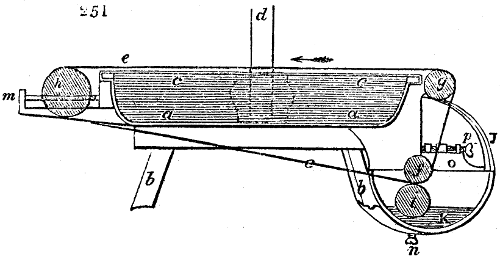
Fig. 251. represents the construction of this ingenious apparatus, shown partly in section. a a is a vessel of iron, supported upon wooden standards b b, over the upper surface of which vessel a sheet or diaphragm, c c, of oiled cloth, or other suitable elastic material, is distended, and made fast at its edges by being bent over a flange, and packed or cemented to render the joints water-tight. A vertical pipe d is intended to conduct water to the interior of the vessel a, and, by a small elevation of the column, to create such upward pressure as shall give to the diaphragm a slight bulge like the swimming tub.
An endless web, e e e, passing over the surface of the diaphragm, is distended over three rollers, f g h, the lower of which, f, is in contact with the colour-roller i in the colour-trough K. On the axle of the roller i a pulley wheel is fixed, which allows the roller to be turned by a band from any first mover; or the roller may receive rotatory motion by a winch fixed on its axle. On this said axle there is also a toothed wheel, taking into another toothed wheel on the axle of the roller f; hence, the rotation of the colour-roller i in the one direction will cause the roller f to revolve in the opposite, and to carry forward the endless web e e e, over the elastic diaphragm, the web taking with it a stratum of colour received from the roller i, evenly distributed over its surface, and ready for the printer to dip his block into.
The axles of the rollers f and g turn in stationary bearings; but the axle of h is mounted in sliding nuts, which may be moved by turning the screws m, for the purpose of tightening the endless web. The axle of the colour-roller i turns in mortises, and may be raised by screws n, in order to bring its surface into contact with the endless web. To prevent too great a quantity of colour being taken up, the endless web passes through a long slit, or parallel aperture, in a frame o, which acts as a scraper or doctor, and is adjustable by a screw p, to regulate the quantity of colour carried up. The contents of the vessel a, and of the colour-trough K, may be discharged when required by a cock in the bottom of each. See Paper Hangings, for the Fondu style.
CALOMEL. (Chlorure de Mercure, Fr.; Versüsstes Quecksilber, Germ.) The mild protochloride of mercury. The manufacture of this substance upon the great scale may be performed in two ways. The cheapest and most direct consists in mixing 11⁄8 part of pure quicksilver with 1 part of pure nitric acid, of sp. grav. from 1·2 to 1·25; and in digesting the mixture till no more metal can be dissolved, or till the liquid has assumed a yellow colour. At the same time, a solution of 1 part of common salt is made in 32 parts of distilled water, to which a little muriatic acid is added; and, when heated to nearly the boiling point, it is mixed with the mercurial solution. The two salts exchange bases, and a protochloride of mercury precipitates in a white powder, which, after being digested for some time in the acidulous supernatant liquor, is to be washed with the greatest care in boiling water. The circumstances which may injure the process are the following:—1. When less mercury is employed than the acid can dissolve, there is formed a deuto-nitrate of mercury, which forms some corrosive sublimate with the common salt, and causes a proportional defalcation of calomel. 2. If the liquors are perfectly neutral at the moment of mixing them, some subnitrate of mercury is thrown down, which cannot be removed by washing, and which gives a noxious contamination to the bland calomel. The acid prescribed in the above formula obviates this danger.
The second manner of manufacturing calomel is to grind very carefully 4 parts of corrosive sublimate (bi-chloride of mercury) with 3 parts of quicksilver, adding a little water or spirits to repress the noxious dust during the trituration. The mass is then introduced into a glass globe, and sublimed at a temperature gradually raised. The quicksilver combines with the deutochloride, and converts it into the protochloride, or calomel. The following formula, upon the same principle, was recommended to the chemical manufacturer in Brande’s Journal, for July, 1818:—
“Prepare an oxysulphate of mercury, by boiling 25 pounds of mercury with 35 pounds of sulphuric acid to dryness. Triturate 31 pounds of this dry salt with 20 pounds 4 ounces of mercury, until the globules disappear, and then add 17 pounds of common salt. The whole is to be thoroughly mixed, and sublimed in earthen vessels. Between 46 and 48 pounds of pure calomel are thus produced: it is to be washed and levigated in the usual way.” The above is the process used at Apothecaries’ Hall, London. The oxysulphate is made in an iron pot; and the sublimation is performed in earthen vessels. The crystalline crust or cake of calomel should be separated from the accompanying gray powder, which is nearest the glass, and consists of mercury mixed with corrosive sublimate.
An ingenious modification of the latter process, for which a patent, now expired, was obtained by Mr. Jewell, consists in conducting the sublimed vapours over an extensive surface of water contained in a covered cistern. The calomel thus obtained is a superior article, in an impalpable powder, propitious to its medical efficacy.
The presence of corrosive sublimate in calomel is easily detected by digesting alcohol upon it, and testing the decanted alcohol with a drop of caustic potash, when the characteristic brick-coloured precipitate will fall, if any of the poisonous salt be present. To detect subnitrate of mercury in calomel, digest dilute nitric acid on it, and test the acid with potash, when a precipitate will fall in case of that contamination. As it is a medicine so extensively administered to children at a very tender age, its purity ought to be scrupulously watched.
118 parts of calomel contain 100 of quicksilver.
CALORIC. The chemical name of the power or matter of heat.
CALORIFÈRE OF WATER. (Calorifère d’eau, Fr.; Wasser-Heitzung, Germ.) In the Dictionnaire Technologique, vol. iv., published in 1823, we find the following description of this apparatus, of late years so much employed in Great Britain for heating conservatories, &c. by hot water circulating in pipes:—
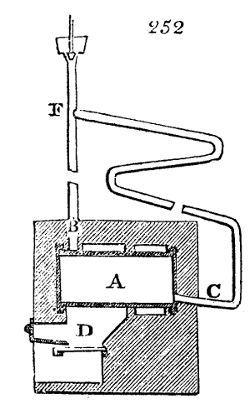
“This mode of heating is analogous to that by stove pipes: it is effected by the circulation of water, which, like air, is a bad conductor, but may serve as a carrier of caloric by its mobility. We may readily form an idea of the apparatus which has been employed for this purpose. We adapt to the upper part of either a close kettle, or of an ordinary cylindric boiler A, fig. 252, a tube B, which rises to a certain height, then descends, making several sinuosities with a gentle slope till it reaches the level of the bottom of the boiler, to whose lowest part, as that which is least heated, it is fitted at C. At the highest point of the tube F we adapt a vertical pipe, destined to serve as an outlet to the steam which may be formed if the temperature be too much raised: it serves also for the escape of the air expelled from the water by the heat; and it permits the boiler to be replenished from time to time as the water is dissipated by evaporation; lastly, it is a tube of safety.
“The apparatus being thus arranged, and all the tubes as well as the boiler filled with water, if we kindle fire in the grate D, the first portions of water heated, having become specifically lighter, will tend to rise: they will actually mount into the upper part of the boiler, and, of course, enter the tube B F: at the same time an equivalent quantity of water will re-enter the boiler by the other extremity C of the tube. We perceive that these simultaneous movements will determine a circulation in the whole mass of the liquid, which will continue as long as heat is generated in the fire-place; and if we suppose that the tubes, throughout their different windings, are applied against the walls of a chamber, or a stove-room, the air will get warmed by contact with the hot surfaces; and we may accelerate the warming by multiplying these contacts in the mode indicated.
“This calorifère cannot be employed so usefully as those with heated air, when it is wished to heat large apartments. In fact, the passage of heat through metallic plates is in the ratio of the difference of temperature and quantity of the heating surfaces. In the present case, the temperature of the water, without pressure, in the tubes, must be always under 100° C. (212° F.), even in those points where it is most heated, and less still in all the other points, while the temperature of the flues in air stoves, heated directly by the products of combustion, may be greatly higher. In these stoves, also, the pipes may without inconvenience have a large diameter, and present, consequently, a large heating surface; whereas, with the water calorifère, the pressure exercised by the liquid upon the sides of the tubes being in the ratio of the surfaces, we are obliged, in order to avoid too great pressure, to employ a multitude of small tubes, which is expensive. Lastly, if the hot-water circulation is to be carried high, as may be often necessary in lofty buildings, the pressure resulting from the great elevation would call for proportional thickness in the tubes and the boiler: for these reasons, and others which we shall state in treating of heating by steam, it appears that water cannot be advantageously substituted for air or steam in the applications above stated; yet this mode of heating presents very decided advantages where it is useful to raise the temperature a small number of degrees in a uniform manner.” See Incubation, artificial.
“M. Bonnemain applied, with much success, these ingenious processes of heating by the circulation of water, to maintain a very equal temperature in hot-houses (serres-chaudes), in stoves adapted to artificial incubation, and in preserving or quickening vegetation within hot-houses, or outside of their walls, during seasons unpropitious to horticulture.
“Since the capacity of water for heat is very great, if the mass of it in a circulation-apparatus be very considerable, and the circulation be accelerated by proper arrangements, as by cooling the descending tube exterior to the stove-room, we may easily obtain by such means a moderately high and uniform temperature, provided the heat generated in the fire-place be tolerably regular. We may easily secure this essential point by the aid of the fire-regulator, an instrument invented by M. Bonnemain, and which is described under the article Incubation, because there its use seems to be indispensable.”
From the above quotation, and, more especially, from the evidence adduced in the article Incubation, we see how little claim the Marquis de Chabannes, or any of his followers, can have to invention in their arrangements for heating apartments by the calorific motions of the particles of water, enclosed in pipes of any kind.
CAMBRIC. (Batiste, Fr.; Kammertuch, Germ.) A sort of very fine and rather thin linen fabric, first made at Cambray. An excellent imitation of this fabric is made in Lancashire, woven from fine cotton yarn hard twisted. Linen cambric of a good quality is also now manufactured in the United Kingdom from power-spun flax.
CAMLET OR CAMBLET. A light stuff, much used for female apparel. It is made of long wool hard spun, sometimes mixed in the loom with cotton or linen yarn.
CAMPHOR, or CAMPHIRE. This immediate product of vegetation was known to the Arabs under the names of kamphur and kaphur, whence the Greek and Latin name camphora. It is found in a great many plants, and is secreted, in purity, by several laurels: it occurs combined with the essential oils of many of the labiatæ; but it is extracted, for manufacturing purposes only, from the Laurus camphora, which abounds in China and Japan, as well as from a tree which grows in Sumatra and Borneo, called, in the country, Kapour barros, from the name of the place where it is most common. The camphor exists, ready formed, in these vegetables, between the wood and the bark; but it does not exude spontaneously. On cleaving the tree Laurus sumatrensis, masses of pure camphor are found in the pith.
The wood of the laurus is cut into small pieces, and put, with plenty of water, into large iron boilers, which are covered with an earthen capital or dome, lined within with rice straw. As the water boils, the camphor rises with the steam, and attaches itself as a sublimate to the stalks, under the form of granulations of a grey colour. In this state it is picked off the straw, and packed up for exportation to Europe.
Formerly Venice held the monopoly of refining camphor, but now France, England, Holland, and Germany refine it for their own markets. All the purifying processes proceed on the principle that camphor is volatile at the temperature of 400° F. The substance is mixed, as intimately as possible, with 2 per cent. of quicklime, and the mixture is introduced into a large bottle made of thin uniform glass, sunk in a sand bath. The fire is slowly raised till the whole vessel becomes heated, and then its upper part is gradually laid bare in proportion as the sublimation goes on. Much attention and experience are required to make this operation succeed. If the temperature be raised too slowly, the neck of the bottle might be filled with camphor before the heat had acquired the proper subliming pitch; and, if too quickly, the whole contents might be exploded. If the operation be carried on languidly, and the heat of the upper part of the bottle be somewhat under the melting point of camphor, that is to say, a little under 350° F., the condensed camphor would be snowy, and not sufficiently compact and transparent to be saleable. Occasionally, sudden alternations of temperature cause little jets to be thrown up out of the liquid camphor at the bottom upon the cake formed above, which soil it, and render its re-sublimation necessary.
If, to the mixture of 100 parts of crude camphor and 2 of quicklime, 2 parts of bone-black, in fine powder, be added, the small quantity of colouring matter in the camphor will be retained at the bottom, and whiter cakes will be produced. A spiral slip of platina foil immersed in the liquid may tend to equalise its ebullition.
By exposing some volatile oils to spontaneous evaporation, at the heat of about 70° F., Proust obtained a residuum of camphor; from oil of lavender, 25 per cent. of its weight; from oil of sage, 121⁄2; from oil of marjoram, 10.
Refined camphor is a white translucid solid, possessing a peculiar taste and smell. It may be obtained, from the slow cooling of its alcoholic solution, in octahedral crystals. It may be scratched by the nail, is very flexible, and can be reduced into powder merely by mixing it with a few drops of alcohol. Its specific gravity varies from 0·985 to 0·996. Mixed and distilled with six times its weight of clay, it is decomposed, and yields a golden yellow aromatic oil, which has a flavour analogous to that of a mixture of thyme and rosemary; along with a small quantity of acidulous water tinged with that oil, charcoal remains in the retort. In the air, camphor takes fire on contact of an ignited body, and burns all away with a bright fuliginous flame.
Camphor is little soluble in water; one part being capable of communicating smell and taste to 1000 of the fluid. 100 parts of alcohol, spec. grav. 0·806, dissolve 120 parts of camphor, at ordinary temperatures. It is separated, in a pulverulent state, by water. Ether and oils, both expressed and volatile, also dissolve it.
When distilled with eight parts of aquafortis, camphor is converted into camphoric acid. Camphor absorbs 144 times its volume of muriatic acid gas, and is transformed into a colourless transparent liquid, which becomes solid in the air, because the acid attracts humidity, which precipitates the camphor. One part of strong acetic acid dissolves two parts of camphor. By my analysis, camphor consists of 77·38 carbon, 11·14 hydrogen, and 11·48 oxygen. Berzelius’s numbers are certainly erroneous.
CAMWOOD. An article imported from Sierra Leone, which seems to possess similar dyeing powers with Brazil or Nicaragua wood.
CANDLE. (Chandelle, Fr.; Kerze, Licht, Germ.) I shall first briefly describe the ordinary manufacture of candles. They are either dipped or moulded. But the first part of the process is the sorting of the tallow. Mutton suet with a proportion of ox-tallow is selected for mould candles, because it gives them gloss and consistence. Coarser tallow is reserved for the dipped candles. After being sorted, it is cut into small pieces, preparatory to being melted or rendered; and the sooner this is done after the fat is taken from the carcase the better, because the fibrous and fleshy matters mixed with it promote its putrefaction. Tallow is too commonly melted by a naked fire applied to the bottom of the vessel, whereas it should be done either in a cold set pan, where the flame plays only round the sides a little way above the bottom, or in a steam-cased pan. After being fused a considerable time, the membranous matters collect at the surface, constituting the cracklings used sometimes for feeding dogs, after the fat has been squeezed out of it by a press. The liquid tallow is strained through a sieve into another copper, where it is treated with water at a boiling temperature in order to wash it. After a while, when the foul water has settled to the bottom, the purified tallow is lifted out, by means of tinned iron buckets, into tubs of a moderate size, where it concretes, and is ready for use.
It is a remarkable circumstance, that the wicks for the best candles are still cotton rovings imported from Turkey, notwithstanding the vast extension and perfection of cotton-spinning in this country. Four or more of these Turkey skeins, according to the intended thickness of the wick, are wound off at once into bottoms or clues, and afterwards cut by a simple machine into lengths corresponding to those of the candles to be made. Mr. Colebank obtained a patent, in June, 1822, for a machine for cutting, twisting, and spreading wicks, which, though convenient, does not seem to have come into general use. The operations are performed upon a series of threads at once. The apparatus is placed in a box, in front of which the operator sits. A reel extends across the box, at the hinder part, upon which the cotton threads have been previously wound: from this reel they are drawn off in proper lengths, doubled, and cut by an ingenious mechanism. By dipping the wicks into the melted tallow, rubbing them between the palms of the hands, and allowing the tallow which adheres to harden, they may be arranged with facility upon the broaches for the purpose of dipping. The dipping room is furnished with a boiler for melting the tallow, the dipping mould, or cistern, and a large wheel for supporting the broaches. From the ceiling of the workshop a long balance-shaped beam is suspended, to one end of which a wooden frame is attached for holding the broaches with the wicks arranged at proper distances. The opposite arm is loaded with a weight to counterbalance the wooden frame, and to enable the workman to ascertain the proper size of the candles. The end of the lever which supports the frame is placed immediately above the dipping cistern; and the whole machine is so balanced that, by a gentle pressure of the hand, the wicks are let down into the melted tallow as often as may be required.
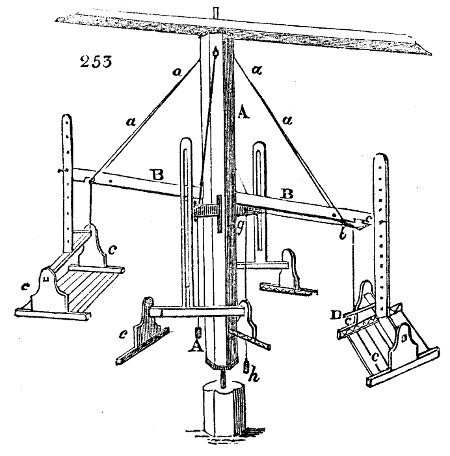
The following convenient apparatus for dipping candles has been long in use at Edinburgh. In the centre of the dipping-room a strong upright post A A, fig. 253., is erected, with turning iron pivots at its two ends. Near its middle, six mortises are cut at small distances from one another, into each of which is inserted a long bar of wood B B, which moves vertically upon an iron pin, also passing through the middle of the shaft. The whole presents the appearance of a large horizontal wheel with twelve arms. A complete view of two of them only is given in the figure. From the extremity of each arm is suspended a frame, or port, as the workmen call it, containing 6 rods, on each of which are hung 18 wicks, making the whole number of wicks upon the wheel 1296. The machine, though apparently heavy, turns round by the smallest effort of the workman; and each port, as it comes in succession over the dipping-mould, is gently pressed downwards, by which means the wicks are regularly immersed in melted tallow. As the arms of the lever are all of the same length, and as each is loaded with nearly the same weight, it is obvious that they will all naturally assume a horizontal position. In order, however, to prevent any oscillation of the machine in turning round, the levers are kept in a horizontal position by means of small chains a a, one end of which is fixed to the top of the upright shaft, and the other terminates in a small square piece of wood b, which exactly fills the notch c in the lever. As one end of the levers must be depressed at each dip, the square piece of wood is thrown out of the notch by the workman pressing down the handle D, which communicates with the small lever e, inserted into a groove in the bar B. In order that the square piece of wood, fixed in one extremity of the chain, may recover its position upon the workman’s raising the port, a small cord is attached to it, which passes over a pulley inserted in a groove near c, and communicates with another pulley and weight, which draws it forward to the notch. In this way the operation of dipping may be conducted by a single workman with perfect ease and regularity, and even dispatch. No time is lost, and no unnecessary labour expended, in removing the ports after each dip; and, besides, the process of cooling is much accelerated by the candles being kept in constant motion through the air. The number of revolutions which the wheel must make, in order to complete one operation, must obviously depend upon the state of the weather and the size of the candles; but it is said that, in moderately cold weather, not more than two hours are necessary for a single person to finish one wheel of candles of a common size. Upon the supposition, therefore, that six wheels are completed in one day, no less a number than 7776 candles will be manufactured in that space of time by one workman.
I shall next describe the process of moulding, which, if possible, is even less complicated in its details than that of dipping. The moulds are made of some metallic substance, usually pewter, and consist of two parts. The shaft or great body of the mould is a hollow cylinder, finely polished in the inside, and open at both extremities. The top of the mould is a small metallic cup, having a moulding within-side, and a hole to admit the wick. The two parts are soldered together, and when united, as will readily be imagined, have the shape of a moulded candle. A third piece, called the foot, is sometimes added; it is a kind of small funnel, through which the liquid tallow runs into the mould, and, being screwed to the opposite extremity of the shaft, is removable at pleasure. This additional piece may certainly be useful in very mild weather; since, by removing it, the candles may be drawn more easily from the moulds; but, in general, it may be dispensed with.
Eight or twelve of these moulds, according to their size, are fixed in a frame, which bears a great resemblance to a wooden stool, the upper surface of which forms a kind of trough. The top of the moulds points downwards, and the other extremity, which is open, is inserted into the bottom trough or top of the stool, and made quite level with its upper surface. In order to introduce the wicks into the mould, the workman lays the frame upon its side on an adjoining table, and holding in his left hand a quantity of wicks, previously cut to the proper length, he introduces into the mould a long wire with a hooked point. As soon as the hook of the wire appears through the hole in the top of the mould, he attaches to it the looped end of the wick, and, immediately drawing back the wire, carries the wick along with it. In this manner each mould in succession is furnished with a wick. Another workman now follows, and passes a small wire through the loop of each wick. This wire is obviously intended to keep the wick stretched, and to prevent it from falling back into the mould upon the frame being placed in the proper position for filling. The frame is then handed to the person that fills the moulds, who previously arranges the small wires in such a manner that each wick may be exactly in the middle of the mould.
The moulds are filled by running tallow into each of them, or into the trough, from a cistern furnished with a cock, and which is regularly supplied with tallow of the proper temperature from an adjoining boiler. When the workman observes that the moulds are nearly half filled he turns the cock, and, laying hold of that portion of the wick which hangs out of the mould, pulls it tight, and thus prevents any curling of the wick, which might injure the candles: he then opens the cock, and completes the process of filling. The frame is now set aside to cool; and when the tallow has acquired a proper consistence, which the workman easily discovers by a snapping noise emitted by the candles upon pressing his thumb against the bottom of the moulds, he first withdraws the small wires which kept the wicks tense, and then, scraping off the loose tallow from the top of the frame with a small wooden spade, he introduces a bodkin into the loop of the wick, and thus draws each candle in succession from its mould. The candles are now laid upon a table for the inspection of the exciseman, and afterwards removed to the storehouse. Previous to storing them up, some candle-makers bleach their candles, by exposing them to the air and dews for several days. This additional labour can be necessary only when the dealer is obliged to have early sales; for if the candles are kept for some months, as they ought to be, before they are brought to market, they become sufficiently whitened by age.
Wax candles.—Next to tallow, the substance most employed in the manufacture of candles is wax. Wax candles are made either by the hand or with a ladle. In the former case, the wax, being kept soft in hot water, is applied bit by bit to the wick, which is hung from a hook in the wall; in the latter, the wicks are hung round an iron circle, placed immediately over a large copper-tinned basin full of melted wax, which is poured upon their tops, one after another, by means of a large ladle. When the candles have by either process acquired the proper size, they are taken from the hooks, and rolled upon a table, usually of walnut-tree, with a long square instrument of box, smooth at the bottom.
A few years ago I made a set of experiments upon the relative intensities of light, and duration of different candles, the results of which are contained in the following table.
Number in a pound. Duration of a candle. Weight in grains. Consump- tion per hour in grains. Propor- tion of light. Economy of light. Candles equal one Argand.
h. m.
10 mould 5 9 682 132 12 1⁄4 68 5 ·7
10 dipped 4 36 672 150 13 65 1⁄2 5 ·25
8 mould 6 31 856 132 10 1⁄2 59 1⁄2 6 ·6
6 ditto 7 2 1⁄2 1160 163 14 2⁄3 66 5 ·0
4 ditto 9 3 ·6 1707 186 20 1⁄4 80 3 ·5
Argand oil flame — — 512 69 ·4 100
A Scotch mutchkin, or 1⁄8 of a gallon of good seal oil, weighs 6010 gr., or 131⁄10 oz., avoirdupois, and lasts in a bright Argand lamp 11 hours 44 minutes. The weight of oil it consumes per hour is equal to 4 times the weight of tallow in candles 8 to the pound, and 1⁄7 the weight of tallow in candles 6 to the pound. But, its light being equal to that of 5 of the latter candles, it appears from the above table that 2 pounds weight of oil, value 9d. in an Argand, are equivalent in illuminating power to 3 pounds of tallow candles, which cost about two shillings. The larger the flame in the above candles the greater the economy of light.
In June, 1825, M. Gay Lussac obtained a patent in England for making candles from margaric and stearic acids, improperly called stearine, by converting tallow into the above fat acids by the following process:—Tallow consists, by Chevreul’s researches, of stearine, a solid fat, and elaine, a liquid fat; the former being in much the larger proportion. When tallow is treated with an alkaline body, such as potash, soda, or lime, it is saponified; that is, its stearine and elaine become respectively stearic and elaic acids, and, as such, form compounds with these bases. When by the action of an acid, such as the sulphuric or muriatic, these combinations are decomposed, the fats reappear in the altered form of stearic and elaic acids; the former body being harder than tallow, and of a texture, somewhat like spermaceti, the latter body being fluid, like oil. “The decomposition of the soap should be made,” says the patentee, “in a large quantity of water, kept well stirred during the operation, and warmed by steam introduced in any convenient way. When the mixture has been allowed to stand, the acid of the tallow or fat will rise to the surface, and the water being drawn off will carry the alkaline or saline matters with it; but, if the acids of the tallow should retain any portion of the salts, fresh water may be thrown upon it, and the whole well agitated, until the acids have become perfectly free from the alkaline matters; and, when allowed to cool, the acids will be formed into a solid mass. This mass is now to be submitted to considerable pressure in such an apparatus as is employed in expressing oil from seeds; when the liquid acid will run off in the form of a substance resembling oil, leaving a solid matter, similar, in every respect, to spermaceti, which is fit for making candles.”
The wick to be used in the manufacture of these improved candles, and which forms one of the features of this invention, is to be made of cotton yarn, twisted rather hard, and laid in the same manner as wire is sometimes coiled round the bass strings of musical instruments. For this purpose, straight rods or wires are to be procured, of suitable lengths and diameters, according to the intended size of the candles about to be made; and these wires, having been covered with cotton coiled round them, as described, are to be inserted in the candle moulds as the common wicks are; and when the candle is made, and perfectly hard, the wire is to be withdrawn, leaving a hollow cylindrical aperture entirely through the middle of the candle. See Stearine.
CANE-MILL. See Mill and Sugar.
CANNON. For the composition of these implements of destruction, see Bronze.
CANVASS (Canevas, Fr.; Segeltuch, Germ.) It has been found that sails of ships made with the selvages and seams of the canvass running down parallel to their edges, are very apt to bag, and become torn in the middle, from the strain to which they are subjected by the pressure of the wind. To obviate this inconvenience, a mode of making sails, with the seams and selvages running diagonally, was proposed by Admiral Brooking, and a patent granted to him for the same on 4th of September, 1828. The invention of Messrs. Ramsay and Orr, which we are about to describe, has a similar object, viz., that of giving additional strength to sails by a peculiar manner of weaving the canvass of which they are made.
The improvement proposed under their patent of March, 1830, consists in weaving the canvass with diagonal threads; that is, placing the weft yarn, or shoot, in weaving, at an oblique angle to the warp yarns, instead of making the decussation of the warp, or weft threads, or yarns, at right angles to each other, as in the ordinary mode of weaving.
To accomplish this object the loom must be peculiarly constructed; that is, its warp and work beams must stand at an oblique angle with the sides of the loom, and the batten and slay must be hung in a peculiar manner, in order to beat up the weft, or shoot, in lines ranging diagonally with the warp. No drawing is shown of the method by which this arrangement of the loom is to be made, but it is presumed that any weaver would know how to accomplish it: the invention consisting solely in producing sail cloth with the threads, or yarns, of the weft ranging diagonally at any desired angle with the direction of the warp thread.
CAOUTCHOUC, GUM-ELASTIC, OR INDIAN-RUBBER, (Federharz, Germ.) occurs as a milky juice in several plants, such as the siphonia cahuca, called also hevea guianensis, cautschuc, jatropha elastica, castilleja elastica, cecropia pellata, ficus religiosa and indica, urceolaria elastica, &c. It is, however, extracted chiefly from the first plant, which grows in South America and Java. The tree has incisions made into it through the bark in many places, and it discharges the milky juice, which is spread upon clay moulds, and dried in the sun, or with the smoke of a fire, which blackens it.
The juice itself has been of late years imported. It is of a pale yellow colour, and has the consistence of cream. It becomes covered in the bottles containing it with a pellicle of concrete caoutchouc. Its spec. grav. is 1·012. When it is dried it loses 55 per cent. of its weight: the residuary 45 is elastic gum. When the juice is heated it immediately coagulates, in virtue of its albumen, and the elastic gum rises to the surface. It mixes with water in any proportion; and, when thus diluted, it coagulates with heat and alcohol as before.
The specific gravity of caoutchouc is 0·925, and it is not permanently increased by any degree of pressure. By cold or long quiescence it becomes hard and stiff. When the milky juice has become once coherent, no means hitherto known can restore it to the emulsive state. By long boiling in water it softens, swells, and becomes more readily soluble in its peculiar menstrua; but when exposed to the air it speedily resumes its pristine consistence and volume. It is quite insoluble in alcohol; but in ether, deprived of alcohol by washing with water, it readily dissolves, and affords a colourless solution. When the ether is evaporated, the caoutchouc becomes again solid, but is somewhat clammy for a while. When treated with hot naphtha, distilled from native petroleum, or from coal tar, it swells to 30 times its former bulk; and if then triturated with a pestle, and pressed through a sieve, it affords a homogeneous varnish, which being applied by a flat edge of metal or wood to cloth, prepares it for forming the patent water-proof cloth of Mackintosh. Two surfaces of cloth, to which several coats of the above varnish have been applied, are, when partially dried, brought evenly in contact, and then passed between rollers, in order to condense and smooth them together. This double cloth is afterwards suspended in a stove-room to dry, and to discharge the disagreeable odour of the naphtha.
Caoutchouc dissolves in the fixed oils, such as linseed oil, but the varnish has not the property of becoming concrete upon exposure to air.
It has been lately asserted that caoutchouc is soluble in the oils of lavender and sassafras.
It melts at 248° F., and stands afterwards a much higher heat without undergoing any further change. When the melted caoutchouc is exposed to the air, it becomes hard on the surface in the course of a year. When kindled it burns with a bright flame and a great deal of smoke.
Neither chlorine, sulphurous acid gas, muriatic acid gas, ammonia, nor fluosilicic acid gas, affect it, whence it forms very valuable flexible tubes for pneumatic chemistry. Cold sulphuric acid does not readily decompose it, nor does nitric acid, unless it be somewhat strong. The strongest caustic potash lye does not dissolve it even at a boiling heat.
Caoutchouc, according to my experiments, which have been confirmed by those of Mr. Faraday, contains no oxygen, as almost all other solid vegetable products do, but is a mere compound of carbon and hydrogen, in the proportion, by my results, of 90 carbon to 10 hydrogen, being three atoms of the former to two of the latter. Mr. Faraday obtained only 87·2 carbon, from which I would infer that some of the carbon, which in this substance is difficult to acidify by peroxide of copper, had escaped its action. It is obvious that too little carbonic acid gas may be obtained, but certainly not more than corresponds to the carbon in the body. No carbon can be created in the process of ultimate analysis by pure peroxide of copper such as I employed; and I repeated the ignition after attrition of the mixture used in the experiment. Melted caoutchouc forms a very excellent chemical lute, as it adheres very readily to glass vessels, and withstands the corrosive action of acid vapours. This substance is much used for effacing the traces of plumbago pencils, whence it derived the name of Indian-rubber. It has been lately employed very extensively for making elastic bands or braces. The caoutchouc bottles are skilfully cut into long spiral slips, which are stretched, and kept extended till nearly deprived of their elasticity, and till they form a thread of moderate fineness. This thread is put into a braid machine, and covered with a sheath of cotton, silk, linen, or worsted. The clothed caoutchouc is then laid as warp in a loom, and woven into an elegant riband. When woven, it is exposed, upon a table to the action of a hot smoothing iron, which restoring to the caoutchouc all its primitive elasticity, the riband retracts considerably in length, and the braiding corrugates equally upon the caoutchouc cores. Such bands possess a remarkable elasticity, combined with any desired degree of softness. Sometimes cloth is made of these braided strands of caoutchouc used both as warp and as weft, which is therefore elastic in all directions. When a light fabric is required, the strands of caoutchouc, either naked or braided, are alternated with common warp yarns. For this mixed fabric a patent has been obtained. The original manufacturer of these elastic webs is a major in the Austrian service, who has erected a great factory for them at St. Denys, near Paris. See Elastic Bands.
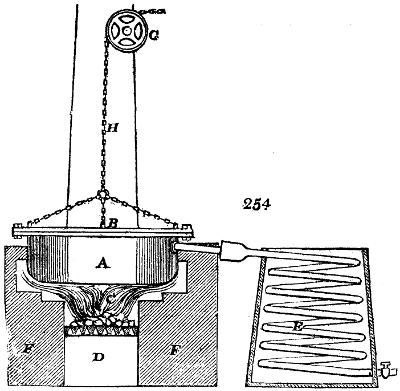
Mr. William Henry Barnard, in the course of some experiments upon the impregnation of ropes with caoutchouc, at the factory of Messrs. Enderby at Greenwich, discovered that when this substance was exposed to a heat of about 600° F. it resolved itself into a vapour, which, by proper refrigeratory methods, was condensable into a liquid possessing very remarkable properties, to which the name caoutchoucine has been given. For this invention “of a solvent not hitherto used in the arts” Mr. Barnard obtained a patent, in August, 1833. His process for preparing it is described in his specification as follows:—I take a mass of the said caoutchouc, or Indian rubber, as imported, and having cut it into small lumps, containing about two cubic inches each (which I prefer), I throw these lumps into a cast-iron still (which I find adapted for the purpose, and a diagram of which is annexed to, and forms part of, this my specification), with a worm attached; fig. 254., A is the still, B the cover ground to a metallic fit, to admit of a thermometer to take the temperature; C the fire-place, D the ash-pit, E the worm-tub and worm, F the brick-work of the still, G a roller and carriage, in conjunction with a crane, or other means, to raise the cover to take out the residue, and to charge the same; H the chain.
I then apply heat to the still in the usual manner, which heat is increased until the thermometer ranges at 600 degrees of Fahrenheit, or thereabouts. And, as the thermometer ranges progressively upwards to 600 degrees of Fahrenheit, a dark-coloured oil or liquid is distilled over, which I claim as my said invention, such liquid being a solvent of caoutchouc, and other resinous and oleaginous substances. When the thermometer reaches 600 degrees, or thereabouts, nothing is left in the still but dirt and charcoal.
I have found the operation of distillation to be facilitated by the addition of a portion of this oil, either previous or subsequent to rectification, as hereinafter mentioned, in the proportion of one third of oil to two thirds of caoutchouc.
I afterwards subject the dark-coloured liquid thus distilled to the ordinary process of rectification, and thereby obtain fluids varying in specific gravity, of which the lightest hitherto has not been under 670, taking distilled water at 1000, which fluids I also claim as my said invention.
At each rectification the colour of the liquid becomes more bright and transparent, until at the specific gravity of 680, or thereabouts, it is colourless and highly volatile.
In the process of rectification (for the purpose of obtaining a larger product of the oil colourless) I put about one third of water into the still. In each and every state the liquid is a solvent of caoutchouc, and several resinous and oleaginous substances, and also of other substances (such as copal), in combination with very strong alcohol.
Having experienced much difficulty in removing the dirt which adheres to the bottom of the still, I throw into the still, lead and tin in a state of alloy (commonly called solder), to the depth of about half an inch, and, as this becomes fused, the dirt which lies on the surface of it is more easily removed.
Objections have been made to the smell of this liquid:—I have found such smell removed by mixing and shaking up the liquid with nitro-muriatic acid, or chlorine, in the proportion of a quarter of a pint of the acid (of the usual commercial strength) to a gallon of the liquid.
The discovery of the chemical solvent, which forms the subject of the patent above described, has excited considerable interest in the philosophic world, not only from its probable usefulness as a new article of commerce, but also from two very extraordinary characteristics which it is found to possess, viz., that, in a liquid state, it has less specific gravity than any other liquid known to chemists, being considerably lighter than sulphuric ether, and, in a state of vapour, is heavier than the most ponderous of the gases.
Its elementary constituents are,
Carbon 6·812 8 proportions.
Hydrogen 1·000 7 ditto.
This new material (when mixed with alcohol) is a solvent of all the resins and particularly of copal, which it dissolves, without artificial heat, at the ordinary temperature of the atmosphere; a property possessed by no other solvent known; and hence it is peculiarly useful for making varnishes in general. It also mixes readily with oils, and will be found to be a valuable and cheap menstruum for liquefying oil-paints; and without in the slightest degree affecting the most delicate colours, will, from its ready evaporation, cause the paint to dry almost instantly.
Cocoa-nut oil, at the common temperature of the atmosphere, always assumes a concrete form; but a portion of this caoutchoucine mixed with it will cause the oil to become fluid, and to retain sufficient fluidity to burn in a common lamp with extraordinary brilliancy.
Caoutchoucine is extremely volatile; and yet its vapour is so exceedingly heavy, that it may be poured, without the liquor, from one vessel into another like water.
CAPERS. The caper is a small prickly shrub, cultivated in Spain, Italy, and the southern provinces of France. The flowers are large roses of a pretty appearance, but the flower buds alone are the objects of this cultivation.
They are plucked before they open, and thrown into strong vinegar slightly salted, where they are pickled. The crop of each day is added to the same vinegar tub, so that in the course of the six months during which the caper shrub flowers, the vessel gets filled, and is sold to persons who sort the capers, (the smallest being most valued) by means of copper sieves. This metal is attacked by the acid, wherefrom the fruit acquires a green colour, much admired by ignorant connoisseurs.
The capers, as found in the French market, are distinguished into five sorts; the non-pareille, the capucine, the capote, the second, and the third; this being the decreasing order of their quality, which depends upon the strength of the vinegar used in pickling them, as also the size and colour of the buds.
The caper shrub grows in the driest situations, even upon walls, and does not disdain any soil; but it loves a hot and sheltered exposure. It is multiplied by grafts made in autumn, as also by slips of the roots taken off in spring.
CAPSTAN. (Cabestan, Fr.; Spille, Germ.) A machine whereon the cable is wound successively in weighing the anchor of a vessel. It is a species of wheel and axle; the axle being vertical, and pierced with holes near its top for the insertion of the ends of horizontal levers, called handspikes, which represent the wheel. These are turned by the force of men moving in a circle. The power applied to the lever is to the resistance to be overcome, (the weight of the anchor, for example,) when the forces are in equilibrio, as the radius of the cylinder round which the cable is coiled is to the circumference described by the power.
It is manifest that the radius of the axle must be augmented in this computation by half the diameter of the cable, which is supposed to lie always one coil thick upon it. The force of a man, thus applied, has been commonly estimated as equal to the traction of 27 pounds hanging over a pulley.
Friction being so variable a quantity in capstans, renders the exact calculation of its mechanical effect somewhat uncertain.
A stout man, stationed near the bottom of the axle, holds fast the loose part of the cable, which has already made two or three turns; and, being aided by its friction upon the wood, he both prevents it from slipping backwards, and uncoils each turn as it is progressively made.
Mr. Hindmarsh, master mariner of Newcastle, obtained a patent, in February, 1827, for a contrivance to enable a capstan or windlass to be occasionally worked with increased mechanical advantage. With this view, he placed toothed wheel-work, partly in the drum-head of the capstan, and partly in the upper part of the barrel, upon which the cable is coiled and uncoiled in successive portions.
The drum-head, and also the barrel, turn loosely upon a central spindle, independent of each other, and are connected together either by the toothed geer, or by bolts. On raising or withdrawing the connecting pinion from the toothed wheels, and then locking the drum-head and barrel together, the capstan works with a power equal only to that exerted by the men at the capstan-bars, as an ordinary capstan; but on lowering the pinion into geer with the wheel-work, and withdrawing the bolts which locked the drum-head to the barrel, the power exerted by the men becomes increased in proportion to the diameter and numbers of teeth in the wheels and pinions.
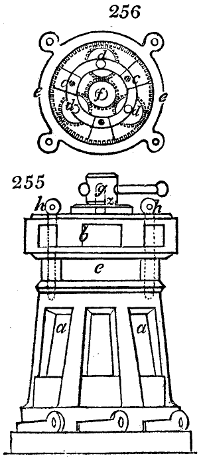
Fig. 255. is the external appearance of this capstan. Fig. 256. a horizontal view of the toothed geer at the top of the barrel. The barrel, with the whelps a a, turns loosely upon a verticle spindle fixed into the deck of the vessel. The drum-head b also turns loosely upon the same spindle. The circular frame c c, in fig. 256., in which the axes of the toothed wheels d d d are mounted, is fixed to the central spindle. The rim e e e, with internal teeth, is made fast to the top of the barrel; and the pinion f, which slides upon the spindle, is connected to the drum-head.
When it is intended to work the capstan with ordinary power, the pinion f is raised up into the recess of the drum-head, by means of a screw g, fig. 255., which throws it out of geer with the toothed wheels, and it is then locked up by a pin z: the bolts h h are now introduced, for the purpose of fastening the drum-head and barrel together, when it becomes an ordinary capstan.
But when it is required that the same number of men shall exert a greater power, the bolts h are withdrawn, and the pinion f lowered into geer, with the toothed wheels. The rotation of the drum-head, then carrying the pinion round, causes it to drive the toothed wheels d d d; and these working into the toothed rim e e, attached to the barrel, cause the barrel to revolve with an increased power.
Thus, under particular circumstances, a smaller number of men at the capstan or windlass (which is to be constructed upon the same principle) will be enabled to haul in the cable and anchor, or warp off the vessel, which is an important object to be effected.
In 1819, Captain Phillips obtained a patent for certain improvements in capstans, a part of which invention is precisely the same as this in principle, though slightly varied in its adaptation.
James Brown, ship-rigger, in his capstan, patented in 1833, instead of applying the moving power by handspikes, having fixed two rims of teeth round the top of the capstan, acts upon them by a rotatory worm, or pinions turned by a winch.
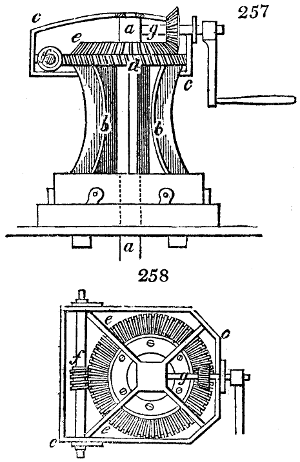
Fig. 257. is an elevation of this capstan, and fig. 258. is a horizontal top view. a is an upright shaft, fixed firmly to the deck, serving as an axle round which the body of the capstan revolves. A frame c, fixed to the top of a stationary shaft a, above the body of the capstan, carries the driving apparatus.
The upper part of the body of the capstan has a ring of oblique teeth d formed round its edge; and above this, on the top of the capstan, is a ring of bevel teeth e. A horizontal shaft f, mounted in the top frame c, has a worm or endless screw, which takes into the teeth of the ring d; and a short axle g, having its bearings in the central shaft a, and in the frame c, carries a bevel pinion, which takes into the bevel teeth of the ring c.
The bearings of the shaft f, in the top frame, are in long slots, with angular returns, something like the fastening of a bayonet, which is for the purpose of enabling the shaft to be readily lifted in and out of geer with the teeth of the ring d: the outer bearing of the axle g of the bevel pinion is also supported in the frame c, in a similar way, in order to put it in and out of geer with the teeth of the bevel ring e. A mode of shifting these is essential; because the two toothed rings, and their driving worm and pinion, give different speeds, and, of course, cannot be both in operation at the same time.
The worm of the shaft f, being placed in geer with the teeth of the ring d, on applying rotatory power thereto, by means of winches attached to the ends of the shaft, the barrel or body of the capstan will be made to revolve with a slow motion, but with great power; and thus two men at the winches will do the same work as many men with capstan bars in the ordinary way.
If a quicker movement than that of the endless screw is desired, then the driving power may be applied by a winch to the axle g of the bevel pinion, that pinion being put into geer with the bevel ring e, and the endless screw withdrawn. It should, however, be here remarked, that the patentee proposes to employ two short axles g, placed opposite to each other, with bevel pinions acting in the bevel-toothed ring, though only one is shown in the figure to avoid confusion. He also contemplates a modification of the same contrivance, in which four short axles g, placed at right angles, with pinions taking into a bevel ring, may be employed, and made effective in giving rotatory motion to the barrel of a capstan by means of winches applied to the outer ends of the axle, and turned by the labour of four men.
CARAT or CARACT is a weight used by goldsmiths and jewellers. See Assay and Diamond.
CARBON, (Carbone, Fr.; Kohlenstoff, Germ.) in a perfectly pure state, constitutes diamond. Carbonaceous substances are usually more or less compound, containing hydrogen, or sometimes oxygen, and azote, along with earthy and metallic matters. Carbon, tolerably pure, abounds in the mineral kingdom; and, in a combined state, it forms a main constituent of vegetable and animal bodies. Anthracite is a mineral charcoal, differing from common pit-coal in containing no bitumen, and, therefore, burning without flame or smoke. Coke is the carbonaceous mass which remains after pit-coal has been exposed to ignition for some time out of contact of air; its volatile parts having been dissipated by the heat. It is a spongy substance, of an iron-black colour, a somewhat metallic lustre, and does not easily burn unless several pieces are kindled together. With a good draught, however, it produces a most intense heat. Wood charcoal is obtained by the calcination of wood in close vessels, as described under the article Acetic Acid, or in piles of various shapes, covered with loam, to screen it from the free action of the atmosphere, which would otherwise consume it entirely. See Charcoal. Such carbon is a solid, without smell or taste, and bears the strongest heats of our furnaces without suffering any change, provided air be excluded: it is a bad conductor of heat, but conducts electricity very well. When burned, it unites with oxygen, and forms carbonic acid, the fixed air of Dr. Black, the choke-damp of the miner. When this carbonic acid is made to traverse red hot charcoal it dissolves a portion of it, and becomes carbonic oxide, which contains only one half of its volume of oxygen; whereas carbonic acid consists of one volume of oxygen combined with one volume of the vapour of carbon, the two being condensed into one volume. If the specific gravity of oxygen, = 1·1025, be deducted from that of carbonic acid, = 1·5245, the difference, = 0·422, will be the specific gravity of the vapour of carbon; as well as the proportion present in that weight of the acid.
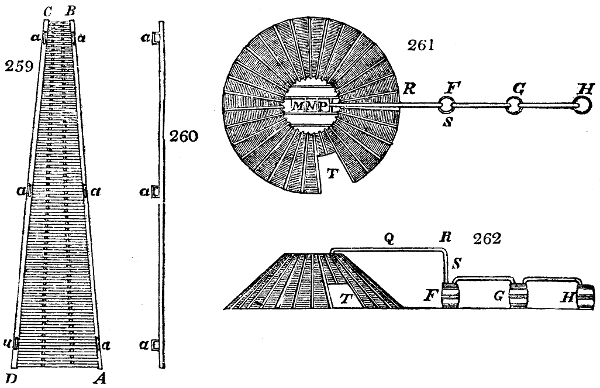
Charcoal obtained by the action of a rapid fire in close vessels is not so solid and so good a fuel as that which is made in the ancient way by the slow calcination of pyramidal piles covered with earth. One of the most economical ovens for making wood charcoal is that invented by M. Foucauld, which he calls a shroud, or abri. To construct one of these, 30 feet in diameter at the base, 10 feet at its summit, and from 8 to 9 feet high, he forms, with wood 2 inches square, a frame 12 feet long, 3 feet broad at one end, and one foot at the other. The figure will explain the construction. The uprights, A B and C D, of this frame are furnished with three wooden handles a a a, and a′ a′ a′, by means of which they can be joined together, by passing through two contiguous handles a wooden fork, the frame being previously provided with props, as shewn in fig. 259, and covered with loam mixed with grass. A flat cover of 10 feet diameter, made of planks well joined, and secured by four cross bars, is mounted with two trap doors, M N, fig. 261., for giving egress to the smoke at the commencement of the operation; a triangular hole P, cut out in the cover, receives the end of a conduit Q R S, (figs. 262. and 261.) of wood formed of three deals, destined to convey the gases and condensed liquids into the casks F G H. Lastly, a door T, which may be opened and shut at pleasure, permits the operator to inspect the state of the fire. The charcoal calcined by this abri, has been found to be of superior quality.
When it is wished to change the place where the abri is erected, and to transport it to a store of new-felled timber, the frame is taken down, after beating off the clay which covers it, the joints are then cut by a saw, as well as the ends of the forks which fixed the frames to one another. This process is economical in use, simple and cheap in construction; since all the pieces of the apparatus are easily moved about, and may be readily mounted in the forests. For obtaining a compact charcoal, for the use of artisans, this mixed process of Foucauld is said to be preferable to either the close iron cylinder or the pile.
For making gunpowder-charcoal the lighter woods, such as the willow, dogwood, and alder answer best; and in their carbonization care should be taken to let the vapours freely escape, especially towards the end of the operation, for when they are re-absorbed, they greatly impair the combustibility of the charcoal.
By the common process of the forests, about 18 per cent. of the weight of the wood is obtained; by the process of Foucauld about 24 per cent. are obtained, with 20 of crude pyrolignous acid of 10 degrees Baumé. By the process described under Acetic Acid, 27 of charcoal, and 18 of acid at 6 degrees, are procured from 100 parts of wood, besides the tar. These quantities were the results of careful experimenting, and are greater than can be reckoned upon in ordinary hands.
Charcoal for chemical purposes may be extemporaneously prepared by calcining pieces of wood covered with sand in a crucible, till no more volatile matter exhales.
The charcoal of some woods contains silica, and is therefore useful for polishing metals. Being a bad conductor of heat, charcoal is employed sometimes in powder to encase small furnaces and steam-pipes. It is not affected by water; and hence, the extremities of stakes driven into moist ground are not liable to decomposition. In like manner casks when charred inside preserve water much better than common casks, because they furnish no soluble matter for fermentation or for food to animalcules.
Lowitz discovered that wood charcoal removes offensive smells from animal and vegetable substances, and counteracts their putrefaction. He found the odour of succinic and benzoic acids, of bugs, of empyreumatic oils, of infusions of valerian, essence of wormwood, spirits distilled from bad grain, and sulphureous substances were all absorbable by freshly calcined charcoal properly applied. A very ingenious filter has been constructed for purifying water, by passing it through strata of charcoal of different fineness.
When charcoal is burned, one third of the heat is discharged by radiation, and two thirds by conduction.
The following table of the quantity of charcoal yielded by different woods was published by Mr. Mushet, as the result of experiments carefully made upon the small scale. He says, the woods before being charred were thoroughly dried, and pieces of each kind were selected as nearly alike in every respect as possible. One hundred parts of each sort were taken, and they produced as under:—
Lignum Vitæ afforded 26·0 of charcoal of a greyish colour, resembling coke.
Mahogany 25·4 tinged with brown, spongy and porous.
Laburnam 24·5 velvet black, compact, very hard.
Chesnut 23·2 glossy black, compact, firm.
Oak 22·6 black, close, very firm.
Walnut 20·6 dull black, close, firm.
Holly 19·9 dull black, loose and bulky.
Beech 19·9 dull black, spongy, firm.
Sycamore 19·7 fine black, bulky, moderately firm.
Elm 19·5 fine black, moderately firm.
Norway Pine 19·2 shining black, bulky, very soft.
Sallow 18·4 velvet black, bulky, loose and soft.
Ash 17·9 shining black, spongy, firm.
Birch 17·4 velvet black, bulky, firm.
Scottish Pine 16·4 tinged with brown, moderately firm.
Messrs. Allen and Pepys, from 100 parts of the following woods, obtained the quantities of charcoal as under:—
Beech 15·00
Mahogany 15·75
Lignum Vitæ 17·25
Oak 17·40
Fir 18·17
Box 20·25
It is observable that the quantities obtained by Messrs. Allen and Pepys are in general less than those given by Mr. Mushet, which may be owing to Mr. Mushet not having applied sufficient heat, or operated long enough, to dissipate the aqueous matter of the gaseous products.
To those persons who buy charcoal by weight, it is important to purchase it as soon after it is made as possible, as it quickly absorbs a considerable portion of water from the atmosphere. Different woods, however, differ in this respect. Messrs. Allen and Pepys found that by a week’s exposure to the air, the charcoal of
Lignum Vitæ gained 9·6 per cent.
Fir 13·0 ditto.
Box 14·0 ditto.
Beech 16·3 ditto.
Oak 16·5 ditto.
Mahogany 18·0 ditto.
The following is a tabular view of the volumes of the different gases which were absorbed in the course of 24 hours, by one volume of charcoal, in the experiments of M. Theodore de Saussure, which were conducted in a way likely to produce correct results. Each portion of charcoal was heated afresh to a red heat, and allowed to cool under mercury. When taken from the mercury, it was instantly plunged into the vessel of gas.
Ammoniacal gas 90
Muriatic acid gas 85
Sulphurous acid 65
Sulphuretted hydrogen 55
Nitrous oxide 40
Carbonic acid gas 35
Bicarburetted hydrogen 35 ·00
Carbonic oxide 9 ·42
Oxygen gas 9 ·25
Nitrogen 7 ·50
Carburetted hydrogen 5 ·00
Hydrogen gas 1 ·75
Neumann, who made many experiments on charcoal, informs us that for the reduction of the metallic oxides, the charcoal of the heavier woods, as that of the oak and the beech, is preferable, and that, for common fuel, such charcoal gives the greatest heat, and requires the most plentiful supply of air to keep it burning; while those of the lighter woods preserve a glowing heat with a much less draught of air; and that for purposes where it is desirable to have a steady and a still fire, charcoal should be employed which has been made from wood previously divested of its bark, since it is the cortical part which crackles and flies off in sparks during combustion, while the coal of the wood itself seldom does.
For making crayons of charcoal, the willow is the best wood that can be employed, as the softness is uniform in all its parts. Its durability may be seen in several of our old churchyards, where the letters made with lamp-black are still perfect, though the white lead with which the body of the stones was painted is entirely destroyed.
This property of carbon is shewn, however, in a more striking manner by the writings that were found in the ruins of Herculaneum, which have retained their original blackness for two thousand years. The ancients wrote with ink made from ground charcoal.
If it be required to purify any carbonaceous matter, to render it fitter for delicate pigments, this may be done by first calcining it in a close vessel, and then lixiviating it in water slightly acidulated by nitric acid.
The incorruptibility of charcoal was well known to the ancients, and they availed themselves of this property upon all important occasions.
About sixty years ago a quantity of oak stakes were found in the bed of the Thames, in the very spot where Tacitus says that the Britons fixed a vast number of such stakes, to prevent the passage of Julius Cæsar and his army. These stakes were charred to a considerable depth, had retained their form completely, and were firm at the heart.
Most of the houses in Venice stand upon piles of wood, which have all been previously charred for their preservation. In this country, estates were formerly marked out by charred stakes driven to a considerable depth into the ground. See Bone-black, Charcoal, and Graphite.
CARBONATED WATER, is water either pure, or holding various saline matters in solution, impregnated with carbonic acid gas. For general sale in this country, the water usually contains a little soda, which being charged with the gas, is called Soda water; see this article for a description of an excellent machine for the manufacture of this fashionable beverage.
CARBONATES. Saline compounds in definite proportions, of carbonic acid, with alkalis, earths, and the ordinary metallic oxides.
The carbonates principally used in the arts and manufactures are those of ammonia, copper, iron, lead, lime, magnesia, potash, soda. Native carbonate of copper is the beautiful green mineral called Malachite.
Carbonates are easily analyzed by estimating either by weight or measure the quantity of carbonic acid which they evolve under the decomposing action of somewhat dilute sulphuric, nitric, or muriatic acid; for as they are all compounds of acid, and base in equivalent proportions, the quantity of acid will indicate the quantity of base. Thus, as pure limestone consists of 56 of lime and 44 of acid, in 100 parts, if upon examining a sample of limestone we find it to give out only 22 per cent. of carbonic acid gas, during its slow solution in muriatic acid, we are sure that there are only 28 parts of lime present. I have described, in the Annals of Philosophy, for October, 1817, a simple form of apparatus for analyzing the carbonates with equal readiness and precision. The simple rule by measure to which I was led, may be thus stated: From the bulk of evolved gas, expressed in cubic inches and tenths, deduct 1⁄20, the remainder will express the proportion of real limestone present in the grains employed. Pure magnesian limestone yields very nearly a cubic inch of the gas for every grain in weight.
CARBONATE OF AMMONIA. A salt called in modern chemistry sesquicarbonate, to denote its being composed of one and a half equivalent primes of carbonic acid, and one of ammonia. It consists by my analysis of 55·89 carbonic acid, 28·86 ammonia, and 15·25 water, in 100 parts. It is generally prepared by mixing from 11⁄4 to 11⁄2 parts of well-washed dry chalk, with 1 of sal-ammoniac, introducing the mixture into an earthen or cast-iron retort, or subliming pot, and exposing it to a heat gradually raised to redness. By double decomposition, the ammonia is volatilized in combination with the carbonic acid of the chalk, and the vapours are received in a condensing receiver made either of glass, stone ware, or lead. The chlorine of the sal-ammoniac remains in the retort, associated with the basis of the chalk in the state of chloride of calcium. Some ammonia gas escapes during the process.
The saline mass thus sublimed is purified by a second sublimation in glass, or salt-glazed earthen vessels. The salt may be obtained, by the above method carefully conducted, in rhomboidal octahedrons, but it is generally made for the market in a compact semi-crystalline white cake. It has a pungent ammoniacal smell, a hot, pungent, alkaline taste, a strong alkaline reaction, and dissolves in two parts of cold water. It must be kept in well-closed vessels, as by exposure to the air a portion of its ammonia exhales, and it passes into the state of the scentless bi-carbonate. It is employed much in medicine, chemical analysis, and by the pastry-cooks to give sponginess to their cakes in consequence of its volatilization from their dough in the oven. See Sal-Ammoniac.
For the other carbonates used in the arts, see their respective bases; copper, lead, lime, &c.
CARBONIC ACID (Acide carbonique, Fr.; Kohlensäure, Germ.), consists of 1 prime equivalent of carbon = 6·125 + 2 of oxygen = 16·026, whose joint sum = 22·151, represents the atomic weight or combining ratio of this acid, in the neutral or protocarbonate salts. Its composition by volume is stated under Carbon. Its natural form is a gas, whose specific gravity is 1·5245, compared to atmospheric air 1·000; and being so dense, it may be poured out of one vessel into another. Hence it was called at first aërial acid. From its existing copiously, in a solid state, in limestones and the mild alkalies, it was styled fixed air by its proper discoverer, Dr. Black. About one volume of it exists in 1000 volumes of common atmospheric air, which may be made manifest by the crust of carbonate it occasions upon the surface of lime water. Carbonic acid gas is found accumulated in many caverns of volcanic districts, and particularly in the grotto dei cani at Pausilippo, near Puzzuoli; being disengaged in such circumstances by the action of subterranean fire, and, possibly, of certain acids, upon the limestone strata. It often issues from fountains in copious currents, as at Franzensbrunn, near Eger, in Polterbrunnen; near Trier; and Byrreshorn. This acid gas occurs also frequently in mines and wells, being called choke damp, from its suffocating quality. Its presence may, at all times, be detected, by letting down a lighted candle, suspended from a string, into the places suspected of containing this mephitic air. It exists, in considerable quantities, in the water of every pump well, and gives it a fresh and pleasant taste. Water, exposed some time to the air, loses these aerial particles, and becomes vapid. Many springs are highly impregnated with carbonic acid gas, and form a sparkling beverage; such as the Selterswasser, from Selters upon the Lahn, in the grand duchy of Nassau; of which no less than two millions and a half of bottles are sold every year. A prodigious quantity of a similar water is also artificially prepared in Great Britain, and many other countries, under the name of aërated or soda water.
Carbonic acid occurs in nature, combined with many salifiable bases; as in the carbonates of soda, baryta, strontia, magnesia; the oxides of iron, manganese, zinc, copper, lead, &c. From these substances it may be separated, generally speaking, by strong ignition, or, more readily, by the superior affinity of muriatic, sulphuric, or nitric acid, for the earth or metallic oxide. It is formed whenever vegetable or animal substances are burned with free access of air, from the union of their carbonaceous principle with atmospheric oxygen. It is also formed in all cases of the spontaneous decomposition of organic substances, particularly in the process of fermentation; and constitutes the pungent, noxious, heavy gas thrown off, in vast volumes, from beer vats. See Distillation and Fermentation. Carbonic acid is also generated in the breathing of animals; from 4 to 5 per cent., in volume, of the inhaled oxygen being converted, at each expiration, into this gas, which contaminates the air of crowded apartments, and renders ventilation essential to health, and even to life: witness the horrible catastrophe of the Black-hole at Calcutta.
Carbonic acid gas is destitute of colour, has a sourish, suffocating smell, an acidulous pungent taste, imparts to moist, but not dry, litmus paper, a transient reddish tint, and weighs per 100 cubic inches, 461⁄2 grains; and per cubic foot, 8031⁄2 grains; a little more than 33⁄4 oz. avoirdupoid. A cubic foot of air weighs about two thirds of that quantity, or 527 grains. It may be condensed into the liquid state by a pressure of 40 atmospheres, and this liquid may be then solidified by its own sudden spontaneous evaporation. If air contain more than 15 per cent. in bulk of this gas, it becomes unfit for respiration and combustion, animal life and candles being speedily extinguished by it.
Before a person ventures into a deep well, or vault containing fermenting materials, he should introduce a lighted candle into the space, and observe how it burns. Carbonic acid, being so much denser than common air, may be drawn out of cellars or fermenting tubs, by a pump furnished with a leather hose, which reaches to the bottom. Quicklime, mixed with water, may be used also to purify the air of a sunk apartment by its affinity for, or power of, absorbing this aërial acid. See Mineral Waters and Soda Water.
CARBONIC OXIDE. See the article Carbon.
CARBUNCLE. A gem highly prized by the ancients; most probably a variety of the noble garnet of modern mineralogists.
CARBURET OF SULPHUR, called also sulphuret of carbon, and alcohol of sulphur, is a limpid volatile liquid, possessing a penetrating fetid smell, and an acrid burning taste. Its specific gravity is 1·265; and its boiling point is about 112° Fahr. It evaporates so readily, and absorbs so much heat in the vaporous state, that if a tube containing quicksilver, surrounded with lint dipped in this liquid, be suspended in the receiver of an air-pump, on making the vacuum, the quicksilver will be congealed. It consists of 15·8 carbon and 84·2 sulphur, in 100 parts; being two equivalent primes of the latter to one of the former.
CARBURETTED HYDROGEN. A compound of carbon and hydrogen, of which there are several species—such as oil-gas, coal-gas, olefiant gas, oil of lemons, otto of roses, oil of turpentine, petroleum, naphta, naphthaline, oil of wine, caoutchoucine and caoutchouc.
CARDS, PLAYING. (Cartes à jouer, Fr.; Karten, Germ.) Mr. de la Rue obtained, in February, 1832, a patent for certain improvements in the manufacture of playing cards, which he distributed under three heads: first, printing the pips, and also the picture or court-cards, in oil colours by means of types or blocks; secondly, effecting the same in oil colours by means of lithography; and thirdly, gilding or silvering borders, and other parts of the characters, by the printing process, either by types, blocks, or lithography.
In the ordinary mode of manufacturing playing cards, their devices are partly produced by copperplate printing, and they are filled up with water colours by the means called stencilling.
The patentee does not propose any material alteration in the devices or forms upon the cards, but only to produce them with oil colours; and, to effect this, he follows precisely the same mode as that practised by calico printers.
A set of blocks or types properly devised, are produced for printing the different pips of hearts, diamonds, spades, and clubs, or they are drawn, as other subjects, in the usual way upon stone. The ink or colour, whether black or red, is to be prepared from the best French lamp-black, or the best Chinese vermillion ground in oil, and laid on the types and blocks, or on the stone, in the same way as printers’ ink, and the impressions taken-on to thick drawing paper by means of a suitable press in the ordinary manner of printing.
The picture or court-cards are to be produced by a series of impressions in different colours, fitting into each other exactly in the same way as in printing paper hangings, or silks and calicoes, observing that all the colours are to be prepared with oil.
For this purpose a series of blocks or types are to be provided for each subject, and which, when put together, will form the whole device. These blocks are to be used separately, that is, all the yellow parts of the picture, for instance, are to be printed at one impression, then all the red parts, next all the flesh colour, then the blue portions, and so on, finishing with the black outlines, which complete the picture.
If the same is to be done by lithography, there must be as many stones as there are to be colours, each to print its portion only; and the impression, or part of the picture given by one stone, must be exactly fitted into by the impression given from the next stone, and so on until the whole subject is complete.
A superior kind of card is proposed to be made, with gold or silver devices in parts of the pictures, or gold or silver borders round the pips. This is to be effected by printing the lines which are to appear as gold or silver, with gilders’ size, in place of ink or colour; and immediately after the impression has been given, the face of the card is to be powdered over with gold dust, silver, or bronze, by means of a soft cotton or wool dabber, by which the gold, silver, or bronze will be made to adhere to the picture, and the superfluous portions of the metal will wipe off by a very slight rubbing. When the prints are perfectly dry, the face of the card may be polished by means of a soft brush.
If it should be desirable to make these improved cards to resemble ivory, that may be done by preparing the face of the paper in the first instance with a composition of size and fine French white, and a drying oil, mixed together to about the consistence of cream; this is to be washed over the paper, and dried before printing, and when the cards are finished, they will exactly resemble ivory.
The only thing remaining to be described, is the means by which the successive impressions of the types, blocks, or stones forming the parts of the pictures, are to be brought exactly to join each other, so as to form a perfect whole design when complete; this is by printers called registering, and is to be effected much in the usual way, by points in the tympan of the press, or by marks upon the stones.
The parts of the subject having been all accurately cut or drawn to fit, small holes are to be made with a fine awl through a quire or more of the paper at once, by placing upon the paper a gauge-plate, having marks or guide-holes, and by observing these, the same sheet laid on several times, and always made to correspond with the points or marks, the several parts of the picture must inevitably register, and produce a perfect subject.
CARD CUTTING. Mr. Dickinson’s patent machine for cutting cards, consists of a pair of rollers with circular revolving cutters, the edges of which are intended to act against each other as circular shears, and the pasteboards in passing between these rollers are cut by the circular shears into cards of the desired dimensions. These rollers are mounted in suitable standards, with proper adjustments, and are made to revolve by a band and pulley connected to the axle of a crank, or by any other convenient means.
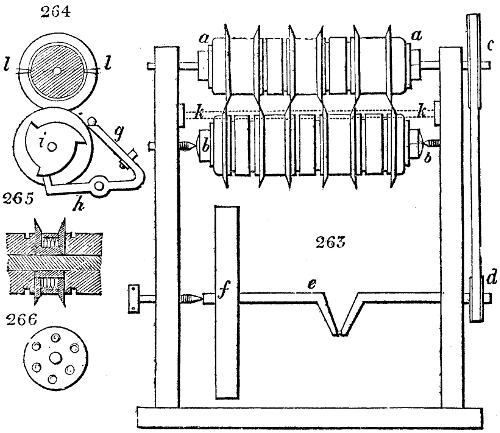
Fig. 263. is a front view of this machine; a a and b b are the two rollers, the upper one turning upon an extended axle, bearing in the standards, the lower one upon pivots. These rollers are formed by a series of circular blocks, between a series of circular steel cutters, which are slidden on to iron shafts, and held together upon their axle by nuts screwed up at their ends. The accurate adjustment of the cutters is of the first importance to their correct performance; it is therefore found necessary to introduce spiral springs within the blocks, in order to press the cutters up to their proper bearings. A section of one of the blocks is shewn at fig. 265, and an end view of the same at fig. 266, with the spiral springs inserted.
At the outer extremity of the axle of the roller a, a rigger c, is attached, whence a band passes to a pulley d, on the crank shaft e, to which a flywheel f, is affixed, for the purpose of rendering the action uniform. Rotatory motion being given to the crank shaft, the upper roller is turned, the lower roller moving at the same time by the friction against the edges of the cutters.
Fig. 264 is an end view of the rollers, showing the manner in which the pasteboards are guided and conducted between the cutters. In the front of the machine a movable frame g, is to be placed, for the purpose of receiving the pasteboards, preparatory to cutting them into cards, and a stop is screwed to this frame for the edge of the pasteboard to bear against, which stop is adjustable to suit different sizes. From the back part of this frame an arm h, extends, the extremity of which acts against the periphery of a ratchet wheel i, fixed at the end of the roller b, and hence, as the roller goes round, the frame is made to rise and fall upon its pivots, for the purpose of guiding the pasteboard up to the cutters; at the same time a rod k, hanging in arms from the sides of the standards (shewn by dots in fig. 263), falling upon the pasteboard, confines it, while the cutters take hold, and racks, corresponding with the indentations of the rollers, are placed as at l l, by means of which the cards, when cut, are pushed out of the grooves.
As various widths of cards will require to be cut by this machine, the patentee proposes to have several pairs of rollers ready adjusted to act together, when mounted in the standards, in preference to shifting the circular cutters, and introducing blocks of greater or less width.
The second part of the invention is a machine for pasting the papers, and pressing the sheets together to make pasteboard. This machine consists of several reels (we suppose rollers are intended) on which the paper is to be wound, along with a paste trough, and rotatory brushes. The several parts of this machine, and their operations in making pasteboard, are described in the specification, but the patentee having omitted the letters of reference in the drawing which he has enrolled, it becomes difficult to explain it.
As far as we are enabled to understand the machine, it appears, that damped paper is to be wound upon two rollers, and conducted from thence over two other rollers; that two fluted rollers revolving in the paste trough are to supply paste to two circular brushes, and that by those brushes the papers are to be pasted upon one side, and then pressed together, to make the pasteboard; after this, the pasteboard is to be drawn on to a table, and to remain there until sufficiently dry to be wound upon other rollers. By comparing this description with the figure, perhaps the intended operations of the machine may be discovered, it is the best explanation we are enabled to give.
CARDS, (Cardes, Fr.; Karden, Ger.) are instruments which serve to disentangle the fibres of wool, cotton, or other analogous bodies, to arrange them in an orderly lap or fleece, and thereby prepare them for being spun into uniform threads. The fineness and the levelness of the yarn, as well as the beauty of the cloth into which it enters, depend as much upon the regularity and perfection of the carding, as upon any subsequent operations of the factory. The quality of the carding depends more upon that of the cards than upon any attention or skill in the operative; since it is now nearly an automatic process, conducted by young women called card-tenters.
Cards are formed of a sheet or fillet of leather pierced with a multitude of small holes, in which are implanted small staples of wire with bent projecting ends called teeth. Thus every piece of wire is double toothed. The leather is afterwards applied to a flat or cylindrical surface of wood or metal, and the co-operation of two or more such surfaces constitutes a card. The teeth of cards are made thicker or slenderer, according as the filaments to be carded are coarser or finer, stiffer or more pliant, more valuable or cheaper. It is obviously of great importance that the teeth should be all alike, equably distributed, and equally inclined over the surface of the leather, a degree of precision which is scarcely possible with handwork. To judge of the difficulty of this manipulation we need only inspect the annexed figures. The wire must first be bent at right angles in c and d, fig. 268, then each branch must receive a second bend in a and b at a determinate obtuse angle, invariable for each system of cards. It is indispensable that the two angles c a e and d b f be mathematically equal, not only as to the twin teeth of one staple, but through the whole series; for it is easy to see that if one of the teeth be more or less sloped than its fellow, it will lay hold of more or less wool than it, and render the carding irregular. But though the perfect regularity of the teeth be important, it is not the sole condition towards making a good card. It must be always kept in view that these teeth are to be implanted by pairs in a piece of leather, and kept in it by the cross part c d. The leather must therefore be pierced with twin holes at the distance c d; and pierced in such a manner, that the slope of the holes, in reference to the plane of the leather, be invariably the same; for otherwise the length of the teeth would vary with this angle of inclination, and the card would be irregular.
A third condition essential towards producing perfect regularity, is that the leather ought to be of the same thickness throughout its whole surface, otherwise the teeth, though of the same length and fixed at the same angle, would be rendered unequal by the different thicknesses of the leather, and the operation of carding would be in consequence extremely defective. Fig. 267. shows the card-teeth acting against each other, as indicated by the arrows in two opposite directions; in fig. 269. they work one way.
Of late years very complex but complete and well-acting machines have been constructed for splitting the leather or equalizing it by shaving, for bending and cutting the wires, and implanting them in the leather, into holes pierced with perfect regularity. Card machines which fashion the teeth with great precision and rapidity, and pierce the leather, have been for a considerable time in use at Halifax, in Yorkshire, a town famous for the excellence of its card-cloth, as also at Leeds, Glasgow, and several other places. The wires and the leather thus prepared are given out by the manufacturer to women and children, who put them together.
1. The simplest machine for equalizing the leather which can be employed, is that which I saw operating in MM. Scrive’s automatic card factory at Lille, the most magnificent I believe in the world, where the leather was drawn forwards by a roller over a solid horizontal table, or bed, and passed under a nicely adjusted vertical blade, which shaved it by a scraping motion to a perfectly uniform thickness. About one half the weight of the leather is lost in this process, and in the subsequent squaring and trimming.
The machine for making cards, invented I believe by a Mr. Ellis of the United States, for which a first patent was obtained in this country by Joseph Cheeseborough Dyer, Esq. of Manchester, in 1811, and a second and third with further improvements in 1814, and 1824, is one of the most elegant automatons ever applied to productive industry. It is however necessarily so complicated with different mechanisms as to render its representation impracticable in such engravings as are compatible with the scope of this dictionary. I must therefore content myself with the following general description of its constituent parts.