C. (continued 7)
Reading edition
When two veins intersect each other, the direction of the one thrown out becomes an object of interest to the miner and geologist. In Saxony it is regarded as a general fact that the rejected portion is always to the side of the obtuse angle; this also holds generally in Cornwall, and the more obtuse the angle of incidence, the more considerable the out-throw.
The great copper vein of Carharack, in the parish of Gwenap, is a most instructive example of intersection. The power of this vein is 8 feet; it runs nearly from east to west, and dips towards the north at an inclination of 2 feet in a fathom. Its upper part is in the killas, its lower part in the granite. The vein has suffered two intersections; the first results from encountering the vein called Steven’s fluckan, which runs from north-east to south-west, throwing it out several fathoms. The second has been caused by another vein, almost at right angles to the first, and which has driven it 20 fathoms out to the right side. The fall of the vein occurs, therefore, in one case to the right, and in the other to the left; but in both instances, it is to the side of the obtuse angle. This disposition is very singular; for one portion of the vein appears to have ascended, while another has sunk.
The mining works in the copper veins are carried on by reverse steps; see Mines. The grand shafts for drainage and extraction are vertical, and open upon the roof side of the vein, traversing it to a certain depth. These pits are sunk to the lowest point of the exploration; and, in proportion as the workings descend, by means of excavations in the vein, the pits are deepened and put into communication towards their bottom with each new gallery of elongation, by means of transverse galleries. At present, the main shafts are fully 160 fathoms deep. Their horizontal section is oblong, and is divided into two compartments; the one destined for extraction, the other for the pumps. Their timbering has nothing remarkable, but is executed with every attention to economy, the whole wood employed in these mines being brought from Norway.
The descent of the workmen is effected by inclined shafts scooped out of the vein; the ladders are slightly inclined; they are interrupted every 10 fathoms by floors; the steps are made of iron, and, to prevent them from turning under the foot, the form of a miner’s punch or jumper has been given them, the one end being round, and the other being wedge-shaped.
The ore is raised either by means of horse-gins, or by steam-engine power most frequently of high pressure. I shall take the Consolidated Mines as an example.
The draining, which is one of the most considerable sources of expense, both from the quantity of water, and from the depth of the mine, is executed by means of sucking and forcing pumps, the whole piston-rods of which, 120 feet long, are attached to a main-rod suspended at the extremity of the working beam of a steam-engine.
On this mine three steam-engines are erected of very great power, for the purpose of drainage; the one called the Maria engine is of the first-rate force, and most improved construction. The cylinder is 90 inches in internal diameter, and the length of the stroke is 9 feet 11 inches. It works single stroke, and is encased in a coating of bricks to prevent dissipation of the heat. The vapour is admitted at the upper end of the cylinder during the commencement of the fall of the piston, at a pressure capable of forming an equilibrium with a column of 60 inches of mercury. The introduction of the steam ceases whenever the piston has descended through a certain space, which may be increased or diminished at pleasure. During the remainder of the descent the piston is pressed merely by this vapour in its progressive expansion, while the under side of the piston communicates with the condenser. It ascends by the counterweight at the pump end of the working beam. Hence, it is only during the descent of the piston, that the effective stroke is exerted. Frequently the steam is admitted only during the sixth part of the course of the piston, or 18 inches. In this way the power of the engine is proportioned to the work to be done; that is, to the body of water to be raised. The maximum force of the above engine is about 310 horses; though it is often made to act with only one third of this power.
The copper mines of the isle of Anglesey, those of North Wales, of Westmoreland, the adjacent parts of Lancashire and Cumberland, of the south west of Scotland, of the Isle of Man, and of the south east of Ireland, occur also in primitive or transition rocks. The ores lie sometimes in masses, but more frequently in veins. The mine of Ecton in Staffordshire, and that of Cross-gill-burn, near Alston-moor in Cumberland, occur in transition or metalliferous limestone.
The copper ores extracted both from the granitic and schistose localities, as well as from the calcareous, are uniformly copper pyrites more or less mixed with iron pyrites; the red oxide, carbonate, arseniate, phosphate, and muriate of copper, are very rare in these districts.
The working of copper in the isle of Anglesey may be traced to a very remote era. It appears that the Romans were acquainted with the Hamlet mine near Holyhead; but it was worked with little activity till about 70 years ago. This metalliferous deposit lies in a greenish clay slate, passing into talc slate; a rock associated with serpentine and euphotide (gabbro of Von Buch). The veins of copper are from one to two yards thick; and they converge towards a point where their union forms a considerable mass of ore. On this mass the mine was first pierced by an open excavation, which is now upwards of 300 feet deep, and appears from above like a vast funnel. Galleries are formed at different levels upon the flank of the excavation to follow the several small veins, which run in all directions, and diverge from a common centre like so many radii. The ore receives in these galleries a kind of sorting, and is raised by means of hand windlasses, to the summit of a hill, where it is cleaned by breaking and riddling.
The water is so scanty in this mine that it is pumped up by a six-horse steam-engine. A great proportion of it is charged with sulphate of copper. It is conveyed into reservoirs containing pieces of old iron; the sulphate is thus decomposed into copper of cementation. The Anglesea ore is poor, yielding only from 2 to 3 per cent. of copper: a portion of its sulphur is collected in roasting the ore.
Mechanical preparation of the copper ores in Cornwall.—The ore receives a first sorting, either within the mine itself, or at its mouth, the object of which is to separate all the pieces larger than a walnut. These are then reduced by the hammer to a smaller size; after which the whole are sorted into four lots, according to their relative richness. The fragments of poor ore are pounded in the stamps so that the metallic portion may be separated by washing.
The rich ore is broken into small bits, of the size of a nut, with a flat beater, formed of a piece of iron 6 inches square and 1 inch thick, adapted to a wooden handle. The ore to be broken is placed upon plates of cast-iron; each about 16 inches square and 11⁄2 inch thick. These iron plates are set towards the edge of a small mound about a yard high, constructed with dry stones rammed with earth. The upper surface of this mound is a little inclined from behind forwards. The work is performed by women, each furnished with a beater; the ore is placed in front of them beyond the plates; they break it, and strew it at their feet, whence it is lifted and disposed of to the smelting-houses.
Inferior ores, containing a notable proportion of stony matters, are also broken with the beater, and the rich parts are separated by riddling and washing from the useless matters.
The smaller ore is washed on a sieve by shaking it in a stream of water, which carries away the lighter stony pieces, and leaves the denser metalliferous. They are then sorted by hand. Thus by beating, stamping, and riddling in water, the stony substances are in a great measure separated. The finer ground matter is washed on a plane table, over which a current of water is made to flow. Finally, the ore nearly fine is put into a large tub with water, and briskly stirred about with a shovel, after which it settles in the order of richness, the pure metallic ore being nearest the bottom. The stamps used for copper ore in Cornwall are the same as those used for tin ores, of which we shall speak in treating of the latter metal, as well as of the boxes for washing the fine powder or slime. These in fact do not differ essentially from the stamping mills and washing apparatus described in the article Metallurgy. Crushing rolls are of late years much employed. See Lead and Tin.
Cornwall being destitute of coal, the whole copper ore which this county produces is sent for smelting to South Wales. Here are 15 copper works upon the Swansea and Neath, which pursue a nearly uniform and much improved process, consisting in a series of calcinations, fusions, and roastings, executed upon the ores and the matters resulting from them.
The furnaces are of the reverberatory construction; they vary in their dimensions and in the number of their openings, according to the operations for which they were intended. There are 5 of them:—1. The calcining furnace or calciner; 2. The melting furnace; 3. The roasting furnace or roaster; 4. The refining furnace; 5. The heating or igniting furnace.
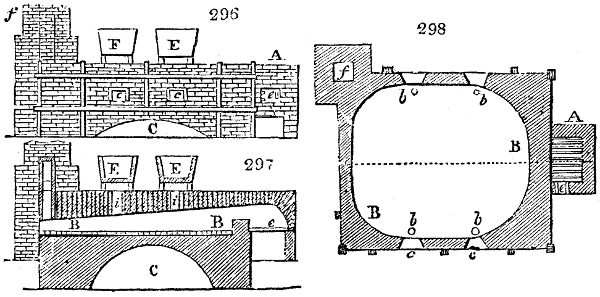
1. The calcining furnace rests upon a vault, C, into which the ore is raked down after being calcined; it is built of bricks, and bound with iron bars, as shown in the elevation, fig. 296. The hearth, B B, figs. 296. and 298. is placed upon a level with the lower horizontal binding bar, and has nearly the form of an ellipse, truncated at the two extremities of its great axis. It is horizontal, bedded with fire-bricks set on edge, so that it may be removed and repaired without disturbing the arch upon which it reposes. Holes, not visible in the figure, are left in the shelves before each door, c c, through which the roasted ore is let fall into the subjacent vault. The dimensions of the hearth B B are immense, being from 17 to 19 feet in length, and from 14 to 16 in breadth. The fire-place, A, fig. 298., is from 41⁄2 to 5 feet long, and 3 feet wide. The bridge or low wall, b, fig. 302., which separates the fire-place from the hearth, is 2 feet thick; and in Mr. Vivian’s smelting-works is hollow, as shown in the figure, and communicates at its two ends with the atmosphere, in order to conduct a supply of fresh air to the hearth of the furnace. This judicious contrivance will be described in explaining the roasting operation. The arched roof of the furnace slopes down from the bridge to the beginning of the chimney, f, fig. 296, 298., its height above the hearth being at the first point about 26 inches, and from 8 to 12 at the second.
Such great calcining furnaces have 4 or 5 doors, c c c c, fig. 298., one for the fire-place, as shown at the right hand in fig. 297., and 3 or 4 others for working the ore upon the reverberatory hearth. If there be 3, 2 of them are placed between the vertical binding bars upon one side, and a third upon the opposite side of the furnace; if there be 4, 2 are placed upon each side, facing one another. These openings are 12 inches square, and are bound with iron frames. The chimney is about 22 feet high, and is placed at one angle of the hearth, as at f, fig. 298., being joined by an inclined flue to the furnace.
For charging it with ore there is usually placed above the upper part of the vault 2 hoppers, E E, in a line with the doors; they are formed of 4 plates of iron, supported in an iron frame. Beneath each of them there is an orifice for letting the ore down into the hearth.
These furnaces serve for calcining the ore, and the matts or crude coppers: for the latter purpose, indeed, furnaces of two stories are sometimes employed, as represented in fig. 301. The dimensions of each floor in this case are a little less than the preceding. Two doors, c c, correspond to each hearth, and the workmen, while employed at the upper story, stand upon a raised movable platform.
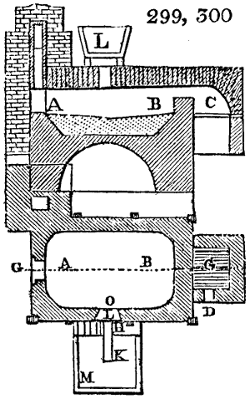
2. Melting furnace, figs. 299 and 300.—The form of the hearth is also elliptical, but the dimensions are smaller than in the calcining furnace. The length does not exceed 11 or 111⁄2 feet, and the breadth varies from 7 to 8. The fire-place is however larger in proportion, its length being from 31⁄2 feet to 4, and its breadth from 3 to 31⁄2; this size being requisite to produce the higher temperature of this furnace. It has fewer openings, there being commonly three; one to the fire-place at D, a second one, O, in the side, kept generally shut, and used only when incrustations need to be scraped off the hearth, or when the furnace is to be entered for repairs; and the third or working-door, G, placed on the front of the furnace beneath the chimney. Through it the scoriæ are raked out, and the melted matters are stirred and puddled, &c.
The hearth is bedded with infusible sand, and slopes slightly towards the side door, to facilitate the discharge of the metal. Above this door there is a hole in the wall of the chimney (fig. 300.) for letting the metal escape. An iron gutter, O, leads it into a pit, K, bottomed with an iron receiving-pot, which may be lifted out by a crane. The pit M is filled with water, and the metal becomes granulated as it falls into the receiver. The melting furnaces are surmounted by a hopper, L, as shown in fig. 299.
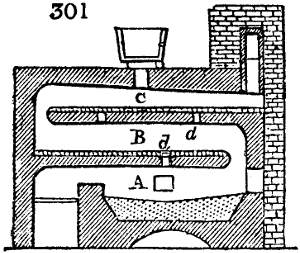
Melting furnaces are sometimes used also for calcination. There are some such near Swansea, which serve this double purpose; they are composed of 3 floors (fig. 301.) The floor A is destined for melting the calcined ore; the other two, B C, serve for calcination. The heat being less powerful, upon the upper sole C, the ore gets dried upon it, and begins to be calcined—a process completed on the next floor. Square holes, d, left in the hearths B and C, put them in communication with each other, and with the lower one A; these perforations are shut during the operation by a sheet of iron, removable at pleasure.
The hearths b and c are made of bricks; they are horizontal at top and slightly vaulted beneath; they are 2 bricks thick, and their dimensions are larger than those of the inferior hearths, as they extend above the fire-place. On the floors destined for calcination the furnace has two doors on one of its sides: on the lower story there are also two; but they are differently collocated. The first, being in the front of the furnace, serves for drawing off the scoriæ, for working the metal, &c.; and the second, upon the side, admits workmen to make necessary repairs. Below this door the discharge or tap-hole A is placed, which communicates by a cast-iron gutter with a pit filled with water. The dimensions of this furnace in length and breadth are nearly the same as those of the melting furnace above described; the total height is nearly 12 feet. It is charged by means of one or two hoppers.
3. Roasting furnace.—The furnaces employed for this purpose are in general analogous to the calcining ones; but in the smelting works of Hafod, the property of Messrs. Vivian, these furnaces, alluded to above, present a peculiar construction, for the purpose of introducing a continuous current of air upon the metal, in order to facilitate its oxidizement. This process was originally invented by Mr. Sheffield, who disposed of his patent right to Messrs. Vivian.
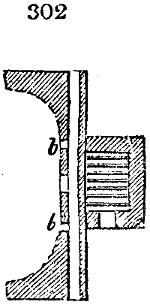
The air is admitted by a channel, c c, through the middle of the fire-bridge, fig. 302, and extending all its length; it communicates with the atmosphere at its two ends c c; square holes, b b, left at right angles to this channel, conduct the air into the furnace. This very simple construction produces a powerful effect in the roasting operation. It not only promotes the oxidizement of the metals, but burns the smoke, and assists in the vaporisation of the sulphur; while by keeping the bridge cool it preserves it from wasting, and secures uniformity of temperature to the hearth.
4. Refining furnace.—In this, as in the melting furnace, the sole slopes towards the door in front, instead of towards the side doors, because in the refining furnace the copper collects into a cavity formed in the hearth towards the front door, from which it is lifted out by ladles; whereas, in the melting furnaces, the metal is run out by a tap-hole in the side. The hearth sole is laid with sand; but the roof is higher than in the melting furnace, being from 32 to 36 inches. If the top arch were too much depressed, there might be produced upon the surface of the metal a layer of oxide very prejudicial to the quality of the copper. When the metal in that case is run out, its surface solidifies and cracks, while the melted copper beneath breaks through and spreads irregularly over the cake. This accident, called the rising of the copper, hinders it from being laminated, and requires it to be exposed to a fresh refining process, when lead must be added to dissolve the oxide of copper. This is the only occasion upon which the addition of lead is proper in refining copper. When the metal to be refined is mixed with others, particularly with tin, as in extracting copper from old bells, then very wide furnaces must be employed, to expose the metallic bath upon a great surface, and in a thin stratum, to the oxidizing action of the air.
The door G, fig. 300., upon the side of the refining furnace, is very large, and is shut with a framed brick door, balanced by a counter-weight. This door being open during the refining process, the heat is stronger at B than at A (figs. 299, 300.)
5. Heating furnaces, being destined to heat the pigs or bars of copper to be laminated, as well as the copper sheets themselves, are made much longer in proportion to their breadth. Their hearth is horizontal, the vault not much depressed; they have only one door, placed upon the side, but which extends nearly the whole length of the furnace: this door may be raised by means of a counter-weight, in the same way as in the furnaces for the fabrication of sheet-iron and brass.
Series of operations to which the ore is subjected.—The ores which are smelted in the Swansea works are cupreous pyrites, more or less mingled with gangue (vein-stone). The pyrites is composed of nearly equal proportions of sulphuret of copper and sulphuret of iron.
The earthy matters which accompany the pyrites are usually siliceous, though in some mines the metalliferous deposit is mixed with clay or fluate of lime. Along with these substances, pretty uniformly distributed, tin and arsenical pyrites occur occasionally with the copper; and though these two metals are not chemically combined, yet they cannot be separated entirely in the mechanical preparations. The constituent parts of the ore prepared for smelting are, therefore, copper, iron, sulphur, with tin, arsenic, and earthy matters in some cases. The different ores are mixed in such proportions that the average metallic contents may amount to 81⁄2 per cent. The smelting process consists in alternate roastings and fusions. The following description of it is chiefly taken from an excellent paper, published by John Vivian, esq., in the Annals of Philosophy for 1823.
In the roasting operation the volatile substances are disengaged mostly in the gaseous state, while the metals that possess a strong affinity for oxygen become oxidized. In the fusion the earthy substances combine with these oxides, and form glassy scoriæ or slags, which float upon the surface of the melted metal.
These calcinations and fusions take place in the following order:—
1. Calcination of the ore. 2. Melting of the calcined ore. 3. Calcination of the coarse metal. 4. Melting of the calcined coarse metal. 5. Calcination of the fine metal (second matt). 6. Melting of the calcined fine metal. 7. Roasting of the coarse copper. In some smelting works, this roasting is repeated four times; in which case a calcination and a melting are omitted. In the Havod works, however, the same saving is made without increasing the number of roastings. 8. Refining or toughening the copper.
Besides these operations, which constitute the treatment of copper properly speaking, two others are sometimes performed, in which only the scoriæ are melted. These may be designated by the letters a and b. a is the re-melting of the portion of the scoriæ of the second process, which contain some metallic granulations. b is a particular melting of the scoriæ of the fourth operation. This fusion is intended to concentrate the particles of copper in the scoriæ, and is not practised in all smelting works.
First operation. Calcination of the ore.—The different ores, on arriving from Cornwall and other districts where they are mined, are discharged in continuous cargoes at the smelting works, in such a way, that by taking out a portion from several heaps at a time, a tolerably uniform mixture of ores is obtained; which is very essential in a foundry, because, the ores being different in qualities and contents, they act as fluxes upon each other. The ore thus mixed is transported to the works in wooden measures that hold a hundred-weight. The workmen entrusted with the calcination convey the ore into the hoppers of the calcining furnace, whence it falls into the hearth; other workmen spread it uniformly on the surface by iron rakes. The charge of a furnace is from three tons to three tons and a half. Fire is applied and gradually increased, till, towards the end of the operation, the temperature be as high as the ore can support without melting or agglutinating. To prevent this running together, and to aid the extrication of the sulphur, the surfaces are renewed, by stirring up the ore at the end of every hour. The calcination is usually completed at the end of 12 hours, when the ore is tumbled into the arch under the sole of the furnace. Whenever the ore is cold enough to be moved, it is taken out of the arch, and conveyed to the calcined heap.
The ore in this process hardly changes weight, having gained in oxidizement nearly as much as it has lost in sulphur and arsenic; and if the roasting has been rightly managed, the ore is in a black powder, owing to the oxide of iron present.
Second operation. Fusion of the calcined ore.—The calcined ore is likewise given to the melters in measures containing a hundred-weight. They toss it into hoppers, and after it has fallen on the hearth, they spread it uniformly. They then let down the door, and lute it tightly. In this fusion there are added about 2 cwt. of scoriæ proceeding from the melting of the calcined matt, to be afterwards described. The object of this addition is not only to extract the copper that these scoriæ may contain, but especially to increase the fusibility of the mixture. Sometimes also, when the composition of the ore requires it, lime, sand, or fluor spar is added; and particularly the last fluxing article.
The furnace being charged, fire is applied, and the sole care of the founder is to keep up the heat so as to have a perfect fusion; the workman then opens the door, and stirs about the liquid mass to complete the separation of the metal (or rather of the matt) from the scoriæ, as well as to hinder the melted matter from sticking to the sole. The furnace being ready, that is, the fusion being perfect, the founder takes out the scoriæ by the front door, by means of a rake. When the matt is thus freed from the scoriæ, a second charge of calcined ore is then introduced to increase the metallic bath; which second fusion is executed like the first. In this way, new charges of roasted ore are put in till the matt collected on the hearth rises to a level with the door-way, which happens commonly after the third charge. The tap hole is now opened; the matt flows out into the pit filled with water, where it is granulated during its immersion; and it collects in the pan placed at the bottom. The granulated matt is next conveyed into the matt warehouse. The oxidation with which the grains get covered by the action of the water, does not allow the proper colour of the matt or coarse metal to be distinguished; but in the bits which stick in the gutter, it is seen to be of a steel gray. Its fracture is compact, and its lustre metallic. The scoriæ often contain metallic grains; they are broken and picked with care. All the portions which include some metallic particles are re-melted in an accessory process. The rejected scoriæ have been found to be composed of siliceous matter 59, oxide of copper 1, oxide of tin 0·7.
In this operation, the copper is concentrated by the separation of a great part of the matters with which it was mixed or combined. The granulated matt produced, contains in general 33 per cent. of copper; it is therefore four times richer than the ore; and its mass is consequently diminished in that proportion. The constituent parts are principally copper, iron, and sulphur.
The most important point to hit in the fusion just described, is to make a fusible mixture of the earths and the oxides, so that the matt of copper may, in virtue of its greater specific gravity, fall to the under-part, and separate exactly from the slag. This point is attained by means of the metallic oxides contained in the scoriæ of the fourth operation, of which 2 cwt. were added to the charge. These consist almost entirely of black oxide of iron. When the ores are very difficult to melt, a measure of about half a hundred-weight of fluor spar is added; but this must be done with precaution, for fear of increasing the scoriæ too much.
The business goes on day and night. Five charges are commonly put through hands in the course of 24 hours; but when all circumstances are favourable, that is to say, when the ore is fusible, when the fuel is of the first quality, and when the furnace is in good condition, even six charges a day have been despatched.
The charge is a ton and a half of calcined ore, so that a melting furnace corresponds nearly to a calcining furnace; the latter turning out nearly 7 tons of calcined ore in 24 hours.
The workmen are paid by the ton.
Third operation. Calcination of the coarse metal, or the matt.—The object of this operation is principally to oxidize the iron, an oxidation easier to execute, than in the first calcining, because the metal is now disengaged from the earthy substances, which screened it from the action of the air.
This calcination is executed in the furnace already represented, fig. 296, 297, 298. page 318. exactly in the same way as the ore was calcined. The metal must be perpetually stirred about, to expose all its surfaces to the action of the hot air, and to hinder the clotting together. The operation lasts 24 hours; during the first six, the fire should be very moderate, and thereafter gradually increased to the end of the calcination. The charge is, like that of the first, 3 tons and a half.
Fourth operation. Melting of the calcined coarse metal, or calcined matt.—In the fusion of this first calcined matt, some scoriæ of the latter operations must be added, which are very rich in oxide of copper, and some crusts from the hearth, which are likewise impregnated with it. The proportion of these substances varies according to the quality of the calcined matt.
In this second fusion, the oxide of copper contained in the scoriæ, is reduced by the affinity of the sulphur, one portion of which passes to the state of acid, while the other forms a subsulphuret with the copper become free. The matt commonly contains a sufficient quantity of sulphur to reduce the oxide of copper completely; but if not, which may happen if the calcination of the matt has been pushed too far, a small quantity of uncalcined matt must be introduced, which, by furnishing sulphur, diminishes the richness of the scoriæ, and facilitates the fusion.
The scoriæ are taken out by the front door, by drawing them forward with a rake. They have a great specific gravity; are brilliant with metallic lustre, very crystalline, and present, in the cavities, crystals like those of pyroxene; they break easily into very sharp-edged fragments. They contain no granulated metal in the interior; but it sometimes occurs, on account of the small thicknesses of the stratum of scoriæ, that these carry off with them, when they are withdrawn, some metallic particles.
These scoriæ, as we have already stated, under the fusion of the roasted ore, are in general melted with it. In some cases, however, a special melting is assigned to them.
The matt obtained in this second fusion is either run out into water like the first, or moulded into pigs (ingots), according to the mode of treatment which it is to undergo. This matt, called by the smelters fine metal when it is granulated, and blue metal when it is in pigs, is of a light grey colour, compact, and bluish at the surface. It is collected in the first form when it is to be calcined anew; and in the second, when it must immediately undergo the operation of roasting. Its contents in copper are 60 per cent. This operation, which is but sometimes had recourse to, lasts 5 or 6 hours. The charge is 1 ton.
(b) Particular fusion of the scoriæ of the fourth operation.—In re-melting these scoriæ, the object is to procure the copper which they contain. To effect this fusion, the scoriæ are mixed with pulverized coal, or other carbonaceous matters. The copper and several other metals are deoxidized, and furnish a white and brittle alloy. The scoriæ resulting from this melting are in part employed in the first melting, and in part thrown away. They are crystalline, and present crystals often in the cavities, which appear to belong to bisilicate of iron. They have a metallic lustre, and break into very sharp-edged fragments. The white metal is melted again, and then united to the product of the second fusion.
Fifth operation. Calcination of the second matt, or fine metal of the smelter.—This is executed in precisely the same way as that of the first matt. It lasts 24 hours; and the charge is usually 3 tons.
Sixth operation. Melting of the calcined fine metal.—This fusion is conducted like that of the first matt. The black copper, or coarse copper, which it produces, contains from 70 to 80 per cent. of pure metal; it is run into ingots, in order to undergo the operation of roasting.
The scoriæ are rich in copper; they are added to the fusion of the calcined coarse metal of the fourth operation.
In the smelting houses of Messrs. Vivian, at Hafod, near Swansea, the fifth and sixth operations have been omitted of late years. The second matt is run into pigs, under the name of blue metal, to be immediately exposed to the roasting.
The disposition of the canal a a′, fig. 302., which introduces a continuous current of air to the hearth of the furnace, accelerates and facilitates the calcination of the matt; an advantage which has simplified the treatment, by diminishing the number of calculations.
Seventh operation. Roasting of the coarse copper, the product of the sixth operation. The chief object of this operation is oxidizement; it is performed either in an ordinary roasting furnace, or in the one belonging to fig. 302., which admits a constant current of air. The pigs of metal derived from the preceding melting are exposed, on the hearth of the furnace, to the action of the air, which oxidizes the iron and other foreign metals with which the copper is still contaminated. The duration of the roasting varies from 12 to 24 hours, according to the degree of purity of the crude copper. The temperature should be graduated, in order that the oxidizement may have time to complete, and that the volatile substances which the copper still retains may escape in the gaseous form. The fusion must take place only towards the end of the operation.
The charge varies from a ton and a quarter to a ton and a half. The metal obtained is run out into moulds of sand. It is covered with black blisters, like steel of cementation; whence it has got the name of blistered copper. In the interior of these pigs, the copper presents a porous texture, occasioned by the ebullition produced by the escape of the gases during the moulding. The copper being now almost entirely purged from the sulphur, iron, and the other substances with which it was combined, is in a fit state to be refined. This operation affords some scoriæ; they are very heavy, and contain a great deal of oxide of copper, sometimes even metallic copper.
These scoriæ, as well as those of the third melting and of the refining, are added to the second fusion, as we have already stated, in describing the fourth operation.
In some works, the roasting is repeated several times upon the blue metal, in order to bring it to a state fit for refining. We shall afterwards notice this modification of the treatment.
Eighth operation. Refining or toughening.—The pigs of copper intended for refining are put upon the sole of the refining furnace through the door in the side. A slight heat is first given, to finish the roasting or oxidation, in case this operation has not already been pushed far enough. The fire is to be increased by slow degrees, so that, by the end of 6 hours, the copper may begin to flow. When all the metal is melted, and when the heat is considerable, the workman lifts up the door in the front, and withdraws with a rake the few scoriæ which may cover the copper bath. They are red, lamellated, very heavy, and closely resemble protoxide of copper.
The refiner takes then an assay with a small ladle, and when it cools, breaks it in a vice, to see the state of the copper. From the appearance of the assay, the aspect of the bath, the state of the fire, &c., he judges if he may proceed to the toughening, and what quantity of wooden spars and wood charcoal he must add to render the metal malleable, or, in the language of the smelters, bring it to the proper pitch. When the operation of refining begins, the copper is brittle or dry, and of a deep red colour approaching to purple. Its grain is coarse, open, and somewhat crystalline.
To execute the refining, the surface of the metal is covered over with wood charcoal, and stirred about with a spar or rod of birch wood. The gases which escape from the wood, occasion a brisk effervescence. More wood charcoal is added from time to time, so that the surface of the metal may be always covered with it, and the stirring is continued with the rods, till the operation of refining be finished; a circumstance indicated by the assays taken in succession. The grain of the copper becomes finer and finer, and its colour gradually brightens. When the grain is extremely fine, or closed, when the trial pieces half cut through and then broken, present a silky fracture, and when the copper is of a fine light red, the refiner considers the operation to be completed; but he verifies still further the purity of the copper, by trying its malleability. For this purpose, he takes out a sample in his small ladle, and pours it into a mould. When the copper is solidified, but still red-hot, he forges it. If it is soft under the hammer, if it does not crack on the edges, the refiner is satisfied with its ductility, and he pronounces it to be in its proper state. He orders the workmen to mould it; who then lift the copper out of the furnace in large iron ladles lined with clay, and pour it into moulds of the size suitable to the demands of commerce. The ordinary dimensions of the ingots or pigs are 12 inches broad, 18 long, and from 2 to 21⁄2 thick.
The period of the refining process is 20 hours. In the first six, the metal heats, and suffers a kind of roasting; at the end of this time it melts. It takes four hours to reach the point at which the refining, properly speaking, begins; and this last part of the process lasts about 4 hours. Finally, 6 hours are required to arrange the moulds, cast the ingots, and let the furnace cool.
The charge of copper in the refining process depends upon the dimensions of the furnace. In the Hafod works, one of the most important in England, the charge varies from 3 to 5 tons; and the quantity of pure copper manufactured in a week is from 40 to 50 tons.
The consumption of fuel is from 15 to 18 parts of coal, for one part of refined copper in pigs.
When the copper offers difficulties in the refining, a few pounds of lead are added to it. This metal, by the facility with which it scorifies, acts as a purifier, aiding the oxidation of the iron and other metals that may be present in the copper. The lead ought to be added immediately after removing the door to skim the surface. The copper should be constantly stirred up, to expose the greatest possible surface to the action of the air, and to produce the complete oxidation of the lead; for the smallest quantity of this metal alloyed in copper, is difficult to clear up in the lamination; that is to say, the scale of oxide does not come cleanly from the surface of the sheets.
The operation of refining copper is delicate, and requires, upon the part of the workmen, great skill and attention to give the metal its due ductility. Its surface ought to be entirely covered with wood charcoal; without this precaution, the refining of the metal would go back, as the workmen say, during the long interval which elapses in the moulding; whenever this accident happens, the metal must be stirred up anew with the wooden pole.
Too long employment of the wooden rod gives birth to another remarkable accident, for the copper becomes more brittle than it was prior to the commencement of the refining; that is, when it was dry. Its colour is now of a very brilliant yellowish red, and its fracture is fibrous. When this circumstance occurs, when the refining, as the workmen say, has gone too far, the refiner removes the charcoal from the top of the melted metal; he opens the side door, to expose the copper to the action of the air, and it then resumes its malleable condition.
Mr. Vivian, to whom we owe the above very graphic account of the processes, has explained, in a very happy manner, the theory of refining. He conceives, we may conclude, that the copper in the dry state, before the refining, is combined with a small portion of oxygen, or, in other words, that a small portion of oxide of copper is diffused through the mass, or combined with it; and that this proportion of oxygen is expelled by the deoxidizing action of the wood and charcoal, whereby the metal becomes malleable. 2. That when the refining process is carried too far, the copper gets combined with a little charcoal. Thus copper, like iron, is brittle when combined with oxygen and charcoal; and becomes malleable only when freed entirely from these two substances.
It is remarkable, that copper, in the dry state, has a very strong action upon iron; and that the tools employed in stirring the liquid metal become very glistening, like those used in a farrier’s forge. The iron of the tools consumes more rapidly at that time, than when the copper has acquired its malleable state. The metal requires, also, when dry, more time to become solid, or to cool, than when it is refined; a circumstance depending, probably, upon the difference in fusibility of the copper in the two states, and which seems to indicate, as in the case of iron, the presence of oxygen.
When the proper refining point has been passed, another very remarkable circumstance has been observed; namely, that the surface of the copper oxidizes more difficultly, and that it is uncommonly brilliant; reflecting clearly the bricks of the furnace vault. This fact is favourable to the idea suggested above, that the metal is in that case combined with a small quantity of carbon; which absorbs the oxygen of the air, and thus protects the metal from its action.
Copper is brought into the market in different forms, according to the purposes which it is to serve. What is to be employed in the manufacture of brass is granulated. In this condition it presents more surface to the action of zinc or calamine, and combines with it more readily. To produce this granulation, the metal is poured into a large ladle, pierced with holes, and placed above a cistern filled with water, which must be hot or cold, according to the form wished in the grains. When it is hot, round grains are obtained analogous to lead shot; and the copper in this state is called bean shot. When the melted copper falls into cold water perpetually renewed, the granulations are irregular, thin, and ramified; constituting feathered shot. The bean shot is the form employed in brass making.
Copper is also made into small ingots, about 6 ounces in weight. These are intended for exportation to the East Indies, and are known in commerce by the name of Japan copper. Whenever these little pieces are solidified, they are thrown, while hot, into cold water. This immersion slightly oxidizes the surface of the copper, and gives it a fine red colour.
Lastly, the copper is often reduced into sheets, for the sheathing of ships, and many other purposes. The Hafod works possess a powerful rolling mill, composed of four pairs of cylinders. It is moved by a steam engine, whose cylinder has 40 inches diameter. See the representation of the rolling mill of the Royal Mint, under Gold.
The cylinders for rolling copper into sheets are usually 3 feet long, and 15 inches in diameter. They are uniform. The upper roller may be approached to the under one, by a screw, so that the cylinders are brought closer, as the sheet is to be made thinner.
The ingots of copper are laid upon the sole of a reverberatory furnace to be heated; they are placed alongside each other, and they are formed into piles in a cross-like arrangement, so that the hot air may pass freely round them all. The door of the furnace is shut, and the workman looks in through a peep-hole from time to time, to see if they have taken the requisite temperature; namely, a dull red. The copper is now passed between the cylinders; but although this metal be very malleable, the ingots cannot be reduced to sheets without being several times heated; because the copper cools, and acquires, by compression, a texture which stops the progress of the lamination.
These successive heatings are given in the furnace indicated above; though, when the sheets are to have a very great size, furnaces somewhat different are had recourse to. They are from 12 to 15 feet long, and 5 wide. See Brass.
The copper, by successive heating and lamination, gets covered with a coat of oxide, which is removed by steeping the sheets for a few days in a pit filled with urine; they are then put upon the sole of the heating furnace. Ammonia is formed, which acts on the copper oxide, and lays bare the metallic surface. The sheets are next rubbed with a piece of wood, then plunged, while still hot, into water, to make the oxide scale off; and lastly, they are passed cold through the rolling press to smooth them. They are now cut square, and packed up for home sale or exportation.
The following estimate has been given by MM. Dufrénoy and Elie de Beaumont of the expense of manufacturing a ton of copper in South Wales.
£ s. d.
121⁄2 tons of ore, yielding 81⁄2 per cent. of copper 55 0 0
20 tons of coals 8 0 0
Workmen’s wages, rent, repairs, &c. 13 0 0
76 0 0
The exhalations from the copper smelting works are very detrimental to both vegetable and animal life. They consist of sulphurous acid, sulphuric acid, arsenic and arsenious acids, various gases and fluoric vapours, with solid particles mechanically swept away into the air, besides the coal smoke. Mr. Vivian has invented a very ingenious method of passing the exhalations from the calcining ores and matts along horizontal flues or rather galleries of great dimensions, with many crossings and windings of the current, and exposure during the greater part of the circuit to copious showers of cold water. By this simple and powerful system of condensation, the arsenic is deposited in the bottoms of the flues, the sulphurous acid is in a great measure absorbed, and the nuisance is remarkably abated.
The following figures represent certain modifications of the copper calcining and smelting copper furnaces of Swansea.
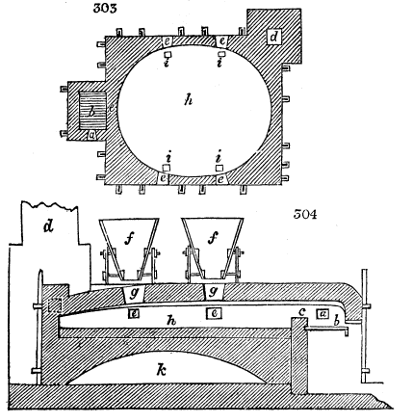
Fig. 304. is the section of the roasting furnace lengthwise; fig. 303. the ground plan; in which a is the fire-door; b the grate; c the fore-bridge; d the chimney; e e working apertures on each of the long sides of the furnace, through which the ore is introduced, spread, and turned over; f f cast-iron hoppers; g g openings in the vaulted roof; h the hearth-sole; i i holes in this; k a vaulted space under the hearth. The hearth has a suitable oval shape, and is covered with a flat arch. Its length is 16 feet, breadth 131⁄2, mean height 2 feet.
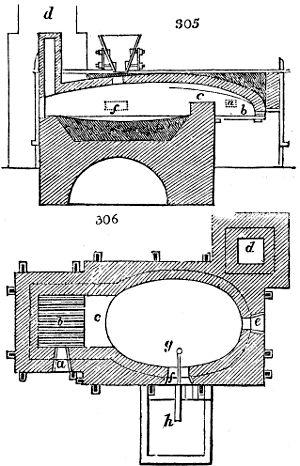
Fig. 305. is a longitudinal section of the melting furnace; fig. 306. the ground plan in which a is the fire door; b the grate; c the fire bridge; d the chimney; e the side openings; f the working doors; g the raking-out hole; h iron spouts, which conduct the melted metal into pits filled with water.
The melting furnace is altogether smaller; but its firing hearth is considerably larger than in the roasting furnace. The long axis of the oval hearth is 14 feet; its short axis 10 feet; its mean height 2 feet.
The principal ore smelted at Chessy is the azure copper, which was discovered by accident in 1812. Red copper ore, also, has come into operation there since 1825. The average metallic contents of the richest azure ore are from 33 to 36 per cent.; of the poorer, from 20 to 24. The red ore contains from 40 to 67 parts in 100. The ore is sorted, so that the mean contents of metal may be 27 per cent., to which 20 per cent. of limestone are added; whence the cinder will amount to 50 per cent. of the ore. A few per cents. of red copper slag, with some quicklime and gahrslag, are added to each charge, which consists of 200 pounds of the above mixture, and 150 pounds of coke. When the furnace (fourneau à manche, see the Scotch smelting hearth, under Lead), is in good action, from 10 to 14 such charges are worked in 12 hours. When the crucible is full of metal at the end of this period, during which the cinder has been frequently raked off, the blast is stopped, and the matt floating over the metal being sprinkled with water and taken off, leaves the black copper to be treated in a similar way, and converted into rosettes. The refining of this black copper is performed in a kind of reverberatory furnace.
The cinders produced in this reduction process are either vitreous and light blue, which are most abundant; cellular, black, imperfectly fused from excess of lime; or, lastly, red, dense, blistery, from defect of lime, from too much heat, and the passage of protoxide into the cinders. They consist of silicate of alumina, of lime, protoxide of iron; the red contain some silicate of copper.
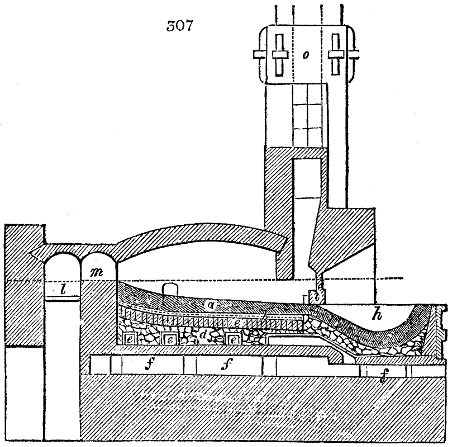
The copper-refining furnace at Chessy, near Lyons, is of the kind called Spleiss-ofen (split hearths) by the Germans. Fig. 307. is a section lengthwise in the dotted line A B of fig. 308., which is the ground plan.
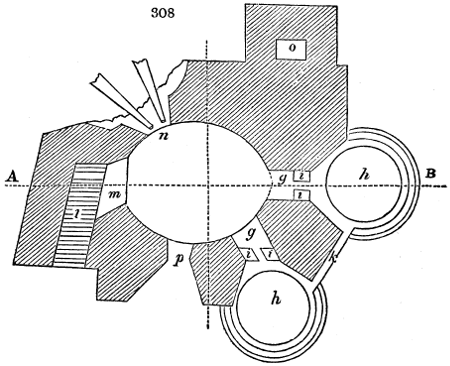
The foundation-walls are made of gneiss; the arch, the fire-bridge, and the chimney, of fire-bricks. The hearth, a, is formed of a dense mixture of coal-dust, upon a bottom of well-beat clay b, which reposes upon a bed of brickwork c. Beneath this there is a slag bottom d; e is the upper, and f the under discharge hole. The hearth is egg-shaped; the longer axis being 8 feet, the shorter 61⁄2 feet: in the middle it is 10 inches deep, and furnished with the outlets g g, which lead to each of the Spleiss-hearths h h, fig. 308. These outlets are contracted with fire-bricks i i, till the proper period of the discharge. The two hearths are placed in communication by a canal h; they are 31⁄2 feet in diameter, 16 inches deep; are floored with well-beat coal ashes, and receive about 27 cwt. for a charge.
l is the grate; m, the fire-bridge; n, the boshes in which the tuyères lie; o, the chimney; p, the working door through which the slags may be drawn off. Above this is a small chimney, to carry off the flame and smoke whenever the door is opened.
The smelting post or charge, to be purified at once, consists of 60 cwt. of black copper, to which a little granular copper and copper of cementation is added; the consumption of pit-coal amounts to 36 cwt. As soon as the copper is melted, the bellows are set a-going, and the surface of the metal gets soon covered with a moderately thick layer of cinder, which is drawn off. This is the first skimming or decrassage. By and by, a second layer of cinder forms, which is in like manner removed; and this skimming is repeated, to allow the blast to act upon fresh metallic surfaces. After 4 or 5 hours, no more slag appears, and then the fire is increased. The melted mass now begins to boil or work (travailler), and continues so to do, for about 3⁄4 of an hour, or an hour, after which the motion ceases, though the fire be kept up. The gahrproof is now taken; but the metal is seldom fine in less than 3⁄4 of an hour after the boil is over. Whenever the metal is run off by the tap-hole into the two basins i i, called SPLIT-HEARTHS, a reddish vapour or mist rises from its surface, composed of an infinite number of minute globules, which revolve with astonishing velocity upon their axes, constituting what the Germans called spratzen (crackling) of the copper. They are composed of a nucleus of metal, covered with a film of protoxide, and are used as sand for strewing upon manuscript. The copper is separated, as usual, by sprinkling water upon the surface of the melted metal, in the state of rosettes, which are immediately immersed in a stream of water. This refining process lasts about 16 or 17 hours; the skimmings weigh about 50 cwt.; the refuse is from 15 to 17 per cent.; the loss from 2 to 3 per cent. The gahrslag amounts to 11 cwt.
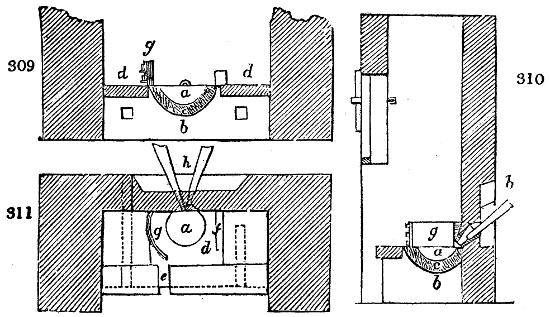
The refining of the eliquated copper (called darrlinge) from which the silver has been sweated out by the intervention of lead, can be performed only in small hearths. The following is the representation of such a furnace, called, in German, Kupfergahrheerd. Fig. 309. is the section lengthwise; fig. 310. is the section across; and fig. 311. is the ground plan, in which a is the hearth-hollow; b, a massive wall; c, the mass out of which the hearth is formed; d, cast-iron plates covering the hearth; e, opening for running off the liquid slag; f, a small wall; g, iron curb for keeping the coals together.
The hearth being heated with a bed of charcoal, 3⁄4 cwt. of darrlinge are laid over it, and covered with more fuel: whenever this charge is melted, another layer of the coal and darrlinge is introduced, and thus in succession till the hearth become full, or contain from 21⁄4 to 21⁄2 cwt. In Neustadt 71⁄2 cwt. of darrlinge have been refined in one furnace, from which 5 cwt. of gahrcopper has been obtained. The blast oxidizes the foreign metals, namely, the lead, nickel, cobalt, and iron, with a little copper, forming the gahrslag; which is, at first, rich in lead oxide, and poor in copper oxide; but, at the end, this order is reversed. The slag, at first blackish, assumes progressively a copper red tint. The slag flows off spontaneously along the channel e, from the surface of the hearth. The gahre is tested by means of a proof rod of iron, called gahr-eisen, thrust through the tuyère into the melted copper, then drawn out and plunged in cold water. As soon as the gahrspan (scale of copper) appears brownish red on the outside, and copper red within, so thin that it seems like a net-work, and so deficient in tenacity that it cannot be bent without breaking, the refining is finished. The blast is then stopped; the coals covering the surface, as also the cinders must be raked off the copper, after being left to cool a little; the surface is now cooled by sprinkling water upon it, and the thick cake of congealed metal (rondelle) is lifted off with tongs, a process called schleissen (slicing), or sheibenreissen (shaving), which is continued till the last convex cake at the bottom of the furnace, styled the kingspiece, is withdrawn. These rondelles are immediately immersed in cold water, to prevent the oxidation of the copper; whereupon the metal becomes of a cochineal red colour, and gets covered with a thin film of protoxide. Its under surface is studded over with points and hooks, the result of tearing the congealed disc from the liquid metal. Such cakes are called rosette copper. When the metal is very pure and free from protoxide, these cakes may be obtained very thin, one 24th of an inch for example.
The refining of two cwts. and a half of darrlinge takes three quarters of an hour, and yields one cwt. and a half of gahr copper in 36 rosettes, as also some gahrslag. Gahr copper generally contains from 11⁄2 to 21⁄2 per cent. of lead, along with a little nickel, silver, iron, and aluminum.
Smelting of the Mansfeldt copper schist, or bituminous Mergelschiefer.—The cupreous ore is first roasted in large heaps, of 2000 cwts., interstratified with brush-wood, and with some slates rich in bituminous matter, mixed with the others. These heaps are 3 ells high, and go on burning 15 weeks in fair and 20 in rainy weather. The bitumen is decomposed; the sulphur is dissipated chiefly in the form of sulphurous acid; the metal gets partially oxidized, particularly the iron, which is a very desirable circumstance towards the production of a good smelting slag. The calcined ore is diminished one-tenth in bulk, and one-eighth in weight; becoming of a friable texture and a dirty yellow gray colour. The smelting furnaces are cupolas (schachtofen), 14 to 18 feet high; the fuel is partly wood charcoal, partly coke from the Berlin gas-works, and Silesia. The blast is given by cylinder bellows, recently substituted for the old barbarous Blasebälgen, or wooden bellows of the household form.
The cupreous slate is sorted, according to its composition, into slate of lime, clay, iron, &c., by a mixture of which the smelting is facilitated. For example, 1 post or charge may consist of 20 cwt. of the ferruginous slate, 14 of the calcareous, 6 of the argillaceous, with 3 of fluor spar, 3 of rich copper slags, and other refuse matters. The nozzle at the tuyère is lengthened 6 or 8 inches, to place the melting heat near the centre of the furnace. In 15 hours 1 fodder of 48 cwts. of the above mixture may be smelted, whereby 4 to 5 cwts. of matte (crude copper, called Kupferstein in Germany) and a large body of slags are obtained. The matte contains from 30 to 40 per cent. of copper, and from 2 to 4 loths (1 to 2 oz.) of silver. The slags contain at times one-tenth their weight of copper.
The matte is composed of the sulphurets of copper, iron, silver, zinc, along with some arsenical cobalt and nickel. The slaty slag is raked off the surface of the melted matte from time to time. The former is either after being roasted six successive times, smelted into black copper; or it is subjected to the following concentration process. It is broken to pieces, roasted by brushwood and coals three several times in brick-walled kilns, containing 60 cwts., and turned over after every calcination; a process of four weeks’ duration. The thrice roasted mass, called spurrost, being melted in the cupola fig. 313. with ore-cinder, yields the spurstein, or concentrated matte. From 30 to 40 cwts. of spurrost are smelted in 24 hours; and from 48 to 60 per cent. of spurstein are obtained, the slag from the slate smelting being employed as a flux. The spurstein contains from 50 to 60 per cent. of copper, combined with the sulphurets of copper, of iron, and silver.
The spurstein is now mixed with dünnstein (a sulphuret of copper and iron produced in the original smeltings) roasted six successive times, in a quantity of 60 cwts., with brushwood and charcoal; a process which requires from 7 to 8 weeks. The product of this six-fold calcination is the Gahrrost of the Germans (done and purified); it has a colour like red copper ore, varying from blue gray into cochineal red; a granular fracture; it contains a little of the metal, and may be immediately reduced into metallic copper, called kupfermachen. But before smelting the mass, it is lixiviated with water, to extract from it the soluble sulphate, which is concentrated in lead pans, and crystallized.
The lixiviated gahröste mixed with from 1⁄4 to 1⁄5 of the lixiviated dünnsteinrost, and 1⁄6 to 1⁄10 of the copper slate slag, are smelted with charcoal or coke fuel in the course of 24 hours, in a mass of 60 or 80 cwts. The product is black copper, to the amount of about 1⁄4 the weight, and 1⁄6 of dünnstein, or thin matte. This black copper contains in the cwt. from 12 to 20 loths (6 to 10 oz.) of silver. The dünnstein consists of from 60 to 70 per cent. of copper combined with sulphur, sulphuret of iron and arsenic; and when thrice roasted, yields a portion of metal. The black copper lies undermost in the crucible of the furnace, above it is the dünnstein, covered with the stone slag, or copper cinder, resulting from the slate-smelting. The slags being raked off, and the crucible sufficiently full, the eye or nozzle hole is shut, the dünnstein removed by cooling the surface, and breaking the crust, which is about 1⁄4 to 1⁄2 inch thick. The same method is adopted for taking out the black copper in successive layers. For the de-silvering of this, and similar black coppers, see Silver.
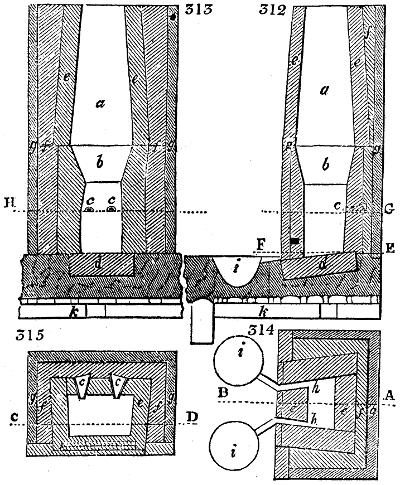
Fig. 312. is a vertical section through the form or tuyère in the dotted line A B of fig. 314. Fig. 313. is a vertical section in the dotted line C D of fig. 315. a is the shaft of the furnace, b the rest, c c the forms; d the sole or hearth-stone, which has a slope of 3 inches towards the front wall; e e, &c. casing walls of fire bricks; f f, &c. filling up walls built of rubbish stones; g g a mass through which the heat is slowly conducted; h h the two holes through one or other of which alternately the product of the smelting process is run off into the fore-hearth. Beneath the hearth-sole there is a solid body of loam; and the fore-hearth is formed with a mixture of coal-dust and clay; k is the discharge outlet. Fig. 314. is a horizontal section of the furnace through the hole or eye in the dotted line E F of fig. 312.; fig. 315. a horizontal section of the shaft of the furnace through the form in the dotted line G H of figs. 312 and 313. The height of the shaft, from the line E F to the top, is 14 feet; from E to G, 25 inches; from c to the line below b, 2 feet; from that line to the line opposite g g, 2 feet. The width at the line g g is 3 feet 3 inches, and at c 26 inches. The basins i i, fig. 314., are 3 feet diameter, and 20 inches deep.
The refining of copper is said to be well executed at Seville, in Spain; and, therefore, some account of the mode of operating there may be acceptable to the reader.
The first object is to evaporate in a reverberatory furnace all the volatile substances, such as sulphur, arsenic, antimony, &c., which may be associated with the sulphur; and the second, to oxidize and to convert into scoriæ the fixed substances, such as iron, lead, &c., with the least possible expense and waste. The minute quantities of gold and silver which resist oxidation cannot be in any way injurious to the copper. The hearth is usually made of a refractory sand and clay with ground charcoal, each mixed in equal volumes, and worked up into a doughy consistence with water. This composition is beat firmly into the furnace bottom. But a quartzose hearth is found to answer better, and to be far more durable; such as a bed of fire-sandstone.
Before kindling the furnace, its inner surface is smeared over with a cream-consistenced mixture of fire-clay and water.
The cast pigs, or blocks of black or crude copper, are piled upon the hearth, each successive layer crossing at right angles the layer beneath it, in order that the flame may have access to play upon the surface of the hearth, and to heat it to a proper pitch for making the metal flow.
The weight of the charge should be proportional to the capacity of the furnace, and such that the level of the metallic bath may be about an inch above the nozzle of the bellows; for, were it higher, it would obstruct its operation, and were it too low, the stream of air would strike but imperfectly the surface of the metal, and would fail to effect, or would retard at least, the refining process, by leaving the oxidation and volatilization of the foreign metals incomplete.
As the scoriæ form upon the surface, they are drawn off with an iron rabble fixed to the end of a wooden rod.
Soon after the copper is melted, charcoal is to be kindled in three iron basins lined with loam, placed alongside the furnace, to prepare them for receiving their charge of copper, which is to be converted in them, into rosettes.
The bellows are not long in action before the evaporation of the mineral substances is so copious, as to give the bath a boiling appearance; some drops rise up to the roof of the reverberatory, others escape by the door, and fall in a shower of minute spherical globules. This phenomenon proves that the process is going on well; and, when it ceases, the operation is nearly completed. A small proof of copper, of the form of a watch-case, and therefore called montre, is taken out from time to time, upon the round end of a polished iron rod, previously heated. This rod is dipped two or three inches into the bath, then withdrawn and immersed in cold water. The copper cap is detached from the iron rod, by a few blows of a hammer; and a judgment is formed from its thickness, colour, and polish, as to the degree of purity which the copper has acquired. But these watches need not be drawn till the small rain, above spoken of, has ceased to fall. At the end of about 11 hours of firing, the numerous small holes observable in the first watch samples begin to disappear; the outer surface passes from a bright red to a darker hue, the inner one becomes of a more uniform colour, and always less and less marked with yellowish spots. It will have acquired the greatest pitch of purity that the process can bestow, when the watches become of a dark crimson colour.
Care must be taken to stop this refining process at the proper time; for, by prolonging it unduly, a small quantity of cupreous oxide would be formed, which, finding no oxygen to reduce it, would render the whole body of copper hard, brittle, and incapable of lamination.
The basins must now be emptied of their burning charcoal, the opening of the tuyère must be closed, and the melted copper allowed to flow into them through the tap-hole, which is then closed with loam. Whenever the surface is covered with a solid crust, it is bedewed with water; and as soon as the crust is about 11⁄2 inch thick it is raised upon hooks above the basin, to drain off any drops, and then carried away from the furnace. If these cakes, or rosettes, be suddenly cooled by plunging them immediately in water, they will assume a fine red colour, from the formation of a film of oxide.
Each refining operation produces, in about 12 hours, 17⁄10 tons of copper, with the consumption of about 4⁄5 of a ton of dry wood.
Care should be taken that the copper cake or rosette be all solidified before plunging it into water, otherwise a very dangerous explosion might ensue, in consequence of the sudden extrication of oxygen from the liquid metal, in the act of condensation. On the other hand, the cake should not be allowed to cool too long in the air, lest it get peroxidized upon the surface, and lose those fine red, purple, and yellow shades, due to a film of the protoxide, which many dealers admire.
When a little oxide of antimony and oxide of copper are combined with copper, they occasion the appearance of micaceous scales in the fractured faces. Such metal is hard, brittle, yellowish within, and can be neither laminated nor wire-drawn. These defects are not owing to arsenic, as was formerly imagined; but, most probably, to antimony in the lead, which is sometimes used in refining copper. They are more easily prevented than remedied.
According to M. Frèrejean, proprietor of the great copper works of Vienne, in Dauphiny, too low a temperature or too much charcoal, gives to the metal a cubical structure, or that of divergent rays; in either of which states it wants tenacity. Too high a temperature, or too rapid a supply of oxygen, gives it a brick red colour, a radiated crystallization without lustre, or a very fine grain of indeterminate form; the last structure being unsuitable for copper that is to be worked under the hammer or in the rolling-press. The form which indicates most tenacity is radiated with minute fibres glistening in mass. Melted copper will sometimes pass successively through these three states in the space of ten minutes.
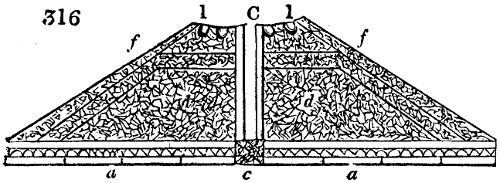
Fig. 316. represents a roasting mound of copper pyrites in the Lower Hartz, near Goslar, where a portion of the sulphur is collected. It is a vertical section of a truncated quadrangular pyramid. A layer of wooden billets is arranged at the base of the pyramid in the line a a.
C, a wooden chimney which stands in the centre of the mound with a small pile of charcoal at its bottom, c; d d are large lumps of ore surrounded by smaller pieces; f f, are rubbish and earth to form a covering. A current of air is admitted under the billets by an opening, in the middle of each of the four sides of the base a a, so that two principal currents of air cross under the vertical axis C of the truncated pyramid, as indicated in the figure.
The fire is applied through the chimney C; the charcoal at its bottom c, and the pile a a are kindled. The sulphureous ores d, f, are raised to such a high temperature as to expel the sulphur in the state of vapour.
In the Lower Hartz a roasting mound continues burning during four months. Some days after it is kindled the sulphur begins to exhale, and is condensed by the air at the upper surface of the pyramid. When this seems impregnated with it, small basins l l are excavated, in which some liquid sulphur collects; it is removed from time to time with iron ladles, and thrown into water, where it solidifies. It is then refined and cast into roll brimstone.
A similar roasting mound contains, in the Lower Hartz, from 100 to 110 tons of ore and 730 cubic feet of wood. It yields in four months about one ton and a half of sulphur from copper pyrites. Lead ore is treated in the same way, but it furnishes less sulphur.
There are usually from 12 to 15 roasting heaps in action at once for three smelting works of the Lower Hartz. After the first roasting two heaps are united to form a third, which is calcined anew, but under a shed; the ores are then stirred up and roasted for the third time, whence a crude mixture is procured for the smelting-house.
The most favourable seasons for roasting in the open air are spring and autumn; the best weather is a light wind accompanied with gentle rain. When the wind or rain obstruct the operation, this inconvenience is remedied by planks distributed round the upper surface of the truncated pyramid over the sulphur basins.
Manufacturing assays of copper.—The first thing is to make such a sample as will represent the whole mass to be valued; with which view, fragments must be taken from different spots, mixed, weighed, and ground together. A portion of this mixture being tried by the blow-pipe, will show, by the garlic or sulphurous smell of its fumes, whether arsenic, sulphur, or both, be the mineralizers. In the latter case, which often occurs, 100 gr. or 1000 gr. of the ore are to be mixed with one half its weight of saw-dust, then imbued with oil, and heated moderately in a crucible till all the arsenical fumes be dissipated. The residuum being cooled and triturated, is to be exposed in a shallow earthen cup to a slow roasting heat, till the sulphur and charcoal be burned away. What remains being ground and mixed with half its weight of calcined borax, one-twelfth its weight of lamp black, next made into a dough with a few drops of oil, is to be pressed down into a crucible, which is to be covered with a luted lid, and to be subjected, in a powerful air furnace, first to a dull red heat, and then to vivid ignition for 20 minutes. On cooling and breaking the crucible, a button of metallic copper will be obtained. Its colour and malleability indicate pretty well the quality, as does its weight, the relative value of the ore. It should be cupelled with lead, to ascertain if it contains silver or gold. See Assay, and Silver.
If the blow-pipe trial showed no arsenic, the first calcination may be omitted; and if neither sulphur nor arsenic, a portion of the ground ore should be dried, and treated directly with borax, lamp black and oil. It is very common to make a dry assay of copper ores, by one roasting and one fusion along with 3 parts of black flux; from the weight of the metallic button the richness of the ore is inferred.
The humid assay is more exact, but it requires more skill and time.
The sulphur and the silica are easily got rid of, by the acids which do not dissolve them, but only the metallic oxides and the other earths. These oxides may then be thrown down by their appropriate reagents, the copper being precipitated in the state of either the black oxide, or pure metal. 105 parts of black oxide represent 100 of copper. Before entering upon the complete analysis of an ore, preliminary trials should be made, to ascertain what are its chief constituents. If it be sulphuret of copper, or copper pyrites, without silver or lead, 100 grains exactly of its average powder may be weighed out, treated in a matras with boiling muriatic acid for some time, gradually adding a few drops of nitric acid, till all action ceases, or till the ore be all dissolved. The insoluble matter found floating in the liquid contains most of the sulphur; it may be separated upon a filter, washed, dried, and weighed; then verified by burning away. The incombustible residuum, treated by muriatic acid, may leave an insoluble deposit, which is to be added to the former. To the whole of the filtered solutions carbonate of potash is to be added; and the resulting precipitate, being washed, and digested repeatedly in water of ammonia, all its cupric oxide will have been dissolved, whenever the ammonia is no longer rendered blue.
Caustic potash, boiled with the ammoniacal solution, will separate the copper in the state of black oxide; which is to be thrown upon a filter, washed, dried, and weighed. The matter left undissolved by the ammonia, consists of oxide of iron, with probably a little alumina. The latter being separated by caustic potash, the iron oxide may be also washed, dried, and weighed. The powder which originally resisted the muriatic acid, is silica.
Assay of copper ores, which contain iron, sulphur, silver, lead, and antimony.
100 grains of these ores, previously sampled, and pulverized, are to be boiled with nitric acid, adding fresh portions of it from time to time, till no more of the matter be dissolved. The whole liquors which have been successively digested and decanted off, are to be filtered and treated with common salt, to precipitate the silver in the state of a chloride.
The nitric acid, by its reaction upon the sulphur, having generated sulphuric acid, this will combine with the lead oxidized at the same time, constituting insoluble sulphate of lead, which will remain mixed with the gangue. Should a little nitrate of lead remain in the liquid, it may be thrown down by sulphate of soda, after the silver has been separated. The dilute liquid being concentrated by evaporation, is to be mixed with ammonia in such excess as to dissolve all the cupric oxide, while it throws down all the oxide of iron and alumina; which two may be separated, as usual, by a little caustic potash. The portion of ore insoluble in the nitric acid, being digested in muriatic acid, every thing will be dissolved except the sulphur and silica. These being collected upon a filter, and dried, the sulphur may be burned away, whereby the proportion of each is determined.
Ores of the oxide of copper, are easily analyzed by solution in nitric acid, the addition of ammonia, to separate the other metals, and precipitation by potash. The native carbonate is analyzed by calcining 100 grains; when the loss of weight will shew the amount of water and carbonic acid; then that of the latter may be found, by expelling it from another 100 grains, by digestion in a given weight of sulphuric acid. The copper is, finally, obtained in a metallic state by plunging bars of zinc into the solution of the sulphate.
The native arseniates of copper are analyzed by drying them first at a moderate heat; after which they are to be dissolved in nitric acid. To this solution, one of nitrate of lead is to be added, as long as it occasions a precipitate; the deposit is to be drained upon a filter, and the clear liquid which passes through, being evaporated nearly to dryness, is to be digested in hot alcohol, which will dissolve every thing except a little arseniate of lead. This being added to the arseniate first obtained, from the weight of the whole, the arsenic acid, constituting 35 per cent., is directly inferred. The alcoholic solution being now evaporated to dryness, the residue is to be digested in water of ammonia, when the cupric oxide will be dissolved, and the oxide of iron will remain. The copper is procured, in the state of black oxide, by boiling the filtered ammoniacal solution with the proper quantity of potash.
The analysis of muriate of copper—atacamite—is an easy process. The ore being dissolved in nitric acid, a solution of nitrate silver is added, and from the weight of the chloride precipitated, the equivalent amount of muriate or chloride of copper is given; for 100 of chloride of silver represent 93 of chloride of copper, and 43·8 of its metallic basis. This calculation may be verified by precipitating the copper of the muriate from its solution in dilute sulphuric acid, by plates of zinc.
The phosphate of copper may be analyzed either by solution in nitric acid, and precipitation by potash; or by precipitating the phosphoric acid present, by means of acetate of lead. The phosphate of lead thus obtained, after being washed, is to be decomposed by dilute sulphuric acid. The insoluble sulphate of lead being washed, dried, and weighed, indicates by its equivalent the proportion of phosphate of lead, as also of phosphate of copper; for 100 of sulphate of lead correspond to 92·25 phosphate of lead, and 89·5 phosphate of copper; and this again to 52·7 of the black oxide.
Copper forms the basis of a greater number of important ALLOYS than any other metal. With zinc it forms Brass in all its varieties; which see.
Bronze and Bell Metal are alloys of copper and tin. This compound is prepared in crucibles when only small quantities are required; but in reverberatory hearths, when statues, bells, or cannons are to be cast. The metals must be protected as much as possible during their combination from contact of air by a layer of pounded charcoal, otherwise two evils would result, waste of the copper by combustion, and a rapid oxidizement of the tin, so as to change the proportions and alter the properties of the alloy. The fused materials ought to be well mixed by stirring, to give uniformity to the compound. See Bronze.
An alloy of 100 of copper and 4·17 of tin has been proposed by M. Chaudet for the ready manufacture of medals. After melting this alloy he casts it in moulds made of such bone-ash as is used for cupels. The medals are afterwards subjected to the action of the coining press, not for striking them, for the mould furnishes perfect impressions, but for finishing and polishing them.
By a recent analysis of M. Berthier, the bells of the pendules, or ornamental clocks, made in Paris, are found to be composed, of copper 72·00, tin 26·56, iron 1·44, in 100 parts.
An alloy of 100 of copper and 14 of tin is said by M. Dussaussy to furnish tools, which hardened and sharpened in the manner of the ancients, afford an edge nearly equal to that of steel.
Cymbals, gongs, and the tamtam of the Chinese are made of an alloy of 100 of copper with about 25 of tin. To give this compound the sonorous property in the highest degree it must be subjected to sudden refrigeration. M. D’Arcet, to whom this discovery is due, recommends to ignite the piece after it is cast, and to plunge it immediately into cold water. The sudden cooling gives the particles of the alloy such a disposition that, with a regulated pressure by skilful hammering, they may be made to slide over each other, and remain permanently in their new position. When by this means the instrument has received its intended form, it is to be heated and allowed to cool slowly in the air. The particles now take a different arrangement from what they would have done by sudden refrigeration; for instead of being ductile they possess such an elasticity, that on being displaced by a slight compression, they return to their primary position after a series of extremely rapid vibrations; whence a very powerful sound is emitted. Bronze, bell-metal, and probably all the other alloys of tin with copper present the same peculiarities.
The alloy of 100 of copper with from 60 to 33 of tin forms common bell-metal. It is yellowish or whitish gray, brittle, and sonorous, but not so much so as the preceding. The metal of house-clock bells contain a little more tin than that of church-bells, and the bell of a repeater contains a little zinc in addition to the other ingredients.
The bronze-founder should study to obtain a rapid fusion, in order to avoid the causes of waste indicated above. Reverberatory furnaces have been long adopted for this operation; and among these, the elliptical are the best. The furnaces with spheroidal domes are used by the bell-founders, because their alloy being more fusible, a more moderate melting heat is required; however, as the rapidity of the process is always a matter of consequence, they also would find advantage in employing the elliptical hearths (see the form of the melting furnace, as figured under Smelting of copper ores.) Coal is now universally preferred for fuel.
The alloy of 100 of copper with 50 of tin, or more exactly of 32 of the former with 141⁄2 of the latter, constitutes speculum metal, for making mirrors of reflecting telescopes. This compound is nearly white, very brittle, and susceptible of a fine polish with a brilliant surface. The following compound is much esteemed in France for making specula. Melt 2 parts of pure copper and 1 of grain-tin in separate crucibles, incorporate thoroughly with a wooden spatula, and then run the metal into moulds. The lower surface is the one that should be worked into a mirror.
Mr. Edwards, in the Nautical Almanack for 1787, gave the following instructions for making speculum metal.
The quality of the copper is to be tried by making a series of alloys with tin, in the proportion of 100 of the former to 47, to 48, to 49, and to 50 of the latter metal; whence the proportions of the whitest compound may be ascertained. Beyond the last proportion, the alloy begins to lose in brilliancy of fracture, and to take a bluish tint. Having determined this point, take 32 parts of the copper, melt, and add one part of brass and as much silver, covering the surface of the mixture with a little black flux; when the whole is melted, stir with a wooden rod, and pour in from 15 to 16 parts of melted tin (as indicated by the preparatory trials), stir the mixture again, and immediately pour it out into cold water. Then melt again at the lowest heat, adding for every 16 parts of the compound 1 part of white arsenic, wrapped in paper, so that it may be thrust down to the bottom of the crucible. Stir with a wooden rod as long as arsenical fumes rise, and then pour it into a sand mould. While still red hot, lay the metal in a pot full of very hot embers, that it may cool very slowly, whereby the danger of its cracking or flying into splinters is prevented.
Having described the different alloys of copper and tin, I shall now treat of the method of separating these metals from each other as they exist in old cannons, damaged bells, &c. The process employed on a very great scale in France during the Revolution, for obtaining copper from bells, was contrived by Fourcroy; founded upon the chemical fact that tin is more fusible and oxidizable than copper.
1. A certain quantity of bell metal was completely oxidized by calcination in a reverberatory furnace; the oxide was raked out, and reduced to a fine powder.
2. Into the same furnace a fresh quantity of the same metal was introduced; it was melted, and there was added to it one half of its weight of the oxide formed in the first operation. The temperature was increased, and the mixture well incorporated; at the end of a few hours, there was obtained on the one hand copper almost pure, which subsided in a liquid state, and spread itself upon the sole of the hearth, while a compound of oxide of tin, oxide of copper, with some of the earthy matters of the furnace collected on the surface of the metallic bath in a pasty form. These scoriæ were removed with a rake, and as soon as the surface of the melted copper was laid bare, it was run out. The scoriæ were levigated, and the particles of metallic copper were obtained after elutriation. By this process, from 100 pounds of bell metal, about 50 pounds of copper were extracted, containing only one per cent. of foreign matters.
3. The washed scoriæ were mixed with 1⁄8 their weight of pulverised charcoal; the mixture was triturated to effect a more intimate distribution of the charcoal; and it was then put into a reverberatory hearth, in which, by aid of a high heat, a second reduction was effected, yielding a fluid alloy consisting of about 60 parts of copper and 20 of tin; while the surface of the bath got covered with new scoriæ containing a larger proportion of tin than the first.
4. The alloy of 60 of copper with 40 of tin was next calcined in the same reverberatory furnace, but with stirring of the mass. The air in sweeping across the surface of the bath, oxidized the tin more rapidly than the copper; whence proceeded crusts of oxide that were skimmed off from time to time. This process was continued till the metallic alloy was brought to the same standard as bell metal, when it was run out to be subjected to the same operations as the metal of No. 1.
The layers of oxide successively removed in this way were mixed with charcoal, and reduced in a fourneau à manche, or Scotch lead smelting furnace.
I shall not prosecute any further the details of this complicated process of Fourcroy; because it has been superseded by a much better one contrived by M. Bréant. He employed a much larger quantity of charcoal to reduce the scoriæ rich in tin; and increased the fusibility by adding crushed oyster-shells, bottle glass, or even vitrified scoriæ, according to the nature of the substance to be reduced; and he treated them directly in a reverberatory furnace.
The metal, thus procured, was very rich in tin. He exposed it in masses on a sloping hearth of a reverberatory furnace, where, by a heat regulated according to the proportions of the two metals in the alloy, he occasioned an eliquation or sweating out of the tin. Metallic drops were seen to transpire round the alloyed blocks or pigs, and, falling like rain, flowed down the sloping floor of the furnace; on whose concave bottom the metal collected, and was ladled out into moulds. When the alloy, thus treated, contained lead, this metal was found in the first portions that sweated out. The purest tin next came forth, while the last portions held more or less copper in solution. By fractioning the products, therefore, there was procured:
1. Tin with lead.
2. Tin nearly pure.
3. Tin alloyed with a little copper.
A spongy mass remained, exhibiting sometimes beautiful crystallizations; this mass, commonly too rich in copper to afford tin by liquation, was treated by oxidizement. In this manner, M. Bréant diminished greatly the reductions and oxidations; and therefore incurred in a far less degree the enormous waste of tin, which flies off with the draught of air in high and long continued heats. He also consumed less fuel as well as labour, and obtained purer products of known composition, ready to be applied directly in many arts.
He treated advantageously in this manner more than a million of kilogrammes (1000 tons) of scoriæ, for every 2 cwts. of which he paid 40 centimes (four-pence), while several million kilogrammes of much richer scoriæ had been previously sold to other refiners at 5 centimes or one sous.
I have said that the ancients made their tools and military weapons of bronze. Several of these have been analyzed, and the results are interesting.
An antique sword found in 1799, in the peat moss of the Somme, consisted of copper 87·47; tin 12·53, in 100 parts.
The bronze springs for the balistæ, according to Philo of Byzantium, were made of copper 97, tin 3.
Hard and brittle nails afforded by analysis, 92 of copper, and 8 of tin.
Of three antique swords found in the environs of Abbeville, one was found to consist of 85 of copper to 15 of tin. The nails of the handle of this sword were flexible; they were composed of copper 95, tin 5.
Another of the swords consisted of 90 of copper and 10 of tin; and the third, of 96 copper, with 4 tin.
A fragment of an ancient scythe afforded to analysis 92·6 copper, and 7·4 tin.
The process of coating copper with tin, exemplifies the strong affinity between the two metals. The copper surface to be tinned is first cleared up with a smooth sandstone; then it is heated and rubbed over with a little sal ammoniac, till it be perfectly clean and bright: the tin, along with some pounded rosin, is now placed on the copper, which is made so hot as to melt the tin, and allow of its being spread over the surface with a dossil or pad of tow. The layer thus fixed on the copper is exceedingly thin; Bayen found that a copper pan, 9 inches in diameter and 31⁄4 inches deep, being weighed immediately before and after tinning, became only 21 grains heavier. Now as the area tinned, including the bottom, amounted to 155 square inches, 1 grain of tin had been spread over nearly 71⁄2 square inches; or only 20 grains over every square foot.
Copper and Arsenic form a white-coloured alloy, sometimes used for the scales of thermometers and barometers; for dials, candlesticks, &c. To form this compound, successive layers of copper clippings and white arsenic are put into an earthen crucible; which is then covered with sea salt, closed with a lid, and gradually heated to redness. If 2 parts of arsenic have been used with 5 of copper, the resulting compound commonly contains one tenth of its weight of metallic arsenic. It is white, slightly ductile, denser, and more fusible than copper, and without action on oxygen at ordinary temperatures; but, at higher heats, it is decomposed with the exhalation of arsenious acid. The white copper of the Chinese consists of 40·4 copper; 31·6 nickel; 25·4 zinc; and 2·6 iron. This alloy is nearly silver white; it is very sonorous, well polished, malleable at common temperatures, and even at a cherry red, but very brittle at a red-white heat. When heated with contact of air, it oxidizes, burning with a white flame. Its specific gravity was 8·432. When worked with great care, it may be reduced to thin leaves, and to wires as small as a needle. See German Silver, infra.
Tutenag, formerly confounded with white copper, is a different composition from the above. Keir says it is composed of copper, zinc, and iron; and Dick describes it as a short metal, of a grayish colour, and scarcely sonorous. The Chinese export it, in large quantities, to India.
Copper, White, or German silver. M. Gersdorf, of Vienna, states, that the proportions of the metals in this alloy should vary according to the uses for which it is destined. When intended as a substitute for silver, it should be composed of 25 parts of nickel, 25 of zinc, and 50 of copper. An alloy better adapted for rolling, consists of 25 of nickel, 20 of zinc, and 60 of copper. Castings, such as candlesticks, bells, &c., may be made of an alloy, consisting of 20 of nickel, 20 of zinc, and 60 of copper; to which 3 of lead are added. The addition of 2 or 21⁄2 of iron (in the shape of tin plate?) renders the packfong much whiter but, at the same time, harder and more brittle.
Keferstein has given the following analysis of the genuine German silver, as made from the original ore found in Hildburghausen, near Suhl, in Henneberg:—
Copper 40·4
Nickel 31·6
Zinc 25·4
Iron 2·6
100·0
Chinese packfong, according to the same authority, consists of 5 parts of copper, alloyed with 7 parts of nickel, and 7 parts of zinc.
The best alloy for making plummer blocks, bushes, and steps for the steel or iron gudgeons, and pivots of machinery to run in, is said to consist of 90 parts of copper, 5 of zinc, and 5 of antimony.
A factitious protoxide of copper, of a fine red colour, may be made by melting together, with a gentle heat, 100 parts of sulphate of copper, and 59 of carbonate of soda in crystals, and continuing the heat till the mass become solid. This being pulverized, and mixed exactly with 15 parts of copper filings, the mixture is to be heated to whiteness, in a crucible, during the space of 20 minutes. The mass, when cold, is to be reduced to powder, and washed. A beautiful metallic pigment may be thus prepared, at the cost of 2s. a pound.