S. (continued 4)
Reading edition
The crude soda of either kind being ground, is to be stratified with lime in cylindrical cast-iron vats, from 6 to 7 feet wide, and from 4 to 5 feet deep; the lowest layer consisting, of course, of unslaked or shell quicklime. The vats have a false bottom, perforated with holes, and a lateral tubulure under it, closed commonly with a wooden plug, similar to the épine of the French soap pans, by which the lyes trickle off clear and caustic, after infiltration through the beds of lime. The quantity of lime must be proportional to the carbonic acid in the soda.
Upon 1 ton of tallow put into the soap pan, about 200 gallons of soda lye, of specific gravity 1·040, being poured, heat is applied, and after a very gentle ebullition of about 4 hours, the fat will be found to be completely saponified, by the test of the spatula, trowel, or pallet knife; for the fluid lye will be seen to separate at once upon the steel blade, from the soapy paste. Such lyes, if composed of pure caustic soda, would contain 4 per cent. of alkali; but from the presence of neutro-saline matter, they seldom contain so much as 2 per cent.; in fact, a gallon may be estimated to contain not more than 2 ounces; so that 200 gallons contain 25 pounds of real soda. The fire being withdrawn from the soap pan, the mass is allowed to cool during one hour, or a little more, after which the spent lyes, which are not at all alkaline, are run off by a spigot below, or pumped off above, by a pump set into the pan. A second similar charge of lye is now introduced into the pan, and a similar boiling process is renewed. Three such boils may be given in the course of one day’s work, by an active soap-maker. Next day the same routine is resumed with somewhat stronger lyes, and so progressively, till, towards the sixth day, the lye may have the density of 1·160, and will be found to contain 6 per cent. of real soda.[56] Were the lye a solution of pure caustic soda, it would contain at this density no less than 143⁄4 per cent. of alkali. The neutro-saline matter present in the spent lye is essential to the proper granulation and separation of the saponaceous compound; for otherwise the watery menstruum would dilute and even liquefy the soap. Supposing 121⁄2 cwt. of tallow to yield upon an average 20 cwt. of hard soap, then 20 cwt. of tallow will produce 32 cwt.; and as its average contents in soda are 6 per cent., these 32 cwt. should require 1·52 cwt. of real soda for their production. If barilla at 20 per cent. be the alkali employed, then 7·6 cwt. of barilla must be consumed in the said process. If the alkali be soda-ash of 40 per cent., half the weight will of course suffice. I have reason to believe that there is great waste of alkali incurred in many soap-works, as 6 cwt. of soda-ash, of at least 30 per cent., is often expended in making 1 ton of soap, being 50 per cent. more than really enters into the composition of the soap.
The barillas always contain a small proportion of potash, to which their peculiar value, in making a less brittle or more plastic hard soap than the factitious sodas, may with great probability be ascribed. Chemistry affords many analogies, especially in mineral waters, where salts, apparently incompatible, co-exist in dilute solutions. We may thus conceive how a small quantity of stearate or oleate of potash may resist the decomposing action of the soda salts. The same modification of the consistence of hard soap may, however, be always more conveniently produced by a proper admixture of oleine with stearine.
Soda which contains sulphurets is preferred for making the mottled or marbled soap, whereas the desulphuretted soda makes the best white curd soap. Mottling is usually given in the London soap-works, by introducing into the nearly finished soap in the pan a certain quantity of the strong lye of crude soda, through the rose spout of a watering-can. The dense sulphuretted liquor, in descending through the pasty mass, causes the marbled appearance. In France a small quantity of solution of sulphate of iron is added during the boiling of the soap, or rather with the first service of the lyes. The alkali seizes the acid of the sulphate, and sets the protoxide of iron free, to mingle with the paste, to absorb more or less oxygen, and to produce thereby a variety of tints. A portion of oxide combines also with the stearine to form a metallic soap. When the oxide passes into the red state, it gives the tint called manteau Isabelle. As soon as the mottler has broken the paste, and made it pervious in all directions, he ceases to push his rake from right to left, but only plunges it perpendicularly, till he reaches the lye; then he raises it suddenly in a vertical line, making it act like the stroke of a piston in a pump, whereby he lifts some of the lye, and spreads it over the surface of the paste. In its subsequent descent through the numerous fissures and channels, on its way to the bottom of the pan, the coloured lye impregnates the soapy particles in various forms and degrees, whence a varied marbling results.
Three pounds of olive oil afford five pounds of marbled Marseilles soap of good quality, and only four pounds four ounces of white soap; showing that more water is retained by the former than the latter. Oil of grains, as linseed and rapeseed, do not afford so solid a soda soap as oil of olives; but tallow affords a still harder soap with soda. Some of the best Windsor soap made in London contains one part of olive oil (gallipoli) for every nine parts of tallow. Much of the English hard soap is made with kitchen and bone fat, of a very coarse quality; the washing of the numerous successive lyes, however, purifies the foul fats, and deprives them of their offensive smell in a great degree. It is common now at Marseilles to mix ten per cent. of the oil of grains with olive oil; for which purpose a large proportion of the oils extracted from seeds in the mills of the Department du Nord is sent to Marseilles; but five per cent. of poppy-seed oil, mixed with tallow, renders the soap made with the mixture stringy and unfit for washing; because the two species of fat refuse to amalgamate.
The affinity between the stearine of tallow and the alkali, is so great that a soap may be speedily made from them in the cold. If we melt tallow at the lowest possible temperature, and let it cool to the fixing point, then add to it half its weight of caustic lye, at 36° B., agitating meanwhile incessantly with a pallet knife, we shall perceive, at the end of some hours of contact, the mixture suddenly acquire a very solid consistence, and at the same moment assume a marked elevation of temperature, proving the phenomenon to be due to chemical attraction. In some trials of this kind, the thermometer has risen from 54° to 140° F.
According to recent experiments made in Marseilles, 100 pounds of olive oil take, for their conversion into soap, 54 pounds of crude soda, of 36 per cent. alkaline strength. One part of lime is employed for rendering three parts of the soda caustic. The richer the oil is in stearine, the more dilute should be the lye used in the saponification; and vice versâ when it abounds in oleine. For oil of the former kind, the first lyes added have a density of from 8° to 9° B.; but for the latter kind, the density is from 10° to 11°. When four parts of olive oil are mixed with one part of poppy, rape, or linseed oil, as is now the general practice at Marseilles, then for such a mixture the first lyes have usually a specific gravity of from 20° to 25°, the second from 10° to 15°, and the third from 4° to 5°, constituting a great difference from the practice in Great Britain, where the weaker lyes are generally employed at the commencement. The chief reason for this practice is, however, to be found in the more complete causticity of the weak than of the strong lyes, according to the slovenly way in which most of our soap-boilers prepare them. Indeed, one very extensive manufacturer of soap in London assured me that the lyes should not be caustic; an extraordinary assertion, upon which no comment need be made. In common cases, I would recommend the first combination of the ingredients to be made with somewhat weak, but perfectly caustic lye, and when the saponification is fairly established, to introduce the stronger lye.
In a Marseilles soap-house, there are four lye-vats in each set: No. 1. is the fresh vat, into which the fresh alkali and lime are introduced; No. 2. is called the avançaire, being one step in advance; No. 3. is the small avançaire, being two steps in advance, and therefore containing weaker liquor; No. 4. is called the water vat, because it receives the water directly.
Into No. 3. the moderately exhausted or somewhat spent lyes are thrown. From No. 3. the lye is run or pumped into No. 2., to be strengthened; and in like manner from No. 3. into No. 1. Upon the lime paste in No. 4., which has been taken from No. 3., water is poured; the lye thus obtained is poured upon the paste of No. 3., which has been taken from No. 2. No. 3. is twice lixiviated; and No. 2., once. The receiver under No. 1. has four compartments; into No. 1. of which the first and strongest lye is run; into No. 2. the second lye; into No. 3. the third lye; and into No. 4. the fourth lye, which is so weak as to be used for lixiviation, instead of water; (pour d’avances).
The lime of vat No. 4., when exhausted, is emptied out of the window near to which it stands; in which case the water is poured upon the contents of No. 3.; and upon No. 2. the somewhat spent lyes.
No. 1. is now the avançaire of No. 4; because this has become, in its turn, the fresh vat, into which the fresh soda and quicklime are put. The lye discharged from No. 3. comes, in this case, upon No. 2.; and after being run through it, is thrown upon No. 1.
144 pounds of oil yield at Marseilles, upon an average, not more than from 240 to 244 pounds of soap; or 100 pounds yield about 168; so that in making 100 pounds of soap, at this rate nearly 60 pounds of oil are consumed.
OF YELLOW OR ROSIN SOAP.
Rosin, although very soluble in alkaline menstrua, is not however susceptible, like fats, of being transformed into an acid, and will not of course saponify, or form a proper soap by itself. The more caustic the alkali, the less consistence has the resinous compound which is made with it. Hence fat of some kind, in considerable proportion, must be used along with the rosin, the minimum being equal parts; and then the soap is far from being good. As alkaline matter cannot be neutralized by rosin, it preserves its peculiar acrimony in a soap poor in fat, and is ready to act too powerfully upon woollen and all other animal fibres to which it is applied. It is said that rancid tallow serves to mask the strong odour of rosin in soap, more than any oil or other species of fat. From what we have just said, it is obviously needless to make the rosin used for yellow soaps pass through all the stages of the saponifying process; nor would this indeed be proper, as a portion of the rosin would be carried away, and wasted with the spent lyes. The best mode of proceeding, therefore, is first of all to make the hard soap in the usual manner, and at the last service or charge of lye, namely, when this ceases to be absorbed, and preserves in the boiling-pan its entire causticity, to add the proportion of rosin intended for the soap. In order to facilitate the solution of the rosin in the soap, it should be reduced to coarse powder, and well incorporated by stirring with the rake. The proportion of rosin is usually from one-third to one-fourth the weight of the tallow. The boil must be kept up for some time with an excess of caustic lye; and when the paste is found, on cooling a sample of it, to acquire a solid consistence, and when diffused in a little water, not to leave a resinous varnish on the skin, we may consider the soap to be finished. We next proceed to draw off the superfluous lyes, and to purify the paste. For this purpose, a quantity of lyes at 80° B. being poured in, the mass is heated, worked well with a rake, then allowed to settle, and drained of its lyes. A second service of lyes, at 4° B., is now introduced, and finally one at 2°; after each of which, there is the usual agitation and period of repose. The pan being now skimmed, and the scum removed for another operation, the soap is laded off by hand-pails into its frame-moulds. A little palm oil is usually employed in the manufacture of yellow soap, in order to correct the flavour of the rosin, and brighten the colour. This soap, when well made, ought to be of a fine wax-yellow hue, be transparent upon the edges of the bars, dissolve readily in water, and afford, even with hard pump-water, an excellent lather.
The frame-moulds for hard soap are composed of strong wooden bars, made into the form of a parallelogram, which are piled over each other, and bound together by screwed iron rods, that pass down through them. A square well is thus formed, which in large soap factories is sometimes 10 feet deep, and capable of containing a couple of tons of soap.
Mr. Sheridan some time since obtained a patent for combining silicate of soda with hard soap, by triturating them together in the hot and pasty state with a crutch in an iron pan. In this way from 10 to 30 per cent. of the silicate may be introduced. Such soap possesses very powerful detergent qualities, but it is apt to feel hard and be somewhat gritty in use. The silicated soda is prepared by boiling ground flints in a strong caustic lye, till the specific gravity of the compound rises to nearly double the density of water. It then contains about 35 grains of silica, and 46 of soda-hydrate, in 100 grains[57].
Hard soap, after remaining two days in the frames, is at first divided horizontally into parallel tablets, 3 or 4 inches thick, by a brass wire; and these tablets are again cut vertically into oblong nearly square bars, called wedges in Scotland.
The soap-pans used in the United Kingdom are made of cast iron, and in three separate pieces joined together by iron-rust cement. The following is their general form:—The two upper frusta of cones are called curbs; the third, or undermost, is the pan, to which alone the heat is applied, and which, if it gets cracked in the course of boiling, may easily be lifted up within the conical pieces, by attaching chains or cords for raising it, without disturbing the masonry, in which the curbs are firmly set. The surface of the hemispherical pan at the bottom, is in general about one-tenth part of the surface of the conical sides.
The white ordinary tallow soap of the London manufacturers, called curd soap, consists, by my experiments, of—fat, 52; soda, 6; water, 42; = 100. Nine-tenths of the fat, at least, is tallow.
I have examined several other soaps, and have found their composition somewhat different.
The foreign Castile soap of the apothecary has a specific gravity of 1·0705, and consists of—
Soda 9
Oily fat 76 ·5
Water and colouring-matter 14 ·5
100 ·0
English imitation of Castile soap, spec. grav. 0·9669, consists of—
Soda 10 ·5
Pasty-consistenced fat 75 ·2
Water, with a little colouring-matter 14 ·3
100 ·0
A perfumer’s white soap was found to consist of—
Soda 9 ·0
Fatty matter 75
Water 16
100
Glasgow white soap—
Soda 6 ·4
Tallow 60 ·0
Water 33 ·6
100 ·0
Glasgow brown rosin soap—
Soda 6 ·5
Fat and rosin 70 ·0
Water 23 ·5
100 ·0
A London cocoa-nut oil soap was found to consist of—
Soda 4 ·5
Cocoa-nut lard 22 ·0
Water 73 ·5
100 ·0
This remarkable soap was sufficiently solid; but it dissolved in hot water with extreme facility. It is called marine soap, because it washes linen with sea water.
A poppy-nut-oil hard soap consisted of—
Soda 7
Oil 76
Water 17
100 [58]
The soap known in France by the name of soap in tables consists, according to M. Thenard’s analysis, of—
Soda 4 ·6
Fatty matter 50 ·2
Water 45 ·2
100 ·0
M. D’Arcet states the analysis of Marseilles soap at—
Soda 6
Oil 60
Water 34
100
SOFT SOAP.
The principal difference between soaps with base of soda, and soaps with base of potash, depends upon their mode of combination with water. The former absorb a large quantity of it, and become solid; they are chemical hydrates. The others experience a much feebler cohesive attraction; but they retain much more water in a state of mere mixture.
Three parts of fat afford, in general, fully five parts of soda soap, well dried in the open air; but three parts of fat or oil will afford from six to seven parts of potash soap of moderate consistence. This feebler cohesive force renders it apt to deliquesce, especially if there be a small excess of the alkali. It is, therefore, impossible to separate it from the lyes; and the washing or relargage, practised on the hard-soap process, is inadmissible in the soft. Perhaps, however, this concentration or abstraction of water might be effected by using dense lyes of muriate of potash. Those of muriate or sulphate of soda change the potash into a soda soap, by double decomposition. From its superior solubility, more alkaline reaction, and lower price, potash soap is preferred for many purposes, and especially for scouring woollen yarns and stuffs.
Soft soaps are usually made in this country with whale, seal, olive, and linseed oils, and a certain quantity of tallow; on the continent, with the oils of hempseed, sesame, rapeseed, linseed, poppy-seed, and colza; or with mixtures of several of these oils. When tallow is added, as in Great Britain, the object is to produce white and somewhat solid grains of stearic soap in the transparent mass, called figging, because the soap then resembles the granular texture of a fig.
The potash lyes should be made perfectly caustic, and of at least two different strengths; the weakest being of specific gravity 1·05; and the strongest, 1·20, or even 1·25. Being made from the potashes of commerce, which contain seldom more than 60 per cent., and often less, of real alkali, the lyes correspond in specific gravity to double their alkaline strength; that is to say, a solution of pure potash, of the same density, would be fully twice as strong. The following is the process followed by respectable manufacturers of soft soap (savon vert, being naturally or artificially green,) upon the continent.
A portion of the oil being poured into the pan, and heated to nearly the boiling point of water, a certain quantity of the weaker lye is introduced; the fire being kept up so as to bring the mixture to a boiling state. Then some more oil and lye are added alternately, till the whole quantity of oil destined for the pan is introduced. The ebullition is kept up in the gentlest manner possible, and some stronger lye is occasionally added, till the workman judges the saponification to be perfect. The boiling becomes progressively less tumultuous, the frothy mass subsides, the paste grows transparent, and it gradually thickens. The operation is considered to be finished when the paste ceases to affect the tongue with an acrid pungency, when all milkiness and opacity disappear, and when a little of the soap placed to cool upon a glass-plate, assumes the proper consistency.
A peculiar phenomenon may be remarked in the cooling, which affords a good criterion of the quality of the soap. When there is formed around the little patch, an opaque zone, a fraction of an inch broad, this is supposed to indicate complete saponification, and is called the strength; when it is absent, the soap is said to want its strength. When this zone soon vanishes after being distinctly seen, the soap is said to have false strength. When it occurs in the best form, the soap is perfect, and may be secured in that state by removing the fire, and then adding some good soap of a previous round, to cool it down, and prevent further change by evaporation.
200 pounds of oil require for their saponification—72 pounds of American potash of moderate quality, in lyes at 15° B.; and the product is 460 pounds of well-boiled soap.
If hempseed oil have not been employed, the soap will have a yellow colour, instead of the green, so much in request on the continent. This tint is then given by the addition of a little indigo. This dye-stuff is reduced to fine powder, and boiled for some hours in a considerable quantity of water, till the stick with which the water is stirred, presents, on withdrawing it, a gilded pellicle over its whole surface. The indigo paste diffused through the liquid, is now ready to be incorporated with the soap in the pan, before it stiffens by cooling.
M. Thenard states the composition of soft soap at—potash 9·5, + oil 44·0, + water 46·5, = 100.
Good soft soap of London manufacture, yielded to me—potash 8·5, + oil and tallow 45, + water 46·5.
Belgian soft or green soap afforded me—potash 7, + oil 36, + water 57, = 100.
Scotch soft soap, being analyzed, gave me—potash 8, + oil and tallow 47, + water 45.
Another well-made soap—potash 9, + oil and fat 34, + water 57.
A rapeseed-oil soft soap, from Scotland, consisted of—potash 10, + oil 51·66, + water 38·33.
An olive-oil (gallipoli) soft soap, from ditto, contained—potash with a good deal of carbonic acid 10, oil 48, water 42, = 100.
A semi-hard soap, from Verviers, for fulling woollen cloth, called savon économique, consisted of, potash 11·5, + fat (solid) 62, + water 26·5, = 100.
The following is a common process, in Scotland, by which good soft soap is made:—
273 gallons of whale or cod oil, and 4 cwt. of tallow, are put into the soap-pan, with 250 gallons of lye from American potash, of such alkaline strength that 1 gallon contains 6600 grains of real potash. Heat being applied to the bottom pan, the mixture froths up very much as it approaches the boiling temperature, but is prevented from boiling over by being beat down on the surface, within the iron curb or crib which surmounts the cauldron. Should it soon subside into a doughy-looking paste, we may infer that the lye has been too strong. Its proper appearance is that of a thin glue. We should now introduce about 42 gallons of a stronger lye, equivalent to 8700 gr. of potash per gallon; and after a short interval, an additional 42 gallons; and thus successively till nearly 600 such gallons have been added in the whole. After suitable boiling to saponify the fats, the proper quality of soap will be obtained, amounting in quantity to 100 firkins of 64 pounds each, from the above quantity of materials.
It is generally supposed, and I believe it to be true, from my own numerous experiments upon the subject, that it is a more difficult and delicate operation to make a fine soft soap of glassy transparency, interspersed with the figged granulations of stearate of potash, than to make hard soap of any kind.
Soft soap is made in Belgium as follows:—For a boil of 18 or 20 tons, of 100 kilogrammes each, there is employed for the lyes—1500 pounds of American potashes, and 500 to 600 pounds of quicklime.
The lye is prepared cold in cisterns of hewn stone, of which there are usually five in a range. The first contains the materials nearly exhausted of their alkali; and the last the potash in its entire state. The lye run off from the first, is transferred into the second; that of the second into the third; and so on to the fifth.
In conducting the empatage of the soap, they put into the pan, on the eve of the boiling-day, six aimes (one ohm, = 30 gallons imperial,) of oil of colza, in summer, but a mixture of that oil with linseed oil in winter, along with two aimes of potash lye at 13° B., and leave the mixture without heat during eight hours. After applying the fire, they continue to boil gently till the materials cease to swell up with the heat; after which, lye of 16° or 17° must be introduced successively, in quantities of one quarter of an aime after another, till from 2 to 4 aimes be used. The boil is finished by pouring some lye of 20° B., so that the whole quantity may amount to 91⁄2 aimes.
It is considered that the operation will be successful, if from the time of kindling the fire till the finish of the boil, only five hours elapse. In order to prevent the soap from boiling over, a wheel is kept revolving in the pan. The operative considers the soap to be finished, when it can no longer be drawn out into threads between the finger and thumb. He determines if it contains an excess of alkali, by taking a sample out during the boil, which he puts into a tin dish; where if it gets covered with a skin, he pours fresh oil into the pan, and continues the boil till the soap be perfect. No wonder the Belgian soap is bad, amid such groping in the dark, without one ray of science!
SOFT TOILET SOAPS.
The soft fancy toilet soaps are divisible into two classes: 1. good potash soap, coloured and scented in various ways, forms the basis of the Naples and other ordinary soft soaps of the perfumer; 2. pearl soap (savon nacré), which differs from the other both in physical aspect and in mode of preparation.
Ordinary soft Toilet Soap.—Its manufacture being conducted on the principles already laid down, presents no difficulty to a man of ordinary skill and experience; the only point to be strictly attended to, is the degree of evaporation, so as to obtain soap always of uniform consistence. The fat generally preferred is good hog’s lard; of which 30 pounds are to be mixed with 45 pounds of a caustic lye marking 17° on Baumé’s scale; the temperature is to be gradually raised to ebullition, but the boil must not be kept up too long or too briskly, till after the empatage or saponification is completed, and the whole of the lye intimately combined with the fatty particles; after this, the evaporation of the water may be pushed pretty quickly, by a steady boil, till copious vapours cease to rise. This criterion is observed when the paste has become too stiff to be stirred freely. The soap should have a dazzling snowy whiteness, provided the lard has been well refined, by being previously triturated in a mortar, melted by a steam heat, and then strained. The lard soap so prepared, is semi-solid, and preserves always the same appearance. If the paste is not sufficiently boiled, however, it will show the circumstance very soon; for in a few days the soap will become gluey and stringy, like a tenacious mass of birdlime. This defect may not only be easily avoided, but easily remedied, by subjecting the paste to an adequate evaporation. Such soaps are in great request for shaving, and are most convenient in use, especially for travellers. Hence their sale has become very considerable.
Pearl soft Soap.—It is only a few years since the process for making this elegant soap became known in France. It differs little from the preceding, and owes its beautiful aspect merely to minute manipulations, about to be described. Weigh out 20 pounds of purified hog’s lard on the one hand; and 10 pounds of potash lye at 36° B. on the other. Put the lard into a porcelain capsule, gently heated upon a sand-bath, stirring it constantly with a wooden spatula; and when it is half melted, and has a milky appearance, pour into it only one-half of the lye, still stirring, and keeping up the same temperature, with as little variation as possible. While the saponification advances gradually, we shall perceive, after an hour, some fat floating on the surface, like a film of oil, and at the same time the soapy granulations falling to the bottom. We must then add the second portion of the lye; whereon the granulations immediately disappear and the paste is formed. After conducting this operation during four hours, the paste becomes so stiff and compact, that it cannot be stirred; and must then be lightly beaten. At this time the capsule must be transferred from the sand-bath into a basin of warm water, and allowed to cool very slowly.
The soap, though completely made, has yet no pearly appearance. This physical property is developed only by pounding it strongly in a marble mortar; whereby all its particles, which seemed previously separated, combine to form a homogeneous paste. The perfume given to it, is always essence of bitter almonds; on which account the soap is called almond cream, crème d’amandes.
HARD SOAPS FOR THE TOILET.
The soaps prepared for the perfumer, are distinguished into different species, according to the fat which forms their basis. Thus there is soap of tallow, of hog’s lard, of oil of olives, of almonds, and palm oil.
It is from the combination of these different sorts, mingled in various proportions, and perfumed agreeably to the taste of the consumer, that we owe the vast number of toilet soaps sold under so many fantastic names. One sort is rarely scented by itself, as a mixture of several is generally preferred; in which respect every perfumer has his peculiar secret. Some toilet soaps, however, require the employment of one kind more than of another.
Formerly the Windsor soap was made in France, wholly with mutton suet; and it was accordingly of inferior value. Now, by mixing some olive oil or lard with the suet, a very good Windsor soap is produced. I have already stated, that the fat of the London Windsor is, nine parts of good ox tallow, and one of olive oil. A soap made entirely with oil and soda, does not afford so good a lather as when it contains a considerable proportion of tallow.
The soaps made with palm oil are much used; when well made, they are of excellent quality, and ought to enter largely into all the coloured sorts. They naturally possess the odour of violets.
The soaps made with oil of almonds are very beautiful, and preserve the agreeable smell of their perfume; but being expensive, are introduced sparingly into the mixtures by most manufacturers.
Some perfumers are in the habit of making what may be called extempore soaps, employing lyes at 36° Baumé in their formation. This method, however, ought never to be adopted by any person who prefers quality to beauty of appearance. Such soap is, indeed, admirably white, glistening, contains no more water than is necessary to its constitution, and may therefore be sold the day after it is made. But it has counterbalancing disadvantages. It becomes soon very hard, is difficultly soluble in water, and, if not made with tallow, does not lather well. Hog’s lard is very commonly used, for making that soap. Twenty kilogrammes of the fat are taken, to ten kilogrammes of soda lye, at 36° B. (specific gravity 1·324); as soon as the former is nearly fluid, 5 kilogrammes of the lye are introduced, and the mixture is continually agitated during an hour with a wooden spatula. The temperature should never be raised above 150° Fahr. at the commencement of the operation; at the end of one hour, 5 other kilogrammes of lye are to be added, with careful regulation of the heat. The paste thus formed by the union of the fat and alkali, ought to be perfectly homogeneous, and should increase in consistence every hour, till it becomes firm enough to be poured into the frame; during which transfer, the essential oils destined to scent it, should be introduced. Next day the soap is hard enough; nor does it differ in appearance from ordinary soap, only it requires prompt manipulation to be cut into bars and cakes; for when neglected a day or two, it may become too brittle for that purpose, and too hard to take the impression of the stamps in relief. Such an article gets the name of little-pan soap, on account of the small quantity in which it is usually manufactured. Hard soap, made in the common way, is, on the contrary, called large-pan soap. This extemporaneous compound is now seldom or never made by respectable manufacturers. In making Windsor soap, the admixture of olive oil is advantageous; because, being richer in oleine than suet, it saponifies less readily than it, and thus favours the formation of a more perfect neutral combination. When the soap cuts, or parts from the lye, when the paste becomes clotty, or, in the language of the operative, when the grain makes its appearance, the fire should be immediately withdrawn, that the impurities may be allowed to subside. This part of the operation lasts 12 hours at least; after which, the soap, still hot, becomes altogether fluid and perfectly neutral.
For every 1000 pounds of the paste, there must be introduced 9 pounds of essences, mingled in the following proportions:—6 pounds of essence of carui; 11⁄2 ditto lavender (finest); 11⁄2 ditto rosemary.
The mixture must be well stirred, in order to get completely saturated with the perfumes; and this may be readily done without at all touching or stirring up the subjacent lyes; in the course of two hours, the soap may be transferred into the ordinary frames. In twenty-four hours, the mass is usually solidified enough for cutting into bars and cakes, ready to be stamped for sale.
The above method of scenting Windsor soap is practised only in the largest establishments; in the smaller, the soap is pailed out of the soap-pans, into a pan provided with a steam case or jacket, and there mixed with the essential oils, by means of appropriate heat and agitation.
The most fashionable toilet soaps are, the rose, the bouquet, the cinnamon, the orange-flower, the musk, and the bitter almond or peach blossom.
Soap à la rose.—This is made of the following ingredients: 30 pounds of olive-oil soap; 20 of good tallow soap.
Toilet soaps must be reduced to thin shavings, by means of a plane, with its under face turned up, so that the bars may be slid along it. These shavings must be put into an untinned copper pan, which is surrounded by a water-bath, or steam. If the soap be old and hard, 5 pounds of water must be added to them; but it is preferable to take fresh-made soaps, which may melt without addition, as soap some time kept does not readily form a homogeneous paste. The fusion is commonly completed in an hour, or thereby, the heat being applied at 212° F., to accelerate the progress, and prevent the dissolution of the constituent water of the soap. For this purpose the interior pan may be covered. Whenever the mass is sufficiently liquefied, 11⁄2 ounces of finely ground vermillion are to be introduced, and thoroughly mixed, after which the heat may be taken off the pan; when the following perfumes may be added with due trituration:—3 ounces of essence of rose; 1 ditto cloves; 1 ditto cinnamon; 21⁄2 ditto bergamot; = 71⁄2.
The scented soap being put into the frames, speedily consolidates. Some recommend to pass the finished fused soap through a tammy cloth, in order to free it from all clots and impurities; a very proper precaution in the act of transferring it to the frame. If the preceding instructions be observed, we obtain a soap perfect in every point of view; possessing a delicious fragrance, equally rich and agreeable, a beautiful roseate hue, and the softest detergent qualities, which keeping cannot impair. Such a soap has, in fact, been known to retain every property in perfection during four or five years. When the essential oils are particularly volatile, they should not be added to the soap till its temperature has fallen to about 140° Fahr.; but in this case a more careful trituration is required. The economy is, however, ill bestowed; for the cakes made of such cooler soap, are never so homogeneous and glossy.
Soap au bouquet.—30 pounds of good tallow soap; 4 ounces of essence of bergamot; oil of cloves, sassafras, and thyme, 1 ounce each; neroli, 1⁄2 ounce. The colour is given with 7 ounces of brown ochre.
Cinnamon Soap.—30 pounds of good tallow soap; 20 ditto of palm-oil soap. Perfumes:—7 ounces of essence of cinnamon; 11⁄4 ditto sassafras; 11⁄4 ditto bergamot. Colour:—1 pound of yellow ochre.
Orange-flower Soap.—30 pounds of good tallow soap; 20 ditto palm-oil soap. Perfumes:—71⁄2 ounces essence of Portugal; 71⁄2 ditto amber. Colour:—91⁄2 ounces, consisting of 81⁄4 of a yellow-green pigment, and 11⁄4 of red lead.
Musk Soap.—30 pounds of good tallow soap; 20 ditto palm-oil soap. Perfumes:—Powder of cloves, of pale roses, gilliflower, each 41⁄2 ounces; essence of bergamot, and essence of musk, each 31⁄2 ounces. Colour:—4 ounces of brown ochre, or Spanish brown.
Bitter Almond Soap.—Is made by compounding, with 50 pounds of the best white soap, 10 ounces of the essence of bitter almonds.
LIGHT SOAPS.
The apparatus employed for making these soaps, is a copper pan, heated by a water-bath; in the bottom of the pan there is a step, to receive the lower end of a vertical shaft, to which arms or paddles are attached, for producing constant agitation, by causing them to revolve among the liquefied mass. Into a pan so mounted, 50 pounds of a good oil soap of any kind are put (for a tallow soap does not become frothy enough), and melted by proper heat, with the addition of 3 or 4 pounds of water. By the rapid rotation of the machine, an abundant thick lather is produced, beginning first at the bottom, and creeping gradually upwards to the top of the pan, when the operation should be stopped; the soap having by this time doubled its volume. It must now be pailed off into the frame, allowed to cool, and then cut into cakes. Such soap is exceedingly pleasant at the wash-stand, feeling very soft upon the skin, affording a copious thick lather, and dissolving with the greatest ease.
TRANSPARENT SOAPS.
These soaps were for a long time manufactured only in England, where the process was kept a profound secret. They are now made every where.
Equal parts of tallow soap, made perfectly dry, and spirit of wine, are to be put into a copper still, which is plunged in a water-bath, and furnished with its capital and refrigeratory. The heat applied to effect the solution should be as slight as possible, to avoid evaporating too much of the alcohol. The solution being effected, must be suffered to settle; and after a few hours’ repose, the clear supernatant liquid is drawn off into tin frames, of the form desired for the cakes of soap. These bars do not acquire their proper degree of transparency till after a few weeks’ exposure to dry air. They are now planed, and subjected to the proper mechanical treatment for making cakes of any form. The soap is coloured with strong alcoholic solution of archil for the rose tint, and of turmeric for the deep yellow. Transparent soaps, however pleasing to the eye, are always of indifferent quality; they are never so detergent as ordinary soaps, and they eventually acquire a disagreeable smell.
Soap charged with duty in 1834. 1835. 1836.
lbs. lbs. lbs.
Hard 144,344,043 143,806,207 146,539,210
Soft 10,401,281 12,103,109 13,358,894
Amount of duty at 11⁄2d. per lb. on hard soap £902,150 £930,039 £915,861
do. at 1d. soft soap 43,339 50,429 55,662
SOAPSTONE; see Steatite.
SODA, Caustic soda (Hydrate de soude, Fr.; Aetznatron, Germ.); is an alkaline substance, used in chemical researches, in bleaching, and in the manufacture of soap. It is prepared by boiling a solution of crystallized carbonate of soda in 4 or 5 parts of water, with half its weight of recently slaked and sifted lime. At the end of half an hour, the vessel of iron, porcelain, or preferably silver, may be removed from the fire, and covered carefully, till the calcareous matter has settled into a solid magma at the bottom. The clear supernatant lye may be then decanted into bottles for use in the liquid state, or evaporated, out of contact of air, till it assumes an oily appearance, then poured upon an iron or marble slab, broken into pieces, and put up in phials secured with greased stoppers or corks.
Caustic soda is a white brittle mass, of a fibrous texture, a specific gravity of 1·536, melting at a heat under redness, having a most corrosive taste and action upon animal matters, dissolving readily in both water and alcohol, attracting carbonic acid when exposed to the atmosphere, but hardly any water, and falling thereby into an efflorescent carbonate; it forms soaps with tallow, oils, wax, rosin; dissolves wool, hair, silk, horn, alumina, silica, sulphur, and some metallic sulphurets. It consists of 77·66 soda, and 22·34 water. A solution of caustic soda affords no precipitate with solution of chloride of platinum, or tartaric acid, as a solution of caustic potash never fails to do.
The following Table of the quantity of Caustic Soda contained in Lyes of different densities, has been given by Richter:—
Spec. grav. Soda per cent.
1·00 0·00
1·02 2·07
1·04 4·02
1·06 5·89
1·08 7·69
1·10 9·43
1·12 11·10
1·14 12·81
1·16 14·73
1·18 16·73
1·20 18·71
1·22 20·66
1·24 22·58
1·26 24·47
1·28 26·33
1·30 28·16
1·32 29·96
1·34 31·67
1·35 32·40
1·36 33·08
1·38 34·41
Soda free from water, can be obtained only by the combustion of sodium, which see.
SODA, CARBONATE OF (Kohlensaures natron, Germ.): is the soda of commerce in various states, either crystallized, in lumps, or in a crude powder called soda-ash. It exists in small quantities in certain mineral waters; as, for example, in those of Seltzer, Seydschutz, Carlsbad, and the volcanic springs of Iceland, especially the Geyser; it frequently occurs as an efflorescence in slender needles upon damp walls, being produced by the action of the lime upon the sea salt present in the mortar. The mineral soda is the sesquicarbonate, to be afterwards described.
Of manufactured soda, the variety most antiently known is barilla, the incinerated ash of the Salsola soda. This plant is cultivated with great care by the Spaniards, especially in the vicinity of Alicant. The seed is sown in light low soils, which are embanked towards the sea shore, and furnished with sluices, for admitting an occasional overflow of salt water. When the plants are ripe, the crop is cut down and dried; the seeds are rubbed out and preserved; the rest of the plant is burned in rude furnaces, at a temperature just sufficient to cause the ashes to enter into a state of semi-fusion, so as to concrete on cooling into cellular masses moderately compact. The most valuable variety of this article is called sweet barilla. It has a grayish-blue colour and gets covered with a saline efflorescence when exposed for some time to the air. It is hard and difficult to break; when applied to the tongue, it excites a pungent alkaline taste.
I have analyzed many varieties of barilla. Their average quantity of free or alkalimetrical soda, is about 17 per cent.; though several contain only 14 parts in the hundred, and a few upwards of 20. This soda is chiefly a carbonate, with a little sulphuret and sulphite; and is mixed with sulphate and muriate of soda, carbonate of lime, vegetable carbon, &c.
Another mode of manufacturing crude soda, is by burning sea-weed into kelp. Formerly very large revenues were derived by the proprietors of the shores of the Scottish islands and Highlands, from the incineration of sea-weed by their tenants, who usually paid their rents in kelp; but since the tax has been taken off salt, and the manufacture of a crude soda from it has been generally established, the price of kelp has fallen extremely low.
The crystals of soda-carbonate, as well as the soda-ash of British commerce, are now made altogether by the decomposition of sea salt.
SODA MANUFACTURE.
The manufacture divides itself into three branches:—1. The conversion of sea salt, or chloride of sodium, into sulphate of soda. 2. The decomposition of this sulphate into crude soda, called black balls by the workmen. 3. The purification of these balls, either into a dry white soda-ash or into crystals.
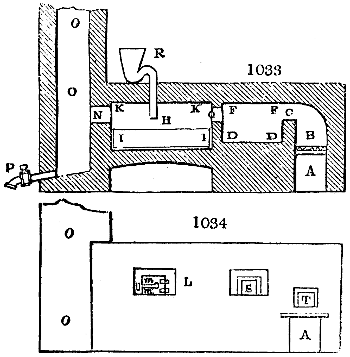
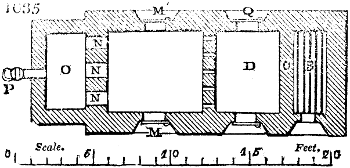
1. The preparation of the sulphate of soda.—Figs. 1033, 1034, 1035. represent the furnace for converting the muriate of soda into the sulphate. The furnace must be built interiorly of the most refractory fire-bricks, such as are used for glasshouses, but of the ordinary brick size; except the bridges C, G, N, which should be formed of one mass, such as what is called a Welsh lump. A is the ash-pit; B, the grate; C, the first bridge, between the fire and the first calcining hearth, D, D; F, F, is its roof; G, the second bridge, between the calcining hearth and the decomposing hearth I, I, I; the roof of which is K, K. This hearth I, I, is lined with a lead square pan, 5 or 6 inches deep, sloped at the back opening, in fig. 1035., marked M′; which deficient part of the upright side is filled up with two bricks placed one over the other, as shown at m, m, fig. 1034., and luted with clay, to confine the semi-liquid mass in the pan, I, I. Some manufacturers make this pan 8 inches deep, and line its bottom and sides with bricks or siliceous sandstone, to protect the lead from the corrosive action of the acid. There are others who consider this precaution troublesome, as the points of the pan which become leaky are thereby concealed. In the roof of the decomposing hearth, one or two syphon funnels R, of lead, are inserted when the charge of acid (sulphuric) is to be poured down upon the salt in I, I, to save the risk of any annoyance from the fumes of the muriatic acid. O, O, is a chimney filled with round flint nodules, which are kept continually moist by the trickling of a streamlet of water upon the topmost layer. The muriatic gas meeting this descending film of water upon so extensive a surface, becomes absorbed, and runs out below in a liquid form. When the acid is required in a somewhat concentrated state, this chimney should be made both high and capacious. Such a plan, moreover, is very valuable for abating the nuisance caused by the disengagement of the muriatic acid gas; which is otherwise apt to sterilize the surrounding vegetation.
A fire being kindled in the grate B, figs. 1033. and 1034., 3 cwt. of salt in powder are to be thrown by a shovel into the pan I, through the door M, fig. 1035., or m, m, fig. 1034. Two hundred weight and a half of oil of vitriol, of specific gravity 1·844 having been diluted with from 25 to 30 per cent. of water, and well mixed, or 3 cwts. at 56° Baumé, are to be slowly poured in by the funnel, and diffused among the muriate of soda, by an occasional stir with an iron rake cased with sheet lead. Fumes of muriatic acid will now plentifully escape, and, passing up the condensing-shaft O, will flow down in the form of liquid spirit of salt, and escape by the stoneware stopcock P, into the pipe of a sunk cistern. The fire having been steadily kept up at a moderate degree, the chemical reaction will be tolerably complete in the course of two hours; but as this is relative to the nature of the fuel, and the draught of the furnace, no very precise rule in point of time can be laid down; but it is sufficient for this stage of the process, when the fumes cease to be very dense and copious, as may be ascertained by opening the door M, and looking in, or by the appearance at the top of the shaft O. Over the door M′, in the opposite side of the decomposing hearth, fig. 1035., there must be an arch or hood terminating in a small chimney, 15 or 20 feet high, for the ascent of the muriatic vapours, when the charge is drawn or run out of the hearth, and allowed to fall into a square shallow iron tray, placed on the ground at the back of the furnace. For this discharge, the two bricks which serve as stoppers to that orifice, must be unluted and removed.
As soon as that charge is taken out, (the fire being meanwhile checked by opening the door T, fig. 1034., and shutting partially the ash-pit opening at A,) a fresh charge must be introduced as above described. The nearly decomposed saline matter during the second charging of the hearth I, will have grown cool and concrete. It must be shovelled into the calcining hearth D, D, fig. 1033., by the back door Q, fig. 1035., where it will receive a higher degree of heat; and, by the expulsion of the remaining part of the muriatic acid, it will become a perfect sulphate of soda. It should be finally brought into a state of semi-fusion. When a sample of it, taken out on the end of the rake or trowel-shaped scraper, emits no fumes, the conversion is accomplished.
From 3 cwts. of common salt, or muriate of soda, rather more than 31⁄2 cwts. of perfect sulphate should be obtained, quite free from metallic impurity.
The next step is the conversion of the sulphate into a crude soda.
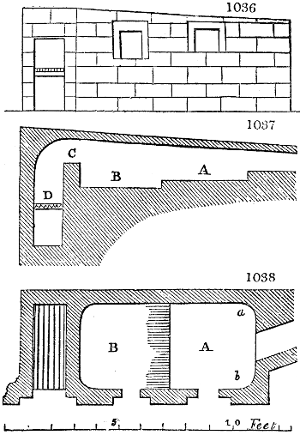
One of the most improved soda furnaces is that, employed in a few factories, represented in figs. 1036, 1037, and 1038. In the section fig. 1037., there are two hearths in one furnace, the one elevated above the level of the other by the thickness of a brick, or about 3 inches. A is the preparatory shelf, where the mixture to be decomposed is first laid in order to be thoroughly heated, so that when transferred to the lower or decomposing hearth B, it may not essentially chill it, and throw back the operation. C is the fire-bridge, and D is the grate. In the horizontal section, or ground plan, fig. 1038., we see an opening in the front corresponding to each hearth. This is a door, as shown in the side view or elevation of the furnace, fig. 1036.; and each door is shut by an iron square frame filled with a fire-tile or bricks, and suspended by a chain over a pulley fixed in any convenient place. See Pitcoal, coking of, p. 1041. The workman, on pushing up the door lightly, makes it rise, because there is a counterweight at the other end of each chain, which balances the weight of the frame and bricks. In the ground plan, only one smoke-flue is shown; and this construction is preferred by many manufacturers; but others choose to have two flues, one from each shoulder, as at a, b; which two flues afterwards unite in one vertical chimney, from 25 to 40 feet high; because the draught of a soda-furnace must be very sharp. Having sufficiently explained the construction of this improved furnace, I shall now proceed to describe the mode of making soda with it.
The materials with which the sulphate is decomposed into a rough carbonate of soda, are chalk or ground limestone, and ground coal or charcoal. The proportions in which these three substances are mixed, influence in a remarkable degree the success of the decomposing process. I have known a false proportion introduced, and persevered in, at a factory, with the most prejudicial effect to the product; the soda-ash produced, being in a small quantity relatively to the sulphate employed, and being much charged with sulphur. After very numerous trials which I have made on the great scale, and many inquiries at the most successful soda-works, both in this country and abroad, I am warranted to offer the following proportions as the most profitable:—
Sulphate of soda, 100 parts: carbonate of lime (chalk or limestone), from 110 to 120 parts; if pure, 110; if a little impure or damp, 120: pit coal, 50 parts.
These materials must be separately ground by an edge-stone mill, and sifted into a tolerably fine powder. They must be then very carefully mixed. Attention to these particulars is of no little importance to the success of the soda process.
One hundred parts or pounds of sulphate of soda are equivalent to 75 parts of carbonate, and when skilfully decomposed, will generally yield fully 70 pounds. A charge for the decomposing furnace with the preparatory shelf should not exceed 200 lbs., or perhaps 180; therefore if 75 pounds of ground sulphate of soda, with 80 pounds of chalk or limestone (ground), and 37 pounds of ground coal; be well mixed, they will constitute one charge. This charge must be shovelled in upon the hearth A, or shelf of preparation, (fig. 1037.); and whenever it has become hot (the furnace having been previously brought to bright ignition), it is to be transferred to the decomposing hearth or laboratory B, by an iron tool, shaped exactly like an oar, called the spreader. This tool has the flattened part from 2 to 3 feet long, and the round part, for laying hold of and working by, from 6 to 7 feet long. Two other tools are used; one, a rake, bent down like a garden hoe at the end; and another, a small shovel, consisting of a long iron rod terminated with a piece of iron plate, about 6 inches long, 4 broad, sharpened and tipped with steel, for cleaning the bottom of the hearth from adhering cakes or crusts. Whenever the charge is shoved by the sliding motion of the oar down upon the working hearth, a fresh charge should be thrown into the preparation shelf, and evenly spread over its surface.
The hot and partially carbonized charge being also evenly spread upon the hearth B, is to be left untouched for about ten minutes, during which time it becomes ignited, and begins to fuse upon the surface. A view may be taken of it through a peep-hole in the door, which should be shut immediately, in order to prevent the reduction of the temperature. When the mass is seen to be in a state of incipient fusion, the workman takes the oar and turns it over breadth by breadth in regular layers, till he has reversed the position of the whole mass, placing on the surface the particles which were formerly in contact with the hearth. Having done this, he immediately shuts the door, and lets the whole get another decomposing heat. After five or six minutes, jets of flame begin to issue from various parts of the pasty-consistenced mass. Now is the time to incorporate the materials together, turning and spreading by the oar, gathering them together by the rake, and then distributing them on the reverse part of the hearth; that is, the oar should transfer to the part next the fire-bridge the portion of the mass lying next the shelf, and vice versâ. The dexterous management of this transposition characterizes a good soda-furnacer. A little practice and instruction will render this operation easy to a robust clever workman. After this transposition, incorporation, and spreading, the door may be shut again for a few minutes, to raise the heat for the finishing off. Lastly, the rake must be dexterously employed to mix, shift, spread, and incorporate. The jets, called candles, are very numerous, and bright at first; and whenever they begin to fade, the mass must be raked out into cast-iron moulds, placed under the door of the laboratory to receive the ignited paste.
One batch being thus worked off, the other, which has lain undisturbed on the shelf, is to be shoved down from A to B, and spread equally upon it, in order to be treated as above described. A third batch is then to be placed on the shelf.
The article thus obtained should contain at least 22 per cent. of real soda, equivalent to 37 per cent. of dry carbonate, or to 100 of crystals. A skilful workman can turn out a batch in from three quarters of an hour to an hour, producing a perfect carbonate, which yields on solution an almost colourless liquid, nearly destitute of sulphur, and containing hardly any decomposed sulphate.
In some soda-works, where the decomposing furnace is very large, and is charged with a ton of materials at a time, it takes two men to work it, and from five to six hours to complete a batch. Having superintended the operation of the above-described small furnace, and examined its products, I feel warranted to recommend its adoption.
The following materials and products show the average state of this soda process:—
Materials—100 parts of sulphate of soda, ground, equivalent to 7·5 of carbonate; 110 of chalk or ground limestone; 55 of ground coal: in the whole, 265.
Products—168 parts of crude soda, at 33 per cent. = 55·5 of dry carbonate.
Or, - 130 — crystals of carbonate of soda = 48 of dry carbonate; and
100 — insoluble matter.
But these products necessarily vary with the skill of the workman.
In another manufactory the following proportions are used:—Six stones, of 14 lbs. each, of dry ground sulphate of soda, are mixed with 3 of chalk and 3 of coal. This mixture, weighing 11⁄2 cwt., forms a batch, which is spread upon the preparation shelf of the furnace (figs. 1037. and 1038.), as above described, and gradually heated to incipient ignition. It is then swept forwards to the lower area B, by the iron oar, and spread evenly by the rake. Whenever it begins to soften under the rising heat of the laboratory (the side doors being meanwhile shut), the mass must be laboriously turned over and incorporated; the small shovel, or paddle, being employed to transfer, by the interchange of small portions at a time, in rapid but orderly succession, the whole materials from the colder to the hotter, and from the hotter to the colder parts of the hearth. The process of working one batch takes about an hour, during the first half of which period it remains upon the preparation shelf. The average weight of the finished ball is 1 cwt., and its contents in alkalimetrical soda are 33 pounds.
Where the acidulous sulphate of iron from pyrites may be had at a cheap rate, it has been long ago employed, as at Hurlett in Scotland, instead of sulphuric acid, for decomposing the chloride of sodium. Mr. Turner’s process of preparing soda, by decomposing sea salt with litharge and quicklime, has been long abandoned, the resulting patent yellow, or sub-chloride of lead, having a very limited sale.
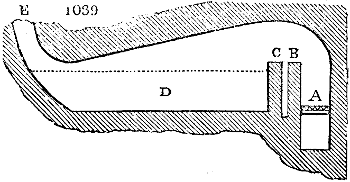
2. The extraction of pure soda from the crude article.—The black balls must be broken into fragments, and thrown into large square iron cisterns, furnished with false bottoms of wooden spars; when the cisterns are nearly full of these lumps, water is pumped in upon them, till they are all covered. After a few days, the lixiviation is effected, and the lye is drawn off either by a syphon or by a plug-hole near the bottom of the cistern, and run into evaporating vessels. These may be of two kinds. The surface-evaporating furnace, shown in fig. 1039., is a very admirable invention for economizing vessels, lime, and fuel. The grate A, and fireplace, are separated from the evaporating laboratory D, by a double fire-bridge B, C, having an interstitial space in the middle, to arrest the communication of a melting or igniting heat towards the lead-lined cistern D. This cistern may be 8, 10, or 20 feet long, according to the magnitude of the soda-work, and 4 feet or more wide. Its depth should be about 4 feet. It consists of sheet lead, of about 6 pounds weight to the square foot, and it is lined with one layer of bricks, set in roman or hydraulic cement, both along the bottom and up the sides and ends. The lead comes up to the top of C, and the liquor, or lye, may be filled in to nearly that height. Things being thus arranged, a fire is kindled upon the grate A; the flame and hot air sweep along the surface of the liquor, raise its temperature there rapidly to the boiling point, and carry off the watery parts in vapour up the chimney E, which should be 15 or 20 feet high, to command a good draught. But, indeed, it will be most economical to build one high capacious chimney stalk, as is now done at Glasgow, Manchester, and Newcastle, and to lead the flues of the several furnaces above described into it. In this evaporating furnace the heavier and stronger lye goes to the bottom, as well as the impurities, where they remain undisturbed. Whenever the liquor has attained to the density of 1·3, or thereby, it is pumped up into evaporating cast-iron pans, of a flattened somewhat hemispherical shape, and evaporated to dryness while being diligently stirred with an iron rake and iron scraper.
This alkali gets partially carbonated by the above surface-evaporating furnace, and is an excellent article.
When pure carbonate is wanted, that dry mass must be mixed with its own bulk of ground coal, sawdust, or charcoal, and thrown into a reverberatory furnace, like fig. 1038., but with the sole all upon one level. Here it must be exposed to a heat not exceeding 650° or 700° F.; that is, a little above the melting heat of lead; the only object being to volatilize the sulphur present in the mass, and carbonate the alkali. Now, it has been found, that if the heat be raised to distinct redness, the sulphur will not go off, but will continue in intimate union with the soda. This process is called calking, and the furnace is called a calker furnace. It may be six or eight feet long, and four or five feet broad in the hearth, and requires only one door in its side, with a hanging iron frame filled with a fire-tile or bricks, as above described.
This carbonating process may be performed upon several cwts. of the impure soda, mixed with sawdust, at a time. It takes three or four hours to finish the desulphuration; and it must be carefully turned over by the oar and the rake, in order to burn the coal into carbonic acid, and to present the carbonic acid to the particles of caustic soda diffused through the mass, so that it may combine with them.
When the blue flames cease, and the saline matters become white, in the midst of the coaly matter, the batch may be considered as completed. It is raked out, and when cooled, lixiviated in great iron cisterns with false bottoms, covered with mats. The watery solution being drawn off clear by a plug-hole, is evaporated either to dryness, in hemispherical cast-iron pans, as above described, or only to such a strength that it shows a pellicle upon its surface, when it may be run off into crystallizing cisterns of cast iron, or lead-lined wooden cisterns. The above dry carbonate is the best article for the glass manufacture.
Crystallized carbonate of soda, contains 623⁄4 per cent. of water. The crystals are colourless transparent rhomboids, which readily effloresce in the air, and melt in their own water of crystallization. On decanting the liquid from the fused mass, it is found that one part of the salt has given up its water of crystallization to another. By evaporation of that fluid, crystals containing one-fifth less water than the common carbonate are obtained. These do not effloresce in the air.
Mineral soda, the sesquicarbonate, (Anderthalb kohlensaures natron, Germ.); is found in the province of Sukena, in Africa, between Tripoli and Fezzan. It forms a stratum no more than an inch thick, just below the surface of the soil. Its texture is striated crystalline, like fibrous gypsum. Several hundred tons of it are collected annually, which are chiefly consumed in Africa. This species of soda does not effloresce like the Egyptian, or the manufactured soda crystals, owing to its peculiar state of composition and density. It was analyzed by Klaproth, under its native name of trona, and was found to consist, in 100 parts, of—soda, 37; carbonic acid, 38; sulphate of soda, 2·5; water, 22·5, in 100.
This soda is, therefore, composed of—3 atoms of carbonic acid, associated with 2 atoms of soda, and 4 of water; while our commercial soda crystals are composed of—1 atom of carbonic acid, 1 atom of soda, and 10 atoms of water.
There are six natron lakes in Egypt. They are situated in a barren valley, called Bahr-bela-ma, about thirty miles to the west of the Delta.
There are natron lakes also in Hungary, which afford in summer a white saline efflorescent crust of carbonate of soda, mixed with a little sulphate.
There are several soda lakes in Mexico, especially to the north of Zacatecas, as also in many other provinces. In Columbia, 48 English miles from Merida, mineral soda is extracted from the earth in great abundance, under the name of urao.
Bicarbonate of soda (Doppelt kohlensaures natron, Germ.); is prepared, like bicarbonate of potassa, by transmitting carbonic acid gas through a cold saturated solution of pure carbonate of soda, till crystalline crusts be formed. The bicarbonate may also be obtained in four-sided tables grouped together. It has an alkaline taste and reaction upon litmus paper, dissolves in 13 parts of cold water, and is converted by boiling water into the sesquicarbonate, with the disengagement of one fourth of its carbonic acid. It consists of—37 of soda, 52·35 carbonic acid, and 10·65 water.
SODA-WATER, is the name given to water containing a minute quantity of soda, and highly charged with carbonic acid gas, whereby it acquires a sparkling appearance, an agreeable pungent taste, an exhilarating quality, and certain medicinal powers. It constitutes a considerable object of manufacture in this kingdom. The following figure represents, I understand, the best system of apparatus for preparing it. A very dilute solution of soda is put into the globular vessel H, and the carbonic acid gas is forced into it from the gasometer E, by means of the powerful pump-work, as will be understood from the subjoined explanation.
The same apparatus may serve for making any species of aerated water, in imitation of any natural spring. All that is necessary for this purpose, is to put into the cistern Q, the neutro-saline matter, earths, metallic oxides, pure water, &c., each in due proportion, according to the most accredited analysis of the mineral water to be imitated, to agitate that mixture, to suck it into the condenser H, through the pipe R, and then to impregnate it to the due degree, by pumping in the appropriate gas, previously contained in the gasometer F.
Thus, to make Seltzer water, for each 12 pounds troy, = 69,120 grains, or 1 gallon imperial very nearly, take 55 grains of dry carbonate of soda, 17 of carbonate of lime, 18 of carbonate of magnesia, 31⁄2 of subphosphate of alumina, 3 of chloride of potassium, 155 of chloride of sodium, and 3 of finely precipitated silica. Put these materials into the cistern Q, and charge the gasometer F with 353 cubic inches of carbonic acid gas. Then work the machine by the handle of the wheel X, as explained below, and regulate the introduction of the liquid and the gas in aliquot portions; for example, if the condenser H admits half a gallon of water at a time, that quantity of liquid should be charged with 176 cubic inches of the gas, being one half of the whole quantity. The sulphuretted mineral waters may be imitated in like manner, by taking the proportions of their constituents, as given in Table II. of Waters, Mineral.
IMPROVED SODA-WATER APPARATUS, AS MADE BY MR. HAYWARD TYLER, OF MILTON STREET.
Fig. 1040. front view of the soda-water machine. Fig. 1041. end view of the same.
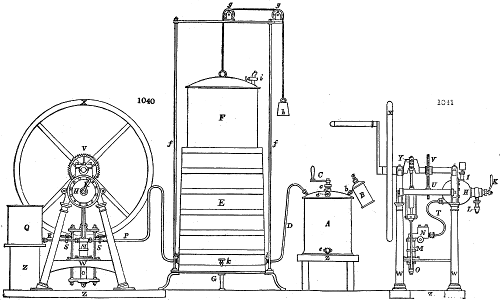
Fig. 1040, 1041 enlarged (78 kB)
A, lead generator, for making the gas. B, lead pot, for holding sulphuric acid. C, handle for moving the agitator of the receiver, which stirs up the ingredients in the lead generator. a, cap and screw, for charging the lead pot with sulphuric acid. b, swivel-joint, which is movable, for occasionally throwing in portions of sulphuric acid for generating gas. c, stuffing-box for agitator. d, large cap and screw, for charging the lead generator with whiting and water. e, cap and screw, for emptying contents of ditto. D, lead pipe, to convey the gas from the lead generator to gasometer. E, wood tub, filled with water, for gasometer to work in. F, copper gasometer. G, strong iron frame, for gasometer and tub to stand on, firmly fixed together by three wrought-iron rods, f, f. g, g, two pulleys, for carrying rope and counterbalance weight h, for balancing copper gasometer. i, cock for discharging atmospheric air contained in the gasometer before making the gas. k, cock for occasionally emptying the water out of the tub. l, union joint, to which is fixed a copper pipe, passing through the water in the tub, to deliver the gas as generated into the copper gasometer. m, another union joint, with a similar copper pipe, passing through the water in the tub, and projecting two or three inches above the surface of the water, to convey the gas from the copper gasometer to the soda-water machine. H, H, condenser for aerating the soda-water. I, safety valve. K, K, bottling valve. L, bottling nipple. M, M, soda-water pump. N, valve-piece. O, O, piston of the pump. P, pipe for conducting gas from the gasometer to pump. Q, copper pan for holding the solution of soda. R, copper pipe for conducting the solution of soda to the force pump. S, S, two cocks for regulating the admission of the solution and gas to the pump. T, copper pipe through which the soda-water is forced to the condenser. U, pinion wheel, to give motion to the agitator revolving inside the condenser. V, V, wheel for driving ditto. W, W, cast-iron frame for carrying machinery. X, X, cast-iron fly-wheel. Z, wrought-iron crank. Y, Z, Z, wood stools and curb, upon which the whole of the machinery is fixed.
SODIUM, the metallic basis of soda, is obtained by processes similar to those by which potassium is procured. By fusing hydrate of soda with a little hydrate of potassa, a mixture is obtained, which yields more readily than soda by itself to the decomposing action of iron-turnings at a high heat, in a bent gun-barrel. The portion of potassium produced, may be got rid of, by digesting the alloy for a few days in some naphtha or oil of turpentine contained in an open vessel. The sodium remains at the bottom of the liquid. Pure sodium may, however, be prepared at once, by subjecting incinerated tartrate of soda to heat in the apparatus of Brunner, described under Potassium. It is white, like silver; softer and more malleable than any other metal, and may be readily reduced into very thin leaves. It preserves its malleability till it approaches the melting point. Its specific gravity is 0·970. It softens at the temperature of 122° F., and at 200° it is perfectly fluid; but it will not rise in vapour until heated to nearly the melting point of glass. In the air it oxidizes slowly, and gets covered with a crust of soda; but it does not take fire till it is made nearly red-hot; and then it emits brilliant scintillations. When thrown upon water, it is rapidly oxidized, but without kindling, like potassium. If a drop of water be thrown upon it, it becomes so hot by the chemical action as to take fire. There are three oxides of sodium; 1. the suboxide; 2. the oxide, or the basis of common soda; and, 3. the suroxide; the last being formed when sodium is heated to redness upon a plate of silver.
SOLDERING (Souder, Fr.; Löthen, Germ.); is the process of uniting the surfaces of metals, by the intervention of a more fusible metal, which being melted upon each surface, serves, partly by chemical attraction, and partly by cohesive force, to bind them together. The metals thus united may be either the same or dissimilar; but the uniting metal must always have an affinity for both. Solders must be, therefore, selected in reference to their appropriate metals. Thus tin-plates are soldered with an alloy consisting of from 1 to 2 parts of tin, with 1 of lead; pewter is soldered with a more fusible alloy, containing a certain proportion of bismuth added to the lead and tin; iron, copper, and brass are soldered with spelter, an alloy of zinc and copper, in nearly equal parts; silver, sometimes with pure tin, but generally with silver-solder, an alloy consisting of 5 parts of silver, 6 of brass, and 2 of zinc; zinc and lead, with an alloy of from 1 to 2 parts of lead with 1 of tin; platinum, with fine gold; gold, with an alloy of silver and gold, or of copper and gold; &c.
In all soldering processes, the following conditions must be observed: 1. the surfaces to be united must be entirely free from oxide, bright, smooth, and level; 2. the contact of air must be excluded during the soldering, because it is apt to oxidize one or other of the surfaces, and thus to prevent the formation of an alloy at the points of union. This exclusion of air is effected in various ways. The locksmith encases in loam the objects of iron, or brass, that he wishes to subject to a soldering heat; the silversmith and brazier mix their respective solders with moistened borax powder; the coppersmith and tinman apply sal ammoniac, rosin, or both, to the cleaned metallic surfaces, before using the soldering-iron to fuse them together with the tin alloy. The strong solder of the coppersmith consists of 8 parts of brass and 1 of zinc; the latter being added to the former, previously brought into a state of fusion. The crucible must be immediately covered up for two minutes till the combination be completed. The melted alloy is to be then poured out upon a bundle of twigs held over a tub of water, into which it falls in granulations. An alloy of 3 parts of copper and 1 of zinc forms a still stronger solder for the coppersmiths. When several parts are to be soldered successively upon the same piece, the more fusible alloys, containing more zinc, should be used first. A softer solder for coppersmiths is made with 6 parts of brass, 1 of tin, and 1 of zinc; the tin being first added to the melted brass, then the zinc; and the whole well incorporated by stirring.
The edges of sheet lead for sulphuric acid chambers, and its concentration pans, are joined together by melted lead itself, because any solder containing tin would soon be corroded. With this view, the two edges being placed in contact, are flattened down into a long wooden groove, and secured in their situation by a few brass pins driven into the wood. The surfaces are next brightened with a triangular scraper, rubbed over with candle grease, and then covered with a stream of hot melted lead. The riband of lead thus applied is finally equalized by being brought into partial fusion with the plumber’s conical iron heated to redness; the contact of air being prevented by sprinkling rosin over the surface. The sheets of lead are thus burned together, in the language of the workmen.
SOOT (Noir de fumée, Suie, Fr.; Rus, Flatterrus, Germ.); is the pulverulent charcoal condensed from the smoke of wood or coal fuel. A watery infusion of the former is said to be antiseptic, probably from its containing some creosote.
The soot of pitcoal has not been analyzed with any minuteness. It contains some sulphate and carbonate of ammonia, along with bituminous matter.
SORBIC ACID, is the same with malic acid; which see.
SOY, is a liquid condiment, or sauce, imported chiefly from China. It is prepared with a species of white haricots, wheat flour, common salt, and water; in the proportions respectively of 50, 60, 50, and 250 pounds. The haricots are washed, and boiled in water till they become so soft as to yield to the fingers. They are then laid in a flat dish to cool, and kneaded along with the flour, a little of the hot water of the decoction being added from time to time. This dough is next spread an inch or an inch and a half thick upon the flat vessel (made of thin staves of bamboo), and when it becomes hot and mouldy, in two or three days, the cover is raised upon bits of stick, to give free access of air. If a rancid odour is exhaled, and the mass grows green, the process goes on well; but if it grows black, it must be more freely exposed to the air. As soon as all the surface is covered with green mouldiness, which usually happens in eight or ten days, the cover is removed, and the matter is placed in the sunshine for several days. When it has become as hard as a stone, it is cut into small fragments, thrown into an earthen vessel, and covered with the 250 pounds of water having the salt dissolved in it. The whole is stirred together, and the height at which the water stands is noted. The vessel being placed in the sun, its contents are stirred up every morning and evening; and a cover is applied at night, to keep it warm and exclude rain. The more powerful the sun, the sooner the soy will be completed; but it generally requires two or three of the hottest summer months. As the mass diminishes by evaporation, well water is added; and the digestion is continued till the salt water has dissolved the whole of the flour and the haricots; after which the vessel is left in the sun for a few days, as the good quality of the soy depends on the completeness of the solution, which is promoted by regular stirring. When it has at length assumed an oily appearance, it is poured into bags, and strained. The clear black liquid is the soy, ready for use. It is not boiled, but is put up into bottles, which must be carefully corked. Genuine soy was made in this way at Canton, by Michael de Grubbens. See Memoirs of Academy of Sciences of Stockholm for 1803.
SPECIFIC GRAVITY, designates the relative weights of different bodies under the same bulk; thus a cubic foot of water weighs 1000 ounces avoirdupois; a cubic foot of coal, 1350; a cubic foot of cast iron, 7280; a cubic foot of silver, 10,400; and a cubic foot of pure gold, 19,200; numbers which represent the specific gravities of the respective substances, compared to water = 1·000. See Alloy.
SPECULUM METAL, is an alloy of copper and tin; described under Copper.
SPERMACETI; the Cetine of Chevreul. In certain species of the cachalot whale, as the Physeter macrocephalus, tursio, microps, and orthodon, as also the Delphinus edentulus, the fat of some parts of their bodies contains a peculiar kind of stearine, called spermaceti. The oil obtained from cavities in the bones of the cranium of the above cetaceæ is the richest in this kind of stearine. This being thrown into great filter-bags, the spermaceti oil passes through, and is subsequently purified by the addition of a small quantity of potash lye, which precipitates certain matters by neutralizing the acid that held them in solution. The solid which remains on the filter is next squeezed in bags, by means of a horizontal hydraulic press encased in steam, then digested with a weak potash lye, in order to dissolve out any oil which may continue to adhere to it, washed with water, finally dissolved in a tub by the agency of steam, laded into tin pans, and allowed slowly to concrete into a white semi-transparent brittle lamellar crystalline mass, which forms elegant candles.
At 60° its specific gravity is 0·943. It melts at 112·5°; 100 parts of alcohol at 0·821 dissolve 31⁄2 of it, of which 0·9 are deposited on cooling. Warm ether dissolves it in very large quantities. It is soluble also in the fat of volatile oils; and if the solutions have been saturated while hot, the greater part of the spermaceti crystallizes on cooling. When this substance has been purified by digesting alcohol upon it repeatedly, what remains is the cetine of Chevreul, or pure spermaceti. Its melting point has now become 116° F., and its boiling point 616° F., at which it distils without alteration. Caustic alkaline lyes saponify it with difficulty.
SPIRIT OF AMMONIA, is, properly speaking, alcohol combined with ammonia gas; but the term is often applied to water of ammonia.
SPIRITS, VINOUS. This subject has been fully discussed in the articles Alcohol, Distillation, and Fermentation. I have shown that the progressive increase of alcohol in the wash tends progressively to prevent the conversion of the wort into spirit, or checks the fermenting process, though a great deal of fermentable matter remains unchanged. Mr. Sheridan has sought to remove this obstacle to the thorough transmutation of saccharine matter into alcohol, by drawing off the spirit as it is formed. For this purpose he ferments his wash in close tuns, connected with a powerful air-pump worked by machinery, thus continually removing the carbonic acid as it is formed, and maintaining a diminished pressure under which the alcohol readily distils at a temperature of 120° or 130° F. He finds that this degree of heat is not injurious to the fermentation, provided that it be communicated by the air of a stove-room, and not by water or steam pipes traversing the liquid, which would inevitably scald or seeth the particles in succession, and thereby extinguish the fermenting principle.
By the above ingenious plan, Mr. Sheridan tells me he has obtained 28 gallons of proof spirit from a quarter of grain, instead of the average product 21, being an increase of 25 per cent. The experiment was tried upon a considerable scale at Messrs. Currie’s great distillery near London; but could not be established as a mode of manufacture, on account of the excise laws, which prohibit the distillers from carrying on the two processes of fermentation and distillation at the same time.
SPIRIT OF WINE; Alcohol.
SPONGE (Eponge, Fr.; Schwamm, Germ.); is a cellular fibrous tissue produced by small animals, almost imperceptible, called polypi by naturalists, which live in the sea. This tissue is said to be covered in its recent state with a kind of semi-fluid thin coat of animal jelly, susceptible of a slight contraction or trembling on being touched; which is the only symptom of vitality displayed by the sponge. After death, this jelly disappears, and leaves merely the sponge; formed by the combination of a multitude of small capillary tubes, capable of receiving water in their interior, and of becoming thereby distended. Sponges occur attached to stones at the bottom of the sea; and abound particularly upon the shores of the islands in the Grecian Archipelago. Although analogous in their origin to coral, sponges are quite different in their nature; the former being composed almost entirely of carbonate of lime; while the latter are formed of the same elements as animal matters, and afford, on distillation, a considerable quantity of ammonia.
Dilute sulphuric acid has been recommended for bleaching sponges, after the calcareous impurities have been removed by muriatic acid. Chlorine water answers better.
SPOON MANUFACTURE. See Stamping of Metals.
STAINED GLASS. When certain metallic oxides or chlorides, ground up with proper fluxes, are painted upon glass, their colours fuse into its surface at a moderate heat, and make durable pictures, which are frequently employed in ornamenting the windows of churches as well as of other public and private buildings. The colours of stained glass are all transparent, and are therefore to be viewed only by transmitted light. Many metallic pigments, which afford a fine effect when applied cold on canvas or paper, are so changed by vitreous fusion as to be quite inapplicable to painting in stained glass.
The glass proper for receiving these vitrifying pigments, should be colourless, uniform, and difficult of fusion; for which reason crown glass, made with little alkali, or with kelp, is preferred. When the design is too large to be contained on a single pane, several are fitted together, and fixed in a bed of soft cement while painting, and then taken asunder to be separately subjected to the fire. In arranging the glass pieces, care must be taken to distribute the joinings so that the lead frame-work may interfere as little as possible with the effect.
A design must be drawn upon paper, and placed beneath the plate of glass; though the artist cannot regulate his tints directly by his pallet, but by specimens of the colours producible from his pallet pigments after they are fired. The upper side of the glass being sponged over with gum-water, affords, when dry, a surface proper for receiving the colours, without the risk of their running irregularly, as they would be apt to do, on the slippery glass. The artist first draws on the plate, with a fine pencil, all the traces which mark the great outlines and shades of the figures. This is usually done in black, or, at least, some strong colour, such as brown, blue, green, or red. In laying on these, the painter is guided by the same principles as the engraver, when he produces the effect of light and shade by dots, lines, or hatches; and he employs that colour to produce the shades, which will harmonize best with the colour which is to be afterwards applied; but for the deeper shades, black is in general used. When this is finished, the whole picture will be represented in lines or hatches similar to an engraving finished up to the highest effect possible; and afterwards, when it is dry, the vitrifying colours are laid on by means of larger hair pencils; their selection being regulated by the burnt specimen tints. When he finds it necessary to lay two colours adjoining, which are apt to run together in the kiln, he must apply one of them to the back of the glass. But the few principal colours to be presently mentioned, are all fast colours, which do not run, except the yellow, which must therefore be laid on the opposite side. After colouring, the artist proceeds to bring out the lighter effects by taking off the colour in the proper place, with a goose quill cut like a pen without a slit. By working this upon the glass, he removes the colour from the parts where the lights should be the strongest; such as the hair, eyes, the reflection of bright surfaces and light parts of draperies. The blank pen may be employed either to make the lights by lines, or hatches and dots, as is most suitable to the subject.
By the metallic preparations now laid upon it, the glass is made ready for being fired, in order to fix and bring out the proper colours. The furnace or kiln best adapted for this purpose, is similar to that used by enamellers. See Enamel, and the Glaze-kiln; under Pottery. It consists of a muffle or arch of fire-clay or pottery, so set over a fireplace, and so surrounded by flues, as to receive a very considerable heat within, in the most equable and regular manner; otherwise some parts of the glass will be melted; while, on others, the superficial film of colours will remain unvitrified. The mouth of the muffle, and the entry for introducing fuel to the fire, should be on opposite sides, to prevent as much as possible the admission of dust into the muffle, whose mouth should be closed with double folding-doors of iron, furnished with small peep-holes, to allow the artist to watch the progress of the staining, and to withdraw small trial slips of glass, painted with the principal tints used in the picture.
The muffle must be made of very refractory fire-clay, flat at its bottom, and only 5 or 6 inches high, with such an arched top as may make the roof strong, and so close on all sides as to exclude entirely the smoke and flame. On the bottom of the muffle a smooth bed of sifted lime, freed from water, about half an inch thick, must be prepared for receiving the pane of glass. Sometimes several plates of glass are laid over each other with a layer of dry pulverulent lime between each. The fire is now lighted, and most gradually raised, lest the glass should be broken; and after it has attained to its full heat, it must be kept up for 3 or 4 hours, more or less, according to the indications of the trial slips; the yellow colour being principally watched, as it is found to be the best criterion of the state of the others. When the colours are properly burnt in, the fire is suffered to die away, so as to anneal the glass.
STAINED-GLASS PIGMENTS.
Flesh colour.—Take an ounce of red lead, two ounces of red enamel (Venetian glass enamel, from alum and copperas calcined together), grind them to fine powder, and work this up with spirits (alcohol) upon a hard stone. When slightly baked, this produces a fine flesh colour.
Black colour.—Take 141⁄2 ounces of smithy scales of iron, mix them with two ounces of white glass (crystal), an ounce of antimony, and half an ounce of manganese; pound and grind these ingredients together with strong vinegar. A brilliant black may also be obtained by a mixture of cobalt blue with the oxides of manganese and iron. Another black is made from three parts of crystal glass, two parts of oxide of copper, and one of (glass of) antimony worked up together, as above.
Brown colour.—An ounce of white glass or enamel, half an ounce of good manganese; ground together.
Red, rose, and brown colours, are made from peroxide of iron, prepared by nitric acid. The flux consists of borax, sand, and minium in small quantity.
Red colour, may be likewise obtained from one ounce of red chalk pounded, mixed with two ounces of white hard enamel, and a little peroxide of copper.
A red, may also be composed of rust of iron, glass of antimony, yellow glass of lead, such as is used by potters (or litharge), each in equal quantity; to which a little sulphuret of silver is added. This composition, well ground, produces a very fine red colour on glass. When protoxide of copper is used to stain glass, it assumes a bright red or green colour, according as the glass is more or less heated in the furnace, the former corresponding to the orange protoxide, the latter having the copper in the state of peroxide.
Bistres and brown reds, may be obtained by mixtures of manganese, orange oxide of copper, and the oxide of iron called umber, in different proportions. They must be previously fused with vitreous solvents.
Green colour.—Two ounces of brass calcined into an oxide, two ounces of minium, and eight ounces of white sand; reduce them to a fine powder, which is to be enclosed in a well luted crucible, and heated strongly in an air-furnace for an hour. When the mixture is cold, grind it in a brass mortar. Green may, however, be advantageously produced by a yellow on one side, and a blue on the other. Oxide of chrome has been also employed to stain glass green.
A fine yellow colour.—Take fine silver laminated thin, dissolve in nitric acid, dilute with abundance of water, and precipitate with solution of sea salt. Mix this chloride of silver, in a dry powder, with three times its weight of pipe-clay well burnt and pounded. The back of the glass pane is to be painted with this powder; for when painted on the face, it is apt to run into the other colours.
Another yellow can be made by mixing sulphuret of silver with glass of antimony, and yellow ochre previously calcined to a red-brown tint. Work all these powders together, and paint on the back of the glass. Or silver laminæ melted with sulphur, and glass of antimony, thrown into cold water, and afterwards ground to powder, afford a yellow.
A pale yellow may be made with the powder resulting from brass, sulphur, and glass of antimony, calcined together in a crucible, till they cease to smoke; and then mixed with a little burnt yellow ochre.
The fine yellow of M. Merand, is prepared from chloride of silver, oxide of zinc, white-clay, and rust of iron. This mixture, simply ground, is applied on the glass.
Orange colour.—Take 1 part of silver powder, as precipitated from the nitrate of that metal by plates of copper, and washed; mix it with 1 part of red ochre and 1 of yellow, by careful trituration; grind into a thin pap with oil of turpentine or lavender, and apply this with a brush, dry, and burn in.
In the Philosophical Magazine, of December, 1836, the anonymous author of an ingenious essay, “On the Art of Glass-painting,” says, that if a large proportion of ochre has been employed with the silver, the stain is yellow; if a small proportion, it is orange-coloured; and by repeated exposure to the fire, without any additional colouring-matter, the orange may be converted into red; but this conversion requires a nice management of the heat. Artists often make use of panes coloured throughout their substance in the glass-house pots, because the perfect transparency of such glass gives a brilliancy of effect, which enamel painting, always more or less opaque, cannot rival. It was to a glass of this kind that the old glass-painters owed their splendid red. This is, in fact, the only point in which the modern and antient processes differ; and this is the only part of the art which was ever really lost. Instead of blowing plates of solid red, the old glass-makers (like those of Bohemia, for some time back,) used to flash a thin layer of brilliant red over a substratum of colourless glass; by gathering a lump of the latter upon the end of their iron rod in one pot, covering it with a layer of the former in another pot, then blowing out the two together into a globe or cylinder, to be opened into circular tables, or into rectangular plates. The elegant art of tinging glass red by protoxide of copper, and flashing it on common crown glass, has become general within these few years.