P. (continued 5)
Reading edition
Dr. W. Reid Clanny, of Sunderland, was the first to contrive a lamp which might burn among explosive air without communicating flame to the gas in which it was plunged. This he effected, in 1813, by means of an air-tight lamp, with a glass front, the flame of which was supported by blowing fresh air from a small pair of bellows through a stratum of water in the bottom of the lamp, while the heated air passed out through water by a recurved tube at top. By this means the air within the lamp was completely insulated from the surrounding atmosphere. This lamp was the first ever taken into a body of inflammable air in a coal-mine, at the exploding point, without setting fire to the gas around it. Dr. Clanny made another lamp upon an improved plan, by introducing into it the steam of water generated in a small vessel at the top of the lamp, heated by the flame. The chief objection to these lamps is their inconvenience in use.
Various other schemes of safe-lamps were offered to the miner by ingenious mechanicians, but they have been all superseded by the admirable invention of Sir H. Davy, founded on his fine researches upon flame. The lamp of Davy was instantly tried and approved of by Mr. Buddle and the principal mining engineers of the Newcastle district. A perfect security of accident is therefore afforded to the miner in the use of a lamp which transmits its light, and is fed with air, through a cylinder of wire gauze; and this invention has the advantage of requiring no machinery, no philosophical knowledge to direct its use, and is made at a very cheap rate.
In the course of a long and laborious investigation on the properties of the fire-damp, and the nature and communication of flame, Sir H. Davy ascertained that the explosions of inflammable gases were incapable of being passed through long narrow metallic tubes; and that this principle of security was still obtained by diminishing their length and diameter at the same time, and likewise diminishing their length, and increasing their number, so that a great number of small apertures would not pass an explosion, when their depth was equal to their diameter. This fact led him to trials upon sieves made of wire-gauze, or metallic plates perforated with numerous small holes; and he found it was impossible to pass explosions through them.
The apertures in the gauze should never be more than 1-20th of an inch square. In the working models sent by Sir H. to the mines, there were 748 apertures in the square inch, and the wire was about the 40th of an inch diameter. The cage or cylinder of wire gauze should be made by double joinings, the gauze being folded over in such a manner as to leave no apertures. It should not be more than two inches in diameter; or in large cylinders the combustion of the fire-damp renders the top inconveniently hot; and a double top is always a proper precaution, fixed at a distance of about half an inch above the first top. The gauze cylinder should be fastened to the lamp by a screw of 4 or 5 turns. All joinings in the lamp should be made with hard solder; and the security depends upon the condition, that no aperture exists in the apparatus larger than in the wire gauze.
The forms of the lamp and cage, and the mode of burning the wick, may be greatly diversified; but the principle which ensures their safety must be strictly attended to. See Lamp of Davy, Safety Lamp, and Ventilation.
The state of the air in coal mines, from very early periods till the discovery of the safe-lamp, was judged of by the appearances exhibited by the flame of a candle; and this test must in many circumstances be still had recourse to. When there is merely a defect of atmospheric oxygen, the air being also partially vitiated by a little carbonic acid, either from choke-damp or the lungs and candles of the miners, the lights burn with a very dull flame, the tallow ceases to melt in the cup formed round the wick, till the flame flickers and expires. In this case the candle may be kept burning by slanting it more or less towards a horizontal position, which causes the tallow to melt with the edge of the flame. The candle is thus rapidly wasted, however; and therefore an oil lamp is preferable, as it continues to burn where a candle would be extinguished. The candles of the collier are generally small, with a very small wick; such being found to produce a more distinct flame than candles of a large size with a thick wick.
In trying the quality of the air by the flame of a candle, the wick must be trimmed by taking off the snuff, so as to produce a clear, distinct, and steady-burning flame. When a candle thus trimmed is looked at in common air, a distinct and well-defined cone of flame is seen, of a fine sky-blue at the bottom next the wick, and thence of a bright yellow to the apex of the cone. Besides this appearance, there is another, surrounding the cone, which the brightness of the flame prevents the eye from discerning. This may be seen by placing one of the hands expanded as a screen betwixt the eyes and the candle, and at the distance of about an inch, so that the least point of the apex of the yellow flame may be seen, and no more. By this method, a top, as the miners term it, will be distinctly observed close to the apex of the yellow flame, from an eighth to a quarter of an inch in length. This top is of a yellowish-brown colour, and like a misty haze. This haze is seen not only on the top, but it extends downwards and surrounds the flame fully half way, about a twentieth of an inch in thickness; here it assumes a violet colour, which passes into a beautiful blue at the bottom next the wick. The test of the state of the air in mines, or “trying the candle,” as practised by miners, depends entirely on the appearance which this haze assumes in shape and colour at the top of the flame. In fact, this top has distinct appearances when burning in atmospheric air, carbonated air, azotized air, or fire-damp air; displaying many modifications, according to the proportions of the various admixtures.
When azote or carbonic acid abounds, the top is frequently an inch or two in length, of a decided brown colour, and the flame is short and dim. When they are still more copious, the flame goes out, and the miners immediately retire.
When inflammable air is imagined to exist in considerable quantity, the miner trims his candle, and advances with cautious step, holding the candle with the left hand, and screening the flame with the right; and as the fire-damp floats in the upper part of the gallery next the roof, he holds the candle as low as he can, and keeping his eye fixed on the tip, he moves forwards. If the gas be small in quantity, he may reach the forehead without observing any material change in his light. But if in his advance he perceives the tip to elongate, and take a bluish-gray colour, he is put on his guard, and steps on with much caution; and if the tip begins to spire, he drops down on one knee, and holding the candle near the pavement, gradually raises it up, and watches the change it undergoes as it approaches the roof. If the gas be copious, the flame elongates into a sharp spire, as well as the top. It is in general reckoned dangerous when the tip changes from the bluish-gray to a fine blue colour, accompanied with minute luminous points, which pass rapidly upwards through the flame and top. When the symptoms are manifestly dangerous, a sudden movement of the hands or body is liable to produce ignition by agitation of the fire-damp. The experienced miner therefore slowly and cautiously lowers his candle to the pavement, and then turning round, effects his retreat slowly, or slips up his right hand and extinguishes the flame with his finger and thumb. Should he venture too far, and approach the body of gas in an explosive condition, the tip of the candle rapidly elongates, and the whole rises in a sharp spire several inches in length; and then the whole surrounding atmosphere is in a blaze, an explosion ensues, and destructive ravage is the consequence, to an extent proportioned to the quantity of fire-damp. See Safety Lamp, and Ventilation.
This trying the candle is a delicate operation, requiring much practical sagacity, where the lives of so many men, and the welfare of the whole establishment, are at stake. Almost every colliery, after having been worked for some time, gives a peculiar top to the candle; so that while in one mine liable to fire-damp an explosion will take place with a top less than an inch long, in another mine the top may be two inches high, and yet the air be considerably under the point of accension. These differences depend on several particulars. If the gas has not passed through a long course of ventilation, and is little mixed with air, it will ignite with a very short top; while on the other hand, a gas which has run through a ventilation of 20 or 30 miles may cause the production of a long top without hazard. It is hence obvious, that skilful experience, and thorough practical knowledge, are the only sure guides in these cases.
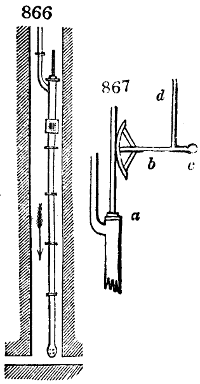
We shall now describe briefly the modern modes of working coals a-dipping of, and deeper than, the engine-pit bottom. One of these consists in laying a working pump barrel with a long wind-bore at the bottom of the downset mine, furnished with a smooth rod working through a collar at the top of the working barrel. At one side of this, near the top, a kneed pipe is attached, and from it pipes are carried to the point of delivery, either at the engine-pit bottom or day level, as represented in fig. 866. The spears are worked sometimes by rods connected with the machinery at the surface; in which case the spears, if very long, are either suspended from swing or pendulum rods, or move on friction rollers. But since the action of the spears, running with great velocity the total length of the engine stroke, very soon tears every thing to pieces, the motion of the spears underground has been reduced from 6 or 8 feet, the length of the engine stroke, to about 15 inches; and the due speed in the pump is effected by the centering of a beam, and the attachment of the spears to it, as represented in fig. 867., where a is the working barrel, b the beam centered at c, having an arc-head and martingale sinking-chain. The spears d are fastened by a strong bolt, which passes through the beam; and there are several holes, by means of which the stroke in the pumps can be lengthened or shortened at convenience. The movement of the spears is regulated by a strong iron quadrant or wheel at the bottom.
In level-free coals, these pumps may be worked by a water-wheel, stationed near the bottom of the pit, impelled by water falling down the shaft, to be discharged by the level to the day (day-level).
But the preferable plan of working under-dip coal, is that recently adopted by the Newcastle engineers; and consists in running a mine a-dipping of the engine-pit, in such direction of the dip as is most convenient; and both coals and water are brought up the rise of the coal by means of high-pressure engines, working with a power of from 30 to 50 pounds on the square inch. These machines are quite under command, and, producing much power in little space, they are the most applicable for underground work. An excavation is made for them in the strata above the coal, and the air used for the furnace under the boiler, is the returned air of the mine ventilation. In the dip-mine a double tram-road is laid; so that while a number of loaded corves are ascending, an equal number of empty ones are going down. Although this improved method has been introduced only a few years back, under-dip workings have been already executed more than an English mile under-dip of the engine-pit bottom, by means of three of these high-pressure engines, placed at equal distances in the under-dip mine. It may hence be inferred, that this mode of working is susceptible of most extensive application; and in place of sinking pits of excessive depth upon the dip of the coal, at an almost ruinous expense, much of the under-dip coal will in future be worked by means of the actual engine-pits. In the Newcastle district, coals are now working in an engine-pit 115 fathoms deep under-dip of the engine-pit bottom, above 1600 yards, and fully 80 fathoms of perpendicular depth more than the bottom of the pit.
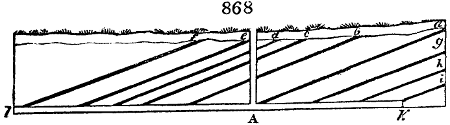
If an engine-pit be sunk to a given coal at a certain depth, all the other coals of the coal-field, both above and below the coal sunk to, can be drained and worked to the same depth, by driving a level cross-cut mine, both to the dip and rise, till all the coals are intersected, as represented in fig. 868., where A is the engine-pit bottom reaching to the coal a; and b, c, d, e, f, coals lying above the coal a; the coals which lie below it, g, h, i; k is the forehead of the cross-cut mine, intersecting all the lower coals; and l, the other forehead of the mine, intersecting all the upper coals.

1. First stage of active creep.
2. Second do.
3. Third do.
4. Fourth do.
5. The metal ridge closed, and the creep beginning to settle.
6. The creep settled, the metal ridges being closely compressed, and supporting the roof.
In the “Report from the select committee of the House of Lords, appointed to take into consideration the state of the coal trade in the United Kingdom,” printed in June, 1829, under the head of Mr. Buddle’s evidence we have an excellent description of the nature and progress of creeps, which we have adverted to in the preceding account. The annexed fig. 869. exhibits the creep in all its progressive stages, from its commencement until it has completely closed all the workings, and crushed the pillars of coal. The section of the figures supposes us standing on the level of the different galleries which are opened in the seam. The black is the coal pillars between each gallery; when these are weakened too much, or, in other words, when their bases become too narrow for the pavement below, by the pressure of the incumbent stratification they sink down into the pavement, and the first appearance is a little curvature in the bottom of each gallery: that is the first symptom obvious to sight; but it may generally be heard before it is seen. The next stage is when the pavement begins to open with a crack longitudinally. The next stage is when that crack is completed, and it assumes the shape of a metal ridge. The next is when the metal ridge reaches the roof. The next stage is when the peak of the metal ridge becomes flattened by pressure, and forced into a horizontal direction, and becomes quite close; just at this moment the coal pillars begin to sustain part of the pressure. The next is when the coal pillars take part of the pressure. The last stage is when it is dead and settled; that is, when the metal or factitious ridge, formed by the sinking of the pillar into the pavement, bears, in common with the pillars of coal on each side, the full pressure, and the coal becomes crushed or cracked, and can be no longer worked, except by a very expensive and dangerous process. Fig. 869.
The quantity of coals, cinders, and culm shipped coastways, and exported from the several ports of the United Kingdom in the year 1837, was 8,204,301 tons; in 1836, the quantity was 7,389,272 tons, being an increase of 815,029 tons, or 11·03 per cent. in favour of 1837.
The following Table shows the separate proportions of this quantity supplied by England and Wales, Scotland, and Ireland:—
1836. 1837. Increase.
Tons. Tons. Tons.
England and Wales 6,757,937 7,570,254 812,317 or 12·02 per cent.
Scotland 624,308 626,532 2,204 0·36
Ireland 7,027 7,515 488 6·94
Total 7,389,272 8,204,301 815,029 or 11·03 per cent.
PITCOAL, COKING OF. See also Charcoal.
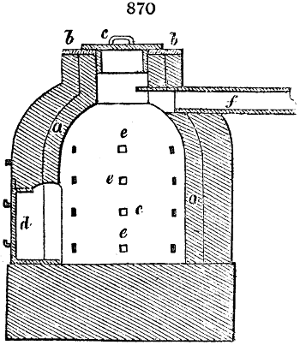
Fig. 870. represents a schachtofen, or pit-kiln, for coking coals in Germany. a is the lining (chemise), made of fire-bricks; the enclosing walls are built of the same material; b, b, is a cast-iron ring covered with a cast-iron plate c. The floor of the kiln is massive. The coals are introduced, and the coke taken out, through a hole in the side d; during the process it is bricked up, and closed with an iron door. In the surrounding walls are 4 horizontal rows of flues e, e, e, e, which are usually iron pipes; the lowest row is upon a level with the floor of the kiln; and the others are each respectively one foot and a half higher than the preceding. Near the top of the shaft there is an iron pipe f, of from 8 to 10 inches in diameter, which allows the incoercible vapours generated in the coking to escape into the condenser, which consists either of wood or brick chambers. For kindling the coal, a layer of wood is first placed on the bottom of the kiln.
The coking of small coal is performed upon vaulted hearths, somewhat like bakers’ ovens, but with still flatter roofs. Of such kilns, several are placed alongside one another each being an ellipse deviating little from a circle, so that the mouth may project but a small space. The dimensions are such, that from 10 to 12 cubic feet of coal-culm may be spread in a layer 6 inches deep upon the sole of the furnace. The top of the flat arch of fire brick should be covered with a stratum of loam and sand.
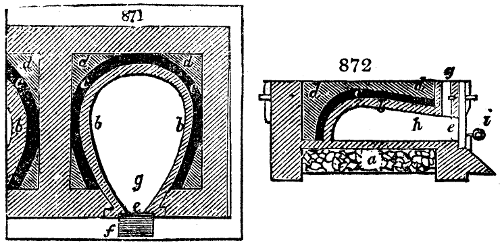
Figs. 871. and 872. represent such a kiln as is mounted at Zabrze, in Upper Silesia, for coking small coal. Fig. 871. is the ground plan; fig. 872. the vertical section in the line of the long axis of fig. 871. a, is the sand-bed of the hearth, under the brick sole; b, is the roof of large fire-bricks; c, the covering of loam; d, the top surface of sand; e, the orifice in the front wall, for admission of the culm, and removal of the coke, over the sloping stone f. The flame and vapours pass off above this orifice, through the chimney marked g, or through the aperture h, into a lateral chimney. i, is a bar of iron laid across the front of the door as a fulcrum to work the iron rake upon. A layer of coals is first kindled upon the hearth, and when this is in brisk ignition, it is covered with the culm in successive sprinklings. When the coal is sufficiently coked, it is raked out, and quenched with water.
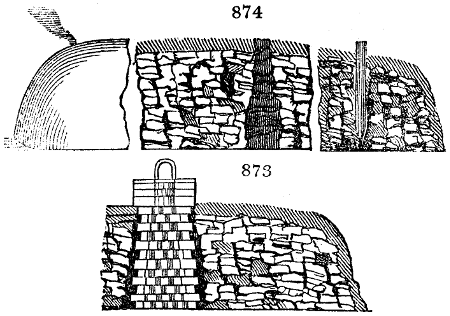
Fig. 873. represents a simple coking meiler or mound, constructed in a circular form round a central chimney of loose bricks, towards which small horizontal flues are laid among the lumps of coals. The sides and top are covered with culm or slack, and the heap is kindled from certain openings towards the circumference. Fig. 874. represents an oblong meiler, sometimes made 100 or 150 feet in length, and from 10 to 12 in breadth. The section in the middle of the figure shows how the lumps are piled up; the wooden stakes are lifted out when the heap is finished, in order to introduce kindlings at various points; and the rest of the meiler is then covered with slack and clay, to protect it from the rains. A jet of smoke and flame is seen issuing from its left end.
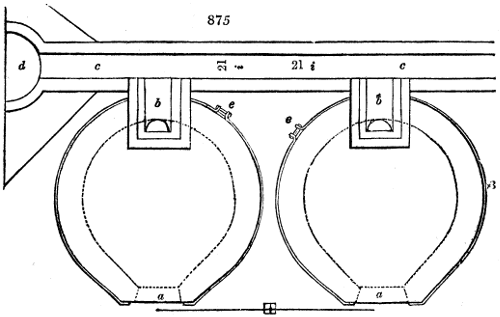
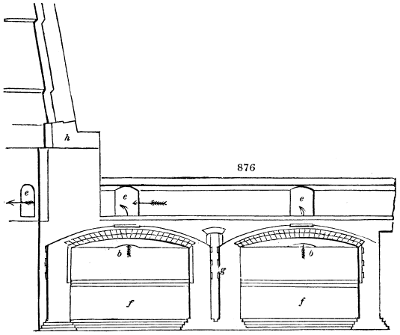
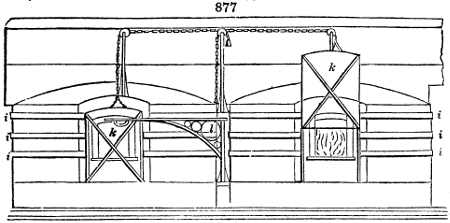
An excellent range of furnaces for making a superior article of coke, for the service of the locomotive engines of the London and Birmingham Railway Company, has been recently erected at the Camden Town station; consisting of 18 ovens in two lines, the whole discharging their products of combustion into a horizontal flue, which terminates in a chimney-stalk, 115 feet high. Fig. 875. is a ground plan of the elliptical ovens, each being 12 feet by 11 internally, and having 3 feet thickness of walls. a, a, is the mouth, 31⁄2 feet wide outside, and about 23⁄4 feet within. b, b, are the entrances into the flue; they may be shut more or less completely by horizontal slabs of fire-brick, resting on iron frames, pushed in from behind, to modify the draught of air. The grooves of these damper-slabs admit a small stream of air to complete the combustion of the volatilized particles of soot. By this means the smoke is well consumed. The flue c, c, is 21⁄2 feet high, by 21 inches wide. The chimney d, at the level of the flue, is 11 feet in diameter inside, and 17 outside; being built from an elegant design of Robert Stephenson, Esq. (See Chimney.) d, d, are the keys of the iron hoops, which bind the brickwork of the oven. Fig. 876. is a vertical section in the line A, B, of fig. 875. showing, at b, b, and e, e, the entrances of the different ovens into the horizontal flue; the direction of the draught being indicated by the arrows. f, f, is a bed of concrete, upon which the whole furnace-range is built, the level of the ground being in the middle of that bed. g, is a stauncheon on which the crane is mounted: (see fig. 877.) h is a section of the chimney wall, with part of the interior to the left of the strong line. Fig. 877. is a front elevation of two of these elegant coke-ovens; in which the bracing hoops i, i, i, are shown; k, k, are the cast-iron doors, strengthened outside with diagonal ridges; each door being 51⁄2 feet high, by 4 feet wide, and lined internally with fire-bricks. They are raised and lowered by means of chains and counterweights, moved by the crane l.
Each alternate oven is charged, between 8 and 10 o’clock every morning, with 31⁄2 tons of good coals. A wisp of straw is thrown in on the top of the heap, which takes fire by the radiation from the dome (which is in a state of dull ignition from the preceding operation), and inflames the smoke then rising from the surface, by the re-action of the hot sides and bottom upon the body of the fuel. In this way the smoke is consumed at the very commencement of the process, when it would otherwise be most abundant. A neighbour of the above coking ovens, having lately indicted them as a nuisance, procured, secundum artem, a parcel of affidavits from sundry chemical and medical men. Two of the former, who had not entered the premises, but had espied the outside of the furnaces’ range at some distance, declared that “the coking process, as performed at the ovens, is a species of distillation of coal”! How rashly do unpractical theorists affirm what is utterly unfounded, and mislead an unscientific judge! That the said coking process is in no respect a species of distillation, but a complete combustion of the volatile principles of the coal, will be manifest from the following description of its actual progress. The mass of coals is first kindled at the surface, as above stated, where it is supplied with abundance of atmospheric oxygen; because the doors of the ovens in front, and the throat-vents behind, are then left open. The consequence is, that no more smoke is discharged from the top of the chimney, at this the most sooty period of the process, than is produced by an ordinary kitchen fire. In these circumstances, the coal gas, or other gas, supposed to be generated in the slightly heated mass beneath, cannot escape destruction in passing up through the bright open flame of the oven. As the coking of the coal advances most slowly and regularly from the top of the heap to the bottom, only one layer is affected at a time, and in succession downwards, while the surface is always covered with a stratum of redhot cinders, ready to consume every particle of carburetted or sulphuretted hydrogen gases which may escape from below. The greatest mass, when calcined in this downward order, cannot emit into the atmosphere any more of the above-mentioned gases than the smallest heap; and therefore the argument raised on account of the magnitude of the operations, is altogether fallacious.
The coke being perfectly freed from all fuliginous and volatile matters by a calcination of upwards of 40 hours, is cooled down to moderate ignition by sliding in the dampers, and sliding up the doors, which had been partially closed during the latter part of the process. It is now observed to form prismatic concretions, somewhat like a columnar mass of basalt. These are loosened by iron bars, lifted out upon shovels furnished with long iron shanks, which are poised upon swing chains with hooked ends, and the lumps are thrown upon the pavement, to be extinguished by sprinkling water upon them from the rose of a watering-can; or, they might be transferred into a large chest of sheet-iron set on wheels, and then covered up. Good coals thus treated, yield 80 per cent. of an excellent compact glistening coke; weighing about 14 cwt. per chaldron.
The loss of weight in coking in the ordinary ovens is usually reckoned at 25 per cent.; and coal, which thus loses one-fourth in weight, gains one-fourth in bulk.
Labourers who have been long employed at rightly-constructed coke ovens, seem to enjoy remarkably good health.
PITTACALL, is one of the 6 curious principles detected in wood-tar by Reichenbach. It is a dark-blue solid substance, somewhat like indigo, assumes a metallic fiery lustre on friction, and varies in tint from copper to golden. It is void of taste and smell, not volatile; carbonizes at a high heat without emitting an ammoniacal smell; is soluble or rather very diffusible in water; gives a green solution with a cast of crimson, in sulphuric acid, with a cast of red blue, in muriatic acid, and with a cast of aurora red, in acetic acid. It is insoluble in alkalis. It dyes a fast blue upon linen and cotton goods, with tin and aluminous mordants.
PLASTER; see Mortar.
PLASTER OF PARIS; see Gypsum.
PLATED MANUFACTURE. (Fabrique de plaqué, Fr.; Silber plattirung, Germ.) The silver in this case is not applied to ingots of pure copper, but to an alloy consisting of copper and brass, which possesses the requisite stiffness for the various articles.
The furnace used for melting that alloy, in blacklead crucibles, is a common air-furnace, like that for making brass.
The ingot-moulds are made of cast iron, in two pieces, fastened together; the cavity being of a rectangular shape, 3 inches broad, 11⁄2 thick, and 18 or 20 long. There is an elevated mouth-piece or gate, to give pressure to the liquid metal, and secure solidity to the ingot. The mould is heated, till the grease with which its cavity is besmeared, merely begins to smoke, but does not burn. The proper heat of the melted metal for casting, is when it assumes a bluish colour, and is quite liquid. Whenever the metal has solidified in the mould, the wedges that tighten its rings are driven out, lest the shrinkage of the ingot should cause the mould to crack. See Brass.
The ingot is now dressed carefully with the file on one or two faces, according as it is to be single or double plated. The thickness of the silver plate is such as to constitute one fortieth of the thickness of the ingot; or when this is an inch and a quarter thick, the silver plate applied is one thirty-second of an inch, being by weight a pound troy of the former, to form 8 to 10 pennyweights of the latter. The silver, which is slightly less in size than the copper, is tied to it truly with iron wire, and a little of a saturated solution of borax is then insinuated at the edges. This salt melts at a low heat, and excludes the atmosphere, which might oxidize the copper, and obstruct the union of the metals. The ingot thus prepared is brought to the plating furnace.
The furnace has an iron door with a small hole to look through; it is fed with cokes, laid upon a grate at a level with the bottom of the door. The ingot is placed immediately upon the cokes, the door is shut, and the plater watches at the peep-hole the instant when the proper soldering temperature is attained. During the union of the silver and copper, the surface of the former is seen to be drawn into intimate contact with the latter, and this species of riveting is the signal for removing the compound bar instantly from the furnace. Were it to remain a very little longer, the silver would become alloyed with the copper, and the plating be thus completely spoiled. The adhesion is, in fact, accomplished here by the formation of a film of true silver-solder at the surfaces of contact.
The ingot is next cleaned, and rolled to the proper thinness between cylinders as described under Mint; being in its progress of lamination frequently annealed on a small reverberatory hearth. After the last annealing, the sheets are immersed in hot dilute sulphuric acid, and scoured with fine Calais sand; they are then ready to be fashioned into various articles.
In plating copper wire, the silver is first formed into a tubular shape, with one edge projecting slightly over the other; through which a redhot copper cylinder being somewhat loosely run, the silver edges are closely pressed together with a steel burnisher, whereby they get firmly united. The tube thus completed, is cleaned inside, and put on the proper copper rod, which it exactly fits. The copper is left a little longer than its coating tube, and is grooved at the extremities of the latter, so that the silver edges, being worked into the copper groove, may exclude the air from the surface of the rod. The compound cylinder is now heated redhot, and rubbed briskly over with the steel burnisher in a longitudinal direction, whereby the two metals get firmly united, and form a solid rod, ready to be drawn into wire of any requisite fineness and form; as flat, half-round, fluted, or with mouldings, according to the figure of the hole in the draw-plate. Such wire is much used for making bread-baskets, toast-racks, snuffers, and articles combining elegance with lightness and economy. The wire must be annealed from time to time during the drawing, and finally cleaned, like the plates, with dilute acid.
Formerly the different shaped vessels of plated metal were all fashioned by the hammer; but every one of simple form is now made in dies struck with a drop-hammer or stamp. Some manufacturers employ 8 or 10 drop machines.
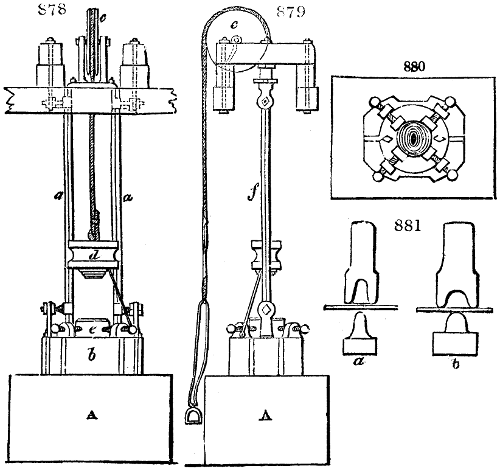
Fig. 878. and 879. are two views of the stamp. A is a large stone, the more massy the better; b, the anvil on which the die e is secured by four screws, as shown in the ground plan, fig. 880. In fig. 878., a a are two upright square prisms, set diagonally with the angles opposed to each other; between which the hammer or drop d slides truly, by means of nicely fitted angular grooves or recesses in its sides. The hammer is raised by pulling the rope f, which passes over the pulley c, and is let fall from different heights, according to the impulse required. Vessels which are less in diameter at the top and bottom than in the middle, must either be raised by the stamp in two pieces, or raised with a hand hammer. The die is usually made of cast steel. When it is placed upon the anvil, and the plated metal is cut into pieces of proper size, the top of the die is then surrounded with a lute made of oil and clay, for an inch or two above its surface; and the cavity is filled with melted lead. The under face of the stamp-hammer has a plate of iron called the licker-up fitted into it, about the area of the die. Whenever the lead has become solid, the hammer is raised to a certain height, and dropped down upon it; and as the under face of the licker-up is made rough like a rasp, it firmly adheres to the lead, so as to lift it afterwards with the hammer. The plated metal is now placed over the die, and the hammer mounted with its lead is let fall repeatedly upon it, till the impression on the metal is complete. If the vessel to be struck, be of any considerable depth, two or three dies may be used, of progressive sizes in succession. But it occasionally happens that when the vessel has a long conical neck, recourse must be had to an auxiliary operation, called punching. See the embossing punches, fig. 881. These are made of cast steel, with their hollows turned out in the lathe. The pieces a, b are of lead. The punching is performed by a series of these tools, of different sizes, beginning with the largest, and ending with the least. By this means a hollow cone, 3 or 4 inches deep, and an inch diameter, may be raised out of a flat plate. These punches are struck with a hand hammer also, for small articles, of too great delicacy for the drop. Indeed it frequently happens that one part of an article is executed by the stamp, and another by the hand.
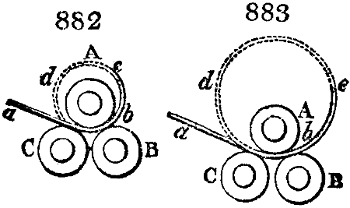
Cylindrical and conical vessels are mostly formed by bending and soldering. The bending is performed on blocks of wood, with wooden mallets; but the machine so much used by the tin-smiths, to form their tubes and cylindric vessels (see the end section, figs. 882. and 883.), might be employed with advantage. This consists of 3 iron rollers fixed in an iron frame. A, B, C, are the three cylinders, and a, b, c, d, the riband or sheet of metal passed through them to receive the cylindrical or conical curvature. The upper roller A can be raised or lowered at pleasure, in order to modify the diameter of the tube; and when one end of the roller is higher than the other, the conical curvature is given. The edges of the plated cylinders or cones are soldered with an alloy composed of silver and brass. An alloy of silver and copper is somewhat more fusible; but that of brass and silver answers best for plated metal, the brass being in very small proportion, lest the colour of the plate be affected. Calcined borax mixed with sandiver (the salt skimmed from the pots of crown glass) is used along with the alloy, in the act of soldering. The seam of the plated metal being smeared with that saline mixture made into a pap with water, and the bits of laminated solder, cut small with scissors, laid on, the seam is exposed to the flame of an oil blowpipe, or to that of charcoal urged by bellows in a little forge-hearth, till the solder melts and flows evenly along the junction. The use of the sandiver seems to be, to prevent the iron wire that binds the plated metal tube from being soldered to it.
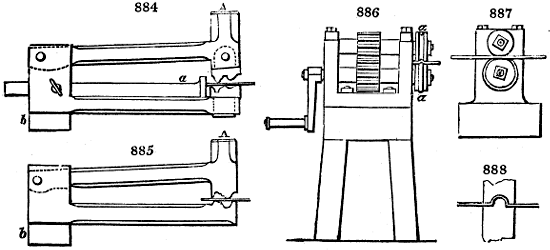
Mouldings are sometimes formed upon the edges of vessels, which are not merely ornamental, but give strength and stiffness. These are fashioned by an instrument called a swage, represented in figs. 884. and 885. The part A lifts up by a joint, and the metal to be swaged is placed between the dies, as shown in the figures; the tail b being held in the jaws of a vice, while the shear-shaped hammer rests upon it. By striking on the head A, while the metal plate is shifted successively forwards, the beading is formed. In fig. 884. the tooth a is a guide to regulate the distance between the bead and the edge. A similar effect is produced of late years in a neater and more expeditious manner by the rollers, figs. 886. 887. Fig. 888. is a section to show the form of the bead. The two wheels a, a, fig. 886., are placed upon axes, two of which are furnished with toothed pinions in their middle; the lower one being turned by the handle, gives motion to the upper. The groove in the upper wheel corresponds with the bead in the lower, so that the slip of metal passed through between them assumes the same figure.
The greatest improvement made in this branch of manufacture, is the introduction of silver edges, beads and mouldings, instead of the plated ones, which from their prominence had their silver surface speedily worn off, and thus assumed a brassy look. The silver destined to form the ornamental edgings is laminated exceedingly thin; a square inch sometimes weighing no more than 10 or 12 grains. This is too fragile to bear the action of the opposite steel dies of the swage above described. It is necessary, therefore, that the sunk part of the die should be steel, and the opposite side lead, as was observed in the stamping; and this is the method now generally employed to form these silver ornaments. The inside shell of this silver moulding is filled with soft solder, and then bent into the requisite form.
The base of candlesticks is generally made in a die by the stamp, as well as the neck, the dish part of the nozzle or socket, and the tubular stem or pillar. The different parts are united, some with soft and others with hard solder. The branches of candlesticks are formed in two semi-cylindrical halves, like the feet of tea-urns. When an article is to be engraved on, an extra plate of silver is applied at the proper part, while the plate is still flat, and fixed by burnishing with great pressure over a hot anvil. This is a species of welding.
The last finish of plated goods is given by burnishing-tools of bloodstone, fixed in sheet-iron cases, or hardened steel, finely polished.
The ingots for lamination might probably be plated with advantage by the delicate pressure process employed for silvering copper wire.
The total value of the plate, plated ware, jewellery, and watches, exported in the year 1836, was 338,889l.; but the value of the plated goods is not given in the tables of revenue. M. Parquin, the greatest manufacturer of plated goods in Paris (or France, for this business is monopolized by the capital), who makes to the value of 700,000 francs per annum, out of the 1,500,000 which, he says, is the whole internal consumption of the kingdom, states that the internal consumption of the United Kingdom amounts 30,000,000, or 20 times, that of France! He adds, that our common laminated copper costs 26 sous the pound, while theirs costs 34. Their plated goods are fashioned, not in general with stamps, but by the pressure of tools upon wood moulds in the turning-lathe, which is a great economy of capital to the manufacturer. There are factories at Birmingham which possess a heavy stock of 300,000 different die-moulds. See Stamping of Metals.
PLATINA-MOHR. The following easy method of preparing igniferous black platinum, proposed thirty years ago by Descotils, has been recently recommended by M. Dobereiner:—
Melt platina ore with double its weight of zinc, reduce the alloy to powder, and treat it first with dilute sulphuric acid, and next with dilute nitric acid, to oxidize and dissolve out all the zinc, which, contrary to one’s expectations, is somewhat difficult to do, even at a boiling heat. The insoluble black-gray powder contains some osmiuret of iridium, united with the crude platinum. This compound acts like simple platina-black, after it has been purified by digestion in potash lye, and washing with water. Its oxidizing power is so great, as to transform not only the formic acid into the carbonic, and alcohol into vinegar, but even some osmic acid, from the metallic osmium. The above powder explodes by heat like gunpowder.
When the platina-mohr prepared by means of zinc is moistened with alcohol, it becomes incandescent, and emits osmic acid; but if it be mixed with alcohol into a paste, and spread upon a watch-glass, nothing but acetic acid will be disengaged; affording an elegant means of diffusing the odour of vinegar in an apartment.
PLATINUM, is a metal of a grayish-white colour, resembling in a good measure polished steel. It is harder than silver, and of about double its density, being of specific gravity 21. It is so infusible, that no considerable portion of it can be melted by the strongest heats of our furnaces. It is unchangeable in the air and water; nor does a white heat impair its polish. The only acid which dissolves it, is the nitro-muriatic; the muriate or chloride thus formed, affords, with pure ammonia or sal ammoniac, a triple salt in a yellow powder, convertible into the pure metal by a red heat. This character distinguishes platinum from every other metal.
Native Platinum.—In the natural state it is never pure, being alloyed with several other metals. It occurs only under the form of grains, which are usually flattened, and resemble in shape the gold pepitas. Their size is in general less than linseed, although in some cases they equal hempseed, and, occasionally, peas. One piece brought from Choco, in Peru, and presented to the Cabinet of Berlin, by M. Humboldt, weighs 55 grammes = 850 grains, or nearly 2 oz. avoirdupois. The greatest lump of native platinum known, till of late years, was one in the Royal Museum of Madrid, which was found in 1814 in the gold mine of Condoto, province of Novita, at Choco. Its size is greater than a Turkey’s egg, (about 2 inches one diameter, and 4 inches the other,) and its weight 760 grammes, = 24 oz. or fully 2 lbs. troy. See infrà.
The colour of the grains of native platinum is generally a grayish white, like tarnished steel. The cavities of the rough grains are often filled with earthy and ferruginous matters, or sometimes with small grains of black oxide of iron, adhering to the surface of the platinum grains. Their specific gravity is also much lower than that of forged pure platinum; varying from 15 in the small particles, to 18·94 in M. Humboldt’s large specimen. This relative lightness is owing to the presence of iron, copper, lead, and chrome; besides its other more lately discovered metallic constituents, palladium, osmium, rhodium, and iridium.
Its main localities in the New Continent, are in the three following districts:—
1. At Choco, in the neighbourhood of Barbacoas, and generally on the coasts of the South Sea, or on the western slopes of the Cordillera of the Andes, between the 2nd and the 6th degrees of north latitude. The gold-washings that furnish most platinum, are those of Condoto, in the province of Novita; those of Santa Rita, or Viroviro, of Santa Lucia, of the ravine of Iro, and Apoto, between Novita and Taddo. The deposit of gold and platinum grains is found in alluvial ground, at a depth of about 20 feet. The gold is separated from the platinum by picking with the hand, and also by amalgamation; formerly, when it was imagined that platinum might be used to debase gold, the grains of the former metal were thrown into the rivers, through which mistaken opinion an immense quantity of it was lost.
2. Platinum grains are found in Brazil, but always in the alluvial lands that contain gold, particularly in those of Matto-Grosso. The ore of this country is somewhat different from that of Choco. It is in grains, which seem to be fragments of a spongy substance. The whole of the particles are nearly globular, exhibiting a surface formed of small spheroidal protuberances strongly cohering together, whose interstices are clean, and even brilliant.
This platinum includes many small particles of gold, but none of the magnetic iron-sand or of the small zircons which accompany the Peruvian ore. It is mixed with small grains of native palladium, which may be recognised by their fibrous or radiated structure, and particularly by their chemical characters.
3. Platinum grains are found in Hayti, or Saint Domingo, in the sand of the river Jacky, near the mountains of Sibao. Like those of Choco, they are in small brilliant grains, as if polished by friction. The sand containing them is quartzose and ferruginous. This native platinum contains, like that of Choco, chromium, copper, osmium, iridium, rhodium, palladium, and probably titanium. Vauquelin could find no gold among the grains.
Platinum has been discovered lately in the Russian territories, in the auriferous sands of Kuschwa, 250 wersts from Ekaterinebourg, and consequently in a geological position which seems to be analogous with that of South America.
These auriferous sands are, indeed, almost all superficial; they cover an argillaceous soil; and include, along with gold and platinum, debris of dolerite (a kind of greenstone), protoxide of iron, grains of corundum, &c. The platinum grains are not so flat as those from Choco, but they are thicker; they have less brilliancy, and more of a leaden hue. This platinum, by M. Laugier’s analysis, is similar in purity to that of Choco; but the leaden-gray grains, which were taken for a mixture of osmium and iridium, are merely an alloy of platinum, containing 25 per cent. of these metals.
The mines of Brazil, Columbia, and Saint Domingo furnish altogether only about 400 kilos. of platinum ore per annum; but those of Russia produce above 1800 kilos. The latter were discovered in 1822, and were first worked in 1824. They are all situated in the Ural mountains. The ore is disseminated in an argillaceous sand, of a greenish-gray colour, resulting from the disintegration of the surrounding rocks, and constitutes from 1 to 3 parts in 4000 of the sand. Occasionally it has been found in lumps weighing 8 kilogrammes (16 lbs.!), but it generally occurs in blackish angular grains, which contain 70 per cent. of platinum, and 3 to 5 of iridium. The ore of Goroblagodat is in small flattened grains, which contain 88 per cent. of this precious metal. The osmiure of iridium is found upon a great many points of the Urals, throughout a space of 140 leagues, being a product accessory to the gold washings. 32 kilogrammes of osmiure are collected there annually, which contain upon an average 2 per cent. of platinum.
M. Vauquelin found nearly ten per cent. of platinum in an ore of argentiferous copper, which was transmitted to him as coming from Guadalcanal in Spain. This would be the only example of platinum existing in a rock, and in a vein. As the same thing has not again been met with, even in other specimens from Guadalcanal, we must delay drawing geological inferences, till a new example has confirmed the authenticity of the first.
Platinum has been known in Europe only since 1748, though it was noticed by Ulloa in 1741. It was compared at first to gold; and was, in fact, brought into the market under the name of white gold. The term platinum, however, is derived from the Spanish word plata, silver, on account of its resemblance in colour to that metal.
The whole of the platinum ore from the Urals is sent to St. Petersburg, where it is treated by the following simple process:—
One part of the ore is put in open platina vessels, capable of containing from 6 to 8 lbs., along with 3 parts of muriatic acid at 25° B. and 1 part of nitric acid at 40°. Thirty of these vessels are placed upon a sand-bath covered with a glazed dome with movable panes, which is surmounted by a ventilating chimney to carry the vapours out of the laboratory. Heat is applied for 8 or 10 hours, till no more red vapours appear; a proof that the whole nitric acid is decomposed, though some of the muriatic remains. After settling, the supernatant liquid is decanted off into large cylindrical glass vessels, the residuum is washed, and the washing is also decanted off. A fresh quantity of nitro-muriatic acid is now poured upon the residuum. This treatment is repeated till the whole solid matter has eventually disappeared. The ore requires for solution from 10 to 15 times its weight of nitro-muriatic acid, according to the size of its grains.
The solutions thus made are all acid; a circumstance essential to prevent the iridium from precipitating with the platinum, by the water of ammonia, which is next added. The deposit being allowed to form, the mother waters are poured off, the precipitate is washed with cold water, dried, and calcined in crucibles of platinum.
The mother-waters and the washings are afterwards treated separately. The first being concentrated to one-twelfth of their bulk in glass retorts, on cooling they let fall the iridium in the state of an ammoniacal chloride, constituting a dark-purple powder, occasionally crystallized in regular octahedrons. The washings are evaporated to dryness in porcelain vessels; the residuum is calcined and treated like fresh ore; but the platinum it affords needs a second purification.
For agglomerating the platinum, the spongy mass is pounded in bronze mortars; the powder is passed through a fine sieve, and put into a cylinder of the intended size of the ingot. The cylinder is fitted with a rammer, which is forced in by a coining press, till the powder be much condensed. It is then turned out of the mould, and baked 36 hours in a porcelain kiln, after which it may be readily forged, if it be pure, and may receive any desired form from the hammer. It contracts in volume from 1-6th to 1-5th during the calcination. The cost of the manufacture of platinum is fixed by the administration at 32 francs the Russian pound; but so great a sum is never expended upon it.
For Dr. Wollaston’s process, see Phil. Trans. 1829, Part I.
Platinum furnishes most valuable vessels to both analytical and manufacturing chemists. It may be beat out into leaves of such thinness as to be blown about with the breath.
This metal is applied to porcelain by two different processes; sometimes in a rather coarse powder, applied by the brush, like gold, to form ornamental figures; sometimes in a state of extreme division, obtained by decomposing its muriatic solution, by means of an essential oil, such as rosemary or lavender. In this case, it must be evenly spread over the whole ground. Both modes of application give rise to a steely lustre.
The properties possessed in common by gold and platinum, have several times given occasion to fraudulent admixtures, which have deceived the assayers. M. Vauquelin having executed a series of experiments to elucidate this subject, drew the following conclusions:—
If the platinum do not exceed 30 or 40 parts in the thousand of the alloy, the gold does not retain any of it when the parting is made with nitric acid in the usual way; and when the proportion of platinum is greater, the fraud becomes manifest, 1st by the higher temperature required to pass it through the cupel, and to form a round button, 2, by the absence of the lightning, fulguration, or coruscation; 3, by the dull white colour of the button and its crystallized surface; 4, by the straw-yellow colour which platinum communicates to the aquafortis in the parting; 5, by the straw-yellow colour, bordering on white, of the cornet, after it is annealed. If the platinum amounts to one fourth of the gold, we must add to the alloy at least 3 times its weight of fine silver, laminate it very thin, anneal somewhat strongly, boil it half an hour in the first aquafortis, and at least a quarter of an hour in the second, in order that the acid may dissolve the whole of the platinum.
Were it required to determine exactly the proportions of platinum contained in an alloy of copper, silver, gold, and platinum, the amount of the copper may be found in the first place by cupellation, then the respective quantities of the three other metals may be learned by a process founded, 1, upon the property possessed by sulphuric acid of dissolving silver without affecting gold or platinum; and, 2, upon the property of platinum being soluble in the nitric acid, when it is alloyed with a certain quantity of gold and silver.
According to Boussingault, the annual product of Platinum in America does not exceed 81⁄3 cwts. At Nischne-Tagilsk, in 1824, a lump of native platinum weighing fully 10 lbs. was found; and in 1830, another lump, of nearly double size, which weighed 353⁄4 Prussian marcs; fully 18 lbs. avoirdupoise.
PRODUCTION OF PLATINUM IN THE URAL.
From 1822 to 1827 inclusively, 52 puds[41] and 22 1⁄2 pounds.
1828 94
1829 78 31 1⁄2
1830 105 1
1831 to 1833 348 15
Analyses of the Platinum Ores of the Urals, and of that from Barbacoas on the Pacific, between the 2nd and 6th degrees of northern latitude.
From Nischne-Tagilsk. Goroblagodat. Barbacoas.
Berzelius. Osann. Berzelius.
Magnetic. Not Magnetic
Platinum 73·58 78·94 83·07 86·50 84·30
Iridium 2·35 4·97 1·91 — 1·46
Rhodium 1·15 0·86 0·59 1·15 3·46
Palladium 0·30 0·28 0·26 1·10 1·06
Iron 12·98 11·04 10·79 8·32 5·31
Copper 5·20 0·70 1·30 0·45 0·74
Undissolved Osmium and Iridium 2·30 1·96 1·80 1·40 —
Osmium — — — — 1·03
Quartz — — — — 0·60
Lime — — — — 0·12
97·86 98·75 99·72 98·92 98·08
PLUMBAGO. See Graphite, for its mineralogical and chemical characters. The mountain at Borrowdale, in which the blacklead is mined, is 2000 feet high, and the entrance to the mine is 1000 feet below its summit. This valuable mineral became so common a subject of robbery about a century ago, as to have enriched, it was said, a great many persons living in the neighbourhood. Even the guard stationed over it by the proprietors was of little avail against men infuriated with the love of plunder; since in those days a body of miners broke into the mine by main force, and held possession of it for a considerable time.
The treasure is now protected by a strong building, consisting of four rooms upon the ground floor; and immediately under one of them is the opening, secured by a trap-door, through which alone workmen can enter the interior of the mountain. In this apartment, called the dressing-room, the miners change their ordinary clothes for their working dress, as they come in, and after their six hours’ post or journey, they again change their dress, under the superintendence of the steward, before they are suffered to go out. In the innermost of the four rooms, two men are seated at a large table, sorting and dressing the plumbago, who are locked in while at work, and watched by the steward from an adjoining room, who is armed with two loaded blunderbusses. Such formidable apparatus of security is deemed requisite to check the pilfering spirit of the Cumberland mountaineers.
The cleansed blacklead is packed up into strong casks, which hold 1 cwt. each. These are all despatched to the warehouse of the proprietors in London, where the blacklead is sold monthly by auction, at a price of from 35s. to 45s. a pound.
In some years, the net produce of the six weeks’ annual working of the mine has, it is said, amounted to 30,000l. or 40,000l.
PLUSH (Panne, Peluche, Fr.; Wollsammet, Plüsch, Germ.), is a textile fabric, having a sort of velvet nap or shag upon one side. It is composed regularly of a woof of a single woollen thread, and a two-fold warp, the one, wool of two threads twisted, the other, goat’s or camel’s hair. There are also several sorts of plush made entirely of worsted. It is manufactured, like velvet, in a loom with three treadles; two of which separate and depress the woollen warp, and the third raises the hair-warp, whereupon the weaver, throwing the shuttle, passes the woof between the woollen and hair warp; afterwards, laying a brass broach or needle under that of the hair, he cuts it with a knife (see Fustian) destined for that use, running its fine slender point along in the hollow of the guide-broach, to the end of a piece extended upon a table. Thus the surface of the plush receives its velvety appearance. This stuff is also made of cotton and silk.
POINT NET, is a style of lace formerly much in vogue, but now superseded by the bobbin-net manufacture.
PORCELAIN, is the finest kind of pottery-ware. It is considered under that title.
PORPHYRY, is a compound mineral or rock, composed essentially of a base of hornstone, interspersed with crystals of felspar. It frequently contains also quartz, mica, and hornblende. That most esteemed is the antient porphyry of Egypt, with a ground of a fine red colour passing into purple, having snow-white crystals of felspar imbedded in it. Most beautiful specimens of it are to be seen in the antique colossal statues in the British Museum.
Porphyry occurs in Arran, and in Perthshire between Dalnacardoch and Tummel bridge. It is much used for making slabs, mullers, and mortars.
PORTER, is a malt liquor, so called from being the favourite beverage of the porters and workpeople of the metropolis and other large towns of the British empire; it is characterized by its dark-brown colour, its transparency, its moderately bitter taste, and peculiar aromatic flavour, which, along with its tonic and intoxicating qualities, make it be keenly relished by thirsty palates accustomed to its use. At first the essential distinction of porter arose from its wort being made with highly-kilned brown malt, while other kinds of beer and ale were brewed from a paler article; but of late years, the taste of the public having run in favour of sweeter and lighter beverages, the actual porter is brewed with a less proportion of brown malt, is less strongly hopped, and not allowed to get hard by long keeping in huge ripening tuns. Some brewers colour the porter with burnt sugar; but in general the most respectable concentrate a quantity of their first and best wort to an extract, in an iron pan, and burn this into a colouring stuff, whereby they can lay claim to the merit of using nothing in their manufacture but malt and hops. The singular flavour of good London porter seems to proceed, in a great degree, from that of the old casks and fermenting tuns in which it is prepared. Though not much addicted to vinous potations of any kind, I feel warranted by long experience to opine, that the porter brewed by the eminent London houses, when drunk in moderation, is a far wholesomer beverage for the people than the thin acidulous wines of France and Germany. See Beer.
PORTLAND STONE, is a fine compact oolite, so named from the island where it is quarried. It is a convenient but not a durable building-stone.
POTATO (Pomme de terre, Fr.; Kartoffel, Germ.); is the well-known root of the Solanum tuberosum.
The following Table exhibits several good analyses of the potato:—
Sort. Fibrine. Starch. Veg. album. Gum. Acids and Salts. Water. Analyst.
Red potatos 7 ·0 15 ·0 1 ·4 4 ·1 5 ·1 75 ·0 Einhof.
Id. germinated 6 ·8 15 ·2 1 ·3 3 ·7 — 73 ·0 —
Potato sprouts 2 ·8 0 ·4 0 ·4 3 ·3 — 93 ·0 —
Kidney potatos 8 ·8 9 ·1 0 ·8 — — 81 ·3 —
Large red do. 6 ·0 12 ·9 0 ·7 — — 78 ·0 —
Sweet do. 8 ·2 15 ·1 0 ·8 — — 74 ·3 —

Potato of Peru 5 ·2 15 ·0 1 ·9 1 ·9 76 ·0 Lampad.
Potato of England 6 ·8 12 ·9 1 ·1 1 ·7 77 ·5 —
Onion potato 8 ·4 18 ·7 0 ·9 1 ·7 70 ·3 —
Onion Voigtland 7 ·1 15 ·4 1 ·2 2 ·0 74 ·3 —
Onion cultivated in the environs of Paris 6 ·79 13 ·3 0 ·92 3 ·3 1 ·4 73 ·12 Henry.
POTASH, or POTASSA. (Potasse, Fr.; Kali, Germ.) This substance was so named from being prepared for commercial purposes by evaporating in iron pots the lixivium of the ashes of wood fuel. In the crude state called potashes, it consists, therefore, of such constituents of burned vegetables as are very soluble in water, and fixed in the fire. The potash salts of plants which originally contained vegetable acids, will be converted into carbonates, the sulphates will become sulphites, sulphurets, or even carbonates, according to the manner of incineration; the nitrates will be changed into pure carbonates, while the muriates or chlorides will remain unaltered. Should quicklime be added to the solution of the ashes, a corresponding portion of caustic potassa will be introduced into the product, with more or less lime, according to the care taken in decanting off the clear lye for evaporation.
In America, where timber is in many places an incumbrance upon the soil, it is felled, piled up in pyramids, and burned, solely with a view to the manufacture of potashes. The ashes are put into wooden cisterns, having a plug at the bottom of one of the sides under a false bottom; a moderate quantity of water is then poured on the mass, and some quicklime is stirred in. After standing for a few hours, so as to take up the soluble matter, the clear liquor is drawn off; evaporated to dryness in iron pots, and finally fused at a red heat into compact masses, which are gray on the outside, and pink-coloured within.
Pearlash is prepared by calcining potashes upon a reverberatory hearth, till the whole carbonaceous matter, and the greater part of the sulphur, be dissipated; then lixiviating the mass, in a cistern having a false bottom covered with straw, evaporating the clear lye to dryness in flat iron pans, and stirring it towards the end into white lumpy granulations.
I find the best pink Canadian potashes, as imported in casks containing about 5 cwts., to contain pretty uniformly 60 per cent. of absolute potassa; and the best pearlashes to contain 50 per cent.; the alkali in the former being nearly in a caustic state; in the latter, carbonated.
All kinds of vegetables do not yield the same proportion of potassa. The more succulent the plant, the more does it afford; for it is only in the juices that the vegetable salts reside, which are converted by incineration into alkaline matter. Herbaceous weeds are more productive of potash than the graminiferous species, or shrubs, and these than trees; and for a like reason, twigs and leaves are more productive than timber. But plants in all cases are richest in alkaline salts when they have arrived at maturity. The soil in which they grow also influences the quantity of saline matter.
The following Table exhibits the average product in potassa of several plants, according to the researches of Vauquelin, Pertuis, Kirwan, and De Saussure:—
In 1000 parts. Potassa.
Pine or fir 0 ·45
Poplar 0 ·75
Trefoil 0 ·75
Beechwood 1 ·45
Oak 1 ·53
Boxwood 2 ·26
Willow 2 ·85
Elm and maple 3 ·90
Wheat straw 3 ·90
Barb of oak twigs 4 ·20
Thistles 5 ·00
Flax stems 5 ·00
Small rushes 5 ·08
Vine shoots 5 ·50
Barley straw 5 ·80
Dry beech bark 6 ·00
Fern 6 ·26
Large rush 7 ·22
Stalk of maize 17 ·5
Bastard chamomile (Anthemis cotula, L.) 19 ·6
Bean stalks 20 ·0
Sunflower stalks 20 ·0
Common nettle 25 ·03
Vetch plant 27 ·50
Thistles in full growth 35 ·37
Dry straw of wheat before earing 47 ·0
Wormwood 73 ·0
Fumitory 79 ·0
Stalks of tobacco, potatos, chesnuts, chesnut husks, broom, heath, furze, tansy, sorrel, vine leaves, beet leaves, orach, and many other plants, abound in potash salts. In Burgundy, the well-known cendres gravelées are made by incinerating the lees of wine pressed into cakes, and dried in the sun; the ashes contain fully 16 per cent. of potassa.
The purification of pearlash is founded upon the fact of its being more soluble in water than the neutral salts which debase it. Upon any given quantity of that substance, in an iron pot, let one and a half times its weight of water be poured, and let a gentle heat be applied for a short time. When the whole has again cooled, the bottom will be encrusted with the salts, while a solution of nearly pure carbonate of potash will be found floating above, which may be drawn off clear by a syphon. The salts may be afterwards thrown upon a filter of gravel. If this lye be diluted with 6 times its bulk of water mixed with as much slaked lime as there was pearlash employed, and the mixture be boiled for an hour, the potash will become caustic, by giving up its carbonic acid to the lime. If the clear settled lixivium be now siphoned off, and concentrated by boiling in a covered iron pan, till it assumes the appearance of oil, it will constitute the common caustic of the surgeon, the potassa fusa of the shops. But to obtain potassa chemically pure, recourse must be had to the bicarbonate, nitrate, or tartrate of potassa, salts which, when carefully crystallized, are exempt from any thing to render the potassa derived from them impure. The bicarbonate having been gently ignited in a silver basin, is to be dissolved in 6 times its weight of water, and the solution is to be boiled for an hour, along with one pound of slaked lime for every pound of the bicarbonate used. The whole must be left to settle without contact of air. The supernatant lye is to be drawn off by a syphon, and evaporated in an iron or silver vessel provided with a small orifice in its close cover for the escape of the steam, till it assumes, as above, the appearance of oil, or till it be nearly redhot. Let the fused potassa be now poured out upon a bright plate of iron, cut into pieces as soon as it concretes, and put up immediately in a bottle furnished with a well-ground stopper. It is hydrate of potassa, being composed of 1 atom of potassa 48, + 1 atom of water 9, = 57.
A pure carbonate of potassa may be also prepared by fusing pure nitre in an earthen crucible, and projecting charcoal into it by small bits at a time, till it ceases to cause deflagration. Or a mixture of 10 parts of nitre and 1 of charcoal may be deflagrated in small successive portions in a redhot deep crucible. When a mixture of 2 parts of tartrate of potassa, or crystals of tartar, and 1 of nitre, is deflagrated, pure carbonate of potassa remains mixed with charcoal, which by lixiviation, and the agency of quicklime, will afford a pure hydrate. Crystals of tartar calcined alone yield also a pure carbonate.
Caustic potassa, as I have said, after being fused in a silver crucible at a red heat, retains 1 prime equivalent of water. Hence its composition in 100 parts is, potassium 70, oxygen 14, water 16. Anhydrous potassa, or the oxide free from water, can be obtained only by the combustion of potassium in the open air. It is composed of 831⁄3 of metal, and 162⁄3 of oxygen. Berzelius’s numbers are 83·05 and 16·95.
Caustic potassa may be crystallized; but in general it occurs as a white brittle substance of spec. grav. 1·708, which melts at a red heat, evaporates at a white heat, deliquesces into a liquid in the air, and attracts carbonic acid; is soluble in water and alcohol, forms soft soaps with fat oils, and soapy-looking compounds with resins and wax; dissolves sulphur, some metallic sulphurets, as those of antimony, arsenic, &c., as also silica, alumina, and certain other bases; and decomposes animal textures, as hair, wool, silk, horn, skin, &c. It should never be touched with the tongue or the fingers.
The following Table exhibits the quantity of Fused Potassa in 100 parts of caustic lye, at the respective densities:—
Sp. gr. Pot. in 100.
1·58 53·06
1·56 51·58
1·54 50·09
1·52 48·46
1·50 46·45
1·48 44·40
1·46 42·31
1·44 40·17
1·42 37·97
1·40 35·99
1·38 34·74
1·36 33·46
1·34 32·14
1·32 30·74
1·30 29·34
1·28 27·86
1·26 26·34
1·24 24·77
1·22 23·14
1·20 21·25
1·18 19·34
1·16 17·40
1·14 15·38
1·12 13·30
1·10 11·28
1·08 9·20
1·06 7·02
1·04 4·77
1·02 2·44
1·00 0·00
The only certain way of determining the quantity of free potassa in any solid or liquid, is from the quantity of a dilute acid of known strength which it can saturate.
The hydrate of potassa, or its lye, often contains a notable quantity of carbonate, the presence of which may be detected by lime water, and its amount be ascertained by the loss of weight which it suffers, when a weighed portion of the lye is poured into a weighed portion of dilute sulphuric acid poised in the scale of a balance.
There are two other oxides of potassium; the suboxide, which consists, according to Berzelius, of 90·74 of metal, and 9·26 oxygen; and the hyperoxide, an orange-yellow substance, which gives off oxygen in the act of dissolving in water, and becomes potassa. It consists of 62 of metal, and 38 of oxygen.
Carbonate of potassa is composed of 48 parts of base, and 22 of acid, according to most British authorities; or, in 100 parts, of 68·57 and 31·43; but according to Berzelius, of 68·09 and 31·91.
Carbonate of potassa, as it exists associated with carbon in calcined tartar, passes very readily into the Bicarbonate, on being moistened with water, and having a current of carbonic acid gas passed through it. The absorption takes place so rapidly, that the mass becomes hot, and therefore ought to be surrounded with cold water. The salt should then be dissolved in the smallest quantity of water at 120° F., filtered, and crystallized.
POTASSIUM (Eng. and Fr.; Kalium, Germ.); is a metal deeply interesting, not only from its own marvellous properties, but from its having been the first link in the chain of discovery which conducted Sir H. Davy through many of the formerly mysterious and untrodden labyrinths of chemistry.
The easiest and best mode of obtaining this elementary substance, is that contrived by Brunner, which I have often practised upon a considerable scale. Into the orifice of one of the iron bottles, as A, fig. 889., in which mercury is imported, adapt, by screwing, a piece of gun-barrel tube, 9 inches long; having brazed into its side, about 3 inches from its outer end, a similar piece of iron tube. Fill this retort two-thirds with a mixture of 10 parts of cream of tartar, previously calcined in a covered crucible, and 1 of charcoal, both in powder; and lay it horizontally in an air-furnace, so that while the screw orifice is at the inside wall, the extremity of the straight or nozzle tube may project a few inches beyond the brickwork, and the tube brazed into it at right angles may descend pretty close to the outside wall, so as to dip its lower end a quarter of an inch beneath the surface of some rectified naphtha contained in a copper bottle surrounded by ice-cold water. By bringing the condenser-vessel so near the furnace, the tubes along which the potassium vapour requires to pass, run less risk of getting obstructed. The horizontal straight end of the nozzle tube should be shut by screwing a stopcock air-tight into it. By opening the cock momentarily, and thrusting in a hot wire, this tube may be readily kept free, without permitting any considerable waste of potassium. The heat should be slowly applied at first, but eventually urged to whiteness, and continued as long as potassuretted hydrogen continues to be disengaged. The retort, and the part of the nozzle tube exposed to the fire, should be covered with a good refractory lute, as described under the article Phosphorus. The joints must be perfectly air-tight; and the vessel freed from every trace of mercury, by ignition, before it is charged with the tartar-ash.
Tartar skilfully treated in this way will afford 3 per cent. of potassium; and when it is observed to send forth green fumes, it has commenced the production of the metal. Instead of the construction above described, the following form of apparatus may be employed.
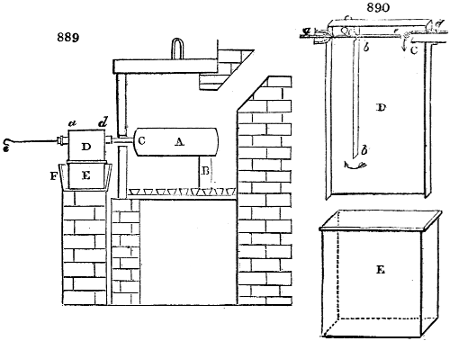
A. fig. 889., represents the iron bottle, charged with the incinerated tartar; and B is a fire-brick support. A piece of fire-tile should also be placed between the bottom of the bottle and the back wall of the furnace, to keep the apparatus steady during the operation. Whenever the moisture is expelled, and the mass faintly ignited, the tube C should be screwed into the mouth of the bottle, through a small hole left for this purpose in the side of the furnace. That tube should be no longer, and the front wall of the furnace no thicker, than what is absolutely necessary. As soon as the reduction is indicated by the emission of green vapours, the receiver must be adapted, d, a, D, E, shown in a large scale in fig. 890.
This is a condenser, in two pieces, made of thin sheet copper; D, the upper part, is a rectangular box, open at bottom, about 10 inches high, by 5 or 6 long, and 2 wide; near to the side a, it is divided inside into two equal compartments, up to two-thirds of its height, by a partition b, b, in order to make the vapours that issue from C pursue a downward and circuitous path. In each of its narrow sides, near the top, a short tube is soldered, at d and a; the former being fitted air-tight into the end of the nozzle of the retort, while the latter is closed with a cork traversed by a stiff iron probe e, which passes through a small hole in the partition b, b, under c, and is employed to keep the tube C clear, by its drill-shaped steel point. In one of the broad sides of the box D, near the top, a bit of pipe is soldered on at e, for receiving the end of a bent glass tube of safety, which dips its other and lower end into a glass containing naphtha. E, the bottom copper box, with naphtha, which receives pretty closely the upper case D, is to be immersed in a cistern of cold water containing some lumps of ice.
The chemical action by which potassa is reduced in this process, seems to be somewhat complicated, and has not been thoroughly explained. A very small proportion of pure potassium is obtained; a great deal of it is converted into a black infusible mass, which passes over with the metal, and is very apt to block up the tube. Should this resist clearing out with the probe, the fire must be immediately withdrawn from the furnace, otherwise the apparatus will probably burst or blow up. Care must be taken to prevent any moisture getting into the nozzle, for it would probably produce a violent detonation.
When the operation has proceeded regularly, accompanied to the end with a constant evolution of gas, the retort becomes nearly empty, or contains merely a little charcoal, or carbonate of potassa, and the potassium collects in the naphtha at the bottom of the receiver E, in the form of globules or rounded lumps, of greater or less size, and of a leaden hue. But the greater part of the metal escapes with the gas, in a state of combination not well understood. This gaseous compound burns with a white or reddish-white flame, and deposits potassa. Several ounces of potassium may be produced in this way at one operation; but, as thus obtained, it always contains some combined charcoal, which must be separated by distilling it in an iron retort, having its beak plunged in naphtha.
Pure potassium, as procured in Sir H. Davy’s original method, by acting upon fused potassa under a film of naphtha, with the negative wire of a powerful voltaic battery, is very like quicksilver. It is semi-fluid at 60° Fahr., nearly liquid at 92°, and entirely so at 120°. At 50° it is malleable, and has the lustre of polished silver; at 32° it is brittle, with a crystalline fracture; and at a heat approaching to redness, it begins to boil, is volatilized, and converted into a green-coloured gas, which condenses into globules upon the surface of a cold body. Its specific gravity in the purest state is 0·865 at 60°. When heated in the air, it takes fire, and burns very vividly. It has a stronger affinity for oxygen than any other known substance; and is hence very difficult to preserve in the metallic state. At a high temperature it reduces almost every oxygenated body. When thrown upon water, it kindles, and moves about violently upon the surface, burning with a red flame, till it be consumed; that is to say, converted into potassa. When thrown upon a cake of ice, it likewise kindles, and burns a hole in it. If a globule of it be laid upon wet turmeric paper, it takes fire, and runs about, marking its desultory path with red lines. The flame observed in these cases is owing chiefly to hydrogen, for it is at the expense of the water that the potassium burns.
Potassa, even in a pretty dilute solution, produces a precipitate with muriate of platinum, a phenomenon which distinguishes it from soda. It forms, moreover, with sulphuric and acetic acids, salts which crystallize very differently from the sulphates and acetates of soda.
POTTERY, PORCELAIN. (Eng. and Fr.; Steingut, Porzellan, Germ.) The French, who are fond of giving far-fetched names to the most ordinary things, have dignified the art of pottery with the title of ceramique, from the Greek noun κεραμος, an earthen pot, compounded of two words which signify, in that language, burned clay. In reference to chemical constitution, there are only two genera of baked stoneware. The first consists of a fusible earthy mixture, along with an infusible, which when combined are susceptible of becoming semi-vitrified and translucent in the kiln. This constitutes porcelain or china-ware; which is either hard and genuine, or tender and spurious, according to the quality and quantity of the fusible ingredient. The second kind consists of an infusible mixture of earths, which is refractory in the kiln, and continues opaque. This is pottery, properly so called; but it comprehends several sub-species, which graduate into each other by imperceptible shades of difference. To this head belong earthenware, stoneware, flintware, fayence, delftware, iron-stone china, &c.
The earliest attempts to make a compact stoneware, with a painted glaze, seem to have originated with the Arabians in Spain, about the 9th century, and to have passed thence into Majorca, in which island they were carried on with no little success. In the 14th century, these articles, and the art of imitating them, were highly prized by the Italians, under the name of Majolica, and porcelana, from the Portuguese word for a cup. The first fabric of stoneware possessed by them, was erected at Fayenza, in the ecclesiastical state, whence the French term fayence is derived. The body of the ware was usually a red clay, and the glaze was opaque, being formed of the oxides of lead and tin, along with potash and sand. Bernhard de Pallissy, about the middle of the 16th century, manufactured the first white fayence, at Saintes, in France; and not long afterwards the Dutch produced a similar article, of substantial make, under the name of delftware, and delft porcelain, but destitute of those graceful forms and paintings for which the ware of Fayenza was distinguished. Common fayence may be, therefore, regarded as a strong, well-burned, but rather coarse-grained kind of stoneware.
It was in the 17th century that a small work for making earthenware of a coarse description, coated with a common lead glaze, was formed at Burslem, in Staffordshire, which may be considered as the germ of the vast potteries now established in that county. The manufacture was improved about the year 1690, by two Dutchmen, the brothers Elers, who introduced the mode of glazing ware by the vapour of salt, which they threw by handfuls at a certain period among the ignited goods in the kiln. But these were rude, unscientific, and desultory efforts. It is to the late Josiah Wedgewood, Esq. that this country and the world at large are mainly indebted for the great modern advancement of the ceramic art. It was he who first erected magnificent factories, where every resource of mechanical and chemical science was made to co-operate with the arts of painting, sculpture, and statuary, in perfecting this valuable department of the industry of nations. So sound were his principles, so judicious his plans of procedure, and so ably have they been prosecuted by his successors in Staffordshire, that a population of 60,000 operatives now derives a comfortable subsistence within a district formerly bleak and barren, of 8 miles long, by 6 broad, which contains 150 kilns, and is significantly called the Potteries.
OF THE MATERIALS OF POTTERY OR PORCELAIN, AND THEIR PREPARATION.
1. Clay.—The best clay from which the Staffordshire ware is made, comes from Dorsetshire; and a second quality from Devonshire: but both are well adapted for working, being refractory in the fire, and becoming very white when burnt. The clay is cleaned as much as possible by hand, and freed from loosely adhering stones at the pits where it is dug. In the factory mounted by Mr. Wedgewood, which may be regarded as a type of excellence, the clay is cut to pieces, and then kneaded into a pulp with water, by engines; instead of being broken down with pickaxes, and worked with water by hand-paddles, in a square pit or water-tank, an old process, called blunging. The clay is now thrown into a cast-iron cylinder, 20 inches wide, and 4 feet high, or into a cone 2 feet wide at top, and 6 feet deep, in whose axis an upright shaft revolves, bearing knives as radii to the shaft. The knives are so arranged, that their flat sides lie in the plane of a spiral line; so that by the revolution of the shaft, they not only cut through every thing in their way, but constantly press the soft contents of the cylinder or cone obliquely downwards, on the principle of a screw. Another set of knives stands out motionless at right angles from the inner surface of the cylinder, and projects nearly to the central shaft, having their edges looking opposite to the line of motion of the revolving blades. Thus the two sets of slicing implements, the one active, and the other passive, operate like shears in cutting the clay into small pieces, while the active blades, by their spiral form, force the clay in its comminuted state out at an aperture at the bottom of the cylinder or cone, whence it is conveyed into a cylindrical vat, to be worked into a pap with water. This cylinder is tub-shaped, being about 4 times wider than it is deep. A perpendicular shaft turns also in the axis of this vat, bearing cross spokes one below another, of which the vertical set on each side is connected by upright staves, giving the movable arms the appearance of two or four opposite square paddle-boards revolving with the shaft. This wooden framework, or large blunger, as it is called, turns round amidst the water and clay lumps, so as to beat them into a fine pap, from which the stony and coarse sandy particles separate, and subside to the bottom. Whenever the pap has acquired a cream-consistenced uniformity, it is run off through a series of wire, lawn, and silk sieves, of different degrees of fineness, which are kept in continual agitation backwards and forward by a crank mechanism; and thus all the grosser parts are completely separated, and hindered from entering into the composition of the ware. This clay liquor is set aside in proper cisterns, and diluted with water to a standard density.
2. But clay alone cannot form a proper material for stoneware, on account of its great contractility by heat, and the consequent cracking and splitting in the kiln of the vessels made of it; for which reason, a siliceous substance incapable of contraction must enter into the body of pottery. For this purpose, ground flints, called flint-powder by the potters, is universally preferred. The nodules of flint extracted from the chalk formation, are washed, heated redhot in a kiln, like that for burning lime, and thrown in this state into water, by which treatment they lose their translucency, and become exceeding brittle. They are then reduced to a coarse powder in a stamping-mill, similar to that for stamping ores; see Metallurgy. The pieces of flint are laid on a strong grating, and pass through its meshes whenever they are reduced by the stamps to a certain state of comminution. This granular matter is now transferred to the proper flint-mill, which consists of a strong cylindrical wooden tub, bottomed with flat pieces of massive chert, or hornstone, over which are laid large flat blocks of similar chert, that are moved round over the others by strong iron or wooden arms projecting from an upright shaft made to revolve in the axis of the mill-tub. Sometimes the active blocks are fixed to these cross arms, and thus carried round over the passive blocks at the bottom. See infrà, under Porcelain, figures of the flint and felspar mill. Into this cylindrical vessel a small stream of water constantly trickles, which facilitates the grinding motion and action of the stones, and works the flint powder and water into a species of pap. Near the surface of the water there is a plughole in the side of the tub, by which the creamy-looking flint liquor is run off from time to time, to be passed through lawn or silk sieves, similar to those used for the clay liquor; while the particles that remain on the sieves are returned into the mill. This pap is also reduced to a standard density by dilution with water; whence the weight of dry siliceous earth present, may be deduced from the measure of the liquor.
The standard clay and flint liquors are now mixed together, in such proportion by measure, that the flint powder may bear to the dry clay the ratio of one to five, or occasionally one to six, according to the richness or plasticity of the clay; and the liquors are intimately incorporated in a revolving churn, similar to that employed for making the clay-pap. This mixture is next freed from its excess of water, by evaporation in oblong stone troughs, called slip-kilns, bottomed with fire-tiles, under which a furnace flue runs. The breadth of this evaporating trough varies from 2 to 6 feet; its length from 20 to 50; and its depth from 8 to 12 inches, or more.
By the dissipation of the water, and careful agitation of the pap, an uniform doughy mass is obtained; which, being taken out of the trough, is cut into cubical lumps. These are piled in heaps, and left in a damp cellar for a considerable time; that is, several months, in large manufactories. Here the dough suffers disintegration, promoted by a kind of fermentative action, due probably to some vegetable matter in the water and the clay; for it becomes black, and exhales a fetid odour. The argillaceous and siliceous particles get disintegrated also by the action of the water, in such a way that the ware made with old paste is found to be more homogeneous, finer grained, and not so apt to crack or to get disfigured in the baking, as the ware made with newer paste.
But this chemical comminution must be aided by mechanical operations; the first of which is called the potter’s sloping or wedging. It consists in seizing a mass of clay in the hands, and, with a twist of both at once, tearing it into two pieces, or cutting it with a wire. These are again slapped together with force, but in a different direction from that in which they adhered before, and then dashed down on a board. The mass is once more torn or cut asunder at right angles, again slapped together, and so worked repeatedly for 20 or 30 times, which ensures so complete an incorporation of the different parts, that if the mass had been at first half black and half white clay, it would now be of a uniform gray colour. A similar effect is produced in some large establishments by a slicing machine, like that used for cutting down the clay lumps as they come from the pit.
In the axis of a cast iron cylinder or cone, an upright shaft is made to revolve, from which the spiral-shaped blades extend, with their edges placed in the direction of rotation. The pieces of clay subjected to the action of these knives (with the reaction of fixed ones) are minced to small morsels, which are forced pell-mell by the screw-like pressure into an opening of the bottom of the cylinder or cone, from which a horizontal pipe about 6 inches square proceeds. The dough is made to issue through this outlet, and is then cut into lengths of about 12 inches. These clay pillars or prisms are thrown back into the cylinder, and subjected to the same operation again and again, till the lumps have their particles perfectly blended together. This process may advantageously precede their being set aside to ripen in a damp cellar. In France the stoneware dough is not worked in such a machine; but after being beat with wooden mallets, a practice common also in England, it is laid down on a clean floor, and a workman is set to tread upon it with naked feet for a considerable time, walking in a spiral direction from the centre to the circumference, and from the circumference to the centre. In Sweden, and also in China (to judge from the Chinese paintings which represent their manner of making porcelain), the clay is trodden to a uniform mass by oxen. It is afterwards, in all cases, kneaded like baker’s dough, by folding back the cake upon itself, and kneading it out, alternately.
The process of slapping consists in cutting through a large mass with a wire, lifting up either half in both hands, and casting it down with great violence on the other; and this violent treatment of the clay is repeated till every appearance of air-bubbles is removed, for the smallest remaining vesicle expanding in the kiln, would be apt to cause blisters or warts upon the ware.
Having thus detailed the preparation of the stoneware paste, we have next to describe the methods of forming it into articles of various forms.
Throwing is performed upon a tool called the potter’s lathe. (See fig., infrà.) This consists of an upright iron shaft, about the height of a common table, on the top of which is fixed, by its centre, a horizontal disc or circular piece of wood, of an area sufficiently great for the largest stoneware vessel to stand upon. The lower end of the shaft is pointed, and runs in a conical step, and its collar, a little below the top-board, being truly turned, is embraced in a socket attached to the wooden frame of the lathe. The shaft has a pulley fixed upon it, with grooves for 3 speeds, over which an endless band passes from a fly-wheel, by whose revolution any desired rapidity of rotation may be given to the shaft and its top-board. This wheel, when small, may be placed alongside, as in the turner’s lathe, and then it is driven by a treadle and crank; or when of larger dimensions, it is turned by the arms of a labourer. Sometimes, indeed, the wooden plate is replaced by a large thick disc of Paris plaster, which is whirled round by the hand of the potter, without the intervention of a pulley and fly-wheel, and affords sufficient centrifugal power for fashioning small vessels. The mass of dough to be thrown, is weighed out or gauged by an experienced hand. The thrower dashes down the lump on the centre of the revolving board, and dipping his hands frequently in an adjoining tub of water, he works up the clay into a tall irregular cylinder, and then down into a cake, alternately, till he has secured the final extrication of air-bubbles, and then gives the proper form to the vessel under a less speed of rotation, regulating its dimensions by wooden pegs and gauges. He now cuts it off at the base with a piece of fine brass wire, fastened to a handle at either end. The vessel thus rudely fashioned is placed in a situation where it may dry gradually to a proper point. At a certain stage of the drying, called the green state, it possesses a greater tenacity than at any other, till it is baked. It is then taken to another lathe, called the turning lathe, where it is attached by a little moisture to the vertical face of a wooden chuck, and turned nicely into its proper shape with a very sharp tool, which also smooths it. After this it is slightly burnished with a smooth steel surface.
DESCRIPTION OF THE POTTER’S LATHE.
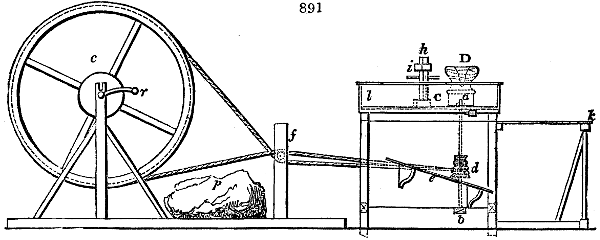
A, fig. 891., is the profile of the English potter’s lathe, for blocking out round ware; C is the table or tray; a is the head of the lathe, with its horizontal disc; a, b, is the upright shaft of the head; d, pulleys with several grooves of different diameters, fixed upon the shaft, for receiving the driving-cord or band; k is a bench upon which the workman sits astride; e, the treadle foot-board; l, is a ledge-board, for catching the shavings of clay which fly off from the lathe; h is an instrument, with a slide-nut i, for measuring the objects in the blocking out; c is the fly-wheel with its winch-handle r, turned by an assistant; the sole-frame is secured in its place by the heavy stone p; f is the oblong guide-pulley, having also several grooves for converting the vertical movement of the fly-wheel into the horizontal movement of the head of the lathe.