B. (continued 4)
Reading edition
Besides the boiling, bucking, and other apparatus above described, the machinery and utensils used in bleaching are various, according to the business done by the bleacher. When linen or heavy cotton cloths are whitened, and the business is carried on to a considerable extent, the machines are both complicated and expensive. They consist chiefly of a water-wheel, sufficiently powerful for giving motion to the wash-stocks, dash-wheels, squeezers, &c., with any other operations where power is required.
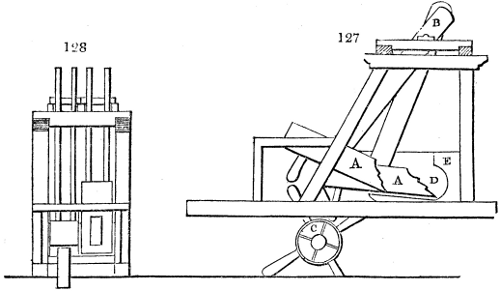
Figs. 127, 128. represent a pair of wash-stocks. A A are called the stocks, or feet. They are suspended on iron pivots at B, and receive their motion from wipers on the revolving-shaft C. The cloth is laid in at D, and, by the alternate strokes of the feet, and the curved form of the turnhead E, the cloth is washed and gradually turned. At the same time, an abundant stream of water rushes on the cloth throughout holes in the upper part of the turnhead. Wash-stocks are much used in Scotland and in Ireland. In the latter country, they are often made with double feet, suspended above and below two turnheads, and wrought with cranks instead of wipers. Wash-stocks, properly constructed, make from 24 to 30 strokes per minute.
This mode of washing is now entirely given up in Lancashire, where a preference is given to what are called dash-wheels and squeezers. The dash are small water-wheels, the inside of which is divided into four compartments, and closed up, leaving only a hole in each compartment for putting in the cloth.
There are, besides, smaller openings for the free admission and egress of the water employed in cleansing. The cloth, by the motion of the wheel, is raised up in one part of the revolution of the wheel; while, by its own weight, it falls in another. This kind of motion is very effectual in washing the cloth, while, at the same time, it does not injure its strength. The plan, however, where economy of water is of any importance, is very objectionable; because the wheel must move at by far too great a velocity to act to advantage as a water-wheel.
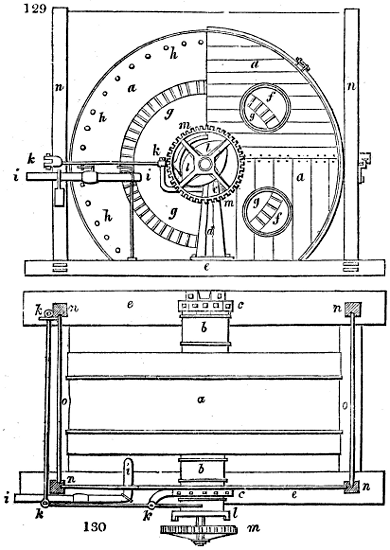
The wash or dash-wheel, now driven by power in all good bleach and print-works, is represented in fig. 129., upon the left side in a back view, and upon the right side in a front view (the sketch being halved). Fig. 130. is a ground plan.
a a is the washing-wheel; b b its shaft-ends; c c their brass bearings or plummer-blocks, supported upon the iron pillars d d. The frame is made of strong beams of wood, e e, bound together by cross bars with mortises. f f, two of the circular apertures, each leading to a quadrantal compartment within the dash-wheel. In the back view (the left-hand half of the figure) the brass grating g g, of a curvilinear form, is seen, through which the jets of water are admitted into the cavity of the wheel; h h, are the round orifices, through which the foul water runs off, as each quadrant passes the lower part of its revolution; i, a water-pipe, with a stop-cock for regulating the washing-jets; k k, the lever for throwing the driving-crab l, or coupling-box, into or out of geer with the shaft of the wheel. This machine is so constructed, that the water-cock is opened or shut by the same leverage which throws the wheel into or out of geer. m, a wheel, fixed upon the round extremity of the shaft of the dash-wheel, which works into the toothed pinion connected with the prime mover. When the end of the lever k, whose fork embraces the coupling-box upon the square part of the shaft, is pushed forwards or backwards, it shifts the clutch into or out of geer with the toothed wheel m. In the latter case, this wheel turns with its pinion without affecting the dash-wheel. n n, holdfasts fixed upon the wooden frame, to which the boards o o are attached, for preventing the water from being thrown about by the centrifugal force.
The dash-wheel is generally from 6 to 7 feet in diameter, about 30 inches wide, and requires the power of about two horses to drive it.
From one to two pieces of calico may be done at once in each quadrantal compartment, in the course of 8 or 10 minutes; hence, in a day of 13 hours, with two such wheels 1200 pieces of yard-wide goods may be washed.
After the process of washing by the dash-wheel, the water is expressed from the cloth by means of the squeezers already described.
Bleaching of Linen.—Linen contains much more colouring matter than cotton. The former loses nearly a third of its weight, while the latter loses not more than a twentieth. The fibres of flax possess, in the natural condition, a light gray, yellow, or blond colour. By the operation of rotting, or, as it is commonly called, water-retting, which is employed to enable the textile filaments to be separated from the boon, or woody matter, the colour becomes darker, and, in consequence probably of the putrefaction of the green matter of the bark, the colouring substance appears. Hence, flax prepared without rotting is much paler, and its colouring matter may be in a great measure removed by washing with soap, leaving the filaments nearly white. Mr. James Lee obtained a patent in 1812, as having discovered that the process of steeping and dew-retting is unnecessary, and that flax and hemp will not only dress, but will produce an equal if not greater quantity of more durable fibre, when cleaned in the dry way. Mr. Lee stated that, when hemp or flax plants are ripe, the farmer has nothing more to do than to pull, spread, and dry them in the sun, and then to break them by proper machinery. This promising improvement has apparently come to nought, having been many years abandoned by the patentee himself, though he was favoured with a special act of parliament, which permitted the specification of his patent to remain sealed up for seven years, contrary to the general practice in such cases.
The substance which gives steeped flax its peculiar tint is insoluble in boiling water, in acids, and in alkalies; but it possesses the property of dissolving in caustic or carbonated alkaline lyes, when it has possessed the means of dehydrogenation by previous exposure to oxygen. Hemp is, in this respect, analogous to flax. The bleaching of both depends upon this action of oxygen, and upon the removal of the acidified dye, by means of an alkali. This process is effected generally by the influence of air in combination with light and moisture acting on the linen cloth laid upon the grass: but chlorine will effect the same object more expeditiously. In no case, however, is it possible to acidify the colour completely at once, but there must be many alternate exposures to oxygen or chlorine, and alkali, before the flax becomes white. It is this circumstance alone which renders the bleaching of linen an apparently complicated business.
Having made these preliminary observations with regard to the method of applying the alkaline lyes used in bleaching linen cloth, I shall now bring the whole into one point of view, by detailing the connection of these processes, as carried on at a bleach-field, which has uniformly been successful in returning the cloth of a good white, and has otherwise given satisfaction to its employers; and I shall only remark, that I by no means hold it up as the best process which may be employed, as every experienced bleacher knows that processes must be varied, not only according to existing circumstances, but also according to the nature of the linens operated upon.
In order to avoid repetition, where washing is mentioned, it must always be understood that the linen is taken to the wash-stocks or dash-wheel, and washed well in them for some hours. This part of the work can never be overdone; and on its being properly executed between every part of the bucking, boiling, steeping in the chloride of lime solution, and souring, not a little of the success of bleaching depends. By exposure is meant, that the linen cloth is taken and spread upon the bleach-green for four, six, or eight days, according as the routine of business calls for the return of the cloth, in order to undergo further operations.
A parcel of goods consists of 360 pieces of those linens which are called Britannias. Each piece is 35 yards long; and they weigh, on an average, 10 lbs. each; the weight of the parcel is, in consequence, about 3600 lbs. avoirdupois weight. The linens are first washed, and then steeped in waste alkaline lye, as formerly described under these processes; they then undergo the following operations:—
1st, Bucked with 60 lbs. pearl-ashes, washed, exposed on the field.
2d, Ditto 80 ditto ditto ditto ditto.
3d, Ditto 90 potashes ditto ditto ditto.
4th, Ditto 80 ditto ditto ditto ditto.
5th, Ditto 80 dito ditto ditto ditto.
6th, Ditto 50 ditto ditto ditto ditto.
7th, Ditto 70 ditto ditto ditto ditto.
8th, Ditto 70 ditto ditto ditto ditto.
9th, Soured one night in dilute sulphuric acid, washed.
10th, Bucked with 50 lbs. pearl-ashes, washed, exposed on the field.
11th, Immersed in the chloride of potash or lime 12 hours.
12th, Boiled with 30 lbs. pearl ashes, washed, exposed on the field.
13th, Ditto 30 ditto ditto ditto ditto.
14th, Soured, washed.
The linens are then taken to the rubbing-board, and well rubbed with a strong lather of black soap, after which they are well washed in pure spring water. At this period they are carefully examined, and those which are fully bleached are laid aside to be blued, and made up for the market; while those which are not fully white are returned to be boiled, and steeped in the chloride of lime or potash; then soured, until they are fully white.
By the above process, 690 lbs. weight of alkali is taken to bleach 360 pieces of linen, each piece consisting of 35 yards in length; so that the expenditure of alkali would be somewhat less than 2 lbs. for each piece, were it not that some parts of the linens are not fully whitened, as above noted. Two pounds of alkali may therefore be stated as the average quantity employed for bleaching each piece of goods.
The method of bleaching linens in Ireland is similar to the foregoing; any alteration in the process depending upon the judgment of the bleacher in increasing or diminishing the quantity of alkali used. But it is common, at most bleach-fields, to steep the linens in the chloride of lime or potash at an early stage of the process, or after the goods have undergone the fifth or sixth operation of bucking. By this means those parts of the flax which are most difficult to bleach are more easily acted upon by the alkali; and, as before noticed, souring early in very dilute sulphuric acid, assists greatly in forwarding the whitening of the linens. Mr. Grimshaw, calico-printer, near Belfast, was the first who recommended early souring, which has since been very generally adopted.
The bleaching of Silk.—Silk in its raw state, as spun by the worm, is either white or yellow of various shades, and is covered with a varnish, which gives it stiffness and a degree of elasticity. For the greater number of purposes to which silk is applied, it must be deprived of this native covering, which was long considered to be a sort of gum. The operation by which this colouring matter is removed is called scouring, cleansing, or boiling. A great many different processes have been proposed for freeing the silk fibres from all foreign impurities, and for giving it the utmost whiteness, lustre, and pliancy; but none of the new plans has superseded, with any advantage, the one practised of old, which consists essentially in steeping the silk in a warm solution of soap; a circumstance placed beyond all doubt by the interesting experiments of M. Roard. The alkalies, or alkaline salts, act in a marked manner upon the varnish of silk, and effect its complete solution; the prolonged agency of boiling water, alone answers the same purpose; but nothing agrees so well with the nature of silk, and preserves its brilliancy and suppleness so perfectly, as a rapid boil with soap-water. It would appear, however, that the Chinese do not employ this method, but something that is preferable. Probably the superior beauty of their white silk may be owing to the superiority of the raw material.
The most ancient method of scouring silk consists of three operations. For the first, or the ungumming, thirty per cent. of soap is first of all dissolved in clean river water by a boiling heat; then the temperature is lowered by the addition of a little cold water, by withdrawing the fire, or at least by damping it. The hanks of silk suspended upon horizontal poles over the boiler, are now plunged into the soapy solution, kept at a heat somewhat under ebullition, which is an essential point; for if hotter, the soap would attack the substance of the silk, and not only dissolve a portion of it, but deprive the whole of its lustre. The portions of the hanks plunged in the bath get scoured by degrees; the varnish and the colouring matter come away, and the silk assumes its proper whiteness and pliancy. Whenever this point is attained, the hanks are turned round upon the poles, so that the portion formerly in the air may be also subjected to the bath. As soon as the whole is completely ungummed, they are taken out, wrung by the peg, and shaken out; after which, the next step, called the boil, is commenced. Into bags of coarse canvass, called pockets, about 25 lbs. or 35 lbs. of ungummed silk are enclosed, and put into a similar bath with the preceding, but with a smaller proportion of soap, which may therefore be raised to the boiling point without any danger of destroying the silk. The ebullition is to be kept up for an hour and a half, during which time the bags must be frequently stirred, lest those near the bottom should suffer an undue degree of heat. The silk experiences in these two operations a loss of about 25 per cent. of its weight.
The third and last scouring operation is intended to give the silk a slight tinge, which renders the white more agreeable, and better adapted to its various uses in trade. In this way we distinguish the China white, which has a faint cast of red, the silver white, the azure white, and the thread white. To produce these different shades, we begin by preparing a soap-water so strong as to lather by agitation; we then add to it, for the China white, a little annotto, mixing it carefully in; and then passing the silk properly through it, till it has acquired the wished for tint. As to the other shades, we need only azure them more or less with a fine indigo, which has been previously washed several times in hot water, and reduced to powder in a mortar. It is then diffused through boiling water, allowed to settle for a few minutes, and the supernatant liquid, which contains only the finer particles, is added to the soap bath, in such proportion as may be requisite. The silk, on being taken out of this bath, must be wrung well, and stretched upon perches to dry; after which it is introduced into the sulphuring chamber, if it is to be made use of in the white state. At Lyons, however, no soap is employed at the third operation: after the boil, the silk is washed, sulphured, and azured, by passing through very clear river water properly blued.
The silks intended for the manufacture of blonds and gauzes are not subjected to the ordinary scouring process, because it is essential, in these cases, for them to preserve their natural stiffness. We must therefore select the raw silk of China, or the whitest raw silks of other countries; steep them, rince them in a bath of pure water, or in one containing a little soap; wring them, expose them to the vapour of sulphur, and then pass them through the azure water. Sometimes this process is repeated.
Before the memoir of M. Roard appeared, extremely vague ideas were entertained about the composition of the native varnish of silk. He has shown that this substance, so far from being of a gummy nature, as had been believed, may be rather compared to bees’ wax, with a species of oil, and a colouring matter, which exists only in raw silks. It is contained in them to the amount of from 23 to 24 per cent., and forms the portion of weight which is lost in the ungumming. It possesses, however, some of the properties of vegetable gums, though it differs essentially as to others. In a dry mass, it is friable and has a vitreous fracture; it is soluble in water, and affords a solution which lathers like soap; but when thrown upon burning coals, it does not soften like gum, but burns with the exhalation of a fetid odour. Its solution, when left exposed to the open air, at first of a golden yellow, becomes soon greenish, and ere long putrefies, as a solution of animal matter would do in similar circumstances. M. Roard assures us that the city of Lyons alone could furnish several thousand quintals of this substance per annum, were it applicable to any useful purpose.
The yellow varnish is of a resinous nature, altogether insoluble in water, very soluble in alcohol, and contains a little volatile oil, which gives it a rank smell. The colour of this resin is easily dissipated, either by exposure to the sun or by the action of chlorine: it forms about one fifty-fifth of its weight.
Bees’ wax exists also in all the sorts of silk, even in that of China; but the whiter the filaments, the less wax do they contain.
M. Roard has observed that, if the silk be exposed to the soap baths for some time after it has been stripped of its foreign matters, it begins to lose body, and has its valuable qualities impaired. It becomes dull, stiff, and coloured in consequence of the solution more or less considerable of its substance; a solution which takes place in all liquids, and even in boiling water. It is for this reason that silks cannot be alumed with heat; and that they lose some of their lustre in being dyed brown, a colour which requires a boiling hot bath. The best mode, therefore, of avoiding these inconveniences, is to boil the silks in the soap-bath no longer than is absolutely necessary for the scouring process, and to expose them in the various dyeing operations to as moderate temperature as may be requisite to communicate the colour. When silks are to be dyed, much less soap should be used in the cleansing, and very little for the dark colours. According to M. Roard, raw silks, white or yellow, may be completely scoured, in one hour, with 15 lbs. of water for one of silk, and a suitable proportion of soap. The soap and the silk should be put into the bath half an hour before its ebullition, and the latter should be turned about frequently. The dull silks, in which the varnish has already undergone some alteration, never acquire a fine white until they are exposed to sulphureous acid gas. Exposure to light has also a very good effect in whitening silks, and is had recourse to, it is said, with advantage by the Chinese.
Carbonate of soda has been proposed to be used instead of soap in scouring silk, but it has never come into use. The Abbé Collomb, in 1785, scoured silk by eight hours’ boiling in simple water, and he found the silks bleached in this way to be stronger than by soap, but they are not nearly so white. A patent has been taken out in England for bleaching them by steam, of which an account will be found under the article Silk.
It appears that the Chinese do not use soap in producing those fine white silks which are imported into Europe. Michel de Grubbens who resided long at Canton, saw and practised himself the operation there, which he published in the Memoirs of the Academy of Stockholm in 1803. It consists in preparing the silk with a species of white beans, smaller than the Turkey beans, with some wheat flour, common salt, and water. The proportions are 5 parts of beans, 5 of salt, 6 of flour, and 25 of water, to form this vegetable bath. The beans must be previously washed. It is difficult to discover what chemical action can occur between that decoction and the varnish of raw silk; possibly some acid may be developed, which may soften the gummy matter, and facilitate its separation.
Baumé contrived a process which does not appear to have received the sanction of experience, but which may put us in the right way. He macerates the yellow raw silk in a mixture of alcohol at 36° (sp. gr. 0·837) and one thirty-second part of pure muriatic acid. At the end of forty-eight hours, it is as white as possible, and the more so, the better the quality of the silk. The loss which it suffers in this menstruum is only one fortieth; showing that nothing but the colouring matter is abstracted. The expense of this menstruum is the great obstacle to Baumé’s process. The alcohol, however, might be in a very great measure recovered, by saturating the acid with chalk, and redistillation.
Bleaching of Wool.—Wool, like the preceding fibrous matter, is covered with a peculiar varnish, which impairs its qualities, and prevents it from being employed in the raw state for the purposes to which it is well adapted when it is scoured. The English give the name yolk, and the French suint, to that native coat: it is a fatty unctuous matter, of a strong smell, which apparently has its chief origin in the cutaneous perspiration of the sheep; but which, by the agency of external bodies, may have undergone some changes which modify its constitution. It results from the experiments of M. Vauquelin, that the yolk is composed of several substances; namely, 1. a soap with basis of potash, which constitutes the greater part of it; 2. of a notable quantity of acetate of potash; 3. of a small quantity of carbonate, and a trace of muriate, of potash; 4. of a little lime in an unknown state of combination; 5. of a species of sebaceous matter, and an animal substance to which the odour is due. There are several other accidental matters present on sheep’s wool.
The proportion of yolk is variable in different kinds of wool, but in general it is more abundant the finer the staple; the loss by scouring being 45 per cent. for the finest wools, and 35 per cent. for the coarse.
The yolk, on account of its soapy nature, dissolves readily in water, with the exception of a little free fatty matter, which easily separates from the filaments, and remains floating in the liquor. It would thence appear sufficient to expose the wools to simple washing in a stream of water; yet experience shows that this method never answers so well as that usually adopted, which consists in steeping the wool for some time in simple warm water, or in warm water mixed with a fourth of stale urine. From 15 to 20 minutes of contact are sufficient in this case, if we heat the bath as warm as the hand can bear it, and stir it well with a rod. At the end of this time the wool may be taken out, set to drain, then placed in large baskets, in order to be completely rinsed in a stream of water.
It is generally supposed that putrid urine acts on the wool by the ammonia which it contains, and that this serves to saponify the remainder of the fatty matter not combined with the potash. M. Vauquelin is not of this opinion, because he found that wool steeped in water, with sal ammoniac and quick lime, is not better scoured than an equal quantity of wool treated with mere water. He was hence led to conclude that the good effects of putrefied urine might be ascribed to any thing else besides the ammonia, and probably to the urea. Fresh urine contains a free acid, which, by decomposing the potash soap of the yolk, counteracts the scouring operation.
If wools are better scoured in a small quantity of water than in a great stream, we can conceive that this circumstance must depend upon the nature of the yolk which, in a concentrated solution, acts like a saponaceous compound, and thus contributes to remove the free fatty particles which adhere to the filaments. It should also be observed that too long a continuance of the wool in the yolk water, hurts its quality very much, by weakening its cohesion, causing the filaments to swell, and even to split. It is said then to have lost its nerve. Another circumstance in the scouring of wool, that should always be attended to, is never to work the filaments together to such a degree as to occasion their felting; but in agitating we must merely push them slowly round in the vessel, or press them gently under the feet. Were it at all felted, it would neither card nor spin well.
As the heat of boiling water is apt to decompose woollen fibres, we should be careful never to raise the temperature of the scouring bath to near this point, nor, in fact, to exceed 140° F. Some authors recommend the use of alkaline or soapy baths for scouring wool, but practical people do not deviate from the method above described.
When the washing is completed, all the wool which is to be sent white into the market, must be exposed to the action of sulphurous acid, either in a liquid or a gaseous state. In the latter case, sulphur is burned in a close chamber, in which the wools are hung up or spread out; in the former, the wools are plunged into water, moderately impregnated with the acid. (See Sulphuring.) Exposure on the grass may also contribute to the bleaching of wool. Some fraudulent dealers are accused of dipping wools in butter-milk, or chalk and water, in order to whiten them and increase their weight.
Wool is sometimes whitened in the fleece, and sometimes in the state of yarn; the latter affording the best means of operating. It has been observed that the wool cut from certain parts of the sheep, especially from the groins, never bleaches well.
After sulphuring, the wool has a harsh crispy feel, which may be removed by a weak soap bath. To this also the wool comber has recourse when he wishes to cleanse and whiten his wools to the utmost. He generally uses a soft or potash soap, and after the wool is well soaked in the warm soap bath, with gentle pressure he wrings it well with the help of a hook, fixed at the end of his washing tub, and hangs it up to dry.
Bleaching of rags, and paste for paper making.—After the rags are reduced to what is called half stuff, they should have the greater part of the floating water run off, leaving just enough to form a stir-about mass. Into this a clear solution of chloride of lime should be poured, of such a strength as is suited to the colour of the rags, which should have been previously sorted; and the engine is kept going so as to churn the rags with the bleaching agent. After an hour, the water may be returned upon the engine, and the washing of the paper resumed. From two to four pounds of good chloride of lime are reckoned sufficient to bleach one hundred weight of rags.
When the rags consist of dyed or printed cottons, after being well washed and reduced to half stuff, they should be put into a large cask or butt, supported horizontally by iron axles upon cradle bearings, so that it may be made to revolve like a barrel-churn. For each hundred weight of the coloured rags, take a solution containing from four to eight pounds of chloride of lime; add it to the liquid mixture in the butt along with half a pound of sulphuric acid for every pound of the chloride; and after inserting the bung, or rather the square valve, set the vessel in slow revolution backwards and forwards. In a short time the rags will be colourless. The rags and paper paste ought to be very well washed, to expel all the chlorine, and perhaps a little muriatic acid might be used with advantage to dissolve out all the calcareous matter, a portion of which is apt to remain in the paper, and to operate injuriously upon both the pens and the ink. Some of the French paper manufacturers bleach the paste with chlorine gas. Paper prepared from such paste, well washed, is not apt to give a brown tint to maps, as that carelessly bleached with chloride of lime is known to do.
BLENDE. (Fr. and Germ.) Sulphuret of zinc, so named from the German blenden to dazzle, on account of its glistening aspect. It is called black jack from its usual colour. Its lustre is pearly adamantine. Spec. gravity from 3·7 to 4·2. It contains frequently iron, copper, arsenic, cadmium and silver, all associated with sulphur. It is worked up partly into metallic zinc, and partly into the sulphate of zinc, or white vitriol. It consists of 66·72 zinc, and 33·28 sulphur; being nearly by weight as two to one. See Zinc.
BLOCK MANUFACTURE. Though the making of ships’ blocks belongs rather to a dictionary of engineering than of manufactures, it may be expected that I should give some account of the automatic machinery for making blocks, so admirably devised and mounted by M. I. Brunel, Esq. for the British navy, in the dock-yard of Portsmouth.
The series of machines and operations are as follows:—
1. The straight cross cutting saw.—The log is placed horizontally on a very low bench which is continued through the window of the mill into the yard. The saw is exactly over the place where the log is to be divided. It is let down, and suffered to rest with its teeth upon the log, the back still being in the cleft of the guide. The crank being set in motion, the saw reciprocates backwards and forwards with exactly the same motion as if worked by a carpenter, and quickly cuts through the tree. When it first begins to cut, its back is in the cleft in the guide, and this causes it to move in a straight line; but before it gets out of the guide, it is so deep in the wood as to guide itself: for in cutting across the grain of the wood, it has no tendency to be diverted from its true line by the irregular grain. When the saw has descended through the tree, its handle is caught in a fixed stop, to prevent its cutting the bench. The machine is thrown out of geer, the attendant lifts up the saw by a rope, removes the block cut off, and advances the tree to receive a fresh cut.
2. The circular cross-cutting saw.—This saw possesses universal motion; but the axis is always parallel to itself, and the saw in the same plane. It can be readily raised or lowered, by inclining the upper frame on its axis; and to move it sidewise, the saw frame must swing sidewise on its joints, which connect it with the upper frame. These movements are effected by two winches, each furnished with a pair of equal pinions, working a pair of racks fixed upon two long poles. The spindles of these winches are fixed in two vertical posts, which support the axis of the upper frame. One of these pairs of poles is jointed to the extreme end of the upper frame; therefore by turning the handle belonging to them, the frame and saw is elevated or depressed; in like manner, the other pair is attached to the lower part of the saw frame, so that the saw can be moved sidewise by means of their handles, which then swing the saw from its vertical position.
These two handles give the attendant a complete command of the saw, which we suppose to be in rapid motion, the tree being brought forward and properly fixed. By one handle, he draws the saw against one side of the tree, which is thus cut into, (perhaps half through); now, by the other handle, he raises the saw up, and by the first-mentioned handle he draws it across the top of the tree, and cuts it half through from the upper side; he then depresses the saw and cuts half through from the next side; and lastly a trifling cut of the saw, at the lower side, completely divides the tree, which is then advanced to take another cut.
The great reciprocating saw is on the same principle as the saw mill in common use in America.
3. The circular ripping saw is a thin circular plate of steel, with teeth similar to those of a pit saw, formed in its periphery. It is fixed to a spindle placed horizontally, at a small distance beneath the surface of a bench or table, so that the saw projects through a crevice a few inches above the bench. The spindle being supported in proper collars, has a rapid rotatory motion communicated to it by a pulley on the opposite end, round which an endless strap is passed from a drum placed overhead in the mill. The block cut by the preceding machine, from the end of the tree, is placed with one of the sides flat upon the bench, and thus slides forward against the revolving saw which cuts the wood with a rapidity incredible to any one who has not seen these or similar machines.
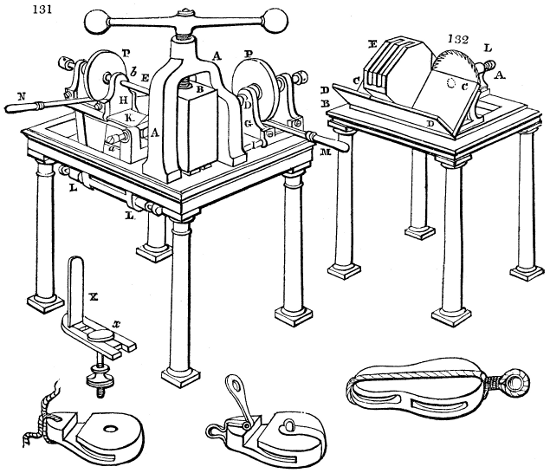
4. Boring machine.—The blocks, prepared by the foregoing saws, are placed in the machine represented in fig. 131. This machine has an iron frame, A A, with three legs, beneath which the block is introduced, and the screw near B being forced down upon it, confines it precisely in the proper spot to receive the borers D and E. This spot is determined by a piece of metal fixed perpendicularly just beneath the point of the borer E, shown separately on the ground at X; this piece of metal adjusts the position for the borer D, and its height is regulated by resting on the head of the screw x, which fastens the piece X down to the frame. The sides of the block are kept in a parallel position, by being applied against the heads of three screws tapped into the double leg of the frame A. The borer D is adapted to bore the hole for the centre pin in a direction exactly perpendicular to the surface resting against the three screws; the other, at E, perforates the holes for the commencement of the sheave holes. Both borers are constructed in nearly the same manner; they are screwed upon the ends of small mandrels, mounted in frames similar to a lathe. These frames, G and H, are fitted with sliders upon the angular edges of the flat broad bars, I and K. The former of these is screwed fast to the frame; the latter is fixed upon a frame of its own, moving on the centre screws, at L L, beneath the principal frame of the machine. By this means the borer E can be moved within certain limits, so as to bore holes in different positions. These limits are determined by two screws, one of which is seen at a; the other being on the opposite side is invisible. They are tapped through fixed pieces projecting up from the frame. A projecting piece of metal, from the under side of the slider K of the borer E, stops against the ends of these screws, to limit the excursion of the borer. The frames for both borers are brought up towards the block by means of levers M and N. These are centered on a pin, at the opposite sides of the frame of the machine, and have oblong grooves through them which receive screw pins, fixed into the frames G and H, beneath the pulleys P P, which give motion to the spindles.
5. The mortising machine is a beautiful piece of mechanism, but too complicated for description within the limits prescribed to this article.
6. The corner saw, fig. 132., consists of a mandrel, mounted in a frame A, and, carrying a circular saw L upon the extreme end of it. This mandrel and its frame being exactly similar to those at G and H fig. 131., does not require a separate view, although it is hid behind the saw, except the end of the screw, marked A. This frame is screwed down upon the frame B B of the machine, which is supported upon four columns. C C, D D, is an inclined bench, or a kind of trough, in which a block is laid, as at E, being supported on its edge by the plane C C of this bench, and its end kept up to its position by the other part of the bench D D.
By sliding the block along this bench, it is applied to the saw, which cuts off its angles, as is evident from the figure, and prepares it for the shaping engine. All the four angles are cut off in succession, by applying its different sides to the trough or bench. In the figure, two of them are drawn as being cut, and the third is just marked by the saw. This machine is readily adapted to different sizes of blocks, by the simple expedient of laying pieces of wood of different thickness against the plane D D, so as to fill it up, and keep the block nearer to or farther from the saw; for all the blocks are required to be cut at the same angle, though, of course, a larger piece is to be cut from large than from small blocks. The block reduced to the state of E is now taken to
7. The shaping machine.—A great deal of the apparent complication of this figure arises from the iron cage, which is provided to defend the workmen, lest the blocks, which are revolving in the circles, or chuck, with an immense velocity, should be loosened by the action of the tool, and fly out by their centrifugal force. Without this provision, the consequences of such an accident would be dreadful, as the blocks would be projected in all directions, with an inconceivable force.
8. The scoring engine receives two blocks, as they come from the shaping engine, and forms the groove round their longest diameters for the reception of their ropes or straps, as represented in the two snatch blocks and double block, under figs. 131, 132.
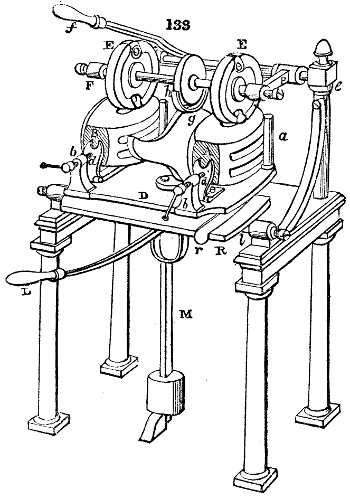
A, B, fig. 133., represent the above two blocks, each held between two small pillars a, (the other pillar is hid behind the block) fixed in a strong plate D, and pressed against the pillars by a screw b, which acts on a clamp d. Over the blocks a pair of circular planes or cutters E E, are situated, both being fixed on the same spindle, which is turned by a pulley in the middle of it. The spindle is fitted in a frame F F, moving in centres at e e, so as to rise and fall when moved by a handle f. This brings the cutters down upon the blocks; and the depth to which they can cut is regulated by a curved shape g, fixed by screws upon the plate D, between the blocks. Upon this rests a curved piece of metal h, fixed to the frame F, and inclosing, but not touching, the pulley. To admit the cutters to traverse the whole length of the blocks, the plate D, (or rather a frame beneath it,) is sustained between the points of two centres. Screws are seen at l, on these centres. The frame inclines when the handle L is depressed. At M is a lever, with a weight at the end of it, counterbalancing the weight of the blocks, and plate D, all which are above the centre on which they move. The frame F is also provided with a counterpoise to balance the cutters, &c. The cutters E E are circular wheels of brass, with round edges. Each has two notches in its circumference, at opposite sides; and in these notches chisels are fixed by screws, to project beyond the rim of the wheel, in the manner of a plane iron before its face.
This machine is used as follows:—In order to fix the block, it is pressed between the two pins (only one of which at a, can be seen in this view), and the clamp d, screwed up against it, so as just to hold the block, but no more. The clamp has two claws, as is seen in the figure, each furnished with a ring entering the double prints previously made, in the end of the block. These rings are partly cut away, leaving only such a segment of each as will just retain the block, and the metal between them is taken out to admit the cutter to operate between them, or nearly so. In putting the blocks into this machine, the workman applies the double prints to the ends of the claws of the clamps, but takes care that the blocks are higher between the pins a than they should be; he then takes the handle f, and by it presses the cutters E E, (which we suppose are standing still,) down upon the blocks, depressing them between their pins at the same time, till the descent of the cutters is stopped by the piece h resting on the shape g. He now turns the screws b b, to fix the blocks tight. The cutters being put in motion cut the scores, which will be plainly seen by the mode of adjustment just described, to be of no depth at the pin-hole; but by depressing the handle L, so as to incline the blocks, and keeping the cutters down upon their shape g, by the handle f, they will cut any depth towards the ends of the blocks, which the shape g admits.
By this means one quarter of the score is formed; the other is done by turning both blocks together half round in this manner. The centres l are not fitted into the plate D itself, but into a frame seen at R beneath the plate, which is connected with it by a centre pin, exactly midway between the two blocks A B. A spring catch, the end of which is seen at r, confines them together; when this catch is pressed back, the plate D can be turned about upon its centre pin, so as to change the blocks, end for end, and bring the unscored quarters (i. e. over the clamps) beneath the cutters; the workman taking the handles f and L, one in each hand, and pressing them down, cuts out the second quarter. This might have been effected by simply lifting up the handle L; but in that case the cutter would have struck against the grain of the wood, so as to cut rather roughly; but by this ingenious device of reversing the blocks, it always cuts clean and smooth, in the direction of the grain. The third and fourth quarters of the score are cut by turning the other sides of the blocks upwards, and repeating the above operation. The shape g can be removed, and another put in its place, for different sizes and curves of block; but the same pins a, and holding clamps d, will suit many different sizes.
By these machines the shells of the blocks are completely formed, and they are next polished and finished by hand labour; but as this is performed by tools and methods which are well known, it is needless to enter into any explanation: the finishing required being only a smoothing of the surfaces. The machines cut so perfectly true as to require no wood to be removed in the finishing; but as they cut without regard to the irregularity of the grain, knots, &c., it happens that many parts are not so smooth as might be wished, and for this purpose manual labour alone can be employed.
The lignum vitæ for the sheaves of the blocks, is cut across the grain of the wood by two cross cutting saws, a circular and straight saw, as before mentioned. These machines do not essentially differ in their principle from the great cross cutting saws we have described, except that the wood revolves while it is cutting, so that a small saw will reach the centre of a large tree, and at the same time cut it truly flat. The limits prescribed for our plates will not admit of giving drawings of these machines, and the idea which could be derived from a verbal description would not be materially different from the cross cutting saws before mentioned. These machines cut off their plates for the end of the tree, which are exactly the thickness for the intended sheave. These pieces are of an irregular figure, and must be rounded and centered in the crown saw.
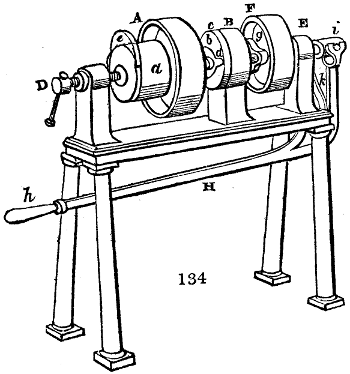
9. The crown saw is represented in fig. 134., where A is a pulley revolving by means of an endless strap. It has the crown or trepan saw a fixed to it, by a screw cut within the piece, upon which the saw is fixed, and which gives the ring or hoop of the saw sufficient stability to perform its office. Both the pulleys and saw revolve together upon a truly cylindrical tube b, which is stationary, being attached by a flaunch c to a fixed puppet B, and on this tube as an axis the saw and pulley turn, and may be slid endwise by a collar fitted round the centre piece of the pulley, and having two iron rods (only one of which can be seen at d in the figure), passing through holes made through the flaunch and puppet B. When the saw is drawn back upon its central tube, the end of the latter projects beyond the teeth of the saw. It is by means of this fixed ring or tube within the saw, that the piece of wood e is supported during the operation of sawing, being pressed forcibly against it by a screw D, acting through a puppet fixed to the frame of the machine. At the end of this screw is a cup or bason which applies itself to the piece of wood, so as to form a kind of vice, one side being the end of the fixed tube, the other the cup at the end of the screw D. Within the tube b is a collar for supporting a central axis, which is perfectly cylindrical. The other end of this axis, (seen at f,) turns in a collar of the fixed puppet E. The central axis has a pulley F, fixed on it, and giving it motion by a strap similar to the other. Close to the latter pulley a collar g is fitted on the centre piece of the pulley, so as to slip round freely, but at the same time confined to move endways with the pulley and its collar. This collar receives the ends of the two iron rods d. The opposite ends of these rods are, as above mentioned, connected by a similar collar, with the pulley A of the saw a. By this connection, both the centre bit, which is screwed into the end of the central axis f, and the saw sliding upon the fixed tube b, are brought forward to the wood at the same time, both being in rapid motion by their respective pulleys.
10. The Coaking Engine.—This ingenious piece of machinery is used to cut the three semicircular holes which surround the hole bored by the crown saw, so as to produce a cavity in the centre of the disc.
11. Face-turning Lathe.—The sheave is fixed against a flat chuck at the end of a mandrel, by an universal chuck, similar to that in the coaking engine, except that the centre pin, instead of having a nut, is tapped into the flat chuck, and turned by a screw-driver.
BLOOD. (Sang, Fr.; Blut, Germ.) The liquid which circulates in the arteries and veins of animals; bright red in the former and purple in the latter, among all the tribes whose temperature is considerably higher than that of the atmosphere. It consists 1. of a colourless transparent solution of several substances in water; and 2. of red, undissolved particles diffused through that solution. Its specific gravity varies with the nature and health of the animal; being from 1·0527 to 1·0570 at 60° F. It has a saline sub-nauseous taste, and a smell peculiar to each animal. When fresh drawn from the vessels, it rapidly coagulates into a gelatinous mass, called the clot, cruor, or crassamentum, from which after some time, a pale yellow fluid, passing into yellowish green, oozes forth, called the serum. If the warm blood be stirred with a bundle of twigs, as it flows from the veins, the fibrine concretes, and forms long fibres and knots, while it retains its usual appearance in other respects. The clot contains fibrine and colouring matter in various proportions. Berzelius found in 100 parts of the dried clot of blood, 35 parts of fibrine, 58 of colouring matter; 1·3 of carbonate of soda; 4 of an animal matter soluble in water, along with some salts and fat. The specific gravity of the serum varies from 1·027 to 1·029. It forms about three fourths of the weight of the blood, has an alkaline reaction, coagulates at 167° F. into a gelatinous mass, and has for its leading constituent albumen to the amount of 8 per cent. besides fat, potash, soda, and salts of these bases. Blood does not seem to contain any gelatine.
The red colouring matter called hematine, may be obtained from the cruor by washing with cold water and filtering.
Blood was at one time largely employed for clarifying syrup, but it is very sparingly used by the sugar refiners in Great Britain of the present day. It may be dried by evaporation at a heat of 130° or 140°, and in this state has been transported to the colonies for purifying cane juice. It is an ingredient in certain adhesive cements, coarse pigments for protecting walls from the weather, for making animal charcoal in the Prussian blue works, and by an after process, a decolouring carbon. It is used in some Turkey red dye-works. Blood is a powerful manure.
BLOWING MACHINE. See Iron, Metallurgy, Ventilation.
BLOWPIPE. (Chalumeau, Fr.; Lothröhre, Germ.) Jewellers, mineralogists, chemists, enamellers, &c. make frequent use of a tube, usually bent near the end, terminated with a finely pointed nozzle, for blowing through the flame of a lamp, candle, or gas-jet, and producing thereby a small conical flame possessing a very intense heat. Modifications of blow pipes are made with jets of hydrogen, oxygen, or the two gases mixed in due proportions.
BLUE DYES. (Teint, Germ. See Enamel.) The materials employed for this purpose are indigo, Prussian blue, logwood, bilberry, (vaccinium myrtillus,) elder berries, (sambucus nigra,) mulberries, privet berries, (ligustrum vulgare,) and some other berries whose juice becomes blue by the addition of a small portion of alkali, or of the salts of copper. For dyeing with the first three articles, see them in their alphabetical places. I shall here describe the other or minor blue dyes.
To dye blue with such berries as the above, we boil one pound of them in water, adding one ounce of alum, of copperas, and of blue vitriol, to the decoction, or in their stead equal parts of verdegris and tartar, and pass the stuffs a sufficient time through the liquor. When an iron mordant alone is employed, a steel blue tint is obtained; and when a tin one, a blue with a violet cast. The privet berries which have been employed as sap colours by the card painters, may be extensively used in the dyeing of silk. The berries of the African night-shade (solanum guineense) have been of late years considerably applied to silk on the continent in producing various shades of blue, violet, red, brown, &c. but particularly violet. With alkalis and acids these berries have the same habitudes as bilberries; the former turning them green, the latter red. They usually come from Italy compressed in a dry cake, and are infused in hot water. The infusion is merely filtered, and then employed without any mordant, for dyeing silk, being kept at a warm temperature by surrounding the bath vessel with hot water. The goods must be winced for six hours through it in order to be saturated with colour; then they are to be rinsed in running water and dried. One pound of silk requires a pound and a half of the berry cake. In the residuary bath, other tints of blue may be given. Sometimes the dyed silk is finished by running it through a weak alum water. A colour approaching to indigo in permanence, but which differs from it in being soluble in alkalis, though incapable of similar disoxidizement, is the gardenia genipa and aculeata of South America whose colourless juice becomes dark blue with contact of air; and dyes stuffs, the skin, and nails, of an unchangeable deep blue colour, but the juice must be applied in the colourless state.
BLUE PIGMENTS. Several metallic compounds possess a blue colour; especially those of iron, cobalt, and molybdenum. The metallic pigments, little if at all employed, but which may be found useful in particular cases, are the molybdate of mercury, the hydro-sulphuret of tungsten, the prussiate of tungsten, the molybdate of tin, the oxide of copper darkened with ammonia, the silicate of copper, and a fine violet colour formed from manganese and molybdenum. The blues of vegetable origin, in common use, are indigo, litmus, and blue cakes. The blue pigments of a metallic nature found in commerce are the following: Prussian blue; mountain blue, a carbonate of copper mixed with more or less earthy matter; Bremen blue, or verditer, a greenish blue colour obtained from copper mixed with chalk or lime; iron blue, phosphate of iron, little employed; cobalt blue, a colour obtained by calcining a salt of cobalt with alumina or oxide of tin; smalt, a glass coloured with cobalt and ground to a fine powder; charcoal blue, a deep shade obtained by triturating carbonized vine stalks with an equal weight of potash in a crucible till the mixture ceases to swell, then pouring it upon a slab, putting it into water and saturating the alkali with sulphuric acid. The liquor becomes blue, and lets fall a dark blue precipitate, which becomes of a brilliant blue colour when heated.
Molybdenum blue is a combination of this metal, and oxide of tin or phosphate of lime. It is employed both as a paint, and an enamel colour. A blue may also be obtained by putting into molybdic acid, (made by digesting sulphuret of molybdenum with nitric acid,) some filings of tin, and a little muriatic acid. The tin deoxidizes the molybdic acid to a certain degree, and converts it into the molybdous, which when evaporated and heated with alumina recently precipitated, forms this blue pigment. Ultramarine is a beautiful blue pigment, which see.
BLUE VITRIOL; sulphate of copper.
BOMBAZINE. A worsted stuff, sometimes mixed with silk.
BONES. (Os, Fr.; Knochen, Germ.) They form the frame work of animal bodies, commonly called the skeleton; upon which the soft parts are suspended, or in which they are enclosed. Bones are invested with a membrane styled the periosteum, which is composed of a dense tissue affording glue; whence it is convertible into jelly, by ebullition with water. Bones are not equally compact throughout their whole substance; the long ones have tubes in their centres lined with a kind of periosteum, of more importance to the life of the bones than even their external coat. The flat, as well as the short and thick bones, exhibit upon their surface an osseous mass of a dense nature, while their interior presents a cavity divided into small cellules by their bony partitions.
In reference to the composition of bones, we have to consider two principal constituents; the living portion or the osseous cartilage, and the inorganic or the earthy salts of the bones.
The osseous cartilage is obtained by suspending bones in a large vessel full of dilute muriatic acid, and leaving it in a cool place at about 50° Fahr. for example. The acid dissolves the earthy salts of the bones without perceptibly attacking the cartilage, which, at the end of a short time, becomes soft and translucid, retaining the shape of the bones; whenever the acid is saturated, before it has dissolved all the earthy salts it should be renewed. The cartilage is to be next suspended in cold water, which is to be frequently changed till it has removed all the acidity. By drying, the cartilage shrinks a little, and assumes a darker hue, but without losing its translucency. It becomes, at the same time, hard and susceptible of breaking when bent, but it possesses great strength.
This cartilage is composed entirely of a tissue passing into gelatine. By boiling with water, it is very readily convertible into a glue, which passes clear and colourless through the filter, leaving only a small portion of fibrous matter insoluble by further boiling. This matter is produced by the vessels which penetrate the cartilage, and carry nourishment to the bone. We may observe all these phenomena in a very instructive manner, by macerating a bone in dilute muriatic acid, till it has lost about the half of its salts; then washing it with cold water, next pouring boiling water upon it, leaving the whole in repose for 24 hours, at a temperature a few degrees below 212° Fahr.
The cartilage, which has been stripped of its earthy salts dissolves, but the small vessels which issue from the undecomposed portion of the bone remain under the form of white plumes, if the water has received no movement capable of crushing or breaking them. We may then easily recognise them with a lens, but the slightest touch tears them, and makes them fall to the bottom of the vessel in the form of a precipitate; if we digest bones with strong hot muriatic acid so as to accelerate their decomposition, a portion of the cartilage dissolves in the acid with a manifest disengagement of carbonic acid gas, which breaks the interior mass, and causes the half-softened bone to begin to split into fibrous plates, separable in the direction of their length. According to Marx these plates, when sufficiently thin, possess, like scales of mica, the property of polarising light, a phenomenon which becomes more beautiful still when we soak them with the essential oil of the bark of the Laurus Cassia. The osseous cartilage is formed before the earthy part. The long bones are then solid, and they become hollow only in proportion as the earthy salts appear. In the new-born infant, a large portion of the bones is but partially filled with these salts, their deposition in cartilage takes place under certain invariable points of ossification, and begins at a certain period after conception, so that we may calculate the age of the foetus according to the progress which ossification has made.
The earthy parts of bones are composed principally of the phosphate and carbonate of lime in various proportions, variable in different animals, and mixed with small quantities, equally variable, of phosphate of magnesia and fluate of lime. The easiest means of procuring the earthy salts of bones consists in burning them to whiteness, but the earthy residuum procured in this manner, contains substances which did not exist beforehand in the bones, and which did not form a part of their earthy salts; as for example sulphate of soda, produced at the expense of the sulphur of the bones and the alkaline carbonate, proceeding from the cartilage with which it was combined. On the other hand, the greater part of the lime has lost its carbonic acid. As the sulphuric acid is the product of combustion, it is obvious that an acidulous solution of a fresh bone can afford no precipitate with muriate of barytes. The phosphate of lime contained in the bone-salts is a subphosphate, consisting, according to Berzelius, of three prime equivalents of the acid, and 8 of the base; or of 2,677 parts of the former, and 2,848 of the latter. It is always obtained when we precipitate the phosphate of lime by an excess of ammonia. When calcined bones are distilled in a retort with their own weight of sulphuric acid, a little fluoric acid is disengaged, and it acts on the surface of the glass. The following analyses of the bones of men and horned cattle, are given by Berzelius. They were dried after being stripped of their fat and periosteum till they lost no more weight.
Human bone. Ox bone.
Cartilage completely soluble in water 32 ·17 - 33 ·3
Vessels 1 ·13
Subphosphate with a little fluate of lime 53 ·04 57 ·35
Carbonate of lime 11 ·3 3 ·85
Phosphate of magnesia 1 ·16 2 ·05
Soda with very little muriate of soda 1 ·20 3 ·45
100 ·00 100 ·00
The most essential difference in the composition of these bones is that those of man contain three times as much carbonate of lime as those of the ox; and that the latter are richer in phosphate of lime and magnesia in the same proportion. Fernandez de Barros has established a comparison between the phosphate and carbonate of lime in the bones of different animals. He found in 100 parts of earthy salt of the bones of the following animals:—
Phosphate of lime. Carb. lime.
Lion 95·0 2·5
Sheep 80·0 19·3
Hen 88·9 10·4
Frog 95·2 2·4
Fish 91·9 5·3
The bones of fish are divided into those which contain earthy salts and those which have none, called cartilaginous fishes. The enamel of the teeth is composed as follows:—
Human enamel. Ox enamel.
Phosphate of lime with fluate of lime 88·5 85·0
Carbonate of lime 8·0 7·1
Phosphate of magnesia 1·5 3·0
Soda 0·0 1·4
Brown membranes attached to the tooth, alkali, water 2·0 3·5
100·0 100·0
In the arts, the bones are employed by turners, cutlers, manufacturers of animal charcoal; and, when calcined, by assayers for making cupels. In agriculture, they are employed as a manure, for which purpose they should be ground in a mill, and the powder sowed along with the seeds in a drill. It is supposed, in many cases, to increase the crop in weight of grain and straw together, by from 40 to 50 per cent. In France, soup is extensively made by dissolving bones in a steam-heat of two or three days’ continuance. The shavings of hartshorn, which is a species of bone, afford an elegant jelly: the shavings of calves’ bones may be used in their stead.
Living bones acquire a red tinge when the animals receive madder with their food; but they lose it when the madder is discontinued for some time.
BONE BLACK (Noir d’os, Fr.; Knochenschwartz, Germ.), or Animal charcoal, as it is less correctly called, is the black carbonaceous substance into which bones are converted by calcination in close vessels. This kind of charcoal has two principal applications; to deprive various solutions, particularly syrups, of their colouring matters, and to furnish a black pigment. The latter subject will be treated of under Ivory Black.
The discovery of the antiputrescent and decolouring properties of charcoal in general, is due to Lowitz, of Petersburg; but their modifications have occupied the attention of many chemists since his time. Kels published, in 1798, some essays on the discolouring of indigo, saffron, madder, syrup, &c. by means of charcoal, but he committed a mistake in supposing bone black to have less power than the charcoal of wood. The first useful application of charcoal to the purification of raw colonial sugar was made by M. Guillon, who brought into the French markets considerable quantities of fine syrups, which he discoloured by ground wood charcoal, and sold them to great advantage, as much superior to the cassonades of that time. In 1811, M. Figuier, an apothecary at Montpellier, published a note about animal charcoal, showing that it blanched vinegars and wines with much more energy than vegetable charcoal; and, lastly, in 1812, M. Derosnes proposed to employ animal charcoal in the purification of syrups and sugar refining. The quantities of bone black left in the retorts employed by MM. Payen, for producing crude carbonate of ammonia, furnished abundant materials for making the most satisfactory experiments, and enabled these gentlemen soon to obtain ten per cent. more of refined sugar from the raw article than had been formerly extracted, and to improve, at the same time, the characters of the lumps, bastards, treacle, &c.
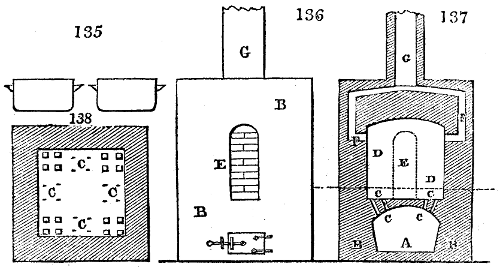
The calcination of bones is effected by two different systems of apparatus; by heating them in a retort similar to that in which coal is decomposed in the gas works, or in small pots piled up in a kiln. For the description of the former, see Gas-Light. On the second plan, the bones, broken into pieces, are put into small cast-iron pots of the form shown in fig. 135., about three eighths of an inch thick, two of which are dexterously placed with their mouths in contact, and then luted together with loam. The lip of the upper pot is made to slip inside of the under one. These double vessels, containing together about fifty pounds of bones, are arranged alongside, and over each other, in an oven, like a potter’s kiln, till it be filled. The oven or kiln may be either oblong or upright. The latter is represented in fig. 136, 137, 138. A is the fireplace or grate for the fuel; C C are the openings in the dome of the furnace through which the flame flows; the divisions of these orifices are shown in fig. 138. B is the wall of brick-work. D the space in which the pots are distributed. E is the door by which the workman carries in the pots, which is afterwards built up with fire bricks, and plastered over with loam. This door is seen in fig. 136. F F are the lateral flues for conveying the disengaged gases into the air.
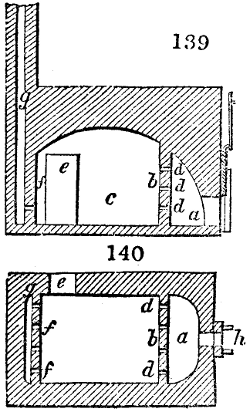
Fig. 139. is a longitudinal section, and fig. 140. a ground plan of a horizontal kiln for calcining bones. a is the fire-chamber, lying upon a level with the sole of the kiln; it is separated by a pillar b, from the calcining hearth c. In the pillar or wall, several rows of holes d, are left at different heights; e is the entrance door; f, the outlet vents for the gases, vapours, and smoke, into the chimney g; h, a sliding damper-plate for regulating the admission of the air into the fire in the space a.
By this arrangement the offensive emanations are partly consumed, and partly carried off with the smoke. To destroy the smell completely, the smoke should be made to pass through a second small furnace.
The number of pots that may be put into a kiln of this kind depends, of course, upon its dimensions; but, in general, from 100 to 150 are piled up over each other, in columns, at once; the greatest heat being nearest the roof of the kiln; which resembles, in many respects, that used for baking pottery ware.
In both kilns the interior walls are built of fire-bricks. In the oblong one, the fiercest heat is near the vaulted roof; in the upright one, near the sole; and the pots, containing the larger lumps of bones, should be placed accordingly near the top of the former, and the bottom of the latter. Such a kiln may receive about seventy double pots, containing in the whole thirty-five cwt. of bones.
After the earth is filled with the pots, and the entrance door is shut, the fire is applied at first moderately, but afterwards it must be raised and maintained, at a brisk heat, for eight or ten hours. The door of the ash-pit and the damper may now be nearly closed, to moderate the draught, and to keep up a steady ignition for six or eight hours longer, without additional firing; after which the doors must be all opened to cool the furnace. When this is done, the brick-work of the entrance door must be taken down, the kiln must be emptied, and immediately filled again with a set of pots previously filled with bones, and luted together: the pots which have been ignited may, in the course of a short time, be opened, and the contents put into the magazine. But in operating with the large decomposing cylinder retort, the bones being raked out hot, must be instantly tossed into a receiver, which can be covered-in air-tight till they are cool.
The bones lose upon the average about one half of their weight in the calcination. In reference to the quality of the black, experience has shown that it is so much more powerful as a discolouring agent, as the bones from which it was made have been freer from adhering fatty, fleshy, and tendinous matters.
The charcoal is ground in a mill, either to a fine powder and sifted; or into a coarse granular state, like gunpowder, for the preparation of which two sieves are required, one with moderately fine meshes, to allow the small dust to pass through, and one with large meshes, to separate the proper sized grains from the coarser lumps. Either a corn-mill, an edgestone mill, or a steel cylinder mill, may be employed for grinding bone-black, and it is generally damped in the operation to keep down the fine dust.
Bone-black, as found in commerce, is very variable in its discolouring power, which arises from its having been exposed either to too great a heat which has glazed its carbon, or to too low a heat which has left its albumen imperfectly decomposed. A steady ignition of due continuance is the proper decomposing temperature. Its composition is generally as follows:—
Phosphate of lime, with carbonate of lime, and a little sulphuret of iron, or oxide of iron, 88 parts; iron in the state of a silicated carburet, 2 parts; charcoal containing about one fifteenth of azote, 10 parts. None of the substances present, except the charcoal, possesses separately any discolouring power.
The quality may be tested by a solution of brown sugar, or molasses, or of indigo in sulphuric acid. The last is generally preferred by the French chemists, who have occupied themselves most with this subject, and it contains usually one thousandth part of its weight of this dye-drug of the best quality. Other animal substances yield a charcoal, possessed of very considerable discolouring properties. The following table by M. Bussy exhibits an interesting comparison of almost every kind of charcoal in this point of view.
Table of the discolouring powers of different charcoals.
Species of Charcoal. Weight. Indigo test consumed. Molasses test consumed. Blanching by indigo. Power by molasses.
Gramme. Litres.
Blood calcined with potash 1 1 ·60 0 ·18 50 20
Ditto with chalk 1 0 ·57 0 ·10 18 11
Ditto with phosp. lime 1 0 ·38 0 ·09 12 10
Gelatine ditto with potash 1 1 ·15 0 ·14 36 15 ·5
Albumen ditto ditto 1 1 ·08 0 ·14 34 15 ·5
Starch ditto ditto 1 0 ·34 0 ·08 10 ·6 8 ·8
Charcoal from acet. potash 1 0 ·18 0 ·04 5 ·6 4 ·4
Ditto from carb. soda by phosphorus 1 0 ·38 0 ·08 12 8 ·8
Calcined lamp black 1 0 ·128 0 ·03 4 3 ·3
Ditto ditto potash 1 0 ·55 0 ·09 15 ·2 10 ·6
Bone black treated with mur. acid and potash 1 1 ·45 0 ·18 45 20
Bone black ditto with mur. acid 1 0 ·06 0 ·015 1 ·87 1 ·6
Oil calcined with phosp. of lime 1 0 ·064 0 ·017 2 1 ·9
Crude bone black 1 0 ·032 0 ·009 1 1
With regard to the mode of operation of bone black on coloured liquids, M. Payen showed in his prize essay, 1. That the decolouring power of charcoal depends in general upon its state of division; 2. That in the various charcoals, the carbonaceous matter acts only upon the colouring matters, combining with and precipitating them; 3. That in the application of charcoal to the refining of sugar, it acts also upon the gluten, for it singularly promotes crystallisation; 4. That according to the above principles, the decolouring action of charcoals may be so modified, as to make the most inert become the most active; 5. That the distinction between animal and vegetable charcoals is improper, and that we may substitute for it that of dull and brilliant charcoals; 6. That of the substances present in charcoal besides carbon, and particularly animal charcoal, those which favour the decolouring action, have an influence relative only to the carbon; they serve as auxiliaries to it, by insulating its particles, and presenting them more freely to the action of the colouring matter; 7. That animal charcoal, besides its decolouring power, has the valuable property of taking lime in solution from water and syrup; 8. That neither vegetable, nor other charcoals, besides the animal, have this power of abstracting lime; 9. That by the aid of the decolorimeter, or graduated tube charged with test solution of indigo or molasses, it is easy to appreciate exactly the decolouring properties of all kinds of charcoal.
Different varieties of lignite (fossilized wood) or even pit coal, when well carbonized in close vessels, afford a decolouring charcoal of considerable value. By reducing 100 parts of clay into a thin paste with water, kneading into it 20 parts of tar, and 500 of finely ground pit coal, drying the mixed mass, and calcining it out of contact of air, a charcoally matter may be obtained not much inferior to bone-black in whitening syrups.
The restoration of animal charcoal from burnt bones, for the purpose of sugar refining, has been long practised in France. Mr. W. Parker has lately made the following process the subject of a patent. The charcoal, when taken from the vessels in which it has been employed for the purposes of clarifying the sugar, is to be thoroughly washed with the purest water that can be obtained, in order to remove all the saccharine matter adhering to it. When the washing process has been completed, the charcoal is laid out to dry, either in the open air or in a suitable stove, and when perfectly free from moisture, it is to be separated into small pieces and sifted through a sieve, the wires or meshes of which are placed at distances of about two and a half in every inch. This sifting will not only divide the charcoal into small pieces, but will cause any bits of wood or other improper matters to be separated from it.
The charcoal, thus prepared, is then to be packed lightly in cylindrical vessels called crucibles, with some small quantity of bones, oil, or other animal matter mixed with it. The crucibles are then to be closed by covers, and luted at the joints, leaving no other opening but one small hole in the centre of the cover, through which any gas, generated within the vessel when placed in the oven or furnace, may be allowed to escape.
The crucibles are now to be ranged round the oven, and placed, one upon another, in vertical positions; and when the oven is properly heated, gas will be generated within each crucible, and issue out from the central hole. The gas thus emitted, being of an inflammable quality, will take fire, and assist in heating the crucibles; and the operation being carried on until the crucibles become of a red heat, the oven is then to be closed, and allowed to cool; after which the crucibles are to be removed, when the charcoal will be found to have become perfectly renovated, and fit for use as before.
BORAX. A native saline compound of boracic acid and soda, found abundantly in Thibet and in South America. The crude product from the former locality was imported into Europe under the name of tincal, and was purified from some adhering fatty matter by a process kept a long time secret by the Venetians and the Dutch, and which consisted chiefly in boiling the substance in water with a little quicklime.
Gmelin found borax, in prismatic crystals, to contain 46·6 per cent. of water; and Arvredson, in the calcined state, to consist of 68·9 of acid and 31·1 soda, in 100 parts. M. Payen describes an octahedral borax, which contains only 30·64 per cent. of water, and is therefore preferred by the braziers in their soldering processes.
Borax has a sweetish, somewhat lixivial taste, and affects vegetable colours like an alkali; it is soluble in 12 parts of cold and 2 of boiling water. It effloresces and becomes opaque in a dry atmosphere, and appears luminous, by friction, in the dark. It melts at a heat a little above that of boiling water, and gives out its water of crystallization, after which it forms a spongy mass, called calcined borax. The octahedral borax, which is prepared by crystallization, in a solution of 1·256 sp. gr., kept up at 145° F., is not efflorescent. When borax is ignited, it fuses into a glassy-looking substance.
The following is the improved mode of purifying borax. The crude crystals are to be broken into small lumps, and spread upon a filter lined with a lead grating, under which a piece of cloth is stretched upon a wooden frame. The lumps are piled up to the height of 12 inches, and washed with small quantities of a caustic soda lye of 5° B. (sp. gr. 1·033) until the liquor comes off nearly colourless; they are then drained, and put into a large copper of boiling water, in such quantities that the resulting solution stands 20° B. (sp. gr. 1·160). Carbonate of soda, equivalent to 12 per cent. of the borax must now be added; the mixed solution is allowed to settle, and the clear liquid syphoned off into crystallizing vessels. Whenever the mother waters get foul, they must be evaporated to dryness in cast-iron pots, and roasted, to burn away the viscid colouring matter.
Borax is sometimes adulterated with alum and common salt: the former addition may be readily detected by a few drops of water of ammonia, which will throw down its alumina; and the latter by nitrate of silver, which will give with it a precipitate insoluble in nitric acid.
The native boracic acid obtained from the lakes of Tuscany, which has been manufactured in France into borax, has greatly lowered the price of this article of commerce. When MM. Payen and Cartier first began the business, they sold the crystals at the same price as the Dutch, viz. 7 francs the kilogramme (21⁄5 lbs. avoird.); but, in a few years, they could obtain only 2 francs and 60 centimes, in consequence of the market getting overstocked. The annual consumption of France in 1823 was 25,000 kilos., and the quantity produced in M. Payen’s works was 50,000. The mode of making borax from the acid is as follows:—The lake water is evaporated in graduation houses, and then concentrated in boilers till it crystallizes. In that state it is carried to Marseilles. About 500 kilogrammes of water are made to boil in a copper, and 600 kilogrammes of crystallized carbonate of soda are dissolved in it by successive additions of 20 kilogrammes. The solution being maintained at nearly the boiling point, 500 kilogrammes of the crystallized boracic acid of Tuscany are introduced, in successive portions. At each addition of about 10 kilogrammes, a lively effervescence ensues, on which account the copper should be of much greater capacity than is sufficient to contain the liquors. When the whole acid has been added, the fire must be damped by being covered up with moist ashes, and the copper must be covered with a tight lid and blankets, to preserve the temperature uniform. The whole is left in this state during 30 hours; the clear liquor is then drawn off into shallow crystallizing vessels of lead, in which it should stand no higher than 10 or 12 inches, to favour its rapid cooling. At the end of three days in winter, and four in summer, the crystallization is usually finished. The mother water is drawn off, and employed, instead of simple water, for the purpose of dissolving fresh crystals of soda. The above crystals are carefully detached with chisels, redissolved in boiling water, adding for each 100 kilos., 10 kilos. of carbonate of soda. This solution marks 20° B. (sp. gr. 1·160); and, at least, one ton (1000 kilos.) of borax should be dissolved at once, in order to obtain crystals of a marketable size. Whenever this solution has become boiling hot, it must be run off into large crystallizing lead chests of the form of inverted truncated pyramids, furnished with lids, enclosed in wooden frames, and surrounded with mats to confine the heat. For a continuous business there should be at least 18 vessels of this kind; as the solution takes a long time to complete its crystallization, by cooling to 30° C. (86° F.). The borax crystals are taken out with chisels, after the liquor has been drawn off, and the whole has become cold.
One hundred parts of the purest acid, usually extracted from the lakes of Tuscany, contain only fifty parts of the real boracic acid, and yield no more, at the utmost, than 140 or 150 of good borax.
Dry borax acts on the metallic oxides at a high temperature, in a very remarkable manner, melting and vitrifying them into beautiful coloured glasses. On this account it is a most useful reagent for the blowpipe. Oxide of chrome tinges it of an emerald green; oxide of cobalt, an intense blue; oxide of copper, a pale green; oxide of tin, opal; oxide of iron, bottle green and yellow; oxide of manganese, violet; oxide of nickel, pale emerald green. The white oxides impart no colour to it by themselves. In the fusion of metals borax protects their surface from oxidizement, and even dissolves away any oxides formed upon them; by which twofold agency it becomes an excellent flux, invaluable to the goldsmith in soldering the precious metals, and to the brazier in soldering copper and iron.
Borax absorbs muriatic and sulphurous acid gases, but no others, whereby it becomes, in this respect, a useful means of analysis.
The strength or purity of borax may be tested by the quantity of sulphuric acid requisite to neutralize a given weight of it, as indicated by tincture of litmus.
When mixed with shell-lac in the proportion of one part to five, borax renders that resinous body soluble in water, and forms with it a species of varnish.
Boracic acid is a compound of 31·19 of boron and 68·81 oxygen, in 100 parts. Its prime equivalent referred to oxygen 100, is 871·96.
The following process for refining the native Indian borax or tincal, has been published by MM. Robiquet and Marchand:—
It is put into large tubs, covered with water for 3 or 4 inches above its surface, and stirred through it several times during six hours. For 400 pounds of the tincal there must now be added one pound of quicklime diffused through two quarts of water. Next day the whole is thrown upon a sieve, to drain off the water with the impurities, consisting, in some measure, of the fatty matter combined with the lime, as an insoluble soap. The borax, so far purified, is to be dissolved in 21⁄2 times its weight of boiling water, and eight pounds of muriate of lime are to be added for the above quantity of borax. The liquor is now filtered, evaporated to the density of 18° or 20° B. (1·14 to 1·16 sp. grav.), and set to crystallize in vessels shaped like inverted pyramids, and lined with lead. At the end of a few days, the crystallization being completed, the mother waters are drawn off, the crystals are detached and dried. The loss of weight in this operation is about 20 per cent.
The quantity of borax imported into the United Kingdom in 1835 was 335,224 pounds; whereof 122,022 pounds were exported. The duty is 10s. upon the refined, and 4s. unrefined.
BOOKBINDING, is the art of sewing together the sheets of a book; and securing them with a back and side boards. Binding is distinguished from stitching, which is merely sewing the leaves without bands or backs; and from half-binding, which consists in securing the back only with leather, the pasteboard sides being covered with blue or marble paper; whereas in binding, both the back and sides are covered with leather.
Bookbinding, according to the present mode, is performed in the following manner:—The sheets are first folded into a certain number of leaves, according to the form in which the book is to appear; viz. two leaves for folios, four for quartos, eight for octavos, twelve for duodecimos, &c. This is done with a slip of ivory or boxwood, called a folding stick; and in the arrangement of the sheets the workmen are directed by the catch-words and signatures at the bottom of the pages. When the leaves are thus folded and arranged in proper order, they are usually beaten upon a stone with a heavy hammer, to make them solid and smooth, and are then condensed in a press. After this preparation they are sewed in a sewing press, upon cords or packthreads called bands, which are kept at a proper distance from each other, by drawing a thread through the middle of each sheet, and turning it round each band, beginning with the first and proceeding to the last. The number of bands is generally six for folios, and five for quartos, or any smaller size. The backs are now glued, and the ends of the bands are opened, and scraped with a knife, that they may be more conveniently fixed to the pasteboard sides; after which the back is turned with a hammer, the book being fixed in a press between boards, called backing boards, in order to make a groove for admitting the pasteboard sides. When these sides are applied, holes are made in them for drawing the bands through, the superfluous ends are cut off, and the parts are hammered smooth. The book is next pressed for cutting; which is done by a particular machine called the plough, to which is attached a knife. See the figures and descriptions infra. It is then put into a press called the cutting press, betwixt two boards, one of which lies even with the press, for the knife to run upon; and the other above for the knife to cut against. After this the pasteboards are cut square with a pair of iron shears; and last of all, the colours are sprinkled on the edges of the leaves, with a brush made of hog’s bristles; the brush being held in the one hand, and the hair moved with the other.
Different kinds of binding are distinguished by different names, such as law binding, marble binding, French binding, Dutch binding, &c. In Dutch binding, the backs are vellum. In French binding a slip of parchment is applied over the back between each band, and the ends are pasted upon the inside of each pasteboard. This indorsing, as it is called, is peculiar to the French binders; who are enjoined, by special ordonnance, to back their books with parchment. The parchment is applied in the press, after the back has been grated to make the paste take hold. The Italians still bind in a coarse thick paper, and this they call binding alla rustica. It is extremely inconvenient, as it is liable to wear without particular care.
A patent was obtained in 1799 by Messrs. John and Joseph Williams, stationers in London, for an improved method of binding books of every description. The improvement consists of a back, in any curved form, turned a little at the edges, and made of iron, steel, copper, brass, tin, or of ivory, bone, wood, vellum, or, in short, any material of sufficient firmness. This back is put on the book before it is bound, so as just to cover without pressing the edges; and the advantage of it is that it prevents the book, when opened, from spreading on either side, and causes it to rise in any part to nearly a level surface. In this method of binding the sheets are prepared in the usual manner, then sewed on vellum slips, glued, cut, clothed, and boarded, or half boarded; the firm back is then fastened to the sides by vellum drawn through holes, or secured by inclosing it in vellum or ferret wrappers, or other materials pasted down upon the boards, or drawn through them.
A patent was likewise obtained in 1800 by Mr. Ebenezer Palmer, a London stationer, for an improved way of binding books, particularly merchants’ account-books. This improvement has been described as follows:—let several small bars of metal be provided about the thickness of a shilling or more, according to the size and thickness of the book; the length of each bar being from half an inch to several inches, in proportion to the strength required in the back of the book. At each end of every bar let a pivot be made of different lengths, to correspond to the thickness of two links which they are to receive. Each link must be made in an oval form, and contain two holes proportioned to the size of the pivots, these links to be the same metal as the hinge, and each of them nearly equal in length to the width of two bars. The links are then to be riveted on the pivots, each pivot receiving two of them, and thus holding the hinge together, on the principle of a link-chain or hinge. There must be two holes or more of different sizes, as may be required, on each bar of the hinge or chain; by means of these holes each section of the book is strongly fastened to the hinge which operates with the back of the book, when bound, in such a manner as to make the different sections parallel with each other, and thus admit writing without inconvenience on the ruled lines, close to the back.
The leather used in covering books is prepared and applied as follows: being first moistened in water, it is cut to the size of the book, and the thickness of the edge is paired off on a marble stone. It is next smeared over with paste made of wheat flour, stretched over the pasteboard on the outside, and doubled over the edges within. The book is then corded, that is, bound firmly betwixt two boards, to make the cover stick strongly to the pasteboard and the back; on the exact performance of which the neatness of the book in a great measure depends. The back is then warmed at the fire to soften the glue, and the leather is rubbed down with a bodkin or folding stick, to set and fix it close to the back of the book. It is now set to dry, and when dry the boards are removed; the book is then washed or sprinkled over with a little paste and water, the edges and squares blacked with ink, and then sprinkled fine with a brush, by striking it against the hand or a stick; or with large spots, by being mixed with solution of green vitriol, which is called marbling. Two blank leaves are then pasted down to the cover, and the leaves, when dry, are burnished in the press, and the cover rolled on the edges. The cover is now glazed twice with the white of an egg, filleted, and last of all, polished, by passing a hot iron over the glazed colour.
The employment in book binding of a rolling press for smoothing and condensing the leaves, instead of the hammering which books have usually received, is an improvement introduced several years ago into the trade by Mr. W. Burn. His press consists of two iron cylinders about a foot in diameter, adjustable in the usual way, by means of a screw, and put in motion by the power of one man or of two, if need be, applied to one or two winch-handles. In front of the press sits a boy who gathers the sheets into packets, by placing two, three, or four upon a piece of tin plate of the same size, and covering them with another piece of tin plate, and thus proceeding by alternating tin plates and bundles of sheets till a sufficient quantity have been put together, which will depend on the stiffness and thickness of the paper. The packet is then passed between the rollers and received by the man who turns the winch, and who has time to lay the sheets on one side, and to hand over the tin plates by the time that the boy has prepared a second packet. A minion bible may be passed through the press in one minute, whereas the time necessary to beat it would be twenty minutes. It is not, however, merely a saving of time that is gained by the use of the rolling press; the paper is made smoother than it would have been by beating, and the compression is so much greater, that a rolled book will be reduced to about five-sixths of the thickness of the same book if beaten. A shelf, therefore, that will hold fifty books bound in the usual way would hold nearly sixty of those bound in this manner, a circumstance of no small importance, when it is considered how large a space even a moderate library occupies, and that book-cases are an expensive article of furniture. The rolling press is now substituted for the hammer by several considerable bookbinders.
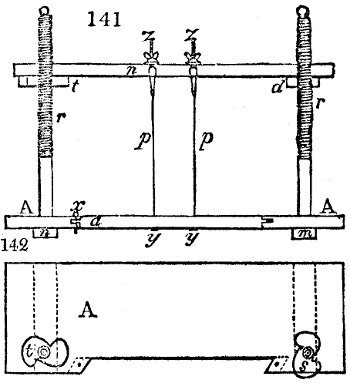
Fig. 141. represents the sewing press, as it stands upon the table, before which the bookbinder sits. Fig. 142. is a ground plan without the parts a and n in the former figure. A is the base-board, supported upon the cross bars m n, marked with dotted lines in fig. 142. Upon the screw rods r r fig. 141. the nuts t d serve to fix the flat upper bar n, at any desired distance from the base. That bar has a slit along its middle, through which the hooks below z z pass down for receiving the ends of the sewing cords p p, fixed at y y, and stretched by the thumb-screws z z. The bar y y is let into an oblong space cut out of the front edge of the base board and fixed there by a movable pin a, and a fixed pin at its other end round which it turns.