B. (continued 3)
Reading edition
The alloy of bismuth and lead in equal parts has a density of 10·709, being greater than the mean of the constituents; it has a foliated texture, is brittle, and of the same colour as bismuth. Bismuth, with tin, forms a compound more elastic and sonorous than the tin itself, and is therefore frequently added to it by the pewterers. With 1 of bismuth and 24 of tin, the alloy is somewhat malleable; with more bismuth, it is brittle. When much bismuth is present, it may be easily parted by strong muriatic acid, which dissolves the tin, and leaves the bismuth in a black powder. It has been said, that an alloy of tin, bismuth, nickel, and silver, hinders iron from rusting. (Erdmann’s Journal.) The alloy of bismuth with tin and lead was first examined by Sir I. Newton, and has been called ever since fusible metal. Eight parts of bismuth, 5 of lead, and 3 of tin, melt at the moderate temperature of 202° F.; but 2 of bismuth, 1 of lead, and 1 of tin, melt at 200·75° F. according to Rose. A small addition of mercury of course aids the fusibility. Such alloys serve to take casts of anatomical preparations. An alloy of 1 bismuth, 2 tin, and 1 lead, is employed as a soft solder by the pewterers; and the same has been proposed as a bath for tempering steel instruments. Cake-moulds, for the manufacturers of toilet soaps are made of the same metal; as also excellent clichés for stereotype, of 3 lead, 2 tin, and 5 bismuth; an alloy which melts at 199° F. This compound should be allowed to cool upon a piece of pasteboard, till it becomes of a doughy consistence, before it is applied to the mould, to receive the impress of the stamp.
The employment of plates of fusible metal as safety rondelles, to apertures in the tops of steam boilers has been proposed in France, because they would melt and give way at elevations of temperature under those which would endanger the bursting of the vessel; the fusibility of the alloy being proportioned to the quality of steam required for the engine. It has been found, however, that boilers, apparently secured in this way, burst, while the safety discs remained entire; the expansive force of the steam causing explosion so suddenly, that the fusible alloy had not time to melt or give way.
There are two, perhaps three, oxides of bismuth; the first and the third, or the suboxide and super-oxide, are merely objects of chemical curiosity. The oxide proper occurs native, and may be readily formed by exposing the metal to a red-white heat in a muffle, when it takes fire, burns with a faint blue flame, and sends off fumes which condense into a yellow pulverulent oxide. But an easier process than that now mentioned is to dissolve the bismuth in nitric acid, precipitate with water, and expose the precipitate to a red heat. The oxide thus obtained has a straw yellow colour, and fuses at a high heat into an opaque glass of a dark-brown or black colour; but which becomes less opaque and yellow after it has cooled. Its specific gravity is so high as 8·211. It consists of 89·87 of metal and 10·13 oxygen in 100 parts. The above precipitate, which is a sub-nitrate of bismuth, is called pearl-white, and is employed as a flux for certain enamels; as it augments their fusibility without imparting any colour to them. Hence, it is used sometimes as a vehicle of the colours of other metallic oxides. When well washed, it is employed in gilding porcelain; being added in the proportion of one fifteenth to the gold. But pearl-white is most used by ladies, as a cosmetic for giving a brilliant tint to a faded complexion. It is called blanc de fard, by the French. If it contains, as bismuth often does, a little silver, it becomes grey or dingy coloured on exposure to light. When the oxide is prepared, by dropping the nitric solution into an alkaline lye in excess, if this precipitate is well washed and dried, it forms an excellent medicine; and is given, mixed with gum tragacanth, for the relief of cardialgia, or burning and spasmodic pains of the stomach.
Another sort of pearl-powder is prepared by adding a very dilute solution of common salt to the above nitric solution of bismuth, whereby a pulverulent sub-chloride of the metal is obtained in a light flocculent form. A similar powder of a mother-of-pearl aspect may be formed by dropping dilute muriatic acid into the solution of nitrate of bismuth. The arsenic always present in the bismuth of commerce is converted by nitric acid into arsenic acid, which, forming an insoluble arseniate of bismuth, separates from the solution, unless there be such an excess of nitric acid as to re-dissolve it. Hence the medicinal oxide, prepared from a rightly-made nitrate, can contain no arsenic. If we write with a pen dipped in that solution, the dry invisible traces will become legible on plunging the paper in water.
It has been proposed to substitute bismuth for lead in assaying silver, as a smaller quantity of it answers the purpose, and, as its oxide is more fluent, can therefore penetrate the cupel more readily, and give a more rapid result. But, independently of the objection from its high price, bismuth has the disadvantage of boiling up, as well as of rocking or vegetating, with the silver, when the cupellation requires a high heat. In extracting the silver from the galena found in the copper-mine of Yahlun, it has happened sometimes that the silver concreted towards the end of the operation, and produced a cauliflower excrescence, which had to be cupelled again with a fresh dose of lead. It was observed that, in this case, a portion of the silver had passed into the cupel. Berzelius detected in a sample of silver thus concreted the presence of bismuth.
The nitrate of bismuth, mixed with solution of tin and tartar, has been employed as a mordant for dyeing lilac and violet in calico printing.
BISTRE. (Bistre, Fr. bister, Germ.) A brown colour which is used in water colours, in the same way as China ink. It is prepared from wood-soot, that of beech being preferred. The most compact and best burned parcels of soot are collected from the chimney, pulverised, and passed through a silk sieve. This powder is infused in pure water, and stirred frequently with a glass ruler, then allowed to settle when the water is decanted. If the salts are not all washed away, the process may be repeated with warm water. The paste is now to be poured into a long narrow vessel filled with water, stirred well, and left to settle for a few minutes, in order to let the grosser parts subside. The supernatant part is then to be poured off into a similar vessel. This process may be repeated twice or thrice, to obtain a very good bistre. At last the settled deposit is sufficiently fine, and, when freed from its supernatant water, it is mixed with gum-water, moulded into proper cakes, and dried. It is not used in oil painting, but has the same effect in water-colours as brown pink has in oil.
BITUMEN, or ASPHALTUM. (Bitume, Fr. Erdpech, Germ.) A black substance found in the earth, externally not dissimilar to pit-coal. It is composed of carbon, hydrogen, and oxygen, like organic bodies; but its origin is unknown. It has not been observed among the primitive or older strata, but only in the secondary and alluvial formations. It constitutes sometimes considerable beds, as in the isle of Trinidad, where it occurs over an extensive district, in scattered masses. The greater part of the asphaltum to be met with in commerce comes from the Dead Sea, on whose shores it is cast up and gathered; whence it has got the name of Jewish bitumen. In its black colour and fracture it resembles ordinary pitch. By friction it affords negative electricity. Its average density is 1·16. It melts at the temperature of boiling water, kindles very readily at the flame, burns brightly with a thick smoke, and leaves little ashes. Distilled by itself, it yields a peculiar bituminous oil, very little water, some combustible gases, and traces of ammonia. It leaves about one third of its weight of charcoal after combustion, and ashes, containing silica, alumina, oxide of iron, sometimes a little lime, and oxide of manganese. According to John, asphaltum may be decomposed, by different solvents, into three distinct substances. Water dissolves nothing; alcohol (anhydrous) dissolves out a yellow resin equal to 5 per cent. of the weight of the asphaltum; that resin is soluble in dilute alcohol and in ether. The portion not soluble in the alcohol gives up a brown resin to ether, amounting to 70 per cent. of the weight of the asphaltum. On evaporating off the ether, the resin remains of a brownish-black colour, which dissolves readily in the volatile oils and in the oil of petroleum. The portion of asphaltum which does not dissolve in ether is very soluble in oil of turpentine, and in oil of petroleum; but less so in oil of lavender. These three resinous principles dissolve all together by digestion in the oils of anise, rosemary, turpentine, olive, hemp-seed, nut, and linseed. Caustic potash dissolves a notable quantity of asphaltum; but carbonate of potash has no effect upon it.
Asphaltum enters into the composition of hydraulic cements, and into that of black varnishes, called japans, for coating iron trays, &c. A similar varnish may be prepared by dissolving 12 parts of fused amber, 2 parts of rosin, and 2 parts of asphaltum, in 6 parts of linseed oil varnish, to which 12 parts of oil of turpentine have been added.
There is a kind of bitumen found at Aniches, in France, in the department of the north, which is black, very fusible, and soft. It burns with flame. Alcohol, ether, and oil of turpentine extract from it a fatty substance, which may be saponified with alkalis.
The bitumen of Murindò, near Choco, in Columbia, is of a brownish-black colour, soft, and has an earthy fracture. It has an acrid taste, burns with a smell of vanilla, and is said to contain a large quantity of benzoic acid. It appears to be the result of the decomposition of trees containing benzoin.
Asphaltum occurs abundantly at the surface of the salt lake Asphaltites, in Judea, produced from springs in the neighbourhood; it is floated down, gathers consistence, and accumulates upon the surface of the lake; the winds drive it on the shores, and the inhabitants collect it for sale. Its inspissation diffuses a disagreeable smell in the air of that region, which is supposed by the natives to be powerful enough to kill birds when they attempt to fly across the lake.
But probably the most remarkable locality of asphaltum in the world is the entire basin, or rather plain of it, in the island of Trinidad, called the Tar Lake. It lies on the highest land in the island, and emits a strong smell, sensible at ten miles’ distance. Its first appearance is that of a lake of water, but, when viewed more nearly, it seems to be a surface of glass. In hot weather its surface liquifies to the depth of an inch, and it cannot then be walked upon. It is of a circular form, about three miles in circumference, and of a depth not ascertained. Large fissures frequently open and close up in it, whence the pitch has been supposed to float upon a body of water. The soil, for a considerable distance round it, consists of cinders and burnt earth, and presents in many points indications of convulsions by subterranean fire. In several parts of the neighbouring woods, there are round holes and fissures in the ground, containing liquid bitumen to the depth of two inches.
Mr. Hatchett examined some specimens from Trinidad, and concluded that what had been heretofore supposed to be a pure mineral pitch was in reality only a porous stone of the argillaceous kind, much impregnated with bitumen.
These various bitumens belong exclusively to the secondary and tertiary geological formations, and are not found among primitive rocks, except very rarely in veins. They occur most generally in calcareous, argillaceous, and sandy strata, and also in volcanic districts. Petroleum frequently floats on the waters which issue from the volcanic mountains, or which lie at their base; even the sea is at times covered with it near the volcanic islands of Cape Verd. Mr. Breislak observed a petroleum spring rising from the bottom of the sea near the southern base of Vesuvius.
The substance with which bitumen seems to have the most constant and most remarkable relations, is sea-salt; so that almost all the countries most abundant in petroleum, as Italy, Transylvania, Persia, the environs of Babylon, the region of the Dead Sea, &c., contain salt mines, or lakes, or exhibit saline efflorescences. Iron pyrites is often impregnated with petroleum, or contains a bituminous nucleus.
The origin of bitumen is as little known as that of most of the productions of nature. Some regard it as an empyreumatic oil, a matter analogous to liquid resin or essential oil, resulting from the destruction of that astonishing multitude of animals and vegetables buried in the earth, whose solid remains are daily brought to view in mineral researches. It has been also supposed that naphtha and petroleum are the product of coals decomposed either by the fire of volcanos, by the subterranean combustion of coal itself, or by the decomposition of pyrites. The latter opinion is not supported by any direct evidence, but the two former are sufficiently probable.
Elastic Bitumen is a rare substance, found hitherto only near Castleton, in Derbyshire, in fissures of slaty clay.
Bituminous mastic, or cement, has been of late extensively employed in France for covering roofs and terraces, and lining water cisterns. The mineral bitumen used for the composition of this mastic is procured chiefly from the Obsann (Bas-Rhin), from the Parc (department de l’Ain), and from the Puy-de-la-Poix (department of Puy-de-Dome). But boiled coal-tar answers equally well. In the neighbourhood of these localities, there is a limestone impregnated with bitumen, which suits for giving consistence to the cement. This is well dried, ground to powder, sifted, and stirred while hot, in about one fifth its weight of melted asphaltum, contained in a cast-iron boiler. Dry chalk or bricks, ground and sifted, will suit equally well. As soon as this paste is made quite homogeneous, it is lifted out with an iron shovel or spoon, and spread in rectangular moulds, secured with pegs at the joints, fastened to a kind of platform of smoothed planks, covered with strong sheet-iron. The sides of these moulds should be previously smeared over with a thin coat of loam-paste, to prevent their adhesion to the mastic. Whenever the cake is cold, the frame is taken asunder, and it is removed from the iron plate by an oblong shovel, or strong spatula of iron. These cakes or bricks are usually 18 inches long, 12 broad, and 4 thick, and weigh about 70 lbs.
BITTER PRINCIPLE. (Amère, Fr.; Bitterstoff, Germ.) This principle has not been insulated hitherto by the chemist from the other proximate principles of plants, but its existence is sufficiently recognised by the taste. The following list contains the principal bitter substances, many of which have been used in the arts and in medicine.
Name. Part employed. Country. Observations.
Quassia Wood Surinam, E. Indies Powerfully bitter
Wormwood Herb Great Britain Ditto
Aloe Inspissated juice South Africa Ditto
Angustura Bark South America Ditto
Orange Unripe fruit South of Europe - Aromatic bitter
Ditto Peel Ditto
Acorus Root Ditto Ditto
Carduus Benedictus Herb Greek Archipelago
Cascarilla Bark Jamaica Ditto
Centaury Herb Great Britain
Camomile Flowers
Colocynth Fruit Levant Intolerably bitter
Colombo Root East Africa Very bitter
Fumitory Herb Great Britain
Gentiana lutea Root Switzerland Very bitter
Ground Ivy Herb Great Britain
Walnut Peels With tannin
Island moss With starch
Hops Scales of the female flowers Great Britain Aromatic bitters
Milfoil Herb flowers Great Britain
Large-leaved Satyrion Herb Great Britain
Rhubarb Root China Disagreeable odour
Rue Herb Great Britain Bitter and sharp
Tansy Herb flowers Ditto Bitter and offensive
Bitter trefoil Herb Ditto
Simarouba Bark Guyana
Bryony Root Great Britain Sharp, bitter, nauseous
Coffee Seeds Arabia
BLACK DYE. (Teinte noire, Fr. Schwartze farbe, Germ.) For 1 cwt. of cloth, there are put into a boiler of middle size 18 lbs. of logwood, with as much Aleppo galls in powder, and the whole, being enclosed in a bag, is boiled in a sufficient quantity of water for 12 hours. One-third of this bath is transferred into another boiler with two pounds of verdigris; and the stuff is passed through this solution, stirring it continually during two hours, taking care to keep the bath very hot without boiling. The stuff is then lifted out, another third of the bath is added to the boiler, along with eight pounds of sulphate of iron or green vitriol. The fire is to be lowered while the sulphate dissolves, and the bath is allowed to cool for half an hour, after which the stuff is introduced, and well moved about for an hour, after which it is taken out to air. Lastly, the remaining third of the bath is added to the other two, taking care to squeeze the bag well. 18 or 22 lbs. of sumach are thrown in; the whole is just brought to a boil, and then refreshed with a little cold water; two pounds more of sulphate of iron are added, after which the stuff is turned through for an hour. It is thereafter washed, aired, and put again into the bath, stirring it continually for an hour. After this, it is carried to the river, washed well, and then filled. Whenever the water runs off clear, a bath is prepared with weld, which is made to boil for an instant; and after refreshing the bath the stuff is turned in to soften, and to render the black more fast. In this manner, a very beautiful black is obtained, without rendering the cloth too harsh.
Commonly more simple processes are employed. Thus the blue cloth is simply turned through a bath of gall-nuts, where it is boiled for two hours. It is next passed through a bath of logwood and sulphate of iron for two hours, without boiling, after which it is washed and fulled.
Hellot has found that the dyeing might be performed in the following manner:—For 20 yards of dark blue-cloth, a bath is made of two pounds of fustic (morus tinctoria), 41⁄4 lbs. of logwood, and 11 lbs. sumach. After boiling the cloth in it for three hours it is lifted out, 11 lbs. of sulphate of iron are thrown into the boiler, and the cloth is then passed through it during two hours. It is now aired, and put again in the bath for an hour. It is, lastly, washed and scoured. The black is less velvety than that of the preceding process. Experience convinced him that the maddering prescribed in the ancient regulations only gives a reddish cast to the black, which is obtained finer and more velvety without madder.
A black may be dyed likewise without having given a blue ground. This method is employed for cloths of little value. In this case they are rooted; that is to say, they receive a dun ground with walnut husks, or the root of the walnut tree, and are afterwards made black in the manner above described, or in some other way; for it is obvious that a black may be obtained by several processes.
According to Lewis, the proportions which the English dyers most generally adopt are, for one hundred and twelve pounds of woollen cloth previously dyed of a dark blue, about five pounds of sulphate of iron, as much gall-nuts, and thirty pounds of logwood. They begin by galling the cloth, they then pass it through the decoction of logwood, to which the sulphate of iron has been added.
When the cloth is completely dyed, it is washed in the river, and passed through the fulling-mill till the water runs off clear and colourless. Some persons recommend, for fine cloths, to full them with soap water. This operation requires an expert workman, who can free the cloth thoroughly from the soap. Several recommend at its coming from the fulling to pass the cloth through a bath of weld, with the view of giving softness and solidity to the black. Lewis says, that passing the cloth through weld, after it has been treated with soap, is absolutely useless, although it may be beneficial when this operation has been neglected.
Different operations may be distinguished in dyeing silk black; the boiling of the silk, its galling, the preparation of the bath, the operation of dyeing, the softening of the black.
Silk naturally contains a substance called gum, which gives it the stiffness and elasticity peculiar to it in its native state; but this adds nothing to the strength of the silk, which is then styled raw; it rather renders it, indeed, more apt to wear out by the stiffness which it communicates; and although raw silk more readily takes a black colour, yet the black is not so perfect in intensity, nor does it so well resist the re-agents capable of dissolving the colouring particles, as silk, which is scoured or deprived of its gum.
To cleanse silk intended for black, it is usually boiled four or five hours with one fifth of its weight of white soap, after which it is carefully beetled and washed.
For the galling, nut-galls equal nearly to three fourths of the weight of the silk are boiled during three or four hours; but on account of the price of Aleppo galls, more or less of the white gall-nuts, or of even an inferior kind called galon, berry or apple galls, are used. The proportion commonly employed at Paris is two parts of Aleppo galls to from eight to ten parts of galon. After the boiling, the galls are allowed to settle for about two hours. The silk is then plunged into the bath, and left in it from twelve to thirty-six hours, after which it is taken out and washed in the river.
Silk is capable of combining with quantities, more or less considerable, of the astringent principle; whence results a considerable increase of weight, not only from the weight of the astringent principle, but also from that of the colouring particles, which subsequently fix themselves in proportion to the quantity of the astringent principle which had entered into combination. Consequently, the processes are varied according to the degree of weight which it is wished to communicate to the silk; a circumstance requiring some illustration.
The commerce of silk goods is carried on in two ways; they are sold either by the weight, or by the surface, that is, by measure. Thus the trade of Tours was formerly distinguished from that of Lyons; the silks of the former being sold by weight, those of the latter, by measure. It was therefore their interest to surcharge the weight at Tours, and, on the contrary, to be sparing of the dyeing ingredients at Lyons; whence came the distinction of light black and heavy black. At present, both methods of dyeing are practised at Lyons, the two modes of sale having been adopted there.
Silk loses nearly a fourth of its weight by a thorough boiling, and it resumes, in the light black dye, one half of this loss; but in the heavy black dye, it takes sometimes upwards of a fifth more than its primitive weight; a surcharge injurious to the beauty of the black, and the durability of the stuff. The surcharged kind is denominated English black, because it is pretended that it was first practised in England. Since silk dyed with a great surcharge has not a beautiful black, it is usually destined for weft, and is blended with a warp dyed of a fine black.
The peculiarity of the process for obtaining the heavy black consists in leaving the silk longer in the gall liquor, in repeating the galling, in passing the silk a greater number of times through the dye, and even letting it lie in it for some time. The first galling is usually made with galls which have served for a preceding operation, and fresh gall-nuts are employed for the second. But these methods would not be sufficient for giving a great surcharge, such as is found in what is called the English black. To give it this weight, the silk is galled without being ungummed; and, on coming out of the galls, it is rendered supple by being worked on the jack and pin.
The silk-dyers keep a black vat, and its very complex composition varies in different dye-houses. These vats are commonly established for many years; and when their black dye is exhausted it is renovated by what is called in France a brevet. When the deposit which has accumulated in it is too great, it is taken out, so that at the end of a certain time nothing remains of the several ingredients which composed the primitive bath, but which are not employed in the brevet.
For the dyeing of raw silk black, it is galled in the cold, with the bath of galls which has already served for the black of boiled silk. For this purpose, silk, in its native yellow colour, is made choice of. It should be remarked, that when it is desired to preserve a portion of the gum of the silk, which is afterwards made flexible, the galling is given with the hot bath of gall-nuts in the ordinary manner. But here, where the whole gum of the silk, and its concomitant elasticity, are to be preserved, the galling is made in the cold. If the infusion of galls be weak, the silk is left in it for several days.
Silk thus prepared and washed takes very easily the black dye, and the rinsing in a little water, to which sulphate of iron may be added, is sufficient to give it. The dye is made in the cold; but, according to the greater or less strength of the rinsings, it requires more or less time. Occasionally three or four days are necessary; after which it is washed, it is beetled once or twice, and it is then dried without wringing, to avoid softening it.
Raw silk may be more quickly dyed, by shaking it round the rods in the cold bath after the galling, airing it, and repeating these manipulations several times, after which it is washed and dried as above.
Macquer describes a more simple process for the black by which velvet is dyed at Genoa; and he says that this process, rendered still simpler, has had complete success at Tours. The following is his description.
For 1 cwt. (50 kilogrammes) silk, (22 lbs. 11 kilogrammes) of Aleppo galls, in powder, are boiled for an hour in a sufficient quantity of water. The bath is allowed to settle till the galls have fallen to the bottom of the boiler, from which they are withdrawn; after which 32 lbs. of English vitriol (or copperas) are introduced, with 13 lbs. of iron filings, and 22 lbs. of country gum, put into a kind of two-handled cullender, pierced every where with holes. This kettle is suspended by two rods in the boiler, so as not to reach the bottom. The gum is left to dissolve for about an hour, stirring it from time to time. If, after this time, some gum remains in the kettle, it is a proof that the bath, which contains two hogsheads, has taken as much of it as is necessary. If, on the contrary, the whole gum is dissolved, from one to 4 lbs. more may be added. This cullender is left constantly suspended in the boiler, from which it is removed only when the dyeing is going on; and thereafter it is replaced. During all these operations the boiler must be kept hot, but without boiling. The galling of the silk is performed with one third of Aleppo galls. The silk is left in it for six hours the first time, then for twelve hours. The rest, secundum artem.
Lewis states that he has repeated this process in the small way; and that, by adding sulphate of iron progressively, and repeating the immersions of the silk a great number of times, he eventually obtained a fine black.
Astringents differ from one another as to the quantity of the principle which enters into combination with the oxide of iron. Hence, the proportion of the sulphate, or of any other salt of iron, and that of the astringents, should vary according to the astringents made use of, and according to their respective quantities. Gall-nut is the substance which contains most astringent; sumach, which seems second to it in this respect, throws down (decomposes), however, only half as much sulphate of iron.
The most suitable proportion of sulphate of iron appears to be that which corresponds to the quantity of the astringent matter, so that the whole iron precipitable by the astringent may be thrown down, and the whole astringent may be taken up in combination with the iron. As it is not possible, however, to arrive at such precision, it is better that the sulphate of iron should predominate, because the astringent, when in excess, counteracts the precipitation of the black colouring particles, and has the property of even dissolving them.
This action of the astringent is such that, if a pattern of black cloth be boiled with gall-nuts, it is reducible to grey. An observation of Lewis may thence be explained. If cloth be turned several times through the colouring bath, after it has taken a good black colour, instead of acquiring more body, it is weakened, and becomes brownish. Too considerable a quantity of the ingredients produces the same effect; to which the sulphuric acid, set at liberty by the precipitation of the oxide of iron, contributes.
It is merely the highly oxidised sulphate which is decomposed by the astringent; whence it appears, that the sulphate will produce a different effect according to its state of oxidisement, and call for other proportions. Some advise, therefore, to follow the method of Proust, employing it in the oxidised state; but in this case it is only partially decomposed, and another part is brought, by the action of the astringent, into the lower degree of oxidisement.
The particles precipitated by the mixture of an astringent and sulphate of iron have not at first a deep colour; but they pass to a black by contact of air while they are moist.
Under dyeing I shall show that the black dye is only a very condensed colour, and that it assumes more intensity from the mixture of different colours likewise deep. It is for this reason advantageous to unite several astringents, each combination of which produces a different shade. But blue appears the colour most conducive to this effect, and it corrects the tendency to dun, which is remarked in the black produced on stuffs by the other astringents.
On this property is founded the practice of giving a blue ground to black cloths, which acquire more beauty and solidity the deeper the blue. Another advantage of this practice is to diminish the quantity of sulphuric acid which is necessarily disengaged by the precipitation of the black particles, and which would not only counteract their fixation, but would further weaken the stuff, and give it harshness.
For common stuffs, a portion of the effect of the blue ground is produced by the rooting.
The mixture of logwood with astringents contributes to the beauty of the black in a twofold way. It produces molecules of a hue different from what the astringents do, and particularly blue molecules, with the oxide of copper, commonly employed in the black dyes; which appears to be more useful the more acetate the verdigris made use of contains.
The boil of weld, by which the dye of black cloth is frequently finished, may also contribute to its beauty, by the shade peculiar to its combination. It has, moreover, the advantage of giving softness to the stuffs.
The processes that are employed for wool, yield, according to the observation of Lewis, only a rusty black to silk; and cotton is hardly dyed by the processes proper for wool and silk. Let us endeavour to ascertain the conditions which these three varieties of dyeing demand.
Wool has a great tendency to combine with colouring substances; but its physical nature requires its combinations to be made in general at a high temperature. The combination of the black molecules may therefore be directly effected in a bath, in proportion as they form; and, if the operation be prolonged by subdividing it, it is only with the view of changing the necessary oxidisement of the sulphate, and augmenting that of the colouring particles themselves.
Silk has little disposition to unite with the black particles. It seems to be merely by the agency of the tannin, with which it is previously impregnated, that these particles can fix themselves on it, especially after it has been scoured. For this reason, silk baths should be old, and have the colouring particles accumulated in them, but so feebly suspended as to yield to a weak affinity. Their precipitation is counteracted by the addition of gum, or other mucilaginous substances. The obstacle which might arise from the sulphuric acid set at liberty is destroyed by iron filings, or other basis. Thus, baths of a very different composition, but with the essential condition of age, may be proper for this dye. For cotton black dye, see Calico Printing.
BLACK PIGMENT. The finest light black is prepared principally for the manufacturing of printers’ ink. In Messrs. Martin and Grafton’s patent process, the black is obtained by burning common coal-tar, which should, however, be previously divested, as much as possible, of the ammoniacal liquor and acid mixed with it in the tank.
For this purpose, it is proposed that four casks should be employed, each capable of holding 130 gallons, and into every one of them are to be put about 60 gallons of the rough impure tar, to which an equal quantity of lime-water is to be added, and then agitated by machinery or manual labour until the lime-water is completely mixed with the tar. The vessels should next be suffered to rest for about six hours, by which time the tar will settle at the bottom of the casks, and the water may be drawn off. The casks containing the tar should now be filled with hot water, which may be supplied from the boiler of a steam engine, and the whole again agitated as before. This process may be repeated three times, suffering the tar to subside between each; and twelve hours should be allowed for settling from the last water, so that the whole of the tar and water may become separated, the water rising to the top of the cask, and the tar being left at the bottom in a pure state.
But, as some of the water will yet remain mechanically combined with the tar, it is proposed that the tar should be subjected to the process of distillation. For this purpose, a still, capable of holding 120 gallons, may be employed, in which about 50 gallons, at one time, may be operated upon; when, by a gentle heat, the water, and other impurities which the tar may have retained, will be driven off. As soon as the water appears to have evaporated, and the spirit runs fine and clear, the process of distillation should be stopped; and, when cold, the pure tar may be drawn off, and set apart for the purpose of being employed as contemplated in the patent.
The tar thus purified may be now converted into black, or it may be subjected to further rectification to divest it of the mineral pitch, or asphaltum, which is combined with the oil and spirit: the latter is to be preferred, because the mineral pitch, or asphaltum, is only inflammable at a high temperature, which renders it more troublesome to use in the process here contemplated, and also would cause the apparatus to require frequent cleaning from the carbonized pitch deposited. In order, therefore, to get rid of the mineral pitch, or asphaltum, forty gallons of the tar are to be introduced into a still, as before; and, instead of stopping the operation, as soon as the spirit begins to come over, the distillation is continued with a strong heat, so as to force over the whole of the oil and spirit, leaving the residuum of asphaltum in the still: this process, however, is known to every chemist, and need not be further explained.
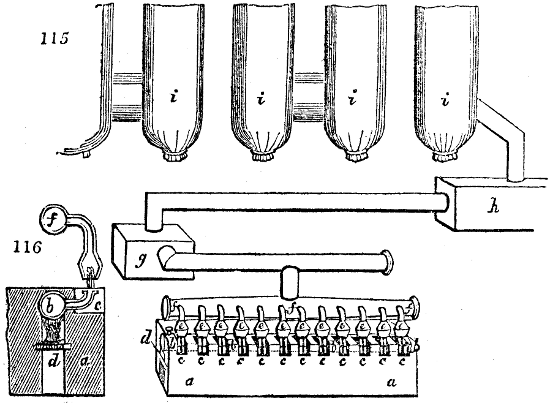
In fig. 115. is exhibited a rude representation of the apparatus employed in preparing and collecting the fine light spirit black, produced by the combustion of the oil and spirit of coal-tar, after it has been purified as above described. a is the brickwork which supports a number of burners issuing from a tube, b, within, and here shown by dots, as passing along its whole length. Fig. 116. is a section of the brickwork, with the tube, burner, and receiver, as will be described hereafter. The tube may be called the tar main, as it is intended to be filled with tar: it is constructed of cast iron, and from it issue several (in this figure twenty-four) jets or burners, c, c, c; any other number may be employed. d is a furnace under the tar main, the flue of which extends along, for the purpose of heating the tar to the boiling point, in order to facilitate the process. From the main, b, the tar flows into the jets c; wicks are introduced into the jets, and, when set fire to by a red-hot stick, will burn and emit a very considerable quantity of smoke; which it is the object of this apparatus to conduct through many passages, for the purpose of collecting its sooty particles.
There are a number of hoods, e, e, e, or bonnets, as they are termed, all of which, through their pipes, have communication with, or lead into, a main chimney, f, f. Into these hoods or bonnets the smoke of the burners ascends, and from thence passes into the main chimney f, and thence through the smoke tubes into the box g: here the heaviest particles of the black deposit themselves; but, as the smoke passes on through the farther pipes, a deposit of the second, or finer, particles of black takes place in the box h. From hence the smoke proceeds through other pipes into a series of canvass bags, i, i, i, which are proposed to be about eighteen feet long, and three in diameter. These bags are connected together at top and bottom alternately, and through the whole series the smoke passes up one bag and down the next, depositing fine black, called spirit black, upon the sides of the canvass. After the jets have continued burning for several days, the bags are to be beaten with a stick, so that the black may fall to the bottom; and, when a sufficient quantity has accumulated, the bags may be emptied and swept out. Thus seventy or eighty bags may be employed; so that the smoke should pass through a length of about 400 yards, the farthest of which will be found to contain the finest black. The last bag should be left open, in order to allow the vapour to escape into the open air.
The main tar tube will require to be emptied every four or five days, in order to clear it from the pitchy matter that may have subsided from the burners, and they also will require to be frequently poked with a wire, to clear off the black which forms upon the edges, and to drive down the carbonized tar which attaches itself to the upper part of the jets.
BLEACHING (Blanchiment, Fr.; Bleichen, Germ.) is the process by which the textile filaments, cotton, flax, hemp, wool, silk, and the cloths made of them, as well as various vegetable and animal substances, are deprived of their natural colour, and rendered nearly or altogether white. The term bleaching comes from the French verb blanchir, to whiten. The word blanch, which has the same origin, is applied to the whitening of living plants by making them grow in the dark, as when the stems of celery are covered over with mould.
The operations which the bleacher has recourse to differ according to the nature of the bleaching means, the property of the stuff to be bleached, and local customs or circumstances; and the result is also obtained with more or less rapidity, certainty, economy, and perfection. The destruction of the colouring matters attached to the bodies to be bleached is effected either by the action of the air and light, of chlorine, or sulphurous acid; which may be considered the three bleaching powers employed for manufacturing purposes.
Bleaching by the influence of air and sunshine is the most ancient, and still the most common, method in several civilised countries; it is also supposed by many to be the least injurious to the texture of yarn and cloth. The operations it involves are very simple, consisting in the exposure of the goods upon a grass-plat to the sky, with their occasional aspersion with moisture if necessary, in addition to the rain and dew. The atmospheric air effects the bleaching by means of its oxygenous constituent, which combines with the colouring matter, or its elements carbon and hydrogen, and either makes it nearly white, or converts it into a substance easily soluble in water and alkaline solutions. This natural process is too slow to suit the modern demands of the cotton and linen manufacturers. Fortunately for them, a new bleaching agent, unknown to our forefathers, has been discovered in chlorine, formerly called oxymuriatic acid, an agent modified by chemistry so as to give an astonishing degree of rapidity, economy, and perfection, to this important art. It is, however, not a little surprising, that the science which has so greatly advanced its practical part should have left its theory far from complete, and should afford no satisfactory answers to the two following questions.—What is the action of the solar rays upon the colouring matter? How do air and chlorine operate upon this principle? Some suppose that light predisposes the colouring matter to combine with oxygen; others fancy that it acts merely in the manner of a high temperature, so as to determine a reaction between the elements of that substance, and to cause a new combination possessed of peculiar properties. It is generally admitted at the present day, that a portion of the oxygen of the air passes into the colouring matter, and changes its constitution. This is, however, probably not the part which oxygen plays, nor is it the only principle in the atmosphere which exercises a bleaching influence. Neither is the action of chlorine such as has been commonly represented in our chemical systems.
But if authors offer us only vague hypotheses concerning the three principal agents, light, oxygen, chlorine, they afford no information whatever concerning the phenomena due to greasy spots so frequently found upon cotton cloth, and so very troublesome to the bleacher. It has indeed been sometimes said in bleach-works, that fatty substances are no longer soluble in alkalies when they are combined with oxygen. The very reverse of this statement is probably nearer the truth.
The object of bleaching is to separate from the textile fibre, by suitable operations, all the substances which mask its intrinsic whiteness; or which, in the course of ulterior dyeing operations, may produce injurious effects. In this latter respect, cotton deserves especial consideration. This substance is covered with a resinous matter, which obstructs its absorption of moisture, and with a yellow colouring matter in very small quantity, often so inconsiderable in some cottons, that it would be unnecessary to bleach them, before submitting them to the dyer, were it not that the manipulations which they undergo introduce certain impurities which are more or less injurious, and must be removed. It is in fact a circumstance well known in the factories, that unbleached cottons may be dyed any dark colour, provided they are deprived of that matter which makes them difficult to moisten. The substances present in cotton goods are the following:—
1. The resinous matter natural to the cotton filaments.
2. The proper colouring matter of this vegetable.
3. The paste of the weaver.
4. A fat matter.
5. A cupreous soap.
6. A calcareous soap.
7. The filth of the hands.
8. Iron, and some earthy substances.
1. The matter which prevents the moistening of cotton wool may be separated by means of alcohol, which, when evaporated, leaves thin yellowish scales, soluble in alkalies, in acids, and even in a large quantity of boiling water. For a long time the bleaching process commenced with the removal of this resinous stuff, by passing the cloth or the yarn through an alkaline ley. This was called scouring; it is now nearly laid aside.
2. The colouring matter of cotton seems to be superficial, and to have no influence on the strength of the fibres; for the yarn is found to be as strong after it has been stripped by caustic soda of its resinous and colouring matters, as it was before. The colouring matter is slightly soluble in water, and perfectly in alkaline leys. When gray calico is boiled in lime water, it comes out with a tint darker than it had before; whence it might be supposed that the colouring matter was not dissolved out, even in part. This, however, is not the case; for if we filter the liquor, and neutralise it with an acid, we shall perceive light flocks, formed of the resinous substance, united with the colouring matter. The dark colour of the cloth is to be ascribed solely to the property which lime possesses of browning certain vegetable colours. This action is here exercised upon the remaining colour of the cloth.
It may be laid down as a principle, that the colouring matter is not directly soluble by the alkalies; but that it becomes so only after having been for some time exposed to the joint action of air and light, or after having been in contact with chlorine. What change does it thereby experience, which gives it this solubility? Experiments made upon pieces of cloth placed in humid oxygen, in dry oxygen, in moist chlorine, and in dry chlorine, tend to show that hydrogen is abstracted by the atmosphere; for in these experiments proofs of dis-hydrogenation appeared, and of the production of carbonic acid. In all cases of bleaching by chlorine, this principle combines immediately with the hydrogen of the colouring matter, and forms muriatic acid, while the carbon is eliminated.
Undoubtedly water has an influence upon this phenomenon, since the bleaching process is quicker with the humid chlorine than with the dry; but this liquid seems to act here only mechanically, in condensing the particles of the gas into a solution. We should also take into account the great affinity of muriatic acid for water.
3. The weaver’s dressing is composed of farinaceous matters, which are usually allowed to sour before they are employed. It may contain glue, starch, gluten; which last is very soluble in lime-water.
4. When the dressing gets dry, the hand-weaver occasionally renders his warp-threads more pliant by rubbing some cheap kind of grease upon them. Hence it happens, that the cloth which has not been completely freed from this fatty matter will not readily imbibe water in the different bleaching operations; and hence, in the subsequent dyeing or dunging, these greasy spots, under peculiar circumstances, somewhat like lithographic stones, strongly attract the aluminous and iron mordants, as well as the dye stuffs, and occasion stains which it is almost impossible to discharge. The acids act differently upon the fatty matters, and thence remarkable anomalies in bleaching take place. When oil is treated with the acetic or muriatic acid, or with aqueous chlorine, it evolves no gas, as it does with the sulphuric and nitric acids, but it combines with these substances so as to form a compound which cannot be dissolved by a strong boiling ley of caustic soda. Carbonic acid acts in the same way with oil. On the other hand, when the oils and fats are sufficiently exposed to the air, they seize a portion of its oxygen, and become thereby capable of saponification, that is, very soluble in the alkalies.
5. When the hand-weaver’s grease continues in contact for a night with the copper dents of his reed, a kind of cupreous soap is formed, which is sometimes very difficult to remove from the web. Lime-water does not dissolve it; but dilute sulphuric acid carries off the metallic oxide, and liberates the margaric acid, in a state ready to be acted on by alkalis.
6. When cloth is boiled with milk of lime, the grease which is uncombined unites with that alkaline earth; and forms a calcareous soap, pretty soluble in a great excess of lime-water, and still more so in caustic soda. But all fats and oils, as well as the soaps of copper and lime, cease to be soluble in alkaline leys, when they have remained a considerable time upon the goods, and have been in contact with acetic, carbonic, muriatic acids, or chlorine. These results have been verified by experiment.
7. Cotton goods are sometimes much soiled, from being sewed or tamboured with dirty hands; but they may be easily cleansed from this filth by hot water.
8. Any ferruginous or earthy matters which get attached to the goods in the course of bleaching, are readily removable.
We are now prepared to understand the true principles of bleaching cotton goods, for the most delicate operations of the calico printer.
1. The first process is steeping, or rather boiling, the goods in water, in order to remove all the substances soluble in that liquid.
2. The next step is to wash or scour the goods by the dash-wheel or the stocks. This is of great importance in the course of bleaching, and must be repeated several times; so much so, that in winter, when the water of the dash-wheel is cold, the bleaching is more tedious and difficult. Yarn and very open fabrics do not much need the dash-wheel.
By these first two operations, the woven goods lose about sixteen per cent. of their weight, while they lose only two parts out of five hundred in all the rest of the bleaching.
3. In the third place the calicoes are boiled with milk of lime, whereby they are stripped of their gluten, and acquire a portion of calcareous soap. Formerly, and still in many bleach-works, the gluten was got rid of by a species of fermentation of the farinaceous dressing; but this method is liable to several objections in reference to the calico-printer. 1. The fermentative action extends sometimes to the goods, and weakens their texture, especially when they are piled up in a great heap without being previously washed. 2. The spots of grease, or of the insoluble soaps, become thereby capable of resisting the caustic alkalies, and are rendered in some measure indelible; an effect due to the acetic and carbonic acids generated during fermentation, and which will be easily understood from what has been said concerning the action of acids on fatty substances. It is not, therefore, without good reason that many practical men throw some spent leys into the fermenting vats, to neutralise the acids which are formed. Were it not for the presence of fat, fermentation, skilfully conducted, would be an excellent means of carrying off the gluten; and the steep is therefore applicable to power-loom goods, which are not polluted with grease.
4. The goods are now subjected to a caustic soda ley, which dissolves out the soaps of lime and copper, as well as that portion of the colouring matter which is sufficiently dis-hydrogenated to be capable of combining with it. This bucking with ley, which is repeated several times upon the goods, in order to purge them completely from the fatty matter present in the hand-loom webs, and also partially introduced in the spinning, is almost the only operation to which yarns for turkey red are subjected. After being boiled in a caustic soda ley, they are passed through solutions of chloride of lime, and afterwards through the acid steep.
5. When the goods are sufficiently bucked in the leys, they are either exposed to chlorine, or laid out on the grass; sometimes both are had recourse to for delicate work. These different modes of action have the same influence on the colouring matter, but they give rise to different effects in reference to greasy stains.
The goods are dipped in a solution of chloride of lime, which should be kept tepid by means of steam. Alongside of the chlorine cistern, there is another filled with dilute sulphuric or muriatic acid. When the goods are taken out of the chlorine, they are drained on the top of its cistern till no more liquid runs off them, and they are then plunged into the sour. The action of the acid in the present case may be easily explained. In proportion as a salt of lime is formed, this base quits the chlorine, and allows it to act freely upon the colouring matter. Thus we prevent the development of too great a quantity of chlorine at once, which would be apt to injure the fibres; and we pursue both a prudent and economical plan. Only so much chlorine as is strictly necessary is called forth, and hence it excites no smell in the apartment.
The chlorine serves to acidify the colouring matter, by abstracting a portion of its hydrogen; but we must take the greatest care that there is no grease upon the goods before immersion in it, for the consequence would be, as above shown, very troublesome spots. When the cloth is laid out upon the grass, it is the oxygen of the air which acidifies the colouring matter; for which reason, the dew, which contains much air rich in oxygen, singularly accelerates the bleaching process. It is likewise, by absorbing oxygen from the atmosphere, that fats or oils pass to the state of margaric and oleic acids, and become most easily saponified. Should the goods, however, be left too long on the grass, the fats absorb carbonic acid, and become insoluble in leys.
6. The goods must now receive a new soda ley, to dissolve out that portion of the colouring matter which has been dis-hydrogenated in the chlorine of the air, as well as the grease, if any perchance remained in the soluble state. These last two operations are to be several times repeated, because the colouring matter should be removed only by degrees, for fear of injuring the texture of the goods, by subjecting them to too much chlorine at a time.
7. We finish with the dilute sulphuric acid, which should be very weak and tepid. It dissolves out the iron, and some earthy matters occasionally found upon cotton. The goods must be most carefully washed at the dash-wheel, or in a stream of water on quitting the sour bath, for if the acid were allowed to dry in them, it would infallibly injure their texture by its concentration. In winter, if the goods are allowed to get frozen with the acid upon them, they may likewise be damaged.
We may here observe, that when the goods are not to remain white, their bleaching may be completed with a ley; for though it leaves a faint yellow tint, this is no inconvenience to the dyer. But when they are to be finished with a starching after the last ley, they must have another dip of the chlorine to render the white more perfect. An immersion in the dilute acid has nearly the same effect.
The principles expounded above lead to this important consequence, that when we wish to bleach goods that are free from greasy stains, as is the case generally with the better kinds of muslins, or when we wish to bleach even greasy goods for the starch finish, we may content ourselves with the following operations:—
1. Boiling in water.
2. Scouring by the stocks or the dash-wheel.
3. Bucking with milk of lime.
4. Passing through chlorine, or exposure on the grass.
5. Bucking, or bouking with milk of lime. These two latter operations require to be alternated several times, till the whole of the colouring matter be removed.
6. Souring.
The bleaching of goods, which are never laid down on the green, and which are not dried between two operations, may be completed in a couple of days. They answer as well for the printer as the others, and they are as white. Cotton fibres or yarns suffer no diminution of their strength, when the cloth has been properly treated in the above described processes.
Accurate experiments have demonstrated that their strength is not impaired by being boiled in milk of lime for two hours at the ordinary pressure, provided they be constantly kept covered with liquid during the whole ebullition, and that they be well washed immediately afterwards; or, by being boiled in pure water under the pressure of ten atmospheres of steam; or by being boiled under the same pressure in a caustic soda ley, marking 3° of Tweedale, or specific gravity 1·015, though it has increased to double the density in the course of the boil, by the escape of the steam; or by being boiled under the atmospheric pressure at 14° of Tweedale, or specific gravity 1·070; or by being immersed for eight hours in chloride of lime, capable of decolouring three times its bulk, of test solution of indigo (see Chlorine); and by being afterwards dipped in sulphuric acid of specific gravity 1·067, Tweedale 14°; or by being steeped for eighteen hours in sulphuric or muriatic acid of specific gravity 1·035, 7° Tweedale.
In other well-conducted bleach-works the following is the train of operations:— 1. Cleansing out the weaver’s dressing by steeping the cloth for twelve hours in cold water, and then washing it at the stocks or the dash-wheel. 2. Boiling in milk of lime, of a strength suited to the quality of the goods, but for a shorter time than with the soda ley; two short operations with the lime, with intermediate washing, being preferable to one of greater duration. 3 and 4. Two consecutive leys of ten or twelve hours’ boiling, with about two pounds of soda crystals for 1 cwt. of cloth. 5. Exposure to the air for six or eight days, or the application of the chloride of lime and the sulphuric acid. 6. A ley of caustic soda, like the former, sometimes with less alkali. 7. Exposure to the air for six or eight days, or chlorine and the sour, as above. 8. Caustic soda ley, as before. 9. Chlorine and the sour. 10. Rinsing in hot water, or scouring at the dash-wheel.
If the number of vessels to be heated exceeds four or five, there is an economy in using steam as the medium of heat; but under this number there is an advantage in the direct application of fire to a boiling or bucking apparatus; since when only two vessels are in activity, there is a waste of fuel by the extra steam power. It deserves to be remarked also, that the increase of the bulk of the liquid by the condensation of the steam, does not permit the spent white ley to be turned to use for the green goods, on account of its excessive dilution. With the milk of lime boil, however, this dilution would be rather an advantage.
It has been found that the introduction of bran into the fermenting steep (when this is used) endangers the texture of the goods, by causing a putrefactive fermentation in some places.
When in the milk of lime boil there is too much of this caustic earth, or when it is poured in on the top of the goods, they are apt to suffer damage. The milk of lime should be introduced from beneath into the under compartment of the bucking apparatus. For the same reason, after the caustic soda lye, the vessel should be filled up with water, if the goods be not immediately transferred to the dash-wheel. When they are allowed to become partially dry on the top, they are easily injured. The copper of the bucking apparatus ought to be of a size proportioned to that of the surmounting crib or vat; for when it is too small, the liquid is too long of being brought into proper circulation, and the goods may be meanwhile injured. In a bucking apparatus, which requires five or six hours to be brought into full play, those goods are very apt to be injured, which lie immediately under the overflow pipe.
When the chloride of lime steep is too strong, sometimes small round holes are made in the calico, just as if they had been cut out by a punch, especially in the borders or thicker parts of the goods. This accident is owing to the presence of bubbles of chlorine. From the saturated state of the liquid, they remain gaseous a sufficient length of time for corroding the parts of the cloth with which they are in contact. These will be obviously the denser parts, for they confine the gas most completely, or prevent its diffusion through the mass. This evil is prevented by diluting the chloride steep to the proper degree, and moving the goods through it.
The greasy spots, described above, show themselves in the maddering by attracting the dye-stuff more copiously than the pure parts of the cloth, so as to mottle it; they are also recognised in the white goods by being somewhat repulsive of moisture. When the combination of fatty matters with chlorine takes place at the surface of cotton goods, it is of a nature to resist the action of alkalies. It is the stearine, or the principle of suet, particularly, which, by this means, acquires such a strong affinity for cottons; the elaine, or the principle of oils, has no such remarkable affinity. Lime, in some circumstances, seems to act as a mordant to greasy matters, and to fix them fast. Hence the weaver should be prohibited, in all cases, from allowing candle-grease to touch his web. Goods soiled with it should never be allowed to lie by in the warehouse, but be immediately cleansed before the air has fixed the stearine by converting it into margaric acid. Lime should, in these cases, be prudently employed; chlorine should never be used till the greasy stains are thoroughly removed; and the bleacher should never warrant his pieces for the printer till he has verified some of them by the water test.
I shall conclude this general analysis of the principles of bleaching by a few precepts. Avoid lime, at the first ley, for goods which contain greasy spots; but use it freely after one or two soda leys, and apply two soda leys after it. Do not apply chlorine between these leys, but reserve it for the final operation. By this plan the goods will be well bleached, and very little worn. Use the souring steeps freely, giving them after each ley, whether of lime or soda, since the calcareous base, with which the greasy spots get charged merely from hard water, is an obstacle to the further action of the leys.
I shall now give some practical instructions concerning the several steps of the bleaching process, as applied to cotton, linen, silk, and wool.
The first thing which the cotton bleacher does, is to mark the pieces with the initials of the owner, by means of a stamp imbued with coal tar. The linen bleacher marks with nitrate of silver, a far more expensive substance, but one which resists better the severer treatment which his goods are destined to undergo.
The cotton goods are generally singed before they are sent to the bleacher, and this is done either by passing them rapidly over a red-hot semi-cylinder of iron, or over a row of gas flames, by Mr. Hall’s ingenious contrivance. (See Singeing.) Each piece is next creased together lengthwise like a rope, folded into a bundle, and fixed by a noose at the end. In this open state it is easily penetrated by the water of the soaking cistern into which it is thrown. It is then scoured by the dash or wash-wheel. It is now ready for the bucking or steaming apparatus, where it is treated with milk of lime. The steam chamber resembles the bucking vessel, without its bottom copper; that is to say, a few inches below the grated bottom of the bucking tub, there is a close iron sole, through the centre of which the steam is admitted by several small apertures, for the purpose of diffusing it throughout the goods, and causing a liquid circulation by its pressure, as the steam does in the proper bucking boiler. One pound of lime previously made into a cream consistenced mixture, and passed through a sieve, is used for every thirty or forty pounds of cloth, according to its colour and texture; and this cream mixed with more water is interstratified with the pieces, as they are laid regularly in the vessel. Whenever this is stocked with goods, all their interstices are filled up with water. After the lime bucking, the cloth is transferred to the dash-wheel.
A pound of cloth requires for its whitening about half a pound of good average chloride of lime or bleaching powder, as it is commonly called, and this ought to be dissolved in about three gallons of water. Mr. Crum of Thorniebank, near Glasgow, an extensive and excellent bleacher, has so modified Dr. Dalton’s ingenious plan of testing the power of bleaching liquors by green sulphate of iron, as to give it much greater precision for the bleacher’s use, than the discolouration of indigo originally proposed by Berthollet. Mr. Crum dissolves four ounces of fresh green vitriol in hot water, and then adds the solution of bleaching powder by small quantities at a time, till the iron becomes wholly peroxidised, when the smell of chlorine will become perceptible. When the bleacher has once found by trial the proper blanching power which his chlorine steep ought to have, he can verify its standard, by seeing how much of it must be added to an ounce, or any given weight of fresh copperas, dissolved in hot water, to cause the peroxidisement and the exhalation of the peculiar odour. M. Gay Lussac’s new method by arsenious acid will be described under chlorine. From the experiments which I made some years ago[9], upon indigo, it will be seen that this dye stuff is so variable in its quantity of colouring matter, that no two chemists operating with it independently, as a test for chloride of lime, could arrive at the same result. They must provide themselves with absolute indigo, by an expensive and troublesome process, not suited to the busy bleacher. The vitriolage, as the French term it, or the souring of the English bleacher, consists in immersing the goods for four hours in dilute sulphuric acid, containing one gallon of oil of vitriol to from 25 to 30 of water, thoroughly intermixed by stirring; for the density of the acid is an obstacle to its equal distribution through the water. This dilute acid will have a density of from 1·047 to 1·040, and will contain from 7 to 61⁄2 per cent. by weight of the oil of vitriol.
The goods are now washed, and then boiled for eight or nine hours in an alkaline ley, containing about two pounds of crystals of soda, or their equivalent in soda ash or pearl-ash, for every 100 lbs. of cloth. The ley must be made previously caustic by quick lime. A washing in the wheel follows this boil; and then a chlorine steep for five hours in a liquor two thirds of the strength of the former. It is next soured in the dilute sulphuric acid, for two, three, or four hours, according to the colour and quality of the cotton, and then thoroughly washed.
The cloth is now bleached white, but cannot be presented in the market till it undergoes certain finishing processes. The piece is elongated from the folds which it contracts during the rotation of the dash-wheel, by being thrown into a stream of water in a cistern, terminated by the squeezing rollers, which take in the end of the piece, and run it through between them, with the effect of making it nearly dry. Two pieces of cloth pass simultaneously through the rollers, and are disentangled spontaneously, so to speak, without the help of hands.
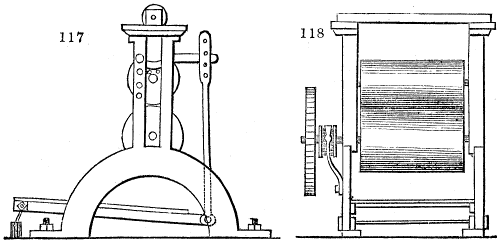
The squeezing rollers or squeezers, for discharging the greater part of the water from the yarns and goods in the process of bleaching, are represented in figs. 117, 118., the former being a side-view, to show how the roller gudgeons lie in the slots of the frame, and how the shaft of the upper roller is pressed downward by a weighted lever, through a vertical junction road, jointed at the bottom to a nearly horizontal bar, on whose end the proper weight is hung. In fig. 118. these rollers of birch-wood are shown in face; the under one receiving motion through the toothed wheel on its shaft, from any suitable power of water or steam. Upon the shaft of the latter, between the toothed wheel and the roller, the lever and pulley for putting the machine into and out of geer is visible. The under roller makes about 25 revolutions in the minute, in which time three pieces of goods, stitched endwise, measuring 28 yards each, may be run through the machine, from a water trough on one side, to a wooden grating upon the other.
When the goods are run through, they are carried off upon a grated wheelbarrow, in a nearly dry state, and transferred to the spreading machine, called at Manchester a candroy. In many bleach-works, however, the creased pieces are pulled straight by the hands of women, and are then strongly beat against a wooden stock to smooth out the edges. This being done, a number of pieces are stitched endwise together, preparatory to being mangled.
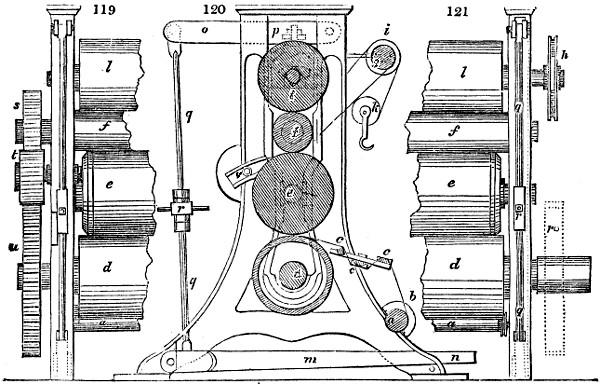
Calender.—Fig. 120. is a cross section of this machine, and figs. 119. 121. are front views broken off. The goods are first rolled upon the wooden cylinder a, near the ground; by the tension roller b, upon the same cylinder, the goods receive a proper degree of stretching in the winding off. They then pass over the spreading bars c c c, by which they are still more distended; next round the hollow iron cylinder d, 16 inches diameter, and the paper cylinder e, of like dimensions; thence they proceed under the second massive iron cylinder f, of 8 inches diameter, to be finally wound about the projecting wooden roller g. This is set in motion by the pulleys h, fig. 121., and i, fig. 120., and receives its proper tension from the hanging roller k; l is a press cylinder, of 14 inches diameter, made of plane-tree wood. By its means we can at all times secure an equal degree of pressure, which would be hardly possible did the weighted lever press immediately upon two points of the calender rollers. The compression exercised by the cylinders may be increased at pleasure by the bent lever m, weights being applied to it at n. The upper branch of the lever o is made fast by screws and bolts at p, to the upper press-cylinder. The junction leg q is attached to the intermediate piece r, by left and right-handed screws, so that according as that piece is turned round to the right or the left, the pressure of the weighted roller will be either increased or diminished. By turning it still more, the piece will get detached, the whole pressure will be removed, and the press-roller may be taken off; which is a main object of this mechanism.
The unequable movement of the cylinders is produced by the wheels s t u, of which the undermost has 69, the uppermost has 20, and the carrier-wheel t, either 33, 32, or 20 teeth, according to the difference of speed required. The carrier-wheel is bolted on at v, and adjusted in its proper place by means of a slot. To the undermost iron cylinder, the first motion is communicated by any power, for which purpose either a rigger (driving pulley) is applied to its shaft at u, or a crank motion. If it be desired to operate with a heated calender, the undermost hollow cylinder may be filled with hot steam, admitted through a stuffing box at one end, and discharged through a stuffing box at the other, or by a red-hot iron roller.
Pure starch would be too expensive a dressing for common calico shirtings, and therefore an extemporaneous starch is made by mixing one pound of flour with one gallon of water, and allowing the mixture to ferment in a warm place for twenty-four hours. In this way, a portion of lactic acid is formed, which dissolves the gluten, or separates it from the starch; so that when the whole is thrown upon a sieve, a liquid paste passes through, which, being boiled, answers well for stiffening the goods, without giving them a gray tinge. The paste is thinned with water to the desired degree, and faintly tinged with solution of indigo. The starch, which is sometimes thickened with porcelain clay, Paris plaster, or Spanish white, is put into a trough, and is evenly imparted to the cloth as this is drawn down through it, by the traction of rollers. There is a roller near the bottom of the trough, round which the cloth is made to run, to secure its full impregnation; while the upper rollers serve to expel its excess of the starch, and throw it back into the cistern. See Starching Apparatus.
The goods are next dried in an apartment heated by two, three, or more flues, running along the floor, and covered usually with fire-tiles. At first the heat is moderate, but it is gradually raised to upwards of 110° F.
The goods must now be passed again through the calender, in order to receive their final smoothness and lustre. They are in the first place damped with a peculiar machine, furnished with a circular brush, whose points revolve in contact with water in a trough placed beneath them, and sprinkle drops of water upon the goods as they are drawn forwards by a pair of cylinders. They are then subjected to the powerful pressure of the calender rollers.
The calendered pieces are neatly folded into compact parcels, and stamped with the marks of each particular manufacturer, or various devices to suit the markets for which they are designed. They are finally piled on the sole of an hydraulic press, with a sheet of pasteboard between each piece; but with occasional plates of iron to secure uniformity of pressure throughout. When sufficiently condensed by the press, they are taken out, and despatched to their respective manufacturers in a state ready for sale.
There are no less than 25 steps in the bleaching of calicoes, many of them effected with expensive machinery; yet the whole do not produce to the bleacher more than 10 pence per piece, of 24 yards.
The following system was pursued a few years back, by a skilful bleacher of muslins near Glasgow:—
“In fermenting muslin goods, we surround them with our spent leys, from the temperature of 100° to 150° F., according to the weather, and allow them to ferment for 36 hours. In boiling 112 lbs. = 112 pieces of yard-wide muslin, we use 6 or 7 lbs. of pearl-ashes, and 2 lbs. of soft soap, with 360 gallons of water, and allow them to boil for 6 hours; then wash them, and boil them again with 5 lbs. of pearl-ashes, and 2 lbs. of soft soap, and allow them to boil 3 hours; then wash them with water, and immerse them into the solution of oxymuriate of lime, at 5 on the test-tube, and allow them to remain from 6 to 12 hours; next wash them, and immerse them into dilute sulphuric acid at the specific gravity of 31⁄2 on Tweedale’s hydrometer = 1·0175, and allow them to remain an hour. They are now well washed, and boiled with 21⁄2 lbs. of pearl-ashes, and 2 lbs. of soft soap for half an hour; afterwards washed and immersed into the oxymuriate of lime as before, at the strength of 3 on the test-tube, which is stronger than the former, and allowed to remain for 6 hours. They are again washed, and immersed in diluted sulphuric acid at the specific gravity of 3 on Tweedale’s hydrometer = 1·015. If the goods be strong, they will require another boil, steep, and sour. At any rate, the sulphuric acid must be well washed out before they receive the finishing operation with starch.
“With regard to the lime, which some use instead of alkali immediately after fermenting, the same weight of it is employed as of pearl-ashes. The goods are allowed to boil in it for 15 minutes, but not longer, otherwise the lime will injure the fabric.”
More recently the plan adopted is as follows; by which the purest whites are produced for the London market.
“Lime is seldom used for our finer muslin goods, as it is found to injure their fabric, and the colours do not keep for any length of time.
“An alkaline ley is made by boiling equal weights of lime and soda together for an hour: this alkali is used for boiling goods the same as potash, but without soap.
“In finishing jacounets or muslins, after washing them from the sour, they are run through spring-water containing a little fine smalts, which give them a clear shade; if of a coarse fabric, a little well-boiled starch is added to the water. From this they are wrung or pressed, and taken up by the selvage for the breadthing frame, and are run off it upon a tin cylinder heated by steam, by which the piece is completely dried in 15 minutes: it is then stripped from the cylinder, neatly folded and pressed, which finishes the piece for the market. From 6d. to 9d. per piece of 12 yards is obtained for the bleaching and finishing of those goods.
“Book muslins, after being washed from the sour, are wrung or pressed; then they are hung up to dry in a heated stove, previous to being put into starch, prepared by boiling 3 lbs. of it to every 5 gallons of water, with 20 ounces of smalts: they are wrung out of this starch, and taken to a room heated to 110° F.; the starch is wrought into the piece till clear, then taken into a cold room, and the selvages dressed or set, before being put on the breadthing frame in the heated stove, where the piece is stretched to its length, while three or four persons at each selvage keep the piece to its breadth. If a stiff finish is wanted, they keep exactly opposite each other; but in breadthing the piece of elastic, they cross the piece in breadthing, which gives it a springy elastic finish. From 9d. to 15d. per piece of 12 yards is obtained for the bleaching and finishing of these goods.
“Sewed trimmings, flounces, and dresses are run through spring water containing fine smalts with a little well-boiled starch. They are then taken to the drying stove, where they are stented till dry, which finishes the piece for the market. From 6d. to 8d. per piece is obtained for trimmings and flounces, and from 9d. to 1s. for dresses, bleaching and finishing.”
In the bleaching of cotton cloth, where fixed colours are previously dyed in the yarn before it is woven into cloth, such as the Turkey or Adrianople red, and its compounds of lilac or purple, by the addition of iron bases, various shades of blue from indigo, together with buff and gold colour, tinged with the oxides of iron, great care is necessary.
The common process of bleaching pulicates, into which permanent colours are woven, is, to wash the dressing or starch well out in cold water; to boil them gently in soap, and, after again washing, to immerse them in a moderately strong solution of the oxymuriate of potash; and this process is followed until the white is good: they are then soured in dilute sulphuric acid. If the goods are attended to in a proper manner, the colours, in place of being impaired, will be found greatly improved, and to have acquired a delicacy of tint which no other process can impart to them.
Pulicates, or ginghams, which have been woven along with yarn which has been previously bleached, are first freed by washing from the starch or dressing: they are then washed, or slightly boiled with soap. After which, they are completely rinsed in pure spring water, and then soured.
Besides these common processes for bleaching, another was some time ago introduced, which consisted in immersing the cotton or linen goods in pretty strong solution of caustic alkali, and afterwards exposing them to the action of steam in a close vessel. It is now generally abandoned.
The cotton or linen goods having been previously cleaned by steeping and washing, were, after being well drained, steeped in a solution of caustic alkali of the specific gravity of 1020. After the superfluous alkaline ley had been drained from them, they were arranged on a grating in a receiver. The cover was then placed on the vessel, and firmly screwed down; and the steam was admitted by turning the stop-cock of the pipe which communicated with a steam boiler of the common construction.
The stains which come out upon maddered goods, in consequence of defective bleaching, are called in this country spangs. Their origin is such as I have described above, as the following statement of facts will show. The weaver of calicoes receives frequently a fine warp so tender from bad spinning or bad staple in the cotton, that it will not bear the ordinary strain of the heddles, or friction of the shuttle and reed, and he is obliged to throw in as much weft as will compensate for the weakness or thinness of the warp, and make a good marketable cloth. He of course tries to gain his end at the least expense of time and labour. Hence when his paste dressing becomes dry and stiff, he has recourse to such greasy lubricants as he can most cheaply procure; which are commonly either tallow or butter in a rancid state, but the former being the lowest priced is preferred. Accordingly, the weaver, having heated a lump of iron, applies it to a piece of tallow held over the warp in the loom, and causes the melted fat to drop in patches upon the yarns, which he afterwards spreads more evenly by his brush. It is obvious, however, that the grease must be very irregularly applied in this way, and be particularly thick on certain spots. This irregularity seldom fails to appear when the goods are bleached or dyed by the common routine of work. Printed calicoes examined by a skilful eye, will be often seen to be stained with large blotches evidently occasioned by this vile practice of the weaver. The ordinary workmen call these copper stains, believing them to be communicated in the dyeing copper. Such stains on the cloth are extremely injurious in dyeing with the indigo vat. The following plan is adopted by some Scotch bleachers with the effect, it is said, of effectually counteracting spangs from grease.
The goods having been singed and steeped in pure water, as is customary in common bleaching, they are passed through a pair of rollers to press out the impurities which have been loosened by the steeping. It must here, however, be observed, that where the expense of one extra drying can be afforded, the process might be very much improved by steeping the brown calicoes for thirty or forty hours before singeing, because this would separate much of that impurity which usually becomes fixed in the stuff on its being passed over the hot cylinders. When the pieces have been thus singed, steeped, and pressed, they are boiled four times, ten or twelve hours at each time, in a solution of caustic potash, of the specific gravity of from 1·0127 to 1·0156, washing them carefully and thoroughly in pure water between each of these boilings. They are then immersed in a solution of the chloride of potash, originally of the strength of 1·0625, and afterwards reduced with twenty-four times its measure with water.
When the preparation is good, these proportions will whiten cotton goods completely in eight hours. In this steep they are, however, generally suffered to remain twelve hours. It has been supposed that the common bleaching liquor (chloride of lime) cannot, without injury, be substituted for chloride of potash, but I believe this to be a mistake.
Some printers take the pieces from this solution, and, while wet, lay them upon the grass, and there expose them to the sun and weather for two or three days. They are thence removed to the sours, made of the specific gravity of about 1·0254 at the temperature of 110° of Fahrenheit. In bleaching common goods, and such as are not designed for the best printing, the specific gravity of the sours is varied from that of 1·0146 to that of 1·0238, if weighed when they become of the temperature of the atmosphere. In these they are suffered to lie for five or six hours, after which they are taken to the dash-wheel and washed thoroughly. When this operation is finished, they are submitted to four more boilings as before, with a solution of caustic potash; taking care to wash well between each of these boilings. Sometimes pearl-ash, made caustic, is used for the last of these boilings, lest the sulphur, which always exists in the potashes of commerce, should impair the whites. They are next immersed in the diluted chloride of potash, of the strength before mentioned; after which they are well washed in pure water, and then winched for half an hour in common sours. The last process is that of careful washing in plenty of clean water, after which they are not put into the stove, but are immediately hung up in the airing sheds to dry gradually. The water must be good, and abundant.
The number of operations, as here described, is great; but I know of no other mode of procedure by which perfect bleaching is so likely to be effected at all times and in all seasons, without disappointment. It must here be remarked, that, for the best purposes of printing, it would not be sufficient to take goods which have been bleached in the common way and finish these by the better process; because the sulphate of lime deposited in the cloth by that operation will be apt to spoil them for madder colours; at least, a printer who is curious in his business would hesitate to work up such cloth.
Bucking or Bowking.—This is one of the most important operations in the bleaching of both cotton and linen goods. There are several methods whereby this process is carried on; but of these we shall select only two, distinguishing them as the old and new method of bucking. In the former way, the cloths have been steeped in the alkaline lye, as before described, and afterwards well washed, are regularly arranged in a large wooden vat, or kieve; a boiler of sufficient capacity is then filled with caustic alkaline lye, which is heated to the temperature of blood. The boiler is then emptied by a stop-cock upon the linens in the kieve, until they are covered with the liquor. After having remained on the cloth for some time, it is run off by a stop-cock, at the bottom of the kieve, into an iron boiler sunk in the ground, from whence it is raised into the boiler by a pump. The heat is now elevated to a higher temperature, and the lye again run upon the goods in the kieve; from whence it is returned into the boiler, as before described: and these operations are continued, always increasing the heat, until the alkaline lye is completely saturated with the colouring matter taken from the cloth, which is known by its having acquired a completely offensive smell, and losing its causticity.
When we consider the effect which heated liquids have upon coloured vegetable matter, we shall see the propriety of the temperature of the alkaline lye being gradually increased. Thus, when vegetable substances are hastily plunged into boiling liquids, the colouring matter, in place of being extracted, is, by this higher temperature, fixed into them. It is on this principle that a cook acts in the culinary art, when the green colour of vegetables is intended to be preserved: in place of putting them into water when cold, they are kept back until the water is boiling; because it is well known that, in the former case, the green colour would be entirely extracted, whereas, when the vegetables are not infused until the water is boiling, the colour is completely preserved or fixed. On the same principle, when the temperature of the alkaline lye is gradually raised, the extractive and colouring matter is more effectually taken from the cloth; and the case is reversed when the lye is applied at the boiling temperature: so much so, that linen which has been so unfortunate as to meet with this treatment, can never be brought to a good white.
When the alkaline lye is saturated with colouring matter, it is run off as unfit for further use in this operation; but, were the goods to be instantly taken out of the kieve, and carried to be washed in the dash-wheel while hot, a certain portion of the colouring matter would be again fixed into them, which is extremely difficult to eradicate. In order to prevent this, the most approved bleachers run warm water upon the cloth as soon as the impure lye is run off: this combines with and carries off part of the remaining impurities. A stream of water is then allowed to run upon the cloth in the kieve, until it comes off almost transparent. The goods are now to be taken to the wash-stocks, or to the dash-wheel, to be further cleaned, with the greatest efficacy.
The improved mode of bowking was the invention of Mr. John Laurie, a native of Glasgow. It is now practised by many bleachers in Lancashire, some on more perfect plans than others; but we shall give the description of the kind of apparatus approved of by those whose experience and skill have rendered them the most competent judges.
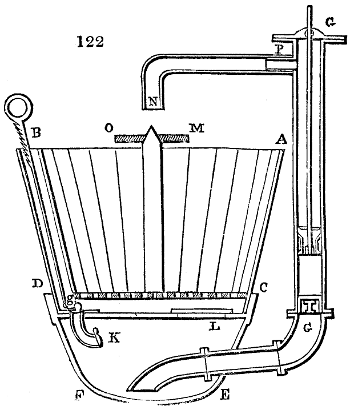
In fig. 122., A B C D is the wooden kieve, or kier, containing the cloth; C E F D represents the cast-iron boiler; G G, the pump; g K, the pipe of communication between the kieve and the boiler. This pipe has a valve on each of its extremities: that on the upper extremity, when shut, prevents the lye from running into the boiler, and is regulated by the attendant by means of the rod and handle g B. The valve at K admits the lye; but, opening inwards, it prevents the steam from escaping through the pipe g K. The boiler has a steam-tight iron cover, g L; and at C D, in the kieve, is a wooden grating, a small distance above the cover of the boiler.
At M O is a broad plate of metal, in order to spread the lye over the cloth. It is hardly necessary to say that the boiler has a furnace, as usual, for similar purposes.
While the lye is at a low temperature, the pump is worked by the mill or steam-engine. When it is sufficiently heated, the elasticity of the steam forces it up through the valves of the pump, in which case it is disjoined from the moving power.
N P is a copper spout, which is removed at the time of taking the cloth out of the kieve.
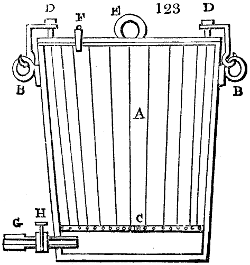
The boilers A, fig. 123., used in bleaching, are of the common form, having a stopcock, H G, at bottom, for running off the waste lye. They are commonly made of cast iron, and are capable of containing from 300 to 600 gallons of water, according to the extent of the business done. In order that the capacity of the boilers may be enlarged, they are formed so as to admit of a crib of wood, strongly hooped, or, what is preferable, of cast iron, to be fixed to the upper rim or edge of it. To keep the goods from the bottom, where the heat acts most forcibly, a strong iron ring, covered with netting made of stout rope, C, is allowed to rest six or eight inches above the bottom of the boiler. Four double ropes are attached to the ring E, for withdrawing the goods when sufficiently boiled, which have each an eye for admitting hooks from the running tackle of a crane. Where more boilers than one are employed, the crane is so placed, that, in the range of its sweep, it may withdraw the goods from any of them. For this purpose, the crane turns on pivots at top and bottom; and the goods are raised or lowered at pleasure, with double pulleys and sheaves, by means of a cylinder moved by cast-iron wheels. The lid is secured by the screw bolts D D, and rings B B. F is a safety valve.
The efficacy of Laurie’s bowking apparatus is remarkable. While the heat is gradually rising, a current of fresh lye is constantly presented to the different surfaces for saturating the goods, so as to increase its detersive powers. Besides, the manner in which the apparatus is worked, first by the water-wheel or steam-engine, and then by its intrinsic operation, puts it completely out of the power of servants to slight the work; not to speak of the great saving of alkali, which, in many cases, has been found to amount to 25 per cent.
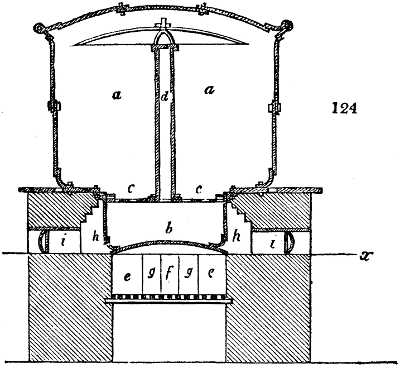
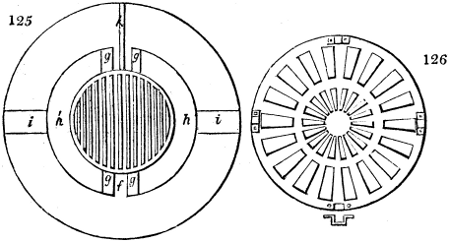
A simple modification of the bowking apparatus is shown in figs. 124, 125, 126.; the first being a vertical section, the second, a horizontal section in the line x of the first. It consists of two parts: the upper wide part, a a, serves for the reception of the goods, and the lower or pot, b, for holding the lye; c c is an iron grating, shown apart in fig. 126. The grating has numerous square apertures in the middle of the disc, to which the rising pipe d is screwed fast. The upper cylinder is formed of cast iron, or of sheet iron well rivetted at the edges; or sometimes of wood, this being secured at its under edge into a groove in the top edge of the lye-pot. The mouth of the cylinder is constructed usually of sheet iron. e e is the fire-grate, whose upper surface is shown in fig. 125.: it is made of cast iron, in three pieces. The flame is parted at f, and passes through the two apertures g g, into the flues h h, so as to play round the pot, as is visible in fig. 125.; and escapes by two outlets into the chimney. The apertures i i serve for occasionally cleaning out the flues h h, and are, at other times, shut with an iron plate. In the partition f, which separates the two openings g g, and the flues h h, running round the pot, there is a circular space at the point marked with k, fig. 125., in which the large pipe for discharging the waste lye is lodged. The upper large cylinder should be encased in wood, with an intermediate space filled with sawdust, to confine the heat. The action of this apparatus is exactly the same as of that already explained.