C. (continued 5)
Reading edition
To the lateral projecting tube of the instrument, as described by Dr. Wollaston, I found it necessary to attach a stop-cock, in order to cut off the action of the chimney, while placing the syphon, to allow of its being fixed in a proper state of adjustment, with its junction line of the oil and water at the zero of the scale. Since a slight deviation of the legs of the syphon from the perpendicular, changes very considerably the line of the level, this adjustment should be made secure by fixing the horizontal pipe tightly into a round hole, bored into the chimney stalk, or drilled through the furnace door. On gently turning the stop-cock, the difference of atmospherical pressure corresponding to the chimney draught, will be immediately indicated by the ascent of the junction-line of the liquids in the syphon. This modification of apparatus permits the experiment to be readily rectified by again shutting off the draught, when the air will slowly re-enter the syphon; because the projecting tube of the barometer is thrust into the stop-cock, but not hermetically joined; whereby its junction line is allowed to return to the zero of the scale in the course of a few seconds.
Out of many experiments made with this instrument, I shall content myself with describing a few, very carefully performed at the breweries of Messrs. Trueman, Hanbury, and Buxton, and of Sir H. Meux, Bart., and at the machine factory of Messrs. Braithwaite; in the latter of which I was assisted by Captain Ericsson. In the first trials at the breweries, the end of the stop-cock attached to the differential barometer was lapped round with hemp, and made fast into the circular peep-hole of the furnace door of a wort copper, communicating with two upright parallel chimneys, each 18 inches square, and 50 feet high. The fire was burning with fully its average intensity at the time. The adjustment of the level being perfect, the stop-cock orifice was opened, and the junction level of the oil and water rose steadily, and stood at 11⁄4 inches, corresponding to 1·258 = 0·156 of 1 inch of water, or a column of air 10·7 feet high. This difference of pressure indicates a velocity of 26 feet per second. In a second set of experiments, the extremity of the stop-cock was inserted into a hole, bored through the chimney stalk of the boiler of a Boulton and Watt steam-engine of twenty-horse power. The area of this chimney was exactly 18 inches square at the level of the bored hole, and its summit rose 50 feet above it. The fire-grate was about 10 feet below that level. On opening the stop-cock, the junction line rose 21⁄4 inches. This experiment was verified by repetition upon different days, with fires burning at their average intensity, and consuming fully 12 lbs. of the best coals hourly for each horse’s power, or nearly one ton and a third in twelve hours. If we divide the number 21⁄4 by 8, the quotient 0·28 will represent the fractional part of 1 inch of water, supported in the syphon by the unbalanced pressure of the atmosphere in the said chimney; which corresponds to 191⁄4 feet of air, and indicates a velocity in the chimney current of 35 feet per second. The consumption of fuel was much more considerable in the immense grate under the wort copper, than it was under the steam-engine boiler.
In my experiments at Messrs. Braithwaite’s factory, the maximum displacement of the junction line was 1 inch, when the differential oil and water barometer was placed in direct communication with a chimney 15 inches square, belonging to a steam boiler, and when the fire was made to burn so fiercely, that, on opening the safety-valve of the boiler, the excess of steam beyond the consumption of the engine, rushed out with such violence as to fill the whole premises. The pressure of one-eighth of an inch of water denotes a velocity of draught of 23·4 feet per second.
In building chimneys, we should be careful to make their area rather too large than too small; because we can readily reduce it to any desired size, by means of a sliding register plate near its bottom, or a damper plate applied to its top, adjustable by wires or chains, passing over pulleys. Wide chimneys are not so liable as narrow ones to have their draught affected by strong winds. In a factory, many furnace flues are often conducted into one vertical chimney stalk, with great economy in the first erection, and increased power of draught in the several fires.
Vast improvements have been made in this country, of late years, in building stalks for steam boilers and chemical furnaces. Instead of constructing an expensive, lofty scaffolding of timber round the chimney, for the bricklayers to stand upon, and to place their materials, pigeon-holes, or recesses, are left at regular intervals, a few feet apart, within the chimney, for receiving the ends of stout wooden bars, which are laid across, so as to form a species of temporary ladder in the interior of the tunnel. By means of these bars, with the aid of ropes and pulleys, every thing may be progressively hoisted, for the building of the highest engine or other stalks. An expert bricklayer, with a handy labourer, can in this way raise, in a few weeks, a considerable chimney, 40 feet high, 5 feet 8 inches square outside, 2 feet 8 inches inside at the base, 28 inches outside, and 20 inches inside at the top. To facilitate the erection, and at the same time increase the solidity of an insulated stalk of this kind, it is built with three or more successive plinths, or recedures, as shown in fig. 281. It is necessary to make such chimneys thick and substantial near the base, in order that they may sustain the first violence of the fire, and prevent the sudden dissipation of the heat. When many flues are conducted into one chimney stalk, the area of the latter should be nearly equal to the sum of the areas of the former, or at least of as many of them as shall be going simultaneously. When the products of combustion from any furnace must be conducted downwards, in order to enter near the bottom of the main stalk, they will not flow off until the lowest part of the channel be heated by burning some wood shavings or straw in it, whereby the air syphon is set agoing. Immediately after kindling this transient fire at that spot, the orifice must be shut by which it was introduced; otherwise the draught of the furnace would be seriously impeded. But this precaution is seldom necessary in great factories, where a certain degree of heat is always maintained in the flues, or, at least, should be preserved, by shutting the damper plate of each separate flue, whenever its own furnace ceases to act. Such chimneys are finished at top with a coping of stone-slabs, to secure their brickwork against the infiltration of rains, and they should be furnished with metallic conducting rods, to protect them from explosions of lightning.
When small domestic stoves are used, with very slow combustion, as has been recently proposed, upon the score of a misjudged economy, there is great danger of the inmates being suffocated or asphyxied, by the regurgitation of the noxious burned air. The smoke doctors who recommend such a vicious plan, from their ignorance of chemical science, are not aware that the carbonic acid gas, of coke or coal, must be heated 250° F. above the atmospheric air, to acquire the same low specific gravity with it. In other words, unless so rarefied by heat, that gaseous poison will descend through the orifice of the ash-pit, and be replaced by the lighter air of the apartment. Drs. Priestley and Dalton have long ago shown the co-existence of these two-fold crossing currents of air, even through the substance of stone-ware tubes. True economy of heat, and salubrity, alike require vivid combustion of the fuel, with a somewhat brisk draught inside of the chimney, and a corresponding abstraction of air from the apartment. Wholesome continuous ventilation, under the ordinary circumstances of dwelling houses, cannot be secured in any other way. Were these mephitic stoves, which have been of late so ridiculously puffed in the public prints, generally introduced, the faculty would need to be immediately quadrupled to supply the demand for medical advice; for headaches, sickness, nervous ailments, and apoplexy, would become the constant inmates of every inhabited mansion. The phenomena of the grotto of Pausilippo might then be daily realised at home, among those who ventured to recline upon sofas in such carbonated apartments; only instead of a puppy being suffocated pro tempore, human beings would be sacrificed, to save two-penny worth of fuel per diem.
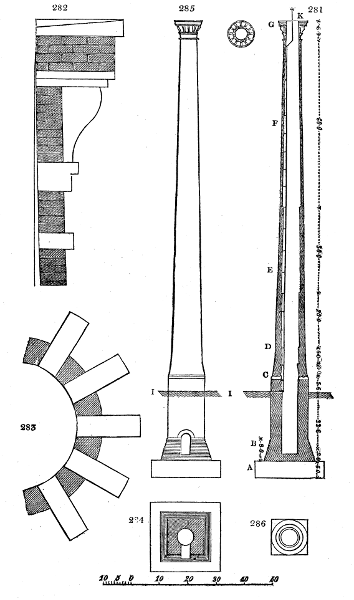
The figures upon the preceding page represent one of the two chimneys, recently erected at the Camden Town station, for the steam boilers of the two engines of 60 horse-power each, belonging to the London and Birmingham Railway Company. These engines draw their train of carriages up the inclined plane of Hampstead Hill. The chimneys were designed by Robert Stephenson, Esq., engineer to the Company, executed by William Cubitt, Esq., of Gray’s Inn Road,—and do equal honour to both gentlemen, being probably the most elegant and substantial specimens of this style of architecture in the world. In the section, fig. 281.,
A represents a bed of concrete, 6 feet thick, and 24 feet square.
B, brick footings set in cement; the lower course 19 feet square.
C, Bramley-fall stone base, with a chain of wrought iron let into it.
D, a portion, 15 feet high, curved to a radius of 113 feet, built entirely of Malm paviours, (a peculiarly good kind of bricks.)
E, shaft built of Malm paviours in mortar.
F, ditto, built from the inside, without exterior scaffolding.
G, the cap ornamented, (as shown in the plan alongside,) with Portland stone, the dressings being tied together with copper cramps and an iron bond.
Fig. 282. represents the mouldings of the top, upon an enlarged scale.
Fig. 283., a plan of the foundation, ditto.
Fig. 284., ditto, at the level of the entrance of the flue, as seen in
Fig. 285., the elevation of the chimney.
Fig. 286., plan at the ground level I, in fig. 281. and 285.
K, fig. 281., the lightning conducting rod.
CHINTZ is a peculiar style of fast-printed calico, in which figures of at least five different colours are impressed upon a white or light coloured ground.
CHLORATE OF POTASH, commonly called oxymuriate of potash. This interesting saline compound has become the object of a pretty extensive manufacture, in consequence of its application to make matches for procuring instantaneous light, and a detonating powder for fire-arms. It may be prepared both in the humid and dry way.
Having made a strong solution of purified potash, or carbonate of potash, with from two to three parts of water, we pass through it in a Woulfe’s apparatus a current of chlorine gas, till it ceases to absorb any more. Chloride of potash and chloride of potassium alone are formed as long as there is an excess of alkali in the solution; but afterwards in the further reaction of the materials, the chloride passes into the state of a chlorate, and, as such, precipitates from the solution. During the first half of the operation, that is, till the potash be about one half saturated with chlorine, as indicated by litmus paper ceasing to be darkened and beginning to be blanched, only the chloride of potassium or muriate of potash falls. The process should be interrupted at this point in order to remove the salt, to wash it, to add the washings to the liquor, and then to transmit the gas freely through the solution. As the operation advances, less muriate of potash is formed, and at length nothing but the pure chlorate is separated in crystals. When finally the bubbles of gas pass through without being sensibly absorbed, the process is known to be completed; the liquid may then be allowed to settle, and be poured off from the crystals of chlorate of potash, which are purified from the muriate by dissolving them in three times their weight of boiling water, and filtering the solution while hot. On its cooling, the chlorate will separate in pearly-looking crystalline plates. It may be rendered quite pure by a second crystallization, in which state it does not affect solution of nitrate of silver.
The above potash lye usually gets a reddish tint in the course of the process in consequence of a little manganesic acid coming over with the chlorine, but it gradually loses this colour as the saturation becomes complete, when the solution turns yellow. The tubes for conveying the gas should be of large diameter, if they be plunged into the saline solution, because the crystallization which takes place in it is apt to choke them up. This inconvenience may however be obviated by attaching to the end of the glass tube, a tube of caoutchouc terminated in a small glass funnel, or simply the neck of a caoutchouc bottle with a part of its body, whose width will not be readily closed with a saline crust. The residuary lixivium may be used against another operation, or it may be evaporated down to half its bulk and set aside to crystallize, whereby some more chlorate will be obtained, mixed indeed with muriate and carbonate, from which however it may be separated by a second crystallization. In general the pure chlorate obtained does not exceed one tenth the weight of the potash employed; because in thus treating potash with chlorine, five-sixths of it are converted into muriate of potash and only one sixth into chlorate, and a part of the latter adheres to the muriate, or is lost in the mother waters of the crystallizations.
The chlorate of potash may be more conveniently manufactured, like that of lime, in the dry way. St. Romer patented at Vienna the following method for that purpose in 1821:—Ten pounds of crystallised peroxide of manganese are to be finely pulverised, mixed with ten pounds of plumbago, and thirty pounds of common salt, and put into the leaden retort represented in fig. 287. p. 287. From the middle of the helmet-shaped lid of this vessel, a lead tube, two feet long and two inches wide, conducts to the receiver, which is a square earthen pan, hard glazed both within and without, of the same capacity with the retort. The end of the tube must be made fast to a frame at the height of six inches above the bottom of the receiver. Upon its inner sides four inches apart, brackets are to be fixed for supporting a series of laths or shelves of white wood, on which a number of little paper or paste-board boxes are to be laid. In these boxes ten pounds of the purest carbonate of potash, prepared from tartar, are to be spread. The receiver must now be covered with a lid made tight by a water lute. Twenty pounds of concentrated sulphuric acid previously diluted with sixteen pounds of water, and then cooled, are to be poured upon the mixed materials in the retort, the lid immediately secured, with the tube adjusted in the receiver. The whole must be allowed to operate spontaneously without heat for twelve hours. At the end of this time the retort is to be surrounded with a water bath and steadily heated during twelve hours, and then left to cool for six hours. The apparatus must now be opened, the cakes of chlorate of potash removed, and freed from muriate by solution and crystallization.
M. Liebig proposes the following process for obtaining chlorate of potash:—
Heat chloride of lime in water till it ceases to destroy vegetable colours. In this case a mixture of chloride of calcium and chlorate of potash is obtained. This is to be dissolved in hot water, and to the solution concentrated by evaporation, chloride of potassium is to be added, and then suffered to cool. After cooling, a quantity of crystals of chlorate of potash is obtained, which are to be redissolved and crystallized again to purify them. M. Liebig considers that this will be a cheap process for obtaining chlorate of potash. From 12 ounces of chloride of lime, of so bad a quality that it left 65 per cent. of insoluble matter, he obtained an ounce of chlorate of potash.
The only difficulty to overcome in this process is, from the chloride of lime not being so easily decomposed by heat as is generally supposed; a solution of it may be kept boiling for an hour without losing its bleaching power. The best method is to form a thin paste with chloride of lime and water, and then to evaporate it to dryness. If it be required to prepare it by passing chlorine into cream of lime, it is advantageous to keep it very hot.
The chlorate of potash which separates from the solution by crystallization, has not the form of scales which it usually possesses, but is prismatic: whether this is occasioned by some admixture has not been ascertained; but on re-crystallizing, it is obtained in the usual form.
The solution ought not merely to be left to cool, in order to procure crystals, for the crystallization is far from being terminated even after complete cooling; crystals continue to be deposited for 3 or 4 days.
The following modification of the process for making chlorate of potash is that of M. Vée. A solution of chloride of lime marking 18° or 20° Baumé, is to be set upon the fire in a lead or cast iron pot, and when it begins to get hot, there is to be dissolved in it, a quantity of chloride of potassium sufficient to raise the hydrometer 3 or 4 degrees. It must be then concentrated as quickly as possible till it marks 30° or 31°, taking care that it does not boil over by the sudden extrication of oxygen. The concentrated liquor is set aside to crystallize in a cool place; where a deposit of chlorate of potash forms, mixed with chloride of potassium. The mother waters being evaporated to the density of 36°, afford another crop of crystals, after which they may be thrown away.
The salts obtained at the first crystallization are to be re-dissolved, and the solution being brought to 15° or 16° is to be filtered, when it will afford upon cooling pure chlorate of potash.
Chlorate or oxymuriate of potash has a cooling, somewhat unpleasant and nitrous taste. It does not bleach. At 60° F. 100 parts of water dissolve six parts of it, and at its boiling point or 220°, sixty parts. When heated to dull ignition in a glass retort it gives out 39·15 per cent. of its weight of oxygen, and becomes thereby chloride of potassium. When strongly triturated in a mortar it crackles, throws out sparks, and becomes luminous. It deflagrates upon red-hot cinders like nitre: when triturated along with sulphur, or phosphorus, it detonates with great violence, not without danger to the hands of the operator, if they be not protected by a thick glove. Similar detonations may be produced with cinnabar or vermillion, sulphuret of potassium, sugar, volatile oils, &c.; but they can be effected only by the smart blow of a heated hammer and anvil. A mixture of sugar or starch with chlorate of potash is readily inflamed by a drop of sulphuric acid, and this experiment is the basis of the preparation of the oxygenated matches, as they have been commonly called. The following formula forms a good paste for tipping the said matches, made of narrow slips of either wood or card. Thirty parts of the chlorate in fine powder are to be mixed gently with a spatula upon paper with ten parts of flowers of sulphur well levigated, eight of sugar, five of gum arabic, and enough of vermillion to give the whole a rose tint. We begin by mixing tenderly together the sugar, the gum, and the salt previously pulverised; we then add as much water as shall reduce the mixture to a thin paste, and lastly introduce the sulphur; after which all must be well incorporated. The points of the matches, either previously tipped with sulphur or not, are to be dipped in that paste, so as to get coated with a little of it, and are lastly laid in a warm place till they become thoroughly dry. To kindle one of them, it must be touched with strong sulphuric acid, which for this purpose is usually kept in a small well-stoppered phial, and thickened with amianthus. Aspen is reckoned the best wood for matches.
Of late years a detonating priming for fire-arms has been much used with the percussion locks. The simplest formula for making it is to take ten parts of gunpowder, to lixiviate it with water, and to mix the residuum, while moist, with five parts and a quarter of chlorate of potash, reduced to an extremely fine powder. The paste may be made pretty thin, for the salt is sparingly soluble in the cold water, and it mixes best when tolerably fluid. This powder when dry is dangerous to handle, being very apt to explode. But this danger is guarded against by letting fall a drop of the paste into each copper percussion cap, and leaving it to dry there. In the detonation of this powder, besides muriate of potash, there are generated a little sulphate of potash and chlorine gas, which rust the metal very fast. For which reason fulminate of mercury is now preferred by many sportsmen as a detonating powder. See Fulminate.
CHLORATES, compounds of chloric acid with the salifiable bases. The only acid belonging to this class of any manufacturing importance is the following:
CHLORIC ACID; the acid constituent of the preceding salt; it consists of one equivalent prime of chlorine = 35·476, + 5 of oxygen, = 40·065; of which the sum 75·535 is the prime equivalent of the acid.
CHLORINE; the most energetic of the undecompounded bodies, or chemical elements as they are usually called, exists, under ordinary circumstances, as a greenish yellow gas, but, when exposed to a pressure of 4 atmospheres, it becomes a yellow transparent liquid. In the first state, its density compared to air, reckoned 1·000, is 2·47; in the second, its density compared to water, 1·000, is 1·33. No degree of cold, hitherto tried, has liquefied the gas when dry. It is obtained by putting into a glass retort a mixture of 3 parts of common salt, with 2 parts of peroxide of manganese, and pouring upon it 2 parts of sulphuric acid diluted with its own weight of water; or, more conveniently, by pouring moderately strong muriatic acid upon peroxide of manganese in a retort; and in either case applying the gentle heat of a spirit lamp or a water bath, while the beak of the retort is plunged under brine upon the shelf of the pneumatic trough. The gas issues, and may be received in the usual way into inverted glass jars, or phials; but the first which comes over being mixed with the air of the retort, must be rejected. It has a peculiar smell, and irritates the nostrils most violently when inhaled, as also the windpipe and lungs. It is eminently noxious to animal life, and, if breathed in its undiluted state, would prove instantly fatal. It supports the combustion of many bodies, and indeed spontaneously burns several without their being previously kindled. The resulting combinations are called chlorides, and act most important parts in many manufacturing processes.
Water absorbs, at the ordinary temperature of the atmosphere, about double its volume of chlorine, and acquires the colour, smell, and taste of the gas, as well as its power of destroying or bleaching vegetable colours. When this aqueous chlorine is cooled to 36° F. dark yellow crystalline plates appear in it of the hydrate of chlorine, which are composed in 100 parts of 27·7 chlorine, and 72·3 water. If these crystals be heated to about 45° they liquefy, and the gas flies off.
Chlorine has a powerful affinity for hydrogen, not only combining with it rapidly in the gaseous, but seizing it in many of its liquid and solid combinations, as in volatile oils, which it inflames, and in yellow wax, cotton, and flax, which it whitens. The compound of chlorine and hydrogen gases is muriatic acid gas. Manganese, when mixed with liquid muriatic acid, as in the above process, abstracts the hydrogen, and lets the chlorine gas go free. When chlorine is passed into water, it decomposes some of it, seizes its hydrogen to form a little muriatic acid, and enables its oxygen to unite either with the chlorine, into chlorous acid, or with the remaining water, and to constitute oxygenated water. Hence, aqueous chlorine, exposed to the sunbeam, continually evolves oxygen, and, ere long, becomes muriatic acid.
This watery compound acts in a powerful way upon coloured vegetable fibres, extracting their hydrogen or colouring element by the twofold affinities of the chlorine and oxygen for it.
Hence chlorine, as a bleaching agent, requires to be tempered by the quiescent affinity of some alkaline base, potash or lime. Malaria, or morbific and putrescent miasmata, consist chiefly of hydrogenous matter as their basis, and are best counteracted by chlorine, where it can be conveniently applied.
Chlorides of Potash, Soda, and Lime.—These are the most important preparations through which chlorine exercises its peculiar powers upon the objects of manufactures. When a weak solution of caustic potash or soda is saturated with chlorine, it affords a bleaching liquor which is still used by some bleachers and calico-printers for their most delicate processes; but the price of the alkalis has led to the disuse of these chlorides as a general means, and has occasioned an extensive employment of chloride of lime. Upon the manufacture of this interesting compound I made an elaborate series of experiments several years ago, and published the results in the 13th volume of Brande’s Journal, for April 1822. I have no reason to suppose, from any thing that has been published since, that the processes there described have been essentially improved, or that any errors, either theoretical or practical, of any moment, exist in that memoir. I shall therefore first present my readers with a brief abstract of it, and then make such observations as subsequent inquiries suggest.
In the researches which I made, at many different times, upon the nature of the chloride of lime, I generally sought to combine the information flowing from both synthesis and analysis; that is, I first converted a known portion of hydrate of lime into bleaching-powder, and then subjected this chloride to analysis.
Two hundred grains of the atomic proto-hydrate of pure lime were put into a glass globe, which was kept cold by immersion in a body of water at 50°. A stream of chlorine, after being washed in water of the same temperature in another glass globe, connected to the former by a long narrow glass tube, was passed over the calcareous hydrate. The globe with the lime was detached from the rest of the apparatus from time to time, that the process might be suspended as soon as the augmentation of weight ceased. This happened when the 200 grains of hydrate, containing 151·9 of lime, had absorbed 130 grains of chlorine. By one analytical experiment it was found, that dilute muriatic acid expelled from 50 grains of the chloride, 20 grains of chlorine, or 40 per cent.; and by another, from 40 grains, 16·25 of gas, which is 40·6 per cent. From the residuum of the first 39·7 grains of carbonate of lime were obtained by carbonate of ammonia; from that of the second, 36·6 of ignited muriate of lime. The whole results are therefore as follows:—
Synthesis. 1st Analysis. 2d Analysis. Mean.
Chlorine 39·39 40·00 40·62 40·31
Lime 46·00 44·74 46·07 45·50
Water 14·60 15·26 13·31 14·28
100·00 100·00 100·00 100·00
Though the heat generated by the action of the dilute acid had carried off in the analytical experiments a small portion of moisture with the chlorine, yet their accordance with the synthetic experiment is sufficiently good to confirm the general results. The above powder appears to have been a pure chloride, without any mixture of muriate. But it exhibits no atomic constitution in its proportions.
To 200 grains of that hydrate of lime 30 grains of water being added, the powder was subjected to a stream of chlorine in the above way, till saturation took place. Its increase of weight was 150 grains.
It ought to be remarked, that in this and the preceding experiment, there was no appreciable pneumatic pressure employed to aid the condensation of the chlorine. In the last case, we see that the addition of 30 grains of water has enabled the lime to absorb 20 grains more of chlorine, being altogether a quantity of gas nearly equal to that of the dry lime. Thus, an atom of lime seems associated with 7⁄9 of an atom of chlorine. Analysis by muriatic acid confirmed this composition. It gave
Chlorine 39·5 = 51·8 cubic inches.
Lime 39·9
Water 20·6
100·0
A great variety of apparatus has been at different times contrived for favouring the combination of chlorine with the slacked lime for the purposes of commerce. One of the most ingenious forms, is that of a cylinder, or barrel, furnished with narrow wooden shelves within, and suspended on a hollow axis by which the chlorine was admitted, and round which the barrel was made to revolve. By this mode of agitation, the lime-dust being exposed on the most extensive surface, was speedily impregnated with the gas to the requisite degree. Such a mechanism I saw at MM. Oberkampf and Widmer’s celebrated fabrique de toiles peintes, at Jouy, in 1816. But this is a costly refinement, inadmissible on the largest scale of British manufacture. The simplest, and, in my opinion, the best construction for subjecting lime-powder to chlorine, is a large chamber 8 or 9 feet high, built of siliceous sandstone, having the joints of the masonry secured with a cement composed of pitch, resin, and dry gypsum in equal parts. A door is fitted into it at one end, which can be made air-tight by strips of cloth and clay lute. A window on each side enables the operator to judge how the impregnation goes on by the colour of the air, and also gives light for making the arrangements within at the commencement of the process. As water lutes are incomparably superior to all others where the pneumatic pressure is small, I would recommend a large valve or door on this principle to be made in the roof, and two tunnels of considerable width at the bottom of each side wall. The three covers could be simultaneously lifted off by cords passing over a pulley, without the necessity of the workman approaching the deleterious gas, when the apartment is to be opened. A great number of wooden shelves, or rather trays, 8 or 10 feet long, 2 feet broad, and 1 inch deep, are provided to receive the riddled slacked lime, containing generally about 2 atoms of lime to 3 of water. These shelves are piled one over another in the chamber, to the height of 5 or 6 feet, cross bars below each keeping them about an inch asunder, that the gas may have free room to circulate over the surface of the calcareous hydrate.
The alembics for generating the chlorine, which are usually nearly spherical, are in some cases made entirely of lead, in others of two hemispheres, joined together in the middle, the upper hemisphere being lead, the under one cast-iron. The first kind of alembic is enclosed for two-thirds from its bottom, in a leaden or iron case, the interval of two inches between the two being destined to receive steam from an adjoining boiler. Those which consist below of cast-iron, have their bottom directly exposed to a very gentle fire; round the outer edge of the iron hemisphere a groove is cast, into which the under edge of the leaden hemisphere fits, the joint being rendered air-tight by Roman or patent cement. In this leaden dome there are four apertures, each secured by a water-lute. The first opening is about 10 or 12 inches square, and is shut with a leaden valve, with incurvated edges, that fit into the water channel at the margin of the hole. It is destined for the admission of a workman to rectify any derangement in the apparatus of rotation, or to detach hard concretions of salt from the bottom.
The second aperture is in the centre of the top. Here a tube of lead is fixed, which descends nearly to the bottom, and down through which the vertical axis passes. To its lower end the cross bars of iron, or of wood, sheathed with lead, are attached, by whose revolution the materials receive the proper agitation for mixing the dense manganese with the sulphuric acid and salt. The motion is communicated either by the hand of a workman applied from time to time to a winch at top, or it is given by connecting the axis with wheel work, impelled by a stream of water or a steam-engine. The third opening admits the syphon-formed funnel, through which the sulphuric acid is introduced; and the fourth is the orifice of the eduction-pipe.
Manufacturers differ much from each other in the proportion of their materials for generating chlorine. In general, 10 cwt. of salt are mixed with from 10 to 14 cwt. of manganese, to which mixture, after its introduction into the alembic, from 12 to 14 cwt. of sulphuric acid are added in successive portions. That quantity of oil of vitriol must, however, be previously diluted with water, till its specific gravity becomes about 1·6. But, indeed, this dilution is seldom actually made, for the manufacturer of bleaching-powder almost always prepares his own sulphuric acid for the purpose, and therefore carries its concentration no higher in the leaden boilers than the density of 1·65, which from my table of sulphuric acid, indicates 1⁄4th of its weight of water, and therefore 1⁄3d more of such acid must be used.
The fourth aperture, I have said, admits the eduction pipe. This pipe is afterwards conveyed into a leaden chest or cylinder, in which all the other eduction pipes also terminate. They are connected with it simply by water-lutes, having a hydrostatic pressure of 2 or 3 inches. In this general diversorium the chlorine is washed from adhering muriatic acid, by passing through a little water, in which each tube is immersed, and from this the gas is let off by a pretty large leaden tube, into the combination room. It usually enters in the top of the ceiling, whence it diffuses its heavy gas equally round.
Four days are required, at the ordinary rate of working, for making good marketable bleaching-powder. A more rapid formation would merely endanger an elevation of temperature, productive of muriate of lime, at the expense of the bleaching quality. But skilful manufacturers use here an alternating process. They pile up, first of all, the wooden trays only in alternate shelves in each column. At the end of two days the distillation is intermitted, and the chamber is laid open. After two hours the workman enters, to introduce the alternate trays covered with fresh hydrate of lime, and at the same time rakes up thoroughly the half-formed chloride in the others. The door is then secured, and the chamber, after being filled for two days more with chlorine, is again opened, to allow the first set of trays to be removed, and to be replaced by others, containing fresh hydrate, as before. Thus the process is conducted in regular alternation; thus, to my knowledge, very superior bleaching-powder is manufactured, and thus the chlorine may be suffered to enter in a pretty uniform stream. But for this judicious plan, as the hydrate advances in impregnation, its faculty of absorption becoming diminished, it would be requisite to diminish proportionately the evolution of chlorine, or to allow the excess to escape to the great loss of the proprietor, and, what is of more consequence, to the great detriment of the health of the workmen.
The manufacturer generally reckons on obtaining from one ton of rock-salt, employed as above, a ton and a half of good bleaching-powder. But the following analysis of the operation will show that he ought to obtain two tons.
When a mixture of sulphuric acid, common salt, and black oxide of manganese are the ingredients used, as by the manufacturer of bleaching-powder, the absolute proportions are, upon the oxygen scale of equivalents:—
1 atom muriate of soda 7 ·5 29·70 100·0
1 atom peroxide of manganese 5 ·5 21·78 73·3
2 atoms oil of vitriol 1·846 12 ·25 48·52 163·3
25 ·25 100·00
And the products ought to be:—
Chlorine disengaged 1 atom. 4 ·5 17·82
Sulphate of soda 1 — 9 ·0 35·64
Proto-sulphate of manganese 1 — 9 ·5 37·62
Water 2 — 2 ·25 8·92
25 ·25 100·00
These proportions are, however, very different from those employed, by many, nay I believe by all manufacturers; and they ought to be so, on account of the impurity of their oxide of manganese. Yet making allowance for this, I am afraid that many of them commit great errors in the relative quantities of their materials.
From the preceding computation, it is evident that 1 ton of salt with 1 ton of the above native oxide of manganese properly treated, would yield 0·59 of a ton of chlorine, which would impregnate 1·41 tons of slaked lime, producing 2 tons of bleaching-powder, stronger than the average of the commercial specimens; or allowing for a little loss, which is unavoidable, would afford 2 tons of ordinary powder, with a little more slaked lime.
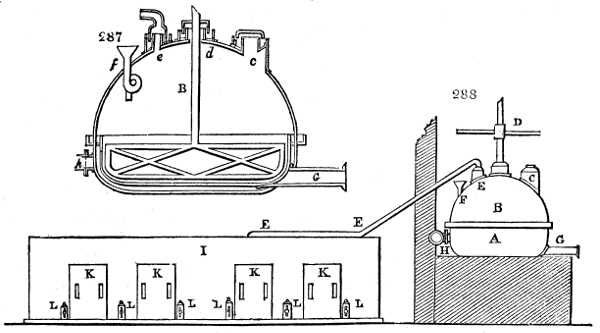
Fig. 287. represents a retort of lead, well adapted to the evolution of chlorine from the mixture of salt, manganese, and sulphuric acid, or from manganese and muriatic acid. The interior vessel is cast in lead, and it has round its bottom part a cast-iron steam case. The salt and manganese are introduced by the aperture C, and the sulphuric acid by the syphon funnel F. The contact of these three substances is continually renewed by the agitator or stirrer B, which consists of wrought or cast iron sheathed with lead. e is the gas discharge pipe. The residuums are drawn off by the bottom discharge pipe G. The heating case receives its steam by the pipe h.
The chlorine gas fig. 288. is conveyed from the retort B into the chamber I, by the tube E E E. This chamber is divided into four compartments, to receive the gas disengaged from four retorts, like the above. The bottom of it is covered with a stratum three or four inches thick of quicklime, newly slaked and sifted, which is stirred about from time to time, by the rakes L L L L. When the saturation is sufficient, the chloride of lime is taken out by the doors K K K K. The size of this apparatus allows 2 cwt. of manganese, and its equivalent quantity of salt and sulphuric acid, or of muriatic acid, to be introduced at once into the retort. D is the handle of the agitator.
The same form of retort will suit perfectly well to prepare chlorine for making liquid chloride of lime, which is preferred by many bleachers and calico-printers who have conveniences for preparing it themselves. The most concentrated solutions of the dry chloride of lime do not mark more than 6° B. (sp. grav. 1·04), and discolour only 50 volumes of Gay Lussac’s solution of indigo, whilst the chloride made in the humid way marks from 8° to 9° B. (about 1·060), and discolours 80 volumes of the same solution.
In the chloride of lime apparatus, most generally used by the skilful calico-printers of Mulhausen, the mixture of muriatic acid and manganese is put into glass globes, with long necks, heated upon a sand-bath. The chlorine is conveyed by glass tubes into a cylindrical stone cistern, containing milk of lime. The furnace of the sand baths is made of cast iron, and has brick partitions, to give each retort its own fire. The smoke of all these fires goes off by a flue into sheet iron pipes. The cistern is made of siliceous sandstone. Its cover is of wood, coated with a resinous cement; and it fits at its edges into grooves cut in the stone. A wheel serves to agitate the liquid continually; its paddles being kept at two inches distance from the sides of the cistern. The milk of lime is introduced by a funnel, and the chloride is drawn off by a discharge pipe. I think the lead retort and agitator used in this country greatly preferable to the experimental laboratory plan described above. In all such apparatus we should avoid giving any pressure to the tubes or vessels, and should not therefore dip the extremities of the gas pipes beneath the surface of the liquid, but rather facilitate the combination of the chlorine and the lime, by enlarging the surfaces of contact and by agitating. Intermediate vessels containing water, or the chemical cascade of M. Clement, are very useful for absorbing any muriatic acid which may be disengaged along with the chlorine, and thereby preventing the needless formation of muriate of lime in the chambers or cisterns of impregnation.
When the solution of the chloride of lime is mixed with hydrate of lime, it bears, without decomposing, a pretty high temperature, provided it be not too long continued; it may even, in certain cases, be raised to near the boiling point without suffering a marked loss of its discolouring power; but when the chloride is deprived of that excess of lime, it is decomposed in a short time, even at a heat of 110° F.
When chlorine is admitted to milk of lime, it infallibly produces some muriate of lime; but the quantity is kept at a minimum by constantly presenting an excess of lime to the gas with the agitator, and by keeping the temperature as low as possible. Hence the influx of gas should not be so rapid as to generate much heat. An automatic agitator, moved by steam or water power, is therefore much better than one driven by the hand of the operator, who is apt to intermit his labours. If the liquor becomes hot at the end of the process, it should be immediately drawn off into large stone bottles, and cooled. The rose-colour, which sometimes supervenes, is due to a minute quantity of manganese. The strongest liquid chloride of lime that can be prepared will not discolour more than 80 times its volume of Gay Lussac’s indigo test.
On acting upon cotton cloth with a concentrated solution of chloride of lime, at from 110° to 120° F., pure carbonic acid gas is disengaged, and the texture of the cloth is injured. Here the hydrogen of the water and the cotton being seized by the chlorine, the liberated oxygen combines with the carbon to form carbonic acid. In the discharge troughs where printed calicoes are passed through strong solutions of chloride of lime, stalactitic crusts of carbonate of lime come to be formed in this way.
The chlorometre of Gay Lussac consists of a test solution of indigo and a graduated tube. One part of the best indigo, passed through a silk sieve, is to be dissolved in nine parts of concentrated sulphuric acid, by the aid of a water-bath heat applied for six hours. The sulphate of indigo is now to be diffused through such a body of water that one volume of chlorine gas shall discolour exactly ten times its volume of this dilute solution. The test liquor should be protected from the agency of light.
Mr. Crum, of Thorniebank, near Glasgow, has lately modified Dr. Dalton’s copperas test for chloride of lime, and made it convenient to the practical man. The Doctor justly considered that the more chlorine any bleaching powder contains, the more of the green sulphate of iron will it convert into the red sulphate, so that we have only to add successive portions of the chloride to a given weight of the dissolved copperas, and note the point at which all the iron gets peroxidized. See Bleaching.
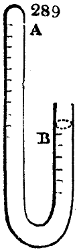
Besides the method of analysis already quoted from my memoir on the manufacture of the chloride of lime, another occurred to me long ago, which I often practised as an easy and expeditious test. Chlorine decomposes ammonia. If therefore water of ammonia, faintly tinged with litmus, be added slowly to a solution of a given weight of chloride of lime, the colour will continue to disappear till the chlorine be all neutralized by the reaction of the hydrogen of the ammonia. The quantity of liquid ammonia of a certain strength requisite to neutralize in this way, a certain volume, say, one cubic inch, or a thousand grain measures of chlorine gas, may be assumed as the standard of such a chlorometer. As chlorine or chloride of lime, when mixed with water of ammonia, causes the disengagement of azote, the quantity of this gas evolved may also be made the foundation of an accurate and convenient chlorometer. The two substances should be mixed over mercury, in a graduated syphon tube. The shut end A and the open end B are both graduated to one scale; for example, to hundredths of a cubic inch, or to grain or 10 grain measures. The tube is to be filled with mercury, and then 10 measures of it are to be displaced at the open end, by inserting a wooden plug. This space, being filled with the solution of chloride of lime, is to be turned up into the shut end by covering the open end with the finger, and inverting the tube; a few drops of water may be sent through to wash the mercury. The ammonia being now let up, will cause a reaction, and evolve a quantity of azote, equivalent to the chlorine present. The action may be quickened by holding the sealed end of the tube obliquely over a lamp heat. The mercury is protected from the chlorine by the ammonia; and should any notion be entertained of such an action, the ammonia may be let up first. I have made innumerable researches over mercury with a detached apparatus of that kind, which combines precision with rapidity of result. It was by a similar mercurial syphon that I analyzed the carbonates, as described in the first edition of my Dictionary of Chemistry, twenty-one years ago.
M. Gay Lussac takes, as the basis of his indigo chlorometer, the fact, that one pound of pure crystallized peroxide of manganese is capable of affording, with muriatic acid, 0·7964 parts of a pound of chlorine; or one kilogramme yields 2511⁄4 litres; that is, one pound yields 2511⁄4 pound measures. Hence 3·98 grammes of that manganese are capable of affording 1000 gramme measures, or 1 litre of chlorine; or, in round numbers, 4 grains will yield 1000 grain measures. This quantity of gas, being received into that volume of milk of lime, constitutes therefore Gay Lussac’s primary standard. The small retort in which the manganese and muriatic acid are put, ought to be heated to ebullition, to discharge every particle of chlorine. To prevent the manganese, in this experiment, from sticking to the bottom in a cake, it has been proposed to mix it previously with a little plumbago. See Chlorometry.
For preparing the chlorides of potash and soda, the same apparatus may be employed as for the liquid chloride of lime. The alkaline solutions should be weak, containing not more than a pound to the gallon of water. Potash liquor saturated with chlorine, is much employed at Paris for whitening linen, under the name of the water of Javelle, the place where it was first made as a manufacture. One hundred parts of chlorine are said to saturate 133 parts of pure potash, and 195 of the carbonate; but the latter should not be used for preparing the bleaching fluid, as the carbonic acid resists the combination of the chlorine. A chloride of carbonate of soda has been lately recommended as a disinfecting substance against contagious miasmata or fomites. One hundred parts of chlorine will saturate 150 of the dry carbonate, and 405 of the crystallized. M. Payen prepares this medicinal chloride by adding 138 parts of carbonate of soda to a liquid, consisting of water 1800, chloride of lime 100, at 98° of strength, by Gay Lussac’s standard. The chloride of lime is to be dissolved, and the sediment well washed; the carbonate of soda, dissolved by heat, is to be poured into the solution, the precipitate allowed to subside, the clear fluid decanted, and the solid matter washed upon a filter. The collected solutions are neutral chloride of soda. Sixty-two parts of the carbonate of soda are then to be dissolved in the remainder of the water, and added to the preparation; the whole being thus filtered, a limpid liquor is obtained, indicating 5° by the hydrometer of Baumé.
The chloride of magnesia was long ago proposed by Sir H. Davy for bleaching linen, as being preferable to chloride of lime, because the resulting muriate of magnesia was not injurious to the fibre of cloth, as muriate of lime may be, under certain circumstances. I prepared a quantity of chloride of magnesia, by exposing a hydrate of that earth in the chlorine chamber of a large manufactory of chloride of lime at Glasgow, and obtained a compound possessed of considerable discolouring powers; but I found that the chlorine was so feebly saturated by the base, that it destroyed the colours of fast-dyed calicoes as readily as chlorine gas or chlorine water did, and was therefore dangerous for common bleaching, and destructive in clearing the grounds of printed goods, which is one of the most valuable applications of the calcareous and alkaline chlorides. The occasion of my making these experiments was the importation of a considerable quantity of magnesite, or native atomic carbonate of magnesia, from the district of Madras, by an enterprising friend of mine. Encouraged by the encomiums bestowed on the chloride of magnesia by many chemical writers, he expected to have benefited both the country and himself, by bringing home the earthy base of that compound, at a moderate price; but was disappointed to his cost.
Dr. Thomson is of opinion that the bleaching compound of lime and chlorine is not a chloride of lime, but a combination of chlorous acid with lime and of chlorine with calcium; consisting in its most concentrated state of
3 atoms of chloride of calcium = 21
1 atom of chlorite of lime = 11
32
So that about one third of the weight is chlorite of lime, to which alone the bleaching powers of the substance are owing. He admits a fact, rather inconsistent with this opinion, that bleaching powder does not attract moisture from the atmosphere with nearly so much rapidity as might be expected from a mixture containing two thirds of its weight of so deliquescent a salt as muriate of lime; unless this indeed be prevented by the chloride and chlorite being united into a double salt, which is a mere conjecture without either proof or analogy. And further, when dilute sulphuric or muriatic acid is poured upon bleaching powder, a profusion of chlorine is given out immediately, which he also admits to be inconsistent with the notion of its being a mixture of chloride of calcium and chlorite of lime, for no such evolution takes place when the above acids are mixed with solutions of chloride of calcium and chlorate of potash. Though I am of opinion that bleaching powder is simply a chloride of lime, in which the lime corresponds to the water in the aqueous chlorine, yet I cannot see the truth or appositeness of his last reason, because chlorine is certainly given out when chlorate of potash is acted upon by dilute muriatic acid, as any man may prove by adding to a mixture of these two substances a vegetable colour; for it will be speedily blanched. Dr. Thomson considers the chloride which is at present made in Mr. Tennant’s great factory, as containing one atom of chlorine associated with one atom of lime, or, taking his numbers, as consisting of
Hydrate of lime 4 ·625
Chlorine 4 ·5
Or nearly equal weights of the chlorine and the base; indicating a surprising degree of excellence in the preparation. The average commercial samples of bleaching powder from different factories which I examined some years ago, did not possess nearly that strength; but varied in their quantity of chlorine from 20 to 28 per cent. In my synthetic experiments related above, the greatest quantity of chlorine that would combine with the atomic hydrate of lime, was in the proportion of 130 to 200; but there is no doubt that if the lime contains additional water, it will condense more gas. I have never seen a chloride of lime of the strength mentioned by Dr. Thomson, and I should think there must be some fallacy in his statements. I have recorded in the paper above quoted an experiment which proves that with additional moisture, a chloride of lime may be obtained of the following composition:—
Chlorine 39·5
Lime 39·9
Water 20·6
100·0
In the article Bleaching, of the Encyclopædia Britannica, Dr. Thomson deduces from a test trial of Mr. Crum, that the best bleaching powder is a compound of 1 atom chlorite of lime = 11, 3 atoms chloride of calcium = 21, and 8 atoms of water = 9. “But,” adds he, “in general the whole lime is not accurately saturated with chlorine. Accordingly, when the bleaching powder is dissolved in water a small residue almost always remains undissolved. Unless the powder be fresh made, a portion of chlorite is always converted into chloride of calcium. It is probable therefore that the best bleaching powder, as it comes into the hands of the bleachers, consists of
1 atom chlorite of lime 11
3 atoms chloride of calcium 21
6 atoms water 6 ·75
Impurity 2 ·25
41 ·00
“If we consider the bleaching powder as a compound of chlorine and lime, our mode of calculating will not be altered. Instead of 1 atom chlorite of lime, and 3 atoms chloride of calcium, we shall have 4 atoms chloride of lime, 6 atoms water, and 2·25 of impurity as before.” In such ambiguity does this able chemist place this interesting compound, for theoretical reasons, of which I cannot see the value. Surely there is no difficulty in conceiving chlorine to exercise a direct attractive force towards the hydrate of lime, as it is known to do towards each of its elementary constituents, the oxygen and the calcium. Such refinements as the preceding tend merely to mystify a plain matter. Even the chlorous acid here brought into play to form the ideal chlorite, is by his own admission a hypothetical being. “When chlorate of potash” says Dr. Thomson, “is mixed with sulphuric acid, and made into small balls the size of a pea, if we expose these balls to a heat somewhat lower than that of boiling water, a bright yellowish green gas separates, which may be received over mercury. Its smell is peculiar and aromatic. Water absorbs at least seven times its volume of it. It destroys vegetable blues. Its constituents are,
1 volume chlorine 2 ·5 or 4 ·5
2 volumes oxygen 2 ·222 or 4 .
Thus this compound consists in weight of chlorine 4·5, oxygen 4 = 8·5. It has been called quarteroxide of chlorine, but it is more probably a teroxide. It has been supposed by some to possess acid properties, and has therefore been called chlorous acid. But this is only as yet a hypothesis.”
Surely this by the Doctor’s own showing is very slender authority for renouncing our long-received doctrines concerning the constitution of bleaching powder. I shall conclude by remarking that the ultra-atomists are now in a dilemma about this substance; M. Welter, and many French chemists calling it a sub-chloride, of 1 atom of chlorine to 2 atoms of lime, and Dr. Thomson showing that Mr. Tennant, the greatest and best manufacturer of it, has produced it in the state of a chloride, or 1 atom of each. The fact is, in chloride of lime, as in water of ammonia, alcohol, and muriatic acid, there is no sufficient reason for definite proportion in any term short of saturation, and therefore we shall find that chloride in every gradation of strength from 1 per cent. of chlorine up to 40 per cent.—the strongest which I succeeded in preparing, though I passed a constant stream of chlorine in great excess over a pure hydrate of lime for upwards of 24 hours, with frequent renewal of the surface; indeed, till it refused to absorb any more gas, as indicated by its remaining stationary in weight.
CHLOROMETRY; Chlorometrie, is the name given by the French to the process for testing the decolouring power of any combination of chlorine, but especially of the commercial articles, the chlorides of lime, potash, and soda. M. Gay Lussac proposed many years ago the following graduated method of applying indigo to this purpose. As indigo varies much in its dyeing quality, and of consequence in the proportion of chlorine required for its decoloration, he assumes as the unity of blanching power, one litre of chlorine gas, measured at the mean pressure of 29·6 inches, and at the temperature of melting ice. This volume of gas, when combined with a determinate quantity of water, is employed to test the standard solution of indigo. For this purpose a solution in sulphuric acid of any sample of indigo is taken, and diluted with water to such a degree that 10 measures of it, in a graduated tube, are decoloured by that one measure of combined chlorine gas. Each measure of indigo solution so destroyed is called a degree, and this measure being divided into five parts, the real test of chlorine is given to fiftieths, which is sufficiently nice. For the standard of the assays, a chloride of lime as pure and fully saturated as possible is taken, and dissolved in such a quantity of water, that the solution shall contain, or be equivalent to, one volume of chlorine gas. Calculation proves that this condition is exactly fulfilled by dissolving 4938 grammes of the said chloride in half a litre of water; or in English measures, 5 gr. very nearly in 500 grain measures of water. This solution, which serves for a type, indicates 10° in the assay, or proof; that is to say, each single volume destroys the colour of 10 volumes of the dilute indigo solution. It may be remarked, that a greater degree of precision is in general attainable with a weak solution of chlorine or a chloride, for example at 4° or 5°, than with one much stronger; consequently if, after a preliminary trial, the standard considerably exceeds 10°, a given volume of water must be added to the solution, and then the above proof must be taken. If the volume of water added was double, the number of degrees afterwards found must be tripled, to obtain the true title of the chloride. It is, however, to be observed that the degree of decoloration varies with the time taken in making the mixture; the more slowly the chlorine is added to the indigo, the less of it escapes into the atmosphere, and the more effective it becomes in destroying the colour. The best mode of obtaining comparable results, is to pour suddenly into the test quantity of chlorine the whole volume of the indigo solution likely to be decoloured; but it is requisite to find approximately beforehand, what quantity of indigo-blue will probably be destroyed. When it comes to the verge of destruction, it is green; but yellowish-brown when entirely decomposed.
I have tried the indigo test in many ways, but never could confide in it. The sulphuric solution of indigo is very liable to change by keeping, and thus to lead to erroneous results. The method of testing the chlorides by green sulphate of iron, described under bleaching, is in my opinion preferable to the above.
M. Gay Lussac has recently proposed another proof of chlorine, founded on the same principle as that by green vitriol, namely, the quantity of it requisite to raise a metallic substance from a lower to a higher stage of oxidizement. He now prescribes as the preferable plan of chlorometry, to pour very slowly from a graduated glass tube, a standard solution of the chloride, to be tested upon a determinate quantity of arsenious acid dissolved in muriatic acid, till the whole arsenious be converted into the arsenic acid. The value of the chloride is greater the less of it is required to produce this effect. It is easy to recognize, by a few drops of solution of indigo, the instant when all the arsenious acid has disappeared; for then the blue tint is immediately effaced, and cannot be restored by the addition of a fresh drop of the indigo solution.
In graduating the arsenical chlorometer, M. Gay Lussac takes for his unity the decolouring power of one volume of chlorine at 32° Fahr., and divides it into 100 parts. Suppose that we prepare a solution of chlorine containing its own volume of the gas, and an arsenious solution, such, that under a like volume, the two solutions shall reciprocally destroy each other. Let us call the first, the normal solution of chlorine, and the second, the normal arsenious solution. We shall fix at 10 grammes the weight of chloride of lime subjected to trial; and dissolve it in water, so that the total volume of the solution shall be a litre (1000 grammes measure), including the sediment. If we take a constant volume of this solution, 10 centimetres cube (10 gramme measures), for example, divided into 100 equal parts, and pour into it gradually the arsenious solution (measured by like portions), till the chlorine be destroyed, the bleaching power will be proportional to the number of portions of the arsenious solution, which the chloride shall have required. If the chloride has destroyed 100 portions of the arsenious solution, its title will be 100; if it has destroyed 80 portions, its title will be 80, &c. and so forth.
On pouring the acidulous arsenious solution into the chloride of lime, this will become very acid; the chlorine will be emitted abundantly, and the proof will be quite incorrect. If, on the contrary, we pour the solution of the chloride of lime into the arsenious solution, this evil will not occur, since the chlorine will always find plenty of arsenious acid to act upon, whatever be the dilution of the one or the other; but in this case, the standard of the chlorine is not given directly, as it is in the inverse ratio of the number of portions which are required to destroy the measures of the arsenious solution. If 50 portions of the chloride have been required, the proof will be 100 × 10050 = 200°; if 200 have been required, the proof will be 100 × 100200 = 50°, &c. This evil is not, however, very serious, since we have merely to consult a table, in which we can find the proof corresponding to each volume of the chloride employed for destroying the constant measure of the arsenious solution. The arsenious solution should be slightly tinged with sulphate of indigo, so as to show, by the disappearance of the colour, the precise point or instant of its saturation with chlorine, that is, its conversion into arsenic acid. If the arsenious acid be pure, the normal solution may be made directly by dissolving 4·439 grammes of it in muriatic acid (free from sulphurous acid), and diluting the solution till it occupies one litre, or 1000 grammes measure. Annales de Chimie et Physique, LX. 225.
CHOCOLATE. Is an alimentary preparation of very ancient use in Mexico, from which country it was introduced into Europe by the Spaniards in the year 1520, and by them long kept a secret from the rest of the world. Linnæus was so fond of it, that he gave the specific name, theobroma, food of the gods, to the cacao tree which produced it. The cacao-beans lie in a fruit somewhat like a cucumber, about 5 inches long and 31⁄2 thick, which contains from 20 to 30 beans, arranged in 5 regular rows with partitions between, and which are surrounded with a rose-coloured spongy substance, like that of water-melons. There are fruits, however, so large as to contain from 40 to 50 beans. Those grown in the West India islands, Berbice and Demerara, are much smaller, and have only from 6 to 15; their development being less perfect than in South America. After the maturation of the fruit, when their green colour has changed to a dark yellow, they are plucked, opened, their beans cleared of the marrowy substance, and spread out to dry in the air. Like almonds, they are covered with a thin skin or husk. In the West Indies they are immediately packed up for the market when they are dried; but in the Caraccas they are subjected to a species of slight fermentation, by putting them into tubs or chests, covering them with boards or stones, and turning them over every morning, to equalize the operation. They emit a good deal of moisture, lose the natural bitterness and acrimony of their taste by this process, as well as some of their weight. Instead of wooden tubs, pits or trenches dug in the ground are sometimes had recourse to for curing the beans; an operation called earthing (terrer). They are lastly exposed to the sun, and dried. The latter kind are reckoned the best; being larger, rougher, of a darker brown colour, and, when roasted, throw off their husk readily, and split into several irregular fragments; they have an agreeable mild bitterish taste, without acrimony. The Guiana and West India sorts are smaller, flatter, smoother-skinned, lighter coloured, more sharp and bitter to the taste. They answer best for the extraction of the butter of cacao, but afford a less aromatic and agreeable chocolate. According to Lampadius, the kernels of the West India cacao beans contain, in 100 parts, besides water, 53·1 of fat or oil, 16·7 of an albuminous brown matter, which contains all the aroma of the bean, 10·91 of starch, 73⁄4 of gum or mucilage, 0·9 of lignine, and 2·01 of a reddish dye stuff somewhat akin to the pigment of cochineal. The husks form 12 per cent. of the weight of the beans; they contain no fat, but, besides lignine, or woody fibre, which constitutes half their weight, they yield a light brown mucilaginous extract by boiling in water. The fatty matter is of the consistence of tallow, white, of a mild agreeable taste, called butter of cacao, and not apt to turn rancid by keeping. It melts only at 122° Fahr., and should, therefore, make tolerable candles. It is soluble in boiling alcohol, but precipitates in the cold. It is obtained by exposing the beans to strong pressure in canvass bags, after they have been steamed or soaked in boiling water for some time. From 5 to 6 ounces of butter may be thus obtained from a pound of cacao. It has a reddish tinge when first expressed, but it becomes white by boiling with water.
The beans, being freed from all spoiled and mouldy portions, are to be gently roasted over a fire in an iron cylinder, with holes in its ends for allowing the vapours to escape; the apparatus being similar to a coffee-roaster. When the aroma begins to be well developed, the roasting is known to be finished; and the beans must be turned out, cooled, and freed by fanning and sifting from their husks. The kernels are then to be converted into a paste, either by trituration in a mortar heated to 130° F., or by the following ingenious and powerful machine. The chocolate paste has usually in France a little vanilla incorporated with it, and a considerable quantity of sugar, which varies from one third of its weight to equal parts. For a pound and a half of cacao, one pod of vanilla is sufficient. Chocolate paste improves in its flavour by keeping, and should therefore be made in large quantities at a time. But the roasted beans soon lose their aroma, if exposed to the air.
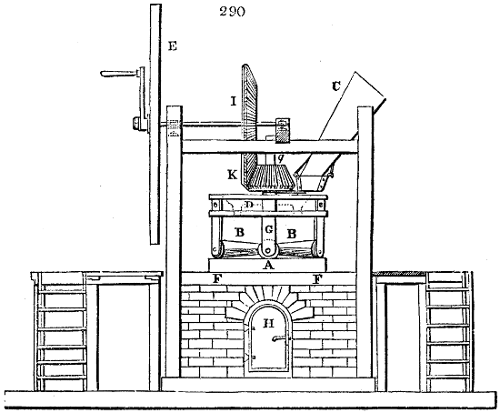
Fig. 290. represents the chocolate mill. Upon the sole A, made of marble, six conical rollers B B, are made to run by the revolution of the upright axis or shaft q, driven by the agency of the fly wheel E and bevel wheels I K. The sole A rests upon a strong iron plate, which is heated by a small stove, introduced at the door H. The wooden frame work F, forms a ledge, a few inches high, round the marble slab, to confine the cocoa in the act of trituration. C is the hopper of the mill through which the roasted beans are introduced to the action of the rollers, passing first into the flat vessel D to be thence evenly distributed. After the cacao has received the first trituration, the paste is returned upon the slab, in order to be mixed with the proper quantity of sugar, and vanilla, previously sliced and ground up with a little hard sugar. When the chocolate is sufficiently worked, and while it is thin with the heat and trituration, it must be put carefully into the proper moulds. If introduced too warm, it will be apt to become damp and dull on the surface; and, if too cold, it will not take the proper form. It must be previously well kneaded with the hands to ensure the expulsion of every air bubble.
In Barcelona, chocolate mills on this construction are very common, but they are turned by a horse-gin set to work in the under story, corresponding to H in the above figure. The shaft G is, in this case, extended down through the marble slab, and is surrounded at its centre with a hoop to prevent the paste coming into contact with it. Each of these horse-mills turns out about ten pounds of fine chocolate in the hour, from a slab two feet seven inches in diameter.
Chocolate is flavoured with cinnamon and cloves, in several countries, instead of the more expensive vanilla. In roasting the beans the heat should be at first very slow, to give time to the humidity to escape; a quick fire hardens the surface, and injures the process. In putting the paste into the tin plate, or other moulds, it must be well shaken down to insure its filling up all the cavities, and giving the sharp and polished impression so much admired by connoisseurs. Chocolate is sometimes adulterated with starch; in which case it will form a pasty consistenced mass when treated with boiling water. The harder the slab upon which the beans are triturated, the better; and hence porphyry is far preferable to marble. The grinding rollers of the mill should be made of iron, and kept very clean.
CHROMATES, saline compounds of chromic acid with the bases. See Chromium.
CHROMIC ACID; see Chromium.
CHROMIUM. The only ore of this metal, which occurs in sufficient abundance for the purposes of art, is the octohedral chrome-ore, commonly called chromate of iron, though it is rather a compound of the oxides of chromium and iron. The fracture of this mineral is uneven; its lustre imperfect metallic; its colour between iron-black and brownish-black, and its streak brown. Its specific gravity, in the purest state, rises to 4·5; but the usual chrome-ore found in the market varies from 3 to 4. According to Klaproth, this ore consists of oxide of chromium, 43; protoxide of iron, 34·7; alumina, 20·3; and silica, 2; but Vauquelin’s analysis of another specimen gave as above, respectively, 55·5, 33, 6, and 2. It is infusible before the blowpipe; but it acts upon the magnetic needle, after having been exposed to the reducing smoky flame. It is entirely soluble in borax, at a high blowpipe heat, and imparts to it a beautiful green colour.
Chrome-ore is found at the Bare Hills, near Baltimore, in Maryland; in the Shetland isles, Unst and Fetlar; the department of Var, in France, in small quantity; and near Portsoy, in Banffshire; as also in Silesia and Bohemia.
The chief application of this ore is to the production of chromate of potash, from which salt the various other preparations of this metal used in the arts are obtained. The ore, freed, as well as possible, from its gangue, is reduced to a fine powder, by being ground in a mill under ponderous edge-wheels, and sifted. It is then mixed with one third or one half its weight of coarsely bruised nitre, and exposed to a powerful heat, for several hours, on a reverberatory hearth, where it is stirred about occasionally. In the large manufactories of this country, the ignition of the above mixture in pots is laid aside, as too operose and expensive. The calcined matter is raked out, and lixiviated with water. The bright yellow solution is then evaporated briskly, and the chromate of potash falls down in the form of a granular salt, which is lifted out from time to time from the bottom with a large ladle, perforated with small holes, and thrown into a draining-box. This saline powder may be formed into regular crystals of neutral chromate of potash, by solution in water and slow evaporation; or it may be converted into a more beautiful crystalline body, the bichromate of potash, by treating its concentrated solution with nitric, muriatic, sulphuric, or acetic acid, or, indeed, any acid exercising a stronger affinity for the second atom of the potash than the chromic acid does.
Bichromate of potash, by evaporation of the above solution, and slow cooling, may be obtained in the form of square tables, with bevelled edges, or flat four-sided prisms. They are permanent in the air, have a metallic and bitter taste, and dissolve in about one tenth of their weight of water, at 60° F.; but in one half of their weight of boiling water. They consist of chromic acid 13, potash 6; or, in 100 parts, 68·4 + 31·6. This salt is much employed in calico-printing and in dyeing; which see.
Chromate of lead, the chrome-yellow of the painter, is a rich pigment of various shades, from deep orange to the palest canary yellow. It is made by adding a limpid solution of the neutral chromate (the above granular salt), to a solution, equally limpid, of acetate or nitrate of lead. A precipitate falls, which must be well washed, and carefully dried out of the reach of any sulphuretted vapours. A lighter shade of yellow is obtained by mixing some solution of alum, or sulphuric acid, with the chromate, before pouring it into the solution of lead; and an orange tint is to be procured by the addition of subacetate of lead, in any desired proportion.
For the production of chromate of potash from chrome ore, various other processes have been recommended. The following formulæ, which have been verified in practice, will prove useful to the manufacturers of this important article:—
I. Two parts of chrome ore, containing about 50 per cent. of protoxide of chromium:
One part of saltpetre.
II. Four parts of chrome ore, containing 34 per cent. of protoxide of chromium.
Two parts of potashes.
One part of saltpetre.
III. Four parts of chrome ore,cont—ining34per cent. of pro—
Two of potashes.
Four tenths of a part of peroxide of manganese.
IV. Three parts of chrome ore.
Four parts of saltpetre.
Two parts of argal.
Some manufacturers have contrived to effect the conversion of the oxide into an acid, and of course to form the chromate of potash, by the agency of potash alone, in a calcining furnace, or in earthen pots fired in a pottery kiln.
After lixiviating the calcined mixtures with water, if the solution be a tolerably pure chromate of potash, its value may be inferred, from its specific gravity, by the following table:—
At specific gravity 1·28 it contains about 50 per cent. of the salt.
1·21 33
1·18 25
1·15 20
1·12 16
1·11 14
1·10 12
In making the red bichromate of potash from these solutions of the yellow salt, nitric acid was at first chiefly used; but, in consequence of its relatively high price, sulphuric, muriatic or acetic acid has been frequently substituted upon the great scale.
There is another application of chrome which merits some notice here; that of its green oxide to dyeing and painting on porcelain. This oxide may be prepared by decomposing, with heat, the chromate of mercury, a salt made by adding to nitrate of protoxide of mercury, chromate of potash, in equivalent proportions. This chromate has a fine cinnabar red, when pure; and, at a dull red heat, parts with a portion of its oxygen and its mercurial oxide. From M. Dulong’s experiments it would appear, that the purest chromate of mercury is not the best adapted for preparing the oxide of chrome to be used in porcelain painting. He thinks it ought to contain a little oxide of manganese and chromate of potash, to afford a green colour of a fine tint, especially for pieces that are to receive a powerful heat. Pure oxide of chrome preserves its colour well enough in a muffle furnace; but, under a stronger fire, it takes a dead-leaf colour.
The green oxide of chrome has come so extensively into use as an enamel colour for porcelain, that a fuller account of the best modes of manufacturing it must prove acceptable to many of my readers.
That oxide, in combination with water, called the hydrate, may be economically prepared by boiling chromate of potash, dissolved in water, with half its weight of flowers of sulphur, till the resulting green precipitate ceases to increase, which may be easily ascertained by filtering a little of the mixture. The addition of some potash accelerates the operation. This consists in combining the sulphur with the oxygen of the chromic acid, so as to form sulphuric acid, which unites with the potash of the chromate into sulphate of potash, while the chrome oxide becomes a hydrate. An extra quantity of potash facilitates the deoxidizement of the chromic acid by the formation of hyposulphite and sulphuret of potash, both of which have a strong attraction for oxygen. For this purpose the clear lixivium of the chromate of potash is sufficiently pure, though it should hold some alumina and silica in solution, as it generally does. The hydrate may be freed from particles of sulphur by heating dilute sulphuric acid upon it, which dissolves it; after which it may be precipitated, in the state of a carbonate, by carbonate of potash, not added in excess.
By calcining a mixture of bichromate of potash and sulphur in a crucible, chromic acid is also decomposed, and a hydrated oxide may be obtained; the sulphur being partly converted into sulphuret of potassium, and partly into sulphuric acid (at the expense of the chromic acid), which combines with the rest of the potash into a sulphate. By careful lixiviation, these two new compounds may be washed away, and the chrome green may be freed from the remaining sulphur, by a slight heat.
Liebig and Wöhler have lately contrived a process for producing a subchromate of lead of a beautiful vermillion hue. Into saltpetre, brought to fusion in a crucible at a gentle heat, pure chrome yellow is to be thrown by small portions at a time. A strong ebullition takes place at each addition, and the mass becomes black, and continues so while it is hot. The chrome yellow is to be added till little of the saltpetre remains undecomposed, care being taken not to overheat the crucible, lest the colour of the mixture should become brown. Having allowed it to settle for a few minutes, during which the dense basic salt falls to the bottom, the fluid part, consisting of chromate of potash and saltpetre, is to be poured off, and it can be employed again in preparing chrome yellow. The mass remaining in the crucible is to be washed with water, and the chrome red being separated from the other matters, is to be dried after proper edulcoration. It is essential for the beauty of the colour, that the saline solution should not stand long over the red powder, because the colour is thus apt to become of a dull orange hue. The fine crystalline powder subsides so quickly to the bottom after every ablution, that the above precaution may be easily observed.
As Chromic Acid will probably ere long become an object of interest to the calico printer, I shall describe here the best method of preparing it. To 100 parts of yellow chromate of potash, add 136 of nitrate of barytes, each in solution. A precipitate of the yellow chromate of barytes falls, which being washed and dried would amount to 130 parts. But while still moist it is to be dissolved in water by the intervention of a little nitric acid, and then decomposed by the addition of the requisite quantity of sulphuric acid, whereby the barytes is separated, and the chromic acid remains associated with the nitric acid, from which it can be freed by evaporation to dryness. On re-dissolving the chromic acid residuum in water, filtering and evaporating to a proper degree, 50 parts of chromic acid may be obtained in crystals.
This acid may also be obtained from chromate of lime, formed by mixing chromate of potash and muriate of lime; washing the insoluble chromate of lime which precipitates, and decomposing it by the equivalent quantity of oxalic acid, or for ordinary purposes even sulphuric acid may be employed.
Chromic acid is obtained in quadrangular crystals, of a deep red colour; it has a very acrid and styptic taste. It reddens powerfully litmus paper. It is deliquescent in the air. When heated to redness, it emits oxygen and passes into the deutoxide. When a little of it is fused along with vitreous borax, the compound assumes an emerald green colour.
As chromic acid parts with its last dose of oxygen very easily, it is capable in certain styles of calico printing of becoming a valuable substitute for chlorine where this more powerful substance would not from peculiar circumstances be admissible. For this ingenious application, the arts are indebted to that truly scientific manufacturer, M. Daniel Kœchlin, of Mulhouse. He discovered that whenever chromate of potash has its acid set free by its being mixed with tartaric or oxalic acid, or a neutral vegetable substance, (starch or sugar for example), and a mineral acid, a very lively action is produced, with disengagement of heat, and of several gases. The result of this decomposition is the active reagent, chromic acid, possessing valuable properties to the printer. Watery solutions of chromate of potash and tartaric acid being mixed, an effervescence is produced which has the power of destroying vegetable colours. But this power lasts no longer than the effervescence. The mineral acids react upon the chromate of potash only when vegetable colouring matter, gum, starch, or a vegetable acid are present, to determine the disengagement of gas. During this curious change carbonic acid is evolved; and when it takes place in a retort, there is condensed in the receiver a colourless liquid, slightly acid, exhaling somewhat of the smell of vinegar, and containing a little empyreumatic oil. This liquid heated with the nitrates of mercury or silver reduces these metals. On these principles M. Kœchlin discharged indigo blue by passing the cloth through a solution of chromate of potash, and printing nitric acid thickened with gum upon certain spots. It is probable that the employment of chromic acid would supersede the necessity of having recourse in many cases to the more corrosive chlorine.
The following directions have been given for the preparation of a blue oxide of chrome. The concentrated alkaline solution of chromate of potash is to be saturated with weak sulphuric acid, and then to every 8 lbs. is to be added 1 lb. of common salt, and half-a-pound of concentrated sulphuric acid; the liquid will now acquire a green colour. To be certain that the yellow colour is totally destroyed, a small quantity of the liquor is to have potash added to it, and filtered; if the fluid is still yellow, a fresh portion of salt and of sulphuric acid is to be added: the fluid is then to be evaporated to dryness, redissolved, and filtered; the oxide of chrome is finally to be precipitated by caustic potash. It will be of a greenish-blue colour, and being washed, must be collected upon a filter.
Chromate of Potash, adulteration of, to detect. The chromate of potash has the power of combining with other salts up to a certain extent without any very sensible change in its form and appearance; and hence it has been sent into the market falsified by very considerable quantities of sulphate and muriate of potash, the presence of which has often escaped observation, to the great loss of the dyers who use it so extensively. The following test process has been devised by M. Zuber, of Mulhouse. Add a large excess of tartaric acid to the chromate in question, which will decompose it, and produce in a few minutes a deep amethyst colour. The supernatant liquor will, if the chromate be pure, afford now no precipitate with the nitrates of barytes or silver; whence the absence of the sulphates and muriates may be inferred. We must, however, use dilute solutions of the chromate and acid, lest bitartrate of potash be precipitated, which will take place if less than 60 parts of water be employed. Nor must we test the liquid till the decomposition be complete, and till the colour verge rather towards the green than the yellow. Eight parts of tartaric acid should be added to one of chromate to obtain a sure and rapid result. If nitrate of potash (saltpetre) is the adulterating ingredient, it may be detected by throwing it on burning coals, when deflagration will ensue. The green colour is a certain mark of the transformation of the chromic acid partially into the chrome oxide; which is effected equally by the sulphurous acid and sulphuretted hydrogen. Here this metallic acid is disoxygenated by the tartaric, as has been long known. The tests which I should prefer, are the nitrates of silver and baryta, having previously added so much nitric acid to the solution of the suspected chromate, as to prevent the precipitation of the chromate of silver or baryta. The smallest adulteration by sulphates or muriates will thus be detected.
CINNABAR; the native red sulphuret of mercury. It occurs sometimes crystallized in rhomboids; has a specific gravity varying from 6·7 to 8·2; a flat conchoidal fracture; is fine grained; opaque; has an adamantine lustre, and a colour passing from cochineal to ruby red. The fibrous and earthy cinnabar has a scarlet hue. It is met with disseminated in smaller or larger lumps in veins, which are surrounded by a black clay, and is associated with native quicksilver, amalgam with iron-ore, lead-glance, blende, copper-ore, gold, &c. Its principal localities are Almaden in Spain, Idria in the Schiefergebirge, Kremnitz and Schemnitz in Hungary; in Saxony, Bavaria, Bohemia, Nassau, China, Japan, Mexico, Columbia, Peru. It consists of two primes of sulphur, = 32·240, combined with one of mercury, = 202,863; or in 100 parts of 12·7 sulphur + 87·3 mercury. It is the most prolific ore of this metal; and is easily smelted by exposing a mixture of it with iron or lime to a red heat in retorts. Factitious cinnabar is called in commerce Vermillion, which see, as also Mercury.
CINNAMON. (Cannelle, Fr.; Zimmt, Germ.) Is the inner bark of the laurus cinnamomum, a handsome-looking tree, which grows naturally to the height of 18 or 20 feet, in Java, Sumatra, Ceylon, and other islands in the East Indian seas. It has been transplanted to the Antilles, particularly Guadaloupe and Martinique, as well as Cayenne, but there it produces a bark of very inferior value to the Oriental.
Cinnamon is gathered twice a year, but not till after the tree has attained to a certain age and maturity. The young twigs yield a bark of better quality than the larger branches. The first and chief harvest takes place from April to August; the second, from November to January. After having selected the proper trees, all the branches more than three years old are cut off; the epidermis is first removed with a two-edged pruning knife, then a longitudinal incision is made through the whole extent of the bark, and lastly, with the bluntest part of the knife, the true bark is carefully stripped off in one piece. All these pieces of bark are collected, the smaller ones are laid within the larger, and in this state they are exposed to the sun, whereby in the progress of drying, they become rolled into the shape of a quill. These convoluted pieces are formed into oblong bundles of 20 or 30 lbs. weight, which are placed in warehouses, sorted and covered with mats. Good cinnamon should be as thin as paper, have its peculiar aromatic taste, without burning the tongue, and leave a sweetish flavour in the mouth. The broken bits of cinnamon are used in Ceylon for procuring the essential oil by distillation. 445,367 lbs. of cinnamon were imported into this kingdom in 1835, of which 16,604 only were retained for internal consumption.
CITRIC ACID. (Acide citrique, Fr.; Citronensäure, Germ.) Scheele first procured this acid in its pure state from lemon juice, by the following process. The juice put into a large tub, is to be saturated with dry chalk in fine powder, noting carefully the quantity employed. The citrate of lime which precipitates being freed from the supernatant foul liquor, is to be well washed with repeated affusion and decantation of water. For every 10 pounds of chalk employed, nine and a half pounds of sulphuric acid, diluted with six times its weight of water, are to be poured while warm upon the citrate of lime, and well mixed with it. At the end of twelve hours, or even sooner, the citrate will be all decomposed, dilute citric acid will float above, and sulphate of lime will be found at the bottom. The acid being drawn off, the calcareous sulphate must be thrown on a canvass filter, drained, and then washed with water to abstract the whole acid.
The citric acid thus obtained may be evaporated in leaden pans, over a naked fire till it acquires the specific gravity 1·13; after which it must be transferred into another vessel, evaporated by a steam or water bath till it assumes a syrupy aspect, when a pellicle appears first in patches, and then over the whole surface. This point must be watched with great circumspection, for if it be passed, the whole acid runs a risk of being spoiled by carbonization. The steam or hot water must be instantly withdrawn, and the concentrated acid put into a crystallizing vessel in a dry, but not very cold apartment. At the end of four days, the crystallization will be complete. The crystals must be drained, re-dissolved in a small portion of water, the solution set aside to settle its impurities, then decanted, re-evaporated, and re-crystallized. A third or fourth crystallization may be necessary to obtain a colourless acid.
If any citrate of lime be left undecomposed by the sulphuric acid, it will dissolve in the citric acid, and obstruct its crystallization, and hence it will be safer to use the slightest excess of sulphuric acid, than to leave any citrate undecomposed. There should not however be any great excess of sulphuric acid. If there be, it is easily detected by nitrate of barytes, but not by the acetate of lead as prescribed by some chemical authors; because the citrate of lead is not very soluble in the nitric acid, and might thus be confounded with the sulphate, whereas citrate of barytes is perfectly soluble in that test acid. Sometimes a little nitric acid is added with advantage to the solution of the coloured crystals, with the effect of whitening them.
Twenty gallons of good lemon juice will afford fully ten pounds of white crystals of citric acid.
Attempts were made both in the West Indies and Sicily, to convert the lime and lemon juice into citrate of lime, but they seem to have failed through the difficulty of drying the citrate for shipment.
The crystals of citric acid are oblique prisms with four faces, terminated by dihedral summits, inclined at acute angles. Their specific gravity is 1·617. They are unalterable in the air. When heated, they melt in their water of crystallization; and at a higher heat, they are decomposed. They contain 18 per cent. of water, of which one half may be separated in a dry atmosphere, at about 100° F., when the crystals fall into a white powder.
Citric acid in crystals is composed by my analysis of carbon, 35·8, oxygen 59·7, and hydrogen 45; results which differ very little from those of Dr. Prout, subsequently obtained. I found its atomic weight to be 8·375, compared to oxygen 1,000. I cannot account for Berzelius’s statements relative to the composition of this acid.
Citric acid in somewhat crude crystals is employed with much advantage in calico-printing. If adulterated with tartaric acid, the fraud may be detected by adding potash to the solution of the acid, which will occasion a precipitate of cream of tartar.
CIVET. (Civette, Fr.; Zibeth, Germ.) This substance approaches in smell to musk and ambergris; it has a pale yellow colour, a somewhat acrid taste, a consistence like that of honey, and a very strong aromatic odour. It is the product of two small quadrupeds of the genus viverra (v. zibetha and v. civetta), of which the one inhabits Africa, the other Asia. They are reared with tenderness, especially in Abyssinia. The civet is contained in a sac, situated between the anus and the parts of generation, in either sex. The animal frees itself from an excess of this secretion by a contractile movement which it exercises upon the sac, when the civet issues in a vermicular form, and is carefully collected. The negroes are accustomed to increase the secretion by irritating the animal; and likewise introduce a little butter, or other grease, by the natural slit in the bag, which mixes with the odoriferous substance, and increases its weight. It is employed only in perfumery.
According to M. Boutron-Chalard, it contains a volatile oil, to which it owes its smell, some free ammonia, resin, fat, an extractiform matter, and mucus. It affords, by calcination, an ash, in which there are some carbonate and sulphate of potash, phosphate of lime, and oxide of iron.