S. (continued 8)
Reading edition
M. Clement-Desormes demonstrated the proposition relative to the influence of temperature by a decisive experiment. He took a glass globe, furnished with three tubulures, and put a bit of ice into it. Through the first opening he then introduced sulphurous acid gas; through the second, oxygen; and through the third, nitrous gas (deutoxide of azote). While the globe was kept cool, by being plunged in iced water, no sulphuric acid was formed, though all the ingredients essential to its production were present. But on exposing the globe to a temperature of 100° Fahr., the four bodies began immediately to react on each other, and oil of vitriol was condensed in visible striæ.
The introduction of steam is a modern invention, which has vastly facilitated and increased the production of oil of vitriol. It serves, by powerful agitation, not only to mix the different gaseous molecules intimately together, but to impel them against each other, and thus bring them within the sphere of their mutual chemical attraction. This is its mechanical effect. Its chemical agency is still more important. By supplying moisture at every point of the immense included space, it determines the formation of hydrous sulphuric acid, from the compound of nitric, nitrous, sulphurous, and dry sulphuric acids. No sooner is this reaction accomplished, than the nitrous gas resumes its oxygen, from the continuous atmospherical current, and becomes again fit to operate a like round of transmutations with sulphurous acid, steam, and oxygen. The nitrogen (azote), which ought to be the only residuum in a perfectly regulated vitriol chamber, escapes, by its relative lightness, at the opening c, in the roof, or, more properly speaking, is displaced by the influx of the heavier gases at the entrance-pipe.
On the intermittent plan, after the consumption of each charge, and condensation of the product, the chamber was opened, and freely ventilated, so as to expel the residuary azote, and replenish it with fresh atmospheric air. In this system there were four distinct stages or periods:—1. Combustion for two hours; 2. Admission of steam, and settling, for an hour and a half; 3. Conversion, for three hours, during which interval the drops of strong acid were heard falling like heavy hailstones on the bottom; 4. Purging of the chamber, for three quarters of an hour.
By the continuous method, sulphuric acid may be currently obtained in the chambers, of the specific gravity 1·350, or 1·450 at most; for, when stronger, it absorbs and retains permanently much nitrous acid gas; but by the intermittent, so dense as 1·550, or even 1·620; whence in a district where fuel is high priced, as near Paris, this method recommended itself by economy in the concentration of the acid. In Great Britain, and even in most parts of France, however, where time, workmen’s wages, and interest of capital, are the paramount considerations, manufacturers do not find it for their interest in general to raise the density of the acid in the chambers above 1·400, or at most 1·500; as the further increase goes on at a retarded rate, and its concentration from 1·400 to 1·600, in leaden pans, costs very little.
At about the specific gravity of 1·35, in Great Britain, the liquid of the chambers is run off, by the syphon above described, into a leaden gutter or spout, which discharges it into a series of rectangular vessels made of large sheets of lead, of 12 or 14 lbs. to the square foot, simply folded up at the angles into pans 8 or 10 inches deep, resting upon a grate made of a pretty close row of wrought-iron bars of considerable strength, under which the flame of a furnace plays. Where coals are very cheap, each pan may have a separate fire; but where they are somewhat dear, the flame, after passing under the lowest pan of the range, which contains the strongest acid (at about 1·600), proceeds upwards with a slight slope to heat the pans of weaker acid, which, as it concentrates, is gradually run down by syphons to replenish the lower pans, in proportion as their aqueous matter is dissipated. The 3 or 4 pans constituting the range are thus placed in a straight line, but each at a different level, terrace-like; en gradins, as the French say.
When the acid has thereby acquired the density of 1·650, or 1·700 at most, it must be removed from the leaden evaporators, because, when of greater strength, it would begin to corrode them; and it is transferred into leaden coolers, or run through a long refrigeratory worm-pipe surrounded by cold water. In this state it is introduced into glass or platinum retorts, to undergo a final concentration, up to the specific gravity of 1·842, or even occasionally 1·845, in consequence of slight saline impurities. When glass retorts are used, they are set in a long sand-bath over a gallery furnace, resting on fire tiles, under which a powerful flame plays; and as the flue gradually ascends from the fireplace, near to which it is most distant from the tiles; to the remoter end, the heat acts with tolerable equality on the first and last retort in the range. When platinum stills are employed, they are fitted into the inside of cast-iron pots, which protect the thin bottom and sides of the precious metal. The fire being applied directly to the iron, causes a safe, rapid, and economical concentration of the acid. The iron pots, with their platinum interior, filled with concentrated boiling-hot oil of vitriol, are lifted out of the fire-seat by tackle, and let down into a cistern of cold water, to effect the speedy refrigeration of the acid, and facilitate its transvasion into carboys packed in osier baskets lined with straw. Sometimes, however, the acid is cooled by running it slowly off through a long platinum syphon, surrounded by another pipe filled with cold water. Fig. 1102. shows my contrivance for this purpose.
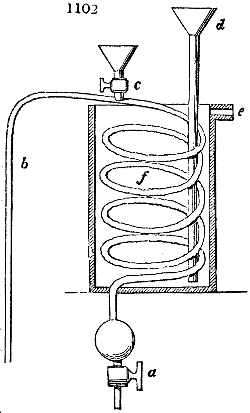
The under stopcock a, being shut, and the leg b, being plunged to nearly the bottom of the still, the worm is to be filled with concentrated cold acid through the funnel c. If that stopcock is now shut, and a opened, the acid will flow out in such quantity as to rarefy the small portion of air in the upper part of the pipe b, sufficiently to make the hot acid rise up over the bend, and set the syphon in action. The flow of the fluid is to be so regulated by the stopcock a, that it may be greatly cooled in its passage by the surrounding cold water in the vessel f, which may be replenished by means of the tube and funnel d, and overflow at e.
A manufacturer of acid in Scotland, who burns in each chamber 210 pounds of sulphur in 24 hours, being at the rate of 420 pounds for 20,000 cubic feet (= nearly 2000 metres cube) has a product of nearly 3 pounds of concentrated oil of vitriol for every pound of sulphur and twelfth of a pound of nitre. The advantage of his process results, I conceive, from the lower concentration of the acid in the chambers, which favours its more rapid production.
The platinum retort admits of from 4 to 6 operations in a day, when it is well mounted and managed. It has a capital of platinum, furnished with a short neck, which conducts the disengaged vapours into a lead worm of condensation; and the liquid thus obtained is returned into the lead pans. Great care must be taken to prevent any particles of lead from getting into the platinum vessel, since at the temperature of boiling sulphuric acid, the lead unites with the precious metal, and thus causes holes in the retort. These must be repaired by soldering-on a plate of platinum with gold.
Before the separate oven or hearth for burning the sulphur in contact with the nitre was adopted, this combustible mixture was introduced into the chamber itself, spread on iron trays or earthen pans, supported above the water on iron stands. But this plan was very laborious and unproductive. It is no longer followed.
One of the characters of the good quality of sulphuric acid, is its dissolving indigo without altering its fine blue colour.
Sulphuric acid, when well prepared, is a colourless and inodorous liquid, of an oily aspect, possessing a specific gravity, in its most concentrated state, of 1·842, when redistilled, but as found in commerce, of 1·845. It is eminently acid and corrosive, so that a single drop will communicate the power of reddening litmus to a gallon of water, and will produce an ulcer of the skin when allowed to remain upon it. If swallowed in its strongest state, in even a small quantity, it acts so furiously on the throat and stomach as to cause intolerable agony and speedy death. Watery diluents, mixed with chalk or magnesia, are the readiest antidotes. At a temperature of about 600° F., or a few degrees below the melting point of lead, it boils and distils over like water. This is the best method of procuring sulphuric acid free from the saline and metallic matters with which it is sometimes contaminated.
The affinity of sulphuric acid for water is so strong that, when exposed in an open saucer, it imbibes one-third of its weight from the atmosphere in 24 hours, and fully six times its weight in a few months. Hence it should be kept excluded from the air. If four parts, by weight, of the strongest acid be suddenly mixed with one part of water, both being at 50° F., the temperature of the mixture will rise to 300°; while, on the other hand, if four parts of ice be mixed with one of sulphuric acid, they immediately liquefy and sink the thermometer to 4° below zero. From the great attraction existing between this acid and water, a saucer of it is employed to effect the rapid condensation of aqueous vapour as it exhales from a cup of water placed over it; both standing under the exhausted receiver of an air-pump. By the cold produced by this unchecked evaporation in vacuo, the water is speedily frozen.
To determine the purity of sulphuric acid, let it be slowly heated to the boiling point of water, and if any volatile acid matter be present, it will evaporate, with its characteristic smell. The presence of saline impurity, which is the common one, is discovered by evaporating a given weight of it in a small capsule of platinum placed on red-hot cinders. If more than two grains remain out of 500, the acid may be reckoned to be impure. The best test for sulphuric acid, and the soluble salts into which it enters, is the nitrate of baryta, of which 182 parts are equivalent to 49 of the strongest liquid acid, or to 40 of the dry, as it exists in crystallized sulphate of potassa. One twenty thousandth part of a grain of the acid may be detected by the grayish-white cloud which baryta forms with it. 100 parts of the concentrated acid are neutralized by 143 parts of dry carbonate of potassa, and by 110 of dry carbonate of soda, both perfectly pure.
Of all the acids, the sulphuric is most extensively used in the arts, and is, in fact, the primary agent for obtaining almost all the others, by disengaging them from their saline combinations. In this way, nitric, muriatic, tartaric, acetic, and many other acids, are procured. It is employed in the direct formation of alum, of the sulphates of copper, zinc, potassa, soda; in that of sulphuric ether, of sugar by the saccharification of starch, and in the preparation of phosphorus, &c. It serves also for opening the pores of skins in tanning, for clearing the surfaces of metals, for determining the nature of several salts by the acid characters that are disengaged, &c.
According to the analysis of Dr. Thomson, the crystalline compound deposited occasionally in the leaden chambers above described consists of—
Sulphurous acid 0·6387, or 3 atoms.
Sulphuric acid 0·5290, 2
Nitric acid 0·3450, 1 atom.
Water 0·0733, 1
Sulphate of lead 0·0140.
He admits that the proportion of water is a little uncertain; and that the presence of sulphurous acid was not proved by direct analysis. When heated with water, the crystalline matter disengages nitrous gas in abundance; lets fall some sulphate of lead; and the liquid is found to be sulphuric acid. When heated without water, it is decomposed with emission of nitrous gas and fuming nitric acid; leaving a liquid which, mixed with water, produces a brisk effervescence, consisting chiefly of nitrous gas.
The following Table shows the quantity of concentrated and dry sulphuric acid in 100 parts of dilute, at different densities, by my experiments, published in the Quarterly Journal of Science, for October, 1817:—
Liquid. Sp. grav. Dry.
100 1 ·8460 81 ·54
99 1 ·8438 80 ·72
98 1 ·8415 79 ·90
97 1 ·8391 79 ·09
96 1 ·8366 78 ·28
95 1 ·8340 77 ·46
94 1 ·8288 76 ·65
93 1 ·8235 75 ·83
92 1 ·8181 75 ·02
91 1 ·8026 74 ·20
90 1 ·8070 73 ·39
89 1 ·7986 72 ·57
88 1 ·7901 71 ·75
87 1 ·7815 70 ·94
86 1 ·7728 70 ·12
85 1 ·7640 69 ·31
84 1 ·7540 68 ·49
83 1 ·7425 67 ·68
82 1 ·7315 66 ·86
81 1 ·7200 66 ·05
80 1 ·7080 65 ·23
79 1 ·6972 64 ·42
78 1 ·6860 63 ·60
77 1 ·6744 62 ·78
76 1 ·6624 61 ·97
75 1 ·6500 61 ·15
74 1 ·6415 60 ·34
73 1 ·6321 59 ·52
72 1 ·6204 58 ·71
71 1 ·6090 57 ·89
70 1 ·5975 57 ·08
69 1 ·5868 56 ·26
68 1 ·5760 55 ·45
67 1 ·5648 54 ·63
66 1 ·5503 53 ·82
65 1 ·5390 53 ·00
64 1 ·5280 52 ·18
63 1 ·5170 51 ·37
62 1 ·5066 50 ·55
61 1 ·4960 49 ·74
60 1 ·4860 48 ·92
59 1 ·4760 48 ·11
58 1 ·4660 47 ·29
57 1 ·4560 46 ·48
56 1 ·4460 45 ·66
55 1 ·4360 44 ·85
54 1 ·4265 44 ·03
53 1 ·4170 43 ·22
52 1 ·4073 42 ·40
51 1 ·3977 41 ·58
50 1 ·3884 40 ·77
49 1 ·3788 39 ·95
48 1 ·3697 39 ·14
47 1 ·3612 38 ·32
46 1 ·3530 37 ·51
45 1 ·3440 36 ·69
44 1 ·3345 35 ·88
43 1 ·3255 35 ·06
42 1 ·3165 34 ·25
41 1 ·3080 33 ·43
40 1 ·2999 32 ·61
39 1 ·2913 31 ·80
38 1 ·2826 30 ·98
37 1 ·2740 30 ·17
36 1 ·2654 29 ·35
35 1 ·2572 28 ·54
34 1 ·2490 27 ·72
33 1 ·2409 26 ·91
32 1 ·2334 26 ·09
31 1 ·2260 25 ·28
30 1 ·2184 24 ·46
29 1 ·2108 23 ·65
28 1 ·2032 22 ·83
27 1 ·1956 22 ·01
26 1 ·1876 21 ·20
25 1 ·1792 20 ·38
24 1 ·1706 19 ·57
23 1 ·1626 18 ·75
22 1 ·1549 17 ·94
21 1 ·1480 17 ·12
20 1 ·1410 16 ·31
19 1 ·1330 15 ·49
18 1 ·1246 14 ·68
17 1 ·1165 13 ·86
16 1 ·1090 13 ·05
15 1 ·1019 12 ·23
14 1 ·0953 11 ·41
13 1 ·0887 10 ·60
12 1 ·0809 9 ·78
11 1 ·0743 8 ·97
10 1 ·0682 8 ·15
9 1 ·0614 7 ·34
8 1 ·0544 6 ·52
7 1 ·0477 5 ·71
6 1 ·0405 4 ·89
5 1 ·0336 4 ·08
4 1 ·0268 3 ·26
3 1 ·0206 2 ·446
2 1 ·0140 1 ·63
1 1 ·0074 0 ·8154
SUMACH (Eng. and Fr.; Schmack, Germ.); is the powder of the leaves, peduncles, and young branches of the Rhus coriaria, and Rhus cotinus, shrubs which grow in Hungary, the Bannat, and the Illyrian provinces. Both kinds contain tannin, with a little yellow colouring-matter, and are a good deal employed for tanning light-coloured leathers; but the first is the best. With mordants, it dyes nearly the same colours as galls. In calico-printing, sumach affords, with a mordant of tin, a yellow colour; with acetate of iron, weak or strong, a gray or black; and with sulphate of zinc, a brownish-yellow. A decoction of sumach reddens litmus paper strongly; gives white flocks with the protomuriate of tin; pale-yellow flocks with alum; blue flocks with red sulphate of iron, with an abundant precipitate. In the south of France, the twigs and leaves of the Coriaria myrthifolia are used for dyeing, under the name of rédoul, or rodou.
SWEEP-WASHER, is the person who extracts from the sweepings, potsherds, &c., of refineries of silver and gold, the small residuum of precious metal.
SYNTHESIS, is a Greek word, which signifies combination, and is applied to the chemical action which unites dissimilar bodies into a uniform compound; as sulphuric acid and lime, into gypsum; or chlorine and sodium, into culinary salt.
SYRUP, is a solution of sugar in water. Cane-juice, concentrated to a density of 1·300, forms a syrup which does not ferment in the transport home from the West Indies, and may be boiled and refined at one step into superior sugar-loaves, with eminent advantage to the planter, the refiner, and the revenue.