S.
Reading edition
SAFETY LAMP. I have reserved for this place an account of the patented improvement made upon Davy’s lamp by Messrs. Upton and Roberts; the latter of whom, having worked in coal mines from a boy, and having observed, that in peculiar circumstances, the Davy was insecure, was led to contrive certain modifications of it, for which he received, some years ago, a reward from the Society of Arts. It appears from undoubted experiments, that if a jet of carburetted hydrogen (coal gas for example) be impelled with very moderate force against the side of the Davy, it will first fill the wire cylinder of the burning lamp with flame, and then take fire itself exteriorly. This passage of the flame of explosive gases through the meshes of wire gauze of the fineness prescribed for safety lamps by Sir H. Davy, was demonstrated in several trials before the select committee of the House Commons on accidents in mines, by Mr. Pereira, at the London University.[49] While the gas is at rest, relatively to Davy’s lamp, the explosion has never been known to pass; but “if,” says Mr. Pereira, “a lamp be held before a jet of gas until it becomes hot (a red heat is not essential), and then gently moved, the flame will pass, and the experiment may be repeated successively a number of times in the minute.” Two layers of wire gauze, though they greatly impede the transmission of light, will still permit that of flame, in the above circumstances. In Upton and Roberts’ lamp, there is but one coat of wire gauze, but it is enclosed in a glass cylinder, in such a manner as to admit the air which feeds the flame only under its bottom, first through an annular range of holes, and next through one disc, or several, of wire gauze, fixed a little way below the wick. The explosive air, after passing up through these wire-gauze discs, enters a little brass cupola, and is reflected inwards from the orifice at its top upon the flame, whereby it is completely burned before it reaches the cavity of the surmounting cylinder. By this reverberatory action of the air upon the wick, the intensity of the light is at the same time greatly augmented. Since the feed orifices of the lamp are small in comparison with the capacity of the surmounting cage, the latter does not get filled with flame on being plunged in an explosive gaseous mixture, as happens to the naked cage of Davy. The wire gauze can never, therefore, become very hot, far less ignited, in the new lamp. There are, in fact, three impediments to the passage of the flame out of the lamp; first, the stratum of carbonic acid round the light; secondly, the wire-gauze cylinder; and thirdly, the glass cylinder. The entrance at the bottom may be made secure in any desired degree, by multiplying the layers of wire cloth. The top is protected, moreover, by a brass hood, through which the currents of carbonic acid and nitrogen gases, continually ascending from the burning wick, oppose certain obstacles to the transmission of flame downwards. Even should the glass be accidentally broken, the lamp is still a complete Davy.
In the experiments made before the honourable committee at the London University, Mr. Pereira showed, first, that when a jet of coal-gas alone, or an explosive mixture of coal-gas and air, impinged upon the wire-gauze cylinder of one of Davy’s lamps with a certain force, the flame generally passed through the meshes, of which there were from 950 to 1024 in the square inch. When a mixture of four parts of hydrogen, and one of coal-gas was directed in a jet upon the lighted lamps of Davy, Stevenson, Dillon, Wood of Killingworth (called the refrigerating lamp), Robson, and Clanny, the flame readily passed; but when thrown upon the lamp of Upton and Roberts, it did not once pass, causing merely slight detonations within the lamp. When the force of the jet was augmented, it extinguished the light. This lamp was finally subjected to the still severer test of a mixture of four parts of atmospherical air, and one of hydrogen; yet it did not explode it. When exposed to a mixture of two-thirds of air, and one of hydrogen, the lamp was immediately extinguished.
The following, out of many certificates, appears to me decisive in favour of this improvement of Davy’s lamp. It comes from an experienced pitman, in a very deep and extensive coal mine, which I know to be replete with explosive gas, as I have myself visited it in company with its accomplished engineer, John Buddle, Esq.
“I hereby certify that I have this day tried Messrs. Upton and Roberts’ new patent safety lamp, in the Jarrow colliery; and I state, as an experienced pitman, having been thirty-two years master wasteman in that colliery, that I greatly prefer this new lamp to the common Davy lamp. I had it between five and six hours on trial in the pit. I consider that it gives about three times the light of the Davy lamp, as I could see at least ten yards before me in a straight line; and of its great safety I can have no doubt, as it does not fill with flame, as the Davy does. And although I had this extra light, there was much less oil consumed. I consider it a good working lamp.
“Jarrow Colliery, near Newcastle on Tyne, March 31, 1836.” (Signed) “ROBERT FAIRLY.”
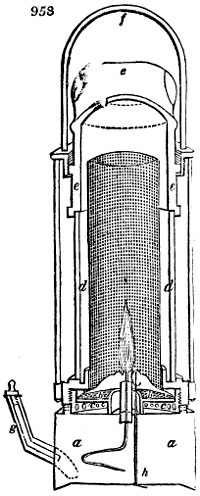
Fig. 953., is a vertical section through the middle of the lamp. a, a, is the oil-cistern, showing the fold of the wick; it is covered at top with b, b, several layers of wire gauze; c, c, is the perforated brass ring, under these layers, for admitting air, which is reverberated upon the burning wick by the cupola c; d, d, is the cylinder of glass, surrounding the wire-cloth one; e, e, is the safety brass hood, which screws down in the frame, so as to cover in the top of the glass chimney; f, is the arched wire for suspending the lamp to the girdle of the miner; g, is the bent tube for supplying oil to the cistern; and h is the safety-trimmer, shown more distinctly in the figure illustrative of the Lamp of Davy.
Between the glass and the cage there should be a space of about one-tenth of an inch, forming an annular chimney for the free ventilation of the flame; and between the under edge of the hood e, and the upper rim of the glass, there should likewise be an interval, as also vent-holes in the top of the hood, for the free escape of the smoke. The orifice of the little tube g, should be rather lower than the ring of holes c, otherwise the oil, when incautiously poured into it, might overflow them, and prevent the lamp from burning. The figure is drawn somewhat in perspective.
As the naked cage of Davy often gets red-hot with flame; as it is sometimes used for hours by miners in this most hazardous state; as this lamp gives so little light as to tempt rash men to remove its safety-cage;[50] as “it is upon record, that taking the average of ten years previous to the introduction of Sir H. Davy’s safety lamp, and allowing one clear year for its introduction, and of ten years after it was properly introduced, there had been double the number of accidents, and at least double the number of deaths, of what took place in the ten years previous to its introduction;[51] as his lamp in explosive air-courses needs to be carried close upon the bosom, or under the coat of the miner; as it was declared by its illustrious inventor to be dangerous when exposed to such currents of explosive gas; and as the above described modification of it is free from all these defects and dangers,—I humbly apprehend that no conscientious proprietor or viewer of coal-mines will delay to substitute the lamp of Upton and Roberts for the naked Davy, for otherwise he will certainly stand in a very painful predicament before a coroner’s inquest, at the next mortal casualty from explosion.”
The patentees have, I am told, been put to so much trouble and expense in trying to introduce this life-protector into our coal-mines, that they have in a great measure abandoned the business. Messrs. Smith of Birmingham have meanwhile undertaken to make the lamps.
SAFFLOWER. This dye-stuff has been fully described under Carthamus and Rouge.
SAFFRON (Saffran, Fr. and Germ.); is a filamentous cake, composed of the stigmata of the flowers of the Crocus sativus. It contains a yellow matter called polychroïte, because a small quantity of it is capable of colouring a great body of water. This is obtained by evaporating the watery infusion of saffron to the consistence of an extract, digesting the extract with alcohol, and concentrating the alcoholic solution. The polychroïte remains in the form of a brilliant mass, of a reddish-yellow colour, transparent, and of the consistence of honey. It has the agreeable smell, with the bitter pungent taste, of saffron. It is very soluble in water; and if it be stove-dried, it deliquesces speedily in the air. According to M. Henry père, polychroïte consists of 80 parts of colouring matter, combined with 20 parts of a volatile oil, which cannot be separated by distillation till the colouring matter has been combined with an alkali. By mixing one part of shred saffron with eight parts of saturated brine, and one-half part of caustic lye, and distilling the mixture, the oil comes over into the receiver, and leaves the colouring matter in the retort, which may be precipitated from the alkaline solution by an acid. The pure colouring matter, when dried, is of a scarlet hue, and then readily dissolves in alcohol, as also in the fat and volatile oils, but sparingly in water. Light blanches the reddish-yellow of saffron, even when it is contained in a full phial well corked. Polychroïte, when combined with fat oil, and subjected to dry distillation, affords ammonia, which shows that azote is one of its constituents. Sulphuric acid colours the solution of polychroïte indigo blue, with a lilac cast; nitric acid turns it green, of various shades, according to the state of dilution. Protochloride (muriate) of tin produces a reddish precipitate.
Saffron is employed as a seasoning in French cookery. It is also used to tinge confectionary articles, liqueurs, and varnishes; but rarely as a pigment.
SAGO (Sagou, Fr. and Germ.); is a species of starch, extracted from the pith of the sago palm, a tree which grows to the height of 30 feet in the Moluccas and the Philippines. The tree is cut down, cleft lengthwise, and deprived of its pith, which being washed with water upon a sieve, the starchy matter comes out, and soon forms a deposit. This is dried to the consistence of dough, pressed through a metal sieve to corn it (which is called pearling), and then dried over a fire with agitation in a shallow copper pan. Sago is sometimes imported in the pulverulent state, in which it can be distinguished from arrow-root only by microscopic examination of its particles. These are uniform and spherical, not unequal and ovoid, like those of arrow-root.
SAL AMMONIAC. The manufacture of this salt may be traced to the remotest era. Its name is derived from Ammonia, or the temple of Jupiter Ammon, in Egypt, near to which the salt was originally made. Sal ammoniac exists ready formed in several animal products. The dung and urine of camels contain a sufficient quantity to have rendered its extraction from them a profitable Egyptian art in former times, in order to supply Europe with the article. In that part of Africa, fuel being very scarce, recourse is had to the dung of these animals, which is dried for that purpose, by plastering it upon the walls. When this is afterwards burned in a peculiar kind of furnace, it exhales a thick smoke, replete with sal ammoniac in vapour; the soot of course contains a portion of that salt, condensed along with other products of combustion. In every part of Egypt, but especially in the Delta, peasants are seen driving asses loaded with bags of that soot, on their way to the sal ammoniac works.
Here it is extracted in the following manner. Glass globes coated with loam are filled with the soot pressed down by wooden rammers, a space of only two or three inches being left vacant, near their mouths. These globes are set in round orifices formed in the ridge of a long vault, or large horizontal furnace flue. Heat is gradually applied by a fire of dry camels’ dung, and it is eventually increased till the globes become obscurely red. As the muriate of ammonia is volatile at a temperature much below ignition, it rises out of the soot in vapour, and gets condensed into a cake upon the inner surface of the top of the globe. A considerable portion, however, escapes into the air; and another portion concretes in the mouth, which must be cleared from time to time by an iron rod. Towards the end, the obstruction becomes very troublesome, and must be most carefully attended to and obviated, otherwise the globes would explode by the uncondensed vapours. In all cases, when the subliming process approaches to a conclusion, the globes crack or split; and when they come to be removed, after the heat has subsided, they usually fall to pieces. The upper portion of the mass is separated, because to it the white salt adheres; and on detaching the pieces of glass with a hatchet, it is ready for the market. At the bottom of each balloon a nucleus of salt remains, surrounded with fixed pulverulent matter. This is reserved, and after being bruised, is put in along with the charge of soot in a fresh operation.
The sal ammoniac obtained by this process is dull, spongy, and of a grayish hue; but nothing better was for a long period known in commerce. Forty years ago, it fetched 2s. 6d. a pound; now, perfectly pure sal ammoniac may be had at one-fifth part of that price.
Various animal offals develope during their spontaneous putrefactive fermentation, or their decomposition by heat, a large quantity of free or carbonated ammonia, among their volatile products. Upon this principle many sal ammoniac works have been established. In the destructive distillation of pitcoal, there is a considerable quantity of ammoniacal products, which are also worked up into sal ammoniac.
The first attempts made in France to obtain sal ammoniac profitably in this manner, failed. A very extensive factory of the kind, which experienced the same fate, was under the superintendence of the celebrated Baumé, and affords one out of a thousand instances where theoretical chemists have shown their total incapacity for conducting operations on the scale of manufacturing economy. It was established at Gravelle near Charenton, and caused a loss to the shareholders in the speculation of upwards of 400,000 francs. This result closed the concern in 1787, after a foolish manipulation of 27 years. For ten years after that event, all the sal ammoniac consumed in France was imported into it from foreign countries. Since then the two works of MM. Payen and Pluvinet were mounted, and seem to have been tolerably successful. Coal soot was, prior to the introduction of the gas-works, a good deal used in Great Britain for obtaining sal ammoniac. In France, bones and other animal matters are distilled in large iron retorts, for the manufacture of both animal charcoal and sal ammoniac.
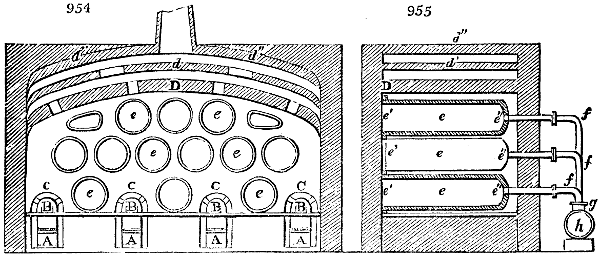
These retorts are iron cylinders, 2 or 3 feet in diameter, and 6 feet long. Figs. 954. and 955. show the form of the furnace, and the manner in which the cylinders are arranged; the first being a longitudinal, the second a transverse section of it. A, the ash-pits under the grates; B, the fireplaces, arched over at top; C, the vault or bench of fire-bricks, perforated inside with eight flues for distributing the flame; D, a great arch, with a triple voussoir D, d′, d′′, under which the retorts are set. The first arch D, is perforated with twenty vent-holes; the second, with four vent-holes; through which the flame passes to the third arch, and thence to the common chimney-stalk. The retorts e, are shut by the door e′ (fig. 955.), luted, and made fast with screw-bolts. Their other ends e′′ terminate in tubes f, f, f, which all enter the main pipe h. The condensing pipe proceeds slantingly downwards from the further end of h, and dips into a large sloping iron cylinder immersed in cold water. See Gas-light and Stove, for a better plan of furnace.
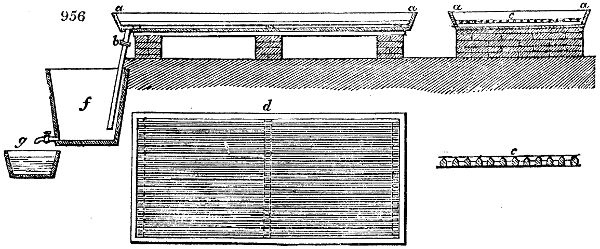
The filters used in the large sal ammoniac works in France are represented in fig. 956. The apparatus consists——1. of a wooden chest a, lined with lead, and which is turned over at the edges; a socket of lead b, soldered into the lowest part of the bottom, serves to discharge the liquid; 2. of a wooden crib or grating formed of rounded rods, as shown in the section c, c, and the plan d; this grating is supported one inch at least above the bottom, and set truly horizontal, by a series of wedges; 3. of an open fabric of canvas or strong calico, laid on the grating, and secured over the edges, so as to keep it tense. A large wooden reservoir f, lined with lead, furnished with a cover, is placed under each of the filters; a pump throws back once or twice upon the filters what has already passed through. A common reservoir g, below the others, may be made to communicate at pleasure with one of them, by means of intermediate stopcocks.
The two boilers for evaporating and decomposing are made of lead, about one quarter of an inch thick, set upon a fire-brick vault, to protect them from the direct action of the flame. Through the whole extent of their bottoms above the vault, horizontal cast-iron plates, supported by ledges and brick compartments, compel the flame and burned air, as they issue from the arch, to percur many sinuosities before they pass up the chimney. This floor of cast iron is intended to support the bottom of the boiler, and to diffuse the heat more equably. The leaden boilers are surrounded with brickwork, and supported at their edges with a wooden frame. They may be emptied at pleasure into lower receivers, called crystallizers, by means of leaden syphons and long-necked funnels.
The crystallizers are wooden chests lined with lead, 15 inches deep, 3 or 4 feet broad, and from 6 to 8 feet long; and may be inclined to one side at pleasure. A round cistern receives the drainings of the mother-waters. The pump is made of lead, hardened with antimony and tin.
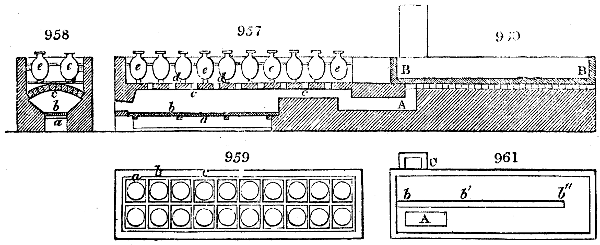
The subliming furnace is shown in figs. 957. and 958. by a transverse and longitudinal section. a is the ash-pit; b, the grate and fireplace; c, the arch above them. This arch, destined to protect the bottles from the direct action of the fire, is perforated with vent-holes, to give a passage to the products of combustion between the subliming vessels. d, d, are bars of iron, upon which the bottoms of the bottles rest; e, stoneware bottles, protected by a coating of loam from the flame.
Fig. 959. shows the cast-iron plates, a, b, c, which, placed above the vaults, receive each two bottles in a double circular opening.
At the extremity of the above furnace, a second one, called the drier, fig. 960., receives the products of the combustion of the first, at A, under horizontal cast-iron plates, and upon which the bottom of a rather shallow boiler B, rests. After passing twice under these plates, round a longitudinal brick partition b, b′, b′′, the products of combustion enter the smoke chimney C. See plan, fig. 961.
The boiler set over this furnace should have no soldered joints. It may be 31⁄2 feet broad, 9 or 10 feet long, and 1 foot deep. The concrete sal ammoniac may be crushed under a pair of edge mill-stones, when it is to be sold in powder.
Bones, blood, flesh, horns, hoofs, woollen rags, silk, hair, scrapings of hides and leather, &c., may be distilled for procuring ammonia. When bones are used, the residuum in the retort is bone black. The charcoal from the other substances will serve for the manufacture of prussian blue. The bones should undergo a degree of calcination beyond what the ammoniacal process requires, in order to convert them into the best bone black; but the other animal matters should not be calcined up to that point, otherwise they are of little use in the prussian blue works. If the bones be calcined, however, so highly as to become glazed, their decolouring power on syrups is nearly destroyed. The other substances should not be charred beyond a red-brown heat.
The condensed vapours from the cylinder retorts afford a compound liquor holding carbonate of ammonia in solution, mixed with a large quantity of empyreumatic oil, which floats at top. Lest incrustations of salt should at any time tend to obstruct the tubes, a pipe should be inserted within them, and connected with a steam boiler, so as to blow steam through them occasionally.
The whole liquors mixed have usually a density of 8° or 9° Baumé (1·060). The simplest process for converting their carbonate of ammonia into muriate, is to saturate them with muriatic acid, to evaporate the solution in a leaden boiler till a pellicle appears, to run it off into crystallizers, and to drain the crystals. Another process is, to decompose the carbonate of ammonia, by passing its crude liquor through a layer of sulphate of lime, 3 or 4 inches thick, spread upon the filters, fig. 956. The liquor may be laid on with a pump; it should never stand higher than 1 or 2 inches above the surface of the bruised gypsum, and it should be closely covered with boards, to prevent the dissipation of the volatile alkali in the air. When the liquor has passed through the first filter, it must be pumped upon the second; or the filters being placed in a terrace form, the liquor from the first may flow down upon the second, and thus in succession. The last filter should be formed of nearly fresh gypsum, so as to ensure the thorough conversion of the carbonate into sulphate. The resulting layers of carbonate of lime should be washed with a little water, to extract the sulphate of ammonia interposed among its particles. The ammoniacal liquor thus obtained must be completely saturated, by adding the requisite quantity of sulphuric acid; even a slight excess of acid can do no harm. It is then to be evaporated, and the oil must be skimmed off in the course of the concentration. When the liquid sulphate has acquired the density of about 1·160, sea salt should be added, with constant stirring, till the whole quantity equivalent to the double decomposition be introduced into the lead boiler.
The fluid part must now be drawn off by a syphon into a somewhat deep reservoir, where the impurities are allowed to subside; it is then evaporated by boiling, till the sulphate of soda falls down in granular crystals, as the result of the mutual reaction of the sulphate of ammonia and muriate of soda; while the more soluble muriate of ammonia remains in the liquor. During this precipitation, the whole must be occasionally agitated with wooden paddles; the precipitate being in the intervals removed to the cooler portion of the pan, in order to be taken out by copper rakes and shovels, and thrown into draining-hoppers, placed near the edges of the pan. The drained sulphate of soda must be afterwards washed with cold water, to extract all the adhering sal ammoniac.
The liquor thus freed from the greater part of the sulphate, when sufficiently concentrated, is to be drawn off by a lead syphon, into the crystallizers, where, at the end of 20 or 30 hours, it affords an abundant crop of crystals of sal ammoniac. The mother-water may then be run off, the crystallizers set aslope to drain the salt, and the salt itself must be washed, first by a weak solution of sal ammoniac, and lastly with water. It must be next desiccated, by the apparatus fig. 960., into a perfectly dry powder, then put into the subliming stoneware balloons, by means of a funnel, and well rammed down. The mouth of the bottle is to be closed with a plate or inverted pot of any kind. The fire must be nicely regulated, so as to effect the sublimation of the pure salt from the under part of the bottle, with due regularity, into a white cake in the upper part. The neck of the bottle should be cleared from time to time with a long steel skewer, to prevent the risk of choking, and consequent bursting; but in spite of every precaution, several of the bottles crack almost in every operation. In Scotland, sal ammoniac is sublimed in cast-iron pots lined with thin fire-tiles, made in segments accommodated to the internal surface of the pots; the vapour being received and condensed into cakes, within balloons of green glass set over their mouths. The salt, when taken out, and freed by scraping from any adhering ochreous or other impurities, is ready for the market, being sold in hollow spherical masses. The residuum in the pots or bottles may be partially worked up in another operation. The greatest evil is produced by the mixture or even contact of iron, because its peroxide readily rises in vapour with the sal ammoniac, and tinges it of a red or yellow colour.
The most ordinary process for converting the ammoniacal liquor of the gas works into sal ammoniac, is to saturate it with sulphuric acid, and to decompose the sulphate, thus formed, by the processes above described. But muriatic acid will be preferred, where it is as cheap as sulphuric of equivalent saturating power; because a tolerably pure sal ammoniac is thereby directly obtained. As the coal-gas liquor contains a good deal of sulphuretted hydrogen, the saturation of it with acid should be so conducted as to burn the disengaged noxious gases in a chimney. Formerly human urine was very extensively employed, both in this country and in France, in the manufacture of sal ammoniac; but since the general establishment of gas-works it has been, I believe, abandoned. The process was exceedingly offensive.
The best white sal ammoniac is in spheroidal cakes of about one foot diameter, three or four inches thick in the middle, somewhat thinner at the edges, and is semi-transparent or translucent. Each lump weighs about one quarter of a cwt. As it is easily volatilized by heat, it may be readily examined as to its sophistication with other salts. Sal ammoniac has a certain tenacity, and is flexible under the hammer or pestle. It is principally used in tinning of cast-iron, wrought iron, copper, brass, and for making the various ammoniacal preparations of pharmacy.
In a chemical factory near Glasgow, 7200 gallons of ammoniacal liquor, obtained weekly from the gas-works, are treated as follows:—The liquor is first rectified by distillation from a waggon-shaped wrought-iron boiler, into a square cistern of iron lined with lead. 4500 lbs. of sulphuric acid, of specific gravity 1·625, are then slowly added to the somewhat concentrated distilled water of ammonia. The produce is 2400 gallons of sulphate of ammonia, slightly acidulous, of specific gravity 1·150, being of such strength as to deposit a few crystals upon the sides of the lead-lined iron tank in which the saline combination is made. It is decomposed by common salt.
From the 7200 gallons of the first crude liquor, 900 gallons of tar are got by subsidence, and 200 gallons of petroleum are skimmed off the surface. The tar is converted, by a moderate boiling in iron pans, into good pitch.
SALAMSTONE. See Lapidary.
SALEP, or SALOUP, is the name of the dried tuberous roots of the Orchis, imported from Persia and Asia Minor, which are the product of a great many species of the plant, but especially of the Orchis mascula. Salep occurs in commerce in small oval grains, of a whitish-yellow colour, at times semi-transparent, of a horny aspect, very, hard, with a faint peculiar smell, and a taste like that of gum tragacanth, but slightly saline. These are composed almost entirely of starchy matter, well adapted for making a thick pap with water or milk, and are hence in great repute in the Levant, as restorers of the animal forces. Their aphrodisiacal properties are apocryphal. If the largest roots of the Orchis mascula of our own country were cleaned, scraped, steeped for a short time in hot, and then for a few minutes in boiling water, to extract their rank flavour, afterwards suspended upon strings to dry in the air, they would afford as nourishing and palatable an article as the Turkey saloup, and at a vastly lower price.
SALICINE, is a febrifuge substance, which may be obtained in white pearly crystals from the bark of the white willow (Salix alba), of the aspen tree (Salix helix), as also of some other willows, and some poplars. It has a very bitter taste.
SAL PRUNELLA, is fused nitre cast into cakes or balls.
SAL VOLATILE, is sesquicarbonate of ammonia.
SALT, EPSOM, is sulphate of magnesia.
SALT, MICROCOSMIC, is the triple phosphate of soda and ammonia.
SALT OF AMBER, is succinic acid.
SALT OF LEMONS, is citric acid.
SALT OF SATURN, is acetate of lead.
SALT OF SODA, is carbonate of soda.
SALT OF SORREL, is bi-oxalate of potassa.
SALT OF TARTAR, is carbonate of potassa.
SALT OF VITRIOL, is sulphate of zinc.
SALT PERLATE, is phosphate of soda.
SALTPETRE, is nitre, or nitrate of potassa.
SALT, SEDATIVE, is boracic acid.
SALTS, are an important class of chemical compounds, antiently studied under the Greek title of Halurgy. At one period every inorganic substance readily soluble in water, was regarded as a salt; and afterwards, every substance soluble in five hundred times its weight of water. Thus both acid and alkaline bodies came to be enrolled among salts; but latterly, the combinations of the acids with alkalis, earths, and metallic calces (now styled oxides), were alone thought to be entitled to the denomination of salts, in consequence of their resemblance in appearance, and supposed analogy in composition, to culinary salt. Since Sir H. Davy demonstrated that this substance contained neither acid nor alkaline matter, but that it consisted of chlorine and the metal sodium, the generality of chemists found it impossible to include salts under one category of constitution; while a few have rashly offered to cut the knot, by excluding from the saline family, chloride of sodium, the patriarch of the whole.
Salts, may be justly divided into three orders:
1. The binary, consisting of two single members; such as the bromides, chlorides, cyanides, fluorides, iodides, carburets, phosphurets, sulphurets, &c.
2. The bi-binary, consisting of two double members; such as the borates, bromates, carbonates, chlorates, sulphates, sulphites, hyposulphites, sulphohydrates, &c.
3. The ternary, consisting of two single members of one genus, and one member of another; such as the boro-fluorides, silico-fluorides, sulpho-cyanides, chloriodides, &c.
The species of each order may exist in three states, constituting neutral salts; supersalts; and subsalts; as for example, the chloride of sodium, the bisulphate of potassa, the subnitrate of lead, &c.
In the above arrangement, cyanogen is allowed to represent a simple substance, from its forming analogous compounds with chlorine and iodine. The neutral state of salts is commonly indicated by their solutions not changing the colours of litmus, violets, or red cabbage; the sub-state of salts, by their turning the violet and cabbage green; and the super-state of salts, by their changing the purple of litmus, violets, and cabbage, red; but to the generality of this criterion there are some exceptions. The atomic theory may be advantageously resorted to, in this predicament. 1. When one prime equivalent of the one member (whether single or double) of a salt, combines with one prime of the other member, a neutral salt is the result, as in chloride of sodium or nitrate of potassa. 2. When two primes of the electro-negative member combine with one prime of the electro-positive, a supersalt is formed, as bichloride of tin, or bisulphate of potassa. 3. When one prime of the electro-negative member combines with two or more primes of the electro-positive, a subsalt is produced, as the subacetate and subchromate of lead, &c.
SALT, SEA, or CULINARY; Chloride of sodium; muriate of soda. (Hydrochlorate de soude, Fr.; Chlornatrium, Germ.) Sea salt, or rock salt, in a state of purity, consists of 60 of chlorine + 40 of sodium, in 100 parts.
This important species of the saline class possesses, even in mass, a crystalline structure, derived from the cube, which is its primitive form. It has generally a foliated texture, and a distinct cleavage; but it has also sometimes a fibrous structure. The massive salt has a vitreous lustre. It is not so brittle as nitre; it is nearly as hard as alum, a little harder than gypsum, and softer than calcareous spar. Its specific gravity varies from 2·0 to 2·25. When pure, it is colourless, translucent, or transparent. On exposure to heat, it commonly decrepitates; but some kinds of rock salt enter quietly into fusion at an elevated temperature, a circumstance which has been ascribed to their having been originally subjected to the action of fire.
According to M. Gay Lussac, 100 parts of water dissolve—
35·81 parts of the salt, at temperature 57·0° Fahr.
35·88 — 62·5°
37·14 — 140·0°
40·38 — 229·5°
Native chloride of sodium, whether obtained from the waters of the ocean, from saline lakes, from salt springs, or mineral masses, is never perfectly pure. The foreign matters present in it vary with its different origins and qualities. These are, the sulphates of lime, magnesia, soda, muriates of magnesia and potash, bitumen, oxide of iron, clay in a state of diffusion, &c.
Muriate of potash has been detected, in the waters of the ocean, in the sal-gem of Berchtesgaden in Bavaria, of Hallein in the territory of Salzbourg, and in the salt springs of Rosenheim.
The more heterogeneous the salt, the more soluble is it, by the reciprocal affinity of its different saline constituents; and thus a delicate hydrometer, plunged in saturated brine, may serve to show approximately the quality of the salt. I find that the specific gravity of a saturated solution of large-grained cubical salt, is 1·1962 at 60° F. 100 parts of this brine contain 251⁄2 of salt, (100 w. + 34·2 s.) From mutual penetration, 100 volumes of the aqueous and saline constituents form rather less than 96 of the solution.
Among the varieties in the form of this salt, the octahedral, the cubo-octahedral, and the dodecahedral, have been mentioned; but there is another, called the funnel or hopper-shaped, which is very common. It is a hollow rectangular pyramid, which forms at the surface of the saline solution in the course of its evaporation, commencing with a small floating cube, upon which lines of other little cubes attach themselves to the edges of the upper face; whereby they form and enlarge the sides of a hollow pyramid, whose apex, the single cubic crystal, is downward. This sinks by degrees as the aggregation goes on above, till a pyramidal boat of considerable size is constructed.
A Table of the results of the Analyses of several varieties of Culinary Salt.
Origin of the Salt. Chloride of Sodium. Muriate of Mag- nesia. Muriate of Lime. Sulphate of Soda. Sulphate of Mag- nesia. Sulphate of Lime. Clay and other insoluble bodies. Oxide of Iron.
Sal-gem of Vic - white 99 ·30 — — — — 0 ·005 0 ·020
red 99 ·80 — — — — — 0 ·002
—— Cheshire, crushed 98 ·33 0 ·02 — — — 0 ·65 — 0 ·002
Salt from Salt Springs:
Schönbeck, Westphalia 93 ·90 0 ·30 — 1 ·00 — 0 ·80
Moutiers - des cordes 97 ·17 0 ·25 — 2 ·00 0 ·58
boilers 93 ·59 0 ·61 — 5 ·55 0 ·25
Château Salins 97 ·82 2 ·12
White of Sulz 96 ·88 3 ·12
Ludwigshall, middle grained 99 ·45 — — 0 ·05 — 0 ·28
Kœnigsborn, Westphalia 95 ·90 — 0 ·27 — — 1 ·10
Sea salt, half white 97 ·20 0 ·004 — — 0 ·050 0 ·120 0 ·070
——, of Saint Malo 96 · 0 ·30 — — 0 ·45 2 ·35
Common Scottish salt 93 ·55 2 ·80 — — 1 ·75 1 ·50
Lymington, common 93 ·7 1 ·1 — — 3 ·50 1 ·50 2 ·00
——, cat 98 ·8 0 ·5 — — 0 ·5 0 ·1
Cheshire, stoved 98 ·25 0 ·075 0 ·025 — — 1 ·55
The geological position of rock salt is between the coal formation and the lias. The great rock-salt formation of England occurs within the red marl, or new red sandstone, the bunter-sandstein of the Germans, so called, because its colours vary from red to salmon and chocolate. This mineral stratum frequently presents streaks of light blue, verdigris, buff, or cream colour; and is chiefly remarkable for containing considerable masses or beds of gypsum. At Northwich, in the vale of the Weaver, the rock salt consists of two beds, together not less than 60 feet thick, which are supposed to constitute large insulated masses, about a mile and a half long, and nearly 1300 yards broad. There are other deposits of rock salt in the same valley, but of inferior importance. The uppermost bed occurs at 75 feet beneath the surface, and is covered with many layers of indurated red, blue, and brown clay, interstratified more or less with sulphate of lime, and interspersed with argillaceous marl. The second bed of rock salt lies 311⁄2 feet below the first, being separated from it by layers of indurated clay, with veins of rock salt running through them. The lowest bed of salt was excavated to a depth of 110 feet, several years ago.
The beds or masses of rock salt are occasionally so thick, that they have not been yet bored through, though mined for many centuries. This is the case with the immense mass of Wieliczka, and the lower bed at Northwich. But in ordinary cases, this thickness varies from an inch or two to 12 or 15 yards. When the strata are thin, they are usually numerous; but the beds, layers, or masses never exhibit throughout a great extent any more than an illusory appearance of parallelism; for when they are explored at several points, enlargements are observed, and such diminutions as cause the salt to disappear sometimes altogether. This mineral is not deposited, therefore, in a geological stratum, but rather in lenticular masses, of very variable extent and thickness, placed alongside of each other at unequal distances, and interposed between the courses of the other formations.
Sometimes the rock salt is disseminated in small masses or little veins among the calcareous and argillaceous marls which accompany or overlie the greater deposits. Bitumen, in small particles, hardly visible, but distinguishable by the smell, occurs in all the minerals of the saliferous system.
It has been remarked, that the plants which grow generally on the sea shores, such as the Triglochinum maritimum, the Salicornia, the Salsola kali, the Aster trifolium, or farewell to summer, the Glaux maritima, &c., occur also in the neighbourhood of salt mines and salt springs, even of those which are most deeply buried beneath the surface.
The interior of rock-salt mines, after digging through the strata of clay marl, &c. is extremely dry; so that the dust produced in the workings becomes an annoyance to the miners, though in other respects the excavations are not at all insalubrious.
Salt springs occur nearly in the same circumstances, and in the same geological formation as the salt rock. It has been noticed that salt springs issue, in general, from the upper portion of the saliferous strata, principally from the saline clay marls. Cases however occur, where the salt springs are not accompanied by rock salt, and where the whole saline matter is derived from the marls themselves, which thus constitute the only saliferous beds.
It has been imagined that there are two other periods of geological formation of this substance; one much more antient, belonging to the transition series of rocks; the other relatively modern, among secondary strata. To the former has been referred the salt formation of Bex, that of Cardonne, &c. But M. Brongniart assigns valid reasons for rejecting this supposition. M. Beudant, indeed, refers to the secondary strata above the chalk, the rock-salt formation of Wieliczka, and of the base of the Carpathians; placing these among the plastic clay and lignites.
The mines of rock salt do not appear to possess any determinate elevation upon the surface of the earth. Immense masses of it are met with at very great depths below the level of the sea, (the mine of Wieliczka is excavated 860 feet beneath the soil,) and others exist at a considerable altitude, as that of Hallein near Salzbourg, which is 3300 feet above the level of the sea, and the saline rock of Arbonne in Savoy, which is nearly 4000 feet higher, situated at the great elevation of 7200 feet above the level of the sea, and consequently in the region of perpetual snow. The rock is a mass of saccharoid and anhydrous gypsum, imbued with common salt, which is extracted by lixiviation; after which the gypsum remains porous and light.
The inland seas, salt lakes, and salt marshes, have their several localities obviously independent of peculiar geological formations. The ocean is, however, the most magnificent mine of salt, since this chloride constitutes about one-thirtieth part of its weight; being pretty evenly diffused throughout its waters, when no local cause disturbs the equilibrium. The largest proportion of salt held in solution in the open sea, is 38 parts in 1000, and the smallest 32. In a specimen taken by Mr. Wilkinson, out of the Red Sea, at Berenice, I found 43 parts of salt in 1000. The specific gravity of the water was 1·035.
Were it requisite to extract the chloride of sodium from sea-water by fuel alone, many countries, even maritime, would find the process too costly. The salt is therefore obtained from it in two different manners; 1. by natural evaporation alone; 2. by natural and artificial evaporation combined. The first method is employed in warm regions, under the form of saline tanks, or brine reservoirs, called also brine-pits. These are large shallow basins, the bottom of which is very smooth, and formed of clay. They are excavated along the sea-shore, and consist of—
1st. A large reservoir, deeper than the proper brine-pits, which is dug between them and the sea. This reservoir communicates with the sea by means of a channel provided with a sluice. On the sea-shore, these reservoirs may be filled at high water, though the tides are rather inconvenient than advantageous to brine-pits.
2dly. The brine-pits, properly so called, which are divided into a number of compartments by means of little banks. All these compartments have a communication with each other, but so that the water frequently has a long circuit to make, from one set to another. Sometimes it must flow 400 or 500 yards, before it reaches the extremity of this sort of labyrinth. The various divisions have a number of singular names, by which they are technically distinguished. They should be exposed to the north, north-east, or north-west winds.
The water of the sea is let into these reservoirs in the month of March, where it is exposed on a vast surface to evaporation. The first reservoir is intended to detain the water till its impurities have subsided, and from it the other reservoirs are supplied, as their water evaporates. The salt is considered to be on the point of crystallizing when the water begins to grow red. Soon after this, a pellicle forms on the surface, which breaks, and falls to the bottom. Sometimes the salt is allowed to subside in the first compartment; at others, the strong brine is made to pass on to the others, where a larger surface is exposed to the air. In either case the salt is drawn out, and left upon the borders to drain and dry.
The salt thus obtained, partakes or the colour of the bottom on which it is formed; and is hence white, red, or gray.
Sea water contains, in 1000 parts, 25 of chloride of sodium, 5·3 sulphate of magnesia, 3·5 chloride of magnesium, 0·2 carbonate of lime and magnesia, 0·1 sulphate of lime, besides 1⁄2000 of sulphate and muriate of potash. It also contains iodide of sodium, and bromide of magnesium. Its average spec. grav. is from 1·029 to 1·030.
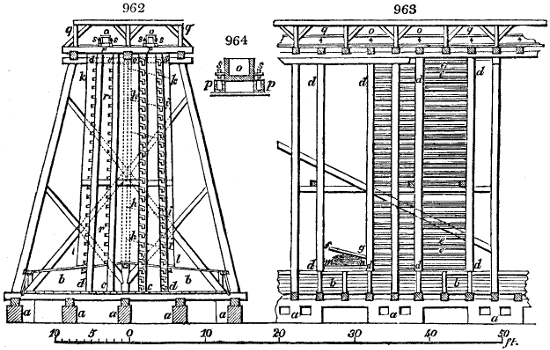
Figs. 962-964 enlarged (155 kB)
Sea-water and weak brines may be concentrated either by the addition of rock salt, by spontaneous evaporation in brine-pits (see suprà), or by graduation. Houses for the last purpose are extensively employed in France and Germany. The weak brine is pumped into an immense cistern on the top of a tower, and is thence allowed to flow down the surface of bundles of thorns built up in regular walls, between parallel wooden frames. At Salza, near Schönebeck, the graduation-house is 5817 feet long, the thorn walls are from 33 to 52 feet high, in different parts, and present a total surface of 25,000 square feet. Under the thorns, a great brine cistern, made of strong wooden planks, is placed, to receive the perpetual shower of water. Upon the ridge of the graduation-house there is a long spout, perforated on each side with numerous holes, and furnished with spigots or stopcocks for distributing the brine, either over the surface of the thorns, or down through their mass; the latter method affording larger evaporation. The graduation-house should be built lengthwise in the direction of the prevailing wind, with its ends open. An experience of many years at Salza and Dürrenberg has shown, that in the former place graduation can go on 258, and in the latter 207 days, on an average, in the year; the best season being from May till August. At Dürrenberg, 3,596,561 cubic feet of water are evaporated annually. According to the weakness of the brine, it must be the more frequently pumped up, and made to flow down over the thorns in different compartments of the building, called the 1st, 2d, and 3d graduation. A deposit of gypsum incrusts the twigs, which requires them to be renewed at the end of a certain time. Figs. 962. and 963. represent the graduation-house of the salt-works at Dürrenberg. a, a, a, are low stone pillars for supporting the brine cistern b, called the soole-schiff. c, c are the inner, d, d the outer, walls of thorns; the first have perpendicular sides, the last sloping. The spars e, e, which support the thorns, are longer than the interval between two thorn walls from f to g, fig. 963, whereby they are readily fastened by their tenons and mortises. The spars are laid at a slope of 2 inches in the foot, as shown by the line h, i. The bundles of thorns are each 11⁄2 foot thick, from 5 to 7 feet long, and are piled up in the following way:——Guide-bars are first placed in the line k, l, to define the outer surface of the thorn wall, the undermost spars m, n, are fastened upon them; and the thorns are evenly spread, after the willow-withs of the bundles have been cut. Over the top of the thorn walls are laid, through the whole length of the graduation-house, the brine spouts o, o, which are secured to the upper beams; and at both sides of these spouts are the drop-spouts p, p, for discharging the brine by the spigots s, s, as shown upon a larger scale in fig. 964. The drop-spouts are 6 feet long, have on each side small notches, 5 inches apart, and are each supplied by a spigot. The space above the ridge of the graduation-house is covered with boards, supported at their ends by binding-beams q. r, r show the tenons of the thorn-spars. Over the soole schiff b, inclined planes of boards are laid for conducting downwards the innumerable showers. The brine, which contains at first 7·692 per cent. of salt, indicates, after the first shower, 11·473; after the second, 16·108; and after the third, 22. The brine, thus concentrated to such a degree as to be fit for boiling, is kept in great reservoirs, of which the eight at Salza, near Schönebeck, have a capacity of 2,421,720 cubic feet, and are furnished with pipes leading to the sheet-iron salt-pans. The capacity of these is very different at different works. At Schönebeck there are 22, the smallest having a square surface of 400 feet, the largest of 1250, and are enclosed within walls, to prevent their being affected by the cold external air. They are covered with a funnel-formed or pyramidal trunk of deals, ending in a square chimney, to carry off the steam.
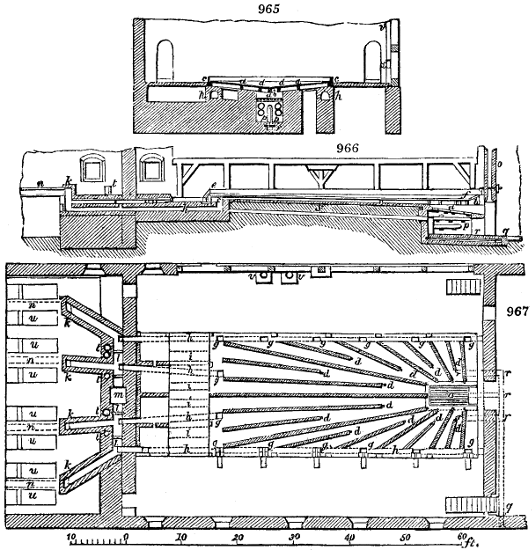
Figs. 965-967 enlarged (227 kB)
Figs. 965, 966, 967. represent the construction of a salt-pan, its furnace, and the salt store-room of the works at Dürrenberg; fig. 967. being the ground plan, fig. 966. the longitudinal section, and fig. 965. the transverse section, a is the fire-grate, which slopes upwards to the back part, and is 311⁄2 inches distant from the bottom of the pan. The ratio of the surface of the grate to that of the bottom of the pan, is as 1 to 59·5; that of the air-hole into the ash-pit, as 1 to 306. The bed under the pan is laid with bricks, smoothly plastered over, from b to c, in fig. 966. Upon this bed the pillars d, d, &c., are built in a radiated direction, being 6 inches broad at the bottom, and tapering to 11⁄2 inch at top. The pan is so laid that its bottom has a fall towards the middle of 21⁄2 inches: see e, f, fig. 966. The fire diffuses itself in all directions under the pan, proceeds thence through several holes g, g, g, into flues h, h, h, which run round three sides of the pan; the burnt air then passes through i, fig. 967., under other pans, from which it is collected in the chimneys k, k, to be conducted into the drying-room. At l, l, there is a transverse flue, through which, by means of dampers, the fire-draught may be conducted into an extra chimney m. From the flues k, k, four square iron pipes n, n, issue and conduct the burnt air into the main chimneys in the opposite wall.
The bottoms of the several flues have a gradual ascent above the level of the fire-grate. A special chimney o, rises above the ash-pit, to carry off the smoke, which may chance to regurgitate in certain states of the wind. p, p, are iron pipes laid upon each side of the ash-pit (see figs. 966. and 967.), into which cold air is admitted by the flue q, r, where, becoming heated, it is conducted through iron pipes s, and thence escapes at t, into the stove-room. Upon both sides of the hot flues in the stove-room, hurdle-frames u, u, are laid, each of which contains 11 baskets, and every basket, except the undermost, holds 60 pounds of salt, spread in a layer 2 inches thick. v, v, show the pipes by which the pan is supplied with graduated brine.
Description of the Steam-trunk, in fig. 968.
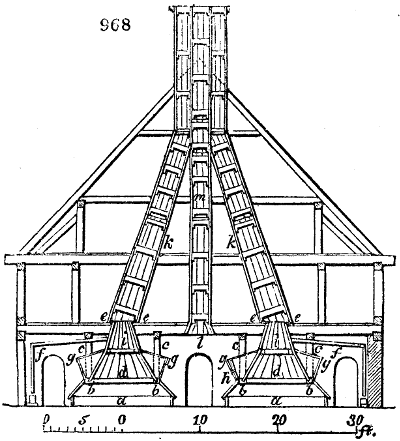
In front of the pan a, a, there are two upright posts, upon which, and in holes of the back wall, two horizontal beams b, b, are supported. The pillars c, c, are sustained upon the bearers d, d. At e, e, a deep quadrangular groove is made in the beams, for fixing down the four boards which form the bottom of the steam-way. In this groove any condensed water from the steam collects, and is carried off by a pipe f, to prevent it falling back into the pan. Upon the three sides of the pan not in contact with the wall, there are three rows of boards hinged upon planks b, b. Behind the upper one, a board is hung on at g, upon which the boiled salt is laid to drain. The two other rows of boards are hooked on so as to cover the pan, as shown at h. Whenever the salt is sufficiently drained, the upper shelves are placed in a horizontal position; the salt is put into small baskets, and carried into the stove-room. i, k, is the steam-trunk; l, m, is a tunnel for carrying off the steam from the middle of the pan, when this is uncovered by lifting the boards.
In proportion as the brine becomes concentrated by evaporation, more is added from the settling reservoir of the graduation-house, till finally small crystals appear on the surface. No more weak brine is now added, but the charge is worked off, care being taken to remove the scum, as it appears. In some places the first pan is called a schlot-pan, in which the concentration is carried only so far as to cause the deposition of the sludge, from which the saline solution is run into another pan, and gently evaporated, to produce the precipitation of the fine salt. This salt should be continually raked towards the cooler and more elevated sides of the pan, and then lifted out with cullender-shovels into large conical baskets, arranged in wooden frames round the border of the pan, so that the drainage may flow back into the boiling liquor. The drained salt is transferred to the hurdles or baskets in the stove-room, which ought to be kept at a temperature of from 120° to 130°, Fahr. The salt is then stowed away in the warehouse.
The graduation range should be divided lengthwise into several sections: the first to receive the water of the spring, the lake, or the sea; the second, the water from the first shower-receiver; the third, the water from the second receiver; and so on. The pumps are usually placed in the middle of the building, and lift the brine from the several receivers below into the alternate elevated cisterns. The square wooden spouts of distribution may be conveniently furnished with a slide-board, attached to each of their sides, to serve as a general valve for opening or shutting many trickling orifices at once. The rate of evaporation at Moutiers is exhibited by the following table:—
Number of Showers. Total Surface of the Fagots. Specific Gravity of the Brine. Water evaporated.
1·010 0·000
1 and 2 5158 square feet 1·023 0·540
3, 4, 5, 6, 7, 8, and 9 2720 1·072 0·333
10 550 1·140 0·062
Total evaporation 0·935
Water remaining in the brine at the density of 1·140 1·065
Water assigned at the density of 1·010 1·000
From the above table it appears that no less than 10 falls of the brine have been required to bring the water from the specific gravity 1·010 to 1·140, or 18° Baumé. The evaporation is found to proceed at nearly the same rate with the weaker water, and with the stronger, within the above limits. When it arrives at a density of from 1·140 to 1·16, it is run off into the settling cisterns. M. Berthier calculates, that upon an average, in ordinary weather, at Moutiers, 60 kilogrammes of water (13 gallons, imp.) are evaporated from the fagots, in the course of 24 hours, for every square foot of their surface. Without the aid of currents of air artificially warmed, such an amount of evaporation could not be reckoned upon in this country. In the schlotting, or throwing down of the sediment, a little bullock’s blood, previously beaten up with some cold brine, promotes the clarification. When the brine acquires, by brisk ebullition, the density of 1·200, it should be run off from the preparation, to the finishing or salting pans.
The mother-water contains a great deal of chloride of magnesium, along with chloride of sodium, and sulphate of magnesia. Since the last two salts mutually decompose each other at a low temperature, and are transformed into sulphate of soda, which crystallizes, and muriate of magnesia, which remains dissolved, the mother-water with this view may be exposed in tanks to the frost during winter, when it affords three successive crystalline deposits, the last being sulphate of soda, nearly pure.
The chloride of magnesium, or bittern, not only deteriorates the salt very much, but occasions a considerable loss of weight. It may, however, be most advantageously got rid of, and converted into chloride of sodium by the following simple expedient:—Let quicklime be introduced in equivalent quantity to the magnesia present, and it will precipitate this earth, and form chloride of calcium, which will immediately react upon the sulphate of soda in the mother-water, with the production of sulphate of lime and chloride of sodium. The former being sparingly soluble, is easily separated. Lime, moreover, decomposes directly the chloride of magnesium, but with the effect of merely substituting chloride of calcium in its stead. But in general there is abundance of sulphate of soda in brine springs to decompose the chloride of calcium. A still better way of proceeding with sea-water, would be to add to it, in the settling tank, the quantity of lime equivalent to the magnesia, whereby an available deposit of this earth would be obtained, at the same time that the brine would be sweetened. Water thus purified may be safely crystallized by rapid evaporation.
In summer, the saturated boiling brine is crystallized by passing it over vertical ropes; for which purpose 100,000 metres (110,000 yards) are mounted in an apartment 70 metres (77 yards) long. When the salt has formed a crust upon the ropes about 21⁄2 inches thick, it is broken off, allowed to fall upon the clean floor of the apartment, and then gathered up. The salting of a charge, which would take 5 or 6 days in the pan, is completed in this way in 17 hours; but the mother-waters are more abundant. The salt is, however, remarkably pure.
The boilers constructed at Rosenheim, in Bavaria, evaporate 31⁄2 pounds of water for every pound of wood burned; which is reckoned a favourable result; but some of those described under Evaporation, would throw off much more.
“The rock salt mines and principal brine springs are in Cheshire; and the chief part of the Cheshire salt, both fossil and manufactured, is sent by the river Weaver to Liverpool, a very small proportion of it being conveyed elsewhere, by canal or land carriage. There are brine springs in Staffordshire, from which Hull is furnished with white salt; and in Worcestershire, from which Gloucester is supplied. If to the quantity shipped by the Weaver, 100,000 tons of white salt are added annually for internal consumption and exports, exclusive of Liverpool, the total manufacture will be approached very nearly; but as there is now no check from the excise, it is impossible to ascertain it exactly. Fossil salt is used in small quantities at some of the Cheshire manufactories, to strengthen the brine, but is principally exported; some to Ireland, but chiefly to Belgium and Holland.”[52] The average quantity of rock salt sent annually down the river Weaver, from the mines in Cheshire, between the years 1803 and 1834 inclusive, was 86,000 tons, of 2,600 lbs. each; the greatest being 125,658, in the year 1823, and the least 47,230, in the year 1813. The average quantity of white salt sent annually down the Weaver from the manufactories in Cheshire during the same period, was 221,351; the greatest being 383,669, in the year 1832, and the least being 120,486, in the year 1811.
M. Clement-Desormes, engineer and chief actionnaire of the great salt-works of Dieuze, in France, informs me that the internal consumption of that kingdom is rather more than 200,000 tons per annum, being at the rate of 61⁄2 kilogrammes for each individual of a population estimated at 32,000,000. As the retail price of salt in France is 10 sous per kilogramme (of 21⁄5 lbs. avoird.), while in this country it is not more than 2 sous (1 penny), its consumption per head will be much greater with us; and, taking into account the immense quantity of salted provisions that are used, it may be reckoned at 22 lbs.; whence our internal consumption will be 240,000 tons, instead of 100,000, as quoted above, from the tables published by the Board of Trade.
In 1836, 9,622,427 bushels, of 56 lbs. = 240,560 tons of salt, value 173,923l., were exported from the United Kingdom, of which 1,350,849 bushels went to Russia; 1,235,086 to Belgium; 314,132 to the Western coast of Africa; 1,293,560 to the British North American colonies; 2,870,808 to the United States of America; 53,299 to New South Wales, Van Diemen’s Land, and other Australian settlements; 58,735 to the British West Indies; and 90,655 to Guernsey, Jersey, Alderney, and Man.
SAND (Eng. and Germ.; Sable, Fr.); is the name given to any mineral substance in a hard granular or pulverulent form, whether strewed upon the surface of the ground, found in strata at a certain depth, forming the beds of rivers, or the shores of the sea. The siliceous sands seem to be either original crystalline formations, like the sand of Neuilly, in 6-sided prisms, terminated by two 6-sided pyramids, or the débris of granitic, schistose, quartzose, or other primitive crystalline rocks, and are abundantly distributed over the globe; as in the immense plains known under the names of downs, deserts, steppes, landes, &c., which, in Africa, Asia, Europe, and America, are entirely covered with loose sterile sand. Valuable metallic ores, those of gold, platinum, tin, copper, iron, titanium, often occur in the form of sand, or mixed with that earthy substance. Pure siliceous sands are very valuable for the manufacture of glass, for making mortars, filters, ameliorating dense clay soils, and many other purposes. For moulder’s sand, see Founding. Lynn and Ryegate furnish our purest siliceous sand.
SANDAL or RED SAUNDERS WOOD (Santal Fr.; Sandelholz Germ.); is the wood of the Pterocarpus santalinus, a tree which grows in Ceylon, and on the coast of Coromandel. The old wood is preferred by dyers. Its colouring matter is of a resinous nature; and is, therefore, quite soluble in alcohol, essential oils, and alkaline lyes; but sparingly in boiling water, and hardly if at all in cold water. The colouring matter which is obtained by evaporating the alcoholic infusion to dryness, has been called santaline; it is a red resin, which is fusible at 212° F. It may also be obtained by digesting the rasped sandal wood in water of ammonia, and afterwards saturating the ammonia with an acid. The santaline falls, and the supernatant liquor, which is yellow by transmitted, appears blue by reflected light. Its spirituous solution affords a fine purple precipitate with the protochloride of tin, and a violet one with the salts of lead. Santaline is very soluble in acetic acid, and the solution forms permanent stains upon the skin.
Sandal wood is used in India, along with one-tenth of sapan wood (the Cæsalpinia sapan of Japan, Java, Siam, Celebes, and the Philippine isles), principally for dyeing silk and cotton. Trommsdorf dyed wool, cotton, and linen a carmine hue by dipping them alternately in alkaline solution of the sandal wood, and in an acidulous bath. Bancroft obtained a fast and brilliant reddish-yellow, by preparing wool with an alum and tartar bath, and then passing it through a boiling bath of sandal wood and sumac. Pelletier did not succeed in repeating this experiment. According to Togler, wool, silk, cotton, and linen, mordanted with salt of tin, and dipped in a cold alcoholic tincture of the wood, or the same tincture mixed with 8 parts of boiling water, become of a superb ponceau-red colour. With alum, they took a scarlet-red; with sulphate of iron, a deep violet, or brown-red. Unluckily these dyes do not stand exposure to light well.
SANDARACH, is a peculiar resinous substance, the product of the Thuya articulata, a small tree of the coniferous family, which grows in the northern parts of Africa, especially round Mount Atlas.
The resin comes to us in pale yellow, transparent, brittle, small tears, of a spherical or cylindrical shape. It has a faint aromatic smell, does not soften, but breaks between the teeth, fuses readily with heat, and has a specific gravity of from 1·05 to 1·09. It contains three different resins; one soluble in spirit of wine, somewhat resembling pinic acid (see Turpentine); one not soluble in that menstruum; and a third, soluble only in alcohol of 90 per cent. It is used as pounce-powder for strewing over paper erasures, as incense, and in varnishes.
SAPAN WOOD, is a species of the Cæsalpinia genus, to which Brasil wood belongs. It is so called by the French, because it comes to them from Japan, which they corruptly pronounce Sapan. As all the species of this tree are natives of either the East Indies or the New World, one would imagine that they could not have been used as dye-stuffs in Europe before the beginning of the 16th century. Yet the author of the article “Brasil,” in Rees’ Cyclopædia, and Mr. Southey, in his History of Brasil, say that Brasil wood is mentioned nearly one hundred years before the discoveries of Columbus and Vasco de Gama, by Chaucer, who died in 1400; that it was known many ages before his time; and that it gave the name to the country, instead of the country giving the name to the wood, as I have stated, with Berthollet and other writers on dyeing. The Cæsalpinia sappan, being a native of the Coromandel coast, may possibly have been transported along with other Malabar merchandise to the Mediterranean marts in the middle ages; but the importation of so lumbering an article in any considerable quantity by that channel, is so improbable, that I am disposed to believe that Brasil wood was not commonly used by the dyers of Europe before the discovery of the New World.
SARD; see Lapidary.
SATIN (Eng., Fr., and Germ.); is the name of a silk stuff, first imported from China, which is distinguished by its very smooth, polished, and glossy surface. It is woven upon a loom with at least five-leaved healds or heddles, and as many corresponding treddles. These are so mounted as to rise and fall four at a time, raising and depressing alternately four yarns of the warp, across the whole of which the weft is thrown by the shuttle, so as to produce a uniform smooth texture, instead of the chequered work resulting from intermediate decussations, as in common webs. See Textile Fabrics. Satins are woven with the glossy or right side undermost, because the four-fifths of the warp, which are always left there during the action of the healds, serve to support the shuttle in its race. Were they woven in the reverse way, the scanty fifth part of the warp threads could either not support, or would be too much worn by the shuttle.
SATURATION, is the term at which any body has taken its full dose or chemical proportion of any other with which it can combine; as water with a salt, or an acid with an alkali in the neutro-saline state.
SCALIOLA, is merely ornamental plaster-work, produced by applying a pap made of finely-ground calcined gypsum, mixed with a weak solution of Flanders’ glue, upon any figure formed of laths nailed together, or occasionally upon brickwork, and bestudding its surface, while soft, with splinters (scagliole) of spar, marble, granite, bits of concrete, coloured gypsum, or veins of clay, in a semi-fluid state. The substances employed to colour the spots and patches, are the several ochres, boles, terra di Sienna, chrome yellow, &c. The surface of the column is turned smooth upon a lathe, polished with stones of different fineness, and finished with some plaster-pap, to give it lustre. Pillars and other flat surfaces are smoothed by a carpenter’s plane, with the chisel finely serrated, and afterwards polished with plaster by friction. The glue is the cause of the gloss, but makes the surface apt to be injured by moisture, or even damp air.
SCARLET DYE. (Teinture en écarlate, Fr.; Scharlachfärberei, Germ.) Scarlet is usually given at two successive operations. The boiler (see figs. 364, 365., article Dyeing,) is made of block tin, but its bottom is formed occasionally of copper.
1. The bouillon, or the colouring-bath.—For 100 pounds of cloth, put into the water, when it is little more than lukewarm, 6 pounds of argal, and stir it well. When the water becomes too hot for the hand, throw into it, with agitation, one pound of cochineal in fine powder. An instant afterwards, pour in 5 pounds of the clear mordant G, (see Tin Mordants,) stir the whole thoroughly as soon as the bath begins to boil, introduce the cloth, and wince it briskly for two or three rotations, and then more slowly. At the end of a two-hours’ boil, the cloth is to be taken out, allowed to become perfectly cool, and well washed at the river, or winced in a current of pure water. (See an automatic plan of washing described under the article Rinsing Machine.)
2. The rougie, or finishing dye.—The bouillon bath is emptied, and replaced with water for the rougie. When it is on the point of boiling, 51⁄2 pounds of cochineal in fine powder are to be thrown in, and mixed with care; when the crust, which forms upon the surface, opens of itself in several places, 14 pounds of solution of tin (as above) are to be added. Should the liquor be likely to boil over the edges of the kettle, it must be refreshed with a little cold water. When the bath has become uniform, the cloth is to be put in, taking care to wince it briskly for two or three turns; then to boil it bodily for an hour, thrusting it under the liquor with a rod whenever it rises to the surface. It is lastly taken out, aired, washed at the river, and dried.
As no person has done more for the improvement of the scarlet dyes than Poërner, I shall here give his processes in detail.
Bouillon, or colouring.—For every pound of cloth or wool, take 14 drams of cream of tartar. When the bath is boiling, and the tartar all dissolved, pour in successively 14 drams of solution of tin, (Mordant F, Tin,) and let the whole boil together during a few minutes. Now introduce the cloth, and boil it for 2 hours; then take it out, and let it drain and cool.
Rougie, or dye.—For every pound of woollen stuff, take 2 drams of cream of tartar. When the bath begins to boil, add 1 ounce of cochineal reduced to fine powder, stir the mixture well with a rod of willow or any white wood, and let it boil for a few minutes. Then pour in, by successive portions, 1 ounce of solution of tin (Mordant F), stirring continually with the rod. Lastly, dye as quickly as possible. The colour will be a beautiful scarlet.
Second scarlet process of Poërner, the bouillon being the same as above given, and always estimated for 1 pound of cloth or wool. Rougie.—Take one ounce of cochineal in fine powder, and two ounces of solution of tin without tartar.
Third scarlet process of Poërner; the bouillon being as above. Rougie for a pound of cloth.—Take two drams of cream of tartar, one ounce of cochineal, one ounce of solution of tin, and two ounces of sea salt: dye as in process 1. The salt helps the dye to penetrate into the cloth.
Tables of the Composition of the Bouillon and Rougie, by different Authors, for 100 pounds of Cloth or Wool.
Composition of the Bouillon.
Names of the Authors. Starch. Cream of Tartar. Cochi- neal. Solution of Tin. Common Salt.
lb. oz. lb. oz. lb. dr. lb. oz. lb. oz.
Berthollet 0 0 6 0 8 0 5 0 0 0
Hellot 0 0 12 8 18 6 12 8 0 0
Scheffer 9 6 9 6 12 4 9 6 0 0
Poërner 0 0 10 15 0 0 10 15 0 0
Composition of the Rougie.
Names of the Authors. Starch. Cream of Tartar. Cochi- neal. Solution of Tin. Common Salt.
lb. oz. lb. oz. lb. oz. lb. oz. lb. oz.
Berthollet 0 0 0 0 5 8 14 0 0 0
Hellot 3 2 0 0 7 4 12 8 0 0
Scheffer 3 2 3 2 5 7 1⁄2 4 11 0 0
Poërner - 0 0 1 8 6 4 6 4 0 0
0 0 0 0 6 4 12 8 0 0
0 0 1 8 6 4 6 4 12 8
M. Lenormand states that he has made experiments of verification upon all the formulæ of the preceding tables, and declares his conviction that the finest tint may be obtained by taking the bouillon of Scheffer, and the rougie No. 4. of Poërner. The solution which produced the most brilliant red, is that made according to the process of mordant B (Tin). M. Robiquet has given the following prescription for making a printing scarlet, for well-whitened woollen cloth.
Boil a pound of pulverized cochineal in four pints of water down to two pints, and pass the decoction through a sieve. Repeat the boiling three times upon the residuum, mix the eight pints of decoction, thicken them properly with two pounds of starch, and boil into a paste. Let it cool down to 104° F., then add four ounces of the subjoined solution of tin, and two ounces of ordinary salt of tin (muriate). When a ponçeau red is wanted, two ounces of pounded curcuma (turmeric) should be added.
The solution of tin above prescribed, is made by taking—one ounce of nitric acid, of specific gravity 36° B. = 1·33; one ounce of sal ammoniac; four ounces of grain tin. The tin is to be divided into eight portions, and one of them is to be put into the acid mixture every quarter of an hour.
A solution of chlorate of potassa (chloride?) is said to beautify scarlet cloth in a remarkable manner.
Bancroft proposed to supplant the nitro-muriatic acid, by a mixture of sulphuric and muriatic acids, for dissolving tin; but I do not find that he succeeded in persuading scarlet-dyers to adopt his plans. In fact the proper base is, in my opinion, a mixture of the protoxide and peroxide of tin; and this cannot be obtained by acting upon the metal with the murio-sulphuric acid. He also prescribed the extensive use of the quercitron yellow to change the natural crimson of the cochineal into scarlet, thereby economizing the quantity of this expensive dye-stuff. See Lac Dye.
SCHEELE’S GREEN, is a pulverulent arsenite of copper, which may be prepared as follows:—Form, first, an arsenite of potassa, by adding gradually 11 ounces of arsenious acid to 2 pounds of carbonate of potassa, dissolved in 10 pounds of boiling water; next, dissolve 2 pounds of crystallized sulphate of copper in 30 pounds of water; filter each solution, then pour the first progressively into the second, as long as it produces a rich grass-green precipitate. This being thrown upon a filter-cloth, and edulcorated with warm water, will afford 1 pound 6 ounces of this beautiful pigment. It consists of, oxide of copper 28·51, and of arsenious acid 71·46. This green is applied by an analogous double decomposition to cloth. See Calico-printing.
SCHWEINFURTH GREEN, is a more beautiful and velvety pigment than the preceding, which was discovered in 1814, by MM. Rusz and Sattler, at Schweinfurth, and remained for many years a profitable secret in their hands. M. Liebig having made its composition known, in 1822, it has been since prepared in a great many colour-works. Braconnot published, about the same time, another process for manufacturing the same pigment. Its preparation is very simple; but its formation is accompanied with some interesting circumstances. On mixing equal parts of acetate of copper and arsenious acid, each in a boiling concentrated solution, a bulky olive-green precipitate is immediately produced; while much acetic acid is set free. The powder thus obtained, appears to be a compound of arsenious acid and oxide of copper, in a peculiar state; since when decomposed by sulphuric acid, no acetic odour is exhaled. Its colour is not changed by drying, by exposure to air, or by being heated in water. But, if it be boiled in the acidulous liquor from which it was precipitated, it soon changes its colour, as well as its state of aggregation, and forms a new deposit in the form of a dense granular beautiful green powder. As fine a colour is produced by ebullition during five or six minutes, as is obtained at the end of several hours by mixing the two boiling solutions, and allowing the whole to cool together. In the latter case, the precipitate, which is slight and flocky at first, becomes denser by degrees; it next betrays green spots, which progressively increase, till the mass grows altogether of a crystalline constitution, and of a still more beautiful tint than if formed by ebullition.
When cold water is added to the mixed solutions, immediately after the precipitate takes place, the development of the colour is retarded, with the effect of making it much finer. The best mode of procedure, is to add to the blended solutions, their own bulk of cold water, and to fill a globe up to the neck with the mixture in order to prevent the formation of any such pellicle on the surface, as might, by falling to the bottom, excite premature crystallization. Thus the reaction continues during two or three days with the happiest effect. The difference of tint produced by these variations, arises merely from the different sizes of the crystalline particles; for when the several powders are levigated upon a porphyry slab to the same degree, they have the same shade. Schweinfurth green, according to M. Ehrmann’s researches, in the 31st Bulletin de la Société Industrielle de Mulhausen, consists of, oxide of copper 31·666, arsenious acid 58·699, acetic acid 10·294. Kastner has given the following prescription for making this pigment:—For 8 parts of arsenious acid, take from 9 to 10 of verdigris; diffuse the latter through water at 120° F., and pass the pap through a sieve; then mix it with the arsenical solution, and set the mixture aside, till the reaction of the ingredients shall produce the wished-for shade of colour. If a yellowish tint be desired, more arsenic must be used. By digesting Scheele’s green in acetic acid, a variety of Schweinfurth green may be obtained.
Both of the above colours are rank poisons. The first was detected a few years ago, as the colouring-matter of some Parisian bonbons, by the conseil de salubrité; since which the confectioners were prohibited from using it, by the French government.
SCOURING, or renovating articles of dress. This art has been much more studied by Frenchmen, who wear the same coats for two or three years, than by Englishmen, who generally cast them off after so many months. The workmen who remove greasy stains from dress, are called, in France, teinturiers-degraisseurs, because they are often obliged to combine dyeing with scouring operations. The art of cleansing clothes being founded upon the knowledge of solvents, the practitioner of it should, as we shall presently illustrate by examples, be acquainted with the laws of chemical affinity.
Among the spots which alter the colours fixed upon stuffs, some are caused by a substance which may be described as simple, in common language; and others by a substance which results from the combination of two or more bodies, that may act separately or together upon the stuff, and which may therefore be called compound.
Simple stains.—Oils and fats are the substances which form the greater part of simple stains. They give a deep shade to the ground of the cloth; they continue to spread for several days; they attract the dust, and retain it so strongly, that it is not removable by the brush; and they eventually render the stain lighter coloured upon a dark ground, and of a disagreeable gray tint upon a pale or light ground.
The general principle of cleansing all spots, consists in applying to them a substance which shall have a stronger affinity for the matter composing them, than this has for the cloth, and which shall render them soluble in some liquid menstruum, such as water, spirits, naphtha, oil of turpentine, &c. See Bleaching.
Alkalis would seem to be proper in this point of view, as they are the most powerful solvents of grease; but they act too strongly upon silk and wool, as well as change too powerfully the colours of dyed stuffs, to be safely applicable in removing stains. The best substances for this purpose are—1. Soap. 2. Chalk, fuller’s earth, soap-stone or steatite (called in this country French chalk). These should be merely diffused through a little water into a thin paste, spread upon the stain, and allowed to dry. The spot requires now to be merely brushed. 3. Ox-gall and yolk of egg have the property of dissolving fatty bodies without affecting perceptibly the texture or colours of cloth, and may therefore be employed with advantage. The ox-gall should be purified, to prevent its greenish tint from degrading the brilliancy of dyed stuffs, or the purity of whites. Thus prepared (see Gall), it is the most precious of all substances known for removing these kinds of stains. 4. The volatile oil of turpentine will take out only recent stains; for which purpose it ought to be previously purified by distillation over quicklime. Wax, rosin, turpentine, pitch, and all resinous bodies in general, form stains of greater or less adhesion, which may be dissolved out by pure alcohol. The juices of fruits, and the coloured juices of all vegetables in general, deposit upon clothes marks in their peculiar hues. Stains of wine, mulberries, black currants, morellos, liquors, and weld, yield only to soaping with the hand, followed by fumigation with sulphurous acid; but the latter process is inadmissible with certain coloured stuffs. Iron mould or rust stains may be taken out almost instantaneously with a strong solution of oxalic acid. If the stain is recent, cream of tartar will remove it.
Compound spots.—That mixture of rust of iron and grease called cambouis by the French, is an example of this kind, and requires two distinct operations; first, the removal of the grease, and then of the rust, by the means above indicated.
Mud, especially that of cities, is a compound of vegetable remains, and of ferruginous matter in a state of black oxide. Washing with pure water, followed if necessary with soaping, will take away the vegetable juices; and then the iron may be removed with cream of tartar, which itself must, however, be well washed out. Ink stains, when recent, may be taken out by washing, first with pure water, next with soapy water, and lastly with lemon juice; but if old, they must be treated with oxalic acid. Stains occasioned by smoke, or by sauces browned in a frying-pan, may be supposed to consist of a mixture of pitch, black oxide of iron, empyreumatic oil, and some saline matters dissolved in pyrolignous acid. In this case several reagents must be employed to remove the stains. Water and soap dissolve perfectly well the vegetable matters, the salts, the pyrolignous acid, and even the empyreumatic oils in a great measure; the essence of turpentine will remove the rest of the oils and all the pitchy matter; then oxalic acid may be used to discharge the iron. Coffee stains require a washing with water, with a careful soaping, at the temperature of 120° F., followed by sulphuration. The two latter processes may be repeated twice or thrice. Chocolate stains may be removed by the same means, and more easily.
As to those stains which change the colour of the stuff, they must be corrected by appropriate chemical reagents or dyes. When black or brown cloth is reddened by an acid, the stain is best counteracted by the application of water of ammonia. If delicate silk colours are injured by soapy or alkaline matters, the stains must be treated with colourless vinegar of moderate force. An earthy compound for removing grease spots is made as follows:—Take fuller’s earth, free it from all gritty matter by elutriation with water; mix with half a pound of the earth so prepared, half a pound of soda, as much soap, and eight yolks of eggs well beat up with half a pound of purified ox-gall. The whole must be carefully triturated upon a porphyry slab; the soda with the soap in the same manner as colours are ground, mixing in gradually the eggs and the ox-gall previously beat together. Incorporate next the soft earth by slow degrees, till a uniform thick paste be formed, which should be made into balls or cakes of a convenient size, and laid out to dry. A little of this detergent being scraped off with a knife, made into a paste with water, and applied to the stain, will remove it. Purified ox-gall is to be diffused through its own bulk of water, applied to the spots, rubbed well into them with the hands till they disappear, after which the stuff is to be washed with soft water. It is the best substance for removing stains on woollen clothes.
The redistilled oil of turpentine may also be rubbed upon the dry clothes with a sponge or a tuft of cotton, till the spot disappear; but it must be immediately afterwards covered with some plastic clay reduced to powder. Without this precaution, a cloud would be formed round the stain, as large as the part moistened with the turpentine.
Oxalic acid may be applied in powder upon the spot previously moistened with water, well rubbed on, and then washed off with pure water.
Sulphurous acid is best generated at the moment of using it. If the clothes be much stained, they should be suspended in an ordinary fumigating chamber. For trifling stains, the sulphur may be burned under the wide end of a small card or paper funnel, whose upper orifice is applied near the cloth.
Manipulations of the scourer.—These consist, first, in washing the clothes in clear soft water, or in soap-water. The cloth must be next stretched on a sloping board, and rubbed with the appropriate reagent as above described, either by a sponge or a small hard brush. The application of a redhot iron a little way above a moistened spot often volatilizes the greasy matter out of it. Stains of pitch, varnish, or oil paint, which have become dry, must first be softened with a little fresh butter or lard, and then treated with the powder of the scouring ball. When the gloss has been taken from silk, it may be restored by applying the filtered mucilage of gum tragacanth; stretching it upon a frame to dry. Ribbons are glossed with isinglass. Lemon juice is used to brighten scarlet spots, after they have been cleaned.
SEAL ENGRAVING. The art of engraving gems is one of extreme nicety. The stone having received its desired form from the lapidary, the engraver fixes it by cement to the end of a wooden handle, and then draws the outline of his subject, with a brass needle or a diamond, upon its smooth surface.
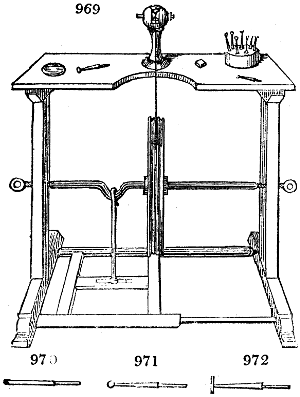
Fig. 969. represents the whole of the seal engraver’s lathe. It consists of a table on which is fixed the mill, a small horizontal cylinder of steel, into one of whose extremities the tool is inserted, and which is made to revolve by the usual fly-wheel, driven by a treddle. The tools that may be fitted to the mill-cylinder, are the following: fig. 970. a hollow cylinder, for describing circles, and for boring; fig. 971. a knobbed tool, or rod terminated by a small ball; fig. 972. a stem terminated with a cutting disc, whose edge may be either rounded, square, or sharp; being in the last case called a saw.
Having fixed the tool best adapted to his style of work in the mill, the artist applies to its cutting point, or edge, some diamond-powder, mixed up with olive oil; and turning the wheel, he holds the stone against the tool, so as to produce the wished-for delineation and erosion. A similar apparatus is used for engraving on glass.
In order to give the highest degree of polish to the engraving, tools of boxwood, pewter, or copper, bedaubed with moistened tripoli or rotten-stone, and lastly, a brush, are fastened to the mill. These are worked like the above steel instruments. Modern engravings on precious stones, have not in general the same fine polish as the antient. The article Gems, in Rees’ Cyclopædia, contains a variety of valuable information on this subject, equally interesting to the artist and the scholar.
SEALING-WAX. (Cire à cacheter, Fr.; Siegellack, Germ.) The Hindus from time immemorial have possessed the resin lac, and were long accustomed to use it for sealing manuscripts before it was known in Europe. It was first imported from the East into Venice, and then into Spain; in which country sealing-wax became the object of a considerable commerce, under the name of Spanish wax.
If shellac be compounded into sealing-wax, immediately after it has been separated by fusion from the palest qualities of stick or seed lac, it then forms a better and less brittle article, than when the shellac is fused a second time. Hence sealing-wax, rightly prepared in the East Indies, deserves a preference over what can be made in other countries, where the lac is not indigenous. Shellac can be restored in some degree, however, to a plastic and tenacious state by melting it with a very small portion of turpentine. The palest shellac is to be selected for bright-coloured sealing-wax, the dark kind being reserved for black.
The following prescription may be followed for making red sealing-wax:—Take 4 ounces of shellac, 1 ounce of Venice turpentine (some say 11⁄2 ounces), and 3 ounces of vermillion. Melt the lac in a copper pan suspended over a clear charcoal fire, then pour the turpentine slowly into it, and soon afterwards add the vermillion, stirring briskly all the time of the mixture with a rod in either hand. In forming the round sticks of sealing-wax, a certain portion of the mass should be weighed while it is ductile, divided into the desired number of pieces, and then rolled out upon a warm marble slab, by means of a smooth wooden block, like that used by apothecaries for rolling a mass of pills. The oval sticks of sealing-wax are cast in moulds, with the above compound in a state of fusion. The marks of the lines of junction of the mould-box may be afterwards removed by holding the sticks over a clear fire, or passing them over a blue gas-flame. Marbled sealing-wax is made by mixing two, three, or more coloured kinds of it, while they are in a semi-fluid state. From the viscidity of the several masses, their incorporation is left incomplete, so as to produce the appearance of marbling. Gold sealing-wax is made simply by stirring gold-coloured mica spangles into the melted resins. Wax may be scented by introducing a little essential oil, essence of musk, or other perfume. If 1 part of balsam of Peru be melted along with 99 parts of the sealing-wax composition, an agreeable fragrance will be exhaled in the act of sealing with it. Either lamp black or ivory black serves for the colouring-matter of black wax. Sealing-wax is often adulterated with rosin; in which case it runs into thin drops at the flame of a candle.
SEA WATER, is composed as follows, according to the author of the article Salines, in the Dictionnaire Technologique:—Chloride of sodium, 2·50; chloride of magnesium, 0·35; sulphate of magnesia, 0·58; carbonates of lime and magnesia, 0·02; sulphate of lime, 0·01; water, 96·54, in 100 parts. See Salt, Sea.
SEGGAR, or SAGGER, is the cylindric case, of fire-clay, in which fine stoneware is enclosed while being baked in the kiln.
SELENIUM, from Σελἡνη, the moon, is a metalloid principle, discovered by Berzelius, in 1817. It occurs sparingly in combination with several metals, as lead, cobalt, copper, and quicksilver, in the Harz, at Tilkerode; with copper and silver (Eukairite) in Sweden, with tellurium and bismuth in Norway, with tellurium and gold in Siebenbürgen, in several copper and iron pyrites, and with sulphur in the volcanic products of the Lipari Islands. Selenium has been found likewise in a red sediment which forms upon the bottoms of the lead chambers in which oil of vitriol has been made from peculiar pyrites, or pyritous sulphur. The extraction of selenium from that deposit, is a very complex process.
Selenium, after being fused and slowly cooled, appears of a bluish-gray colour, with a glistening surface; but it is reddish brown, and of metallic lustre when quickly cooled, It is brittle, not very hard, and has little tendency to assume the crystalline state. Selenium is dark-red in powder, and transparent, with a ruby cast, in thin scales. Its specific gravity is 4·30. It softens at the temperature of 176° F., is of a pasty consistence at 212°, becomes liquid at a somewhat higher heat, forming in close vessels dark-yellow vapours, which condense into black drops; but in the air, the fumes have a cinnabar-red colour.
This singular substance, apparently intermediate in its constitution between sulphur and metals, has not hitherto been applied to any use in the arts.
SELTZER WATER. See Soda-water, and Waters, Mineral.
SEPIA, is a pigment prepared from a black juice secreted by certain glands of the cuttle-fish, which the animal ejects to darken the water when it is pursued. One part of it is capable of making 1000 parts of water nearly opaque. All the varieties of this mollusca secrete the same juice; but the Sepia officinalis, the Sepia ioligo, and the Sepia tunicata, are chiefly sought after for making the pigment. The first, which occurs abundantly in the Mediterranean, affords most colour; the sac containing it being extracted, the juice is to be dried as quickly as possible, because it runs rapidly into putrefaction. Though insoluble in water, it is extremely diffusible through it, and is very slowly deposited. Caustic alkalis dissolve the sepia, and turn it brown; but in proportion as the alkali becomes carbonated by exposure to air, the sepia falls to the bottom of the vessel. Chlorine blanches it slowly. It consists of carbon in an extremely divided state, along with albumine, gelatine, and phosphate of lime.
The dried native sepia is prepared for the painter, by first triturating it with a little caustic lye, then adding more lye, boiling the liquid for half an hour, filtering, next saturating the alkali with an acid, separating the precipitate, washing it with water, and finally drying it with a gentle heat. The pigment is of a brown colour, and a fine grain.