B. (continued 2)
Reading edition
I may here observe that the arithmetical mean or sum is not the true mean or sum of the two specific gravities; but this difference is either not known or disregarded by the brewers. At low densities this difference is inconsiderable, but at high densities it would lead to serious errors. At specific gravity 1·231, wort or syrup contains one half of its weight of solid pure saccharum, and at 1·1045 it contains one fourth of its weight; but the brewer’s rule, when here applied, gives for the mean specific gravity 1·1155 = 1·231 + 1·0002.
The contents in solid saccharine matter at that density are however 271⁄4 per cent. showing the rule to be 21⁄4 lbs. wrong in excess on 100 lbs., or 9 lbs. per barrel.
The specific gravity of the solid dry extract of malt wort is 1·264; it was taken in oil of turpentine, and the result reduced to distilled water as unity. Its specific volume is 0·7911, that is, 10 lbs. of it will occupy the volume of 7·911 lbs. of water. The mean specific gravity, by computation of a solution of that extract in its own weight of water, is 1·1166; but by experiment, the specific gravity of that solution is 1·216, showing considerable condensation of volume in the act of combination with water.
The following Table shows the relation between the specific gravities of solutions of malt extract, and the per-centage of solid extract they contain:
Extr. Malt. Water. Malt Extract in 100. Sugar in 100. Specific gravity.
600 + 600 50·00 47·00 1·2180
600 + 900 40·0 37·00 1·1670
600 + 1200 33·3 31·50 1·1350
600 + 1500 28·57 26·75 1·1130
600 + 1800 25·00 24·00 1·1000
The extract of malt was evaporated to dryness, at a temperature of about 250° F., without the slightest injury to its quality, or any empyreumatic smell. Bate’s tables have been constructed on solutions of sugar, and not with solutions of extract of malt, or they agree sufficiently well with the former, but differ materially from the latter. Allan’s tables give the amount of a certain form of solid saccharine matter extracted from malt, and dried at 175° F., in correspondence to the specific gravity of the solution; but I have found it impossible to make a solid extract from infusions of malt, except at much higher temperatures than 175° F. Indeed, the numbers on Allan’s saccharometer scale clearly show that his extract was by no means dry: thus, at 1·100 of gravity he assigns 29·669 per cent. of solid saccharine matter; whereas there is at that density of solid extract only 25 per cent. Again, at 1·135, Allan gives 40 parts per cent. of solid extract, whereas there are only 331⁄3 present.
By the triple mashing operations above described, the malt is so much exhausted that it can yield no further extract useful for strong beer or porter. A weaker wort might no doubt still be drawn off for small beer, or for contributing a little to the strength of the next mashing of fresh malt. But this I believe is seldom practised by respectable brewers, as it impoverishes the grains which they dispose of for feeding cattle.
The wort should be transferred into the copper, and made to boil as soon as possible, for if it remains long in the under-back it is apt to become acescent. The steam moreover raised from it in the act of boiling serves to screen it from the oxygenating or acidifying influence of the atmosphere. Until it begins to boil, the air should be excluded by some kind of a cover.
Sometimes the first wort is brewed by itself into strong ale, the second by itself into an intermediate quality; and the third into small beer; but this practice is not much followed in this country.
We shall now treat of the boiling in of the hops. The wort drawn from the mash-tun, whenever it is pumped into the copper, must receive its allowance of hops. Besides evaporating off a portion of the water, and thereby concentrating the wort, boiling has a twofold object. In the first place, it coagulates the albuminous matter, partly by the heat, and partly by the principles in the hops, and thereby causes a general clarification of the whole mass, with the effect of separating the muddy matters in a flocculent form. Secondly, during the ebullition, the residuary starch and hordeine of the malt are converted into a limpid sweetish mucilage, the dextrine above described; while some of the glutinous stringy matter is rendered insoluble by the tannin principle of the hops, which favours still further the clearing of the wort. By both operations the keeping quality of the beer is improved. This boil must be continued during several hours; a longer time for the stronger, and a shorter for the weaker beers. There is usually one seventh or one sixth part of the water dissipated in the boiling copper. This process is known to have continued a sufficient time, if the separation of the albuminous flocks is distinct, and if these are found, by means of a proof gauge suddenly dipped to the bottom, to be collected there, while the supernatant liquor has become limpid. Two or three hours’ boil is deemed long enough in many well-conducted breweries; but in some of those in Belgium, the boiling is continued from 10 to 15 hours, a period certainly detrimental to the aroma derived from the hop.
Many prefer adding the hops when the wort has just come to the boiling point. Their effect is to repress the further progress of fermentation, and especially the passage into the acetous stage, which would otherwise inevitably ensue in a few days. In this respect, no other vegetable production hitherto discovered can be a substitute for the hop. The odorant principle is not so readily volatilised as would at first be imagined; for when hop is mixed with strong beer wort, and boiled for many hours, it can still impart a very considerable degree of its flavour to weaker beer. By mere infusion in hot beer or water, without boiling, the hop loses very little of its soluble principles. The tannin of the hop combines, as we have said, with the vegetable albumen of the barley, and helps to clarify the liquor. Should there be a deficiency of albumen and gluten, in consequence of the mashing having been done at such a heat as to have coagulated them beforehand, the defect may be remedied by the addition of a little gelatine to the wort copper, either in the form of calf’s foot, or of a little isinglass. If the hops be boiled in the wort for a longer period than 5 or 6 hours, they lose a portion of their fine flavour; but if their natural flavour be rank, a little extra boiling improves it. Many brewers throw the hops in upon the surface of the boiling wort, and allow them to swim there for some time, that the steam may penetrate them, and open their pores for a complete solution of their principles when they are pushed down into the liquor. It is proper to add the hops in considerable masses, because in tearing them asunder, some of the lupuline powder is apt to be lost.
The quantity of hop to be added to the wort varies according to the strength of the beer, the length of time it is to be kept, or the heat of the climate where it is intended to be sent. For strong beer, 41⁄2 lbs. of hops are required to a quarter of malt, when it is to be highly aromatic and remarkably clear. For the stronger kinds of ale and porter, the rule, in England, is to take a pound of hops for every bushel of malt, or 8 lbs. to a quarter. Common beer has seldom more than a quarter of a pound of hops to the bushel of malt.
It has been attempted to form an extract of hops by boiling in covered vessels, so as not to lose the oil, and to add this instead of the hop itself to the beer. On the great scale this method has no practical advantage, because the extraction of the hop is perfectly accomplished during the necessary boiling of the wort, and because the hop operates very beneficially, as we have explained, in clarifying the beer. Such an extract, moreover, could be easily adulterated.
Of the Coolers.—The contents of the copper are run into what is called the hop-back, on the upper part of which is fixed a drainer, to keep back the hops. The pump is placed in the hop-back, for the purpose of raising the wort to the coolers, usually placed in an airy situation upon the top of the brewery. Two coolers are indispensable when we make two kinds of beer from the same brewing, and even in single brewings, called gyles, if small beer is to be made. One of these coolers ought to be placed above the level of the other. As it is of great consequence to cool the worts down to the fermenting pitch as fast as possible, various contrivances have been made for effecting this purpose. The common cooler is a square wooden cistern, about 6 inches deep, and of such an extent of surface that the whole of one boil may only occupy 2 inches, or thereabouts, of depth in it. For a quantity of wort equal to about 1500 gallons its area should be at least 54 feet long and 20 feet wide. The seams of the cooler must be made perfectly water-tight and smooth, so that no liquor may lodge in them when they are emptied. The utmost cleanliness is required, and an occasional sweetening with lime-water.
The hot wort reaches the cooler at a temperature of from 200° to 208°, according to the power of the pump. Here it should be cooled to the proper temperature for the fermenting tun, which may vary from 54° to 64°, according to circumstances. The refrigeration is accomplished by the evaporation of a portion of the liquor: it is more rapid in proportion to the extent of the surface, to the low temperature, and the dryness of the atmosphere surrounding the cooler. The renewal of a body of cool dry air by the agency of a fan, may be employed with great advantage. The cooler itself must be so placed that its surface shall be freely exposed to the prevailing wind of the district, and be as free as possible from the eddy of surrounding buildings. It is thought by many, that the agitation of the wort during its cooling, is hurtful. Were the roof made moveable, so that the wort could be readily exposed, in a clear night, to the aspect of the sky, it would cool rapidly by evaporation, on the principles explained by Dr. Wells, in his “Essay on Dew.”
When the cooling is effected by evaporation alone, the temperature falls very slowly, even in cold air, if it be loaded with moisture. But when the air is dry, the evaporation is vigorous, and the moisture exhaled does not remain incumbent on the liquor, as in damp weather, but is diffused widely in space. Hence we can understand how wort cools so rapidly in the spring and autumn, when the air is generally dry, and even more quickly than in winter, when the air is cooler, but loaded with moisture. In fact, the cooling process goes on better when the atmosphere is from 50° to 55°, than when it falls to the freezing point, because in this case, if the air be still, the vapours generated remain on the surface of the liquor, and prevent further evaporation. In summer the cooling can take place only during the night.
In consequence of the evaporation during this cooling process, the bulk of the worts is considerably reduced; thus, if the temperature at the beginning was 208°, and if it be at the end 64°, the quantity of water necessary to be evaporated to produce this refrigeration would be nearly 1⁄8 of the whole, putting radiation and conduction of heat out of the question. The effect of this will be a proportional concentration of the beer.
The period of refrigeration in a well-constructed cooler, amounts to 6 or 7 hours in favourable weather, but to 12 or 15 in other circumstances. The quality of the beer is much improved by shortening this period; because, in consequence of the great surface which the wort exposes to the air, it readily absorbs oxygen, and passes into the acetous fermentation with the production of various mouldy spots; an evil to which ill-hopped beer is particularly liable. Various schemes have been contrived to cool wort, by transmitting it through the convolutions of a pipe immersed in cold water. The best plan is to expose the hot wort for some hours freely to the atmosphere and the cooler, when the loss of heat is most rapid by evaporation and other means, and when the temperature falls to 100°, or thereby, to transmit the liquor through a zig-zag pipe, laid almost horizontally in a trough of cold water. The various methods described under Refrigerator are more complex, but they may be practised in many situations with considerable advantage.
Whilst the wort reposes in the cooler, it lets fall a slight sediment, which consists partly of fine flocks of coagulated albumen combined with tannin, and partly of starch, which had been dissolved at the high temperature, and separates at the lower. The wort should be perfectly limpid, for a muddy liquor never produces transparent beer. Such beer contains, besides mucilaginous sugar and gum, usually some starch, which even remains after the fermentation, and hinders its clarifying, and gives it a tendency to sour. The wort contains more starch the hotter it has been mashed, the less hops have been added, and the shorter time it has been boiled. The presence of starch in the wort may be made manifest by adding a little solution of iodine in alcohol to it, when it will become immediately blue. We thus see that the tranquil cooling of wort in a proper vessel has an advantage over cooling it rapidly by a refrigeratory apparatus. When the wort is sufficiently cool, it is let down into the fermenting tun. In this transfer, the cooling might be carried several degrees lower, were the wort made to pass down through a tube inclosed in another tube, along which a stream of cold water is flowing in the opposite direction, as we have described in the sequel of Acetic Acid. These fermenting tuns are commonly called gyle-tuns, or working tuns, and are either square or circular, the latter being preferable on many accounts.
IV. Of the Fermentation.—In the great London breweries, the size of these fermenting tuns is such that they contain from 1200 to 1500 barrels. The quantity of wort introduced at a time must, however, be considerably less than the capacity of the vessel, to allow room for the head of yeast which rises during the process; if the vessel be cylindrical, this head is proportional to the depth of the worts. In certain kinds of fermentation, it may rise to a third of that depth. In general, the fermentation proceeds more uniformly and constantly in large masses, because they are little influenced by vicissitudes of temperature; smaller vessels, on the other hand, are more easily handled. The general view of fermentation will be found under that title; I shall here make a few remarks on what is peculiar to beer. During the fermentation of wort, a portion of its saccharine matter is converted into alcohol, and wort thus changed, is beer. It is necessary that this conversion of the sugar be only partial, for beer which contains no undecomposed sugar would soon turn sour, and even in the casks its alcohol undergoes a slow fermentation into vinegar. The amount of this excess of sugar is greater in proportion to the strength of the wort, since a certain quantity of alcohol, already formed, prevents the operation of the ferment on the remaining wort. Temperature has the greatest influence upon the fermentation of wort. A temperature of from 55° to 60° of the liquor, when that of the atmosphere is 55°, is most advantageous for the commencement. The warmth of the wort as it comes into the gyle-tun must be modified by that of the air in the apartment. In winter, when this apartment is cold, the wort should not be cooled under 64° or 60°, as in that case the fermentation would be tedious or interrupted, and the wort liable to spoil or become sour. In summer, when the temperature of the place rises to above 75°, the wort should be cooled, if possible, down to 55°, for which purpose it should be let in by the system of double pipes, above mentioned. The higher the temperature of the wort, the sooner will the fermentation begin and end, and the less is it in our power to regulate its progress. The expert brewer must steer a middle course between these two extremes, which threaten to destroy his labours. In some breweries a convoluted pipe is made to traverse or go round the sides of the gyle-tun, through which warm water is allowed to flow in winter, and cold in summer, so as to modify the temperature of the mass to the proper fermenting pitch. If there be no contrivance of this kind, the apartment may be cooled in summer, by suspending wet canvas opposite the windows in warm weather, and kindling a small stove within it in cold.
When the wort is discharged into the gyle-tun, it must receive its dose of yeast, which has been previously mixed with a quantity of the wort, and left in a warm place till it has begun to ferment. This mixture, called lobb, is then to be put into the tun, and stirred well through the mass. The yeast should be taken from similar beer. Its quantity must depend upon the temperature, strength, and quantity of the wort. In general, one gallon of yeast is sufficient to set 100 gallons of wort in complete fermentation. An excess of yeast is to be avoided, lest the fermentation should be too violent, and be finished in less than the proper period of 6 or 8 days. More yeast is required in winter than summer; for, at a temperature of 50°, a double quantity may be used to that at 68°.
Six or eight hours after adding the yeast, the tun being meanwhile covered, the fermentation becomes active: a white milky-looking froth appears, first on the middle, and spreads gradually over the whole surface; but continues highest in the middle, forming a frothy elevation, the height of which increases with the progress of the fermentation, and whose colour gradually changes to a bright brown, the result, apparently, of the oxidation of the extractive contained in this yeasty top. This covering screens the wort from the contact of the atmospherical air. During this time, there is a perpetual disengagement of carbonic acid gas, which is proportional to the quantity of sugar converted into alcohol. The warmth of the fermenting liquid increases at the same time, and is at a maximum when the fermentation has come to its highest point. This increase of temperature amounts to from 9° to 14° or upwards, and is the greater the more rapid the fermentation. But in general, the fermentation is not allowed to proceed so far in the gyle-tun, for after it is advanced a little way, the beer is cleansed, that is, drawn off into other vessels, which are large barrels set on end, with large openings in their top, furnished with a sloping tray for discharging an excess of yeast into the wooden trough, in which the stillions stand. These stillions are placed in communication with a store-tub, which keeps them always full, by hydrostatic pressure, so that the head of yeast may spontaneously flow over, and keep the body of liquor in the cask clean. This apparatus will be explained in describing the brewery plant. See the figures, infrà.
It must be observed, that the quantity of yeast, and the heat of fermentation, differ for every different quality of beer. For mild ale, when the fermentation has reached 75°, its first flavour begins; at 80° the flavour increases; at 85° it approaches the high flavour; at 90° it is high; but it may be carried to 100° and upwards, for particular purposes. A wort of 30 lbs. per barrel (sp. gr. 1·088), ought to increase about 15°, so that in order to arrive at 80°, it should be set at 65°. The quantity of yeast for such an ale should be from 2 to 3 lbs. per barrel. The higher the heat, the less yeast is necessary. If the heat of the fermentation should at any time fall, it must be raised by a supply of fresh yeast, well stirred in; but this practice is not advisable in general, because rousing the worts in the gyle-tun is apt to communicate a rank flavour of yeast to the ale. It is the practice of many experienced brewers to look every 2 hours into the gyle-tun, chiefly with the view of observing the progress of the heat, which is low at first, but afterwards often increases half a degree per hour, and subsequently declines, as the fermentation approaches its conclusion, till at length the heat becomes uniform, or sometimes decreases, before the fermentation is finished, especially where the quantity operated upon is small.
Some brewers recommend, when the fermentation is carried to its utmost period, to add about 7 lbs. of wheat or bean flour to a gyle-tun of 25 or 30 barrels, at the time of cleansing, so as to quicken the discharge of the yeast, by disengagement of more carbonic acid. The flour should be whisked up in a pail, with some of the beer, till the lumps are broken, and then poured in. By early cleansing, the yeast is preserved longer in a state proper for a perfect fermentation than by a contrary practice.
For old ale, which is to be long kept, the heat of the fermentation should not exceed 75°, but a longer time is required to complete the fermentation and ensure the future good flavour of the ale.
For porter, the general practice is, to use from 4 to 41⁄2 lbs. of hops per barrel for keeping; though what is termed mild or mixing porter, has not more than 3 or 31⁄2 lbs. The heat of fermentation must not exceed 70°, and begin about 60°. If the heat tend to increase much above that pitch in the gyle-tun, the porter should be cleansed, by means of the stillions. At this period of the fermentation, care should be taken that the sweetness of the malt be removed, for which purpose more yeast may be used than with any other beer of the same strength. The quantity is from 3 to 4 lbs. per barrel, rousing the wort in the gyle-tun every 2 hours in the day-time.
When the plan of cleansing casks is not employed, the yeast is removed from the surface of the fermenting tun by a skimmer, and the clear beer beneath is then drawn off into the ripening tuns, called store-vats, in which it is mixed up with different brewings, to suit the taste of the customers. This transfer must take place whenever the extrication of carbonic acid has nearly ceased; lest the alcohol formed should dissolve some of the floating yeast, acquire thereby a disagreeable taste, and pass partially into the acetous state.
In this process, during the formation of vinous spirit at the expense of the sugar, the albumen and gluten diffused through the beer, being acted upon by the alcohol, become insoluble; one portion of them is buoyed to the top with the carbonic acid gas, to form the frothy yeast; and another portion falls to form the bottom barm. The former consists of the same materials as the wort, with a large proportion of gluten, which forms its active constituent; the latter is a peculiar deposit, consisting of the same gluten mixed with the various dense impurities of the wort, and may be also used as a ferment, but is cruder than the floating yeast. The amount of yeast is proportional to the activity of the fermentation, or extrication of carbonic acid gas, as also to the heat of the mashing process, and the quantity of starch or flour unaltered by germination. Pale malt affords usually, more yeast than malt highly kilned. When the yeast becomes excessive, from too violent fermentation, it should be skimmed off from time to time, which will tend to cool the liquor and moderate the intestine changes.
After the beer is let down into the close store-tuns in the cellar, an obscure fermentation goes on, for a considerable period in its body, which increases its spirituous strength, and keeps up in it a constant impregnation of carbonic acid gas, so as to render it lively and agreeable to the taste, when it is casked off for sale. It would appear, that beer is never stationary in quality, while it is contained in the tuns; for the moment when it ceases to improve by the decomposition of its residuary sugar, it begins to degenerate into vinegar. This result may be produced either by the exhaustion of the saccharine, or by the fermentative matter. The store cellar should therefore be under ground, free from alternations of temperature, vibrations of carriages, and as cool as possible. In the great London breweries, the fermentation is rendered very complete in the cleansing butts; so that a slow and steady ripening is ensured in the great store-tuns. The gyle-tuns are too capacious to permit the fermentation to be finished, with either safety or sufficient dispatch in them.
V. Of ripening different kinds of Beer.—The varieties of beer depend either upon the difference of their materials, or from a different management of the brewing processes.
With regard to the materials, beers differ in the proportion of their malt, hops, and water; and in the different kinds of malt or other grain. To the class of table or small beers, all those sorts may be referred whose specific gravity does not exceed 1·025, which contain about 5 per cent. of malt extract, or nearly 18 pounds per barrel. Beers of middling strength may be reckoned those between the density of 1·025 and 1·040; which contain, at the average, 7 per cent., or 25 pounds per barrel. The latter may be made with 400 quarters of malt to 1500 barrels of beer. Stronger beers have a specific gravity of from 1·050 to 1·080, and take from 45 to 75 quarters of malt to the same quantity of beer. The strongest beer found in the market is some of the English and Scotch ales, for which from 18 to 27 quarters of malt are taken for 1500 gallons of beer. Good porter requires from 16 to 18 quarters for that quantity. Beers are sometimes made with the addition of other farinaceous matter to the malt; but when the latter constitutes the main portion of the grain, the malting of the other kinds of corn becomes unnecessary, for the diastase of the barley-malt changes the starch into sugar during the mashing operation. Even with entirely raw grain, beer is made in some parts of the Continent, the brewers trusting the conversion of the starch into sugar to the action of the gluten alone, at a low mashing temperature, on the principle of Saussure’s and Kirchoff’s researches.
The colour of the beer depends upon the colour of the malt, and the duration of the boil in the copper. The pale ale is made, as we have stated, from steam or sun-dried malt, and the young shoots of the hop; the deep yellow ale from a mixture of pale yellow and brown malt; and the dark brown beer from well-kilned and partly carbonised malt, mixed with a good deal of the pale, to give body. The longer and more strongly heated the malt has been in the kiln, the less weight of extract, cæteris paribus, does it afford. In making the fine mild ales, high temperatures ought to be avoided, and the yeast ought to be skimmed off, or allowed to flow very readily from its top, by means of the cleansing butt system, so that little ferment being left in it to decompose the rest of the sugar, the sweetness may remain unimpaired. With regard to porter, in certain breweries, each of the three kinds of malt employed for it is separately mashed, after which the first and the half of the second wort is boiled along with the whole of the hops, and thence cooled and set to ferment in the gyle-tun. The third drawn wort, with the remaining half of the second, is then boiled with the same hops, saved by the drainer, and, after cooling, added to the former in the gyle-tun, when the two must be well roused together.
It is obvious, from the preceding development of principles, that all amylaceous and saccharine materials, such as potatoes, beans, turnips, as well as cane and starch syrup, molasses, &c., may be used in brewing beer. When, however, a superior quality of brown beer is desired, malted barley is indispensable, and even with these substitutes a mixture of it is most advantageous. The washed roots of the common carrot, of the red and yellow beet, or of the potato, must be first boiled in water, and then mashed into a pulp. This pulp must be mixed with water in the copper, along with wheaten or oat meal, and the proper quantity of hops, then boiled during 8 or 9 hours. This wort is to be cooled in the usual way, and fermented, with the addition of yeast. A much better process is that now practised, on a considerable scale, at Strasbourg, in making the ale, for which that city is celebrated. The mashed potatoes are mixed with from a twentieth to a tenth of their weight of finely ground barley malt, and some water. The mixture is exposed, in a water-bath, to a heat of 160° F. for four hours, whereby it passes into a saccharine state, and may then be boiled with hops, cooled, and properly fermented into good beer.
Maize, or Indian corn, has also been employed to make beer; but its malting is somewhat difficult on account of the rapidity and vigour with which its radicles and plumula sprout forth. The proper mode of causing it to germinate is to cover it, a few inches deep, with common soil, in a garden or field, and to leave it there till the bed is covered with green shoots of the plant. The corn must be then lifted, washed, and exposed to the kiln.
The Difference of the Fermentation.—The greater or less rapidity with which the worts are made to ferment has a remarkable influence upon the quality of the beer, especially in reference to its fitness for keeping. The wort is a mucilaginous solution in which the yeastly principles, eliminated by the fermentation, will, if favoured by regular and slow intestine movements, completely rise to the surface, or sink to the bottom, so as to leave the body fine. But, when the action is too violent, these barmy glutinous matters get comminuted and dispersed through the liquor, and can never afterwards be thoroughly separated. A portion of the same feculent matter becomes, moreover, permanently dissolved, during this furious commotion, by the alcohol that is generated. Thus the beer loses not merely its agreeable flavour and limpidity, but is apt to spoil from the slightest causes. The slower, more regularly progressive, and less interrupted, therefore, the fermentation is, so much better will the product be.
Beer, in its perfect condition, is an excellent and healthful beverage, combining, in some measure, the virtues of water, of wine, and of food, as it quenches thirst, stimulates, cheers, and strengthens. The vinous portion of it is the alcohol, proceeding from the fermentation of the malt sugar. Its amount, in common strong ale or beer, is about 4 per cent., or four measures of spirits, specific gravity 0·825 in 100 measures of the liquor. The best brown stout porter contains 6 per cent., the strongest ale even 8 per cent.; but common beer only one. The nutritive part of the beer is the undecomposed gum-sugar, and the starch-gum, not changed into sugar. Its quantity is very variable, according to the original starch of the wort, the length of the fermentation, and the age of the beer.
The main feature of good beer is fine colour and transparency; the production of which is an object of great interest to the brewer. Attempts to clarify it in the cask seldom fail to do it harm. The only thing that can be used with advantage for fining foul or muddy beer, is isinglass. For porter, as commonly brewed, it is frequently had recourse to. A pound of good isinglass will make about 12 gallons of finings. It is cut into slender shreds, and put into a tub with as much vinegar or hard beer as will cover it, in order that it may swell and dissolve. In proportion as the solution proceeds, more beer must be poured upon it, but it need not be so acidulous as the first, because, when once well softened by the vinegar, it readily dissolves. The mixture should be frequently agitated with a bundle of rods, till it acquires the uniform consistence of thin treacle, when it must be equalised still more by passing through a tammy cloth, or a sieve. It may now be made up with beer to the proper measure of dilution. The quantity generally used is from a pint to a quart per barrel, more or less, according to the foulness of the beer. But before putting it into the butt, it should be diffused through a considerable volume of the beer with a whisk, till a frothy head be raised upon it. It is in this state to be poured into the cask, briskly stirred about; after which the cask must be bunged down for at least 24 hours, when the liquor should be limpid. Sometimes the beer will not be improved by this treatment; but this should be ascertained beforehand, by drawing off some of the beer into a cylindric jar or phial, and adding to it a little of the finings. After shaking and setting down the glass, we shall observe whether the feculencies begin to collect in flocky parcels, which slowly subside; or whether the isinglass falls to the bottom without making any impression upon the beer. This is always the case when the fermentation is incomplete, or a secondary decomposition has begun. Mr. Jackson has accounted for this clarifying effect of isinglass in the following way.
The isinglass, he thinks, is first of all rather diffused mechanically, than chemically dissolved, in the sour beer or vinegar, so that when the finings are put into the foul beer, the gelatinous fibres, being set free in the liquor, attract and unite with the floating feculencies, which before this union were of the same specific gravity with the beer, and therefore could not subside alone; but having now acquired additional weight by the coating of fish-glue, precipitate as a flocculent magma. This is Mr. Jackson’s explanation; to which I would add, that if there be the slightest disengagement of carbonic acid gas, it will keep up an obscure locomotion in the particles, which will prevent the said light impurities, either alone or when coated with isinglass, from subsiding. The beer is then properly enough called stubborn by the coopers. But the true theory of the action of isinglass is, that the tannin of the hops combines with the fluid gelatine, and forms a flocculent mass, which envelopes the muddy particles of the beer, and carries them to the bottom as it falls, and forms a sediment. When after the finings are poured in, no proper precipitate ensues, it may be made to appear by the addition of a little decoction of hop.
Mr. Richardson, the author of the well-known brewer’s saccharometer, gives the following as the densities of different kinds of beer:—
Beer. Pounds per Barrel. Specific Gravity.
Burton ale, 1st sort 40 to 43 1·111 to 1·120
Burton ale, 2d ditto 35 to 40 1·097 to 1·111
Burton ale, 3d ditto 28 to 33 1·077 to 1·092
Common ale 25 to 27 1·070 to 1·073
Ditto ditto 21 1·058
Porter, common sort 18 1·050
Ditto, double 20 1·055
Ditto, brown stout 23 1·064
Ditto, best brown stout 26 1·072
Common small beer 6 1·014
Good table beer 12 to 14 1·033 to 1·039
Of Returns or Malt Residuums.—When small beer is brewed after ale or porter, only one mash is to be made; but where this is not done, there may be two mashes, in order to economise malt to the utmost. We may let on the water at 160° or 165°, in any convenient quantity, infuse for an hour or thereby, then run it off, and pump into the copper, putting some hops into it, and causing it to boil for an instant; when it may be transferred to the cooler. A second mash or return may be made in the same manner, but at a heat 5° lower; and then disposed of in the boiler with some hops, which may remain in the copper during the night at a scalding heat, and may be discharged into the cooler in the morning. These two returns are to be let down into the under-back immediately before the next brewing, and thence heated in the copper for the next mashing of fresh malt, instead of hot water, commonly called liquor, in the breweries. But allowance must be made, in the calculation of the worts, for the quantity of fermentable matter in these two returns. The nett aggregate saving is estimated from the gravity of the return taken when cold in the cooler. A slight economy is also made in the extra boiling of the used hops. The lapse of a day or two between the consecutive brewings is no objection to the method of returns, because they are too weak in saccharine matter to run any risk of fermentation.
In conclusion, it may be remarked that Mr. Richardson somewhat underrates the gravity of porter, which is now seldom under 20 lbs. per barrel. The criterion for transferring from the gyle-tun to the cleansing butts is the attenuation caused by the production of alcohol in the beer: when that has fallen to 10 lbs. or 11 lbs., which it usually does in 48 hours, the cleansing process is commenced. The heat is at this time generally 75°, if it was pitched at 65°; for the heat and the attenuation go hand in hand.
About thirty years ago, it was customary for the London brewers of porter, to keep immense stocks of it for eighteen months or two years, with the view of improving its quality. The beer was pumped from the cleansing butts into store-vats, holding from twenty to twenty-five gyles or brewings of several hundred barrels each. The store-vats had commonly a capacity of 5000 or 6000 barrels; and a few were double, and one was treble, this size. The porter, during its long repose in these vats, became fine, and by obscure fermentation its saccharine mucilage was nearly all converted into vinous liquor, and dissipated in carbonic acid. Its hop-bitter was also in a great degree decomposed. Good hard beer was the boast of the day. This was sometimes softened by the publican, by the addition of some mild new-brewed beer. Of late years, the taste of the metropolis has undergone such a complete revolution in this respect, that nothing but the mildest porter will now go down. Hence, six weeks is a long period for beer to be kept in London; and much of it is drunk when only a fortnight old. Ale is for the same reason come greatly into vogue; and the two greatest porter houses, Messrs. Barclay, Perkins, & Co., and Truman, Hanbury, & Co., have become extensive and successful brewers of mild ale, to please the changed palate of their customers.
We shall add a few observations upon the brewing of Scotch ale. This beverage is characterised by its pale amber colour, and its mild balsamic flavour. The bitterness of the hop is so mellowed with the malt, as not to predominate. The ale of Preston Pans is, in fact, the best substitute for wine which barley has hitherto produced. The low temperature at which the Scotch brewer pitches his fermenting tun restricts his labours to the colder months of the year. He does nothing during four of the summer months. He is extremely nice in selecting his malt and hops; the former being made from the best English barley, and the latter being the growth of Farnham or East Kent. The yeast is carefully looked after, and measured into the fermenting tun in the proportion of one gallon to 240 gallons of wort.
Only one mash is made by the Scotch ale brewer, and that pretty strong; but the malt is exhausted by eight or ten successive sprinklings of liquor (hot water) over the goods (malt), which are termed in the vernacular tongue, sparges. These waterings percolate through the malt on the mash-tun bottom, and extract as much of the saccharine matter as may be sufficient for the brewing. By this simple method much higher specific gravities may be obtained than would be practicable by a second mash. With malt, the infusion or saccharine fermentation of the diastase is finished with the first mash; and nothing remains but to wash away from the goods the matter which that process has rendered soluble. It will be found on trial that 20 barrels of wort drawn from a certain quantity of malt, by two successive mashings, will not be so rich in fermentable matter as 20 barrels extracted by ten successive sparges of two barrels each. The grains always remain soaked with wort like that just drawn off, and the total residual quantity is three fourths of a barrel for every quarter of malt. The gravity of this residual wort will on the first plan be equal to that of the second mash; but on the second plan, it will be equal only to that of the tenth sparge, and will be more attenuated in a very high geometrical ratio. The only serious objection to the sparging system is the loss of time by the successive drainages. A mash-tun with a steam jacket, promises to suit the sparging system well; as it would keep up an uniform temperature in the goods, without requiring them to be sparged with very hot liquor.
The first part of the Scotch process seems of doubtful economy; for the mash liquor is heated so high as 180°. After mashing for about half an hour, or till every particle of the malt is thoroughly drenched, the tun is covered, and the mixture left to infuse about three hours; it is then drained off into the under-back, or preferably into the wort copper.
After this wort is run off, a quantity of liquor (water), at 180° of heat, is sprinkled uniformly over the surface of the malt; being first dashed on a perforated circular board, suspended horizontally over the mash-tun, wherefrom it descends like a shower upon the whole of the goods. The percolating wort is allowed to flow off, by three or more small stopcocks round the circumference of the mash-tun, to insure the equal diffusion of the liquor.
The first sparge being run off in the course of twenty minutes, another similar one is affused; and thus in succession till the whole of the drainage, when mixed with the first mash-wort, constitutes the density adapted to the quality of the ale. Thus, the strong worts are prepared, and the malt is exhausted either for table beer, or for a return, as pointed out above. The last sparges are made 5° or 6° cooler than the first.
The quantity of hops seldom exceeds four pounds to the quarter of malt. The manner of boiling the worts is the same as that above described; but the conduct of the fermentation is peculiar. The heat is pitched at 50°, and the fermentation continues from a fortnight to three weeks. Were three brewings made in the week, seven or eight working tuns would thus be in constant action; and, as they are usually in one room, and some of them at an elevation of temperature of 15°, the apartment must be propitious to fermentation, however low its heat may be at the commencement. No more yeast is used than is indispensable: if a little more be needed, it is made effective by rousing up the tuns twice a day from the bottom.
When the progress of the attenuation becomes so slack as not to exceed half a pound in the day, it is prudent to cleanse, otherwise the top harm might re-enter the body of the beer, and it would become yeast-bitten. When the ale is cleansed, the head, which has not been disturbed for some days, is allowed to float on the surface till the whole of the then pure ale is drawn off into the casks. This top is regarded as a sufficient preservative against the contact of the atmosphere. The Scotch do not skim their tuns, as the London ale brewers commonly do. The Scotch ale, when so cleansed, does not require to be set upon close stillions. It throws off little or no yeast, because the fermentation was nearly finished in the tun. The strength of the best Scotch ale ranges between 32 and 44 pounds to the barrel; or it has a specific gravity of from 1·088 to 1·122, according to the price at which it is sold. In a good fermentation, seldom more than a fourth of the original gravity of the wort remains at the period of the cleansing. Between one third and one fourth is the usual degree of attenuation. Scotch ale soon becomes fine, and is seldom racked for the home market. The following table will show the progress of fermentation in a brewing of good Scotch ale:—
20 barrels of mash-worts of 42 1⁄2 pounds gravity = 860 ·6
20 — returns 6 1⁄10 = 122
12 ) 982 ·6
pounds weight of extract per quarter of malt = 81
Fermentation:—
March 24. pitched the tun at 51°: yeast 4 gallons.
Temp. Gravity.
25. 52° 41 pounds.
28. 56° 39
30. 60° 34
April 1. 62° 32
4. 65° 29 added 1 lb. of yeast.
5. 66° 25
6. 67° 23
7. 67° 20
8. 66° 18
9. 66° 15
10. 64° 14 ·5 cleansed[7].
The following table shows the origin and the result of fermentation, in a number of practical experiments:—
Original Gravity of the Worts. Lbs. per Barrel of Saccharine Matter. Specific Gravity of the Ale. Lbs. per Barrel of Saccharine Matter. Attenuation, or Saccharum decomposed.
1 ·0950 88 ·75 1 ·0500 40 ·25 0 ·478
1 ·0918 85 ·62 1 ·0420 38 ·42 0 ·552
1 ·0829 78 ·125 1 ·0205 16 ·87 0 ·787
1 ·0862 80 ·625 1 ·0236 20 ·00 0 ·757
1 ·0780 73 ·75 1 ·0280 24 ·25 0 ·698
1 ·0700 65 ·00 1 ·0285 25 ·00 0 ·615
1 ·1002 93 ·75 1 ·0400 36 ·25 0 ·613
1 ·1025 95 ·93 1 ·0420 38 ·42 0 ·600
1 ·0978 91 ·56 1 ·0307 27 ·00 0 ·705
1 ·0956 89 ·37 1 ·0358 32 ·19 0 ·640
1 ·1130 105 ·82 1 ·0352 31 ·87 0 ·661
1 ·1092 102 ·187 1 ·0302 26 ·75 0 ·605
1 ·1171 110 ·00 1 ·0400 36 ·25 0 ·669
1 ·1030 96 ·40 1 ·0271 23 ·42 0 ·757
1 ·0660 61 ·25 1 ·0214 17 ·80 0 ·709
The second column here does not represent, I believe, the solid extract, but the pasty extract obtained as the basis of Mr. Allen’s saccharometer, and therefore each of its numbers is somewhat too high. The last column, also, must be in some measure erroneous, on account of the quantity of alcohol dissipated during the process of fermentation. It must be likewise incorrect, because the density due to the saccharine matter will be partly counteracted, by the effect of the alcohol present in the fermented liquor. In fact, the attenuation does not correspond to the strength of the wort; being greatest in the third brewing, and smallest in the first. The quantity of yeast for the above ale brewings in the table was, upon an average, one gallon for 108 gallons; but it varied with its quality, and with the state of the weather, which, when warm, permits much less to be used with propriety.
The good quality of the malt, and the right management of the mashing, may be tested by the quantity of saccharine matter contained in the successively drawn worts. With this view, an aliquot portion of each of them should be evaporated by a safety-bath heat to a nearly concrete consistence, and then mixed with twice its volume of strong spirit of wine. The truly saccharine substance will be dissolved, while the starch and other matters will be separated; after which the proportions of each may be determined by filtration and evaporation. Or an equally correct, and much more expeditious, method of arriving at the same result would be, after agitating the viscid extract with the alcohol in a tall glass cylinder, to allow the insoluble fecula to subside, and then to determine the specific gravity of the supernatant liquid by a hydrometer. The additional density which the alcohol has acquired will indicate the quantity of malt sugar which it has received. The following table, constructed by me, at the request of Henry Warburton, Esq., M. P., chairman of the Molasses Committee of the House of Commons in 1830, will show the brewer the principle of this important inquiry. It exhibits the quantity in grains weight of sugar requisite to raise the specific gravity of a gallon of spirit of different densities to the gravity of water = 1·000.
Specific Gravity of Spirit. Grains, Weight of Sugar in the Gallon Imperial.
0·995 0·980
0·990 1·890
0·985 2·800
0·980 3·710
0·975 4·690
0·970 5·600
0·965 6·650
0·960 7·070
0·955 8·400
0·950 9·310
The immediate purpose of this table was to show the effect of saccharine matter in disguising the presence or amount of alcohol in the weak feints of the distiller. But a similar table might easily be constructed, in which, taking a uniform quantity of alcohol of 0·825, for example, the quantity of sugar in any wort-extract would be shown by the increase of specific gravity which the alcohol received from agitation with a certain weight of the wort, inspissated to a nearly solid consistence by a safety-pan, made on the principle of my patent sugar-pan. (See Sugar.) Thus, the normal quantities being 1000 grain measures of alcohol, and 100 grains by weight of inspissated mash-extract, the hydrometer would at once indicate, by help of the table, first, the quantity per cent. of truly saccharine matter, and next, by subtraction, that of farinaceous matter present in it.
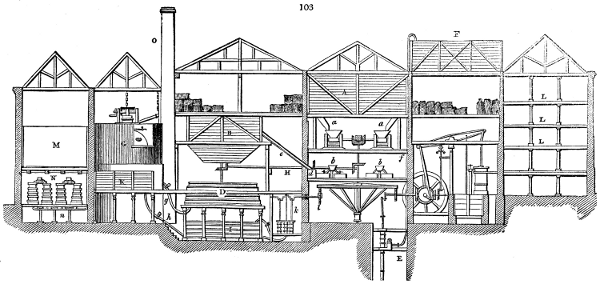
Fig. 103 enlarged (269 kB)
Plan, Machinery, and Utensils of a great Brewery.—Figs. 103. and 104. represent the arrangement of the utensils and machinery in a porter brewery on the largest scale; in which, however, it must be observed that the elevation fig. 103. is in a great degree imaginary as to the plane upon which it is taken; but the different vessels are arranged so as to explain their uses most readily, and at the same time to preserve, as nearly as possible, the relative positions which are usually assigned to each in works of this nature.
The malt for the supply of the brewery is stored in vast granaries or malt-lofts, usually situated in the upper part of the buildings. Of these, I have been able to represent only one, at A, fig. 103.: the others, which are supposed to be on each side of it, cannot be seen in this view. Immediately beneath the granary A, on the ground floor, is the mill; in the upper story above it, are two pairs of rollers, fig. 101, 102, and 103, under a, a, for bruising or crushing the grains of the malt. In the floor beneath the rollers are the mill-stones b, b, where the malt is sometimes ground, instead of being merely bruised by passing between the rollers, under a, a.
The malt, when prepared, is conveyed by a trough into a chest d, to the right of b, from which it can be elevated by the action of a spiral screw, fig. 105., enclosed in the sloping tube e, into the large chest or binn B, for holding ground malt, situated immediately over the mash-tun D. The malt is reserved in this binn till wanted, and it is then let down into the mashing-tun, where the extract is obtained by hot water supplied from the copper G, seen to the right of B.
The water for the service of the brewery is obtained from the well E, seen beneath the mill to the left, by a lifting pump worked by the steam engine; and the forcing-pipe f of this pump conveys the water up to the large reservoir or water-back F, placed at the top of the engine-house. From this cistern, iron pipes are laid to the copper G (on the right-hand side of the figure), as also to every part of the establishment where cold water can be wanted for cleaning and washing the vessels. The copper G can be filled with cold water by merely turning a cock; and the water, when boiled therein, is conveyed by the pipe g into the bottom of the mash-tun D. It is introduced beneath a false bottom, upon which the malt lies, and, rising up through the holes in the false bottom, it extracts the saccharine matter from the malt; a greater or less time being allowed for the infusion, according to circumstances. The instant the water is drawn off from the copper, fresh water must be let into it, in order to be ready for boiling the second mashing; because the copper must not be left empty for a moment, otherwise the intense heat of the fire would destroy its bottom. For the convenience of thus letting down at once as much liquor as will fill the lower part of the copper, a pan or second boiler is placed over the top of the copper, as seen in fig. 103.; and the steam rising from the copper communicates a considerable degree of heat to the contents of the pan, without any expense of fuel. This will be more minutely explained hereafter. (See fig. 107.)
During the process of mashing, the malt is agitated in the mash-tun, so as to expose every part to the action of the water. This is done by a mechanism contained within the mash-tun, which is put in motion by a horizontal shaft above it, H, leading from the mill. The mash machine is shown separately in fig. 106. When the operation of mashing is finished, the wort or extract is drained down from the malt into the vessel I, called the under-back, immediately below the mash-tun, of like dimensions, and situated always on a lower level, for which reason it has received this name. Here the wort does not remain longer than is necessary to drain off the whole of it from the tun above. It is then pumped up by the three-barrelled pump k, into the pan upon the top of the copper, by a pipe which cannot be seen in this section. The wort remains in the pan until the water for the succeeding mashes is discharged from the copper. But this delay is no loss of time, because the heat of the copper, and the steam arising from it, prepare the wort, which had become cooler, for boiling. The instant the copper is emptied, the first wort is let down from the pan into the copper, and the second wort is pumped up from the under-back into the upper pan. The proper proportion of hops is thrown into the copper through the near hole, and then the door is shut down, and screwed fast, to keep in the steam, and cause it to rise up through pipes into the pan. It is thus forced to blow up through the wort in the pan, and communicates so much heat to it, or water, called liquor by the brewers, that either is brought near to the boiling point. The different worts succeed each other through all the different vessels with the greatest regularity, so that there is no loss of time, but every part of the apparatus is constantly employed. When the ebullition has continued a sufficient period to coagulate the grosser part of the extract, and to evaporate part of the water, the contents of the copper are run off through a large cock into the jack-back K, below G, which is a vessel of sufficient dimensions to contain it, and provided with a bottom of cast-iron plates, perforated with small holes, through which the wort drains and leaves the hops. The hot wort is drawn off from the jack-back through the pipe h by the three-barrelled pump, which throws it up to the coolers L, L, L; this pump being made with different pipes and cocks of communication, to serve all the purposes of the brewery except that of raising the cold water from the well. The coolers L, L, L, are very shallow vessels, built over one another in several stages: and that part of the building in which they are contained is built with lattice-work or or shutter flaps, on all sides, to admit free currents of air. When the wort is sufficiently cooled to be put to the first fermentation, it is conducted in pipes from all the different coolers to the large fermenting vessel or gyle-tun M, which, with another similar vessel behind it, is of sufficient capacity to contain all the beer of one day’s brewings.
Whenever the first fermentation is concluded, the beer is drawn off from the great fermenting vessel M, into the small fermenting casks or cleansing vessels N, of which there are a great number in the brewery. They are placed four together, and to each four a common spout is provided to carry off the yeast, and conduct it into the troughs n, placed beneath. In these cleansing vessels the beer remains till the fermentation is completed; and it is then put into the store-vats, which are casks or tuns of an immense size, where it is kept till wanted, and is finally drawn off into barrels, and sent away from the brewery. The store-vats are not represented in the figure: they are of a conical shape, and of different dimensions, from fifteen to twenty feet diameter, and usually from fifteen to twenty feet in depth. The steam-engine which puts all the machine in motion is exhibited in its place, on the left side of the figure. On the axis of the large fly-wheel is a bevelled spur-wheel, which turns another similar wheel upon the end of a horizontal shaft, which extends from the engine-house to the great horse-wheel, set in motion by means of a spur-wheel. The horse-wheel drives all the pinions for the mill-stones b, b, and also the horizontal axis which works the three-barrelled pump k. The rollers a, a, are turned by a bevel wheel upon the upper end of the axis of the horse-wheel, which is prolonged for that purpose; and the horizontal shaft H, for the mashing engine, is driven by a pair of bevel wheels. There is likewise a sack-tackle, which is not represented. It is a machine for drawing up the sacks of malt from the court-yard to the highest part of the building, whence the sacks are wheeled on a truck to the malt-loft A, and the contents of the sacks are discharged.
The horse-wheel is intended to be driven by horses occasionally, if the steam-engine should fail; but these engines are now brought to such perfection that it is very seldom any recourse of this kind is needed.
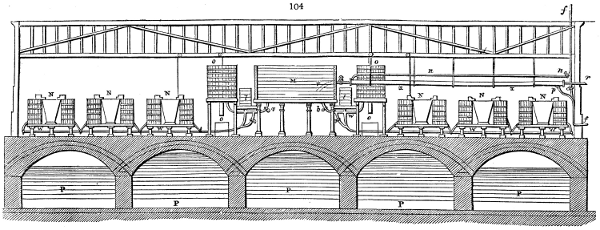
Fig. 104 enlarged (362 kB)
Fig. 104. is a representation of the fermenting house at the brewery of Messrs. Whitbread and Company, Chiswell Street, London, which is one of the most complete in its arrangement in the world: it was erected after the plan of Mr. Richardson, who conducts the brewing at those works. The whole of fig. 104. is to be considered as devoted to the same object as the large vessel M and the casks N, fig. 103. In fig. 104., r r is the pipe which leads from the different coolers to convey the wort to the great fermenting vessels or squares M, of which there are two, one behind the other; f f represents a part of the great pipe which conveys all the water from the well E, fig. 103, up to the water cistern F. This pipe is conducted purposely up the wall of the fermenting-house, fig. 104, and has a cock in it, near r, to stop the passage. Just beneath this passage a branch-pipe p proceeds, and enters a large pipe x x, which has the former pipe r withinside of it. From the end of the pipe x, nearest to the squares M, another branch n n proceeds, and returns to the original pipe f, with a cock to regulate it. The object of this arrangement is to make all, or any part, of the cold water flow through the pipe x x, which surrounds the pipe r, formed only of thin copper, and thus cool the wort passing through the pipe r, until it is found by the thermometer to have the exact temperature which is desirable before it is put to ferment in the great square M. By means of the cocks at n and p, the quantity of cold water passing over the surface of the pipe r can be regulated at pleasure, whereby the heat of the wort, when it enters into the square, may be adjusted within half a degree.
When the first fermentation in the squares M M is finished, the beer is drawn off from them by pipes marked c, and conducted by its branches W W W, to the different rows of fermenting-tuns, marked N N, which occupy the greater part of the building. In the hollow between every two rows are placed large troughs, to contain the yeast which they throw off. The figure shows that the small tuns are all placed on a lower level than the bottom of the great vessels M, so that the beer will flow into them, and, by hydrostatic equilibrium, will fill them to the same level. When they are filled, the communication-cock is shut; but, as the working off the yeast diminishes the quantity of beer in each vessel, it is necessary to replenish them from time to time. For this purpose, the two large vats O O are filled from the great squares M M, before any beer is drawn off into the small casks N, and this quantity of beer is reserved at the higher level for filling up. The two vessels O O are, in reality, situated between the two squares M M; but I have been obliged to place them thus in the section, in order that they may be seen. Near each filling-up tun O is a small cistern t communicating with the tun O by a pipe, which is closed by a float-valve. The small cisterns t are always in communication with the pipes which lead to the small fermenting vessels N; and therefore the surface of the beer in all the tuns, and in the cisterns, will always be at the same level; and as this level subsides by the working off of the yeast from the tuns, the float sinks and opens the valve, so as to admit a sufficiency of beer from the filling-up tuns O, to restore the surfaces of the beer in all the tuns, and also in the cistern t, to the original level. In order to carry off the yeast which is produced by the fermentation of the beer in the tuns O O, a conical iron dish or funnel is made to float upon the surface of the beer which they contain; and from the centre of this funnel a pipe, o, descends, and passes through the bottom of the tun, being packed with a collar of leather, so as to be water-tight; at the same time that it is at liberty to slide down, as the surface of the beer descends in the tun. The yeast flows over the edge of this funnel-shaped dish, and is conveyed down the pipe to a trough beneath.
Beneath the fermenting-house are large arched vaults, P, built with stone, and lined with stucco. Into these the beer is let down in casks when sufficiently fermented, and is kept in store till wanted. These vaults are used at Mr. Whitbread’s brewery, instead of the great store-vats of which we have before spoken, and are in some respects preferable, because they preserve a great equality of temperature, being beneath the surface of the earth.
The malt-rollers, or machines for bruising the grains of the malt, fig. 101. 102., have been already described. The malt is shot down from A, fig. 103., the malt-loft, into the hopper; and from this it is let out gradually through a sluice or sliding shuttle, a, fig. 103. and falls between the rollers.
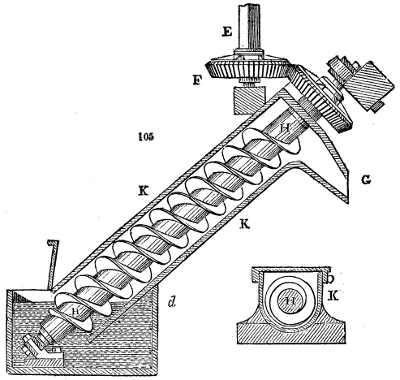
Fig. 105. is the screw by which the ground or bruised malt is raised up, or conveyed from one part of the brewery to another. K is an inclined box or trough, in the centre of which the axis of the screw H is placed; the spiral iron plate or worm, which is fixed projecting from the axis, and which forms the screw, is made very nearly to fill the inside of the box. By this means, when the screw is turned round by the wheels E F, or by any other means, it raises up the malt from the box d, and delivers it at the spout G.
This screw is equally applicable for conveying the malt horizontally in the trough K, as slantingly; and similar machines are employed in various parts of breweries for conveying the malt wherever the situation of the works require.
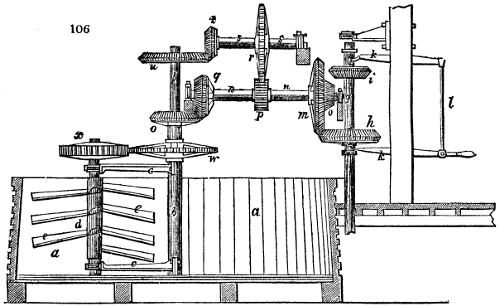
Fig. 106. is the mashing-machine. a a is the tun, made of wood staves, hooped together. In the centre of it rises a perpendicular shaft, b, which is turned slowly round by means of the bevelled wheels t u at the top. c c are two arms, projecting from that axis, and supporting the short vertical axis d of the spur-wheel x, which is turned by the spur-wheel w; so that, when the central axis b is made to revolve, it will carry the thick short axle d round the tun in a circle. That axle d is furnished with a number of arms, e e, which have blades placed obliquely to the plane of their motion. When the axis is turned round, these arms agitate the malt in the tun, and give it a constant tendency to rise upwards from the bottom.
The motion of the axle d is produced by a wheel, x, on the upper end of it, which is turned by a wheel, w, fastened on the middle of the tube b, which turns freely round upon its central axis. Upon a higher point of the same tube b is a bevel wheel, o, receiving motion from a bevel wheel, q, fixed upon the end of the horizontal axis n n, which gives motion to the whole machine. This same axis has a pinion, p, upon it, which gives motion to the wheel r, fixed near the middle of a horizontal axle, which, at its left hand end, has a bevel pinion, t, working the wheel u, before mentioned. By these means, the rotation of the central axis b will be very slow compared with the motion of the axle d; for the latter will make seventeen or eighteen revolutions on its own axis in the same space of time that it will be carried once round the tun by the motion of the shaft b. At the beginning of the operation of mashing, the machine is made to turn with a slow motion; but, after having wetted all the malt by one revolution, it is driven quicker. For this purpose, the ascending-shaft f g, which gives motion to the machine, has two bevel wheels, h i, fixed upon a tube, f g, which is fitted upon a central shaft. These wheels actuate the wheels m and o, upon the end of the horizontal shaft n n; but the distance between the two wheels h and i is such, that they cannot be engaged both at once with the wheels m and o; but the tube f g, to which they are fixed, is capable of sliding up and down on its central axis sufficiently to bring either wheel h or i into geer with its corresponding wheel o or m, upon the horizontal shaft; and as the diameters of n o, and i m, are of very different proportions, the velocity of the motion of the machine can be varied at pleasure, by using one or other. k and k are two levers, which are forked at their extremities, and embrace collars at the ends of the tube f g. These levers being united by a rod, l, the handle k gives the means of moving the tube f g, and its wheels h i, up or down, to throw either the one or the other wheel into geer.
The object of boiling the wort is not merely evaporation and concentration, but extraction, coagulation, and, finally, combination with the hops; purposes which are better accomplished in a deep confined copper, by a moderate heat, than in an open shallow pan with a quick fire. The copper being encased above in brickwork, retains its digesting temperature much longer than the pan could do. The waste steam of the close kettle, moreover, can be economically employed in communicating heat to water or weak worts; whereas the exhalations from an open pan would prove a nuisance, and would need to be carried off by a hood. The boiling has a four-fold effect: 1. it concentrates the wort; 2. during the earlier stages of heating, it converts the starch into sugar, dextrine, and gum, by means of the diastase; 3. it extracts the substance of the hops diffused through the wort; 4. it coagulates the albuminous matter present in the grain, or precipitates it by means of the tannin of the hops.
The degree of evaporation is regulated by the nature of the wort, and the quality of the beer. Strong ale and stout for keeping, require more boiling than ordinary porter or table-beer brewed for immediate use. The proportion of the water carried off by evaporation is usually from a seventh to a sixth of the volume. The hops are introduced during the progress of the ebullition. They serve to give the beer not only a bitter aromatic taste, but also a keeping quality, or they counteract its natural tendency to become sour; an effect partly due to the precipitation of the albumen and starch, by their resinous and tanning constituents, and partly to the antifermentable properties of their lupuline, bitter principle, ethereous oil, and resin. In these respects, there is none of the bitter plants which can be substituted for hops with advantage. For strong beer, powerful fresh hops should be selected; for weaker beer, an older and weaker article will suffice.
The hops are either boiled with the whole body of the wort, or extracted with a portion of it; and this concentrated extract added to the rest. The stronger the hops are, the longer time they require for extraction of their virtues; for strong hops, an hour and a half or two hours boiling may be proper; for a weaker sort, half an hour or an hour may be sufficient; but it is never advisable to push this process too far, lest a disagreeable bitterness, without aroma, be imparted to the beer. In our breweries, it is the practice to boil the hops with a part of the wort, and to filter the decoction through a drainer, called the jack hop-back. The proportion of hops to malt is very various; but, in general, from a pound and a quarter to a pound and a half of the former are taken for 100 lbs. of the latter in making good table-beer. For porter and strong ale, 2 pounds of hops are used, or even more; for instance, one pound of hops to a bushel of malt, if the beer be destined for the consumption of India.
During the boiling of the two ingredients, much coagulated albuminous matter, in various states of combination, makes its appearance in the liquid, constituting what is called the breaking or curdling of the wort, when numerous minute flocks are seen floating in it. The resinous, bitter, and oily-ethereous principles of the hops combine with the sugar and gum, or dextrine of the wort; but for this effect they require time and heat; showing that the boil is not a process of mere evaporation, but one of chemical reaction. A yellowish-green pellicle of hop-oil and resin appears upon the surface of the boiling wort, in a somewhat frothy form: when this disappears, the boiling is presumed to be completed, and the beer is strained off into the cooler. The residuary hops may be pressed and used for an inferior quality of beer; or they may be boiled with fresh wort, and be added to the next brewing charge.
Figs. 107, 108. represent the copper of a London brewery. Fig. 107. is a vertical section; fig. 108., a ground-plan of the fire-grate and flue, upon a smaller scale: a is the close copper kettle, having its bottom convex within; b is the open pan placed upon its top. From the upper part of the copper, a wide tube, c, ascends, to carry off the steam generated during the ebullition of the wort, which is conducted through four downwards-slanting tubes, d d (two only are visible in this section), into the liquor of the pan b, in order to warm its contents. A vertical iron shaft or spindle, e, passes down through the tube c, nearly to the bottom of the copper, and is there mounted with an iron arm, called a rouser, which carries round a chain hung in loops, to prevent the hops from adhering to the bottom of the boiler. Three bent stays, f, are stretched across the interior, to support the shaft by a collet at their middle junction. The shaft carries at its upper end a bevel wheel, g, working into a bevel pinion upon the axis h, which may be turned either by power or by hand. The rouser shaft may be lifted by means of the chain i, which, going over two pulleys, has its end passed round the wheel and axle k, and is turned by a winch: l is a tube for conveying the waste steam into the chimney m.
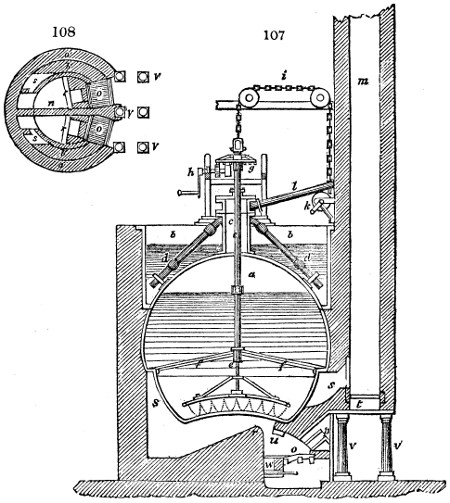
Fig. 108 enlarged (41 kB)
The heat is applied as follows:—For heating the colossal coppers of the London breweries, two separate fires are required, which are separated by a narrow wall of brickwork, n, fig. 107M, 108. The dotted circle a′ a′ indicates the largest circumference of the copper, and b′ b′ its bottom; o o are the grates upon which the coals are thrown, not through folding doors (as of old), but through a short slanting iron hopper, shown at p, fig. 107., built in the wall, and kept constantly filled with the fuel, in order to exclude the air. Thus the lower stratum of coals gets ignited before it reaches the grate. Above the hopper p, a narrow channel is provided for the admission of atmospherical air, in such quantity merely as may be requisite to complete the combustion of the smoke of the coals. Behind each grate there is a fire-bridge, r, which reflects the flame upwards, and causes it to play upon the bottom of the copper. The burnt air then passes round the copper in a semicircular flue, s s, from which it flows off into the chimney m, on whose under end a sliding damper-plate, t, is placed, for tempering the draught. When cold air is admitted at this orifice, the combustion of the fuel is immediately checked. There is, besides, another slide-plate at the entrance of the slanting flue into the vertical chimney, for regulating the play of the flame under and around the copper. If the plate t be opened, and the other plate shut, the power of the fire is suspended, as it ought to be, at the time of emptying the copper. Immediately over the grate is a brick arch, u, to protect the front edge of the copper from the first impulsion of the flame. The chimney is supported upon iron pillars, v v; w is a cavity closed with a slide-plate, through which the ashes may be taken out from behind, by means of a long iron hook.
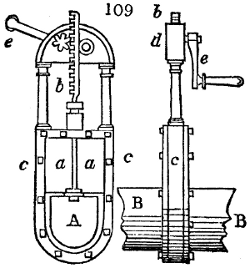
Fig. 109. represents one of the sluice-cocks, which are used to make the communications of the pipes with the pumps, or other parts of the brewery. B B represents the pipe in which the cock is placed. The two parts of this pipe are screwed to the side of a box, C C, in which a slider, A, rises and falls, and intercepts, at pleasure, the passage of the pipe. The slider is moved by the rod a. This passes through a stuffing-box, in the top of the box which contains the slider, and has the rack b fastened to it. The rack is moved by a pinion fixed upon the axis of a handle e, and the rack and pinion are contained in a frame d which is supported by two pillars. The frame contains a small roller behind the rack, which bears it up towards the pinion, and keeps its teeth up to the teeth of the pinion. The slider A is made to fit accurately against the internal surface of the box C, and to bear against this surface by the pressure of a spring, so as to make a perfectly close fitting.
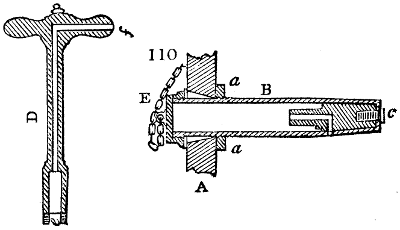
Fig. 110. is a small cock to be placed in the side of the great store vats, for the purpose of drawing off a small quantity of beer, to taste and try its quality. A is a part of the stave or thickness of the great store vat; into this the tube B of the cock is fitted, and is held tight in its place by a nut, a a, screwed on withinside. At the other end of the tube B, a plug, c, is fitted, by grinding it into a cone, and it is kept in by a screw. This plug has a hole up the centre of it, and from this a hole proceeds sidewise, and corresponds with a hole made through the side of the tube when the cock is open; but when the plug c is turned round, the hole will not coincide, and then the cock will be shut. D is the handle or key of the cock, by which its plug is turned to open or shut it: this handle is put up the bore of the tube (the cover E being first unscrewed and removed), and the end of it is adapted to fit the end of the plug of the cock. The handle has a tube or passage bored up it, to convey the beer away from the cock when it is opened, and from this the passage f, through the handle, leads, to draw the beer into a glass or tumbler. The hole in the side of the plug is so arranged, that, when the handle is turned into a perpendicular direction, with the passage f downwards, the cock will be open. The intention of this contrivance is, that there shall be no considerable projection beyond the surface of the tun; because it sometimes happens that a great hoop of the tun breaks, and, falling down, its great weight would strike out any cock which had a projection; and, if this happened in the night, much beer might be lost before it was discovered. The cock above described, being almost wholly withinside, and having scarcely any projection beyond the outside surface of the tun, is secure from this accident.
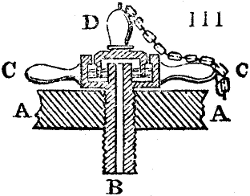
Fig. 111. is a small contrivance of a vent peg, to be screwed into the head of a common cask when the beer is to be drawn off from it, and it is necessary to admit some air to allow the beer to flow. A A represents a portion of the head of the cask into which the tube B is screwed. The top of this tube is surrounded by a small cup, from which project the two small handles C C, by which the peg is turned round to screw it into the cask. The cup round the other part of the tube, is filled with water; into this a small cup, D, is inverted; in consequence, the air can gain admission into the cask when the pressure within is so far diminished, that the air will bubble up through the water, and enter beneath the small cup D.
The most efficient substance for fining beer hitherto discovered is isinglass, which is prepared by solution in vinegar or old stale beer, and this solution is afterwards reduced with thin mild beer generally brewed for the purpose, in all large establishments, from a raw or return wort. It must next be passed through a fine hair sieve, by means of rubbing it down with a hard hair-brush, and brought to the proper consistency by thin mild beer. If properly made, it will be clear, transparent, and free from feculencies. Finings serve excellently to remove any extraneous matter that may be found floating in the beer, and thus changes it from bright to brilliant. The common quantity used is from a pint to a quart per barrel, according to the nature of the beer.
To ascertain whether the beer is in a fit state for fining, put it into a long glass cylindric vessel, and add to it a teaspoonful, or thereby, of the fining; then give the mixture a good shake, by turning the vessel up and down, after closing its mouth with the palm of the hand. If the beer has been well brewed, its aptitude to become bright will be soon shown by the mixture getting thick and curdy; a bright portion will generally show itself at the bottom or middle; after which the finings will gradually mount to the top, taking up all the impurities along with them, till the whole becomes brilliant. Some have said that the finings should carry the impurities down to the bottom; but this, according to Mr. Black[8], takes place only with stubborn beer, which would not become thoroughly bright with any quantity of finings which could be introduced. Finings have usually a specific gravity of from 1·010 to 1·016, and, when added to beer in a fit condition for fining, invariably go to the top, and not to the bottom. In fining beer in a barrel laid on its side, if the finings do not make their appearance at the bung-hole, the beer will not become bright. The isinglass must not be dissolved with heat, nor in hot water.
Beer brewed from imperfectly malted grain, or from a mixture of malt and raw corn, gives a fermentation quite different in flavour from that of beer from sound malt. The nose is, in fact, the best guide to the experienced brewer for ascertaining whether his process is going on well or ill.
Ropiness is a morbid state of beer, which is best remedied, according to Mr. Black, by putting the beer into a vat with a false bottom, and adding, per barrel, 4 or 5 pounds of hops, taken gradually away after the first boilings of the worts; and to them may be added about half a pound per barrel of mustard-seed. Rouse the beer as the hops are gradually introduced, and, in some months, the ropiness will be perfectly cured. The beer should be drawn off from below the false bottom.
For theoretical views, see Fermentation; and for wort-cooling apparatus, see Refrigerator.
BEET-ROOT SUGAR. See Sugar.
BELL-METAL, an alloy of copper and tin. See Copper.
BELLOWS. See Metallurgy.
BEN OIL. See Oil of Ben.
BENGAL STRIPES. Ginghams; a kind of cotton cloth woven with coloured stripes.
BENJAMIN or BENZOIN. (Benjoin, Fr.; Benzöe, Germ.) A species of resin used chiefly in perfumery. It is extracted by incision from the trunk and branches of the styrax benzoin, which grows in Java, Sumatra, Santa Fé, and in the kingdom of Siam. The plant belongs to the decandria monogynia of Linnæus, and the natural family of the ebenaceæ. It hardens readily in the air, and comes to us in brittle masses, whose fracture presents a mixture of red, brown, and white grains of various sizes, which, when white, and of a certain shape, have been called amygdaloid, from their resemblance to almonds. The sorted benzoin is, on the other hand, very impure.
The fracture of benzoin is conchoidal, and its lustre greasy: its specific gravity varies from 1·063 to 1·092. It has an agreeable smell, somewhat like vanilla, which is most manifest when it is ground. It enters into fusion at a gentle heat, and then exhales a white smoke, which may be condensed into the acicular crystals of benzoic acid, of which it contains 18 parts in the hundred. Stoltze recommends the following process for extracting the acid. The resin is to be dissolved in 3 parts of alcohol, the solution is to be introduced into a retort, and a solution of carbonate of soda dissolved in dilute alcohol is to be gradually added to it, till the free acid be neutralised; and then a bulk of water equal to double the weight of the benzoin is to be poured in. The alcohol being drawn off by distillation, the remaining liquor contains the acid, and the resin floating upon it may be skimmed off and washed, when its weight will be found to amount to about 80 per cent. of the raw material. The benzoin contains traces of a volatile oil, and a substance soluble in water, at least through the agency of carbonate of potash. Ether does not dissolve benzoin completely. The fat and volatile oils dissolve very little of it.
Unverdorben has found in benzoin, besides benzoic acid, and a little volatile oil, no less than three different kinds of resin, none of which has, however, been turned as yet to any use in the arts.
Benzoin is of great use in perfumery, as it enters into a number of preparations; among which may be mentioned fumigating pastilles, fumigating cloves (called also nails), poudre à la maréchale, &c. The alcoholic tincture, mixed with water, forms virginal milk. Benzoin enters also into the composition of certain varnishes employed for snuff-boxes and walkingsticks, in order to give these objects an agreeable smell when they become heated in the hand. It is likewise added to the spirituous solution of isinglass with which the best court plaster is made.
BERLIN BLUE. Prussian blue. See Blue.
BERRIES OF AVIGNON, and Persian Berries. (Graines d’Avignon, Fr.; Gelbbeeren, Germ.) A yellowish dye-drug, the fruit of the rhamnus infectorius, a plant cultivated in Provence, Languedoc, and Dauphiné, for the sake of its berries, which are plucked before they are ripe, while they have a greenish hue. Another variety comes from Persia, whence its trivial name; it is larger than the French kind, and has superior properties. The principal substances contained in these berries are: 1. A colouring matter, which is united with a matter insoluble in ether, little soluble in concentrated alcohol, and very soluble in water: it appears to be volatile. 2. A matter remarkable for its bitterness, which is soluble in water and alcohol. 3. A third principle, in small quantity. A decoction of one part of the Avignon or Persian berry in ten of water affords a brown-yellow liquor bordering upon green, having the smell of a vegetable extract, and a slightly bitter taste.
With gelatine that decoction gives, after some time, a slight precipitate,—
— alkalies a yellow hue,
— acids a slight muddiness,
— lime-water a greenish-yellow tint,
— alum a yellow colour,
— red sulphate of iron an olive-green colour,
— sulphate of copper an olive colour,
— proto-muriate of tin a greenish yellow with a slight precipitate. (See Calico Printing.)
BERYL. A beautiful mineral or gem, of moderate price, usually of a green colour of various shades, passing into honey-yellow and sky blue.
BEZOAR. The name of certain concretions found in the stomachs of animals, to which many fanciful virtues were formerly ascribed. They are interesting only to the chemical pathologist.
BILE. (Bile, Fr.; Galle, Germ.) The secreted liquor of the liver in animals. For an account of the uses of animal bile in the arts, see Gall.
BIRDLIME. (Glu, Fr.; Vogelleim, Germ.) The best birdlime may be made from the middle bark of the holly, boiled seven or eight hours in water, till it is soft and tender, then laid by heaps in pits under ground, covered with stones after the water is drained from it. There it must be left during two or three weeks, to ferment in the summer season, and watered, if necessary, till it passes into a mucilaginous state. It is then to be pounded in a mortar to a paste, washed in running water, and kneaded till it be free from extraneous matters. It is next left for four or five days in earthen vessels to ferment and purify itself, when it is fit for use. Birdlime may be made by the same process from the mistletoe (viburnum lantana), young shoots of elder, and the barks of other vegetables, as well as from most parasite plants.
Good birdlime is of a greenish colour, and sour flavour, somewhat resembling that of linseed oil; gluey, stringy, and tenacious. By drying in the air it becomes brittle, and may be powdered; but its viscosity may be restored by moistening it. It has an acid reaction with litmus paper. It contains resin, mucilage, a little free acid, colouring and extractive matter. The resin has been called Viscine.
BISMUTH. (Bismuth, Fr.; Wismuth, Germ.) Called also marcasite and tin-glass. It was shown to be a metal somewhat different from lead, by G. Agricola, in 1546; Stahl and Dufay proved its peculiarity; but it was more minutely distinguished by Pott and Geoffroy, about the middle of the last century. It is a rare substance, occurring native, as an oxide, under the name of bismuth ochre; as a sulphuret, called bismuth glance; as a sulphuret with copper, called copper bismuth ore; as also with copper and lead, called needle ore. It is found associated likewise with selenium and tellurium. The native metal occurs in various forms and colours, as white, reddish, and variegated; in primitive and floetz formations, along with the ores of cobalt, nickel, copper, silver, and bismuth ochre; at the Saxon Erzgebirge, near Schneeberg, and Joh. Georgenstadt; also in Bohemia, Baden, Wurtemberg, Hessia, Sweden, Norway, England, and France.
The production of this metal is but a limited object of the smelting-works of the Saxon Erzgebirge at Schneeberg. It there occurs, mixed with cobalt speiss, in the proportion of about 7 per cent. upon the average, and is procured by means of a peculiar furnace of liquation, which is the most economical method, both as to saving fuel, and oxidisement of the bismuth.
The bismuth eliquation furnace at Schneeberg is represented in figs. 112, 113, and 114., of which the first is a view from above, the second a view in front, and the third a transverse section in the dotted line A B of fig. 112. a is the ash-pit; b, the fireplace; c, the eliquation pipes; d, the grate of masonry or brickwork, upon which the fuel is thrown through the fire-door e e. The anterior deeper lying orifice of the eliquation pipes is closed with the clay-plate f; which has beneath a small circular groove, through which the liquefied metal flows off. g is a wall extending from the hearth-sole nearly to the anterior orifices of the eliquation pipes, in which wall there are as many fire-holes, h, as there are pipes in the furnace; i are iron pans, which receive the fluid metal; h, a wooden water-trough, in which the bismuth is granulated and cooled; l, the posterior and higher lying apertures of the eliquation pipes, shut merely with a sheet-iron cover. The granulations of bismuth drained from the posterior openings fall upon the flat surfaces m, and then into the water-trough. n n are draught-holes in the vault between the two pipes, which serve for increasing or diminishing the heat at pleasure.
The ores to be eliquated (sweated) are sorted by hand from the gangue, broken into pieces about the size of a hazel nut, and introduced into the ignited pipes; one charge consisting of about 1⁄2 cwt.; so that the pipes are filled to half their diameter, and three fourths of their length. The sheet-iron door is shut, and the fire strongly urged, whereby the bismuth begins to flow in ten minutes, and falls through the holes in the clay-plates into hot pans containing some coal-dust. Whenever it runs slowly, the ore is stirred round in the pipes, at intervals during half an hour, in which time the liquation is usually finished. The residuum, called bismuth barley (graupen), is scooped out with iron rakes into a water trough; the pipes are charged afresh; the pans, when full, have their contents cast into moulds, forming bars of from 25 to 50 pounds weight. About 20 cwt. of ore are smelted in 8 hours, with a consumption of 63 Leipzic cubic feet of wood. The total production of Schneeberg, in 1830, was 9800 lbs. The bismuth thus procured by liquation upon the great scale, contains no small admixture of arsenic, iron, and some other metals, from which it may be freed by solution in nitric acid, precipitation by water, and reduction of the subnitrated oxide by black flux. By exposing the crude bismuth for some time to a dull red heat, under charcoal, arsenic is expelled.
Bismuth is white, and resembles antimony, but has a reddish tint; whereas the latter metal has a bluish cast. It is brilliant, crystallises readily in small cubical facets, is very brittle, and may be easily reduced to powder. Its specific gravity is 9·83; and by hammering it with care, the density may be increased to 9·8827. It melts at 480° Fahr., and may be cooled 6 or 7 degrees below this point without fixing; but the moment it begins to solidify, the temperature rises to 480°, and continues stationary till the whole mass is congealed. When heated from 32° to 212°, it expands 1⁄710 in length. When pure it affords a very valuable means of adjusting the scale of high-ranged thermometers. At strong heats bismuth volatilises, may be distilled in close vessels, and is thus obtained in crystalline laminæ.