M. (continued 2)
Reading edition
MELLITE. (Eng. and Fr.; Honigstein, Germ.) See Honeystone.
MELLITIC ACID, which is associated with alumina in the preceding mineral, crystallizes in small colourless needles, is without smell, of a strongly acid taste, permanent in the air, soluble in water and alcohol, as also in boiling hot concentrated sulphuric acid, but is decomposed by hot nitric acid, and consists of 50·21 carbon, and 49·79 oxygen. It is carbonized at a red heat, without the production of any inflammable oil.
MELLON, is a new compound of carbon and azote, discovered by M. Liebig, by heating bi-sulpho-cyanide of mercury. The mellon remains at the bottom of the retort under the form of a yellow powder.
MENACHANITE, an ore of titanium, found in the bed of a rivulet which flows into the valley Menacan, in Cornwall.
MERCURY or QUICKSILVER. This metal is distinguished by its fluidity at common temperatures; its density = 13·6; its silver blue lustre; and its extreme mobility. A cold of 39° below zero of Fahrenheit, or -40° cent., is required for its congelation, in which state its density is increased in the proportion of 10 to 9, or it becomes of spec. grav. 15·0. At a temperature of 656° F. it boils and distils off in an elastic vapour; which, being condensed by cold, forms purified mercury.
Mercury combines with great readiness with certain metals, as gold, silver, zinc, tin, and bismuth, forming, in certain proportions, fluid solutions of these metals. Such mercurial alloys are called amalgams. This property is extensively employed in many arts; as in extracting gold and silver from their ores; in gilding, plating, making looking-glasses, &c. Humboldt estimates at 16,000 quintals, of 100 lbs. each, the quantity of mercury annually employed at his visit to America, in the treatment of the mines of New Spain; three-fourths of which came from European mines.
The mercurial ores may be divided into four species:—
1. Native quicksilver.—It occurs in most of the mines of the other mercurial ores, in the form of small drops attached to the rocks, or lodged in the crevices of other ores.
2. Argental mercury, or native silver amalgam.—It has a silver-white colour, and is more or less soft, according to the proportion which the mercury bears to the silver. Its density is sometimes so high as 14. A moderate heat dissipates the mercury, and leaves the silver. Klaproth states its constituents at silver 36, and mercury 64, in 100; but Cordier makes them to be, 271⁄2 silver, and 721⁄2 mercury. It occurs crystallized in a variety of forms. It has been found in the territory of Deux-Ponts, at Rozenau and Niderstana, in Hungary, in a canton of Tyrol, at Sahlberg in Sweden, at Kolyvan in Siberia, and at Allémont in Dauphiny; in small quantity at Almaden in Spain, and at Idria in Carniola. By the chemical union of the mercury with the silver, the amalgam, which should by calculation have a spec. grav. of only 12·5, acquires that of 14·11, according to M. Cordier.
3. Sulphuret of mercury, commonly called Cinnabar, is a red mineral of various shades; burning at the blowpipe with a blue flame, volatilizing entirely with the smell of burning sulphur, and giving a quicksilver coating to a plate of copper held in the fumes. Even the powder of cinnabar rubbed on copper whitens it. Its density varies from 6·9 to 10·2. It becomes negatively electrical by friction. Analysed by Klaproth, it was found to consist of mercury 84·5, sulphur 14·75. Its composition, viewed as a bisulphuret of mercury, is, mercury 86·2, sulphur 13·8. The finest crystals of sulphuret of mercury come from China, and Almaden in Spain. These contain, according to Klaproth, 85 per cent. of mercury.
A bituminous sulphuret of mercury appears to be the base of the great exploration of Idria; it is of a dark liver-red hue; and of a slaty texture, with straight or twisted plates. It exists in large masses in the bituminous schists of Idria. M. Beurard mentions also the locality of Munster-Appel, in the duchy of Deux-Ponts, where the ore includes impressions of fishes, curiously spotted with cinnabar.
The compact variety of the Idria ore seems very complex in composition, according to the following analysis of Klaproth:—Mercury, 81·8; sulphur, 13·75; carbon, 2·3; silica, 0·65; alumina, 0·55; oxide of iron, 0·20; copper, 0·02; water, 0·73; in 100 parts. M. Beurard mentions another variety from the Palatinate, which yields a large quantity of bitumen by distillation; and it was present in all the specimens of these ores analyzed by me for the German Mines Company. At Idria and Almaden the sulphurets are extremely rich in mercury.
4. Muriated mercury, or the Chloride of mercury, commonly called Horn mercury. This ore occurs in very small crystals of a pearl-gray or greenish-gray colour, or in small nipples which stud, like crystals, the cavities, fissures, or geodes among the ferruginous gangues of the other ores of mercury. It is brittle, and entirely volatile at the blowpipe, characters which distinguish it from horn silver.
The geological position of the mercurial ores, in all parts of the world, is in the strata which commence the series of secondary formations. Sometimes they are found in the red sandstone above the coal, as at Menildot, in the old dutchy of Deux-Ponts, at Durasno in Mexico, at Cuença in New Granada, at Cerros de Gauzan and Upar in Peru; in the subordinate porphyries, as at Deux-Ponts, San Juan de la Chica in Peru, and at Cerro-del-Fraile, near the town of San-Felipe, they occur also among the strata below, or subordinate to the calcareous formation, called zechstein, in Germany, or among the accompanying bituminous schists, as at Idria in Carniola; and, lastly, they form masses in the zechstein itself. Thus, it appears that the mercurial deposits are confined within very narrow geological limits, between the calcareous beds of zechstein, and the red sandstone. They occur at times in carbonaceous nodules, derived from the decomposition of mosses of various kinds; and the whole mercurial deposit is occasionally covered with beds of charcoal, as at Durasno.
They are even sometimes accompanied with the remains of organic bodies, such as casts of fishes, fossil shells, silicified wood, and true coal. The last fact has been observed at Potzberg, in the works of Drey-Koenigszug, by M. Brongniart. These sandstones, bituminous schists, and indurated clays, contain mercury both in the state of sulphuret and in the native form. They are more or less penetrated with the ore, forming sometimes numerous beds of very great thickness; while, in the more antient or the primitive formations, these ores exist only in very small quantity associated with tin. Mercury is, generally speaking, a metal sparingly distributed in nature, and its mines are very rare.
The great exploitations of Idria in Friuli, in the county of Goritz, were discovered in 1497, and the principal ore mined there is the bituminous sulphuret. The workings of this mine have been pushed to the depth of 280 yards. The product in quicksilver might easily amount annually to 6000 metric quintals = 600 tons British; but, in order to uphold the price of the metal, the Austrian government has restricted the production to 150 tons. The memorable fire of 1803 was most disastrous to these mines. It was extinguished only by drowning all the underground workings. The sublimed mercury in this catastrophe occasioned diseases and nervous tremblings to more than 900 persons in the neighbourhood.
Pliny has recorded two interesting facts: 1. that the Greeks imported red cinnabar from Almaden 700 years before the Christian era; and 2. that Rome, in his time, annually received 700,000 pounds from the same mines. Since 1827, they have produced 22,000 cwts. of mercury every year, with a corps of 700 miners and 200 smelters; and, indeed, the veins are so extremely rich, that though they have been worked pretty constantly during so many centuries, the mines have hardly reached the depth of 330 yards, or something less than 1000 feet. The lode actually under exploration is from 14 to 16 yards thick, and it becomes thicker still at the crossing of the veins. The totality of the ore is extracted. It yields in their smelting works only 10 per cent. upon an average, but there is no doubt, from the analysis of the ores, that nearly one half of the quicksilver is lost, and dispersed in the air, to the great injury of the workmen’s health, in consequence of the barbarous apparatus of aludels employed in its sublimation; an apparatus which has remained without any material change for the better since the days of the Moorish dominion in Spain. M. Le Play, the eminent Ingenieur des Mines, who published, in a recent volume of the Annales des Mines, his Itinéraire to Almaden, says, that the mercurial contents of the ores are notablement plus elevées than the product.
These veins extend all the way from the town of Chillon to Almadenejos. Upon the borders of the streamlet Balde Azogues, a black slate is also mined which is abundantly impregnated with metallic mercury. The ores are treated in 13 double furnaces, which I shall presently describe. “Le mercure,” says M. Le Play, “a sur la santé des ouvriers la plus funeste influence, et l’on ne peut se défendre d’un sentiment pénible en voyant l’empressement avec lequel des jeunes gens, pleins de force et de santé, se disputent la faveur d’aller chercher dans les mines, des maladies cruelles, et souvent une mort prématurée. La population des mineurs d’Almaden méritent le plus haut interêt.” These victims of a deplorable mismanagement are described as being a laborious, simple-minded, virtuous race of beings, who are thus condemned to breathe an atmosphere impregnated far and near with the fumes of a volatile poison, which the lessons of science, as I shall presently demonstrate, might readily repress, with the effect of not only protecting the health of the population, but of vastly augmenting the revenues of the state.
These celebrated mines, near to which lie those of Las Cuebas and of Almadenejos, were known to the Romans. After having been the property of the religious knights of Calatrava, who had assisted in expelling the Moors, they were farmed off to the celebrated Fugger merchants of Augsbourg; and afterwards explored on account of the government, from the date of 1645 till the present time. Their produce was, till very lately, entirely appropriated to the treatment of the gold and silver ores of the new world.
The mines of the Palatinate, situated on the left bank of the Rhine, though they do not approach in richness and importance to those of Idria and Almaden, merit, however, all the attention of the government that farms them out. They are numerous, and varied in geological position. Those of Drey-Koenigszug, at Potzberg, near Kussel, deserve particular notice. The workings have reached a depth of more than 220 yards; the ore being a sandstone strongly impregnated with sulphuret of mercury. The produce of these mines is estimated at about 30 tons per annum.
There are also in Hungary, Bohemia, and several other parts of Germany, some inconsiderable exploitations of mercury, the total produce of which is valued at about 30 or 40 tons on an average of several years.
The mines of Guancavelica, in Peru, are the more interesting, as their products are directly employed in treating the ores of gold and silver, which abound in that portion of America. These quicksilver mines, explored since 1570, produced, up to 1800, 53,700 tons of that metal; but the actual produce of the explorations of these countries was, according to Helms, about the beginning of this century, from 170 to 180 tons per annum.
In 1782 recourse was had by the South American miners to the mercury extracted in the province of Yun-nan, in China.
The metallurgic treatment of the quicksilver ores is tolerably simple. In general, when the sulphuret of mercury, the most common ore, has been pulverized, and sometimes washed, it is introduced into retorts of cast iron, sheet iron, or even stoneware, in mixture with an equal weight of quicklime. These retorts are arranged in various ways.
Prior to the 17th century, the method called per descensum was the only one in use for distilling mercury; and it was effected by means of two earthen pots adjusted over each other. The upper pot, filled with ore, and closed at the top, was covered over with burning fuel; and the mercurial vapours expelled by the heat, passed down through small holes in the bottom of the pot, to be condensed in another vessel placed below. However convenient this apparatus might be, on account of the facility of transporting it, wherever the ore was found, its inefficiency and the losses it occasioned were eventually recognized. Hence, before 1635, some smelting works of the Palatinate had given up the method per descensum, which was, however, still retained in Idria; and they substituted for it the furnaces called galleries. At first earthenware retorts were employed in these furnaces; but they were soon succeeded by iron retorts. In the Palatinate this mode of operating is still in use. At Idria, in the year 1750, a great distillatory apparatus was established for the treatment of the mercurial ores, in imitation of those which previously existed at Almaden, in Spain, and called aludel-furnaces. But, since 1794, these aludels have been suppressed, and new distillatory apparatus have been constructed at Idria, remarkable only for their magnitude; exceeding, in this respect, every other metallurgic erection.
There exist, therefore, three kinds of apparatus for the distillation of mercury: 1. the furnace called a gallery; 2. the furnace with aludels; and 3. the large apparatus of Idria. I shall describe each of these briefly, in succession.
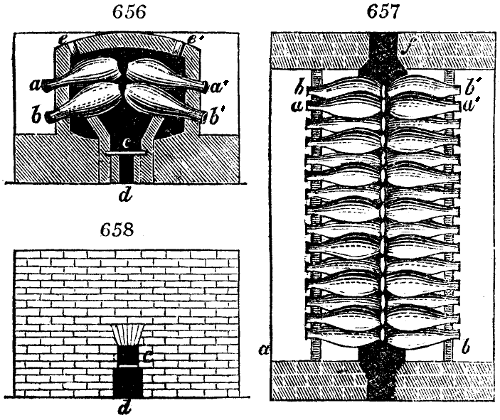
1. Furnace called Gallery of the Palatinate.—The construction of this furnace is disposed so as to contain four ranges, a a′, b b′, of large retorts, styled cucurbits, of cast iron, in which the ore of mercury is subjected to distillation. This arrangement is shewn in fig. 656., which presents a vertical section in the line a b of the ground plan, fig. 657. In the ground plan, the roof e e′ of the furnace (fig. 656.) is supposed to be lifted off, in order to shew the disposition of the four ranges of cucurbits upon the grate c f, figs. 656, 657., which receives the pit-coal employed as fuel. Under this grate extends an ash-pit d. Fig. 658., which exhibits an elevation of the furnace, points out this ash-pit, as well as one of the two doors c, by which the fuel is thrown upon the grate c f. Openings e e, (fig. 656.) are left over the top arch of the furnace, whereby the draught of air may receive a suitable direction. The grate of the fire-place extends over the whole length of the furnace, fig. 657., from the door c to the door f, situated at the opposite extremity. The furnace called gallery includes commonly 30 cucurbits, and in some establishments even 52. Into each are introduced from 56 to 70 pounds of ore, and 15 to 18 pounds of quicklime, a mixture which fills no more than two-thirds of the cucurbit; to the neck a stoneware receiver is adapted, containing water to half its height. The fire, at first moderate, is eventually pushed till the cucurbits are red hot. The operation being concluded, the contents of the receivers are poured out into a wooden bowl placed upon a plank above a bucket; the quicksilver falls to the bottom of the bowl, and the water draws over the black mercury, for so the substance that coats the inside of the receivers is called. This is considered to be a mixture of sulphuret and oxide of mercury. The black mercury, taken out of the tub and dried, is distilled anew with excess of lime; after which the residuum in the retorts is thrown away, as useless.
Figs. 659 and 660 enlarged (180 kB)
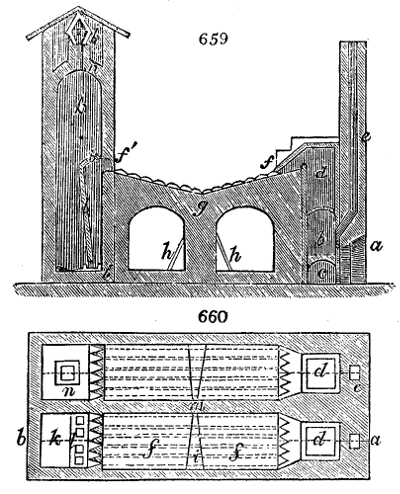
Aludel furnaces of Almaden.—Figs. 659. and 660. represent the great furnaces with aludels in use at Almaden, and anciently in Idria; for between the two establishments there was in fact little difference before the year 1794. Figs. 659. and 662. present two vertical sections; figs. 660. and 661. are two plans of two similar furnaces, conjoined in one body of brickwork. In the four figures the following objects are to be remarked; a door a, by which the wood is introduced into the fire-place b. This is perforated with holes for the passage of air; the ash-pit c, is seen beneath. An upper chamber d, contains the mercurial ores distributed upon open arches, which form the perforated sole of this chamber. Immediately over these arches, there are piled up in a dome form, large blocks of a limestone, very poor in quicksilver ore; above these are laid blocks of a smaller size, then ores of rather inferior quality, and stamped ores mixed with richer minerals. Lastly, the whole is covered up with soft bricks, formed of clay kneaded with schlich, and with small pieces of sulphuret of mercury. Six ranges of aludels or stoneware tubes, f f, of a pear shape, luted together with clay, are mounted in front of each of the two furnaces, on a double sloping terrace, having in its lowest middle line two gutters t v, a little inclined towards the intermediate wall m. In each range the aludel placed at the line t m v of fig. 660., that is to say at the lowest point, g, figs. 659. 662., is pierced with a hole. Thereby the mercury which had been volatilized in d, if it be already condensed by the cooling in the series of aludels f g, may pass into the corresponding gutter, next into the hole m, fig. 660., and after that into the wooden pipes h h′, fig. 659., which conduct it across the masonry of the terrace into cisterns filled with water; see q, fig. 661., which is the plan of fig. 662.
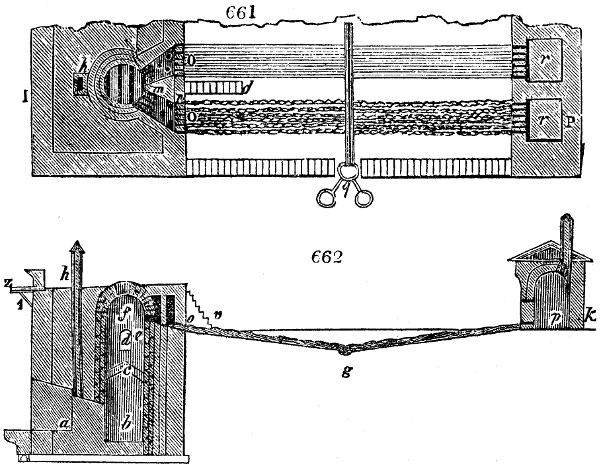
The portion of mercury not condensed in the range of aludels, f g, which is the most considerable, goes in the state of vapour, into a chamber k; but in passing under a partition l l, a certain portion is deposited in a cistern i, filled with water. The greater part of the vapours diffused in the chamber k′ is thereby condensed, and the mercury falls down upon the two inclined planes which form its bottom. What may still exist as vapour passes into an upper chamber k′, by a small chimney n. On one of the sides of this chamber there is a shutter which may be opened at pleasure from below upwards, and beneath this shutter, there is a gutter into which a notable quantity of mercury collects. Much of it is also found condensed in the aludels. These facts prove that this process has inconveniences, which have been tried to be remedied by the more extensive but rather unchemical grand apparatus of Idria.
Details of the aludel apparatus: 25 are set in each of the 12 ranges, seen in fig. 661. constituting 300 pear-shaped stoneware vessels, open at both ends, being merely thrust into one another, and luted with loam. What a multitude of joints, of which a great many must be continually giving way by the shrinkage of the luting, whereby the mercurial fumes will escape with great loss of product, to poison the air!
a, is the door of the fire-place; c, the perforated arches upon which the ore is piled in the chamber e, through the door d, and an orifice at top; the latter being closed during the distillation; f f are vents for conducting the mercurial vapours into two chambers i, separated by a triangular body of masonry m n; h is the smoke chimney of the fire-place; o o, are the ranges of aludels, in connection with the chamber i, which are laid slantingly towards the gutter q, upon the double inclined plane terrace, and terminate in the chamber h q; this being surmounted by two chimneys t. The mercury is collected in these aludels and in the basins at q and p, fig. 661. r is a thin stone partition set up between the two principal walls of each of the furnaces. v is the stair of the aludel terrace, leading to the platform which surmounts the furnace; z is a gutter for conducting away the rains which may fall upon the buildings.
Great apparatus of Idria.—Before entering into details of this laboratory, it will not be useless to recapitulate the metallurgic classification of the ores treated in it. 1. The ores in large blocks, fragments, or shivers, whose size varies from a cubic foot to that of a nut. 2. The smaller ores, from the size of a nut to that of grains of dust.
The first class of large ores comprises three subdivisions, namely; a, blocks of metalliferous rocks, which is the most abundant and the poorest species of ore, affording only one per cent. of mercury; b, the massive sulphuret of mercury, the richest and rarest ore, yielding 80 per cent. when it is picked; c, the fragments or splinters proceeding from the breaking and sorting, and which vary in value, from 1 to 40 per cent.
The second class of small ores comprises: d, the fragments or shivers extracted from the mine in the state of little pieces, affording from 10 to 12 per cent.; e, the kernels of ore, separated on the sieve, yielding 32 per cent.; f, the sands and paste called schlich, obtained in the treatment of the poorest ores, by means of the stamps and washing tables; 100 parts of this schlich give at least 8 of quicksilver.
The general aspect of the apparatus is indicated by figs. 663, 664. and 665. Fig. 665. represents the exterior, but only one half, which is enough, as it resembles exactly the other, which is not shown. In these three figures the following objects may be distinguished; figs. 663, 664., a, door of the fire-place; b, the furnace in which beech-wood is burned mixed with a little fir-wood; c, door of the ash-pit, extended beneath; d, a space in which the ores are deposited upon the seven arches, 1. to 7., as indicated in figs. 663. and 666.; e e, brick tunnels, by which the smoke of the fuel and the vapours of mercury pass, on the one side, into successive chambers f k.
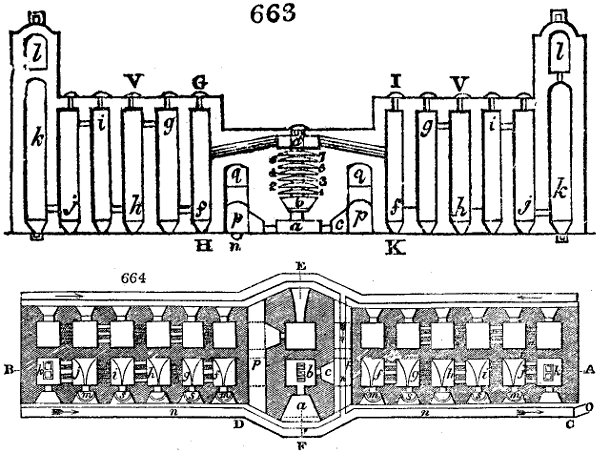
Fig. 664 enlarged (89 kB)
f g h i j k l are passages which permit the circulation of the vapours from the furnace a b c d, to the chimneys l l. Figs. 663. and 664. exhibit clearly the distribution of these openings on each side of the same furnace, and in each half of the apparatus, which is double, as fig. 664. shows; the spaces without letters being in every respect similar to the spaces mentioned below. Fig. 664. is double the scale of fig. 663.
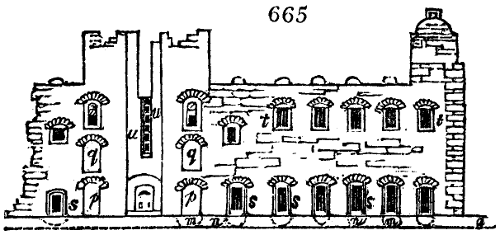
m m′, fig. 664., are basins of reception, distributed before the doors of each of the chambers f k f′ k′. The condensed mercury which flows out of the chambers is conveyed thither. n n′ is a trench into which the mercury, after being lifted into the basins m, is poured, so that it may run towards a common chamber o, in the sloping direction indicated by the arrows. o leads to the chamber where the mercury is received into a porphyry trough; out of which it is laded and packed up in portions of 50 or 100 lbs. in sheep-skins prepared with alum. p p′, fig. 663., are vaulted arches, through which a circulation may go on round the furnace a b c d, on the ground level, q q′ are the vaults of the upper stories. r r′, fig. 665., vaults which permit access to the tunnels e′ e′′, fig. 663.
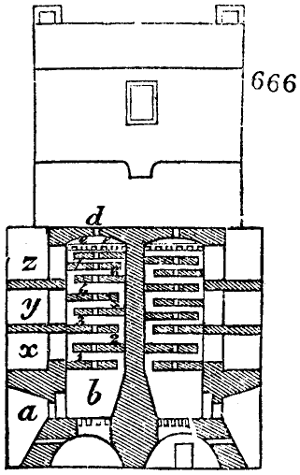
s s′ and t t′, fig. 665., are the doors of the chambers, f k and f′ k′. These openings are shut during the distillation by wooden doors faced with iron, and luted with a mortar of clay and lime. u u′ is the door of the vaults 1. to 7. of the furnace represented in fig. 663. These openings are hermetically shut, like the preceding. v v′, fig. 663., are superior openings of the chambers, closed during the operation by luted plugs; they are opened afterwards to facilitate the cooling of the apparatus, and to collect the mercurial soot. x y z, fig. 666., are floors which correspond to the doors u u′ of the vaults 1. to 7., fig. 665. These floors are reached by stairs set up in the different parts of the building, which contains the whole apparatus.
On the lower arches the largest blocks of metalliferous rock are laid; over these the less bulky fragments are arranged, which are covered with the shivers and pieces of less dimension. On the middle vaults, the small ore is placed, distributed into cylindrical pipkins of earthenware, of 10 inches diameter and 5 inches depth. The upper vaults receive likewise pipkins filled with the sands and pastes called schlich.
In 3 hours, by the labour of 40 men, the two double sets of apparatus are charged, and all the apertures are closed. A quick fire of beech-wood is then kindled; and when the whole mass has become sufficiently heated, the sulphuret of mercury begins to vapourize; coming into contact with the portion of oxygen which had not been carbonated, by combustion, its sulphur burns into sulphurous acid, while the mercury becomes free, passes with the other vapours into the chambers for condensing it, and precipitates in the liquid form at a greater or less distance from the fire-place. The walls of the chambers and the floors, with which their lower portion is covered, are soon coated over with a black mercurial soot, which, being treated anew, furnishes 50 per cent. of mercury. The distillation lasts from 10 to 12 hours; during which time the whole furnace is kept at a cherry-red heat. A complete charge for the two double apparatus, consists of from 1000 to 1300 quintals of ore, which produce from 80 to 90 quintals of running mercury. The furnace takes from 5 or 6 days to cool, according to the state of the weather; and if to that period be added the time requisite for withdrawing the residuums, and attending to such repairs as the furnace may need, it is obvious that only one distillation can be performed in the course of a week.
In the works of Idria, in 1812, 56,686 quintals and a half of quicksilver ores were distilled, after undergoing a very careful mechanical preparation. They afforded 4832 quintals of running mercury; a quantity corresponding to about 81⁄2 per cent. of the ore. These smelting works are about 180 feet long and 30 feet high.
Upon the preceding three systems of smelting mercurial ores, I shall now make some observations.
It has been long well known, that quicksilver may be most readily extracted from cinnabar, by heating it in contact with quicklime. The sulphur of the cinnabar combines, by virtue of a superior affinity with the lime, to the exclusion of the quicksilver, to form sulphurets of lime and calcium, both of which being fixed hepars, remain in the retort while the mercury is volatilized by the heat. In a few places, hammerschlag, or the iron cinder, driven off from the blooms by the tilting hammer, has been used instead of lime in the reduction of this mercurial ore, whereby sulphurous acid and sulphuret of iron are formed.
The annual production of the Bavarian Rhine provinces has been estimated at from 400 to 550 quintals; that of Almaden, in the year 1827, was 22,000 quintals; and of Idria, at present, is not more than 1500 quintals.
All the plans hitherto prescribed for distilling the ore along with quicklime, are remarkably rude. In that practised at Landsberg by Obermoschel, there is a great waste of labour, in charging the numerous small cucurbits; there is a great waste of fuel in the mode of heating them; a great waste of mercury by the imperfect luting of the retorts to the receivers, as well as the imperfect condensation of the mercurial vapours; and probably a considerable loss by pilfering.
The modes practised at Almaden and Idria are, in the greatest degree, barbarous; the ores being heated upon open arches, and the vapours attempted to be condensed by enclosing them within brick or stone and mortar walls, which can never be rendered either sufficiently tight or cool.
To obviate all these inconveniences and sources of loss, the proper chemical arrangements suited to the present improved state of the arts ought to be adopted, by which labour, fuel, and mercury, might all be economized to the utmost extent. The only apparatus fit to be employed is a series of cast-iron cylinder retorts, somewhat like those employed in the coal gas works, but with peculiarities suited to the condensation of the mercurial vapours. Into each of these retorts, supposed to be at least one foot square in area, and 7 feet long, 6 or 7 cwt. of a mixture of the ground ore with the quicklime, may be easily introduced, from a measured heap, by means of a shovel. The specific gravity of the cinnabar being more than 6 times that of water, a cubic foot of it will weigh more than 31⁄2 cwt.; but supposing the mixture of it with quicklime (when the ore does not contain the calcareous matter itself) to be only thrice the density of water, then four cubic feet might be put into each of the above retorts, and still leave 11⁄2 cubic feet of empty space for the expansion of volume which may take place in the decomposition. The ore should certainly be ground to a moderately fine powder, by stamps, iron cylinders, or an edge wheel, so that when mixed with quicklime, the cinnabar may be brought into intimate contact with its decomposer, otherwise much of it will be dissipated unproductively in fumes, for it is extremely volatile.
Figs. 667, 668, 669. represent a cheap and powerful apparatus which I contrived at the request of the German Mines Company of London, and which is now mounted at Landsberg, near Obermoschel, in the Bavarian Rhein-Kreis.
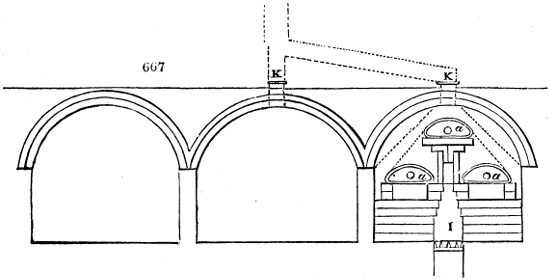
Fig. 667. is a section parallel to the front elevation of three arched benches of retorts, of the size above specified. Each bench contains 3 retorts, of the form represented by a a a. I, is the single fire-place or furnace, capable of giving adequate ignition by coal or wood, to the three retorts. The retorts were built up in an excellent manner, by an English mason perfectly acquainted with the best modes of erecting coal-gas retorts, who was sent over on purpose. The path of the flame and smoke is precisely similar to that represented in fig. 483, page 549, whereby the uppermost retort is immersed in a bath of uniformly ignited air, while the currents reverberated from the top, play round the two undermost retorts, in their way to the vent-flues beneath them. The bottom of the uppermost retort is protected from the direct impulse of the flame by fire-tiles. The dotted lines K K, show the paths of the chimneys which rise at the back ends of the retorts.
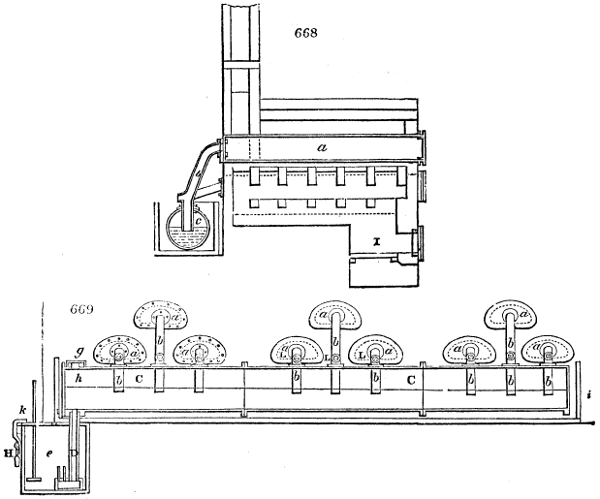
In the section, fig. 668., a is the body of the retort; its mouth at the right hand end is shut, as usual, by a luted iron lid, secured with a cross-bar and screw-bolts; its other end is prolonged by a sloping pipe of cast iron, 4 inches in diameter, furnished with a nozzle hole at L, closed with a screw plug. Through this hole a wire rammer may be introduced, to ascertain that the tube is pervious, and to cleanse it from the mercurial soot, when thought necessary. c, is a cross section of the main condenser, shown in a longitudinal section at C C, fig. 669. This pipe is 18 inches in diameter, and about 20 feet long. At a a, &c., the back ends of the retorts are seen, with the slanting tubes b b, &c., descending through orifices in the upper surface of the condenser pipe, and dipping their ends just below the water-line h i. g, is the cap of a water valve, which removes all risk from sudden expansion or condensation. The condenser is placed within a rectangular trough, made either of wood or stone, through which a sufficient stream of water passes to keep it perfectly cool, and repress every trace of mercurial vapour, and it is laid with a slight inclination from i to h, so that the condensed quicksilver may spontaneously flow along its bottom, and pass through the vertical tube D into the locked up iron chest, or magazine e. This tube D is from the beginning closed at bottom, by immersion in a shallow iron cup, always filled with mercury. k is a graduated gauge rod, to indicate the progressive accumulation of quicksilver in the chest, without being under the necessity of unlocking it.
This air-tight apparatus was erected about a year ago, and has been found to act perfectly well; I regret, however, that my professional engagements at home have not hitherto permitted me to conduct its operations personally for some days. The average samples of cinnabar ore from Obermoschel are ten times poorer than those of Almaden. Were such an apparatus as the above, with some slight modifications which have lately occurred to me, mounted for the Spanish mines, I am confident that their produce in quicksilver might be nearly doubled, with a vast economy of fuel, labour, and human life. The whole cost of the 9 large retorts, with their condensing apparatus, iron magazine, &c., was very little more than two hundred pounds! As the retorts are kept in a state of nearly uniform ignition, like those of the gas works, neither they, nor the furnaces are liable to be injured in their joints by the alternate contractions and expansions, which they would inevitably suffer if allowed to cool; and being always ready heated to the proper pitch for decomposing the mercurial ores, they are capable of working off a charge, under skilful management, in the course of 3 hours. Thus, in 24 hours, with a relay of labourers, 8 charges of at least 5 cwts. of ore each, might be smelted = 2 tons, with 3 retorts, and 6 tons with 9 retorts; with a daily product from the rich ores of Almaden, or even Idria, of from 12 cwts. to 20 cwts. Instead of 3 benches of 3 retorts each, I would recommend 15 benches, containing 45 retorts, to be erected for either the Almaden or Idria mines; which, while they would smelt all their ores, could be got for a sum not much exceeding 1000l., an outlay which they would reimburse within a month or two.
Quicksilver is a substance of paramount value to science. Its great density and its regular rate of expansion and contraction by increase and diminution of temperature, give it the preference over all liquids for filling barometric and thermometric tubes. In chemistry it furnishes the only means of collecting and manipulating, in the pneumatic trough, such gaseous bodies as are condensable over water. To its aid, in this respect, the modern advancement of chemical discovery is pre-eminently due.
This metal alloyed with tin-foil forms the reflecting surface of looking glasses, and by its ready solution of gold or silver, and subsequent dissipation by a moderate heat, it becomes the great instrument of the arts of gilding and silvering copper and brass. The same property makes it so available in extracting these precious metals from their ores. The anatomist applies it elegantly, to distend and display the minuter vessels of the lymphatic system, and secretory systems, by injecting it with a syringe through all their convolutions. It is the basis of many very powerful medicines, at present probably too indiscriminately used, to the great detriment of English society; for it is far more sparingly prescribed by practitioners upon the continent of Europe, not otherwise superior in skill or science to those of Great Britain.
The nitrate of mercury is employed for the secrétage of rabbit and hare-skins, that is, for communicating to the fur of these and other quadrupeds the faculty of felting, which they do not naturally possess. With this view the solution of that salt is applied to them lightly in one direction with a sponge. A compound amalgam of zinc and tin is probably the best exciter which can be applied to the cushions of electrical machines. Mercury imported for home consumption in 1836, 286,808 lbs.; in 1837, 314,036 lbs.
The only mercurial compounds which are extensively used in the arts, are fictitious cinnabar or Vermillion, and corrosive sublimate.
MERCURY, BICHLORIDE OF; Corrosive sublimate; (Deutochlorure de mercure, Fr.; Aetzendes quecksilber sublimat, Germ.) is made by subliming a mixture of equal parts of persulphate of mercury, prepared as above described, and sea-salt, in a stone-ware cucurbit. The sublimate rises in vapour, and encrusts the globular glass capital with a white mass of small prismatic needles. Its specific gravity is 5·14. Its taste is acrid, stypto-metallic, and exceedingly unpleasant. It is soluble in 20 parts of water, at the ordinary temperature, and in its own weight of boiling water. It dissolves in 21⁄2 times its weight of cold alcohol. It is a very deadly poison. Raw white of egg swallowed in profusion, is the best antidote. A solution of corrosive sublimate has been long employed for preserving soft anatomical preparations. By this means the corpse of Colonel Morland was embalmed, in order to be brought from the seat of war to Paris. His features remained unaltered, only his skin was brown, and his body was so hard as to sound like a piece of wood when struck with a hammer.
In the valuable work upon the dry rot, published by Mr. Knowles, secretary of the committee of inspectors of the navy, in 1821, corrosive sublimate is enumerated among the chemical substances which had been prescribed for preventing the dry rot in timber; and it is well known that Sir H. Davy had, several years before that date, used and recommended to the Admiralty and Navy Board, corrosive sublimate as an anti-dry rot application. It has been since extensively employed by a joint-stock company for the same purpose, under the title of Kyan’s patent.
MERCURY, PROTOCHLORIDE OF; Calomel; (Protochlorure de mercure, Fr., Versüsstes quecksilber, Germ.) This compound, so much used and abused by medical practitioners, is commonly prepared by triturating four parts of corrosive sublimate along with three parts of running quicksilver in a marble mortar, till the metallic globules entirely disappear, with the production of a black powder, which is to be put into a glass balloon, and exposed to a subliming heat in a sand bath. The calomel, which rises in vapour, and attaches itself in a crystalline crust to the upper hemisphere of the balloon, is to be detached, reduced to a fine powder, or levigated and elutriated. 200 lbs. of mercury yield 236 of calomel and 272 of corrosive sublimate.
The following more economical process is that adopted at the Apothecaries’ Hall, London. 140 pounds of concentrated sulphuric acid are boiled in a cast iron pot upon 100 pounds of mercury, till a dry persulphate is obtained. Of this salt, 124 pounds are triturated with 81 pounds of mercury, till the globules disappear, and till a protosulphate be formed. This is to be intimately mixed with 68 pounds of sea-salt, and the mixture, being put into a large stone-ware cucurbit, is to be submitted to a subliming heat. See Calomel.
From 190 to 200 pounds of calomel rise in a crystalline cake, as in the former process, into the capital; while sulphate of soda remains at the bottom of the alembic. The calomel must be ground to an impalpable powder, and elutriated. The vapours, instead of being condensed into a cake within the top of the globe or in a capital, may be allowed to diffuse themselves into a close vessel, containing water in a state of ebullition, whereby the calomel is obtained at once in the form of a washed impalpable powder. Calomel is tasteless and insoluble in water. Its specific gravity is 7·176.
For the compound of mercury with fulminic acid, see Fulminate. Periodide of mercury is a bright but fugitive red pigment. It is easily prepared by dropping a solution of iodide of potassium into a solution of corrosive sublimate, as long as any precipitation takes place, decanting off the supernatant muriate of potash, washing and drying the precipitate.
METALLURGY (Erzkunde, Germ.) is the art of extracting metals from their ores. This art, which supplies industry with the instruments most essential to its wants, is alike dependent upon the sciences of chemistry and mechanics; upon the former, as directing the smelting processes, best adapted to disentangle each metal from its mineralizer; upon the latter, as furnishing the means of grinding the ores, and separating the light stony parts from the rich metallic matter.
Notwithstanding the striking analogy which exists between common chemical and metallurgic operations, since both are employed to insulate certain bodies from others, there are essential differences which should be carefully noted. In the first place, the quantity of materials being always very great in metallurgy, requires corresponding adaptations of apparatus, and often produces peculiar phenomena; in the second place, the agents to be employed for treating great masses, must be selected with a view to economy, as well as to chemical action. In analytical chemistry, the main object being exactness of result, and purity of product, little attention is bestowed upon the value of the reagents, on account of the small quantity required for any particular process. But in smelting metals upon the great scale, profit being the sole object, cheap materials and easy operations alone are admissible.
The metallic ores as presented by nature, are almost always mixed with a considerable number of foreign substances; and could not therefore be advantageously submitted to metallurgic operations, till they are purified and concentrated to a certain degree by various methods.
OF THE PREPARATION OF ORES FOR THE SMELTING HOUSE.
There are two kinds of preparation; the one termed mechanical, from the means employed, and the results obtained, consists in processes for breaking and grinding the ores, and for washing them so as to separate the vein-stones, gangues, or other mixed earthy matters, in order to insulate or concentrate the metallic parts.
Another kind of preparation, called chemical, has for its object to separate, by means of fire, various volatile substances combined in the ores, and which it is requisite to clear away, at least in a certain degree, before trying to extract the metals they may contain.
Lastly, an indispensable operation in several circumstances, is to discover, by simple and cheap methods, called assays, the quantity of metal contained in the different species of ores to be treated.
This head of our subject, therefore, falls under three subdivisions:—
§ 1. The mechanical preparation of ores, including picking, stamping, and different modes of washing.
§ 2. The chemical preparation, consisting especially in the roasting or calcination of the ores.
§ 3. The assay of ores, comprehending the mechanical part: that is, by washing; the chemical part, or assays by the dry way; and the assays by the moist way.
Section 1. Of the mechanical preparation or dressing of ores.—I. The first picking or sorting takes place in the interior, or underground, workings, and consists in separating the fragments of rocks, that apparently contain no metallic matter, from those that contain more or less of it. The external aspect guides this separation; as also the feeling of density in the hand.
The substances when turned out to the day, undergo another sorting, with greater or less care, according to the value of the included metal. This operation consists in breaking the lumps of ore with the hammer, into fragments of greater or less size, usually as large as the fist, whereby all the pieces may be picked out and thrown away that contain no metal, and even such as contain too little to be smelted with advantage. There is for the most part, a building erected near the output of the mine, in which the breaking and picking of the ores are performed. In a covered gallery, or under a shed, banks of earth are thrown up, and divided into separate beds, on each of which a thick plate of cast iron is laid. On this plate, elderly workmen, women, and children, break the ores with hand hammers, then pick and sort them piece by piece. The matters so treated, are usually separated into three parts; 1. the rock or sterile gangue, which is thrown away; 2. the ore for the stamping mill, which presents too intimate a mixture of rock and metallic substance to admit of separation by breaking and picking; and 3. the pure ore, or at least the very rich portion, called the sorted mine or the fat ore. On the sorting floors there remains much small rubbish, which might form a fourth subdivision of ore, since it is treated in a peculiar manner, by sifting, as will be presently mentioned.
The distribution of fragments more or less rich, in one class or another, is relative to the value of the included metal, taking into account the expenses necessary for its extraction. Thus in certain lead mines, pieces of the gangues are thrown away, which judged by the eye may contain 3 per cent. of galena, because it is known that the greater portion of this would be lost in the washings required for separating the 97 parts of the gangue, and that the remainder would not pay the expenses.
II. The very simple operations of picking are common to almost all ores; but there are other operations requiring more skill, care, and expense, which are employed in their final state of perfection only upon ores of metals possessing a certain value, as those of lead, silver, &c. We allude to the washing of ores.
The most simple and economical washings are those that certain iron ores, particularly the alluvial, are subjected to, as they are found near the surface of the ground agglutinated in great or little pieces. It is often useful to clean these pieces, in order to pick out the earthy lumps, which would be altogether injurious in the furnaces.
This crude washing is performed sometimes by men stirring in the midst of a stream of water, with iron rakes or shovels, the lumps of ore placed in large chests, or basins of wood or iron.
In other situations, this washing is executed more economically by a machine called a buddle or dolly-tub by our miners. A trough of wood or iron, with a concave bottom, is filled with the ore to be washed. Within the tub or trough, arms or iron handles are moved round about, being attached to the arbor of a hydraulic wheel. The trough is kept always full of water, which as it is renewed carries off the earthy matters, diffused through it by the motion of the machine, and the friction among the pieces of the ore. When the washing is finished, a door in one of the sides of the trough is opened, and the current removes the ore into a more spacious basin, where it is subjected to a kind of picking. It is frequently indeed passed through sieves in different modes. See Lead and Tin, for figures of buddles and dollies.
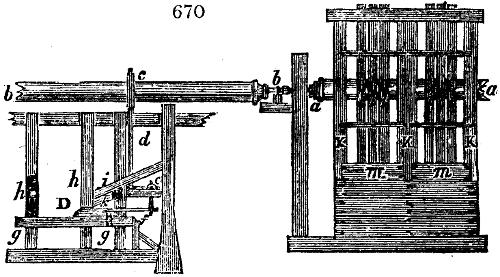
III. Stamping. Before describing the refined methods of washing the more valuable ores of copper, silver, lead, &c., it is proper to point out the means of reducing them into a powder of greater or less fineness, by stamping, so called from the name stamps of the pestles employed for that purpose. Its usefulness is not restricted to preparing the ores; for it is employed in almost every smelting house for pounding clays, charcoal, scoriæ, &c. A stamping mill or pounding machine, fig. 670., consists of several movable pillars of wood l l l, placed vertically, and supported in this position between frames of carpentry K K K. These pieces are each armed at their under end with a mass of iron m. An arbor or axle a a, moved by water, and turning horizontally, tosses up these wooden pestles, by means of wipers or cams, which lay hold of the shoulders of the pestles at l l l. These are raised in succession, and fall into an oblong trough below m m, scooped out in the ground, having its bottom covered either with plates of iron or hard stones. In this trough, beneath these pestles, the ore to be stamped is allowed to fall from a hopper above, which is kept constantly full.
The trough is closed in at the sides by two partitions, and includes three or four pestles; which the French miners call a battery. They are so disposed that their ascent and descent take place at equal intervals of time.
Usually a stamping machine is composed of several batteries (two, three, or four), and the arrangement of the wipers on the arbor of the hydraulic wheel is such that there is constantly a like number of pestles lifted at a time; a circumstance important for maintaining the uniform going of the machine.
The matters that are not to be exposed to subsequent washing are stamped dry, that is without leading water into the trough; and the same thing is sometimes done with the rich ores, whose lighter parts might otherwise be lost.
Most usually, especially for ores of lead, silver, copper, &c., the trough of the stamper is placed in the middle of a current of water, of greater or less force; which, sweeping off the pounded substances, deposits them at a greater or less distance onwards, in the order of the size and richness of the grain; constituting a first washing, as they escape from beneath the pestles.
In the dry stamping, the fineness of the powder depends on the weight of the pestles, the height of their fall, and the period of their action upon the ore; but in the stampers exposed to a stream of water, the retention of the matters in the trough is longer or shorter, according to the facility given for their escape. Sometimes these matters flow out of the chest over its edges, and the height of the line they must surmount has an influence on the size of the grain; at other times, the water and the pounded matter which it carries off, are made to pass through a grating, causing a kind of sifting at the same time. There are, however, some differences in the results of these two methods. Lastly, the quantity of water that traverses the trough, as well as its velocity, has an influence on the discharge of the pounded matters, and consequently on the products of the stampers.
The size of the particles of the pounded ore being different, according to the variable hardness of the matters which compose them, suggests the means of classing them, and distributing them nearly in the order of their size and specific gravity, by making the water, as it escapes from the stamping trough, circulate in a system of canals called a labyrinth, where it deposits successively, in proportion as it loses its velocity, the earthy and metallic matters it had floated along. These metalliferous portions, especially when they have a great specific gravity like galena, would be deposited in the first passages, were it not that from their hardness being inferior to that of the gangue, they are reduced to a much finer powder, or into thin plates, which seem to adhere to both the watery and earthy particles; whence they have to be sought for among the finest portions of the pulverised gangue, called slime, schlich, or schlamme.
There are several methods of conducting the stamps; in reference to the size of the grains wished to be obtained, and which is previously determined agreeably to the nature of the ore, and of the gangue; its richness, &c. The height of the slit that lets the pounded matters escape, or the diameters of the holes in the grating, their distance, the quantity of water flowing in, its velocity, &c., modify the result of the stamping operation.
When it is requisite to obtain powder of an extreme fineness, as for ores that are to be subjected to the process of amalgamation, they are passed under millstones, as in common corn mills; and after grinding, they are bolted so as to form a species of flour; or they are crushed between rolls. See Lead and Tin.
Washing of ores.
IV. The ores pounded under the stamps are next exposed to very delicate operations, both tedious and costly, which are called the washings. Their purpose is to separate mechanically the earthy matters from the metallic portion, which must therefore have a much higher specific gravity; for otherwise, the washing would be impracticable.
The medium employed to diminish the difference of specific gravity, and to move along the lightest matters, is water; which is made to flow with greater or less velocity and abundance over the schlich or pasty mud spread on a table of various inclination.
But as this operation always occasions, not only considerable expense, but a certain loss of metal, it is right to calculate what is the degree of richness below which washing is unprofitable; and on the other hand, what is the degree of purification of the schlich at which it is proper to stop, because too much metal would be lost comparatively with the expense of fusing a small additional quantity of gangue. There cannot, indeed, be any fixed rule in this respect, since the elements of these calculations vary for every work.
Before describing the different modes of washing, we must treat of the sifting or riddling, whose purpose, like that of the labyrinth succeeding the stamps, is to distribute and to separate the ores (which have not passed through the water stamps) in the order of the coarseness of grain. This operation is practised particularly upon the debris of the mine, and the rubbish produced in breaking the ores. These substances are put into a riddle, or species of round or square sieve, whose bottom is formed of a grating instead of a plate of metal pierced with holes. This riddle is plunged suddenly and repeatedly into a tub or cistern filled with water. This liquid enters through the bottom, raises up the mineral particles, separates them and keeps them suspended for an instant, after which they fall down in nearly the order of their specific gravities, and are thus classed with a certain degree of regularity. The sieve is sometimes dipped by the immediate effort of the washer; sometimes it is suspended to a swing which the workman moves; in order that the riddling may be rightly done, the sieve should receive but a single movement from below upwards; in this case the ore is separated from the gangue, and if there be different specific gravities, there is formed in the sieve as many distinct strata, which the workman can easily take out with a spatula, throwing the upper part away when it is too poor to be re-sifted. This operation by the hand-sieve, is called riddling in the tub, or riddling by deposit.
We may observe, that during the sifting, the particles which can pass across the holes of the bottom, fall into the tub and settle down there; whence they are afterwards gathered out, and exposed to washing when they are worth the trouble.
Sometimes, as at Poullaouen, the sieves are conical, and held by means of two handles by a workman; and instead of receiving a single movement, as in the preceding method, the sifter himself gives them a variety of dexterous movements in succession. His object is to separate the poor portions of the ore from the richer; in order to subject the former to the stamp mill.
Among the siftings and washings which ores are made to undergo, we must notice among the most useful and ingenious, those practised by iron gratings, called on the Continent grilles anglaises, and the step-washings of Hungary, laveries à gradins. These methods of freeing the ores from the pulverulent earthy matters, consist in placing them, at their out-put from the mine, upon gratings, and bringing over them a stream of water, which merely takes down through the bars the small fragments, but carries off the pulverulent portions. The latter are received in cisterns, where they are allowed to rest long enough to settle to the bottom. The washing by steps is an extension of the preceding plan. To form an idea, let us imagine a series of grates placed successively at different levels, so that the water, arriving on the highest, where the ore for washing lies, carries off a portion of it, through this first grate upon a second closer in its bars, thence to a third, &c., and finally into labyrinths or cisterns of deposition.
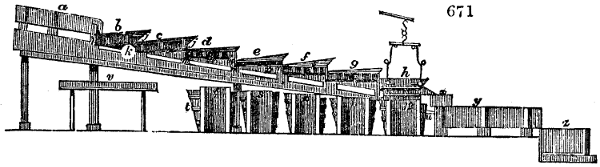
Fig. 671 enlarged (103 kB)
The grilles anglaises are similar to the sleeping tables used at Idria. The system of these en gradins is represented in fig. 671. There are 5 such systems in the works at Idria, for the sorting of the small morsels of quicksilver ore, intended for the stamping mill. These fragments are but moderately rich in metal, and are picked up at random, of various sizes, from that of the fist to a grain of dust.
These ores are placed in the chest a, below the level of which 7 grates are distributed, so that the fragments which pass through the first b, proceed by an inclined conduit on to the second grate c, and so in succession. (See the conduits l, o, p). In front, and on a level with each of the grates b, c, d, &c., a child is stationed on one of the floors, 1, 2, 3, to 7.
A current of water, which falls into the chest a, carries the fragments of ore upon the grates. The pieces which remain upon the two grates b and c, are thrown on the adjoining table v, where they undergo a sorting by hand; there the pieces are classified, 1. into gangue to be thrown away; 2. into ore for the stamp mill; 3. into ore to be sent directly to the furnace. The pieces which remain on each of the succeeding grates, d, e, f, g, h, are deposited on those of the floors 3 to 7, in front of each. Before every one of these shelves a deposit-sieve is established, (see t, u,) and the workmen in charge of it stand in one of the corresponding boxes, marked 8 to 12. The sieve is represented only in front of the chest h, for the sake of clearness.
Each of the workmen placed in 8, 9, 10, 11, 12, operates on the heap before him; the upper layer of the deposit formed in his sieve, is sent to the stamping house, and the inferior layer directly to the furnace.
As to the grains which, after traversing the five grates, have arrived at the chest x, they are washed in the two chests y, which are analogous to the German chests to be presently described. The upper layer of what is deposited in y is sent to the furnace; the rest is treated anew on three tables of percussion, similar to the English brake-sieves, also to be presently described.
After several successive manipulations on these tables, an upper stratum of schlich is obtained fit for the furnace; an intermediate stratum, which is washed anew by the same process; and an inferior stratum, that is sent to the system of stamps, fig. 672.
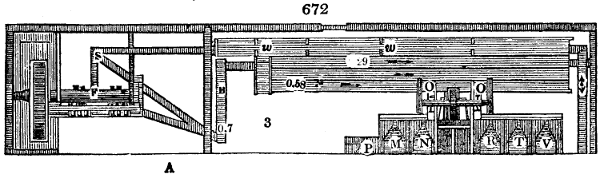
Fig. 672 enlarged (128 kB)
This figure represents the general ground plan of a stamping and washing mill. The stamps F are composed of two batteries similar to fig. 670. The ore passes in succession under three pestles of cast iron, each of which is heavier the nearer it is to the sieve through which the sand or pounded matter escapes.
In the upper part of the figure we see issuing from the stamps, two conduits destined to receive the water and the metalliferous sand with which it is loaded. The first, marked F, S, w, is used only when a certain quality of ore is stamped, richer in metal than is usually treated by means of the second conduit, the first being closed. The second conduit, or that employed for ordinary manipulation when the other is shut, is indicated by F, 0·7, B; then by 0·58 and 0·29. These numbers express the depth of the corresponding portions of this conduit. From F to B, the conduit or water-course is divided into three portions much shallower, called the rich conduit, the middle conduit, and the inferior. Beyond the basin B, the conduit takes the name of labyrinth. There the muddy sediments of ore are deposited; being the finer the further they are from the stamps F. Darts indicate the direction of the stream in the labyrinth. On the German chests, placed at 3, the sand derived from the rich and middle conduits is treated, in order to obtain three distinct qualities of schlich, as already mentioned. P is a cloth-covered table, for treating the deposit of the German chests at 3. M N are two sweep tables (à balai), for treating the ore collected in the lower conduit, which precedes the midmost of the three German chests. Upon the three similar tables R T V, are treated in like manner the muddy deposits of the labyrinth, which forms suite to three parallel German chests situated at 3, not shown for want of room in the figure, but connected in three rectangular zigzags with each other, as well as by a transverse branch to the points 0·7 and P. At the upper part of these five sweep tables, the materials which are to undergo washing are agitated in two boxes O O, by small paddle-wheels.
We shall now describe the percussion-tables used in the Hartz, for treating the sand of ore obtained from the conduits represented above.
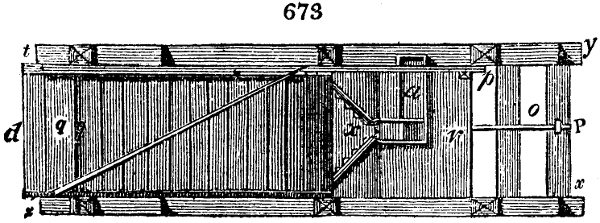
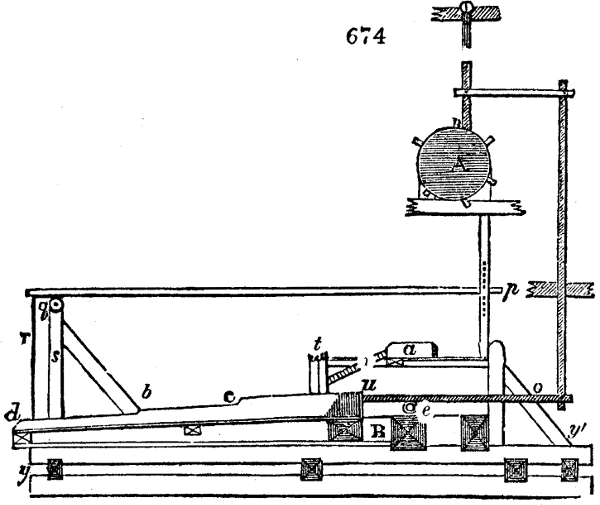
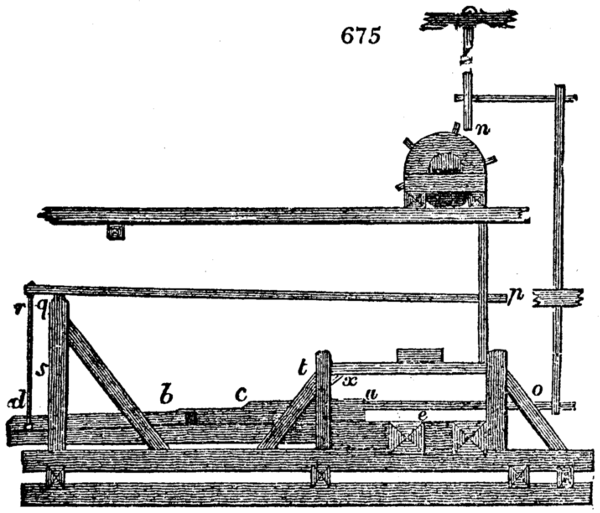
Figs. 673, 674. and 675. exhibit a plan, a vertical section, and elevation, of one of these tables, taken in the direction of its length. The arbor or great shaft in prolongation from the stamps mill, is shown in section perpendicularly to its axis, at A. The cams or wipers are shown round its circumference, one of them having just acted on n.
These cams, by the revolution of the arbor, cause the alternating movements of a horizontal bar of wood o, u, which strikes at the point u against a table d, b, c, u. This table is suspended by two chains t, at its superior end, and by two rods at its lower end. After having been pushed by the piece o, u, it rebounds to strike against a block or bracket B. A lever p, q, serves to adjust the inclination of the movable table, the pivots q being points of suspension.
The ore-sand to be washed, is placed in the chest a, into which a current of water runs. The ore floated onwards by the water, is carried through a sieve on a sloping small table x, under which is concealed the higher end of the movable table d, b, c, u; and it thence falls on this table, diffusing itself uniformly over its surface. The particles deposited on this table form an oblong talus (slope) upon it; the successive percussions that it receives, determine the weightier matters, and consequently those richest in metal, to accumulate towards its upper end at u. Now the workman by means of the lever p, raises the lower end d a little in order to preserve the same degree of inclination to the surface on which the deposit is strewed. According as the substances are swept along by the water, he is careful to remove them from the middle of the table towards the top, by means of a wooden roller. With this intent, he walks on the table d b c u, where the sandy sediment has sufficient consistence to bear him. When the table is abundantly charged with the washed ore, the deposit is divided into three bands or segments d b, b c, c u. Each of these bands is removed separately and thrown into the particular heap assigned to it. Every one of the heaps thus formed becomes afterwards the object of a separate manipulation on a percussion table, but always according to the same procedure. It is sufficient in general to pass twice over this table the matters contained in the heap, proceeding from the superior band c u, in order to obtain a pure schlich; but the heap preceding from the intermediate belt b c, requires always a greater number of manipulations, and the lower band d b still more. These successive manipulations are so associated that eventually each heap furnishes pure schlich, which is obtained from the superior band c u. As to the lightest particles which the water sweeps away beyond the lower end of the percussion table, they fall into conduits; whence they are lifted to undergo a new manipulation.
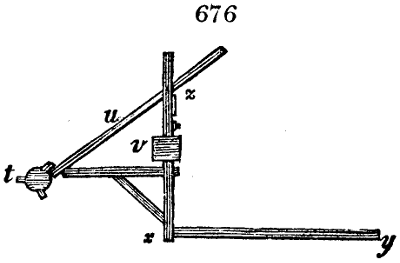
Fig. 676. is a profile of a plan which has been advantageously substituted, in the Hartz, for that part of the preceding apparatus which causes the jolt of the piece o u against the table d b c u. By means of this plan, it is easy to vary, according to the circumstances of a manipulation always delicate, the force of percussion which a bar x y, ought to communicate by its extremity y. With this view, a slender piece of wood u is made to slide in an upright piece, v x, adjusted upon an axis at v. To the piece u a rod of iron is connected, by means of a hinge z; this rod is capable of entering more or less into a case or sheath in the middle of the piece v x, and of being stopped at the proper point, by a thumb-screw which presses against this piece. If it be wished to increase the force of percussion, we must lower the point z; if to diminish it, we must raise it. In the first case, the extremity of the piece u, advances so much further under the cam of the driving shaft t; in the second, it goes so much less forwards; whereby the adjustment is produced.
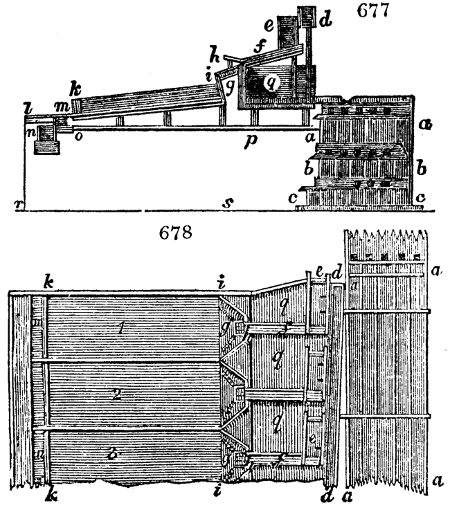
Figs. 677. and 678. represent a complete system of sleeping tables, tables dormantes; such as are mounted in Idria. Fig. 678. is the plan, and fig. 677. a vertical section. The mercurial ores, reduced to a sand by stamps like those of fig. 672., pass into a series of conduits a a, b b, c c, which form three successive floors below the level of the floor of the works. The sand taken out of these conduits is thrown into the cells q; whence they are transferred into the trough e, and water is run upon them by turning two stopcocks for each trough. The sand thus diffused upon each table, runs off with the water by a groove f, comes upon a sieve h, spreads itself upon the board g, and thence falls into the slanting chest, or sleeping table i k. The under surface k of this chest is pierced with holes, which may be stopped at pleasure with wooden plugs. There is a conduit m, at the lower end of each table, to catch the light particles carried off by the water out of the chest i k, through the holes properly opened, while the denser parts are deposited upon the bottom of this chest. A general conduit n passes across at the foot of all the chests i k; it receives the refuse of the washing operations.
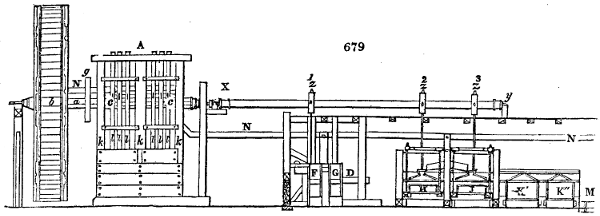
Fig. 679 enlarged (83 kB)
Fig. 679. is a set of stamping and washing works for the ores of argentiferous galena, as mounted at Bockwiese, in the district of Zellerfeldt, in the Hartz.
A is the stamp mill and its subsidiary parts; among which are a, the driving or main shaft; b, the overshot water-wheel; c c, six strong rings or hoops of cast iron, for receiving each a cam or tappet; g, the brake of the machine; k, k, k, the three standards of the stamps; l l, &c. six pestles of pine wood, shod with lumps of cast iron. There are two chests, out of which the ore to be ground falls spontaneously into the two troughs of the stamps. Of late years, however, the ore is mostly supplied by hand; the watercourse terminates a short distance above the middle of the wheel b. There is a stream of water for the service of the stamps, and conduits proceeding from it, to lead the water into the two stamp troughs; the conduit of discharge is common to the two batteries or sets of stamps through which the water carries off the sand or stamped ore. There is a movable table of separation, mounted with two sieves. The sands pass immediately into the conduit placed upon a level with the floor, and separated into two compartments, the first of which empties its water into the second. There are two boards of separation, or tables, laid upon the ground, with a very slight slope of only 15 inches from their top to their bottom. Each of these boards is divided into four cases with edges; the whole being arranged so that it is possible, by means of a flood-gate or sluice, to cause the superfluous water of the case to pass into the following ones. Thus the work can go on without interruption, and alternately upon the two boards. There are winding canals in the labyrinth, N, N, N, in which are deposited the particles carried along by the water which has passed upon the boards. The depth of these canals gradually increases from 12 to 20 inches, to give a suitable descent for maintaining the water-flow. At D, two percussion tables are placed. F G are two German chests. H J are two percussion tables, which are driven by the cams z z, fixed upon the main shaft x y. K K′ are two sloping sweep tables (à balai).
The German chests are rectangular, being about 3 yards long, half a yard broad, with edges half a yard high; and their inclination is such that the lower end is about 15 inches beneath the level of the upper. At their upper end, usually called the bolster, a kind of trough or box, without any edge at the side next the chest, is placed, containing the ore to be washed. The water is allowed to fall upon the bolster in a thin sheet.
The sleeping tables have upright edges; they are from 4 to 5 yards long, nearly 2 yards wide, and have fully a yard of inclination.
The preceding tables are sometimes covered with cloth, particularly in treating ores that contain gold, on a supposition that the woollen or linen fibres would retain more surely the metallic particles; but this method appears on trial to merit no confidence, for it produces a very impure schlich.
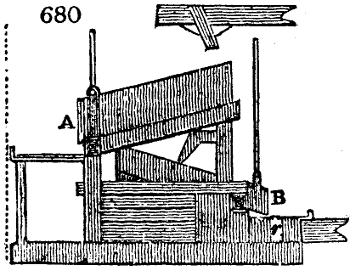
Fig. 680. is a swing-sieve employed in the Hartz, for sifting the small fragments of the ore of argentiferous lead. Such an apparatus is usually set up in the outside of a stamp, and washing mill; its place being denoted by the letter A, fig. 672. The two movable chests or boxes A B, of the sieve, are connected together, at their lower ends, with an upright rod, which terminates at one of the arms of a small balance beam, mounted between the driving shaft of the stamps and the sieve, perpendicularly to the length of both. The opposite arm of this beam carries another upright rod, which ears (cams or mentonnets), placed on purpose upon the driving shaft, may push down. During this movement the two lower ends A, B, are raised; and when the peg-cam of the shaft quits the rod which it had depressed, the swing chests fall by their own weight. Thus they are made to vibrate alternately upon their axes. The small ore is put into the upper part of the chest A, over which a stream of water falls from an adjoining conduit. The fragments which cannot pass through a cast-iron grid in the bottom of that chest, are sorted by hand upon a table in front of A, and they are classed by the workman, either among the ores to be stamped, whether dry or wet, or among the rubbish to be thrown away, or among the copper ores to be smelted by themselves. As to the small particles which fall through the grid upon the chest B, supplied also with a stream of water, they descend successively upon two other brass wire sieves, and also through the iron wire r, in the bottom of B.
In certain mines of the Hartz, tables called à balais, or sweeping tables, are employed. The whole of the process consists in letting flow, over the sloping table, in successive currents, water charged with the ore, which is deposited at a less or greater distance, as also pure water for the purpose of washing the deposited ore, afterwards carried off by means of this sweeping operation.
At the upper end of these sweep-tables, the matters for washing are agitated in a chest, by a small wheel with vanes, or flap-boards. The conduit of the muddy waters opens above a little table or shelf; the conduit of pure water, which adjoins the preceding, opens below it. At the lower part of each of these tables, there is a transverse slit, covered by a small door with hinges, opening outwardly, by falling back towards the foot of the table. The water spreading over the table, may at pleasure be let into this slit, by raising a bit of leather which is nailed to the table, so as to cover the small door when it is in the shut position; but when this is opened, the piece of leather then hangs down into it. Otherwise the water may be allowed to pass freely above the leather, when the door is shut. The same thing may be done with a similar opening placed above the conduit. By means of these two slits, two distinct qualities of schlich may be obtained, which are deposited into two distinct conduits or canals. The refuse of the operation is turned into another conduit, and afterwards into ulterior reservoirs, whence it is lifted out to undergo a new washing.
In the percussion tables, the water for washing the ores is sometimes spread in slender streamlets, sometimes in a full body, so as to let two cubic feet escape per minute. The number of shocks communicated per minute, varies from 15 to 36; and the table may be pushed out of its settled position at one time, three quarters of an inch, at another nearly 8 inches. The coarse ore-sand requires in general less water, and less slope of table, than the fine and pasty sand.
The mechanical operations which ores undergo, take place commonly at their out-put from the mine, and without any intermediate operation. Sometimes, however, the hardness of certain gangues (vein-stones), and of certain iron-ores, is diminished by subjecting them to calcination previously to the breaking and stamping processes.
When it is intended to wash certain ores, an operation founded on the difference of their specific gravities, it may happen that by slightly changing the chemical state of the substances that compose the ore, the earthy parts may become more easily separable, as also the other foreign matters. With this view, the ores of tin are subjected to a roasting, which by separating the arsenic, and oxidizing the copper which are intermixed, furnishes the means of obtaining, by the subsequent washing, an oxide of tin much purer than could be otherwise procured. In general, however, these are rare cases; so that the washing almost always immediately succeeds the picking and stamping; and the roasting comes next, when it needs to be employed.
The operation of roasting is in general executed by various processes, relatively to the nature of the ores, the quality of the fuel, and to the object in view. The greatest economy ought to be studied in the fuel, as well as the labour; two most important circumstances, on account of the great masses operated upon.
Three principal methods may be distinguished; 1. the roasting in a heap in the open air, the most simple of the whole; 2. the roasting executed between little walls, and which may be called case-roasting (rost-stadeln, in German); and 3. roasting in furnaces.
We may remark, as to the description about to be given of these different processes, that in the first two, the fuel is always in immediate contact with the ore to be roasted, whilst in furnaces, this contact may or may not take place.
1. The roasting in the open air, and in heaps more or less considerable, is practised upon iron ores, and such as are pyritous or bituminous. The operation consists in general in spreading over a plane area, often bottomed with beaten clay, billets of wood arranged like the bars of a gridiron, and sometimes laid crosswise over one another, so as to form a uniform flat bed. Sometimes wood charcoal is scattered in, so as to fill up the interstices, and to prevent the ore from falling between the other pieces of the fuel. Coal is also employed in moderately small lumps; and even occasionally, turf. The ore either simply broken into pieces, or even sometimes under the form of schlich, is piled up over the fuel; most usually alternate beds of fuel and ore are formed.
The fire, kindled in general at the lower part, but sometimes, however, at the middle chimney, spreads from spot to spot, putting the operation in train. The combustion must be so conducted as to be slow and suffocated, to prolong the ustulation, and let the whole mass be equably penetrated with heat. The means employed to direct the fire, are to cover outwardly with earth the portions where too much activity is displayed, and to pierce with holes or to give air to those where it is imperfectly developed. Rains, winds, variable seasons, and especially good primary arrangements of a calcination, have much influence on this process, which requires, besides, an almost incessant inspection at the beginning.
Nothing in general can be said as to the consumption of fuel, because it varies with its quality, as well as with the ores and the purpose in view. But it may be laid down as a good rule, to employ no more fuel than is strictly necessary for the kind of calcination in hand, and for supporting the combustion; for an excess of fuel would produce, besides an expense uselessly incurred, the inconvenience, at times very serious, of such a heat as may melt or vitrify the ores; a result entirely the reverse of a well-conducted ustulation.
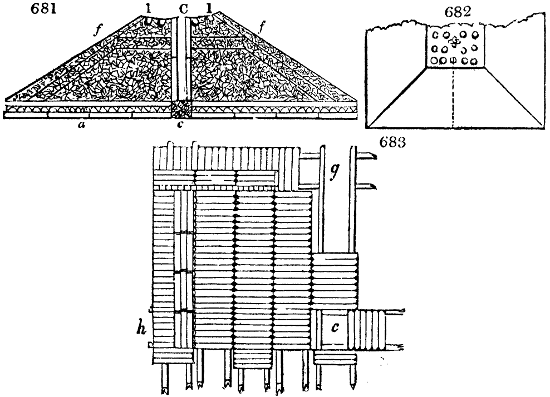
Figs. 681, 682, 683. represent the roasting in mounds, as practised near Goslar in the Hartz, and at Chessy in the department of the Rhone. Fig. 681. is a vertical section in the line h c of figs. 682. and 683. In fig. 682. there is shown in plan, only a little more than one half of the quadrangular truncated pyramid, which constitutes the heap. Fig. 683. shows a little more than one fourth of a bed of wood, arranged at the bottom of the pyramid, as shown by a a, fig. 681., and c g h, fig. 683. C is a wooden chimney, formed within the heap of ore, at whose bottom c there is a little parcel of charcoal, d d are large lumps of ore distributed upon the wooden pile a a; e e are smaller fragments, to cover the larger; f f is rubbish and clay laid smoothly in a slope over the whole. g, fig. 683., a passage for air left under the bed of billets; of which there is a similar one in each of the four sides of the base a a, so that two principal currents of air cross under the upright axis C c, of the truncated pyramid indicated in fig. 681.
The kindling is thrown in by the chimney C. The charcoal c, and the wood a a, take fire; the sulphureous ores d e f are heated to such a high temperature as to vaporize the sulphur. In the Lower Hartz, a heap of this kind continues roasting during four months.
2. The second method. The difficulty of managing the fire in the roasting of substances containing little sulphur, with the greater difficulty of arranging and supporting in their place the schlichs to be roasted, and last of all, the necessity of giving successive fires to the same ores, or to inconsiderable quantities at a time, have led to the contrivance of surrounding the area on which the roasting takes place with three little walls, or with four, leaving a door in the one in front. This is what is called a walled area, and sometimes, improperly enough, a roasting furnace. Inside of these little walls, about 3 feet high, there are often vertical conduits or chimneys made to correspond with an opening on the ground level, in order to excite a draught of air in the adjacent parts. When the roasting is once set agoing, these chimneys can be opened or shut at their upper ends, according to the necessities of the process.
Several such furnaces are usually erected in connexion with each other by their lateral walls, and all terminated by a common wall, which forms their posterior part; sometimes they are covered with a shed supported partly by the back wall, built sufficiently high for this purpose. These dispositions are suitable for the roasting of schlichs, and in general of all matters which are to have several fires; a circumstance often indispensable to a due separation of the sulphur, arsenic, &c.
3. The furnaces employed for roasting the ores and the mattes differ much, according to the nature of the ores, and the size of the lumps. We shall content ourselves with referring to the principal forms.
When iron ores are to be roasted, which require but a simple calcination to disengage the combined water and carbonic acid, egg-shaped furnaces, similar to those in which limestone is burned in contact with fuel, may be conveniently employed; and they present the advantage of an operation which is continuous with a never-cooling apparatus. The analogy in the effects to be produced is so perfect, that the same furnace may be used for either object. Greater dimensions may, however, be given to those destined for the calcination of iron ores. But it must be remembered that this process is applicable only to ores broken into lumps, and not to ores in grains or powder.
It has been attempted to employ the same method a little modified, for the roasting of ores of sulphuret of copper and pyrites, with the view of extracting a part of the sulphur. More or less success has ensued, but without ever surmounting all the obstacles arising from the great fusibility of the sulphuret of iron. For sometimes it runs into one mass, or at least into lumps agglutinated together in certain parts of the furnace, and the operation is either stopped altogether, or becomes more or less languid; the air not being able to penetrate into all the parts, the roasting becomes consequently imperfect. This inconvenience is even more serious than might at first sight appear; for, as the ill-roasted ores now contain too little sulphur to support their combustion, and as they sometimes fall into small fragments in the cooling, they cannot be passed again through the same furnace, and it becomes necessary to finish the roasting in a reverberatory hearth, which is much more expensive.
In the Pyrenees, the roasting of iron ores is executed in a circular furnace, so disposed that the fuel is contained and burned in a kind of interior oven, above which lie the pieces of ore to be calcined. Sometimes the vault of this oven which sustains the ore, is formed of bricks, leaving between them openings for the passage of the flame and the smoke, and the apparatus then resembles certain pottery kilns; at other times the vault is formed of large lumps of ore, carefully arranged as to the intervals requisite to be left for draught over the arch. The broken ore is then distributed above this arch, care being taken to place the larger pieces undermost. This process is simple in the construction of the furnace, and economical, as branches of trees, without value in the forests, may be employed in the roasting. See Lime-kiln figures.
In some other countries, the ores are roasted in furnaces very like those in which porcelain is baked; that is to say, the fuel is placed exteriorly to the body of the furnace in a kind of brick shafts, and the flame traverses the broken ore with which the furnace is filled. In such an apparatus the calcination is continuous.
When it is proposed to extract the sulphur from the iron pyrites, or from pyritous minerals, different furnaces may be employed, among which that used in Hungary deserves notice. It is a rectangular parallelopiped of four walls, each of them being perforated with holes and vertical conduits which lead into chambers of condensation, where the sulphur is collected. The ore placed between the four walls on billets of wood arranged as in figs. 681, 682, 683., for the great roastings in the open air, is calcined with the disengagement of much sulphur, which finds more facility in escaping by the lateral conduits in the walls, than up through the whole mass, or across the upper surface covered over with earth; whence it passes into the chambers of condensation. In this way upwards of a thousand tons of pyrites may be roasted at once, and a large quantity of sulphur obtained. See Copper.
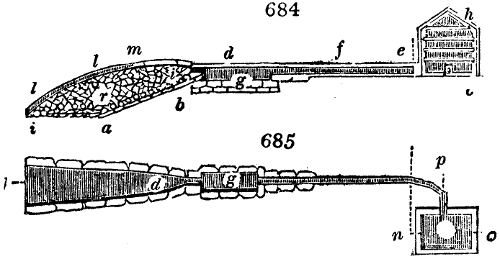
Roasting of Pyrites.—Figs. 684, 685. represent a furnace which has been long employed at Fahlun in Sweden, and several other parts of that kingdom, for roasting iron pyrites in order to obtain sulphur. This apparatus was constructed by the celebrated Gahn. Fig. 684. is a vertical section, in the line k d n o of fig. 685., which is a plan of the furnace; the top being supposed to be taken off. In both figures the conduit may be imagined to to be broken off at e; its entire length in a straight line is 43 feet beyond the dotted line e n, before the bend, which is an extension of this conduit. Upon the slope a b of a hillock a b c, lumps r of iron pyrites are piled upon the pieces of wood i i for roasting. A conduit d f e forms the continuation of the space denoted by r, which is covered by stone slabs so far as f; and from this point to the chamber h it is constructed in boards. At the beginning of this conduit, there is a recipient g. The chamber h is divided into five chambers by horizontal partitions, which permit the circulation of the vapours from one compartment to another. The ores r being distributed upon the billets of wood i i, whenever these are fairly kindled, they are covered with small ore, and then with rammed earth l l. Towards the point m, for a space of a foot square, the ores are covered with movable stone slabs, by means of which the fire may be regulated, by the displacement of one or more, as may be deemed necessary. The liquid sulphur runs into the recipient g, whence it is laded out from time to time. The sublimed sulphur passes into the conduit f e and the chamber h, from which it is taken out, and washed with water, to free it from sulphuric acid with which it is somewhat impregnated; it is afterwards distilled in cast-iron retorts. The residuum of the pyrites is turned to account in Sweden, for the preparation of a common red colour much used as a pigment for wooden buildings.
The reverberatory furnace affords one of the best means of ustulation, where it is requisite to employ the simultaneous action of heat and atmospherical air to destroy certain combinations, and to decompose the sulphurets, arseniurets, &c. It is likewise evident that the facility thus offered of stirring the matters spread out on the sole, in order to renew the surfaces, of observing their appearances, of augmenting or diminishing the degree of heat, &c., promise a success much surer, a roasting far better executed, than by any other process. It is known, besides, that flame mingled with much undecomposed air issuing from the furnace, is highly oxidizing, and is very fit for burning away the sulphur, and oxidizing the metals. Finally, this is almost the only method of rightly roasting ores which are in a very fine powder. If it be not employed constantly and for every kind of ore, it is just because more economy is found in practising calcination in heaps, or on areas enclosed by walls; besides, in certain mines, a very great number of these furnaces, and many workmen, would be required to roast the considerable body of ores that must be daily smelted. Hence there would result from the construction of such apparatus and its maintenance a very notable outlay, which is saved in the other processes.
But in every case where it is desired to have a very perfect roasting, as for blende from which zinc is to be extracted, for sulphuret of antimony, &c., or even for ores reduced to a very fine powder, and destined for amalgamation, it is proper to perform the operation in a reverberatory furnace. When very fusible sulphurous ores are treated, the workman charged with the calcination must employ much care and experience, chiefly in the management of the fire. It will sometimes, indeed, happen, that the ore partially fuses; when it becomes necessary to withdraw the materials from the furnace, to let them cool and grind them anew, in order to recommence the operation. The construction of these furnaces demands no other attention than to give to the sole or laboratory the suitable size, and so to proportion to this the grate and the chimney that the heating may be effected with the greatest economy.
The reverberatory furnace is always employed to roast the ores of precious metals, and especially those for amalgamation; as the latter often contain arsenic, antimony, and other volatile substances, they must be disposed of in a peculiar manner.
The sole, usually very spacious, is divided into two parts, of which the one farthest off from the furnace is a little higher than the other. Above the vault there is a space or chamber in which the ore is deposited, and which communicates with the laboratory by a vertical passage; which serves to allow the ore to be pushed down, when it is dried and a little heated. The flame and the smoke which escape from the sole or laboratory pass into condensing chambers, before entering into the chimney of draught, so as to deposit in them the oxide of arsenic and other substances. When the ore on the part of the sole farthest from the grate has suffered so much heat as to begin to be roasted, has became less fusible, and when the roasting of that in the nearer part of the sole is completed, the former is raked towards the fire-bridge, and its ustulation is finished by stirring it over frequently with a paddle, skilfully worked, through one of the doors left in the side for this purpose. The operation is considered to be finished when the vapours and the smell have almost wholly ceased; its duration depending obviously on the nature of the ores.
When this furnace is employed to roast very arsenical ores, as the tin ores of Schlackenwald in Bohemia, and at Ehrenfriedersdorf in Saxony, the arsenical pyrites of Geyer (in Saxony), &c., the chambers of condensation for the arsenious acid are much more extensive than in the furnaces commonly used for roasting galena, copper, or even silver ores.
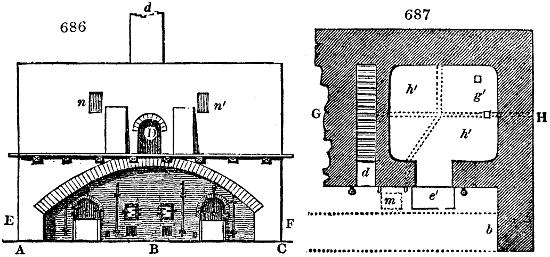
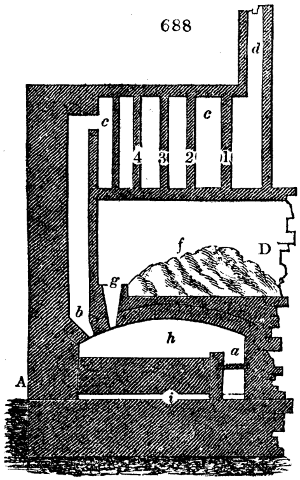
Figs. 686, 687, 688. represent a reverberatory furnace employed in the smelting works of Lautenthal, in the Hartz, for roasting the schlichs of lead ores, which contain much blende or sulphuret of zinc. In fig. 686. we see that the two parts A B, B C, are absolutely like, the two furnaces being built in one body of brickwork. Fig. 687. is the plan of the furnace B C, taken at the level E F of fig. 686. Fig. 688. is a vertical section of the similar furnace A B, taken in the prolongation of the line G H in fig. 687.
a is the fire-place of the furnace, its grate and ash-pit. b is the conduit of vaporization, which communicates with the chambers c; c, chambers into which the vaporized substances are deposited; d, chimney for the escape of the smoke of the fire-place a, after it has gone through the space b c c; e′, is the charging door, with a hook hanging in front to rest the long iron rake upon, with which the materials are turned over; f, chamber containing a quantity of schlich destined for roasting; this chamber communicates with the vaulted corridor (gallery) D, seen in fig. 686.; g, orifice through which the schlich is thrown into the furnace; h, area or hearth of the reverberatory furnace, of which the roof is certainly much too high; i, channels for the escape of the watery vapours; k l, front arcade, between which and the furnace, properly speaking, are the two orifices of the conduits, which terminate at the channels m, m′. m is the channel for carrying towards the chimney d, the vapours which escape by the door e′. n is a walled-up door, which is opened from time to time, to take out of the chambers c, c, the substances that may be deposited in them.
At the smelting works of Lautenthal, in such a roasting furnace, from 6 to 9 quintals (cwts.) of schlich are treated at a time, and it is stirred frequently with an iron rake upon the altar h. The period of this operation is from 6 to 12 hours, according as the schlich may be more or less dry, more or less rich in lead, or more or less charged with blende. When the latter substance is abundant, the process requires 12 hours, with about 60 cubic feet of cleft billets for fuel.
In such furnaces are roasted the cobalt ores of Schneeberg in Saxony, the tin ores of Schlackenwald in Bohemia, of Ehrenfriedersdorf in Saxony, and elsewhere; as also the arsenical pyrites at Geyer in Saxony. But there are poison towers and extensive condensing chambers attached in the latter case. See Arsenic.