B. (continued 5)
Reading edition
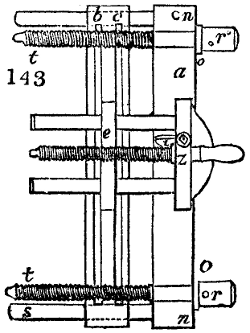
Fig. 143. is the bookbinder’s cutting press, which is set upright upon a sort of chest for the reception of the paper parings; and consists of three sides, being open above and to the left hand of the workman. The pressbar, or beam a, has two holes n n upon its under surface, for securing it to two pegs standing on the top of the chest. The screw rods t t pass through two tapped holes in the bar, marked with b c at its upper end; their heads r r being held by the shoulders o o. The heads are pierced with holes into which lever pins are thrust for screwing the rods hard up. The heavy beam a remains immovable, while the parallel bar with the book is brought home towards it by the two screws. The two rulers s s serve as guides to preserve the motions truly parallel; and the two parallel lath bars b c guide between them the end bar e, of the plough, whose knife is shown at i, with its clamping screw z.
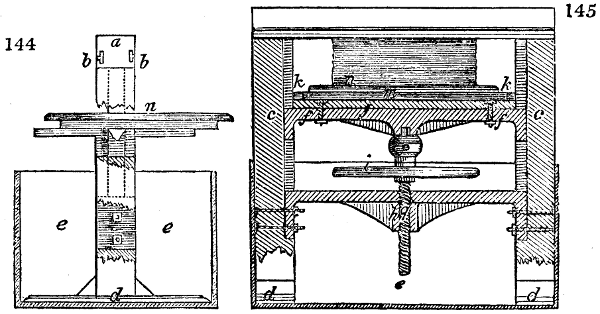
Mr. Oldham, printing engineer of the Bank of England, distinguished for mechanical ingenuity, has contrived a convenient machine for cutting the edges of books, banknotes, &c. either truly square or polygonal, with mathematical precision. Fig. 144. represents an end elevation of the machine. Fig. 145. a side view of the same, the letters of reference indicating the same parts of the machine in each of the figures.
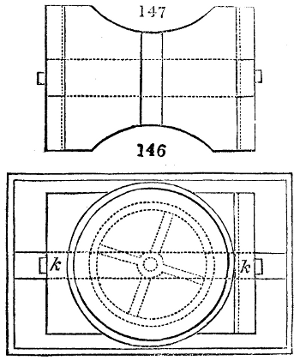
a, is the top cross bar with rectangular grooves b b; c c, are side posts; d d, cross feet to the same, with strengthening brackets; e e, a square box, in which the press stands, for holding waste cuttings. Fig. 146. is a cross section of the upright posts, c c, taken horizontally. There are rectangular grooves in the upright posts, for the projecting ends of the cast iron cross bracket f, to slide up and down in. In the middle of the under-side of this piece f, there is a boss, within which is a round recess, to receive the top of the screw g, which works in the cast iron cross piece h, similarly made with the former, but bolted firmly to the posts c c. Upon the screw g there is a circular handle or ring i, for partially turning the screw, and immediately over it cross holes for tightening the press by means of a lever bar. Upon the cross piece f, is bolted the board j, and upon each end of this board is made fast the rabbetted pieces k k, for another board l, to slide in. Across the middle of this board, and parallel to the pieces k k, the tongue piece m, is made fast, which fits into a groove in the bottom of board l. A horizontal representation of this is seen at fig. 147. and immediately under this view is also seen an end view of l, and f, connected together, and a side view of f by itself. In the middle of the board l, is a pin for a circular board n, to turn upon, and upon this latter board is placed the “material to be cut,” with a saving piece between it, and the circular piece which is to be divided upon its edge into any number of parts required, with a stationary index on the board l, to point to each.
It will now be understood that the “material to be cut,” may be turned round upon the centre pin of the board n, and also that both it and the board can be shifted backward and forward under the top cross piece a, and between the side slide slips k k, the surfaces of which should also be divided into inches and tenths.
The plough, fig. 148., shown in several positions, is made to receive two knives or cutters as the “material to be cut” may require, and which are situated in the plough as I now describe. The plough is composed of three principal parts, namely, the top, and its two sides. The top o, is made the breadth of the cross piece a, and with a handle made fast thereon. The sides p p, are bolted thereto, with bolts and nuts through corresponding holes in the top and sides. The figures below give inside views, and cross sections of the details of the manner in which the cutters and adjustments are mounted. A groove is cut down each cheek or side, in which are placed screws that are held at top and bottom from moving up and down, but by turning they cause the nuts upon them to do so; they are shown at q q. These nuts have each a pin projecting inwards, that go into plain holes made in the top ends of cutters r r. The 148th. and following figs. are 1⁄4 in scale.
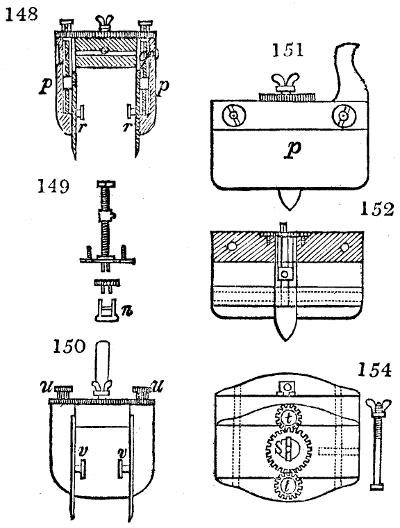
The cutters, and the work for causing them to go up and down, are sunk into the cheeks, so as to be quite level with their inner surfaces. Fig. 149. shows one of those screws apart, how fixed, and with moveable nut and projecting pin. The top of each screw terminates with a round split down, and above it a pinion wheel and boss thereon, also similarly split. This pinion fits upon the split pin. Above, there is cross section of a hollow coupling cap with steel tongue across, that fits into both the cuts of the screw pin and pinion boss, so that when lowered upon each other, they must all turn together. In the middle and on the top of the upper piece o, the larger wheel s, runs loose upon its centre, and works into the two pinion-wheels t t. The wheel s has a fly-nut with wings mounted upon it.
It will now be seen, when the plough is in its place as at fig. 150., that if it be pushed to and fro by the right hand, and the nut occasionally turned by the left, the knives or cutters will be protruded downwards at the same time, and these either will or will not advance as the coupling caps u u are on or off. The ribs v v, run in the grooves b b, fig. 144., and keep the cutters to their duty, working steadily. The top cross bar a, is the exact breadth of a bank-note, by which means both knives are made to cut at the same time. The paper is cut uniformly to one length, and accurately square.
By the use of this machine, the air-pump paper-wetting apparatus, and appendant press, the paper of 45,000 notes is fully prepared in one hour and a half by one person, and may then be printed. It is not so much injured by this process as by the ordinary method of clipping by hand, soaking it, &c., which more or less opens and weakens the fabric, especially of bank-note paper.
One of the greatest improvements ever made in the art of bookbinding is, apparently, that for which Mr. William Hancock has very recently obtained a patent. After folding the sheets in double leaves, he places them vertically, with the edges forming the back of the book downwards in a concave mould, of such rounded or semi-cylindrical shape as the back of the book is intended to have. The mould for this purpose consists of two parallel upright boards, set apart upon a cradle frame, each having a portion or portions cut out vertically, somewhat deeper than the breadth of the book, but of a width nearly equal to its thickness before it is pressed. One of these upright boards may be slidden nearer to or farther from its fellow, by means of a guide bar, attached to the sole of the cradle. Thus the distance between the concave bed of the two vertical slots in which the book rests, may be varied according to the length of the leaves. In all cases about one-fourth of the length of the book at each end projects beyond the board, so that one half rests between the two boards. Two or three packthreads are now bound round the leaves thus arranged, from top to bottom of the page in different lines, in order to preserve the form given to the back of the mould in which it lay. The book is next subjected to the action of the press. The back, which is left projecting very slightly in front, is then smeared carefully by the fingers with a solution of caoutchouc, whereby each paper-edge receives a small portion of the cement. In a few hours it is sufficiently dry to take another coat of a somewhat stronger caoutchouc solution. In 48 hours, 4 applications of the caoutchouc may be made and dried. The back and the adjoining part of the sides are next covered with the usual band or fillet of cloth, glued on with caoutchouc; after which the book is ready to have the boards attached, and to be covered with leather or parchment as may be desired.
We thus see that Mr. Hancock dispenses entirely with the operations of stitching, sewing, sawing-in, hammering the back, or the use of paste and glue. Instead of leaves attached by thread stitches at 2 or 3 points, we have them agglutinated securely along their whole length. Books bound in this way open so perfectly flat upon a table without strain or resilience, that they are equally comfortable to the student, the musician, and the merchant. The caoutchouc cement moreover being repulsive to insects, and not affected by humidity, gives this mode of binding a great superiority over the old method with paste or glue, which attracted the ravages of the moth, and in damp situations allowed the book to fall to pieces. For engravings, atlasses, and ledgers, this binding is admirably adapted, because it allows the pages to be displayed most freely, without the risk of dislocating the volume; but for security, 3 or 4 stitches should be made. The leaves of music-books bound with caoutchouc, when turned over, lie flat at their whole extent, as if in loose sheets, and do not torment the musician like the leaves of the ordinary books, which are so ready to spring back again. Manuscripts and collections of letters which happen to have little or no margin left at the back for stitching them by, may be bound by Mr. Hancock’s plan without the least encroachment upon the writing. The thickest ledgers thus bound, open as easily as paper in quire, and may be written on up to the innermost margin of the book without the least inconvenience.
Having inspected various specimens of Mr. Hancock’s workmanship, I willingly bear testimony to the truth of the preceding statement. See Cloth Binding.
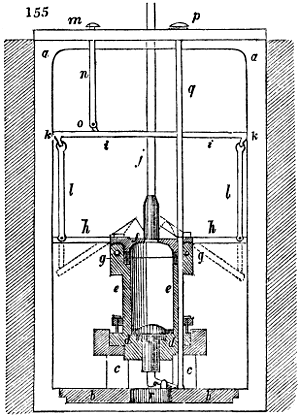
BOTTLE MANUFACTURE. The following mechanism for moulding bottles, forms the subject of a patent obtained by Henry Rickets of Bristol in 1822. Fig. 155. is a section of the apparatus, consisting of a square frame, a a, of iron or wood; this is fixed in a pit formed in the floor; b b is the base of the frame, with an aperture for knocking up the bottom of the bottle; c c are four legs secured to the frame-floor b, upon which the mould is supported. The platform or stand of the mould d d has an opening in its centre for the introduction of the bottom of the mould, which is raised against the bottom of the bottle by the knocker up; e e are the sides of the mould; and f f is the top of the mould in two pieces, turning over upon the joints at g g, so as to form the neck of the bottle; h h are levers or arms for raising and depressing the top pieces; i i is a horizontal shaft or axle, turning in bearings at each end, from which shaft two levers, k k, extend; these levers are connected by upright rods, l l, to the levers or arms, h h, of the top pieces f f.
The weight of the arms h h, and rods l l, will, by their gravity, cause the top pieces to open, as shown by the dotted lines; in this situation of the mould, the melted glass is to be introduced by a tube as usual. The workman then steps with one foot upon the knob m, which forces down the rod n, and by means of a short lever o, extending from the shaft i, forces down the top pieces f, and closes the mould, as seen in the figure; the glass is then made to extend itself to the shape of the mould, by blowing as usual, so as to form the bottle, and the workman at this time putting his other foot upon the knob p, depresses the rod q, and hence raises the bottom of the mould by means of the knocker-up, r, so as to form the bottom of the bottle.
At the bottom of the mould a ring is introduced of any required thickness, for the purpose of regulating the capacity of the bottle; upon which ring it is proposed to raise letters and figures, as a mould to imprint the maker’s name and the size of the bottle. These moulds can be removed and changed at pleasure. Under the knob p, a collar or washer is to be introduced, of any required thickness, to regulate the knocking up of the bottom, by which a perfect symmetry of form is presented. In order to make bottles of different sizes or forms, the mould is intended to be removed, and its place supplied by another mould of different dimensions and figure; the lower parts of all the moulds being made to fit the same frame. Such a mould ought to be prescribed by legislative enactment, with an excise stamp to define the capacity of every bottle, and thereby put an end to the interminable frauds committed in the measure of wine and all other liquors sold by the bottle.
BOUGIE. A smooth, flexible, elastic, slender cylinder, introduced into the urethra, rectum, or œsophagus, for opening or dilating it, in cases of stricture and other diseases. The invention of this instrument is claimed by Aldereto, a Portuguese physician, but its form and uses were first described by his pupil Amatus, in the year 1554. Some are solid, and some hollow; some corrosive, and some mollifying. They generally owe their elasticity to linseed oil, inspissated by long boiling, and rendered drying by litharge. This viscid matter is spread upon a very fine cord or tubular web of cotton, flax, or silk, which is rolled upon a slab when it becomes nearly solid by drying, and is finally polished in the same way.
Pickel, a French professor of medicine, published the following recipe for the composition of bougies. Take 3 parts of boiled linseed oil, one part of amber, and one of oil of turpentine; melt and mix these ingredients well together, and spread the compound at three successive intervals upon a silk cord or web. Place the pieces so coated in a stove heated to 150° F.; leave them in it for 12 hours, adding 15 or 16 fresh layers in succession, till the instruments have acquired the proper size. Polish them first with pumice-stone, and finally smooth with tripoli and oil. This process is the one still employed in Paris, with some slight modifications; the chief of which is dissolving in the oil one twentieth of its weight of caoutchouc to render the substance more solid. For this purpose the caoutchouc must be cut into slender shreds, and added gradually to the hot oil. The silk tissue must be fine and open, to admit of the composition entering freely among its filaments. Each successive layer ought to be dried first in a stove, and then in the open air, before another is applied. This process takes two months for its completion, in forming the best bougies called elastic; which ought to bear twisting round the finger without cracking or scaling, and extension without giving way, but retracting when let go. When the bougies are to be hollow, a mandril of iron wire, properly bent with a ring at one end, is introduced into the axis of the silk tissue. Some bougies are made with a hollow axis of tin foil rolled into a slender tube. Bougies are also made entirely of caoutchouc, by the intervention of a solution of this substance in sulphuric ether, a menstruum sufficiently cheap in France, on account of the low duty upon alcohol. There are medicated bougies, the composition of which belongs to surgical pharmacy. The manufacture of these instruments of various kinds forms a separate and not inconsiderable branch of industry at Paris. MM. Feburger and Lamotte are eminent in this line.
BRACES. (Bretelles, Fr. Hosenträger, Germ.) Narrow fillets or bands of leather or textile fabric, which pass over the shoulders, and are attached behind and before to the waistbands of pantaloons and trowsers, in the act of wearing them, for supporting their weight, and bracing them up to the body. It is a useful modern invention, superseding the necessity of girding the belly with a tight girdle, as in former times.
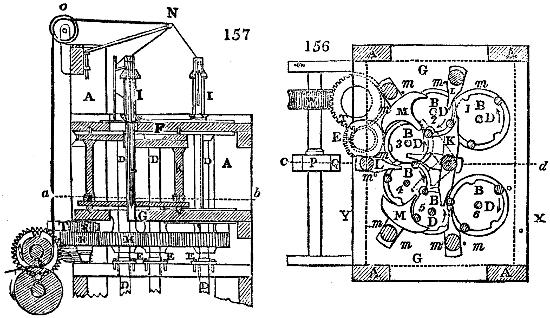
Fig. 156 and 157 enlarged (148 kB)
BRAIDING MACHINE. (Machine à lacets, Fr.; Bortenwerkerstuhl, Germ.) This being employed, not only to manufacture stay-laces, braid, and upholsterer’s cord, but to cover the threads of caoutchouc for weaving brace-bands, deserves a description in this work. Three threads at least are required to make such a knitted lace, but 11, 13, or 17, and even 29 threads are often employed, the first three numbers being preferred. They are made by means of a frame of a very ingenious construction, which moves by a continuous rotation. We shall describe a frame with 13 threads, from which the structure of the others may be readily conceived. The basis of the machine consists of four strong wooden uprights, A, fig. 156, 157, 158., occupying the four angles of a rectangle, of which one side is 14 inches long, the other 18 inches, and the height of the rectangle about 40 inches. Fig. 156. is a section in a horizontal plane, passing through the line a b of fig. 157. which is a vertical section in a plane passing through the centre of the machine C, according to the line c d, fig. 156. The side X is supposed to be the front of the frame; and the opposite side, Y, the back. B, six spindles or skewers, numbered, from 1 to 6, placed in a vertical position upon the circumference of a circle, whose centre coincides with that of the machine at the point C. These six spindles are composed, 1. Of so many iron shafts or axes D, supported in brass collets E, (fig. 157.) and extended downwards within 6 inches of the ground, where they rest in brass steps fixed upon a horizontal beam. 2. Wooden heads, made of horn-beam or nut-tree, placed, the first upon the upper end of each spindle, opposite the cut-out beam F, and the second opposite the second beam G. 3. Wooden-toothed wheels, H, reciprocally working together, placed between the beam G, and the collet-beam E. The toothed wheels and the lower heads for each spindle are in one piece.
The heads and shafts of the spindles No. 1. and 6., are one fifth stronger than those of the other spindles; their heads have five semi-circular grooves, and wheels of 60 teeth, while the heads of the others have only four grooves, and wheels of 48 teeth; so that the number of the grooves in the six spindles is 26, one half of which is occupied with the stems of the puppets I, which carry the 13 threads from No. 1. to 13. The toothed wheels, which give all the spindles a simultaneous movement, but in different directions, are so disposed as to bring their grooves opposite to each other in the course of rotation.
K, the middle winglet, triple at bottom and quintuple at top, which serves to guide the puppets in the direction they ought to pursue.
L, three winglets, single at top and bottom, placed exteriorly, which serve a like purpose.
M, two winglets, triple at bottom and single at top, placed likewise exteriorly, and which serve the same purposes as the preceding; m, are iron pins inserted in the cut-out beam G, which serve as stops or limits to the oscillations of the exterior winglets.
Now, if by any moving power (a man can drive a pair) rotation be impressed upon the large spindle No. 1., in the direction of the arrow, all the other spindles will necessarily pursue the rotatory movement indicated by the respective arrows. In this case, the 13 puppets working in the grooves of the heads of the spindles will be carried round simultaneously, and will proceed each in its turn, from one extremity of the machine to the opposite point, crossing those which have a retrograde movement. The 13 threads united at the point N, situated above the centre of the machine, will form at that point the braid, which after having passed over the pulley o, comes between the two rollers P Q, and is squeezed together, as in a flatting-mill, where the braid is calendered at the same time that it is delivered. It is obvious that the roller P, receives its motion from the toothed wheel of the spindle No. 3., and from the intermediate wheels R, S, T, as well as from the endless screw Z, which drives at proper speed the wheel W, fixed upon the shaft of the roller P.
The braid is denser in proportion as the point N is less elevated above the tops of the puppets; but in this case, the eccentric motion of these puppets is much more sensible in reference to that point, towards which all the threads converge, than when it is elevated. The threads which must be always kept equally stretched by means of a weight, as we shall presently see, are considerably strained by the traction, occasioned by the constantly eccentric movement of the puppets. From this cause, braiding machines must be worked at a moderate velocity. In general, for fine work, 30 turns of the large spindle per minute are the utmost that can safely be made.
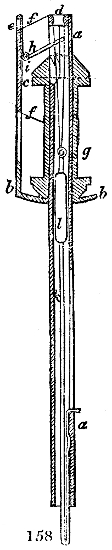
The puppet or spindle of this machine, being the most important piece, I have represented it in section, upon a scale one fourth of its actual size, fig. 158. It is formed of a tube, a, of strong sheet iron well brazed; b is a disc, likewise of sheet iron, from which a narrow fillet, c, rises vertically as high as the tube, where both are pierced with holes, d e, through which the thread f is passed, as it comes from the bobbin, g, which turns freely upon the tube a. The top of this bobbin is conical and toothed. A small catch or detent, h, moveable in a vertical direction round i, falls by its own weight into the teeth of the crown of the bobbin, in which case this cannot revolve; but when the detent is raised so far as to disengage the teeth, and at the same time to pull the thread, the bobbin turns, and lets out thread till the detent falls back into these same teeth.
A skewer of iron wire, k, is loaded with a small weight, l, melted upon it. The top of this skewer has an eye in it, and the bottom is recurved as is shown in fig. 158., so that supposing the thread comes to break, this skewer falls into the actual position in the figure, where we see its lower end extending beyond the tube a, by about 1⁄4 of an inch; but as long as the thread is unbroken, the skewer k, which serves to keep it always tense, during the eccentric movement of the puppet, does not pass out below the tube.
This disposition has naturally furnished the means of causing the machine to stop, whenever one of the threads breaks. This inferior protrusion of the skewer pushes in its progress a detent, which instantly causes the band to slide from the driving pulley to the loose pulley. Thus the machine cannot operate unless all the threads be entire. It is the business of the operative, who has 3 or 4 under her charge, to mend the threads as they break, and to substitute full bobbins for empty ones, whenever the machine is stopped.
The braiding frame, though it does not move quickly, makes a great deal of noise, and would make still more, were the toothed wheels made of metal instead of wood. For them to act well, they should be made with the greatest precision, by means of appropriate tools for forming the teeth of the wheels, and the other peculiar parts.
BRAN. (Son, Fr.; Kleie, Germ.) The husky portion of ground wheat, separated by the boulter from the flour. It is advantageously employed by the calico printers, in the clearing process, in which, by boiling in bran-water, the colouring matters adhering to the non-mordanted parts of maddered goods, as well as the dun matters which cloud the mordanted portions, are removed. A valuable series of researches concerning the operation of bran in such cases was made a few years ago by that distinguished chemist and calico printer, M. Daniel Kœchlin-Schouch, and published in the ninth number of the Bulletin de la Société Industrielle de Mulhausen. Nine sets of experiments are recorded, which justified the following conclusions.
1. The dose of two bushels of bran for 10 pieces of calico is the best, the ebullition being kept up for an hour. A boil for the same time in pure water had no effect in clearing either the grounds or the figures.
2. Fifteen minutes boiling are sufficient when the principal object is to clear white grounds, but in certain cases thirty minutes are requisite to brighten the dyed parts. If, by increasing the charge of bran, the time of the ebullition could be shortened, it would be in some places, as Alsace, an economy; because for the passage of ten pieces through a copper or vat heated with steam, 1 cwt. of coal is consumed in fuel which costs from 21⁄2 to 3 francs, while two bushels of bran are to be bought for one franc.
3. By increasing the quantity of water from 12 to 24 hectolitres with two bushels of bran, the clearing effect upon the ten pieces was impaired. It is therefore advantageous not to use too much water.
4. Many experiments concur to prove that flour is altogether useless for the clearing boil, and that finer bran is inferior for this purpose to the coarser.
5. The white ground of the calicoes boiled with wheat bran, are distinguishable by their superior brightness from that of those boiled with rye bran, and especially with barley bran; the latter having hardly any effect.
6. There is no advantage in adding soap to the bran boil; though a little potash or soda may be properly introduced when the water is calcareous.
7. The pellicle of the bran is the most powerful part, the flour and the starch are of no use in clearing goods, but the mucilage which forms one third of the weight of the bran has considerable efficacy, and seems to act in the following way. In proportion as the mucilaginous substance dissolves the colouring and tawny matters upon the cloth, the husky surface attracts and fixes upon itself the greater part of them. Accordingly, when used bran is digested in a weak alkaline bath, it gives up the colour which it had absorbed from the cloth.
The following chemical examination of bran is interesting. A pound of it was boiled at successive times with water, the decoctions being filtered, let fall in cooling a greyish deposit, which was separated by decantation. The clear liquor afforded by evaporation to dryness four ounces of a brownish, brittle matter, composed chiefly of mucilage, a little gluten, and starch. The gray deposit of the above filtered liquor amounted to half an ounce. Nine ounces of the cortical portion of the bran were obtained. The loss amounted to 21⁄2 ounces, being in some measure the hygrometric water of the bran itself.
When boiled with distilled water, goods are cleared pretty well without bran. Certain delicate dyes must be boiled only a few minutes in a strong decoction of bran previously made.
BRANDY. The name given in this country to ardent spirits distilled from wine, and possessed of a peculiar taste and flavour, due to a minute portion of a peculiar volatile oil. Each variety of alcohol has an aroma characteristic of the fermented substance from which it is procured; whether it be the grape, cherries, sugar-cane, rice, corn, or potatoes; and it may be distinguished even as procured from different growths of the vine. The brandies of Languedoc, Bordeaux, Armagnac, Cognac, Aunis, Saintonge, Rochelle, Orleans, Barcelona, Naples, &c. being each readily recognisable by an experienced dealer.
Aubergier showed, by experiments, that the disagreeable taste of the spirits distilled from the marc of the grape is owing to an essential oil contained in the skin of the grape; and found that the oil, when insulated, is so energetic that a few drops are sufficient to taint a pipe of 600 litres of fine-flavoured spirit.
The most celebrated of the French brandies, those of Cognac and Armagnac, are slightly rectified to only from 0·935 to 0·922; they contain more than half their weight of water, and come over therefore highly charged with the fragrant essential oil of the husk of the grape. When, to save expense of carriage, the spirit is rectified to a much higher degree, the dealer, on receiving it at Paris, reduces it to the market proof by the addition of a little highly-flavoured weak brandy and water; but he cannot in this way produce so finely-flavoured a spirit, as the weaker product of distillation of the Cognac wine. If the best Cognac brandy be carefully distilled at a low heat, and the strong spirit be diluted with water, it will be found to have suffered much in its flavour.
Genuine French brandy evinces an acid reaction with litmus paper, owing to a minute portion of vinegar; it contains besides some acetic ether, and, when long kept in oak casks, a little astringent matter. The following formula may be proposed for converting a silent or flavourless corn spirit, into a factitious brandy. Dilute the pure alcohol to the proof pitch, add to every hundred pounds weight of it from half a pound to a pound of argol (crude winestone) dissolved in water, a little acetic ether, and French-wine vinegar, some bruised French plums, and flavour-stuff from Cognac; then distil the mixture with a gentle fire, in an alembic furnished with an agitator.
The spirit which comes over may be coloured with nicely burned sugar (caramel) to the desired tint, and roughened in taste with a few drops of tincture of catechu or oak-bark.
The above recipe will afford a spirit free from the deleterious drugs too often used to disguise and increase the intoxicating power of British brandies; one which may be reckoned as wholesome as alcohol, in any shape, can ever be.
BRASS. (Laiton, cuivre jaune, Fr.; Messing, Germ.) An alloy of copper and zinc. It was formerly manufactured by cementing granulated copper, called bean-shot, or copper clippings, with calcined calamine (native carbonate of zinc) and charcoal, in a crucible, and exposing them to bright ignition. Three parts of copper were used for three of calamine and two of charcoal. The zinc reduced to the metallic state by the agency of the charcoal, combined with the copper, into an alloy which formed, on cooling, a lump at the bottom of the crucible. Several of these, being remelted and cast into moulds, constituted ingots of brass for the market. James Emerson obtained a patent, in 1781, for making brass by the direct fusion of its two metallic elements, and it is now usually manufactured in this way.
It appears that the best proportion of the constituents to form fine brass is one prime equivalent of copper = 631⁄2 + one of zinc = 32·3; or very nearly 2 parts of copper to 1 of zinc. The bright gold coloured alloy, called Prince’s, or Prince Rupert’s metal, in this country, consists apparently of two primes of zinc to one of copper, or of nearly equal parts of each. Brass, or hard solder, consists of two parts of brass and one of zinc melted together, to which a little tin is occasionally added; but when the solder must be very strong, as for brass tubes that are to undergo drawing, two thirds of a part of zinc are used for two parts of brass. Mosaic gold, according to the specification of Parker and Hamilton’s patent consists of 100 parts of copper, and from 52 to 55 of zinc; which is no atomic proportion. Bath metal is said to consist of 32 parts of brass and 9 parts of zinc.
The button manufacturers of Birmingham make their platin with 8 parts of brass and 5 of zinc; but their cheap buttons with an alloy of copper, tin, zinc, and lead.
Red brass, the Tombak of some, (not of the Chinese, for this is white copper,) consists of more copper and less zinc than go to the composition of brass; being from 21⁄2 to 8 or 10 of the former to 1 of the latter. At the famous brass works of Hegermühl, to be presently described, 11 parts of copper are alloyed with 2 of zinc into a red brass, from which plates are made that are afterwards rolled into sheets. From such an alloy the Dutch foil, as it is called, is manufactured at Nürnberg; Pinchbeck, Similor, Mannheim gold, are merely different names of alloy similar to Prince’s metal. The last consists of 3 of copper and 1 of zinc, separately melted, and suddenly incorporated by stirring.—Wiegleb.
In the process of alloying two metals of such different fusibilities as copper and zinc, a considerable waste of the latter metal by the combustion, to which it is so prone, might be expected; but, in reality, their mutual affinities seem to prevent the loss, in a great measure, by the speedy absorption of the zinc into the substance of the copper. Indeed, copper plates and rods are often brassed externally by exposure, at a high temperature, to the fumes of zinc, and afterwards laminated or drawn. The spurious gold wire of Lyons is made from such rods. Copper vessels may be superficially converted into brass by boiling them in dilute muriatic acid, containing some winestone and zinc amalgam.
The first step in making brass is to plunge slips of copper into melted zinc till an alloy of somewhat difficult fusion be formed, to raise the heat, and add the remaining proportion of the copper.
The brass of the first fusion is broken to pieces, and melted with a fresh quantity of zinc, to obtain the finished brass. Each melting takes about 8 or 9 hours. The metal is now cast into plates, about 40 inches long by 26 inches broad, and from one third to one half inch thick. The moulds are, in this case also, slabs of granite mounted in an iron frame. Granite appears to be preferred to every thing else as a mould, because it preserves the heat long, and by the asperities of its surface, it keeps hold of the clay lute applied to secure the joinings.
The cast plates are most usually rolled into sheets. For this purpose they are cut into ribands of various breadths, commonly about 61⁄2 inches. The cylinders of the brass rolling-press are generally 46 inches long, and 18 inches in diameter. The ribands are first of all passed cold through the cylinders; but the brass soon becomes too hard to laminate. It is then annealed in a furnace, and, after cooling, is passed afresh through a rolling press. After paring off the chipped edges, the sheets are laminated two at a time: and if they are to be made very thin, even eight plates are passed through together. The brass in these operations must be annealed 7 or 8 times before the sheet arrives at the required thinness. These successive heatings are very expensive; and hence they have led the manufacturers to try various plans of economy. The annealing furnaces are of two forms according to the size of the sheets of brass. The smaller are about 12 feet long, with a fire place at each end, and about 13 inches wide. The arch of the furnace has a cylindrical shape, whose axis is parallel to its small side. The hearth is horizontal, and is made of bricks set on edge. In the front of the furnace there is a large door, which is raised by a lever, or chain, and counterweight, and slides in a frame between two cheeks of cast iron. This furnace has, in general, no chimney, except a vent slightly raised above the door, to prevent the workmen being incommoded by the smoke. Sometimes the arch is perforated with a number of holes. The sheets of brass are placed above each other, but separated by parings, to allow the hot air to circulate among them, the lowest sheet resting upon two bars of cast iron placed lengthwise.
The large furnaces are usually 32 feet long, by 61⁄2 feet wide, in the body, and 3 feet at the hearth. A grate, 13 inches broad, extends along each side of the hearth, through its whole length, and is divided from it by a small wall, 2 or 3 inches high. The vault of the furnace has a small curvature, and is pierced with 6 or 8 openings, which allow the smoke to pass off into a low bell-chimney above. At each end of the furnace there is a cast-iron door, which slides up and down in an iron frame, and is poised by a counterweight. On the hearth there is a kind of railway, composed of two iron bars, on the grooves of which the carriage moves with its loads of sheets of brass.
These sheets, being often 24 feet long, could not be easily moved in and out of the furnace; but as brass laminates well in the cold state, they are all introduced and moved out together. With this view, an iron carriage is framed with four bars, which rest on four wheels. Upon this carriage, of a length nearly equal to that of the furnace, the sheets are laid, with brass parings between them. The carriage is then raised by a crane to a level with the furnace, and entered upon the grooved bars which lie upon the hearth. That no heat may be lost, two carriages are provided, the one being ready to put in as the other is taken out; the furnace is meanwhile uniformly kept hot. This method, however convenient for moving the sheets in and out, wastes a good deal of fuel in heating the iron carriage.
The principal places in which brass is manufactured on the great scale in England, are Bristol, Birmingham, and Holywell, in North Wales.
The French writers affirm, that a brass, containing 2 per cent. of lead, works more freely in the turning lathe, but does not hammer so well as the mere alloy of copper and zinc.
At the brass manufactory of Hegermühl, upon the Finon canal near Potsdam, the following are the materials of one charge; 41 pounds of old brass, 55 pounds refined copper (gahrkupfer) granulated; and 24 pounds of zinc. This mixture, weighing 120 pounds, is distributed into four crucibles, and fused in a wind furnace with pitcoal fuel. The waste varies from 21⁄2 to 4 pounds upon the whole.
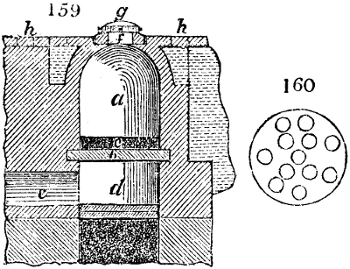
Fig. 159. represents the furnace as it was formerly worked there with charcoal; a, the laboratory in which the crucibles were placed. It was walled with fire bricks. The foundations and the filling-in walls were formed of stone rubbish, as being bad conductors of heat; sand and ashes may be also used; b, cast-iron circular grating plates pierced with 12 holes (see fig. 160.), over them a sole of loam, c, is beat down, and perforated with holes corresponding to those in the iron discs; d, the ash-pit; e, the bock, a draught flue which conducts the air requisite to the combustion, from a sunk tunnel, in communication with several melting furnaces. The terrace or crown of the furnace, f, lies on a level with the foundry floor, h h, and is shut with a tile of fire-clay, g, which may be moved in any direction by means of hooks and eyes in its binding iron ring. Fig. 161. the tongs for putting in and taking out the charges, as viewed from above and from the side.
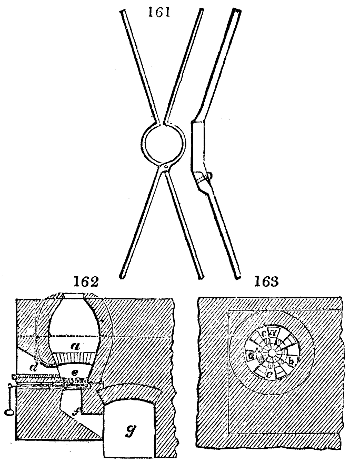
Figs. 162, 163. represent the furnaces constructed more recently for the use of pitcoal fuel; fig. 162. being an upright section, and fig. 163. the ground plan. In this furnace the crucibles are not surrounded with the fuel, but they receive the requisite melting heat from the flame proceeding from the grate upon which it is burned. The crucibles stand upon 7 binding arches, a, which unite in the middle at the key-stone b, fig. 163. Between the arches are spaces through which the flame rises from the grate c. d is the fire-door; e, a sliding tile or damper for regulating or shutting off the air-draught; f an inclined plane, for carrying off the cinders that fall through the grate, along the draught tunnel g, so that the air in entering below may not be heated by them.
The crucibles are 16 inches deep, 91⁄2 wide at the mouth, 61⁄2 at the bottom; with a thickness in the sides of 1 inch and 11⁄2 below; they stand from 40 to 50 meltings. The old brass, which fills their whole capacity, is first put in and melted down; the crucibles are now taken out, and are charged with the half of the zinc in pieces of from 1 to 3 cubic inches in size, covered over with coal ashes; then one half of the copper charge is introduced, again coal-dust; and thus the layers of zinc and copper are distributed alternately with coal-ashes betwixt them, till the whole charge gets finally fused. Over all, a thicker layer of carbonaceous matter is laid, to prevent oxidizement of the brass. Eight crucibles filled in this way are put into the furnace between the 11 holes of the grate shelf; and over them two empty crucibles are laid to be heated for the casting operation. In from 31⁄2 to 4 hours the brass is ready to be poured out. Fifteen English bushels of coals are consumed in one operation; of which six are used at the introduction of the crucibles, and four gradually afterwards.
When sheet brass is to be made the following process is pursued:—
An empty crucible, called a caster (giesser), is taken out of the furnace through the crown with a pair of tongs, and is kept red hot by placing it in a hollow hearth (mundal), surrounded with burning coals; into this crucible the contents of four of the melting pots are poured; the dross being raked out with an iron scraper. As soon as the melting pot is emptied, it is immediately re-charged in the manner above described, and replaced in the furnace. The surface of the melted brass in the caster is swept with the stump of a broom, then stirred about with the iron rake, to bring up any light foreign matter to the surface, which is then skimmed with a little scraper; the crucible is now seized with the casting tongs, and emptied in the following way:—
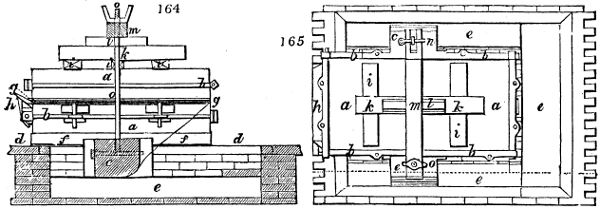
The mould or form for casting sheet brass consists of two slabs of granite, a a, figs. 164, 165. They are 51⁄2 feet long; 3 feet broad, 1 foot thick, and, for greater security, girt with iron bands, b b, 2 inches broad, 11⁄2 thick, and joined at the four corners with bolts and nuts. The mould rests upon an oaken block, c, 31⁄2 feet long, 21⁄6 broad, and 11⁄4 thick, which is suspended at each end upon gudgeons, in bearing blocks, placed under the foundery floor, d d, in the casting pit, e e. This is lined with bricks; and is 63⁄4 feet long, 51⁄2 broad, and 2 deep; upon the two long side walls of the pit, the bearing blocks are laid, which support the gudgeons. The swing-blocks are 10 inches long, 18 inches broad, 15 inches thick, and are somewhat rounded upon their back edge, so that the casting frame may slope a little to the horizon. To these blocks two cross wooden arms, f f, are mortised, upon which the under slab rests, freely, but so as to project about 5 inches backwards over the block, to secure an equipoise in the act of casting. g g are bars, placed at both of the long sides, and one of the ends, between the slabs, to determine the thickness of the brass-plate. Upon the other slab the gate h is fastened, a sheet of iron 6 inches broad, which has nearly the shape of a parallel trapezium (lozenge), and slopes a little towards the horizon. It serves for setting the casting pot upon in the act of pouring out, and renders its emptying more convenient. That gate (steinmaul) is coated with a mixture of loam and hair. The upper slab is secured to the under one in its slanting position by an armour or binding. This consists of the tension bars of wood, i k l m, of the iron bars n, (3 to 31⁄2 inches broad, 11⁄2 inch thick, see the top view, fig. 165.) of a rod with holes and pins at its upper end, and of the iron screw spindle o. The mode in which these parts act may be understood from inspection of the figure. In order to lift the upper slab from the under one, which is effected by turning it round its edge, a chain is employed, suspending two others, connected with the slab. The former passes over a pulley, and may be pulled up and down by means of a wheel and axle, or with the aid of a counterweight. Upon each of the two long sides of the slab there are two iron rings, to which the ends of the chains may be hooked. The casting faces of the slab must be coated with a layer of finely ground loam; the thinner the better.
When calamine is employed, 1⁄2 cwt. of copper, 3⁄4 cwt. of calamine, and 1⁄3 the volume of both of charcoal mixed, are put into 7 crucibles, and exposed to heat during 11 or 12 hours; the product being from 70 to 72 lbs. of brass.
Brass-plate rolling.—At Hegermühl there are two re-heating or annealing furnaces, one larger, 18 feet long, and another smaller, 81⁄2; the hot chamber is separated from the fire place by iron beams, in such a way that the brass castings are played upon by the flames on both their sides. After each passage through the laminating press (rolls) they are heated anew, then cooled and laminated afresh, till they have reached the proper length. The plates are besmeared with grease before rolling.
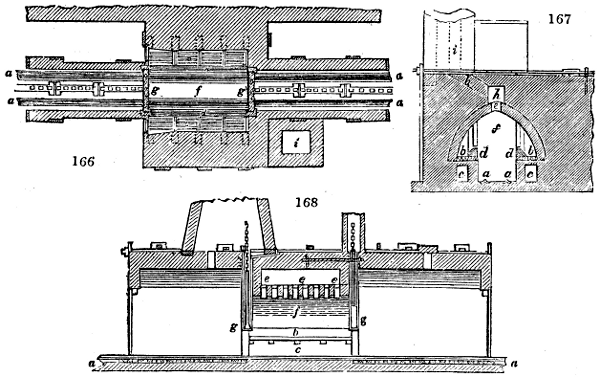
Fig. 166. shows the ground plan of the furnace and its railway; fig. 167. the cross section; and fig. 168. the section lengthwise; a a, the iron way bars or rails upon the floor of the foundry, for enabling the wheels of the waggon-frame to move readily backwards and forwards; b b, the two grates; c c, the ash pits; d d, the fire beams; e e e, vents in the roof of the hot chamber f; g g, two plates for shutting the hot chamber; h, the flue; i, the chimney. After the rolling, the sheets covered with a black oxide of copper, are plunged into a mother water of the alum works for a few minutes, then washed in clean water, and lastly, smeared with oil and scraped with a blunt knife.
In rough brass and brass wares, no less than 16,240 cwts. were manufactured in the Prussian States in the year 1832.
For musical purposes, the brass wire made in Berlin, has acquired great and merited celebrity; but that of Birmingham is now preferred even by foreigners.
Brass Colour, for staining glass, is prepared by exposing for several days thin plates of brass upon tiles in the leer or annealing arch of the glass-house, till it be oxidized into a black powder, aggregated in lumps. This being pulverized and sifted, is to be again well calcined for several days more, till no particles remain in the metallic state; when it will form a fine powder of a russet brown colour. A third calcination must now be given, with a carefully regulated heat; its quality being tested from time to time by fusion with some glass. If it makes the glass swell, and intumesce, it is properly prepared; if not, it must be still farther calcined. Such a powder communicates to glass, greens of various tints, passing into turquoise.
When thin narrow strips of brass are stratified with sulphur in a crucible, and calcined at a red heat, they become friable, and may be reduced to powder. This being sifted and exposed upon tiles in a reverberatory furnace for ten or twelve days, becomes fit for use, and is capable of imparting a calcedony, red or yellow tinge to glass by fusion, according to the mode and proportion of using it.
The glass-makers’ red colour may be prepared by exposing small plates of brass to a moderate heat in a reverberatory furnace, till they are thoroughly calcined, when the substance becomes pulverulent, and assumes a red colour. It is then ready for immediate use.
Brass Colour, as employed by the colourmen to imitate brass, is of two tints, the red or bronze, and the yellow like gilt brass. Copper filings mixed with red ochre or bole, constitute the former; a powdered brass imported from Germany is used for the latter. Both must be worked up with varnish after being dried with heat, and then spread with a flat camel-hair brush evenly upon the surface of the object. The best varnish is composed of 20 ounces of spirits of wine, 2 ounces of shellac, and 2 ounces of sandarach, properly dissolved. See Varnish. Only so much of the brass powder and varnish should be mixed at a time as is wanted for immediate use.
Brass Foil. Dutch leaf, called Knitter or Rauschgold in Germany, is made from a very thin sheet brass, beat out under a hammer worked by water power, which gives 300 or 400 strokes per minute; from 40 to 80 leaves being laid over each other. By this treatment it acquires its characteristic solidity and lustre. See above, the process for converting the copper superficially into brass by the fumes of zinc.
BRAZING. (Braser, Fr.; Messing-lothung, Germ.) The soldering together of edges of iron, copper, brass, &c., with an alloy consisting of brass and zinc, sometimes with a little tin or silver. The surfaces to be thus united must be filed perfectly bright, and not be soiled with the fingers or in any other way. The granular or nearly pulverulent alloy is usually wetted with a paste of ground borax and water, applied in this state, dried, and then exposed carefully to bright ignition at a clear forge fire. Some workmen enclose the part to be soldered in a clay lute, but others prefer leaving it uncovered, that they may see when the solder has flowed freely, and entered into all the seams.
BRAZIL-WOOD. (Bois de Fernambouc, Fr.; Brasilienholz, Germ.) This dye-wood derives its name from the part of America whence it was first imported. It has also the names Fernambuca, wood of Saint Martha, and of Sapan, according to the places which produce it. Linnæus distinguishes the tree which furnishes the Brazil wood by the name of Cæsalpinia crista. It commonly grows in dry places among rocks. Its trunk is very large, crooked, and full of knots. It is very hard, susceptible of a fine polish, and sinks in water. It is pale when newly cleft, but becomes red on exposure to the air.
It has different shades of red and orange. Its goodness is determined particularly by its density. When chewed, a saccharine taste is perceived. It may be distinguished from red saunders wood, as the latter does not yield its colour to water.
Boiling water extracts the whole colouring matter of Brazil-wood. If the ebullition be long enough continued, it assumes a fine red colour. The residuum appears black. In this case, an alkali may still extract much colouring matter. The solution in alcohol or ammonia is still deeper than the preceding.
The decoction of Brazil-wood, called juice of Brazil, is observed to be less fit for dyeing when recent, than when old or even fermented. By age it takes a yellowish-red colour. For making this decoction, Hellot recommends to use the hardest water; but it should be remarked, that this water deepens the colour in proportion to the earthy salts which it contains. After boiling this wood reduced to chips, or, what is preferable, to powder, for three hours, this first decoction is poured into a cask. Fresh water is poured on the wood, which is then made to boil for three hours, and mixed with the former. When Brazil-wood is employed in a dyeing bath, it is proper to enclose it in a thin linen bag, as well as all the dye woods in general.
Wool immersed in the juice of Brazil takes but a feeble tint, which is speedily destroyed. It must receive some preparations.
The wool is to be boiled in a solution of alum, to which a fourth or even less of tartar is added, for a larger proportion of tartar would make the colour yellowish. The wool is kept impregnated with it for at least eight days, in a cool place. After this, it is dyed in the Brazil juice with a slight boiling. But the first colouring particles that are deposited, afford a less beautiful colour; hence it is proper to pass a coarser stuff previously through the bath. In this manner a lively red is procured, which resists pretty well the action of the air.
Brazil-wood is made use of for dyeing silk what is called false crimson, to distinguish it from the crimson made by means of cochineal, which is much more permanent.
The silk should be boiled at the rate of 20 parts of soap per cent., and then alumed. The aluming need not be so strong as for the fine crimson. The silk is refreshed at the river, and passed through a bath more or less charged with Brazil juice, according to the shade to be given. When water free from earthy salts is employed, the colour is too red to imitate crimson; this quality is given it by passing the silk through a slight alkaline solution, or by adding a little alkali to the bath. It might, indeed, be washed in a hard water till it had taken the desired shade.
To make deeper false crimsons of a dark red, juice of logwood is put into the Brazil bath after the silk has been impregnated with it. A little alkali may be added, according to the shade that is wanted.
To imitate poppy or flame colour, an annotto ground is given to the silk, deeper even than when it is dyed with carthamus. It is washed, alumed, and dyed with juice of Brazil, to which a little soap water is usually added.
The colouring particles of Brazil wood are easily affected, and made yellow by the action of acids.
They thus become permanent colours. But what distinguishes them from madder and kermes, and approximates them to cochineal, is their reappearing in their natural colour, when they are thrown down in a state of combination with alumina, or with oxide of tin. These two combinations seem to be the fittest for rendering them durable. It is requisite, therefore, to inquire what circumstances are best calculated to promote the formation of these combinations, according to the nature of the stuff.
The astringent principle, likewise, seems to contribute to the permanence of the colouring matter of Brazil wood; but it deepens its hue, and can only be employed for light shades.
The colouring particles of Brazil wood are very sensible to the action of alkalies which give them a purple hue; and there are several processes in which the alkalies, either fixed or volatile, are used for forming violets and purples. But the colours obtained by these methods, which may be easily varied according to the purpose, are perishable, and possess but a transient bloom. The alkalies appear not to injure the colours derived from madder, but they accelerate the destruction of most other colours.
In England and Holland the dye-woods are reduced to powder by means of mills erected for the purpose.
The bright fugitive red, called fancy red, is given to cotton by Nicaragua, or peachwood, a cheap kind of Brazil wood.
The cotton being scoured and bleached, is boiled with sumach. It is then impregnated with a solution of tin (at 5° Baumé, according to Vitalis). It should now be washed slightly in a weak bath of the dyeing wood, and lastly, worked in a somewhat stale infusion of the peach or Brazil wood. When the temperature of this is lukewarm, the dye is said to take better. Sometimes two successive immersions in the bath are given. It is now wrung out, aired, washed in water, and dried.
M. Vitalis says, that his solution of tin is prepared with two ounces of tin and a pound of aqua regia made with two parts of nitric acid at 24° Baumé, and three parts of muriatic acid at 22°.
For a rose colour, the cotton is alumed as usual, and washed from the alum. It then gets the tin mordant, and is again washed. It is now turned through the dye-bath, an operation which is repeated if necessary.
For purple a little alum is added to the Brazil bath.
1. For amaranth, the cotton is strongly galled, dried, and washed.
2. It is passed through the black cask (tonneau noir), see Black Dye, till it has taken a strong grey shade.
3. It receives a bath of lime water.
4. Mordant of tin.
5. Dyeing in the Brazil wood bath.
6. The two last operations are repeated.
Dingler has endeavoured to separate the colouring matter of the different sorts of Brazil wood, so as to obtain the same tint from the coarser as from the best Pernambuco. His process consists in treating the wood with hot water or steam, in concentrating the decoction so as to obtain 14 or 15 pounds of it from 4 pounds of wood, allowing it to cool, and pouring into it two pounds of skim milk; agitating, then boiling for a few minutes, and filtering. The dun colouring matters are precipitated by the coagulation of the caseous substance. For dyeing, the decoctions must be diluted with water; for printing they must be concentrated, so that 4 pounds of wood shall furnish only 5 or 6 pounds of decoction, and the liquor may be thickened in the ordinary way. These decoctions may be employed immediately, as by this treatment they have acquired the same property as they otherwise could get only by being long kept. A slight fermentation is said to improve the colour of these decoctions; some ground wood is put into the decoction to favour this process.
As gelatine produces no precipitate with these decoctions, they consequently contain no tannin. Gall-nuts, however, sumach, the bark of birch or alder, render the colour of Brazil wood more durable, upon alumed linen and cotton goods, but the shade is a little darker.
In dyeing wool with Pernambuco, the temperature of the bath should never be above 150° Fahr., since higher heats impair the colour.
According to Dingler and Kurrer, bright and fast scarlet reds may be obtained upon wool, by preparing a decoction of 50 pounds of Brazil wood in three successive boils, and setting the decoction aside for 3 or 4 weeks in a cool place; 100 pounds of the wool are then alumed in a bath of 22 pounds of alum and 11 pounds of tartar, and afterwards rinsed in cold water. Meanwhile we fill two-thirds with water, a copper containing 30 pails, and heated to the temperature of 150° or 160° F. We pour in 3 pailfuls of the decoction, heat to the same point again, and introduce 30 pounds of wool, which does not take a scarlet, but rather a crimson tint. This being removed, 2 pails of decoction are put in, and 30 pounds of wool which becomes scarlet, but not so fine as at the third dip. If the dyer strengthens the colour a little at the first dip, a little more at the second, and adds at the third and fourth the quantity of decoction merely necessary, he will obtain an uniform scarlet tint. With 50 pounds of Pernambuco 1000 pounds of wool may be dyed scarlet in this way, and with the deposits another 100 may be dyed of a tile colour. An addition of weld renders the colour faster but less brilliant.
Karkutsch says the dye may be improved by adding some ox-gall to the bath.
In dyeing cotton the tannin and gallic acid are two necessary mordants, and the colour is particularly bright and durable, when the cloth has been prepared with the oily process of Turkey red.
It is said that stale urine heightens the colour of the Brazil dye when the ground wood is moistened with it.
The quantity of Brazil or Nicaragua wood imported into the United Kingdom in 1835, was 6,242 tons, whereof 1,811 were exported; of Brazilietto 230 tons. The duty upon the first article is 5s. per ton.
BREAD (Pain, Fr.; Brod, Germ.) is the spongy mass produced by baking the leavened or fermented dough of wheat or rye flour, at a proper heat. It is the principal food of highly civilized nations. The skilful preparation of this indispensable article constitutes the art of the Baker. Dough baked without being fermented constitutes cakes or biscuits; but not bread strictly speaking.
Pliny informs us, that barley was the only species of corn at first used for food; and even after the method of reducing it to flour had been discovered, it was long before mankind learned the art of converting it into cakes.
Ovens were first invented in the East. Their construction was understood by the Jews, the Greeks, and the Asiatics, among whom baking was practised as a distinct profession. In this art, the Cappadocians, Lydians, and Phœnicians, are said to have particularly excelled. It was not till about 580 years after the foundation of Rome, that these artisans passed into Europe. The Roman armies, on their return from Macedonia, brought Grecian bakers with them into Italy. As these bakers had handmills beside their ovens, they still continued to be called pistores, from the ancient practice of bruising the corn in a mortar; and their bakehouses were denominated pistoriæ. In the time of Augustus there were no fewer than 329 public bakehouses in Rome; almost the whole of which were in the hands of Greeks, who long continued the only persons in that city acquainted with the art of baking good bread.
In nothing, perhaps, is the wise and cautious policy of the Roman government more remarkably displayed, than in the regulations which it imposed on the bakers within the city. To the foreign bakers who came to Rome with the army from Macedonia, a number of freedmen were associated, forming together an incorporation from which neither they nor their children could separate, and of which even those who married the daughters of bakers were obliged to become members. To this incorporation were entrusted all the mills, utensils, slaves, animals, every thing, in short, which belonged to the former bakehouses. In addition to these, they received considerable portions of land; and nothing was withheld, which could assist them in pursuing, to the best advantage, their highly prized labours and trade. The practice of condemning criminals and slaves, for petty offences, to work in the bakehouse, was still continued; and even the judges of Africa were bound to send thither, every five years, such persons as had incurred that kind of chastisement. The bakehouses were distributed throughout the fourteen divisions of the city, and no baker could pass from one into another without special permission. The public granaries were committed to their care; they paid nothing for the corn employed in baking bread that was to be given in largess to the citizens; and the price of the rest was regulated by the magistrates. No corn was given out of these granaries except for the bakehouses, and for the private use of the prince. The bakers had besides private granaries, in which they deposited the grain, which they had taken from the public granaries for immediate use; and if any of them happened to be convicted of having diverted any portion of the grain to another purpose, he was condemned to a ruinous fine of five hundred pounds weight of gold.
Most of these regulations were soon introduced among the Gauls; but it was long before they found their way into the more northern countries of Europe. Borrichius informs us that in Sweden and Norway, the only bread known, so late as the middle of the 16th century, was unleavened cakes kneaded by the women. At what period in our own history the art of baking became a separate profession, we have not been able to ascertain; but this profession is now common to all the countries in Europe, and the process of baking is also nearly the same.
The French, who particularly excel in the art of baking, have a great many different kinds of bread. Their pain bis, or brown bread, is the coarsest kind of all, and is made of coarse groats mixed with a portion of white flour. The pain bis blanc, is a kind of bread between white and brown, made of white flour and fine groats. The pain blanc, or white bread, is made of white flour, shaken through a sieve after the finest flour has been separated. The pain mollet, or soft bread, is made of the purest flour without any admixture. The pain chaland, or customers’ bread, is a very white kind of bread, made of pounded paste. Pain chapelé, is a small kind of bread, with a well-beaten and very light paste, seasoned with butter or milk. This name is also given to a small bread, from which the thickest crust has been removed by a knife. Pain cornu, is a name given by the French bakers to a kind of bread made with four corners, and sometimes more. Of all the kinds of small bread, this has the strongest and firmest paste. Pain à la reine, queen’s bread, pain à la Sigovie, pain chapelé, and pain cornu, are all small kinds of bread, differing only in the lightness or thickness of the paste. Pain gruau is a small very white bread made now in Paris, from the flour separated after a slight grinding from the best wheat. Such flour is in hard granular particles.
In this country we have fewer varieties of bread, and these differ chiefly in their degrees of purity. Our white or fine bread is made of the purest flour; our wheaten bread, of flour with a mixture of the finest bran; and our household bread, of the whole substance of the grain without the separation either of the fine flour or coarse bran. We have also symnel bread, manchet or roll bread, and French bread, which are all made of the purest flour from the finest wheat; the roll bread being improved by the addition of milk, and the French bread by the addition of eggs and butter. To these may be added gingerbread, a cake made of flour, with almonds, liquorice, aniseed, rose-water, and sugar or treacle; and mastlin bread, made of wheat and rye, or sometimes of wheat and barley. We have various kinds of small bread, having various names, according to their various forms. They are, in general, extremely light, and are sweetened with sugar, currants, and other palatable ingredients. In Scotland there is a cake called short bread, made from a pretty thick dough, enriched with butter, sweetened with sugar, and seasoned with orange peel, or other kinds of spices.
The process of making bread is nearly the same in all the countries of modern Europe; though the materials of which it as composed vary with the farinaceous productions of different climates and soils. The flour of wheat is most generally employed for this purpose, wherever that vegetable can be reared. This flour is composed of a small portion of mucilaginous saccharine matter, soluble in cold water, from which it may be separated by evaporation; of a great quantity of starch, which is scarcely soluble in cold water, but capable of combining with that fluid by means of heat; and an adhesive gray substance called gluten, insoluble in water, ardent spirit, oil, or ether, and resembling an animal substance in many of its properties. Flour kneaded with water, forms a tough rather indigestible paste containing all the constituent parts which we have enumerated. Heat produces a considerable change on the glutinous part of this compound, and renders it more easy of mastication and digestion. Still, however, it continues heavy and tough, compared with bread which is raised by leaven or yeast. Leaven is nothing more than a piece of dough, kept in a warm place till it undergoes a process of fermentation; swelling, becoming spongy, or full of air bubbles, at length disengaging an acidulo-spirituous vapour, and contracting a sour taste. When this leaven is mingled in proper proportions with fresh-made dough, it makes it rise more readily and effectually than it would do alone, and gives it at the same time a greater degree of firmness. Upon the quality of the leaven employed, the quality of the bread materially depends.
The principal improvement which has been made on bread in modern times, is the substitution of yeast or barm in place of common leaven. This yeast is the viscid froth that rises to the surface of beer, in the first stage of its fermentation. When mixed with the dough, it makes it rise much more speedily and effectually than ordinary leaven, and the bread is of course much lighter, and freer from that sour and disagreeable taste which may often be perceived in bread raised with leaven, either because too much is mingled with the paste, or because it has been allowed to advance too far in the process of fermentation.
Bread properly raised and baked, differs materially from unleavened cakes, not only in being less compact and heavy, and more agreeable to the taste, but in losing its tenacious and glutinous qualities, and thus becoming more salutary and digestible.
We possess several analyses of wheat flour. Ordinary wheat (triticum hybernum mixed with triticum turgidum) contains, according to the analyses made by Vauquelin of several species of wheat flour, the following substances:—
Species of Wheat. Water. Gluten. Starch. Sugar. Gum. Bran. Total. Water of dough.
French wheat flour 10·0 10·96 71·49 4·72 3·32 - 100·49 50·3
Hard wheat of Odessa flour 12·0 14·55 56·50 8·48 4·90 2·3 98·73 51·2
Soft wheat of Odessa flour 10·0 12·00 62·00 7·56 5·80 1·2 98·42 54·8
Same sort of flour 8·0 12·10 70·84 4·90 4·60 - 100·41 37·4
Same sort of flour 12·0 7·30 72·00 5·42 3·30 - 100·02 37·2
Wheat of the French bakers 10·0 10·20 72·80 4·20 2·80 - 100·00 40·6
Flour of the Paris hospitals (2d quality) 8·0 10·30 71·20 4·80 3·60 - 97·90 37·8
Ditto (3d quality) 12·0 9·02 67·78 4·80 4·60 2·0 100·21 37·8
The following table of analyses merits also a place here.
Species of Flour. Water. Gluten. Starch. Sugar. Gummi- gluten. Albu- men. Bran.
Flour of the triticum spelta 1 22· 74· 5· 50 1· 1·50
Ditto triticum hybernum 1 24· 68· 5· 0 1· 1·50
Ditto common wheat - 12· 5 74· 5 12· 2·
Ditto wheat and rye mixed (mastlin) 6 9· 80 75· 50 4· 22 3· 28 - 1·2
The first two of the above analyses were made by Vogel, the third by Proust, and the fourth by Vauquelin.
Analyses of the flour of some other corns.
Species of Flour. Starch. Mucilage. Gluten. Albumen. Sugar. Husk. Hordein.
White oatmeal 59·00 2· 5 - 4·30 8·25 Of a fat oil, 2
Barley meal 32·00 9· 3· - Of resin, 2 - 55
The first analysis is by Vogel, the second by Proust.
It deserves to be remarked, that the flour of Odessa contains a much greater quantity of sugar than the French flour. The substance indicated in the preceding table by the name of gluten, is the gluten of Beccaria, that is to say, a mixture of gluten and vegetable albumen. The gum of wheat is not quite identical with ordinary gum. It is a brown azotised substance, which, when treated by nitric acid, affords no mucic acid, but oxalic acid and the bitter principle of Welter. It contains besides superphosphate of lime.
The last column of the first table exhibits the quantity of water necessary to convert the flour into dough of the ordinary consistence, and it is usually proportional to the quantity of gluten. The hard wheat of Odessa forms an exception in this respect; the reason of the difference being that the starch contained in this flour is not as in ordinary flour in a fine powder, but in small transparent grains, which resemble pounded gum, and absorb less water than pulverulent starch.
The triticum monococcon, according to Zenneck, contains in its unsifted flour, 16·334 of gluten and vegetable albumen; 64·838 of starch; 11·347 of gum, sugar, and extractive; 7·481 of husks. The sifted flour affords 15·536 of gluten and vegetable albumen; 76·459 of starch; 7·198 of sugar, gum, and extractive; 0·807 of husky matter. It is difficult to conceive how such great quantities of gluten, albumen, and extractive matter, could disappear in the sifting. The triticum spelta contains in 100 parts of the finest flour, 22·5 of a soft and humid gluten, mixed with vegetable albumen; 74 of starch, and 5·5 of sugar. Here we have an excess of 2 parts in the 100.
Wheat furnishes very little ashes by incineration, not more than 0·15 per cent. of the weight; containing superphosphates of soda, lime, and magnesia.
The object of baking is to combine the gluten and starch of the flour into a homogeneous substance, and to excite such a vinous fermentative action, by means of its saccharine matter, as shall disengage abundance of carbonic acid gas in it for making an agreeable, soft, succulent, spongy, and easily digestible bread. The two evils to be avoided in baking are, hardness on the one hand, and pastiness on the other. Well-made bread is a chemical compound, in which the gluten and starch cannot be recognized or separated, as before, by a stream of water. When flour is kneaded into a dough, and spread into a cake, this cake, when baked, will be horny if it be thin, or if thick, will be tough and clammy; whence we see the value of that fermentative process, which generates thousands of little cells in the mass or crumb, each of them dry, yet tender and succulent, through the intimate combination of the moisture. By this constitution it becomes easily soluble in the juices of the stomach, or in other words, light of digestion. It is moreover much less liable to turn sour than cakes made from unfermented dough.
Rye, which also forms a true spongy bread, though inferior to that of wheat, consists of similar ingredients; namely, 61·07 of starch; 9·48 of gluten; 3·28 of vegetable albumen; 3·28 of uncrystallizable sugar; 11·09 of gum; 6·38 of vegetable fibre; the loss upon the 100 parts amounted to 5·62, including an acid whose nature the analyst, M. Einhof, did not determine. Rye flour contains also several salts, principally the phosphates of lime and magnesia. This kind of grain forms a dark-coloured bread reckoned very wholesome; comparatively little used in this country, but very much in France, Germany, and Belgium.
Dough fermented with the aid either of leaven or yeast, contains little or none of the saccharine matter of the flour, but in its stead a certain portion, nearly half its weight, of spirit, which imparts to it a vinous smell, and is volatilized in the oven; whence it might be condensed into a crude weak alcohol, on the plan of Mr. Hick’s patent, were it worth while. But the increased complexity of the baking apparatus, will probably prove an effectual obstacle to the commercial success of this project, upon which already upwards of 20,000l. sterling have been squandered.
That the sugar of the flour is the true element of the fermentation preposterously called panary, which dough undergoes, and that the starch and gluten have nothing to do with it, may be proved by decisive experiments. The vinous fermentation continues till the whole sugar is decomposed, and no longer; when if the process be not checked by the heat of baking, the acetous fermentation will supervene. Therefore if a little sugar be added to a flour which contains little or none, its dough will become susceptible of fermenting, with extrication of gas, so as to make spongy succulent bread. But since this sponginess is produced solely by the extrication of gas, and its expansion in the heat of the oven, any substance capable of emitting gas, or of being converted into it under these circumstances, will answer the same purpose. Were a solution of bicarbonate of ammonia obtained by exposing the common sesqui-carbonate in powder for a day to the air, incorporated with the dough, in the subsequent firing it will be converted into vapour, and in its extrication render the bread very porous. Nay, if water highly impregnated with carbonic acid gas be used for kneading the dough, the resulting bread will be somewhat spongy. Could a light article of food be prepared in this way, then as the sugar would remain undecomposed, the bread would be so much the sweeter, and the more nourishing. How far a change propitious to digestion takes place in the constitution of the starch and gluten, during the fermentative action of the dough, has not been hitherto ascertained by precise experiments. Medical practitioners, who derive an enormous revenue from dyspepsia, should take some pains to investigate this subject.
Dr. Colquhoun, in his able essay upon the art of making bread, has shown that its texture when prepared by a sudden formation and disengagement of elastic fluid generated within the oven, differs remarkably from that of a loaf which has been made after the preparatory fermentation with yeast. Bread which has been raised with the common carbonate of ammonia as used by the pastry-cooks, is porous no doubt, but not spongy with vesicular spaces, like that made in the ordinary way. The former kind of bread never presents that air-cell stratification which is the boast of the Parisian baker, but which is almost unknown in London. I have found it moreover very difficult to expel by the oven the last portion of the ammonia, which gives both a tinge and a taste to the bread. I believe, however, that the bicarbonate would be nearly free from this objection, which operates so much against the sesqui-carbonate of the shops.
In opposition to Mr. Edlin’s account of the excellent quality of bread made by impregnating dough with carbonic acid gas[10], Dr. Colquhoun adduces Vogel’s experiments, which show that such dough, when baked, after having been kept in a warm situation during the usual time, afforded nothing better than a hard cake, which had no resemblance to common bread. Vogel further states, as illustrative of the general necessity of providing a sufficient supply of disengaged elastic fluid within the dough, before baking it at all, that when he made various attempts to form a well-raised vesicular loaf, within the oven, by mixing flour with carbonate of magnesia, or with zinc filings, and then kneading it into a paste by means of water, acidulated with sulphuric acid, he always met with complete failure and disappointment. Dr. Colquhoun performed a series of well-devised experiments on this subject, which fully confirmed Vogel’s results, and prove that a proper spongy bread cannot be made by the agency of either carbonic acid water, or of mixtures of sesqui-carbonate of soda, and tartaric acid. The bread proved doughy and dense in every case, though less so with the latter mixture than the former. No loaf bread can, indeed, be well made by any of these two extemporaneous systems, because they are inconsistent with the thorough kneading of the dough. It is this process which renders dough at once elastic enough to expand when carbonic acid gas is generated within it, and cohesive enough to confine the gas when it is generated. The whole gas of the loaf is disengaged in its interior by a continuous fermentation, after all the processes of kneading have been finished; for the loaf, after being kneaded, weighed out, and shaped, is set aside till it expands gradually to double its bulk, before it is put into the oven. But when a dough containing sesqui-carbonate of soda is mixed with one containing muriatic acid, in due proportions to form the just dose of culinary salt, the gas escapes during the necessary incorporation of the two, and the bread formed from it is dense and hard. Dr. Whiting has, however, made this old chemical process the subject of a new patent for baking bread.
When the baker prepares his dough, he takes a portion of the water needed for the batch, having raised its temperature to from 70° to 100° F., dissolves a certain proportion of his salt in it, then adds the yeast, and a certain quantity of his flour. This mixture, called the sponge, is next covered up in the small kneading-trough, alongside of the large one, and let alone for setting in a warm situation. In about an hour, signs of vinous fermentation appear, by the swelling and heaving up of the sponge, in consequence of the generation of carbonic acid; and if it be of a semi-liquid consistence, large air bubbles will force their way to the surface, break, and disappear in rapid succession. But when the sponge has the consistence of thin dough, it confines the gas, becomes thereby equably and progressively inflated to double its original volume; when no longer capable of containing the pent-up air, it bursts and subsides. This process of rising and falling alternately might be carried on during twenty-four hours, but the baker has learned by experience to guard against allowing full scope to the fermentative principle. He generally interferes after the first, or at furthest after the second or third dropping of the sponge; for were he not to do so, the bread formed with such dough would invariably be found sour to the taste and the smell. Therefore he adds at this stage to the sponge the reserved proportions of flour, salt, and water, which are requisite to make the dough of the desired consistence and size; and next incorporates the whole together by a long and laborious course of kneading. When this operation has been continued till the fermenting and the fresh dough have been intimately blended, and till the glutinous matter of both is worked into such union and consistence that the mass becomes so tough and elastic as to receive the smart pressure of the hand without adhering to it, the kneading is suspended for some time. The dough is now abandoned to itself for a few hours, during which it continues in a state of active fermentation throughout its entire mass. Then it is subjected to a second but much less laborious kneading, in order to distribute the generated gas as evenly as possible among its parts, so that they may all partake equally of the vesicular structure. After this second kneading, the dough is weighed out into the portions suitable to the size of bread desired; which are of course shaped into the proper forms, and once more set aside in a warm situation. The continuance of the fermentation soon disengages a fresh quantity of carbonic acid gas, and expands the lumps to about double their pristine volume. These are now ready for the oven, and when they finally quit it in the baked state, are about twice the size they were when they went in. The generation of the due quantity of gas should be complete before the lumps are transferred to the oven; because whenever they encounter its heat, the process of fermentation is arrested; for it is only the previously existing air which gets expanded throughout every part of the loaf, swells out its volume, and gives it the piled and vesicular texture. Thus the well-baked loaf is composed of an infinite number of cellules filled with carbonic acid gas, and apparently lined with a glutinous membrane of a silky softness. It is this which gives the light, elastic porous constitution to bread.
After suffering the fermentative process to exhaust itself in a mass of dough, and the dough to be brought into that state in which the addition of neither yeast, nor starch, nor gluten will produce any effect in restoring that action, if we mix in 4 per cent. of saccharine matter, of any kind, with a little yeast, the process of fermentation will immediately re-commence, and pursue a course as active and lengthened as at first, and cease about the same period.[11]
This experiment, taken in connection with the facts formerly stated, proves that what was called panary fermentation, is nothing but the ancient and well-known process of the vinous fermentation of sugar, which generates alcohol. There seems to be but one objection to the adoption of this theory. After the loaf is baked, there is found in its composition nearly as much saccharine matter as existed in the flour before fermentation. M. Vogel states that in the baked bread there remains 3·6 parts of sugar, out of the 5 parts which it originally contained. Thus, in 100 parts of loaf bread prepared with wheaten flour, distilled water, and yeast without the admixture of any common salt, he found the following ingredients:—
Sugar 8· 6
Torrefied or gummy starch 18· 0
Starch 53· 5
Gluten, combined with a little starch, 20· 75
Exclusive of carbonic acid, muriate of lime, phosphate of lime, &c.
It must be borne in mind that in every loaf the process of fermentation has been prematurely checked by the baker’s oven, and therefore the saccharine constituent can never be wholly decomposed. It seems certain, also, that by the action of gluten upon the starch in the early stage of the firing, a quantity of sugar will be formed by the saccharine fermentation; which we have explained in treating of Beer.
Several masses of dough were prepared by Dr. Colquhoun in which pure wheat starch was mixed with common flour, in various proportions. In some of the lumps this starch had been gelatinized, with the minimum of hot water, before it was added to the flour. After introducing the usual dose of salt, the dough was thoroughly kneaded, set apart for the proper period, allowed to ferment in the accustomed way, and then baked in the oven. In outward appearance, increase of bulk, and vesicular texture, none of them differed materially from a common loaf, baked along with them for the sake of comparison; except that when the starch considerably exceeded the proportion of flour in the lump, the loaf, though whiter, had not risen so well, being somewhat less vesicular. But, on tasting the bread of each loaf, those which contained most gelatinized starch were unexpectedly found to be the sweetest. The other loaves, into which smaller quantities of the gelatinized starch had been introduced, or only some dry starch, had no sweetish taste whatever to distinguish them from ordinary bread. These facts seem to establish the conclusion, that the presence of gelatinous starch in bread put into the oven, is a means of forming a certain portion of saccharine matter within the loaf, during the baking process. Now it is more than probable that gelatinized starch does exist, more or less, in all loaves which have been fermented by our usual methods, and hence a certain quantity of sugar will necessarily be generated at its expense, by the action of heat. Thus the difficulty started by M. Vogel is sufficiently solved; and there remains no doubt that, in the saccharine principle of flour, the fermentation has its origin and end, while dough is under fermentation.
The source of the sourness which supervenes in bread, under careless or unskilful hands, had been formerly ascribed to each of all the constituents of flour; to its gluten, its starch, and its sugar; but erroneously, as we now see: for it is merely the result of the second fermentation which always succeeds the vinous, when pushed improperly too far. It has been universally taken for granted by authors, that the acid thus generated in dough is the acetic. But there appear good grounds to believe that it is frequently a less volatile acid, probably the lactic, particularly when the process has been tardy, from the imperfection of the yeast or the bad quality of the flour. The experiments of Vogel, Braconnot, and others, prove that the latter acid is generated very readily, and in considerable quantity during the spontaneous decomposition of a great many vegetable substances, when in a state of humidity. The presence of lactic acid would account for the curious fact, that the acidity of unbaked dough is much more perceptible to the taste than to the smell; while the sourness of the same piece of bread, after coming out of the oven, is, on the contrary, much more obvious to the olfactory organs than to the palate. But this is exactly what ought to happen, if the lactic acid contributes, in conjunction with the acetic, to produce the acescence of the dough. At the ordinary temperature of a bakehouse, the former acid, though very perceptible in the mouth, is not distinguishable by the nostrils; but as it is easily decomposed by heat, no sooner is it exposed to the high temperature of the oven, than it is resolved, in a great measure, into acetic acid[12], and thus becomes more manifest to the sense of smell, and less to that of taste. This theory seems to explain satisfactorily all the phenomena accompanying the progress of fermentation in baker’s dough, and also some of its results in the process of baking which do not easily admit of any other solution.
There are extremely simple and effectual methods for enabling the baker to adopt measures either to prevent or correct the evil of acescence, and these are to neutralize the acid by the due exhibition of an alkali, such as soda; or an alkaline earth, such as magnesia or chalk. And it affords a striking proof of how much the artisan has been accustomed to plod, uninquiring and uninformed, over the same ground, that a remedy so safe and so economical, should remain at this day unthought of and unemployed by most of the manufacturers of bread in the United Kingdom. The introduction of a small portion of carbonate of soda will rectify any occasional error in the result of the so called panary fermentation, and will, in fact, restore the dough to its pristine sweetness. The quantity of acetate of soda, which will be thus present in the bread, will be altogether inconsiderable; and as it has no disagreeable taste, and is merely aperient to the bowels in a very mild degree, it can form no objection in the eye of the public police. The restoration of dough thus tainted with acid, and its conversion into pleasant and wholesome bread, has been sufficiently verified by experiment. But, according to Mr. Edmund Davy, carbonate of magnesia may be used with still greater advantage, as during the slow action of the acid upon it, the carbonic acid evolved serves to open up and lighten bread which would otherwise be dense and doughy from the indifferent quality of the flour. Here, however, the dangerous temptation lies with a sordid baker to use cheap or damaged flour, and to rectify the bread made of it by chemical agents, innocent in themselves, but injurious as masks of a bad raw material. When sour yeast must be used, as sometimes happens with the country bakers, or in private houses at a distance from beer breweries, there can be no harm, but, on the contrary, much propriety, in correcting its acidity, by the addition of as much carbonate of soda to it as will effect its neutralization, but nothing more. When sour yeast has been thus corrected, it has been found, in practice, to possess its fermentative power unimpaired, and to be equally efficacious, with fresh formed yeast, in making good palatable loaves.
We have seen that, in baking, about one fourth of the starch is converted into a matter possessing the properties of British gum (see Starch), and also that the gluten, though not decomposed, has its particles disunited, and is not so tough and adhesive as it is in the flour. This principle is also, as we have said, useful in cementing all the particles of the dough into a tenacious mass, capable of confining the elastic fluid generated by the vinous fermentation of the sugar. Starch is the main constituent, the basis of nourishment in bread, as well as in all farinaceous articles of food. The albumen also of the wheat being coagulated by the heat of the oven, contributes to the setting of the bread into a consistent elastic body.
In the mills in the neighbourhood of London, no less than seven distinct sorts of flour are ground out of one quantity of wheat. These are for one quarter—
Fine flour 5 bushels 3 pecks.
Seconds 0 2
Fine middlings 0 1
Coarse middlings 0 0 ·5
Bran 3 0
Twenty-penny 3 0
Pollard 2
14 2 ·5
So that we have nearly a double bulk of flour, or 14 bushels and 21⁄2 pecks from 8 bushels of wheat. In the sifting of the flour through the bolter, there is a fine white angular meal obtained called sharps, which forms the central part of the grain. It is consumed partly by the fine biscuit bakers. The bakers of this country were formerly bound by law to bake three kinds of bread, the wheaten, standard wheaten, and the household; marked respectively with a W, S W, and H, and if they omitted to make these marks on their bread they were liable to a penalty. The size of the loaves were usually peck, half-peck, quartern, and half-quartern; the weights of which, within 48 hours of their being baked, should have been respectively 17 lbs. 6 oz.; 8 lbs. 11 oz.; 4 lbs. 5 oz. 8 dr.; and 4 lbs. 2 oz. 14 dr. In general they weigh about one-seventh more before they enter the oven, or they lose one-seventh of their weight in baking. The French bread loses fully one-sixth in the oven, owing chiefly to its more oblong thin shape, as compared to the cubical shape of the English bread. But this loss of weight is very variable, being dependent upon the quality of the wheaten flour, and the circumstances of baking. The present law in England defines the quartern loaf at 4 lbs., and subjects the baker to a penalty if the bread be one ounce lighter than the standard. Hence it leaves the baker in self-defence, to leave it in rather a damp and doughy state. But there is much light bread sold in London. I have met with quartern loaves of 3 lbs. 10 ozs. A sack of flour weighing 280 lbs. was presumed by the framers of our former parliamentary acts, for the assize of bread, to be capable of being baked into 80 loaves. If this proportion had been correct, one-fifth part of our quartern loaf must consist of water and salt, and four-fifths of flour. But in general, of good wheaten flour, three parts will take up one part of water; so that the sack of flour should have turned out, and actually did turn out, more than 80 loaves. At present with 4 lb. bread it may well yield 92 loaves.