I. & J. (continued 2)
Reading edition
Years. Produce in India. Con- sumption of World; average, 4 years. Stock in England 31st De- cember. Highest Price. Good middling Violet.
Per lb.
Chests. Chests. Chests. s. d. s. d. s. d.
1811 21,000 22,200 26,900 10 6 5 6 6 0
1812 23,500 22,500 29,500 11 6 6 9 7 3
1813 22,800 22,800 24,500 15 5 9 0 9 6
1814 28,500 23,000 24,900 13 0 7 9 8 3
1815 30,500 23,200 30,400 11 0 6 9 7 6
1816 25,000 26,900 25,700 10 0 5 0 5 6
1817 20,500 27,000 23,500 10 0 7 3 7 9
1818 19,100 26,500 24,000 9 3 6 9 7 3
1819 20,700 26,400 19,700 8 6 5 6 6 0
1820 27,200 24,200 14,500 9 0 6 3 6 9
1821 21,100 25,300 9,800 11 6 8 6 9 0
1822 25,700 26,000 8,200 12 0 9 0 9 6
1823 29,800 25,300 13,100 10 0 7 3 7 9
1824 24,100 26,500 12,200 15 0 12 0 12 6
1825 43,500 23,500 16,400 15 6 12 0 12 6
1826 28,000 27,300 22,300 11 3 7 6 7 9
1827 45,300 28,900 22,800 12 6 8 0 8 6
1828 30,000 31,000 31,100 10 0 6 3 6 6
1829 43,200 33,000 31,200 8 9 5 3 5 9
Years.
1830-1 32,100 32,800 37,600 1831 7 9 4 3 4 9
1831-2 32,500 34,500 35,700 1832 6 3 4 3 4 6
1832-3 35,200 35,500 32,500 1833 6 0 4 2 4 4
1833-4 27,100 34,600 35,800 1834 8 0 6 3 6 6
1834-5 30,500 33,800 29,319 1835 7 0 5 3 5 6
1835-6 32,600 34,700 21,449 1836 6 3 4 9 5 0
1836-7 - - 32,600 26,219 1837 8 9 6 9 7 0
East India and Spanish, &c. Indigo.
Years. Importations. Exported. Home Consump- tion.
East India. Spanish, &c.
lbs. lbs. lbs. lbs.
1785 154,291 1,539,218 584,885
1786 253,345 1,724,945 466,696
1787 364,046 1,514,784 502,800
1788 622,691 1,473,920 445,857
1789 371,469 1,594,618 673,630
1790 531,619 1,307,088 821,131
1791 465,198 1,141,589 870,185
1792 581,827 1,274,538 880,951
1793 890,766 1,066,817 929,707
1794 1,403,650 1,487,642 1,623,908
1795 2,862,684 1,424,941 1,387,171
1796 3,897,120 680,915 1,883,320
1797 1,754,233 535,845 3,105,610
1798 3,862,188 192,060 1,718,624
1799 2,529,377 512,459 2,585,755
1800 2,674,317 1,076,417 2,586,833
1801 2,123,637 827,696 2,281,812
1802 2,264,199 669,679 1,961,346
1803 2,632,110 522,825 1,130,194
1804 2,765,871 395,258 1,523,095
1805 4,666,292 687,319 1,845,035
1806 2,612,181 319,394 2,904,614
1807 5,326,032 715,809 2,006,463
1808 5,314,860 477,625 1,568,351
1809 2,179,083 674,048 3,179,861
1810 5,243,613 883,061 2,485,679
1811 4,453,932 658,577 1,566,056
1812 4,461,793 354,171 1,853,916
1813 Accounts destroyed by Fire at Custom House.
1814 6,803,064 328,881 5,501,851 3,406,282
1815 5,543,852 79,253 4,278,674 2,774,091
1816 7,247,227 39,275 4,214,454 1,899,819
1817 5,001,280 134,313 2,427,443 2,377,659
1818 5,497,768 187,257 2,963,462 2,302,163
1819 3,689,052 129,682 3,126,739 2,033,601
1820 4,924,222 161,164 4,378,857 2,288,196
1821 3,943,592 119,517 2,985,364 1,959,509
1822 2,549,284 374,230 2,378,948 2,004,062
1823 6,557,296 664,408 2,783,504 2,322,221
1824 4,595,707 485,110 2,795,740 2,493,350
1825 6,233,335 560,296 3,870,929 2,381,233
1826 7,699,439 386,312 4,365,163 1,901,047
1827 5,404,811 662,936 3,315,675 2,399,365
1828 9,683,626 229,384 4,588,658 3,064,915
1829 5,978,527 769,757 4,286,605 2,113,830
1830 7,920,924 295,516 4,686,784 2,676,945
1831 7,004,510 290,089 4,374,241 2,490,134
1832 6,221,725 131,340 5,346,725 2,395,653
1833 6,304,016 331,016 3,664,814 2,323,300
1834 3,798,144 357,152 3,928,226 2,447,827
1835 3,986,233 183,480 4,074,598 2,606,772
1836 6,753,898 418,800 3,691,951 2,864,274
1837 5,872,601 673,270 3,587,561 2,240,451
INDIAN RUBBER, is the vulgar name of caoutchouc in this country.
INK; (Encre, Fr.; Tinte, Germ.) is a coloured liquid for writing on paper, parchment, linen, &c. with a pen.
Black ink.—Nut-galls, sulphate of iron, and gum, are the only substances truly useful in the preparation of ordinary ink; the other things often added merely modify the shade, and considerably diminish the cost to the manufacturer upon the great scale. Many of these inks contain little gallic acid, or tannin, and are therefore of inferior quality. To make 12 gallons of ink we may take,—
12 pounds of nutgalls,
5 pounds of green sulphate of iron,
5 pounds of gum senegal,
12 gallons of water.
The bruised nutgalls are to be put into a cylindrical copper, of a depth equal to its diameter, and boiled, during three hours, with three fourths of the above quantity of water, taking care to add fresh water to replace what is lost by evaporation. The decoction is to be emptied into a tub, allowed to settle, and the clear liquor being drawn off, the lees are to be drained. Some recommend the addition of a little bullock’s blood or white of egg, to remove a part of the tannin. But this abstraction tends to lessen the product, and will seldom be practised by the manufacturer intent upon a large return for his capital. The gum is to be dissolved in a small quantity of hot water, and the mucilage, thus formed, being filtered, is added to the clear decoction. The sulphate of iron must likewise be separately dissolved, and well mixed with the above. The colour darkens by degrees, in consequence of the peroxidizement of the iron, on exposing the ink to the action of the air. But ink affords a more durable writing when used in the pale state, because its particles are then finer, and penetrate the paper more intimately. When ink consists chiefly of tannate of peroxide of iron, however black, it is merely superficial, and is easily erased or effaced. Therefore whenever the liquid made by the above prescription has acquired a moderately deep tint, it should be drawn off clear into bottles, and well corked up. Some ink-makers allow it to mould a little in the casks before bottling, and suppose that it will thereby be not so liable to become mouldy in the bottles. A few bruised cloves, or other aromatic perfume, added to ink, is said to prevent the formation of mouldiness, which is produced by the ova of infusoria animalcules. I prefer digesting the galls, to boiling them.
The operation may be abridged, by peroxidizing the copperas beforehand, by moderate calcination in an open vessel; but, for the reasons above assigned, ink made with such a sulphate of iron, however agreeable to the ignorant, when made to shine with gum and sugar, under the name of japan ink, is neither the most durable nor the most pleasant to write with.
From the comparatively high price of gall-nuts, sumach, logwood, and even oak bark, are too frequently substituted, to a considerable degree, in the manufacture of ink.
The ink made by the prescription given above, is much more rich and powerful than many of the inks commonly sold. To bring it to their standard, a half more water may safely be added, or even 20 gallons of tolerable ink may be made from that weight of materials, as I have ascertained.
Sumach and logwood admit of only about one half of the copperas that galls will take to bring out the maximum amount of black dye.
Chaptal gives a prescription in his Chimie appliquée aux arts, which, like many other things in that book, are published with very little knowledge and discrimination. He uses logwood and sulphate of copper, in addition to the galls and sulphate of iron; a pernicious combination productive of a spurious fugitive black, and a liquor corrosive of pens. It is, in fact, a modification of the vile dye of the hatters.
Lewis, who made exact experiments on inks, assigned the proportion of 3 parts of galls to 1 of sulphate of iron, which, with average galls, will answer very well; but good galls will admit of more copperas.
Gold ink is made by grinding upon a porphyry slab, with a muller, gold leaves along with white honey, till they be reduced to the finest possible division. The paste is then collected upon the edge of a knife or spatula, put into a large glass, and diffused through water. The gold by gravity soon falls to the bottom, while the honey dissolves in the water, which must be decanted off. The sediment is to be repeatedly washed till entirely freed from the honey. The powder, when dried, is very brilliant, and when to be used as an ink, may be mixed up with a little gum water. After the writing becomes dry, it should be burnished with a wolf’s tooth.
Silver ink is prepared in the same manner.
Indelible ink.—A very good ink, capable of resisting chlorine, oxalic acid, and ablution with a hair pencil or sponge, may be made by mixing some of the ink made by the preceding prescription, with a little genuine China ink. It writes well. Many other formulæ have been given for indelible inks, but they are all inferior in simplicity and usefulness to the one now prescribed. Solution of nitrate of silver thickened with gum, and written with upon linen or cotton cloth, previously imbued with a solution of soda, and dried, is the ordinary permanent ink of the shops. Before the cloths are washed, the writing should be exposed to the sun-beam, or to bright daylight, which blackens and fixes the oxide of silver. It is easily discharged by chlorine and ammonia.
Red ink.—This ink may be made by infusing, for 3 or 4 days in weak vinegar, Brazil wood chipped into small pieces; the infusion may be then boiled upon the wood for an hour, strained, and thickened slightly with gum arabic and sugar. A little alum improves the colour. A decoction of cochineal with a little water of ammonia, forms a more beautiful red ink, but it is fugitive. An extemporaneous red ink of the same kind may be made by dissolving carmine in weak water of ammonia, and adding a little mucilage.
Green ink.—According to Klaproth, a fine ink of this colour may be prepared by boiling a mixture of two parts of verdigris in eight parts of water, with one of cream of tartar, till the total bulk be reduced one half. The solution must be then passed through a cloth, cooled, and bottled for use.
Yellow ink is made by dissolving 3 parts of alum in 100 of water, adding 25 parts of Persian or Avignon berries bruised, boiling the mixture for an hour, straining the liquor, and dissolving in it 4 parts of gum arabic. A solution of gamboge in water forms a convenient yellow ink.
By examining the different dye-stuffs, and considering the processes used in dyeing with them, a variety of coloured inks may be made.
China ink.—Proust says, that lamp-black purified by potash lye, when mixed with a solution of glue, and dried, formed an ink which was preferred by artists to that of China. M. Merimée, in his interesting treatise, entitled, De la peinture à l’huile, says, that the Chinese do not use glue in the fabrication of their ink, but that they add vegetable juices, which render it more brilliant and more indelible upon paper. When the best lamp-black is levigated with the purest gelatine or solution of glue, it forms, no doubt, an ink of a good colour, but wants the shining fracture, and is not so permanent on paper as good China ink; and it stiffens in cold weather into a tremulous jelly. Glue may be deprived of the gelatinizing property by boiling it for a long time, or subjecting it to a high heat in a Papin’s digester; but as ammonia is apt to be generated in this way, M. Merimée recommends starch gum made by sulphuric acid (British gum) to be used in preference to glue. He gives, however, the following directions for preparing this ink with glue. Into a solution of glue he pours a concentrated solution of gall-nuts, which occasions an elastic resinous-looking precipitate. He washes this matter with hot water, and dissolves it in a spare solution of clarified glue. He filters anew, and concentrates it to the proper degree for being incorporated with the purified lamp-black. The astringent principle in vegetables does not precipitate gelatine when its acid is saturated, as is done by boiling the nutgalls with limewater or magnesia. The first mode of making the ink is to be preferred. The lamp-black is said to be made in China, by collecting the smoke of the oil of sesame. A little camphor (about 2 per cent.) has been detected in the ink of China, and is supposed to improve it. infusion of galls renders the ink permanent on paper.
Sympathetic ink. The best is a solution of muriate of cobalt.
Printer’s ink. See this article.
By decomposing vanadate of ammonia with infusion of galls, a liquid is obtained of a perfectly black hue, which flows freely from the pen, is rendered blue by acids, is insoluble in dilute alkalis, and resists the action of chlorine. Whenever the metal vanadium shall become more abundant, as it probably may ere long, we shall possess the means of making an ink, at a moderate price, much superior to the tannate and gallate of iron.
To prepare the above vanadic salt cheaply, the cinder or hammerschlag obtained from the iron made at Ekersholm, in Sweden, or other iron which contains vanadium, being reduced to a fine powder, is to be mixed with two thirds of its weight of nitre, and one third of effloresced soda. The mixture is to be ignited in a crucible; cooled and lixiviated, whereby solutions of the vanadates of potash and soda are obtained, not pure, indeed, but sufficiently so for being decomposed, by means of sal ammoniac, into a vanadate of ammonia. This being rendered nearly neutral with any acid, constitutes an excellent indelible ink.
INULINE; (Eng. and Fr.) is a substance first extracted from the root of the Inula-Hellenium, or Elecampane. It is white and pulverulent like starch; and differs from this substance chiefly because its solution, when it cools, lets fall the inuline unchanged in powder, whereas starch remains dissolved in the cold, as a jelly or paste.
Inuline is obtained by boiling the root sliced in 3 or 4 times its weight of water, and setting the strained decoction aside till it cools, when the pulverulent inuline precipitates. It exists also in the roots of colchicum, and pellitory.
IODINE; (Iode, Fr.; Iod, Germ.) is one of the archæal undecompounded chemical bodies, which was discovered accidentally in 1812 by M. Courtois, a manufacturer of saltpetre, in the mother-waters of that salt. Its affinities for other substances are so powerful as to prevent it from existing in an insulated state. It occurs combined with potassium and sodium in many mineral waters, such as the brine spring of Ashby-de-la-Zouche, and other strongly saline springs. This combination exists sparingly in sea-water, abundantly in many species of fucus or sea-weed, and in the kelp made from them; in sponges; in several marine molluscæ, such as the doris, the venus, oysters, &c.; in several polyparies, and sea plants, as the gorgonia, the zostera marina, &c.; particularly in the mother-waters of the salt works upon the Mediterranean sea; and it has been found in combination with silver, in some ores brought from the neighbourhood of Mexico.
Iodine is most economically procured from the mother-water of kelp, as furnished by those manufacturers of soap in Scotland and elsewhere who employ this crude alkaline matter. By pouring an excess of sulphuric acid upon that liquid, and exposing the mixture to heat in a retort, iodine rises in violet vapours (whence its name), and condenses in the receiver into black, brilliant, soft, scaly crystals, resembling graphite or plumbago. An addition of the peroxide of manganese to the above mixture, favours the production of iodine. Soubeiran has proposed, as a means of extracting it in greater abundance from a given quantity of the said mother-waters, to transform the iodide of potash or soda, present, into an insoluble iodide of copper, by pouring into them solution of sulphate of copper, which precipitates first of all one half of the iodine. He then decants the supernatant liquor, and adds to it a fresh quantity of the sulphate along with some iron filings. The latter metal seizes the oxygen and sulphuric acid of the cupreous salt, sets the copper free, which then seizes the other half of the iodine. To separate this iodide from the remaining iron filings, he agitates the whole with water, and decants the liquor. The filings immediately subside, but the iodide of copper remains for some time in a state of suspension. This compound, separated by a filter cloth, is to be mixed with twice its weight of the black peroxide of manganese, and as much sulphuric acid as will make the mixture into a paste; which mixture being introduced into a retort, and distilled, the iodine comes over in its characteristic violet vapours, which are condensed into the glistening black substance in the receiver.
Iodine is always solid at atmospheric temperatures, though it slowly flies off with a peculiar offensive penetrating odour somewhat like chlorine. Its specific gravity is 4·946 at the temperature of 58° Fahr. Its prime equivalent, according to Berzelius, is 63·283, one volume of hydrogen being 1·000; but 126·566, if two volumes of hydrogen be reckoned unity, as most British chemists estimate it, from the composition of water. It possesses in a high degree electro-negative properties, like oxygen and chlorine; and therefore makes its appearance at the positive pole, when its compounds are placed in the voltaic circuit. It stains the skin yellow; and if applied for some time to it, is apt to produce painful ulcerations.
Iodine melts only at about 390° Fahr.; but with the vapour of water it volatilizes at 212°. It has a great affinity for hydrogen, and constitutes by that union hydriodic acid; a compound resembling in some respects muriatic or hydrochloric acid. It also can be combined with oxygen, and forms thereby iodic acid. Its compounds with carbon, phosphorus, sulphur, chlorine, azote, and many metals have not been applied to any manufacturing purpose, and therefore need not be described here.
The chief application of iodine in the arts, is for the detection of starch, which its watery solution, though containing only one part in 5000, does readily, by the production of a deep purple colour; this vanishes by exposing the starch to the air for some time, or more quickly by heating it.
As a medicine, iodine and its compounds, such as the iodides of potassium and iron, are supposed to possess great powers in resolving glandular swellings. The periodide of mercury is a brilliant red pigment, but somewhat evanescent.
Chlorine, bromine, and iodine are frequently associated; and it has hitherto been reckoned a difficult problem to separate them from one another. The following plan is proposed by M. Lövig.
Heat the mixture of the dried chloride and bromide (or chloride and iodide) while a current of chlorine is made to pass over it, till no more bromine is carried off by the chlorine. Receive the gases in a solution of potash; saturate this fluid mixture of the chloride of potassium, and the chlorate and bromate of potash with nitric acid, adding afterwards nitrate of silver. A mixture of bromate and chloride of silver will precipitate. Dry the precipitate, calcine it, and calculate the proportion of bromine from the volume of oxygen gas now disengaged. It would be preferable to digest in a phial, the precipitate while moist, along with water of baryta, which decomposes the bromate of silver without acting upon the chloride. The excess of baryta being thrown down by carbonic acid, and the liquid being evaporated, a bromate of baryta is obtained, which may be washed with alcohol of 0·840. The solution of bromate of baryta may also be neutralized by nitric acid, and the bromic acid may be precipitated by nitrate of silver. The same method is applicable to the separation of iodine from chlorine.
After throwing down the solution of the mixed salts by nitrate of silver, Berzelius digests the washed precipitate in a closed bottle of water of baryta; whence results bromate of baryta without any chloride of barium. On evaporating the liquor we obtain crystallized bromate of baryta, which may be freed from a small accidental quantity of chloride, by washing with alcohol at 0·840. By calcination we then obtain bromide of barium, which being distilled with sulphuric acid and peroxide of manganese, affords bromine.
IRIDIUM, is a metal discovered by Descotils in 1803, as also by Tennant in 1804; and is so called because its different solutions exhibit all the colours of the rainbow. It occurs only in the ore of platinum, being found there in two states; 1. united to that metal, and 2., as alloy of osmium and iridium, in the form of small, insulated, hard grains. Iridium is the most refractory of all the metals; and appears as a gray metallic powder. It is not fused by the flame of the hydroxygen lamp.
IRON; (Fer, Fr.; Eisen, Germ.) is a metal of a bluish-gray colour, and a dull fibrous fracture, but it is capable of acquiring a brilliant surface by polishing. Its specific gravity is 7·78. It is the most tenacious of metals, and the hardest of all those which are malleable and ductile. It is singularly susceptible of the magnetic virtue, but in its pure state soon loses it. When rubbed it has a slight smell, and it imparts to the tongue a peculiar astringent taste, called chalybeate. In a moist atmosphere, iron speedily oxidizes, and becomes covered with a brown coating, called rust.
Every person knows the manifold uses of this truly precious metal; it is capable of being cast in moulds of any form; of being drawn out into wires of any desired strength or fineness; of being extended into plates or sheets; of being bent in every direction; of being sharpened, hardened, and softened at pleasure. Iron accommodates itself to all our wants, our desires, and even our caprices; it is equally serviceable to the arts, the sciences, to agriculture, and war; the same ore furnishes the sword, the ploughshare, the scythe, the pruning hook, the needle, the graver, the spring of a watch or of a carriage, the chisel, the chain, the anchor, the compass, the cannon, and the bomb. It is a medicine of much virtue, and the only metal friendly to the human frame.
The ores of iron are scattered over the crust of the globe with a beneficent profusion, proportioned to the utility of the metal; they are found under every latitude, and every zone; in every mineral formation, and are disseminated in every soil. Considered in a purely mineralogical point of view, without reference to their importance for reduction, they may be reckoned to be 19 in number; namely, 1. native iron of three kinds: pure, nickeliferous, and steely; 2. arsenical iron; 3. yellow sulphuret of iron; 4. white sulphuret of iron; 5. magnetic sulphuret of iron; 6. black oxide of iron, either the loadstone, or susceptible of magnetism, and titaniferous; 7. compact fer oligiste, specular iron ore, as of Elba, and scaly fer oligiste; 8. hematite, affording a red powder; 9. hematite or hydrate of iron, affording a yellow powder, of which there are several varieties; 10. pitchy iron ore; 11. siliceo-calcareous iron, or yenite; 12. sparry carbonate of iron, and the compact clay iron-stone of the coal formation; 13. phosphate of iron; 14. sulphate of iron, native copperas; 15. chromate of iron; 16. arseniate of iron; 17. muriate of iron; 18. oxalate of iron; 19. titanate of iron.
Among all these different species, ten are worked by the miner, either for the sake of the iron which they contain; for use in their native state; or for extracting some principles from them advantageous to the arts and manufactures; such are arsenical iron, sulphate of iron, sulphuret of iron, and chromate of iron.
1. Native iron A. Pure.—This species is very rare, and its existence was long matter of dispute; though it has been undoubtedly found not only in volcanic formations, but in veins properly so called. It is not entirely like our malleable iron; but is whiter, more ductile, more permanent or less oxidizable in the air, and somewhat less dense. Among the best attested examples of pure native iron is that observed by M. Schreber, in the mountain of Oulle near Grenoble. The metal was entangled in a vein running through gneiss, and appeared in ramifying stalactites, enveloped in fibrous brown-oxide of iron mixed with quartz and clay.
B. The native nickeliferous or meteoric iron is very malleable, often cellular, but sometimes compact, and in parallel plates, which pass into rhomboids or octahedrons. It is naturally magnetic, and by its nickel is distinguishable from terrestrial native iron. Macquart, in describing the famous mass found at mount Kemir in Siberia, says that the iron is perfectly flexible, and fit for making small instruments at a moderate heat; but in too strong a fire, the metal becomes short, brittle, and falls into grains under the hammer. Meteoric iron is covered with a sort of varnish which preserves its surface from the rusting action of the air; but this preservative property does not extend to the interior. Chladni has given a list of masses of meteoric iron, which have been known to fall at different times from the atmosphere, and of many specimens which indicate their atmospheric origin, by their aspect and composition. A portion of the mass of meteoric iron found at Santa-Rosa near Santa-Fe-de-Bogota, was made into a sword, and presented to Bolivar.
C. Native steel-iron.—This substance has all the characters of cast-steel; it occurs in a kind of small button ingots, with a finely striated surface, and a fracture exceedingly fine grained. It is hardly to be touched by the file, and will scarcely flatten under the hammer. M. Mossier found this native steel at the village of Bouiche, near Nery, department of the Allier, in a spot where there had existed a seam of burning coal. A mass of 16 pounds and 6 ounces of native steel was discovered in that place, besides a great many small globules.
2. Arsenical iron, Arsenikkies or Mispickel, is a tin-white mineral, which emits a garlic smell at the blowpipe, or even when sparks are struck from it by steel, accompanied with a small train of white smoke. It contains generally more or less sulphur and sometimes a little silver, associated with metallic arsenic and iron.
3. Yellow sulphuret of iron, commonly called Marcasite, or Martial pyrites. The bronze or brass-yellow colour enables us to recognize this mineral. At the blowpipe it gives off its sulphur, and is converted into a globule attractable by the blowpipe. It is a bisulphuret of iron containing 32 of sulphur and 28 of metal.
Copper pyrites may be distinguished from it by its golden yellow colour, which is frequently iridescent, and by its inferior hardness; for it does not strike fire with steel, like the preceding persulphuret. There is no vein, stratum, or mass of metallic ore which does not contain some iron pyrites; and it is often the sole mineral that fills the veins in quartz. It sometimes contains gold, and at other times silver.
4. White sulphuret of iron.—This is distinguishable from the preceding species only by its colour and form of crystallization, and was hence till lately confounded with it by mineralogists. Its surface is often radiated.
5. Magnetic sulphuret of iron, the Magnetkies of the Germans.—This ore is attractable by the magnet like common iron. Its colour is reddish-yellow, passing into brown; its fracture is rough. It consists of 16 of sulphur and 28 of iron.
6. Black oxide of iron, magnet ore, or native loadstone.—One variety of this species has two poles in each specimen, which manifest a repulsive action against the corresponding poles of a magnetic needle. All the varieties furnish a black powder. Its external colour is a gray approaching to that of metallic iron, but somewhat duller; with occasional iridescence of surface. Neither nitric acid nor the blowpipe has any action upon it. Its specific gravity varies from 4·24 to 5·4; and its constituents are 71·86 peroxide, and 28·14 protoxide, according to Berzelius; or in 100 parts, 71·74 of metallic iron, and 28·26 of oxygen. Assuming the prime equivalent of iron to be 28, with the British chemists, then an ore consisting, like the above, of two prime proportions of peroxide, and one of protoxide, would be represented by the number 116 = 80 + 36; and would consist in 100 parts, of iron 72·4, oxygen 27·6.
Magnetic iron-ore belongs to primitive rock formations, and occurs abundantly in Sweden, Dalecarlia, Norway, Siberia, China, Siam, and the Philippine Isles; but it is rare in England and France. It is worked extensively in Sweden, and furnishes an excellent iron.
The titaniferous oxide of iron, or iron sand, is also attractable by the magnet. Its colour is a deep black, with some metallic lustre; it is perfectly opaque: its fracture is conchoidal; it is hard and difficult to grind under the pestle into a dull black powder, which stains the fingers when it is very fine; it melts at a high heat into a black enamel without lustre. All volcanic rocks contain a greater or less quantity of titanic iron-ore, disseminated through them, which may be recognised by its brilliant metallic lustre, and its perfect conchoidal fracture.
7. Fer oligiste, iron-glance, specular iron and red iron-ore.—This ore has the colour of polished steel; and the light transmitted through the thin edges of its crystals appears of a beautiful red. Its powder is always of a well marked brown-red hue, passing into cherry-red, which distinguishes it from the black-oxide ore. Its fracture is rough, or vitreous in certain varieties; it breaks easily; but it is hard enough to scratch glass. It usually contains from 60 to 70 of metallic iron in 100 parts; the equivalent proportion of oxygen in the pure red oxide of iron being 30 parts combined with 70 of metal. It is a mistake to suppose any specular iron ore capable of yielding 85 per cent. of iron, for 100 parts of even protoxide of iron contain only 77·77 parts of metal.
The compact variety comprises the crystals of the island of Elba, and of Framont in the Vosges, which have a rough-grained fracture. It exists in very great masses, constituting even entire mountains; in the cavities and fissures of these masses, the beautiful crystals so much prized by collectors of minerals, occur.
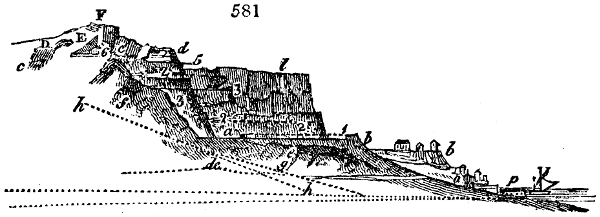
The island of Elba is equally celebrated for its inexhaustible abundance of rich specular iron-ore, and for the immemorial antiquity of its mining operations. Fig. 581. is a vertical section passing through the three workings, called Pietamonte (D), Sanguinaccio (E), Antenna (F), through an antient excavation a, through the coast o, and the mole p, ending at the canal of Piombino. The total height of the metalliferous mountain above the level of the sea, is no more than 180 metres, or 600 feet.
The rock which constitutes the body of this little mountain d l, is called bianchetta by the workmen. It is a white slaty talc, slightly ochreous, or yellowish, consisting chiefly of silica and alumina, with some magnesia.
The ore of Antenna (F) is a very hard compact fer oligiste, of a brilliant metallic aspect. The workable bed has a height of 66 feet, and consists of metalliferous blocks mixed confusedly with sterile masses of the rock; the whole covered with a rocky detritus, under a brownish mould. From its metallic appearance and toughness, this bed is called vena ferrata, the iron vein. In Pietamonte the workable bed is composed entirely of micaceous specular iron ore (fer oligiste), with its fissures filled with yellow ochre. This bed rests upon the rock called bianchetta; the brilliant aspect of ore in this place has gained for it the name of vena lucciola.
The metalliferous hill d l, extends to the north-east, about a mile beyond the workings D E F. The ore contains about 65 per cent. of iron, and is smelted in Catalan forges.
The following description of the figure will make the structure of this extraordinary mine well understood. a, is a great excavation, the result of antient workings.
1, 1; 2, 2; 3, 3, 4, 4, 5, 6, and 7, are roads for carrying off the rubbish, in correspondence with the several working levels.
b, b, b, masses of old rubbish (deblais).
c, c, ditto, from the present workings D, E, F.
d, the rocky mass called bianchetta, against which the ore extracted from a, abuts.
e, the surface of a bed of ore, near the streamlet g.
f, f, indication of beds of iron pyrites and fer oligiste.
g, a small rivulet preceding from the infiltration of rains, and which is impregnated with acidulous sulphate of iron.
h, h, ravine which separates the metalliferous hill d l, from the barren hill i.
k, masses of slags from ancient smelting operations; such are very common in this island. None of any consequence now exists; nearly the whole of the ore being exported to Tuscany, the Romagna, the Genoese territories, Piedmont, Naples, and Corsica.
l, a considerable body of rubbish from ancient workings, towards the summit of the metalliferous hill d, l.
m, m, part of this hill covered with rubbish, the result of old workings.
n, the site called Vigneria.
o, houses upon the shore called Marine de Rio, where the workpeople live, and the mineral is kept in store.
p, wooden pier (mole) whence the ore is shipped; terminated by a small tower q.
Compact fer oligiste occurs also in the Vosges, in Corsica, at Altenberg and Freyburg in Saxony, Presnitz in Bohemia, Norberg and Bisberg in Sweden, &c.
The varieties called specular fer oligiste, and scaly fer oligiste, or iron-glance, do not differ essentially from the compact. None of them affects the magnetic needle, and their powder is a red of greater or less vivacity.
8. Red oxide of iron.—The varieties included under this species afford a red powder, do not affect the magnetic needle, and are destitute of metallic lustre. At the blowpipe they all become black, or deep brown; and then they act on the needle. The crystallized variety consists of 70 iron and 30 oxygen in 100 parts. The concretionary kind, or hematite, has a brown-red colour; is solid, compact, and sometimes very hard; its surface may be filed and polished so as to acquire a lustre almost metallic; its internal structure is fibrous, and it exhibits sometimes a resemblance to splinters of wood. Its outer surface is constantly concretionary, mammelated, and presents occasionally sections of a sphere, or cylinders attached to each other. This is the blood-stone of the burnisher of metals. It is a very common mineral. The ochry variety or red-iron-ochre is distinguished from the solid hematite by the brightness of its colour. It is used as a pigment.
9. Brown oxide of iron, brown iron-stone.—This affords always a yellow powder, without any shade of red, which passes sometimes into the bistre brown, or velvet black. At the blowpipe this oxide becomes brown, and very attractable by the magnet; but after calcination and cooling, the ore yields a red powder, which stains paper nearly as red as hematite does; and which is much employed in polishing metals. All the yellow or brown oxides contain a large proportion of water, in chemical combination; and hence this species has been called hydrate of iron. There are several varieties which assume globular, reniform, stalactitic, and fruticose shapes. As impure varieties of the species we must consider some of the clay-iron-ores, such as the granular, the common, the pisiform, and the reniform clay-iron-ore. According to D’Aubuisson, the present species consists of peroxide of iron, from 82 to 84 per cent.; water, 14 to 11; oxide of manganese, 2; silica, 1 to 2. It is therefore a hydrated peroxide of iron; and ought by theory, to consist, in its absolute state, of 81·63 peroxide, and 18·37 water. It occurs both in beds and veins. The œtites or eagle-stones form a particular variety of this ore. On breaking the balls so named, they are observed to be composed of concentric coats, the outside ones being very hard, but the interior becoming progressively softer towards the centre, which is usually earthy and of a bright yellow colour; sometimes however the centre is quite empty, or contains only a few drops of water. Œtites occur in abundance, often even in continuous beds in secondary mountains, and in certain argillaceous strata. These stones are still considered by the French shepherds as amulets or talismans, and may be found in the small bags which they suspend to the necks of their favourite rams; and they are in such general use that a large quantity is annually imported into France from the frontiers of Germany, for this superstitious purpose. When smelted, they yield a good iron.
The variety called granular brown oxide, or bone ore, is merely a modification of the preceding. It occurs in grains nearly round, varying in size from a millet seed to a pea, each being composed of concentric coats, hard outside and soft within. They are generally agglutinated by a calcareous or argillaceous paste; but are occasionally quite loose. This ore occurs in calcareous formations, and is sometimes accompanied with shells, such as terebratulæ. The brittle quality of the iron afforded by it, has been ascribed to the phosphorus derived from the large quantity of organic bodies, with which the ore is frequently mixed. The bog-iron-ore, and swamp iron ore belong to this species.
10. Pitchy hydrate of iron.—This is a rare mineral of a resinous aspect, found in a vein in the mine of Braunsdorf, two leagues from Freyberg, and seems to consist of red oxide of iron and water.
11. Yenite, is a mineral species rather rare, composed of red oxide of iron, silica, and lime.
12. Carbonate of iron, sparry iron, or brown-spar.—This important species has been divided into two varieties; spathose iron, and the compact carbonate. The first has a sparry and lamellar fracture; with a colour varying from yellowish-gray to isabella yellow, or even to brownish-red. It turns brown without melting at the blowpipe, and becomes attractable by the magnet after being slightly roasted in the flame of a candle. Even by a short exposure to the air, after its extraction from the mine, it also assumes the same brown tint, but without acquiring the magnetic quality. It affords but a slight effervescence with nitric acid, changing merely to a red-brown colour. Its specific gravity varies from 3·00 to 3·67. Its primitive form is like that of carbonate of lime, an obtuse rhomboid. Without changing this form, its crystals are susceptible of containing variable quantities of carbonate of lime, till it passes wholly into this mineral. Manganese and magnesia enter also occasionally into its composition.
Sparry carbonate of iron belongs to primitive formations; forming powerful veins in mountains of gneiss, and is associated in these veins with quartz, copper pyrites, gray copper, fibrous brown oxide of iron, and a variety of ramose carbonate of lime, vulgarly called flos ferri. Thus it is found at Allevard and Vizille, near Grenoble, at Saint-George d’Huretière, in the Alps of Savoy; at Baigorry, in the Lower Pyrenees; at Eisenerz, in Styria; at Hüttenberg, in Carinthia; at Schwartz, in the Tyrol; in Saxony, Hungary, other places in Germany, as also in Spain, Sweden, Norway, and Siberia. It also occurs along with galena, and other ores of lead, in the mines of Lead-Hills, and Wanlockhead, in Scotland; and in the mines of Cumberland, Northumberland, and Derbyshire; likewise with tin-ore, at Wheal Maudlin, Saint-Just, and other places in Cornwall.
This ore viewed as a metallurgic object, is one of the most interesting and valuable that is known; it affords natural steel with the greatest facility, and accommodates itself best to the Catalan smelting forge. It was owing in a great measure to the peculiar quality of the iron which it produces, that the excellence long remarked in the cutlery of the Tyrol, Styria, and Carinthia was due. It was called by the older mineralogists steel ore.
The carbonate of iron of the coal formation, is the principal ore from which iron is smelted in England and Scotland, and it yields usually from 30 to 33 per cent. of cast metal. We are indebted to Dr. Colquhoun for several elaborate analyses of the sparry-irons of the Glasgow coal field; ores which afford the best qualities of iron made in that district. The richest specimen out of the nine which he tried, came from the neighbourhood of Airdrie; it had a specific gravity of 3·0533, and afforded in 100 parts; carbonic acid, 35·17; protoxide of iron, 53·03; lime, 3·33; magnesia, 1·77; silica, 1·4; alumina, 0·63; peroxide of iron, 0·23; carbonaceous or bituminous matter, 3·03; moisture and loss, 1·41. Its contents in metallic iron are 41·25.
The compact carbonate of iron has no relation externally with the sparry variety. It comprehends most of the clay-iron-stones, and particularly that which occurs in flattened spheroidal masses of various size, among the coal measures. The colour of this ore is often a yellowish-brown, reddish-gray, or a dirty brick-red. Its fracture is close grained; it is easily scratched, and gives a yellowish-brown powder. It adheres to the tongue, has an odour slightly argillaceous when breathed upon, makes no effervescence with any acid, blackens at the blowpipe without melting, and becomes attractable by the magnet with the slightest calcination.
This ore affords from 30 to 40 per cent. of iron of excellent quality; and it is the object of most extensive workings in Great Britain. It occurs in the slaty clay which serves as a roof or floor to the strata of coal; and also in continuous beds, from 2 to 18 inches thick, among the coal measures, as in Staffordshire, Shropshire, and Wales. It is remarkable, that the coal-basin of Newcastle contains little clay iron-stone, while the coal-basin of Dudley is replete with it.
13. Phosphate of iron.—A dull blue colour is the most remarkable external character of this species, which occurs in small masses composed of aggregated plates, sometimes in an excessively fine powder, or giving other bodies a blue tinge. It assumes at the blowpipe a rusty hue, and is then reduced to a button of a metallic aspect. It dissolves completely in dilute nitric acid, as well as in ammonia, but it does not communicate its colour to them, and oil turns it black; characters which distinguish it readily from blue carbonate of copper, whose colour is not altered by ammonia. It is of no use as a smelting ore.
14. Sulphate of iron, native green vitriol.—This is formed by the oxygenation of sulphuret of iron, and is unimportant in a metallurgic point of view.
15. Chromate of iron.—For the treatment and use of this ore, see Chrome.
16. Arseniate of iron, Wurfelerz.
17. Muriate of iron.
18. Oxalate of iron; Humboldtite, found by M. Breithaupt in the lignite of Kolaw. It consists of protoxide of iron, 53·86; oxalic acid, 46·14; in 100.
19. Titanate of iron, consists of protoxide and peroxide of iron, 86; titanic acid, 8; oxide of manganese, 2; gangue, 1 = 97. See Black Oxide of iron.
Of the assay of iron-ores by fusion.—In the assays by the dry way, the object is to separate exactly all the iron which the ore may contain, with the view of comparing the result with the product of smelting on the great scale. In order to succeed in this operation, we must deoxidize the iron, and produce at the same time such a temperature as will melt the metal and the earths associated with it in the ore, and obtain the former in a dense button at the bottom of a crucible, and the latter in a lighter glass or slag, above it. Sometimes the gangue of the ores, consisting mostly of a single earth, as quartz, alumina, or lime, is of itself very refractory, and hence some flux must be added to bring about the fusion. The substance most commonly employed for this purpose is borax; but ordinary flint glass may be substituted for it. Sometimes, also, instead of adding borax, which always succeeds, lime or clay may be added to the ore, according to the nature of its mineralizer; that is, lime for a clay iron-stone, and clay for a calcareous carbonate of iron; and both, when the gangue is siliceous, as occurs with the black oxide.
The ore, pulverized and passed through a silk sieve, is to be well mixed with the flux, and the mixture introduced into the smooth concavity made in the centre of a crucible lined with hard rammed damp charcoal dust. Were the mixture diffused through the charcoal, the reduced iron would be apt to remain scattered in little globules through the crucible, and no metallic button would be formed at its bottom. The mingled ore and flux must be covered with charcoal. The crucible thus filled must be shut with an earthen lid luted on with fire-clay; and it is then set on its base, either in an air furnace, or on the hearth of a forge urged with a smith’s bellows. The heat should be very slowly raised, not employing the bellows till three quarters of an hour have expired. In this way, the water of the damp charcoal (brasque) is allowed to exhale slowly, and the deoxidation is completed before the fusion begins; for by acting otherwise, the slags formed would dissolve some oxide of iron, and the assay would not indicate the whole of the iron to be obtained from the ore. At the end of the above period, the fire must be raised progressively to a white heat, at which pitch it must be maintained for a quarter of an hour, after which the crucible should be withdrawn. Whenever it has cooled, it is to be opened, the brasque must be carefully removed or put aside, and the button of cast-iron taken out and weighed. The brasque may sometimes contain a few globules, which must be collected by washing in water, or the application of a magnetic bar. The quantity of iron denotes, of course, the richness of the ore. These assays furnish always a gray cast-iron; and, therefore, the quality of the products can hardly be judged of, except by an experiment on the large scale. The temperature necessary for the success of an assay is about 150° of Wedgewood.
In the assays by the humid way, we may expect to find manganese, silica, alumina, lime, magnesia, and sometimes carbonic acid, associated with the iron. 100 grains of the ore in fine powder are to be digested with nitro-muriatic acid; which will leave only the silica with perhaps a very little alumina. If an effervescence takes place in the cold with a dilute acid, the loss of weight will indicate the amount of carbonic acid gas expelled. The muriatic solution contains the iron, the manganese, the lime, magnesia, and most of the alumina, with a little silica. On evaporating to dryness, and digesting in water, all the silica will remain in an insoluble state. If the solution somewhat acidulated be treated with oxalate of ammonia, the lime will fall down in the form of an oxalate; ammonia will now precipitate the alumina and the oxide of iron together, while the manganese and magnesia will continue dissolved in the state of triple salts (ammonia-muriates). The alumina may be separated from the ferric oxide by potash-lye. The manganese may be thrown down by hydrosulphuret of potash; and, finally, the magnesia may be precipitated by carbonate of soda. 100 parts of the red oxide of iron contain 69·34 of metal, and 30·66 of oxygen.
If phosphorus be present in the ore, the nitro-muriatic solution being rendered nearly neutral, will afford with muriate of lime a precipitate of phosphate of lime, soluble in an excess of muriatic acid.
When the sole object is to learn readily the per-centage of iron, the ore may be treated with hot nitro-muriatic, the acid solution filtered, and supersaturated with ammonia, which will throw down only the iron oxide and alumina; because the lime is not precipitable by that alkali, nor is magnesia and manganese, when in the state of ammonia-muriates. The red precipitate being digested with some potash-lye, will lose its alumina, and will leave the ferric oxide nearly pure. The presence of sulphur, phosphorus, or arsenic, in iron ores, may always be detected by the blowpipe, or ustulation in the assay muffle, as described under Furnace.
Of the smelting of iron-ores.—We shall describe, in the first place, the methods practised in Great Britain, and shall afterwards consider those pursued in other countries, in the treatment of their peculiar ores.
Iron is divided into three kinds, according to the different metallic states in which it may be obtained; and these are called crude or cast iron; steel; and bar or malleable iron. These states are determined essentially by the different proportions of charcoal or carbon held in chemical combination; cast iron containing more than steel, and steel more than malleable iron; which last, indeed, ought to be the pure metal, a point of perfection, however, rarely if ever attained. It is impossible to assign the limits between these three forms of iron, or their relative proportions of carbon, with ultimate precision; for bar iron passes into steel by insensible gradations, and steel and cast iron make such mutual transitions as to render it difficult to define where the former commences, and the latter ceases, to exist. In fact, some steels may be called crude iron, and some cast irons may be reckoned among steels.
Towards the conclusion of the last century the manufacture of iron underwent a very important revolution in Great Britain, by the substitution of pitcoal for charcoal of wood, the only combustible previously used in smelting the ores of this metal. This improvement served not merely to diminish the cost of reduction, but it furnished a softer cast iron, fit for many new purposes in the arts. From this era, iron works have assumed an immense importance in our national industry, and have given birth to many ingenious and powerful machines for fashioning the metal into bars of every form, with almost incredible economy and expedition.
The profusion of excellent coal, and its association in many localities with iron-stone, have procured hitherto for our country a marked superiority over all others in the iron trade; though now every possible effort is making by foreign policy to rival or to limit our future operations. In 1802, M. de Bonnard, now divisionary inspector in the royal corps of mines of France, and secretary of the general council, made a tour in England, in order to study our new processes of manufacturing iron, and published on his return, in the Journal des Mines, tom. 17., a memoir descriptive of them. Since the peace, many French engineers and iron-masters have exerted themselves in naturalizing in France this species of industry; and M. de Gallois, in particular, after a long residence in Great Britain, where he was admitted to see deliberately and minutely every department of the iron trade, returned with ample details, and erected at Saint-Etienne a large establishment entirely on the English model. More recently, MM. Dufrénoy and Elie de Beaumont, and MM. Coste and Perdonnet, have published two very copious accounts of their respective metallurgic tours in Great Britain, illustrated with plans and sections of our furnaces, for the instruction of the French nation.
The argillaceous carbonate of iron, or clay ironstone of the coal measures, is the chief ore smelted in England. Some red hematite is used as an auxiliary in certain works in Cumberland and Lancashire; but nowhere is the iron-sand, or other ferruginous matters of the secondary strata, employed at present for procuring the metal.
Among the numerous coal-basins of England there are two, in particular, which furnish more than three-fourths of the whole cast iron produced in the kingdom; namely, the coal field of Dudley, in the south of Staffordshire; and the coal fields of Monmouthshire, in South Wales, along with those of Gloucestershire and Somersetshire.
Dudley is peculiarly favoured by nature. There are found associated the coal, the iron ore, the limestone for flux, and the refractory fire-clay for constructing the interior brick-work of the furnaces. This famous clay is mined at Stourbridge, and exported to every part of the kingdom for making cast-steel crucibles and glass-house melting pots.
At Merthyr-Tydvil, the centre of the iron works of Wales, the iron-stone is extremely plentiful, forming 16 beds, or rather constituting an integrant portion of 16 beds of slate-clay. Sometimes it occurs in pretty long tables adjoining each other, so as to resemble a continuous stratum; but more frequently it forms nodules of various size and abundance, placed in planes both above and below the coal seam. Eight varieties of ore, belonging to different beds, have been distinguished by the following barbarous names: black balls, black pins, six-inch-wide vein, six-inch jack, blue vein, blue pins, gray pins, seven pins. The bed containing the first quality of iron-stone is analogous to the black ore of Staffordshire called gubbin; it is often cleft within like septaria, and its cavities are sometimes besprinkled with crystals of carbonate of lime or quartz. In the superior beds there are nodules decomposing into concentric coats, of which the middle is clay. Crystals of oxide of titanium are occasionally found in the middle of the balls of clay iron-stone; to which the metallic titanium observed in the inside of the dome of blast furnaces, may be traced. Both at Dudley and South Wales, casts of shells belonging to the genus unio, are observed on the iron-stone.
The average richness of the iron-stones of South Wales is somewhat greater than those of Staffordshire. The former is estimated at 33 parts of cast iron, while the latter rarely exceeds 30 parts in 100 of ore; and this richness, joined to the superior quality or cheapness of the coals, and the proximity of the sea, gives South Wales a decided advantage as a manufacturing district.
The number of blast furnaces in the parish of Merthyr-Tydvil amounts to upwards of 30. The cast iron produced is, however, seldom brought into the market, but is almost entirely converted into bar iron, of which, at Mr. Crawshay’s works, 600 tons are manufactured in a week. Numerous iron railways, extending through a length of 220 miles, facilitate the transport of the materials and the exportation of the products. That concurrence of favourable circumstances, which we have noticed as occurring at Dudley, prevails in an equal degree in South Wales.
The same economy which the use of coal has introduced into the smelting of cast iron from the ore, also extends to its refinery into bars. And this process would supersede in every iron work the use of wood charcoal, were not the iron produced by the latter combustible, better for many purposes, particularly the manufacture of steel. In some English smelting works, indeed, where sheet iron is prepared for making tin plate, a mixed refining process is employed, where the cast iron is made into bar iron by wood charcoal, and laminated by the aid of a coal fire.
Till 1740, the smelting of iron ores in England was executed entirely with wood charcoal; and the ores employed were principally brown and red hematites. Earthy iron ores were also smelted; but it does not appear that the clay iron-stones of the coal-basins were then used, though they constitute almost the sole smelting material at the present day. At that era, there were 59 blast furnaces, whose annual product was 17,350 tons of cast iron; that is, for each furnace, 294 tons per annum, and 51⁄8 tons per week. By the year 1788, several attempts had been made to reduce iron ore with coaked coal; and there remained only 24 charcoal blast furnaces, which produced altogether 13,000 tons of cast iron in the year; being at the rate of 546 tons for each per annum, or nearly 11 tons per week. This remarkable increase of 11 tons for 51⁄8, was due chiefly to the substitution of cylinder blowing machines worked with pistons, for the common wooden bellows. Already 53 blast furnaces fired with coke were in activity; which furnished in toto 48,800 tons of iron in a year; which raises the annual product of each furnace to 907 tons, and the weekly product to about 171⁄2 tons. The quantity of cast iron produced that year (1788)
by means of coal, was 48,800 tons,
and that by wood charcoal, was 13,100
constituting a total quantity of 61,900 tons.
In 1796, the wood charcoal process was almost entirely given up; when the returns of the iron trade made by desire of Mr. Pitt, for establishing taxes on the manufacture, afforded the following results:—
121 blast furnaces, furnishing in whole per annum 124,879 tons, constituting an average amount for each furnace of 1032 tons.
In 1802, Great Britain possessed 168 blast furnaces, yielding a product of about 170,000 tons; and this product amounted, in 1806, to 250,000 tons, derived from 227 coke furnaces, of which only 159 were in activity at once. These blast furnaces were distributed as follows:—
In the principality of Wales 52
In Staffordshire 42
In Shropshire 42
In Derbyshire 17
In Yorkshire 28
In the counties of Gloucester, Monmouth, Leicester, Lancaster, Cumberland, and Northumberland 18
In Scotland 28
227
In 1820, the iron trade had risen to the amount shewn in the following table:—
Tons.
Wales manufactured, per annum 150,000
Shropshire and Staffordshire 180,000
Yorkshire and Derbyshire 50,000
Scotland, with some places in England 20,000
Total 400,000
In a statistical view given by M. de Villefosse, of the French and English iron works, he assigns to the latter, in 1826, 305 blast furnaces, distributed as follows:—
In the principality of Wales 87
In Staffordshire 78
In Shropshire, Derbyshire, Yorkshire, &c. 84
In Scotland 56
305
Out of these, 280 were in activity at the same time; and if we suppose their mean product to have been 50 tons a week, the total product would have been, in 1826, 728,000 tons. But this estimate seems to be somewhat above the truth; for, from the information communicated by Mr. Philip Taylor to M. Achille Chaper, a considerable French iron-master, who, in the summer of 1826, inspected two-thirds of the blast furnaces of Great Britain, their product during this year was about 600,000 tons.
The preceding details shew the successive increments which the manufacture of cast iron has received; and a similar progression has taken place in its refinery into wrought iron. This operation was formerly effected by the agency of wood charcoal in refineries analogous to those still made use of in France. But when that kind of fuel began to be scarce in this island, it came to be mixed with coke in various proportions. The bar iron thus produced was usually hard, and required much time to convert, so that an establishment which could produce 20 tons of bar iron in a week, was deemed considerable. At that time, England imported annually from Sweden and Russia the enormous quantity of 70,000 tons of iron.
Mr. Cort, to whom Great Britain is indebted for the methods now pursued in this country, succeeded about that time, after many unsuccessful experiments, in converting cast iron into bar iron, by exposing it on the hearth of a reverberatory furnace to the flame of pitcoal. This method, which possessed the advantage of employing this species of combustible alone, likewise simplified the treatment, because it required no blast apparatus. But this mode of refinery, consisting in the use of a reverberatory furnace alone, did not produce altogether the desired result. It was irregular; sometimes the loss of iron was small, but at others it was very considerable; and there were great variations in the quality of the iron, as well as in the quantity of fuel consumed. Mr. Cort succeeded in removing this uncertainty of result, by causing the puddling in the reverberatory furnace to be preceded by a kind of refinery with coke. The intent of this operation was to decarburate the iron, and to prepare it for becoming malleable. The metal took in that case the name of finery metal, called, for sake of brevity, fine-metal.
He also substituted the drawing cylinders for the extension under the hammer, an improvement which accelerated greatly the manufacture of bar iron. The iron then yielded by the operation of puddling, was of a very inferior quality, and could not be directly employed in the arts. In order to give it more consistence, it was subjected to a second heating in a reverberatory furnace; and whenever this method had arrived at a high enough degree of perfection to afford products fit for the market, it became exclusively employed in Great Britain. This new method of transforming cast-iron into malleable iron, speedily gained such an extension, that of late years, a single iron-work, Cyfartha in Wales, manufactured annually more than twice as much as was made annually from 1740 to 1750, in the whole kingdom.
In surveying the improvements which the iron manufacture has received in England in the space of the last 60 years, they are seen to be resolvable into two; the first set relating to the smelting of the ores; the other, to the conversion of the pigs into bar iron; hence naturally arise two heads under which the subject of iron must be treated.
1. Manufacture of cast-iron by coke and coal.—The cast-iron produced by the English and Scotch blast furnaces is in general black and very soft; but yet may be distinguished into several qualities, of which three are particularly noticed.
No. 1. Very black cast-iron, in large rounded grains, obtained commonly near the commencement of the casting, when an excess of carbon is present; in flowing, it appears pasty, and throws out blue scintillations. It exhibits a surface where crystalline vegetations develope themselves rapidly in very fine branches; it congeals or fixes very slowly; its surface when cold is smooth, concave, and often charged with plumbago; it has but a moderate tenacity, is tender under the file, and susceptible of a dull polish. When melted over again, it passes into No. 2., and forms the best castings.
No. 2. Black cast-iron, has a somewhat lighter shade than the preceding, and may therefore on comparison be called blackish-gray. It presents less large granulations than No. 1.; is tenacious, easily turned, filed, and polished; excellent for casting when it approaches to No. 1., and for the manufacture of bar iron when it has on the contrary a shade somewhat lighter. If repeatedly melted, it passes into the next quality, or
No. 3. White cast-iron; this is brittle, and indicates always some derangement in the working of the furnace; it flows imperfectly, and darts out in casting, abundance of brilliant white scintillations; it fixes very quickly; and on cooling, exhibits on its surface irregular asperities, which make it extremely rough. It is easily broken, and presents a lamellar and radiated fracture; and is so hard that tempered steel cannot act upon it. It is cast only into weights, bullets or bombs, but never into pieces of machinery. When exposed to the refinery processes, it affords a bad bar iron. It is owing probably to the different nature of the cast-iron obtained in different counties in England, that Staffordshire and Shropshire furnish the greater part of the great iron castings, while Wales manufactures almost exclusively malleable iron. The lower price of coals in Wales is perhaps the cause to a certain extent of this difference in the results of these two iron districts. It will be interesting at any rate, to describe separately the processes employed in Staffordshire and Wales.
The blast furnaces of Staffordshire, in the neighbourhood of Dudley, Bilston, and Wednesbury, are constructed almost wholly of bricks. Their outer form is frequently a cone, often also a pyramid with a square base. They are bound about with a great many iron hoops, or with iron bars placed at different heights. This powerful armour allows the furnaces to be built much less massively than they formerly were; and admits of lighter and more elegant external forms. They are seldom insulated; but are usually associated to the number of two or three in the same line. A narrow passage is left between them, which leads to the lateral openings where the tuyères are placed. At the front of the furnace, a large shed is always raised. The roofs of these sheds present in general circular profiles, and being made of cast or bar iron, they display a remarkable lightness of construction. The cast-iron columns likewise, which support the joists and girders, give additional elegance.
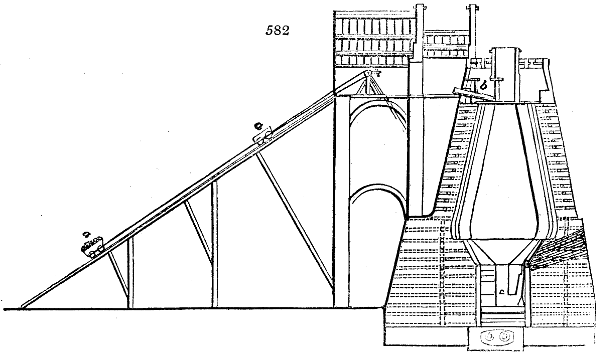
In the Dudley field, the furnaces are almost always in the middle of the plain, and an inclined rail-way must be formed to reach their platform. These inclined planes, composed of beams or rails placed alongside of each other, and sustained by props and cross-bars, as indicated in fig. 582., are set up mostly against the posterior face of the furnace. Two chains or ropes, passing over the drums of gins, moved by a steam engine (commonly the same that drives the bellows), draw up the waggons of wood or sheet iron a a, which contain the various materials for supplying the furnace. To facilitate this service, the platform round the furnace is sometimes enlarged behind by a floor; while a balustrade, which opens when the waggons arrive at the platform, prevents accidents. This projection is occasionally covered by a roof. For a furnace of the largest size, the force expended by this lifting apparatus, is not more than a two-horse power.
Fig. 582. is a vertical section through the furnace from front to rear, or at right angles to the line of the lateral tuyères. The erection of a pair of blast furnaces, of 40 feet high each, costs, in the Dudley district, 1800 pounds sterling; and requires for building each, 160,000 common bricks for the outside work, 3900 fire-bricks for the lining or shirt of the furnace, and 825 for the boshes. The dimensions of the fire-bricks are various; 5 kinds are employed for the lining, and 9 kinds for the boshes. They are all 6 inches thick, and are curved to suit the voussoirs.
The number of charges given in 12 hours is different in different furnaces; being sometimes 20, 25, and even so high as 40; but 30 is a fair average. Each charge is composed of from 5 to 6 cwt. of coak, (or now of 3 to 4 cwt. of coal with the hot blast); 3, 4, and sometimes 6 cwt. of the roasted mine, according to its richness and the quality of cast iron wanted; the limestone flux is usually one-third of the weight of the roasted iron stone. There are 2 casts in 24 hours; one at 6 in the morning, and another at 6 in the evening.
The height of the blast furnaces is very variable; some being only 36 feet high including the chimney, whilst others have an elevation of 60 feet. These extreme limits are very rare: so that the greater part of the furnaces are from 45 to 50 feet high. They are all terminated by a cylindrical chimney of from 8 to 12 feet long; being about one-fifth of the total height of the furnace. The inside diameter of this chimney is the same as that of the throat or mouth; and varies from 4 to 6 feet. The chimney is frequently formed of a single course of bricks, and acquires solidity from its hoops of iron, so thickly placed that one half of the surface is often covered with them. At its lower end, the mouth presents one or two rectangular openings, through which the charge is given. It is built on a basement circle of cast-iron, which forms the circumference of the throat; and a sloping plate of cast-iron b is so placed as to make the materials slide over into the furnace, as shown in the figure.
The inside of the blast furnaces of Staffordshire is most frequently of a circular form, except the hearth and working area. The inner space is divided into four portions, different in their forms, and the functions which they fulfil in the smelting of the ore.
The undermost, called the hearth, or crucible, in which the cast-iron collects, is a right rectangular prism, elongated in a line perpendicular to the axes of the tuyères. The sides of the hearth consist in general of refractory sandstone (fire-stone), obtained mostly from the bed of the coal basin, called millstone grit; and the bottom of the hearth is formed of a large block of the same nature, laid on a cast-iron plate.
The second portion is also made of the same refractory grit stone. It has the form of a quadrangular pyramidal, approaching considerably to a prism, from the smallness of the angle included between the sides and the axis.
The third portion or lower body of the furnace is conical, but here the interior space suddenly expands; the slope outwards at this part seems to have a great influence on the quality of the cast-iron obtained from the furnace. When No. 2. of the blackest kind is wanted for castings, the inclination of this cavity of the furnace is in general less considerable than when No. 2. cast iron for conversion into bar iron is required. The inclination of this conical chamber, called the boshes, varies from 55 to 60 degrees with the horizon. The diameter of this part is equal to that of the belly, and is from 11 to 13 feet. The boshes are built of masonry, as shown in figs. 583, 584.
The fourth part, which constitutes about two-thirds of the height of the furnace from the base of the hearth up to the throat, presents the figure of a surface of revolution, generated by a curve whose concavity is turned towards the axis of the furnace, and whose last tangent towards the bottom is almost vertical. This surface is sloped off with that of the boshes (étalages in French), so that no sharp angle may exist at the belly. In some furnaces of considerable dimensions, as in that with three tuyères, this portion of the furnace is cylindrical for a certain height.
The following measurements represent the interior structure of two well-going furnaces.
No. 1. No. 2.
Feet. Feet.
Height from the hearth to the throat or mouth 45 49
Height of the crucible or hearth 6 1⁄2 6
H—ht of the boshes 8 7
H—ht of the cone 30 1⁄2 36
H—ht of the chimney or mouth 8 12 3⁄4
Width of the bottom of the hearth 2 1⁄2 2
Ditto at its upper end 3 2 2⁄3
Ditto of the boshes 12 2⁄3 13 1⁄2
Ditto at one-third of the belly 12 11 1⁄2
Ditto at two-thirds of ditto 8 2⁄3 9 1⁄2
Ditto at the mouth 4 1⁄2 3 2⁄3
Inclination of the boshes 59 ° 52 °
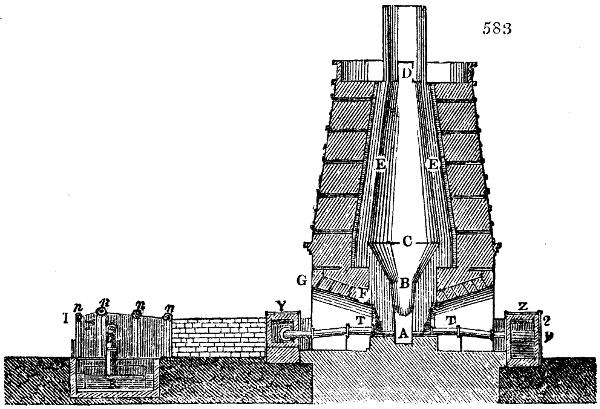
The conical orifice called the tuyère, in which the tapered pipes are placed, for imparting the blast, is seen near the bottom of the furnace, fig. 583. at A. Nose tubes of various sizes, from 2 to 4 inches in diameter, are applied to the extremity of the main blast-pipe. Under A is the bottom of the hearth, which, in large furnaces, may be two feet square. B is the top of the hearth, about two feet six inches square. A, B, is the height of the hearth, about six feet six inches. B shows the round bottom of the conical or funnel part, called in this country, the boshes, standing upon the square area of the hearth. C is the top of the boshes, which may be about 12 feet in diameter, and 8 feet in perpendicular height. D is the furnace top or mouth (gueulard in French), at which the materials are charged. It may be 41⁄2 feet in diameter. The line between C, D, is the height of the internal cavity of the furnace, from the top of the boshes upwards, supposed to be 30 feet. A, D, is the total height of the interior of the furnace, reckoned at 441⁄2 feet. E E is the lining, which is built in the nicest manner with the best fire-bricks, from 12 to 14 inches long, 3 inches thick, and curved to suit the circle of the cone. A vacancy of 3 inches wide is left all round the outside of the first lining by the builder; which is sometimes filled with coak dust, but more generally with sand firmly rammed. This void space in the brick-work is for the purpose of allowing for any expansion which might occur, either by an increase in the bulk of the building, or by the pressure and weight of the materials when descending to the bottom of the furnace. Exterior to E E is a second lining of fire-bricks similar to the first. At F, on either side, is a cast-iron lintel, 81⁄2 feet long, by 10 inches square, upon which the bottom of the arches is supported. F, G, is the rise of the tuyère arch, which may be 14 feet high upon the outside, and 18 feet wide. The extreme size of the bottom or sole of the hearth, upon each side of A, may be 10 feet square. This part and the boshing stones, are preferably made from a coarse sandstone grit, containing large rounded grains of quartz, united by a siliceo-argillaceous cement.
The bottom of the hearth consists, first, of a course of the said gritstone; beneath which is a layer of bedding sand, having, in its under part, passages for the escape of the vapours generated by damps; the whole being supported upon pillars of brick.
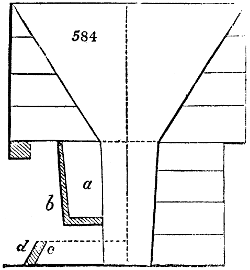
Fig. 584. represents the hearth and boshes, in a vertical side section. a is the tymp stone, and b the tymp plate for confining the liquid metal in the hearth. The latter is wedged firmly into the side-walls of the hearth; c is the dam-stone, which occupies the whole breadth at the bottom of the hearth, excepting about 6 inches, which space, when the furnace is at work, is filled before every cast, with a strong binding sand. This stone is faced outside by a cast-iron plate d, called the dam-plate, of considerable thickness, and peculiar shape. The top of the dam-stone, or rather the notch of the dam-plate, lies from 4 to 8 inches under the level of the tuyère hole. The space under the tymp plate, for 5 or 6 inches down, is rammed full, for every cast, with strong loamy earth, or even fine clay; a process called the tymp stopping. The area of the base of this furnace being 38 feet; its extreme height is 55 feet.
The blast furnaces of Staffordshire have always two tuyères, at least, placed on opposite sides, but so pointed that the blast may not pursue directly opposite lines. In a furnace acting well in the neighbourhood of Dudley, the one of the tuyères was 10 inches distant from the posterior wall of the hearth, and the other only 4 inches. In other furnaces with 3 tuyères; the side ones are placed, the one 161⁄2 inches, and the other 61⁄2 inches from the back. Three tuyères are seldom made to blow simultaneously. The third is brought into action only when the furnace seems to be choaked up, and when it becomes necessary to clear it up by a powerful concussion. Too much pains cannot be bestowed on the masonry and brickwork of a blast furnace, and on the solidity of its foundation. In a soft ground it should rest on piles, so driven that the channel left beneath for the drainage of the building may be above any water level. Small passages should likewise be left throughout the body of the work, for the transpiration of moisture.
The blowing machines employed in Staffordshire, are generally cast-iron cylinders, in which a metallic piston is exactly fitted as for a steam engine, and made in the same way. Towards the top and bottom of the blowing cylinders orifices are left covered with valves, which open inside when the vacuum is made with the cylinders, and afterwards shut by their own weight. Adjutages conduct into the iron globe or chest, the air expelled by the piston, both in its ascent and descent; because these blowing machines have always a double stroke.
The pressure of the air is made to vary through a very considerable range, according to the nature of the fuel and season of the year; for as in summer the atmosphere is more rarefied, it must be expelled with a compensating force. The limits are from 11⁄2 pounds to 31⁄2 pounds on the inch; but these numbers represent extreme proportions, the average amount in Staffordshire being 3 pounds. With this pressure a furnace usually works, which affords 60 tons of cast iron in the week; and the pressure may be 21⁄2 pounds on an average. The orifices, or nose-pipes, through which the air issues, also vary with the nature of the coke and the ore. In Staffordshire they are generally from 2 inches and 5 tenths to 2 inches and 8 tenths in diameter.
The blowing machines of Staffordshire are always impelled by steam engines. At Mr. Bagnall’s works, two blast furnaces, 40 feet high, exclusive of the chimney or top, and two finery furnaces, are worked by a steam engine of 40 horses power; and therefore the power of one horse corresponds to the production of 21⁄2 tons of cast iron per weekly, independently of the finery.
In South Wales, especially at Pontypool, there are slighter blast furnaces, whose upper portion is composed of a single range of bricks, each of which is 20 inches long, 4 thick, and 9 broad. The interior of the chimney represents an inverted cone. These furnaces derive solidity, and power to resist the expansions and contractions from change of temperature, by being cased, as it were, in horizontal hoops, placed 3 feet, or, even in some cases, only 6 inches asunder. These flat rings consist of four pieces, which are joined by means of vertical bars, that carry a species of ears or rings, into which the hoops enter, and are retained by bolts or keys. Instead of these ears, screw nuts are also employed for the junction. Each hoop is alternately connected to each of the eight vertical bars. The interior of these furnaces is the same as of the others; being generally from 12 to 14 feet diameter at the belly, and from 50 to 55 feet high. Though slight, they last as long as those composed of an outer body of masonry and a double lining of bricks; and have continued constantly at work for three years. In Wales also the blast furnaces are generally somewhat larger than in Staffordshire; because there the object being to refine the cast iron, they wish to procure as large a smelting product as possible. But in Staffordshire, a fine quality of casting iron is chiefly sought after, and hence their furnaces have less height, but nearly the same width.
In a blast apparatus employed at the Cyfartha works, moved by a 90-horse steam power, the piston rod of the blowing cylinder is connected by a parallelogram mechanism with the opposite end of the working beam of the steam engine. The cylinder is 9 feet 4 inches diameter, and 8 feet 4 inches high. The piston has a stroke 8 feet long, and it rises 13 times in the minute. By calculating the sum of the spaces percurred by the piston in a minute, and supposing that the volume of the air expelled is equal to only 96 per cent. of that sum, which must be admitted to hold with machines executed with so much precision, we find that 12,588 cubic feet of air are propelled every minute. Hence a horse power applied to blowing machines of this nature gives, on an average, 137 cubic feet of air per minute. The pressure on the air as it issues, rarely exceeds two pounds on the square inch in the Welsh works.
At the establishment of Cyfartha, for blowing seven smelting furnaces, and the seven corresponding fineries, three steam engines are employed, one of 90 horse-power, another of 80, and a third of 40; which constitutes in the whole, a force of 210 horses, or 26 horses and 1⁄5 per furnace, supposing the fineries to consume one-eighth of the blast. In the whole of the works of Messrs. Crawshay, the proprietors of Cyfartha, the power of about 350 horses is expended in blowing 12 smelting furnaces, and their subordinate fineries; which gives from 25 to 26 horses for each, allowing as before one-eighth for the fineries. As these furnaces produce each about 60 tons of cast iron weekly, we find that a horse power corresponds to 2 tons and a tenth in that time. Each of the furnaces consumes about 3567 cubic feet of air per minute. These works have been greatly increased of late years.
The following analyses of the English coal ironstones have been made by M. Berthier, at the school of mines in Paris.
Rich Welsh ore. Poor Welsh ore. Rich ore of Dudley, or gubbin.
Loss by ignition 30 ·00 27 ·00 31 ·00
Insoluble residuum 8 ·40 22 ·03 7 ·66
Lime 0 ·0 6 ·00 2 ·66
Peroxide of iron 60 ·00 42 ·66 58 ·33
On calculating the quantities of carbonate of iron, and metallic iron, to which the above peroxide corresponds, we have:—
Carbonate of iron 88 ·77 65 ·09 85 ·20
Metallic iron 42 ·15 31 ·38 40 ·45
The mean richness of the ores of carbonate of iron of these coal basins, is not far from 33 per cent. About 28 per cent. is dissipated on an average, in the roasting of the ores.
Every ferruginous clay-stone is regarded as an iron ore, when it contains more than 20 per cent. of metal; and it is paid for according to its quality, being on an average at 12 shillings per ton in Staffordshire. The gubbin however fetches so high a price as 16 or 17 shillings. The ore must be roasted before it is fit for the blast furnace, a process carried on in the open air. A heap of ore mingled with small coal (if necessary) is piled up over a stratum of larger pieces of coal; and this heap may be 6 or 7 feet high, by 15 or 20 broad. The fire is applied at the windward end, and after it has burned a certain way, the heap is prolonged at the other extremity, as far as the nature of the ground or convenience of the work requires. The quantity of coal requisite for roasting the ore varies from one to four hundred weight per ton, according to the proportion of bituminous matter associated with the iron-stone. The ore loses in this operation from 25 to 30 per cent. of its weight. Three and a quarter tons of crude ore, or two and a quarter tons of roasted ore are required to produce a ton of cast iron; that is to say, the crude material yields on an average 30·7 per cent., and the roasted ore 44·4 of pig metal. In most smelting works in Staffordshire, about equal weights of the rich ore in round nodules called gubbin, and the poorer ore in cakes called blue flat, are employed together in their roasted state; but the proportions are varied, in order to have an uniform mixture, capable of yielding from 30 to 33 per cent. of metal.
The transition or carboniferous limestone of Dudley is used as the flux; it is compact and contains little clay. The bulk of the flux is made nearly equal to that of the ore. To treat two tons and a quarter of roasted ore, which furnish one ton of pig iron, 19 hundred weight of limestone are employed; constituting nearly 1 of limestone for 3 of unroasted ore. The limestone costs 6 shillings the ton.
Carbonized pitcoal or coke was, till within these few years, the sole combustible used in the blast furnaces of Staffordshire.
The coal is distributed in circular heaps, about 5 feet diameter, by 4 feet high; and the middle is occupied by a low brick chimney, piled with loose bricks, so open as to leave interstices between them, especially near the ground. The larger lumps of coal are arranged round this chimney, and the smaller towards the circumference of the heap. When every thing is adjusted, a kindling of coals is introduced into the bottom of the brick chimney; and to render the combustion slow, the whole is covered over with a coat of coal dross, the chimney being loosely closed with a slab of any kind. Openings are occasionally made in the crust and afterwards shut up, to quicken and retard the ignition at pleasure, during its continuance of 24 hours. Whenever the carbonization has reached the proper point for forming good coke, the covering of coal dross is removed, and water is thrown on the heap to extinguish the combustion; a circumstance deemed useful to the quality of the coke. In this operation the Staffordshire coal loses the half of its weight, or two tons of coal produce one of coke.
As soon as the blast furnace gets into a regular heat, which happens about 15 days or three weeks after fires have been put in it, the working consists simply in charging it, at the opening in the throat, whenever there is a sufficient empty space; the only rule being to keep the furnace always full. The coke is measured in a basket, thirteen of which go to the ton. The ore and the flux (limestone) are brought forwards in wheelbarrows of sheet-iron. In 24 hours, there are thrown into a furnace such as fig. 582., 141⁄3 tons of coke, 16 tons of roasted ore, and 63⁄4 tons of limestone; from which about 7 tons of pig iron are procured. This is run off every 12 hours; in some works the blast is suspended during the discharge. The metal intended to be converted into bar iron, or to be cast again into moulds, is run into small pigs 3 feet long, and 4 inches diameter; weighing each about 2 hundred weight and a half.
The disorders to which blast furnaces are liable, have a tendency always to produce white cast iron. The colour of the slag or scoriæ is the surest test of these derangements, as it indicates the quality of the products. If the furnace is yielding an iron proper for casting into moulds, the slag has an uniform vitrification, and is slightly translucid. When the dose of ore is increased in order to obtain a gray pig iron, fit for fabrication into bars, the slag is opaque, dull, and of a greenish-yellow tint, with blue enamelled zones. Lastly, when the furnace is producing a white metal, the slags are black, glassy, full of bubbles, and emit an odour of sulphuretted hydrogen. The scoriæ from a coke, are much more loaded with lime than those from a charcoal blast furnace. This excess of lime appears adapted to absorb and carry off the sulphur, which would otherwise injure the quality of the iron. The slags, when breathed on, emit an argillaceous odour.
A blast furnace of 50 or 60 feet in height, gives commonly from 60 to 70 tons of cast iron per week; one from 50 to 55 feet high, gives 60 tons; two united of 45 feet, produce together, 100 tons; and one of 36 feet furnishes from 30 to 40. A blast furnace should go for four or five years without needing restoration. From 31⁄2 to 4 tons of coal, inclusive of the coal of calcination, are required in Staffordshire to obtain one ton of cast iron; and the expense in workmen’s wages is about 15 shillings on that quantity.
At the Cyfartha works of Messrs. Crawshay in South Wales, the average price of the lithoid carbonate of iron, ready for roasting, is only 7s. 6d. a ton, and its richness is about 33 per cent. The furnaces for roasting the ore in that country are made in the form of cylinders, placed above an inverted cone. The cylindrical part is 6 feet high and wide, and the cone is about 4 feet high, with a base equal to that of the cylinder; towards the bottom or narrowest part of the inverted cone, there is an aperture which terminates in an outlet on a level with the bottom of the terrace in which the furnace is built. Sometimes, however, all the roasting furnaces are in a manner combined into one, which resembles a long pit about 6 feet in width and depth, and whose bottom presents a series of inverted hollow quadrangular pyramids, 6 feet in each side, and 4 deep. The bottom or apex of each of these pyramids, communicates with a mouth or door-way that opens on a lower terrace, through which the ore falls in proportion as it is roasted; and whence it is wheeled and tumbled into the throat of an adjoining blast furnace, on the same level with the terrace; for in Wales the blast furnace is generally built up against the face of a hill, which makes one of its fronts. The above roasting furnaces, which closely resemble lime-kilns, after being filled with alternate strata of small coal and ore, are set on fire; and the roasted ore is progressively withdrawn below, as already mentioned.
The product of coke from a certain weight of coal is greater in Wales than in Staffordshire, though the mode of manufacture is the same. At Pen-y-Darran, for example, 5 of coal furnish 31⁄2 of coke; or 100 give 70; at Dowlais 100 of coal afford 71 of coke, and the product would be still greater if more pains were bestowed upon the process. At Dowlais, coal costs only 2 shillings a ton; at Cyfartha, it is worth from 2s. 6d. to 5 shillings. About 2 tons of coke are employed in obtaining 1 ton of cast iron.
According to M. Berthier’s analysis, the slag or cinder of Dowlais consists of silica, 40·4; lime, 38·4; magnesia, 5·2; alumina, 11·2; protoxide of iron, 3·8; and a trace of sulphur. He says that the silica contains as much oxygen as all the other bases united; or is equivalent to them in saturating power; and to the excess of lime he ascribes the freedom from sulphur, and the good quality of the iron produced. The specimen examined was from a furnace at Merthyr-Tydvil. Other slags from the same furnace, and one from Dudley, furnished upwards of 2 per cent. of manganese. Those which he analysed from Saint Etienne in France afforded about 1 per cent. of sulphur.
The consumption of coal in the Welsh smelting furnaces may be estimated, on an average, at 3 tons per ton of cast iron; corresponding to 2·1 of their coke. From this economy in the quantity of fuel, as well as from its cheapness and that of the iron ore, the iron of South Wales can be brought into the market at a much lower rate than that of any other district. These blast furnaces remain in action from 5 to 10 years; at the end of which time only their interior surface has to be repaired. The lining of the upper part lasts much longer; for examples are not wanting of its holding good for nearly 40 years.
One of the greatest improvements ever made by simple means in any manufacture is the employment of hot air instead of the ordinary cold air of the atmosphere, in supplying the blast of furnaces for smelting and founding iron. The discovery of the superior power of a hot over a cold blast in fusing refractory lumps of cast iron, was accidentally observed by my pupil Mr. James Beaumont Neilson, engineer to the Glasgow gas works, about the year 1827, at a smith’s forge in that city, and it was made the subject of a patent in the month of September of the following year. No particular construction of apparatus was described by the inventor by which the air was to be heated, and conveyed to the furnace; but it was merely stated that the air may be heated in a chamber or closed vessel, having a fire under it, or in a vessel connected in any convenient manner with the forge or furnace. From this vessel the air is to be forced by means of bellows into the furnace. The quantity of surface which a heating furnace is required to have for a forge, is about 1260 cubic inches; for a cupola furnace, about 10,000 cubic inches. The vessel may be enclosed in brickwork, or fixed in any other manner that may be found desirable, the application of heated air in any way to furnaces or forges, for the purposes of working iron, being the subject claimed as constituting the invention.
Wherever a forced stream of air is employed for combustion, the resulting temperature must evidently be impaired by the coldness of the air injected upon the fuel. The heat developed in combustion is distributed into three portions; one is communicated to the remaining fuel, another is communicated to the azote of the atmosphere, and to the volatile products of combustion, and a third to the iron and fluxes, or other surrounding matter to be afterwards dissipated by wider diffusion. This inevitable distribution takes place in such a way, that there is a nearly equal temperature over the whole extent of a fire-place, in which an equal degree of combustion exists.
We thus perceive that if the air and the coal be very cold, the portions of heat absorbed by them might be very considerable, and sufficient to prevent the resulting temperature from rising to a proper pitch; but if they were very hot they would absorb less caloric, and would leave more to elevate the common temperature. Let us suppose two furnaces charged with burning fuel, into one of which cold air is blown, and into the other hot air, in the same quantity. In the same time, nearly equal quantities of fuel will be consumed with a nearly equal production of heat; but notwithstanding of this, there will not be the same degree of heat in the two furnaces, for the one which receives the hot air will be hotter by all the excess of heat in its air above that of the other, since the former air adds to the heat while the latter abstracts from it. Nor are we to imagine that by injecting a little more cold air into the one furnace, we can raise its temperature to that of the other. With more air indeed we should burn more coals in the same time, and we should produce a greater quantity of heat, but this heat being diffused proportionally among more considerable masses of matter, would not produce a greater temperature; we should have a larger space heated, but not a greater intensity of heat in the same space.
Thus, according to the physical principles of the production and distribution of heat, fires fed with hot air should, with the same fuel, rise to a higher pitch of temperature than fires fed with common cold air. This consequence is independent of the masses, being as true for a small stove which burns only an ounce of charcoal in a minute, as for a furnace which burns a hundred weight; but the excess of temperature produced by hot air cannot be the same in small fires as in great; because the waste of heat is usually less the more fuel is burned.