M. (continued 5)
Reading edition
If the mordant applied to the surface of the cloth were completely decomposed, and the whole of its base brought into chemical union with it, a mere rinsing or scouring in water would suffice for removing the viscid substances added to it, but this never happens, whatsoever precautions may be taken; one portion of the mordant remains untouched, and besides, one part of the base of the portion decomposed does not enter into combination with the stuff, but continues loose and superfluous. All these particles, therefore, must be removed without causing any injury to the dyes. If in this predicament the stuff were merely immersed in water, the free portion of the mordant would dissolve, and would combine indiscriminately with all the parts of the cloth not mordanted, and which should be carefully protected from such combination, as well as the action of the dye. We must therefore add to the scouring water some substance that is capable of seizing the mordant as soon as it is separated from the cloth, and of forming with it an insoluble compound; by which means we shall withdraw it from the sphere of action, and prevent its affecting the rest of the stuff, or interfering with the other dyes. This result is obtained by the addition of cow-dung to the scouring bath; a substance which contains a sufficiently great proportion of soluble animal matters, and of colouring particles, for absorbing the aluminous and ferruginous salts. The heat given to the dung-bath accelerates this combination, and determines an insoluble and perfectly inert coagulum.
Thus the dung-bath produces at once the solution of the thickening paste; a more intimate union between the alumina or iron and the stuff, in proportion to its elevation of temperature, which promotes that union; an effectual subtraction of the undecomposed and superfluous part of the mordant, and perhaps a commencement of mechanical separation of the particles of alumina, which are merely dispersed among the fibres; a separation, however, which can be completed only by the proper scouring, which is done by the dash-wheel with such agitation and pressure (see Bleaching and Dunging) as vastly facilitate the expulsion of foreign particles. See also Bran.
Before concluding this article, we may say a word or two about astringents, and especially gall-nuts, which have been ranked by some writers among mordants. It is rather difficult to account for the part which they play. Of course we do not allude to their operation in the black dye, where they give the well known purple-black colour with salts of iron; but to the circumstance of their employment for madder dyes, and especially the Adrianople red. All that seems to be clearly established is, that the astringent principle or tannin, whose peculiar nature in this respect is unknown, combines like mordants with the stuffs and the colouring substance, so as to fix it; but as this tannin has itself a brown tint, it will not suit for white grounds, though it answers quite well for pink grounds. When white spots are desired upon a cloth prepared with oil and galls, they are produced by an oxygenous discharge, effected either through chlorine or chromic acid.
MORDANT, is also the name sometimes given to the adhesive matter by which gold-leaf is made to adhere to surfaces of wood and metal in gilding. Paper, vellum, taffety, &c., are easily gilt by the aid of different mordants, such as the following: 1. beer in which some honey and gum arabic have been dissolved; 2. gum arabic, sugar, and water; 3. the viscid juice of onion or hyacinth, strengthened with a little gum arabic. When too much gum is employed, the silver or gold leaf is apt to crack in the drying of the mordant. A little carmine should be mixed with the above colourless liquids, to mark the places where they are applied. The foil is applied by means of a dossil of cotton wool, and when the mordant has become hard, the foil is polished with the same.
The best medium for sticking gold and silver leaf to wood, is the following, called mixtion by the French artists:—1 pound of amber is to be fused, with 4 ounces of mastic in tears, and 1 ounce of Jewish pitch, and the whole dissolved in 1 pound of linseed oil rendered drying by litharge.
Painters in distemper sometimes increase the effect of their work, by patches of gold leaf, which they place in favourable positions; they employ the above mordant. The manufacturers of paper hangings of the finer kinds attach gold and silver leaf to them by the same varnish.
MOROCCO. See Leather.
MORPHIA (Morphine, Fr.; Morphin, Germ.), is a vegeto-alkali which exists associated with opian, codeïne, narcotine, meconine, meconic acid, resin, gum, bassorine, lignine, fat oil, caoutchouc, extractive, &c., in opium. Morphia is prepared as follows: Opium in powder is to be repeatedly digested with dilute muriatic acid, slightly heated, and sea-salt is to be added, to precipitate the opian. The filtered liquid is to be supersaturated with ammonia, which throws down the morphia, along with the meconine, resin, and extractive. The precipitate is to be washed with water, heated, and dissolved in dilute muriatic acid; the solution is to be filtered, whereby the foreign matters are separated from the salt of morphia, which concretes upon cooling, while the meconine remains in the acid liquid. The muriate of morphia having been squeezed between folds of blotting paper, is to be sprinkled with water, again squeezed, next dissolved in water, and decomposed by water of ammonia. The precipitate, when washed, dried, dissolved in alcohol, and crystallized, is morphia.
These crystals, which contain 6·32 per cent. of combined water, are transparent, colourless, four-sided prisms, without smell, and nearly void of taste, fusible at a moderate heat, and then concrete into a radiated translucent mass, but at a higher temperature they grow purple-red. Morphia consists of 72·34 of carbon; 6·366 of hydrogen; 5 of azote; and 16·3 of oxygen. It burns with a red and very smoky flame, is stained red by nitric acid, is soluble in 30 parts of boiling anhydrous alcohol, in 500 parts of boiling water, but hardly if at all in cold water, and is insoluble in ether and oils. The solutions have a strong bitter taste, and an alkaline reaction upon litmus paper. The saline compounds have a bitter taste, are mostly crystallizable, are soluble in water and alcohol (but not in ether), and give a blue colour to the peroxide salts of iron. It is a very poisonous substance. Acetate of morphia is sometimes prescribed, instead of opium, in medicine.
MORTAR, HYDRAULIC, called also Roman Cement, is the kind of mortar used for building piers, or walls under or exposed to water, such as those of harbours, docks, &c. The poorer sorts of limestone are best adapted for this purpose, such as contain from 8 to 25 per cent. of foreign matter, in silica, alumina, magnesia, &c. These, though calcined, do not slake when moistened; but if pulverized they absorb water without swelling up or heating, like fat lime, and afford a paste which hardens in a few days under water, but in the air they never acquire much solidity. Smeaton first discovered these remarkable facts, and described them in 1759.
The following analyses of different hydraulic limestones, by Berthier, merit confidence:—
No. 1. No. 2. No. 3. No. 4. No. 5.
A. Analyses of limestones.
Carbonate of lime 97·0 98·5 74·5 76·5 80·0
Carbonate of magnesia 2·0 — 23·0 3·0 1·5
Carbonate of protoxide of iron — — — 3·0 —
Carbonate of manganese — — — 1·5 —
Silica and alumina - 15·2 - 18·0
Oxide of iron 1·0 1·5 1·2
100·0 100·0 100·0 100·0 100·0
B. Analyses of the burnt lime.
Lime 96·4 97·2 78·0 68·3 70·0
Magnesia 1·8 — 20·0 2·0 1·0
Alumina 1·8 2·8 2·0 24·0 29·0
Oxide of iron — — — 5·7 —
100·0 100·0 100·0 100·0 100·0
No. 1. is from the fresh-water lime formation of Château-Landon, near Nemours; No. 2. the large-grained limestone of Paris; both of these afford a fat lime when burnt. Dolomite affords a pretty fat lime, though it contains 42 per cent. of carbonate of magnesia; No. 3. is a limestone from the neighbourhood of Paris, which yields a poor lime, possessing no hydraulic property; No. 4. is the secondary limestone of Metz; No. 5. is the lime marl of Senonches, near Dreux; both the latter have the property of hardening under water, particularly the last, which is much used at Paris on this account.
All good hydraulic mortars must contain alumina and silica; the oxides of iron and manganese, at one time considered essential, are rather prejudicial ingredients. By adding silica and alumina, or merely the former, in certain circumstances, to fat lime, a water-cement may be artificially formed; as also by adding to lime any of the following native productions, which contain silicates; puzzolana, trass or tarras, pumice-stone, basalt-tuff, slate-clay. Puzzolana is a volcanic product, which forms hills of considerable extent to the south-west of the Appenines, in the district of Rome, the Pontine marshes, Viterbo, Bolsena, and in the Neapolitan region of Puzzuoli, whence the name. A similar volcanic tufa is found in many other parts of the world. According to Berthier, the Italian puzzolana consists of 44·5 silica; 15·0 alumina; 8·8 lime; 4·7 magnesia; 1·4 potash; 4·1 soda; 12 oxides of iron and titanium; 9·2 water; in 100 parts.
The tufa stone, which when ground forms trass, is composed of 57·0 silica, 16·0 clay, 2·6 lime, 1·0 magnesia, 7·0 potash, 1·0 soda, 5 oxides of iron and titanium, 9·6 water. This tuff is found abundantly filling up valleys in beds of 10 or 20 feet deep, in the north of Ireland, among the schistose formations upon the banks of the Rhine, and at Monheim in Bavaria.
The fatter the lime, the less of it must be added to the ground puzzolana or trass, to form a hydraulic mortar; the mixture should be made extemporaneously, and must at any rate be kept dry till about to be applied. Sometimes a proportion of common sand mortar instead of lime is mixed with the trass. When the hydraulic cement hardens too soon, as in 12 hours, it is apt to crack; it is better when it takes 8 days to concrete. Through the agency of the water, silicates of lime, alumina, (magnesia), and oxide of iron are formed, which assume a stony hardness.
Besides the above two volcanic products, other native earthy compounds are used in making water cements. To this head belong all limestones which contain from 20 to 30 per cent. of clay and silica. By gentle calcination, a portion of the carbonic acid is expelled, and a little lime is combined with the clay, while a silicate of clay and lime results, associated with lime in a subcarbonated state. A lime-marl containing less clay will bear a stronger calcining heat without prejudice to its qualities as a hydraulic cement; but much also depends upon the proportion of silica present, and the physical structure of all the constituents.
The mineral substance most used in England for making such mortar, is vulgarly called cement-stone. It is a reniform limestone, which occurs distributed in single nodules or rather lenticular cakes, in beds of clay. They are mostly found in those argillaceous strata which alternate with the limestone beds of the oolite formation, as also in the clay strata above the chalk, and sometimes in the London clay. On the coasts of Kent, in the isles of Sheppey and Thanet, on the coasts of Yorkshire, Somersetshire, and the Isle of Wight, &c., these nodular concretions are found in considerable quantities, having been laid bare by the action of the sea and weather. They were called by the older mineralogists Septaria and Ludus Helmontii (Van Helmont’s coits). When sawn across, they show veins of calc-spar traversing the siliceous clay, and are then sometimes placed in the cabinets of virtuosi. They are found also in several places on the Continent, as at Neustadt-Eberswalde, near Antwerp, near Altdorf in Bavaria; as also at Boulogne-sur-mer, where they are called Boulogne-pebbles (galets). These nodules vary in size from that of a fist to a man’s head, they are of a yellow-gray or brown colour, interspersed with veins of calc-spar, and sometimes contain cavities bestudded with crystals. Their specific gravity is 2·59.
Analyses of several cement-stones, and of the cement made with them:—
No. 1. No. 2. No. 3. No. 4. No. 5.
A. Constituents of the cement-stones.
Carbonate of lime 65·7 61·6 82·9 63·8
Carb——e ofmagnesia 0·5 1·5
Carb——e ofprotoxide of iron 6·0 6·0 - 4·3 11·6
Carb——e ofmanganese 1·6
Silica 18·0 15·0 13·0 14·0
Alumina or clay 6·6 4·8 trace 5·7
Oxide of iron 3·0
Water 1·2 6·6 3·4
B. Constituents of the cement.
Lime 55·4 54·0 55·0 56·6
Magnesia 1·1
Alumina or clay 36·0 31·0 38·0 21·0
Oxide of iron 8·6 15·0 13·0 13·7
No. 1. English cement-stone, analyzed by Berthier; No. 2. Boulogne stone, by Drapiez; No. 3. English ditto, by Davy; No. 4. reniform limestone nodules from Arkona, by Hühnefeld; No. 5. cement-stone of Avallon, by Dumas.
In England the stones are calcined in shaft-kilns, or sometimes in mound-kilns, then ground, sifted, and packed in casks. The colour of the powder is dark-brown-red. When made into a thick paste with water, it absorbs little of it, evolves hardly any heat, and soon indurates. It is mixed with sharp sand in various proportions, immediately before using it; and is employed in all marine and river embankments, for securing the seams of stone or brick floors or arches from the percolation of moisture, and also for facing walls to protect them from damp.
The cement of Pouilly is prepared from a Jurassic (secondary) limestone, which contains 39 per cent. of silica, with alumina, magnesia, and iron oxide. Vicat forms a factitious Roman cement by making bricks with a pasty mixture of 4 parts of chalk, and 1 part of dry clay, drying, burning, and grinding them. River sand must be added to this powder; and even with this addition, its efficacy is somewhat doubtful; though it has, for want of a better substitute, been much employed at Paris.
The cement of Dihl consists of porcelain or salt-glaze potsherds ground fine, and mixed with boiled linseed oil.
Hamelin’s mastic or lithic paint to cover the façades of brick buildings, &c., is composed of 50 measures of siliceous sand, 50 of lime-marl, and 9 of litharge or red-lead ground up with linseed oil.
MOSAIC GOLD. For the composition of this peculiar alloy of copper and zinc, called also Or-molu, Messrs. Parker and Hamilton obtained a patent in November, 1825. Equal quantities of copper and zinc are to be “melted at the lowest temperature that copper will fuse,” which being stirred together so as to produce a perfect admixture of the metals, a further quantity of zinc is added in small portions, until the alloy in the melting pot becomes of the colour required. If the temperature of the copper be too high, a portion of the zinc will fly off in vapour, and the result will be merely spelter or hard solder; but if the operation be carried on at as low a heat as possible, the alloy will assume first a brassy yellow colour; then, by the introduction of small portions of zinc, it will take a purple or violet hue, and will ultimately become perfectly white; which is the appearance of the proper compound in its fused state. This alloy may be poured into ingots; but as it is difficult to preserve its character when re-melted, it should be cast directly into the figured moulds. The patentees claim the exclusive right of compounding a metal consisting of from 52 to 55 parts of zinc out of 100.
Mosaic gold, the aurum musivum of the old chemists, is a sulphuret of tin.
MOSAIC. (Mosaïque, Fr.; Mosaisch, Germ.) There are several kinds of mosaic, but all of them consist in imbedding fragments of different coloured substances, usually glass or stones, in a cement, so as to produce the effect of a picture. The beautiful chapel of Saint Lawrence in Florence, which contains the tombs of the Medici, has been greatly admired by artists, on account of the vast multitude of precious marbles, jaspers, agates, avanturines, malachites, &c., applied in mosaic upon its walls. The detailed discussion of this subject belongs to a treatise upon the fine arts.
MOTHER OF PEARL (Nacre de Perles, Fr.; Perlen mutter, Germ.); is the hard, silvery, brilliant internal layer of several kinds of shells, particularly oysters, which is often variegated with changing purple and azure colours. The large oysters of the Indian seas alone secrete this coat of sufficient thickness to render their shells available to the purposes of manufactures. The genus of shell fish called pentadinæ furnishes the finest pearls, as well as mother of pearl; it is found in greatest perfection round the coasts of Ceylon, near Ormus in the Persian Gulf, at Cape Comorin, and among some of the Australian seas. The brilliant hues of mother of pearl, do not depend upon the nature of the substance, but upon its structure. The microscopic wrinkles or furrows which run across the surface of every slice, act upon the reflected light in such a way as to produce the chromatic effect; for Sir David Brewster has shown, that if we take, with very fine black wax, or with the fusible alloy of D’Arcet, an impression of mother of pearl, it will possess the iridescent appearance. Mother of pearl is very delicate to work, but it may be fashioned by saws, files, and drills, with the aid sometimes of a corrosive acid, such as the dilute sulphuric or muriatic; and it is polished by colcothar of vitriol.
MOTHER-WATER, is the name of the liquid which remains after all the salts that will regularly crystallize have been extracted, by evaporation and cooling, from any saline solution.
MOUNTAIN SOAP (Savon de montagne, Fr.; Bergseife, Germ.); is a tender mineral, soft to the touch, which assumes a greasy lustre when rubbed, and falls to pieces in water. It consists of silica 44, alumina 26·5, water 20·5, oxide of iron 8, lime 0·5. It occurs in beds, alternating with different sorts of clay, in the Isle of Skye, at Billin in Bohemia, &c. It has been often, but improperly, confounded with steatite.
MUCIC ACID (Acid mucique, Fr.; Schleimsaüre, Germ.); is the same as the saclactic acid of Scheele, and may be obtained by digesting one part of gum arabic, sugar of milk, or pectic acid, with twice or thrice their weight of nitric acid. It forms white granular crystals, and has not been applied to any use in the arts.
MUCILAGE, is a solution in water of gummy matter of any kind.
MUFFLE, is the earthenware case or box, in the assay furnaces, for receiving the cupels, and protecting them from being disturbed by the fuel. See Assay and Furnace.
MUNDIC, is the name of copper pyrites among English miners.
MUNJEET, is a kind of madder grown in several parts of India.
MURIATIC or HYDROCHLORIC ACID; anciently marine acid, and spirit of salt. (Acide hydrochlorique, and Chlorhydrique, Fr.; Salzsaüre, Germ.) This acid is now extracted from sea-salt, by the action of sulphuric acid and a moderate heat; but it was originally obtained from the salt by exposing a mixture of it and of common clay to ignition in an earthen retort. The acid gas which exhales, is rapidly condensed by water. 100 cubic inches of water are capable of absorbing no less than 48,000 cubic inches of the acid gas, whereby the liquid acquires a specific gravity of 1·2109; and a volume of 142 cubic inches. This vast condensation is accompanied with a great production of heat, whence it becomes necessary to apply artificial refrigeration, especially if so strong an acid as the above is to be prepared. In general, the muriatic acid of commerce has a specific gravity varying from 1·15 to 1·20; and contains, for the most part, considerably less than 40 parts by weight of acid gas in the hundred. The above stronger acid contains 42·68 per cent. by weight; for since a cubic inch of water, which weighs 252·5 grains, has absorbed 480 cubic inches = 188 grains of gas; and 252·5 + 188 = 440·5; then 440·5 : 188 ∷ 100 : 42·68. In general a very good approximation may be found to the percentage of real muriatic acid, in any liquid sample, by multiplying the decimal figures of the specific gravity by 200. Thus for example, at 1·162 we shall have by this rule 0·162 × 200 = 32·4, for the quantity of gas in 100 parts of the liquid. Muriatic acid gas consists of chlorine and hydrogen combined, without condensation, in equal volumes. Its specific gravity is 1·247, air = 1·000.
By sealing up muriate of ammonia and sulphuric acid, apart, in a strong glass tube recurved, and then causing them to act on each other, Sir H. Davy procured liquid muriatic acid. He justly observes, that the generation of elastic substances in close vessels, either with or without heat, offers much more powerful means of approximating their molecules than those dependent on the application of cold, whether natural or artificial; for as gases diminish only 1⁄480 in volume for every degree of Fahrenheit’s scale, beginning at ordinary temperatures, a very slight condensation only can be produced by the most powerful freezing mixtures, not half as much as would result from the application of a strong flame to one part of a glass tube, the other part being of ordinary temperature: and when attempts are made to condense gases into liquids by sudden mechanical compression, the heat instantly generated presents a formidable obstacle to the success of the experiment; whereas in the compression resulting from their slow generation in close vessels, if the process be conducted with common precautions, there is no source of difficulty or danger; and it may be easily assisted by artificial cold, in cases where gases approach near to that point of compression and temperature at which they become vapours.—Phil. Trans. 1823.
The muriatic acid of commerce has usually a yellowish tinge, but when chemically pure it is colourless. It fumes strongly in the air, emitting a corrosive vapour of a peculiar smell. The characteristic test of muriatic acid in the most dilute state, is nitrate of silver, which causes a curdy precipitate of chloride of silver.
The preparation of this acid upon the great scale is frequently effected in this country by acting upon sea-salt in hemispherical iron pots, or in cast-iron cylinders, with concentrated sulphuric acid; taking 6 parts of the salt to 5 of the acid. The mouth of the pot may be covered with a slab of siliceous freestone, perforated with two holes of about two inches diameter each, into the one of which the acid is poured by a funnel in successive portions, and into the other, a bent glass, or stone-ware tube, is fixed, for conducting the disengaged muriatic gas into a series of large globes of bottle glass, one-third filled with water, and laid on a sloping sand-bed. A week is commonly employed for working off each pot; no heat being applied to it till the second day.
The decomposition of sea-salt by sulphuric acid, was at one time carried on by some French manufacturers in large leaden pans, 10 feet long, 5 feet broad, and a foot deep, covered with sheets of lead, and luted. The disengaged acid gas was made to circulate in a conduit of glazed bricks, nearly 650 yards long, where it was condensed by a sheet of water exceedingly thin, which flowed slowly in the opposite direction of the gas down a slope of 1 in 200. At the end of this canal nearest the apparatus, the muriatic acid was as strong as possible, and pretty pure; but towards the other end, the water was hardly acidulous. The condensing part of this apparatus was therefore tolerably complete; but as the decomposition of the salt could not be finished in the leaden pans, the acid mixture had to be drawn out of them, in order to be completely decomposed in a reverberatory furnace; in this way nearly 50 per cent. of the muriatic acid was lost. And besides, the great quantity of gas given off during the emptying of the lead-chambers was apt to suffocate the workmen, or seriously injured their lungs, causing severe hemoptysis. The employment of muriatic acid is so inconsiderable, and the loss of it incurred in the preceding process is of so little consequence, that subsequently, both in France and in England, sulphate of soda, for the soda manufacture, has been procured with the dissipation of the muriatic acid in the air. In the method more lately resorted to, the gaseous products are discharged into extensive vaults, where currents of water condense them and carry them off into the river. The surrounding vegetation is thereby saved in some measure from being burned up, an accident which was previously sure to happen when fogs precipitated the floating gases upon the ground. At Newcastle, Liverpool, and Marseilles, where the consumption of muriatic acid bears no proportion to the manufacture of soda, this process is now practised upon a vast scale.
The apparatus for condensing muriatic acid gas has been modified and changed, of late years, in many different ways.
The Bastringue apparatus. At the end of a reverberatory furnace, (see Copper, smelting of, and Soda, manufacture of,) a rectangular lead trough or pan, about 1 foot deep, of a width equal to that of the interior of the furnace, that is about 5 feet wide, and 61⁄2 feet long, is encased in masonry, having its upper edges covered with cast-iron plates or fire tiles, and placed upon a level with the passage of the flame, as it escapes from the reverberatory. The arch which covers that pan forms a continuation of the roof of the reverberatory, and is of the same height. The flame which proceeds from the furnace containing the mixture of salt and sulphuric acid is made to escape between the vault and the surface of the iron plates or fire tiles, through a passage only 4 inches in height. When the burned air and vapours reach the extremity of the pan, they are reflected downwards, and made to return beneath the bottom of the pan, in a flue, which is afterwards divided so as to lead the smoke into two lateral flues, which terminate in the chimney. The pan is thus surrounded as it were with the heat and flame discharged from the reverberatory furnace. See Evaporation. A door is opened near the end of the pan, for introducing the charge of sea-salt, amounting to 12 bags of 2 cwt. each, or 24 cwt. This door is then luted on as tightly as possible, and for every 100 parts of salt, 110 of sulphuric acid are poured in, of specific gravity 1·594, containing 57 per cent. of dry acid. This acid is introduced through a funnel inserted in the roof of the furnace. Decomposition ensues, muriatic acid gas mingled with steam is disengaged, and is conducted through 4 stone-ware tubes into the refrigerators, where it is finally condensed. These refrigerators consist of large stone-ware carboys, called dame-jeans in France, to the number of 7 or 8 for each pipe, and arranged so that the neck of the one communicates with the body of the other; thus the gas must traverse the whole series, and gets in a good measure condensed by the water in them, before reaching the last.
When the operation is finished, the door opposite the pan is opened, and the residuum in it, is discharged, in the form of a fluid magma, upon a square bed of bricks, exterior to the furnace. This paste speedily concretes on cooling, and is then broken into fragments and carried to the soda manufactory. The immense quantity of gas exhaled in discharging the pan, renders this part of the operation very painful to the workmen; and wasteful in reference to the production of muriatic acid. The difficulty of luting securely the cast-iron plates or fire tiles which cover the pan, the impossibility of completing the decomposition of the salt, since the residuum must be run off in a liquid state, finally, the damage sustained by the melting and corrosion of the lead, &c., are among the causes why no more than 80 or 90 parts of muriatic acid at 1·170 are collected, equivalent to 25 per cent. of real acid for every 100 of salt employed, instead of much more than double that quantity, which it may be made to yield by a well conducted chemical process.
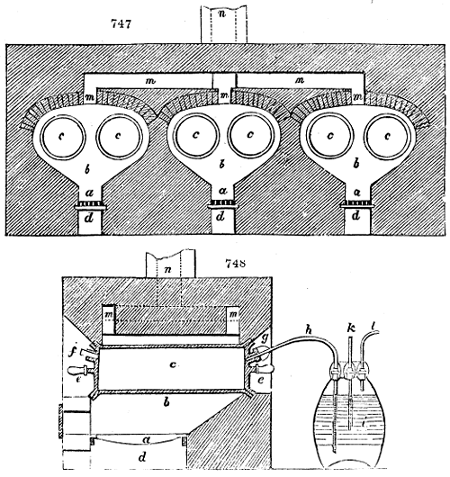
The cylinder apparatus is now much esteemed by many manufacturers. Fig. 747. represents, in transverse section, a bench of iron cylinder retorts, as built up in a proper furnace for producing muriatic acid; and fig. 748. a longitudinal section of one retort with one of its carboys of condensation. a is the grate; b, a fireplace, in which two iron cylinders, c c, are set alongside of each other. They are 51⁄2 feet long, 20 inches in diameter, about 1⁄4 of an inch thick, and take 1·6 cwts. of salt for a charge; d is the ash-pit; e, e, are cast-iron lids, for closing both ends of the cylinders; f is a tube in the posterior lid, for pouring in the sulphuric acid; g is another tube, in the anterior lid, for the insertion of the bent pipe of hard glazed stone-ware h; i is a three-necked stone-ware carboy; k is a tube of safety; l, a tube of communication with the second carboy; m m, m m, are the flues leading to the chimney n.
After the salt has been introduced, and the fire kindled, 831⁄4 per cent. of its weight of sulphuric acid, of spec. grav. 1·80, should be slowly poured into the cylinder through a lead funnel, with a syphon-formed pipe. The three-necked carboys may be either placed in a series for each retort, like a range of Woulfe’s bottles, or all the carboys of the front range may be placed in communication with one another, while the last carboy at one end is joined to the first of the second range; and thus in succession. They must be half filled with cold water; and when convenient, those of the front row at least, should be plunged in an oblong trough of running water. The acid which condenses in the carboys of that row is apt to be somewhat contaminated with sulphuric acid, muriate of iron, or even sulphate of soda; but that in the second and third will be found to be pure. In this way 100 parts of sea-salt will yield 130 parts of muriatic acid, of spec. grav. 1·19; while the sulphate of soda in the retort will afford from 208 to 210 of that salt in crystals.
It is proper to heat all the parts of the cylinders equably, to insure the simultaneous decomposition of the salt, and to protect it from the acid; for the hotter the iron, and the stronger the acid, the less erosion ensues.
Some manufacturers, with the view of saving fuel by the construction of their furnaces oppose to the flame as many obstacles as they can, and make it perform numerous circulations round the cylinders; but this system is bad, and does not even effect the desired economy, because the passages, being narrow, impair the draught, and become speedily choked up with the soot, which would be burned profitably in a freer space; the decomposition also, being unequally performed, is less perfect, and the cylinders are more injured. It is better to make the flame envelope at once the body of the cylinder; after which it may circulate beneath the vault, in order to give out a portion of its caloric before it escapes at the chimney.
The fire should be briskly kindled, but lowered as soon as the distillation commences; and then continued moderate till the evolution of gas diminishes, when it must be heated somewhat strongly to finish the decomposition. The iron door is now removed, to extract the sulphate of soda, and to recommence another operation. This sulphate ought to be white and uniform, exhibiting in its fracture no undecomposed sea-salt.
Liquid muriatic acid has a very sour corrosive taste, a pungent suffocating smell, and acts very powerfully upon a vast number of mineral, vegetable, and animal substances. It is much employed for making many metallic solutions; and in combination with nitric acid, it forms the aqua regia of the alchemists, so called from its property of dissolving gold.
Table of Muriatic Acid, by Dr. Ure.
Acid of 120 in 100. Specific gravity. Chlorine. Muriatic Gas.
100 1·2000 39·675 40·777
99 1·1982 39·278 40·369
98 1·1964 38·882 39·961
97 1·1946 38·485 39·554
96 1·1928 38·089 39·146
95 1·1910 37·692 38·738
94 1·1893 37·296 38·330
93 1·1875 36·900 37·923
92 1·1857 36·503 37·516
91 1·1846 36·107 37·108
90 1·1822 35·707 36·700
89 1·1802 35·310 36·292
88 1·1782 34·913 35·884
87 1·1762 34·517 35·476
86 1·1741 34·121 35·068
85 1·1721 33·724 34·660
84 1·1701 33·328 34·252
83 1·1681 32·931 33·845
82 1·1661 32·535 33·437
81 1·1641 32·136 33·029
80 1·1620 31·746 32·621
79 1·1599 31·343 32·213
78 1·1578 30·946 31·805
77 1·1557 30·550 31·398
76 1·1536 30·153 30·990
75 1·1515 29·757 30·582
74 1·1494 29·361 30·174
73 1·1473 28·964 29·767
72 1·1452 28·567 29·359
71 1·1431 28·171 28·951
70 1·1410 27·772 28·544
69 1·1389 27·376 28·136
68 1·1369 26·979 27·728
67 1·1349 26·583 27·321
66 1·1328 26·186 26·913
65 1·1308 25·789 26·505
64 1·1287 25·392 26·098
63 1·1267 24·996 25·690
62 1·1247 24·599 25·282
61 1·1226 24·202 24·874
60 1·1206 23·805 24·466
59 1·1185 23·408 24·058
58 1·1164 23·012 23·050
57 1·1143 22·615 23·242
56 1·1123 22·218 22·834
55 1·1102 21·822 22·426
54 1·1082 21·425 22·019
53 1·1061 21·028 21·611
52 1·1041 20·632 21·203
51 1·1020 20·235 20·796
50 1·1000 19·837 20·388
49 1·0980 19·440 19·980
48 1·0960 19·044 19·572
47 1·0939 18·647 19·165
46 1·0919 18·250 18·757
45 1·0899 17·854 18·349
44 1·0879 17·457 17·941
43 1·0859 17·060 17·534
42 1·0838 16·664 17·126
41 1·0818 16·267 16·718
40 1·0798 15·870 16·310
39 1·0778 15·474 15·902
38 1·0758 15·077 15·494
37 1·0738 14·680 15·087
36 1·0718 14·284 14·679
35 1·0697 13·887 14·271
34 1·0677 13·490 13·863
33 1·0657 13·094 13·456
32 1·0637 12·697 13·049
31 1·0617 12·300 12·641
30 1·0597 11·903 12·233
29 1·0577 11·506 11·825
28 1·0557 11·109 11·418
27 1·0537 10·712 11·010
26 1·0517 10·316 10·602
25 1·0497 9·919 10·194
24 1·0477 9·522 9·786
23 1·0457 9·126 9·379
22 1·0437 8·729 8·971
21 1·0417 8·332 8·563
20 1·0397 7·935 8·155
19 1·0377 7·538 7·747
18 1·0357 7·141 7·340
17 1·0337 6·745 6·932
16 1·0318 6·348 6·524
15 1·0298 5·951 6·116
14 1·0279 5·554 5·709
13 1·0259 5·158 5·301
12 1·0239 4·762 4·893
11 1·0220 4·365 4·486
10 1·0200 3·968 4·078
9 1·0180 3·571 3·670
8 1·0160 3·174 3·262
7 1·0140 2·778 2·854
6 1·0120 2·381 2·447
5 1·0100 1·984 2·039
4 1·0080 1·588 1·631
3 1·0060 1·191 1·224
2 1·0040 0·795 0·816
1 1·0020 0·397 0·408
MURIATES were, till the great chemical era of Sir H. Davy’s researches upon chlorine, considered to be compounds of an undecompounded acid, the muriatic, with the different bases; but he proved them to be in reality compounds of chlorine with the metals. They are all, however, still known in commerce by their former appellation. The only muriates much used in the manufactures are, Muriate of ammonia, or Sal ammoniac; muriated peroxide of mercury, Mercury, bichloride of; muriate of soda, or chloride of sodium, see Salt; muriate of tin, see Calico-printing and Tin.
MUSK (Musc, Fr.; Moschus, Germ.), is a peculiar aromatic substance, found in a sac between the navel and the parts of generation of a small male quadruped of the deer kind, called by Linnæus, Moschus moschiferus, which inhabits Tonquin and Thibet. The colour of musk is blackish-brown; it is lumpy or granular, somewhat like dried blood, with which substance, indeed, it is often adulterated. The intensity of its smell is almost the only criterion of its genuineness. When thoroughly dried it becomes nearly scentless; but it recovers its odour when slightly moistened with water of ammonia. The Tonquin musk is most esteemed. It comes to us in small bags covered with a reddish-brown hair; the bag of the Thibet musk is covered with a silver-gray hair. All the analyses of musk hitherto made, teach little or nothing concerning its active or essential constituent. It is used in medicines, and is an ingredient in a great many perfumes.
MUSLIN, is a fine cotton fabric, used for ladies’ robes; which is worn either white, dyed, or printed.
MUST, is the sweet juice of the grape.
MUSTARD (Moutarde, Fr.; Senf, Germ.); is a plant which yields the well-known seed used as a condiment to food. M. Lenormand gives the following prescription for preparing mustard for the table.
With 2 pounds of very fine flour of mustard, mix half an ounce of each of the following fresh plants; parsley, chervil, celery, and tarragon, along with a clove of garlic, and twelve salt anchovies, all well minced. The whole is to be triturated with the flour of mustard till the mixture becomes uniform. A little grape-must or sugar is to be added, to give the requisite sweetness; then one ounce of salt, with sufficient water to form a thinnish paste by rubbing in a mortar. With this paste the mustard pots being nearly filled, a redhot poker is to be thrust down into the contents of each, which removes (it is said) some of the acrimony of the mustard, and evaporates a little water, so as to make room for pouring a little vinegar upon the surface of the paste. Such table mustard not only keeps perfectly well, but improves with age.
The mode of preparing table mustard patented by M. Soyés, consisted in steeping mustard seed in twice its bulk of weak wood vinegar for eight days, then grinding the whole into paste in a mill, putting it into pots, and thrusting a redhot poker into each of them.
MUTAGE, is a process used in the south of France to arrest the progress of fermentation in the must of the grape. It consists either in diffusing sulphurous acid, from burning sulphur matches in the cask containing the must, or in adding a little sulphite (not sulphate) of lime to it. The last is the best process. See Fermentation.
MYRICINE, is a vegetable principle which constitutes from 20 to 30 per cent. of the weight of bees-wax, being the residuum from the solvent action of alcohol upon that substance. It is a grayish-white solid, which may be vaporized almost without alteration.
MYRRH, is a gum-resin, which occurs in tears of different sizes; they are reddish-brown, semi-transparent, brittle, of a shining fracture, appear as if greasy under the pestle, they have a very acrid and bitter taste, and a strong, not disagreeable, smell. Myrrh flows from the incisions of a tree not well known, which grows in Arabia and Abyssinia, supposed to be a species of amyris or mimosa. It consists of resin and gum in proportions stated by Pelletier at 31 of the former and 66 of the latter; but by Braconnot, at 23 and 77. It is used only in medicine.