D. (continued 3)
Reading edition
We shall conclude this account of the general principles of dyeing, with Mr. Delaval’s observations on the nature of dyes, and a list of the different substances used in dyeing, in reference to the colours produced by them.
Sir Isaac Newton supposed coloured matters to reflect the rays of light; some bodies reflecting the more, others the less, refrangible rays most copiously; and this he conceived to be the true, and the only reason of their colours. Mr. Delaval, however, proved in the 2d vol. of the “Memoirs of the Philosophical and Literary Society of Manchester,” that, “in transparent coloured substances, the colouring substance does not reflect any light; and that when, by intercepting the light which was transmitted, it is hindered from passing through substances, they do not vary from their former colour to any other colour, but become entirely black;” and he instances a considerable number of coloured liquors, none of them endued with reflective powers, which, when seen by transmitted light, appeared severally in their true colours; but all of them, when seen by incident light, appeared black; which is also the case of black cherries, black currants, black berries, &c., the juices of which appeared red when spread on a white ground, or otherwise viewed by transmitted instead of incident light; and he concludes, that bleached linen, &c. “when dyed or painted with vegetable colours, do not differ in their manner of acting on the rays of light, from natural vegetable bodies; both yielding their colours by transmitting through the transparent coloured matter, the light which is reflected from the white ground:” it being apparent, from different experiments, “that no reflecting power resides in any of their components, except in their white matter only,” and that “transparent coloured substances, placed in situations by which transmission of light through them is intercepted, exhibit no colour, but become entirely black.”
The art of dyeing, therefore, (according to Mr. Delaval) “consists principally in covering white substances, from which light is strongly reflected, with transparent coloured media, which, according to their several colours, transmit more or less copiously the rays reflected from the white,” since “the transparent media themselves reflect no light; and it is evident that if they yielded their colours by reflecting, instead of transmitting the rays, the whiteness or colour of the ground on which they are applied, would not in anywise alter or affect the colours which they exhibit.”
But when any opaque basis is interposed, the reflection is doubtless made by it, rather than by the substance of the dyed wool, silk, &c., and more especially when such basis consists of the white earth of alum, or the white oxide of tin; which, by their strong reflective powers, greatly augment the lustre of colours. There are, moreover, some opaque colouring matters, particularly the acetous, and other solutions of iron, used to stain linen, cotton, &c., which must necessarily themselves reflect, instead of transmitting the light by which their colours are made perceptible.
The compound or mixed colours, are such as result from the combination of two differently coloured dye stuffs, or from dyeing stuffs with one colour, and then with another. The simple colours of the dyer, are red, yellow, blue, and black, with which, when skilfully blended, he can produce every variety of tint. Perhaps the dun or fawn colour might be added to the above, as it is directly obtained from a great many vegetable substances.
1. Red with yellow, produces orange; a colour, which upon wool, is given usually with the spent scarlet bath. To this shade may be referred flame colour, pomegranate, capuchin, prawn, jonquil, cassis, chamois, café au lait, aurora, marigold, orange peel, mordorés, cinnamon, gold, &c. Snuff, chesnut, musk, and other shades are produced by substituting walnut peels or sumach for bright yellow. If a little blue be added to orange, an olive is obtained. The only direct orange dyes are annotto, and subchromate of lead; see Silk and Wool Dyeing.
2. Red with blue produces purple, violet, lilac, pigeon’s neck, mallow, peach-blossom, bleu de roi, lint-blossom, amaranth.
3. Red with black; brown, chocolate, marone, &c.
4. Yellow with blue; green of a great variety of shades; such as nascent green, gay green, grass green, spring green, laurel green, sea green, celadon green, parrot green, cabbage green, apple green, duck green.
5. Mixtures of colours, three and three, and four and four, produce an indefinite diversity of tints; thus red, yellow and blue, form brown olives, and greenish grays; in which the blue dye ought always to be first given, lest the indigo vat should be soiled by other colours. Red, yellow, and gray, (which is a gradation of black), give the dead-leaf tint, as well as dark orange, snuff colour, &c. Red, blue and gray give a vast variety of shades; as lead gray, slate gray, wood-pigeon gray, and other colours, too numerous to specify. See Brown Dye.
The following list of dyes, and the colouring substances which produce them, may prove useful.
Red. Cochineal, kermes, lac, madder, archil, carthamus or safflower, brazil wood, logwood, periodide of mercury, alkanet.
Yellow. Quercitron, weld, fustic (yellow wood), annotto, sawwort, dyer’s broom, turmeric, fustet (rhus cotinus), Persian and Avignon berries (rhamnus infectorius), willow, peroxide of iron; chromate of lead (chrome yellow), sulphuret of arsenic, hydrosulphuret of antimony; nitric acid on silk.
Blue. Indigo, woad or pastel, Prussian blue, turnsole or litmus, logwood with a salt of copper.
Black. Galls, sumach, logwood, walnut peels, and other vegetables which contain tannin and gallic acid, along with ferruginous mordants. The anacardium of India.
Green. These are produced by the blue and yellow dyes skilfully combined; with the exception of the chrome green, and perhaps the copper green of Schweinfurt.
Orange. Annotto, and mixtures of red and yellow dyes; subchromate of lead.
Brown. See the remarks at the beginning of this article; Brown in its alphabetical place; Calico Printing, Catechu, and Manganese.
Fawn, Dun or Root. Walnut peels, sumach, birch tree, henna, sandal wood. See Calico Printing, for a great variety of these dyes.
Fig. 364. and 365. represent in a cross and longitudinal section the automatic dyeing steam copper, so generally employed in the well-appointed factories of Lancashire.
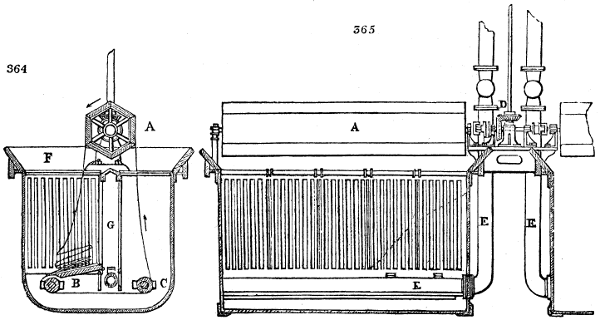
A is the long reel, composed at each end of six radial iron arms or spokes, bound at their outer extremities with a six-sided wooden frame; these two terminal hexagons are connected by long wooden laths, seen above and below A in fig. 365. F shows the sloping border or ledge of the copper. B and C are rollers laid horizontally, for facilitating the continuous motion of the series of pieces of goods stitched together into an endless web, which are made to travel by the incessant rotations of the reel. Immediately above the roller B in fig. 364., all the spare foldings of the web are seen resting upon the sloping wooden grating, which guides them onwards in the direction indicated by the arrow. The dye stuffs are put within the middle grating, like a hen-coop, marked G. Each copper is 6 feet long, 31⁄2 feet wide, 31⁄2 feet deep, exclusive of the top ledge, 9 inches high. Such steam coppers are usually erected in pairs, and moved by a common horizontal bevel wheel seen at D in fig. 365., fixed upon a vertical shaft, shifted into geer by a wheel at its top, with one of the driving shafts of the factory. Upon each side of D, the two steam pipes for supplying the right and left hand coppers are seen; each provided with a stop cock for admitting, regulating, or cutting off the steam. These steam pipes descend at E E, the horizontal branch having several orifices in its upper surface. The horizontal shaft in a line with the axes of the reels, and which turns them, is furnished upon each side with a clutch for putting either of the reels into or out of geer, that is to say, setting it a going, or at rest, in a moment by the touch of a forked lever.
The steam pipe of distribution E lies horizontally near the bottom of the middle coop, as shown under G in fig. 364., and sends up the steam through its numerous orifices, among the dye-stuffs and water by which it is covered. Thus the infusion or decoction is continually advancing in the copper, during the incessant loco-motion of the endless web. The horizontal pipe traverses the copper from end to end, and is not stopped short in the middle. Each of these coppers can receive two, three or more parallel pieces of goods at a time, the reel and copper being divided into so many compartments by transverse wooden spars.