I. & J. (continued 3)
Reading edition
This principle may be rendered still more evident by a numerical illustration. Let us take, for example, a blast furnace, into which 600 cubic feet of air are blown per minute; suppose it to contain no ore but merely coal or coke, and that it has been burning long enough to have arrived at the equilibrium of temperature, and let us see what excess of temperature it would have if blown with air of 300° C. (572° F.), instead of being blown with air at 0° C.
600 cubic feet of air under the mean temperature and pressure, weigh a little more than 45 pounds avoirdupois; they contain 10·4 pounds of oxygen, which would burn very nearly 4 pounds of carbon, and disengage 16,000 times as much heat as would raise by one degree cent. the temperature of two pounds of water. These 16,000 portions of heat, produced every minute, will replace 16,000 other portions of heat, dissipated by the sides of the furnace, and employed in heating the gases which escape from its mouth. This must take place in order to establish the assumed equilibrium of caloric.
If the 45 pounds of air be heated beforehand up to 300° C., they will contain about the eighth part of the heat of the 16,000 disengaged by the combustion, and there will be therefore in the same space one eighth of heat more, which will be ready to operate upon any bodies within its range, and to heat them one eighth more. Thus the blast of 300° C. gives a temperature which is nine-eighths of the blast at zero C., or at even the ordinary atmospheric temperature; and as we may reckon at from 2200° to 2700° F. (from 1200° to 1500° C.), the temperature of blast furnaces worked in the common way, we perceive that the hot-air blast produces an increase of temperature equal to from 270° to 360° F.
Now in order to appreciate the immense effects which this excess of temperature may produce in metallurgic operations, we must consider that often only a few degrees more temperature are required to modify the state of a fusible body, or to determine the play of affinities dormant at lower degrees of heat. Water is solid at 1° under 32° F.; it is liquid at 1° above. Every fusible body has a determinate melting point, a very few degrees above which it is quite fluid, though it may be pasty below it. The same observation applies to ordinary chemical affinities; charcoal, for example, which reduces the greater part of metallic oxides, begins to do so only at a determinate pitch of temperature, under which it is inoperative, but a few degrees above, it is in general lively and complete. It is unnecessary, in this article, to enter into any more details to show the influence of a few degrees of heat, more or less, in a furnace, upon chemical operations, or merely upon physical changes of state.
These consequences might have been deduced long ago, and industry might thus have been enriched with a new application of science; but philosophers have been and still are too much estranged from the study of the useful arts, and content themselves too much with the minutiæ of the laboratory or theoretic abstractions. Within the space of 7 years, the use of the hot blast has been so much extended in Great Britain, as to have enabled many proprietors of iron works to add 50 per cent. to their weekly production of metal, to diminish the expenses of smelting by 50 per cent., and, in many cases, to produce a better sort of cast iron from indifferent materials.
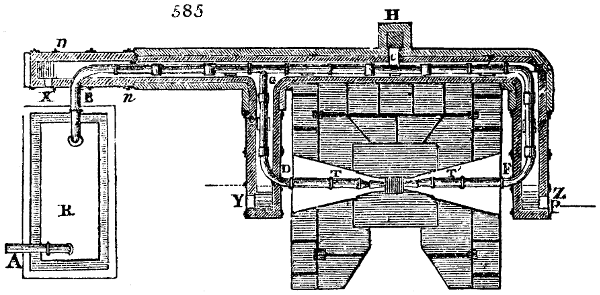
The figures here given represent the blast furnace, and all the details of the air-heating at one view. Fig. 583. is a vertical section of the furnace and the apparatus; fig. 585. represents the plan at the height of the line 1, 2. of fig. 583. The blowing machine, which is not shown in this view, injects the air through the pipe A, into the regulator chamber R, fig. 585.; the air thence issues by the pipe B, proceeds to C, where it is subdivided into two portions; the one passes along the pipe C D to get to the tuyère T, the other passes behind the furnace, and arrives at the tuyère T′ by the pipe C E F.
These pipes are distributed in a long furnace or flue, whose bottom, sides, and top are formed with fire-brick, where they are exposed to the action of the flame of the three fires X, Y, Z. The flame of the fire X plays round the pipe B at its entrance into the flue, and quits it only to go into the chimney H; that of the fire Y acts from the point D to the same chimney, passing by the elbow C; that of the fire Z acts equally upon F and H, in passing by the elbow E.
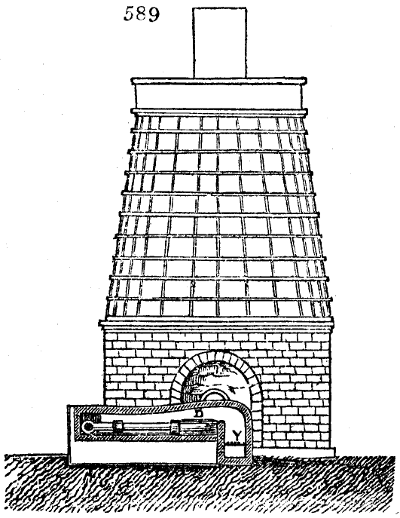
Disposition of the fires and furnace.—Fig. 586. represents, upon a scale three times larger than fig. 585., the section of the fire X, of which the plan is seen in fig. 585., and the elevation in fig. 583.; as also in the outside view of the blast furnace, fig. 589.
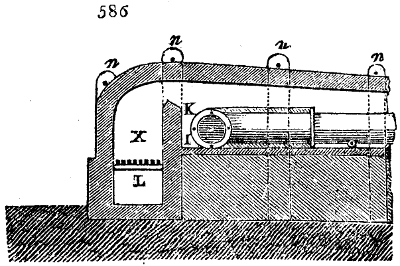
The grate is at L; the fuel is introduced by the door P, fig. 583.; the flame rises above the bridge I K, and proceeds along the vaulted flue towards the chimney H. Through a length of about 13 feet including the grate, the furnace is on each side supported by oblong plates of cast iron, which are bound together by 4 upright ribbed or feathered bars, also on each side; these bars n being bound together by iron rods furnished with screw nuts at their ends (figs. 583, 585, 586.) Beyond this distance, the outside of the furnace is mere brickwork.
The fires Y and Z have exactly a like disposition with the above.
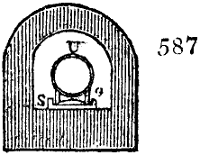
Fig. 586. indicates the dimensions and the curvature of the arch above the grate, near the bridge; fig. 587. represents the section of the furnace and of the pipe beyond the cast-iron casing.
I find that the furnace is only about 3 feet wide at the bottom, and that the elevation of the arch above the bottom is no more than 30 inches. Perhaps it might be made a little wider with advantage; the combustion would be more vigorous and effective; and if the sides also were a little thicker, the heat would be better confined.
The distance from the fire-place X to the chimney H, is 43 1⁄2 feet.
The di—ance from the fire— Y to the point C, is 13 —
The di—ance from the fire— Z to the chimney, is 29 — including the turn of the elbow E.
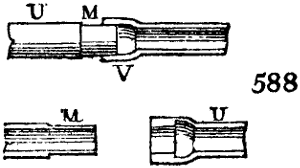
Distribution of the pipes.—At B, the pipe is 18 inches diameter outside, and one inch thick of metal, and it tapers to C; from C to D and from D to C the pipes are only 11 inches in external diameter, and three-fourths of an inch thick; they are 5 feet long, and are united by two kinds of joints; the ordinary ones, and those of compensation, to give play for the expansion and contraction. One of these is seen between B and C, one between C and D, one between C and E, and a fourth between E and F. These pipes and their adjustment are seen more at large in fig. 588.; U V is one of these pipes, its widened mouth receives the extremity M of the preceding pipe. These pieces are truly bored and turned to fit each other, and slide out and in like telescope tubes, by the effect of dilatation and contraction of the pipes with changes of temperature.
At certain distances castors or friction-rollers of cast iron are placed to carry the pipes, which roll upon oblong plates of cast iron laid upon the floor of the flues. These castors are shown at a, b, c, d, e, f, g, fig. 585.; one of them is shown separate upon a larger scale at G, fig. 587., as also the plate or rail S, on which it runs.
The tuyères T T′ are adjusted into the pipe behind them; this is truly bored, so as to allow the thick end of the tuyère to slide tightly backwards and forwards in it, like a piston in the barrel of a pump; a diaphragm moreover prevents the tuyère from being drawn or forced entirely out of its tube. At the side of this tube there is a small orifice, which may be shut or opened at pleasure with a stopcock or screw-plug: it serves to try the degree of heat of the air-blast; if a lead wire does not melt when held at this hole, the temperature is reckoned too low; being under the 612th degree of Fahrenheit. The nozzles are 2 inches in diameter.
Near the fire-places of the air-heating furnaces the pipes are at a cherry-red heat; and lest they should be burned, they are there coated with a lute of fire-clay, as shown near K fig. 586. By this means the air is kept up at the heat of 350° C, or 662° F., a little above the boiling point of quicksilver.
Quantity of air and pressure.—The blowing-machine belonging to the above blast-furnace is moved by a water wheel of 22-horse power, the pistons are 4 feet in diameter, have a 31⁄2-feet stroke, work double, and expel 1200 cubic feet of air in the minute; or 600 cubic feet for each nozzle. The pressure of the air is equivalent to no more than 2 or 21⁄4 inches of mercury; formerly with cold air it amounted to 31⁄2 inches. This furnace yields, upon an average, 51⁄4 tons of cast iron daily, and consumes 11⁄3 cwt. of coke for each cwt. of cast iron produced; being 7 tons of coke per diem.
The consumption of the three flue fires is 30 pounds of small coal, for 100 pounds of cast-iron produced, which may be reckoned equivalent to 15 pounds of coke; hence altogether each ton of cast iron requires for its production 11⁄2 tons of coke.
The same furnace worked with the cold blast, the same pressure and the same ores, produced only 31⁄2 tons of cast iron daily, with an expenditure of 2·55 of coke for 1 of cast iron; in which case the coke amounted to 9 tons daily.
The returns by the hot blast compared with those by the cold, are therefore as the numbers 3 and 2, which shows an advantage by the former plan of 50 per cent. The consumption of fuel in the two cases is as 8 to 9, being a saving in this article of about 11 per cent. Coke is used on account of sulphur in the coal.
Hot-blast heated by the flame of the furnace mouth.—This system is mounted in Staffordshire. The heating apparatus is there set immediately upon the mouth of the furnace; and is composed of 2 large cast-iron cylinders of the same length, the one within the other, leaving a space between them. This annular interval amounts to 16 inches, and it is closed at top and bottom: but the innermost cylinder is open at both ends, and forms, indeed, the vent of the chimney or furnace. It carries nine rows of pipes, three in each row, which cross its interior, and open into the annular space.
The flame of the furnace passes between the intervals of the cross pipes, heating them, and also the two upright cylinders with which they are connected. The air of the blowing machine arrives by a vertical pipe, which is placed at the back of the furnace; it enters into the above annular space, and thence circulates, with more or less velocity, through the 27 cross tubes, upon which the flame is continually playing; lastly, it is drawn through to the bottom of the annular space; the two tubes which conduct it to the two tuyères, pass down within the brickwork of the furnace, and thus prevent the dissipation of its heat.
Below this heating apparatus there is a door for putting the charges into the furnace.
The above arrangement does not seem to be the best for obtaining the greatest possible heat for the blast, nor for favouring the free action of the furnace; but it illustrates perfectly well the principle of this application. A serpentine movement in a long bent hot channel would be much better adapted for communicating heat to so bad a conductor as air is known to be.
In the month of July, 1836, I paid a visit to Codner Park and Butterly works, in Derbyshire, belonging to the eminent iron-masters, Messrs. Jessop and Co., where I was kindly permitted not only to study the various processes of the manufacture of cast and wrought iron, but to inspect the registers of the products of cast iron in their blast furnaces for several years back. It appeared that in the year 1829, only 29 tons of cast iron were made weekly in each of the blast furnaces at Codner Park. They were then worked with coke, and blown with cold air. Each ton of iron required for its production, at that time, 6·82 tons of coals, made into coke for smelting; with 2·64 of roasted iron ore (carbonate), called mine; and 0·87 of limestone, the castine of the French.
In 1835 and 1836, the same furnaces turned out weekly, 49 tons of cast iron each; and every ton of iron required for its production only 3 tons of coal (not made into coke); 2·72 tons of mine; and 0·77 of lime.
In 1829, and for many years before, as well as one or two after, each ton of coals is said to have cost for coking the sum of 6s., whence the 6·82 tons of coals then converted into coke for smelting one ton of iron, cost fully 40s. in coking alone, in addition to their prime cost. The saving in this respect, therefore, is 40s. upon each ton of iron, besides the saving of fully half the coal, and the increased produce of nearly 60 per cent. of metal per week. The iron-master pays the patentee 1s. upon every ton of iron which he makes, and at the prices of 1836, he lessened his expenses by, at least, 30s. or 40s. per ton by the patent improvement.
The following tabular view of the progression in the management and results of the hot blast, is given by M. Dufrénoy, after visiting the various iron works in this country where it had been introduced.
“At the Clyde iron works, near Glasgow; in 1829, when the combustion was effected by the cold air blast,—
Coal.
Tons. cwt. lbs.
There were consumed, for smelting; 3 tons of coke, equivalent to 6 13 0
— for the blowing engine 1 0 7
Total coal per ton of iron 7 13 7
Limestone 0 10 1⁄2 0
In 1831, with the hot blast at 450° F., coke being still used in smelting,—
There were consumed, for smelting; 1 ton 18 cwt. of coke, equivalent to 4 6 0
— for heating the air, 5 cwt. - 0 12 4
— for the blowing engine, 7 cwt. 4 lbs.
Total coal per ton of iron 4 18 4
Limestone 0 9 0
In July, 1833, with the hot blast at 612° F., raw coal alone being used for smelting,—
There were consumed, for smelting 2 0 0
— for heating the air 0 8 0
— for the blowing engine 0 11 2
Total coal per ton of iron 2 19 2
Limestone 0 7 0
“At the last period the use of hot air had increased the make of the furnaces by more than one third, and had consequently produced a great saving of expense in the article of labour. The quantity of blast necessary for the furnaces was also sensibly diminished; for a blowing engine of seventy-horse power, which, in 1829, served only for three blast furnaces, was now sufficient for the supply of four.
“On comparing these several results, we find that the economy of fuel is in proportion to the temperature to which the air is raised. As for the actual saving, it varies in every work, according to the nature of the coal, and the care with which the operation is conducted.
“This process, though it has been four years in use in the works near Glasgow, (which it has rescued from certain ruin) has scarcely passed the borders of Scotland; the marvellous advantages, however, which it has produced, are beginning to triumph over prejudice, and gradually to extend its use into the different English iron districts. There are one-and-twenty works, containing altogether sixty-seven blast furnaces, in which hot air is used. The pig iron run out of these furnaces is generally No. 1., and is fit for making the most delicate castings. This process is equally applicable to forge pigs for the manufacture of bar iron; since in order to obtain this quality of iron, it is only necessary to alter the proportion of fuel and mineral. In the forges of the Tyne iron-works, near Newcastle, and of Codner Park, near Derby, pigs made in furnaces blown by hot air, are alone used in the manufacture of bar iron.
“In the side of the tuyère pipe a small hole is made, by means of which the heat of the air may be ascertained at any moment. This precaution is indispensable, it being of importance to the beneficial use of hot air, that it be kept at a uniformly high temperature. With a proper apparatus the air is raised to 612 degrees Fahr., which is a greater heat, by several degrees, than is necessary for the fusion of lead.”
“At Calder works the consumption of fuel has diminished in the proportion of 7 tons 17 cwt. to 2 tons 2 cwt. There has also been a great diminution of expense in limestone, of which only 51⁄2 cwt. are now used, instead of 13 cwt., which were used in 1828. This decrease results, as I have already said, from the high temperature which the furnace has acquired since the introduction of hot air.
“The quantity of blast has been reduced from 3500 cubic feet per minute, to 2627 cubic feet; the pressure also has been reduced from 31⁄4 to 23⁄4 lbs.”
Of the refinery of cast iron, or its conversion into bar-iron, in England.—This operation is naturally divisible into three distinct parts. The first, or the finery properly speaking, is executed in peculiar furnaces called running out fires; the second operation completes the first, and is called puddling; and the third consists in welding several iron bars together, and working them under forge hammers, and between rolls.
1. The finery furnaces are composed of a body of brickwork, about 9 feet square; rising but little above the surface of the ground. The hearth, placed in the middle, is two feet and a half deep; it is rectangular, being in general, 3 feet by 2, with its greatest side parallel to the face of the tuyères; and it is made of cast iron in four plates. On the side of the tuyères there is a single brick wall. On the three other sides, sheet iron doors are placed, to prevent the external air from cooling the metal, which is almost always worked under an open shed, or in the open air, but never in a space surrounded by walls. The chimney, from 15 to 18 feet high, is supported upon four columns of cast iron; its lintel is four feet above the level of the hearth, in order that the labourers may work without restraint.
The number of tuyères is from two to three; they are placed at the height of the lip of the crucible or hearth, and distributed so as to divide its length into equal parts; their axes being inclined towards the bottom, at an angle of from 25° to 30°, so as to point upon the bath of melted metal as it flows. The cast-iron nose-pipe is encased, and water is made to circulate in the hollow space by means of cylindrical tubes; being introduced by one tube, and let off by another, so as to prevent the tuyères from getting burned in the process.
Two nozzles are usually placed in each tuyère, to render the blast constant and uniform; and for the same end, the air impelled by the bellows, is sometimes received at first in a regulator. The quantity of air blown into the fineries is considerable; being nearly 400 cubic feet per minute for each finery; or about the eighth part of the consumption of a blast furnace.
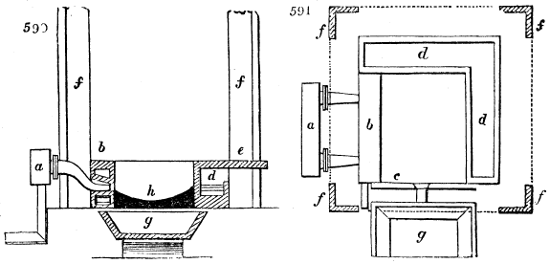
The finery furnace, or running out fire, is represented in figs. 590. and 591. It is a smelting hearth, in which by first fusing and then cooling gray cast iron in a peculiar way, it is converted into white cast iron, called fine iron, or fine metal, of the quality of forge pig, for making malleable iron by the puddling process. The furnace resembles the forge hearth employed in Germany and France for converting forge pig into wrought iron; but it differs, particularly in this, that the fused iron is run out into an oblong iron trough, for sudden congelation.
a is the air-chest, in communication with the blowing cylinder, or bellows; the air being conducted through at least two blast pipes to the fire, and sometimes through even 4 or 6 pipes. b is the side of the furnace, corresponding to the tuyère plates, in which are the openings for the blast pipes. All the sides of the furnace are hollow, and are kept cool by the circulation of water through the cavity between them. c is the front wall of the furnace, having a strong cast-iron plate containing the tap holes for running off the melted metal. d d is the exterior wall of the furnace, which corresponds to the contre-vent and ash-hearth of the French refining forge. e, is the top plate upon which the coke is piled up in store. f f, f f, iron props of the chimney, (not shown in this view). g, cast-iron trough into which the fine iron is run off in fusion; which is sometimes made in one piece, but more usually in separate plates joined together. Beneath this mould a stream of water is made to flow. h is the bottom of the hearth, covered with sand.
In the finery process, the hearth or crucible of the furnace is filled with coke; then six pigs of cast iron are laid horizontally on the hearth, namely, four of them parallel to the four sides, and two in the middle above; and the whole is covered up in a dome-form, with a heap of coke. The fire is now lighted, and in a quarter of an hour the blast is applied. The cast iron flows down gradually, and collects in the crucible; more coke being added as the first quantity burns away. This operation proceeds by itself; the melted metal is not stirred about, as in some modes of refinery, and the temperature is always kept high enough to preserve the metal liquid. During this stage the coals are observed continually heaving up, a movement due in part to the action of the blast, and in part to an expansion caused in the metal by the discharge of gaseous oxide of carbon. When all the pig iron is collected at the bottom of the hearth, which happens commonly at the end of two hours, or two and a half, the tap hole is opened, and the fine metal flows out with the slag, into the loam-coated pit, on a plate 10 feet long, 3 broad, and from 2 inches to 21⁄2 thick. A portion of the slag forms a small crust on the surface of the metal; but most part of it collects in a basin scooped out at the bottom of the pit, into which the fine metal is run.
A large quantity of water is thrown on the fine metal, with the view of rendering it brittle, and perhaps of partially oxidizing it. This metal suddenly cooled, is very white, and possesses in general a fibrous radiated texture; or sometimes a cellular, including a considerable number of small spherical cavities, like a decomposed amygdaloid rock. If the cast iron be of bad quality, a little limestone is occasionally used in the above operation.
Three samples of cinder, analyzed by Berthier, gave,
Silica 0·276; protox. of iron, 0·612; alumina, 0·040; phosp. acid, 0·072, Dudley.
— 0·368 — 0·610 — 0·015; puddling of Dowlais.
— 0·424 — 0·520 — 0·033; ditto.
The remarkable fact of the presence of phosphoric acid, shows how important this operation is to the purification of the iron. The charge varies from a ton and a quarter to a ton and a half of pigs; and the loss by the process varies from 12 to 17 per cent.
The fine metal is broken into fragments, and sent to the puddling furnace after the product of each operation has been weighed. The coal consumed in the fine metal process is from 4 to 5 hundred weight for the ton of cast iron. About 10 tons may be refined per diem, a quantity somewhat greater than the supply from a blast furnace; but the fineries are not worked on the Sundays; and therefore a smelting furnace just keeps one of them in play. Whatever care be taken in this process, the bar iron finally resulting is never so good as if wood charcoal had been used in the refinery; and hence in making sheet iron for the tin plate manufacture, wood charcoal is substituted for coke in one Welsh establishment. The cast iron treated with charcoal, gets into clots or lumps in the finery furnace, which are lifted out, set under the hammer, and flattened into thin cakes.
The main effect of the finery process, is probably the separation of the plumbaginous part of the charcoal, which is disseminated through the gray cast iron in a state of imperfect chemical combination. When that is removed the metal becomes more homogeneous, having no crystalline carbon present to counteract its transition into pure iron; much of the silica and manganese are also vitrified together, and run off in the finery cinder.
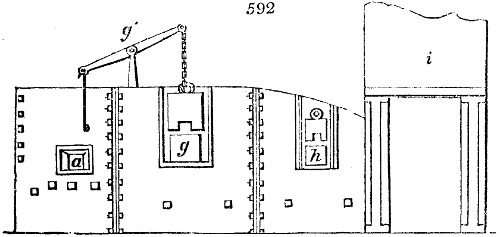
2. The puddling furnace, is of the reverberatory form. It is bound generally with iron, as represented in the side view, fig. 592., by means of horizontal and vertical bars, which are joined together and fixed by wedges, to prevent them from starting asunder. Very frequently, indeed, the reverberatory furnaces are armed with cast-iron plates over their whole surface. These are retained by upright bars of cast iron applied to the side walls, and by horizontal bars of iron, placed across the arch or roof. The furnace itself is divided interiorly into three parts; the fire-place, the hearth, and flue. The fire-place varies from 31⁄2 to 41⁄2 feet long, by from 2 feet 8 inches to 3 feet 4 inches wide. The door way by which the coke is charged, is 8 inches square, and is bevelled off towards the outside of the furnace. This opening consists entirely of cast iron, and has a quantity of coal gathered round it. The bars of the fire grate are movable, to admit of more readily clearing them from ashes.
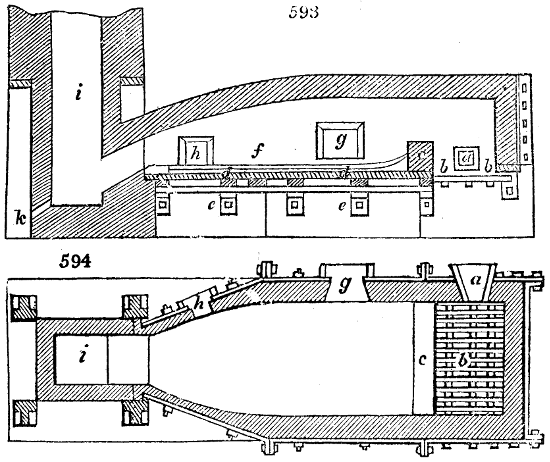
Fig. 593. is a longitudinal section referring to the elevation, fig. 592., and fig. 594. is a ground plan. When the furnace is a single one, a square hole is left in the side of the fire-place opposite to the door, through which the rakes are introduced, in order to be heated.
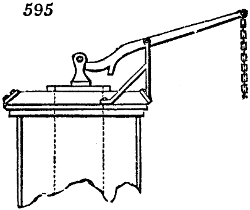
a is the fire door; b, the grate; c, the fire bridge; d d, cast-iron hearth plates, resting upon cast-iron beams e e, which are bolted upon both sides to the cast-iron binding plates of the furnace. f is the hearth covered with cinders or sand; g, is the main working door, which may be opened and shut by means of a lever g′, and chain to move it up and down. In this large door there is a hole 5 inches square, through which the iron may be worked with the paddles or rakes; it may also be closed air-tight. There is a second working door h, near the flue, for introducing the cast iron, so that it may soften slowly, till it be ready for drawing towards the bridge. i, is the chimney, from 30 to 50 feet high, which receives commonly the flues of two furnaces, each provided with a damper plate or register. Fig. 595., shows the main damper for the top of the common chimney, which may be opened or shut to any degree by means of the lever and chain. k, fig. 593., is the tap or floss hole far running off the slag or cinder.
The sole is sometimes made of bricks, sometimes of cast iron. In the first case it is composed of fire-bricks set on edge, forming a species of flat vault. It rests immediately on a body of brickwork either solid or arched below. When it is made of cast iron, which is now beginning to be the general practice, it may be made either of one piece or of several. It is commonly in a single piece, which, however, causes the inconvenience of reconstructing the furnace entirely when the sole is to be changed. In this case it is a little hollow, as is shown in the preceding vertical section; but if it consists of several pieces, it is usually made flat.
The hearths of cast iron rest upon cast-iron pillars, to the number of four or five; which are supported on pedestals of cast iron placed on large blocks of stone. Such an arrangement is shown in the figure, where also the square hole a, fig. 592., for heating the rake irons, may be observed. The length of the hearth is usually six feet; and its breadth varies from one part to another. Its greatest breadth, which is opposite the door, is four feet. In the furnace, whose horizontal plan is given above, and which produces good results, the sole exhibits, in this part, a species of ear, which enters into the mouth of the door. At its origin towards the fireplace, it is 2 feet 10 inches wide; from the fire it is separated, moreover, by a low wall of bricks (the fire-bridge) 10 inches thick, and from 3 inches to 5 high. At the other extremity its breadth is 2 feet. The curvature presented by the sides of the sole or hearth is not symmetrical; for sometimes it makes an advancement, as is observable in the plan. At the extremity of the sole furthest from the fire, there is a low rising in the bricks of 21⁄2 inches, called the altar, for preventing the metal from running out at the floss-hole when it begins to fuse. Beyond this shelf the sole terminates in an inclined plane, which leads to the floss, or outlet of the slag from the furnace. This floss is a little below the level of the sole, and is hollowed out of the basement of the chimney. The slag is prevented from concreting here, by the flame being made to pass over it, in its way to the sunk entry of the chimney; and there is also a plate of cast iron near this opening, on which a moderate fire is kept up to preserve the fluidity of the scoriæ, and to burn the gases that escape from the furnace, as also to quicken the draught, and to keep the remote end of the furnace warm. On the top of this iron plate, and at the bottom of the inclined plane, the cinder accumulates in a small cavity, whence it afterwards flows away; whenever it tends to congeal, the workman must clear it out with his rake.
The door is a cast-iron frame filled up inside with fire-bricks; through a small hole in its bottom the workmen can observe the state of the furnace. This hole is at other times shut with a stopper. The chimney has an area of from 14 to 16 inches.
The hearth stands 3 feet above the ground. Its arched roof, only one brick thick, is raised 2 feet above the fire-bridge, and above the level of the sole, taken at the middle of the furnace. At its extreme point near the chimney, its elevation is only 8 inches; and the same height is given to the opening of the chimney.
In most iron-works the sole is covered with a layer of refractory sand, from 21⁄2 to 3 inches thick, which is lightly beat down with a shovel. At each operation a portion of the sand is carried away; and is replaced before another. Within these few years, there has been substituted for the sand a body of pounded slags; a substitution which has occasioned, it is said, a great economy of iron and fuel.
The fine metal obtained by the coke is puddled by a continuous operation, which calls for much care and skill on the part of the workmen. To charge the puddling furnace, pieces of fine metal are successively introduced with a shovel, and laid one over another on the sides of the hearth, in the form of piles rising to the roof; the middle being left open for puddling the metal, as it is successively fused. Indeed, the whole are kept as far separate as possible, to give free circulation to the air round the piles. The working door of the furnace is now closed, fuel is laid on the grate, and the mouth of the fire-place as well as the side opening of the grate, are both filled up with coal, at the same time that the damper is entirely opened.
The fine metal in about twenty minutes comes to a white-red heat, and its thin-edged fragments begin to melt and fall in drops on the sole of the furnace. At this period the workman opens the small hole of the furnace door, detaches with a rake the pieces of fine metal that begin to melt, tries to expose new surfaces to the action of the heat, and in order to prevent the metal from running together as it softens, he removes it from the vicinity of the fire-bridge. When the whole of the fine metal has thus got reduced to a pasty condition, he must lower the temperature of the furnace, to prevent it from becoming more fluid. He closes the damper, takes out a portion of the fire, and the ribs of the grate, and also throws a little water sometimes on the semi-fused mass. He then works about with his paddle the clotty metal, which swells up, with the discharge of gaseous oxide of carbon, burning with a blue flame, as if the bath were on fire. The metal becomes finer by degrees, and less fusible; or in the language of the workmen, it begins to get dry. The disengagement of the oxide of carbon diminishes, and soon stops. The workmen continue meanwhile to puddle the metal till the whole charge be reduced to the state of incoherent sand; and at that time, the ribs of the grate are replaced, the fire is restored, and the register is progressively opened up. With the return of the heat, the particles of metal begin to agglutinate, the charge becomes more difficult to raise, or in the labourers’ language, it works heavy. The refining is now finished, and nothing remains but to gather the iron into balls. The founder with his paddle takes now a little lump of metal, as a nucleus, and makes it roll about on the surface of the furnace, so as to collect more metal, and form a ball of about 60 or 70 pounds weight. With a kind of rake, called in England a dolly, and which he heats beforehand, the workman sets this ball on that side of the furnace most exposed to the action of the heat, in order to unite its different particles; which he then squeezes together to force out the scoriæ. When all the balls are fashioned, (they take about 20 minutes work,) the small opening of the working door is closed with a brick, to cause the heat to rise, and to facilitate the welding. Each ball is then lifted out, either with tongs, if roughing rollers are to be used as in Wales, or with an iron rod welded to the lump as a handle, if the hammer is to be employed, as in Staffordshire. Thus we see that the operation lasts in whole from 2 hours to 21⁄2; in a quarter of an hour, the fine metal melts at its edges, when the puddling begins, in order to effect its division; at the end of an hour or an hour and a half, the metal is entirely reduced to a sand; a state that is kept up for half an hour by continual stirring; and finally, the balling operation takes nearly the same time.
The charge for each operation is from 31⁄2 to 4 hundred weight; and sometimes the cuttings of bar-ends are introduced, which are puddled apart. The loss of iron is here very variable, according to the degree of skill in the workman, who by negligence may suffer a considerable body of iron to scorify or to flow into the hearth and raise the bottom. In good working, the loss is from 8 to 10 per cent. In Wales, the consumption of coal is estimated at one ton for every ton of fine metal. About five puddling furnaces are required for the service of one smelting furnace and one finery. The hearth of the puddling furnace should be exposed to heat for 12 hours before the work begins on the Mondays; and on the Saturdays, the old sole must be cleared out, by melting it off; and running it out by the floss-hole.
Mr. Schafthault obtained, in May, 1835, a patent for the conversion of cast into wrought iron, by adding a mixture of black oxide of manganese, common salt and potter’s clay, in certain small portions, successively to the melting iron in the puddling furnace.
The reheating furnaces, balling furnaces, or mill furnaces, are analogous to the puddling furnaces, but only of larger dimensions.
The wood charcoal forge hearth is employed for working up scrap iron into boiler plate, &c. Here 22 bushels of charcoal are consumed in making one ton of iron of that description, from boiler plate parings.
Machines for forging and condensing the iron.—In England there are employed for the forging and drawing out of the iron, cast-iron hammers of great weight, and cylinders of different dimensions, for beating out the balls, or extending the iron into bars, as also powerful shears. These several mechanisms are moved either by a steam engine, as in Staffordshire, and in almost all the other counties of England, or by water-wheels when the localities are favourable, as in many establishments in South Wales. We shall here offer some details concerning these machines.
The main driving shaft usually carries at either end a large toothed wheel, which communicates motion to the different machines through smaller toothed wheels. Of these, there are commonly six, four of which drive four different systems of cylinders, and the two others work the hammer and the shears. The different cylinders of an iron work should never be placed on the same arbor, because they are not to move together, and they must have different velocities, according to their diameter. In order to economise time and facilitate labour, care is taken to associate on one side of the motive machine the hammer, the shears, and the reducing cylinders; and on the other side, to place the several systems of cylinders for drawing out the iron into bars. For the same reason the puddling furnaces ought to be grouped on the side of the hammer; and the reheating furnaces on the other side of the works.
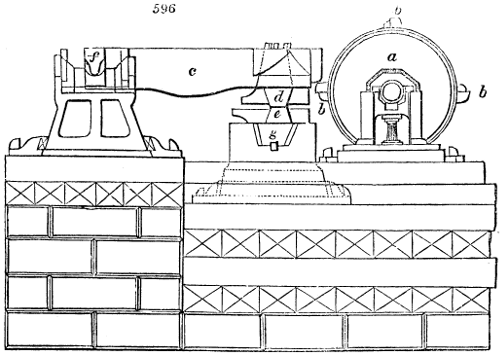
The hammers, fig. 596., are made entirely of cast iron; they are nearly 10 feet long, and consist usually of two parts, the helve c, and the head or pane d. The latter enters with friction into the former, and is retained in its place by wedges of iron or wood. The head consists of several faces or planes receding from each other; for the purpose of giving different forms to the ball lumps. A ring of cast-iron a, called the cam-ring bag, bearing movable cams b b, drives the hammer d, by lifting it up round its fulcrum f, and then letting it fall alternately. In one iron work, this ring was found to be 3 feet in diameter, 18 inches thick, and to weigh 4 tons. The weight of the helve (handle) of the corresponding hammer was 3 tons and a half, and that of the head of the hammer, 8 hundred weight.
The anvil e consists also of two parts; the one called the pane of the anvil, is the counterpart of the pane of the hammer; it likewise weighs 8 hundred weight. The second g, named the stock of the anvil, weighs 4 tons. Its form is a parallelopiped, with the edges rounded. The bloom, or rough ball, from the puddle furnace, is laid and turned about upon it, by means of a rod of iron welded to each of them, called a porter. Since the weight of these pieces is very great, and the shocks very considerable, the utmost precautions should be taken in setting the hammer and its anvil upon a substantial mass of masonry, as shown in the figure, over which is laid a double, or even quadruple flooring of wood, formed of beams placed in transverse layers close to each other. Such beams possess an elastic force, and thereby partially destroy the injurious reaction of the shock. In some works, a six-feet cube of cast iron is placed as a pedestal to the anvil.
Forge hammers are very frequently mounted as levers of the first kind, with the centre of motion about one-third or one-fourth of the length of the helve from the cam wheel. The principle of this construction will be understood by inspection of fig. 605. The short end of the lever which is struck down by the tappet c, is driven against the end of an elastic beam a, and immediately rebounds, causing the long end to strike a harder blow upon the anvil s.
The shears are composed of two branches, the one fixed and the other movable, each formed of two pieces. The fixed branch is a cast-iron plate, which forms one mass with a horizontal base fixed to a piece of wood or cast iron buried in the ground. A sharpened chisel is fastened to its upper part by screws and nuts. The movable branch is likewise of cast iron; it bears an axis round which it turns, and this axis passes through the fixed part. It is also furnished with a cutting chisel, fixed on by nuts and screws. An excentric or an ellipse, moved directly by a toothed wheel, lifts the movable branch of the shears, and forces it to cut the iron bars presented to it. The pressure exerted by these scissors is such, that they can cut without difficulty, iron bars, one-half or two-thirds of an inch thick.
Cylinders.—The compression between cylinders now effects, in a few seconds, that condensation and distribution of the fibres, which 40 years ago, could not be accomplished till after many heats in the furnace, and many blows of the hammer. The cylinders may be distinguished into two kinds; 1. those which serve to draw out the ball, called puddling rolls, or roughing rolls, and which are, in fact, reducing cylinders; 2. the cylinders of extension, called rollers, for drawing into bars the massive iron after it has received a welding, to make it more malleable. This second kind of cylinders is subdivided into several varieties, according to the patterns of bar iron that are required. These may vary from 2 inches square to less than one-sixth of an inch.
Beneath the cylinders there is usually formed an oblong fosse, into which the scoriæ and the scales fall when the iron is compressed. The sides of this fosse, constructed of stone, are founded on a body of solid masonry, capable of supporting the enormous load of the cylinders. Beams of wood form in some measure the sides of this pit, to which cylinders may be made fast, by securing them with screws and bolts. Massive bars of cast iron are found, however, to answer still better, not only because the uprights and bearers may be more solidly fixed to them, but because the basement of heavy metal is more difficult to shatter or displace, an accident which happens frequently to the wooden beams. A rill of water is supplied by a pipe to each pair of cylinders, to hinder them from getting hot; as also to prevent the hot iron from adhering to the cylinder, by cooling its surface, and perhaps producing on it a slight degree of oxidizement.
The shafts are one foot in diameter for the hammer and the roughing rolls; and six inches where they communicate motion to the cylinders destined to draw the iron into bars.
The roughing rolls are employed either to work out the lump or ball immediately after it leaves the puddling furnace, as in the Welsh forges, or only to draw out the piece, after it has been shaped under the hammer, as is practised in most of the Staffordshire establishments. These roughing cylinders are generally 7 feet long, including the trunnions, or 5 feet between the bearers, and 18 inches diameter; and weigh in the whole from 4 to 41⁄2 tons. They contain from 5 to 7 grooves, commonly of an elliptical form, one smaller than another in regular progression, as is seen in fig. 597. The small axis of each ellipse, as formed by the union of the upper and under grooves, is always placed in the vertical direction, and is equal to the great axis, or horizontal axis of the succeeding groove; so that in transferring the bar from one groove to another, it must receive a quarter of a revolution, whereby the iron gets elongated in every direction. Sometimes the roughing rolls serve as preparatory cylinders, in which case they bear towards one extremity rectangular grooves, as the figure exhibits. Several of these large grooves are bestudded with small asperities analogous to the teeth of files, for biting the lump of iron, and preventing its sliding. On a level with the under side of the grooves of the lower cylinder, there is a plate of cast iron with notches in its edge adapted to the grooves. This piece called the apron, rests on iron rods, and serves to support the balls and bars exposed to the action of the rollers, and to receive the fragments of ill-welded metal, which fall off during the drawing. The housing frames in which the rollers are supported and revolve, are made of great strength. Their height is 5 feet; their thickness is 1 foot in the side perpendicular to the axis of the cylinders, and 10 inches in the other. Each pair of bearers is connected at their upper ends by two iron rods, on which the workmen rest their tongs or pinchers for passing the lump or bar from one side of the cylinders to the other.
The cods or bushes are each composed of two pieces; the one of hard brass, which presents a cylindrical notch, is framed into the other which is made of cast iron, as is clearly seen in fig. 597.
The iron bar delivered from the square grooves, is cut by the shears into short lengths, which are collected in a bundle in order to be welded together. When this bundle of bars has become hot enough in the furnace, it is conveyed to the rollers; which differ in their arrangement according as they are meant to draw iron from a large or small piece. The first, fig. 597., possess both elliptical and rectangular grooves; are 1 foot in diameter and 3 feet long between the bearers. The bar is not finished under these cylinders, but is transferred to another pair, whose grooves have the dimensions proper for the bar, with a round, triangular, rectangular, or fillet form. The triangular grooves made use of for square iron, have for their profile, an isosceles triangle slightly obtuse, so that the space left by the two grooves together may be a rhombus, differing little from a square, and whose smaller diagonal is vertical. When the bar is to be passed successively through several grooves of this kind, the larger or horizontal diagonal of each following groove is made equal to the smaller or upright of the preceding one, whereby the iron must be turned one fourth round at each successive draught, and thus receive pressure in opposite directions. Indeed the bar is often turned in succession through the triangular and rectangular grooves, that its fibres may be more accurately worked together. The decrement in the capacity of the grooves follows the proportion of 15 to 11.
When it is intended to reduce the iron to a small rod, the cylinders have such a diameter, that three may be set in the same housing frame. The lower and middle cylinders are employed as roughing rollers, while the upper and middle ones are made to draw out the rod. When a rod or bar is to be drawn with a channel or gutter in its face, the grooves of the rollers are suitably formed.
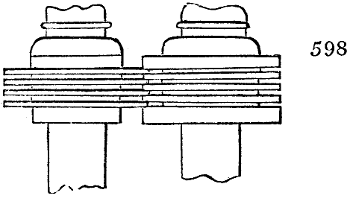
To draw out square rods of a very small size, as nail-rods, a system of small rollers is employed, called slitters. Their ridges are sharp-edged, and enter into the opposite grooves 21⁄2 inches deep; so that the flat bar in passing between such rollers is instantaneously divided into several slips. For this purpose the rollers represented in fig. 598. may be put on and removed from the shaft at pleasure.
The velocity of the cylinders varies with their dimensions. In one work, cylinders for drawing out iron of from one-third to two-thirds of an inch thick, make 140 revolutions per minute; while those for iron of from two-thirds of an inch to 3 inches, make only 65. In another work, the cylinders for two inch iron, make 95 revolutions per minute; those for iron from two-thirds of an inch to an inch and a third, make 128; and those for bars from one-third to two-thirds of an inch, 150. The roughing rollers move with only one-third the velocity of the drawing cylinders.
The shingling and plate-rolling mill is represented in fig. 597. The shingling mill, for converting the blooms from the balling furnace into bars, consists of two sets of grooved cylinders, the first being called puddling rolls or roughing rolls; the second are for reducing or drawing the iron into mill-bars, and are called simply rolls.
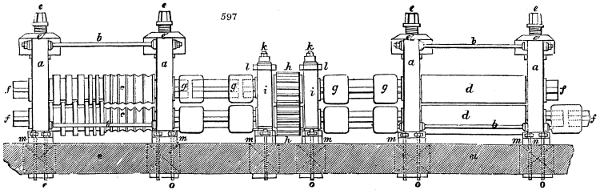
Fig. 597 enlarged (186 kB)
a, a, a, a, are the powerful uprights or standards called housing frames, of cast iron, in which the gudgeons of the rolls are set to revolve; b, b, b, b, are bolt rods for binding these frames together at top and bottom; c, are the roughing rolls, having each a series of triangular grooves, such that between those of the upper and under cylinder, rectangular concavities are formed in the circumference with slightly sloping sides. The end groove to the right of c, should be channelled like a rough file, in order to take the better hold of the blooms, or to bite the metal as the workmen say; and give it the preparatory elongation for entering into and passing through the remaining grooves till it comes to the square ones, where it becomes a mill-bar. d, d, are the smooth cylinders, hardened upon the surface, or chilled as it is called, by being cast in iron moulds, for rolling iron into plates or hoops. e, e, e, e, are strong screws with rectangular threads, which work by means of a wrench or key, into the nuts e′ e′ e′ e′, fixed in the standards; they serve to regulate the height of the plummer blocks or bearers of the gudgeons, and thereby the distance between the upper and under cylinders. f is a junction shaft; g, g, g, are solid coupling boxes, which embrace the two separate ends of the shafts, and make them turn together. h, h, are junction pinions, whereby motion is communicated from the driving shaft f, through the under pinion to the upper one, and thus to both upper and under rolls at once. i, i, are the pinion standards in which their shafts run; they are smaller than the uprights of the rolls. k, k, are screws for fastening the head pieces l to the top of the pinion standards. All the standards are provided with sole plates m, whereby they are screwed to the foundation beams, n, of wood or preferably iron, as shown by dotted lines; o o are the binding screw bolts. Each pair of rolls at work is kept cool by a small stream of water let down upon it from a pipe and stop-cock.
In the cylinder drawing, the workman who holds the ball in tongs, passes it into the first of the elliptical grooves; and a second workman on the other side of the cylinders, receives this lump, and hands it over to the first, who re-passes it between the rollers, after bringing them somewhat closer to each other, by giving a turn to the adjusting pressure screws. After the lump has passed five or six times through the same groove, it has got an elliptical form, and is called in England a bloom. It is next passed through a second groove of less size, which stretches the iron bar. In this state it is subjected to a second pair of cylinders, by which the iron is drawn into flat bars, 4 inches broad and half an inch thick. Fragments of the ball or bloom fall round about the cylinders; which are afterwards added to the puddling charge. In a minute and a half, the rude lump is transformed into bars, with a neatness and rapidity which the inexperienced eye can hardly follow. A steam engine of thirty-horse power can rough down in a week, 200 tons of coarse iron.
This iron called mill-bar iron, is however of too inferior a quality to be employed in any machinery; and it is subjected to another operation, which consists in welding several pieces together, and working them into a mass of the desired quality. The iron bars while still hot, are cut by the shears into a length proportional to the size of iron bar that is wanted; and four rows of these are usually laid over each other into a heap or pile, which is placed in the re-heating furnace above described, and exposed to a free circulation of heat; one pile being set crosswise over another. In a half or three quarters of an hour, the iron is hot enough, and the pieces now sticking together, are carried in successive piles to the bar-drawing cylinders, to be converted into strong bars, which are reckoned of middle quality. When a very tough iron is wanted, as for anchors, another welding and rolling must be given. In the re-heating ovens, the loss is from 8 to 10 per cent. on the large bar iron, and from 10 to 12 in smaller work. A ton of iron consumes in this process, about 150 lbs. of coals.
It is thought by many that a purer iron is obtained by subjecting the balls as they come out of the puddling furnace, to the action of the hammer at first, than to the roughing rollers; and that by the latter process vitrified specks remain in the metal, which the hammer expels. Hence, in some works, the balls are first worked under the forge-hammer; and these stampings being afterwards heated in the form of pies or cakes piled over each other, are passed through the roughing rollers.
Having given ample details concerning the manufacturing processes used in England for making cast iron, it may be proper to subjoin a few observations upon its chemical constitution. It has been generally believed and taught that the dark gray cast iron, No. 1. or No. 2., contains more carbon than the white cast iron; and that the superior quality of the former in tenacity and softness, is to be ascribed to that excess. But the distinguished German metallurgist, M. Karsten, in his instructive volume, “Handbuch der Eisenhüttenkunde,” or manual of the art of smelting iron ores, has proved, on the contrary, that the white cast iron contains most charcoal; that this substance exists in it in a state of combination with the whole body of the iron; that the foliated or lamellar white cast iron contains as much carbon as iron can absorb in the liquid state; and that this constitutes a compound of 4 atoms of iron combined with 1 of charcoal, or 112 + 6; or 51⁄3 per cent.; whereas the dark gray cast iron contains generally from 3 to 4 per cent., in the state of plumbago merely dispersed through the metal. He has further confirmed his opinion, by causing the white variety to pass into the gray, and reciprocally. Thus, dark gray cast metal melted and suddenly cooled, gives a silvery white metal, hard and brittle. On the other hand, when the white cast iron is cooled very slowly after fusion, the condition of the carbon in it changes, and a dark gray cast iron is obtained. These phenomena shew that the graphite or plumbago, which requires a high temperature for its formation, cannot be produced but by a slow cooling, which allows the carbon to agglomerate itself in the iron in the state of graphite; while under a rapid congelation, the carbon remains dissolved in the mass, and produces a white metal. Hence we may understand how each successive fusion of dark gray iron hardens and whitens it, though in contact with coke, by completing that chemical dissolution of the carbon on which the white state depends.
In the manufacture of the blackest No. 1. cast iron, it sometimes happens that a considerable quantity of a glistening carburet of iron appears, floating on the top of the metal as it is run out into the sand-moulds. This substance is called kish by the English workmen; and it affords a sure test of the good state of the furnace and quality of the iron.
The most remarkable fact relative to the smelting of cast iron, is the difference of product between the workings of the summer and the winter season, though all the materials and machinery be the same. In fact, no cold-blast furnace will carry so great a burden in summer as in winter, that is, afford so great a product of metal, or bear so great a charge of ore with the same quantity of coke. This difference is undoubtedly due to the dilated and humid state of the atmosphere in the warm season. A very competent judge of this matter, states the diminution in summer at from one-fifth to one-seventh, independently of deterioration of quality.
Some of the foreign irons, particularly certain Swedish and Russian bars, are imported into Great Britain in large quantities, and at prices much greater than those of the English bars, and therefore the modes of manufacturing such excellent metal deserve examination. All the best English cast steel, indeed, is made from the hoop L, iron from Dannemora, in Sweden.
The processes pursued in the smelting works of the Continent have frequently in view to obtain from the ore malleable iron directly, in a pure or nearly pure state. The furnaces used for this purpose are of two kinds, called in French, 1. Feux de Loupes, or Forges Catalanes; and 2. Fourneaux à pièce, or Forges Allemandes.
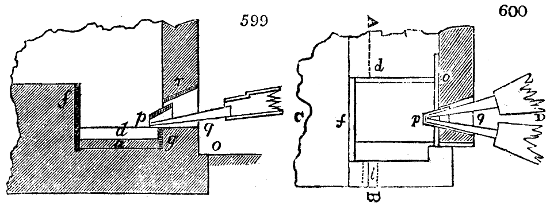
In the Catalan, or French method, the ore previously roasted in a kiln is afterwards strongly torrefied in the forge before the smelting begins; operations which follow in immediate succession. Ores treated in this way should be very fusible and very rich; such as black oxide of iron, hematites, and certain spathose iron ores. From 100 parts of ore, 50 of metallic iron have been procured, but the average product is 35. The furnaces employed are rectangular hearths, figs. 599. and 600., the water-blowing machine being employed to give the blast. See Metallurgy. There are three varieties of this forge; the Catalan, the Navarrese, and the Biscayan. The dimensions of the first, the one most generally employed, are as follows: 21 inches long, in the direction p f, fig. 600.; 181⁄2 broad, at the bottom of the hearth or creuset, in the line A B; and 17 inches deep, fig. 599. The tuyère, q p, is placed 91⁄2 inches above the bottom, so that its axis is directed towards the opposite side, about 2 inches above the bottom. But it must be movable, as its inclination needs to be changed, according to the stage of the operation, or the quantity of the ores. It is often raised or lowered with pellets of clay; and even with a graduated circle, for the workmen make a great mystery of this matter. The hearth is lined with a layer of brasque (loam and charcoal dust worked together), and the ore after being roasted is sifted; the small powder being set aside to be used in the course of the operation. The ore is piled up on the side opposite to the blast in a sharp saddle ridge, and it occupies one-third of the furnace. In the remaining space of two-thirds, the charcoal is put. To solidify the small ore on the hearth, it is covered with moist cinders mixed with clay.
The fire is urged with moderation during the first two hours, the workman being continually employed in pressing down more charcoal as the former supply burns away, so as to keep the space full, and prevent the ore from crumbling down. By a blast so tempered at the beginning, the ore gets well calcined, and partially reduced in the way of cementation. But after two hours, the full force of the air is given; at which period the fusion ought to commence. It is easy to see whether the torrefaction be sufficiently advanced, by the aspect of the flame, as well as of the ore, which becomes spongy or cavernous; and the workman now completes the fusion, by detaching the pieces of ore from the bottom, and placing them in front of the tuyère. When the fine siftings are afterwards thrown upon the top, they must be watered, to prevent their being blown away, and to keep them evenly spread over the whole surface of the light fuel. They increase the quantity of the products, and give a proper fusibility to the scoriæ. When the scoriæ are viscid, the quantity of siftings must be diminished; but if thin, they must be increased. The excess of slag is allowed to run off by the chio or floss hole. The process lasts from five to six hours, after which the pasty mass is taken out, and placed under a hammer to be cut into lumps, which are afterwards forged into bars.
Each mass presents a mixed variety of iron and steel; in proportions which may be modified at pleasure; for by using much of the siftings, and making the tuyère dip towards the sole of the hearth, iron is the chief product; but if the operation be conducted slowly, with a small quantity of siftings, and an upraised tuyère, the quantity of steel is more considerable. This primitive process is favourably spoken of by M. Brongniart. The weight of the lump of metal varies from 200 to 400 pounds. As the consumption of charcoal is very great, amounting in the Palatinate or Rheinkreis to seven times the weight of iron obtained, though in the Pyrenees it is only thrice, the Catalan forge can be profitably employed only where wood is exceedingly cheap and abundant.
The Fourneaux à pièce of the French, or Stuck-ofen of the Germans, resembles fig. 313., (Copper); the tuyère (not shown there) having a dip towards the bottom of the hearth, where the smelted matter collects. When the operation is finished, that is at least once in every 24 hours, one of the sides of the hearth must be demolished, to take out the pasty mass of iron, more or less pure. This furnace holds a middle place in the treatment of iron, between the Catalan forge and the cast-iron floss-ofen, or high-blast furnaces. The stuck-ofen are from 10 to 15 feet high, and about 3 feet in diameter at the hearth. Most usually there is only one aperture for the tuyère and for working; with a small one for the escape of the slag; on which account, the bellows are removed to make way for the lifting out of the lump of metal, which is done through an opening left on a level with the sole, temporarily closed with bricks and potters’ clay, while the furnace is in action.
This outlet being closed, and the furnace filled with charcoal, fire is kindled at the bottom. Whenever the whole is in combustion, the roasted ore is introduced at the top in alternate charges with charcoal, till the proper quantity has been introduced. The ore falls down; and whenever it comes opposite to the tuyère the slag begins to flow, and the iron drops down and collects at the bottom of the hearth into the mass or stuck; and in proportion as this mass increases, the floss-hole for the slag and the tuyère is raised higher. When the quantity of iron accumulated in the hearth is judged to be sufficient, the bellows are stopped, the scoriæ are raked off, the little brick wall is taken down, and the mass of iron is removed by rakes and tongs. This mass is then flattened under the hammer, into a cake from 3 to 4 inches thick, and is cut into two lumps, which are submitted to a new operation; where it is treated in a peculiar refinery, lined with charcoal brasque, and exposed to a nearly horizontal blast. The above mass seized in the jaws of powerful tongs, is heated before the tuyère; a portion of the metal flows down to the bottom of the hearth, loses its carbon in a bath of rich slags or fused oxides, and forms thereby a mass of iron thoroughly refined. The portion that remains in the tongs furnishes steel, which is drawn out into bars.
This process is employed in Carniola for smelting a granular oxide of iron. The mass or stuck amounts to from 15 to 20 hundred weight, after each operation of 24 hours. Eight strong men are required to lift it out, and to carry it under a large hammer, where it is cut into pieces of about 1 cwt. each. These are afterwards refined, and drawn into bars as above described. These furnaces are now almost generally abandoned on the Continent, in favour of charcoal high or blast furnaces.
Fig. 313. represents a schachtofen, (but without the tuyère, which may be supposed to be in the usual place), and is, like all the continental Hauts Fourneaux, remarkable for the excessive thickness of its masonry. The charge is put in at the throat, near the summit of the octagonal or square concavity, for they are made of both forms. At the bottom of the hearth there is a dam-stone with its plate, for permitting the overflow of the slag, while it confines the subjacent fluid metal; as well as a tymp-stone with its plate, which forms the key to the front of the hearth; the boshes are a wide funnel, almost flat, to obstruct the easy descent of the charges, whereby the smelting with charcoal would proceed too rapidly. The bottom of the hearth is constructed of two large stones, and the hinder part of one great stone, called in German rückstein (back stone), which the French have corrupted into rustine. In other countries of the Continent, the boshes are frequently a good deal more tapered downwards, and the hearth is larger than here represented. The refractory nature of the Hartz iron ores is the reason assigned for this peculiarity.
In Sweden there are blast-furnaces, schachtofen, 35 feet in height, measured from the boshes above the line of the hearth, or creuset. Their cavity has the form of an elongated ellipse, whose small diameter is 8 feet across, at a height of 14 feet above the bottom of the hearth; hence, at this part, the interior space constitutes a belly corresponding with the upper part of the boshes. In other respects the details of the construction of the Swedish furnaces resemble the one figured above. Marcher relates that a furnace of that kind whose height was only 30 feet, in which brown hydrate of iron (hematite) was smelted, yielded 47 per cent. in cast iron, at the rate of 5 hundred weight a day, or 36 hundred weight one week after another; and that in the production of 100 pounds of cast iron, 130 pounds of charcoal were consumed. That furnace was worked with forge bellows, mounted with leather.
The decarburation of cast iron is merely a restoration of the carbon to the surface, in tracing inversely the same progressive steps as had carried it into the interior during the smelting of the ore. The oxygen of the air, acting first at the surface of the cast metal, upon the carbon which it finds there, burns it: fresh charcoal, oozing from the interior, comes then to occupy the place of what had been dissipated; till, finally, the whole carbon is transferred from the centre to the surface, and is there converted into either carbonic acid gas or oxide of carbon; for no direct experiment has hitherto proved which of these is the precise product of this combustion.
This diffusibility of carbon through the whole mass of iron constitutes a movement by means of which cast iron may be refined even without undergoing fusion, as is proved by a multitude of phenomena. Every workman has observed that steel loses a portion of its steely properties every time it is heated in contact with air.
On the above principle, cast iron may be refined at one operation. Three kinds of iron are susceptible of this continuous process:—1. The speckled cast-iron, which contains such a proportion of oxygen and carbon as with the oxygen of the air and the carbon of the fuel may produce sufficient and complete saturation, but nothing in excess. 2. The dark gray cast-iron. 3. The white cast-iron. The nature of the crude metal requires variations both in the form of the furnaces, and in the manipulations.
Indeed malleable iron may be obtained directly from the ores by one fusion. This mode of working is practised in the Pyrenees to a considerable extent. All the ores of iron are not adapted for this operation. Those in which the metallic oxide is mixed with much earthy matter, do not answer well; but those composed of the pure black oxide, red oxide, and carbonate, succeed much better. To extract the metal from such ores, it is sufficient to expose them to a high temperature, in contact either with charcoal, or with carbonaceous gases; the metallic oxide is speedily reduced. But when several earths are present, these tend continually, during the vitrification which they suffer, to retain in their vitreous mass the unreduced oxide of iron. Were such earthy ores, as our ironstones, to be put into the low furnaces called Catalan, through which the charges pass with great rapidity, and in which the contact with the fuel is merely momentary, there would be found in the crucible or hearth merely a rich metallic glass, instead of a lump of metal.
In smelting and refining by a continuous operation, three different stages may be distinguished:—1. The roasting of the ore to expel the sulphur, which would be less easily separated afterwards. The roasting dissipates likewise the water, the carbonic acid, and any other volatile substances which the minerals may contain. 2. The deoxidizement and reduction to metal by exposure to charcoal or carburetted vapours. 3. The melting, agglutination, and refining of the metal to fit it for the heavy hammers where it gets nerve. There are several forges in which these three operations seem to be confounded into a single one, because, although still successive, they are practised at one single heating without interruption. In other forges, the processes are performed separately, or an interval elapses between each stage of the work. Three systems of this kind are known to exist:—1. The Corsican method; 2. The Catalan with wood charcoal; and 3. The Catalan with coke.
The furnaces of Corsica are a kind of semicircular basins, 18 inches in diameter, and 6 inches deep. These are excavated in an area, or a small elevation of masonry, 8 or 10 feet long by 5 or 6 broad, and covered in with a chimney. This area is quite similar to that of the ordinary hearths of our blast-furnaces.
The tuyère stands 5 or 6 inches above the basin, and has a slight inclination downwards. In Corsica, and the whole portion of Italy adjoining the Mediterranean shores, the iron ore is an oxide similar to the specular ore of the Isle of Elba. This ore contains a little water, some carbonic acid, occasionally pyrites, but in small quantity. Before deoxidizing the ore, it is requisite to expel the water and carbonic acid combined with the oxide, as well as the sulphur of the pyrites.
The operations of roasting, reduction, fusion, and agglutination are executed in the same furnace. These are indeed divided into two stages, but the one is a continuation of the other. In the first, the two primary operations are performed at once;—the reduction of a portion of the roasted ore is begun at the same time that a portion of the raw ore is roasted: these two substances are afterwards separated. In the second stage, the deoxidizement of the metal is continued, which had begun in the preceding stage; it is then melted and agglutinated, so as to form a ball to be submitted to the forge-hammer.
The roasted pieces are broken down to the size of nuts, to make the reduction of the metal easier. In executing the first step, the basin and area of the furnace must be lined with a brasque of charcoal dust, 3, 4, or even 5 inches thick: over this brasque a mound is raised with lumps of charcoal, very hard, and 4 or 5 inches high. A semi-circle is formed round the tuyère, the inner radius of which is 5 or 6 inches. This mass of charcoal is next surrounded with another pile of the roasted and broken ores, which must be covered with charcoal dust. The whole is sustained with large blocks of the raw ore, which form externally a third wall.
These three piles of charcoal, with roasted and unroasted ore, are raised in three successive beds, each 7 inches thick: they are separated from each other by a layer of charcoal dust of about an inch, which makes the whole 24 inches high. This is afterwards covered over with a thick coat of pounded charcoal.
The blocks of raw ore which compose the outward wall form a slope; the larger and stronger pieces are at the bottom, and the smaller in the upper part. The large blocks are sunk very firmly into the charcoal dust, to enable them better to resist the pressure from within.
On the bottom of the semicircular well formed within the charcoal lumps, kindled pieces are thrown, and over these, pieces of black charcoal; after which the blast of a water-blowing machine (trompe) is given. The fire is kept up by constantly throwing charcoal into the central well. At the beginning of the operation it is thrust down with wooden rods, lest it should affect the building; but when the heat becomes too intense for the workmen to come so near the hearth, a long iron rake is employed for the purpose. At the end of about 3 hours, the two processes of roasting and reduction are commonly finished: then the raw ore no longer exhales any fumes, and the roasted ore, being softened, unites into lumps more or less coherent.
The workman now removes the blocks of roasted ore which form the outer casing, rolls them to the spot where they are to be broken into small pieces, and pulls down the brasque (small charcoal) which surrounds the mass of reduced ore.
The second operation is executed by cleaning the basin, removing the slags, covering the basin anew with 2 or 3 brasques, (coats of pounded charcoal), and piling up to the right and the left, two heaps of charcoal dust. Into the interval between these conical piles two or three baskets of charcoal are cast, and on its top some cakes of the reduced crude metal being laid, the blast is resumed. The cakes, as they heat, undergo a sort of liquation, or sweating, by the action of the earthy glasses on the unreduced black oxide present. Very fusible slags flow down through the mass; and the iron, reduced and melted, passes finally through the coals, and falls into the slag basin below. To the first parcel of cakes, others are added in succession. In proportion as the slags proceeding from these run down, and the melted iron falls to the bottom, the thin slag is run off by an upper overflow or chio hole, and the reduced iron kept by the heat in the pasty condition, remains in the basin: all its parts get agglutinated, forming a soft mass, which is removed by means of a hooked pole in order to be forged. Each lump or bloom of malleable iron requires 3 hours and a half for its production.
The iron obtained by this process is in general soft, very malleable, and but little steely. In Corsica four workmen are employed at one forge. The produce of their labour is only about 4 cwt. of iron from 10 cwt. of ore and 20 of charcoal, mingled with wood of beech and chestnut. Though their ore contains on an average 65 per cent. of iron, only about 40 parts are extracted; evincing a prodigious waste, which remains in the slags.
The difference between the Corsican and the Catalonian methods consists in the latter roasting the ore at a distinct operation, and employing a second one in the reduction, agglutination, and refining of the metal. In the Catalonian forges, 100 pounds of iron are obtained from 300 pounds of ore and 310 pounds of charcoal; being a produce of only 33 per cent. It may be concluded that there is a notable loss, since the sparry iron ores, which are those principally smelted, contain on an average from 54 to 56 per cent. of iron. The same ores smelted in the ordinary blast furnace produce about 45 per cent. of cast iron.
On the Continent, iron is frequently refined from the cast metal of the blast furnaces by three operations, in three different ways. In one, the pig being melted, with aspersion of water, a cake is obtained, which is again melted in order to form a second cake. This being treated in the refinery fire, is then worked into a bloom. In another system, the pig iron is melted and cast into plates: these are melted anew in order to obtain crude balls, which are finally worked into blooms. In a third mode of manufacture, the pig-iron is melted and cast into plates, which are roasted, and then strongly heated, to form a bloom.
The French fusible ores, such as the silicates of iron, are very apt to smelt into white cast iron. An excess of fluxes, light charcoals, too strong a blast, produce the same results. A surcharge of ores which deranges the furnace and affords impure slags mixed with much iron, too rapid a slope in the boshes, too low a degree of heat, and too great condensation of the materials in the upper part of the furnace; all tend also to produce a white cast iron. In its state of perfection, white cast iron has a silver colour, and a bright metallic lustre. It is employed frequently in Germany for the manufacture of steel, and is then called steel floss, or lamellar floss, a title which it still retains, though it be hardly silver white, and have ceased to be foliated. When its colour takes a bluish-gray tinge, and its fracture appears striated or splintery, or when it exhibits gray spots, it is then styled flower floss. In a third species of white cast iron we observe still much lustre, but its colour verges upon gray, and its texture is variable. Its fracture has been sometimes compared to that of a broken cheese. This variety occurs very frequently. It is a white cast iron, made by a surcharge of ore in the furnace. If the white colour becomes less clear and turns bluish, if its fracture be contorted, and contains a great many empty spaces or air-cells, the metal takes the name of cavernous-floss, or tender-floss. The whitest metal cannot be employed for casting. When the white is mixed with the gray cast iron, it becomes riband or trout cast iron.
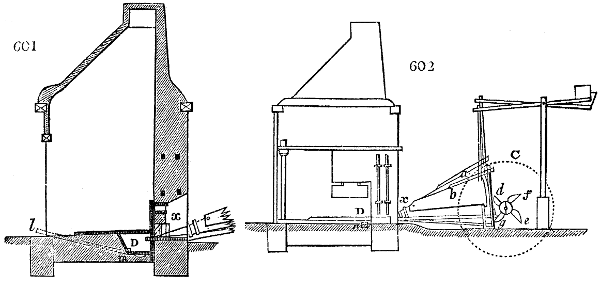
The German refining forge.—Figs. 601, 602. represent one of the numerous refinery furnaces so common in the Hartz. The example is taken from the Mandelholz works, in the neighbourhood of Elbingerode. Fig. 602. is an elevation of this forge. D is the refinery hearth, provided with two pairs of bellows. Fig. 601. is a vertical section, showing particularly the construction of the crucible or hearth in the refinery forge D. C is an overshot water-wheel, which gives an alternate impulsion to the two bellows a b by means of the revolving shaft c, and the cams or tappets d f e g.
D, the hearth, is lined with cast-iron plates. Through the pipe l, cold water may be introduced, under the bottom plate m, in order to keep down, when necessary, the temperature of the crucible, and facilitate the solidification of the loupe or bloom. An orifice n, figs. 601, 602., called the chio (floss hole), allows the melted slag or cinder to flow off from the surface of the melted metal. The copper pipe or nose piece p, fig. 600., conducts the blast of both bellows into the hearth, as shown at b x, fig. 602., and D g p fig. 600.
The substance subjected to this mode of refinery, is a gray carbonaceous cast iron, from the works of Rothehütte. The hearth D, being filled and heaped over with live charcoal, upon the side opposite to the tuyère x, figs. 601, 602, long pigs of cast iron are laid with their ends sloping downwards, and are drawn forwards successively into the hearth by a hooked poker, so that the extremity of each may be plunged into the middle of the fire, at a distance of 6 or 8 inches from the mouth of the tuyère. The workman proceeds in this way, till he has melted enough of metal to form a loupe. The cast iron, on melting, falls down in drops to the bottom of the hearth; being covered by the fused slags, or vitreous matters more or less loaded with oxide of iron. After running them off by the orifice n, he then works the cast iron by powerful stirring with an iron rake (ringard), till it is converted into a mass of a pasty consistence.
During this operation, a portion of the carbon contained in the cast iron combines with the atmospherical oxygen supplied by the bellows, and passes off in the form of carbonic oxide and carbonic acid. When the lump is coagulated sufficiently, the workman turns it over in the hearth, then increases the heat so as to melt it afresh, meanwhile exposing it all round to the blast, in order to consume the remainder of the carbon, that is, till the iron has become ductile, or refined. If one fusion should prove inadequate to this effect, two are given. Before the conclusion, the workman runs off a second stratum of vitreous slag, but at a higher level, so that some of it may remain upon the metal.
The weight of such a loupe or bloom is about 2 cwts., being the product of 2 cwts. and 7⁄10 of pig iron; the loss of weight is therefore about 26 per cent. 149 pounds of charcoal are consumed for every 100 pounds of bar iron obtained. The whole operation lasts about 5 hours. The bellows are stopped as soon as the bloom is ready; this is immediately transferred to a forge hammer, such as is represented fig. 605.; the cast-iron head of which weighs 8 or 9 cwts. The bloom is greatly condensed thereby, and discharges a considerable quantity of semi-fluid cinder. The lump is then divided by the hammer and a chisel into 4 or 6 pieces, which are re-heated, one after another, in the same refinery fire, in order to be forged into bars, whilst another pig of cast iron is laid in its place, to prepare for the formation of a new bloom. The above process is called by the Germans klump-frischen, or lump-refining. It differs from the durch-brech-frischen, because in the latter, the lump is not turned over in mass, but is broken, and exposed in separate pieces successively to the refining power of the blast near the tuyère. The French call this affinage par portions; it is much lighter work than the other.
The quality of the iron is tried in various ways; as first, by raising a bar by one end, with the two hands over one’s head, and bringing it forcibly down to strike across a narrow anvil at its centre of percussion, or one-third from the other extremity of the bar; after which it may be bent backwards and forwards at the place of percussion several times; 2. a heavy bar may be laid obliquely over props near its end, and struck strongly with a hammer with a narrow pane, so as to curve it in opposite directions; or while heated to redness, they may be kneed backwards and forwards at the same spot, on the edge of the anvil. This is a severe trial, which the hoop L, Swedish iron, bears surprisingly, emitting as it is hammered, a phosphoric odour, peculiar to it and to the bar iron of Ulverstone, which also resembles it, in furnishing a good steel. The forging of a horseshoe is reckoned a good criterion of the quality of iron. Its freedom from flaws is detected by the above modes; and its linear strength may be determined by suspending a scale to the lower end of a hard-drawn wire, of a given size, and adding weights till the wire breaks. The treatises of Barlow and Tredgold may be consulted with advantage on the methods of proving the strength of different kinds of iron, in a great variety of circumstances.
Steel of cementation, or blistered steel and cast steel, are treated under the article Steel. But since in the conversion of cast iron into wrought iron, by a very slight difference in the manipulations, a species of steel may be produced called natural steel, I shall describe this process here.
Fig. 603. is a view of the celebrated steel iron works, called Königshütte (king’s-forge), in Upper Silesia, being one of the best arranged in Germany, for smelting iron ore by means of coke. The front shown here is about 400 English feet long. a a are two blast furnaces. A third blast furnace, all like the English, is situated to the left of one of the towers b. b b are the charging towers, into which the ore is raised by machinery from the level of the store-houses l l, up to the mouth of the furnaces a a; c c point to the positions of the boilers of the two steam engines, which drive two cylinder bellows at f. n n n n are arched cellars placed below the store-houses l l, for containing materials and tools necessary for the establishment.
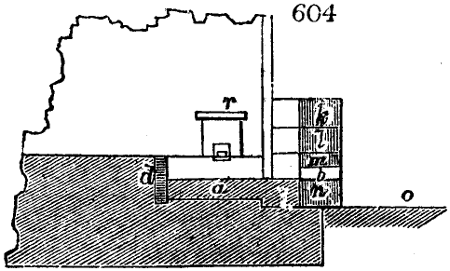
Figs. 599., 604., are vertical sections of the forge of Königshütte, for making natural steel; fig. 599. being drawn in the line A B of the plan, fig. 600. a is the bottom of the hearth, consisting of a fire-proof gritstone; b is a space filled with small charcoal, damped with water, under which, at n, in fig. 604., is a bed of well rammed clay; d is a plate of cast iron, which lines the side of the hearth called rückstein (backstone) in German, and corrupted by the French into rustine; f is the plate of the counter-blast; g the plate of the side of the tuyère: behind, upon the face d, the fire-place or hearth is only 51⁄2 inches deep; in front as well as upon the lateral faces, it is 18 inches deep. By means of a mound made of dry charcoal, the posterior face d, is raised to the height of the face f. i, fig. 600., is the floss-hole, by which the slags are run off from the hearth during the working, and through which, by removing some bricks, the lump of steel is taken out when finished.
k l m are pieces of cast iron, for confining the fire in front, that is towards the side where the workman stands; o is the level of the floor of the works; p a copper tuyère; it is situated 41⁄2 inches above the bottom a, slopes 5 degrees towards it, and advances 4 inches into the hearth or fire-place, where it presents an orifice, one half inch in horizontal length, and one inch up and down; q the nose pipes of two bellows, like those represented in fig. 602., and under Silver; the round orifice of each of them within the tuyère being one inch in diameter. r is the lintel or top arch of the tuyère, beneath which is seen the cross section of the pig of cast iron under operation.
For the production of natural steel, a white cast iron is preferred, which contains little carbon, which does not flow thin, and which being cemented over or above the wind, falls down at once through the blast to the bottom of the hearth in the state of steel. With this view, a very flat fire is used; and should the metal run too fluid, some malleable lumps are introduced to give the mass a thicker pasty consistence.
If the natural steel be supposed to contain too little carbon, which is a very rare case, the metal bath covered with its cinder slag, is diligently stirred with a wooden pole, or it may receive a little of the more highly carburetted iron. If it contains the right dose of carbon, the earthy and other foreign matters are made progressively to sweat out, into the supernatant slag. When the mass is found by the trial of a sample to be completely converted, and has acquired the requisite stiffness, it is lifted out of the furnace, by the opening in front, subjected to the forge hammer, and drawn into bars. In Sweden, the cast-iron pigs are heated to a cherry-red, and in this state broken to pieces under the hammer, before they are exposed in the steel furnace. These natural steels are much employed on the Continent in making agricultural implements, on account of their cheapness. The natural steel of Styria is regarded as a very good article.
Wootz is a natural steel prepared from a black ore of iron in Hindostan, by a process analogous to that of the Catalan hearth, but still simpler. It seems to contain a minute portion of the combustible bases of alumina and silica, to which its peculiar hardness when tempered, may possibly be ascribed. It is remarkable for the property of assuming a damask surface, by the action of dilute sulphuric acid, after it has been forged and polished. See Damascus and Steel.
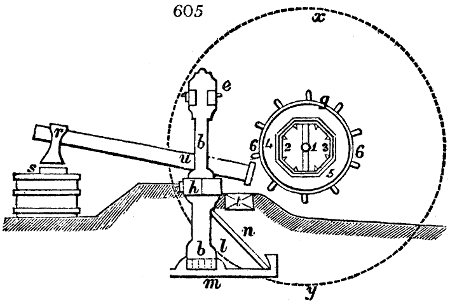
Fig. 605. is the German forge-hammer; to the left of 1, is the axis of the rotatory cam, 2, 3, consisting of 8 sides, each formed of a strong broad bar of cast iron, which are joined together to make the octagon wheel. 4, 5, 6, are cast-iron binding rings or hoops; made fast by wooden wedges. b, b, are standards of the frame work e, l, m, in which the helve of the forge hammer has its fulcrum near u. h, the sole part of the frame. Another cast-iron base or sole is seen at m. n is a strong stay, to strengthen the frame-work. At r two parallel hammers are placed, with cast-iron heads and wooden helves. s is the anvil, a very massive piece of cast iron. t is the end of a vibrating beam, for throwing back the hammer from it forcibly by recoil. x y is the outline of the water-wheel which drives the whole. The cams or tappets are shown mounted upon the wheel 6, g, 6.
Analysis of Irons.—Oxidized substances cannot exist in metallic iron, and the foreign substances it does contain are present in such small quantities, that it is somewhat difficult to determine their amount. The most intricate point is, the proportion of carbon. The free carbon, which is present only in gray cast iron, may, indeed, be determined nearly, for most of it remains after solution of the metal in acids. The combined charcoal, however, changes by the action of muriatic acid into gas and oil; sulphuric acid also occasions a great loss of carbon, and nitric acid dissipates it almost entirely. Either nitre or chloride of silver may be employed to ascertain the amount of carbon; but when the iron contains chromium and much phosphorus, the determination of the carbon is attended with many difficulties.
The quantity of sulphur is always so small, that it can scarcely be ascertained by the weight of the precipitate of sulphate of barytes from the solution of the iron in nitro-muriatic acid. The iron should be dissolved in muriatic acid; and the hydrogen, as it escapes charged with the sulphur, should be passed through an acidulous solution of acetate of lead. The weight of the precipitated sulphuret shows the amount of sulphur, allowing 13·45 of the latter for 100 of the former. In this experiment the metal should be slowly acted upon by the acid. Cast iron takes from 10 to 15 days to dissolve, steel from 8 to 10, and malleable iron 4 days. The residuum of a black colour does not contain a trace of sulphur.