S. (continued 5)
Reading edition
That gold melted with flint glass stains it purple, was originally discovered and practised, as a profitable secret, by Kunckel. Gold has been recently used at Birmingham for giving a beautiful rose-colour to scent bottles. The proportion of gold should be very small, and the heat very great, to produce a good effect. The glass must contain either the oxide of lead, bismuth, zinc, or antimony; for crown glass will take no colour from gold. Glass combined with this metal, when removed from the crucible is generally of a pale rose-colour; nay, sometimes is as colourless as water, and does not assume its ruby colour till it has been exposed to a low red heat, either under a muffle or at the lamp. This operation must be nicely regulated; because a slight excess of fire destroys the colour, leaving the glass of a dingy brown, but with a blue (green?) transparency, like that of gold leaf. It is metallic gold which gives the colour; and, indeed, the oxide is too easily reduced, not to be converted into the metal by the intense heat which is necessarily required.
Upon the kindred art of painting in enamel, Mr. A. Essex has published an interesting paper in the same journal, for June, 1837, in which he says that the antient ruby glass, on being exposed to the heat of a glass-kiln, preserves its colour unimpaired, while the modern suffers considerable injury, and in some cases becomes almost black. Hence the latter cannot be painted upon, as the heat required to fix the fresh colour would destroy the beauty of the original basis. To obviate this difficulty, the artist paints upon a piece of plain glass the tints and shadows necessary for blending the rich ruby glow with the other parts of his picture, leaving those parts untouched where he wishes the ruby to appear in undiminished brilliancy, and fixes the ruby glass in the picture behind the painted piece, so that in such parts, the window is double-glazed. Mr. Essex employs, as did the late Mr. Muss, chrome oxide alone for greens; and he rejects the use of iron and manganese in his enamel colours.
Coloured transparent glass is applied as enamel in silver and gold bijouterie, previously bright-cut in the metal with the graver or the rose-engine. The cuts, reflecting the rays of light from their numerous surfaces, exhibit through the glass, richly stained with gold, silver, copper, cobalt, &c., a gorgeous play of prismatic colours, varied with every change of aspect. When the enamel is to be painted on, it should be made opalescent by oxide of arsenic, in order to produce the most agreeable effect.
The artist in enamel has obtained from modern chemistry, preparations of the metals platinum, uranium, and chromium, which furnish four of the richest and most useful colours of his palette. Oxide of platinum produces a substantive rich brown, formerly unknown in enamel painting; a beautiful transparent tint, which no intensity or repetition of firing can injure. Colours proper for enamel painting, he says, are not to be purchased; those sold for the purpose, are adapted only for painting upon china. The constituents of the green enamel used by his brother, Mr. W. Essex, are, silica, borax, oxide of lead, and oxide of chrome.
Mr. Essex’s enamelling furnace is a cubic space of about 12 inches, and contains a fire-clay muffle, without either bottom or back, which is surrounded with coke, except in front. The entire draught of air which supplies the furnace, passes through the muffle; the plates and paintings being placed on a thin slab, made of tempered fire-clay, technically termed planche, which rests on the bed of coke-fuel. As the greatest heat is at the back of the muffle, the picture must be turned round while in the fire, by means of a pair of spring tongs. The above furnace serves for objects up to five inches in diameter; but for larger works a different furnace is required, for the description of which I must refer to the original paper.
Relatively to the receipts for enamel colours, and for staining and gilding on glass, for which twenty guineas were voted by the Society for the Encouragement of Arts, in the session of 1817, to Mr. R. Wynn, Mr. A. Essex says, in p. 446. of his essay—“the unfortunate artist who shall attempt to make colours for the purpose of painting in enamel from these receipts, will assuredly find, to his disappointment, that they are utterly useless.” In page 449. he institutes a comparison between Mr. Wynn’s complex farrago for green, as published in the Transactions of the Society, with the simple receipt of his brother, as given above. It is a remarkable circumstance, that not one of our enamel artists, during a period of twenty years, should have denounced the fallacy of these receipts, and the folly of sanctioning imposture by a public reward. Should Mr. Essex’s animadversions be just, the well-intentioned Society in the Adelphi may, from the negligence of its committee, come to merit the sobriquet, “For the Discouragement of Arts.”
STAMPING OF METALS. The following ingenious machine for manufacturing metal spoons, forks, and other articles, was made the subject of a patent by Jonathan Hayne, of Clerkenwell, in May, 1833. He employs a stamping-machine with dies, in which the hammer is raised to a height between guides, and is let fall by a trigger. He prefers fixing the protuberant or relief portion of the die to the stationary block or bed of the stamping-machine, and the counterpart or intaglio to the falling hammer or ram.
The peculiar feature of improvement in this manufacture consists in producing the spoon, ladle, or fork perfect at one blow in the stamping-machine, and requiring no further manipulation of shaping, but simply trimming off the barb or fin, and polishing the surface, to render the article perfect and finished.
Heretofore, in employing a stamping-machine, or fly-press, for manufacturing spoons, ladles, and forks, it has been the practice to give the impressions to the handles, and to the bowls or prongs, by distinct operations of different dies, and after having so partially produced the pattern upon the article, the handles had to be bent and formed by the operations of filing and hammering.
By his improved form of dies, which, having curved surfaces and bevelled edges, allow of no parts of the faces of the die and counter-die to come into contact, he is enabled to produce considerable elevations of pattern and form, and to bring up the article perfect at one blow, with only a slight barb or fin upon its edge.
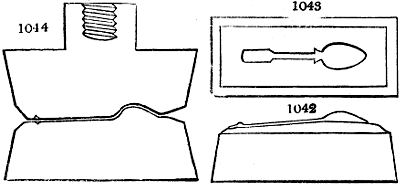
In the accompanying drawings, fig. 1042. is the lower or bed die for producing a spoon, seen edgewise; fig. 1043. is the face of the upper or counter-die, corresponding; fig. 1044. is a section, taken through the middle of the pair of dies, showing the space in which the metal is pressed to form the spoon.
To manufacture spoons, ladles, or forks according to his improved process, he first forges out the ingot into flat pieces, of the shape and dimensions of the die of the intended article; and if a spoon or ladle is to be made, gives a slight degree of concavity to the bowl part; but, if necessary, bends the back, in order that it may lie more steadily, and bend more accurately, upon the lower die; if a fork, he cuts or otherwise removes portions of the metal at those parts which will intervene between the prongs; and, having thus produced the rude embryo of the intended article, scrapes its entire surface clean and free from oxidation-scale or fire-strain, when it is ready to be introduced into the stamping-machine.
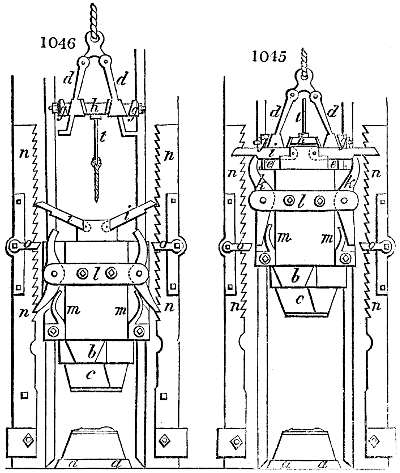
He now fixes the lower die in the bed of the stamping-machine, shown at a, a, in the elevations figs. 1045. and 1046., and fixes, in the hammer b, the upper or counter-die c, accurately adjusting them both, so that they may correspond exactly when brought together. He then places the rudely-formed article above described upon the lower die, and having drawn up the hammer to a sufficient elevation by a windlass and rope, or other ordinary means, lets go the trigger, and allows the hammer with the counter-die to fall upon the under die, on which the article is placed; when, by the blow thus given to the metal, the true and perfect figure and pattern of the spoon, ladle, or fork is produced, and which, as before said, will only require the removal of the slight edging of barb or fin, with polishing, to finish it.
On striking the blow, in the operation of stamping the article, the hammer will recoil and fly up some distance, and if allowed to fall again with reiterated blows, would injure both the article and the dies; therefore, to avoid this inconvenience, he causes the hammer on recoiling to be caught by a pair of palls locking into racks on the face of the standards, seen in figs. 1045. and 1046. In fig. 1045. the hammer b, of the stamping-machine, is seen raised and suspended by a rope attached to a pair of jointed hooks or holders d, d, the lower ends of which pass into eyes e, e, extending from the top of the hammer. When the lever or trigger t is drawn forward, as in fig. 1046., the two inclined planes g, g, on the axle h, press the two legs of the holders d, d, inward, and cause their hooks or lower ends to be withdrawn from the eyes e, e, when the hammer instantly falls, and brings the dies together: such is the ordinary construction of the stamping-machine.
On the hammer falling from a considerable elevation, the violence of the blow causes it to recoil and bound upwards, as before mentioned; it therefore becomes necessary to catch the hammer when it has rebounded, in order to prevent the dies coming again together; this is done by the following mechanism:—
Two latch levers i, i, are connected by joints to the upper part of the hammer, and two pall levers k, k, turning upon pins, are mounted in the bridge l, affixed to the hammer. Two springs m, m, act against the lower arms of these levers, and press them outwards, for the purpose of throwing the palls at the lower ends of the levers into the teeth of the ratchet racks n, n, fixed on the sides of the upright standards.
Previously to raising the hammer, the upper ends of the pall levers k, are drawn back, and the latches i, being brought down upon them, as in fig. 1045., the levers k are confined, and their palls prevented from striking into the side racks; but as the hammer falls, the ends of the latches i strike upon the fingers o, o, fixed to the side standards, and liberate the palls, the lower ends of which, when the hammer rebounds, after stamping, catch into the teeth of the racks, as in fig. 1046., and thereby prevent the hammer from again descending.
STARCH; (Amidon, Fecule, Fr.; Stärke, Germ.); is a white pulverulent substance, composed of microscopic spheroids, which are bags containing the amylaceous matter. It exists in a great many different plants, and varies merely in the form and size of its microscopic particles; as found in some plants, it consists of spherical particles 1⁄1000 of an inch in diameter; and in others, of ovoid particles, of 1⁄300 or 1⁄400 of an inch. It occurs, 1. in the seeds of all the acotyledinous plants, among which are the several species of corns, and those of other gramineæ; 2. in the round perennial tap roots, which shoot up an annual stem; in the tuberose roots, such as potatos, the Convolvulus batatas and edulis, the Helianthus tuberosus, the Jatropha manihot, &c., which contain a great quantity of it; 3. in the stems of several monocotyledinous plants, especially of the palm tribe, whence sago comes; but it is very rarely found in the stems and branches of the dicotyledinous plants; 4. it occurs in many species of lichen. Three kinds of starch have been distinguished by chemists; that of wheat, that called inuline, and lichen starch. These three agree in being insoluble in cold water, alcohol, ether, and oils, and in being converted into sugar by either dilute sulphuric acid or diastase. The main difference between them consists in their habitudes with water and iodine. The first forms with hot water a mucilaginous solution, which constitutes, when cold, the paste of the laundress, and is tinged blue by iodine; the second forms a granular precipitate, when its solution in boiling-hot water is suffered to cool, which is tinged yellow by iodine; the third affords, by cooling the concentrated solution, a gelatinous mass, with a clear liquor floating over it, that contains little starch. Its jelly becomes brown-gray with iodine.
1. Ordinary starch.—This may be extracted from the following grains:—wheat, rye, barley, oats, buckwheat, rice, maize, millet, spelt; from the siliquose seeds, as peas, beans, lentiles, &c.; from tuberous and tap roots, as those of the potato, the orchis, manioc; arrowroot, batata, &c. Different kinds of corn yield very variable quantities of starch. Wheat differs in this respect, according to the varieties of the plant, as well as the soil, manure, season, and climate. See Bread.
Wheat partly damaged by long keeping in granaries, may be employed for the manufacture of starch, as this constituent suffers less injury than the gluten; and it may be used either in the ground or unground state.
1. With unground wheat.—The wheat being sifted clean, is to be put into cisterns, covered with soft water, and left to steep till it becomes swollen and so soft as to be easily crushed between the fingers. It is now to be taken out, and immersed in clear water of a temperature equal to that of malting-barley, whence it is to be transferred into bags, which are placed in a wooden chest containing some water, and exposed to strong pressure. The water rendered milky by the starch being drawn off by a tap, fresh water is poured in, and the pressure is repeated. Instead of putting the swollen grain into bags, some prefer to grind it under vertical edge-stones, or between a pair of horizontal rollers, and then to lay it in a cistern, and separate the starchy liquor by elutriation with successive quantities of water well stirred up with it. The residuary matter in the sacks or cisterns contains much vegetable albumen and gluten, along with the husks; when exposed to fermentation, it affords a small quantity of starch of rather inferior quality.
The above milky liquor, obtained by expression or elutriation, is run into large cisterns, where it deposits its starch in layers successively less and less dense; the uppermost containing a considerable proportion of gluten. The supernatant liquor being drawn off, and fresh water poured on it, the whole must be well stirred up, allowed again to settle, and the surface-liquor again withdrawn. This washing should be repeated as long as the water takes any perceptible colour. As the first turbid liquor contains a mixture of gluten, sugar, gum, albumen, &c., it ferments readily, and produces a certain portion of vinegar, which helps to dissolve out the rest of the mingled gluten, and thus to bleach the starch. It is, in fact, by the action of this fermented or soured water, and repeated washing, that it is purified. After the last deposition and decantation, there appears on the surface of the starch a thin layer of a slimy mixture of gluten and albumen, which, being scraped off, serves for feeding pigs or oxen; underneath will be found a starch of good quality. The layers of different sorts are then taken up with a wooden shovel, transferred into separate cisterns, where they are agitated with water, and passed through fine sieves. After this pap is once more well settled, the clear water is drawn off, the starchy mass is taken out, and laid on linen cloths in wicker baskets, to drain and become partially dry. When sufficiently firm, it is cut into pieces, which are spread upon other cloths, and thoroughly desiccated in a proper drying-room, which in winter is heated by stoves. The upper surface of the starch is generally scraped, to remove any dusty matter, and the resulting powder is sold in that state. Wheat yields, upon an average, only from 35 to 40 per cent. of good starch. It should afford more by skilful management.
2. In this country, wheat crushed between iron rollers is laid to steep in as much water as will wet it thoroughly; in four or five days the mixture ferments, soon afterwards settles, and is ready to be washed out with a quantity of water into the proper fermenting vats. The common time allowed for the steep, is from 14 to 20 days. The next process consists in removing the stuff from the vats into a stout round basket set across a back below a pump. One or two men keep going round the basket, stirring up the stuff with strong wooden shovels, while another keeps pumping water, till all the farina is completely washed from the bran. Whenever the subjacent back is filled, the liquor is taken out and strained through hair sieves into square frames or cisterns, where it is allowed to settle for 24 hours; after which the water is run off from the deposited starch by plug taps at different levels in the side. The thin stuff, called slimes, upon the surface of the starch, is removed by a tray of a peculiar form. Fresh water is now introduced, and the whole being well mixed by proper agitation, is then poured upon fine silk sieves. What passes through is allowed to settle for 24 hours; the liquor being withdrawn, and then the slimes, as before, more water is again poured in, with agitation, when the mixture is again thrown upon the silk sieve. The milky liquor is now suffered to rest for several days, 4 or 5, till the starch becomes settled pretty firmly at the bottom of the square cistern. If the starch is to have the blue tint, called Poland, fine smalt must be mixed in the liquor of the last sieve, in the proportion of 2 or 3 lbs. to the cwt. A considerable portion of these slimes may, by good management, be worked up into starch by elutriation and straining.
The starch is now fit for boxing, by shovelling the cleaned deposit into wooden chests, about 4 feet long, 12 inches broad, and 6 inches deep, perforated throughout, and lined with thin canvas. When it is drained and dried into a compact mass, it is turned out by inverting the chests upon a clean table, where it is broken into pieces 4 or 5 inches square, by laying a ruler underneath the cake, and giving its surface a cut with a knife, after which the slightest pressure with the hand will make the fracture. These pieces are set upon half-burned bricks, which by their porous capillarity imbibe the moisture of the starch, so that its under surface may not become hard and horny. When sufficiently dried upon the bricks, it is put into a stove (which resembles that of a sugar refinery), and left there till tolerably dry. It is now removed to a table, when all the sides are carefully scraped with a knife; it is next packed up in the papers in which it is sold; these packages are returned into the stove, and subjected to a gentle heat during some days; a point which requires to be skilfully regulated.
Mr. Samuel Hall obtained a patent for bleaching starch by chloride of lime in 1821. Chlorine water would probably be preferable, and might prove useful in operating upon damaged wheat.
The sour water of the starch manufacture contains, according to Vauquelin, acetic acid, acetate of ammonia, alcohol, phosphate of lime, and gluten.
During the drying, starch splits into small prismatic columns, of considerable regularity. When kept dry, it remains unaltered for a very long period. When it is heated to a certain degree in water, the envelopes of its spheroidal particles burst, and the farina forms a mucilaginous emulsion, magma, or paste. When this apparent solution is evaporated to dryness, a brittle horny-looking substance is obtained, quite different in aspect from starch, but similar in chemical habitudes. When the moist paste is exposed for 2 or 3 months to the air in summer, the starch is converted into sugar to the amount of one-third or one-half of its weight, into gum, and gelatinous starch called amidine by De Saussure, with occasionally a resinous matter. This curious change goes on even in close vessels.
Starch from potatos.—From the following table of analyses, it appears that potatos contain from 24 to 30 per cent. of dry substance:—
Starch. Fibrous paren- chyma. Veg. Albumen. Gum, Sugar, and Salts. Water.
Red potato 15·0 7·0 1·4 9·2 75·0
Germinating potatos 15·2 6·8 1·3 3·7 73·0
Kidney potatos 9·1 8·8 0·8 — 81·3
Large red potatos 12·9 6·0 0·7 — 78·0
Sweet potatos 15·1 8·2 0·8 — 74·3
Peruvian potatos 15·0 5·2 1·9 1·9 76·0
English potatos 12·9 6·8 1·1 1·7 77·5
Parisian potatos 13·3 6·8 0·9 4·8 73·1
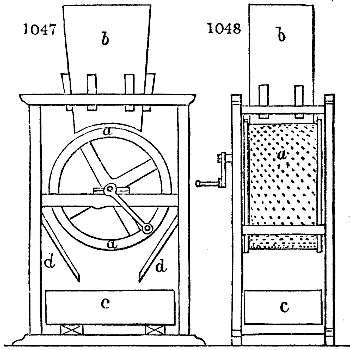
Manufacture of potato starch.—The potatos are first washed in a cylindrical cage formed of wooden spars, made to revolve upon a horizontal axis, in a trough filled with water to the level of the axis. They are then reduced to a pulp by a rasping machine, similar to that represented in figs. 1047, 1048., where a is a wooden drum covered with sheet-iron, roughened outside with numerous prominences, made by punching out holes from the opposite side. It is turned by a winch fixed upon each end of the shaft. The drum is enclosed in a square wooden box, to prevent the potato-mash from being scattered about. The hopper b is attached to the upper frame, has its bottom concentric with the rasp-drum, and nearly in contact with it. The pulp chest c is made to slide out, so as when full to be readily replaced by another. The two slanting boards d, d, conduct the pulp into it. A moderate stream of water should be made to play into the hopper upon the potatos, to prevent the surface of the rasp from getting foul with fibrous matter. Two men, with one for a relay, will rasp, with such a machine, from 21⁄2 to 3 tons of potatos in 12 hours.
The potato pulp must be now elutriated upon a fine wire or hair sieve, which is set upon a frame in the mouth of a large vat, while water is made to flow upon it from a spout with many jets. The pulp meanwhile must be stirred and kneaded by the hand, or by a mechanical brush-agitator, till almost nothing but fibrous particles are left upon the sieve. These, however, generally retain about 5 per cent. of starch, which cannot be separated in this way. This parenchyma should therefore be subjected to a separate rasping upon another cylinder. The water turbid with starch is allowed to settle for some time in a back; the supernatant liquor is then run by a cock into a second back, and after some time into a third, whereby the whole starch will be precipitated. The finest powder collects in the last vessel. The starch thus obtained, containing 33 per cent. of water, may be used either in the moist state, under the name of green fecula, for various purposes, as for the preparation of dextrine, and starch syrup; or it may be preserved under a thin layer of water, which must be renewed from time to time, to prevent fermentation; or lastly, it may be taken out and dried.
In trials made with St. Etienne’s rasp and starch machinery, in Paris, which was driven by two horses, nearly 18 cwt. of potatos were put through all the requisite operations in one hour, including the pumping of the water. The product in starch amounted to from 17 to 18 per cent. of the potatos. The quicker the process of potato-starch making, the better is its quality.
Starch from certain foreign plants.—1. From the pith of the sago palm. See Sago.
2. From the roots of the Maranta arundinacea, of Jamaica, the Bahamas, and other West India islands, the powder called arrow-root is obtained, by a process analogous to that for making potato starch.
3. From the root of the Manioc, which also grows in the West Indies, as well as in Africa, the cassava is procured, by a similar process. The juice of this plant is poisonous, from which the wholesome starch is deposited. When dried with stirring upon hot iron plates, it agglomerates into small lumps, called tapioca; being a gummy fecula.
The characters of the different varieties of starch can be learnt only from microscopic observation; by which means also their sophistication or admixture may be readily ascertained.
Starch, from whatever source obtained, is a white soft powder, which feels crispy, like flowers of sulphur, when pressed between the fingers; it is destitute of taste and smell, unchangeable in the atmosphere, and has a specific gravity of 1·53. I have already described the particles as spheroids enclosed in a membrane. The potato contains some of the largest, and the millet the smallest. Potato starch consists of truncated ovoids, varying in size from 1⁄300 to 1⁄3000 of an inch; arrow-root, of ovoids varying in size from 1⁄800 to 1⁄2000 of an inch; flower starch, of insulated globules about 1⁄1000 of an inch; cassava, of similar globules assembled in groups. These measurements I have made with a good achromatic microscope, and a divided glass-slip micrometer of Tully.
For the saccharine changes which starch undergoes by the action of diastase, see Fermentation.
Lichenine, a species of starch obtained from Iceland moss (Cetraria islandica), as well as inuline, from elecampane (Inula Helenium), are rather objects of chemical curiosity, than of manufactures.
There is a kind of starch made in order to be converted into gum for the calico-printer. This conversion having been first made upon the great scale in this country, has occasioned the product to be called British gum. The following is the process pursued in a large and well conducted establishment near Manchester. A range of four wooden cisterns, each about 7 or 8 feet square, and 4 feet deep, is provided. Into each of them 2000 gallons of water being introduced, 121⁄2 loads of flour are stirred in. This mixture is set to ferment upon old leaven left at the bottom of the backs, during 2 or 3 days. The contents are then stirred up, and pumped off into 3 stone cisterns, 7 feet square and 4 feet deep; as much water being added, with agitation, as will fill the cisterns to the brim. In the course of 24 hours the starch forms a firm deposit at the bottom; and the water is then syphoned off. The gluten is next scraped from the surface, and the starch is transferred into wooden boxes pierced with holes, which may be lined with coarse cloth, or not, at the pleasure of the operator.
The starch, cut into cubical masses, is put into iron trays, and set to dry in a large apartment, two stories high, heated by a horizontal cylinder of cast-iron traversed by the flame of a furnace. The drying occupies two days. It is now ready for conversion into gum, for which purpose it is put into oblong trays of sheet iron, and heated to the temperature of 300° F. in a cast-iron oven, which holds four of these trays. Here it concretes into irregular semi-transparent yellow-brown lumps, which are ground into fine flour between mill-stones, and in this state brought to the market. In this roasted starch, the vesicles being burst, their contents become soluble in cold water. British gum is not convertible into sugar, as starch is, by the action of dilute sulphuric acid; nor into mucic acid, by nitric acid; but into the oxalic; and it is tinged purple-red by iodine. It is composed, in 100 parts, of 35·7 carbon, 6·2 hydrogen, and 58·1 oxygen; while starch is composed of, 43·5 carbon, 6·8 hydrogen, and 49·7 oxygen.
To prove whether starch be quite free from gluten, or whether it be mixed with any wheat flour, diffuse 12 grains of it through six ounces of water, heat the mixture to boiling, stirring it meanwhile with a glass slip. If the starch be pure, no froth will be seen upon the surface of the pasty fluid; or if any be produced during the stirring, it will immediately subside after it; but if the smallest portion of gluten be present, much froth will be permanently formed, which may be raised by stirring into the appearance of soap-suds.
Figs. 1049, 1050 enlarged (177 kB)
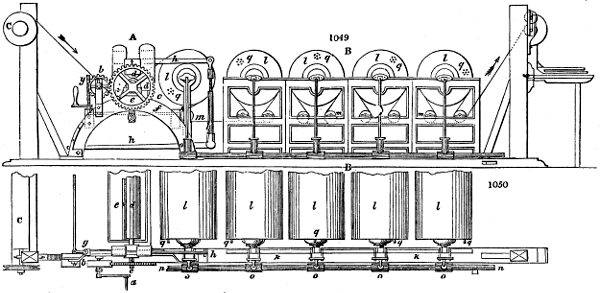
STARCHING and Steam-drying Apparatus. The system of hollow cylinders, for drying goods in the processes of bleaching or calico-printing, is represented in fig. 1049. in a longitudinal section, and in fig. 1050. in a top view; but the cylinders are supposed to be broken off in the middle, as it was needless to repeat the parts at the other end, which are sufficiently shown in the section.
A is the box containing the paste, when the goods are to be starched or stiffened: a, a winch, when it is desired to turn the machine by hand, though it is always moved by power in considerable factories; b, is the driving pinion; d, d′, two brass rollers with iron shafts, the undermost of which is moved by the wheel c, in geer with the pinion b. The uppermost roller d′, is turned by the friction with the former, d, being pressed upon it by the weighted lever h; e is the trough filled with the paste, which rests upon the bars f, and may be placed higher or lower by means of the adjusting screws g, according as the roller d is to be plunged more or less deeply. A brass roller i serves to force down the cloth into the paste.
B, is the drying part of the machine: k, k, its iron framing; l, l, &c., five drums, or hollow copper cylinders, heated with steam: m, m, m, &c., small copper drums, in pairs, turning freely on shafts under the former, for stretching the goods, and airing them, during their passage through the machine: n, n, is the main steam-pipe, from which branch off small copper tubes, o, o, &c., which conduct the steam through stuffing-boxes into the cavity of the drying-drums. There are similar tubes upon the other ends of the drums, for discharging the condensed water through similar stuffing-boxes: q, q, are valves, opening internally, for admitting the air whenever the steam is taken off, or becomes feeble, to prevent the drums from being crushed by the unbalanced pressure of the atmosphere upon their external surfaces.
C, is the cloth-beam, from which the starching roller draws forward the goods; d, d, are two rollers, of which the lower is provided with a band-pulley or rigger, driven by a similar pulley fixed upon the shaft of the starching roller d. These two rollers pull the goods through the drying machine, and then let them fall either upon a table or the floor.
STEAM, is the vapour of hot water; the discussion of which belongs to chemistry, physics, and engineering. Certain practical applications of the subject will be found in the article Evaporation.
STEARIC ACID, improperly called Stearine (Talgsaüre, Germ.), is the solid constituent of fatty substances, as of tallow and olive oil, converted into a crystalline mass by saponification with alkaline matter, and abstraction of the alkali by an acid. By this process, fats are convertible into three acids, called Stearic, Margaric, and Oleic; the first two being solid, and the last liquid. The stearine, of which factitious wax candles are made, consists of the stearic and margaric acids combined. These can be separated from each other only by the agency of alcohol, which holds the margaric acid in solution after it has deposited the stearic in crystals. Pure stearic acid is prepared, according to its discoverer, Chevreul, in the following way:—Make a soap, by boiling a solution of potash and mutton-suet in the proper equivalent proportions (see Soap); dissolve one part of that soap in 6 parts of hot water, then add to the solution 40 or 50 parts of cold water, and set the whole into a place whose temperature is about 52° Fahrenheit. A substance falls to the bottom, possessed of pearly lustre, consisting of the bi-stearate and bi-margarate of potash; which is to be drained and washed upon a filter. The filtered liquor is to be evaporated, and mixed with the small quantity of acid necessary to saturate the alkali left free by the precipitation of the above bi-salts. On adding water to it afterwards, the liquor affords a fresh quantity of bi-stearate and bi-margarate. By repeating this operation with precaution, we finally arrive at a point when the solution contains no more of these solid acids, but only the oleic. The precipitated bi-salts are to be washed and dissolved in hot alcohol, of specific gravity 0·820, of which they require about 24 times their weight. During the cooling of the solution, the bi-stearate falls down, while the greater part of the bi-margarate, and the remainder of the oleate, remain dissolved. By once more dissolving in alcohol, and crystallizing, the bi-stearate will be obtained alone; as may be proved by decomposing a little of it in water at a boiling heat, with muriatic acid, letting it cool, washing the stearic acid obtained, and exposing it to heat, when, if pure, it will not fuse in water under the 158th degree of Fahrenheit’s scale. If it melts at a lower heat, it contains more or less margaric acid. The purified bi-stearate being decomposed by boiling in water along with any acid, as the muriatic, the disengaged stearic acid is to be washed by melting in water, then cooled and dried.
Stearic acid, prepared by the above process, contains combined water, from which it cannot be freed. It is insipid and inodorous. After being melted by heat, it solidifies at the temperature of 158° Fahrenheit, and affects the form of white brilliant needles grouped together. It is insoluble in water, but dissolves in all proportions in boiling anhydrous alcohol, and on cooling to 122°, crystallizes therefrom, in pearly plates; but if the concentrated solution be quickly cooled to 112°, it forms a crystalline mass. A dilute solution affords the acid crystallized in large white brilliant scales. It dissolves in its own weight of boiling ether of 0·727, and crystallizes on cooling in beautiful scales, of changing colours. It distils over in vacuo without alteration; but if the retort contains a little atmospheric air, a small portion of the acid is decomposed during the distillation; while the greater part passes over unchanged, but slightly tinged brown, and mixed with traces of empyreumatic oil. When heated in the open air, and kindled, stearic acid burns like wax. It contains 3·4 per cent. of water, from which it may be freed by combining it with oxide of lead. When this anhydrous acid is subjected to ultimate analysis, it is found to consist of—80 of carbon, 12·5 hydrogen, and 7·5 oxygen, in 100 parts. Stearic acid displaces, at a boiling heat in water, carbonic acid from its combinations with the bases; but in operating upon an alkaline carbonate, a portion of the stearic acid is dissolved in the liquor before the carbonic acid is expelled. This decomposition is founded upon the principle, that the stearic acid transforms the salt into a bicarbonate, which is decomposed by the ebullition.
Stearic acid put into a strong watery infusion of litmus, has no action upon it in the cold; but when hot, the acid combines with the alkali of the litmus, and changes its blue colour to red; so that it has sufficient energy to abstract from the concentrated tincture all the alkali required for its neutralization. If we dissolve bi-stearate of potash in weak alcohol, and pour litmus water, drop by drop, into the solution, this will become red, because the litmus will give up its alkali to a portion of the bi-stearate, and will convert it into neutral stearate. If we now add cold water, the reddened mixture will resume its blue tint, and will deposit bi-stearate of potash in small spangles. In order that the alcoholic solution of the bi-stearate may redden the litmus, the alcohol should not be very strong.
From the composition of stearate of potash, the atomic weight of the acid appears to be 106·6; hydrogen being 1; for 18 : 48 × 2 ∷ 100 : 533·3 = 5 atoms of acid.
From the stearate of soda, it appears to be 104; and from that of lime, 102. The stearate of lead, by Chevreul, gives 109 for the atomic weight of the acid.
The margaric and oleic acids seem to have the same neutralizing power, and the same atomic weight.
The preceding numbers will serve to regulate the manufacture of stearic acid for the purpose of making candles. Potash and soda were first prescribed for saponifying fat, as may be seen in M. Gay Lussac’s patent, under the article Candle; and were it not for the cost of these articles, they are undoubtedly preferable to all others in a chemical point of view. Of late years lime has been had recourse to, with perfect success, and has become subservient to a great improvement in candle-making. The stearine block now made by many London houses, though containing not more than 2 or 3 per cent. of wax, is hardly to be distinguished from the purified produce of the bee. The first process is to boil the fat with quicklime and water in a large tub, by means of perforated steam pipes distributed over its bottom. From the above statements we see that about 11 parts of dry lime are fully equivalent to 100 of stearine and oleine mixed: but as the lime is in the state of hydrate, 14 parts of it will be required when it is perfectly pure; in the ordinary state, however, as made from average good limestone, 16 parts may be allowed. After a vigorous ebullition of 3 or 4 hours, the combination is pretty complete. The stearate being allowed to cool to such a degree as to allow of its being handled, becomes a concrete mass, which must be dug out with a spade, and transferred into a contiguous tub, in order to be decomposed with the equivalent quantity of sulphuric acid diluted with water, and also heated with steam. Four parts of concentrated acid will be sufficient to neutralize three parts of slaked lime. The saponified fat now liberated from the lime, which is thrown down to the bottom of the tub in the state of sulphate, is skimmed off the surface of the watery menstruum into a third contiguous tub, where it is washed with water and steam.
The washed mixture of stearic, margaric, and oleic acids, is next cooled in tin pans; then shaved by large knives, fixed on the face of a fly-wheel, called a tallow cutter, preparatory to its being subjected in canvas or caya bags to the action of a powerful hydraulic press. Here a large portion of the oleic acid is expelled, carrying with it a little of the margaric. The pressed cakes are now subjected to the action of water and steam once more, after which the supernatant stearic acid is run off, and cooled in moulds. The cakes are then ground by a rotatory rasping-machine to a sort of mealy powder, which is put into canvas bags, and subjected to the joint action of steam and pressure in a horizontal hydraulic press of a peculiar construction, somewhat similar to that which has been long used in London for pressing spermaceti. The cakes of stearic acid thus freed completely from the margaric and oleic acids, are subjected to a final cleansing in a tub with steam, and then melted into hemispherical masses called blocks. When these blocks are broken, they display a highly crystalline texture, which would render them unfit for making candles. This texture is therefore broken down or comminuted by fusing the stearine in a plated copper pan, along with one thousandth part of pulverized arsenious acid, after which it is ready to be cast into candles in appropriate moulds. See Candle.
1051Scale 3-20ths of an inch to the foot.
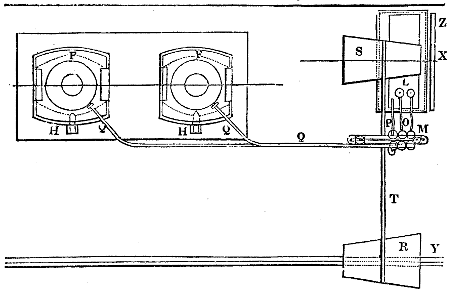
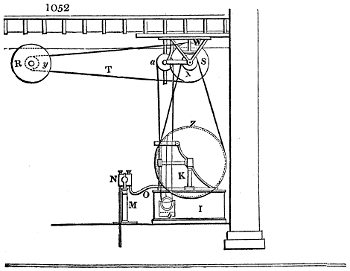
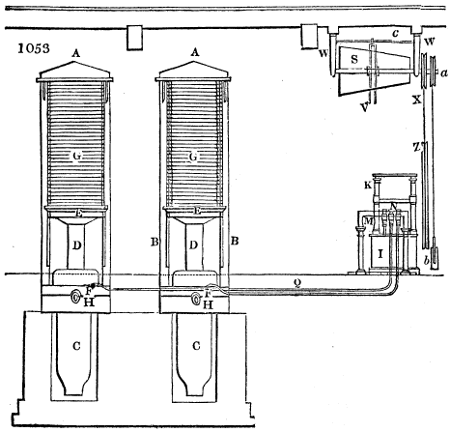
STEARINE COLD PRESS. The cold hydraulic press, as mounted by Messrs. Maudslay and Field, for squeezing out the oleic acid from saponified fat, or the oleine from coco-nut lard, is represented in plan in fig. 1051.; in side view of pump in fig. 1052.; and in elevation, fig. 1053.; where the same letters refer to like objects.
A, A, are two hydraulic presses; B the frame; C, the cylinder; D, the piston or ram; E, the follower; F, the recess in the bottom to receive the oil; G, twilled woollen bags with the material to be pressed, having a thin plate of wrought iron between each; H, apertures for the discharge of the oil; I, cistern in which the pumps are fixed; K, framing for machinery to work in; L, two pumps, large and small, to inject the water into the cylinders; M, a frame containing three double branches; N, three branches, each having two stops or plugs, by which the action of one of the pumps may be intercepted from, or communicated to, one or both of the presses; the large pump is worked at the beginning of the operation, and the small one towards the end; by these branches, one or both presses may be discharged when the operation is finished; O, two pipes from the pumps to the branches; P, pipe to return the water from the cylinders to the cisterns; Q, pipes leading from the pumps through the branches to the cylinders; R, conical drum, fixed upon the main shaft Y, driven by the steam-engine of the factory; S, a like conical drum to work the pumps; T, a narrow leather strap to communicate the motion from R to S; U, a long screw bearing a nut, which works along the whole length of the drum; V, the fork or guide for moving the strap T; W, W, two hanging bearings to carry the drum S; X, a pulley on the spindle of the drum S; Y, the main shaft; Z, fly-wheel with groove on the edge, driven by the pulley X; on the axis of S, is a double crank, which works the two pumps L. a, is a pulley on the end of the long screw U; an endless cord passes twice round this pulley, and under a pulley fixed in the weight b; by laying hold of both sides of his cord, and raising or lowering it, the forked guide V, and the leather strap T, are moved backwards or forwards, by means of the nut fixed in the guide, so as to accelerate or retard at pleasure the speed of the working of the pumps; c, is a piece of iron, with a long slit, in which a pin, attached to the fork V, travels, to keep it in the vertical position.
STEATITE (Soapstone; Craie de Briançon, Fr.; Speckstein, Germ.); is a mineral of the magnesian family. It has a grayish-white or greenish-white colour, often marked with dendritic delineations, and occurs massive, as also in various supposititious crystalline forms; it has a dull or fatty lustre; a coarse splintery fracture, with translucent edges; a shining streak; it writes feebly; is soft, and easily cut with a knife; but somewhat tough; does not adhere to the tongue; feels very greasy; infusible before the blowpipe; specific gravity from 2·6 to 2·8. It consists of—silica, 44; magnesia, 44; alumina, 2; iron, 7·3; manganese, 1·5; chrome, 2; with a trace of lime. It is found frequently in small contemporaneous veins that traverse serpentine in all directions, as at Portsoy, in Shetland, in the limestone of Icolmkiln, in the serpentine of Cornwall, in Anglesey, in Saxony, Bavaria (at Bayruth), Hungary, &c. It is used in the manufacture of porcelain. It makes the biscuit semi-transparent, but rather brittle, and apt to crack with slight changes of heat. It is employed for polishing serpentine, marble, gypseous alabaster, and mirror glass; as the basis of cosmetic powders; as an ingredient in anti-attrition pastes; it is dusted in powder upon the inside of boots, to make the feet glide easily into them; when rubbed upon grease-spots in silk and woollen clothes, it removes the stains by absorption; it enters into the composition of certain crayons, and is used itself for making traces upon glass, silk, &c. The spotted steatite, cut into cameos and calcined, assumes an onyx aspect. Soft steatite forms excellent stoppers for the chemical apparatus used in distilling or subliming corrosive vapours. Lamellar steatite is Talc.
STEEL (Acier, Fr.; Stahl, Germ.); as a carburet of iron, has already been considered under that metal. I shall treat in this article more particularly of its manufacture and technical relations.
1. Steel of cementation, bar or blistered steel.—With the exception of the Ulverstone charcoal iron, no bars are manufactured in Great Britain capable of conversion into steel at all approaching in quality to that made from the Madras, Swedish, and Russian irons, so largely imported for that purpose. The first rank is assigned to the Swedish iron stamped with a circle enclosing the letter L (hence called hoop L); which fetches the high price of 36l. 10s. per ton, while excellent English coke-iron may be had for one-fifth of the price. The other Swedish irons are sold at a much lower rate, though said to be manufactured in the same way; and therefore the superiority of the Dannemora iron must be owing to some peculiarity in the ore from which it is smelted. The steel recently made in the Indian steel-works at Chelsea, from Mr. Heath’s Madras iron, rivals that from the hoop L.
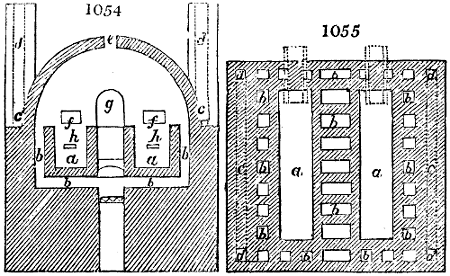
The Sheffield furnace for making bar or blistered steel, called the furnace of cementation, is represented in fig. 1054. in a cross section, and in fig. 1055. in a ground plan. The hearth of this oblong quadrangular furnace, is divided by a grate into two parts, upon each side of which there is a chest a, called a trough, made of fire-clay, or fire-tiles. The breadth of the grate varies according to the quality of the fuel. b, b, are air-holes; c, c, flues leading to the chimney d, d. To aid the draught of the smoke and the flame, an opening e, is made in the middle of the flat arch of the furnace. In one of its shorter sides (ends), there are orifices f, f, through which the long bars of iron may be put in and taken out; g, is the door by which the steel-maker enters, in filling or emptying the trough; h, is a proof hole, at which small samples of the steel, in the act of its conversion, may be drawn out. The furnace is built under a conical hood or chimney, from 30 to 50 feet high, for aiding the draught, and carrying off the smoke.
The two chests are built of fire-stone grit. They are 8, 10, or even 15 feet long, and from 26 to 36 inches in width and depth; the lower and smaller they are, the more uniform will the quality of the steel be. A great breadth and height of trough are incompatible with equability of the cementing temperature. The sides are a few inches thick. The space between them is at least a foot wide. They should never rest directly upon the sole of the furnace, but must have their bottom freely played upon by the flame, as well as the sides and top. The degree of heat is regulated by openings in the arch, or upon the long sides of the furnace, which lead to the chimney; as also by the greater or less quantity of air admitted below the grate, as in glass-house furnaces.
The cement consists of ground charcoal (sometimes of soot), mixed with one-tenth of ashes, and some common salt; the charcoal of hard wood being preferred. Ground coke is inadmissible, on account of the sulphur, silica, and clay which it generally contains. Possibly the salt serves to vitrify the particles of silica in the charcoal, and thus to prevent their entering into combination with the steel. As for the ashes, it is difficult to discover their use. The best steel may be made without their presence. The bottom of the trough being covered with two inches of the powder of cementation, the bars are laid along in it, upon their narrow edge, the side bar being one inch from the trough, and the rest being from 1⁄2 to 3⁄4 of an inch apart. Above this first layer of iron bars, fully half an inch depth of the powder is spread, then a new series of bars is stratified, and so on till the trough is filled within six inches of the top. This space is partially filled with old cement powder, and is covered with refractory damp sand. Sometimes the trough is filled to the surface with the old cement, and then closely covered with fire-tiles. The bars should never be allowed to touch each other, or the trough. The fire must be carefully urged from 2 to 4 days, till it acquires the temperature of 100° Wedgewood; which must be steadily maintained during the 4, 6, 8, or 10 days requisite for the cementation; a period dependent on the size of the furnace, and which is determined by the examination of the proof pieces, taken out from time to time.
In the front or remote end of the furnace, fig. 1054., a door is left in the outer building, corresponding to a similar one in the end of the interior vault, through which the workman enters for charging the furnace with charcoal and iron bars, as also for taking out the steel after the conversion. Small openings are likewise made in the ends of the chests, through which the extremities of a few bars are left projecting, so that they may be pulled out and examined, through small doors opposite to them in the exterior walls. These tap holes, as they are called, should be placed near the centre of the end stones of the chests, that the bars may indicate the average state of the process. The joinings of the fire-stones are secured with a finely ground Stourbridge clay.
The interval between the two chests (in furnaces containing two, for many have only one,) being covered with an iron platform, the workman stands on it, and sifts a layer of charcoal on the bottom of the chests evenly, about half an inch thick; he then lays a row of bars, cut to the proper length, over the charcoal, about an inch from each other; he next sifts on a second stratum of charcoal-dust, which, as it must serve for the bars above, as well as below, is made an inch thick; thus, he continues to stratify, till the chest be filled within two inches of the top; and he covers the whole with the earthy detritus found at the bottom of grindstone troughs, or any convenient fire-loam. It is obvious that the second series of bars should correspond vertically with the interstices between the first series, and so in succession. The trial-rods are left longer than the others, and their projecting ends are encrusted with fire-clay, or imbedded in sand. The iron platform being removed, and all the openings into the vault closed, the fire is lighted, and very gradually increased, to avoid every risk of cracking the gritstone by too sudden a change of temperature; and the ignition being finally raised to about 100° Wedgewood, but not higher, for fear of melting the metal, must be maintained at a uniform pitch, till the iron have absorbed the desired quantity of carbon, and have been converted as highly as the manufacturer intends for his peculiar object. From six to eight days may be reckoned a sufficient period for the production of steel of moderate hardness, and fit for tilting into shear steel. A softer steel, for saws and springs, takes a shorter period; and a harder steel, for fabricating chisels used in cutting iron, will need longer exposure to the ignited charcoal. But, for a few purposes, such as the bits for boring cast iron, the bars are exposed to two or three successive processes of cementation, and are hence said to be twice or thrice converted into steels. The higher the heat of the furnace, the quicker is the process of conversion.
The furnace being suffered to cool, the workman enters it again, and hands out the steel bars, which being covered with blisters, from the formation and bursting of vesicles on the surface filled with gaseous carbon, is called blistered steel. This steel is very irregular in its interior texture, has a white colour, like frosted silver, and displays crystalline angles and facettes, which are larger the further the cementation has been urged, or the greater the dose of carbon. The central particles are always smaller than those near the surface of the bar.
In such a furnace as the above, twelve tons of bar iron may be converted at a charge. But other furnaces are constructed with one chest, which receives six or eight tons at a time; the small furnaces, however, consume more fuel in proportion than the larger.
The absorption and action of the carbonaceous matter, to the amount of about a half per cent., occasions fissures and cavities in the substance of the blistered bars, which render the steel unfit for any useful purpose in tool-making, till it be condensed and rendered uniform by the operation of tilting, under a powerful hammer driven by machinery. See Iron.[59]
The heads of the tilt-hammers for steel weigh from one and a half to two hundred pounds. Those in the neighbourhood of Sheffield are much simpler than the one referred to in the note. They are worked by a small water-wheel, on whose axis is another wheel, bearing a great number of cams or wipers on its circumference, which strike the tail of the hammer in rapid succession, raise its head, and then let it fall smartly on the hot metal rod, dexterously presented on its several parts to the anvil beneath it, by the workman. The machinery is adapted to produce from 300 to 400 blows per minute; which on this plan requires an undue and wasteful velocity of the float-boards. Were an intermediate toothed wheel substituted between the water-wheel and the wiper-wheel, so that while the former made one turn, the latter might make three, a much smaller force of water would do the work. The anvils of the tilt-hammer are placed nearly on a level with the floor of the mill-house; and the workman sits in a fosse, dug on purpose, in a direction perpendicular to the line of the helve, on a board suspended from the roof of the building by a couple of iron rods. On this swinging seat, he can advance or retire with the least impulse of his feet, pushing forward the steel bar, or drawing it back with equal rapidity and convenience.
At a small distance from each tilt, stands the forge-hearth, for heating the steel. The bellows for blowing the fire are placed above-head, and are worked by a small crank fixed on the end of the axis of the wheel, the air being conveyed by a copper pipe down to the nozzle. Each workman at the tilt has two boys in attendance, to serve him with hot rods, and to take them away after they are hammered. In small rods, the bright ignition originally given at the forge soon declines to darkness; but the rapid impulsions of the tilt revive the redness again in all the points near the hammer; so that the rod, skilfully handled by the workman, progressively ignites where it advances to the strokes. Personal inspection alone can communicate an adequate idea of the precision and celerity with which a rude steel rod is stretched and fashioned into an even, smooth, and sharp-edged prism, under the operation of the tilt-hammer. The heat may be clearly referred to the prodigious friction among the particles of so cohesive a metal, when they are made to slide so rapidly over each other in every direction during the elongation and squaring of the rod.
2. Shear steel derives its name from the accidental circumstance of the shears for dressing woollen cloth being usually forged from it. It is made by binding into a bundle, with a slender steel rod, four parallel bars of blistered steel, previously broken into lengths of about 18 inches, including a fifth of double length, whose projecting end may serve as a handle. This faggot, as it is called, is then heated in the forge-hearth to a good welding heat, being sprinkled over with sand to form a protecting film of iron slag, carried forthwith to the tilt, and notched down on both sides to unite all the bars together, and close up every internal flaw or fissure. The mass being again heated, and the binding rings knocked off, is drawn out into a uniform rod of the size required. Manufacturers of cutlery are in the habit of purchasing the blistered bars at the conversion furnaces, and sending them to tilt-mills to have them drawn out to the proper size, which is done at regular prices to the trade; from 5 to 8 per cent. discount being allowed on the rude bars for waste in the tilting. The metal is rendered so compact by the welding and hammering, as to become susceptible of a much finer polish than blistered steel can take; while the uniformity of its body, tenacity, and malleability are at the same time much increased; by which properties it becomes well adapted for making table knives and powerful springs, such as those of gun-locks. The steel is also softened down by this process, probably from the expulsion of a portion of its carbon during the welding and subsequent heats; and if these be frequently or awkwardly applied, it may pass back into common iron.
3. Cast steel is made by melting, in the best fire-clay crucibles, blistered steel, broken down into small pieces of convenient size for packing; and as some carbon is always dissipated in the fusion, a somewhat highly converted steel is used for this purpose. The furnace is a square prismatic cavity, lined with fire-bricks, 12 inches in each side, and 24 deep, with a flue immediately under the cover, 31⁄2 inches by 6, for conducting the smoke into an adjoining chimney of considerable height. In some establishments a dozen such furnaces are constructed in one or two ranges, their tops being on a level with the floor of the laboratory, as in brass-foundries, for enabling the workmen more conveniently to inspect, and lift out, the crucibles with tongs. The ash-pits terminate in a subterraneous passage, which supplies the grate with a current of cool air, and serves for emptying out the ashes. The crucible, stands of course, on a sole-piece of baked fire-clay; and its mouth is closed with a well-fitted lid. Sometimes a little bottle-glass, or blast-furnace slag, is put into the crucible, above the steel pieces, to form a vitreous coating, that may thoroughly exclude the air from oxidizing the metal. The fuel employed in the cast-steel furnace is a dense coke, brilliant and sonorous, broken into pieces about the size of an egg, one good charge of which is sufficient. The tongs are furnished at the fire end with a pair of concave jaws, for embracing the curvature of the crucible, and lifting it out whenever the fusion is complete. The lid is then removed, the slag or scoriæ cleared away, and the liquid metal poured into cast-iron octagonal or rectangular moulds, during which it throws out brilliant scintillations.
Cast-steel works much harder under the hammer than shear steel and will not, in its usual state, bear much more than a cherry-red heat without becoming brittle; nor can it bear the fatigue incident to the welding operation. It may, however, be firmly welded to iron, through the intervention of a thin film of vitreous boracic acid, at a moderate degree of ignition. Cast steel, indeed, made from a less carburetted bar steel, would be susceptible of welding and hammering at a higher temperature; but it would require a very high heat for its preparation in the crucible.
Iron may be very elegantly plated with cast steel, by pouring the liquid metal from the crucible into a mould containing a bar of iron polished on one face. In this circumstance the adhesion is so perfect as to admit of the two metals being rolled out together; and in this way the chisels of planes and other tools may be made, at a moderate rate and of excellent quality, the cutting-edge being formed in the steel side. Such instruments combine the toughness of iron with the hardness of steel.
For correcting the too high carbonization of steel, or equalizing the too highly converted exterior of a bar with the softer steel of the interior, the metal requires merely to be imbedded, at a cementing heat, in oxide of iron or manganese; the oxygen of which soon abstracts the injurious excess of carbon, so that the outer layers may be even converted into soft iron, while the axis continues steely; because the decarbonizing advances far more rapidly than the carbonizing.
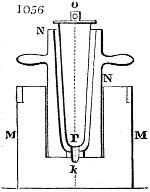
Fig. 1056. represents the mould for making crucibles for the cast-steel works. M, M, is a solid block of wood, to support the two-handled outside mould N, N. This being rammed full of the proper clay dough or compost (see Crucible), the inner mould is to be then pressed vertically into it, till it reaches the bottom P, being directed and facilitated in its descent by the point K. A cord passes through O, by which the inner mould is suspended over a pulley, and guided in its motions.
When a plate of polished steel is exposed to a progressive heat, it takes the following colours in succession: 1. a faint yellow; 2. a pale straw-colour; 3. a full yellow; 4. a brown yellow; 5. a brown with purple spots; 6. a purple; 7. a bright blue; 8. a full blue; 9. a dark blue, verging on black; after which the approach to ignition supersedes all these colours. If the steel plate has been previously hardened by being dipped in cold water or mercury when red-hot, then those successive shades indicate or correspond to successive degrees of softening or tempering. Thus, No. 1. suits the hard temper of a lancet, which requires the finest edge, but little strength of metal; No. 2. a little softer, for razors and surgeons’ amputating instruments; No. 3. somewhat more toughness, for penknives; No. 4. for cold chisels and shears for cutting iron; No. 5. for axes and plane-irons; No. 6. for table knives and cloth shears; No. 7. for swords and watch springs; No. 8. for small fine saws and daggers; No. 9. for large saws, whose teeth need to be set with pliers, and sharpened with a file. After ignition, if the steel be very slowly cooled, it becomes exceedingly soft, and fit for the engraver’s purposes. Hardened steel may be tempered to the desired pitch, by plunging it in metallic baths heated to the proper thermometric degree, as follows: for No. 1. 430° Fahr.; No. 2. 450°; No. 3. 470°; No. 4. 490°; No. 5. 510°; No. 6. 530°; No. 7. 550°; No. 8. 560°; No. 9. 600°.
Small steel tools are most frequently tempered, after hardening, by covering their surface with a thin coat of tallow, and heating them in the flame of a candle till the tallow diffuses a faint smoke, and then thrusting them into the cold tallow. Rinman long ago defined steel to be any kind of iron which, when heated to redness, and then plunged in cold water, becomes harder. But several kinds of cast iron are susceptible of such hardening. Every malleable and flexible iron, however, which may be hardened in that way, is a steel. Moreover, steel may be distinguished from pure iron by its giving a dark-gray spot when a drop of dilute nitric acid is let fall on its surface, while iron affords a green one. Exposed to the air, steel rusts less rapidly than iron; and the more highly carburetted, the more slowly does it rust, and the blacker is the spot left by an acid.
After hardening, steel seems to be quite a different body; even its granular texture becomes coarser or finer according to the degree of heat to which it was raised; it grows so hard as to scratch glass, and resist the keenest file, while it turns exceedingly brittle. When a slowly cooled steel rod is forged and filed, it becomes capable of affording agreeable and harmonious sounds by its vibrations; but hard-tempered steel affords only dull deafened tones, like those emitted by a cracked instrument.
The good quality of steel is shown by its being homogeneous; being easily worked at the forge; by its hardening and tempering well; by its resisting or overcoming forces; and by its elasticity. To ascertain the first point, the surface should be ground and polished on the wheel; when its lustre and texture will appear. The second test requires a skilful workman to give it a heat suitable to its nature and state of conversion. The size and colour of the grain are best shown by taking a bar forged into a razor form; hardening and tempering it; and then breaking off the thin edge in successive bits with a hammer and anvil. If it had been fully ignited only at the end, then, after the hardening, it will display, on fracture, a succession in the aspect of its grains from that extremity to the other; as they are whiter and larger at the former than the latter. The other qualities become manifest on filing the steel; using it as a chisel for cutting iron; or bending it under a heavy weight.
Much interest was excited a few years back by the experiments of Messrs. Stodart and Faraday on the alloys of steel with silver, platinum, rhodium, and iridium. Steel refuses to take up in fusion more than one five-hundreth part of silver; but with this minute quantity of alloy, it is said to bear a harder temper, without losing its tenacity. When pure iron is substituted for steel, the alloys so formed are much less subject to oxidation in damp air than before. With three per cent. of iridium and osmium, an alloy was obtained which had the property of tempering like steel, and of remaining clean and bright, in circumstances when simple iron became covered with rust. “Upon the whole,” says the editor of the Quarterly Journal of Science, giving a report of these experiments in his 14th volume, p. 378, “though we consider these researches upon the alloys of steel as very interesting, we are not sanguine as to their important influence upon the improvement of the manufacture of cutlery, and suspect that a bar of the best ordinary steel, selected with precaution, and most carefully forged, wrought, and tempered, under the immediate inspection of the master, would afford cutting instruments as perfect and excellent as those composed of wootz, or of the alloys.”
Case-hardening of iron, is a process for converting a thin film of the outer surface into steel, while the interior remains as before. Fine keys are generally finished in this way. See Case-hardening.
So great is the affinity of iron for carbon, that, in certain circumstances, it will absorb it from carburetted hydrogen, or coal-gas, and thus become converted into steel. On this principle, Mr. Macintosh of Glasgow obtained a patent for making steel. His furnace consists of one cylinder of bricks built concentrically within another. The bars of iron are suspended in the innermost, from the top; a stream of purified coal-gas circulates freely round them, entering below and escaping slowly above, while the bars are maintained in a state of bright ignition by a fire burning in the annular space between the cylinders. The steel so produced is of excellent quality; but the process does not seem to be so economical as the ordinary cementation with charcoal powder.
Damasking of steel, is the art of giving to sabre blades a variety of figures in the style of watering. See Damascus Blades.
Several explanations have been offered of the change in the constitution of steel, which accompanies the tempering operation; but none of them seems quite satisfactory. It seems to be probable that the ultimate molecules are thrown by the sudden cooling into a constrained state, so that their poles are not allowed to take the position of strongest attraction and greatest proximity; and hence the mass becomes hard, brittle, and somewhat less dense. An analogous condition may be justly imputed to hastily cooled glass, which, like hardened steel, requires to be annealed by a subsequent nicely graduated heat, under the influence of which the particles assume the position of repose, and constitute a denser, softer, and more tenacious body. The more sudden the cooling of ignited steel, the more unnatural and constrained will be the distribution of its particles, and also the more refractory, an effect produced by plunging it into cold mercury. This excess of hardness is removed in any required degree by judicious annealing or tempering. The state of the carbon present in the steel may also be modified by the rate of refrigeration, as Mr. Karsten and M. Bréant conceive happens with cast iron and the damask metal. If the uniform distribution and combination of the carbon through the mass, determine the peculiarity of white cast iron, which is a hard and brittle substance, and if its transition to the dark-gray and softer cast metal be effected by a partial formation of plumbago during slow cooling, why may not something similar be supposed to occur with steel, an analogous compound?
Mr. Oldham, printing engineer of the Bank of England, who has had great experience in the treatment of steel for dies and mills, says that, for hardening it, the fire should never be heated above the redness of sealing-wax, and kept at that pitch for a sufficient time. On taking it out, he hardens it by plunging it, not in water, but in olive oil, or rather naphtha, previously heated to 200° F. It is kept immersed only till the ebullition ceases, then instantly transferred into cold spring water, and kept there till quite cold. By this treatment the tools come out perfectly clean, and as hard as it is possible to make cast-steel, while they are perfectly free from cracks, flaws, or twist. Large tools are readily brought down in temper by being suspended in the red-hot muffle till they show a straw-colour; but for small tools, he prefers plunging them in the oil heated to 400 degrees; and leaves them in till they become cold.
Mr. Oldham softens his steel dies by exposing them to ignition for the requisite time, imbedded in a mixture of chalk and charcoal.
“The common mode of softening steel,” says Mr. Baynes, “is to put it into an iron case, surrounded with a paste made of lime, cow’s gall, and a little nitre and water; then to expose the case to a slow fire, which is gradually increased to a considerable heat, and afterwards allowed to go out, when the steel is found to be soft and ready for the engraver.”[60]
Indian steel, or wootz.—The wootz ore consists of the magnetic oxide of iron, united with quartz, in proportions which do not seem to differ much, being generally about 42 of quartz and 58 of magnetic oxide. Its grains are of various size, down to a sandy texture. The natives prepare it for smelting by pounding the ore, and winnowing away the stony matrix, a task at which the Hindoo females are very dexterous. The manner in which iron ore is smelted and converted into wootz or Indian steel, by the natives at the present day, is probably the very same that was practised by them at the time of the invasion of Alexander; and it is a uniform process, from the Himalaya mountains to Cape Comorin. The furnace or bloomery in which the ore is smelted, is from 4 to 5 feet high; it is somewhat pear-shaped, being about 2 feet wide at bottom, and one foot at top; it is built entirely of clay, so that a couple of men can finish its erection in a few hours, and have it ready for use the next day. There is an opening in front about a foot or more in height, which is built up with clay at the commencement, and broken down at the end, of each smelting operation. The bellows are usually made of a goat’s skin, which has been stripped from the animal without ripping open the part covering the belly. The apertures at the legs are tied up, and a nozzle of bamboo is fastened in the opening formed by the neck. The orifice of the tail is enlarged and distended by two slips of bamboo. These are grasped in the hand, and kept close together in making the stroke for the blast; in the returning stroke they are separated to admit the air. By working a bellows of this kind with each hand, making alternate strokes, a pretty uniform blast is produced. The bamboo nozzles of the bellows are inserted into tubes of clay, which pass into the furnace at the bottom corners of the temporary wall in front. The furnace is filled with charcoal, and a lighted coal being introduced before the nozzles, the mass in the interior is soon kindled. As soon as this is accomplished, a small portion of the ore, previously moistened with water, to prevent it from running through the charcoal, but without any flux whatever, is laid on the top of the coals, and covered with charcoal to fill up the furnace.
In this manner ore and fuel are supplied; and the bellows are urged for 3 or 4 hours, when the process is stopped; and the temporary wall in front being broken down, the bloom is removed by a pair of tongs from the bottom of the furnace. It is then beaten with a wooden mallet, to separate as much of the scoriæ as possible from it, and, while still red-hot, it is cut through the middle, but not separated, in order merely to show the quality of the interior of the mass. In this state it is sold to the blacksmiths, who make it into bar iron. The proportion of such iron made by the natives from 100 parts of ore, is about 15 parts. In converting the iron into steel, the natives cut it into pieces, to enable it to pack better in the crucible, which is formed of refractory clay, mixed with a large quantity of charred husk of rice. It is seldom charged with more than a pound of iron, which is put in with a proper weight of dried wood chopped small, and both are covered with one or two green leaves; the proportions being in general 10 parts of iron to 1 of wood and leaves. The mouth of the crucible is then stopped with a handful of tempered clay, rammed in very closely, to exclude the air. The wood preferred is the Cassia auriculata, and the leaf that of the Asclepias gigantea, or the Convolvulus laurifolius. As soon as the clay plugs of the crucibles are dry, from 20 to 24 of them are built up in the form of an arch, in a small blast furnace; they are kept covered with charcoal, and subjected to heat urged by a blast for about two hours and a half, when the process is considered to be complete. The crucibles being now taken out of the furnace and allowed to cool, are broken, and the steel is found in the form of a cake, rounded by the bottom of the crucible. When the fusion has been perfect, the top of the cake is covered with striæ, radiating from the centre, and is free from holes and rough projections; but if the fusion has been imperfect, the surface of the cake has a honeycomb appearance, with projecting lumps of malleable iron. On an average, four out of five cakes are more or less defective. These imperfections have been tried to be corrected in London by re-melting the cakes, and running them into ingots; but it is obvious, that when the cakes consist partially of malleable iron and of unreduced oxide, simple fusion cannot convert them into good steel. When care is taken, however, to select only such cakes as are perfect, to re-melt them thoroughly, and tilt them carefully into rods, an article has been produced which possesses all the requisites of fine steel in an eminent degree. In the Supplement to the Encyclopædia Britannica, article Cutlery, the late Mr. Stodart, of the Strand, a very competent judge, has declared “that for the purposes of fine cutlery, it is infinitely superior to the best English cast steel.”
The natives prepare the cakes for being drawn into bars by annealing them for several hours in a small charcoal furnace, actuated by bellows; the current of air being made to play upon the cakes while turned over before it; whereby a portion of the combined carbon is probably dissipated, and the steel is softened; without which operation the cakes would break in the attempt to draw them. They are drawn by a hammer of a few pounds weight.
The natives weld two pieces of cast steel, by giving to each a sloping face, jagged all over with a small chisel; then applying them with some calcined borax between, and tying them together with a wire, they are brought to a full red heat, and united by a few smart blows of a hammer.
The ordinary bar iron of Sweden and England, when converted by cementation into steel, exhibits upon its surface numerous small warty points, but few or no distinct vesicular eruptions; whereas the Dannemora and the Ulverston steels present, all over the surface of the bars, well raised blisters, upwards of three-eighths of an inch in diameter horizontally, but somewhat flattened at top. Iron of an inferior description, when highly converted in the cementing-chest, becomes gray on the outer edges of the fracture; while that of Dannemora acquires a silvery colour and lustre on the edges, with crystalline facets within. The highly converted steel is used for tools that require to be made very hard; the slightly converted, for softer and more elastic articles, such as springs and sword blades.
STEREOTYPE PRINTING, signifies printing by fixed types, or by a cast typographic plate. This plate is made as follows:—The form, composed in ordinary types, and containing one, two, three, or more pages, inversely as the size of the book, being laid flat upon a slab, with the letters looking upwards, the faces of the types are brushed over with oil, or preferably, with plumbago (black lead). A heavy brass rectangular frame of three sides, with bevelled borders, adapted exactly to the size of the pages, is then laid down upon the chase,[61] to circumscribe three sides of its typography; but the fourth side, which is one end of the rectangle, is formed by placing near the types, and over the hollows of the chase, a single brass bar, having the same inwards sloping bevel as the other three sides. The complete frame resembles that of a picture, and serves to define the area and thickness of the cast, which is made by pouring the pap of Paris plaster into its interior space, up to a given line on its edges. The plaster mould, which soon sets, or becomes concrete, is lifted gently off the types, and immediately placed upright on its edge in one of the cells of a sheet-iron rack mounted within the cast-iron oven. An able workman will mould ten sheets octavo in a day, or 160 pages. The moulds are here exposed to air heated to fully 400° F., and become perfectly dry in the course of two hours. As they are now friable and porous, they require to be delicately handled. Each mould, containing generally two pages octavo, is laid, with the impression downwards, upon a flat cast-iron plate, called the floating-plate; this plate being itself laid on the bottom of the dipping-pan, which is a cast-iron square tray, with its upright edges sloping outwards. A cast-iron lid is applied to the dipping-pan, and secured in its place by a screw. The pan having been heated to 400° in a cell of the oven, under the mould-rack, previous to receiving the hot mould, is ready to be plunged into the bath of melted alloy contained in an iron pot placed over a furnace, and it is dipped with a slight deviation from the horizontal plane, in order to facilitate the escape of the air. As there is a minute space between the back or top surface of the mould and the lid of the dipping-pan, the liquid metal, on entering into the pan through the orifices in its corners, floats up the plaster along with the iron plate on which it had been laid, thence called the floating-plate, whereby it flows freely into every line of the mould, through notches cut in its edge, and forms a layer or lamina upon its face, of a thickness corresponding to the depth of the border. Only a thin metal film is left upon the back of the mould. The dipping-pan is suspended, plunged, and removed by means of a powerful crane, susceptible of vertical and horizontal motions in all directions. When lifted out of the bath, it is set in a water-cistern, upon bearers so placed as to allow its bottom only to touch the surface. Thus the metal first concretes below, while, by remaining fluid above, it continues to impart hydrostatic pressure during the shrinkage attendant upon refrigeration. As it thus progressively contracts in volume, more melted metal is fed into the corners of the pan by a ladle, in order to keep up the hydrostatic pressure upon the mould, and to secure a perfect impression, as well as a solid cast. Were the pan more slowly and equably cooled, by being left in the air, the thin film of metal upon the back of the inverted plaster cake would be apt to solidify first, and intercept the hydrostatic action indispensable to the purpose of filling all the lines in its face. A skilful workman makes five dips, containing two pages octavo each, in the course of an hour, or about nine and a half octavo sheets per day. The pan being taken asunder, the compound cake of mould and metal is removed, and beat upon its edges with a wooden mallet, to detach the superfluous metal. The stereotype plate is then handed over to the picker, who planes its edges truly square, turns its back flat upon a lathe to a determinate thickness, and carefully removes the little imperfections occasioned by dirt or air left among the letters when the mould was cast. Should any of them be damaged in the course of the operation, they must be cut out, and replaced by soldering in separate types of the same size and form.
STILL (Alambic, Fr.; Blase, Germ.); is a chemical apparatus, for vaporizing liquids by heat in one part, called the cucurbit, and condensing the vapours into liquids in another part, called the refrigeratory; the general purpose of both combined being to separate the more volatile fluid particles from the less volatile. In its simplest form, it consists of a retort and a receiver, or of a pear-shaped matrass and a capital, furnished with a slanting tube for conducting away the condensed vapours in drops; whence the term still, from the Latin verb stillare, to drop. Its chief employment in this country being to eliminate alcohol, of greater or less strength, from fermented wash, I shall devote this article to a description of the stills best adapted to the manufacture of British spirits, referring to chemical authors[62] for those fitted for peculiar objects.
In respect of rapidity and extent of work, stills had attained to an extraordinary pitch of perfection in Scotland about thirty years ago, when legislative wisdom thought fit to levy the spirits duty, per annum, from each distiller, according to the capacity of his still. It having been shown, in a report presented to the House of Commons in 1799, that an 80-gallon still could be worked off in eight minutes, this fact was made the basis of a new fiscal law, on the supposition that the maximum of velocity had been reached. But, instigated by the hopes of enormous gains at the expense of the revenue, the distillers soon contrived to do the same thing in three minutes, by means of broad-bottomed shallow stills, with stirring-chains, and lofty capitals. In the year 1815, that preposterous law, which encouraged fraud and deteriorated the manufacture, was repealed. The whiskey duties having been since levied, independently of the capacity of the still, upon the quantity produced, such rapid operations have been abandoned, and processes of economy in fuel, and purity in product, have been sought after.
One of the greatest improvements in modern distilleries, is completing the analysis of crude spirit at one operation. Chemists had been long familiar with the contrivance of Woulfe, for impregnating with gaseous matter, water contained in a range of bottles; but they had not thought of applying that plan to distillation, when Edouard Adam, an illiterate workman of Montpellier, after hearing accidentally a chemical lecture upon that apparatus, bethought himself of converting it into a still. He caused the boiling-hot vapours to chase the spirits successively out of one bottle into another, so as to obtain in the successive vessels alcohol of any desired strength and purity, “at one and the same heat.” He obtained a patent for this invention in 1801, and was soon afterwards enabled, by his success on the small scale, to set up in his native city a magnificent distillery, which excited the admiration of all the practical chemists of that day. In November, 1805, he obtained a certificate of certain improvements for extracting from wine, at one process, the whole of its alcohol. Adam was so overjoyed, after making his first experiments, that he ran about the streets of Montpellier, telling every body of the surprising results of his invention. Several competitors soon entered the lists with him, especially Solimani, professor of chemistry in that city, and Isaac Berard, distiller in the department of Gard; who, having contrived other forms of continuous stills, divided the profits with the first inventor.
The principles of spirituous distillation may be stated as follows:—The boiling point of alcohol varies with its density or strength, in conformity with the numbers in the following table:—
Specific gravity. Boiling point, by Fahrenheit’s scale.
0·7939 168·5°
0·8034 168·0
0·8118 168·5
0·8194 169·0
0·8265 172·5
0·8332 173·5
0·8397 175·0
0·8458 177·0
0·8518 179·0
0·8875 181·0
0·8631 183·0
0·8765 187·0
0·8892 190·0
0·9013 194·0
0·9126 197·0
0·9234 199·0
0·9335 201·0
See also the table under Alcohol, page 16.
Hence, the lower the temperature of the spirituous vapour which enters the refrigeratory apparatus, the stronger and purer will the condensed spirit be; because the offensive oils, which are present in the wash or wine, are less volatile than alcohol, and are brought over chiefly with the aqueous vapour. A perfect still should, therefore, consist of three distinct members; first, the cucurbit, or kettle; second, the rectifier, for intercepting more or less of the watery and oily particles; and third, the refrigerator, or condenser of the alcoholic vapours.
These principles are illustrated in the construction of the still represented in figs. 1057, 1058, 1059, 1060, 1061.; in which the resources of the most refined French stills are combined with a simplicity and solidity suited to the grain distilleries of the United Kingdom. Three principal objects are obtained by the arrangement here shown; first, the extraction from fermented wort or wine, at one operation, of a spirit of any desired cleanness and strength; second, great economy of time, labour, and fuel; third, freedom from all danger of blowing up or boiling over, by mismanaged firing. When a combination of water, alcohol, and essential oil, in the state of vapour, is passed upwards through a series of winding passages, maintained at a determinate degree of heat, between 170° and 180°, the alcohol alone, in any notable proportion, will retain the elastic form, and will proceed onwards into the refrigeratory tube, in which the said passages terminate; while the water and the oil will be in a great measure condensed, arrested, and thrown back into the body of the still, to be discharged with the effete residuum.
The system of passages or channels, represented in fig. 1058., is so contrived as to bring the mingled vapours which rise from the alembic a, into ample and intimate contact with metallic surfaces, maintained, in a water-bath, at a temperature self-regulated by a heat-governor. See Thermostat.
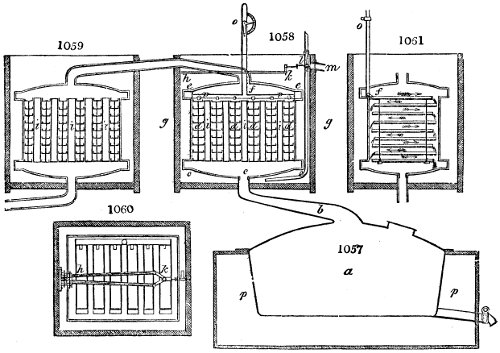
The neck of the alembic tapers upwards, as shown at b, fig. 1057.; and at c, fig. 1058., it enters the bottom, or ingress vestibule, of the rectifier c, f. f is its top or egress vestibule, which communicates with the bottom one by parallel cases or rectangular channels d, d, d, of which the width is small, compared with the length and height. These cases are open at top and bottom, where they are soldered or riveted into a general frame within the cavity, enclosed by the two covers f, c, which are secured round their edges e, e, e, e, with bolts and packing. Each case is occupied with a numerous series of shelves or trays, placed at small distances over each other, in a horizontal or slightly inclined position, of which a side view is given in fig. 1059., and cross sections at d, d, d, fig. 1058. Each shelf is turned up a little at the two edges, and at one end, but sloped down at the other end, that the liquor admitted at the top may be made to flow slowly backwards and forwards in its descent through the system of shelves or trays, as indicated by the darts and spouts in fig. 1059. The shelves of each case are framed together by two or more vertical metallic rods, which pass down through them, and are fixed to each shelf by solder, or by screw-nuts. By this means, if the cover f, be removed, the sets of shelves may be readily lifted out of the cases and cleaned; for which reason they are called movable.
The intervals i, i, i, fig. 1058., between the cases, are left for the free circulation of the water contained in the bath-vessel g, g; these intervals being considerably narrower than the cases.
Fig. 1060. represents in plan the surface of the rectifying cistern, shown in two different sections in figs. 1058. and 1059. h, k, figs. 1058. and 1060., is the heat-governor, shaped somewhat like a pair of tongs. Each leg is a compound bar, consisting of a flat bar or ruler of steel, and one of brass alloy, riveted facewise together, having their edges up and down. The links, at k, are joined to the free ends of these compound bars, which, receding by increase and approaching by decrease of temperature, act by a lever on the stopcock l, fixed to the pipe of a cold-water back, and are so adjusted by a screw-nut, that whenever the water in the bath vessel g, g, rises above the desired temperature, cold water will be admitted, through the stopcock l, and pipe n, into the bottom of the cistern, and will displace the over-heated water by the overflow-pipe m. Thus a perfect equilibrium of caloric may be maintained, and alcoholic vapour of correspondent uniformity transmitted to the refrigeratory.
Fig. 1061. is the cold condenser, of similar construction to the rectifier, fig. 1058.; only the water cells should be here larger in proportion to the vapour channels d, d. This refrigeratory system will be found very powerful, and it presents the great advantage of permitting its interior to be readily inspected and cleansed. It is best made of laminated tin, hardened with a little copper alloy.
The mode of working the preceding apparatus will be understood by the following instructions. Into the alembic, a, let as much fermented liquor be admitted as will protect its bottom from being injured by the fire, reserving the main body in the charging-back. Whenever the ebullition in the alembic has raised the temperature of the water-bath g, g, to the desired pitch, whether that be 170°, 175°, or 180°, the thermostatic instrument is to be adjusted by its screw-nut, and then the communication with the charging-back is to be opened by moving the index of the stopcock o, over a proper portion of its quadrantal arch. The wash will now descend in a slender equable stream, through the pipe o, f, thence spread into the horizontal tube p, p, and issue from the orifices of distribution, as seen in the figure, into the respective flat trays or spouts. The manner of its progress is seen for one set of trays, in fig. 1059. The direction of the stream in each shelf is evidently the reverse of that in the shelf above and below it; the turned-up end of one shelf corresponding to the discharge slope of its neighbour.
By diffusing the cool wash or wine in a thin film over such an ample range of surfaces, the constant tendency of the bath to exceed the proper limit of temperature is counteracted to the utmost, without waste of time or fuel; for the wash itself, in transitu, becomes boiling-hot, and experiences a powerful steam distillation. By this arrangement a very moderate influx of cold water, through the thermostatic stopcock, suffices to temper the bath; such an extensive vaporization of the wash producing a far more powerful refrigerant influence than its simple heating to ebullition. It deserves to be remarked, that the maximum distillatory effect, or the bringing over the greatest quantity of pure spirits in the least time, and with the least labour and fuel, is here accomplished without the least steam pressure in the alembic; for the passages are all pervious to the vapour; whereas, in almost every wash-still heretofore contrived for similar purposes, the spirituous vapours must force their way through successive layers of liquid, the total pressure produced by which causes undue elevation of temperature, and obstruction to the process. Whatever supplementary refrigeration of the vapours in their passage through the bath may be deemed proper, will be administered by the thermostatic regulator.