P. (continued 8)
Reading edition
M. Kestner, of Thann, in Alsace, obtains, in his manufactory of pyrolignous acid, 5 hectolitres (112 gallons imperial, nearly,) from a cord containing 93 cubic feet of wood. The acid is very brown, much loaded with tar, and marks 5° Baumé; 220 kilogrammes of charcoal are left in the cylinders; 500 litres of that brown acid produce, after several distillations, 375 of the pyrolignous acid of commerce, containing 7 per cent. of acid, with a residuum of 40 kilogrammes of pitch. For the purpose of making a crude acetate of lead (pyrolignite), he dries pyrolignite of lime upon iron plates, mixes it with the equivalent decomposing quantity of sulphuric acid, previously diluted with its own weight of water, and cooled; and transfers the mixture as quickly as possible into a cast-iron cylindric still, built horizontally in a furnace; the under half of the mouth of the cylinder being always cast with a semicircle of iron. The acetic acid is received into large salt-glazed stone bottles. From 100 parts of acetate of lime, he obtains 133 of acetic acid, at 38° Baumé. It contains always a little sulphurous acid from the reaction of the tar and the sulphuric acid.
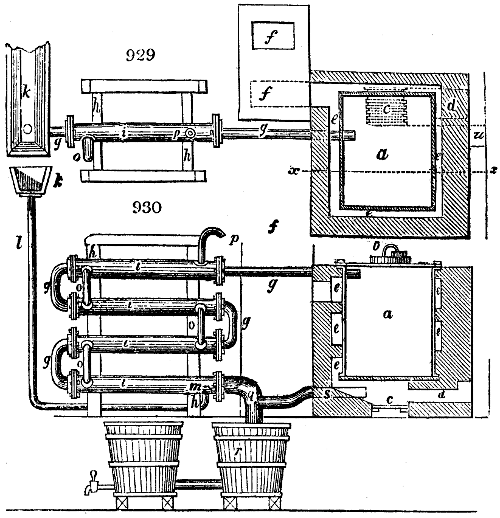
The apparatus represented in figs. 929. and 930. is a convenient modification of that exhibited under acetic acid, for producing pyrolignous acid. Fig. 929. shows the furnace in a horizontal section drawn through the middle of the flue which leads to the chimney. Fig. 930. is a vertical section taken in the dotted line x, x, of fig. 929. The chest a is constructed with cast-iron plates bolted together, and has a capacity of 100 cubic feet. The wood is introduced into it through the opening b, in the cover, for which purpose it is cleft into billets of moderate length. The chest is heated from the subjacent grate c, upon which the fuel is laid, through the fire-door d. The flame ascends spirally through the flues e, e, round the chest, which terminate in the chimney f. An iron pipe g conveys the vapours and gaseous products from the iron chest to the condenser. This consists of a series of pipes laid zigzag over each other, which rest upon a framework of wood. The condensing tubes are enclosed in larger pipes i, i; a stream of cold water being caused to circulate in the interstitial spaces between them. The water passes down from a trough k, through a conducting tube l, enters the lowest cylindrical case at m, flows thence along the series of jackets i, i, i, being transmitted from the one row to the next above it, by the junction tubes o, o, o, till at p it runs off in a boiling-hot state. The vapours proceeding downwards in an opposite direction to the cooling stream of water, get condensed into the liquid state, and pass off at q, through a discharge pipe, into the first close receiver r, while the combustible gases flow off through the tube s, which is provided with a stopcock to regulate the magnitude of their flame under the chest. As soon as the distillation is fully set agoing, the stopcock upon the gas-pipe is opened; and after it is finished, it must be shut. The fire should be supplied with fuel at first, but after some time the gas generated keeps up the distilling heat. The charcoal is allowed to cool during 5 or 6 hours, and is then taken out through an aperture in the back of the chest, which corresponds to the opening u, fig. 929., in the brickwork of the furnace. About 60 per cent. of charcoal may be obtained from 100 feet of fir-wood, with a consumption of as much brush-wood for fuel.
Stoltze has ascertained, by numerous experiments, that one pound of wood yields from 6 to 71⁄2 ounces of liquid products; but in acetic acid it affords a quantity varying from 2 to 5, according to the nature of the wood. Hard timber, which has grown slowly upon a dry soil, gives the strongest vinegar. White birch and red beech afford per pound 71⁄3 ounces of wood vinegar, 11⁄3 ounce of combustible oil, and 4 ounces of charcoal. One ounce of that vinegar saturates 110 grains of carbonate of potassa. Red pine yields per pound 61⁄2 ounces of vinegar, 21⁄4 ounces of oil, 33⁄4 ounces of charcoal; but one ounce of the vinegar saturates only 44 grains of carbonate of potassa, and has therefore only two-fifths of the strength of the vinegar from the birch. An ounce of the vinegar from the white beech, holly oak (Ilex), common ash, and horse chesnut, saturates from 90 to 100 grains of the carbonate. In the same circumstances, an ounce of the vinegar of the alder and white pine saturates from 58 to 60 grains.
PYROLIGNOUS or PYROXILIC SPIRIT, improperly called naphtha. This is employed, as well as pyroacetic ether, to dissolve the sandarach, mastic, and other resinous substances, which, under the name of gums, are used for stiffening the bodies of hats. I have already described, in the article Pyrolignous Acid, how this spirit is obtained. Berzelius has found that the crude spirit may be best purified by agitating it with a fat oil, in order to abstract the empyreumatic oil; then to decant the spirit, distil it, first with fresh calcined charcoal, and next with chloride of calcium. The pyrolignous spirit, thus purified, is colourless, and limpid like alcohol; has an ethereous smell, somewhat resembling that of ants. Its taste is hot, and analogous to that of oil of peppermint. Its specific gravity, by my experiments, is 0·824. It readily takes fire, and burns with a blue flame, without smoke. It combines with water in any proportion; a property which distinguishes it from pyroacetic ether and spirit.
It is not easy to say what is the real chemical nature of pyroxilic spirit. There is no ultimate analysis of it that can be depended upon. The properties of the spirit examined by MM. Marcet and Macaire, differ from those of our spirit, in refusing to combine with water, like alcohol. The article on sale in this country readily unites with water, and in all proportions with alcohol.
PYROMETER, is the name of an instrument for measuring high degrees of heat above the range of the mercurial thermometer. Wedgewood’s is the one commonly referred to by writers upon porcelain and metallurgy; but a better one might be easily contrived.
PYROPHORUS, is the generic name of any chemical preparation, generally a powder, which inflames spontaneously when exposed to the air.
PYROTECHNY. See Fire-works.
PYROXILINE, is a name which I have ventured to give to a substance detected in pyroxilic spirit, by Mr. Scanlan, while residing in Dublin, and therefore called by him Eblanin. I am indebted to that ingenious chemist for the following facts.
If potash water be added to raw wood-spirit (pyrolignous), as long as it throws down any thing, a precipitate is produced, which is pyroxiline, mixed with tarry matter. This precipitate is to be collected on a filter cloth, and submitted to strong pressure between folds of blotting-paper; it is next to be washed with cold alcohol, spec. grav. 0·840, in order to free it from any adhering tarry matter; when the pyroxiline is left nearly pure. If it be dissolved in boiling alcohol, or hot oil of turpentine, it crystallizes regularly on cooling, in right square prisms, of a fine yellow colour, that look opaque to the naked eye, but when examined under the microscope, have the transparency and colour of ferroprussiate of potash. Its turpentine solution affords crystals of a splendid orange-red colour, having the appearance of minute plates, whose form is not discernible by the naked eye, but when examined by the microscope, they are seen to be thin right rectangular prisms. The orange-red colour is only the effect of aggregation; for when ground to powder, these crystals become yellow; and under the microscope, the difference in colour between the two is very slight. Its melting point is 318° F. It sublimes at 300° in free air; heated in a close tube in a bath of mercury, it emits vapour at 400°; it then begins to decompose, and is totally decomposed at 500°. Sulphuric acid decomposes it, producing a beautiful blue colour, which passes into crimson, as the acid attracts water from the atmosphere, and it totally disappears on plentiful dilution with water, leaving carbon of a dirty-brown colour. Its alcoholic or turpentine solution imparts a permanent yellow dye to vegetable or animal matter.
Pyroxiline consists, according to the analysis of Drs. Apjohn and Gregory, of—carbon, 75·275; hydrogen, 5·609; oxygen, 19·116, in 100 parts.