W. (continued 2)
Reading edition
In general the whole vintage of the day is pressed in the evening, and the resulting must is received in separate vats. At the end usually of 6 or 8 hours, if the temperature be above 50° F., and if the grapes have not been too cold when plucked, a froth or scum is formed at the surface, which rapidly increases in thickness. After it acquires such a consistence as to crack in several places, it is taken off with a skimmer, and drained; and the thin liquor is returned to the vat. A few hours afterwards another coat of froth is formed, which is removed in like manner, and sometimes a third may be produced. The regular vinous fermentation now begins, characterized by air-bubbles rising up the sides of the staves, with a peculiar whizzing as they break at the surface. At this period all the remaining froth should be quickly skimmed off, and the clear subjacent must, be transferred into barrels, where it is left to ripen by a regular fermentation.
The white wines, which might be disposed to become stringy, from a deficient supply of tannin, may be preserved from this malady by a due addition of the footstalks of ripe grapes. The tannin, while it tends to preserve the wines, renders them also more easy to clarify, by the addition of white of egg, or isinglass.
The white wines should be racked off as soon as the first frosts have made them clear, and at the latest by the end of the February moon. By thus separating the wine from the lees, we avoid, or render of little consequence, the fermentation which takes place on the return of spring, and which, if too brisk, would destroy all its sweetness, by decomposing the remaining portion of sugar.
The characteristic odour possessed by all wines, in a greater or less degree, is produced by a peculiar substance, which possesses the characters of an essential oil. As it is not volatile, it cannot be confounded with the aroma of wine. When large quantities of wine are distilled, an oily substance is obtained towards the end of the operation. This may also be procured from the wine lees which are deposited in the casks after the fermentation has commenced. It forms one 40,000th part of the wine; and consists of a peculiar new acid, and ether, each of which has been called the œnanthic. The acid is analogous to the fatty acids, and the ether is liquid, but insoluble in water. The acid is perfectly white when pure, of the consistence of butter at 60°, melts with a moderate heat, reddens litmus, and dissolves in caustic and carbonated alkalis, as well as in alcohol and ether. Œnanthic ether is colourless, has an extremely strong smell of wine, which is almost intoxicating when inhaled, and a powerful disagreeable taste. Liebig and Pelouze.
Sparkling wines.—In the manufacture of these, black grapes of the first quality are usually employed, especially those gathered upon the vine called by the French noirien, cultivated on the best exposures. As it is important, however, to prevent the colouring-matter of the skin from entering into the wine, the juice should be squeezed as gently and rapidly as possible. The liquor obtained by a second and third pressing is reserved for inferior wines, on account of the reddish tint which it acquires. The marc is then mixed with the grapes of the red-wine vats.
The above nearly colourless must, is immediately poured into tuns or casks, till about three-fourths of their capacity are filled, when fermentation soon begins. This is allowed to continue under the control of the elastic bung, above mentioned, for about 15 days, and then three-fourths of the casks are filled up with wine from the rest. The casks are now closed by a bung secured with a piece of hoop iron nailed to two contiguous staves. The casks should be made of new wood, but not of oak—though old white wine casks are occasionally used.
In the month of January the clear wine is racked off, and is fined by a small quantity of isinglass dissolved in old wine of the same kind. Forty days afterwards a second fining is required. Sometimes a third may be useful, if the lees be considerable. In the month of May the clear wine is drawn off into bottles, taking care to add to each of them a small measure of what is called liquor, which is merely about 3 per cent. of a syrup made by dissolving sugar-candy in white wine. The bottles being filled, and their corks secured by packthread and wire, they are laid on their sides, in this month, with their mouths sloping downwards at an angle of about 20 degrees, in order that any sediment may fall into the neck. At the end of 8 or 10 days, the inclination of the bottles is increased, when they are slightly tapped, and placed in a vertical position; so that after the lees are all collected in the neck, the cork is partially removed for an instant, to allow the sediment to be expelled by the pressure of the gas. If the wine be still muddy in the bottles, along with a new dose of liquor, a small quantity of fining should be added to each, and the bottles should be placed again in the inverted position. At the end of two or three months, the sediment collected over the cork, is dexterously discharged; and if the wine be still deficient in transparency, the same process of fining must be repeated.
Sparkling wine (vin mousseux), prepared as above described, is fit for drinking usually at the end of from 18 to 30 months, according to the state of the seasons. It is in Champagne that the lightest, most transparent, and most highly flavoured wines, have been hitherto made. The breakage of the bottles in these sparkling wines amounts frequently to 30 per cent., a circumstance which adds greatly to their cost of production.
Weak wines of bad growths ought to be consumed within 12 or 15 months after being manufactured; and should be kept meanwhile in cool cellars. White wines of middling strength ought to be kept in casks constantly full, and carefully excluded from contact of air, and the racking off should be done as quickly as possible. As the most of them are injured by too much fermentation, this process should be so regulated as always to leave a little sugar undecomposed. It is useful to counteract the absorption of oxygen, and the consequent tendency to acidity, by burning a sulphur match in the casks into which they are about to be run. This is done by hooking the match to a bent wire, kindling and suspending it within the cask through the bung-hole. Immediately on withdrawing the match, the cask should be corked, if the wine be not ready for transfer. If the burning sulphur be extinguished on plunging it into the cask, it is a proof of the cask being unsound, and unfit for receiving the wine; in which case it should be well cleansed, first with lime-water, then with very dilute sulphuric acid, and lastly with boiling water.
Wine-cellars ought to be dry at bottom, floored with flags, have windows opening to the north, be so much sunk below the level of the adjoining ground as to possess a nearly uniform temperature in summer and winter; and be at such a distance from a frequented highway or street as not to suffer vibration from the motion of carriages.
Wines should be racked off in cool weather; the end of February being the fittest time for light wines. Strong wines are not racked off till they have stood a year or eighteen months upon the lees, to promote their slow or insensible fermentation. A syphon well managed serves better than a faucet to draw off wine clear from the sediment. White wines, before being bottled, should be fined with isinglass; red wines are usually fined with whites of eggs beat up into a froth, and mixed with two or three times their bulk of water. But some strong wines, which are a little harsh from excess of tannin, are fined with a little sheep or bullock’s blood. Occasionally a small quantity of sweet glue is used for this purpose.
The following maladies of wines, are certain accidental deteriorations, to which remedies should be speedily applied.
La-pousse (pushing out of the cask), is the name given to a violent fermentative movement, which occasionally supervenes after the wine has been run off into the casks. If these have been tightly closed, the interior pressure may increase to such a degree as to burst the hoops, or cause the seams of the staves or ends to open. The elastic bungs already described, will prevent the bursting of the casks; but something must be done to repress the fermentation, lest it should destroy the whole of the sugar, and make the wine unpalatably harsh. One remedy is, to transfer the wine into a cask previously fumigated with burning sulphur; another is, to add to it about one thousandth part of sulphite of lime; and a third, and perhaps the safest, is to introduce half a pound of mustard-seed into each barrel. At any rate the wines should be fined whenever the movements are allayed, to remove the floating ferment which has been the cause of the mischief.
Turning sour.—The production of too much acid in a wine, is a proof of its containing originally too little alcohol, of its being exposed too largely to the air, or to vibrations, or to too high a temperature in the cellar. The best thing to be done in this case is, to mix it with its bulk of a stronger wine in a less advanced state, to fine the mixture, to bottle it, and to consume it as soon as possible, for it will never prove a good keeping wine. This distemper in wines formerly gave rise to the very dangerous practice of adding litharge as a sweetener; whereby a quantity of acetate or sugar of lead was formed in the liquor, productive of the most deleterious consequences to those who drunk of it. In France, the regulations of police, and the enlightened surveillance of the council of salubrity, have completely put down this gross abuse. The saturation of the acid by lime and other alkaline bases has generally a prejudicial effect, and injures more or less the vinous flavour and taste.
Ropiness or viscidity of wines.—The cause of this phenomenon, which renders wine unfit for drinking, was altogether unknown, till M. François, an apothecary of Nantes, demonstrated that it was owing to an azotized matter, analogous to gliadine (gluten); and in fact it is the white wines, especially those which contain the least tannin, which are subject to this malady. He also pointed out the proper remedy, in the addition of tannin under a rather agreeable form, namely, the bruised berries of the mountain-ash (sorbier), in a somewhat unripe state; of which one pound, well stirred in, is sufficient for a barrel. After agitation, the wine is to be left in repose for a day or two, and then racked off. The tannin by this time will have separated the azotized matter from the liquor, and removed the ropiness. The wine is to be fined and bottled off.
The taste of the cask, which sometimes happens to wine put into casks which had remained long empty, is best remedied by agitating the wine for some time with a spoonful of olive oil. An essential oil, the chief cause of the bad taste, combines with the fixed oil, and rises with it to the surface.
According to a statement in the Dictionnaire Technologique, the annual produce of a hectare of vineyard, upon the average of 113 years, in the district of Volnay, is 1779 litres, which fetch 0·877 francs each, or 200 francs the piece of 228 litres, amounting in all to 1672 francs. Deducting for expenses and taxes (contributions) 572 francs, there remain 1100 francs of net proceeds; and as the value of the capital may be estimated at 23,000 francs, the profit turns out to be no more than 5 per cent. The net proceeds in the growths of Beaune, Nuits, &c., does not exceed 600 francs per hectare (2·4 acres), and therefore is equivalent to only 21⁄2 per cent. upon the capital.
The quantity of alcohol contained in different wines, has been made the subject of elaborate experiments by Brande and Fontenelle; but as it must evidently vary with different seasons, the results can be received merely as approximative. The only apparatus required for this research, is a small still and refrigeratory, so well fitted up as to permit none of the spirituous vapours to be dissipated. The distilled liquor should be received in a glass tube, graduated into one hundred measures, of such capacity as to contain the whole of the alcohol which the given measure of wine employed is capable of yielding. In the successive experiments, the quantity of wine used, and of spirit distilled over, being the same in volume, the relative densities of the latter will show at once the relative strengths of the wines. A very neat small apparatus has been contrived for the purpose of analyzing wines in this manner, by M. Gay Lussac. It is constructed, and sold at a moderate price, by M. Collardeau, No. 56, Rue Faubourg St. Martin, Paris. The proportion given by Brande (Table I.), has been reduced to the standard of absolute alcohol by Fesser; and that by Fontenelle (Table II.), to the same standard by Schubarth; as in the following tables:—
Table I.
Name of the Wine. Sp. grav. 100 measures, contain at 60° F.
Alcohol of 0·825. Absolute alcohol.
Port Wine 0 ·97616 21 ·40 19 ·82
Do. 0 ·97200 25 ·83 23 ·92
Mean 0 ·97460 23 ·49 21 ·75
Madeira 0 ·97810 19 ·34 17 ·91
Do. 0 ·97333 21 ·42 22 ·61
Sherry 0 ·97913 18 ·25 17 ·00
Do. 0 ·97700 19 ·83 18 ·37
Bordeaux, Claret 0 ·97410 12 ·91 11 ·95
Do. 0 ·97092 16 ·32 15 ·11
Calcavella 0 ·97920 18 ·10 16 ·76
Lisbon 0 ·97846 18 ·94 17 ·45
Malaga 0 ·98000 17 ·26 15 ·98
Bucellas 0 ·97890 18 ·49 17 ·22
Red Madeira 0 ·97899 18 ·40 17 ·04
Malmsey 0 ·98090 16 ·40 15 ·91
Marsala 0 ·98190 15 ·26 14 ·31
Do. 0 ·98000 17 ·26 15 ·98
Champagne (rose) 0 ·98608 11 ·30 10 ·46
ChaDo.agne(white) 0 ·98450 12 ·80 11 ·84
Burgundy 0 ·98300 14 ·53 13 ·34
Do. 0 ·98540 11 ·95 11 ·06
White Hermitage 0 ·97990 17 ·43 16 ·14
Red do. 0 ·98495 12 ·32 11 ·40
Hock 0 ·98290 14 ·37 13 ·31
Do. 0 ·98873 8 ·88 8 ·00
Vin de Grave 0 ·98450 12 ·80 11 ·84
Frontignac 0 ·98452 17 ·79 11 ·84
Côte-Rotí 0 ·98495 12 ·27 11 ·36
Roussillon 0 ·98005 17 ·24 15 ·96
Cape Madeira 0 ·97924 18 ·11 16 ·77
Muscat 0 ·97913 18 ·25 17 ·00
Constantia 0 ·97770 19 ·75 18 ·29
Tinto 0 ·98399 13 ·30 12 ·32
Schiraz 0 ·98176 15 ·52 14 ·35
Syracuse 0 ·98200 15 ·28 14 ·15
Nice 0 ·98263 14 ·63 13 ·64
Tokay 0 ·98760 9 ·88 9 ·15
Raisin wine 0 ·97205 25 ·77 23 ·86
Drained grape wine 0 ·97925 18 ·11 16 ·77
Lachrymæ Christi — 19 ·70 18 ·24
Currant wine 0 ·97696 20 ·55 19 ·03
Gooseberry wine 0 ·98550 11 ·84 10 ·96
Elder wine - 0 ·98760 9 ·87 9 ·14
Cyder
Perry
Brown Stout 0 ·99116 6 ·80 6 ·30
Ale 0 ·98873 8 ·88 8 ·00
Porter — 4 ·20 3 ·89
Rum 0 ·93494 53 ·68 49 ·71
Hollands 0 ·93855 51 ·60 47 ·77
Scotch whiskey — 54 ·32 50 ·20
Irish whiskey — 53 ·90 49 ·91
Table II.
Name of the Wine. Absolute alcohol.
Roussillon (Eastern Pyrenees.)
Rive-saltes 18 yrs. old 9·156
Banyulls 18 9·223
Collyouvre 15 9·080
Salces 10 8·580
Department of the Aude.
Fitou and Leucaté 10 8·568
Lapalme 10 8·790
Sijeau 8 8·635
Narbonne 8 8·379
Lezignan 10 8·173
Mirepeisset 10 8·589
Carcasonne 8 7·190
Department of l’Herault.
Nissau 9 7·896
Beziers 8 7·728
Montagnac 10 8·108
Mèze 10 7·812
Montpellier 5 7·413
Lunel 8 7·564
Frontignan 5 7·098
Red Hermitage 4 5·838
White do. 7·056
Burgundy 4 6·195
Grave 3 5·838
Champagne (sparkling) 5·880
Do. white do. 5·145
Do. rose 4·956
Bordeaux 6·186
Toulouse 5·027
WINE, FAMILY, may be made by the following recipe:—Take black, red, white currants, ripe cherries (black hearts are the best), and raspberries, of each an equal quantity. To 4 pounds of the mixed fruit, well bruised, put 1 gallon of clear soft water; steep three days and nights, in open vessels, frequently stirring up the magma; then strain through a hair sieve; press the residuary pulp to dryness, and add its juice to the former. In each gallon of the mixed liquors dissolve 3 pounds of good yellow muscovado sugar; let the solution stand other three days and nights, frequently skimming and stirring it up; then tun it into casks, which should remain full, and purging at the bung-hole, about two weeks. Lastly, to every 9 gallons, put 1 quart of good Cognac brandy (but not the drugged imitations made in London with grain whiskey), and bung down. If it does not soon become fine, a steeping of isinglass may be stirred into the liquid, in the proportion of about half an ounce to 9 gallons. I have found that the addition of an ounce of cream of tartar to each gallon of the fermentable liquor, improves the quality of the wine, and makes it resemble more nearly the produce of the grape.
WINE-STONE, is the deposit of crude tartar, called argal, which settles on the sides and bottoms of wine casks.
WIRE-DRAWING. (Tréfilerie, Fr.; Draht-ziehen, Drahtzug, Germ.) When an oblong lump of metal is forced through a series of progressively diminishing apertures in a steel plate, so as to assume in its cross section the form and dimensions of the last hole, and to be augmented in length at the expense of its thickness, it is said to be wire-drawn. The piece of steel called the draw-plate is pierced with a regular gradation of holes, from the largest to the smallest; and the machine for overcoming the lateral adhesion of the metallic particles to one another, is called the draw-bench. The pincers which lay hold of the extremity of the wire, to pull it through the successive holes, are adapted to bite it firmly, by having the inside of the jaws, cut like a file. For drawing thick rods of gilt silver down into stout wire, the hydraulic press has been had recourse to with advantage.
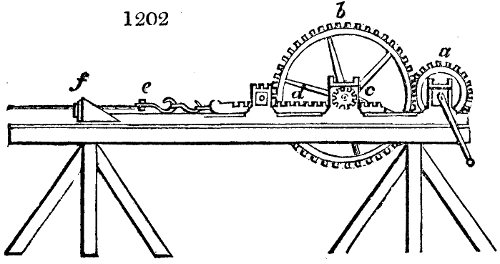
Fig. 1202. represents a convenient form of the draw-bench, where the power is applied by a toothed wheel, pinion, and rack-work, moved by the hands of one or two men working at a winch; the motion being so regulated by a fly-wheel, that it does not proceed in fits and starts, and cause inequalities in the wire. The metal requires to be annealed, now and then, between successive drawings, otherwise it would become too hard and brittle for further extension. The reel upon which it is wound is sometimes mounted in a cistern of sour small beer, for the purpose of clearing off, or loosening at least, any crust of oxide formed in the annealing, before the wire enters the draw-plate.
When, for very accurate purposes of science or the arts, a considerable length of uniform wire is to be drawn, a plate with one or more jewelled holes, that is, filled with one or more perforated rubies, sapphires, or chrysolites, can alone be trusted to, because the holes even in the best steel become rapidly wider by the abrasion. Through a hole in a ruby 0·0033 of an inch in diameter, a silver wire 170 miles long has been drawn, which possessed at the end, the very same section as at the beginning; a result determined by weighing portions of equal length, as also by measuring it with a micrometer. The hole in an ordinary draw-plate of soft steel becomes so wide, by drawing 14,000 fathoms of brass wire, that it requires to be narrowed before the original sized wire can be again obtained.
Wire, by being diminished one-half, one-third, one-fourth, &c., in diameter, is augmented in length respectively, four, nine, sixteen times, &c. The speed with which it may be prudently drawn out, depends upon the ductility and tenacity of the metal; but may be always increased the more the wire becomes attenuated, because its particles progressively assume more and more of the filamentous form, and accommodate themselves more readily to the extending force. Iron and brass wires, of 0·3 inch in diameter, bear drawing at the rate of from 12 to 15 inches per second; but when of 0·025 (1⁄40) of an inch, at the rate of from 40 to 45 inches in the same time. Finer silver and copper wire may be extended from 60 to 70 inches per second.
By enclosing a wire of platinum within one of silver ten times thicker, and drawing down the compound wire till it be 1⁄300 of an inch, a wire of platinum of 1⁄3000 of an inch, will exist in its centre, which may be obtained apart, by dissolving the silver away in nitric acid. This pretty experiment was first made by Dr. Wollaston.
The French draw-plates are so much esteemed, that one of the best of them used to be sold in this country, during the late war, for its weight in silver. The holes are formed with a steel punch; being made large on that side where the wire enters, and diminishing with a regular taper to the other side. In the act of drawing, they must be well supplied with grease for the larger kinds of wire, and with wax for the smaller.
WOAD (Vouëde, Pastel, Fr.; Waid, Germ; Isatis tinctoria, Linn.); the glastum of the antient Gauls and Germans; is an herbaceous plant which was formerly much cultivated, as affording a permanent blue dye, but it has been in modern times well nigh superseded by indigo. Pliny says, “A certain plant which resembles plantago, called glastum, is employed by the women and girls in Great Britain for dyeing their bodies all over, when they assist at certain religious ceremonies; they have then the colour of Ethiopians.”—Hist. Nat. cap. xxii. § 2.
When the arts, which had perished with the Roman empire, were revived, in the middle ages, woad began to be generally used for dyeing blue, and became an object of most extensive cultivation in many countries of Europe. The environs of Toulouse and Mirepoix, in Upper Languedoc, produced annually 40,000,000 pounds of the prepared woad, or pastel, of which 200,000 bales were consumed at Bordeaux. Beruni, a rich manufacturer of this drug, became surety for the payment of the ransom of his king, Francis I., then the prisoner of Charles V. in Spain.
The leaves of woad are fermented in heaps, to destroy certain vegetable principles injurious to the beauty of the dye, as also to elaborate the indigoferous matter present, before they are brought into the market; but they should be carefully watched during this process. Whenever the leaves have arrived at maturity, a point judged of very differently in different countries, they are stripped off the plant, a cropping which is repeated as often as they shoot, being three or four times in Germany, and eight or ten times in Italy. The leaves are dried as quickly as possible, but not so much as to become black; and they are ground before they get quite dry. The resulting paste is laid upon a sloping pavement, with gutters for conducting the juice which exudes into a tank; the heap being tramped from time to time, to promote the discharge of the juice. The woad ferments, swells, and cracks in many places, which fissures must be closed; the whole being occasionally watered. The fermentation is continued for twenty or thirty days, in cold weather; and if the leaves have been gathered dry, as in Italy, for four months. When the fermented heap has become moderately dry, it is ground again, and put up in cakes of from one to three pounds; which are then fully dried, and packed up in bundles for the market. Many dyers subject the pastel to a second fermentation.
1,600 square toises (fathoms) of land afford in two cuttings at least 19,000 pounds of leaves, of which weight four-fifths are lost in the fermentation, leaving 3,880 pounds of pastel, in loaves or cakes. When good, it has rather a yellow, or greenish-yellow, than a blue colour; it is light, and slightly humid; it gives to paper a pale-green trace; and improves by age, in consequence of an obscure fermentation; for if kept four years, it dyes twice as much as after two years. According to Hellot, 4 pounds of Guatimala indigo produce the same effect as 210 pounds of the pastel of Albi. At Quins, in Piedmont, the dyers estimate that 6 pounds of indigo are equivalent to 300 of pastel; but Chaptal thinks the indigo underrated.
Pastel will dye blue of itself, but it is commonly employed as a fermentative addition to the proper blue vat, as described under Indigo.
Fresh woad, analyzed by Chevreul, afforded, in 100 parts, 65·4 of juice. After being steeped in water, the remaining mass yielded, on expression, 29·65 of liquid; being in whole, 95·05 parts, leaving 4·95 of ligneous fibre. The juice, by filtration, gave 1·95 of green fecula. 100 parts of fresh woad, when dried, are reduced to 13·76 parts. Alcohol, boiled upon dry woad, deposits, after cooling, indigo in microscopic needles; but these cannot be separated from the vegetable albumine, which retains a greenish-gray colour.
WOLFRAM, is the native tungstate of iron and manganese, a mineral which occurs in primitive formations, along with the ores of tin, antimony, and lead, in the Bohemian Erzgebirge, in Cornwall, Switzerland, North America, &c. It is used by chemists for obtaining tungstic acid and tungsten.
WOOD (Bois, Fr.; Holz, Germ.); is the hard but porous tissue between the pith and the bark of trees and shrubs, through which the chief part of the juices are conducted from the root towards the branches and leaves, during the life of the vegetable. The ligneous fibre is the substance which remains, after the plant has been subjected to the solvent action of ether, alcohol, water, dilute acids, and caustic alkaline lyes. It is considered by chemists that dry timber consists, on an average, of 96 parts of fibrous, and 4 of soluble matter, in 100; but that these proportions vary somewhat with the seasons, the soil, and the plant. All kinds of wood sink in water, when placed in a basin of it under the exhausted receiver of an air-pump; showing their specific gravity to be greater than 1·000. That of fir and maple is stated, by chemical authors, to be 1·46; and that of oak and beech, at 1·53; but I believe them to have all the same spec. grav. as the fibre of flax; namely, 1·50, as determined by me some years ago.[71]
Wood becomes snow-white, when exposed to the action of chlorine; digested with sulphuric acid, it is transformed first into gum, and, by ebullition with water, afterwards into grape-sugar; with concentrated nitric acid, it grows yellow, loses its coherence, falls into a pulverulent mass, but eventually dissolves, and is converted into oxalic acid; with strong caustic alkaline lyes, in a hot state, it swells up excessively, dissolves into a homogeneous liquid, and changes into a blackish-brown mass, containing oxalic and acetic acids.
The composition of wood has been examined by Gay Lussac and Thenard, and Dr. Prout. The first two chemists found it to consist, in 100 parts, of—
Oak. Beech.
Carbon 52 ·53 51 ·45
Hydrogen 5 ·69 5 ·82
Oxygen 41 ·78 42 ·73
According to Dr. Prout, the oxygen and hydrogen are in the exact proportions to form water. Willow contains 50, and box 49·8 per cent. of carbon; each containing, therefore, very nearly 44·444 of oxygen, and 5·555 of hydrogen. In the analyses of Gay Lussac and Thenard, there is a great excess of hydrogen above what the oxygen requires to form water. Authenrieth stated, some years ago, that he found that fine sawdust, mixed with a sufficient quantity of wheat flour, made a coherent dough with water, which formed an excellent food for pigs; apparently showing that the digestive organs of this animal could operate the same sort of change upon wood as sulphuric acid does.
Table of the Distillation of One Pound of Wood, dried, at 86° Fahr.
Name of the wood. Weight of wood acid. One ounce of the acid saturates of carbonate of potash. Weight of the combustible oil. Weight of the charcoal.
Ounces. Grains. Ounces. Ounces.
White birch 7 44 1 1⁄4 3 3⁄4
Red beech 7 44 1 1⁄2 3 3⁄4
Prick wood (spindle tree) 7 1⁄2 40 1 3⁄4 3 1⁄2
Large leaved linden 6 3⁄4 41 2 3 3⁄4
Red or scarlet oak 7 40 1 1⁄2 4 1⁄4
White beech 6 1⁄2 40 1 3⁄4 3 3⁄4
Common ash 7 1⁄2 34 1 1⁄2 3 1⁄2
Horse chestnut 7 1⁄2 31 1 1⁄2 3 1⁄2
Italian poplar 7 1⁄4 30 1 1⁄2 3 3⁄4
Silver poplar 7 1⁄4 30 1 1⁄4 3 3⁄4
White willow 7 1⁄4 28 1 1⁄2 3 1⁄2
Root of the sassafras laurel 6 3⁄4 29 1 3⁄4 4 1⁄4
Wild service tree 7 28 1 3⁄4 3 1⁄2
Basket willow 8 27 1 1⁄2 3 1⁄2
Dogberry tree 7 27 2 3 1⁄2
Buckthorn 7 1⁄2 26 1 1⁄2 3 1⁄2
Logwood 7 3⁄4 26 1 1⁄2 4
Alder 7 1⁄4 22 1 1⁄2 3 1⁄2
Juniper 7 1⁄4 23 1 3⁄4 3 1⁄2
White fir (deal) 6 1⁄2 23 2 1⁄4 3 1⁄2
Common pine wood 6 3⁄4 22 1 3⁄4 3 1⁄2
Savine tree 7 20 1 3⁄4 3 3⁄4
Red deal (pine) 6 1⁄2 18 2 1⁄4 3 3⁄4
Guiac wood 6 16 2 1⁄2 4 1⁄4
WOOF, is the same as Weft.
WOOLLEN MANUFACTURE. In reference to textile fabrics, sheep’s wool is of two different sorts, the short and the long stapled; each of which requires different modes of manufacture in the preparation and spinning processes, as also in the treatment of the cloth after it is woven, to fit it for the market. Each of these is, moreover, distinguished in commerce by the names of fleece wools and dead wools, according as they have been shorn at the usual annual period from the living animal, or are cut from its skin after death. The latter are comparatively harsh, weak, and incapable of imbibing the dyeing principles, more especially if the sheep has died of some malignant distemper. The annular pores, leading into the tubular cavities of the filaments, seem, in this case, to have shrunk and become obstructed. The time of year for sheep-shearing most favourable to the quality of the wool, and the comfort of the animal, is towards the end of June and beginning of July;—the period when Lord Leicester holds his celebrated rural fête for that interesting purpose.
The wool of the sheep has been surprisingly improved, by its domestic culture. The mouflon (Ovis aries), the parent stock from which our sheep is undoubtedly derived, and which is still found in a wild state upon the mountains of Sardinia, Corsica, Barbary, Greece, and Asia Minor, has a very short and coarse fleece, more like hair than wool. When this animal is brought under the fostering care of man, the rank fibres gradually disappear; while the soft wool round their roots, little conspicuous in the wild animal, becomes singularly developed. The male most speedily undergoes this change, and continues ever afterwards to possess far more power in modifying the fleece of the offspring, than the female parent. The produce of a breed from a coarse-woolled ewe, and a fine-woolled ram, is not of a mean quality between the two, but half-way nearer that of the sire. By coupling the female thus generated, with such a male as the former, another improvement of one-half will be obtained, affording a staple three-fourths finer than that of the grandam. By proceeding inversely, the wool would be as rapidly deteriorated. It is, therefore, a matter of the first consequence in wool husbandry, to exclude from the flock all coarse-fleeced rams.
Long wool is the produce of a peculiar variety of sheep, and varies in the length of its fibres from 3 to 8 inches. Such wool is not carded like cotton, but combed like flax, either by hand or appropriate machinery. Short wool is seldom longer than 3 or 4 inches; it is susceptible of carding and felting, by which processes the filaments become first convoluted, and then densely matted together. The shorter sorts of the combing wool are used principally for hosiery, though of late years the finer kinds have been extensively worked up into merino and mousseline-de-laine fabrics. The longer wools of the Leicestershire breed are manufactured into hard yarns, for worsted pieces, such as waistcoats, carpets, bombasines, poplins, crapes, &c.
The wool of which good broad cloth is made, should be not only shorter, but, generally speaking, finer and softer than the worsted wools, in order to fit them for the fulling process. Some wool-sorters and wool-staplers acquire by practice great nicety of discernment in judging of wools by the touch and traction of the fingers. Two years ago, I made a series of observations upon different wools, and published the results. The filaments of the finer qualities varied in thickness from 1⁄1100 to 1⁄1500 of an inch; their structure is very curious, exhibiting, in a good achromatic microscope, at intervals of about 1⁄300 of an inch, a series of serrated rings, imbricated towards each other, like the joints of Equisetum, or rather like the scaly zones of a serpent’s skin. See Philosophy of Manufactures, figs. 11, 12., page 91. second edition.
There are four distinct qualities of wool upon every sheep; the finest being upon the spine, from the neck to within 6 inches of the tail, including one-third of the breadth of the back; the second covers the flanks between the thighs and the shoulders; the third clothes the neck and the rump; and the fourth extends upon the lower part of the neck and breast down to the feet, as also upon a part of the shoulders and the thighs, to the bottom of the hind quarter. These should be torn asunder, and sorted, immediately after the shearing.
The harshness of wools is dependent not solely upon the breed of the animal, or the climate, but is owing to certain peculiarities in the pasture, derived from the soil. It is known, that in sheep fed upon chalky districts, wool is apt to get coarse; but in those upon a rich loamy soil, it becomes soft and silky. The ardent sun of Spain renders the fleece of the Merino breed harsher than it is in the milder climate of Saxony. Smearing sheep with a mixture of tar and butter, is deemed favourable to the softness of their wool.
All wool, in its natural state, contains a quantity of a peculiar potash-soap, secreted by the animal, called in this country the yolk; which may be washed out by water alone, with which it forms a sort of lather. It constitutes from 25 to 50 per cent. of the wool, being most abundant in the Merino breed of sheep; and however favourable to the growth of the wool on the living animal, should be taken out soon after it is shorn, lest it injure the fibres by fermentation, and cause them to become hard and brittle. After being washed in water, somewhat more than lukewarm, the wool should be well pressed, and carefully dried. England grows annually about 1,000,000 packs of wool, and imports 100,000 bags.
Wool imported into the United Kingdom, in 1836, 64,239,977 lbs.; in 1837, 48,356,121 lbs. Retained for home consumption, in 1836, 60,724,795 lbs.; in 1837, 43,148,297 lbs. Duty received, in 1836, £190,075; in 1837, £118,519.
Having premised these general observations on wool, I shall now proceed to treat of its manufacture, beginning with that of wool-combing, or
THE WORSTED MANUFACTURE.
In this branch of business, a long stapled and firm fibre is required to form a smooth level yarn, little liable to shrink, curl, or felt in weaving and finishing the cloth. It must not be entangled by carding, but stretched in lines as parallel as possible, by a suitable system of combing, manual or mechanical.
When the long wool is brought into the worsted factory, it is first of all washed by men with soap and water, who are paid for their labour by the piece, and are each assisted by a boy, who receives the wool as it issues from between the drying squeezers (see Bleaching). The boy carries off the wool in baskets, and spreads it evenly upon the floor of the drying-room, usually an apartment over the boilers of the steam-engine, which is thus economically heated to the proper temperature. The health of the boys employed in this business is found to be not at all injured.
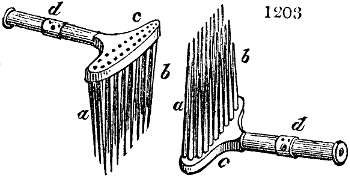
The wool, when properly dried, is transferred to a machine called the plucker, which is always superintended by a boy of 12 or 14 years of age, being very light work. He lays the tresses of wool pretty evenly upon the feed-apron, or table covered with an endless moving web of canvas, which, as it advances, delivers the ends of the long tufts to a pair of fluted rollers, whence it is introduced into a fanning apparatus, somewhat similar to the willow employed in the cotton manufacture, which see. The filaments are turned out, at the opposite end of this winnowing machine, straightened, cleaned, and ready for the combing operation. According to the old practice of the trade, and still for the finer descriptions of the long staple, according to the present practice, the wool is carded by hand. This is far more severe labour than any subservient to machinery, and is carried on in rooms rendered close and hot by the number of stoves requisite to heat the combs, and so enable them to render the fibres soft, flexible, and elastic. This is a task at which only robust men are engaged. They use three implements: 1. a pair of combs for each person; 2. a post, to which one of the combs can be fixed; 3. a comb-pot, or small stove for heating the teeth of the combs. Each comb is composed either of two or three rows of pointed tapering steel teeth, b, fig. 1203., disposed in two or three parallel planes, each row being a little longer than the preceding. They are made fast at the roots to a wooden stock or head c, which is covered with horn, and has a handle d, fixed into it at right angles to the lines of the teeth. The spaces between these two or three planes of teeth, is about one-third of an inch at their bottoms, but somewhat more at their tips. The first combing, when the fibres are most entangled, is performed with the two-row toothed combs; the second or finishing combing, with the three-row toothed.
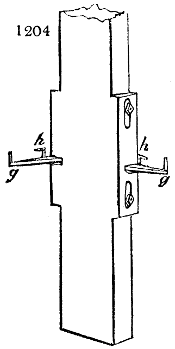
In the workshop a post is planted (fig. 1204.) upright, for resting the combs occasionally upon, during the operation. An iron stem g, projects from it horizontally, having its end turned up, so as to pass through a hole in the handle of the comb. Near its point of insertion into the post, there is another staple point h, which enters into the hollow end of the handle; which, between these two catches, is firmly secured to the post. The stove is a very simple affair, consisting merely of a flat iron plate, heated by fire or steam, and surmounted with a similar plate, at an interval sufficient to allow the teeth to be inserted between them at one side, which is left open, while the space between their edges, on the other sides, is closed to confine the heat.
In combing the wool, the workman takes it up in tresses of about four ounces each, sprinkles it with oil, and rolls it about in his hands, to render all the filaments equally unctuous. Some harsh dry wools require one-sixteenth their weight of oil, others no more than a fortieth. He next attaches a heated comb to the post, with its teeth pointed upwards, seizes one-half of the tress of wool in his hands, throws it over the teeth, then draws it through them, and thus repeatedly: leaving a few straight filaments each time upon the comb. When the comb has in this way collected all the wool, it is placed with its points inserted into the cell of the stove, with the wool hanging down outside, exposed to the influence of the heat. The other comb, just removed in a heated state from the stove, is planted upon the post, and furnished in its turn with the remaining two-ounce tress of wool; after which it supplants the preceding at the stove. Having both combs now hot, he holds one of them with his left hand over his knee, being seated upon a low stool, and seizing the other with his right hand, he combs the wool upon the first, by introducing the teeth of one comb into the wool stuck in the other, and drawing them through it. This manipulation is skilfully repeated, till the fibres are laid truly parallel, like a flat tress of hair. It is proper to begin by combing the tips of the tress, and to advance progressively, from the one end towards the other, till at length the combs are worked with their teeth as closely together as is possible, without bringing them into collision. If the workman proceeded otherwise, he would be apt to rupture the filaments, or tear their ends entirely out of one of the combs. The flocks left at the end of the process, because they are too short for the comber to grasp them in his hand, are called noyls. They are unfit for the worsted spinner, and are reserved for the coarse cloth manufacture.
The wool finally drawn off from the comb, though it may form a uniform tress of straight filaments, must yet be combed again at a somewhat lower temperature, to prepare it perfectly for the spinning operation. From ten to twelve slivers are then arranged in one parcel.
To relieve the workman from this laborious and not very salubrious task, has been the object of many mechanical inventions. One of these, considerably employed in this country and in France, is the invention of the late Mr. John Collier, of Paris, for which a patent was obtained in England, under the name of John Platt, of Salford, in November, 1827. It consists of two comb-wheels, about ten feet in diameter, having hollow iron spokes filled with steam, in order to keep the whole apparatus at a proper combing heat. The comb forms a circle, made fast to the periphery of the wheel, the teeth being at right angles to the plane of the wheel. The shafts of the two wheels are mounted in a strong frame of cast iron; not, however, in horizontal positions, but inclined at acute angles to the horizon, and in planes crossing each other, so that the teeth of one circular comb sweep with a steady obliquity over the teeth of the other, in a most ingenious manner, with the effect of combing the tresses of wool hung upon them. The proper quantity of long wool, in its ordinary state, is stuck in handfuls upon the wheel, revolving slowly, by a boy, seated upon the ground at one side of the machine. Whenever the wheel is dressed, the machine is made to revolve more rapidly, by shifting its driving-band on another pulley; and it is beautiful to observe the delicacy and precision with which it smoothes the tangled tress. When the wools are set in rapid rotation, the loose ends of the fleece, by the centrifugal force, are thrown out, in the direction of radii, upon the teeth of the other revolving comb-wheel, so as to be drawn out and made truly straight. The operation commences upon the tips of the tresses, where the wheels, by the oblique posture of their shafts, are at the greatest distance apart; but as the planes slowly approach to parallelism, the teeth enter more deeply into the wool, till they progressively comb the whole length of its fibres. The machines being then thrown out of geer, the teeth are stript of the tresses by the hand of the attendant; the noyls, or short refuse wool, being also removed, and kept by itself.
This operation being one of simple superintendence, not of handicraft effort and skill, like the old combing of long wool, is now performed by boys or girls of 13 and 14 years of age; and places in a striking point of view the influence of automatic mechanism, in so embodying dexterity and intelligence in a machine, as to render the cheap and tractable labour of children a substitute for the high-priced and often refractory exertions of workmen too prone to capricious combinations. The chief precaution to be taken with this machine, is to keep the steam-joints tight, so as not to wet the apartments, and to provide due ventilation for the operatives.
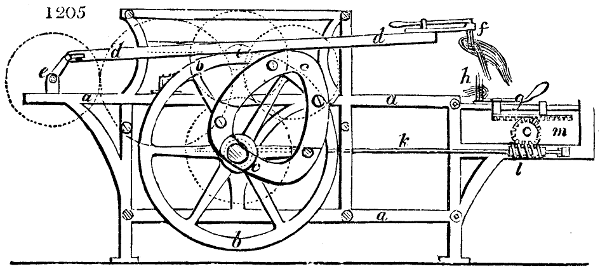
The following machine, patented by James Noble, of Halifax, worsted-spinner, in February, 1834, deserves particular notice, as its mode of operation adapts it well also for heckling flax. In fig. 1205. the internal structure is exhibited. The frame-work a, a, supports the axle of a wheel b, b, in suitable bearings on each side. To the face of this wheel is affixed the eccentric or heart-wheel cam c, c. On the upper part of the periphery of this cam or heart-wheel, a lever d, d, bears merely by its gravity; one end of which lever is connected by a joint to the crank e. By the rotation of the crank e, it will be perceived that the lever d, will be slidden to and fro on the upper part of the periphery of the eccentric or heart-wheel cam c, the outer end of the lever d, carrying the upper or working comb or needle-points f, as it moves, performing an elliptical curve, which curve will be dependent upon the position of the heart-wheel cam c, that guides it. A movable frame g, carries a series of points h, which are to constitute the lower comb or frame of needles. Into these lower needles the rough uncombed wool is to be fed by hand, and to be drawn out and combed straight by the movements of the upper or working comb.
As it is important, in order to prevent waste, that the ends of the wool should be first combed out, and that the needle-points should be made to penetrate the wool progressively, the movable frame g, is in the first instance placed as far back as possible; and the action of the lever d, during the whole operation, is so directed by the varying positions of the cam-wheel, as to allow the upper comb to enter at first a very little way only into the wool; but as the operation of combing goes on, the frame with the lower combs is made to advance gradually, and the relative positions of the revolving heart cam-wheel c, being also gradually changed, the upper or working needles are at length allowed to be drawn completely through the wool, for the purpose of combing out straight the whole length of its fibre.
In order to give to the machine the necessary movements, a train of toothed wheels and pinions is mounted, mostly on studs attached to the side of the frame; which train of wheels and pinions is shown by dots in the figure, to avoid confusion. The driving power, a horse or steam-engine, is communicated by a band to a rigger on the short axle i; which axle carries a pinion, taking into one of the wheels of the train. From this wheel the crank e, that works the lever d, is driven; and also, by geer from the same pinion, the axle of the wheel b, carrying the eccentric or heart-wheel cam, is also actuated, but slower than the crank-axle.
At the end of the axle of the wheel b, and cam c, a bevel pinion is affixed, which geers into a corresponding bevel pinion on the end of the lateral shaft k. The reverse end of this shaft has a worm or endless screw l, taking into a toothed wheel m; and this last-mentioned toothed wheel geers into a rack at the under part of the frame g.
It will hence be perceived, that by the movements of the train of wheels, a slow motion is given to the frame g, by which the lower needles carrying the wool are progressively advanced as the operation goes on; and also, that by the other wheels of the train, the heart-wheel cam is made to rotate, for the purpose of giving such varying directions to the stroke of the lever which slides upon its periphery, and to the working comb, as shall cause the comb to operate gradually upon the wool as it is brought forward. The construction of the frames which hold the needles, and the manner of fixing them in the machine, present no features of importance; it is therefore unnecessary to describe them farther, than to say, that the heckles are to be heated when used for combing wool. Instead of introducing the wool to be combed into the lower needles by hand, it is sometimes fed in, by means of an endless feeding-cloth, as shown in fig. 1206. This endless cloth is distended over two rollers, which are made to revolve, for the purpose of carrying the cloth with the wool forward, by means of the endless screw and pinions.
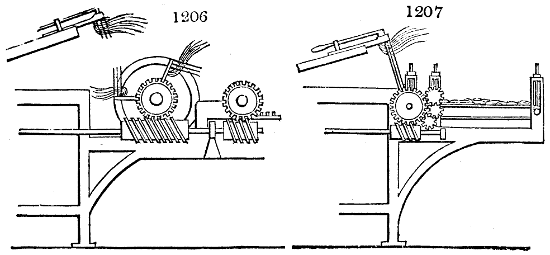
A slight variation in the machine is shown at fig. 1207., for the purpose of combing wool of long fibre, which differs from the former only in placing the combs or needle points upon a revolving cylinder or shaft. At the end of the axle of this shaft, there is a toothed wheel, which is actuated by an endless screw upon a lateral shaft. The axle of the cylinder on which the needles are fixed, is mounted in a movable frame or carriage, in order that the points of the needles may, in the first instance, be brought to act upon the ends of the wool only, and ultimately be so advanced as to enable the whole length of the fibres to be drawn through. The progressive advancement of this carriage, with the needle cylinder, is effected by the agency of the endless screw on the lateral shaft before mentioned.
Some combing-machines reduce the wool into a continuous sliver, which is ready for the drawing-frame; but the short slivers produced by the hand combing, must be first joined together, by what is called planking. These slivers are rolled up by the combers ten or twelve together, in balls called tops, each of which weighs half a pound. At the spinning-mill these are unrolled, and the slivers are laid on a long plank or trough, with the ends lapping over, in order to splice the long end of one sliver into the short end of another. The long end is that which was drawn off first from the comb, and contains the longer fibres; the short is that which comes last from the comb, and contains the shorter. The wool-comber lays all the slivers of each ball the same way, and marks the long end of each by twisting up the end of the sliver. It is a curious circumstance, that when a top or ball of slivers is unrolled and stretched out straight, they will not separate from each other without tearing and breaking, if the separation is begun at the short ends; but if they are first parted at the long ends, they will readily separate.
The machine for combing long wool, for which Messrs. Donisthorpe and Rawson obtained a patent in April, 1835, has been found to work well, and therefore merits a detailed description:—
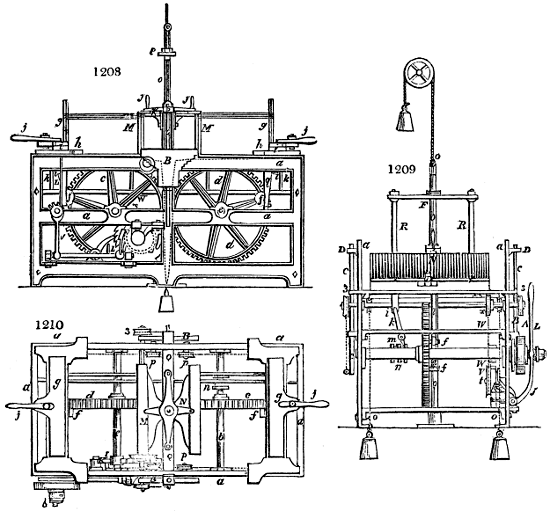
Figs. 1208-1210 enlarged (262 kB)
Fig. 1208. is an elevation; fig. 1209. an end view; and fig. 1210. a plan; in which a, a, is the framing; b, the main shaft, bearing a pinion which drives the wheel and shaft c, in geer with the wheel d, on the shaft e. Upon each of the wheels c and d, there are two projections or studs f, which cause the action of the combs g, g, of which h, h, are the tables or carriages. These are capable of sliding along the upper guide rails of the framing a. Through these carriages or tables h, h, there are openings or slits, shown by dotted lines, which act as guides to the holders i, i, of the combs g, g, rendering the holders susceptible of motion at right angles to the course pursued by the tables h. The combs are retained in the holders i, i, by means of the lever handles j, j, which move upon inclined surfaces, and are made to press on the surface of the heads of the combs g, g, so as to be retained in their places; and they are also held by studs affixed to the holders, which pass into the comb-heads. From the under side of the tables, forked projections i, i, stand out, which pass through the openings or slits formed in the tables h h; these projections are worked from side to side by the frame k, k, which turning on the axis or shaft l, l, is caused to vibrate, or rock to and fro, by the arms m, moved by the eccentric groove n, made fast to the shaft e. The tables h, are drawn inwards, by weights suspended on cords or straps o, o, which pass over friction pulleys p, p; whereby the weights have a constant tendency to draw the combs into the centre of the machine, as soon as it is released by the studs f, passing beyond the projecting arms g, on the tables. On the shaft c, a driving-tooth or catch r, is fixed, which takes into the ratchet wheel s, and propels one of its teeth at every revolution of the shaft c. This ratchet wheel turns on an axis at t; to the ratchet the pulley v is made fast, to which the cord or band w is secured, as also to the pulley x, on the shaft y. On the shaft y, there are two other pulleys z, z, having the cords or bands A, A, made fast to them, and also to the end of the gauge-plates B, furnished with graduated steps, against which the tables h, h, are drawing at each operation of the machine. In proportion as these gauge-plates are raised, the nearer the carriages or tables h, will be able to advance to the centre of the machine, and thus permit the combs g, g, to lay hold of, and comb, additional lengths of the woolly fibres. The gauge-plates B, are guided up by the bars C, which pass through openings, slots, or guides, made in the framing a, as shown by D.
To the ratchet wheel s, an inclined projection E, is made fast, which in the course of the rotation of the ratchet wheel, comes under the lever F, fixed to the shaft G, that turns in bearings H. To this shaft the levers I and J, are also fixed; I serving to throw out the click or catch K, from the ratchet wheel, by which the parts of the machine will be released, and restored to positions ready for starting again. The lever J, serves to slide the drum upon the driving shaft b, out of geer, by means of the forked handle L, when the machine is to be stopped, whenever it has finished combing a certain quantity of wool. The combs which hold the wool have a motion upwards, in order to take the wool out of the way of the combs g, g, as these are drawn into the centre of the machine; while the holding combs descend to lay the wool among the points of the combs g, g. For obtaining this upward and downward motion, the combs M, M, are placed upon the frame N, and retained there just as the combs g, g, are upon the holders i, i. The framing N is made fast to the bar or spindle O, which moves vertically through openings in the cross-head P, and the cross-framing of the machine Q; from the top of which, there is a strap passes over pulleys with a weight suspended to it; the cross-head being supported by the two guide-rods R, fixed to the cross-framing Q. It is by the guide-rods R, and the spindle O, that the frame N is made to move up and down; while the spindle is made to rise by the studs f, as the wheels c and d come successively under the studs s, on the spindle O.
A quantity of wool is to be placed on each of the combs g, g, and M, M, the machine being in the position shown in fig. 1210. When the main shaft b, is set in motion, it will drive by its pinion the toothed wheel c, and therefrom the remaining parts of the machine. The first effect of the movement will be to raise the combs M, M, sufficiently high to remove the wool out of the way of the combs g, g, which will be drawn towards the centre of the machine, as soon as they are released by the studs f, passing the projecting arms q, on the tables h; but the distance between the combs g, g, and the combs H, H, will depend on the height to which the gauge-plates B, have been raised. These plates are raised one step at each revolution of the shaft c; the combs g, g, will therefore be continually approaching more nearly to the combs M, M, till the plates B, are so much raised as to permit the tables h, to approach the plates B, below the lowest step or graduation, when the machine will continue to work. Notwithstanding the plates B, continuing to rise, there being only parallel surfaces against which the tables come, the combs g, g, will successively come to the same position, till the inclined projection E, on the ratchet wheel s, comes under the lever F, which will stop the machine. The wool which has been combed, is then to be removed, and a fresh quantity introduced. It should be remarked, that the combs g, g, are continually moving from side to side of the machine, at the same time that they are combing out the wool. The chief object of the invention is obviously to give the above peculiar motions to the combs g, g, and M, M; which may be applied also to combing goat-hair.
For the purposes of the worsted manufacture, wool should be rendered inelastic to a considerable degree, so that its fibres may form long lines, capable of being twisted into straight level yarn. Mr. Bayliffe, of Kendal, has sought to accomplish this object, first, by introducing into the drawing machine a rapidly revolving wheel, in contact with the front drawing roller, by whose friction the filaments are heated, and at the same time deprived of their curling elasticity; secondly, by employing a movable regulating roller, by which the extent of surface on the periphery of the wheel that the lengths of wool is to act upon, may be increased or diminished at pleasure, and, consequently, the effect regulated or tempered as the quality of the wool may require; thirdly, the employment of steam in a rotatory drum, or hollow wheel, in place of the wheel first described, for the purpose of heating the wool, in the process of drawing, in order to facilitate the operation of straightening the fibres.
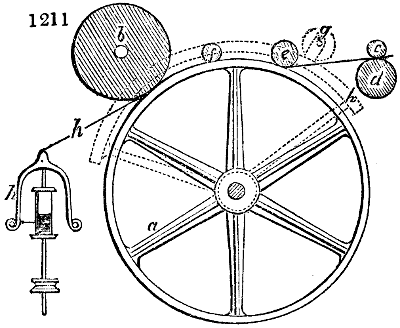
These objects may be effected in several ways; that is, the machinery may be variously constructed, and still embrace the principles proposed. Fig. 1211. shows one mode:—a, is the friction wheel; b, the front drawing roller, placed in the drawing frame in the same way as usual; the larger wheel a, constituting the lower roller of the pair of front drawing rollers; c, and d, are the pair of back drawing rollers, which are actuated by geer connected to the front rollers, as in the ordinary construction of drawing machines, the front rollers moving very considerably faster than the back rollers, and, consequently, drawing or extending the fibres of the sliver of wool, as it passes through between them; e, is a guide roller, bearing upon the periphery of the large wheel; f, is a tension roller, which presses the fibres of the wool down upon the wheel a.
Now, supposing the back rollers c and d to be turned with a given velocity, and the front roller b to be driven much faster, the effect would be, that the fibres of wool constituting the sliver, passing through the machine, would be considerably extended between b and d, which is precisely the effect accomplished in the ordinary drawing frame; but the wheel a, introduced into the machine in place of the lower front drawing roller, being made to revolve much faster than b, the sliver of wool extended over the upper part of its periphery from b, to the tension roller f, will be subjected to very considerable friction from the contact; and, consequently, the natural curl of the wool will be taken out, and its elasticity destroyed, which will enable the wool to proceed in a connected roving down to the spindle or flyer h, where it becomes twisted or spun into a worsted thread.
In order to increase or diminish the extent to which the fibres of wool are spread over the periphery of the wheel a, a regulating roller is adapted to the machine, as shown at g, in place of the tension roller f. This regulating roller g, is mounted by its pivots in bearings on the circular arms h, shown by dots. These circular arms turn loosely upon the axle of the wheel a, and are raised or depressed by a rack and a winch, not shown in the figure; the rack taking into teeth on the periphery of the circular arms. It will hence be perceived, that by raising the circular arms, the roller g, will be carried backward, and the fibres of wool pressed upon the periphery of the wheel to a greater extent. On the contrary, the depression of the circular arms will draw the roller g, forward, and cause the wool to be acted upon by a smaller portion of the periphery of the wheel a, and consequently subject it to less friction.
When it is desired to employ steam for the purpose of heating the wool, the wheel a, is formed as a hollow drum, and steam from a boiler, in any convenient situation, is conveyed through the hollow axle to the interior of the drum, which, becoming heated by that means, communicates heat also to the wool, and thereby destroys its curl and elasticity.
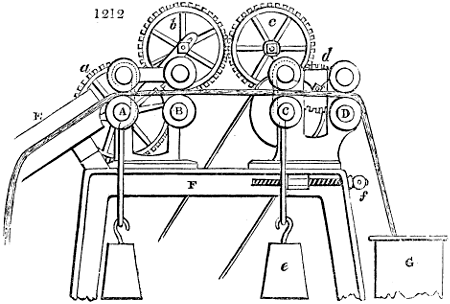
Breaking-frame.—Here the slivers are planked, or spliced together, the long end of one to the short end of another; after which they are drawn out and extended by the rollers of the breaking-frame. A sketch of this machine is given in fig. 1212. It consists of four pairs of rollers A, B, C, D. The first pair A, receives the wool from the inclined trough E, which is the planking-table. The slivers are unrolled, parted, and hung loosely over a pin, in reach of the attendant, who takes a sliver, and lays it flat in the trough, and the end is presented to the rollers A, which being in motion, will draw the wool in; the sliver is then conducted through the other rollers, as shown in the figure: when the sliver has passed half through, the end of another sliver is placed upon the middle of the first, and they pass through together; when this second is passed half through, the end of a third is applied upon the middle of it, and in this way the short slivers produced by the combing are joined into one regular and even sliver.
The lower roller C receives its motion from the mill, by means of a pulley upon the end of its axis, and an endless strap. The roller which is immediately over it, is borne down by a heavy weight, suspended from hooks, which are over the pivots of the upper roller. The fourth pair of rollers D, moves with the same velocity as C, being turned by means of a small wheel upon the end of the axis of the roller C, which turns a wheel of the same size upon the axis of the roller D, by means of an intermediate wheel d, which makes both rollers turn the same way round. The first and second pairs of rollers, A and B, move only one-third as quick as C and D, in order to draw out the sliver between B and C to three times the length it was when put on the planking-table. The slow motion of the rollers A, is given by a large wheel a, fixed upon the axis of the roller A, and turned by the intermediate cog-wheels b, c, and d; the latter communicates between the rollers C and D. The pinions on the rollers C and D being only one-third the size of the wheel a, C and D turn three times as fast as A, for b, c, and d, are only intermediate wheels. The rollers B turn at the same rate as A. The upper roller C is loaded with a heavy weight, similar to the rollers A; but the other rollers, B and D, are no further loaded than the weight of the rollers.
The two pairs of rollers A, B, and C, D, are mounted in separate frames; and that frame which contains the third and fourth pairs C, D, slides upon the cast-iron frame F, which supports the machine, in order to increase or diminish the distance between the rollers B and C. There is a screw f, by which the frame of the rollers is moved, so as to adjust the machine according to the length of the fibres of the wool. The space between B and C should be rather more than the length of the fibres of the wool. The intermediate wheels b and c, are supported upon pieces of iron, which are movable on centres; the centre for the piece which supports the wheel b is concentric with the axis of the roller A; and the supporting piece for the wheel c is fitted on the centre of the wheel d. By moving these pieces the intermediate wheels b and c can be always kept in contact, although the distance between the rollers is varied at times. By means of this breaking-frame, the perpetual sliver, which is made up by planking the sliver together, is equalized, and drawn out three times in length, and delivered into the can G.
Drawing-frame.—Three of these cans are removed to the drawing-frame, which is similar to the breaking-frame, except that there is no planking-table E. There are five sets of rollers, all fixed upon one common frame F, the breaking-frame, which we have described, being the first. As fast as the sliver comes through one set of rollers, it is received into a can, and then three of these cans are put together, and passed again through another set of rollers. In the whole, the wool must pass through the breaker and four drawing-frames before the roving is begun. The draught being usually four times at each operation of drawing, and three times in the breaking, the whole will be 3 + 4 + 4 + 4 + 4 = 768; but to suit different sorts of wool, the three last drawing-frames are capable of making a greater draught, even to five times, by changing the pinions; accordingly the draught will be 3 + 4 + 5 + 5 + 5 = 1500 times.
The size of the sliver is diminished by these repeated drawings, because only three slivers are put together, and they are drawn out four times; so that, in the whole, the sliver is reduced to a fourth or a ninth of its original bulk.
The breaking-frame and drawing-frame which are used when the slivers are prepared by the combing-machines, are differently constructed; they have no planking-table, but receive three of the perpetual slivers of the combing-machine from as many tin cans, and draw them out from ten to twelve times. In this case, all the four rollers contribute to the operation of drawing: thus the second rollers B, move 21⁄2 times as fast as the rollers A; the third rollers C, move 8 times as fast as A; and the fourth rollers E, move 101⁄2 times as fast as A. In this case, the motion is given to the different rollers by means of bevelled wheels, and a horizontal axis, which extends across the ends of all the four rollers, to communicate motion from one pair of rollers to another.
There are three of these systems of rollers, which are all mounted on the same frame; and the first one through which the wool passes, is called the breaking-frame; but it does not differ from the others, which are called drawing-frames. The slivers which have passed through one system of rollers, are collected four or five together, and put through the drawing-rollers. In all, the slivers pass through three drawings, and the whole extension is seldom less than 1000 times, and for some kinds of wool much greater.
After the drawing of the slivers is finished, a pound weight is taken, and is measured by means of a cylinder, in order to ascertain if the drawing has been properly conducted; if the sliver does not prove of the length proposed, according to the size of worsted which is intended to be spun, the pinions of some of the drawing-frames are changed, to make the draught more or less, until it is found by experiment that one pound of the sliver measures the required length.
Roving-frame.—This is provided with rollers, the same as the drawing-frames: it takes in one or two slivers together, and draws them out four times. By this extension, the sliver becomes so small, that it would break with the slightest force, and it is therefore necessary to give some twist; this is done by a spindle and flyer. See Roving, under Cotton Manufacture.
Spinning-frame.—This is so much like the roving-frame, that a short description will be sufficient. The spindles are more delicate, and there are three pairs of rollers, instead of two; the bobbins, which are taken off from the spindles of the roving-frame, when they are quite full, are stuck upon skewers, and the roving which proceeds from them is conducted between the rollers. The back pair turns round slowly; the middle pair turns about twice for once of the back rollers; and the front pair makes from twelve to seventeen turns for one turn of the back roller, according to the degree of extension which is required.
The spindles must revolve very quickly in the spinning-frame, in order to give the requisite degree of twist to the worsted. The hardest twisted worsted is called tammy warp; and when the size of this worsted is such as to be 20 or 24 hanks to the pound weight, the twist is about 10 turns in each inch of length. The least twist is given to the worsted for fine hosiery, which is from 18 to 24 hanks to the pound. The twist is from 5 to 6 turns per inch. The degree of twist is regulated by the size of the whirls or pulleys upon the spindle, and by the wheel-work which communicates the motion to the front rollers from the band-wheel, which turns the spindles.
It is needless to enter more minutely into the description of the spinning machinery, because the fluted roller construction, invented by Sir Richard Arkwright, fully described under Cotton Manufacture, is equally applicable to worsted. The difference between the two, is chiefly in the distance between the rollers, which, in the worsted-frame, is capable of being increased or diminished at pleasure, according to the length of the fibres of the wool; and the draught or extension of the roving is far greater than in the cotton.
Reeling.—The bobbins of the spinning-frame are placed in a row upon wires before a long horizontal reel, and the threads from 20 bobbins are wound off together. The reel is exactly a yard in circumference, and when it has wound off 80 turns, it rings a bell; the motion of the reel is then stopped, and a thread is passed round the 80 turns or folds which each thread has made. The reeling is then continued till another 80 yards is wound off, which is also separated by interweaving the same thread; each of these separate parcels is called a ley, and when 7 such leys are reeled, it is called a hank, which contains 560 yards. When this quantity is reeled off, the ends of the binding thread are tied together, to bind each hank fast, and one of the rails of the reel is struck to loosen the hanks, and they are drawn off at the end of the reel. These hanks are next hung upon a hook, and twisted up hard by a stick; then doubled, and the two parts twisted together to make a firm bundle. In this state, the hanks are weighed by a small index-machine, which denotes what number of the hanks will weigh a pound, and they are sorted accordingly into different parcels. It is by this means that the number of the worsted is ascertained as the denomination for its fineness: thus No. 24. means, that 24 hanks, each containing 560 yards, will weigh a pound, and so on.
This denomination is different from that used for cotton, because the hank of cotton contains 840 yards, instead of 560; but in some places the worsted hank is made of the same length as the cotton.
To pack up the worsted for market, the proper number of hanks is collected to make a pound, according to the number which has been ascertained; these are weighed as a proof of the correctness of the sorting, then tied up in bundles of one pound each, and four of these bundles are again tied together. Then 60 such bundles are packed up in a sheet, making a bale of 240 pounds, ready for market.
Of the treatment of short wool for the cloth manufacture.—Short wool resembles cotton, not a little in the structure of its filaments, and is cleaned by the willy, as cotton is by the willow, which opens up the matted fleece of the wool-stapler, and cleans it from accidental impurities. Sheep’s wool for working into coarse goods, must be passed repeatedly through this machine, both before and after it is dyed; the second last time for the purpose of blending the different sorts together, and the last for imbuing the fibres intimately with oil. The oiled wool is next subjected to a first carding operation called scribbling, whereby it is converted into a broad thin fleece or lap, as cotton is by the breaker-cards of a cotton mill. The woollen lap is then worked by the cards proper, which deliver it in a narrow band or sliver. By this process the wool expands greatly in all its dimensions; while the broken or short filaments get entangled by crossing in every possible direction, which prepares them for the fulling operation. See Carding, under Cotton Manufacture.
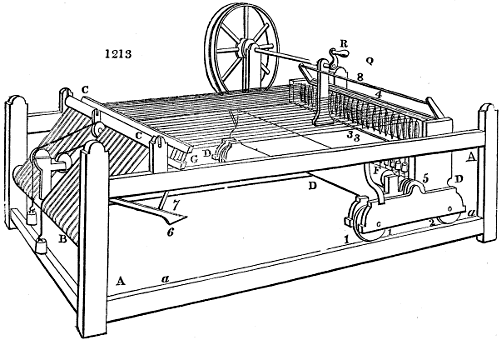
The slubbing machine, or billy, reduces the separate rolls of cardings into a continuous slightly twisted spongy cord, which is sometimes called a roving. Fig. 1213. is a perspective representation of the slubbing machine in most common use. A, A, is the wooden frame; within which is the movable carriage D, D, which runs upon the lower side rails at a, a, on friction wheels at 1, 2, to make it move easily backwards and forwards from one end of the frame to the other. The carriage contains a series of steel spindles, marked 3, 3, which receive rapid rotation from a long tin drum F, by means of a series of cords passing round the pulley or whorl of each spindle. This drum, 6 inches in diameter, is covered with paper, and extends across the whole breadth of the carriage. The spindles are set nearly upright in a frame, and about 4 inches apart; their under ends being pointed conically, turn in brass sockets called steps, and are retained in their position by a small brass collet, which embraces each spindle at about the middle of its length. The upper half of each spindle projects above the top of the frame. The drum revolves horizontally before the spindles, having its axis a little below the line of the whorls; and receives motion, by a pulley at one of its ends, from an endless band which passes round a wheel E, like the large domestic wheel formerly used in spinning wool by hand, and of similar dimensions. This wheel is placed upon the outside of the main frame of the machine, and has its shafts supported by upright standards upon the carriage D. It is turned by the spinner placed at Q, with his right hand applied to a winch R, which gives motion to the drum, and thereby causes the spindles to revolve with great velocity.
Each spindle receives a soft cylinder or carding of wool, which comes through beneath a wooden roller C, C, at the one end of the frame. This is the billy roller, so much talked of in the controversies between the operatives and masters in the cotton factories, as an instrument of cruel punishment to children, though no such machine has been used in cotton mills for half a century at least. These woollen rolls proceed to the series of spindles, standing in the carriage, in nearly a horizontal plane. By the alternate advance and retreat of the carriage upon its railway, the spindles are made to approach to, and recede from, the roller C, with the effect of drawing out a given length of the soft cord, with any desired degree of twist, in the following manner:—
The carding rolls are laid down straight, side by side, upon the endless cloth, strained in an inclined direction between two rollers, one of which is seen at B, and the other lies behind C. One carding is allotted to a spindle; the total number of each in one machine being from 50 to 100. The roller C, of light wood, presses gently with its weight upon the cardings, while they move onwards over the endless cloth, with the running out of the spindle carriage. Immediately in front of the said roller, there is a horizontal wooden rail or bar G, with another beneath it, placed across the frame. The carding is conducted through between these two bars, the movable upper one being raised to let any aliquot portion of the roll pass freely. When this bar is again let down, it pinches the spongy carding fast; whence this mechanism is called the clasp. It is in fact the clove, originally used by Hargreaves in his cotton-jenny. The movable upper rail G, is guided between sliders, and a wire 7, descends from it to a lever C. When the spindle carriage D, D, is wheeled close home to the billy roller, a wheel 5, lifts the end 6 of the lever, which, by the wire 7, raises the upper bar or rail G, so as to open the clasp, and release all the card rolls. Should the carriage be now drawn a little way from the clasp bars, it would tend to pull a corresponding length of the cardings forward from the inclined plane B, C. There is a small catch, which lays hold of the upper bar of the clasp G, and hinders it from falling till the carriage has receded to a certain distance, and has thereby allowed from 7 to 8 inches of the cardings to be taken out. A stop upon the carriage then comes against the catch, and withdraws it; thus allowing the upper rail to fall and pinch the carding, while the carriage, continuing to recede, draws out or stretches that portion of the roll which is between the clasp and the spindle points. But during this time the wheel has been turned to keep the spindles revolving, communicating the proper degree of twist to the cardings in proportion to their extension, so as to prevent them from breaking.
It might be imagined that the slubbing cords would be apt to coil round the spindles; but as they proceed in a somewhat inclined direction to the clasp, they receive merely a twisting motion, continually slipping over the points of the spindles, without getting wound upon them. Whenever the operative or slubber has given a due degree of twist to the rovings, he sets about winding them upon the spindles into a conical shape, for which purpose he presses down the faller-wire 8, with his left hand, so as to bear it down from the points of the spindles, and place it opposite to their middle part. He next makes the spindles revolve, while he pushes in the carriage slowly, so as to coil the slubbing upon the spindle into a conical cop. The wire 8, regulates the winding-on of the whole series of slubbings at once, and receives its proper angle of depression for this purpose from the horizontal rail 4, which turns upon pivots in its ends, in brasses fixed on the standards, which rise from the carriage D. By turning this rail on its pivots, the wire 8 may be raised or lowered in any degree. The slubber seizes the rail 4 in his left hand, to draw the carriage out; but in returning it, he depresses the faller-wire, at the same time that he pushes the carriage before him.
The cardings are so exceedingly tender, that they would readily draw out, or even break, if they were dragged with friction upon the endless cloth of the inclined plane. To save this injurious traction, a contrivance is introduced for moving the apron. A cord is applied round the groove in the middle part of the upper roller, and after passing over pulleys, as shown in the figure, it has a heavy weight hung at the one end, and a light weight at the other, to keep it constantly extended, while the heavy weight tends to turn the rollers with their endless cloth round in such a direction as to bring forward the rovings, without putting any strain upon them. Every time that the carriage is pushed home, the larger weight gets wound up; and when the carriage is drawn out, the greater weight turns the roller, and advances the endless apron, so as to deliver the carding at the same rate as the carriage runs out; but when the proper quantity is delivered, a knot in the rope arrives at a fixed stop, which does not permit it to move any further; while at the same instant the roller 5 quits the lever 6, and allows the upper rail G, of the clasp to fall, and pinch the carding fast; the wheel E, being then set in motion, makes the spindles revolve; and the carriage being simultaneously drawn out, extends the slubbings while under the influence of twisting. In winding up the slubbings, the operative must take care to push in the carriage, and to turn the wheel round at such rates that the spindles will not take up faster than the carriage moves on its railway, or he would injure the slubbings. The machine requires the attendance of a child, to bring the cardings from the card-engine, to place them upon the sloping feed-cloth, and to join the ends of the fresh ones carefully to the ends of the others newly drawn under the roller. Slubbings intended for warp-yarn must be more twisted than those for weft; but each must receive a degree of torsion relative to the quality of the wool and of the cloth intended to be made. In general, however, no more twist should be given to the slubbings than is indispensable for enabling them to be drawn out to the requisite slenderness without breaking. This twist forms no part of the twist of the finished yarn, for the slubbing will be twisted in the contrary direction, when spun afterwards in the jenny or mule.
I may here remark, that various machines have been constructed of late years for making continuous card-ends, and slubbings, in imitation of the carding and roving of the Cotton Manufacture; to which article I therefore refer my readers. The wool slubbings are now spun into yarn, in many factories, by means of the mule. Indeed, I have seen in France the finest yarn, for the mousseline-de-laine fabrics, beautifully spun upon the self-actor mule of Sharp and Roberts.[72]
Tentering.—When the cloth is returned from the fulling-mill (which see), it is stretched upon the tenter-frame, and left in the open air till dry.
In the woollen manufacture, as the cloth suffers, by the operation of the fulling-mill, a shrinkage of its breadth to well nigh one-half, it must at first be woven of nearly double its intended width when finished. Superfine six-quarter broad cloths must therefore be turned out of the loom twelve-quarters wide.
Burling is the name of a process, in which the dried cloth is examined minutely in every part, freed from knots or uneven threads, and repaired by sewing any little rents, or inserting sound yarns in the place of defective ones.
Teasling.—The object of this operation is to raise up the loose filaments of the woollen yarn into a nap upon one of the surfaces of the cloth, by scratching it either with thistle-heads, called teasels, or with teasling-cards or brushes, made of wire. The natural teasels are the balls which contain the seeds of the plant called Dipsacus fullorum; the scales which form the balls, project on all sides, and end in sharp elastic points, that turn downwards like hooks. In teasling by hand, a number of these balls are put into a small wooden frame, having crossed handles, eight or ten inches long; and when thus filled, form an implement not unlike a curry-comb, which is used by two men, who seize the teasel-frame by the handles, and scrub the face of the cloth, hung in a vertical position from two horizontal rails, made fast to the ceiling of the workshop. First, they wet the cloth, and work three times over, by strokes in the direction of the warp, and next of that of the weft, so as to raise all the loose fibres from the felt, and to prepare it for shearing. In large manufactories, this dressing operation is performed by a machine called a gig-mill, which originally consisted, and in most places still consists, of a cylinder bristled all over with the thistle-heads, and made to revolve rapidly while the cloth is drawn over it in a variety of directions. If the thistle be drawn in the line of the warp, the points act more efficaciously upon the weft, being perpendicular to its softer spun yarns. Inventors who have tried to give the points a circular or oblique action between the warp and the weft, proceed apparently upon a false principle, as if the cloth were like a plate of metal, whose substance could be pushed in any direction. Teasling really consists in drawing out one end of the filaments, and leaving the body of them entangled in the cloth; and it should seize and pull them perpendicularly to their length, because in this way it acts upon the ends, which being least implicated, may be most readily disengaged.
When the hooks of the thistles become clogged with flocks of wool, they must be taken out of the frame or cylinder, and cleaned by children with a small comb. Moisture, moreover, softens their points, and impairs their teasling powers; an effect which needs to be counterbalanced, by taking them out, and drying them from time to time. Many contrivances have, therefore, been proposed, in which metallic teasels of an unchangeable nature, mounted in rotatory machines, driven by power, have been substituted for the vegetable, which being required in prodigious quantities, become sometimes excessively scarce and dear in the clothing districts. In 1818, several schemes of that kind were patented in France, of which those of M. Arnold-Merick, and of MM. Taurin frères, of Elbœuf, are described in the 16th volume of Brevets d’Invention expirés. Mr. Daniell, cloth manufacturer in Wilts, renewed this invention under another form, by making his rotatory cards with two kinds of metallic wires, of unequal lengths; the one set, long, thin, and delicate, representing the points of the thistle; the other, shorter, stiffer, and blunter, being intended to stay the cloth, and to hinder the former from entering too far into it. But none of these processes have succeeded in discarding the natural teasel from the most eminent manufactories.
The French government purchased, in 1807, the patent of Douglas, an English mechanist, who had, in 1802, imported into France, the best system of gig-mills then used in the west of England. A working set of his machines having been placed in the Conservatoire des Arts, for public inspection, they were soon introduced into most of the French establishments, so as generally to supersede teasling (lainage) by hand. A description of them was published in the third volume of the Brevets d’Invention. The following is an outline of some subsequent improvements:—
1. As it was imagined that the seesaw action of the hand operative was in some respects more effectual than the uniform rotation of a gig-mill, this was attempted to be imitated by an alternating movement.
2. Others conceived that the seesaw motion was not essential, but that it was advantageous to make the teasels or cards act in a rectilinear direction, as in working by hand; this action was attempted by placing the two ends of the teasel-frame in grooves formed like the letter D, so that the teasel should act on the cloth only when it came into the rectilinear part. Mr. Wells, machine-maker, of Manchester, obtained a patent, in 1832, for this construction.
3. It was supposed that the teasels should not act perpendicularly to the weft, but obliquely or circularly upon the face of the cloth. Mr. Ferrabee, of Gloucester, patented, in 1830, a scheme of this kind, in which the teasels are mounted upon two endless chains, which traverse from the middle of the web to the selvage or list, one to the right, and another to the left hand, while the cloth itself passes under them with such a velocity, that the effect, or resultant, is a diagonal action, dividing into two equal parts the rectangle formed by the weft and warp yarns. Three patent machines of Mr. George Oldland—the first in 1830, the second and third in 1832—all proceed upon this principle. In the first, the teasels are mounted upon discs made to turn flat upon the surface of the cloth; in the second, the rotating discs are pressed by corkscrew spiral springs against the cloth, which is supported by an elastic cushion, also pressed against the discs by springs; and in the third machine, the revolving discs have a larger diameter, and they turn, not in a horizontal, but a vertical plane.
4. Others fancied that it would be beneficial to support the reverse side of the cloth by flat hard surfaces, while acting upon its face with cards or teasels. Mr. Joseph Cliseld Daniell, having stretched the cloth upon smooth level stones, teasels them by hand. 5. Messrs. Charlesworth and Mellor obtained a patent, in 1829, for supporting the back of the cloth with elastic surfaces, while the part was exposed to the teasling action. 6. Elasticity has also been imparted to the teasels, in the three patent inventions of Mr. Sevill, Mr. J. C. Daniell, and Mr. R. Atkinson. 7. It has been thought useful to separate the teasel-frames upon the drum of the gig-mill, by simple rollers, or by rollers heated with steam, in order to obtain the combined effect of calendering and teasling. Mr. J. C. Daniell, Mr. G. Haden, and Mr. J. Rayner, have obtained patents for contrivances of this kind. 8. Several French schemes have been mounted for making the gig-drum act upon the two sides of the cloth, or even to mount two drums on the same machine.
Mr. Jones, of Leeds, contrived a very excellent method of stretching the cloth, so as to prevent the formation of folds or wrinkles. (See Newton’s Journal, vol. viii., 2nd series, page 126.) Mr. Collier, of Paris, obtained a patent, in 1830, for a greatly improved gig-mill, upon Douglas’s plan, which is now much esteemed by the French clothiers. The following figures and description exhibit one of the latest and best teasling machines. It is the invention of M. Dubois and Co., of Louviers, and is now doing excellent work in that celebrated seat of the cloth manufacture.
In the fulling-mill, the woollen web acquires body and thickness, at the expense of its other dimensions; for being thereby reduced about one-third in length, and one-half in breadth, its surface is diminished to one-third of its size as it comes out of the loom; and it has, of course, increased threefold in thickness. As the filaments drawn forth by teasling, are of very unequal lengths, they must be shorn to make them level, and with different degrees of closeness, according to the quality of the stuff, and the appearance it is desired to have. But, in general, a single operation of each kind is insufficient; whence, after having passed the cloth once through the gig-mill, and once through the shearing-machine (tondeuse), it is ready to receive a second teasling, deeper than the first, and then to suffer a second shearing. Thus, by the alternate repetition of these processes, as often as is deemed proper, the cloth finally acquires its wished-for appearance. Both of these operations are very delicate, especially the first; and if they be ill conducted, the cloth is weakened, so as to tear or wear most readily. On the other hand, if they be skilfully executed, the fabric becomes not only more sightly, but it acquires strength and durability, because its face is changed into a species of fur, which protects it from friction and humidity.