A. (continued 3)
Reading edition
3. The evaporation of the Schist Lixivium.—As the aluminous liquors, however well settled at first, are apt, on the great scale, to deposit earthy matters in the course of their concentration by heat, they are best evaporated by a surface fire, such as that employed at Hurlett and Campsie. A water-tight stone cistern must be built, having a layer of well rammed clay behind the flags or tiles which line its bottom and sides. This cistern may be 4 or 6 feet wide, 2 or 3 feet deep, and 30 or 40 feet long, and it is covered in by an arch of stone or brickwork. At one extremity of this tunnel, or covered canal, a fire-grate is set, and at the other a lofty chimney is erected. The cistern being filled to the brim with the alum ley, a strong fire is kindled in the reverberatory grate, and the flame and hot air are forced to sweep along the surface of the liquor, so as to keep it in constant ebullition, and to carry off the aqueous parts in vapour. The soot which is condensed in the process falls to the bottom, and leaves the body of the liquor clear. As the concentration goes on, more of the rough lixivium is run in from the settling cistern, placed on a somewhat higher level, till the whole gets charged with a clear liquor of a specific gravity sufficiently high for transferring into the proper lead boilers.
At Whitby, the lead pans are 10 feet long, 4 feet 9 inches wide, 2 feet 2 inches deep at the one end, and 2 feet 8 inches deep at the other. This increase of depth and corresponding slope, facilitates the decantation of the concentrated lixivium by means of a syphon, applied at the lower end. The bottom of the pan is supported by a series of parallel iron bars, placed very near each other. In these lead pans the liquor is concentrated, at a brisk boiling heat, by means of the flame of a flue beneath them. Every morning the pans are emptied into a settling cistern of stone or lead. The specific gravity of the liquor should be about 1·4 or 1·5, being a saturated solution of the saline matters present. The proper degree of density must vary, however, with different kinds of lixivia, and according to the different views of the manufacturer. For a liquor which consists of two parts of sulphate of alumina, and one part of sulphate of iron, a specific gravity of 1·25 may be sufficient; but for a solution which contains two parts of sulphate of iron to one of sulphate of alumina, so that the green vitriol must be withdrawn first of all by crystallisation, a specific gravity of 1·4 may be requisite.
The construction of an evaporating furnace well adapted to the concentration of aluminous and other crude lixivia, is described under Soda. The liquor basin may be made of tiles or flags puddled in clay, and secured at the seams with a good hydraulic cement. A mortar made of quicklime mixed with the exhausted schist in powder, and iron turnings, is said to answer well for this purpose. Sometimes over the reverberatory furnace a flat pan is laid, instead of the arched top, into which the crude liquor is put for neutralisation and partial concentration. In Germany, such a pan is made of copper, because iron would waste too fast, and lead would be apt to melt. From this preparation basin the under evaporating trough is gradually supplied with hot liquor. At one side of this lower trough, there is sometimes a door, through which the sediment may be raked out as it accumulates upon the bottom. Such a contrivance is convenient for this mode of evaporation, and it permits, also, any repairs to be readily made; but, indeed, an apparatus of this kind, well mounted at first, will serve for many years.
In the course of the final concentration of the liquors, it is customary to add some of the mother waters of a former process, the quantity of which must be regulated by a proper analysis and knowledge of their contents. If these mother waters contain much free sulphuric acid, from the peroxidation of their sulphate of iron, they may prove useful in dissolving a portion of the alumina of the sediment which is always present in greater or less quantity.
4. The precipitation of the Alum by adding Alkaline Salts.—As a general rule, it is most advantageous to separate, first of all, from the concentrated clear liquors, the alum in the state of powder or small crystals, by addition of the proper alkaline matter, and to leave the mingled foreign salts, such as the sulphate of iron or magnesia, in solution, instead of trying to abstract these salts by a previous crystallisation. In this way we not only simplify and accelerate the manufacture of alum, and leave the mother waters to be worked up at any convenient season, but we also avoid the risk of withdrawing any of the sulphate of alumina with the sulphate of iron or magnesia. On this account, the concentration of the liquor ought not to be pushed so far as that, when it gets cold, it should throw out crystals, but merely to the verge of this point. This density may be determined by suitable experiments.
The clear liquor should now be run off into the precipitation cistern, and have the proper quantity of sulphate or muriate of potash, or impure sulphate or carbonate of ammonia added to it. The sulphate of potash, which is the best precipitant, forms 18·34 parts out of 100 of crystallised alum; and therefore that quantity of it, or its equivalent in muriate of potash, or other potash or ammoniacal salts, must be introduced into the aluminous liquor. Since sulphate of potash takes 10 parts of cold water to dissolve it, but is much more soluble in boiling water, and since the precipitation of alum is more abundant the more concentrated the mingled solutions are, it would be prudent to add the sulphate solution as hot as may be convenient; but, as muriate of potash is fully three times more soluble in cold water, it is to be preferred as a precipitant, when it can be procured at a cheap rate. It has, also, the advantage of decomposing the sulphate of iron present into a muriate, a salt very difficult of crystallisation, and, therefore, less apt to contaminate the crystals of alum. The quantity of alkaline salts requisite to precipitate the alum, in a granular powder, from the lixivium, depends on their richness in potash or ammonia, on the one hand, and on the richness of the liquors in sulphate of alumina on the other; and it must be ascertained, for each large quantity of product, by a preliminary experiment in a precipitation glass. Here, an aliquot measure of the aluminous liquor being taken, the liquid precipitant must be added in successive portions, as long as it causes any cloud, when the quantity added will be indicated by the graduation of the vessel. A very exact approximation is not practicable upon the great scale; but, as the mother waters are afterwards mixed together in one cistern, any excess of the precipitant, at one time, is corrected by excess of aluminous sulphate at another, and the resulting alum meal is collected at the bottom. When the precipitated saline powder is thoroughly settled and cooled, the supernatant mother water must be drawn off by a pump, or rather a syphon or stopcock, into a lower cistern. The more completely this drainage is effected, the more easily and completely will the alum be purified.
This mother liquor has, generally, a specific gravity of 1·4 at a medium temperature of the atmosphere, and consists of a saturated solution of sulphate or muriate of black and red oxide of iron, with sulphate of magnesia, in certain localities, and muriate of soda, when the soaper’s salt has been used as a precipitant, as also a saturated solution of sulphate of alumina. By adding some of it, from time to time, to the fresh lixivia, a portion of that sulphate is converted into alum; but, eventually, the mother water must be evaporated, so as to obtain from it a crop of ferruginous crystals; after which it becomes capable, once more, of giving up its alum to the alkaline precipitants.
When the aluminous lixivia contain a great deal of sulphate of iron, it may be good policy to withdraw a portion of it by crystallisation before precipitating the alum. With this view, the liquors must be evaporated to the density of 1·4, and then run off into crystallising stone cisterns. After the green vitriol has concreted, the liquor should be pumped back into the evaporating pan, and again brought to the density of 1·4. On adding to it, now, the alkaline precipitants, the alum will fall down from this concentrated solution, in a very minute crystalline powder, very easy to wash and purify. But this method requires more vessels and manipulation than the preceding, and should only be had recourse to from necessity; since it compels us to carry on the manufacture of both the valuable alum and the lower priced salts at the same time; moreover, the copperas extracted at first from the schist liquors carries with it, as we have said, a portion of the sulphate of alumina, and acquires thereby a dull aspect; whereas the copperas obtained after the separation of the alum is of a brilliant appearance.
5. The washing, or edulcoration, of the Alum Powder.—This crystalline pulverulent matter has a brownish colour, from the admixture of the ferruginous liquors; but it may be freed from it by washing with very cold water, which dissolves not more than one sixteenth of its weight of alum. After stirring the powder and the water well together, the former must be allowed to settle, and then the washing must be drawn off. A second washing will render the alum nearly pure. The less water is employed, and the more effectually it is drained off, the more complete is the process. The second water may be used in the first washing of another portion of alum powder, in the place of pure water. These washings may be added to the schist lixivia.
6. The crystallisation.—The washed alum is put into a lead pan, with just enough water to dissolve it at a boiling heat; fire is applied, and the solution is promoted by stirring. Whenever it is dissolved in a saturated state, it is run off into the crystallising vessels, which are called roching casks. These casks are about five feet high, three feet wide in the middle, somewhat narrower at the ends; they are made of very strong staves, nicely fitted to each other, and held together by strong iron hoops, which are driven on pro tempore, so that they may be easily knocked off again, in order to take the staves asunder. The concentrated solution, during its slow cooling in these close vessels, forms large regular crystals, which hang down from the top, and project from the sides, while a thick layer or cake lines the whole interior of the cask. At the end of eight or ten days, more or less, according to the weather, the hoops and staves are removed, when a cask of apparently solid alum is disclosed to view. The workman now pierces this mass with a pickaxe at the side near the bottom, and allows the mother water of the interior to run off on the sloping stone floor into a proper cistern, whence it is taken and added to another quantity of washed powder to be crystallised with it. The alum is next broken into lumps, exposed in a proper place to dry, and is then put into the finished bing for the market. There is sometimes a little insoluble basic alum (subsulphate) left at the bottom of the cask. This being mixed with the former mother liquors, gets sulphuric acid from them; or, being mixed with a little sulphuric acid, it is equally converted into alum.
When, instead of potash or its salts, the ammoniacal salts are used, or putrid urine, with the aluminous lixivia, ammoniacal alum is produced, which is perfectly similar to the potash alum in its appearance and properties. At a gentle heat both lose their water of crystallisation, amounting to 451⁄2 per cent. for the potash alum, and 48 for the ammoniacal. The quantity of acid is the same in both, as, also, very nearly the quantity of alumina, as the following analyses will show:
Potash alum. Ammonia alum.
Sulphate of potash 18·34 Sulphate of ammonia 12·88
Sulphate of alumina 36·20 Sulphate of alumina 38·64
Water 45·46 Water 48·48
100·00 100·00
Or otherwise, Potash alum. Ammonia alum.
1 atom sulphate of potash 1089·07 1 atom sulphate of ammonia 716·7
1 atom sulphate of alumina 2149·80 1 atom sulphate of alumina 2149·8
24 water 2669·52 24 water 2699·5
5938·39 5566·0
Or, Potash alum. Ammonia alum.
Alumina 10·82 Alumina 11·90
Potash 9·94 Ammonia 3·89
Sulphuric Acid 33·77 Sulphuric acid 36·10
Water 45·47 Water 48·11
100·00 100·00
When heated pretty strongly, the ammoniacal alum loses its sulphuric acid and ammonia, and only the earth remains. This is a very convenient process for procuring pure alumina. Ammoniacal alum is easily distinguished from the other by the smell of ammonia which it exhales when triturated with quicklime. The Roman alum, made from alum stone, possesses most of the properties of the schist-made alums, but it has a few peculiar characters: it crystallises always in opaque cubes, whereas the common alum crystallises in transparent octahedrons. It is probable that Roman alum is a sulphate of alumina and potash, with a slight excess of the earthy ingredient. It is permanent when dissolved in cold water; for after a slow evaporation it is recovered in a cubical form. But when it is dissolved in water heated to 110° Fahr. and upwards, or when its solution is heated above this pitch, subsulphate of alumina falls, and on evaporation octahedral crystals of common alum are obtained. The exact composition of the Roman alum has not been determined, as far as I know. It probably differs from the other also in its water of crystallisation. The Roman alum contains, according to MM. Thenard and Roard, only 1⁄2200 of sulphate of iron, while the common commercial alums contain 1⁄1000. It may be easily purified by solution, granulation, crystallisation, and washing, as has been already explained.
Alum is made extensively in France from an artificial sulphate of alumina. For this purpose clays are chosen as free as possible from carbonate of lime and oxide of iron. They are calcined in a reverberatory furnace, in order to expel the water, to peroxidise the iron, and to render the alumina more easily acted on by the acid. The expulsion of the water renders the clay porous and capable of absorbing the sulphuric acid by capillary attraction. The peroxidation of the iron renders it less soluble in the sulphuric acid; and the silica of the clay, by reacting on the alumina, impairs its aggregation, and makes it more readily attracted by the acid. The clay should, therefore, be moderately calcined; but not so as to indurate it like pottery ware, for it would then suffer a species of siliceous combination which would make it resist the action of acids. The clay is usually calcined in a reverberatory furnace, the flame of which serves thereafter to heat two evaporating pans and a basin for containing a mixture of the calcined clay and sulphuric acid. As soon as the clay has become friable in the furnace it is taken out, reduced to powder, and passed through a fine sieve. With 100 parts of the pulverised clay, 45 parts of sulphuric acid, of sp. gr. 1·45, are well mixed, in a stone basin, arched over with brickwork. The flame and hot air of a reverberatory furnace are made to play along the mixture, in the same way as described for evaporating the schist liquors. See Soda. The mixture, being stirred from time to time, is, at the end of a few days, to be raked out, and to be set aside in a warm place, for the acid to work on the clay, during six or eight weeks. At the end of this time it must be washed, to extract the sulphate of alumina. With this view, it may be treated like the roasted alum ores above described. If potash alum is to be formed, this sulphate of alumina is evaporated to the specific gravity of 1·38; but if ammonia alum, to the specific gravity of only 1·24; because the sulphate of ammonia, being soluble in twice its weight of water, will cause a precipitation of pulverulent alum from a weaker solution of sulphate of alumina than the less soluble sulphate of potash could do.
The alum stone, from which the Roman alum is made, contains potash. The following analysis of alunite, by M. Cordier, places this fact in a clear light:—
Sulphate of potash 18·53
Sulphate of alumina 38·50
Hydrate of alumina 42·97
100·00
To transform this compound into alum, it is merely necessary to abstract the hydrate of alumina. The ordinary alum stone, however, is rarely so pure as the above analysis would seem to show; for it contains a mixture of other substances; and the above are in different proportions.
Alum is very extensively employed in the arts, most particularly in dyeing, lake making, dressing sheep-skins, pasting paper, in clarifying liquors, &c. Its purity for the dyer may be tested by prussiate of potash, which will give solution of alum a blue tint in a few minutes if it contain even a very minute portion of iron. A bit of nut-gall is also a good test of iron.
AMADOU. The French name of the spongy combustible substance, called in German zunderschwamm, prepared from a species of agaric, the boletus igniarius, a kind of mushroom, which grows on the trunks of old oaks, ashes, beeches, &c. It must be plucked in the months of August and September. It is prepared by removing the outer bark with a knife, and separating carefully the spongy substance of a yellow brown colour, which lies within it, from the ligneous matter below. This substance is cut into thin slices, and beat with a mallet to soften it, till it can be easily pulled asunder between the fingers. In this state the boletus is a valuable substance for stopping oozing hemorrhages, and some other surgical purposes. To convert it into tinder it must receive a finishing preparation, which consists in boiling it in a strong solution of nitre; drying it, beating it anew, and putting it a second time into the solution. Sometimes, indeed, to render it very inflammable, it is imbued with gunpowder, whence the distinction of black and brown amadou.
All the puff balls of the lycopodium genus of plants, which have a fleshy or filamentous structure, yield a tinder quite ready for soaking in gunpowder water. The Hindoos employ a leguminous plant, which they call solu, for the same purpose. Its thick spongy stem, being reduced to charcoal, takes fire like amadou.
AMALGAM. When mercury is alloyed with any metal, the compound is called an amalgam of that metal; as, for example, an amalgam of tin, bismuth, &c.
AMALGAMATION. This is a process used extensively in extracting silver and gold from certain of their ores, founded on the property which mercury has to dissolve these metals as disseminated in the minerals, and thus to separate them from the earthy matters. See Mercury, Metallurgy, and Silver.
AMBER. (Succin, Fr.; Bernstein, Germ.) A mineral solid, of a yellow colour of various shades, which burns quite away with flame, and consists of carbon, hydrogen, and oxygen, in nearly the same proportions, and the same state of combination, as vegetable resin. Its specific gravity varies, by my trials, from 1·080 to 1·085. It becomes negatively and powerfully electrical by friction. When applied to a lighted candle it takes fire, swells considerably, and exhales a white smoke of a pungent odour; but does not run into drops. Copal, which resembles it in several respects, differs in being softer, and in melting into drops at the flame; and mellite, or honey-stone, which is a mineral of a similar colour, becomes white when laid on a red-hot coal.
The texture of amber is resino-vitreous, its fracture conchoidal, and lustre glassy. It is perfectly homogeneous; sufficiently hard to scratch gypsum, and to take a fine polish. It is, however, scratched by calcareous spar. When amber is distilled in a retort, crystalline needles of succinic acid sublime into the dome, and oil of amber drops from the beak into the receiver. Fossil resins, such as that of Highgate, found in the London clay formation, do not afford succinic acid by heat; nor does copal. Amber is occasionally found of a whitish and brownish colour.
The most interesting fact relative to this vegeto-mineral is its geological position, which is very characteristic and well determined. It is found almost uniformly in separate nodules, disseminated in the sand, clay, or fragments of lignite of the plastic clay, and lignite formation, situated between the calcaire grossier (crag limestone) of the tertiary strata above, and the white chalk below. The size of these nodules varies from a nut to a man’s head; but this magnitude is very rare in true amber. It does not occur either in continuous beds, like the chalk flints, nor in veins; but it lies at one time in the earthy or friable strata, which accompany or include the lignites; at another, entangled in the lignites themselves; and is associated with the minerals which constitute this formation, principally the pyrites, the most abundant of all. The pieces of amber found in the sands, and other formations evidently alluvial, those met with on the sea-coasts of certain countries, and especially Pomerania, come undoubtedly from the above geological formation; for the organic matters found still adhering to the amber leave no doubt as to its primitive place. Amber does not, therefore, belong to any postdiluvian or modern soil, since its native bed is covered by three or four series of strata, often of considerable thickness, and well characterised; proceeding upwards from the plastic clay which includes the amber: these are, the crag limestone, the bone gypsum, with its marls, the marly limestone, the upper marl sandstone, which covers it, and, lastly, the freshwater or lacustrine formation, often so thick, and composed of calcareous and siliceous rocks.
The amber bed is not, however, always covered with all these strata; and it is even rare to see a great mass of one of them above the ground which contains it; because, were it buried under such strata, it would be difficult to meet with such circumstances as would lay it spontaneously open to the day. But by comparing observations made in different places, relatively to the patches of these formations, which cover the amber deposits, we find that no other mineral formations have been ever seen among them except those above detailed, and thus learn that its geological locality is completely determined.
The proper yellow amber, therefore, or the Borussic, from the country where it has been most abundantly found, belongs to the plastic clay formation, intermediate, in England, between the chalk and the London clay. It is sometimes interposed in thin plates between the layers of the lignites, but more towards the bark of the fibrous lignites, which retain the form of the wood, than towards the middle of the trunk of the tree; a position analogous to that of the resinous matters in our existing ligneous vegetables. The fibrous lignites which thus contain amber belong to the dicotyledinous woods. Hence that substance seems to have been formed during the life of the vegetable upon which it is now encrusted. It must be remembered that the grounds containing the amber are often replete with the sulphates of iron, alumina, and lime, or at least with the pyritous elements of these salts. Some specimens of amber have a surface figured with irregular meshes, indicating a sort of shrinkage from consolidation, and consequently a matter that was at one time fluid, viscid, or merely soft. From optical examination, Dr. Brewster has concluded amber to be of vegetable origin.
The different bodies included in the amber, distinguishable from its transparence, demonstrate, indeed, in the most convincing manner, its primitive state of liquidity or softness. These bodies have long exercised the skill of naturalists. They are generally insects, or remains of insects, and sometimes leaves, stalks, or other portions of vegetables. Certain families of insects occur more abundantly than others. Thus the hymenoptera, or insects with four naked membranaceous wings, as the bee and wasp, and the diptera, or insects with two wings, as gnats, flies, gadflies, &c.; then come the spider tribe; some coleoptera (insects with crustaceous shells or elytra, which shut together, and form a longitudinal suture down the back,) or beetles, principally those which live on trees; such as the elaterides, or leapers, and the chrysomelida. The lepidoptera, or insects with four membranaceous wings, and pterigostea covered with mail-like scales, are very rare in amber. We perceive from this enumeration, which results from the labours of Germar, Schweiger, &c., that the insects enveloped in this resinous matter are in general such as sit on the trunks of trees, or live in the fissures of their bark. Hitherto, it has not been found possible to refer them to any living species; but it has been observed in general that they resemble more the insects of hot climates than those of the temperate zones.
The districts where amber occurs in a condition fit for mining operations are not numerous; but those in which it is met with in small scattered bits are very abundant. Its principal exploitation is in Eastern Prussia, on the coasts of the Baltic sea, from Memel to Dantzick, particularly in the neighbourhood of Konigsberg, along the shore which runs north and south from Grossdirschheim to Pillau, and in several other places near Dantzick.
It is collected upon this coast in several ways; 1. In the beds of small streams which run near the villages, and in rounded fragments without bark, or in the sand-banks of rivers, in pieces thrown back by the sea, and rounded by the waves. 2. If the pieces thrown up by the waters are not numerous, the fishers, clothed in a leather dress, wade into the sea up to the neck, seek to discover the amber by looking along its surface, and seize it with bag nets, hung at the end of very long poles. They conclude that a great deal of amber has been detached from the cliffs by the sea, when many pieces of lignite (wood coal) are seen afloat. This mode of collecting amber is not free from danger, and the fishers, therefore, advance in troops, to lend each other aid in case of accident; but their success, even thus, is most precarious. 3. The third method of searching for amber is a real mining operation: it consists in digging pits upon the borders of the sandy downs, sometimes to a depth of more than 130 feet. 4. The last mode is by exploring the precipitous sea cliffs in boats, and detaching masses of loose soil from them with long poles terminating in iron hooks; a very hazardous employment. They search the cliffs with great care at the level, where the amber nodules commonly lie, and loosen the seams with their hooks; in which business the boats are sometimes broken against the precipices, or sunk by an avalanche of rubbish.
Amber occurs in Sicily, disseminated in beds of clay and marl, which lie below the crag limestone. It is accompanied with bitumen; and, though a scanty deposit, it is mined for sale. The pieces are coated with a kind of whitish bark, present a variety of colours, and include many insects. Amber is found in a great many places in the sandy districts of Poland, at a very great distance from the sea, where it is mixed with cones of the pine. In Saxony it is met with in the neighbourhood of Pretsch and Wittemberg, in a bituminous clay mingled with lignite. At the embouchure of the Jenissey, in Siberia, it occurs likewise along with lignite; as also in Greenland.
Fine amber is considerably valued for making ornamental objects, and the coarser kinds for certain uses in chemistry, medicine, and the arts. The oriental nations prize more highly than the people of Europe trinkets made of amber; and hence the chief commerce of the Pomeranian article is with Turkey. The Prussian government is said to draw an annual revenue of 17,000 dollars from amber. A good piece of a pound weight fetches 50 dollars. A mass weighing 13 pounds was picked up not long since in Prussia, for which 5000 dollars were offered, and which would bring, in the opinion of the Armenian merchants, from 30,000 to 40,000 dollars at Constantinople. At one time it was customary to bake the opaque pieces of amber in sand, at a gentle heat, for several hours, in order to make it transparent, or to digest it in hot rapeseed oil, with the same view; but how far these processes were advantageous does not appear.
When amber is to be worked into trinkets, it is first split on a leaden plate at a lathe (see Gems, Cutting of), and then smoothed into shape on a Swedish whetstone. It is polished on the lathe with chalk and water, or vegetable oil, and finished by friction with flannel. In these processes the amber is apt to become highly electrical, very hot, and even to fly into fragments. Hence, the artists work the pieces time about, so as to keep each of them cool, and feebly excited. The men are often seized with nervous tremors in their wrists and arms from the electricity. Pieces of amber may be neatly joined by smearing their edges with linseed oil, and pressing them strongly together, while they are held over a charcoal fire. Solid specimens of amber, reported to have been altogether fused by a particular application of heat, are now shown in the royal cabinet of Dresden.
A strong and durable varnish is made by dissolving amber in drying linseed oil. For this purpose, however, the amber must be previously heated in an iron pot, over a clear red fire, till it soften and be semi-liquefied. The oil, previously heated, is to be now poured in, with much stirring, in the proportion of 10 ounces to the pound of amber; and after the incorporation is complete, and the liquid somewhat cooled, a pound of oil of turpentine must be added. Some persons prescribe 2 ounces of melted shellac, though by this means they are apt to deepen the colour, already rendered too dark by the roasting.
The fine black varnish of the coachmakers is said to be prepared by melting 16 ounces of amber in an iron pot, adding to it half a pint of drying linseed oil, boiling hot, of powdered resin and asphaltum 3 ounces each: when the materials are well united, by stirring over the fire, they are to be removed, and, after cooling for some time, a pint of warm oil of turpentine is to be introduced.
The oil of amber enters into the composition of the old perfume called eau de luce; and is convertible, by the action of a small quantity of strong nitric acid, into a viscid mass like shoemakers’ rosin, which has a strong odour of musk, and, under the name of artificial musk, has been prescribed, in alcoholic solution, as a remedy against hooping cough, and other spasmodic diseases.
Acid of amber (succinic acid) is a delicate reagent, in chemistry, for separating red oxide of iron from compound metallic solutions.
AMBERGRIS. (Ambregric, Fr.; Ambra, Germ.).—A morbid secretion of the liver of the spermaceti whale (physeter macrocephalus), found usually swimming upon the sea. It occurs upon the coasts of Coromandel, Japan, the Moluccas, and Madagascar, and has sometimes been extracted from the rectum of whales in the South Sea fishery. It has a gray-white colour, often with a black streak, or is marbled, yellow and black; has a strong but rather agreeable smell, a fatty taste, is lighter than water, melts at 60° C. (140° F.), dissolves readily in absolute alcohol, in ether, and in both fat and volatile oils. It contains 85% of the fragrant substance called ambreine. This is extracted from ambergris by digestion with alcohol of 0·827, filtering the solution, and leaving it to spontaneous evaporation. It is thus obtained in the form of delicate white tufts: which are convertible into ambreic acid by the action of nitric acid. Ambergris is used in perfumery.
AMIANTHUS. A mineral in silky filaments, called also Asbestus.
AMMONIA. A chemical compound, called also volatile alkali. This substance, in its purest state, is a highly pungent gas, possessed of all the mechanical properties of the air, but very condensable with water. It consists of 3 volumes of hydrogen and 1 of azote condensed into two volumes; and hence its density is 0·591, atmospheric air being 1·000. By strong compression and refrigeration it may be liquefied into a fluid, whose specific gravity is 0·76 compared to water 1·000.
Ammonia gas is composed by weight of 82·53 azote and 17·47 hydrogen in 100 parts. It is obtained by mixing muriate of ammonia, commonly called sal ammoniac, with quicklime, in a retort or still, applying a moderate heat, and receiving the gas either over mercury for chemical experiments, or in water to make liquid ammonia for the purposes of medicine and the arts. Woulfe’s apparatus is commonly employed for this condensation.
Ammonia is generated in a great many operations, and especially in the decomposition of many organic substances, by fire or fermentation. Urine left to itself for a few days is found to contain much carbonate of ammonia, and hence this substance was at one time collected in great quantities for the manufacture of certain salts of ammonia, and is still used for its alkaline properties in making alum, scouring wool, &c. When woollen rags, horns, bones, and other animal substances are decomposed in close vessels by fire, they evolve a large quantity of ammonia, which distils over in the form of a carbonate. The main source of ammonia now in this country, for commercial purposes, is the coal gas works. A large quantity of watery fluid is condensed in their tar pits, which contains, chiefly ammonia combined with sulphuretted hydrogen and carbonic acid. When this water is saturated with muriatic acid and evaporated it yields muriate of ammonia, or sal ammoniac, somewhat impure, which is afterwards purified by sublimation. See Carbonate of Ammonia and Sal Ammoniac.
The soot of chimnies where coal is burned contains both sulphate and carbonate of ammonia, and was extensively employed, at one time, to manufacture these salts.
In making water of ammonia on the great scale, a cast iron still should be preferred, and equal weights of quicklime and sal ammoniac should be brought to the consistence of a pap, with water, before the heat is applied. In this case, a refrigeratory worm or globe should be interposed between the adopter tube of the capital of the still and the bottles of Woulfe’s apparatus. The muriate of lime, or chloride of calcium, which is left in the still when the whole ammonia is expelled, is of no value. Water is capable of condensing easily about one third of its weight of ammonia gas, or 460 times its bulk. The following table of the quantity of ammonia in 100 parts by weight of its aqueous combinations, at successive densities, is the result of very careful experiments made by me, and recorded in the Philosophical Magazine for March, 1821.
Table of Water of Ammonia or Volatile Alkali, by Dr. Ure.
Water of 0·900. Ammo- nia in 100. Water in 100. Specific gravity by experi- ment. Mean specific gravity. Equivalent primes.
100 26·500 73·500 0·9000
95 25·175 74·825 0·9045 0·90452 Wat. Am.
90 23·850 76·150 0·9090 0·90909 24 + 76, 6 to 1
85 22·525 77·475 0·9133 0·91370
80 21·200 78·800 0·9177 0·91838 21·25 + 78·75, 7 to 1
75 19·875 80·125 0·9227 0·92308
70 18·550 81·450 0·9275 0·92780 19·1 + 80·9, 8 to 1
65 17·225 82·775 0·9320 0·93264 17·35 + 82·65, 9 to 1
60 15·900 84·100 0·9363 0·93750 15·9 + 84·1, 10 to 1
55 14·575 85·425 0·9410 0·94241 14·66 + 85·34, 11 to 1
50 13·250 86·750 0·9455 0·94737 13·60 + 86·40, 12 to 1
45 11·925 88·075 0·9510 0·95238 11·9 + 88·1, 14 to 1
40 10·600 89·400 0·9564 0·95744 11·2 + 88·8, 15 to 1
35 9·275 90·725 0·9614 0·96256
30 7·950 92·050 0·9662 0·96774 8·63 + 91·37, 20 to 1
25 6·625 93·375 0·9716 0·97297 7 + 93, 25 to 1
20 5·300 94·700 0·9768 0·97826 6 + 94, 30 to 1
15 3·975 96·025 0·9828 0·98360 4·5 + 95·5, 40 to 1
10 2·650 97·350 0·9887 0·98900 3 + 97, 60 to 1
5 1·325 98·675 0·9945 0·99447
AMMONIAC, gum-resin. This is the inspissated juice of an umbelliferous plant (the dorema armeniacum) which grows in Persia. It comes to us either in small white tears clustered together, or in brownish lumps, containing many impurities. It possesses a peculiar smell, somewhat like that of assafœtida, and a bitterish taste. It is employed in medicine. Its only use in the arts is for forming a cement to join broken pieces of china and glass, which may be prepared as follows: Take isinglass 1 ounce, distilled water 6 ounces, boil together down to 3 ounces, and add 11⁄2 ounce of strong spirit of wine;—boil this mixture for a minute or two; strain it; add, while hot, first, half an ounce of a milky emulsion of gum ammoniac, and then five drams of an alcoholic solution of resin mastic. This resembles a substance sold in the London shops, under the name of diamond cement. The recipe was given me by a respectable dispensing chemist.
AMORPHOUS. Without shape. Said of mineral and other substances which occur in forms not easy to be defined.
ANALYSIS. The art of resolving a compound substance or machine into its constituent parts. Every manufacturer should so study this art, in the proper treatises, and schools of Chemistry or Mechanics, as to enable him properly to understand and regulate his business.
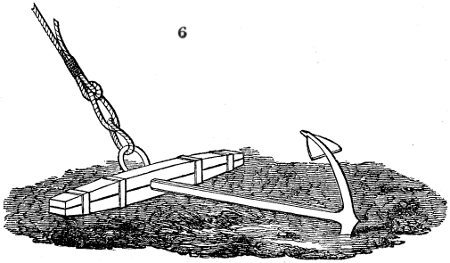
ANCHOR. (Ancre, Fr.; Anker, Germ.) An iron hook of considerable weight and strength, for enabling a ship to lay hold of the ground, and fix itself in a certain situation by means of a rope called the cable. It is an instrument of the greatest importance to the navigator, since upon its taking and keeping hold depends his safety upon many occasions, especially near a lee shore, where he might be otherwise stranded or shipwrecked. Anchors are generally made of wrought iron, except among nations who cannot work this metal well, and who therefore use copper. The mode in which an anchor operates will be understood from inspection of fig. 6., where, from the direction of the strain, it is obvious that the anchor cannot move without ploughing up the ground in which its hook or fluke is sunk. When this, however, unluckily takes place, from the nature of the ground, from the mode of insertion of the anchor, or from the violence of the winds or currents, it is called dragging the anchor. When the hold is good, the cable or the buried arm will sooner break than the ship will drive. Anchors are of different sizes, and have different names, according to the purposes they serve; thus there are, sheet, best bower, small bower, spare, stream, and kedge anchors. Ships of the first class have seven anchors, and smaller vessels, such as brigs and schooners, three.
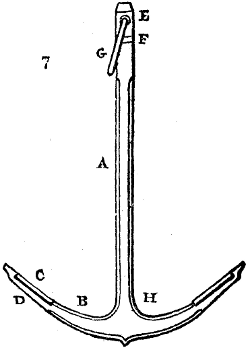
The manufacture of anchors requires great knowledge of the structure of iron, and skill in the art of working it. I shall give, here, a brief notice of the improved system introduced by Mr. Perring, clerk of the cheque at Plymouth, in which the proportions of the parts are admirably adapted to the strains they are likely to suffer. In fig. 7. A is the shank; B, the arm or fluke; C, the palm; D, the blade; E, the square; F, the nut; G, the ring; H, the crown.
Formerly the shank was made of a number of square iron rods, laid parallel together in a cylindrical form, and bound by iron hoops. When they were welded into one bar, the exterior rods could not fail to be partially burned and wasted by the strong heat. Mr. Perring abated this evil by using bars of the whole breadth of the shank, and placing them right over each other, hooping them and welding them together at two heats into one solid mass. To any one who has seen the working of puddled iron, with a heavy mill hammer, this operation will not appear difficult.
He formed the crown with bars similarly distributed with those of the shank. His mode of uniting the flukes to the crown is probably the most valuable part of his invention. The bars and half the breadth of the anchor are first welded separately, and then placed side by side, where the upper half is worked into one mass, while the lower part is left disunited, but has carrier iron bars, or porters, as these prolongation rods are commonly called, welded to the extremity of each portion. The lower part is now heated and placed in the clamping machine, which is merely an iron plate firmly bolted to a mass of timber, and bearing upon its surface four iron pins. One end of the crown is placed between the first of these pins, and passed under an iron strap; the other end is brought between the other pins, and is bent by the leverage power of the elongated rods or porters.
Thus a part of the arm being formed out of the crown gives much greater security that a true union of fibres is effected, than when the junction was made merely by a short scarf.
The angular opening upon the side opposite B H, fig. 7., is filled with the chock, formed of short iron bars placed upright. When this has been firmly welded, the truss-piece is brought over it. This piece is made of plates similar to the above, except that their edges are here horizontal. The truss-piece is half the breadth of the arm; so that when united to the crown, it constitutes, with the other parts, the total breadth of the arms at those places.
The shank is now shut upon the crown; the square is formed, and the nuts welded to it; the hole is punched out for the ring, and the shank is then fashioned.
The blade is made much in the way above described. In making the palm, an iron rod is first bent into the approximate form, notching it so that it may more readily take the desired shape. To one end a porter rod is fastened, by which the palm is carried and turned round in the fire during the progress of the fabrication. Iron plates are next laid side by side upon the rod, and the joint at the middle is broken by another plate laid over it. When the mass is worked, its under side is filled up by similar plates, and the whole is completely welded; pieces being added to the sides, if necessary, to form the angles of the palm. The blade is then shut on to the palm, after which the part of the arm attached to the blade is united to that which constitutes the crown. The smith-work of the anchor is now finished.
The junction, or shutting on, as the workmen call it, of the several members of an anchor, is effected by an instrument called a monkey, which is merely a mass of iron raised to a certain height, between parallel uprights, as in the pile engine or vertical ram, and let fall upon the metal previously brought to a welding heat.
The monkey and the hercules, both silly, trivial names, are similar instruments, and are usually worked, like a portable pile engine, by the hands of several labourers, pulling separate ropes. Many other modes of manufacturing anchors have been devised, in which mechanical power is more extensively resorted to.
The upper end of the shank F (fig. 7.) is squared to receive and hold the stock steadily, and keep it from turning. To prevent it shifting along, there are two knobs or tenon-like projections. The point of the angle H, between the arms and the shank, is sometimes called the throat. The arm B C generally makes an angle of 56° with the shank A; it is either round or polygonal, and about half the length of the shank.
The stock of the anchor (fig. 6.) is made of oak. It consists of two beams which embrace the square, and are firmly united by iron bolts and hoops, as shown in the figure. The stock is usually somewhat longer than the shank, has in the middle a thickness about one-twelfth of its length, but tapers at its under side to nearly one half this thickness at the extremities. In small anchors the stock is frequently made of iron; but in this case it does not embrace the anchor, but goes through a hole made in the square, which is swelled out on purpose.
The weight of anchors for different vessels is proportioned to the tonnage; a good rule being to make the anchor in hundredweights one-twentieth of the number of tons of the burden. Thus a ship of 1000 tons would require a sheet anchor of 50 cwts. Ships of war are provided with somewhat heavier anchors.
Several new forms and constructions of anchors were proposed under Mr. Piper’s patent of November, 1822, by the adoption of which great advantages as to strength were anticipated over every other form or construction previously made.
The particular object was to preserve such a disposition of the fibres of the metal as should afford the greatest possible strength; in doing which the crossing or bending of the fibres at the junctions of the shank, flukes, and crown, where great strength is required, has been avoided as much as possible, so that the fibres are not disturbed or injured.
In this respect most anchors are defective; for in connecting the shanks to the crown-pieces, the grain of the metal is either crossed, or so much curved, as to strain the fibre, and consequently induce a weakness where the greatest strength is required. And, further, the very considerable thicknesses of metal which are to be brought into immediate contact by means of the hammer in forging anchors upon the old construction, render it highly probable that faulty places may be left within the mass, though they be externally imperceptible. Mr. Piper’s leading principle was, that the fibre of the metal should run nearly straight in all the parts where strength is particularly required.
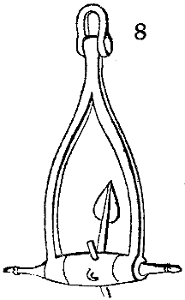
Fig. 8. shows an anchor with one tumbling fluke, which passes through the forked or branched part of the shank. The lower part of this anchor, answering to the crown, has a spindle through it, upon which the fluke turns, and a pin is there introduced for the purpose of confining the fluke when in a holding position. This shank is formed of a solid piece of wrought iron, the fibres of which run straight, and at the crown holes are pierced, which merely bulge the metal without bending the fibres round so as to strain them. The arm and fluke, also, are formed of one piece punched through without curling or crossing the fibre, and the spindle which holds the arm to the crown is likewise straight. This spindle extends some distance on each side of the anchor, and is intended to answer the purpose of a stock; for when either of the ends of the spindle comes in contact with the ground, the anchor will be thrown over into a holding position; or an iron stock may be introduced near the shackle, instead of these projecting ends. In the descent of the anchor, the fluke will fall over towards that side which is nearest the ground, and will there be ready to take hold when the anchor is drawn forward.
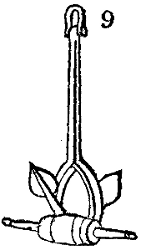
Fig. 9. is another anchor upon the same principle, but slightly varied in form from the last. In this the forked part of the shank is closer than in the former, and there are two arms or flukes connected to the crown-pieces, one of which falls into its holding position as the anchor comes to the ground, and is held at its proper angle by the other fluke stopping against the shank.
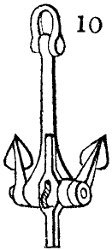
Fig. 10. represents another variation in the form of these improved anchors, having two tumbling flukes, which are both intended to take hold of the ground at the same time. The shank is here, as before, made without crossing the grain of the iron, and the eyes for admitting the bolt at the crown and at the shackle are punched out of the solid, not formed by welding or turning the iron round. In this form a guard is introduced at the crown, to answer the purpose of a stock, by turning the flukes over into a holding position. The arms and flukes are made, as before described, of the straight fibre of the iron punched through, and the flukes are fixed to the spindle, which passes through the crown-piece.
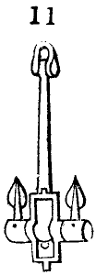
Fig. 11. has a shank without any fork, but formed straight throughout; the guard here is an elongated frame of iron, for the same purpose as a stock, and is, with the tumbling flukes, fastened to the spindle, which passes through the crown of the anchor, and causes the flukes to fall into their holding position.
The principles of these new anchors are considered to consist in shanks which are made of straight lengths of metal, and finished so that the fibres of the iron shall not be injured by cross-shuts or uncertain welding; also each arm and palm is made in one solid piece, and finished in straight lines, so that the fibres will not be altered, and the shaft-pin or spindle will also be in one straight line; and this is the improvement claimed. These anchors being made in separate pieces, give a great advantage to the workman to execute each part perfectly; for he will not have such heavy weights to lift when hot, which will render these anchors much stronger, with less weight; and if any accident should happen to them, any part may be taken separate from the others to be repaired, and several of those parts of the anchor which may be likely to break may be carried on board, in case of accident. This anchor is so contrived that one of thirty hundred weight may be taken to pieces and put together again, by one man, in twenty minutes; it may also be dismounted, and stowed in any part of the ship, in as little room as straight bars of iron, and speedily put together again.
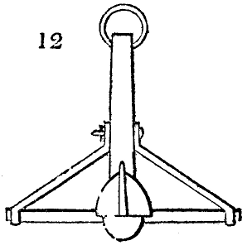
The anchor (fig. 12.) patented by Mr. Brunton, in February, 1822, has its stock introduced at the crown part, for the purpose of turning it over into a holding position. The shank is perforated through the solid, in two places, with elliptical apertures, for the purpose of giving it a greater stability, and more effectually resisting the strain to which the anchor may be subjected. The stock is a cylindrical iron rod, held at its extremities by lateral braces, which are bolted to the shank.
Fig. 12. shows the form of the anchor. The shank is seen upright, with one of the flukes projecting in its front; the horizontal iron stock is at bottom; and the oblique braces are bolted to both shank and stock. The ends of the stock, from the shoulder, are formed dove-tailed, and oval in the vertical direction, and are protruded through apertures in the braces, also oval, but in the horizontal direction, and counter sunk. When the ends of the stock have been thus introduced through the holes, the braces are securely bolted to the shank; the ends of the stock are then spread, by hammering into the counter-sunk holes of the braces, and by that means they are made firm.
An anchor of this description is considered by the patentee to possess considerable advantage, particularly in point of stability, over the ordinary construction of anchors, and is economical, inasmuch as a less weight of metal will give, upon this plan, an equal degree of strength.
An ingenious form of anchor was made the subject of a patent, by Lieutenant Rodgers, of the Royal Navy, in 1828, and was afterwards modified by him in a second patent, obtained in August, 1829. The whole of the parts of the anchor are to be bound together by means of iron bands or hoops, in place of bolts or pins.
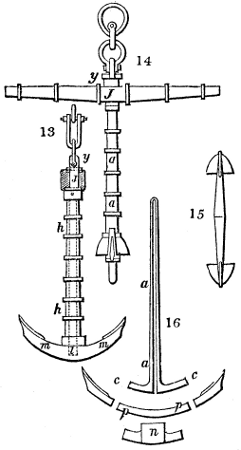
Fig. 13. is a side view of a complete anchor, formed upon his last improved construction, and fig. 14., a plan of the same; fig. 15., an end view of the crown and flukes, or arms; fig. 16. represents the two principal iron plates, a, a, of which the shank is constructed, but so as to form parts of the stump arms to which the flukes are to be connected.
The crown piece is to be welded to the stump piece, c c, fig. 16., as well as to the end l of the centre piece h h, and the scarfs m m are to be cut to receive the arms or flukes. Previously, however, to uniting the arms or flukes with the stump arms, the crown and throat of the anchor are to be strengthened, by the application of the crown slabs n n, fig. 16., which are to be welded upon each side of the crown, overlapping the end of the pillar h, and the throat or knees of the stump arms and the crown piece. The stump arms are then to be strengthened in a similar manner, by the thin flat pieces p p, which are to be welded upon each side. The palms are united to the flukes in the usual way, and the flukes are also united to the stump arms by means of the long scarfs m m. When the shank of the anchor has been thus formed, and united with the flukes, the anchor smith’s work may be said to be complete.
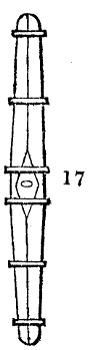
Another of the improvements in the construction of anchors, claimed under this patent, consists in a new method of affixing the stock upon the shank of the anchor, which is effected in the following manner: in fig. 14. the stock is shown affixed to the anchor; in fig. 17. it is shown detached. It may be made either of one or two pieces of timber, as may be found most convenient. It is, however, to be observed that the stock is to be completed before fitting on to the shank. After the stock is shaped, a hole is to be made through the middle of it, to fit that part of the shank to which it is to be affixed. Two stock plates are then to be let in, one on each side of the stock, and made fast by counter sunk nails and straps, or hoops; other straps or hoops of iron are also to be placed round the stock, as usual.
In place of nuts, formed upon the shank of the anchor, it is proposed to secure the stock by means of a hoop and a key, shown above and below J, in fig. 14. By this contrivance, the stock is prevented from going nearer to the crown of the anchor than it ought to do, and the key prevents it from sliding towards the shackle.
Since fitting the stock to the shank of an anchor, by this method, prevents the use of a ring, as in the ordinary manner, the patentee says that he in all cases substitutes a shackle for the ring, and which is all that is required for a chain cable; but, when a hempen cable is to be used, he connects a ring to the usual shackle, by means of a joining shackle, as in figs. 13. and 14.
Mr. Rodgers proposes, under another patent, dated July, 1833, to alter the size and form of the palms; having found from experience that anchors with small palms will not only hold better than with large ones, but that the arms of the anchor, even without any palms, have been found to take more secure hold of the ground than anchors of the old construction, of similar weight and length. He has, accordingly, fixed upon one-fifth of the length of the arm, as a suitable proportion for the length or depth of the palm. He makes the palms, also, broader than they are long or deep.
ANIMÉ. A resin of a pale brown yellow colour, transparent and brittle. It exudes from the courbaril of Cayenne, a tree which grows also in various parts of South America. It occurs in pieces of various sizes, and it often contains so many insects belonging to living species, as to have merited its name, as being animated. It contains about a fifth of one per cent. of a volatile oil, which gives it an agreeable odour. Alcohol does not dissolve the genuine animé, as I have ascertained by careful experiments; nor does caoutchoucine; but a mixture of the two, in equal parts, softens it into a tremulous jelly, though it will not produce a liquid solution. When reduced to this state, the insects can be easily picked out, without injury to their most delicate parts.
The specific gravity of the different specimens of animé which I tried, varied from 1·054 to 1·057. When exposed to heat, in a glass retort over a spirit flame, it softens, and, by careful management, it may be brought into liquid fusion, without discolouration. It then exhales a few white vapours, of an ambrosiacal odour, which being condensed in water, and the liquid being tested, is found to be succinic acid. Author.
It is extensively used by the varnish makers, who fuse it at a pretty high heat, and in this state combine it with their oils, or other varnishes.
ANKER. A liquid measure of Amsterdam, which contains 32 gallons English.
ANNEALING or NEALING. (Le recuit, Fr.; das anlassen, Germ.) A process by which glass is rendered less frangible; and metals, which have become brittle, either in consequence of fusion, or long-continued hammering, are again rendered malleable. When a glass vessel is allowed to cool immediately after being made, it will often sustain the shock of a pistol-bullet, or any other blunt body falling into it from a considerable height; while a small splinter of flint, or an angular fragment of quartz, dropped gently into it, makes it sometimes immediately, sometimes after a few minutes, fly to pieces with great violence. This extreme fragility is prevented by annealing, or placing the vessels in an oven, where they take several hours or even some days to cool. Similar phenomena are exhibited in a higher degree by glass-tears, or Prince Rupert’s drops. They are procured by letting drops of melted glass fall into cold water. Their form resembles that of a pear, rounded at one extremity, and tapering to a very slender tail at the other. If a part of the tail be broken off, the whole drop flies to pieces with a loud explosion; and yet the tail of a drop may be cut away by a glass-cutter’s wheel, or the thick end may be struck smartly with a hammer, without the fear of sustaining any injury. When heated to redness, and permitted to cool gradually in the open air, they lose these peculiarities, and do not differ sensibly from common glass.
The properties of unannealed glass depend on a peculiar structure, extending uniformly through its whole substance; and the bursting of a glass drop by breaking off the tail, or of an unannealed glass vessel, by dropping a piece of flint into it, arises from a crack being thus begun, which afterwards extends its ramifications in different directions throughout the glass.
When metals have been extended to a certain degree under the hammer, they become brittle, and incapable of being further extended without cracking. In this case the workman restores their malleability by annealing, or heating them red-hot. The rationale of this process seems to be, that the hammering and extension of the metal destroy the kind of arrangement which the particles of the metal had previous to the hammering; and that the annealing, by softening the metal, enables it to recover its original structure.
Of late years a mode has been discovered of rendering cast iron malleable, without subjecting it to the action of puddling. The process is somewhat similar to that employed in annealing glass. The metal is kept for several hours at a temperature a little below its fusing point, and then allowed to cool slowly. In this manner vessels are made of cast iron which can sustain considerable violence, without being broken. See Steel, softening of.
ANNOTTO. (Rocou, or roucou, Fr.; orleans, Germ.) A somewhat dry and hard paste, brown without, and red within. It is usually imported in cakes of two or three pounds weight, wrapped up in leaves of large reeds, packed in casks, from America, where it is prepared from the seeds of a certain tree, the bixa orellana, of Linnæus.
The pods of the tree being gathered, their seeds are taken out and bruised; they are then transferred to a vat, which is called the steeper, where they are mixed with as much water as covers them. Here the substance is left for several weeks, or even months; it is now squeezed through sieves placed above the steeper, that the water containing the colouring matter in suspension may return, into the vat. The residuum is preserved under the leaves of the anana (pine-apple) tree, till it becomes hot by fermentation. It is again subjected to the same operation, and this treatment is continued till no more colour remains.
The substance thus extracted is passed through sieves, in order to separate the remainder of the seeds, and the colour is allowed to subside. The precipitate is boiled in coppers till it be reduced to a consistent paste; it is then suffered to cool, and dried in the shade.
Instead of this long and painful labour, which occasions diseases by the putrefaction induced, and which affords a spoiled product, Leblond proposes simply to wash the seeds of annotto till they be entirely deprived of their colour, which lies wholly on their surface; to precipitate the colour by means of vinegar or lemon juice, and to boil it up in the ordinary manner, or to drain it in bags, as is practised with indigo.
The experiments which Vauquelin made on the seeds of annotto imported by Leblond, confirmed the efficacy of the process which he proposed; and the dyers ascertained that the annotto obtained in this manner was worth at least four times more than that of commerce; that, moreover, it was more easily employed; that it required less solvent; that it gave less trouble in the copper, and furnished a purer colour.
Annotto dissolves better and more readily in alcohol than in water, when it is introduced into the yellow varnishes for communicating an orange tint.
The decoction of annotto in water has a strong peculiar odour, and a disagreeable taste. Its colour is yellowish-red, and it remains a little turbid. An alkaline solution renders its orange-yellow clearer and more agreeable, while a small quantity of a whitish substance is separated from it, which remains suspended in the liquid. If annotto be boiled in water along with an alkali, it dissolves much better than when alone, and the liquid has an orange hue.
The acids form with this liquor an orange-coloured precipitate, soluble in alkalies, which communicate to it a deep orange colour. The supernatant liquor retains only a pale yellow hue.
When annotto is used as a dye, it is always mixed with alkali, which facilitates its solution, and gives it a colour inclining less to red. The annotto is cut in pieces, and boiled for some instants in a copper with its own weight of crude pearl ashes, provided the shade wanted do not require less alkali. The cloths may be thereafter dyed in this bath, either by these ingredients alone, or by adding others to modify the colour; but annotto is seldom used for woollen, because the colours which it gives are too fugitive, and may be obtained by more permanent dyes. Hellot employed it to dye a stuff, prepared with alum and tartar; but the colour acquired had little permanence. It is almost solely used for silks.
For silks intended to become aurora and orange, it is sufficient to scour them at the rate of 20 per cent. of soap. When they have been well cleansed, they are immersed in a bath prepared with water, to which is added a quantity of alkaline solution of annotto, more or less considerable according to the shade that may be wanted. This bath should have a mean temperature, between that of tepid and boiling water.
When the silk has become uniform, one of the hanks is taken out, washed, and wrung, to see if the colour be sufficiently full; if it be not so, more solution of annotto is added, and the silk is turned again round the sticks: the solution keeps without alteration.
When the desired shade is obtained, nothing remains but to wash the silk, and give it two beetlings at the river, in order to free it from the redundant annotto, which would injure the lustre of the colour.
When raw silks are to be dyed, those naturally white are chosen, and dyed in the annotto bath, which should not be more than tepid, or even cold, in order that the alkali may not attack the gum of the silk, and deprive it of the elasticity which it is desirable for it to preserve.
What has been now said regards the silks to which the aurora shades are to be given; but to make an orange hue, which contains more red than the aurora, it is requisite, after dyeing with annotto, to redden the silks with vinegar, alum, or lemon juice. The acid, by saturating the alkali employed for dissolving the annotto, destroys the shade of yellow that the alkali had given, and restores it to its natural colour, which inclines a good deal to red.
For the deep shades, the practice at Paris, as Macquer informs us, is to pass the silks through alum; and if the colour be not red enough, they are passed through a faint bath of brazil wood. At Lyons, the dyers who use carthamus, sometimes employ old baths of this ingredient for dipping the deep oranges.
When the orange hues have been reddened by alum, they must be washed at the river; but it is not necessary to beetle them, unless the colour turns out too red.
Shades may be obtained also by a single operation, which retain a reddish tint, employing for the annotto bath a less proportion of alkali than has been pointed out.
Guhliche recommends to avoid heat in the preparation of annotto. He directs it to be placed in a glass vessel, or in a glazed earthen one; to cover it with a solution of pure alkali; to leave the mixture at rest for 24 hours; to decant the liquor, filter it, and add water repeatedly to the residuum, leaving the mixture each time at rest for two or three days, till the water is no longer coloured; to mix all these liquors, and preserve the whole for use in a well-stopped vessel.
He macerates the silk for 12 hours in a solution of alum, at the rate of an eighth of this salt for one part of silk, or in a water rendered acidulous by the aceto-citric acid above described; and he wrings it well on its coming out of this bath.
Silk thus prepared is put into the annotto bath quite cold. It is kept in agitation there till it has taken the shade sought for; or the liquor may be maintained at a heat far below ebullition. On being taken out of the bath, the silk is to be washed and dried in the shade.
For lighter hues, a liquor less charged with colour is taken; and a little of the acid liquid which has served for the mordant may be added, or the dyed silk may be passed through the acidulous water.
We have seen the following preparation employed for cotton velvet:—one part of quicklime, one of potash, two of soda.
Of these a ley is formed, in which one part of annotto is dissolved; and the mixture is boiled for an hour and a half. This bath affords the liveliest and most brilliant auroras. The buff (chamois) fugitive dye is also obtained with this solution. For this purpose only a little is wanted; but we must never forget, that the colours arising from annotto are all fugitive.
Dr. John found in the pulp surrounding the unfermented fresh seeds, which are about the size of little peas, 28 parts of colouring resinous matter, 26·5 of vegetable gluten, 20 of ligneous fibre, 20 of colouring extractive matter, 4 formed of matters analogous to vegetable gluten and extractive, and a trace of spicy and acid matters.
The Gloucestershire cheese is coloured with annotto, in the proportion of one cwt. to an ounce of the dye.
When used in calico-printing, it is usually mixed with potash or ammonia and starch.
It is an appropriate substance for tingeing varnishes, oils, spirits, &c.
The import duty upon annotto is 1s. per cwt. for flag, and 4s. for other sorts. In 1834, 252,981 lbs. were imported; and in 1835, 163,421 lbs. The revenue from this drug in these two years, was 180l. and 98l. respectively.
ANTHRACITE, from ανθραξ, coal, is a species of coal found in the transition rock formation, and is often called stone coal. It has a grayish black, or iron black colour, an imperfectly metallic lustre, conchoidal fracture, and a specific gravity of from 1·4 to 1·6, being, therefore, much denser than the coal of the proper coal measures. It consists wholly of carbon, with a small and variable proportion of iron, silica, and alumina. It is difficult to kindle in separate masses, and burns when in heaps or grates without smell or smoke, leaving sometimes an earthy residuum. It has been little explored or worked in the old world; but is extensively used in the United States of America, and has become of late years a most valuable mineral to that country, where it is burned in peculiar grates, adapted to its difficult combustion. In Pennsylvania the anthracite coal formation has been traced through a tract many miles in width, and extending across the two entire counties of Luzerne and Schuylkill. At Maunch Chunk, upon the Lehigh, 800 men were employed so far back as 1825, in digging this coal. In that year 750,000 bushels were dispatched for Philadelphia. It is worked there with little cost or labour, being situated on hills from 300 to 600 feet above the level of the neighbouring rivers and canals, and existing in nearly horizontal beds, of from 15 to 40 feet in thickness, covered by only a few feet of gravelly loam. At Portsmouth, in Rhode Island, an extensive stratum of this coal has been worked, with some interruptions, for 20 years; and more recently a mine of anthracite has been opened at Worcester, in Massachusetts, at the head of the Blackstone canal. It has been of late employed in South Wales, for smelting iron, and in a cupola blast furnace, by Mr. Crane.
ANTIGUGGLER. A small syphon of metal, which is inserted into the mouths of casks, or large bottles, called carboys, to admit air over the liquor contained in them, and thus to facilitate their being emptied without agitation or a guggling noise.
ANTIMONY. (Antimoine, Fr.; Spiessglanz, or Spiessglass, Ger.) The only ore of this metal found in sufficient abundance to be smelted, is the sulphuret, formerly called crude antimony. It occurs generally in masses, consisting of needles closely aggregated, of a metallic lustre, a lead-gray colour, inclining to steel-gray, which is unchanged in the streak. The needles are extremely brittle, and melt even in the flame of a candle, with the exhalation of a sulphureous smell. The powder of this sulphuret is very black, and was employed by women in ancient times to stain their eyebrows and eyelids. This ore consists in 100 parts of 72·86 metal, and 27·14 sulphur. Specific gravity from 4·13 to 4·6.
The veins of sulphuret of antimony occur associated with gangues of quartz, sulphate of barytes, and carbonate of lime; those of Allémont occur in the numerous fissures of a mica schist, evidently primitive.
In treating the ore to obtain the metal, the first object is to separate the gangue, which was formerly done by filling crucibles with the mixed materials, placing them on the hearth of an oven, and exposing them to a moderate heat. As the sulphuret easily melts, it ran out through a hole in the bottom of the crucible into a pot placed beneath, and out of the reach of the fire. But the great loss from breakage of the crucibles, has caused another method to be adopted. In this the broken ore, being sorted, is laid on the bottom of a concave reverberatory hearth, where it is reduced.
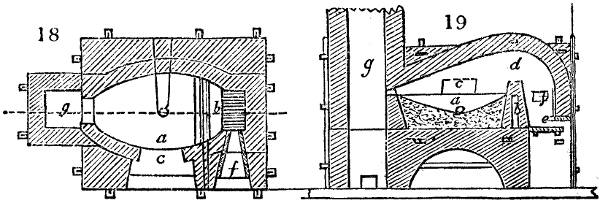
Figs. 18. 19. represent a wind or flame furnace, for the reduction of antimony. The hearth is formed of sand and clay solidly beat together, and slopes from all sides towards the middle, where it is connected with the orifice a, which is closed with dense coal-ashes; b is the air channel up through the bridge; c, the door for introducing the prepared ore, and running off the slags; d, the bridge; e, the grate; f, the fire or fuel-door; g, the chimney. With 2 or 3 cwt. of ore, the smelting process is completed in from 8 to 10 hours. The metal thus obtained is not pure enough, but must be fused under coal dust, in portions of 20 or 30 pounds, in crucibles, placed upon a reverberatory hearth.
To obtain antimony free from iron, it should be fused with some antimonic oxide in a crucible, whereby the iron is oxidized and separated. The presence of arsenic in antimony is detected by the garlic smell, emitted by such an alloy when heated at the blow-pipe; or, better, by igniting it with nitre in a crucible; in which case, insoluble antimonite and antimoniate of potash will be formed along with soluble arseniate. Water digested upon the mixture, filtered, and then tested with nitrate of silver, will afford the brown-red precipitate characteristic of arsenic acid.
According to Berthier, the following materials afford, in smelting, an excellent product of antimony: 100 parts of sulphuret; 60 of hammerschlag (protoxide of iron from the shingling or rolling mills); 45 to 50 of carbonate of soda; and 10 of charcoal powder. From 65 to 70 parts of metallic antimony or regulus should be obtained. Glauber salts may be used instead of soda. For another mode of smelting antimony, at Malbosc, in the department of Ardèche, in France, see Liquation.
In the works where antimonial ores are smelted, by means of tartar (argol), the alkaline scoriæ, which cover the metallic ingots, are not rejected as useless, for they hold a certain quantity of antimonial oxide in combination; a property of the potash flux, which is propitious to the purity of the metal. These scoriæ, consisting of sulphuret of potassium and antimonite of potash, being treated with water, undergo a reciprocal decomposition; the elements of the water act on those of the sulphuret, and the resulting alkaline hydro-sulphuret re-acts on the antimonial solution, so as to form a species of kermes mineral, which precipitates. This is dried, and sold at a low price as a veterinary medicine, under the name of kermes, by the dry way.
Metallic antimony, as obtained by the preceding process, is the antimony of commerce, but is not absolutely pure; containing frequently minute portions of iron, lead, and even arsenic; the detection and separation of which belong to the sciences of chemistry and pharmacy. Antimony is a brittle metal, of a silvery white colour, with a tinge of blue, a lamellar texture, and crystalline fracture. When heated at the blowpipe, it melts with great readiness, and diffuses white vapours, possessing somewhat of a garlic smell. If thrown in this melted state on a sheet of flat paper, the globule sparkles, and bursts into a multitude of small spheroids, which retain their incandescence for a long time, and run about on the paper, leaving traces of the white oxide produced during the combustion. When this oxide is fused with borax, or other vitrifying matter, it imparts a yellow colour to it. Metallic antimony, treated with hot nitric acid and in a concentrated state, is converted into a powder, called antimonious acid, which is altogether insoluble in the ordinary acid menstrua; a property by which the chemist can separate that metal from lead, iron, copper, bismuth, and silver. According to Bergman, the specific gravity of antimony is 6·86; but Haidinger makes the Swedish native metal only 6·646. The alchemists had conceived the most brilliant hopes of this metal; the facility with which it is alloyed with gold, since its fumes alone render this most ductile metal immediately brittle, led them to assign to it a royal lineage, and to distinguish it by the title of regulus, or the little king.
Its chief employment now is in medicine, and in making the alloys called type metal, stereotype metal, music plates, and Britannia-metal; the first consisting of 6 of lead and 2 of antimony; the second of 6 of lead and 1 of antimony; the third of lead, tin, and antimony; and the fourth also of lead, tin, and antimony, with occasionally a little copper and bismuth.—For Glass of antimony, see Pastes.
ANTISEPTICS. Substances which counteract the spontaneous decomposition of animal and vegetable substances. These are chiefly culinary salt, nitre, spices, and sugar, which operate partly by inducing a change in the animal or vegetable fibres, and partly by rendering the aqueous constituent unsusceptible of decomposition. See Provisions, curing of.
ANVIL. A mass of iron, having a smooth and nearly flat top surface of steel; upon which blacksmiths, and various other artificers, forge metals with the hammer. The common anvil is usually made of seven pieces: 1, the core, or body; 2, 3, 4, 5, the four corner pieces which serve to enlarge its base; 6, the projecting end, which has a square hole for the reception of the tail or shank of a chisel on which iron bars may be cut through; and 7, the beak, or horizontal cone round which rods or slips of metal may be turned into a circular form, as in making rings. These 6 pieces are welded separately to the first, or core, and then hammered into an uniform body. In manufacturing large anvils two hearths are needed, in order to bring each of the two pieces to be welded, to a proper heat by itself; and several men are employed in working them together briskly in the welding state, by heavy swing hammers. The steel facing is applied by welding in the same manner. The anvil is then hardened by heating it to a cherry red, and plunging it into cold water; a running stream being preferable to a pool or cistern. The facing should not be too thick a plate, for, when such, it is apt to crack in the hardening. The face of the anvil is now smoothed upon a grindstone, and finally polished with emery and crocus, for all delicate purposes of art.
The blacksmith, in general, sets his anvil loosely upon a wooden block, and in preference on the root of an oak. But the cutlers and file-makers fasten their anvils to a large block of stone; which is an advantage, for the more firmly and solidly this tool is connected to the earth, the more efficacious will be the blows of the hammer on any object placed upon it.
AQUAFORTIS. Nitric acid, somewhat dilute, was so named by the alchemists on account of its strong solvent and corrosive operation upon many mineral, vegetable, and animal substances. See Nitric Acid.
AQUA REGIA. The name given by the alchemists to that mixture of nitric and muriatic acids which was best fitted to dissolve gold, styled by them the king of the metals. It is now called nitro-muriatic acid.
AQUA VITÆ. The name very absurdly given to alcohol, when used as an intoxicating beverage. It has been the aqua mortis to myriads of the human race; and will, probably, ere long destroy all the native tribes of North America and Australia.
ARCHIL. A violet red paste used in dyeing, of which the substance called cudbear in Scotland (from Cuthbert, its first preparer in that form), is a modification. Two kinds of archil are distinguished in commerce, the archil plant of the Canaries, and that of Auvergne. The first is most esteemed: it is prepared from the lichen rocellus, which grows on rocks adjoining the sea in the Canary and Cape de Verde Islands, in Sardinia, Minorca, &c., as well as on the rocks of Sweden. The second species is prepared from the lichen parellus, which grows on the basaltic rocks of Auvergne.
There are several other species of lichen which might be employed in producing an analogous dye, were they prepared, like the preceding, into the substance called archil. Hellot gives the following method for discovering if they possess this property. A little of the plant is to be put into a glass vessel; it is to be moistened with ammonia and lime-water in equal parts; a little muriate of ammonia (sal ammoniac) is added; and the small vessel is corked. If the plant be of a nature to afford a red dye, after three or four days, the small portion of liquid, which will run off on inclining the vessel, now opened, will be tinged of a crimson red, and the plant itself will have assumed this colour. If the liquor or the plant does not take this colour, nothing need be hoped for; and it is useless to attempt its preparation on the great scale. Lewis says, however, that he has tested in this way a great many mosses, and that most of them afforded him a yellow or reddish brown colour; but that he obtained from only a small number a liquor of a deep red, which communicated to cloth merely a yellowish-red colour.
Prepared archil gives out its colour very readily to water, ammonia, and alcohol. Its solution in alcohol is used for filling spirit-of-wine thermometers; and when these thermometers are well freed from air, the liquor loses its colour in some years, as Abbé Nollet observed. The contact of air restores the colour, which is destroyed anew, in vacuo, in process of time. The watery infusion loses its colour, by the privation of air, in a few days; a singular phenomenon, which merits new researches.
The infusion of archil is of a crimson bordering on violet. As it contains ammonia, which has already modified its natural colour, the fixed alkalies can produce little change on it, only deepening the colour a little, and making it more violet. Alum forms in it a precipitate of a brown red; and the supernatant liquid retains a yellowish-red colour. The solution of tin affords a reddish precipitate, which falls down slowly; the supernatant liquid retains a feeble red colour. The other metallic salts produce precipitates which offer nothing remarkable.
The watery solution of archil applied to cold marble, penetrates it, communicating a beautiful violet colour, or a blue bordering on purple, which resists the air much longer than the archil colours applied to other substances. Dufay says, that he has seen marble tinged with this colour preserve it without alteration at the end of two years.
To dye with archil, the quantity of this substance deemed necessary, according to the quantity of wool or stuff to be dyed, and according to the shade to which they are to be brought, is to be diffused in a bath of water as soon as it begins to grow warm. The bath is then heated till it be ready to boil, and the wool or stuff is passed through it without any other preparation, except keeping that longest in, which is to have the deepest shade. A fine gridelin, bordering upon violet, is thereby obtained; but this colour has no permanence. Hence archil is rarely employed with any other view than to modify, heighten, and give lustre to the other colours. Hellot says, that having employed archil on wool boiled with tartar and alum, the colour resisted the air no more than what had received no preparation. But he obtained from herb archil (l’orseille d’herbe) a much more durable colour, by putting in the bath some solution of tin. The archil thereby loses its natural colour, and assumes one approaching more or less to scarlet, according to the quantity of solution of tin employed. This process must be executed in nearly the same manner as that of scarlet, except that the dyeing may be performed in a single bath.
Archil is frequently had recourse to for varying the different shades and giving them lustre; hence it is used for violets, lilacs, mallows, and rosemary flowers. To obtain a deeper tone, as for the deep soupes au vin, sometimes a little alkali or milk of lime is mixed with it. The suites of this browning may also afford agates, rosemary flowers, and other delicate colours, which cannot be obtained so beautiful by other processes. Alum cannot be substituted for this purpose; it not only does not give this lustre, but it degrades the deep colours.
The herb-archil is preferable to the archil of Auvergne, from the greater bloom which it communicates to the colours, and from the larger quantity of colouring matter. It has, besides, the advantage of bearing ebullition. The latter, moreover, does not answer with alum, which destroys the colour; but the herb archil has the inconvenience of dyeing in an irregular manner, unless attention be given to pass the cloth through hot water as soon as it comes out of the dye.
Archil alone is not used for dyeing silk, unless for lilacs; but silk is frequently passed through a bath of archil, either before dyeing it in other baths or after it has been dyed, in order to modify different colours, or to give them lustre. Examples of this will be given in treating of the compound colours. It is sufficient here to point out how white silks are passed through the archil bath. The same process is performed with a bath more or less charged with this colour, for silks already dyed.
Archil, in a quantity proportioned to the colour desired, is to be boiled in a copper. The clear liquid is to be run off quite hot from the archil bath, leaving the sediment at the bottom, into a tub of proper size, in which the silks, newly scoured with soap, are to be turned round on the skein-sticks with much exactness, till they have attained the wished-for shade. After this they must receive one beetling at the river.
Archil is in general a very useful ingredient in dyeing; but as it is rich in colour, and communicates an alluring bloom, dyers are often tempted to abuse it, and to exceed the proportions that can add to the beauty without at the same time injuring in a dangerous manner the permanence of the colours. Nevertheless, the colour obtained when solution of tin is employed, is less fugitive than without this addition: it is red, approaching to scarlet. Tin appears to be the only ingredient which can increase its durability. The solution of tin may be employed, not only in the dyeing bath, but for the preparation of the silk. In this case, by mixing the archil with other colouring substances, dyes may be obtained which have lustre with sufficient durability.
We have spoken of the colour of the archil as if it were natural to it; but it is, really, due to an alkaline combination. The acids make it pass to red, either by saturating the alkali, or by substituting themselves for the alkali.
The lichen which produces archil is subjected to another preparation, to make turnsole (litmus). This article is made in Holland. The lichen comes from the Canary Islands, and also from Sweden. It is reduced to a fine powder by means of a mill, and a certain proportion of potash is mixed with it. The mixture is watered with urine, and allowed to suffer a species of fermentation. When this has arrived at a certain degree, carbonate of lime in powder is added, to give consistence and weight to the paste, which is afterwards reduced into small parallelopipeds that are carefully dried.
The latest researches on the lichens, as objects of manufacture, are those of Westring of Stockholm. He examined 150 species, among which he found several which might be rendered useful. He recommends that the colouring matter should be extracted in the places where they grow, which would save a vast expense in curing, package, carriage, and waste. He styles the colouring substance itself cutbear, persio, or turnsole; and distributes the lichens as follows:—1st. Those which left to themselves, exposed to moderate heat and moisture, may be fixed without a mordant upon wool or silk; such are the L. cinereus, æmatonta, ventosus, corallinus, westringii, saxatilis, conspassus, barbatus, plicatus, vulpinus, &c.
2. Those which develop a colouring matter fixable likewise without mordant, but which require boiling and a complicated preparation; such are the lichens subcarneus, dillenii, farinaceus, jubatus, furfuraceus, pulmonareus, cornigatus, cocciferus, digitatus, ancialis, aduncus, &c. Saltpetre or sea-salt are requisite to improve the lustre and fastness of the dye given by this group to silk.
3. Those which require a peculiar process to develop their colour; such as those which become purple through the agency of stale urine or ammonia. Westring employed the following mode of testing:—He put three or four drachms of the dried and powdered lichen into a flask; moistened it with three or four measures of cold spring water; put the stuff to be dyed into the mixture, and left the flask in a cool place. Sometimes he added a little salt, saltpetre, quicklime, or sulphate of copper. If no colour appeared, he then moistened the lichen with water containing one twentieth of sal ammoniac, and one tenth of quicklime, and set the mixture aside in a cool place from eight to fourteen days. There appeared in most cases a reddish or violet coloured tint. Thus the lichen cinereus dyed silk a deep carmelite, and wool a light carmelite; the l. physodes gave a yellowish-gray; the pustulatus, a rose red; sanguinarius, gray; tartareus, found on the rocks of Norway, Scotland, and England, dyes a crimson-red. In Jutland, cutbear is made from it, by grinding the dry lichen, sifting it, then setting it to ferment in a close vessel with ammonia. The lichen must be of the third year’s growth to yield an abundant dye; and that which grows near the sea is the best. It loses half its weight by drying. A single person may gather from twenty to thirty pounds a day in situations where it abounds. No less than 2,239,685 pounds were manufactured at Christiansand, Flekkefiort, and Fakrsund, in Norway, in the course of the six years prior to 1812. Since more solid dyes of the same shade have been invented, the archil has gone much into disuse. Federigo, of Florence, who revived its use at the beginning of the fourteenth century, made such an immense fortune by its preparation, that his family became one of the grandees of that city, under the name of Oricellarii, or Rucellarii. For more than a century Italy possessed the exclusive art of making archil, obtaining the lichens from the islands of the Mediterranean. According to an official report of 1831, Teneriffe furnished annually 500 quintals (cwts.) of lichen; the Canary Isles, 400; Fuerta Santura, 300; Lancerot, 300; Gomera, 300; isle of Ferro, 800. This business belonged to the crown, and brought it a revenue of 1500 piastres. The farmers paid from 15 to 20 reals for the right to gather each quintal. At that time the quintal fetched in the London market 4l. sterling.
Archil is perhaps too much used in some cloth factories of England, to the discredit of our dyes. It is said, that by its aid one third of the indigo may be saved in the blue vat; but the colour is so much the more perishable. The fine soft tint induced upon much of the black cloth by means of archil is also deceptive. One half-pound of cutbear will dye one pound of woollen cloth. A crimson red is obtained by adding to the decoction of archil a little salt of tin (muriate), and passing the cloth through the bath, after it has been prepared by a mordant of tin and tartar. It must be afterwards passed through hot water.
ARDENT SPIRIT. Alcohol of moderate strength.
AREOMETER OF BAUMÉ. This scale is much used by the French authors.
Specific Gravity Numbers corresponding with Baumé’s Areometric Degrees.
Liquids denser than Water. Less dense than Water.
De- grees. Spe- cific gravi- ty. De- grees. Spe- cific gravi- ty. De- grees. Spe- cific gravi- ty. De- grees. Spe- cific gravi- ty. De- grees. Spe- cific gravi- ty.
0 1·0000 26 1·2063 52 1·5200 10 1·0000 36 0·8488
1 1·0066 27 1·2160 53 1·5353 11 0·9932 37 0·8439
2 1·0133 28 1·2258 54 1·5510 12 0·9865 38 0·8391
3 1·0201 29 1·2358 55 1·5671 13 0·9799 39 0·8313
4 1·0270 30 1·2459 56 1·5833 14 0·9733 40 0·8295
5 1·0340 31 1·2562 57 1·6000 15 0·9669 41 0·8249
6 1·0411 32 1·2667 58 1·6170 16 0·9605 42 0·8202
7 1·0483 33 1·2773 59 1·6344 17 0·9542 43 0·8156
8 1·0556 34 1·2881 60 1·6522 18 0·9480 44 0·8111
9 1·0630 35 1·2992 61 1·6705 19 0·9420 45 0·8066
10 1·0704 36 1·3103 62 1·6889 20 0·9359 46 0·8022
11 1·0780 37 1·3217 63 1·7079 21 0·9300 47 0·7978
12 1·0857 38 1·3333 64 1·7273 22 0·9241 48 0·7935
13 1·0935 39 1·3451 65 1·7471 23 0·9183 49 0·7892
14 1·1014 40 1·3571 66 1·7674 24 0·9125 50 0·7849
15 1·1095 41 1·3694 67 1·7882 25 0·9068 51 0·7807
16 1·1176 42 1·3818 68 1·8095 26 0·9012 52 0·7766
17 1·1259 43 1·3945 69 1·8313 27 0·8957 53 0·7725
18 1·1343 44 1·4074 70 1·8537 28 0·8902 54 0·7684