G. (continued 4)
Reading edition
As the principal saline impurity of saltpetre is muriate of soda (a substance scarcely more soluble in hot than in cold water), a ready mode thence arises of separating that salt from the nitre in mother waters that contain them in nearly equal proportion. Place an iron ladle or basin, perforated with small holes, on the bottom of the boiler in which the solution is concentrating. The muriate, as it separates by the evaporation of the water, will fall down and fill the basin, and may be removed from time to time. When small needles of nitre begin to appear, the solution must be run off into the crystallizing cooler, in which moderately pure nitre will be obtained, to be refined by another similar operation.
At the Waltham Abbey gunpowder works the nitre is rendered so pure by successive solutions and crystallizations, that it causes no opalescence in a solution of nitrate of silver. Such crystals are dried, fused in an iron pot at a temperature of from 500° to 600° F., and cast into moulds. The cakes are preserved in casks.
About the period of 1794 and 1795, under the pressure of the first wars of their revolution, the French chemists employed by the government contrived an expeditious, economical, and sufficiently effective mode of purifying their nitre. It must be observed that this salt, as brought to the gunpowder-works in France, is in general a much cruder article than that imported into this country from India. It is extracted from the nitrous salts contained in the mortar-rubbish of old buildings, especially those of the lowest and filthiest descriptions. By their former methods, the French could not refine their nitre in less time than eight or ten days; and the salt was obtained in great lumps, very difficult to dry and divide; whereas the new process was so easy and so quick, that in less than twenty-four hours, at one period of pressure, the crude saltpetre was converted into a pure salt, brought to perfect dryness, and in such a state of extreme division as to supersede the operations of grinding and sifting, whence also considerable waste was avoided.
The following is a brief outline of this method, with certain improvements, as now practised in the establishment of the Administration des poudres et salpêtres, in France.
The refining boiler is charged over night with 600 kilogrammes of water, and 1200 kilogrammes of saltpetre, as delivered by the salpêtriers. No more fire is applied than is adequate to effect the solution of this first charge of saltpetre. It may here be observed, that such an article contains several deliquescent salts, and is much more soluble than pure nitre. On the morrow morning the fire is increased, and the boiler is charged at different intervals with fresh doses of saltpetre, till the whole amounts to 3000 kilogrammes. During these additions, care is taken to stir the liquid very diligently, and to skim off the froth as it rises. When it has been for some time in ebullition, and when it may be presumed that the solution of the nitrous salts is effected, the muriate of soda is scooped out from the bottom of the boiler, and certain affusions or inspersions of cold water are made into the pot, to quicken the precipitation of that portion which the boiling motion may have kept afloat. When no more is found to fall, one kilogramme of Flanders glue, dissolved in a sufficient quantity of hot water, is poured into the boiler; the mixture is thoroughly worked together, the froth being skimmed off, with several successive inspersions of cold water, till 400 additional kilogrammes have been introduced, constituting altogether 1000 kilogrammes.
When the refining liquor affords no more froth, and is grown perfectly clear, all manipulation must cease. The fire is withdrawn, with the exception of a mere kindling, so as to maintain the temperature till the next morning at about 88° C. = 190·4 F.
This liquor is now transferred by hand-basins into the crystallizing reservoirs, taking care to disturb the solution as little as possible, and to leave untouched the impure matter at the bottom. The contents of the long crystallizing cisterns are stirred backwards and forwards with wooden paddles, in order to quicken the cooling, and the consequent precipitation of the nitre in minute crystals. These are raked as soon as they fall, to the upper end of the doubly-inclined bottom of the crystallizer, and thence removed to the washing chests or boxes. By the incessant agitation of the liquor, no large crystals of nitre can possibly form. When the temperature has fallen to within 7° or 8° F., of the apartment, that is, after seven or eight hours, all the saltpetre that it can yield will have been obtained. By means of the double inward slope given to the crystallizer, the supernatant liquid is collected in the middle of the breadth, and may be easily laded out.
The saltpetre is shovelled out of the crystallizer into the washing chests, and heaped up in them so as to stand about six or seven inches above their upper edges, in order to allow for the subsidence which it must experience in the washing process. Each of these chests being thus filled, and their bottom holes being closed with plugs, the salt is besprinkled from the rose of a watering-can, with successive quantities of water saturated with saltpetre, and also with pure water, till the liquor, when allowed to run off, indicates by the hydrometer, a saturated solution. The water of each sprinkling ought to remain on the salt for two or three hours; and then it may be suffered to drain off through the plug-holes below, for about an hour.
All the liquor of drainage from the first watering, as well as a portion of the second, is set aside, as being considerably loaded with the foreign salts of the nitre, in order to be evaporated in the sequel with the mother waters. The last portions are preserved, because they contain almost nothing but nitre, and may therefore serve to wash another dose of that salt. It has been proved by experience, that the quantity of water employed in washing need never exceed thirty-six sprinklings in the whole, composed of three waterings, of which the first two consist of fifteen, and the last of six pots = 3 gallons E.; or in other words, of fifteen sprinklings of water saturated with saltpetre, and twenty-one of pure water.
The saltpetre, after remaining five or six days in the washing chests, is transported into the drying reservoirs, heated by the flue of the nearest boiler; here it is stirred up from time to time with wooden shovels, to prevent its adhering to the bottom, or running into lumps, as well as to quicken the drying process. In the course of about four hours, it gets completely dry, in which state it no longer sticks to the shovel, but falls down into a soft powder by pressure in the hand, and is perfectly white and pulverulent. It is now passed through a brass sieve, to separate any small lumps or foreign particles accidentally present, and is then packed up in bags or barrels. Even in the shortest winter days, the drying basin may be twice charged, so as to dry 700 or 800 kilogrammes. By this operation, the nett produce of 3000 kilogrammes (3 tons) thus refined, amounts to from 1750 to 1800 kilogrammes of very pure nitre, quite ready for the manufacture of gunpowder.
The mother waters are next concentrated; but into their management it is needless to enter in this memoir.
On reviewing the above process as practised at present, it is obvious that, to meet the revolutionary crisis, its conductors must have shortened it greatly, and have been content with a brief period of drainage.
2. On the sulphur.—The sulphur now imported into this country, from the volcanic districts of Sicily and Italy, for our manufactories of sulphuric acid, is much purer than the sulphur obtained by artificial heat from any varieties of pyrites, and may, therefore, by simple processes, be rendered a fit constituent of the best gunpowder. As it not my purpose here to repeat what may be found in common chemical compilations, I shall say nothing of the sublimation of sulphur; a process, moreover, much too wasteful for the gunpowder-maker.
Sulphur may be most easily analyzed, even by the manufacturer himself; for I find it to be soluble in one tenth of its weight of boiling oil of turpentine, at 316° Fahrenheit, forming a solution which remains clear at 180°. As it cools to the atmospheric temperature, beautiful crystalline needles form, which may be washed sufficiently with cold alcohol, or even tepid water. The usual impurities of the sulphur, which are carbonate and sulphate of zinc, oxide and sulphuret of iron, sulphuret of arsenic and silica, will remain unaffected by the volatile oil, and may be separately eliminated by the curious, though such separation is of little practical importance.
Two modes of refining sulphur for the gunpowder works have been employed; the first is by fusion, the second by distillation. Since the combustible solid becomes as limpid as water, at the temperature of about 230° Fahrenheit, a ready mode offers of removing at once its denser and lighter impurities, by subsidence and skimming. But I may take the liberty of observing, that the French melting pot, as described in the elaborate work of MM. Bottée and Riffault, is singularly ill-contrived, for the fire is kindled right under it, and plays on its bottom. Now a pot for subsidence ought to be cold set; that is, should have its bottom part imbedded in clay or mortar for four or six inches up the side, and be exposed to the circulating flame of the fire only round its middle zone. This arrangement is adopted in many of our great chemical works, and is found to be very advantageous. With such a boiler, judiciously heated, I believe that crude sulphur might be made remarkably pure; whereas by directing the heat against the bottom of the vessel, the crudities are tossed up, and incorporated with the mass. See Evaporation.
The sulphur of commerce occurs in three prevailing colours; lemon yellow verging on green, dark yellow, and brown yellow. As these different shades result from the different degrees of heat to which it has been exposed in its original extraction on the great scale, we may thereby judge to what point it may still be heated anew in the refinery melting. Whatever be the actual shade of the crude article, the art of the refiner consists in regulating the heat, so that after the operation it may possess a brilliant yellow hue, inclining somewhat to green.
In seeking to accomplish this purpose, the sulphur should first be sorted according to its shades; and if a greenish variety is to be purified, since this kind has been but little heated in its extraction, the fusion may be urged pretty smartly, or the fire may be kept up till every thing is melted but the uppermost layer.
Sulphur of a strong yellow tinge cannot bear so great a heat, and therefore the fire must be withdrawn whenever three fourths of the whole mass have been melted.
Brown-coloured brimstone, having been already somewhat scorched, should be heated as little as possible, and the fire may be removed as soon as one half of the mass is fused.
Instead of melting, separately, sulphurs of different shades, we shall obtain a better result by first filling up the pot to half its capacity, with the greenish-coloured article, putting over this layer one quarter volume of the deep yellow, and filling it to the brim with the brown-coloured. The fire must be extinguished as soon as the yellow is fused. The pot must then be closely covered for some time; after which the lighter impurities will be found on the surface in a black froth, which is skimmed off, and the heavier ones sink to the bottom. The sulphur itself must be left in the pot for ten or twelve hours, after which it is laded out into the crystallizing boxes or casks.
Distillation affords a more complete and very economical means of purifying sulphur, which was first introduced into the French gunpowder establishments, when their importation of the best Italian and Sicilian sulphur was obstructed by the British navy. Here the sulphur need not come over slowly in a rare vapour, and be deposited in a pulverulent form called flowers; for the only object of the refiner is to bring over the whole of the pure sulphur into his condensing chamber, and to leave all its crudities in the body of the still. Hence a strong fire is applied to elevate a denser mass of vapours, of a yellowish colour, which passing over into the condenser, are deposited in a liquid state on its bottom, whilst only a few lighter particles attach themselves to the upper and lateral surfaces. The refiner must therefore give to the heat in this operation very considerable intensity; and, at some height above the edge of the boiler, he should provide an inclined plane, which may let the first ebullition of the sulphur overflow into a safety recipient. The condensing chamber should be hot enough to maintain the distilled sulphur in a fluid state,—an object most readily procured by leading the pipes of several distilling pots into it; while the continuity of the operations is secured, by charging each of the stills alternately, or in succession. The heat of the receiver must be never so high as to bring the sulphur to a syrupy consistence, whereby its colour is darkened.
In the sublimation of sulphur, a pot containing about four cwt. can be worked off only once in twenty-four hours, from the requisite moderation of its temperature, and the precaution of an inclined plane, which restores to it the accidental ebullitions. But, by distillation, a pot containing fully ten cwt. may complete one process in nine hours at most, with a very considerable saving of fuel. In the former plan of procedure, an interval must elapse between the successive charges; but in the latter, the operation must be continuous to prevent the apparatus from getting cooled: in sublimation, moreover, where communication of atmospheric air to the condensing chamber is indispensable, explosive combustions of the sulphurous vapours frequently occur, with a copious production of sulphurous acid, and correspondent waste of the sulphur; disadvantages from which the distillatory process is in a great measure exempt.
I shall here describe briefly the form and dimensions of the distilling apparatus employed at Marseilles in purifying sulphur for the national gunpowder works, which was found adequate to supply the wants of Napoleon’s great empire. This apparatus consists of only two still-pots of cast iron, formed like the large end of an egg, each about three feet in diameter, two feet deep, and nearly half an inch thick at the bottom, but much thinner above, with a horizontal ledge four inches broad. A pot of good cast iron is capable of distilling 1000 tons of sulphur before it is rendered unserviceable, by the action of the brimstone on its substance, aided by a strong red heat. The pot is covered in with a sloping roof of masonry, the upper end of which abuts on the brickwork of the vaulted dome of condensation. A large door is formed in the masonry in front of the mouth of the pot, through which it is charged and cleared out; and between the roof-space over the pot, and the cavity of the vault, a large passage is opened. At the back of the pot a stone-step is raised to prevent the sulphur boiling over into the condenser. The vault is about ten feet wide within, and fourteen feet from the bottom up to the middle of the dome, which is perforated, and carries a chimney about twelve feet high, and twelve feet diameter inside.
As the dome is exposed to the expansive force of a strong heat, and to a very considerable pressure of gases and vapours, it must possess great solidity, and be therefore bound with iron straps. Between the still and the contiguous wall of the condensing chamber, a space must be left for the circulation of air; a precaution found by experience indispensable; for the contact of the furnaces would produce on the wall of the chamber such a heat as to make it crack and form crevices for the liquid sulphur to escape. The sides of the chamber are constructed of solid masonry, forty inches thick, surmounted by a brick dome, covered with a layer of stones. The floor is paved with tiles, and the walls are lined with them up to the springing of the dome; a square hole being left in one side, furnished with a strong iron door, at which the liquid sulphur is drawn off at proper intervals. In the roof of the vault are two valve-holes covered with light plates of sheet-iron, which turn freely on hinges at one end, so as to give way readily to any sudden expansion from within, and thus prevent dangerous explosions.
As the chamber of condensation is an oblong square, terminating upwards in an oblong vault, it consists of a parallelopiped below, and semi-cylinder above, having the following dimensions:—
Length of the parallelopiped 161⁄2 feet.
Width 104⁄5
Height 71⁄4
Radius of the cylinder 52⁄5
Height or length of semi-cylinder 161⁄2
Whenever the workman has introduced into each pot its charge of ten or twelve hundred weight of crude sulphur, he closes the charging doors carefully with their iron plates and cross-bars, and lutes them tight with loam. He then kindles his fire, and makes the sulphur boil. One of his first duties (and the least neglect in its discharge may occasion serious accidents) is to inspect the roof-valves and to clean them, so that they may play freely and give way to any expulsive force from within. By means of a cord and chain, connected with a crank attached to the valves, he can, from time to time, ascertain their state, without mounting on the roof. It is found proper to work one of the pots a certain time before fire is applied to the other. The more steadily vapours of sulphur are seen to issue from the valves, the less atmospherical air can exist in the chamber, and therefore the less danger there is of combustion. But if the air be cold, with a sharp north wind, and if no vapours be escaping, the operator should stand on his guard, for in such circumstances a serious explosion may ensue.
As soon as both the boilers are in full work the air is expelled, the fumes cease, and every hazard is at an end. He should bend his whole attention to the cutting off all communication with the atmosphere, securing simply the mobility of the valves, and a steady vigour of distillation. The conclusion of the process is ascertained by introducing his sounding-rod into the pot, through a small orifice made for its passage in the wall. A new charge must then be given.
By the above process, well conducted, sulphurs are brought to the most perfect state of purity that the arts can require; while not above four parts in the hundred of the sulphur itself are consumed; the crude, incombustible residuum varying from five to eight parts, according to the nature of the raw material. But in the sublimation of sulphur, the frequent combustions inseparable from this operation carry the loss of weight in flowers to about twenty per cent. See Sulphur, for a figure of the subliming apparatus.
The process by fusion, performed at some of the public works in this country, does not afford a return at all comparable with that of the above French process, though a much better article is operated upon in England. After two meltings of rough sulphur (as imported from Sicily or Italy), eighty-four per cent. is the maximum amount obtained, the average being probably under eighty; while the product is certainly inferior in quality to that by distillation.
3. On the charcoal.—Tender and light woods, capable of affording a friable and porous charcoal, which burns rapidly away, leaving the smallest residuum of ashes, and containing therefore the largest proportion of carbon, ought to be preferred for charring in gunpowder-works.
After many trials made long ago, black dogwood came to be preferred to every plant for this purpose; but modern experiments have proved that many other woods afford an equally suitable charcoal. The woods of black alder, poplar, lime-tree, horse-chesnut and chesnut-tree, were carbonized in exactly similar circumstances, and a similar gunpowder was made with each, which was proved by the same proof-mortar. The following results were obtained:—
Toises. Feet.
Poplar—mean range 113 2
Black alder 110 4
Lime 110 3
Horse-chesnut 110 3
Chesnut-tree 109
By subsequent experiments confirmatory of the above, it has been further found that the willow presents the same advantages as the poplar, and that several shrubs, such as the hazel-nut, the spindle-tree, the dogberry, the elder-tree, the common sallow, and some others, may be as advantageously employed. But whichever wood be used, we should always cut it when full of sap, and never after it is dead; we should choose branches not more than five or six years old, and strip them carefully, because the old branches and the bark contain a larger proportion of earthy constituents. The branches ought not to exceed three-quarters of an inch in thickness, and the larger ones should be divided lengthwise into four, so that their pith may be readily burned away.
Wood is commonly carbonized in this country into gunpowder-charcoal in cast-iron cylinders, with their axes laid horizontally, and built in brick-work, so that the flame of a furnace may circulate round them. One end of the cylinder is furnished with a door, for the introduction of the wood and the removal of the charcoal; the other end terminates in a pipe, connected with a worm-tub for condensing the pyrolignous acid, and giving vent to the carburetted hydrogen gases that are disengaged. Towards the end of the operation, the connexion of the cylinder with the pyrolignous acid cistern ought to be cut off, and a very free egress opened for the volatile matter, otherwise the charcoal is apt to get coated with a fuliginous varnish, and to be even penetrated with condensable matter, which materially injure its qualities.
In France, the wood is carbonized for the gunpowder works either in oblong vaulted ovens, or in pits, lined with brick-work or cylinders of strong sheet-iron. In either case, the heat is derived from the imperfect combustion of the wood itself to be charred. In general, the product in charcoal by the latter method is from 16 to 17 parts by weight from 100 of wood. The pit-process is supposed to afford a more productive return, and a better article; since the body of wood is much greater, and the fuliginous vapours are allowed a freer escape. The surface of a good charcoal should be smooth, but not glistening. See Charcoal.
The charcoal is considered by the scientific manufacturers to be the ingredient most influential, by its fluctuating qualities, upon the composition of gunpowder; and, therefore, it ought always to be prepared under the vigilant and skilful eye of the director of the powder establishment. If it has been kept for some time, or quenched at first with water, it is unsuitable for the present purpose. Charcoal extinguished in a close vessel by exclusion of air, and afterwards exposed to the atmosphere, absorbs only from three to four per cent. of moisture, while red-hot charcoal quenched with water may lose by drying twenty-nine per cent. When the latter sort of charcoal is used for gunpowder, a deduction of weight must be made for the water present. But charcoal which has remained long impregnated with moisture, constitutes a most detrimental ingredient of gunpowder.
4. On Mixing the Constituents and forming the Powder.
The three ingredients thus prepared are ready for manufacturing into gunpowder. They are, 1. Separately ground to a fine powder, which is passed through sorted silk sieves or bolting machines; 2. They are mixed together in the proper proportions, which we shall afterwards discuss; 3. The composition is then sent to the gunpowder mill, which consists of two edge-stones of a calcareous kind, turning by means of a horizontal shaft, on a bed-stone of the same nature; incapable of affording sparks by collision with steel, as sand-stones would do. On this bed-stone the composition is spread, and moistened with as small a quantity of water as will, in conjunction with the weight of the revolving stones, bring it into a proper body of cake, but by no means into a pasty state. The line of contact of the rolling edge-stone is constantly preceded by a hard copper scraper, which goes round with the wheel, regularly collecting the caking mass, and bringing it into the track of the stone. From 50 to 60 pounds of cake are usually worked at one operation, under each millstone. When the mass has been thoroughly kneaded and incorporated, it is sent to the corning-house, where a separate mill is employed to form the cake into grains or corns. Here it is first pressed into a hard firm mass, then broken into small lumps; after which the corning process is performed, by placing these lumps in sieves, on each of which is laid a disc or flat cake of lignum vitæ. The sieves are made of parchment skins, or of copper, perforated with a multitude of round holes. Several such sieves are fixed in a frame, which, by proper machinery, has such a motion given to it as to make the lignum vitæ runner in each sieve move about with considerable velocity, so as to break down the lumps of the cake, and force its substance through the holes, in grains of certain sizes. These granular particles are afterwards separated from the finer dust by proper sieves and reels.
The corned powder must now be hardened, and its rougher angles removed, by causing it to revolve in a close reel or cask turning rapidly round its axis. This vessel resembles somewhat a barrel-churn, and is frequently furnished inside with square bars parallel to its axis, to aid the polish by attrition.
The gunpowder is finally dried, which is now done generally with a steam heat, or in some places by transmitting a current of air, previously heated in another chamber, over canvas shelves, covered with the damp grains.
5. On the proportion of the Constituents.
A very extensive suite of experiments, to determine the proportions of the constituents for producing the best gunpowder, was made at the Essonne works, by a commission of French chemists and artillerists, in 1794.
Powders in the five following proportions were prepared:—
Nitre. Charcoal. Sulphur.
1 76 14 10 Gunpowder of Bâle.
2 76 12 12 Gunpowder works of Grenelle.
3 76 15 9 M. Guyton de Morveau.
4 77 ·32 13 ·44 9 ·24 Idem.
5 77 ·5 15 7 ·5 M. Riffault.
The result of more than two hundred discharges with the proof-mortar shewed that the first and third gunpowders were the strongest; and the commissioners in consequence recommended the adoption of the third proportions. But a few years thereafter it was thought proper to substitute the first set of proportions, which had been found equal in force to the other, as they would have a better keeping quality, from containing a little more sulphur and less charcoal. More recently still, so strongly impressed have the French government been with the high value of durability in gunpowders, that they have returned to their ancient dosage of 75 nitre, 121⁄2 charcoal, and 121⁄2 sulphur. In this mixture, the proportion of the substance powerfully absorbent of moisture, viz. the charcoal, is still further reduced, and replaced by the sulphur, or the conservative ingredient.
If we inquire how the maximum gaseous volume is to be produced from the chemical reaction of the elements of nitre on charcoal and sulphur, we shall find it to be by the generation of carbonic oxide and sulphurous acid, with the disengagement of nitrogen. This will lead us to the following proportions of these constituents:—
Hydrogen = 1. Per cent.
1 prime equivalent of nitre 102 75·00
1 ... sulphur 16 11·77
3 ... charcoal 18 13·23
136 100·00
The nitre contains five primes of oxygen, of which three, combining with the three of charcoal, will furnish three of carbonic oxide gas, while the remaining two will convert the one prime of sulphur into sulphurous acid gas. The single prime of nitrogen is, therefore, in this view, disengaged alone.
The gaseous volume, on this supposition, evolved from 136 grains of gunpowder, equivalent in bulk to 751⁄2 grains of water, or to three-tenths of a cubic inch, will be, at the atmospheric temperature, as follows:—
Grains. Cubic Inches.
Carbonic oxide 42 = 141·6
Sulphurous acid 32 = 47·2
Nitrogen 14 = 47·4
236·2
being an expansion of one volume into 787·3. But as the temperature of the gases at the instant of their combustive formation must be incandescent, this volume may be safely estimated at three times the above amount, or considerably upwards of two thousand times the bulk of the explosive solid.
But this theoretical account of the gases developed does not well accord with the experimental products usually assigned, though these are probably not altogether exact. Much carbonic acid is said to be disengaged, a large quantity of nitrogen, a little oxide of carbon, steam of water, with carburetted and sulphuretted hydrogen. From experiments to be presently detailed, I am convinced that the amount of these latter products printed in italics must be very inconsiderable indeed, and unworthy of ranking in the calculation; for, in fact, fresh gunpowder does not contain above one per cent. of water, and can therefore yield little hydrogenated matter. Nor is the hydrogen in the carbon of any consequence.
It is obvious that the more sulphur is present, the more of the dense sulphurous acid will be generated, and the less forcibly explosive will be the gunpowder. This is sufficiently confirmed by the trials at Essonne, where the gunpowder that contained 12 of sulphur and 12 of charcoal in 100 parts, did not throw the proof-shell so far as that which contained only 9 of sulphur and 15 of charcoal. The conservative property is, however, so capital, especially for the supply of our remote colonies and for humid climates, that it justifies a slight sacrifice of strength, which at any rate may be compensated by a small addition of charge.
Table of Composition of different Gunpowders.
Nitre. Charcoal. Sulphur.
Royal Mills at Waltham Abbey 75 15 10
France, national establishment 75 12 ·5 12 ·5
French, for sportsmen 78 12 10
French, for mining 65 15 20
United States of America 75 12 ·5 12 ·5
Prussia 75 13 ·5 11 ·5
Russia 73 ·78 13 ·59 12 ·63
Austria (musquet) 72 17 16
Spain 76 ·47 10 ·78 12 ·75
Sweden 76 15 9
Switzerland (a round powder) 76 14 10
Chinese 75 14 ·4 9 ·9
Theoretical proportions (as above) 75 13 ·23 11 ·77
6. On the Chemical Examination of Gunpowders.
I have treated five different samples: 1. The government powder made at Waltham Abbey; 2. Glass gunpowder made by John Hall, Dartford; 3. The treble strong gunpowder of Charles Lawrence and Son; 4. The Dartford gunpowder of Pigou and Wilks; 5. Superfine treble strong sporting gunpowder of Curtis and Harvey. The first is coarse-grained, the others are all of considerable fineness. The specific gravity of each was taken in oil of turpentine: that of the first and last three was exactly the same, being 1·80; that of the second was 1·793, all being reduced to water as unity.
The above density for specimen first, may be calculated thus:—
75 parts of nitre, specific gravity = 2·000
15 parts of charcoal, specific gr. = 1·154
10 parts of sulphur, specific gr. = 2·000
The volume of these constituents is 55·5, (the volume of their weight of water being 100;) by which if their weight 100 be divided, the quotient is 1·80.
The specific gravity of the first and second of the above powders, including the interstices of their grains, after being well shaken down in a phial, is 1·02. This is a curious result, as the size of the grains is extremely different. That of Pigou and Wilks similarly tried is only 0·99; that of the Battle powder is 1·03; and that of Curtis and Harvey is nearly 1·05. Gunpowders thus appear to have nearly the same weight as water, under an equal bulk; so that an imperial gallon will hold from 10 pounds to 10 pounds and a half, as above shown.
The quantities of water which 100 grains of each part with on a steam bath, and absorb when placed for 24 hours under a moistened receiver standing in water, are as follows:
100 grains of Waltham Abbey, lose 1·1 by steam heat, gain 0·8 over water.
of Hall 0·5 2·2
Lawrence 1·0 1·1
Pigou and Wilks 0·6 2·2
Curtis and Harvey 0·9 1·7
Thus we perceive that the large-grained government powder resists the hygrometric influence better than the others; among which, however, Lawrence’s ranks nearly as high. These two are therefore relatively the best keeping gunpowders of the series.
The process most commonly practised in the analysis of gunpowder seems to be tolerably exact. The nitre is first separated by hot distilled water, evaporated and weighed. A minute loss of salt may be counted on, from its known volatility with boiling water. I have evaporated always on a steam bath. It is probable that a small portion of the lighter and looser constituent of gunpowder, the carbon, flies off in the operations of corning and dusting. Hence, analysis may show a small deficit of charcoal below the synthetic proportions originally mixed. The residuum of charcoal and sulphur left on the double filter-paper, being well dried by the heat of ordinary steam, was estimated, as usual, by the difference of weight of the inner and outer papers. This residuum was cleared off into a platina capsule with a tooth-brush, and digested in a dilute solution of potash at a boiling temperature. Three parts of potash are fully sufficient to dissolve out one of sulphur. When the above solution is thrown on a filter, and washed first with a very dilute solution of potash boiling hot, then with boiling water, and afterwards dried, the carbon will remain; the weight of which deducted from that of the mixed powder, will show the amount of sulphur.
I have tried many other modes of estimating the sulphur in gunpowder more directly, but with little satisfaction in the results. When a platina capsule, containing gunpowder spread on its bottom, is floated in oil heated to 400° Fahrenheit, a brisk exhalation of sulphur fumes rises, but, at the end of several hours, the loss does not amount to more than one half of the sulphur present.
The mixed residuum of charcoal and sulphur digested in hot oil of turpentine gives up the sulphur readily; but to separate again the last portions of the oil from the charcoal or sulphur, requires the aid of alcohol.
When gunpowder is digested with chlorate of potash and dilute muriatic acid, at a moderate heat in a retort, the sulphur is acidified; but this process is disagreeable and slow, and consumes much chlorate. The resulting sulphuric acid being tested by nitrate of baryta, indicates of course the quantity of sulphur in the gunpowder. A curious fact occurred to me in this experiment. After the sulphur and charcoal of the gunpowder had been quite acidified, I poured some solution of the baryta salt into the mixture, but no cloud of sulphate ensued. On evaporating to dryness, however, and redissolving, the nitrate of baryta became effective, and enabled me to estimate the sulphuric acid generated; which was of course 10 for every 4 of the sulphur.
The acidification of the sulphur by nitric or nitro-muriatic acid is likewise a slow and unpleasant operation.
By digesting gunpowder with potash water, so as to convert its sulphur into a sulphuret, mixing this with nitre in great excess, drying and igniting, I had hoped to convert the sulphur readily into sulphuric acid. But on treating the fused mass with dilute nitric acid, more or less sulphurous acid was exhaled. This occurred even though chlorate of potash had been mixed with the nitre to aid the oxygenation.
The following are the results of my analyses, conducted by the first described method:
100 grains afford, of Nitre. Charcoal. Sulphur. Water.
Waltham Abbey 74·5 14·4 10·0 1·1
Hall, Dartford 76·2 14·0 9·0 0·5 loss 0·3
Pigou and Wilks 77·4 13·5 8·5 0·6
Curtis and Harvey 76·7 12·5 9·0 1·1 loss 0·7
Battle Gunpowder 77·0 13·5 8·0 0·8 loss 0·7
It is probable, for reasons already assigned, that the proportions mixed by the manufacturers may differ slightly from the above.
The English sporting gunpowders have long been an object of desire and emulation in France. Their great superiority for fowling pieces over the product of the French national manufactories, is indisputable. Unwilling to ascribe this superiority to any genuine cause, M. Vergnaud, captain of French artillery, in a little work on fulminating powders lately published, asserts positively, that the English manufacturers of ‘poudre de chasse’ are guilty of the ‘charlatanisme’ of mixing fulminating mercury with it. To determine what truth was in this allegation, with regard at least to the above five celebrated gunpowders, I made the following experiments:
One grain of fulminating mercury, in crystalline particles, was mixed in water with 200 grains of the Waltham Abbey gunpowder, and the mixture was digested over a lamp with a very little muriatic acid. The filtered liquid gave manifest indications of the corrosive sublimate, into which fulminating mercury is instantly convertible by muriatic acid; for copper was quicksilvered by it; potash caused a white cloud in it that became yellow, and sulphuretted hydrogen gas separated a dirty yellow white precipitate of bisulphuret of mercury. When the Waltham Abbey powder was treated alone with dilute muriatic acid, no effect whatever was produced upon the filtered liquid by the sulphuretted hydrogen gas.
200 grains of each of the above sporting gunpowders were treated precisely in the same way, but no trace of mercury was obtained by the severest tests. Since by this process there is no doubt but one 10,000th part of fulminating mercury could be detected, we may conclude that Captain Vergnaud’s charge is groundless. The superiority of our sporting gunpowders is due to the same cause as the superiority of our cotton fabrics—the care of our manufacturers in selecting the best materials, and their skill in combining them.
I shall subjoin here some miscellaneous observations upon gunpowder.
In Bengal, mixing is performed by shutting up the ingredients in barrels, which are turned either by hand or machinery; each containing 50 lbs. weight, or more, of small brass balls. They have ledges on the inside, which occasion the balls and composition to tumble about and mingle together, so that the intermixture of the ingredients, after the process has been gone through, cannot fail to be complete. The operation is continued two or three hours; and I think it would be an improvement in Her Majesty’s system of manufacture if this method of mixing were adopted.
In England two or three pints of water are used for a 42 lb. charge: but the quantity is variable; both the temperature and the humidity of the atmosphere influence it.
Bramah’s hydrostatic press, or a very strong wooden press working with a powerful screw, lever, and windlass, constitutes the description of mechanism by which density is imparted to gunpowder. The incorporated or mill-cake powder is laid on the bed or follower of the press, and separated, at equal distances, by sheets of copper, so that when the operation is over, it comes out in large thin solid cakes, or strata, distinguished by the term press-cake. The mill-cake powder at Waltham Abbey, is submitted to a mean theoretic pressure of 70 to 75 tons per superficial foot.
Gunpowder should be thoroughly dried, but not by too high a degree of heat; that of 140° or 150° of Fahrenheit’s thermometer is sufficient. It appears to be of no consequence whether it be dried by solar heat; by radiation from red-hot iron, as in the gloom stove; or by a temperature raised by means of steam. Her Majesty’s gunpowder is dried by the last two methods. The grain should not be suddenly exposed to the highest degree of heat, but gradually.
The method of trial best adapted to shew the real inherent strength and goodness of gunpowder, appears to be an eight or ten-inch iron or brass mortar, with a truly spherical solid shot, having not more than one-tenth of an inch windage, and fired with a low charge. The eight-inch mortar, fired with two ounces of powder, is one of the established methods of proof at Her Majesty’s works. Gunpowders that range equally in this mode of trial, may be depended on as being equally strong.
Another proof is by four drachms of powder laid in a small neat heap, on a clean, polished, copper plate; which heap is fired at the apex, by a red-hot iron. The explosion should be sharp and quick; not tardy, nor lingering; it should produce a sudden concussion in the air, and the force and power of that concussion ought to be judged of by comparison with that produced by powder of known good quality. No sparks should fly off, nor should beads, or globules of alkaline residuum, be left on the copper. If the copper be left clean, i. e. without gross foulness, and no lights, i. e. sparks, be seen, the ingredients may be considered to have been carefully prepared, and the powder to have been well manipulated, particularly if pressed and glazed; but if the contrary be the result, there has been a want of skill or of carefulness manifested in the manufacture.
“Gunpowder,” says Captain Bishop “explodes exactly at the 600° of heat by Fahrenheit’s thermometer; when gunpowder is exposed to 500° it alters its nature altogether; not only the whole of the moisture is driven off, but the saltpetre and sulphur are actually reduced to fusion, both of which liquefy under the above degree. The powder on cooling, is found to have changed its colour from a gray to a deep black; the grain has become extremely indurated, and by exposure even to very moist air, it then suffers no alteration by imbibing moisture.”
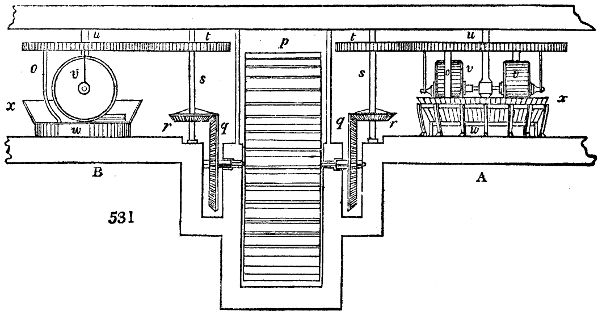
The mill for grinding the gunpowder cake may be understood from the following representation: (fig. 531.) p, is the water wheel, which may drive several pairs of stones; q, q, two vertical bevel wheels, fixed upon the axis of the great wheel; r, r, two horizontal bevel wheels working in q, q, and turning the shafts s, s; t, t, two horizontal spur wheels fixed to the upper part of the vertical shafts, and driving the large wheels u, u. To the shafts of these latter wheels are fixed the runners v, v, which traverse upon the bed stone w, w; x, x, are the curbs surrounding the bed stone to prevent the powder from falling off; o is the scraper. Mill A represents a view, and mill B a section of the bed stone and curb.
GYPSUM, Sulphate of Lime, Alabaster, or Paris Plaster. This substance is found in three geological positions in the crust of the earth; among transition rocks; in the red marl formation; and above the chalk, in the tertiary beds.
1. The alpine gypsums are ranged by M. Brochant among the transition class, and are characterized by the presence of anthracite or stone coal; some of them are white and pure, others gray or yellowish, and mixed with mica, talc, steatite, black oxide of iron, pyrites, compact carbonate of lime, sulphur, and common salt. Examples of such localities are found in the gypsum of Val-Canaria at the foot of Saint Gothard, that of Brigg in the upper Valais; of the Grilla in the valley of Chamouni, and of Saint Gervais-les-Bains, near Sallenches in Savoy.
2. The secondary gypsum, or that of the salt mine districts, belongs to the red ground, immediately beneath the lias in the order of stratification, and therefore a rock relatively antient. Near Northwick, the red marl beds above the great deposit of rock salt, are irregularly intersected with gypsum, in numerous laminæ or plates. At Newbiggin in Cumberland, the gypsum lies in red argillaceous marl, between two strata of sandstone; and a mile south of Whitehaven, the subterraneous workings for the alabaster extend 30 yards in a direct line; with two or three lateral branches extending about 10 yards, at whose extremities are large spaces where the gypsum is blasted with gunpowder. It is generally compact, forming a regular and conformable bed, with crystals of selenite (crystallized gypsum) in drusy cavities. Gypsum occurs in the red marl in the isle of Axholme, and various other places in Nottinghamshire. In Derbyshire some considerable deposits have been found in the same red sandstone, several of which are mined, as at Chellaston hill, which would exhibit a naked and water-worn rock of gypsum, were it not for a covering of alluvial clay. It appears in general to present itself chiefly in particular patches, occasioning a sudden rise, or an insulated hill, by the additional thickness which it gives to the stratum of the red ground in these places. The principal demand for the pure white gypsum, or that faintly streaked with red, is by the potters in Staffordshire, who form their moulds with the calcined powder which it affords; only particularly fine blocks are selected for making alabaster ornaments on the turning lathe. In one of the salt pits near Droitwich, the strata sunk through, were, vegetable mould, 3 feet; red marl, 35 feet; gypsum, 40 feet; a river of brine, 22 inches; gypsum, 75 feet; a rock of salt, bored into only 5 feet, but probably extending much deeper. On the Welsh side of the Bristol channel, gypsum occurs in the red marl cliffs of Glamorganshire, from Pennarth to Lavernock. No organic remains or metallic minerals have hitherto been found in the gypsum of this formation.
3. The most interesting gypsums in a general point of view, are certainly the tertiary, or those of the plains, or hills of comparatively modern formation. They are characterized, by the presence of fossil bones of extinct animals, both mammifera and birds, by shells, and a large proportion of carbonate of lime, which gives them the property of effervescing with acids, and the title of limestone gypsums. Such are the gypsums of the environs of Paris, as at the heights of Montmartre, which contain crystallized sulphate of lime in many forms, but most commonly the lenticular and lance-shaped.
Sulphate of lime occurs either as a dense compound without water, and is called anhydrite from that circumstance; or with combined water, which is its most ordinary state. Of the latter there are 6 sub-species; sparry gypsum or selenite in a variety of crystalline forms; the foliated granular; the compact; the fibrous; the scaly foliated; the earthy.
The prevailing colour is white, with various shades of gray, blue, red, and yellow. More or less translucent. Soft, sectile, yielding to the nail. Specific gravity 2·2. Water dissolves about one five-hundredth part of its weight of gypsum, and acquires the quality of hardness, with the characteristic selenitic taste. When exposed on red hot coals, it decrepitates, becomes white, and splits into a great many brittle plates. At the heat of a baker’s oven, or about 400° Fahr., the combined water of gypsum escapes with a species of ebullition. At a higher temperature the particles get indurated. When rightly calcined and pulverized, gypsum is mixed with water to the consistence of cream, and poured into moulds by the manufacturers of stucco ornaments and statues. A species of rapid crystallization ensues, and the thin paste soon acquires a solid consistence, which is increased by drying the figure in proper stoves. During the consolidation of the plaster, its volume expands into the finest lines of the mould, so as to give a sharp and faithful impression.
The plaster stone of the Paris basin contains about 12 per cent. of carbonate of lime. This body, ground and mixed with water, forms an adhesive mortar much used in building, as it fixes very speedily. Works executed with pure gypsum never become so hard as those made with the calcareous kind; and hence it might be proper to add a certain portion of white slaked lime to our calcined gypsum, in order to give the stucco this valuable property. Coloured stuccos of great solidity are made by adding to a clear solution of glue, any desired colouring tincture, and mixing-in the proper quantity of the calcined calcareous gypsum.
The compact, fine-grained gypseous alabaster is often cut into various ornamental figures, such as vases, statuary groups, &c., which take a high polish and look beautiful, but from their softness are easily injured, and require to be kept enclosed within a glass shade.
In America and France, the virtues of gypsum in fertilizing land have been highly extolled, but they have not been realized in the trials made in this kingdom.
Pure gypsum consists of lime 28; sulphuric acid 40; water 18; which are the respective weights of its prime equivalent parts.
M. Gay Lussac, in a short notice, in the Annales de Chimie for April 1829, on the setting of gypsum, says that the purest plasters are those that harden least, and that the addition of lime is of no use towards promoting their solidity, nor can the heat proper for boiling gypsum ever expel the carbonic acid gas from the calcareous carbonate present in the gypsum of Montmartre. He conceives that a hard plaster-stone having lost its water, will resume more solidity in returning to its first state, than a plaster-stone naturally tender or soft; and that it is the primitive molecular arrangement which is regenerated. See Alabaster.