F. (continued 4)
Reading edition
2Cr 703·638 112·766
Molybdenum Mo 598·525 95·920
Tungstenium Tu or W 1183·200 189·621
Antimony Sb 806·452 129·243
2Sb 1612·904 258·486
Tellurium Te 806·452 129·243
Tantalum Ta 1153·715 184·896
2Ta 2307·430 369·792
Titanium Ti 389·092 62·356
Gold (aurum) Au 1243·013 199·207
2Au 2486·026 398·415
Platina Pt 1215·220 194·753
Rhodium R 750·680 120·305
2R 1501·360 240·610
Palladium Pd 714·618 114·526
Silver (argentum) Ag 1351·607 216·611
Mercury (hydrargyrus) Hg 1265·822 202·863
2Hg 2531·645 405·725
Copper (cuprum) Cu 395·695 63·415
2Cu 791·390 126·829
Uranium U 2711·360 434·527
2U 5422·720 869·154
Bismuth Bi 1330·376 213·208
2Bi 2660·752 426·416
Tin (stannum) Sn 735·294 117·839
Lead (plumbum) Pb 1294·498 207·458
2Pb 2588·996 414·917
Cadmium Cd 696·767 111·665
Zinc Zn 403·226 64·621
Nickel Ni 369·675 59·245
Cobalt Co 368·991 59·135
2Co 737·982 118·270
Iron (ferrum) Fe 339·213 54·363
2Fe 678·426 108·725
Manganese Mn 355·787 57·019
2Mn 711·575 114·038
Cerium Ce 574·718 92·105
2Ce 1149·436 184·210
Zirconium Zr 420·238 67·348
2Zr 840·476 134·696
Yttrium Y 401·840 64·395
Beryllium (glucinum) Be 331·479 53·123
2Be 662·958 106·247
Aluminum Al 171·167 27·431
2Al 342·234 54·863
Magnesium Mg 158·353 25·378
Calcium Ca 256·019 41·030
Strontium Sr 547·285 87·709
Baryum Ba 856·88 137·325
Lithium L 127·757 20·474
Natrium (sodium) Na 290·897 46·620
2Na 581·794 93·239
Kalium (potassium) K 489·916 78·515
Ammonia 2N 2H3 214·474 34·372
Cyanogen 2NC 329·911 52·872
Sulphuretted hydrogen 2HS 213·644 34·239
Hydrochloric acid 2HCl 455·129 72·940
Hydrocyanic acid 2HNC 342·390 54·872
Water 2. 112·479 18·026
2H
Protoxide of nitrogen 2. 277·036 44·398
2N
Deutoxide of nitrogen . 188·518 30·212
N
Nitrous acid 2... 477·036 76·449
2N
Nitric acid .·.·. 677·036 108·503
2N
Hyposulphurous acid . 301·165 48·265
S
Sulphurous acid .. 401·165 64·291
S
Hyposulphuric acid .·.·. 902·330 144·609
2S
Sulphuric acid ... 501·165 80·317
S
Phosphoric acid .·.·. 892·310 143·003
2P
Chloric acid .·.·. 942·650 151·071
2Cl
Perchloric acid ::: 1042·650 167·097
2Cl
Iodic acid .·.·. 2037·562 326·543
2I
Carbonic acid .. 276·437 44·302
C
Oxalic acid 2... 452·875 72·578
2C
Boracic acid 2::: 871·966 139·743
2B
Silicic acid ... 577·478 92·548
Si
Selenic acid .. 694·582 111·315
Se
Arsenic acid .·.·. 1440·084 230·790
2As
Protoxide of chrome 2... 1003·638 160·840
2Cr
Chromic acid ... 651·819 104·462
Cr
Molybdic acid ... 898·525 143·999
Mo
Tungstic, or wolfram acid ... 1483·200 237·700
W
Oxide of antimony 2... 1912·904 306·565
2Sb
Antimonious acid .. 1006·452 161·296
Sb
.... 2012·904 322·591
2Sb
Antimonic acid 2.·.·. 2112·904 338·617
2Sb
Oxide of tellurium .. 1006·452 161·296
Te
Tantalic acid ... 2607·430 417·871
2Ta
Titanic acid .. 589·092 94·409
Ti
Protoxide of gold . 2586·026 414·441
2Au
Peroxide of gold ... 2786·026 446·493
2Au
Oxide of platina .. 1415·220 226·086
Pt
Oxide of rhodium 2... 1801·360 228·689
2R
Oxide of palladium . 814·618 130·552
Pd
Oxide of silver . 1451·607 232·637
Ag
Protoxide of mercury . 2631·645 421·752
2Hg
Peroxide of mercury . 1365·822 218·889
Hg
Protoxide of copper . 801·390 142·856
2Cu
Peroxide of copper . 495·695 79·441
Cu
Protoxide of uranium . 2811·360 450·553
U
Peroxide of uranium 2... 5722·720 917·132
2U
Oxide of bismuth 2... 2960·752 474·49
2Bi
Protoxide of tin . 835·294 133·866
Sn
Peroxide of tin .. 935·294 149·892
Sn
Oxide of lead . 1394·498 223·484
Pb
Minium ... 2888·996 462·995
2Pb
Brown oxide of lead .. 1494·498 239·511
Pb
Oxide of cadmium . 796·767 127·691
Cd
Oxide of zinc . 503·226 80·649
Zn
Oxide of nickel . 469·675 75·271
Ni
Oxide of cobalt . 468·991 75·161
Co
Peroxide of cobalt ... 1037·982 166·349
2Co
Protoxide of iron . 439·213 70·389
Fe
Peroxide of iron ... 978·426 156·804
2Fe
Protoxide of manganese . 455·787 73·045
Mn
Oxide of manganese ... 1011·575 162·117
2Mn
Peroxide of manganese .. 555·787 89·071
Mn
Manganesic acid .·.·. 1211·575 194·169
2Mn
Protoxide of cerium . 674·718 108·132
Ce
Oxide of cerium ... 1449·436 232·289
2Ce
Zirconia ... 1140·476 182·775
2Zr
Yttria . 501·840 80·425
Y
Glucina, or berryllia ... 962·958 154·325
2Be
Alumina ... 642·334 109·942
2Al
Magnesia . 258·353 41·404
Mg
Lime . 356·019 57·056
Ca
Strontia . 647·285 103·735
Sr
Baryta . 956·880 153·351
Ba
Lithia . 227·757 36·501
L
Natron, or soda . 390·897 62·646
Na
Peroxide of sodium ... 881·794 141·318
2Na
Kali, or potassa . 589·916 94·541
K
Peroxide of potassium ... 789·916 126·593
K
Sulphate of potassa . ... 1091·081 174·859
K S
Protosulphate of iron . ... 940·378 150·706
Fe S
Persulphate of iron ... ... 2481·906 397·754
2Fe S3
Protochloride of iron Fe 2Cl 781·863 125·303
Perchloride of iron 2Fe 2Cl3 2006·376 321·545
Protochloride of mercury 2Hg 2Cl 2974·295 476·666
Perchloride of mercury Hg 2Cl 1708·472 273·803
Ferrocyanide of iron Fe2NC + 2K2NC 2308·778 370·008
Alum . ... + 2... ... + 24 2 . 5936·406 951·378
K S + 2Al S3 + 24 2H
Felspar . ... + 2 ... ... 3542·162 567·673
K Si + 2Al Si3
FOUNDING of metals, chiefly of Iron. The operations of an iron foundry consist in re-melting the pig-iron of the blast furnaces, and giving it an endless variety of forms, by casting it in moulds of different kinds, prepared in appropriate manners. Coke is the only kind of fuel employed to effect the fusion of the cast iron.
The essential parts of a well-mounted iron foundry, are,
1. Magazines for pig irons of different qualities, which are to be mixed in certain proportions, for producing castings of peculiar qualities; as also for coal, coke, sands, clay, powdered charcoal, and cow-hair for giving tenacity to the loam mouldings.
2. One or more coke ovens.
3. A workshop for preparing the patterns and materials of the moulds. It should contain small edge millstones for grinding and mixing the loam, and another mill for grinding coal and charcoal.
4. A vast area, called properly the foundry, in which the moulds are made and filled with the melted metal. These moulds are in general very heavy, consisting of two parts at least, which must be separated, turned upside down several times, and replaced very exactly upon one another. The casting is generally effected by means of large ladles or pots, in which the melted iron is transported from the cupola, where it is fused. Hence the foundry ought to be provided with cranes, having jibs movable in every direction.
5. A stove in which such moulds may be readily introduced, as require to be entirely deprived of humidity, and where a strong heat may be uniformly maintained.
6. Both blast and air furnaces, capable of melting speedily the quantity of cast-iron to be employed each day.
7. A blowing machine to urge the fusion in the furnaces.
Fig. 467. represents the general plan of a well-mounted foundry.
a, is a cupola furnace of which the section and view will be afterwards given; it is capable of containing 5 tons of cast-iron.
a′, is a similar furnace, but of smaller dimensions, for bringing down 13⁄4 tons.
a′′, is a furnace like the first, in reserve for great castings.
b, b, b, b, a vast foundry apartment, whose floor to a yard in depth, is formed of sand and charcoal powder, which have already been used for castings, and are ready for heaping up into a substratum, or to be scooped out when depth is wanted for the moulds. There are besides several cylindrical pits, from five to seven yards in depth, placed near the furnaces. They are lined with brick work, and are usually left full of moulding sand. They are emptied in order to receive large moulds, care being had that their top is always below the orifice from which the melted metal is tapped.
These moulds, and the ladles full of melted metal are lifted and transported by the arm of one or more men, when their weight is moderate; but if it be considerable, they are moved about by cranes whose vertical shafts are placed at c, d, e, in correspondence, so that they may upon occasion transfer the load from one to another. Each crane is composed principally of an upright shaft, embraced at top by a collet, and turning below upon a pivot in a step; next of a horizontal beam, stretched out from nearly the top of the former, with an oblique stay running downwards, like that of a gallows. The horizontal beam supports a movable carriage, to which the tackle is suspended for raising the weights. This carriage is made to glide backwards or forwards along the beam by means of a simple rack and pinion mechanism, whose long handle descends within reach of the workman’s hand.
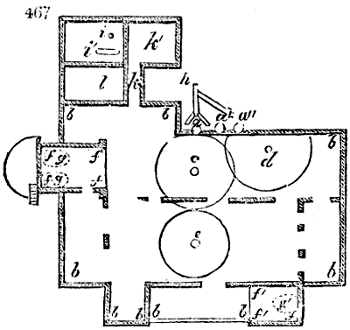
By these arrangements in the play of the three cranes, masses weighing five tons may be transported and laid down with the greatest precision upon any point whatever in the interior of the three circles traced upon fig. 467. with the points c, d, e, as centres.
c, d, e, are the steps, upon which the upright shafts of the three cranes rest and turn. Each shaft is 16 feet high.
f, f, is the drying stove, having its floor upon a level with that of the foundry.
f′, f′, is a supplementary stove for small articles.
g, g, g, are the coaking ovens.
h, is the blowing machine or fan.
i, is the steam-engine, for driving the fan, the loam-edge stones,
k, and the charcoal mill.
i′′, are the boiler and the furnace of the engine.
k′, workshop for preparing the loam and other materials of moulding.
l, is the apartment for the patterns.
The pig-iron, coals, &c. are placed either under sheds or in the open air, round the above buildings; where are also a smith’s forge, a carpenter’s shop, and an apartment mounted with vices for chipping and rough cleaning the castings by chisels and files.
Such a foundry may be erected upon a square surface of about 80 yards in each side, and will be capable, by casting in the afternoon and evening of each day, partly in large and partly in small pieces, of turning out from 700 to 800 tons per annum, with an establishment of 100 operatives, including some moulding boys.
Of making the Moulds.—1. Each mould ought to present the exact form of its object.
2. It should have such solidity that the melted metal may be poured into it, and fill it entirely without altering its shape in any point.
3. The air which occupies the vacant spaces in it, as well as the carburetted gases generated by the heat, must have a ready vent; for if they are but partially confined, they expand by the heat, and may crack, even blow up the moulds, or at any rate become dispersed through the metal, making it vesicular and unsound.
There are three distinct methods of making the moulds:—
1. In green sand; 2. In baked sand; 3. In loam.
To enumerate the different means employed to make every sort of mould exceeds the limits prescribed to this work. I shall merely indicate for each species of moulding, what is common to all the operations; and I shall then describe the fabrication of a few such moulds as appear most proper to give general views of this peculiar art.
Moulding in green sand.—The name green is given to a mixture of the sand as it comes from its native bed, with about one twelfth its bulk of coal reduced to powder, and damped in such a manner as to form a porous compound, capable of preserving the forms of the objects impressed upon it. This sand ought to be slightly argillaceous, with particles not exceeding a pin’s head in size. When this mixture has once served for a mould, and been filled with metal, it cannot be employed again except for the coarsest castings, and is generally used for filling up the bottoms of fresh moulds.
For moulding any piece in green sand, an exact pattern of the object must be prepared in wood or metal; the latter being preferable, as not liable to warping, swelling, or shrinkage.
A couple of iron frames form a case or box, which serves as an envelope to the mould. Such boxes constitute an essential and very expensive part of the furniture of a foundry. It is a rectangular frame, without bottom or lid, whose two largest sides are united by a series of cross bars, parallel to each other, and placed from 6 to 8 inches apart.
The two halves of the box carry ears corresponding exactly with one another; of which one set is pierced with holes, but the other has points which enter truly into these holes, and may be made fast in them by cross pins or wedges, so that the pair becomes one solid body. Within this frame there is abundance of room for containing the pattern of the piece to be moulded with its encasing sand, which being rammed into the frame, is retained by friction against the lateral faces and cross bars of the mould.
When a mould is to be formed, a box of suitable dimensions is taken asunder, and each half, No. 1. and No. 2., is laid upon the floor of the foundry. Green sand is thrown with a shovel into No. 1. so as to fill it; when it is gently pressed in with a rammer. The object of this operation is to form a plane surface upon which to lay in the pattern with a slight degree of pressure, varying with its shape. No. 1. being covered with sand, the frame No. 2. is laid upon it, so as to form the box. No. 2. being now filled carefully with the green sand, the box is inverted, so as to place No. 1. uppermost, which is then detached and lifted off in a truly vertical position; carrying with it the body of sand formed at the commencement of the operation. The pattern remains imbedded in the sand of No. 2., which has been exactly moulded upon a great portion of its surface. The moulder condenses the sand in the parts nearest to the pattern, by sprinkling a little water upon it, and trimming the ill-shaped parts with small iron trowels of different kinds. He then dusts a little well-dried finely-sifted sand over all the visible surface of the pattern, and of the sand surrounding it; this is done to prevent adhesion when he replaces the frame No. 1.
He next destroys the preparatory smooth bed or area formed in this frame, covers the pattern with green sand, replaces the frame 1. upon 2. to reproduce the box, and proceeds to fill and ram No. 1., as he had previously done No. 2. The object of this operation is to obtain very exactly a concavity in the frame No. 1., having the shape of the part of the model impressed coarsely upon the surface formed at the beginning, and which was meant merely to support the pattern and the sand sprinkled over it, till it got imbedded in No. 2.
The two frames in their last position, along with their sand, may be compared to a box of which No. 1. is the lid, and whose interior is adjusted exactly upon the enclosed pattern.
If we open this box, and after taking out the pattern, close its two halves again, then pour in melted metal till it fill every void space, and become solid, we shall obviously attain the wished-for end, and produce a piece of cast iron similar to the pattern. But many precautions must still be taken before we can hit this point. We must first lead through the mass of sand in the frame No. 1., one or more channels for the introduction of the melted metal; and though one may suffice for this purpose, another must be made for letting the air escape. The metal is run in by several orifices at once, when the piece has considerable surface, but little thickness, so that it may reach the remotest points sufficiently hot and liquid.
The parts of the mould near the pattern must likewise be pierced with small holes, by means of wires traversing the whole body of the sand, in order to render the mould more porous, and to facilitate the escape of the air and the gases. Then, before lifting off the frame No. 1., we must tap the pattern slightly, otherwise the sand enclosing it would stick to it in several points, and the operation would not succeed. These gentle jolts are given by means of one or more pieces of iron wire which have been screwed vertically into the pattern before finally ramming the sand into the frame No. 1., or which enter merely into holes in the pattern. These pieces are sufficiently long to pass out through the sand when the box is filled; and it is upon their upper ends that the horizontal blows of the hammer are given; their force being regulated by the weight and magnitude of the pattern. These rods are then removed by drawing them straight out; after which the frame No. 1. may be lifted off smoothly from the pattern.
The pattern itself is taken out, by lifting it in all its parts at once, by means of screw pins adjusted at the moment. This manœuvre is executed, for large pieces, almost always by several men, who while they lift the pattern with one hand, strike it with the other with small repeated blows to detach the sand entirely, in which it is generally more engaged than it was in that of the frame No. 1. But in spite of all these precautions, there are always some degradations in one or other of the two parts of the mould; which are immediately repaired by the workman with damp sand, which he applies and presses gently with his trowel, so as to restore the injured forms.
Hitherto I have supposed all the sand rammed into the box to be of one kind; but from economy, the green sand is used only to form the portion of the mould next the pattern, in a stratum of about an inch thick; the rest of the surrounding space is filled with the sand of the floor which has been used in former castings. The interior layer round the pattern is called in this case, new sand.
It may happen that the pattern is too complex to be taken out without damaging the mould, by two frames alone; then 3 or more are mutually adjusted to form the box.
When the mould, taken asunder into two or more parts, has been properly repaired, its interior surface must be dusted over with wood charcoal reduced to a very fine powder, and tied up in a small linen bag, which is shaken by hand. The charcoal is thus sifted at the moment of application, and sticks to the whole surface which has been previously damped a little. It is afterwards polished with a fine trowel. Sometimes, in order to avoid using too much charcoal, the surfaces are finally dusted over with sand, very finely pulverized, from a bag like the charcoal. The two frames are now replaced with great exactness, made fast together by the ears, with wedged bolts laid truly level, or at the requisite slope, and loaded with considerable weights. When the casting is large, the charcoal dusting as well as that of fine sand, is suppressed. Every thing is now ready for the introduction of the fused metal.
Moulding in baked or used sand.—The mechanical part of this process is the same as of the preceding. But when the castings are large, and especially if they are tall, the hydrostatic pressure of the melted metal upon the sides of the mould cannot be counteracted by the force of cohesion which the sand acquires by ramming. We must in that case adapt to each of these frames a solid side, pierced with numerous small holes to give issue to the gases. This does not form one body with the rest of the frame, but is attached extemporaneously to it by bars and wedged bolts. In general no ground coal is mixed with this sand. Whenever the mould is finished, it is transferred to the drying stove, where it may remain from 12 to 24 hours at most, till it be deprived of all its humidity. The sand is then said to be baked, or annealed. The experienced moulder knows how to mix the different sands placed at his disposal, so that the mass of the mould as it comes out of the stove, may preserve its form, and be sufficiently porous. Such moulds allow the gases to pass through them much more readily than those made of green sand; and in general the castings they turn out are less vesicular, and smoother upon the surface. Sometimes in a large piece, the three kinds of moulding, that in green sand, in baked sand, and in loam, are combined to produce the best result.
Moulding in loam.—This kind of work is executed from drawings of the pieces to be moulded, without being at the expense of making patterns. The mould is formed of a pasty mixture of clay, water, sand, and cow’s hair, or other cheap filamentous matter, kneaded together in what is called the loam mill. The proportions of the ingredients are varied to suit the nature of the casting. When the paste requires to be made very light, horse dung or chopped straw is added to it.
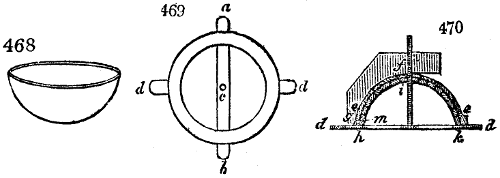
I shall illustrate the mode of fabricating loam moulds, by a simple case, such as that of a sugar pan. Fig. 468. is the pan. There is laid upon the floor of the foundry, an annular platform of cast-iron a b, fig. 469.; and upon its centre c, rests the lower extremity of a vertical shaft, adjusted so as to turn freely upon itself, while it makes a wooden pattern e f, fig. 470., describe a surface of revolution identical with the internal surface reversed of the boiler intended to be made. The outline e g, of the pattern is fashioned so as to describe the surface of the edge of the vessel. Upon the part a d b d, fig. 469., of the flat cast-iron ring, there must next be constructed, with bricks laid either flat or on their edge, and clay, a kind of dome, h i k, fig. 470., from two to four inches thick, according to the size and weight of the piece to be moulded. The external surface of the brick dome ought to be everywhere two inches distant at least, from the surface described by the arc e, f. Before building up the dome to the point i, coals are to be placed in its inside upon the floor, which may be afterwards kindled for drying the mould. The top is then formed, leaving at i, round the upright shaft of revolution, only a very small outlet. This aperture, as also some others left under the edges of the iron ring, enable the moulder to light the fire when it becomes necessary, and to graduate it so as to make it last long enough without needing more fuel, till the mould be quite finished and dry. The combustion should be always extremely slow.
Over the brick dome a pasty layer of loam is applied, and rounded with the mould g e f; this surface is then coated with a much smoother loam, by means of the concave edge of the same mould. Upon the latter surface, the inside of the sugar pan is cast; the line e g having traced, in its revolution, a ledge m. The fire is now kindled, and as the surface of the mould becomes dry, it is painted over by a brush, with a mixture of water, charcoal powder, and a little clay, in order to prevent adhesion between the surface already dried and the coats of clay about to be applied to it. The board g e f is now removed, and replaced by another, g′ e′ f′, fig. 471., whose edge e′ f′ describes the outer surface of the pan. Over the surface e, f, a layer of loam is applied, which is turned and polished so as to produce the surface of revolution e′ f′, as was done for the surface e f; only in the latter case, the line e′ g′ of the board does not form a new shoulder, but rubs lightly against m.
The layer of loam included between the two surfaces e f, e′ f′, is an exact representation of the sugar pan. When this layer is well dried by the heat of the interior fire, it must be painted like the former. The upright shaft is now removed, leaving the small vent hole through which it passed to promote the complete combustion of the coal. There must be now laid horizontally upon the ears of the platform d d, fig. 469., another annular platform p q, like the former, but a little larger, and without any cross-bar.
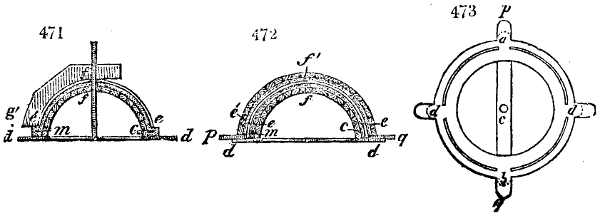
The relative position of these two platforms is shown in fig. 473. Upon the surface e′ f′, fig. 472., a new layer of loam is laid, two inches thick, of which the surface is smoothed by hand. Then upon the platform p q, fig. 473., a brick vault is constructed, whose inner surface is applied to the layer of loam. This contracts a strong adherence with the bricks which absorb a part of its moisture, while the coat of paint spread over the surface e′ f′, prevents it from sticking to the preceding layers of loam. The brick dome ought to be built solidly.
The whole mass is now to be thoroughly dried by the continuance of the fire, the draught of which is supported by a small vent left in the upper part of the new dome; and when all is properly dry, the two iron platforms are adjusted to each other by pin points, and p q is lifted off, taking care to keep it in a horizontal position. Upon this platform are removed the last brick dome, and the layer of loam which had been applied next to it; the latter of which represents exactly by its inside the mould of the surface e′ f′, that is of the outside of the pan. The crust contained between e f and e′ f′ is broken away, an operation easily done without injury to the surface e f, which represents exactly the inner surface of the pan; or only to the shoulder m, corresponding to the edge of the vessel. The top aperture through which the upright shaft passed must be now closed; only the one is kept open in the portion of the mould lifted off upon p q; because through this opening the melted metal is to be poured in the process of casting. The two platforms being replaced above each other very exactly, by means of the adjusting pin-points, the mould is completely formed, and ready for the reception of the metal.
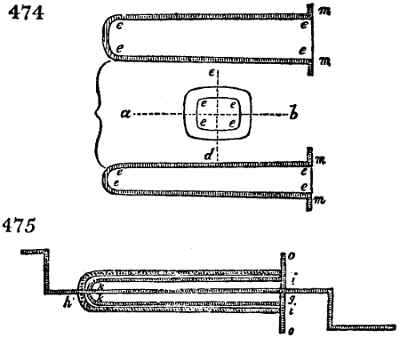
When the object to be moulded presents more complicated forms than the one now chosen for the sake of illustration, it is always by analogous processes that the workman constructs his loam moulds, but his sagacity must hit upon modes of executing many things which at first sight appear to be scarcely possible. Thus, when the forms of the interior and exterior do not permit the mould to be separated in two pieces, it is divided into several, which are nicely fitted with adjusting pins. More than two cast-iron rings or platforms are sometimes necessary. When ovals or angular surfaces must be traced instead of those of revolution, no upright shaft is used, but wooden or cast-iron guides made on purpose, along which the pattern cut-out board is slid according to the drawing of the piece. Iron wires and claws are often interspersed through the brick work to give it cohesion. The core, kernel, or inner mould of a hollow casting is frequently fitted in when the outer shell is moulded. I shall illustrate this matter in the case of a gas-light retort, fig. 474. The core of the retort ought to have the form e e e e, and be very solid, since it cannot be fixed in the outer mould, for the casting, except in the part standing out of the retort towards m m. It must be modelled in loam, upon a piece of cast-iron called a lantern, made expressly for this purpose. The lantern is a cylinder or a truncated hollow cone of cast iron, about half an inch thick; and differently shaped for every different core. The surface is perforated with holes of about half an inch in diameter. It is mounted by means of iron cross bars, upon an iron axis, which traverses it in the direction of its length. Fig. 475. represents a horizontal section through the axis of the core; g h is the axis of the lantern, figured itself at i k k i; o i i o is a kind of disc or dish, perpendicular to the axis, open at i i, forming one piece with the lantern, whose circumference o o presents a curve similar to the section of the core, made at right angles to its axis. We shall see presently the two uses for which this dish is intended. The axis g h is laid upon two gudgeons, and handles are placed at each of its extremities, to facilitate the operation in making the core. Upon the whole surface of the lantern, from the point h to the collet formed by the dish, a hay cord as thick as the finger is wound. Even two or more coils may be applied, as occasion requires, over which loam is spread to the exact form of the core, by applying with the hand a board, against the dish o o, with its edge cut out to the desired shape; as also against another dish, adjusted at the time towards h; while by means of the handles a rotatory movement is given to the whole apparatus.
The hay interposed between the lantern and the loam, which represents the crust of the core, aids the adhesion of the clay with the cast iron of the lantern, and gives passage to the holes in its surface, for the air to escape through in the casting.
When the core is finished, and has been put into the drying stove, the axis g h is taken out, then the small opening which it leaves at the point h, is plugged with clay. This is done by supporting the core by the edges of the dish, in a vertical position. It is now ready to be introduced into the hollow mould of the piece.
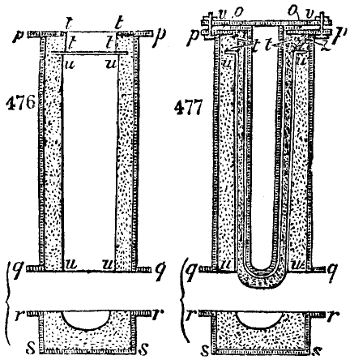
This mould executed in baked sand consists of three pieces, two of which absolutely similar, are represented, fig. 476., at p q, the third is shown at r s. The two similar parts p q, present each the longitudinal half of the nearly cylindrical portion of the outer surface of the gas retort; so that when they are brought together, the cylinder is formed; r s contains in its cavity the kind of hemisphere which forms the bottom of the retort. Hence, by adding this part of the mould to the end of the two others, the resulting apparatus presents in its interior, the exact mould of the outside of the retort; an empty cylindrical portion t t, whose axis is the same as that of the cylinder u u, and whose surface, if prolonged, would be every where distant from the surface u u, by a quantity equal to the desired thickness of the retort. The diameter of the cylinder t t is precisely equal to that of the core, which is slightly conical, in order that it may enter easily into this aperture t t, and close it very exactly when it is introduced to the collet or neck.
The three parts of the mould and the core being prepared, the two pieces p q, must first be united, and supported in an upright position; then the core must be let down into the opening t t, fig. 477. When the plate or disc o o of the core is supported upon the mould, we must see that the end of the core is every where equally distant from the edge of the external surface u u, and that it does not go too far beyond the line q q. Should there be an inaccuracy, we must correct it by slender iron slips placed under the edge of the disc o o; then by means of a cast iron cross, and screw bolts v v, we fix the core immovably. The whole apparatus is now set down upon r s, and we fix with screw bolts the plane surface q q upon r r; then introduce the melted metal by an aperture z, which has been left at the upper part of the mould.
When, instead of the example now selected, the core of the piece to be cast must go beyond the mould of the external surface, as is the case with a pipe open at each end, the thing is more simple, because we may easily adjust and fix the core by its two ends.
In casting a retort, the metal is poured into the mould set upright. It is important to maintain this position in the two last examples of casting; for all the foreign matters which may soil the metal during its flow, as the sand, the charcoal, gases, scoriæ, being less dense than it, rise constantly to the surface. The hydrostatic pressure produced by a high gate, or filling-in aperture, contributes much to secure the soundness and solidity of the casting. This gate piece being superfluous, is knocked off almost immediately after, or even before the casting cools. Very long, and somewhat slender pieces, are usually cast in moulds set up obliquely to the horizon. As the metal shrinks in cooling, the mould should always be somewhat larger than the object intended to be cast. The iron founder reckons in general upon a linear shrinkage of a ninety-sixth part; that is one-eighth of an inch per foot.
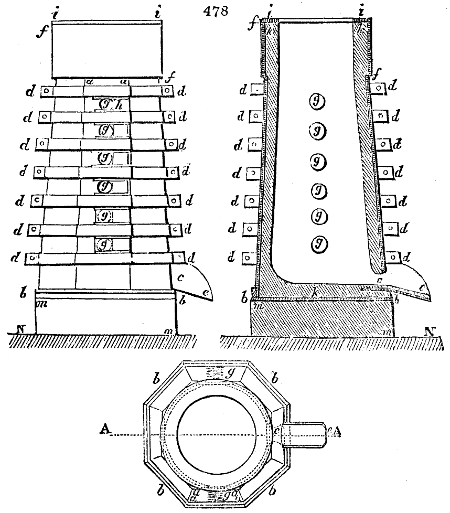
Melting of the cast-iron.—The metal is usually melted in a cupola furnace, of which the dimensions are very various. Fig. 478. represents in plan, section, and elevation, one of these furnaces of the largest size; being capable of founding 5 tons of cast-iron at a time. It is kindled by laying a few chips of wood upon its bottom, leaving the orifice c open, and it is then filled up to the throat with coke. The fire is lit at c, and in a quarter or half an hour, when the body of fuel is sufficiently kindled, the tuyère blast is set in action. The flame issues then by the mouth as well as the orifice c, which has been left open on purpose to consolidate it by the heat. Without this precaution, the sides which are made up in argillaceous sand after each day’s work, would not present the necessary resistance. A quarter of an hour afterwards, the orifice c is closed with a lump of moist clay, and sometimes, when the furnace is to contain a great body of melted metal, the clay is supported by means of a small plate of cast-iron fixed against the furnace. Before the blowing machine is set a going, the openings g g g had been kept shut. Those of them wanted for the tuyères are opened in succession, beginning at the lowest, the tuyères being raised according as the level of the fused iron stands higher in the furnace. The same cupola may receive at a time from one to six tuyères, through which the wind is propelled by the centrifugal action of an excentric fan or ventilator. It does not appear to be ascertained whether there be any advantage in placing more than two tuyères facing each other upon opposite sides of the furnace. Their diameter at the nozzle varies from 3 to 5 inches. They are either cylindrical or slightly conical. A few minutes after the tuyères have begun to blow, when the coke sinks in the furnace, alternate charges of coke and pig iron must be thrown in. The metal begins to melt in about 20 minutes after its introduction; and successive charges are then made every 10 minutes nearly; each charge containing from 2 cwt. to 5 cwt. of iron, and a quantity proportional to the estimate given below. The amount of the charges varies of course with the size of the furnace, and the speed required for the operation. The pigs must be previously broken into pieces weighing at most 14 or 16 pounds. The vanes of the blowing fan make from 625 to 650 turns per minute. The two cupolas represented fig. 478., and another alongside in the plan, may easily melt 61⁄2 tons of metal in 23⁄4 hours; that is 21⁄3 tons per hour. This result is three or four times greater than what was formerly obtained in similar cupolas, when the blast was thrown in from small nozzles with cylinder bellows, moved by a steam engine of 10 horses power.
In the course of a year, a considerable foundry like that represented in the plan, fig. 467., will consume about 300 tons of coke in melting 1240 tons of cast iron; consisting of 940 tons of pigs of different qualities, and 300 tons of broken castings, gate-pieces, &c. Thus, it appears that 48 pounds of coke are consumed for melting every 2 cwt. of metal.
Somewhat less coke is consumed when the fusion is pushed more rapidly to collect a great body of melted metal, for casting heavy articles; and more is consumed when, as in making many small castings, the progress of the founding has to be slackened from time to time; otherwise, the metal would remain too long in a state of fusion, and probably become too cold to afford sharp impressions of the moulds.
It sometimes happens that in the same day, with the same furnace, pieces are to be cast containing several proportions of different kinds of iron; in which case, to prevent an intermixture with the preceding or following charges, a considerable bed of coke is interposed. Though there be thus a little waste of fuel, it is compensated by the improved adaptation of the castings to their specific objects. The founding generally begins at about 3 o’clock, P. M., and goes on till 6 or 8 o’clock. One founder, aided by four labourers for charging, &c., can manage two furnaces.
The following is the work of a well-managed foundry in Derby.
200 lbs. of coke are requisite to melt, or bring down (in the language of the founders), 1 ton of cast-iron, after the cupola has been brought to its proper heat, by the combustion in it of 9 baskets of coak, weighing by my trials, 40 pounds each, = 360 lbs.
The chief talent of the founder consists in discovering the most economical mixtures, and so compounding them as to produce the desired properties in the castings. One piece, for example, may be required to have great strength and tenacity to bear heavy weights or strains; another must yield readily to the chisel or the file; a third must resist sudden alternations of temperature; and a fourth must be pretty hard.
The filling in of the melted metal is managed in two ways. For strong pieces, whose moulds can be buried in the ground at 7 or 8 yards distance from the furnace, the metal may be run in gutters, formed in the sand of the floor, sustained by plates or stones. The clay plug is pierced with an iron rod, when all is ready.
When from the smaller size, or greater distance of the moulds, the melted metal cannot be run along the floor from the furnace, it is received in cast-iron pots or ladles, lined with a coat of loam. These are either carried by the hands of two or more men, or transported by the crane. Between the successive castings, the discharge hole of the furnace is closed with a lump of clay, applied by means of a stick, having a small disc of iron fixed at its end.
After the metal is somewhat cooled, the moulds are taken asunder, and the excrescences upon the edges of the castings are broken off with a hammer. They are afterwards more carefully trimmed or chipped by a chisel when quite cold. The loss of weight in founding is about 61⁄2 per cent. upon the pig iron employed. Each casting always requires the melting of considerably more than its own weight of iron. This excess forms the gates, false seams, &c.; the whole of which being deducted, shows that 1 cwt. of coke is consumed for every 3 cwt. of iron put into the furnace; for every 138 cwt. of crude metal, there will be 100 cwt. of castings, 32 of refuse pieces, and 6 of waste.
Explanation of the plates.
Manner of constructing the Mould of a Sugar-pan.
Fig. 468. View of the pan.
—g.469. Flat ring of cast-iron for supporting the inner mould.
—g.470. Construction of the inner mould.
—g.471. Formation of the outer surface of the pan.
—g.472. Finished mould.
—g.473. Position of the two flat cast-iron rings, destined to sustain the moulds of the inner and the outer surface.
Gas-retort Moulding.
—g.474. Vertical projection, perpendicular to the axis of the retort; and two sections, the one upright, the other horizontal.
—g.475. Construction of the core of the retort.
—g.476. Disposition of the outer mould.
—g.477. Adjustment of the core in the mould.
—g.478. Cupola furnace. It is 3 feet wide within, and 131⁄2 high.
m m, solid body of masonry, as a basis to the furnace.
b b, octagonal platform of cast iron, with a ledge in which the plates a a a a are engaged.
a a, eight plates of cast iron, 1 inch thick, absolutely similar; only one of them is notched at its lower part in c, to allow the melted metal to run out, and two of the others have six apertures g g g, &c. to admit the tuyères.
c, orifice for letting the metal flow out. A kind of cast iron gutter, e, lined with loam is fitted to the orifice.
d, hoops of hammered iron, 41⁄4 inches broad; one half of an inch thick for the bottom ones; and a quarter of an inch for the upper ones. The intermediate hoops decrease in thickness from below upwards between these limits.
e, cast iron gutter or spout, lined with loam, for running off the metal.
f f, cylindrical piece of cast iron, for increasing the height and draught of the furnace.
g, side openings for receiving the tuyères, of which there are six upon each side of the furnace. Each of them may be shut at pleasure, by means of a small cast iron plate h, made to slide horizontally in grooves sunk in the main plate, pierced with the holes g g.
k k, interior lining of the surface, made of sand, somewhat argillaceous, in the following way. After having laid at the bottom of the furnace a bed of sand a few inches thick, slightly sloped towards the orifice of discharge, there is set upright, in the axis of the cupola, a wooden cylinder of its whole height, and of a diameter a little less than that of the vacant space belonging to the top of the furnace. Sand is to be then rammed in so as to fill the whole of the furnace; after which the wooden cylinder is withdrawn, and the lining of sand is cut or shaved away, till it has received the proper form.
This lining lasts generally 5 or 6 weeks, when there are 6 meltings weekly.
i i, cast iron circular plate, through which the mouth of the furnace passes, for protecting the lining in k during the introduction of the charges.
N N, level of the floor of the foundry. The portion of it below the running out orifice consists of sand, so that it may be readily sunk when it is wished to receive the melted metal in ladles or pots of large dimensions.
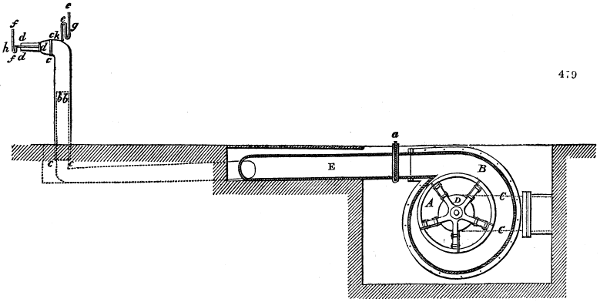
The fan distributes the blast from the main pipe to three principal points, by three branch tubes of distribution. A register, consisting of a cast-iron plate sliding with friction in a frame, serves to intercept the blast at any moment, when it is not desirable to stop the moving power. A large main pipe of zinc or sheet iron is fitted to the orifice of the slide valve. It is square at the beginning, or only rounded at the angles; but at a little distance it becomes cylindrical, and conducts the blast to the divaricating points. There, each of the branches turns up vertically, and terminates at b b, fig. 479., where it presents a circular orifice of 71⁄2 inches. Upon each of the upright pipes b, the one end of an elbow-tube of zinc c c c c, fig. 479., is adjusted rather loosely, and the other end receives a tuyère of wrought iron d d, through the intervention of a shifting hose or collar of leather c c d, hooped with iron wire to both the tube and the tuyère. The portion c c c c may be raised or lowered, by sliding upon the pipe b, in order to bring the nozzle of the tuyère d d, to the requisite point of the furnace. The portion c c c c may be made also of wrought iron. A power of 4 horses is adequate to drive this fan, for supplying blast to 3 furnaces.
The founders have observed the efflux of air was not the same when blown into the atmosphere, as it was when blown into the furnaces; the velocity of the fan, with the same impulsive power, being considerably increased in the latter case. They imagine that this circumstance arises from the blast being sucked in, so to speak, by the draught of the furnace, and that the fan then supplied a greater quantity of air.
The following experimental researches show the fallacy of this opinion. Two water syphons, e e e, f f f, made of glass tubes, one-fifth of an inch in the bore, were inserted into the tuyère, containing water in the portions g g g, h h h. The one of these manometers for measuring the pressure of the air was inserted at k, the other in the centre of the nozzle. The size of this glass tube was too small to obstruct in any sensible degree the outlet of the air. It was found that when the tuyères of the fan discharged into the open air, the expenditure by a nozzle of a constant diameter was proportional to the number of the revolutions of the vanes. It was further found, that when the speed of the vanes was constant, the expenditure by one or by two nozzles was proportional to the total area of these nozzles. The following formulæ give the volume of air furnished by the fan, when the number of turns and the area of the nozzles are known.
Volume = 25·32 S n 1,000,000n(1)
Volume = 0·86′6′7 S n1,000,000(2)
The volume is measured at 32° Fahr., under a pressure of 29·6 inches barom.
S = is the total area of the orifices of the tuyères in square inches.
n = the number of turns of the vanes in a minute.
After measuring the speed of the vanes blowing into the atmosphere, if we introduce the nozzle of discharge into the orifice of the furnace, we shall find that their speed immediately augments in a notable degree. We might, therefore, naturally suppose that the fan furnishes more air in the second case than in the first; but a little reflection will show that it is not so. In fact, the air which issues in a cold state from the tuyère encounters instantly in the furnace a very high temperature, which expands it, and contributes, along with the solid matters with which the furnace is filled, to diminish the facility of the discharge, and consequently to retard the efflux by the nozzles. The oxygen gas consumed is replaced by a like volume of carbonic acid gas, equally expansible by heat. Reason leads us to conclude that less air flows from the nozzles into the furnace than into the open atmosphere.
The increase in the velocity of the vanes takes place precisely in the same manner, when after having made the nozzles blow into the atmosphere, we substitute for these nozzles others of a smaller diameter, instead of directing the larger ones into the furnace. Hence we may conceive that the proximity of the charged furnace acts upon the blast like the contraction of the nozzles. When the moving power is uniform, and the velocity of the vanes remains the same, the quantity of air discharged must also be the same in the two cases.
Two tuyères, one 5 inches in diameter, the other 41⁄2, and which, consequently, presented a total area of 351⁄2 square inches, discharged air into one of the furnaces, from a fan whose vanes performed 654 turns in the minute. These two nozzles being briskly withdrawn from the furnace, and turned round to the free air, while a truncated pasteboard cone of 31⁄2 inches diameter was substituted for the nozzle of 41⁄2 inches, whereby the area of efflux was reduced to 29·3 square inches, the velocity of the vanes continued exactly the same. The inverse operation having been performed, that is to say, the two original nozzles having been smartly replaced in the furnace, to discover whether or not the moving power had changed in the interval of the experiment, they betrayed no perceptible alteration of speed. From the measures taken to count the speed, the error could not exceed 3 revolutions per minute, which is altogether unimportant upon the number 654.
It follows, therefore, that when the vanes of the fan have the velocity of 654 turns per minute, the expenditure by two nozzles, whose joint area is 351⁄2 square inches, both blowing into a furnace, is to the expenditure which takes place, when the same nozzles blow into the air, as 35·5 is to 29·3; that is, a little more than 4-fifths.
If this be, as is probable, a general rule for areas and speeds considerably different from the above, to find the quantity of air blown into one or more furnaces by the fan, we should calculate the volume by one of the above formulæ (1) or (2), and take 4-fifths of the result, as the true quantity.
The fan A C here represented is of the best excentric form, as constructed by Messrs. Braithwaite and Ericsson. D is the circular orifice round the axis by which the air is admitted; and C C B is the excentric channel through which the air is wafted towards the main discharge pipe E.
FOUNTAIN; a stream of water rising up through the superficial strata of the earth. See Artesian Wells.
FOXING, is a term employed by brewers to characterize the souring of beer, in the process of its fermentation or ripening.
FRANKFORT BLACK; is made by calcining vine branches, and the other refuse lees of the vinegar vats in Germany. They must be previously washed.
FREEZING. (Congelation, Fr.; Gefrierung, Germ.) The three general forms, solid, liquid, and gaseous, under one or other of which all kinds of matter exist, seem to be immediately referrible to the influence of heat; modifying, balancing, or subduing the attraction of cohesion. Every solid may be liquefied, and every liquid may be vaporized, by a certain infusion of caloric, whether this be regarded as a moving power, or an elastic essence. The converse of this proposition is equally true; for many gases, till lately styled permanent, may be liquefied, nay, even solidified, by diminution of their temperature, either alone, or aided by a condensing force, to bring their particles within the sphere of aggregative attraction. When a solid is transformed into a liquid, and a liquid into a gas or vapour, a quantity more or less considerable of heat is absorbed, or becomes latent, to use the term of Dr. Black, the celebrated discoverer of this great law of nature. When the opposite transformation takes place, the heat absorbed is again emitted, or what was latent becomes sensible caloric. Upon the first principle, or the absorption of heat, are founded the various artificial methods of producing cold and congelation.
Tables, exhibiting a collective view of all the Frigorific Mixtures contained in Mr. Walker’s publication, 1808.
I.—Table consisting of Frigorific Mixtures, composed of ice, with chemical salts and acids.
Frigorific Mixtures with Ice.
MIXTURES. Thermometer sinks. Deg. of cold produced.
Snow, or pounded ice 2 parts From any tem- pera- ture - to -5° *
Muriate of soda 1
Snow, or pounded ice 5 parts to -12° *
Muriate of soda 2
Muriate of ammonia 1
Snow, or pounded ice 24 parts to -18° *
Muriate of soda 10
Muriate of ammonia 5
Nitrate of potash 5
Snow, or pounded ice 12 parts to -25° *
Muriate of soda 5
Nitrate of ammonia 5
Snow 3 parts From +32° to -23° 55
Diluted sulphuric acid 2
Snow 8 parts From +32° to -27° 59
Muriatic acid 5
Snow 7 parts From +32° to -30° 62
Diluted nitric acid 4
Snow 4 parts From +32° to -40° 72
Muriate of lime 5
Snow 2 parts From +32° to -50° 82
Cryst. muriate of lime 3
Snow 3 parts From +32° to -51° 83
Potash 4
N. B.—The reason for the omissions in the last column of the preceding table is, the thermometer sinking in these mixtures to the degree mentioned in the preceding column, and never lower, whatever may be the temperature of the materials at mixing.
II.—Table, consisting of Frigorific Mixtures, having the power of generating or creating cold, without the aid of ice, sufficient for all useful and philosophical purposes, in any part of the world at any season.
Frigorific Mixtures without Ice.
MIXTURES. Thermometer sinks. Deg. of cold produced.
Muriate of ammonia 5 parts From +50° to +10° 40 °
Nitrate of potash 5
Water 16
Muriate of ammonia 5 parts From +50° to +4° 46
Nitrate of potash 5
Sulphate of soda 8
Water 16
Nitrate of ammonia 1 part From +50° to +4° 46
Water 1
Nitrate of ammonia 1 part From +50° to -7° 57
Carbonate of soda 1
Water 1
Sulphate of soda 3 parts From +50° to -3° 53
Diluted nitric acid 2
Sulphate of soda 6 parts From +50° to -10° 60
Muriate of ammonia 4
Nitrate of potash 2
Diluted nitric acid 4
Sulphate of soda 6 parts From +50° to -14° 64
Nitrate of ammonia 5
Diluted nitric acid 4
Phosphate of soda 9 parts From +50° to -12° 62
Diluted nitric acid 4
Phosphate of soda 9 parts From +50° to -21° 71
Nitrate of ammonia 6
Diluted nitric acid 4
Sulphate of soda 8 parts From +50° to 0° 50
Muriatic acid 5
Sulphate of soda 5 parts From +50° to +3° 47
Diluted sulphuric acid 4
N. B.—If the materials are mixed at a warmer temperature than that expressed in the table, the effect will be proportionably greater; thus, if the most powerful of these mixtures be made when the air is +85°, it will sink the thermometer to +2°.
III.—Table consisting of Frigorific Mixtures selected from the foregoing Tables, and combined so as to increase or extend cold to the extremest degrees.
Combinations of Frigorific Mixtures.
MIXTURES. Thermometer sinks. Deg. of cold produced.
Phosphate of soda 5 parts From 0° to -34° 34
Nitrate of ammonia 3
Diluted nitric acid 4
Phosphate of soda 3 parts From -34° to -50° 16
Nitrate of ammonia 2
Diluted mixed acids 4
Snow 3 parts From 0° to -46° 46
Diluted nitric acid 2
Snow 8 parts From -10° to -56° 46
Diluted sulphuric acid 3
Diluted nitric acid 3
Snow 1 part From -20° to -60° 40
Diluted sulphuric acid 1
Snow 3 parts From +20° to -48° 68
Muriate of lime 4
Snow 3 parts From +10° to -54° 64
Muriate of lime 4
Snow 2 parts From -15° to -68° 53
Muriate of lime 3
Snow 1 part From 0° to -66° 66
Cryst. muriate of lime 2
Snow 1 part From -40° to -73° 33
Cryst. muriate of lime 3
Snow 8 parts From -68° to -91° 23
Diluted sulphuric acid 10
N. B.—The materials in the first column are to be cooled, previously to mixing, to the temperature required, by mixtures taken from either of the preceding tables.
Water absorbs 1000 degrees of heat in becoming vapour; whence, if placed in a saucer within an exhausted receiver, over a basin containing strong sulphuric acid, it will freeze by the rapid absorption of its heat into the vapour so copiously formed under these circumstances.
But the most powerful means of artificial refrigeration is afforded by the evaporation of liquefied carbonic acid gas; for the frozen carbonic acid thus obtained, has probably a temperature 100° under zero; so that when a piece of it is laid upon quicksilver, it instantly congeals this metal. The more copious discussion of this subject belongs to chemical science.
FRENCH BERRIES; Berries of Avignon.
FRICTION, counteraction of; see Lubrication.
FRIT; see Enamel and Glass.
FUEL; (Combustible, Fr; Brennstoff, Germ.).
Such combustibles as are used for fires or furnaces are called fuel, as wood, turf, pitcoal. These differ in their nature, and in their power of giving heat.
I. Wood, which is divided into hard and soft. To the former belong the oak, the beech, the alder, the birch, and the elm; to the latter, the fir, the pine of different sorts, the larch, the linden, the willow, and the poplar.
Under like dryness and weight, different woods are found to afford equal degrees of heat in combustion. Moisture diminishes the heating power in three ways; by diminishing the relative weight of the ligneous matter, by wasting heat in its evaporation, and by causing slow and imperfect combustion. If a piece of wood contain, for example, 25 per cent. of water, then it contains only 75 per cent. of fuel, and the evaporation of that water will require 1⁄28 part of the weight of the wood. Hence the damp wood is of less value in combustion by 8⁄28 or 2⁄7 than the dry. The quantity of moisture in newly felled wood amounts to from 20 to 50 per cent.; birch contains 30, oak 35, beech and pine 39, alder 41, fir 45. According to their different natures, woods which have been felled and cleft for 12 months contain still from 20 to 25 per cent. of water. There is never less than 10 per cent. present, even when it has been kept long in a dry place, and though it be dried in a strong heat, it will afterwards absorb 10 or 12 per cent. of water. If it be too strongly kiln dried, its heating powers are impaired by the commencement of carbonization, as if some of its hydrogen were destroyed. It may be assumed as a mean of many experimental results, that 1 pound of artificially dried wood will heat 35 pounds of water from the freezing to the boiling point; and that a pound of such wood as contains from 20 to 25 per cent. of water will heat 26 pounds of ice-cold water to the same degree. It is better to buy wood by measure than by weight, as the bulk is very little increased by moisture. The value of different woods for fuel is inversely as their moisture, and this may easily be ascertained by taking their shavings, drying them in a heat of 140° F., and seeing how much weight they lose.
From every combustible the heat is diffused either by radiation or by direct communication to bodies in contact with the flame. In a wood fire the quantity of radiating heat is to that diffused by the air, as 1 to 3; or it is one fourth of the whole heating power.
II. Charcoal. The different charcoals afford, under equal weights, equal quantities of heat. We may reckon, upon an average, that a pound of dry charcoal is capable of heating 73 pounds of water from the freezing to the boiling point; but when it has been for some time exposed to the air, it contains at least 10 per cent. of water, which is partially decomposed in the combustion into carburetted hydrogen, which causes flame, whereas pure dry charcoal emits none.
A cubic foot of charcoal from soft wood weighs upon an average from 8 to 9 pounds, and from hard wood 12 to 13 pounds; and hence the latter are best adapted to maintain a high heat in a small compass. The radiating heat from charcoal fires constitutes one third of the whole emitted.
III. Pitcoal. The varieties of this coal are almost indefinite, and give out very various quantities of heat in their combustion. The carbon is the heat-giving constituent, and it amounts, in different coals, to from 75 to 95 per cent. One pound of good pitcoal will, upon an average, heat 60 pounds of water from the freezing to the boiling point. Small coal gives out three-fourths of the heat of the larger lumps. The radiating heat emitted by burning pitcoal is greater than that by charcoal.
IV. The coke of pitcoal.—The heating power of good coke is to that of pitcoal as 75 to 69. One pound of the former will heat 65 pounds of water from 32° to 212°; so that its power is equal to nine-tenths of that of wood charcoal.
V. Turf or peat.—One pound of this fuel will heat from 25 to 30 pounds of water from freezing to boiling. Its value depends upon its compactness and freedom from earthy particles; and its radiating power is to the whole heat it emits in burning, as 1 to 3.
VI. Carburetted hydrogen or coal gas.—One pound of this gas, equal to about 24 cubic feet, disengages in burning, as much heat as will raise 76 pounds of water from the freezing to the boiling temperature.
In the following table the fourth column contains the weight of atmospherical air, whose oxygen is required for the complete combustion of a pound of each particular substance.
Species of combustible. Pounds of water which a pound can heat from 0° to 212°. Pounds of boiling water evaporated by 1 pound. Weight of atmospheric air at 32°, to burn 1 pound.
Perfectly dry wood 35·00 6·36 5·96
Wood in its ordinary state 26·00 4·72 4·47
Wood charcoal 73·00 13·27 11·46
Pitcoal 60·00 10·90 9·26
Coke 65·00 11·81 11·46
Turf 30·00 5·45 4·60
Turf charcoal 64·00 11·63 9·86
Carburetted hydrogen gas 76·00 13·81 14·58
Oil - 78·00 14·18 15·00
Wax
Tallow
Alcohol of the shops 52·60 9·56 11·60
The quantity of air stated in the fourth column, is the smallest possible required to burn the combustible, and is greatly less than would be necessary in practice, where much of the air never comes into contact with the burning body, and where it consequently never has its whole oxygen consumed. The heating power stated in the second column is also the maximum effect, and can seldom be realized with ordinary boilers. The draught of air usually carries off at least 1⁄7 of the heat, and more if its temperature be very high when it leaves the vessel. In this case it may amount to one half of the whole heat or more; without reckoning the loss by radiation and conduction, which however may be rendered very small by enclosing the fire and flues within proper non-conducting and non-radiating materials.
It appears that in practice, the quantity of heat which may be obtained from any combustible in a properly mounted apparatus, must vary with the nature of the object to be heated. In heating chambers by stoves, and water boilers by furnaces, the effluent heat in the chimney which constitutes the principal waste, may be reduced to a very moderate quantity, in comparison of that which escapes from the best constructed reverberatory hearth. In heating the boilers of steam engines, one pound of coal is reckoned adequate to convert 71⁄2 pounds of boiling water into vapour; or to heat 411⁄4 pounds of water from the freezing to the boiling point. One pound of fir of the usual dryness will evaporate 4 pounds of water, or heat 22 pounds to the boiling temperature; which is about two-thirds of the maximum effect of this combustible. According to Watt’s experiments upon the great scale, one pound of coal can boil off with the best built boiler, 9 pounds of water; the deficiency from the maximum effect being here 10⁄57, or nearly one-sixth.
In many cases the hot air which passes into the flues or chimneys may be beneficially applied to the heating, drying, or roasting of objects; but care ought to be taken that the draught of the fire be not thereby impaired, and an imperfect combustion of the fuel produced. For at a low smothering temperature both carbonic oxide and carburetted hydrogen may be generated from coal, without the production of much heat in the fire-place.
To determine exactly the quantity of heat disengaged by any combustible in the act of burning, three different systems of apparatus have been employed; 1. the calorimeter of Lavoisier and Laplace, in which the substance is burned in the centre of a vessel, whose walls are lined with ice; and the amount of ice melted, measures the heat evolved; 2. the calorimeter of Watt and Rumford, in which the degree of heat communicated to a given body of water affords the measure of temperature; and 3. by the quantity of water evaporated by different kinds of fuel in similar circumstances.
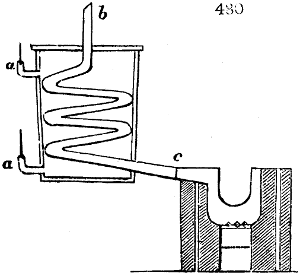
If our object be to ascertain the relative heating powers of different kinds of fuel, we need not care so much about the total waste of heat in the experiments, provided it be the same in all; and therefore they should be burned in the same furnace, and in the same way. But the more economically the heat is applied, the greater certainty will there be in the results. The apparatus, fig. 480., is simple and well adapted to make such comparative trials of fuel. The little furnace is covered at top, and transmits its burned air by c, through a spiral tube immersed in a cistern of water, having a thermometer inserted near its top, and another near its bottom, into little side orifices a a, while the effluent air escapes from the upright end of the tube b. Here also a thermometer bulb may be placed. The average indication of the two thermometers gives the mean temperature of the water. As the water evaporates from the cistern, it is supplied from a vessel placed alongside of it. The experiment should be begun when the furnace has acquired an equability of temperature. A throttle valve at c serves to regulate the draught, and to equalize it in the different experiments by means of the temperature of the effluent air. When the water has been heated the given number of degrees, which should be the same in the different experiments, the fire may be extinguished, the remaining fuel weighed, and compared with the original quantity. Care should be taken to make the combustion as vivid and free from smoke as possible.
FULGURATION; designates the sudden brightening of the melted gold and silver in the cupel of the assayer, when the last film of vitreous lead and copper leaves their surface.
FULLER’S EARTH, (Terre à foulon, Argile Smectique, Fr.; Walkererde, Germ.) is a soft, friable, coarse or fine grained mass of lithomarge clay. Its colour is greenish, or yellowish gray; it is dull, but assumes a fatty lustre upon pressure with the fingers, feels unctuous, does not adhere to the tongue, and has a specific gravity varying from 1·82 to 2·19. It falls down readily in water, into a fine powder, with extrication of air bubbles, and forms a non-plastic paste. It melts at a high heat into a brown slag. Its constituents are 53·0 silica; 10·0 alumina; 9·75 red oxide of iron; 1·25 magnesia; 0·5 lime; 24 water, with a trace of potash. Its cleansing action upon woollen stuffs depends upon its power of absorbing greasy matters. It should be neither tenacious nor sandy; for in the first case, it would not diffuse itself well through water, and in the second it would abrade the cloth too much. The finely divided silica is one of its useful ingredients.
Fuller’s earth is found in several counties of England; but in greatest abundance in Bedfordshire, Berkshire, Hampshire, and Surry.
In the county of Surry there are great quantities of fuller’s earth found about Nutfield, Ryegate, and Blechingley, to the south of the Downs, and some, but of inferior quality, near Sutton and Croydon, to the north of them. The most considerable pits are near Nutfield, between which place and Ryegate, particularly on Redhill, about a mile to the east of Ryegate, it lies so near the surface as frequently to be turned up by the wheels of the waggons. The fuller’s earth to the north of the road between Redhill and Nutfield, and about a quarter of a mile from the latter place, is very thin; the seam in general is thickest on the swell of the hill to the south of the road. It is not known how long this earth has been dug in Surry; the oldest pit now wrought is said to have lasted between 50 and 60 years, but it is fast wearing out. The seam of fuller’s earth dips in different directions. In one, if not in more cases, it inclines to the west with a considerable angle. There are two kinds of it, the blue and the yellow: the former, on the eastern side of the pit, is frequently within a yard of the surface, being covered merely with the soil—a tough, wet, clayey loam. A few yards to the west, the blue kind appears with an irony sand-stone, of nearly two yards in thickness, between it and the soil. The blue earth in this pit is nearly 16 feet deep. In some places the yellow kind is found lying upon the blue; there seems, indeed, to be no regularity either in the position or inclination of the strata where the fuller’s earth is found, nor any mark by which its presence could be detected. It seems rather thrown in patches than laid in any continued or regular vein. In the midst of the fuller’s earth are often found large pieces of stone of a yellow colour, translucent and remarkably heavy, which have been found to be sulphate of barytes, encrusted with quartzose crystals. These are carefully removed from the fuller’s earth, as the workmen say they often spoil many tons of it which lie about them. There is also found with the yellow fuller’s earth a dark brown crust, which the workmen consider as injurious also. In Surry the price of fuller’s earth seems to have varied very little, at least for these last 80 years. In 1730, the price at the pit was 6d. a sack, and 6s. per load or ton. In 1744, it was nearly the same. It is carried in waggons, each drawing from three to four tons, to the beginning of the iron railway near Westham, along which it is taken to the banks of the Thames, where it is sold at the different wharfs for about 25s. or 26s. per ton. It is then shipped off either to the north or west of England.
The next characteristic stratum, owing to its forming a ridge of conspicuous hills through the country, is the Woburn land, a thick ferruginous stratum, which below its middle contains a stratum of fuller’s earth. This is thicker and more pure in Aspley and Hogstye-end, two miles north-west of Woburn, than in any known place.
Fuller’s earth is found at Tillington, and consumed in the neighbouring fulling mills.
Mode of preparing fuller’s earth:—
After baking it is thrown into cold water, where it falls into powder, and the separation of the coarse from the fine is effectually accomplished, by a simple method used in the dry colour manufactories, called washing over. It is done in the following manner: Three or four tubs are connected on a line by spouts from their tops; in the first the earth is beat and stirred, and the water, which is continually running from the first to the last through intermediate ones, carries with it and deposits the fine, whilst the coarse settles in the first. The advantages to be derived from this operation are, that the two kinds will be much fitter for their respective purposes of cleansing coarse or fine cloth; for without baking the earth they would be unfit, as before noticed, to incorporate so minutely with the water in its native state; it would neither so readily fall down, nor so easily be divided into different qualities, without the process of washing over. When fuel is scarce for baking the earth, it is broken into pieces of the same size, as mentioned above, and then exposed to the heat of the sun.
The various uses of fuller’s earth may be shortly explained. According to the above method, the coarse and fine of one pit being separated, the first is used for cloths or an inferior, and the second for those of a superior quality. The yellow and the blue earths of Surry are of different qualities naturally, and are like the above, obtained artificially, and used for different purposes. The former, which is deemed the best, is employed in fulling the kerseymeres and finer cloths of Wiltshire and Gloucestershire, whilst the blue is principally sent into Yorkshire for the coarser cloths. Its effects on these cloths is owing to the affinity which alumine has for greasy substances; it unites readily with them, and forms combinations which easily attach themselves to different stuffs, and thereby serve the purpose of mordants in some measure. The fullers generally apply it before they use the soap.
FULLING; for the theory of the process, see Felting, and Wool.
FULLING MILL. Willan and Ogle obtained a patent in 1825 for improved fulling machinery, designed to act in a similar way to the ordinary stocks, in which cloths are beaten, for the purpose of washing and thickening them; but the standard and the bed of the stocks are made of iron instead of wood as heretofore; and a steam vessel is placed under the bed, for heating the cloths during the operation of fulling; whereby their appearance is said to be greatly improved.
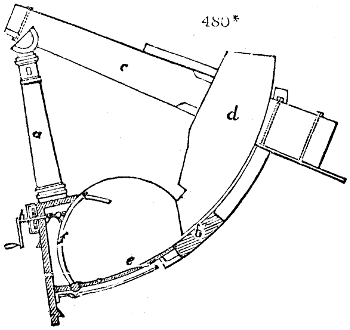
Fig. 480*. is a section of the fulling machine or stocks; a, is a cast-iron pillar, made hollow for the sake of lightness; b, is the bed of the stocks, made also of iron, and polished smooth, the side of the stock being removed to shew the interior; c, is the lever that carries the beater d. The cloths are to be placed on the bed b, at bottom, and water allowed to pass through the stock, when by the repeated blows of the beater d, which is raised and let fall in the usual way, the cloths are beaten, and become cleansed and fulled.
A part of the bed at e, is made hollow, for the purpose of forming a steam box, into which steam from a boiler is introduced by a pipe with a stop-cock. This steam heats the bed of the stock, and greatly facilitates, as well as improves the process of cleansing and fulling the cloths.
The smoothness of the surface of the polished metal, of which the bed of the stock is constituted, is said to be very much preferable to the roughness of the surface of wood of which ordinary fulling stocks are made, as by these iron stocks less of the nap or felt of the cloth is removed, and its appearance when finished is very much superior to cloths fulled in ordinary stocks.
In the operation of fulling, the cloths are turned over on the bed, by the falling of the beaters, but this turning over of the cloths will depend in a great measure upon the form of the front or breast of the stock. In these improved stocks therefore, there is a contrivance by which the form of the front may be varied at pleasure, in order to suit cloths of different qualities; f, is a movable curved plate, constituting the front of the stock; its lower part is a cylindrical rod, extending along the entire width of the bed, and being fitted into a recess, forms a hinge joint upon which the curved plate moves; g, is a rod attached to the back of the curved plate f, with a screw thread upon it; this rod passes through a nut h, and by turning this nut, the rod is moved backward or forward, and consequently, the position of the curved plate altered.
The nut h, is a wheel with teeth, taking into two other similar toothed wheels, one on each side of it, which are likewise the nuts of similar rods jointed to the back of the curved plate f; by turning the central wheel, therefore, which may be done by a winch, the other two wheels are turned also, and the curved plate moved backward or forward. At the upper part of the plate there are pins passing through curved slots, which act as guides when the plate is moved.
The patentees state in conclusion, that steam has been employed before for heating cloths while fulling them, they therefore do not exclusively claim its use, except in the particular way described; the advantages arising from the construction of iron stocks, with polished surfaces in place of wooden ones, together with the movable curved plates described, are in their opinion “sufficiently important to constitute a patent right.”
FULMINATES, or fulminating powders. Of these explosive compounds, there are several species; such as fulminating gold, mercury, platinum, silver; besides the old fusible mixture of nitre, sulphur, and potash. The only kind at all interesting in a manufacturing point of view is the fulminate of mercury, now so extensively used as a priming to the caps of percussion locks. Having published a paper in the Journal of the Royal Institution for 1831, upon gunpowder (see Gunpowder), the result of an elaborate suite of experiments, I was soon afterwards requested by the Hon. the Board of Ordnance to make such researches as would enable me to answer, in a satisfactory practical manner, a series of questions upon fulminating powders, subservient to the future introduction of percussion musquets into the British army. The following is a verbatim copy of my report upon the subject:—
To the Secretary of the Board of Ordnance.
“Sir,—I have the honour of informing you, for the instruction of the Honourable the Master General and the Board of Ordnance, that the researches on fulminating mercury, which I undertook by their desire, have been brought to a satisfactory conclusion, after a numerous, diversified, and somewhat hazardous series of experiments. The following are the questions submitted to me, with their respective answers:—
Question 1. What proportions of mercury, with nitric acid and alcohol of certain strengths, will yield the greatest quantity of pure fulminate of mercury?
Answer. One hundred parts, by weight, of mercury, must be dissolved with a gentle heat, in 1000 parts (also by weight) of nitric acid, spec. gr. 1·4; and this solution, at the temperature of about 130° Fahr. must be poured into 830 parts by weight of alcohol, spec. gr. 0·830.—Note. 830 parts of such alcohol, by weight, constitute 1000 by measure; and 1000 parts of such nitric acid, by weight, constitute 740 by measure. Hence, in round numbers, one ounce weight of quicksilver must be dissolved in 71⁄2 oz. measures of the above designated nitric acid, and the resulting solution must be poured into 10 oz. measures of the said alcohol.
Question 2. What is the most economical and safe process for conducting the manipulation, either as regards the loss of nitrous gas and residuum, or as respects danger to the operator; also, what is the readiest and safest mode of mixing the fulminate intimately with its due proportions of common gunpowder.
Answer. The mercury should be dissolved in the acid in a glass retort, the beak of which is loosely inserted into a large balloon or bottle of glass or earthenware, whereby the offensive fumes of the nitrous gas disengaged during the solution, are, in a considerable measure, condensed into liquid acid, which should be returned into the retort. As soon as the mercury is all dissolved, and the solution has acquired the prescribed temperature of about 130°, it should be slowly poured, through a glass or porcelain funnel, into the alcohol contained in a glass matrass or bottle capable of holding fully 6 times the bulk of the mixed liquids. In a few minutes bubbles of gas will proceed from the bottom of the liquid; these will gradually increase in number and magnitude till a general fermentative commotion, of a very active kind, is generated, and the mixture assumes a somewhat frothy appearance. A white voluminous gas now issues from the orifice of the matrass, which is very combustible, and must be suffered to escape freely into the air, at a distance from any flame. These fumes consist of an ethereous gas, holding mercury in suspension or combination. I have made many experiments with the view of condensing this gas, or, at least, the mercury, but with manifest disadvantage to the perfection of the process of producing fulminate. When the said gas is transmitted, through a glass tube, into a watery solution of carbonate of soda, a little oxide of mercury is, no doubt, recovered; but the pressure on the fermentative mixture, though slight, necessary to the displacement of the soda solution, seems to obstruct or impair the generation of the fulminate; this effect is chiefly injurious towards the end of the operation when the gaseous fumes are strongly impregnated with nitrous gas. When this is not allowed freely to come off, a portion of subnitrate or nitrate of mercury is apt to be formed, to the injury of the general process and the product.
As soon as the effervescence and concomitant emission of gas are observed to cease, the contents of the matrass should be turned out upon a paper double filter, fitted into a glass or porcelain funnel, and washed by the affusion of cold water till the drainings no longer redden litmus paper. The powder adhering to the matrass should be washed out and thrown on the filter by the help of a little water. Whenever the filter is thoroughly drained, it is to be lifted out of the funnel, and opened out on plated copper or stone ware, heated to 212° Fahr. by steam or hot water. The fulminate being thus dried, is to be put up in paper parcels of about 100 grains each; the whole of which may be afterwards packed away in a tight box, or a bottle with a cork stopper. The excellence of the fulminate may be ascertained, by the following characters. It consists of brownish-gray small crystals which sparkle in the sun, are transparent when applied to a slip of glass with a drop of water, and viewed by transmitted light. These minute spangles are entirely soluble in 130 times their weight of boiling water; that is to say, an imperial pint of boiling water will dissolve 67 grs. of pure fulminate. Whatever remains indicates impurity. From that solution beautiful pearly spangles of fulminate fall down as the liquid cools.
It may now be proper to show within what nice and narrow limits the best proportions of the ingredients used in making the fulminate of mercury lie. The following are selected from among many experiments instituted to determine that point, as well as the most economical process.
1. According to the formula given by the celebrated chemist Berzelius, in the 4th vol. of his “Traité de Chimie,” recently published (p. 383.), the mercury should be dissolved in 12 times its weight of nitric acid sp. gr. 1·375; and alcohol of sp. gr. 0·850, amounting to 16·3 times the weight of the mercury, should be poured at intervals into the nitric solution. The mixture is then to be heated till effervescence with the characteristic cloud of gas appears. On the action becoming violent, alcohol is to be poured in from time to time to repress it, till additional 16·3 parts have been employed.
On this process I may remark, that it is expensive, troublesome, dangerous, and unproductive of genuine pure fulminate. One fifth more nitric acid is expended very nearly than what is necessary, and almost four times the weight of alcohol which is beneficial. Of alcohol at 0·83, 8·3 parts by weight are sufficient; whereas Berzelius prescribes nearly 4 times this quantity in weight, though the alcohol is somewhat weaker, being of sp. gr. 0·850. By using such an excess of alcohol, much of the fulminate is apt to be revived into globules of quicksilver at the end of the process, as I showed in my paper on this subject published in the Journal of the Royal Institution two years ago. There is no little hazard in pouring the alcohol into the nitric solution; for at each effusion an explosive blast takes place, whereas by pouring the solution into the alcohol, as originally enjoined by the Hon. Mr. Howard, the inventor of the process, no danger whatever is incurred. 100 parts of mercury treated in the way recommended by Berzelius afforded me only 112 parts of fulminate, instead of the 130 obtained by my much more economical and safe proportions and process from the same weight of quicksilver.
2. If 10 parts of nitric acid of sp. gr. 1·375 be used for dissolving 1 of quicksilver, and if 14 parts of alcohol of sp. gr. 0·85 be thereafter mixed with the solution, the product of such proportions will either be not granular, and therefore not fulminating, or it will be partially granular and partially pulverulent, being a mixture of fulminate and subnitrate of mercury ill adapted for priming detonating caps. Instead of 130 parts of genuine fulminate, as I do obtain, probably not more than 10 parts of powder will be produced, and that of indifferent quality. In fact, whenever the ethereous fermentation is defective, or not vigorous, little true fulminate is generated; but much of the mercury remains in the acidulated alcoholic liquid.
3. If the alcohol be poured in successive portions, and of proper strength (sp. gr. 0·83) into a proper nitric solution of mercury, the explosive action which accompanies each effusion dissipates much of the alcohol, and probably impairs the acid, so that the subsequent ethereous fermentation is defective, and little good fulminate is formed. From 100 parts of mercury submitted to this treatment, I obtained in one experiment carefully made, only 51 parts of a powder, which was impalpable, had a cream colour, and was not explosive either by heat or percussion.
4. When, with 100 parts of mercury, 800 of nitric acid of sp. gr. 1·375 are employed with 650 of alcohol of sp. gr. 846, no fulminate whatever is generated.
5. When with the proper proportions of mercury, acid, and alcohol, the process is advanced into a proper energy of fermentative commotion, if the matrass be immersed in cold water so as materially to repress that action, the process will be impaired, and will turn out ultimately defective both as to the quantity and quality of the fulminate. It is therefore evident that a certain energy or vivacity of etherization is essential to the full success of this curious process, and that any thing which checks it, or obstructs its taking place, is injurious and to be avoided.
When my proportions are observed in making fulminating mercury, somewhat less than one fourth of the nitric acid used in making the solution remains in the alcoholic mixture along with the fulminate. When other proportions are taken, much more acid remains. This acid is not recoverable to any useful or economical purpose, nor is the alcohol that is associated with it. Many distillations with various reagents have led me to this practical conclusion. In fact, when the process is most complete, as described in the first paragraph, the alcohol is entirely and profitably employed in etherization, and generating fulminic acid.
I have made a series of analytical experiments on the pure fulminate of mercury, with the view of determining its composition, the quantity of quicksilver present in it, and consequently the loss of mercury in the operation. I have stated that my maximum product of fulminate from 100 grs. of quicksilver is 130 grs. Occasionally from slight differences in the temperature of the mixture, or the ambient atmosphere, 2 grs. less may be obtained.
A. I dissolved 130 grs. with a gentle heat in muriatic acid contained in a small matrass, adding a few drops of the nitric to quicken the solution. On evaporating it to dryness, with much care to avoid volatilization of the salt, I obtained 125 grs. of corrosive sublimate or bi-chloride of mercury. But 125 grs. of this bi-chloride contain only 91·1 grs. of quicksilver. Therefore, by this experiment, 130 grs. of fulminate contain no more than 91·1 of mercury, indicating an exhalation of 8·9 parts in the form of fumes, or a retention in the residuary liquid of some of these 8·9 parts, out of the 100 originally employed.
B. In another experiment for analysis, 130 grs. dissolved as above, were thrown down by carbonate of soda. 95 grs. of black oxide of mercury were obtained, which are equivalent to 91·2 grs. of quicksilver; affording a confirmation of the preceding result.
C. 130 grs. of fulminate were dissolved in strong muriatic acid, and the solution was decomposed by crystals of proto-muriate of tin at a boiling temperature. The mercury was precipitated in globules to such amount as to verify the two preceding experiments.
Regarding fulminate of mercury as a bi-cyanate, that is, as a compound of one atom or one equivalent prime of deutoxide of mercury, and two primes of cyanic acid, we shall find its theoretical composition to be as follows, hydrogen being the radix, or 1.
2 Primes of Cyanic or fulminic Acid = 34 × 2 = 68 24
1 Deutoxide of Mercury = 216 76
284 100
As these 284 parts of fulminate contain 200 of quicksilver, so 142 parts of fulminate will contain 100 of quicksilver. Whence it appears, that when only 130 parts of fulminate can be obtained in practice from 100 of quicksilver, 81⁄2 parts of quicksilver out of the 100 are unproductive, that is, are expended in the etherized gas, or left in the residuary acidulous liquid. By the above experimental and theoretical analysis, 91·5 parts of quicksilver enter into the composition of 130 parts of true crystalline fulminate. The complete accordance here exhibited between theory and practice removes every shadow of doubt as to the accuracy of the statements. 100 parts of fulminate consist of—
Mercury - 70·4 - Peroxide 76 ·0
Oxygen 5·6
Fulminic acid 24
100 ·0
Question 3. May the gas or vapour produced by the inflammation of the fulminate of mercury, when combined with a portion of gunpowder, be considered in its nature corrosive of iron or brass?
Answer. I have suggested to Mr. Lovell, of Waltham Abbey works, that the fulminate may be probably diluted most advantageously with spirit varnish made of a proper consistence by dissolving sandarach in alcohol. When well mixed with this varnish, a small drop of the mixture will suffice for priming each copper cap or disc; and as the spirit evaporates immediately, the fulminate will be fixed to the copper beyond the risk of shaking or washing away. On the Continent, tincture of benjamin is used for the same purpose; but as that balsamic resin leaves in combustion a voluminous coal, which sandarach does not, the latter, which is the main constituent of spirit varnish, seems better adapted for this purpose. It is sufficiently combustible, and may be yet made by a due proportion, to soften the violence of the explosive mercury on the nipple of the touch-hole. Fulminate prepared by my formula has no corrosive influence whatsoever on iron or steel; and, therefore, if such a medium of applying it, as I have now taken leave to suggest, should be found to answer, all fears on the score of corrosion may for ever be set at rest.
Question 4. How far is the mixture (of fulminate and gunpowder) liable to be affected by the moisture of the atmosphere, or by the intrusion of water; and will such an accident affect its inflammability when dried again?
Answer. Well made fulminate, mixed with gunpowder and moistened, undergoes no change, nor is it apt to get deteriorated by keeping any length of time in a damp climate or a hazy atmosphere. Immersion in water would be apt to wash the nitre out of the pulverine; but this result would be prevented if the match or priming mixture were liquefied or brought to the pasty consistence not with water, but spirit varnish. Such detonating caps would be indestructible, and might be alternately moistened and dried without injury.
Question 5. Is it at all probable that the composition would be rendered more inflammable or dangerous of use, by the heat of tropical climates?
Answer. No elevation of temperature of an atmospheric kind, compatible with human existence, could cause spontaneous combustion of the fulminating mercury, or the detonating matches made with it. In fact, its explosive temperature is so high as 367° of Fahrenheit’s scale, and no inferior heat will cause its detonation.
Question 6. Is the mercurial vapour or gas arising from the ignition of a great number of primers, and combined with the smoke of gunpowder in a confined space (as in the case of troops in close bodies, squares, casemates, &c.) likely in its nature to be found prejudicial to human health?
Answer. I have exploded in rapid succession of portions, 100 grains of fulminate of mercury (equivalent to 300 or 400 primers), in a close chamber of small dimensions, without experiencing the slightest inconvenience at the period, or afterwards, though my head was surrounded by the vapours all the time of the operation. These vapours are, in fact, so heavy that they subside almost immediately. When the fulminate mixed with pulverine is exploded in the primers by condensed masses of troops, the mercury will cause no injury to their health, nor one 100th part of the deleterious impression on weak lungs which the gases of exploded gunpowder might by possibility inflict. These gases are all, theoretically speaking, noxious to respiration; such as carbonic acid gas, azote, carburetted hydrogen, and sulphuretted hydrogen, a deadly gas. Yet the soldier who should betray any fear of gunpowder smoke would be an object of just ridicule.”