C. (continued 10)
Reading edition
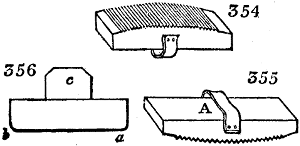
The stretching iron, fig. 356., is a flat plate of iron or copper, fully a fourth of an inch thick at top, and thinning off at bottom in a blunt edge, shaped like the arc of a circle of large diameter, having the angles a and b rounded, lest in working they should penetrate the leather. The top c is mounted with leather to prevent it from hurting the hands. A copper stretching knife is used for delicate skins. The workman holds this tool nearly perpendicular, and scrapes the thick places powerfully with his two hands, especially those where some tan or flesh remains. He thus equalizes the thickness of the skin, and renders it at the same time more dense and uniform in texture. This tool is of very general use in currying.
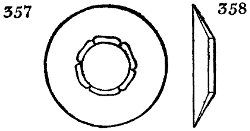
The round knife, fig. 357. and 358. (lunette in French), is a circular knife from 10 to 12 inches in diameter, with a round 4 or 5 inch hole in its centre, for introducing the hands and working it. It is concave, as shown in the section fig. 358., presenting the form of a spherical zone. The concave part is that applied to the skin. Its edge is not perfectly straight; but is a little turned over on the side opposite to the skin, to prevent it from entering too far into the leather. The currier first slopes off with the head knife from the edges, a portion equal to what he afterwards removes with the round one. By this division the work is done sooner and more exactly. All the oiled or greased skins are dressed with the round knife.

The cleaner is a straight two-handled knife two inches broad, of which there are two kinds, a sharp-edged and a blunt one. Fig. 359.
The mace is made of wood, having a handle 30 inches long, with a cubical head or mallet; upon the two faces of which, parallel to the line of the handle, there are 4 pegs of hard wood turned of an egg-shape, and well polished, so as not to tear the moistened leather when it is strongly beat and softened with the mace.
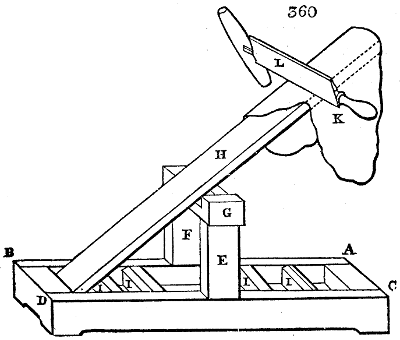
The horse or trestle, fig. 360., consists of a strong wooden frame, A B C D, which serves as a leg or foot. Upon the middle of this frame there are two uprights, E F, and a strong cross beam, G, for supporting the thick plank H, upon which the skins are worked. This plank may be set at a greater or less slope, according as its lower end is engaged in one or other of the cross bars, I I I I, of the frame. In the figure, a skin K is represented upon the plank with the head knife upon it, in the act of being pared.
A cylindrical bar fixed horizontally at its ends to two buttresses projecting from the wall, serves by means of a parallel stretched cord, to fix a skin by a coil or two in order to dress it. This is accordingly called the dresser. The tallow cloth is merely a mop made of stout rags, without the long handle; of which there are several, one for wax, another for oil, &c. Strong-toothed pincers with hook-end handles, drawn together by an endless cord, are employed to stretch the leather in any direction, while it is being dressed. The currier uses clamps like the letter U, to fix the edges of the leather to his table. His polisher is a round piece of hard wood, slightly convex below, with a handle standing upright in its upper surface, for seizing it firmly. He first rubs with sour beer, and finishes with barberry juice.
Every kind of tanned leather not intended for soles or such coarse purposes, is generally curried before being delivered to the workmen who fashion it, such as shoemakers, coachmakers, saddlers, &c. The chief operations of the currier are four:—
1. Dipping the leather, which consists in moistening it with water, and beating it with the mace, or a mallet upon the hurdle. He next applies the cleaners, both blunt and sharp, as well as the head knife, to remove or thin down all inequalities. After the leather is shaved, it is thrown once more into water, and well scoured by rubbing the grain side with pumice stone, or a piece of slaty grit, whereby it parts with the bloom, a whitish matter, derived from the oak bark in the tan pit.
2. Applying the pommel to give the leather a granular appearance, and correspondent flexibility. The leather is first folded with its grain side in contact, and rubbed strongly with the pommel, then rubbed simply upon its grain side; whereby it becomes extremely flexible.
3. Scraping the leather. This makes it of uniform thickness. The workman holds the tool nearly perpendicular upon the leather, and forcibly scrapes the thick places with both his hands.
4. Dressing it by the round knife. For this purpose he stretches the leather upon the wooden cylinder, lays hold of the pendent under edge with the pincers attached to his girdle, and then with both hands applies the edge of the knife to the surface of the leather, slantingly from above downwards, and thus pares off the coarser fleshy parts of the skin. This operation requires great experience and dexterity; and when well performed improves greatly the look of the leather.
The hide or skin being rendered flexible and uniform, is conveyed to the shed or drying house, where the greasy substances are applied, which is called dubbing (daubing), or stuffing. The oil used for this purpose is prepared by boiling sheep-skins or doe-skins, in cod oil. This application of grease is often made before the graining board or pommel is employed.
Before waxing, the leather is commonly coloured by rubbing it with a brush dipped into a composition of oil and lamp black on the flesh side, till it be thoroughly black; it is then black-sized with a brush or sponge, dried, tallowed with the proper cloth, and slicked upon the flesh with a broad smooth lump of glass; sized again with a sponge; and when dry, again curried as above described.
Currying leather on the hair or grain side, termed black on the grain, is the same in the first operation with that drest on the flesh, till it is scoured. Then the first black is applied to it while wet, by a solution of copperas put upon the grain, after this has been rubbed with a stone; a brush dipped in stale urine is next rubbed on, then an iron slicker is used to make the grain come out as fine as possible. It is now stuffed with oil. When dry, it is seasoned; that is, rubbed over with a brush dipped in copperas water, on the grain, till it be perfectly black. It is next slicked with a good grit-stone, to take out the wrinkles, and smooth the coarse grain. The grain is finally raised with the pommel or graining board, by applying it to the leather in different directions. When thoroughly dry, it is grained again in two or three ways.
Hides intended for covering coaches are shaved nearly as thin as shoe hides, and blacked upon the grain.
CUTLERY. (Coutellerie, Fr.; Messerschmidwaare, Germ.) Three kinds of steel are made use of in the manufacture of different articles of cutlery, viz. common steel, shear steel, and cast steel. Shear steel is exceedingly plastic and tough. All the edge tools which require great tenacity without great hardness are made of it, such as table knives, scythes, plane-irons, &c.
Cast steel is formed by melting blistered steel in covered crucibles, with bottle glass, and pouring it into cast-iron moulds, so as to form it into ingots: these ingots are then taken to the tilt, and drawn into rods of suitable dimensions. No other than cast steel can assume a very fine polish, and hence all the finer articles of cutlery are made of it, such as the best scissors, penknives, razors, &c.
Formerly cast steel could be worked only at a very low heat; it can now be made so as to be welded to iron with the greatest ease. Its use is consequently extended to making very superior kinds of chisels, plane-irons, &c.
Forging of table knives.—Two men are generally employed in the forging of table knives; one called the foreman or maker, and the other the striker.
The steel called common steel is employed in making the very common articles; but for the greatest part of table knives which require a surface free from flaws, shear steel is generally preferred. That part of the knife termed the blade, is first rudely formed and cut off. It is next welded to a rod of iron about 1⁄2 inch square, in such a manner as to leave as little of the iron part of the blade exposed as possible. A sufficient quantity of the iron now attached to the blade, is taken off from the rod to form the bolster or shoulder, and the tang.
In order to make the bolster of a given size, and to give it at the same time shape and neatness, it is introduced into a die, and a swage placed upon it; the swage has a few smart blows given it by the striker. This die and swage are, by the workman, called prints.
After the tangs and bolster are finished, the blade is heated a second time, and the foreman gives it its proper anvil finish; this operation is termed smithing. The blade is now heated red-hot, and plunged perpendicularly into cold water. By this means it becomes hardened. It requires to be tempered regularly down to a blue colour: in which state it is ready for the grinder.
Mr. Brownill’s method of securing the handles upon table-knives and forks, is, by lengthening the tangs, so as to pass them completely through the handle, the ends of which are to be tinned after the ordinary mode of tinning iron; and, when passed through the handle, the end of the tang is to be spread by beating, or a small hole drilled through it, and a pin passed to hold it upon the handle. After this, caps of metal, either copper plated, or silver, are to be soldered on to the projecting end of the tang, and while the solder is in a fluid state, the cap is to be pressed upon the end of the handle and held there until the solder is fixed, when the whole is to be cooled by being immersed in cold water.
Mr. Thomason’s patent improvements consist in the adaptation of steel edges to the blades of gold and silver knives. These steel edges are to be attached to the other metal of whatever quality it may be, of which the knife, &c. is made, by means of solder, in the ordinary mode of effecting that process. After the edge of steel is thus attached to the gold, silver, &c., it is to be ground, polished, and tempered by immersion in cold water, or oil, after being heated. This process being finished, the other parts of the knife are then wrought and ornamented by the engraver or chaser, as usual.
A patent was obtained in 1827, by Mr. Smith of Sheffield, for rolling out knives at one operation.
In the ordinary mode of making knives, a sheet of steel being provided, the blades are cut out of the sheet, and the backs, shoulders, and tangs, of wrought iron, are attached to the steel blades, by welding at the forge. The knife is then ground to the proper shape, and the blade polished and hardened.
Instead of this welding process, the patentee proposes to make the knives entirely of steel, and to form them by rolling in a heated state between massive rollers; the shoulders or bolsters, and the tangs for the handles being produced by suitable recesses in the peripheries of the rollers; just as rail-way rails are formed. When the knife is to be made with what is called a scale tang, that is a broad flat tang, to which the handle is to be attached in two pieces, riveted on the sides of the tang, the rollers are then only to have recesses cut in them, in a direction parallel to the axis for forming the bolster.
The plate of steel having been heated, is to be pressed between the two rollers, by which the blades and the parts for the scale tangs will be pressed out flat and thin, and those parts which pass between the grooves or recess will be left thick or protuberant, forming the bolster for the shoulder of the blade. But if the tangs are to be round in order to be fixed into single handles, then it will be necessary also to form transverse grooves in the rollers, that is, at right angles to those which give shape to the bolsters, the transverse grooves corresponding in length to the length of the intended tang. When the plates of steel have been thus rolled, forming three or more knives in a breadth, the several knives are to be cut out by the ordinary mode of what is called slitting, and the blades and shoulders ground, hardened, and polished in the usual way.
Forks are generally a distinct branch of manufacture from that of knives, and are purchased of the fork makers by the manufacturers of table knives, in a state fit for receiving the handles.
The rods of steel from which the forks are made, are about 3⁄8ths of an inch square. The tang and shank of the fork are first roughly formed. The fork is then cut off, leaving at one end about 1 inch of the square part of the steel. This part is afterwards drawn out flat to about the length of the prongs. The shank and tang are now heated, and a proper form given to them by means of a die and swage. The prongs are afterwards formed at one blow by means of the stamp; this machine is very similar to that used in driving piles, but it is worked by one man. It consists of a large anvil fixed in a block of stone nearly on a level with the ground. To this anvil are attached two rods of iron of considerable thickness, fixed 12 inches asunder, perpendicularly to the anvil, and diagonally to each other. These are fastened to the ceiling. The hammer or stamp, about 100 lbs. in weight, having a groove upon either side corresponding to the angles of the upright rods, is made to slide freely through its limited range, being conducted by its two iron supporters. A rope is attached to the hammer, which goes over a pulley on the floor of the room above, and comes down to the person who works the stamp: two corresponding dies are attached, one to the hammer, and the other to the anvil. That part of the fork intended to form the prongs, is heated to a pretty white heat and placed in the lower die, and the hammer containing the other die is made to fall upon it from a height of about 7 or 8 feet. This forms the prongs and the middle part of the fork, leaving a very thin substance of steel between each prong, which is afterwards cut out with an appropriate instrument called a flie-press. The forks are now annealed by surrounding a large mass of them with hot coals, so that the whole shall become red hot. The fire is suffered gradually to die out, and the forks to cool without being disturbed. This process is intended to soften, and by that means to prepare them for filing. The inside of the prongs are then filed, after which they are bent into their proper form and hardened. When hardened, which is effected by heating them red-hot and plunging them into cold water, they are tempered by exposing them to the degree of heat at which grease inflames. See Stamps.
Penknives are generally forged by a single hand, with the hammer and the anvil simply. The hammer in this trade is generally light, not exceeding 31⁄2 lbs. The breadth of the face, or the striking part, is about one inch; if broader, it would not be convenient for striking so small an object. The principal anvil is about 5 inches, and 10 upon the face, and is provided with a groove into which a smaller anvil is wedged. The smaller anvil is about 2 inches square upon the face. The blade of the knife is first drawn out at the end of the rod of steel, and as much more is cut off along with it as is thought necessary to form the joint. The blade is then taken in a pair of tongs, and heated a second time to finish the joint part, and at the same time to form a temporary tang for the purpose of driving into a small haft used by the grinder. Another heat is taken to give the blade a proper finish. The small recess called the nail hole, used in opening the knife, is made while it is still hot by means of a chisel, which is round on one side, and flat upon the other.
Penknives are hardened by heating the blade red hot, and dipping them into water up to the shoulder. They are tempered by setting them side by side, with the back downwards upon a flat iron plate laid upon the fire, where they are allowed to remain till they are of a brown or purple colour.
The blades of pocket knives, and all that come under the denomination of spring knives, are made in the same way.
The forging of razors is performed by a foreman and striker, as in making table knives.
They are generally made of cast steel. The rods, as they come from the tilt, are about 1⁄2 inch broad, and of a thickness sufficient for the back of the razor.
There is nothing peculiar in the tools made use of in forging razors: the anvil is a little rounded at the sides, which affords the opportunity of making the edge thinner, and saves an immense labour to the grinder.
Razors are hardened and tempered in a similar manner to penknives. They are, however, left harder, being only let down to yellow or brown colour.
The forging of scissors is wholly performed by the hammer, and all the sizes are made by a single hand. The anvil of the scissor-maker weighs about 11⁄2 cwt.; it measures, on the face, about 4 by 11 inches. It is provided with two gates or grooves for the reception of various little indented tools termed by the workman bosses; one of these bosses is employed to give proper figure to the shank of the scissors; another for forming that part which has to make the joint; and a third is made use of for giving a proper figure to the upper side of the blade. There is also another anvil placed on the same block, containing two or three tools called beak-irons, each consisting of an upright stem about 6 inches high, at the top of which a horizontal beak projects; one of these beaks is conical, and is used for extending the bow of the scissors; the other is a segment of a cylinder with the round side upwards, containing a recess for giving a proper shape and smoothness to the inside of the bow.
The shank of the scissors is first formed by means of one of the bosses, above described, leaving as much steel at the end as will form the blade. A hole is then punched about 1⁄4 inch in width, a little above the shank. The blade is drawn out and finished, and the scissors separated from the rod a little above the hole. It is heated a third time, and the small hole above mentioned is extended upon the beak-irons so as to form the bow. This finishes the forging of scissors. They are promiscuously made in this way, without any other guide than the eye, having no regard to their being in pairs. They are next annealed for the purpose of filing such parts of them as cannot be ground, and afterwards paired.
The very large scissors are made partly of iron, the blades being of steel.
After the forging, the bow and joints, and such shanks as cannot be ground, are filed. The rivet hole is then bored, through which they are to be screwed or riveted together. This common kind of scissors is only hardened up to the joint. They are tempered down to a purple or blue colour. In this state they are taken to the grinder.
Grinding and polishing of cutlery.—The various processes which come under this denomination are performed by machinery, moving in general by the power of the steam-engine or water-wheel.
Grinding wheels or grinding mills are divided into a number of separate rooms; every room contains six places called troughs; each trough consists of a convenience for running a grindstone and a polisher at the same time, which is generally occupied by a man and a boy.
The business of the grinder is generally divided into three stages, viz. grinding, glazing, and polishing.
The grinding is performed upon stones of various qualities and sizes, depending on the articles to be ground. Those exposing much flat surface, such as saws, fenders, &c. require stones of great diameter, while razors, whose surface is concave, require to be ground upon stones of very small dimensions. Those articles which require a certain temper, which is the case with most cutting instruments, are mostly ground on a wet stone; for which purpose the stone hangs within the iron trough, filled with water to such a height that its surface may just touch the face of the stone.
Glazing is a process following that of grinding: it consists in giving that degree of lustre and smoothness to an article which can be effected by means of emery of the various degrees of fineness. The tool on which the glazing is performed, is termed a glazer. It consists of a circular piece of wood, formed of a number of pieces in such a manner that its edge or face may always present the endway of the wood. Were it made otherwise, the contraction of the parts would destroy its circular figure. It is fixed upon an iron axis similar to that of the stone. Some glazers are covered on the face with leather, others with metal, consisting of an alloy of lead and tin; the latter are termed caps. In others, the wooden surface above is made use of. Some of the leather-faced glazers, such as are used for forks, table knives, edge tools, and all the coarser polished articles, are first coated with a solution of glue, and then covered with emery. The surfaces of the others are prepared for use by first turning the face very true, then filling it with small notches by means of a sharp-ended hammer, and lastly filling up the interstices with a compound of tallow and emery.
The pulley of the glazer is so much less than that of the stone, that its velocity is more than double, having in general a surface speed of 1500 feet in a second.
The process of polishing consists in giving the most perfect polish to the different articles. Nothing is subjected to this operation but what is made of cast steel, and has been previously hardened and tempered.
The polisher consists of a circular piece of wood covered with buff leather, the surface of which is covered from time to time, while in use, with the crocus of iron, called also colcothar of vitriol.
The polisher requires to run at a speed much short of that of the stone, or the glazer. Whatever may be its diameter, the surface must not move at a rate exceeding 70 or 80 feet in a second.
CYANATES; saline compounds of cyanic acid with the bases potash, soda, ammonia, baryta, &c. The first is prepared by calcining at a dull red heat, a mixture of ferro-cyanide of potassium (prussiate of potash) and black oxide of manganese. The cyanates have not hitherto been applied to any use in the arts.
CYANHYDRIC Acid; another name for the hydrocyanic or prussic acid. See Prussian Blue and Prussic Acid.
CYANIDES; compounds of cyanogen with the metals; as cyanide of potassium, sodium, barium, calcium, iron, mercury. The last is the only one of importance in a manufacturing point of view, since from it prussic acid is made.
CYANIDES, FERRO. Double compounds of cyanogen with iron, and of cyanogen with another metal, such as potassium, sodium, barium, &c. The ordinary yellow prussiate of potash has this constitution, and is called the ferro-cyanide.
CYANOGEN. A gaseous compound of two prime equivalents of charcoal = 12, and one of azote = 14 = 26; hydrogen being the radix or, 1. It consists of two volumes of vapour of carbon, and one volume of azote, condensed into one volume; and has therefore a density equal to the sum of the weights of these 3 gaseous volumes = 1·815. Cyanogen is readily procured by exposing the cyanide of mercury to a dull red heat in a retort; the gas is evolved and may be collected over mercury. Its smell is very sharp and penetrating; it perceptibly reddens tincture of litmus; it is condensable by pressure at a low temperature into a liquid; and by a still greater degree of cold, it is solidified. When a lighted taper is applied to a mixture of cyanogen and oxygen, an explosion takes place; carbonic acid is formed, and the azote is set at liberty.
For a connected view of the various compounds of cyanogen employed in the arts, see Prussian Blue.
CYDER; (Cidre, Fr.; Apfelwein, Germ.) the vinous fermented juice of the apple. The ancients were acquainted with cyder and perry, as we learn from the following passage of Pliny the naturalist: “Wine is made from the Syrian pod, from pears and apples of every kind.” Book xiv. chap. 19. The term cyder or cidre in French, at first written sidre, is derived from the latin word sicera, which denoted all other fermented liquors except grape wine. Cyder seems to have been brought into Normandy by the Moors of Biscay, who had preserved the use of it after coming into that country from Africa. It was afterwards spread through some other provinces of France, whence it was introduced into England, Germany, and Russia. It is supposed that the first growths of Normandy afford still the best specimens of cyder. Devonshire and Herefordshire are the counties of England most famous for this beverage.
Strong and somewhat elevated ground, rather dry, and not exposed to the air of the sea, or to high winds, are the best situations for the growth of the cyder apple. The fruit should be gathered in dry weather. The juice of apples is composed of a great deal of water; a little sugar analogous to that of the grape; a matter capable of causing fermentation with contact of air; a pretty large proportion of mucilage, with malic acid, acetic acid, and an azotized matter in a very small quantity. The seeds contain a bitter substance and a little essential oil; the pure parenchyma or cellular membrane constitutes not more than two per cent. of the whole. After the apples are gathered, they are left in the barn-loft for fifteen days or upwards to mellow; some of them in this case, however, become soft and brown. This degree of maturation diminishes their mucilage, and developes alcohol and carbonic acid; in consequence of which the cyder suffers no injury. There is always however a little loss; and if this ripening goes a little further it is very apt to do harm, notwithstanding the vulgar prejudice of the country people to the contrary. Too much care, indeed, cannot be taken to separate the sound from the spoiled apples; for the latter merely furnish an acid leaven, give a disagreeable taste to the juice, and hinder the cyder from fining, by leaving in it a certain portion of the parenchyma, which the gelatinous matter or the fermentation has diffused through it. Unripe apples should be separated from the ripe also, for they possess too little saccharum to be properly susceptible of the vinous fermentation.
In France, where cyder making is most scientifically practised, it is prepared by crushing the apples in a mill with revolving edge-stones, turned in a circular stone cistern by one or two horses. When the fruit is half mashed, about one fifth of its weight of river water is added, or the water of lakes. The latter have been found by experience to be preferable to other water.
In some places a mill composed of two cast-iron fluted cylinders placed parallel to each other under the bottom of a hopper, is employed for crushing the apples. One of the cylinders is turned by a winch, and communicates its motion in the opposite direction by means of the flutings working into each other. Each portion of the fruit must be passed thrice through this rude mill in order to be sufficiently mashed; and the same quantity of water must be added as in the edge stone mill.
After the apples are crushed they are usually put into a large tub or tun for 12 or 24 hours. This steeping aids the separation of the juice, because the fermentative motion which takes place in the mass breaks down the cellular membranes; but there is always a loss of alcohol carried off by the carbonic acid disengaged, while the skins and seeds develope a disagreeable taste in the liquid. The vatting might be suppressed if the apples were so comminuted as to give out their juice more readily. With slight modifications, the process employed in rasping and squeezing the beet-roots might in my opinion be applied with great advantage to the cyder manufacture. See Sugar.
After the vatting, the mashed fruit is carried to the press and put upon a square wicker frame or into a hair bag, sometimes between layers of straw, and exposed stratum super stratum to strong pressure till what is called a cheese or cake is formed. The mass is to be allowed to drain for some time before applying pressure, which ought to be very gradually increased. The juice which exudes with the least pressure affords the best cyder; that which flows towards the end acquires a disagreeable taste from the seeds and the skins. The must is put into casks with large bungholes, where it soon begins to exhibit a tumultuous fermentation. The cask must be completely filled, in order that all the light bodies suspended in the liquid when floated to the top by the carbonic acid may flow over with the froth; this means of clearing cyder is particularly necessary with the weak kinds, because it cannot be expected that these matters in suspension will fall to the bottom of the casks after the motion has ceased. In almost every circumstance besides, when no saccharine matter has been added to the must, that kind of yeast which rises to the top must be separated, lest by precipitation it may excite an acid fermentation in the cyder. The casks are raised upon gawntrees or stillions, in order to place flat tubs below them to receive the liquor which flows over with the froth. At the end of two or three days, for weak cyders which are to be drunk somewhat sweet, of 6 or 10 days or more for stronger cyders, with variations for the state of the weather, the fermentation will be sufficiently advanced, and the cyder may be racked off into other casks. Spirit puncheons preserve cyder better than any other, but in all cases the casks should be well seasoned and washed. Sometimes a sulphur match is burned in them before introducing the cyder, a precaution to be generally recommended, as it suspends the activity of the fermentation, and prevents the formation of vinegar.
The cyder procured by the first expression is called cyder without water. The cake remaining in the press is taken out, divided into small pieces, and mashed anew, adding about half the weight of water, when the whole is carried back to the press and treated as above described. The liquor thus obtained furnishes a weaker cyder which will not keep, and therefore must be drunk soon.
The cake is once more mashed up with water, and squeezed, when it yields a liquor which may be used instead of water for moistening fresh ground apples.
The processes above described, although they have been long practised, and have therefore the stamp of ancestral wisdom, are extremely defective. Were the apples ground with a proper rotatory rasp which would tear all their cells asunder, and the mash put through the hydraulic press in bags between hurdles of wicker-work, the juice would be obtained in a state of perfection fit to make a cyder superior to many wines. An experimental process of this kind has been actually executed in France upon a considerable scale, with the best results. The juice had the fine flavour of the apple, was fermented by itself without any previous fermentation in the mash, and afforded an excellent strong cyder which kept well.
When the must of the apples is weak or sour, good cyder cannot be made from it without the addition of some saccharine matter. The syrup into which potato farina is convertible by diastase (saccharine ferment), see Starch and Sugar, would answer well for enriching poor apple juice.