R. (continued 2)
Reading edition
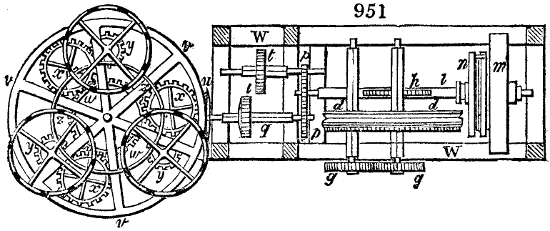
The additional axle s, and wheels t, t, shown in fig. 951., are applied occasionally for reversing the motion of the said drums, and making what is usually termed left-hand ropes; u, figs. 950. and 951., show a bevelled pinion, driving the main crown wheel v, v, which wheel carries and gives motion to the drums R, R; w, w, is a fixed or sun wheel, which gives a reverse motion to the drums, as they revolve round the same, by means of the intervening wheels x, x, x, whereby the reverse or retrograding motion is produced, and which gives to the strands the right twist. The various retrograding motions, or right twists for all sizes and descriptions of ropes, may be obtained by changing the diameters of the pinions y, y, y, on the under ends of the drum spindles; the carriages of the intervening wheels x, x, x, being made to slide round the ring z, z; W, W, is the framework of the machine and drawing motion; T, T, T, are the bobbins containing the yarns; their number is varied to correspond with the different sizes of the machines.
The machine here described, in elevation and plan, is calculated to make ropes from three to seven and one-half inches in circumference, and to an indefinite length.
Messrs. Chapman of Newcastle, to whom the art of rope-making is deeply indebted, having observed that rope yarn is considerably weakened by passing through the tar-kettle, that tarred cordage loses its strength progressively in cold climates, and so rapidly in hot climates as to be scarcely fit for use in three years, discovered that the deterioration was due to the reaction of the mucilage and acid of the tar. They accordingly proposed the following means of amelioration. 1. Boiling it with water, in order to remove these two soluble constituents. 2. Concentrating the washed tar by heat, till it becomes pitchy, and then restoring the plasticity which it thereby loses, by the addition of tallow, or animal or expressed oils.
In 1807, the same able engineers obtained a patent for a method of making a belt or flat band, of two, three, or more strands of shroud or hawser-laid rope, placed side by side, so as to form a band of any desired breadth, which may be used for hoisting the kibbles and corves in mine-shafts, without any risk of its losing twist by rotation. The ropes should be laid with the twist of the one strand directed to the right hand, that of the other to the left, and that of the yarns the opposite way to the strands, whereby perfect flatness is secured to the band. This parallel assemblage of strands has been found also to be stronger than when they are all twisted into one cylinder. The patentees at the same time contrived a mechanism for piercing the strands transversely, in order to brace them firmly together with twine. Flat ropes are usually formed of hawsers with three strands, softly laid, each containing 33 yarns, which with four ropes, compose a cordage four and a half inches broad, and an inch and a quarter thick, being the ordinary dimensions of the grooves in the whim-pulleys round which they pass.
Relative Strength of Cordage, shroud laid.
Size. Warm Register. Cold Register. Common Staple.
Tons. Cwt. Qrs. Lbs. Tons. Cwt. Qrs. Lbs. Tons. Cwt. Qrs. Lbs.
3 inches bore 3 17 — 16 3 5 3 16 2 9 1 24
3 1⁄2 — 5 5 — — 4 9 2 21 3 6 1 27
4 — 6 17 — 16 5 17 — 4 4 5 3 7
4 1⁄2 — 8 13 2 8 7 5 3 1 5 1 2 6
5 — 10 14 1 4 9 3 — 4 6 9 2 8
5 1⁄2 — 12 19 2 4 11 1 1 25 7 12 — 22
6 — 14 15 2 24 13 3 2 8 8 17 1 20
6 1⁄2 — 18 2 — 10 15 9 1 9 9 16 3 14
7 — 21 — — — 17 18 3 8 11 4 1 21
7 1⁄2 — 24 2 — 16 20 11 3 9 12 8 3 6
8 — 27 8 1 26 23 8 2 8 13 2 3 12
The above statement is the result of several hundred experiments.
ROSIN, or COLOPHANY (Galipot, Fr.; Fichtenharz, Germ.); is the rosin left after distilling off the volatile oil from the different species of turpentine. Yellow rosin contains some water, which black rosin does not. See Turpentine.
ROSIN GAS. Fig. 952. exhibits the retort and its appendages, as erected by Messrs. Taylor and Martineau, under the direction of the patentee, Professor Daniel, F.R.S.
I have introduced this manufacturing project, not as a pattern to imitate, but as an example to deter; as affording a very instructive lesson of the danger of rushing headlong into most extensive enterprises, without fully verifying, upon a moderate scale, the probability of their ultimate success. The capital, labour, and time annually wasted upon visionary schemes of this sort, got up by chamber chemists, are incalculably great. No more essential service could be rendered to the cause of productive industry, than to unmask the thousand and one chimerical inventions which disgrace our lists of patents during the last thirty years. These remarks have been suggested by the circumstance, that 50,000l. were squandered upon the rosin-gas concern; a fact communicated to me by an eminent capitalist, who was induced by fallacious statements to embark largely in the speculation. Had 100l. been employed beforehand, by a dispassionate practical man, in making judicious trials, and in calculating the chances of eventual profit and loss, it would have been demonstrated, as clearly as noonday, that rosin could never compete with pitcoal in the production of gas-light. Whatever ingenuity was expended in getting up the following apparatus, may be regarded as an additional ignis fatuus to mislead the public, and divert their thoughts from the abyss that lay before them. The main preliminary to be settled, in all new undertakings, is the soundness of the principle. By neglecting this point, projectors perpetually realize the expiatory fable of the Danaïds.
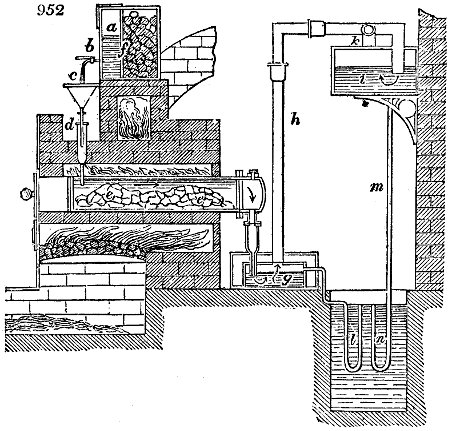
The retort e, e, fig. 952., is seen charged with coke, which is in the first instance raised to a bright red heat, by means of the furnace beneath. The common brown rosin of commerce, which is deposited in the tank a, is to be mixed with the essential oil (condensed from the rosin vapours in a preceding operation) in the proportion of one hundred pounds of the former to ten gallons of the latter. The influence of the flame and heated air beneath serves to preserve this in a fluid state, and by a damper passing across the aperture in the chimney the temperature of the fluid may be exactly regulated. A wire-gauze screen at f, reaches to the bottom of the tank, and prevents the solid rosin, or any impurity with which it may be mixed, from choking the stopcock.
The melted rosin having passed by the stopcock b, funnel c, and syphon d, into the retort, falls on the coke, and in its passage through the ignited mass, becomes decomposed. On arriving at the other end of the retort, a large portion of the oil of turpentine, in the form of condensable vapour, is separated by the refrigerator g; this is supplied with water from a cistern above, and the non-condensable vapour or gas passes up the tube h, and dips beneath the surface of the fluid in the vessel i. This completes the condensation; and the gas proceeds in a perfectly pure state, by the pipe k, to the gasometer, or rather to the floating reservoir, for use.
The essential oil, when it leaves the refrigerator, is conveyed, by the syphon l, to a cistern beneath. The necessity for employing a syphon will be apparent, when it is borne in mind that the tube prevents the escape of the gas, which would otherwise pass away from the box with the essential oil. Another pipe and syphon m, n, serve to convey the condensed essential oil from the top cistern.
ROTTEN-STONE. See Tripoli.
ROUGE. (Fard, Fr.) The only cosmetic which can be applied without injury to brighten a lady’s complexion, is that prepared, by the following process, from safflower (Carthamus tinctorius). The flowers, after being washed with pure water till it comes off colourless, are dried, pulverized, and digested with a weak solution of crystals of soda, which assumes thereby a yellow colour. Into this liquor a quantity of finely carded white cotton wool is plunged, and then so much lemon juice or pure vinegar is added as to supersaturate the soda. The colouring matter is disengaged, and falls down in an impalpable powder upon the cotton filaments. The cotton, after being washed in cold water, to remove some yellow colouring particles, is to be treated with a fresh solution of carbonate of soda, which takes up the red colouring matter in a state of purity. Before precipitating this pigment a second time by the acid of lemons, some soft powdered talc should be laid in the bottom of the vessel, for the purpose of absorbing the fine rouge, in proportion as it is separated from the carbonate of soda, which now holds it dissolved. The coloured mixture must be finally triturated with a few drops of olive-oil, in order to make it smooth and marrowy. Upon the fineness of the talc, and the proportion of the safflower precipitate which it contains, depend the beauty and value of the cosmetic. The rouge of the above second precipitation is received sometimes upon bits of fine-twisted woollen stuff, called crepons, which ladies rub upon their cheeks.
RUBY. See Lapidary.
RUM, is a variety of ardent spirits, distilled in the West Indies, from the fermented skimmings of the sugar teaches, mixed with molasses, and diluted with water to the proper degree. A sugar plantation in Jamaica or Antigua, which makes 200 hogsheads of sugar, of about 16 cwt. each, requires, for the manufacture of its rum two copper stills; one of 1000 gallons for the wash, and one of 600 gallons for the low wines, with corresponding worm refrigeratories. It also requires two cisterns, one of 3000 gallons for the lees or spent wash of former distillations, called dunder (Quasi redundar, Span.), another for the skimmings of the clarifiers and teaches of the sugar-house; along with twelve, or more, fermenting cisterns or tuns.
Lees that have been used more than three or four times, are not considered to be equally fit for exciting fermentation, when mixed with the sweets, as fresher lees. The wort is made, in Jamaica, by adding to 1000 gallons of dunder, 120 gallons of molasses, 720 gallons of skimmings (= 120 of molasses in sweetness), and 160 gallons of water; so that there may be in the liquid nearly 12 per cent. of solid saccharum. Another proportion, often used, is 100 gallons of molasses, 200 gallons of lees, 300 gallons of skimmings, and 400 of water; the mixture containing, therefore, 15 per cent. of sweets. These two formulæ prescribe so much spent wash, according to my opinion, as would be apt to communicate an unpleasant flavour to the spirits. Both the fermenting and flavouring principles reside chiefly in the fresh cane juice, and in the skimmings of the clarifier; because, after the syrup has been boiled, they are in a great measure dissipated. I have made many experiments upon fermentation and distillation from West India molasses, and always found the spirits to be perfectly exempt from any rum flavour.
The fermentation goes on most uniformly and kindly in very large masses, and requires from 9 to 15 days to complete; the difference of time depending upon the strength of the wort, the condition of its fermentable stuff, and the state of the weather. The progress of the attenuation of the wash should be examined from day to day with a hydrometer, as I have described in the article Distillation. When it has reached nearly to its maximum, the wash should be as soon as possible transferred by pumps into the still, and worked off by a properly regulated heat; for if allowed to stand over, it will deteriorate by acetification. Dr. Higgins’s plan, of suspending a basket full of limestone in the wash-tuns, to counteract the acidity, has not, I believe, been found to be of much use. It would be better to cover up the wash from the contact of atmospheric air, and to add perhaps a very little sulphite of lime to it, both of which means would tend to arrest the acetous fermentation. But one of the best precautions against the wash becoming sour, is to preserve the utmost cleanliness among all the vessels in the distillery. They should be scalded at the end of every round with boiling water and quicklime.
About 115 gallons of proof rum are usually obtained from 1200 gallons of wash. The proportion which the product of rum bears to that of sugar, in very rich moist plantations, is rated, by Edwards, at 82 gallons of the former to 16 cwt. of the latter; but the more usual ratio is 200 gallons of rum to 3 hogsheads of sugar. But this proportion will necessarily vary with the value of rum and molasses in the market, since whichever fetches the most remunerating price, will be brought forward in the greatest quantity. In one considerable estate in the island of Grenada, 92 gallons of rum were made for every hogshead (16 cwts.) of sugar. See Still.
Rum imported, in Retained for Home Consumption.—Duty 9s. per Imp. Gallon.
1835. 1836. 1837. 1835. 1836. 1837.
Galls. 5,540,170; 4,993,942; 4,612,416. 3,416,966; 3,325,068; 3,184,599.
RUST, is the orange-yellow coat of peroxide which forms upon the surface of iron exposed to moist air. Oil-paint, varnish, plumbago, or a film of caoutchouc, may be employed, according to circumstances, to prevent the rusting of iron utensils.
RYE, consists, according to the analysis of Einhof, of 24·2 of husk, 65·6 of flour, and 10·2 of water, in 100 parts. This chemist found in 100 parts of the flour, 61·07 of starch, 9·48 of gluten, 3·28 of vegetable albumen, 3·28 of uncrystallizable sugar, 11·09 of gum, 6·38 of vegetable fibre, and the loss was 5·62, including a vegetable acid not yet investigated. Some phosphate of lime and magnesia are also present. See Gin.