M.
Reading edition
MACARONI, is a dough of fine wheat flour, made into a tubular or pipe form, of the thickness of goose-quills, which was first prepared in Italy, and introduced into commerce under the name of Italian or Genoese paste. The wheat for this purpose must be ground into a coarse flour, called gruau or semoule, by the French, by means of a pair of light mill-stones, placed at a somewhat greater distance than usual. This semoule is the substance employed for making the dough. For the mode of manufacturing it into pipes, see Vermicelli.
MACE, is a somewhat thick, tough, unctuous membrane, reticulated or chapt, of a yellowish-brown or orange colour. It forms the envelop of the shell of the fruit of the myristica moschata, which contains the nutmeg. It is dried in the sun, after being dipped in brine; sometimes it is sprinkled over with a little brine, before packing, to prevent the risk of moulding. Mace has a more agreeable flavour than nutmeg; with a warm and pungent taste. It contains two kinds of oil; the one of which is unctuous, bland, and of the consistence of butter; the other is volatile, aromatic, and thinner. The membrane is used as a condiment in cookery, and the aromatic oil in medicine.
MACERATION (Eng. and Fr.; Einweichen, Germ.), is a preparatory steep to which certain vegetable and animal substances are submitted, with the view of distending their fibres or pores, and causing them to be penetrated by such menstrua as are best adapted to extract their soluble parts. Water, alone, or mixed with acids, alkalis, or salts; alcohol and ether, are the liquids usually employed for that purpose.
MACLE, is the name of certain diagonal black spots in minerals, like the ace of diamonds in cards, supposed to proceed from some disturbance of the particles in the act of crystallization.
MADDER (Garance, Fr.; Färberröthe, Germ.), a substance very extensively used in dyeing, is the root of the Rubia tinctorum, a plant, of which two species are distinguished by Linnæus.
The best roots are those which have the size of a writing quill, or, at most, of the little finger. They are semitransparent, and reddish; have a strong odour, and a smooth bark. They should be of two or three years’ growth.
The madder, taken from the ground and picked, must be dried in order to be ground and preserved. In warm climates it is dried in the open air; but, elsewhere, stoves must be employed.
The stringy filaments and epidermis are to be removed, called mulle; as also the pith, so as to leave nothing but the ligneous fibres.
The preparation of madders is carried on in the department of the Rhone, in the following manner.
The roots are dried in a stove, heated by means of a furnace, from which the air is allowed to issue only at intervals, at the moment when it is judged to be saturated with moisture. The furnace-flue occupies a great portion of the floor; above are three close gratings, on which the roots are distributed in layers of about two decimetres (nearly 8 inches). At the end of 24 hours, those which are on the first grated floor directly above the stove are dry, when they are taken away and replaced by those of the superior floors. This operation is repeated whenever the roots over the stove are dry. The dry roots are thrashed with a flail, passed through fanners similar to those employed for corn, and then shaken upon a very coarse sieve. What passes through is farther winnowed and sifted through a finer sieve than the first. These operations are repeated five times, proceeding successively to sieves still finer and finer, and setting aside every time what remains on the sieve. What passes through the fifth sieve is rejected as sand and dust. After these operations, the whole fibrous matters remaining on the sieve are cleaned with common fanners, and women separate all the foreign matters which had not been removed before. For dividing the roots, afterwards, into different qualities, a brass sieve is made use of, whose meshes are from six to three millimetres in diameter (from 1⁄4th to 1⁄8th inch E.) What passes through the finest is rejected; and what passes through the coarsest is regarded as of the best quality. These roots thus separated, are carried into a stove, of a construction somewhat different from the first. They are spread out in layers of about a decimetre in thickness (nearly 4 inches E.), on large lattice-work frames, and the drying is known to be complete, when on taking up a handful and squeezing it, the roots break easily. On quitting the stove, the madder is carried, still hot, into a machine, where it is minced small, and a sieve separates the portion of the bark reduced to powder. This operation is repeated three or four times, and then the boulter is had recourse to. What passes through the sieve, or the brass meshes of the boulter, is regarded as common madder; and what issues at the extremity of the boulter is called the flour. Lastly, the madder which passes through the boulter is ground in a mill with vertical stones, and then passed through sieves of different sizes. What remains above is always better than what goes through.
The madder of Alsace is reduced to a very fine powder, and its colouring matter is extracted by a much longer ebullition than is necessary for the lizari of the Levant. The prepared madders ought to be carefully preserved from humidity, because they easily imbibe moisture, in which case fermentation spoils their colour.
D’Ambourney and Beckman have asserted, that it is more advantageous to employ the fresh root of madder than what has been submitted to desiccation, especially by means of stoves. But in its states of freshness, its volume becomes troublesome in the dyeing bath, and uniform observation seems to prove that it ameliorates by age. Besides, it must be rendered susceptible of keeping and carrying easily.
It appears that madder may be considered as composed of two colouring substances, one of which is dun (tawny), and the other is red. Both of these substances may combine with the stuff. It is of consequence, however, to fix only the red part. The dun portion appears to be more soluble, but its fixity on stuffs may possibly be increased by the affinity which it has for the red portion.
The different additions made to madder, and the multiplied processes to which it is sometimes exposed, have probably this separation for their chief object.
The red portion of madder is soluble, but in small quantity, in water. Hence but a limited concentration can be given to its solution. If the portion of this substance be too much increased, so far from obtaining a greater effect, we merely augment the proportion of the dun part, which is the more soluble of the two.
In consequence of the Société Industrielle of Mulhausen having offered in the year 1826 large premiums to the authors of the best analytical investigation of madder, eight memoirs were transmitted to it in the year 1827. They were examined with the greatest care by a committee consisting of able scientific and practical men. None of the competitors however fulfilled the conditions of the programme issued by the society; but four of them received a tribute of esteem and gratitude from it; MM. Robiquet and Colin at Paris, Kuhlmann at Lille, and Houton-Libillardière. Fresh premiums were offered for next year, to the amount of 2000 francs.
Every real discovery made concerning this precious root, would be of vast consequence to dyers and calico-printers. Both M. Kuhlmann, and Robiquet and Colin, conceived that they had discovered a new principle in madder, to which they gave the name alizarine. The latter two chemists treated the powdered madder with sulphuric acid, taking care to let it heat as little as possible. By this action the whole is carbonized, except perhaps the red matter. The charcoal thus obtained is pulverized, mixed with water, thrown upon a filter, and well washed in the cold. It is next dried, ground, and diffused through fifty parts of water, containing six parts of alum. This mixture is then boiled for one quarter of an hour, and thrown upon a filter cloth while boiling hot. The residuum is once more treated with a little warm alum water. The two liquors are to be mixed, and one part of sulphuric acid poured into them; when they are allowed to cool with occasional agitation. Flocks now make their appearance; the clear liquid is decanted, and the grounds are thrown upon a filter. The precipitate is to be washed, first with acidulated water, then with pure water, and dried, when the colouring matter is obtained in a red or purple state. This purple substance, when heated dry, gives out alizarine, and an empyreumatic oil, having an odour of animal matter; while a charcoally matter remains.
M. Dan. Kœchlin, the justly celebrated calico-printer of Mulhausen, has no faith in alizarine as the dyeing principle of madder; and thinks moreover that, were it of value, it could not be extracted on the great scale, on account of the destructive heat which would result from the acid acting upon a considerable body of the ground madder. Their alizarine is not a uniform substance, as it ought to be, if a proximate principle; for samples of it obtained in different repetitions of the process have produced very variable effects in dyeing. The madders of Avignon, though richer in colour than those of Alsace, afford however little or no alizarine. In fact, purpurine, the crude substance from which they profess to extract alizarine, is a richer dye than this pure substance itself.
Madder contains so beautiful and so fast a colour, that it has become of almost universal employment in dyeing; but that colour is accompanied with so many other substances which mask and degrade it, that it can be brought out and fixed only after a series of operations more or less difficult and precarious. This dye is besides so little soluble, that much of it is thrown away in the dye-house; the portion supposed to be exhausted being often as rich as other fresh madder; hence it would be a most valuable improvement in this elegant art to insulate this tinctorial body, and make it a new product of manufacture.
Before the time of Haussmann, an apothecary at Colmar, the madder bath was subject to many risks, which that skilful chemist taught dyers how to guard against, by introducing a certain quantity of chalk into the bath. A change of residence led Haussmann to this fortunate result. After having made very fine reds at Rouen, he encountered the greatest obstacles in dyeing the same reds at Logelbach near Colmar, where he went to live. Numerous trials, undertaken with the view of obtaining the same success in his new establishment, proved that the cause of his favourable results at Rouen existed in the water, which contained carbonate of lime in solution, whilst the water of Logelbach was nearly pure. He then tried a factitious calcareous water, by adding chalk to his dye bath. Having obtained the most satisfactory results, he was not long of producing here as beautiful and as solid reds as he had done at Rouen. This practice became soon general among the calico-printers of Alsace, though in many dye-works the chalk is now replaced by lime, potash, or soda. But when the madder of Avignon is used, all these antacid correctives become unnecessary, because it contains a sufficient quantity of carbonate of lime; an important fact first analytically demonstrated by that accurate chemist M. Henri Schlumberger of Mulhausen. Avignon madder indicates the presence of carbonate of lime in it, by effervescing with dilute acids, which Alsace madder does not.
M. Kuhlmann found a free acid resembling the malic, in his analysis of madders. But his experiments were confined to those of Alsace. The madders of Avignon are on the contrary alkaline, as may be inferred from the violet tint of the froth of their infusions; whereas that of the Alsace madders is yellowish, and it strongly reddens litmus paper. This important difference between the plants of these two districts, depends entirely upon the soil; for madders grown in a calcareous shelly soil in Alsace, have been found to be possessed of the properties of the Avignon madder.
The useful action of the carbonate and the phosphate of lime in the madder of Avignon, explains why madders treated with acids which remove their calcareous salts, without taking away their colouring matter, lose the property of forming fast dyes. Many manufacturers are in the habit of mixing together, and with advantage, different sorts of madder. That of Avignon contains so much calcareous matter that, when mixed with the madder of Alsace, it can compensate for its deficiency. Some of the latter is so deficient as to afford colours nearly as fugitive as those of Brazil wood and quercitron. The Alsace madders by the addition of chalk to their baths, become as fit for dyeing Turkey reds as those of Avignon. When the water is very pure, one part of chalk ought to be used to five of Alsace madder, but when the waters are calcareous, the chalk should be omitted. Lime, the neutral phosphate of lime, the carbonate of magnesia, oxide and carbonate of zinc, and several other substances have the property of causing madder to form a fast dye, in like manner as the carbonate of lime.
The temperature of from 50° to 60° R. (145° to 167° F.), is the best adapted to the solution of the colouring matter, and to its combination with the mordants; and thus a boiling heat may be replaced advantageously by the long continuance of a lower temperature. A large excess of the dye-stuff in the bath is unfavourable in two points of view; it causes a waste of colouring matter, and renders the tints dull. It is injurious to allow the bath to cool, and to heat it again.
In a memoir published by the Society of Mulhausen, in September, 1835, some interesting experiments upon the growth of madders in factitious soils are related by MM. Kœchlin, Persoz, and Schlumberger. A patch of ground was prepared containing from 50 to 80 per cent. of chalky matter, and nearly one fifth of its bulk of good horse-dung. Slips of Alsace and Avignon madders were planted in March, 1834, and a part of the roots were reaped in November following. These roots, though of only six months growth, produced tolerably fast dyes, nor was any difference observable between the Alsace and the Avignon species; whilst similar slips or cuttings, planted in a natural non-calcareous soil, alongside of the others, yielded roots which gave fugitive dyes. Others were planted in the soil of Palud, transported from Avignon, which contained more than 90 per cent. of carbonate of lime, and they produced roots that gave still faster dyes than the preceding. Three years are requisite to give the full calcareous impregnation to the indigenous madders of Avignon.
As to the function of the chalk, valuable observations, made long ago by M. Daniel Kœchlin, have convinced him, that the combination of two different bases with a colouring matter, gave much more solidity to the dye, in consequence, undoubtedly, of a greater insolubility in the compound. Experiments recently made by him and his colleagues above named, prove that in all cases of madder-dyeing under the influence of chalk, a certain quantity of lime becomes added to the aluminous mordant. In the subsequent clearing with a soap bath, some of the alumine is removed, and there remains upon the fibre of the cloth a combination of these two earths in atomic proportions. Thus the chalk is not for the purpose of saturating the acid, as had been supposed, but of forming a definite compound with alumina, and probably also with the fatty bodies, and the colouring matter itself.
The red mordants are prepared commonly in Alsace, as follows:—The crushed alum and acetate of lead being weighed, the former is put into a deep tub, and dissolved by adding a proper quantity of hot water, when about one tenth of its weight of soda crystals is introduced to saturate the excess of acid in the alum. The acetate of lead is now mixed in; and as this salt dissolves very quickly, the reaction takes place almost instantly. Care must be taken to stir for an hour. The vessel should not be covered, lest its contents should cool too slowly.
The different mordants most generally employed for madder, are detailed under Colours, in Calico-Printing and Mordant.
Much mordant should not be prepared at once, for sooner or later it will deposit some sub-acetate of alumina. This decomposition takes place even in corked phials in the cold; and the precipitate does not readily dissolve again in acetic acid. All practical men know that certain aluminous mordants are decomposed by heating them, and restored on cooling, as Gay Lussac has pointed out. He observed, that by adding to pure acetate of alumina, some alum or sulphate of potash, the mixture acquires the property of forming a precipitate with a heat approaching the boiling point, and of redissolving on cooling. The precipitate is alumina nearly pure, according to M. Gay Lussac; but, by M. Kœchlin’s more recent researches, it is shown to be sub-sulphate of alumina, containing eight times as much base as the neutral sulphate.
Madder dye.—On account of the feeble solubility of its colouring matter in water, we cannot dye with its decoction; but we must boil the dye-stuff along with the goods to be dyed; thereby the water dissolves fresh portions of the dye, and imparts it in succession to the textile fibres. In dyeing with madder, we must endeavour to fix as little of the dun matter as possible upon the cloth.
Dyeing on wool.—Alumed wool takes, in the madder bath, a red colour, which is not so bright as cochineal red, but it is faster; and as it is far cheaper, it is much used in England to dye soldiers cloth. A mordant of alum and tartar is employed; the bath of madder, at the rate of from 8 to 16 ounces for the pound of cloth, is heated to such a degree that we can just hold our hand in it, and the goods are then dyed by the wince, without heating the bath more till the colouring matter be fixed. Vitalis prescribes as a mordant, one fourth of alum, and one sixteenth of tartar; and for dyeing, one third of madder, with the addition of a 24th of solution of tin diluted with its weight of water. He raises the temperature in the space of an hour, to 200°, and afterwards he boils for 3 or 4 minutes; a circumstance which is believed to contribute to the fixation of the colour. The bath, after dyeing, appears much loaded with yellow matter, because this has less affinity for the alum mordant than the red. Sometimes a little archil is added to the madder, to give the dye a pink tinge; but this is fugitive.
Silk is seldom dyed with madder, because cochineal affords brighter tints.
Dyeing on cotton and linen.—The most brilliant and fastest madder red is the Turkey or Adrianople. The common madder reds are given in the following way:—The yarn or cloth is boiled in a weak alkaline bath, washed, dried and galled, by steeping the cotton in a decoction of bruised galls or of sumach. After drying, it is twice alumed; for which purpose, for every 4 parts of the goods, one part of alum is taken, mixed with 1-16th of its weight of chalk. The goods are dipped into a warm solution of the alum, wrung out, dried, and alumed afresh, with half the quantity. The acetate of alumina mordant, described above, answers much better than common alum for cotton. After the goods are dried and rinsed, they are passed through the dye bath, which is formed of 3⁄4 lb. of good madder for every pound of cotton; and it is raised to the boiling point by degrees, in the space of 50 or 60 minutes. Whenever the ebullition has continued a few minutes, the goods must be removed, washed slightly, and dyed a second time in the same way, with as much madder. They are then washed and passed through a warm soap bath, which removes the dun colouring matter.
Hölterhoff prescribes for ordinary madder red the following proportions:—20 pounds of cotton yarn; 14 pounds of Dutch madder; 3 pounds of nut-galls; 5 pounds of alum; to which 1⁄2 lb. of acetate of lead has been first added, and then a quarter of a pound of chalk.
In the calico-print works the madder goods are passed through a bran bath first, immediately after dyeing; next, after several days exposure to the air, when the dun dye has become oxidized, and is more easily removed. An addition of chalk, on the principles explained above, is sometimes useful in the madder bath. If bran be added to the madder bath, the colour becomes much lighter, and of an agreeable shade. Sometimes bran-water is added to the madder bath, instead of bran.
Adrianople or Turkey red.—This is the most complicated and tedious operation in the art of dyeing; but it produces the fastest colour which is known. This dye was discovered in India, and remained long a process peculiar to that country. It was afterwards practised in other parts of Asia and in Greece. In 1747, Ferquet and Goudard brought Greek dyers into France, and mounted near Rouen, and in Languedoc, Turkey-red dye works. In 1765, the French government, convinced of the importance of this business, caused the processes to be published. In 1808, Reber, at Mariakirch, furnished the finest yarn of this dye, and M. Köchlin became celebrated for his Turkey-red cloth.
Process for Turkey-red.—The first step consists in clearing the yarn or cloth in alkaline baths, and dipping them in oily liquors, to which sheep’s dung was formerly added. This operation is repeated several times, the goods being dried after each immersion. There next follows the cleansing with alkaline liquors to remove the excess of oil, the galling, the aluming, the maddering, the brightening or removing the dun part of the dye by boiling, at a high temperature, with alkaline liquid, and the rosing by boiling in a bath of salt of tin. We shall give some details concerning this tedious manipulation, and the differences which exist in it in the principal dye-works.
At Rouen, where the process was first brought to perfection, two methods are pursued, called the gray and the yellow course or march. In the gray, the dye is given immediately after the cotton has received the oily mordant, the gall, and the alum, as it has then a gray colour. In the yellow course, it is passed through fresh oils, alum, and galls before the maddering, the cotton having then a yellow tint.
Different views have been taken of the principles of the Turkey red dye, and the object and utility of the various steps. The most ancient notion is that of animalizing the cotton by dung and blood, but experience has proved that without any animal matter the finest colour may be obtained. According to Dingler, the cotton is imbued with oil by steeping it in combinations of oil and soda; the oil is altered by repeated dryings at a high temperature; it attracts oxygen from the air, and thereby combines intimately with the cotton fibre, so as to increase the weight of the stuff. The dung, by a kind of fermentation, accelerates the oxidizement, and hence crude oil is preferable to pure. In England, the mucilaginous oils of Gallipoli are preferred, and in Malabar, oils more or less rancid. The drying oils do not answer. The subsequent treatment with the alkaline liquors removes the excess of oil, which has not been oxidized and combined; a hard drying completely changes that which remains in the fibres; the aluming which follows combines alumina with the cotton; the galling tans the fibres, producing a triple compound of oil and alum, which fixes the colouring matter. The object of the other steps is obvious.
According to Wuttich the treatment with oil opens the cotton so as to admit the mordant and the colouring matter, but the oil and soap do not combine with the fibres. In the alkaline baths which follow, the oil is transformed into soap and removed; whence the cotton should not increase in weight in the galling and aluming; the cotton suffers a kind of tanning, and the saline parts of the blood assist in fixing the madder dye.
The German process improved, according to Dingler, consists of the following operations: mordant of an oily soap or a soapy liniment, hard drying; alkaline bath, drying, steeping, rinsing away of the uncombined mordant, drying; galling, drying; aluming, drying, steeping in water containing chalk, rinsing; maddering, airing, rinsing; brightening with an alkaline boil, and afterwards in a bath containing salt of tin; then washing and drying.
The yarn or the cloth must be first well worked in a bath of sheep’s dung and oil, compounded as follows:—25 pounds of sheep’s dung are to be bruised in a solution of pure caustic potash of hydrometer strength 3°, and the mixed liquor is to be passed through a sieve. Two pounds of fine oil are now to be poured into 16 pounds of this lye, after which 30 pounds of coarse oil are to be added, with agitation for 1⁄4 of an hour. Other 4 pounds of hot lye are to be well stirred in, till the whole is homogeneous. This proportion of mordant is sufficient for 100 pounds of cotton yarn, for 90 pounds of unbleached or 100 pounds of bleached cotton goods. The cotton stuff, after being well wrung out, is to be laid in a chest and covered with a lid loaded with weights, in which state it should remain for five days. At the end of 24 hours, the cotton becomes hot with fermentation, gets imbued with the mordant, and the oil becomes rapidly altered. The goods are next exposed freely to the air during the day, and in the evening they are dried in a hot chamber, exposed to a temperature of 158° F., for 6 or 8 hours, which promotes the oxidizement of the oil.
The goods are now passed the second time through a soapy-oil mordant similar to the first, then dried in the air by day, and in the hot stove by night. The third and fourth oil-soap steeps are given in the same way, but without the dung. The fifth steep is composed of a lye at 2°, after which the goods must also be dried. Indeed from the first to the fourth steep, the cotton stuff should be put each time into a chamber heated to 145° F. for 12 or 15 hours, and during 18 hours after the fifth steep.
The uncombined oil must, in the next place, be withdrawn by the degraissage, which consists in steeping the goods for 6 hours in a very weak alkaline ley. After rinsing and wringing, they are dried in the air, and then put into the hot stove.
The goods are now galled in a bath formed of 36 pounds of Sicilian sumach, boiled for 3 hours in 260 pounds of water, and filtered. The residuum is treated with 190 fresh pounds of water. This decoction is heated with 12 pounds of pounded nut-galls to the boiling point, allowed to cool during the night, and used next morning as hot as the hand can bear; the goods being well worked through it. They are again dried in the air, and afterwards placed in a stove moderately heated. They are next passed through a tepid alum bath, containing a little chalk; left afterwards in a heap during the night, dried in the air, and next in the stove. The dry goods are finally passed through hot water containing a little chalk, wrung out, rinsed, and then maddered.
For dyeing, the copper is filled with water, the fire is kindled, and an ounce and a half of chalk is added for every pound of madder; a pound and a quarter of madder being taken for every pound of cotton yarn. The goods are now passed through the bath, so that they penetrate to near its bottom. The fire must be so regulated, that the copper will begin to boil in the course of from 21⁄2 to 3 hours; and the ebullition must be continued for an hour; after which the yarn is aired and rinsed. Cloth should be put into the dye-bath when its temperature is 77°, and winced at a heat of from 100° to 122° during the first hour; at 167° during the second; and at the boiling point when the third hour begins. It is to be kept boiling for half an hour; so that the maddering lasts four hours. Dingler does not add sumach or galls to the madder bath, because their effect is destroyed in the subsequent brightening, and he has no faith in the utility of blood.
After being dyed, the goods are washed, pressed, and subjected to a soapy alkaline bath at a high heat, in a close boiler, by which the dun parts of the galls and the madder are dissolved away, and the red colour remains in all its lustre. This operation is called brightening. It is repeated in a similar liquor, to which some muriate of tin is added for the purpose of enlivening the colour and giving it a rosy tint. Last of all, the goods are rinsed, and dried in the shade.
The Elberfeld process consists for 100 libs. of the following steps:—
1. Cleaning the cotton by boiling it for four hours in a weak alkaline bath, cooling and rinsing.
2. Working it thoroughly four times over in a steep, consisting of 300 pounds of water, 15 pounds of potash, 1 pailful of sheep’s dung, and 121⁄2 pounds of olive oil, in which it should remain during the night. Next day it is drained for an hour, wrung out and dried. This treatment with the dung steep, and drying, is repeated 3 times.
3. It is now worked in a bath containing 120 quarts of water, 18 pounds of potash, and 6 quarts of olive oil; then wrung out and dried. This steep is also repeated 4 times.
4. Steeping for a night in the river is the next process; a slight rinsing without wringing, and drying in the air.
5. Bath made of a warm decoction (100° F.) of sumach and nut-galls, in which the goods remain during the night; they are then strongly wrung, and dried in the air.
6. Aluming with addition of potash and chalk; wringing; working it well through this bath, where it is left during the night.
7. Draining, and strong rinsing the following day; piling up in a water cistern.
8. Rinsing repeated next day, and steeping in water to remove any excess of alum from the fibres; the goods continue in the water till they are taken to the dyeing-bath.
9. The maddering is made with the addition of blood, sumach, and nut-galls; the bath is brought to the boil in 1 hour and 3⁄4, and kept boiling for half an hour.
10. The yarn is rinsed, dried, boiled from 24 to 36 hours in a covered copper, with an oily alkaline liquid; then rinsed twice, laid for two days in clear water, and dried.
11. Finally, the greatest brightness is obtained by boiling for three or four hours in a soap bath, containing muriate of tin; after which the yarn is rinsed twice over, steeped in water, and dried.
Process of Haussmann.—He treats cotton twice or 4 times in a solution of aluminated potash, mixed with one thirty-eighth part of linseed oil. The solution is made by adding caustic potash to alum. He dries and rinses each time, and dries after the last operation. He then rinses and proceeds to the madder bath. For the rose colour, he takes one pound of madder for one pound of cotton; for carmine red, he takes from 2 to 3 pounds; and for the deepest red, no less than 4 pounds. It is said that the colour thus obtained surpasses Turkey red.
The French process, by Vitalis of Rouen.—First operation. Scouring with a soda lye, of 1° Baumé, to which there is usually added the remainder of the white preparation bath, which consists of oil and soda with water. It is then washed, wrung out, and dried.
In the second operation, he states that from 25 to 30 pounds of sheep’s dung are commonly used for 100 pounds of cotton yarn. The dung is first steeped for some days in a lye of soda, of 8° to 10° B. This is afterwards diluted with about 500 pints of a weaker ley, and at the same time bruised with the hand in a copper basin whose bottom is pierced with small holes. The liquor is then poured into a vat containing 5 or 6 pounds of fat oil (Gallipoli), and the whole are well mixed. The cotton is washed in this, and the hanks of yarn are then stretched on perches in the open air, and turned from time to time, so as to make it dry equably. After receiving thus a certain degree of desiccation, it is carried into the drying house, which is heated to 50° Reaumur (144° Fahrenheit), where it loses the remainder of its moisture, which would have prevented it from combining with the other mordants which it is afterwards to receive. What is left of the bath is called avances, and is added to the following bath. Two, or even three dung baths are given to the cotton, when it is wished to have very rich colours. When the cotton has received the dung baths, care must be taken not to leave it lying in heaps for any length of time, lest it should take fire; an accident which has occasionally happened.
The white bath is prepared by pouring 6 pounds of fat oil, into 50 pints of soda water, at 1° or sometimes less, according as, by a preliminary trial, the oil requires. This bath ought to be repeated two, three, or even a greater number of times, as more or less body is to be given to the colour.
To what remains of the white bath, and which is also styled avances, about 100 pints of soda lye of two or three degrees are added. Through this the cotton is passed as usual. Formerly it was the practice to give two, or three, or even four oils. Now, two are found to be sufficient.
The cotton is steeped for five or six hours in a tepid solution of soda, of 1° at most; it is set to drain, is then sprinkled with water, and at the end of an hour is washed, hank by hank, to purge it entirely from the oil. What remains of the water of degraissage, serves for the scouring or first operation.
For 100 pounds of cotton, from 20 to 25 pounds of galls in sorts must be taken, which are bruised and boiled in about 100 pints of water, till they crumble easily between the fingers. The galling may be done at two operations, dividing the above quantity of galls between them, which is thought to give a richer and more uniform colour.
The aluming of 100 pounds of cotton requires from twenty-five to thirty pounds of pure alum, that is, alum entirely free from ferruginous salts. The alum should be dissolved without boiling, in about 100 pints of river or rain water. When the alum is dissolved, there is to be poured in a solution of soda, made with the sixteenth part of the weight of the alum. A second portion of the alkaline solution must not be poured in till the effervescence caused by the first portion has entirely ceased,—and so in succession. The bath of saturated alum, being merely tepid, the cotton is passed through it, as in the gall bath, so as to impregnate it well, and it is dried with the precautions recommended above. The dyers who gall at two times, alum also twice, for like reasons.
For 25 pounds of cotton, 25 pints of blood are prescribed, and 400 pints of water. Whenever the bath begins to warm, 50 pounds of madder are diffused through the bath; though sometimes the maddering is given at two operations, by dividing the madder into two portions.
The brightening bath is prepared always for 100 pounds of cotton, with from four to five pounds of rich oil, six pounds of Marseilles white soap, and 600 litres of soda water of 2° B.
The rosing is given with solution of tin, mixed with soap water.
The Turkey-red dye of Messrs. Monteith and Co., of Glasgow, is celebrated all over the world, and merits a brief description here.
The calico is taken as it comes from the loom without bleaching, for the natural colour of the cotton wool harmonizes well with the dye about to be given; it is subjected to a fermentative steep for 24 hours, like that preliminary to bleaching, after which it is washed at the dash wheel. It is then boiled in a lye, containing about 1 pound of soda crystals for 12 pounds of cloth. The oiling process now begins. A bath is made with 10 gallons of Gallipoli oil, 15 gallon measures of sheep’s dung not indurated; 40 gallons of solution of soda crystals, of 1·06 specific gravity; 10 gallons of solution of pearl-ash of spec. grav. 1·04; and 140 gallons of water; constituting a milk-white, soapy solution of about spec. grav. 1·022. This liquor is put into a large cylindrical vat, and constantly agitated by the rotation of wooden vanes, which are best constructed on the plan of the mashing apparatus of a brewery, but far slighter. This saponaceous compound is let off as wanted by a stopcock into the trough of a padding machine, in order to imbue every fibre of the cloth in its passage. This impregnation is still more fully ensured by laying the padded cloth aside in wooden troughs during 16 or 18 days. The sheep’s dung has been of late years disused by many Turkey-red dyers both in England and France, but it is found to be advantageous in producing the very superior colour of the Glasgow establishment. It is supposed, also, to promote the subsequent bleaching during the exposure on the green; which is the next process in favourable weather, but in bad weather the goods are dried over a hot-flue.
The cloth is padded again with the saponaceous liquor; and again spread on the grass, or dried hard in the stove. This alternation is repeated a third time, and occasionally, even a fourth.
The cloth by this time is varnished as it were with oil, and must be cleansed in a certain degree by being passed through a weak solution of pearl-ash, at the temperature of about 122° F. It is then squeezed by the rollers and dried.
A second system of oiling now commences, with the following liquor:—10 gallons of Gallipoli oil; 30 gallons of soda crystals lye, of sp. grav. 1·06; and 10 gallons of caustic potash lye, of specific gravity 1·04, thoroughly diffused through 170 gallons of water. With this saponaceous liquor the cloth is padded as before, and then passed between squeezing-rollers, which return the superfluous liquor into the padding-trough. The cloth may be now laid on the grass if convenient; but at any rate it must be hard dried in the stove.
These saponifying, grassing, and drying processes, are repeated three times; whereby the cloth becomes once more very oleaginous, and must be cleansed again by steeping in a compound lye of soda crystals and pearl-ash of the spec. grav. 1·012, at the temperature of 122°. The cloth is taken out, squeezed between rollers to save the liquor, and washed. A considerable portion of the mingled alkalis disappear in this operation, as if they entered into combination with the oil in the interior of the cotton filaments. The cloth is now hard dried.
Galling is the next great step in the Turkey-red preparation; and for its success all the oil should have been perfectly saponified.
From 18 to 20 pounds of Aleppo galls (for each 100 libs of cloth) are to be bruised and boiled for 3 or 4 hours, in 25 gallons of water, till 5 gallons be evaporated; and the decoction is to be then passed through a searce. Two pounds of sumach may be substituted for every pound of galls. The goods must be well padded with this decoction, kept at 90° F., passed through squeezing-rollers, and dried. They are then passed through a solution of alum of the sp. gr. 1·04, to which a certain portion of chalk is added to saturate the acid excess of that supersalt; and in this cretaceous mixture, heated to 110°, the cloth is winced and steeped for 12 hours. It is then passed between squeezing-rollers, and dried in the stove.
The maddering comes next.
From two to three pounds of madder, ground to powder in a proper mill, are taken for every pound of cloth. The cloth, as usual in maddering, is entered into the cold bath, and winced by the automatic reel during one hour that the bath takes to boil, and during an ebullition of two hours afterwards. One gallon of bullock’s blood is added to the cold bath for every 25 pounds of cloth; being the quantity operated upon in one bath. The utility of the blood in improving the colour has been ascribed to its colouring particles; but it is more probably owing to its albuminous matter combining with the margarates of soda and potash condensed in the fibres.
As madder contains a dingy brown colouring matter associated with the fine red, the goods must be subjected to a clearing process to remove the former tinge, which is more fugitive than the latter. Every hundred pounds of cloth are therefore boiled during 12 hours at least, with water containing 5 pounds of soda crystals, 8 pounds of soap, and 16 gallons of the residual pearl-ash and soda-lye of the last cleansing operation. By this powerful means the dun matter is well nigh removed; but it is completely so by a second boil, at a heat of 250° F., in a tight globular copper, along with 5 pounds of soap, and 1 pound of muriate of tin crystals, dissolved in a sufficient body of water for 100 pounds of cloth. The muriate of tin serves to raise the madder red to a scarlet hue. A margarate of tin is probably fixed upon the cloth in this operation.
When the weather permits, the goods should be now laid out for a few days on the grass. Some manufacturers give them a final brightening with a weak bath of a chloride of lime; but it is apt to impoverish the colour.
According to the latest improvements of the French dyers, each of the four processes of oiling, mordanting, dyeing, and brightening differs, in some respects, from the above.
1. Their first step is boiling the cloth for four hours, in water containing one pound of soap for every four pieces. Their saponaceous bath of a creamy aspect is used at a temperature of 75° F.; and it is applied by the padding machine 6 times, with the grassing and drying alternations. In winter, when the goods cannot be exposed on the grass, no less than 12 alternations of the saponaceous or white bath are employed, and 8 in spring. They consider the action of the sun-beam to aid greatly in brightening this dye; but at Midsummer, if it be continued more than 4 hours, the scarlet colour produced begins to be impaired.
They conceive that the oiling operation impregnates the fibres with super-margarate of potash or soda, insoluble salts which attract and condense the alumina, and the red colouring particles of the madder, so firmly that they can resist the clearing boil.
2. Their second step, the mordanting, consists first in padding the pieces through a decoction of galls mixed with a solution of an equal weight of alum; and after drying in the hot-flue, &c., again padding them in a solution of an acetate of alumina, made by decomposing a solution of 16 libs. of alum with 16 libs of acetate of lead, for 6 pieces of cloth, each 32 aunes long.
3. The maddering is given at two successive operations; with 4 pounds of Avignon madder per piece at each time.
4. The brightening is performed by a 12 hours’ boil in water with soda crystals, soap, and salt of tin; and the rosing by a 10 hours’ boil with soap and salt of tin. Occasionally, the goods are passed through a weak solution of chloride of potash. When the red has too much of a crimson cast, the pieces are exposed for two days on the grass, which gives them a bright scarlet tint.
Process of M. Werdet to dye broad cloth and wool by madder:—
“Preparation for 24 pounds of scoured wool:
“Take 41⁄4 pounds of cream of tartar, 41⁄4 pounds of pure alum; boil the wool gently for 2 hours, transfer it into a cool place, and wash it next day in clear water.
“Dyeing.—12 pounds of Avignon madder, infused half an hour at 30° R. (100° F.) Put into the bath 1 pound of muriate of tin, let the colour rose for three quarters of an hour at the same heat, and drain or squeeze the madder through canvas. The whole of the red dye will remain upon the filter, but the water which has passed through will be as deep a yellow as a weld bath. The boiler with the dye must now be filled up with clear river water, and heated to 100° F. Two ounces of the solution of the tartar and alum must be poured into it, and the wool must be turned over in it for an hour and a half, while the heat is gradually raised to the boiling point. The wool is then removed and washed. It must be rosed the following day.
“Rosing.—Dissolve in hot water 1 pound of white Marseilles soap; let the bath cool, and pass the wool through it till it has acquired the desired shade; 15 or 20 minutes are sufficient. On coming out of this bath it should be washed.
“Solution of deuto-muriate of tin:—
“2 ounces of pure muriatic acid; 4 drachms of pure nitric acid; 1 ounce of distilled water. Dissolve in it, by small portions at a time, 2 drachms of grain tin, in a large bottle of white glass, shutting it after putting in the tin. This solution may be preserved for years, without losing its virtue.”
I have inserted this process, as recently recommended by the French minister of commerce, and published by M. Pouillet in vol. i. of his Portefeuille Industriel, to show what official importance is sometimes given by our neighbours to the most frivolous things.
Madders imported for home consumption. Gross amount of Duty paid in
1836. 1837. 1836. 1837.
Cwts. 106,172 cwts. 79,228 £10,810 £8,081
MADREPORES, are calcareous incrustations produced by polypi contained in cells of greater or less depth, placed at the surface of calcareous ramifications, which are fixed at their base, and perforated with a great many pores. The mode of the increase, reproduction and death of these animals is still unknown to naturalists. Living madrepores are now-a-days to be observed only in the South American, the Indian, and the Red seas; but although their polypi are not found in our climate at present, there can be no doubt of their having existed in these northern latitudes in former times, since fossil madrepores occur in both the older and newer secondary strata of Europe.
MAGISTERY, is an old chemical term to designate white pulverulent substances, spontaneously precipitated in making certain metallic solutions; as magistery of bismuth.
MAGISTRAL, in the language of the Spanish smelters of Mexico and South America, is the roasted and pulverized copper pyrites, which is added to the ground ores of silver in their patio, or amalgamation magma, for the purpose of decomposing the horn silver present. See Silver, for an account of this curious process of reduction.
MAGMA, is the generic name of any crude mixture of mineral or organic matters, in a thin pasty state.
MAGNANIER, is the name given in the southern departments of France to the proprietor of a nursery in which silk-worms are reared upon the great scale, or to the manager of the establishment. The word is derived from magnans, which signifies silkworms in the language of the country people. See Silk.
MAGNESIA (Eng. and Fr.; Bittererde, Talkerde, Germ.), is one of the primitive earths, first proved by Sir H. Davy to be the oxide of a metal, which he called magnesium. It is a fine, light, white powder, without taste or smell, which requires 5150 parts of cold water, and no less than 36,000 parts of boiling water, for its solution. Its specific gravity is 2·3. It is fusible only by the heat of the hydroxygen blowpipe. A natural hydrate is said to exist which contains 30 per cent. of water. Magnesia changes the purple infusion of red cabbage to a bright green. It attracts carbonic acid from the air, but much more slowly than quicklime. It consists of 61·21 parts of metallic basis, and 38·79 of oxygen; and has, therefore, 20 for its prime equivalent upon the hydrogen scale. Its only employment in the arts is for the purification of fine oil, in the preparation of varnish.
Magnesia may be obtained by precipitation with potash or soda, from its sulphate, commonly called Epsom salt; but it is usually procured by calcining the artificial or natural carbonate. The former is, properly speaking, a subcarbonate, consisting of 44·69 magnesia, 35·86 carbonic acid, and 19·45 water. It is prepared by adding to the solution of the sulphate, or the muriate (the bittern of sea-salt evaporation works), a solution of carbonate of soda, or of carbonate of ammonia distilled from bones in iron cylinders. The sulphate of magnesia is generally made by acting upon magnesian limestone with somewhat dilute sulphuric acid. The sulphate of lime precipitates, while the sulphate of magnesia remains in solution, and may be made to crystallize in quadrangular prisms, by suitable evaporation and slow cooling. Where muriatic acid may be had in profusion for the trouble of collecting it, as in the soda works in which sea salt is decomposed by sulphuric acid, the magnesian limestone should be first acted upon with as much of the former acid as will dissolve out the lime, and then, the residuum being treated with the latter acid, will afford a sulphate at the cheapest possible rate; from which magnesia and all its other preparations may be readily made. Or, if the equivalent quantity of calcined magnesian limestone be boiled for some time in bittern, the lime of the former will displace the magnesia from the muriatic acid of the latter. This is the most economical process for manufacturing magnesia. The subcarbonate, or magnesia alba of the apothecary, has been proposed by Mr. E. Davy to be added by the baker to damaged flour, to counteract its acescency.
MAGNESIAN LIMESTONE (Dolomie, Fr.; Bittertalk, Talkspath, Germ.), is a mineral which crystallizes in the rhombohedral system. Spec. grav. 2·86; scratches calc-spar; does not fall spontaneously into powder, when calcined, as common limestone does. It consists of 1 prime equivalent of carbonate of lime = 50, associated with 1 of carbonate of magnesia = 42.
Massive magnesian limestone, is yellowish-brown, cream-yellow, and yellowish-gray; brittle. It dissolves slowly and with feeble effervescence in dilute muriatic acid; whence it is called Calcaire lent dolomie by the French mineralogists. Specific gravity 2·6 to 2·7.
Near Sunderland, it is found in flexible slabs. The principal range of hills composing this geological formation in England, extends from Sunderland on the northeast coast to Nottingham, and its beds are described as being about 300 feet thick on the east of the coal field in Derbyshire, which is near its southern extremity. On the western side of the Cumberland mountains magnesian limestone overlies the coal measures near Whitehaven. The stratification of this rock is very distinct, the individual courses of stone not exceeding in general the thickness of a common brick.
The lime resulting from the calcination of magnesian limestone appears to have an injurious action on vegetation, unless applied in quantities considerably less than common lime, when it is found to fertilize the soil. After two years, its hurtful influence on the ground seems to become exhausted, even when used in undue quantity. Great quantities of it are annually brought from Sunderland to Scotland by the Fifeshire farmers, and employed beneficially by them, as a manure, in preference to other kinds of lime. It has been unfairly denounced by Mr. Tennent and Sir H. Davy, as a sterilizer.
This rock is used in many places for building; indeed our most splendid monument of Gothic architecture, York Minster, is constructed of magnesian limestone.
MAGNESIA, NATIVE (Brucite; Guhr magnésien, Fr.; Wassertalk, Germ.), is a white, lamellar, pearly-looking mineral, soft to the touch. Spec. grav. 2·336; tender; scratched by calc-spar; affording water by calcination; leaving a white substance which browns turmeric paper; and, by calcination with nitrate of cobalt, becoming of a lilac hue. It consists of 69·75 magnesia, and 30·25 water. It occurs in veins in the serpentine at Hoboken, in New Jersey, as also at Swinaness, in the island of Unst, Shetland.
MAGNESITE, Giobertite; native carbonate of magnesia, occurs in white, hard, stony masses, in the presidency of Madras, and in a few other localities. It dissolves very slowly in muriatic acid, and gives out carbonic acid in the proportion of 22 parts by weight to 42 of the mineral, according to my experiments, and is therefore an atomic carbonate. It forms an excellent and beautiful mortar cement for terraces; a purpose to which it has been beneficially applied in India by Dr. Macleod.
MAGNET, NATIVE, is a mineral consisting of the protoxide and peroxide of iron combined in equivalent proportions. See Iron.
MAHALEB. The fruit of this shrub affords a violet dye, as well as a fermented liquor like Kirschwasser. It is a species of cherry cultivated in our gardens.
MALACHITE, or mountain green, is native carbonate of copper of a beautiful green colour, with variegated radiations and zones; spec. grav. 3·5; it scratches calc-spar, but not fluor; by calcination it affords water and turns black. Its solution in the acids, deposits copper upon a plate of iron plunged into it. It consists of carbonic acid 18·5; deutoxide of copper 72·2; water 9·3.
MALATES, are saline compounds of the bases, with
MALIC ACID. (Acide malique, Fr.; Aepfelsäure, Germ.) This acid exists in the juices of many fruits and plants, alone, or associated with the citric, tartaric, and oxalic acids; and occasionally combined with potash or lime. Unripe apples, sloes, barberries, the berries of the mountain ash, elder berries, currants, gooseberries, strawberries, raspberries, bilberries, brambleberries, whortleberries, cherries, ananas, afford malic acid; the house-leek and purslane contain the malate of lime.
The acid may be obtained most conveniently from the juice of the berries of the mountain ash, or barberries. This must be clarified, by mixing with white of egg, and heating the mixture to ebullition; then filtering, digesting the clear liquor with carbonate of lead, till it becomes neutral; and evaporating the saline solution, till crystals, of malate of lead be obtained. These are to be washed with cold water, and purified by re-crystallization. On dissolving the white salt in water, and passing a stream of sulphuretted hydrogen through the solution, the lead will be all separated in the form of a sulphuret, and the liquor, after filtration and evaporation, will yield yellow granular crystals, or cauliflower concretions, of malic acid, which may be blanched by re-dissolution and digestion with bone-black, and re-crystallization.
Malic acid has no smell, but a very sour taste, deliquesces by absorption of moisture from the air, is soluble in alcohol, fuses at 150° Fahr., is decomposed at a heat of 348°, and affords by distillation a peculiar acid, the pyromalic. It consists in 100 parts, of 41·47 carbon; 3·51 hydrogen; and 55·02 oxygen; having nearly the same composition as citric acid. A crude malic acid might be economically extracted from the fruit of the mountain ash, applicable to many purposes; but it has not hitherto been manufactured upon the great scale.
MALLEABILITY, is the property belonging to certain metals, of being extended under the hammer. A table of malleability is given in the article Ductility.
MALT; (Eng. and Fr.; Malz, Germ.) is barley-corn, which has been subjected to an artificial process of germination. See Beer.
Table of the Quantity of Malt consumed by the undermentioned Brewers of London and Vicinity, from October 10th, 1836, to October 10th, 1837.
Brewers. Qrs.
Barclay and Co. 100005
Hanbury and Co. 82798
Whitbread and Co. 47012
Reid and Co. 43945
Combe and Co. 40366
Hoare and Co. 32347
Calvert and Co. 32335
Meux and Co. 30575
Elliot and Co. 24154
Taylor and Co. 23556
Charrington and Co. 18842
Thorne and Son 16404
Gardner 15256
Ramsbottom and Co. 15227
J. & C. Goding (11 months) 14023
Bricheno 9863
Courage and Co. 9284
Wood and Co. 7834
Goding, Thos. 7095
Hazard 6674
Mann, Jas. 6588
Harris, Thos. 6042
More 6025
M’Leod, B. 4960
Farren and Till 4783
Manners and Co. 4552
Hale, George. 4547
Halford and Topham 3786
Stains and Fox 5783
Lamont and Co. 3600
Laxton 3583
Richmond 3174
Maynard 3133
M’Leod and Thompson 2834
Tubb 2826
Johnson and Wyatt 2809
Duggan and Co. 2665
Hodgson 2400
Sherborn and Co. 2347
Griffith 2221
Cox, John 2151
Masterman 1914
Hill and Rice 1853
Gray and Dacre 1760
Plimmer 1747
Hayward 1737
Verey, W. and C. 1573
Williamson and Co. 1566
Honeyball 1512
Satchell and Son 1441
Clarke, C. 1330
Colyer 1299
Filmer and Wall 1298
Nicholls and Co. 1240
Hagan 1143
Hume 1126
Buckley and Co. 1025
Verey, J. 1017
Collins, J. 966
Jones 956
Ufford and Oldershaw 953
Blogg, B. 943
Ing 900
Keep 886
Soulby 861
Clarke, R. 834
Jenner 833
Manvell 824
M’Leods 820
Braithwaite 799
Addison 768
Turner 766
Holt 756
Church 742
Clarke, S. 741
Mann, Joel 733
Turner 712
Mantell 693
Lock 651
Hood 649
Pink, A. 636
Collins 598
Wright 588
West 565
Abbott 560
Hett (6 months) 552
Wells 520
Higgs 475
Harris, Robt. 470
Woodward 462
Wicks 441
Bell 440
Thompson 406
Mattam 400
M’Intosh 397
Thurlby 392
Griffiths 391
Kay 360
Tidman 332
Lindsay 326
Cooper 315
West 306
Carpenter 299
Green 292
Chapman 286
Brace 266
Clark 248
Allen 245
Powditch 238
Garnett 232
Hill 222
Olley 214
Ward 206
Bye 201
Newton 175
Chadwick 169
Prosser 166
Smith 164
Edwards 156
Pugh 155
Hainstock 155
Lloyd 154
Reynolds 151
Latham 142
Meaton 140
Brewer 135
Stirling 133
Ambler 130
Potter 122
Champion 121
Miller 115
Edwards 108
Easton 105
Griffiths 105
Hopkins 91
Hudson 90
Thorpe 89
Burt 88
Bowden 88
Batt 84
Phillips 83
Jewit 82
Tyler 76
Whittaker 75
Begbie 75
Carter 75
Priddle 74
Coomber 73
Stallwood 71
Jones 71
Rose 67
Norris 67
Remnant 62
Kearney 62
Smith 62
Woodroffe 60
Knight 60
Graves 54
Sheppard 52
Field 51
Bradfield 51
Webb 50
Chapman 48
Price 45
Godfrey 45
Hobbs 32
Denman 31
Qrs.
Quantity used 1836, 754,313
Quantity used 1837, 714,488
Decrease 1837, 39,825
John Slater, Cask Inspector.
Hop-Duty, 1837. (Old) £178,578. 3s. 01⁄2d.
Table of the Quantity of Malt from Barley, which paid Duty in
Years. England. Scotland. Ireland.
Bushels. Bushels. Bushels.
1834. 34,949,646 3,580,758 1,776,883
1835. 36,078,855 3,604,816 1,825,300
1836. 37,196,998 4,168,854 1,872,104
Amount of Duties paid:
£ £ £
1834. 4,449,745 462,514 229,514
1835. 4,660,185 465,622 235,767
1836. 4,804,612 538,477 241,813
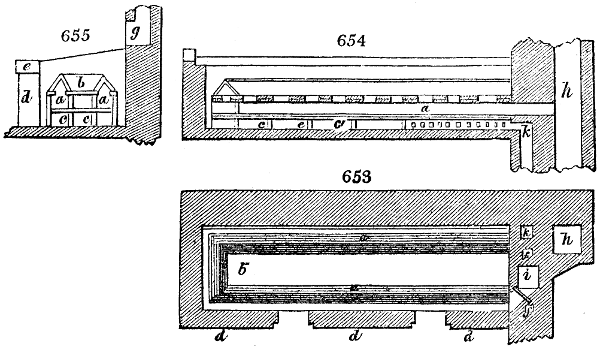
MALT KILN; (Darre, Germ.) The improved malt kiln of Pistorius is represented fig. 653. in a top view; fig. 654. in a longitudinal view and section; and fig. 655., in transverse section. a a, are two quadrangular smoke flues, constructed of fire-tiles, or fire-stones, and covered with iron plates, over which a pent-house roof is laid; the whole bound by the cross pieces b (figs. 654, 655.) These flues are built above a grating c c, which commences at c′; in front of c′ there is a bridge of bricks. Instead of such a brick flue covered with plates, iron pipes may be used, covered with semi-cylindrical tiles, to prevent the malt that may happen to fall from being burned. d d, are the breast walls of the kiln, 3 feet high, furnished with two apertures shut with iron doors, through which the malt that drops down may be removed from time to time. e is a beam of wood lying on the breast wall, against which the hurdles are laid down slantingly towards the back wall of the kiln; f f, are two vertical flues left in the substance of the walls, through which the hot air, discharged by open pipes laid in a subjacent furnace, rises into the space between the pent-house roof and the iron plates, and is thence allowed to issue through apertures in the sides. g is the discharge flue in the back wall of the kiln for the air now saturated with moisture; h is the smoke-pipe, from which the smoke passes into the anterior flue a, provided with a slide-plate, for modifying the draught; the smoke thence flows off through a flue fitted also with a damper-plate into the chimney i. k is the smoke-pipe of a subsidiary fire, in case no smoke should pass through h. The iron pipes are 11 inches in diameter, the air-flue f, 5 inches, and the smoke-pipe h, 10 inches square; the brick flues 10 inches wide, and the usual height of bricks.
MALTHA; Bitume Glutineux, or mineral pitch. It is a soft glutinous substance, with the smell of pitch. It dissolves in alcohol, but leaves a bituminous residuum; as also in naphtha, and oil of turpentine. It seems to be inspissated petroleum.
MANGANESE, (Eng. and Fr.; Mangan, Braunsteinmetal, Germ.) is a grayish-white metal, of a fine-grained fracture, very hard, very brittle, with considerable lustre, of spec. grav. 8·013, and requiring for fusion the extreme heat of 160° Wedgewood. It should be kept in closely stoppered bottles, under naphtha, like potassium, because with contact of air it speedily gets oxidized, and falls into powder. It decomposes water slowly at common temperatures, and rapidly at a red heat. Pure oxide of manganese can be reduced to the metallic state only in small quantities, by mixing it with lamp black and oil into a dough, and exposing the mixture to the intense heat of a smith’s forge, in a luted crucible; which must be shaken occasionally to favour the agglomeration of the particles into a button. Thus procured, it contains, however, a little carbon.
Manganese is susceptible of five degrees of oxigenation:—
1. The protoxide may be obtained from a solution of the sulphate by precipitation with carbonate of potash, and expelling the carbonic acid from the washed and dried carbonate, by calcination in a close vessel filled with hydrogen gas, taking care that no air have access during the cooling. It is a pale green powder, which slowly attracts oxygen from the air, and becomes brown; on which account it should be kept in glass tubes, containing hydrogen, and hermetically sealed. It consists of 77·57 metal and 22·43 oxygen. It forms with 24 per cent. of water a white hydrate; and with acids, saline compounds; which are white, pink, or amethyst coloured. They have a bitter, acerb taste, and afford with hydrogenated sulphuret of ammonia, a flesh-red precipitate, but with caustic alkalis, one which soon turns brown-red, and eventually black.
2. The deutoxide of manganese exists native in the mineral called Braunite; but it may be procured either by calcining, at a red heat, the proto-nitrate, or by spontaneous oxidizement of the protoxide in the air. It is black; when finely pulverized, dark brown, and is convertible, on being heated in acids, into protoxide, with disengagement of oxygen gas. It consists of 69·75 metal, and 30·25 oxygen. It forms with 10 per cent. of water, a liver-brown hydrate, which occurs native under the name of Manganite. It dissolves readily in tartaric and citric acids, but in few others. This oxide constitutes a bronze ground in calico-printing.
3. Peroxide of manganese; Braunstein, occurs abundantly in nature. It gives out oxygen freely when heated, and becomes an oxidulated deutoxide. It consists of 63·36 metal, and 36·64 oxygen.
4. Manganesic acid, forms green-coloured salts, but has not hitherto been insulated from the bases. It consists of 53·55 metal, and 46·45 oxygen.
5. Hypermanganesic acid, consists of 49·70 metal, and 50·30 oxygen.
Ores of manganese.—There are two principal ores of this metal which occur in great masses; the peroxide and the hydrated oxide; the first of which is frequently found in primitive formations.
1. Metalloide oxide of manganese; pyrolusite, or gray manganese ore; has a metallic lustre, a steel gray colour, and affords a black powder. Spec. grav. 4·85. Scratches calc-spar. It effervesces briskly with borax at the blow-pipe, in consequence of the disengagement of oxygen gas. This is the most common ore of manganese, and a very valuable one, being the substance mostly employed in the manufacture of chloride of lime and of flint-glass. It is the peroxide. Great quantities are found near Tavistock, in Devonshire, and Launceston, in Cornwall.
2. Braunite, is a dark brown substance, of a glassy metallic lustre, affording a brown powder. Spec. grav. 4·8. It scratches felspar; but is scratched by quartz. Infusible at the blow-pipe, and effervesces but slightly when fused with glass of borax. It is the deutoxide. It gives out at a red heat only 3 per cent. of oxygen.
3. Manganite, or hydroxide of manganese; is brownish-black or iron-black, powder brown, with somewhat of a metallic lustre. Spec. grav. 4·3. Scratches fluor spar; affords water by calcination in a glass tube; infusible at the blow-pipe; and effervesces slightly when fused with glass of borax. It consists of about 90 of deutoxide, and 10 of water.
4. Haussmanite, black braunstein; is brownish-black, affords a reddish-brown powder. Spec. grav. 4·7; scratches fluor spar; infusible at the blow-pipe; does not effervesce when fused with borax. It is a deutoxide. This is a rare mineral, and of no value to the arts.
5. Barytic oxide of manganese; fibrous wad. It is a combination of deutoxide and peroxide, with some baryta.
6. Manganese blende, or sulphuret of manganese; has a metallic aspect; is black, or dark steel gray; spec. grav. 3·95; has no cleavage; cannot be cut; infusible, but affords after being roasted distinct evidence of manganese, by giving a violet tinge to soda at the blow-pipe. Soluble in nitric acid; solution yields a white precipitate with the ferro-cyanide of potassium. It consists of sulphur 53·65; manganese 66·35.
7. Carbonate of manganese; dialogite. Spec. grav. 3·4; affords a green frit by fusion with carbonate of soda; is soluble with some effervescence in nitric acid; solution when freed from iron by succinate of ammonia, gives a white precipitate, with ferrocyanide of potassium. It consists of 28 carbonic acid, 56 protoxide of manganese, 5·4 of lime, 4·5 protoxide of iron, and 0·8 magnesia.
8. Hydrosilicate of manganese; is a black metallic looking substance, which yields a yellowish-brown powder, and water by calcination; is acted upon by muriatic acid, but affords no chlorine. It consists of silica 25; protoxide of manganese 60; water 13.
9. Ferriferous phosphate of manganese, is brown or black. Spec. grav. 3·6; scratches fluor; affords by calcination a very little of an acid water which corrodes glass; very fusible at the blow-pipe into a black metalloid magnetic bead; is acted upon by nitric acid: solution lets fall a blue precipitate with ferrocyanide of potassium; which tested by soda is shown to be manganese. It consists of phosphoric acid 32·78; protoxide of iron 31·90; protoxide of manganese 32·60; phosphate of lime 3·2. Another phosphate called hureaulite, contains 38 of phosphoric acid; 11·10 of protoxide of iron; 32·85 of protoxide of manganese, and 18 of water.
Black wad, is the old English name of the hydrated peroxide of manganese. It occurs in various imitative shapes, in froth-like coatings upon other minerals, as also massive. Some varieties possess imperfect metallic lustre. The external colour is brown of various shades, and similar in the streak, only shining. It is opaque, very sectile, soils and writes. Its specific gravity is about 3·7. Mixed with linseed oil into a dough, black wad forms a mass that spontaneously inflames. A variety from the Hartz, analyzed by Klaproth, afforded peroxide of manganese 68; oxide of iron 6·5; water 17·5; carbon 1; barytes and silica 9. The localities of black wad are particularly Cornwall and Devonshire, the Hartz, and Piedmont. I have analyzed many varieties of the black wad sold to the manufacturers of bleaching salt, and flint glass, and have found few of them so rich in peroxide of manganese as the above. Very generally they contained no less than 25 per cent. of oxide of iron, 8 or 9 of silica, about 7 of water, and the remainder amounting to only 60 per cent. of the peroxide.
M. Gay Lussac has proposed to determine the commercial value of manganese ore, by the quantity of chlorine which it affords when treated with liquid muriatic acid. He places the manganese powder in a small retort or matras, pours over it the acid, and the chlorine being disengaged with the aid of a gentle heat, is transmitted into a vessel containing milk of lime or potash water. This liquor is thereafter poured into a dilute solution of sulphate of indigo; and the quantity of chlorine is inferred from the quantity of the blue solution which is decoloured. I pass the chlorine into test solution of indigo.
The manufacturer of flint glass uses a small proportion of the black manganese ore, to correct the green tinge which his glass is apt to derive from the iron present in the sand he employs. To him it is of great consequence to get a native manganese containing as little iron oxide as possible; since in fact the colour or limpidity of his product will depend altogether upon that circumstance.
Sulphate of manganese has been of late years introduced into calico printing, to give a chocolate or bronze impression. It is easily formed by heating the black oxide, mixed with a little ground coal, with sulphuric acid. See Calico Printing.
The peroxide of manganese is used also in the formation of glass pastes, and in making the black enamel of pottery. See Oxalic Acid.
MANGLE. (Calandre, Fr.; Mangel, Germ.) This is a well known machine for smoothing table cloths, table napkins, as well as linen and cotton furniture. As usually made, it consists of an oblong rectangular wooden chest, filled with stones, which load it to the degree of pressure that it should exercise upon the two cylinders on which it rests, and which, by rolling backwards and forwards over the linen spread upon a polished table underneath, render it smooth and level. The moving wheel, being furnished with teeth upon both surfaces of its periphery, and having a notch cut out at one part, allows a pinion, uniformly driven in one direction, to act alternately upon its outside and inside, so as to cause the reciprocating motion of the chest. This elegant and much admired English invention, called the mangle-wheel, has been introduced with great advantage into the machinery of the textile manufactures.
Mr. Warcup, of Dartford, obtained a patent several years ago for a mangle, in which the linen, being rolled round a cylinder revolving in stationary bearings, is pressed downwards by heavy weights hung upon its axes, against a curved bed, made to slide to and fro, or traverse from right to left, and left to right, alternately.
Mr. Hubie, of York, patented in June, 1832, another form of mangle, consisting of three rollers, placed one above another in a vertical frame, the axle of the upper roller being pressed downwards by a powerful spring. The articles intended to be smoothed are introduced into the machine by passing them under the middle roller, which is made to revolve by means of a fly wheel; the pinion upon whose axis works in a large toothed wheel fixed to the shaft of the same roller. The linen, &c. is lapped as usual in protecting cloths. This machine is merely a small Calender.
MANIOC, is the Indian name of the nutritious matter of the shrub jatropha manihot, from which cassava and tapioca are made in the West Indies.
MANNA, is the concrete saccharine juice of the Fraxinus ornus, a tree much cultivated in Sicily and Calabria. It is now little used, and that only in medicine.
MARBLE. This title embraces such of the primitive, transition, and purer compact limestones of secondary formation, as may be quarried in solid blocks without fissures, and are susceptible of a fine polished surface. The finer the white, or more beautifully variegated the colours of the stone, the more valuable, ceteris paribus, is the marble. Its general characters are the following:—
Marble effervesces with acids; affords quicklime by calcination; has a conchoidal scaly fracture; is translucent only on the very edges; is easily scratched by the knife; has a spec. grav. of 2·7; admits of being sawn into slabs; and receives a brilliant polish. These qualities occur united in only three principal varieties of limestone; in the saccharoid limestone, so called from its fine granular texture resembling that of loaf sugar, and which constitutes modern statuary marble, like that of Carrara; 2. in the foliated limestone, consisting of a multitude of small facets formed of little plates applied to one another in every possible direction, constituting the antique statuary marble, like that of Paros; 3. in many of the transition and carboniferous, or encrinitic limestones, subordinate to the coal formation.
The saccharoid and lamellar, or statuary marbles, belong entirely to primitive and transition districts. The greater part of the close-grained coloured marbles belong also to the same geological localities; and become so rare in the secondary limestone formations, that immense tracts of these occur without a single bed sufficiently entire and compact to constitute a workable marble. The limestone lying between the calcareo-siliceous sands and gritstone of the under oolite, and which is called Forest marble in England, being susceptible of a tolerable polish, and variegated with imbedded shells, has sometimes been worked into ornamental slabs in Oxfordshire, where it occurs in the neighbourhood of Whichwood forest; but this case can hardly be considered as an exception to the general rule. To constitute a profitable marble-quarry, there must be a large extent of homogeneous limestone, and a facility of transporting the blocks after they are dug. On examining these natural advantages of the beds of Carrara marble, we may readily understand how the statuary marbles discovered in the Pyrenees, Savoy, Corsica, &c. have never been able to come into competition with it in the market. In fact, the two sides of the valley of Carrara may be regarded as mountains of statuary marble of the finest quality.
Gypseous alabaster may be readily distinguished from marbles, because it does not effervesce with acids, and is soft enough to be scratched by the nail; stalagmitic alabaster is somewhat harder than marble, translucent, and variegated with regular stripes or undulations.
Some granular marbles are flexible in thin slabs, or, at least, become so by being dried at the fire; which shews, as Dolomieu suspected, that this property arises from a diminution of the attractive force among the particles, by the loss of the moisture.
The various tints of ornamental marbles generally proceed from oxides of iron; but the blue and green tints are sometimes caused by minute particles of hornblende, as in the slate-blue variety called Turchino, and in some green marbles of Germany. The black marbles are coloured by charcoal, mixed occasionally with sulphur and bitumen; when they constitute stinkstone.
Brard divides marbles, according to their localities, into classes, each of which contains eight subdivisions:—
1. Uni-coloured marbles; including only the white and the black.
2. Variegated marbles; those with irregular spots or veins.
3. Madreporic marbles, presenting animal remains in the shape of white or gray spots, with regularly disposed dots and stars in the centre.
4. Shell marbles; with only a few shells interspersed in the calcareous base.
5. Lumachella marbles, entirely composed of shells.
6. Cipolin marbles, containing veins of greenish talc.
7. Breccia marbles, formed of a number of angular fragments of different marbles, united by a common cement.
8. Puddingstone marbles; a conglomerate of rounded pieces.
Antique marbles.—The most remarkable of these are the following:—Parian marble, called lychnites by the ancients, because its quarries were worked by lamps; it has a yellowish-white colour; and a texture composed of fine shining scales, lying in all directions. The celebrated Arundelian tables at Oxford consist of Parian marble, as well as the Medicean Venus. Pentelic marble, from Mount Penteles, near Athens, resembles the Parian, but is somewhat denser and finer grained, with occasional greenish zones, produced by greenish talc, whence it is called by the Italians Cipolino statuario. The Parthenon, Propyleum, the Hippodrome, and other principal monuments of Athens, were of Pentelic marble; of which fine specimens may be seen among the Elgin collection, in the British Museum. Marmo Greco, or Greek white marble, is of a very lively snow white colour, rather harder than the preceding, and susceptible of a very fine polish. It was obtained from several islands of the Archipelago, as Scio, Samos, Lesbos, &c. Translucent white marble, Marmo statuario of the Italians, is very much like the Parian, only not so opaque. Columns and altars of this marble exist in Venice, and several towns of Lombardy; but the quarries are quite unknown. Flexible white marble, of which five or six tables are preserved in the house of Prince Borghese, at Rome. The White marble of Luni, on the coast of Tuscany, was preferred by the Greek sculptors to both the Parian and Pentelic. White marble of Carrara, between Specia and Lucca, is of a fine white colour, but often traversed by gray veins, so that it is difficult to procure moderately large pieces free from them. It is not so apt to turn yellow as the Parian marble. This quarry was worked by the ancients, having been opened in the time of Julius Cæsar. Many antique statues remain of this marble. Its two principal quarries at the present day are those of Pianello and Polvazzo. In the centre of its blocks very limpid rock-crystals are sometimes found, which are called Carrara diamonds. As the finest qualities are becoming excessively rare, it has risen in price to about 3 guineas the cubic foot. The White marble of Mount Hymettus, in Greece, was not of a very pure white, but inclined a little to gray. The statue of Meleager, in the French Museum, is of this marble.
Black antique marble, the Nero antico of the Italians. This is more intensely black than any of our modern marbles; it is extremely scarce, occurring only in sculptured pieces. The red antique marble, Egyptum of the ancients, and Rosso antico of the Italians, is a beautiful marble of a deep blood-red colour, interspersed with white veins and with very minute white dots, as if strewed over with grains of sand. There is in the Grimani palace at Venice, a colossal statue of Marcus Agrippa in rosso antico, which was formerly preserved in the Pantheon at Rome. Green antique marble, verde antico, is a kind of breccia, whose paste is a mixture of talc and limestone, while the dark green fragments consist of serpentine. Very beautiful specimens of it are preserved at Parma. The best quality has a grass-green paste, with black spots of noble serpentine, but is never mingled with red spots. Red spotted green antique marble, has a dark green ground marked with small red and black spots, with fragments of entrochi changed into white marble. It is known only in small tablets. Leek marble; a rare variety of that colour, of which there is a table in the Mint at Paris. Marmo verde pagliocco is of a yellowish green colour, and is found only in the ruins of ancient Rome. Cervelas marble of a deep red, with numerous gray and white veins, is said to be found in Africa, and highly esteemed in commerce. Yellow antique marble, giallo antico of the Italians; colour of the yolk of an egg, either uniform or marked with black or deep yellow rings. It is rare, but may be replaced by Sienna marble. Red and white antique marbles, found only among the ruins of ancient Rome. Grand antique, a breccia marble, containing shells, consists of large fragments of a black marble, traversed by veins or lines of a shining white. There are four columns of it in the Museum at Paris. Antique Cipolino marble. Cipolin is a name given to all such marbles as have greenish zones produced by green talc; their fracture is granular and shining, and displays here and there plates of talc. Purple antique breccia marble, is very variable in the colour and size of its spots. Antique African breccia, has a black ground, variegated with large fragments of a grayish-white, deep red, or purplish wine colour; and is one of the most beautiful marbles. Rose-coloured antique breccia marble is very scarce, occurring only in small tablets. There are various other kinds of ancient breccias, which it would be tedious to particularize.
Modern marbles.—1. British. Black marble is found at Ashford, Matlock, and Monsaldale in Derbyshire; black and white in the north part of Devonshire; the variegated marbles of Devonshire are generally reddish, brownish, and grayish, variously veined with white and yellow, or the colours are often intimately blended; the marbles from Torbay and Babbacombe, display a great variety in the mixture of their colours; the Plymouth marble is either ash-coloured with black veins, or blackish-gray and white, shaded with black veins; the cliffs near Marychurch exhibit marble quarries not only of great extent, but of superior beauty to any other in Devonshire, being either of a dove-coloured ground with reddish-purple and yellow veins, or of a black ground mottled with purplish globules. The green marble of Anglesea is not unlike the verde antico; its colours being greenish-black, leek-green, and sometimes dull purplish, irregularly blended with white. The white part is limestone, the green shades proceed from serpentine and asbestos. There are several fine varieties of marble in Derbyshire; the mottled-gray in the neighbourhood of Moneyash, the light gray being rendered extremely beautiful by the number of purple veins which spread upon its polished surface in elegant irregular branches; but its chief ornament is the multitude of entrochi, with which this transition limestone-marble abounds. Much of the transition and carboniferous limestone of Wales and Westmoreland is capable of being worked up into agreeable dark marbles.
In Scotland, a particularly fine variety of white marble is found in immense beds, at Assynt in Sutherlandshire. A beautiful ash-gray marble of a very uniform grain, and susceptible of a fine polish, occurs on the north side of the ferry of Ballachulish in Invernesshire. One of the most beautiful varieties is that from the hill of Belephetrich in Tiree, one of the Hebrides. Its colours are pale blood-red, light flesh-red, and reddish-white, with dark green particles of hornblende, or rather sahlite, diffused through the general base. The compact marble of Iona is of a fine grain, a dull white colour, somewhat resembling pure compact felspar. It is said by Bournon, to consist of an intimate mixture of tremolite and carbonate of lime, sometimes with yellowish or greenish-yellow spots. The carboniferous limestone of many of the coal basins in the lowlands of Scotland may be worked into a tolerably good marble for chimney-pieces.
In Ireland, the Kilkenny marble is the one best known, having a black ground more or less varied with white marks produced by petrifactions. The spar which occupies the place of the shells, sometimes assumes a greenish-yellow colour. An exceedingly fine black marble has also been raised at Crayleath in the county of Down. At Louthlougher, in the county of Tipperary, a fine purple marble is found, which when polished looks very beautiful. The county of Kerry affords several variegated marbles, not unlike the Kilkenny.
France possesses a great many marble quarries which have been described by Brard, and of which a copious abstract is given under the article marble,—Rees’ Cyclopedia.
The territory of Genoa furnishes several beautiful varieties of marble, the most remarkable of which is the polzevera di Genoa, called in French the vert d’Egypte and vert de mer. It is a mixture of granular limestone with a talcose and serpentine substance disposed in veins; and it is sometimes mixed with a reddish body. This marble was formerly much employed in Italy, France, and England, for chimney-pieces, but its sombre appearance has put it out of fashion.
Corsica possesses a good statuary marble of a fine close grain, and pure milky whiteness, quarried at Ornofrio; it will bear comparison with that of Carrara; also a gray marble (bardiglio), a cipolin, and some other varieties. The island of Elba has immense quarries of a white marble with blackish-green veins.
Among the innumerable varieties of Italian marbles, the following deserve especial notice.
The rovigio, a white marble found at Padua; the white marble of St. Julien, at Pisa, of which the cathedral and celebrated slanting tower are built; the Biancone marble, white with a tinge of gray, quarried at Magurega for altars and tombs. Near Mergozza the white saline marble with gray veins is found, with which the cathedral of Milan is built. The black marble of Bergamo is called paragone, from its black colour, like touchstone; it has a pure intense tint, and is susceptible of a fine polish. The pure black marble of Como is also much esteemed. The polveroso of Pistoya, is a black marble sprinkled with dots; and the beautiful white marble with black spots, from the Lago Maggiore, has been employed for decorating the interior of many churches in the Milanese. The Margorre marble found in several parts of the Milanese, is bluish veined with brown, and composes part of the dome of the cathedral of Milan. The green marble of Florence owes its colour to a copious admixture of steatite. Another green marble, called verde di Prado, occurs in Tuscany, near the little town of Prado. It is marked with spots of a deeper green than the rest, passing even into blackish-blue. The beautiful Sienna marble, or brocatello di Siena, has a yellow colour like the yolk of an egg, which is disposed in large irregular spots, surrounded with veins of bluish-red, passing sometimes into purple. At Montarenti, two leagues from Sienna, another yellow marble is met with, which is traversed by black and purplish-black veins. The Brema marble is yellow with white spots. The mandelato of the Italians is a light red marble with yellowish-white spots, found at Luggezzana, in the Veronese. The red marble of Verona is of a red rather inclining to yellow or hyacinth; a second variety of a dark red, composes the vast amphitheatre of Verona. Another marble is found near Verona, with large white spots in a reddish and greenish paste. Very fine columns have been made of it. The occhio di pavone is an Italian shell marble, in which the shells form large orbicular spots, red, white, and bluish. A madreporic marble known under the name of pietra stellaria, much employed in Italy, is entirely composed of star madrepores, converted into a gray and white substance, and is susceptible of an excellent polish. The village of Bretonico, in the Veronese, furnishes a splendid breccia marble, composed of yellow, steel-gray, and rose-coloured spots. That of Bergamo consists of black and gray fragments in a greenish cement. Florence marble, called also ruin and landscape marble, is an indurated calcareous marl.
Sicily abounds in marbles, the most valuable of which is that called by the English stone-cutters, Sicilian jasper; it is red with large stripes like ribands, white, red, and sometimes green, which run zigzag with pretty acute angles.
Among the Genoese marbles we may notice the highly esteemed variety called portor, on account of the brilliant yellow veins in a deep black ground. The most beautiful kind comes from Porto-Venese, and Louis XIV. caused a great deal of it to be worked up for the decoration of Versailles. It costs now two pounds per cubic foot.
Of cutting and polishing marble.—The marble saw is a thin plate of soft iron, continually supplied during its sawing motion, with water and the sharpest sand. The sawing of moderate pieces is performed by hand, but that of large slabs is most economically done by a proper mill.
The first substance used in the polishing process is the sharpest sand, which must be worked with till the surface becomes perfectly flat. Then a second, and even a third sand of increasing fineness is to be applied. The next substance is emery of progressive degrees of fineness, after which tripoli is employed; and the last polish is given with tin-putty. The body with which the sand is rubbed upon the marble, is usually a plate of iron; but for the subsequent process, a plate of lead is used with fine sand and emery. The polishing rubbers are coarse linen cloths, or bagging, wedged tight into an iron planing tool. In every step of the operation, a constant trickling supply of water is required.
Visiters of Derby may have an opportunity of inspecting Brown’s extensive machinery for cutting marble into many ornamental forms, which has been well described in Rees’ Cyclopedia.
Sir James Jelf patented, in 1822, a combination of machinery for cutting any description of parallel mouldings upon marble slabs, for ornamental purposes; in which, tools, supplied with sand and water, are made to traverse to and fro.
Mr. Tullock obtained a patent, in 1824, for improvements in machinery for sawing and grooving marble; the power being applied by means of toothed wheels bearing cranks, which gave the see-saw motion to the cutting iron plates.
In November, 1829, Mr. Gibbs secured, by patent, an invention for working ornamental devices in marble, by means of a travelling drill, guided by a mould of wood, &c., in counter relief; and in April, 1833, Mr. G. W. Wilds obtained a patent for machinery, which consists of a series of circular cutters, for separating slabs from a block of marble; the block being advanced slowly to meet the cutters, by the progressive movement of a platform upon wheels, driven by the agency of a rack and pinion, as in the cylinder boring machine of the steam-engine manufacturer. Sand and water must be supplied, of course, from a hopper, to these smooth cutting discs of iron or copper. See Glass-Cutting. He proposes also to mould and polish marble, by applying a rotatory wheel or cylinder of any shape to it, in its carrying frame.
MARCASITE, is a variety of iron pyrites, containing generally a little arsenic.
MARGARATES, are saline compounds of margaric acid with the bases.
MARGARIC ACID, is one of the acid fats, produced by saponifying tallow with alkaline matter, and decomposing the soap with dilute acid. The term Margaric signifies Pearly-looking.
The physical properties of the margaric and stearic acids are very similar; the chief difference is that the former is more fusible, melting at 140° F. The readiest mode of obtaining pure margaric acid, is to dissolve olive oil soap in water, to pour into the solution, a solution of neutral acetate of lead, to wash and dry the precipitate, and then to remove its oleate of lead by ether, which does not affect its margarate of lead. The residuum being decomposed by boiling hot muriatic acid, affords margaric acid. When heated in a retort this acid boils. It is insoluble in water, very soluble in alcohol and ether; it reddens litmus paper, and decomposes with the aid of heat, the carbonates of soda and potash.
MARINE ACID. See Muriatic Acid.
MARINE SALT. See Salt.
MARL (Marne, Fr.; Mergel, Germ.), is a mixed earthy substance, consisting of carbonate of lime, clay, and siliceous sand, in very variable proportions; it is sometimes compact, sometimes pulverulent. According to the predominance of one or other of these three main ingredients, marls may be distributed into calcareous, clayey, and sandy. See Limestone.
MARQUETRY, is a peculiar kind of cabinet work, in which the surface of wood is ornamented with inlaid pieces of various colours and forms. The marqueteur puts gold, silver, copper, tortoise-shell, mother-of-pearl, ivory, horn, &c. under contribution. These substances being reduced to laminæ of proper thinness, are cut out into the desired forms by punches, which produce at once the full pattern or mould, and the empty one, which enclosed it; and both serve their separate purposes in marquetry. For the methods of dyeing the woods, &c. see Ivory.
MARTIAL, signifies belonging to iron; from Mars, the mythological name of this metal.
MASSICOT, is the yellow oxide of lead.
MASTIC (Eng. and Fr.; Mastix, Germ.), is a resin produced by making incisions in the Pistacia Lentiscus, a tree cultivated in the Levant, and chiefly in the island of Chios. It comes to us in yellow, brittle, transparent, rounded tears; which soften between the teeth; with bitterish taste and aromatic smell, and a specific gravity of 1·07. Mastic consists of two resins; one soluble in dilute alcohol; but both dissolve in strong alcohol. Its solution in spirit of wine constitutes a good varnish. It dissolves also in oil of turpentine. See Varnish.
MATRASS, is a bottle with a thin egg-shaped bottom, much used for digestions in chemical researches.
MATTE, is a crude black copper reduced, but not refined from sulphur and other heterogeneous substances.
MEADOW ORE, is conchoidal bog iron ore.
MEDALS. For their composition, see Bronze and Copper.
MEERSCHAUM (Germ.; sea-froth, Eng.; Ecume de Mer, Magnésie carbonatée silicifère, Fr.), is a white mineral, of a somewhat earthy appearance, always soft, but dry to the touch, and adhering to the tongue. Specific gravity, 2·6 to 3·4; affords water by calcination; fuses with difficulty at the blowpipe into a white enamel; and is acted upon by acids. It consists, according to Klaproth, of silica, 41·5; magnesia, 18·25; water and carbonic acid, 39. Other analysts give, silica 50, magnesia 25, water 25. It occurs in veins or kidney-shaped nodules, among rocks of serpentine, at Egribos, in the island of Negropont, Eski-Schehir in Anatolia, Brussa at the foot of Mount Olympus, at Baldissero in Piedmont, in the serpentine veins of Cornwall, &c.
When first dug up, it is soft, greasy, and lathers like soap; and is on that account used by the Tartars in washing their linen. The well-known Turkey tobacco-pipes are made from it, by a process analogous to that for making pottery ware. The bowls of the pipes, when imported into Germany, are prepared for sale by soaking them first in tallow, then in wax, and finally by polishing them with shave-grass.